This is a repository copy of Accelerating the Innovation Process: A Systematic Review and Realist Synthesis of the Research Literature.
White Rose Research Online URL for this paper: http://eprints.whiterose.ac.uk/98813/
Version: Accepted Version
Article:
Ellwood, P, Grimshaw, P and Pandza, K orcid.org/0000-0002-6807-1812 (2017)
Accelerating the Innovation Process: A Systematic Review and Realist Synthesis of the Research Literature. International Journal of Management Reviews, 19 (4). pp. 510-530. ISSN 1460-8545
https://doi.org/10.1111/ijmr.12108
© 2016 British Academy of Management and John Wiley & Sons Ltd. This is the peer reviewed version of the following article: Ellwood, P. , Grimshaw, P. and Pandza, K. (2017), Accelerating the Innovation Process: A Systematic Review and Realist Synthesis of the Research Literature. International Journal of Management Reviews, 19: 510-530.
doi:10.1111/ijmr.12108, which has been published in final form at https://doi.org/Ellwood, P. , Grimshaw, P. and Pandza, K. (2017), Accelerating the Innovation Process: A Systematic Review and Realist Synthesis of the Research Literature. International Journal of
Management Reviews, 19: 510-530. doi:10.1111/ijmr.12108. This article may be used for non-commercial purposes in accordance with Wiley Terms and Conditions for
Self-Archiving. Uploaded in accordance with the publisher's self-archiving policy.
[email protected] https://eprints.whiterose.ac.uk/
Reuse
Items deposited in White Rose Research Online are protected by copyright, with all rights reserved unless indicated otherwise. They may be downloaded and/or printed for private study, or other acts as permitted by national copyright laws. The publisher or other rights holders may allow further reproduction and re-use of the full text version. This is indicated by the licence information on the White Rose Research Online record for the item.
Takedown
If you consider content in White Rose Research Online to be in breach of UK law, please notify us by
Accelerating the innovation process
–
a systematic review
and realist synthesis of the research literature
Dr Paul Ellwood*
Senior Lecturer in Management,
University of Liverpool Management School, Chatham Street, Liverpool, L69 7ZH, 0151 795 3726,
Dr Paul Grimshaw Research Associate
Leeds University Business School, Maurice Keyworth Building, University of Leeds, Leeds, LS2 9JT,
0113 243 1751
Prof. Krsto Pandza
Professor of Strategy and Innovation
Leeds University Business School, Maurice Keyworth Building, University of Leeds, Leeds, LS2 9JT,
Abstract
There is a continued interest amongst academics, practitioners and policy makers in
methods to achieve accelerated innovation. Academic studies of this complex
phenomenon have succeeded in reaching a high degree of consensus on the
antecedents of innovation speed. Our aim in this review is to further elucidate the
mechanisms underlying management interventions to promote speed. The review
adopts a theory-led, realist synthesis of innovation speed research – the first example
of this methodology in management studies. We develop a new time-based
framework for categorizing the innovation speed literature. The framework has a
CIMO-logic, and is built by invoking the organisational studies literature on time
.
We contextualise the innovation speed literature in relation the three generic temporal
challenges faced by all organisations: reducing temporal uncertainty; resolving
temporal conflicts over activities; and allocating resources amidst conditions of
temporal scarcity. We problematize extant explanations of innovation speed as not
taking account of different temporal orientations (temporal dichotomies) within
innovation work, and thereby neglecting a potential barrier to achieving accelerated
innovation outcomes. We further draw upon the literature on time in organisations to
suggest new avenues of research, and methodological approaches new to the study of
innovation speed. The principal contribution of this review is to offer a new
conceptual perspective on the complex empirical research examining how innovation
projects may be accelerated from original idea to launch.
Keywords: Innovation speed, Accelerating innovation; temporal dichotomies;
Introduction
This paper presents a systematic review of research that has sought to identify how
innovation projects may be progressed more quickly from first idea to launch.
Studies of accelerated innovation have proved popular with academic researchers,
professional innovation managers and policy-makers. This topic emerged as an area
of significant research interest in the late 1980’s and early 1990’s with the burgeoning
focus on globalization and the increasing pressure of time based competition (Stalk,
1988; Starr, 1992). The subject remains a feature of contemporary business discourse
on globalization and competitive strategy (e.g. Williamson and Yin, 2014), as
increased innovation speed has been shown to be associated with new product success
as measured financially, or in terms of technical quality and customer value
(Cankurtaran et al., 2013). However, some authors have argued that an over-emphasis
on speed in innovation strategies can have negative trade-offs (Calantone and Di
Benedetto, 2000), hidden costs (Crawford, 1992) or risks fixating management
attention to the detriment of other factors (Lambert and Slater, 1999; Chen et al.,
2012; Kessler and Bierly, 2002; Smith, 1999).
The challenge of innovation speed has been framed in a number of ways: reducing
new product development cycle times (Griffin, 1993; 1997) and conversely increasing
rates of product obsolescence; delivery of innovative products to market quickly
(Jones, 2003) and the benefits of strategies such as ‘first-mover’ to provide ‘lock-in’
advantages (Lieberman and Montgomery, 1988; Dumaine, 1989); or fast responding,
cost saving, ‘second-to-market’ strategies (Emmanuelides, 1991). Empirical research
has sought to identify the antecedents of innovation speed predominantly in the
acceleration techniques that are suggested may speed an idea to launch. The resulting
literature spans a range of industries, firm sizes, technologies and geography. In
undertaking this review we sought an explanation of the mechanism of speed amidst
such a diversity of innovation projects. We followed a systematic review process
(Denyer and Tranfield, 2009) in order to: provide a transparent account of our
method; be able to include relevant data regardless of the types of research design
used in original papers; and be able to develop explanations for how different
acceleration techniques actually worked. The overarching question that motivates this
literature review is: what management interventions have been employed to accelerate
innovation projects and reduce the time taken to progress from ‘idea’ to ‘launch’?
Existing literature reviews on this subject, although very informative in identifying
numerous antecedents and contingencies, are limited in articulating underlying
mechanisms that explain how interventions increase innovation speed. In response
we propose a new framing of innovation speed by examining the way in which time
(rather than explicitly speed) has been studied within organisations. We argue that
speeding innovations requires both the efficient and effective use of time. This in turn
requires a richer perspective on the way time is experienced in organisations
(Bluehorn and Denhardt, 1988; Clark, 1985) than has been evident in the existing
literature reviews of innovation speed. We invoke such ideas about how time is
experienced in order to build a framework to guide or systematic review based on a
“CIMO” architecture (Denyer and Tranfield, 2009). The findings concerning
management interventions for speed are then presented in terms of temporal
categories (rather than more conventional categories such as technology, sector or
hitherto developed within this literature: a slowing of innovation work as a result of
different temporal orientations (or temporal dichotomies) being held by innovation
actors. The discussion section examines the implications of the findings for our
conceptual understanding of the mechanisms by which speed is realised in innovation
work. We conclude by identifying areas for future academic research and
implications of our ideas for innovation practitioners. Our motivation in this whole
endeavor is to extend the terms on which innovation speed is understood and
researched.
Previous Literature Reviews of Innovation Speed
There have been a number of literature reviews examining the concept and practices
of innovation speed (Zirger and Hartley, 1994; Brown and Eisenhardt, 1995; Kessler
and Chakrabarti, 1996; Chen et al., 2010; Cankurtaran et al., 2013). A sixth literature
review (Menon et al., 2002) is not as well developed as the others, uncovers no
additional insights and fails to reference any of the earlier reviews, and is therefore
not examined here in any detail. The contribution of each of the five major reviews is
examined briefly in this section.
The “acceleration techniques” (Zirger and Hartley, 1994), organisational “factors”
(Brown and Eisenhardt, 1995; Kessler and Chakrabarti, 1996) and “antecedents”
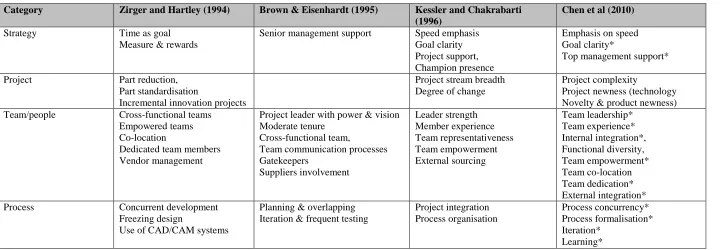
(Chen et al., 2010) from previous reviews are summarised in Table 1. They are
further categorised using labels similar to those that are used in the reviews
themselves: “Strategy”; “Project”; “Team/people”; and “Process”. The Table
illustrates a similarity in thinking and approach evident in the existing reviews. We
dominance of an approach taken toward innovation speed that is akin to that of
efficient project management techniques. The innovation journey between original
idea to launch of product is conceptualised as entailing the execution of a series of
tasks. Faster innovation journey times are then achieved by a judicious combination
of: a) shrinking the time taken to complete a task; b) running tasks concurrently; c)
avoiding waiting time between tasks and d)avoiding the repetition of tasks. From
this perspective innovation projects are treated as being no different from any other
project. Indeed Kessler and Chakrabarti acknowledge that their propositions advocate
a similar approach to that when improving the efficiency of manufacturing processes
(Kessler and Chakrabarti, 1996: 1181). Time within innovation projects thus
becomes a simple resource, and the achievement of accelerated innovation becomes a
matter of using that resource efficiently. Our contention is that the complexity
inherent to the organisation of innovation projects (Phillips, 2014; Crossan and
Apaydin, 2010) makes this project management orientation in extant reviews
conceptually limited. Innovation projects cannot simply be compared to well-defined
manufacturing process where the detail of each individual task is known in advance.
The wider innovation literature has acknowledged that innovation processes are
complex (Dougherty and Dunne, 2011; Andriani and Carignani, 2014) and non-linear
(Van de Ven et al., 1999; Meyer et al., 2005), and it is therefore intriguing that when
speed of such processes is concerned scholars very often assume that effective time
and project management techniques are sufficient solutions. Our response in this
paper is to introduce a wider range of perspectives on time in relation to debates about
Secondly, many of the techniques/factors/antecedents listed in Table 1 are not, of
themselves uniquely concerned with speed. For example, project leadership might
manifest itself in a number of ways completely unconnected with speed (e.g. in
relation to project cost or quality). Indeed, taken out of context then a list of factors
(cf Table 1) comprising leadership, top management support, clear goals,
cross-functional teams composed of experienced people, working to a well-designed
process, might be important for practically any management challenge. Furthermore,
these acceleration techniques do not, of themselves, explain the response to changes
in speed-related priorities during the course of projects. The issue for any conceptual
model of innovation speed is to explain how elements such as project leadership
operate in order to generate accelerated innovation outcomes. In this paper we seek to
elucidate the mechanisms that explain how the elements listed in Table 1 succeed in
engendering innovation speed. The need to explain the acceleration mechanisms was
part of the aims of the review of Zirger and Hartley (1994). We extend their
explanation by examining the speed-related implications of a wider range of temporal
perspectives for the organisation of innovation.
The third limitation we seek to redress is the exclusion of qualitative studies in the
most extensive reviews of innovation speed (Kessler and Chakrabarti, 1996; Chen et
al., 2010; Cankurtaran et al., 2013). Notwithstanding the significance of the
contributions of these studies to our understanding of innovation speed, their
advocacy or exclusive use of quantitative research, necessarily excludes studies based
upon qualitative data. The best of the latter involve rich accounts of innovation
practice and offer potential insights into the way in which (otherwise) generic factors
In the next main sections we address these limitations in the existing reviews by
proposing a new approach to theorisation of innovation speed in organisations: one
that considers a wider range of temporal perspectives on innovation, and integrates a
wider range of methodological approaches. In this we hope to build on the
achievements of the extant reviews, whilst also widening the terms of scholarship on
accelerated innovation. The model of innovation speed we develop is then used as a
Table 1 – Summary of the antecedent/factors/techniques identified in extant reviews that enable accelerated innovation
Category Zirger and Hartley (1994) Brown & Eisenhardt (1995) Kessler and Chakrabarti
(1996)
Chen et al (2010)
Strategy Time as goal
Measure & rewards
Senior management support Speed emphasis Goal clarity Project support, Champion presence
Emphasis on speed Goal clarity*
Top management support*
Project Part reduction,
Part standardisation
Incremental innovation projects
Project stream breadth Degree of change
Project complexity
Project newness (technology Novelty & product newness) Team/people Cross-functional teams
Empowered teams Co-location
Dedicated team members Vendor management
Project leader with power & vision Moderate tenure
Cross-functional team,
Team communication processes Gatekeepers Suppliers involvement Leader strength Member experience Team representativeness Team empowerment External sourcing Team leadership* Team experience* Internal integration*, Functional diversity, Team empowerment* Team co-location Team dedication* External integration* Process Concurrent development
Freezing design
Use of CAD/CAM systems
Planning & overlapping Iteration & frequent testing
Towards a New Conceptual Model of Innovation Speed
The review approach taken in this paper is that proposed by Denyer and Tranfield
(2009) in their adaptation for management studies of the principles of systematic
review that pertain for evidence-based medicine. Specifically we adopt a theory-led
approach to the review method that draws on the ideas of realist evaluation associated
with Ray Pawson (e.g., 2006; 2013). In developing a realist method of evidence
evaluation (e.g. in the production of a systematic review), Pawson argues that “to
infer a causal outcome between two events one needs to understand the underlying
mechanism that connects them to a context” (Pawson et al., 2005: 21). He developed
these ideas in relation to evaluating the effectiveness of programmes entailing
interventions designed to improve some aspect of health. The approach involves
articulating a theory that is inherent to the programme’s design that relates the
interventions made to the desired health outcomes. Evidence is then sought (e.g. from
published research papers) that clarifies and refines the theory (Pawson, 2002). This
method is not simply a matter of identifying “what works?” but rather seeks to
understand “what is it about this programme that works for whom and in what
circumstances” (Pawson et al., 2005: 22). It has been argued that this approach is
particularly suited to complex social situations in which more than one mechanism
may be operating (Pawson et al., 2005; Rogers, 2008). Denyer et al. have suggested
(2008) that such complexity is found in managerial and organisational studies as well
as the healthcare settings with which Pawson’s work is concerned.
The structure of our working theory is articulated in terms of a “CIMO logic” (Denyer
contexts (C), by using particular management intervention (I) it is possible to enable
generative mechanism (M), to achieve outcome (O). The extant literature reviews in
innovation speed have largely sought to establish the relationship between accelerated
outcomes with a series of management interventions (cf. Table 1). Following Denyer
and Tranfield our theory does not seek “generalization…in terms of the association
between variables but in terms of the role and impact of generative mechanisms that
play out in diffuse ways over time” (2009: 681). Therefore, this approach is not
limited to the synthesis of quantitative data, and allows us to integrate good studies
adopting a variety of methodologies.
Temporal dichotomies – different perceptions of time in organisations
Our approach to conceptualizing innovation speed starts by examining the way in
which time (rather than explicitly speed) has been studied within organisations. To
progress an innovation project more quickly is to complete its associated tasks with a
more efficient and effective use of time. As we will elaborate in this section, different
organisational actors may perceive the passage of time within organisations
differently. Therefore, if innovation speed concerns the accomplishment of tasks
within a shorter period of time, it becomes important to take account of different
perceptions of time. In this manner we widen the terms of the innovation speed
literature by drawing upon a wider literature studying time in organisations.
One major recurrent theme in writing in this area concerns the different ways in
which time is understood within organisations; in particular whether it is an objective
or a subjective phenomenon. Clark characterized the objective view as being time
linearity carries a mechanical connotation that means organizing is seen as a
succession of tasks that may be measured in quantitative terms. For this reason, the
clock has become the dominant metaphor in this step-wise conception of time. The
contrasting view sees time as subjective, and a socially constructed product of the
values, customs and practices of organisational actors. In this view time is “defined
by organisational members” (Clark, 1985: 36), and in doing so it becomes a more
organic and contextual construct. In contrast to the clock-time of the objective
perspective, this subjective perspective is often presented as event-time (Jacques,
1982).
The clock-time/event-time opposition is not the only contrasting temporal perspective
evident within the organisational studies literature that has a bearing on issues of
innovation speed. A second temporal distinction concerns that between the pacing of
events driven by circumstances internal to the organisation and the pacing that
pertains in its external environment (Brown and Eisenhardt, 1997). The very rhetoric
of the contemporary imperative for speed (e.g. Stalk, 1988) provides the impetus for
organisations to out-pace and stay ahead of their competitors. The alternative
perspective argues that organisations cannot effectively set the pace of progress
independent of the rhythms that pertain in their external organisation (Ancona and
Chong, 1996). The time and organisations literature has included a strong thread of
research related to the concept of entrainment (Bluehorn and Denhardt, 1988; Ancona
and Chong, 1996). The concept is borrowed from natural science where it is used to
explain the connection between an organism’s internal and external biological cycles.
In a social science setting it is “a process that integrates temporally differentiated
of innovation speed, the implication is that the rhythm of markets (external pacing) is
something to which an organisation’s innovation efforts (internal pacing) should
align, rather than simply out-pace.
A third temporal distinction in organisational studies is that between linear and cyclic
time. Cunha (2004) characterises firms adopting a linear orientation as preferring to
create their own future rather than simply relying on past experiences to guide their
decisions. By contrast cyclical notions of time draw attention to patterns of
reoccurrence in organisational life. Such notions are related to event-based time
discussed earlier, but foreground the characteristic of the cyclical nature of such
events. Cunha (2004) argues that firms adopted a cyclical orientation toward time are
those that believe the past is a sure guide for action in the future. It is important to
note that a linear temporal orientation does not simply relate to a view of innovation
as proceed through orderly steps (i.e. it does not relate to linear innovation processes).
The three temporal dichotomies outlined here (clock/event, internal/external, and
linear/cyclic) are themselves interrelated, but each dichotomy has specific temporal
resonances, and draws attention to a particular temporal challenge faced by
organisations. In the case of innovation projects these temporal challenges might be
expressed in the following terms:
Clock vs Event challenges: should the time allowed for innovation tasks be set
to a defined timetable, or be defined by innovation actors following their
Internal vs External challenges: should the pacing of projects align with
related processes internal to the firm, or with the rhythms of external forces
(markets, customers and competitors)?
Linear vs Cyclical challenges: should past experiences guide decisions on
what innovation task to do next, or should new possibilities be pursued?
The speed with which an innovation project is progressed from idea to launch will
depend on the resolutions adopted to each of these questions. It seems unlikely that
there could be a single answer to each question. The dynamic and creative nature of
innovation projects might be expected to yield different approaches at different stages
during the project (Eling et al., 2013). Furthermore, we suggest that tensions caused
by innovation actors holding different temporal orientations are a source of slowness
in innovation work that has not been addressed in this literature. In its reliance on
quantitative studies of antecedents, the extant literature reviews on innovation speed
privilege an objective notion of time. The extant reviews’ advocacy of quantitative
studies and rejection of qualitative studies reinforce an objective temporal orientation.
Our brief introduction to different perspectives of time within organisational life
suggests a more nuanced approach may be needed to fully conceptualise innovation
speed. The organisation of innovation tasks in order to achieve accelerated outcomes
requires some, or all, of these temporal challenges to be overcome. In developing our
working theory of innovation speed the next sub-section explains the nature of these
temporal challenges, and the requirements of a managerial intervention that seeks to
Temporal challenges for organising
In an examination of how time has been portrayed within organisations Hassard
argues that there are three time-related problems that all organisations must resolve
(1996). The first temporal challenge for organisations noted by Hassard is the
problem of “temporal uncertainty” (1996: 338). By this he means that organisations
need to understand and attempt to manage the consequence of operational
uncertainties for the timing of activities. In the context of the innovation speed
literature such uncertainties would include those of technological developments (Song
and Montoya-Weiss, 2001) and environmental uncertainty (Milliken, 1987). Hassard
explains that solving this temporal challenge creates a need for “time schedules”, i.e.
“for reliable predictions of the points at which specific actions will occur” (Hassard,
1996: 338). Cunha (2004) views this challenge as being related to the dichotomy of
clock-time/event-time, and different strategies for addressing this problem can imply
different temporal conceptions for organizing work. One response is to set
calendar-based new product launch deadlines (Brown and Eisenhardt, 1997) in order to try to
shape the competitive environment. Alternatively having a more heterogeneous sense
of time (i.e. event-time) might provide organisations with a greater variety of
“chronological repertoires” (Clark, 1985: 137) with which to respond to a turbulent
environment. We argue that in responding to the temporal challenge of uncertainty
(Hassard, 1996), a conceptual model is needed of innovation speed that explains the
pursuit of both clock-time and event-time strategies, and the choices organisations
make between them.
Hassard’s second challenge concerns the resolution of conflicts over temporal
coordination among functionally segmented parts and activities” (Hassard, 1996:
338). This coordination is not simply between different individuals and tasks, but also
concerns the alignment of the pace of different processes. Cunha (2004) argues that
this challenge can be understood in relation to the temporal opposition between
internal time/external time. Solving the synchronisation challenge is a matter of
aligning the rhythms of two organizationally-distinct activities or processes. Other
temporal studies of organisations have argued that simply ‘going faster’ within a focal
firm may ultimately proved futile, if that organisation’s pace is not aligned with the
rhythm of its external environment (Ancona and Chong, 1996). In addressing the
temporal challenge of conflict over activities, we argue that a conceptual model of
innovation speed should explain how organisations synchronise internal and external
rhythms that set the pace for innovation.
Hassard’s third temporal challenge concerns the scarcity of time (i.e. a given segment
of time cannot be consumed or experienced twice or more), and the importance for
optimally allocating resources to activities to ensure that they “will consume it [time]
in the most efficient and rational way” (Hassard, 1996: 338). The organisational
challenge is one of deciding what is the most valuable activity to be doing at any
given point in time. Cunha (2004) expresses this choice in terms of the dichotomy
between linear and cyclic time, and the way in which organisations approach the
planning of projects. He argues (2004) that the linear-progression view is suggestive
of organisations that believe that their environment is in such a state of constant
change that they cannot rely on past experiences to guide future actions. By contrast
organisations adopting a cyclical-time orientation maintain that previous experience
innovating organisations adopt a position between these two extremes. Solving the
temporal challenge of allocation thus becomes one of deciding how to make use of
learning from experience whilst remaining flexible enough to try new organisational
practices.
Development of research questions to guide the literature review
We now draw together the threads of this discussion to construct our ‘working theory’
or framework to guide our literature review. Our approach has been to understand the
temporal challenges faced by organisations for these issues must, in part or in whole,
be solved if innovations are to progress speedily from idea to launch. Therefore, we
posit that the three temporal problems elaborated in this subsection constitute a
generalisable class of contexts (C) to which specific contexts of innovation speed may
be resolved. In other words categorizing innovation speed studies in terms of the
temporal challenges allows us to focus on the speed-related challenge within those
studies rather than possible generic contexts related to innovation (e.g. technologies,
markets or sectors). In our reading of the literature on innovation speed we evaluated
which of these three generalisable contexts or temporal challenges (one, two or all
three) each reviewed paper was concerned.
In seeking the interventions (I) to solve these temporal challenges, we started by
considering the acceleration techniques of the type summarised in Table 1. However,
our reading of the literature sought to go beneath these labels and identify the actual
organisational activities that constitute them. Our aim was not to confirm (for
been established in the extant reviews), but to determine what leaders do to contribute
to accelerate project outcomes.
Our approach has two requirements for any explanation of the mechanism (M) of
innovation speed: (i) to explain how any individual intervention operates in order to
accelerate innovation; and (ii) to explain how temporal dichotomies are resolved
without an adverse impact on speed. We drew on the writing of Hassard (1996) to
specify the type of solution for each temporal challenge, and we drew on Cunha
(2004) to identify the temporal dichotomy associated with each challenge. Our
“working theory” is thus expressed in terms of three generalisable contexts:
Contexts of temporal uncertainty relate to the timing of innovation activities
for the realization of accelerated outcomes. Within this context, we posit that
speed is realised by scheduling interventions that: (i) ensure the most efficient
and effective time for a specific innovation activity; and (ii) avoid delays
caused by differences in temporal orientation (clock vs event).
Contexts of temporal conflict relate to aligning the pace of different
innovation activities for the realization of accelerated outcomes. Within this
context, we posit that speed is realised by synchronisation interventions that:
(i) ensure the most efficient and effective alignment of interactions between
innovation actors and processes; and (ii) avoiding delays caused by a
misalignment of internal and external pacing of innovation.
Contexts of temporal scarcity relate to identifying the most valuable
innovation activities to be conducting at any point for the realization of
resource allocation interventions that: (i) identify the most valuable tasks to
conduct at any point in time; and (ii) being able to integrate past experiences
with future possibilities.
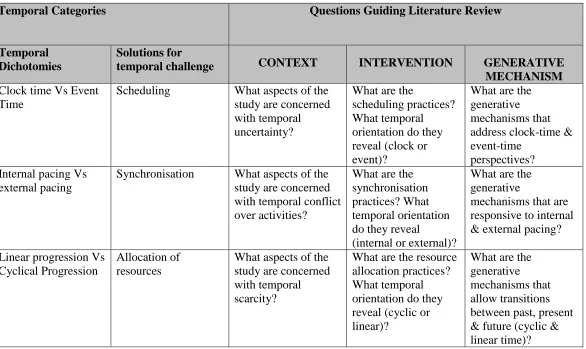
These ideas (categories) are summarised in Table 2 in terms of temporal categories
Table 2 – Framework to guide synthesis of literature.
Temporal Categories Questions Guiding Literature Review
Temporal Challenge Temporal Dichotomies
Solutions for
temporal challenge CONTEXT INTERVENTION GENERATIVE MECHANISM
Reducing temporal uncertainty
Clock time Vs Event Time
Scheduling What aspects of the
study are concerned with temporal uncertainty?
What are the
scheduling practices? What temporal orientation do they reveal (clock or event)?
What are the generative mechanisms that address clock-time & event-time
perspectives? Reducing temporal
conflict
Internal pacing Vs external pacing
Synchronisation What aspects of the
study are concerned with temporal conflict over activities?
What are the synchronisation practices? What temporal orientation do they reveal
(internal or external)?
What are the generative
mechanisms that are responsive to internal & external pacing?
Allocating resources amidst temporal scarcity
Linear progression Vs Cyclical Progression
Allocation of resources
What aspects of the study are concerned with temporal scarcity?
What are the resource allocation practices? What temporal orientation do they reveal (cyclic or linear)?
Methodology
In this paper we adopt a theory-led approach to the synthesis of the literature. In this
we have been guided by the realist philosophy of systematic review (Pawson et al.,
2005), as it has been developed for management and organisation studies by Denyer
and Tranfeld (2009). These authors identified four principles for systematic review
that we have tried to follow: transparency; explanatory; inclusivity; and heuristic.
This review is transparent to the extent that we followed (and describe here) a
defined methodology, and that we present (available as supplementary material) a
summary of our (coding) analysis of the literature. Our principle aim in this review is
to provide an explanation of innovation speed in temporal terms that are new to this
literature. Our selection of literature is inclusive of studies using both quantitative
and qualitative research methodologies. The output of this review is heuristic in the
sense of providing a guide to inform practitioners on the selection of managerial
interventions for speed.
The systematic review/realist synthesis method developed by Denyer et al. (2008)
proceeds through three main stages:
1. The creation of an initial theory or framework for understanding the area of
study. The conceptualization of innovation speed developed in the first half of
the paper constitutes the framework (summarised in Table 2) that has guided
our synthesis of the literature.
2. Conducting a literature search (Tranfield et al., 2003) and selecting articles
the initial theory.
3. The initial framework is developed in light of our reading of selected papers.
In research terms, such a realist synthesis does not attempt to show the
universal effect of a particular innovation speed intervention, but through an
iterative process of reading and comparison with the initial framework, unveil
the generative mechanisms.
At the outset of this review we convened a panel comprising senior business school
academics in order to critique the progress of the work. Academics were selected
with (a) an interest and background in innovation research, and (b) a track record of
designing and publishing literature reviews in management journals. In consultation
with the review panel we identified the relevant business and management
bibliographic databases, database domains/topics/subjects and search keywords. The
following search strings, designed to capture relevant papers:
(1) innov* AND (fast OR speed OR time OR accelerat*)
(2) innov* AND (disrupt* OR rapid OR stage-gate OR portfolio OR radical OR
phase)
(3) (NPD OR new product) AND (fast OR speed OR time OR accelerat*)
(4) (NPD OR new product) AND (disrupt* OR rapid OR stage-gate OR portfolio OR
We applied the search strategy to the chosen bibliographic databases of: Web of
Science, EBSCO, Science Direct and ABI Global. The date range for returned papers
was restricted to the years 1990-2015 to reflect the emergence of the interest in
innovation speed in general (Blackburn, 1991; Starr, 1992). This initial search
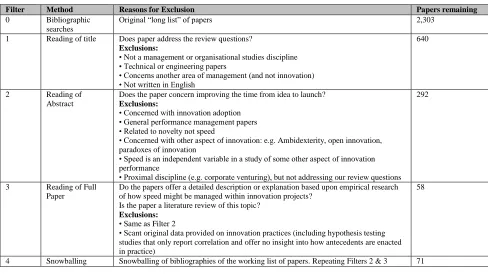
strategy generated a long list of 2,303 papers. The selection of studies for the next
phase was undertaken by subjecting each paper to a series of criteria, with reasons for
inclusion and exclusion being noted (we use the word ‘filter’ to label these different
rounds of exclusion).
Having removed duplicates from the list, all titles were read to confirm they were in
our broad area of interest (Filter 1). This allowed many papers to be dropped largely
because they related to non-management topics (e.g. they were engineering papers).
The abstracts of remaining 640 papers were read and those discarded that did not deal
with decreasing the project time from idea-to-launch (Filter 2): leaving 292 papers.
The next stage (Filter 3) involved a reading of the full paper to identify those that not
only reported empirical research, but also offered detailed descriptions or
explanations of managerial interventions for innovation speed (giving a total of 58
papers). The papers selected included findings (or discussion of findings) that
described or explained managerial interventions for speed. We found such
information on interventions in quantitative studies that included some element of
qualitative data, or in purely quantitative studies that involved fine-grained constructs.
Good qualitative research was amongst the studies selected; with the papers rejected
often being purely anecdotal accounts of practice, rather than ones resulting from
scientific study. To further clarify this selection criterion, consider the commonly
test the hypothesis that using cross-functional teams leads to accelerated innovation
outcomes. Notwithstanding the importance of this finding, not all of these papers
elaborated upon establishing a positive correlation, by including details of what the
cross-functional teams within their study had actually done (i.e. the interventions of
cross-functional teams). Such studies show that having a cross-functional team was
better (for speed) than not having one. We removed such studies from our review
which rather sought detailed information on interventions, and the insights they offer
on mechanisms to progress innovation more quickly.
Reading the selected 58 papers made evident the limitations of the initial
bibliographic search strings (cf. Pittaway et al., 2004: 139). Hence a final phase of
snowballing (Filter 4) was included, and examining the bibliographies of the full
papers identified additional papers. These snowball returns were then checked by
repeating Filters 2 & 3 to create a final total 71 papers to be included in the next stage
of the review. This total was composed of 65 original papers and 6 literature reviews
(discussed above). A summary of this selection method and associated exclusion
criteria is presented in Table 3. A detailed summary of the 65 selected original
papers, and the findings that we extracted from them are provided as supplementary
Table 3 – Summary of criteria for selection of studies for review
Filter Method Reasons for Exclusion Papers remaining 0 Bibliographic
searches
Original “long list” of papers 2,303
1 Reading of title Does paper address the review questions? Exclusions:
• Not a management or organisational studies discipline
• Technical or engineering papers
• Concerns another area of management (and not innovation)
• Not written in English
640
2 Reading of
Abstract
Does the paper concern improving the time from idea to launch? Exclusions:
• Concerned with innovation adoption • General performance management papers • Related to novelty not speed
• Concerned with other aspect of innovation: e.g. Ambidexterity, open innovation, paradoxes of innovation
• Speed is an independent variable in a study of some other aspect of innovation performance
• Proximal discipline (e.g. corporate venturing), but not addressing our review questions 292
3 Reading of Full Paper
Do the papers offer a detailed description or explanation based upon empirical research of how speed might be managed within innovation projects?
Is the paper a literature review of this topic? Exclusions:
• Same as Filter 2
• Scant original data provided on innovation practices (including hypothesis testing studies that only report correlation and offer no insight into how antecedents are enacted in practice)
58
4 Snowballing Snowballing of bibliographies of the working list of papers. Repeating Filters 2 & 3 71
Management interventions and generative mechanisms for
innovation speed
This section describes our reading of the innovation speed literature in the terms set
out in the framework in Table 2. The explanations of the generative mechanisms
underpinning managerial interventions for innovation speed are structured in relation
to the three “temporal challenges”, and their associated “temporal dichotomies” and
“solutions for temporal challenge” (Table 2). A detailed summary of our coding of
each individual paper to particular temporal categories is available as supplementary
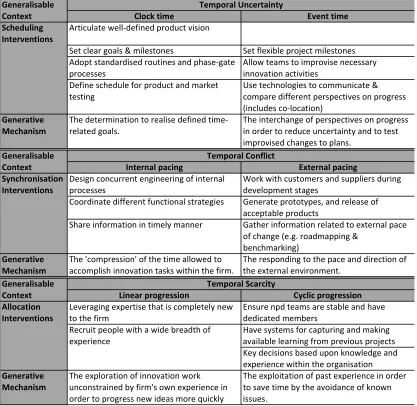
material. An overview of the interventions and mechanisms we identified associated
Table 4 – Summary of interventions and generative mechanisms by temporal category
Innovation Speed in contexts of temporal uncertainty
Contexts of temporal uncertainty draw attention to be importance of the timing of
innovation activities for the realization of accelerated outcomes. Following the
terminology of Hassard (1996: 338) we identified “scheduling” interventions; that is
organisational activity related to the timing of specific actions. Furthermore, we
categorised such interventions in terms of whether they suggested a “clock-based” or
“event-based” temporal orientation. Within this context, we posit that speed is
realised by: (1) the determination of the most efficient and effective time for a
Clock time Event time Scheduling
Interventions
Articulate well-defined product vision
Set clear goals & milestones Set flexible project milestones
Adopt standardised routines and phase-gate processes
Allow teams to improvise necessary innovation activities
Define schedule for product and market testing
Use technologies to communicate & compare different perspectives on progress (includes co-location)
Generative Mechanism
The determination to realise defined time-related goals.
The interchange of perspectives on progress in order to reduce uncertainty and to test improvised changes to plans.
Internal pacing External pacing Synchronisation
Interventions
Design concurrent engineering of internal processes
Work with customers and suppliers during development stages
Coordinate different functional strategies Generate prototypes, and release of acceptable products
Share information in timely manner Gather information related to external pace
of change (e.g. roadmapping & benchmarking)
Generative Mechanism
The 'compression' of the time allowed to accomplish innovation tasks within the firm.
The responding to the pace and direction of the external environment.
Linear progression Cyclic progression Allocation
Interventions
Leveraging expertise that is completely new to the firm
Ensure npd teams are stable and have dedicated members
Recruit people with a wide breadth of experience
Have systems for capturing and making available learning from previous projects Key decisions based upon knowledge and experience within the organisation
Generative Mechanism
The exploration of innovation work unconstrained by firm's own experience in order to progress new ideas more quickly
specific innovation activity; and (2) avoiding delays caused by differences in temporal
orientation (clock vs event).
Not surprisingly we encountered a number of studies that advocated clear clock-based
management interventions. These approaches may start with a clear definition of the
innovative product concept (Kessler and Chakrabarti, 1999; Minderhoud and Fraser,
2005; Tessarolo, 2007). Such well-defined end-points are then broken down into
clear goals and milestones that are then used to drive the speed of projects (Swink,
2003; Allocca and Kessler, 2006; LaBahn et al., 1996). Some studies argued that this
is important from the very outset of projects (Filippini et al., 2004; Kach et al., 2012).
An important theme for such milestones was a schedule for the regular testing of
products or prototypes with customers (Bers et al., 2009; Cooper and Kleinschmidt,
1994; Eisenhardt and Tabrizi, 1995; Minderhoud and Fraser, 2005). The setting of
goals was suggested by some authors as something that should involve senior
management (Carbonell and Rodriguez-Escudero, 2009), though once project goals
were agreed further “tinkering” from top management should be avoided (Lynn et al.,
1999; Mabert et al., 1992). Indeed Dougherty et al. (2013) went so far as to suggest
that clock-time pacing of projects should be limited to strategic milestones only.
Allied to clarity in goals and milestones was the design of associated development
processes. Different approaches were advocated with respect to process design.
Prasnikar and Skerlj (2006) argued that clarity of key temporal targets (e.g. product
registration timeline) should be allied to simplified development processes, whereas
Minderhould and Fraser (2005) advocated detailed phase-gate processes. However,
Vassilakis (1997) suggested problem definition practices including: an ordering of
decisions; specifying design goals; and minimizing sub-problem size.
In addition to studies that emphasised the orderly planning of innovation projects,
many studies suggested that not all innovation projects could be so easily scheduled.
Such studies speak to a more event-based orientation towards time (though this
terminology was not used in the papers themselves). A recurrent theme saw project
teams being given the freedom, within the context of defined project goals and
defined processes, to improvise (Akgun and Lynn, 2002a; Akgun and Lynn, 2002b),
take key decisions on how to conduct development steps (Lewis et al., 2002; Sarin
and McDermott, 2003; Naveh, 2007) or even be allowed to miss out steps (Lynn et
al., 1999). Some studies noted that such flexibility in deciding how plans were
executed could be manifest as non-rigid goals (Allocca and Kessler, 2006).
An important feature of such event-based interventions was the comparison of
different perspectives on progress. This could be from bringing people into contact
who were of different levels of seniority within the organisation (Terziovski et al.,
2002), or from different disciplinary backgrounds (Iansiti, 1995). This could involve
the co-locating of members at stages requiring sense making of complex information
(Kessler and Chakrabarti, 1999; Carbonell and Rodriguez, 2006). However Ettlie
(2007) found the use of virtual teaming software enabled asynchronous comparison of
progress, which in turn meant fewer formal review meetings.
In summary, clock-based interventions are ones that emphasise clarity of action: what
innovative speed is then the determination to realise goals. This is the “acceleration
intermediary of motivation” expressed by Zirger and Hartley (1994: 243).
Event-based interventions by contrast are ones that allow flexibility in decisions about
action; including (crucially for speed) decisions about timing and duration. Here the
generative mechanism is the interchange of perspectives on progress within projects.
In part this mechanism is covered by Zirger and Hartley’s “acceleration intermediary
of project complexity” (1994: 236). Those authors emphasise the reduction in the
complexity and uncertainty within innovation projects, to which we would add the
responsibility to improvise action.
What remains unanswered in the extant literature is the mechanism by which the two
temporal orientations are integrated within the same innovation project. Some
authors may imply that both temporal orientations can exist comfortably side-by-side
within projects. The suggestion is that strict milestones are set by managers, and team
members are allowed the flexibility to act within these defined timings (e.g. LaBahn
et al., 1996). More recently, Chen et al. have demonstrated a curvilinear relationship
between team autonomy and speed (2015), and identified high environmental
turbulence as the key contextual feature that justifies managerial interventions in the
work of NPD teams. Our presentation of the coding of the literature in Table 4
highlights these apparent contradictions, e.g. clear milestone vs. flexible milestone,
stage-gate vs. improvisation. Importantly, and as noted in the case study of
innovation in the Pharmaceutical sector by Dougherty et al. (2013), differences in
temporal orientation is a cause of tension within projects, and failure to integrate these
temporal perspectives is itself a source of slow projects. Our framework analysis in
defined milestones and allow interpretation in what those milestones are? And yet
changing circumstances may well necessitate shifts between clock-based and
event-based interventions (cf. Chen et al., 2015). The generative mechanisms for such
shifting are not explained within this literature. We suggest a way of conceptualizing
such shifts in the Discussion section as part of a call for new research avenues for this
literature.
Innovation Speed in contexts of temporal conflict
Contexts of temporal conflict draw attention to the importance of the aligning the
pace of different innovation activities for the realization of accelerated outcomes.
Following Hassard (1996) we used the label “synchronisation” for interventions
related to such alignment. Furthermore, we categorised such interventions in terms of
whether they suggested an “internal-based” or “external-based” temporal orientation.
Within this context, we posit that speed is realised by: (1) the determination of the
most efficient and effective alignment of interactions between innovation actors and
processes; and (2) avoiding delays caused by a misalignment of internal and external
pacing of innovation.
Beginning with internally-oriented management interventions then the realization of
benefits (cost, quality and speed) as a result of the parallel execution of different
disciplinary activities is very well established within the innovation literature in
general (Gerwin and Barrowman, 2002). Such concurrent engineering of
organisational process is a frequently advocated practice in this literature (e.g.
Calantone et al., 1997; Eisenhardt and Tabrizi, 1995; Filippini et al., 2004; Griffin,
Zirger and Hartley, 1996). It is interesting that a number of authors in our review
who have written in detail about this practice all conclude there is a “hierarchy of
techniques” that must be mastered in turn (Millson et al., 1992; Nijssen et al., 1995;
Sun and Zhao, 2010). The implication is that enacting concurrent engineering is not
simply a matter of the efficient, parallel planning of tasks, but a capability that must
be developed. In addition to time gains through the optimization of innovation
processes, other forms of internal alignment were noted that promoted the timely
sharing of information: the coordination of different functional strategies
(Schoonhoven et al., 1990; Swink and Song, 2007); having common communication
technology across different groups (Droge et al., 2000); and co-location of different
functions (Mabert et al., 1992).
Turning to issues of perspectives on pace external to the focal organisation, then
having an innovation team working closely with customers and suppliers is a common
practice (Du et al., 2014; Langerak and Hultink, 2008; Mabert et al., 1992;
Wonglimpiyarat, 2005; Karagozoglu and Brown, 1993). These studies invariably
involved incremental innovation, or were employed in “manufacturing firms”. In
these cases the focal firm already knew customers, and the innovations were related to
existing products. There was evidence of interactions continuing throughout the new
product development process either formal meetings or informal communications as
part of everyday business dealings. In situations in which the degree of technology
development was more complex, then there appeared to be a corresponding increase
in the sophistication of collecting market-related intelligence (Swink and Song, 2007;
Wonglimpiyarat, 2005; Terziovski et al., 2002; Zirger and Hartley, 1996). Particular
(Floricel and Miller, 2003), benchmarking exercises (Karagozoglu and Brown, 1993)
and data mining tools to systematically collect and collate information (Bers et al.,
2009). More direct forms of testing the pace of markets resulted from the evaluation
of prototypes (O'Connor and DeMartino, 2006; Mabert et al., 1992) or the release of
‘acceptable’ products followed by rapid next generation improvements (Kessler and
Chakrabarti, 1999).
However, regardless of the sophistication of the intelligence gathering system, the
importance of having the internal capability of responding to external signals was
paramount (Bers et al., 2009; Carbonell and Rodriguez Escudero, 2010;
Rodriguez-Pinto et al., 2001). Many studies reported the responsibility for interpreting and
acting upon external pacing signals lay in the work of cross-functional teams. Our
categorisation of speed as requiring the synchronisation of internal with external
pacing makes an additional requirement for explanations of speed. The coupling (e.g.
Kessler and Chakrabarti, 1996: 1181) of disciplinary activities and inter-disciplinary
communications provides a conduit for interpreting, resolving and responding to both
internal and external pacing signals. In their study of the relationship between new
product speed of development and new product success Chen et al. argued (2012) that
different degrees of market newness called for different time based strategies; and that
it could be disadvantageous to proceed too fast. Using the terms of the current
review, new product success requires that an alignment of the pace customers can
absorb product innovations (i.e external pacing) with the speed with which firms can
produce new products (i.e. internal pacing). Chen et al. advocate an intervention of
“probe, learn, iterate fast” (2012: 288). In our reading we suggest this capability
related to product features) and integrate them into internal activities. Each “probe,
learn, iterate” cycle then provides an opportunity to re-align internal and external
pacing.
In summary, internal-based interventions are ones that emphasise the optimization of
time taken to run innovation processes. The generative mechanism for innovative
speed is then the compression of time to accomplish innovation tasks. This is part of
Zirger and Hartley’s“acceleration intermediary of project complexity” (1994: 239).
External-based interventions involve engagement with supply chain partners, testing
prototypes and gathering information related to the pace of market changes. Here the
generative mechanism is responding to the pace and direction of the external
environment (cf. McCarthy et al., 2010). The reduction of market uncertainties
feature in Zirger and Hartley’s construct of project complexity” (1994: 237). Those
authors emphasise the time wasted in the search for information and in revising
product designs. Whilst the entrainment of internal and external-based managerial
interventions for speed has not been a feature of this literature, the periodic
re-alignment of internal and external pacing may be accomplished through “probe, learn
and fast iterate” interventions (Chen et al., 2012).
Innovation speed and temporal scarcity
Contexts of temporal scarcity draw attention to the importance of the identifying the
most valuable innovation activities to be conducting at any point for the realization of
accelerated outcomes. Following the terminology of Hassard (1996) we identified
“allocation” interventions; that is organisational activity related to establishing what
interventions in terms of whether they suggested a “linear-progression” or “
cyclic-progression” temporal orientation. Within this context, we posit that speed is realised
by: (1) the identification of the most valuable tasks to conduct at any point in time;
and (2) being able to integrate past experiences with future possibilities.
The organisational interventions that we encountered relating to temporal scarcity
were dominated by the idea of leveraging past experience within the organisation to
resolve issues in the present and future; thus suggesting a cyclic orientation towards
time. These interventions involved (invariably) cross-functional teams in achieving
accelerated innovation by drawing upon their learning from previous projects. In
stable environments or in cases of only moderate levels of innovation then studies
noted the advantage of: stability within NPD teams (Carbonell and Rodriguez, 2006;
Akgun and Lynn, 2002a; Akgun and Lynn, 2002b); team members dedicated to
individual projects (Cooper and Kleinschmidt, 1994); and running post-project
reviews (Thomke and Fujimoto, 2000; Sherman et al., 2000). Akgun et al.
conceptualise this process in terms of the creation of “transactive memory systems”
(2002a; 2002b). They observed the creation and maintenance of information systems
encompassing expertise and experience amongst people within the project’s network.
They found that communicating this to team members and allowing all access to the
network, enables project actors to transcend different options for action within the
current project.
As projects become more complex or involved significant technology change then the
range of innovation actors on whose experience NPD teams drew, became more
practices to leverage their experience. Such interventions included: outsourcing
systems development in a case of financial service innovation (Drew, 1995); linking
Just-in-Time purchasing systems to supplier development goals (Droge et al., 2000);
creating and participating in industry networks (Floricel and Miller, 2003); recruiting
experienced executives to run start-up enterprises (Heirman and Clarysse, 2007);
working with technology intermediaries (Knockaert and Spithoven, 2014); retaining
the services of the academic inventor in the case of university spin-outs (Markman et
al., 2005); and working with established suppliers as part of a market entry strategy
(Prasnikar and Skerlj, 2006). Our interpretation of interventions to access
new-to-the-firm knowledge and expertise is that they reveal a linear temporal orientation amongst
innovation actors.
The mechanism for interventions with a cyclic temporal orientation relates to the
learning resulting from past experiences. This is manifest as time saved in avoiding
known issues (in the present or likely to occur in the future), or as an intuitive grasp
of an issue that allowed expert decision-making. The only type of intervention we
categorise as cyclic that found a place in Zirger and Hartley’s mechanisms of speed
was “dedicated team members” whose mechanism they explained with reference to
their “acceleration intermediary of motivation” (Zirger and Hartley, 1994: 244).
These authors argued that stable dedicated teams enabled project goal coherence. In
the two decades since their seminal paper, the range and sophistication of
interventions for drawing upon previous experience has increased.
The interventions we have categorised as displaying a linear orientation towards time
resources towards innovation activities. In this they are seeking to avoid being
constrained by their own past. This suggests that such activity could be understood as
a more generic set of interventions geared towards doing completely new (to the
innovating organisation) things. The innovation literature in general emphasises
breaking with the past, and dealing with discontinuities and disruptions. However
progress in such circumstances has not been framed in terms of speed explicitly, but
rather in terms of disruption (cf. Christensen, 1997) or radical change (cf. Henderson
and Clark, 1990). Studies framed in terms of innovation speed seem more focused on
exploitative new product development that can make use of a cyclical time orientation
and much less on explorative technological searches that try to break with the past.
From the wider innovation literature, studies of emerging technologies (Bhardway et
al., 2006; Fleming and Sorenson, 2004) suggest pure explorative search occurs when
both technology and market domains are new to a firm. These are broad technological
domains potentially yielding a variety of market applications that may prove to be
broad or narrow. Here innovation activity encounters a double challenge of
developing competency in a new technology and creating, what are at best, elusive
market applications. The wider innovation literature suggests searching in such distant
domains is exceptional and is more likely if the acting firms and individuals are in
possession of a breadth of experience in exploring distant domains (Dimov and
Martin de Holan, 2010; Gavetti et al., 2005). By contrast, the “probe, learn, iterate”
interventions within this literature (e.g. Chen et al., 2012; Costanzo, 2004) involve the
search of near domains with known customers and supply-chain partners.
What remains unclear in this literature is the mechanistic question of how linear and
This has not been a feature of this literature, and we take up this conceptual challenge
and its implications for future research in the next section.
Discussion - resolution of temporal dichotomies and suggestions for
future research
In the last section we argued that innovation actors holding different orientations
towards time within a particular project could constitute a barrier to innovation speed.
The existing literature adopts (implicitly) a single temporal orientation and the
generative mechanisms we noted are unable to fully explain temporal dichotomies.
In this section we suggest that future research in this area should seek to identify
explanations for innovation that include resolving temporal dichotomies. To this end
we identify theoretical concepts and methodological approaches capable of addressing
each temporal dichotomy. We continue to structure our discussion in terms of the
temporal categories in Table 2.
Clock-time and Event-time temporal dichotomy
We noted earlier an apparent assumption in this literature that innovation projects can
be both subject to defined schedules and allow flexibility in the interpretation of those
schedules. Biazzo (2009) critiques a comparable acceptance of a dichotomy between
a flexible NPD processes and Stage-Gate processes. The recent paper by Dougherty
et al. (2013) demonstrates that innovation actors holding different temporal
perspectives on the timing of activities can be a source of slowness within innovation
projects. We conclude that more research is needed to understand how the
the organisational studies literature on time suggests one explanation of how this
dichotomy might be resolved is found in the notion of temporal structuring in
organisations developed by Orlikowski and Yates (2002).
Orlikowski and Yates are interested in understanding time as an enacted phenomenon
in organisations (2002). In this they examine how through their daily practices,
organisational actors produce and reproduce temporal structures that “guide, orient,
and co-ordinate ongoing activities” (Orlikowski and Yates, 2002: 684). Such
structures include project plans, reporting schedules, seasonal events, open-ended
project phases and contract periods. These structures are developed and used to set
the pace of organisational work. However, in their adoption of a practice-based
perspective, these authors argue that such temporal structures cannot be simply
understood as some objective expression of external events, or organisational
sensemaking. Rather, they posit that temporal structures are constituted in action, that
is social practices not only generate such structures, but that the structures may be
altered by the actions they influence. For example, the repeated use of certain
temporal structures may reinforce their legitimacy for guiding action. “Temporal
structures are [to be] understood as both shaping and being shaped by ongoing action”
(2002: 684). This process of the production and re-production of temporal structures
is labeled by the authors as temporal structuring. Their main insight (and key
contribution to our thinking here) is that “time is realised [in organisational life]
through people’s recurrent practices that (re)produce temporal structures that are both
the medium and outcome of those practices” (Orlikowski and Yates, 2002: 684).
These authors argue further that such temporal structuring provides an approach to
Temporal structures, like all social structures are only ever provisional, and because
they are created through recurrent practices, they can be change through such
practices. This idea draws attention to the “temporal reflexivity” (Orlikowski and
Yates, 2002: 698) of innovation actors as, working within a given temporal structure
(say, an open ended project phase), they monitor their own action and switch their
temporal orientation (to say a fixed deadline for the end of the project phase).
Following their practice-based conceptual framing of temporal challenges we suggest
that research on innovation speed should produce more detailed accounts of what
organisational actors actually do in order to produce and reproduce temporal
structures to guide their activities. This advocacy of empirical research to uncover
detailed case studies of innovation work is in line with other authors who have
problematized the assumption that these different temporal orientations can be easily
managed in innovation projects (Biazzo, 2009; Dougherty et al., 2013). This would
include more longitudinal studies capable of delineating the shifts in emphasis of such
interventions.
Internal-pacing vs External-pacing temporal dichotomy
Although the dichotomy between internal-pacing and external-pacing is not explicitly
named in this literature, the extensive array of interventions studied under the label of
concurrent engineering and stakeholder engagement means that this dichotomy has, at
least partially, been addressed in this literature. In questioning whether speed is
always a good thing for innovation Chen et al. explore customers’ absorptive capacity
for adopting new products, and the risk of fast NPD “overshooting customer needs