FOR TIME SERIES MODELS IN ECONOMICS
by A.R. Pagan
A thesis submitted for the degree of
(ii)
The results presented in this thesis are my own except where otherwise stated.
The thesis is concerned with the formulation and estimation of the
autoregressive-moving average (ARMA) model, and its application to econometrics. Chapter 1 considers the origin of ARMA models and provides a discussion on the loss of optimal properties by a number of estimators under such a specification. Having established an a fortiori case for the ARMA model in economics, Chapter 2 derives the likelihood function in both the frequency and time domains, and outlines computational algorithms for its maximization - these being variants of the well known Gauss-Newton and Newton-Raphson techniques for the solution of systems of non-linear equations.
Chapters 3 and 4 contain Monte Carlo experiments on the estimators proposed in Chapter 2. These were primarily constructed to assess the likely impact of
small samples upon the distribution of the estimators, but, as well, some indication of the sample size at which asymptotic theorems will hold is gained. As the first four chapters were concerned with single-equation problems Chapter 5 provides a generalization of the methodology to systems of equations, and reports
on some experiments conducted with the systems estimator.
Finally Chapters 6 and 7 deal with applications of the ARMA model in
economics. Chapter 6 demonstrates that a number of concepts appearing in
economic theory e.g. permanent income, may be formulated as ARMA models, thereby enabling some estimates of these quantities to be made, while Chapter 7 compares the optimal ARMA estimator to ordinary least squares for a number of published studies, in order to demonstrate the extent of bias in conclusions based upon a
use of the latter estimator. The final section of Chapter 7 outlines directions
(iii)
ACKNOWLEDGEMENTS
My initiation into the subject of this thesis was performed by Professor A.W. Phillips and guidance into it3 mysteries by Professor R.D. Terrell. To both I owe a debt of gratitude. To the latter I especially wish to record my appreciation of his patient
and helpful criticism throughout the preparation of the thesis.
Many others at A.N.U. and elsewhere should be thanked for their generous assistance. In particular I would like to mention the operators of the A.N.U. Computer Centre (Alan Harris, Errol Rumpf and Margaret Brinkley), Des Nicholls of the Department of Statistics
(S.G.S.) and Ken Brewer and his colleagues at the Commonwealth Bureau
Page
CHAPTER 1 The Origin of ARMAX Models
1.1 Introduction 1
1.2 The Origin of ARMA/ARMAX Models 5
1.2.1 Dynamic Behavioural Models 5
1.2.2 Dynamic Explanatory Models 9
1.3 Some Theorems on Time Series IT
l.U Reasons for the Estimation of ARMAX Models 23
l.U.l "Optimal" Estimation 23
1.U.2 "Optimal" Prediction 2h
1.5 General Considerations Relating to the Estimation
of ARMAX Models 25
1.5.1 Ordinary Least Squares 26
1.5.2 Generalized Least Squares 39
1.5.3 Correlogram Estimates ho
1.6 Conclusion Ul
Appendix 1: Time Aggregation and ARMA Models U2
(v)
CHAPTER 2 The Estimation of ARMAX Models
Page
2.1 Introduction 1+7
2.2 Non-Linear Algorithms 1+7
2.3 Time Domain Estimation of ARMAX Models 1+9
2.3.1 The Phillips Estimator 52
2.3.2 An Aitken Estimator 5^+
2.1+ Frequency Domain Estimation of ARMAX Models 55
2.5 Alternative Time Domain Estimators
6
22.5.1 e and the S function 62
*
2.5.2 Estimates of e "by Concentration of the
Likelihood 61+
2.5.3 The Box-Jenkins - Watts-Bacon Solution
67
2.5.1+ The Box and Jenkins Solution
67
2.5.5 The Klein-Dhrymes-Steigliz Solution
69
2.6 Computational Considerations 70
2.6.1 Starting Values 70
2.6.2 Constrained Estimation 72
2.6.3 Improved Convergence 7^-+
2.7 Asymptotic Theory 77
2.8 Conclusion 8l
Appendix 3:Asymptotic Equivalence of the Gauss-Newton and
Newton-Raphson Weighting Matrices
83
Appendix 1+:Derivation of the Asymptotic Covariance Matrix for
ARMAX Estimators
85
Appendix 5:A Survey of Some Time Series Contributions to the
Page
Appendix 6: Relationship between the Box-Jenkins and Phillips
Estimator 96
CHAPTER 3 Monte Carlo Studies of the Phillips Estimator
3.1 Introduction 101
3.2 The Design of the Sampling Experiments 103
3.3 An Overview of the Remaining Sections 111
3.4 Effects of Spectral Shape 113
3.5 Misspecification and Lack of Identification 128
3.6 Rational Lags and Expectations 137
3.7 Seasonal Models 142
3.8 Stationarity 147
3.9 Departures from Normality 149
3.10 Conclusion 151
Appendix 7: A Criliqueof the Hendry and Trivedi Study 152
Appendix 8: Characteristics of Models A - U 157
CHAPTER 4 A Comparison of Some Alternative Estimators of
ARMAX Models
4.1 Introduction l60
k .2 A Comparison of A.T.D. and PH l6l
b .3 A Comparison of PH/0 and PH 169
4.4 A Comparison of O.L.S. and PH l80
4.5 A Comparison of B-J and PH 185
4.6 A Comparison of A.F.D. and PH 189
4.7 Some Parametric Models of Economic Time Series 193
(vii)
Page
CHAPTER 5 The Estimation of Nor-Simultaneous Systems of
ARMAX Equations
5.1 Introduction 198
5.2 A Generalized Phillips Estimator 199
5.2.1 Derivation 199
5.2.2 Computation 203
5.3 A Frequency Domain Estimator 206
5. U A Monte Carlo Study of the Estimator 211
5.5 An Experiment with Some Economic Time Series 215
5.5.1 Specification 215
5.5.2 Estimation 22U
5.6 Conclusion 227
Appendix 9*. Derivation of the Asymptotic Covariance Matrix for 228
the M.L. Estimator of Systems of Equations
CHAPTER 6 Parametric Estimation of Some Time Series Models
6.1 Introduction 230
6.2 A Time Series Model 230
6.3 Parametric Estimation of Some Simple Models 237
6. U Monte Carlo Studies 2^7
6.5 Seasonal/Trend Components 255
6.6 A.R. with Superimposed Noise 263
6.7 Permanent Income 268
6.8 Conclusion 270
Appendix 10:Computational Difficulties with the Estimator PH/R 272
Page
CHAPTER T The Utility of ARMA/ARMAX Models
T.l Introduction 276
7.2 The Utility of ARMA Models 276
7.3 The Utility of ARMAX Models 279
7.3.1 The Structure of the Error 279
7.3.2 Stochastic Behavioural Models 2Ö8
7.3.3 Rational Lags 291
7.^ Final Summary and Conclusion 291
Bibliography 29^
Appendix 12:Programs for the Estimation of ARMAX Models and ( Second
Table 1.1
Table 1.2
Table 1.3
Table l.k
Table 1.5
Table 2.1
Table 3.1
Table 3.2
Table 3.3
Table 3.^
Table 3.5
Table 3.6
Table 3.T
Table 3.8
Tables
Efficiency Index for Varying Values of the
Parameters of Equation (l.2U).
Alternative Schemes to Generate x(t), C(L) and
u ( t ) .
Efficiency Indexes of O.L.S. for Models A-H.
Efficacy Index for and Inconsistency of
O.L.S. : A(L) =(l+a L).
Efficacy Index for and Inconsistency of
O.L.S. : A(L) = (l+a1L)(l+a1+L1+).
Convergence of the Shrnno Scheme.
Ratio of f (0) to f ( ^ 2 ) and f (0) to
XX XX XX
f (tt) for the various schemes for generating
x(t) .
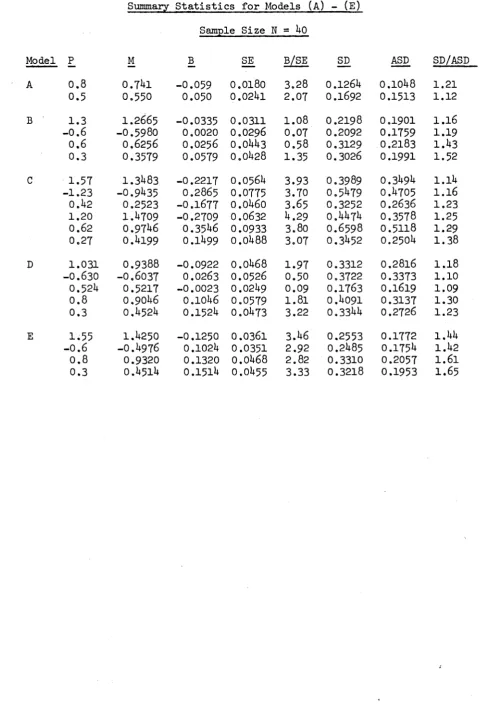
Summary Statistics for Models (A) - (E) :
Sample Size N = U o .
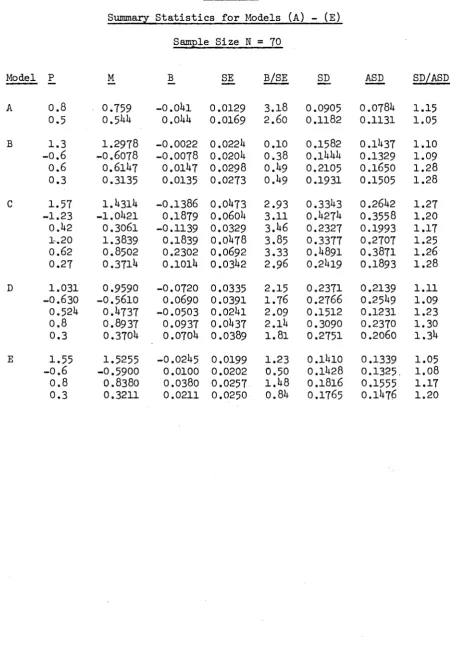
Summary Statistics for Models (A) - (E) :
Sample Size N = TO.
Summary Statistics for Models (A) - (E) :
Sample Size N = 100.
Frequency of Use of Root Restrictions, Models
B, D and E : All Sample Sizes.
Kolmogorov-Smirnov D Statistic for Models B anc 3
Summary Statistics for Model F : All Sample Sizes
Summary Statistics for Model G : All Sample Sizes
Page 29 32
3b
37 38 75 106 117 118 119 121. 12U
. 126
. 127
P ag e
T a b le 3 .9 K o lm o g o ro v -S m irn o v D S t a t i s t i c f o r M odel G: 128
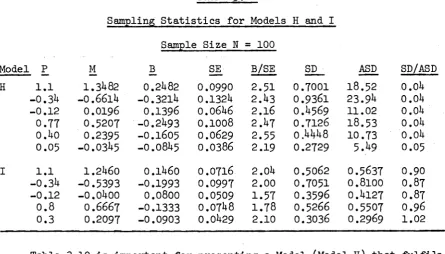
A l l Sam ple S i z e s .
T a b le 3 .1 0 S a m p lin g S t a t i s t i c s f o r M odels H and I : 130
Sam ple S i z e N = 1 0 0 .
T a b le 3 .1 1 S a m p lin g S t a t i s t i c s f o r M odel J : A l l S am ple 135
S i z e s .
T a b le 3 .1 2 S a m p lin g S t a t i s t i c s f o r M odel K : A l l 136
Sam ple S i z e s .
T a b le 3 .1 3 Summary S t a t i s t i c s f o r M odel L : A l l Sam ple 138
S i z e s .
T a b le 3.1*+ Summary S t a t i s t i c s f o r M odel M : A l l Sam ple 139
S i z e s .
T a b le 3 .1 5 F re q u e n c y o f U sage o f R oot R e s t r i c t i o n s , 1^0
M odels L a n d M : A l l S am ple S i z e s .
T a b le 3 .1 6 C o m p a riso n o f A s y m p to tic a n d S am ple S t a n d a r d l U l
D e v i a t i o n s , M odels L and M : A l l Sam ple S i z e s .
T a b le 3 .1 7 Summary S t a t i s t i c s f o r M odels N a n d G/S : A l l lUU
Sam ple S i z e s .
T a b le 3 .1 8 S a m p lin g S t a t i s t i c s f o r M odel 0 : S am ple S i z e lUU
N = 1 0 0 .
T a b le 3 .1 9 F re q u e n c y D i s t r i b u t i o n f o r o f M odel 0 . lU 6
T a b le 3 .2 0 Summary S t a t i s t i c s f o r M odels P an d G/NS : lU 8
A l l Sam ple S i z e s .
T a b le 3 .2 1 Summary S t a t i s t i c s f o r M odel F/NS : A l l Sam ple 1^9
S i z e s .
T a b le 3 .2 2 Summary S t a t i s t i c s f o r M o d e ls? m d F , A l l Sam ple 150
S i z e s : D i s t u r b a n c e s i . i . d . .
(xi)
Page
Table 4.1 Summary Statistics for A.T.D. and PH, Model Q l63
: All Sample Sizes.
Table 4.2 Summary Statistics for A.T.D. and PH, Mod.el R l64
: All Sample Sizes.
Table 4.3 Summary Statistics for A.T.D. and PH, Model S 165
: All Sample Sizes.
Table 4.4 Summary Statistics for Models Q and F, Sample I6T
Size N = 100 : Various Variance Ratios.
Table 4.5 Computation Time for A.T.D. and PH for Model R l68
: All Sample Sizes.
Table 4.6 Summary Statistics for PH/0 and PH, Models E,F 171
and T : Sample Size N = 40.
Table 4.7 Summary Statistics for PH/0 and PH, Models E,F 172
and T : Sample Size N = 70.
Table 4.8 Summary Statistics for PH/0 and PH, Models E,F 173
and T : Sample Size N = 100.
Table 4.9 Replications for which the Root Restrictions 175
are Enforced, Model T : N = 40.
Table 4.11 Correlogram of y(t) for Replications 177
3,4,18,27,32,43,45 and 47, Model T : N = 40.
Table 4.12 Computation Time for PH/0 and PH, Models E and l80
T : All Sample Sizes.
Table 4.13 Summary Statistics for O.L.S. and PH, Models A, l8l
D and G : Sample Size N = 4 o .
Table 4.l4 Summary Statistics for O.L.S. and PH, Models A, 182
Page
Table *+.15 Summary Statistics for O.L.S. and PH, Models A, 183
D and G : Sample Size N = 100.
Table 4.l6 Summary Statistics for B-J and PH, Model' E,F 186
and T : Sample Size N = 40.
Table 4.17 Summary Statistics for B-J and PH, Models E, F 187
and T : Sample Size N = 70.
Table 4.l8 Summary Statistics for B-J and PH, Models E, F 188
and T : Sample Size
N
= 100.Table 4.19 Summary Statistics for A.F.D. and PH, Models A,T 190
and U : Sample Size N = 40.
Table 4.20 Summary Statistics for A.F.D. and PH, Models A,T 191
and U : Sample Size N = 70.
Table 4.21 Summary Statistics for A.F.D. and PH, Models A,T 192
and U : Sample Size N = 100.
Table 4.22 Computation Time for A.F.D. and PH (Mins.), 193
Models T and U : All Sample Sizes.
Table 4.23 Equation (4.1) fitted to Food : All Estimators. 195
Table 4.24 Equation (4.2) fitted to New Money : All 196
Estimators.
Table 5.1 Summary Statistics of SYSTEM for the Model of 212
Eq„ (5.24) : Sample Sizes N=4o,70.
Table 5.2 Construction of the Consumption Series from 215
National Accounts Data.
Table 5.3 Correlograms (8 lags) of all Consumption Series. 2l6
Table 5.4 Correlogram (8 lags) of the Differenced
Consumption Series.
( x i i i )
P age
T a b l e 5 . 5 E s t i m a t e d P a r a m e t e r s o f E q u a t i o n ( 5 . 2 5 ) : 219
S e r i e s 1 , 3 a n d 4 .
T a b l e 5 . 6 E s t i m a t e d P a r a m e t e r s o f E q u a t i o n ( 5 . 2 6 a ) , 221
( 5 . 2 6 b ) a n d ( 5 . 2 7 ) ( P H ) .
T a b l e 5 . 7 C o r r e l o g r a m o f t h e R e s i d u a l s (8 l a g s ) : 222
E q u a t i o n s ( 5 . 2 6 a ) , ( 5 . 2 6 b ) an d ( 5 . 2 7 ) .
T a b l e 5 . 8 E s t i m a t e d P a r a m e t e r s o f E q u a t i o n s ( 5 . 2 6 a ) , 223
( 5 . 2 6 b ) a n d ( 5 . 2 7 ) (P H /O ).
T a b l e 5 . 9 E f f i c i e n c y C o m p a ris o n o f SYSTEM a n d SINGLE : 22h
E q u a t i o n s ( 5 . 2 6 a ) , ( 5 . 2 6 b ) and ( 5 . 2 7 ) .
T a b l e 5 . 1 0 E f f i c i e n c y C o m p a ris o n o f A .F . D . a n d A . F . D . / S : 226
E q u a t i o n s ( 5 . 2 6 a ) , ( 5 . 2 6 b ) and ( 5 . 2 7 ) .
T a b l e 6 . 1 N o n -Z e ro C o v a r i a n c e s o f u ( t ) f o r some s p e c i a l 238
fo rm s o f B ( L ) .
T a b l e 6 . 2 An Exam ple o f t h e C o n v e r g e n c e o f PH/R. 2U6
T a b l e 6 . 3 V a r i a n c e R a t i o s a n d t h e I m p l i e d M.A. P a r a m e t e r s 2U8
o f M odels I , I I a n d I V .
T a b l e 6 ,h Summary S t a t i s t i c s f o r PII/U a n d PH/R, 2^9
M odels I , I I a n d IV : Sam ple S i z e N = UO.
T a b l e 6 . 5 Summary S t a t i s t i c s f o r PH/U a n d PH /R, 250
M odels I , I I a n d IV : Sam ple S i z e N = 7 0 .
T a b l e 6 . 6 Summary S t a t i s t i c s f o r PH/U and PH /R, 251
M odels I , I I a n d IV : Sam ple S i z e N = 1 0 0 .
T a b le 6 . 7 C o n d i t io n Number a n d O th e r F e a t u r e s o f PH/R and 25*+
PH/U.
T a b l e 6 . 8 Model I I f i t t e d t o C a n a d i a n a n d U n i t e d S t a t e s 259
Page
Table 6.9 Estimates of the Trend Component in the Wheat 260
Yields Data, Canada and the United States : 19^0-1960.
Table 6.10 Parameter Estimates for the Sunspots Data : 26h
A.R. (2) with superimposed noise.
Table 6.11 Correlogram of the Residuals from O.L.S. : 265
Untransformed Sunspots Data.
Table 6.12 Parameter Estimates for the Transformed 266
Sunspots Data : A.R.(5) with superimposed noise.
Table 6.13 Correlogram of Residuals from O.L.S. : 267
Transformed Sunspots Data.
Table 6 .lU Roots of A(L for the Transformed Sunspots 268
Data.
Table 6.15 Correlogram of Personal Disposable Income 269
1905-19^9 (1929 prices).
Table 7.1 O.L.S. Residuals Correlogram (8 lags): 283
Equations (7.1a),(7.1b),(7.7a) and (7.7b).
Table 7.2 Parameter Estimates of (7.1a) and (7.1b). 285
Table 7.3 Parameter Estimates of (7.7a) and (7.7b). 286
Table 7.^ Parameter Estimates for (7.7a) and (7.7b) : 290
List of Figures
Figure 1,1
Figure 3.1
Figure 3.2
Figure 3.3
Figure 3.4
Figure 3.5
Figure 4.1
Figure 5 .1
Figure 5.2
Figure 5.3
Figure 5.4
Figure 6.1
Schematic Representation of the Models Implicit
in Table 1.2.
Spectral Characteristics of Model A.
Spectral Characteristics of Model B.
Spectral Characteristics of Model C.
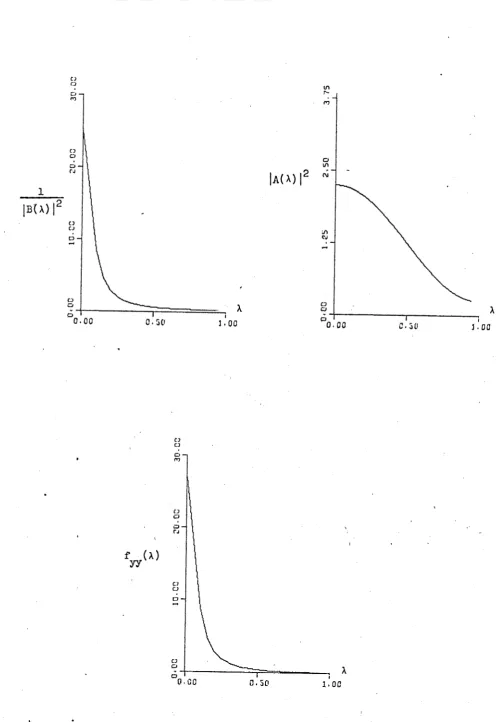
Spectral Characteristics of Model D.
Spectral Characteristics of Model E.
Sum of Squares Function for Model T as Iteration
Progresses.
Spectrum of Food after First and Fourth
Differencing.
Spectrum of Clothing after First and Fourth
Differencing.
Spectrum of Household Appliances and Equipment
after First and Fourth Differencing.
Spectrum of Miscellaneous after First and
Fourth Differencing.
1 .1 I n t r o d u c t i o n
An o u t s t a n d i n g f e a t u r e o f e c o n o m e tric r e s e a r c h h a s b een th e
r e l i a n c e upon th e a n a l y s i s o f econom ic tim e s e r i e s to y i e l d v a l u a b le
in f o r m a tio n a b o u t t h e p a r a m e te r s o f econom ic m o d els: a r e l i a n c e
o c c a s io n e d by th e i n a b i l i t y o f e c o n o m is ts t o p e rfo rm e x p e r im e n ts .
The c e n t r a l f e a t u r e o f th e tim e s e r i e s u t i l i z e d was th e in te r d e p e n d e n c e
o f o b s e r v a ti o n s i n th e a v a i l a b l e sam ple - an in te r d e p e n d e n c e t h a t q u e r ie s
th e v a l i d i t y o f a p p ly in g many s t a t i s t i c a l th e o re m s p r e d i c a t e d upon
th e in d e p e n d e n c e o f o b s e r v a t i o n s . I n o r d e r t o ta k e c o g n iz a n c e o f t h i s
d ep endence (a n d i n some i n s t a n c e s t o s tu d y th e s t r u c t u r e o f th e
dependence i t s e l f ) i t was n e c e s s a r y t o c o n s t r u c t new th e o re m s and t o o l s
o f a n a l y s i s . As th e y e v o lv e d th e y form ed th e n u c le u s o f w hat i s now
r e f e r r e d t o as tim e s e r i e s a n a l y s i s .
The i n f l u e n c e o f t h i s c o rp u s o f te c h n iq u e s upon e c o n o m e tric
s p e c i f i c a t i o n and e s t i m a t i o n a p p e a rs t o h av e w axed and w aned r e p e a t e d l y
i n th e l a s t h a l f c e n t u r y . Some o f t h e e a r l i e s t s t u d i e s o f econom ic
phenom ena e . g . B e v e rid g e [ 8 ] w ere a p p l i c a t i o n s o f t h e t o o l s o f tim e
s e r i e s a n a l y s i s and know ledge o f t h i s f i e l d seem ed t o be e s s e n t i a l f o r
e c o n o m e tr i c ia n s . In th e q u a r t e r c e n tu r y f o llo w in g W orld War I I
h o w e v e r, th e i n t e r e s t o f e c o n o m e tr ic ia n s i n t h i s f i e l d seem s t o have
d ie d awav ( w ith t h e e x c e p tio n o f t h e u se o f s p e c t r a l a n a l y s i s f o r th e
.i n v e s t i g a t i o n o f lo n g sw in g s and s e a s o n a l a d ju s tm e n t te c h n iq u e s ) t o th e
2.
c o n c e p ts such as c o r r e lo g r a m , s t a t i o n a r y p r o c e s s e t c .
What i s th e e x p l a n a t i o n o f t h i s c u r io u s s t a t e o f a f f a i r s ? F i r s t l y
i t m ig h t he a rg u e d t h a t th e r e s t r i c t i v e a ss u m p tio n s p la c e d upon th e
e v o l u t i o n a r y n a t u r e o f th e s e r i e s d id n o t seem t o a c c o r d w e ll w ith v i s u a l
e v id e n c e on th e b e h a v io u r o f econom ic tim e s e r i e s . Thus th e n o t i o n o f
s t a t i o n a r i t y c o n ta in e d i n ( f o r ex am p le) Wold [119] d id n o t seem a p t f o r
tim e s e r i e s d o m in a te d by t r e n d and s e a s o n a l m ovem ents. S e c o n d ly much
o f tim e s e r i e s a n a l y s i s was c o n c e rn e d w ith th e a n a l y s i s o f a s i n g l e
tim e s e r i e s and a p p r o p r i a t e p a r a m e tr i c d e s c r i p t i o n s o f i t w h ereas
(p e rh a p s s t i m u l a t e d by th e K ey n esian R e v o lu tio n ) e c o n o m is ts w is h e d to
i n v e s t i g a t e t h e r e l a t i o n s h i p b etw ee n s e r i e s . L a s t l y t h e r e w ere th e
d i f f i c u l t i e s r a i s e d in th e e s t i m a t i o n o f t h e p a r a m e te r s o f th e
s p e c i f i c a t i o n c o n s id e r e d a p p o s i t e b y tim e s e r i e s t h e o r i s t s .
I t w i l l be th e aim o f t h i s t h e s i s t o show t h a t a know ledge o f th e
c o n c e p ts and t o o l s o f tim e s e r i e s a n a l y s i s i s o f im p o rta n c e t o an
e c o n o m e tr ic ia n and t h a t w ith t h e a i d o f a d i g i t a l com pu ter th e s e
te c h n iq u e s may b e e a s i l y i n t e g r a t e d i n t o a t r a d i t i o n a l e c o n o m e tric
fram ew ork. To do t h i s a t t e n t i o n w i l l be f o c u s s e d upon th e r e p r e s e n t a t
io n o f tim e s e r i e s as m ixed a u to r e g r e s s iv e - m o v in g a v e ra g e (ARMA) sch em e s.
The c o n s t i t u e n t s o f t h i s m o d e l- th e a u t o r e g r e s s i o n and m oving a v e ra g e
p a r t s - h ave a lo n g h i s t o r y i n tim e s e r i e s a n a l y s i s and Wold [119] i s a
c o n v e n i e n t summary o f many o f t h e i m p o r t a n t a p p l i c a t i o n s . The s y m b o lic
form em ployed f o r an ARMA model w i l l be
y ( t ) - ß1y ( t - l ) - . . . - ß ^ y ( t - p ) = e ( t ) + a1 £ ( t - l ) + . . . + a ^ e ( t - q )
t = l , . . . , N ( 1 . 1 )
■where E ( e ( t ) ) = 0 , E ( e ( t ) e ( t - s )) = s=0
= 0 s ^ O,
2 and E i s t h e e x p e c t a t i o n o p e r a t o r .
E q u a t io n ( l . l ) w i l l be g iv e n t h e s h o r t h a n d n o t a t i o n ARMA ( p , q )
where p i s t h e l e n g t h o f t h e a u t o r e g r e s s i o n (A .R .) and q t h e l e n g t h
o f t h e moving a v e r a g e (M .A .), and i t d e s c r i b e s t h e u n i v a r i a t e , s i n g l e
e q u a t i o n f o r m u l a t i o n o f an ARMA m odel.
Two f u r t h e r e x t e n s i o n s o f ( l . l ) a r e t o be c o n s i d e r e d .
(a ) M u l t i v a r i a t e , s i n g l e e q u a t i o n m odels o f t h e ty p e
y ( t ) - ß y ( t - l ) - . . . - ß y ( t - p ) = y x ( t ) + ynx ( t - l ) + . . ,+y x ( t - r ) + e ( t )
l p o 1 r
+a_ e ( t - l ) ^ . .+a e ( t - q ) ( 1 . 2 )
1 q.
w hich i s d e s i g n a t e d ARMAX ( p , r , q ) and t h e x ( t ) p r o c e s s h a s t h e p r o p e r t y
t h a t
E ( x ( t ) e ( t ) ) = 0
3
and may b e r e g a r d e d as an " ex o g en o u s" v a r i a b l e .
H e n c e f o r t h any s e r i e s d e s i g n a t e d as e ( t ) o r e ( t ) w i l l be assumed t o p o s s e s s t h e s e two p r o p e r t i e s i . e . z e r o e x p e c t a t i o n and f i n i t e v a r i a n c e . Sometimes t h e a s s u m p tio n w i l l be made t h a t t h e o b s e r v a t i o n s a r e
i d e n t i c a l l y and i n d e p e n d e n t l y d i s t r i b u t e d ( i . i . c L ) o t h e r w i s e i t s h o u ld be u n d e r s t o o d t h a t any e ( t ) o r e ( t ) i s a n o r m a l ly and i n d e p e n d e n t l y
d i s t r i b u t e d ( n . i . d . ) random v a r i a b l e . A d d i t i o n a l a s s u m p tio n s w i l l be t h a t y ( t ) i s mean c o r r e c t e d i . e . E ( y ( t ) ) = 0, and t h a t t h e r e i s o n l y one ex ogenous v a r i a b l e x ( t ) . Both o f t h e s e may be e a s i l y r e l a x e d .
u.
I f t h e r e a r e a num ber o f ex ogenous v a r i a b l e s r w i l l be a v e c t o r and th e
f i r s t and l a s t s u b s c r i p t s i n t h e b r a c k e t s w i l l b e ta k e n t o r e f e r t o th e
o r d e r o f th e A.R. and M.A. r e s p e c t i v e l y . An econom ic exam ple o f ( 1 .2 )
m ig h t be t o s e t ( p = l , r = l , q=0) and t o l e t y ( t ) be t o t a l consum er
e x p e n d itu r e and x ( t ) t o t a l p e r s o n a l d is p o s a b le in co m e, th e r e b y
d e s c r i b i n g a co n su m p tio n f u n c ti o n f r e q u e n t l y u s e d i n e c o n o m e tric m o d e ls.
( b ) M u l t i v a r i a t e , M u ltip le E q u a tio n System s
T h is w i l l b e r e s t r i c t e d t o a llo w i n t e r a c t i o n b etw een th e d i s tu r b a n c e s
o f e a c h e q u a tio n o n ly , so t h a t i t r e p r e s e n t s a tim e s e r i e s g e n e r a l i z a t i o n
o f Z e l l n e r 's ’’s e e m in g ly u n r e l a t e d e q u a t io n s " e s t i m a t o r P-21].
I t w i l l be a rg u e d i n t h i s and s u b s e q u e n t c h a p te r s t h a t e q u a tio n s
( l . l ) and ( 1 .2 ) (a n d t h e e x t e n s i o n t o m u l t i p l e e q u a tio n sy stem s
m e n tio n e d i n (b ) ab ov e) a r e a p p r o p r i a t e to a w ide v a r i e t y o f them es i n
modern e c o n o m e tric r e s e a r c h .
A s k e tc h o f t h e c h a p t e r may now be g iv e n . H aving e s t a b l i s h e d th e
ty p e o f m odel t o b e c o n s id e r e d i t i s n e c e s s a r y t o i n v e s t i g a t e
( i ) The o r i g i n o f t h e s e m odels i . e . a r e t h e r e any t h e o r e t i c a l o r
e m p i r i c a l r e a s o n s f o r b e l i e v i n g t h a t e q u a t io n s ( l . l ) and ( 1 .2 ) a r e
l i k e l y t o a r i s e i n th e a n a l y s i s o f econom ic tim e s e r i e s . S e c tio n
1 .2 o u t l i n e s v a r io u s th e o re m s t h a t may be fo u n d i n th e tim e
s e r i e s l i t e r a t u r e w hich e s t a b l i s h a p r e s u p p o s i t i o n i n f a v o u r o f
ARMA m o d e ls , and g iv e s some i l l u s t r a t i o n s o f t h i s from e m p ir ic a l
r e s e a r c h .
( i i ) The c o n d i tio n s t h a t m ust b e p la c e d upon t h e p a r a m e te r s o f ( l . l )
and ( 1 .2 ) and th e e v o l u t i o n a r y n a t u r e o f th e s e r i e s y ( t ) . I t
be q u i t e s t r i c t . S e c tio n 1 .3 th e n p ro c e e d s t o exam ine th e
s i g n i f i c a n c e o f th e a ss u m p tio n s f o r t h e o b s e rv e d b e h a v io u r o f
a tim e s e r i e s and a sk s i f econom ic s e r i e s a r e l i k e l y t o be
c o m p a tib le w ith them?
( i i i ) A lth o u g h t h e r e a r e a p r i o r i g ro u n d s f o r s u p p o r tin g th e u se o f
( l . l ) and ( 1 .2 ) we a r e l e d to e n q u ir e i n t o th e b e n e f i t s t h a t
d e r iv e from an e s t i m a t i o n o f t h e s e e q u a t i o n s . As e c o n o m is ts a r e
p r i m a r i l y i n t e r e s t e d i n th e m a g n itu d e o f c e r t a i n p a r a m e te r s , and
th e a b i l i t y t o p r e d i c t c e r t a i n v a r i a b l e s , t h i s s e c t i o n n a t u r a l l y
c o n c e n tr a te s upon th e r e l a t i o n s h i p o f ( l . l ) and ( 1 .2 ) t o t h e s e
p r o b le m s .
( i v ) L a s t l y we t u r n t o t h e e s t i m a t i o n o f ( l . l ) and ( 1 . 2 ) . In S e c t io n
1 .5 th e t r a d i t i o n a l t o o l s o f e c o n o m e tric a n a l y s i s - O rd in a ry
L e a s t S q u a re s and G e n e r a liz e d L e a s t S q u a re s - a r e a n a ly s e d f o r
t h e i r s u i t a b i l i t y f o r th e e s t i m a t i o n o f t h e p a r a m e te r s o f t h e s e
e q u a t i o n s . I t w i l l b e s e e n (fro m n u m e ric a l ex a m p le s) t h a t i n a
num ber o f r e a l i s t i c m odels th e l o s s e s ( i n te rm s o f i n c o r r e c t
h y p o th e s i s t e s t i n g ) a r e v e ry l a r g e from a u se o f O rd in a ry L e a s t
S q u a re s and t h i s f a c t p ro m p ts th e d ev elo p m en t o f e s t i m a t o r s t o
a v o id su ch l o s s e s .
1 .2 The O r ig in o f ARMA/ARMAX M odels
1 . 2 . 1 Dynamic B e h a v io u r a l M odels
S t a t i c econom ics d e a ls w ith in s t a n t a n e o u s r e l a t i o n s h i p s b e tw e e n
v a r i a b l e s and sum m arizes su ch f u n c ti o n s i n tim e i n v a r i a n t m e a su re s su ch
as e l a s t i c i t i e s and p r o p e n s i t i e s . F o r a lo n g w h ile i t was u n d e r s to o d
6
.p e r t u r b a t i o n s i n a n o t h e r , b u t i t was c o n v in c in g ly a rg u e d t h a t
m easurem ents o f p a r a m e te r s o b ta in e d u n d e r su ch a s s u m p tio n s w o u ld be
a p p ro x im a te ly c o r r e c t i f th e p e r i o d o f a d ju s tm e n t was s h o r t e r th a n
th e p e r i o d a t w hich t h e v a lu e s o f econom ic v a r i a b l e s m ig ht be
o b s e r v e d . Thus i t was u n l i k e l y t h a t many la g s w ould b e l o n g e r th a n a
s i n g l e y e a r , w hich i n g e n e r a l was th e tim e p e r i o d f o r w h ich d a t a was
c o l l e c t e d .
Even u n d e r t h i s reg im e how ever t h e r e w ere some econom ic v a r i a b l e s
e . g .I n v e s t m e n t i n w hich th e r e s p o n s e w ould b e d i s t r i b u t e d o v e r a number
o f tim e p e r i o d s , and i t was t o m eet t h i s o b j e c t i o n t h a t t h e c o n c e p t o f
a d i s t r i b u t e d l a g a r o s e . W ith t h e r e a d y a v a i l a b i l i t y o f q u a r t e r l y
(an d som etim es m o n th ly ) d a t a t h i s c o n c e p t h a s become o f c r u c i a l
im p o rta n c e to a p p l i e d e c o n o m e tr ic ia n s as i t i s now e v i d e n t t h a t la g s
o f t h e o r d e r o f 10 q u a r t e r s e . g . In v e s tm e n t may b e r e q u i r e d to
a d e q u a te ly a c c o u n t f o r dynam ic econom ic b e h a v io u r .
The g e n e r a l d i s t r i b u t e d l a g s p e c i f i c a t i o n i s
y ( t ) = E w ( j ) x ( t - j ) + e ( t ) ( 1 . 3 ) .
j=0
A c u r s o r y i n s p e c t i o n o f ( 1 .3 ) shows t h a t t h e i n f i n i t e num ber o f
p a r a m e te r s w ( j ) p r o h i b i t s th e d i r e c t a p p l i c a t i o n o f r e g r e s s i o n a n a l y s i s .
To e s c a p e from t h i s q u an d ry some w r i t e r s recommended t h a t w ( j ) b e s e t
a t z e ro f o r j > K (w here K i s a f i n i t e i n t e g e r s e t on a p r i o r i g ro u n d s )
th e r e b y c o n s t r u c t i n g a f i n i t e d i s t r i b u t e d la g m odel w hich may b e
e s t i m a t e d by O rd in a ry L e a s t S q u a re s ( O . L . S . ) . U n f o r tu n a te ly i f K i s
a t a l l l a r g e th e p r e s e n c e o f c o r r e l a t i o n i n t h e x ( t ) s e r i e s w i l l a lm o s t
Koyck [6 3] and N e rlo v e [80] h a d s u g g e s t e d t h a t i t was p o s s i b l e t o
t r a n s f o r m an i n f i n i t e s e r i e s i n w ( j ) i n t o a f i n i t e A.R. and t h i s
p ro m p ted J o r g e n s o n ’ s r a t i o n a l l a g f u n c t i o n [ 5 7 ] . D e f i n i n g t h e l a g
o p e r a t o r L w i t h t h e p r o p e r t y Lm x ( t ) -* x ( t - m ) ( 1 . 3 ) may be r e w r i t t e n as
y ( t ) = W (L )x (t) + e ( t ) ( l . * 0 .
Then J o r g e n s o n 's th e o re m s on r a t i o n a l l a g s s t a t e t h a t i f W(l) i s
an i n f i n i t e ( f i n i t e ) p o ly n o m ia l i n L an e x a c t ( a r b i t r a r i l y c l o s e )
r e p r e s e n t a t i o n o f W(L) i s g iv e n by
W ( L ) = f g ( 1 . 5 ) ,
where C(L) = y + y nL + . . . + y L r
o '1 ' r
B(L) = 1 + ß_L + . . . + 3 LP
1 P
and r and p a r e s m a l l i n t e g e r s .
U sin g ( 1 . 5 ) , ( l . U ) may be g iv e n t h e ARMAX ( p , r , p ) form
B ( L ) y ( t ) = C ( L ) x ( t ) + B ( L ) e ( t ) ( 1 . 6 ) .
Prom ( 1 . 6 ) i t i s a p p a r e n t t h a t ARMAX models a r i s e n a t u r a l l y from
c e r t a i n methods o f e s t i m a t i n g d i s t r i b u t e d l a g phenomena. Some p o p u l a r
v e r s i o n s o f t h e p o ly n o m ia l s C(L) and B(l) have b e e n
( a ) K oy ck -N erlo v e C(l) = y^ B(l) = 1 - ß^L
( b) S o lo w ( P a s c a l) C(l) = yQ B(l) = ( l - ß L ) r
where r i s an i n t e g e r i n t h e r a n g e 1 < r << 00.
Both o f t h e s e v a r i a n t s a r e w e l l e s t a b l i s h e d i n t h e l i t e r a t u r e
b u t l i t t l e a t t e m p t h a s b e e n made t o impose t h e ARMAX form: t h e most
8
.r e l a t i o n s h i p c o n ta in s c o r r e l a t e d n o i s e . Of c o u rs e t h i s a ssu m p tio n
_1
may be t r u e b u t th e form o f t h e m oving a v e ra g e r e q u i r e d i . e . B ( L ) s ( t )
k
i s so r e s t r i c t i v e as t o make i t u n r e a l i s t i c .
A n o th er b e h a v i o u r a l r e l a t i o n t h a t g e n e r a te s an ARMAX m odel i s t o
be fo u n d i n th e l i t e r a t u r e c e n t e r e d on m a rk e ts i n w hich e x p e c ta t io n s
( o r a n t i c i p a t i o n s ) a r e im p o r ta n t . The d e a r t h o f o b s e r v a ti o n s on su ch
v a r i a b l e s h as made i t cu sto m ary t o assume t h a t e x p e c t a t i o n s a r i s e from
p a s t b e h a v io u r and may be r e p l a c e d by a l i n e a r combination o f p a s t
o b s e r v a b le v a l u e s .
To g iv e an ex am p le, assum e t h a t t h e r e i s a l i n e a r f u n c t i o n a l
r e l a t i o n b etw een a v a r i a b l e y ( t ) and th e a n t i c i p a t e d v a lu e o f a se c o n d
v a r i a b l e x ( t ) . D en o tin g t h i s a n t i c i p a t e d v a lu e by x * ( t ) th e f u n c ti o n
i s
y ( t ) = y x * ( t ) + e ( t ) ( 1 . 7 ) .
To a c c o u n t f o r t h e f o r m a tio n o f e x p e c t a t i o n s c o n c e rn in g x ( t ) from p a s t
v a lu e s o f x ( t ) t r a d i t i o n a l l y one o f th e f o llo w in g h y p o th e s e s h as b een
a d o p te d :
-(a ) A d a p tiv e E x p e c ta t io n s : x * ( t ) - x * ( t - l ) = A( x * ( t ) - x ( t - l ) ) .
( b) E x t r a p o l a t i v e E x p e c ta t io n s : x * ( t ) = W ( L ) x ( t ) .
The f i r s t o f t h e s e was f o r m u la te d i n i t i a l l y by Cagan [ l 6 ] in h i s
s tu d y o f h y p e r i n f l a t i o n and N erlo v e i n h i s s tu d y o f s u p p ly r e s p o n s e i n
t h e a g r i c u l t u r a l s e c t o r [ 8 0 ] s w h ile th e s e c o n d h a s b een i n t e g r a t e d
i n t o g ro w th m odels by N e rlo v e and Arrow [ 8U] and a d o p te d by T urnovsky
[l08] i n h i s i n v e s t i g a t i o n i n t o th e f o r m u la tio n o f p r i c e e x p e c t a t i o n s .
1+ T h is does n o t r u l e o u t th e p o s s i b i l i t y o f a l e s s r e s t r i c t i v e M.A. i n ( l . U ) so t h a t th e M.A. and A.R. p a r a m e te r s n e e d n o t be e q u a l i n
From th e d i s c u s s i o n o f r a t i o n a l la g s i t i s e a s i l y se e n t h a t (a ) i s a
s p e c i a l c a s e o f (b ) and t h a t when s u b s t i t u t e d i n t o ( 1 .7 ) w i l l g iv e an
ARMAX ( 1 , 1 , 1 ) m odel.
1 , 2 , 2 Dynamic E x p la n a to r y M odels
The p r e v io u s s e c t i o n h a s c o n c e n tr a te d upon th e o r i g i n o f ARMAX
m odels from b e h a v i o u r a l r e l a t i o n s . As w e ll as t h i s t h e r e i s an
argum ent from tim e s e r i e s th e o r y f o r t h e s e f o r m s .
A b e g in n in g may be made by a d o p tin g W old’ s d e c o m p o s itio n th e o re m
'Summing up we h av e t h e f o llo w in g th e o re m in w hich one o f
th e v a r i a b l e s {4>( t ) }• and ( c ( t ) } may be v a n is h in g :
Theorem 7« D e n o tin g by £ ( t ) an a r b i t r a r y d i s c r e t e s t a t i o n a r y
p r o c e s s w ith f i n i t e d i s p e r s i o n , t h e r e e x i s t s a th r e e - d im e n s i o n a l
s t a t i o n a r y p r o c e s s { ^ ( t ) , c ( t ) , r i ( t ) } w ith t h e f o llo w in g p r o p e r t i e s
(A) U ( t )} = l i M t ) } + U ( t ) }.
(B) ( i p( t ) } and {c ( t )} a r e n o n - c o r r e l a t e d .
(c) {ip( t )} i s s in g u la r ." ^
(D) {n (t ) } i s n o n - a u t o c o r r e l a t e d , and E [ n ( t ) ] = E [ c ( t ) ] = 0 .
(E) ( c ( t ) } = ( n ( t ) } + b 1 { n ( t - l ) } + b 2 ( n ( t - 2 ) } +
w here b r e p r e s e n t s r e a l num bers su ch t h a t Eb 2 i s
n n c o n v e r g e n t." [ l l 9 , p . 8 9 l
F o r th e p r e s e n t i t i s im p o r ta n t t o c o n s id e r w h e th e r th e d e te r m in
i s t i c com ponent 'K t.- v a n is h e s f o r econom ic tim e s e r i e s . One in s t a n c e
i n w hich i t w ou ld n o t i s th e p r e s e n c e o f s t r i c t p e r i o d i c i t i e s i n th e
s e r i e s . N e rlo v e h a s r e c e n t l y commented upon t h i s i n t h e f o llo w in g
1 0.
f a s h i o n
" F o r a l o n g tim e s e a s o n a l i t y was b e l i e v e d t o be r e p r e s e n t a b l e
by a s t r i c t l y p e r i o d i c f u n c t i o n , . . . .H ow ever, . . . . , su c h s t r i c t
p e r i o d i c i t y c a n n o t p l a u s i b l y be assumed t o c h a r a c t e r i z e
econom ic tim e s e r i e s " [82 p . 1 2 ] .
A d d i t i o n a l l y he a r g u e s i n t h e f o l l o w i n g q u o t a t i o n t h a t i t i s t h e
l i n e a r l y n o n - d e t e m i n i s t i c p a r t w h ich i s o f im p o r ta n c e f o r t h e a n a l y s i s
o f econom ic tim e s e r i e s .
" We h av e fo u n d t h a t most econom ic tim e s e r i e s , p o s s i b l y a f t e r
some t r a n s f o r m a t i o n t o r e n d e r them s t a t i o n a r y , can be r e p r e s e n t e d
i n t h e form ( 3 . 2 ) " ( o f t h e form ( 1 . 8 ) b e l o w ) .
A c c e p t in g t h e p r o p o s i t i o n t h a t o n ly t h e n o n - d e t e r m i n i s t i c p a r t
i s r e l e v a n t , t h e s e r i e s may be r e p r e s e n t e d i n t h e p r e v i o u s te r m i n o l o g y
as
y ( t ) = E w ( j ) e ( t - J ) ( 1 . 8 ) .
J=0
As w i t h t h e i n f i n i t e d i s t r i b u t e d l a g i t i s n o t p o s s i b l e t o e s t i m a t e
( 1 . 8 ) d i r e c t l y , b u t i t i s p o s s i b l e t o p r o c e e d by a d o p t i n g t h e r a t i o n a l
form o f W(l) i . e . W(L) = so t h a t ( 1 . 8 ) becomes t h e ARMA model^
B(L)
B ( L ) y ( t ) = A ( L ) e ( t ) ( 1 . 9 ) .
I t i s w o r t h w h i l e t o n o t e a s p e c i a l c a s e o f ( 1 . 9 ) i . e . A(L) = 1 ,
= 1 - ß^L - . . . - 3 c o r r e s p o n d s t o t h e p ' t h o r d e r A.R. p r o c e s s .
I n t h i s c o n t e x t t h e r a t i o n a l l a g a s s u m p tio n i s e q u i v a l e n t t o t h e a s s u m p tio n t h a t y ( t ) h a s a r a t i o n a l s p e c t r a l d e n s i t y f u n c t i o n - a n o t uncommon a s s u m p ti o n i n t h e f i e l d s o f e l e c t r i c a l e n g i n e e r i n g and
T h is f o r m u l a t i o n h a s a lo n g h i s t o r y i n t h e a n a l y s i s o f s t a t i o n a r y tim e
s e r i e s e 0g 6 K e n d a ll
[6o
1, K e n d a ll and S t u a r t [6 l ] and i t i s o f somei n t e r e s t t o e n q u i r e i n t o t h e f a c t o r s t h a t m ig h t i n f l u e n c e t h e c h o ic e o f
an ARMA r a t h e r th a n an AoRo model i n p a r a m e t e r i z i n g econom ic ti m e s e r i e s „
An o b v io u s an sw er r e s i d e s i n t h e g e n e r a l i t y o f t h e r a t i o n a l
f u n c t i o n em ployed i n c o n t r a d i s t i n c t i o n t o t h e f i x e d s p e c i f i c a t i o n o f
ACL) = 1 r e q u i r e d by AuRo p r o c e s s e s , and t h i s g e n e r a l i t y s h o u l d e n a b l e
a w i d e r c l a s s o f s e r i e s t o be s u c c e s s f u l l y m o d e l l e d a A more p r a g m a t i c
r e a s o n (an d p e r h a p s more a p p e a l i n g i n view o f t h e c o l l i n e a r i t y p r e s e n t
b e tw ee n v a r i a b l e s i n many e c o n o m e t r i c m o d e ls) i s t h a t an ARMA model may
be t h e most p a r s im o n io u s p a r a m e t e r i z a t i o n o f t h e s e r i e s 0 Box and
J e n k i n s [ 9 ] have b e e n th e main p r o p o n e n t s o f t h i s p r o p o s i t i o n and have
j u s t i f i e d su ch a c l a i m by o b s e r v i n g t h a t t h e r e i s an i n v e r s e r e l a t i o n
b etw ee n t h e o r d e r o f t h e M0A0 and A0Ro r e q u i r e d t o y i e l d t h e same
r e p r e s e n t a t i o n o f a s e r i e s e 0g 0 an i n f i n i t e AoRo o f t h e form
y ( t ) + ß y ( t - l ) + ß2y ( t - 2 ) + s „ 0+ f r ^ y C t- k ) ». 0= e ( t ) may be c o n v e r t e d t o a
f i r s t o r d e r M0A0 y ( t ) = ( l - ß L ) e ( t ) 0 T h e r e f o r e low o r d e r ARMA models
may be u s e d i n l i e u o f t h e h i g h o r d e r A0R0 p r o c e s s e s t h a t a r e g e n e r a l l y
7
r e q u i r e d t o c h a r a c t e r i z e econom ic tim e s e r i e s »From t h e p r e v i o u s d i s c u s s i o n i t i s e a s i l y c o n c lu d e d t h a t ARMA
models a r e a n a t u r a l f u n c t i o n a l form t o re p r o d u c e a s t a t i o n a r y tim e
7
12
series0 However as most economists are aware few economic time series
are stationary and most exhibit a trending mean and heteroskedasticity
in the variance, To what extent then is the previous theory applicable?
A partial answer comes from the widespread adoption of the "variate
difference method" in the 1930's as a device for removing polynomial
trends in the mean and variance of a series0 Fishman [26 p 059] shows
that for a series y(t) exhibiting a q'th order polynomial in the mean
and variance an application of the filter (l-L)^ will yield a
stationary series with a constant mean and variance0 The filtered
series will be representable by an ARMA m o d e l 0 Although the "variate
difference method" rests on assumptions that are untenable about
economic series it is sufficient to note that differencing will reduce
a non-stationary process to stationarity if repeated a sufficient number
of times. Therefore by allowing HCL) to have roots on the unit circle
(1.9) will be applicable to non-stationary series as well. More of
g
this in Chapter 6 when we come to consider some actual time series,
A second explanation of the source of ARMA models lies in what we
will designate as time transform effects, Quenouille [9^] was the
first to isolate these by demonstrating that a continuous variable,
when observed at intervals of p time units apart, would exhibit a
correlogram identical to that of an ARMA (p,p-l) equation, Quenouille's
Authors who have used differencing to induce stationarity are Yaglom [121], Whittle [117], Box and Tiao [12], Nerlove, Grether and Couts
[18], Nerlove and Wage [83], Theil and Wage [10*+] and Box and Jenkins
[9]. Of these Yaglom seems to have been the first. Box and
t h e o r e m i s o f some i m p o r t a n c e t o e c o n o m e t r i c s as i t d e m o n s t r a t e s t h a t
ARMA models a r e t h e d i s c r e t e a n a l o g u e s o f r e l a t i o n s h i p s b e l i e v e d t o
h o l d i n c o n t i n u o u s t i m e and s u g g e s t t h a t t h e y a r e a n a t u r a l model t o
f i t when o n l y d i s c r e t e o b s e r v a t i o n s a r e a v a i l a b l e .
A n o t h e r view o f t h i s e f f e c t i s g a i n e d by c o n s i d e r i n g t h e form o f
AöR» p r o c e s s e s u n d e r v a r i o u s t i m e r e g i m e s « To g i v e a s i m p l e example
assume t h a t y ( t ) f o l l o w s a s ec on d o r d e r A.R.
y ( t ) + b ^ y ( t - l ) + b 2y ( t - 2 ) = e ( t ) t = l , . . o , N ( l . l O ) .
C o n s i d e r t h e change i n ( l . l O ) when i n f o r m a t i o n can be o b t a i n e d f o r
o n l y e v e r y s e c o n d t i m e p o i n t i c e . we o b s e r v e r = 2 , ^ , 00>N ( i f N i s e v e n ) .
Even t h o u g h y ( t - l ) i s no l o n g e r o b s e r v a b l e i t i s p o s s i b l e t o r e f o r m u l a t e
( 1 . 1 0 ) as an A.R. i n o b s e r v a b l e v a l u e s o n l y by t h e f o l l o w i n g me thod.
Lag ( 1 . 1 0 ) once t o g e t ( L i l a ) and l a g ( 1 . 1 1 a ) once t o a r r i v e a t
( 1 . 1 1 b ) .
y ( t - l ) + b ^ y ( t - 2 ) + b 2y ( t - 3 ) = e ( t - l ) ( l . l l a )
y ( t - 2 ) + b 1y ( t - 3 ) + b g y ( t - U ) = e ( t - 2 ) ( l . l l b )
S o l v i n g ( 1 . 1 0 ) , ( l . l l a ) and ( l . l l b ) t h e r e d u c e d form i s
y ( t ) + ( 2 b 2- b ^ ) y ( t - 2 ) + b | y ( t - 4 ) = e ( t ) - b ^ e U - l ) + b 2e ( t - 2 ) ( 1 . 1 2 ) .
R e - i n d e x i n g e q u a t i o n ( l „ 1 2 ) i n t h e r - d o m a i n we have
y ( r ) + ( 2b2 - b ^ ) y ( r - l ) + b 2y ( r - 2 ) = u ( r ) ( 1 . 1 3 ) .
What i s t h e a u t o c o r r e l a t i o n p a t t e r n o f u ( r ) i n ( 1 . 1 3 ) ? The e x p r e s s i o n s
f o r u ( r ) , u ( r - l ) and u ( r - 2 ) a r e
u ( r ) = e ( t ) - b ^ e ( t - l ) + b 2e ( t - 2 )
u ( r - l ) = e ( t - 2 ) - b ^ e ( t - 3 ) + b 2e ( t - U ) ( l . l U ) .
lU
From (l.lU) the covariance function of u(r), F is given hy
uu
Y u u (°) = a'U+b^+b^)
YuuU) = b2°2 (1-15),
Yuu0 ) = 0 J = 2,ooc,
-so that since u(r) has the correlation function of a first order M.A.
process (l013) becomes ^
y ( r ) + (2b2-b^)y(r-l) + b 2y(r-2) = e(r) + o^etr-l) (1.16)
This simple example illustrates the transition between A.R. and
ARMA forms as the period of observation changes0 In general (see
Appendix l) it may be shown that for an A.R. of order p indexed on
t = 1,..0,N, the appropriate process indexed on r = k, 2 k , o .0,N (if N
is a multiple of k) is ARMA (p , I ( 11 )) where I is the operator
truncating the expression in brackets to the integer immediately below
this value.
A number of interesting cases emerge. Firstly if p = 2, k = 2
(the example given above) we obtain ARMA (2,1) as was found. Secondly
as k-*30 we obtain the "balanced" ARMA (p,p) model. Lastly as k-*l i.e„
the r and t domains coincide, the ARMA (p,o) model emerges i.e. the
original A.R.
In future chapters the covariance function of a series x(t) will be
denoted by r and the individual covariances by 7 (j). The cross
covariance between x(t) and y(t) will be F with d e m e n t s y (j).
xy xy
^ See Box and Jenkins [9 p.68] for a discussion on the theoretical
autocorrelation function of a M.A. process. A number of properties
Brewer [ 15 ] has extended the above analysis to a large number of
different models0 He shows that an initial ARMA (p,q) equation will
become ARMA (p ,I ( ) ) if the variable observed is a stock and
ARMA [p ,I ( ^ )] if it is a flow. The reader is referred to
his paper for an extensive discussion of the possible variations
The importance of his contribution lies in the limits as k~*» i 0e o
ARMA (p,p) (for stock models) and ARMA (p,p+l) (for flow models)
signifying that if ARMA models are to be justified by time transform
effects alone the order of the MoA, can never be greater than the order
of the AoRo for stock variables and only one greater for flow variables.
Such a principle may help to explain the heavy emphasis upon "balanced"
models in the work of Box and Jenkins,
A source of high order autocorrelation that may require a complex
disturbance assumption is that originating from the seasonal patterns
present in many monthly and quarterly data series. If the error term
is to reflect unobservable (or omitted) variables then it is likely
that these patterns will be retained in the disturbances. Additionally
the practice of incorporating dummy variables into regression equations
will only serve to remove a stable seasonal pattern so that any
evolutionary behaviour in this component will be reflected in the error
term.
Sane mention should be made of the studies of Zellner [125], Zellner
ana Montmarquette [127 ], and Telser [103] who also arrive at ARMA
or ARMAX forms by time aggregation. However in the case of the
first two papers there is no need to estimate M.A, parameters because k is assumed known and there are no lagged dependent
Thomas and Wallis [105 1 have considered this aspect and have
concluded that for a quarterly model it is advantageous to test for the
presence of fourth order serial correlation„ To this end they
hypothesize the disturbance specification
u(t) (l-p L ) = e(t) (1.17)
which yields p = Yu (^)/y u u(0)o Their test statistic is basically a
test that the estimated value of p(=p) is statistically insignificant
from zero and is a generalization of the Durbin-Watson d statistic to
a higher order disturbance formate Of course the test will lack power
as even the traditional specification
has ^ u u ^ ^ V a ^ ^ = (p) * so that it is possible to obtain a high
fourth serial correlation coefficient from a model with a disturbance
format not generated by (ldT)o
These criticisms should not detract from Thomas and Wallis*
contribution as it is becoming clear that as the data is observed at
shorter intervals the autocorrelation patterns in the disturbances are
12
potentially more complex» However there must be some doubt about the
adequacy of ( l d T ) as an appropriate description (say) of an omitted
variable with a quarterly seasonal pattern» Allowance for the presence
of trend factors in such series leads to the contention that a more
plausible version would be
An even more fundamental criticism lies in the use of the autoregressive
u(t) (l-p L) = e(t) (1.18)
(1.19).
12
format of (l.lT)^(l.l8) and (l019) to account for autocorrelation.
For example, assuming a regression model
y(t)(l-BL) = y x(t) + u(t) (1.20)
where u(t) has the form (1.19), it is possible to rewrite (lo20) as
y ( t ) (1-I3L) (l-p^L-p^L^ ) = y d - P j L - p ^ S x t t ) + e(t) (1.21).
OoLoSo may be applied to (l02l) to yield consistent estimates of
ß,y,p^,p^ as the disturbance term is no longer correlated with any of
the regressors. Of course this has been achieved by adding y(t-2),
y(t-U), y(t-5), x(t-l) and x(t-4) to the regression thereby reducing
the disturbance term to white noise. In contrast to this it is
impossible to remove a M 0A. in this way, so that if consistent estimates
are desired it would always be necessary to check that this type of
13 autocorrelation was not present.
1 o 3_____ Some Theorems on Time Series
Throughout this thesis attention will be focussed upon the
estimation of the time series models discussed in the preceding two
sections. The estimators devised for this purpose must possess certain
properties if they are to be of use in econometric investigation and it
is assumed that minimal requirements would be consistency and asymptotic
normality. However as will become apparent later it is not easy to
provide such proofs, and existing theorems are subject to a number of
conditions pertaining to the evolutionary nature of time series and
One suspects that in many econometric studies lagged dependent
variables are being added because of this "autocorrelation reducing" feature rather than as a result of some postulated behavioural
phenomenon.
18.
the m a g n i t u d e o f the p a r a m e t e r s o f A R M A / A R M A X m o d e l s 0 W i t h r e f e r e n c e
to the f o r m e r the m o s t general c o n d i t i o n s u n d e r w h i c h the p r o p e r t i e s of
time s eries e s t i m a t o r s s e e m to h o l d are G r e n a n d e r fs c o n d i t i o n s (see H a n n a n
[1+7 pol22]) o
2 N 2
C O N D I T I O N 1 L i m d^ (N) = L i m I x ^ ( t ) = « J = 1 , . 0 .,k N-*» J N x » t = 0 ^
C O N D I T I O N 2 L i m x^ (N) / d^ (N) = 0
N-Voo
J
J
C O N D I T I O N 3 L i m N-*»
l x . ( t ) x.(t+h) t=l J 1
d (N) d ^ N )
j = 1 , 0 0 0 , k
pj,(h) exists i,j = 1, ,k
-and p _ ( h ) is the h ' t h p o p u l a t i o n cross c o r r e l a t i o n c o e f f i c i e n t
h e t w e e n x.(t) and x ^ ( t + h ) 0
A w i d e v a r i e t y o f e v o l u t i o n a r y types are e n c o m p a s s e d in C o n d i t i o n s
1 - 3 o It is a s s e r t e d that m o s t e c o n o m i c time series are e i t h e r
d e s c r i b e d b y p o l y n o m i a l functions, or m a y be w h e n s u i t a b l y t r a n s f o r m e d 0
To s u p p o r t the first p a r t o f the a s s e r t i o n we r e f e r to T i n t n e r ’s
d e m o n s t r a t i o n t hat the v ariate d i f f e r e n c e m e t h o d (which e l i m i n a t e s
func t i o n s only up to a n d i n v o l v i n g a p o l y n o m i a l ) r e d u c e d m a n y se r i e s to
w h i t e n oise, a n d the s a t i s f a c t o r y p e r f o r m a n c e o f p o l y n o m i a l s in
r e g r e s s i o n m o d e l s to a c c o u n t for t r e n d a n d s e a s o n a l c o m p o n e n t s ( H enshaw
[ 5 0 ] ) 0 F o r the s e c o n d part it is s u f f i c i e n t to n o t e that the o n l y o t h e r
e v o l u t i o n a r y p a t t e r n o f g eneral i n t e r e s t for e c o n o m i c t i m e s eries - the
e x p o n e n t i a l - may be r e d u c e d to a p o l y n o m i a l by a l o g a r i t h m i c t r a n s
f o r m a t i o n of the d a t a 0
N e v e r t h e l e s s the a s s e r t i o n is not m e a n t to b e u n i v e r s a l e
U n d o u b t e d l y t here are a n u m b e r o f e c o n o m i c s eries w h i c h cannot be t r a n s
fo llo w s a p a th in v o l v in g e x p o n e n t ia l grow th d u r in g o n ly p a r t o f th e
p r o d u c t c y c l e , and i t w ould h e u nw ise to model th e s e w ith th e te c h n iq u e s
o f t h i s t h e s i s o C e r t a i n l y a v is u a l, i n s p e c t i o n o f th e g ra p h e d d a t a i s
alw ays recommended b e f o r e any m odels a r e f i t t e d 0
H aving d e c id e d on p o ly n o m ia l f u n c ti o n s as s u i t a b l e d e s c r i p t i o n s o f
econom ic s e r i e s i t i s n e c e s s a r y to a d o p t a p a r t i c u l a r form f o r th e ARMA/
ARMAX model i n o r d e r to a s s e s s c o m p a t i b i l i t y w ith G re n a n d e r’ s c o n d i t i o n s .
F o r t h i s p u rp o s e u n i t r o o t s i n B(L) w i l l be a d v o c a te d . C hoosing th e
s im p l e s t ARMA form y ( t ) ( l - L ) = e ( t ) , th e c o v a r ia n c e s may be d e r iv e d as
Y (o ) = N<T yy
y ( J ) = (n-j)o2o
%/ J
C o n d itio n s 1 and 2 r e q u i r e th e a b s o lu t e m a g n itu d e o f th e o b s e r v a t
io n s t o become l a r g e r w ith tim e (C o n d itio n l ) and t h a t th e l a t e s t
o b s e r v a ti o n m ust n o t d om in ate t h e s e r i e s ( C o n d itio n 2) and a r e c l e a r l y
s a t i s f i e d f o r any f u n c ti o n up to an e x p o n e n t i a l . However C o n d itio n 3
r e q u i r e s an e x a m in a tio n o f th e above c o r r e l a t i o n s . In th e exam ple
p (h ) = 1 - - - , Lim p (h ) = 1 and t h i s l i m i t w i l l be a p p ro a c h e d from below
yy
N N + o oyy
th e r e b y s a t i s f y i n g th e t h i r d c o n d i t i o n .
From t h e s e arg u m en ts we c o n c lu d e t h a t s e r i e s w hich may be m o d e lle d
a d e q u a te ly by in c l u d i n g u n i t r o o ts i n B(L) w i l l obey G r e n a n d e r’ s
c o n d i tio n s and m ost th e o re m s o f tim e s e r i e s a n a l y s i s w i l l b e a p p l i c a b l e .
As a t e s t o f w h e th e r p o ly n o m ia ls a r e s u f f i c i e n t one may form th e
d i f f e r e n c e d s e r i e s and i n v e s t i g a t e i t s b e h a v io u r : i f t h e r e i s an
e x p o n e n t ia l te rm i n th e o r i g i n a l s e r i e s th e f i l t e r e d s e r i e s s h o u ld be
2 0
.
c o r r e l o g r a m o f a s e r i e s c a p a b le o f b e i n g r e p r e s e n t e d by u n i t r o o t s i n
B(L) w i l l d i e o u t o n ly v ery s lo w ly ( a s s e e n from PXXÜ ) = 1 - J / T ) 0
The above d i s c u s s i o n i n t i m a t e s t h a t t h e number o f e v o l v i n g s e r i e s
w hich do n o t s a t i s f y G r e n a n d e r 's c o n d i t i o n s i s l i k e l y t o be s m a l l and
c e r t a i n l y t h e s e r i e s t o b e s t u d i e d i n t h i s t h e s i s ( p r i m a r i l y co n su m p tio n )
do n o t» A f u r t h e r d i s c o u r s e on t h i s w i l l be g iv e n i n t h e c h a p t e r s
c o n c e r n e d w i t h e m p i r i c a l m o d e llin g ,,
As w e l l as t h e c o n d i t i o n s im posed upon t h e n a t u r e o f t h e tim e
s e r i e s t h e ra n g e o f t h e p a r a m e t e r s o f ARMA/ARMAX models must be
r e s t r i c t e d , p a r t l y t o a c h i e v e i d e n t i f i c a t i o n - a l o g i c a l p r e l u d e t o
e s t i m a t i o n . I n t h e form g iv e n h e r e t h e c o n d i t i o n s a r e t o be fo u n d i n
Hannan [U6 ] e
L e t t h e ARMAX ( p , r , q ) model be
B(L)y = C(L)x + A(L)e
w i t h ACL) o f o r d e r p , C(L) o f o r d e r r and ACL) o f o r d e r q 0 Then f o u r
c o n d i t i o n s must be im posed upon t h e p o ly n o m ia l s BCR), C(l) and ACL),,
CONDITION U0 T h ere m ust be no r o o t s common t o B ( L ) , C(L) and A ( L )o
Some exam ples o f th e f l a t l i k e l i h o o d s ( i n d i c a t i v e o f a l a c k o f
i d e n t i f i c a t i o n ) a s s o c i a t e d w i t h a v i o l a t i o n o f t h i s a s s u m p tio n a r e t o
be found i n Box and J e n k i n s [ 9 ] , and t h e s e a u t h o r s warn t h a t i n p r a c t i c e
t h e e x i s t e n c e o f r o o t s w hich a r e a p p r o x im a te ly e q u a l w i l l r e s u l t i n t h e
same e f f e c t o An i m p o r t a n t model i n w hich t h i s o c c u r s w i l l be
e n c o u n t e r e d i n C h a p te r 6 .
CONDITION 9 ° I f t h e p o ly n o m ia l s B(l) , C(L) and A(L) a r e o f o r d e r p , r and
q r e s p e c t i v e l y t h e n 3 , y ^ and c a n n o t a l l be z e r o . T h is can be


![FIGURE 3.]4SPECTRAL CHARACTERISTICS OF MODEL D](https://thumb-us.123doks.com/thumbv2/123dok_us/1950263.155447/136.561.51.550.80.799/figure-spectral-characteristics-of-model-d.webp)