Search for the isotropic stochastic background using data from Advanced
LIGO
’
s second observing run
B. P. Abbott et al.*
(LIGO Scientific and Virgo Collaboration)
(Received 14 April 2019; published 4 September 2019)
The stochastic gravitational-wave background is a superposition of sources that are either too weak or too numerous to detect individually. In this study, we present the results from a cross-correlation analysis on data from Advanced LIGO’s second observing run (O2), which we combine with the results of the first observing run (O1). We do not find evidence for a stochastic background, so we place upper limits on the normalized energy density in gravitational waves at the 95% credible level ofΩGW<6.0×10⁻⁸for a
frequency-independent (flat) background andΩGW<4.8×10⁻⁸ at 25 Hz for a background of compact
binary coalescences. The upper limit improves over the O1 result by a factor of 2.8. Additionally, we place upper limits on the energy density in an isotropic background of scalar- and vector-polarized gravitational waves, and we discuss the implication of these results for models of compact binaries and cosmic string backgrounds. Finally, we present a conservative estimate of the correlated broadband noise due to the magnetic Schumann resonances in O2, based on magnetometer measurements at both the LIGO Hanford and LIGO Livingston observatories. We find that correlated noise is well below the O2 sensitivity.
DOI:10.1103/PhysRevD.100.061101
I. INTRODUCTION
A superposition of gravitational waves from many astro-physical and cosmological sources creates a stochastic gravitational-wave background (SGWB). Sources which may contribute to the stochastic background include com-pact binary coalescences [1–8], core collapse supernovae [9–14], neutron stars[15–24], stellar core collapse[25,26], cosmic strings [27–31], primordial black holes [32–34], superradiance of axion clouds around black holes[35–38], and gravitational waves produced during inflation[39–47]. A particularly promising source is the stochastic background from compact binary coalescences, especially in light of the detections of one binary neutron star and ten binary black hole mergers [48–55] by the Advanced LIGO detector, installed in the Laser Interferometer Gravitational-wave Observatory (LIGO) [56], and by Advanced Virgo [57] so far. Measurements of the rate of binary black hole and binary neutron star mergers imply that the stochastic back-ground may be large enough to detect with the Advanced LIGO-Virgo detector network[58,59]. The stochastic back-ground is expected to be dominated by compact binaries at redshifts inaccessible to direct searches for gravitational-wave events[60]. Additionally, a detection of the stochastic background would enable a model-independent test of general relativity by discerning the polarization of gravita-tional waves [61,62]. Because general relativity predicts only two tensor polarizations for gravitational waves, any detection of alternative polarizations would imply a modi-fication to our current understanding of gravity[63–65]. For
recent reviews on relevant data analysis methods, see Refs.[66,67].
In this paper, we present a search for an isotropic stochastic background using data from Advanced LIGO’s second observing run (O2). As in previous LIGO and Virgo analyses, this search is based on cross-correlating the strain data between pairs of gravitational-wave detectors[68,69]. We first review the stochastic search methodology and then describe the data and data quality cuts. As we do not find evidence for the stochastic background, we place upper limits on the possible amplitude of an isotropic stochastic background as well as limits on the presence of alternative gravitational-wave polarizations. Upper limits on aniso-tropic stochastic backgrounds are given in a publication that is a companion to this one[70]. We then give updated forecasts of the sensitivities of future stochastic searches and discuss the implications of our current results for the detection of the stochastic background from compact binaries and cosmic strings. Finally, we present estimates of the correlated noise in the LIGO detectors due to magnetic Schumann resonances[71]and discuss mitigation strategies that are being pursued for future observing runs.
II. METHOD
The isotropic stochastic background can be described in terms of the energy density per logarithmic frequency interval
ΩGWðfÞ ¼ f
ρc
dρGW
df ; ð1Þ
where dρGW is the energy density in gravitational waves
in the frequency interval from f to fþdf and ρc¼ 3H2
0c2=ð8πGÞ is the critical energy density required for a spatially flat universe. Throughout this work, we will use the value of the Hubble constant measured by thePlanck satellite,H0¼67.9km s−1Mpc−1 [72].
We use the optimal search for a stationary, Gaussian, unpolarized, and isotropic stochastic background, which is the cross-correlation search [66,67,73,74] (however, see Ref.[75]). For two detectors, we define a cross-correlation statistic CˆðfÞ in every frequency bin
ˆ
CðfÞ ¼2
T
Re½s˜⋆1ðfÞs˜2ðfÞ
γTðfÞS0ðfÞ ; ð2Þ
wheres˜iðfÞis the Fourier transform of the strain time series in detector i¼ f1;2g, T is the segment duration used to compute the Fourier transform, and S0ðfÞ is the spectral shape for an ΩGW¼const background given by
S0ðfÞ ¼ 3H 2 0
10π2f3: ð3Þ
The quantity γTðfÞ is the normalized overlap reduction function for tensor (T) polarizations [73], which encodes the geometry of the detectors and acts as a transfer function between strain cross-power andΩGWðfÞ. Equation(2)has been normalized so that the expectation value of CˆðfÞ is equal to the energy density in each frequency bin
hCˆðfÞi ¼ΩGWðfÞ: ð4Þ
In the limit where the gravitational-wave strain amplitude is small compared to instrumental noise, the variance ofCˆðfÞ is approximately given by
σ2ðfÞ≈ 1 2TΔf
P1ðfÞP2ðfÞ
γ2
TðfÞS20ðfÞ;
ð5Þ
where P1;2ðfÞ are the one-sided noise power spectral densities of the two detectors and Δf is the frequency resolution, which we take to be1=32Hz.
An optimal estimator can be constructed for a model of any spectral shape by taking a weighted combination of the cross-correlation statistics across different frequency bins fk,
ˆ
Ωref ¼ P
kPwðfkÞ−1CˆðfkÞσ−2ðfkÞ kwðfkÞ−2σ−2ðfkÞ ; σ−2
Ω ¼ X
k
wðfkÞ−2σ−2ðfkÞ; ð6Þ
where the optimal weights for spectral shapeΩGWðfÞ are given by
wðfÞ ¼ΩGWðfrefÞ
ΩGWðfÞ : ð7Þ
The broadband estimators are normalized so thathΩrefˆ i ¼
ΩGWðfrefÞ. By appropriate choices of the weightswðfÞ, one
may construct an optimal search for stochastic backgrounds with arbitrary spectral shapes, or for stochastic back-grounds with scalar and vector polarizations.
Many models of the stochastic background can be approximated as a power laws[74,76],
ΩGWðfÞ ¼Ωref
f fref
α
; ð8Þ
with a spectral indexαand an amplitudeΩrefat a reference frequencyfref. As in the search in Advanced LIGO’s first observing run (O1)[68], we will takefref ¼25Hz, which is a convenient choice in the most sensitive part of the frequency band. While we will seek to generically constrain both Ωref and α from the data, we will also investigate several specific spectral indices predicted for different gravitational-wave sources. In the frequency band probed by Advanced LIGO, the stochastic background from compact binaries is well approximated by a power law withα¼2=3 [77]. Slow roll inflation and cosmic string models can be described withα¼0[78]. Finally, follow-ing previous analyses[68], we useα¼3as an approximate value to stand in for a variety of astrophysical models with positive slopes, such as unresolved supernovae[11–14].
III. DATA
We analyze data from Advanced LIGO’s second observ-ing run, which took place from 16∶00:00 UTC on November 30, 2016 to 22∶00:00 UTC on August 25, 2017. We cross-correlate the strain data measured by the two Advanced LIGO detectors, located in Hanford, Washington, and Livingston, Louisiana, in the United States[56]. Linearly coupled noise has been removed from the strain time series at Hanford and Livingston using Wiener filtering[79,80]; see also Refs.[81–83]. By comparing coherence spectra and narrowband estimators formed with and without Wiener filtering, we additionally verified that this noise subtraction scheme does not introduce correlated artifacts into the Hanford and Livingston data.
transform to segments with a duration of 192 s, using 50% overlapping Hann windows, and then we coarse grain six frequency bins to obtain a frequency resolution of1=32Hz. As in Ref.[68], we observe in the band 20–1726 Hz. The maximum frequency of 1726 Hz is chosen to avoid aliasing effects after downsampling the data.
Next, we apply a series of data quality cuts that remove non-Gaussian features of the data. We remove times when the detectors are known to be unsuitable for science results[84] and times associated with known gravitational-wave events [55]. We also remove times where the noise is nonstationary, following the procedure described in the supplement of Ref. [69] (see also Ref. [68]). These cuts remove 16% of the coincident time, which is in principle suitable for data analysis, leading to a coincident live time of 99 days.
In the frequency domain, we remove narrowband coher-ent lines that are determined to have instrumcoher-ental or environmental causes, using the methods described in Ref. [85]. These cuts remove 15% of the total observing band, but only 4% of the band below 300 Hz, where the isotropic search is most sensitive. The narrow frequency binning of 1=32Hz was needed to cut out a comb of coherent lines found at integer frequencies. A list of notch filters corresponding to lines which were removed from the analysis is also available on the public data release page[86].
IV. O2 RESULTS
In Fig.1, we plot the observed cross-correlation spec-trum CˆðfÞ and uncertaintyσðfÞ obtained from Advanced
LIGO’s O2 run. We only plot the spectrum up to 100 Hz to focus on the most sensitive part of the frequency band. These data are also publicly available on the webpage[86] and can be used to search for stochastic backgrounds of any spectral shape.
We perform several tests that the cross-correlation spectrum is consistent with uncorrelated Gaussian noise. Theχ2per degree of freedom for the observed spectrum is 0.94. The loudest individual frequency bin is 51.53 Hz, with a signal-to-noise ratioCðfÞ=σðfÞof 4.2. With a total of 46,227 (un-notched) frequency bins, there is a 71% probability that random Gaussian noise would yield an equally loud bin.
In TableI, we list the broadband point estimates and1σ uncertainties obtained from the O2 data when assuming power laws withα¼0,2=3, and 3. Given the uncertainties, uncorrelated Gaussian noise would produce point estimates at least this large with probability 30%, 22%, and 21%, respectively. We conclude there is not sufficient evidence to claim detection of the stochastic background.
V. UPPER LIMITS ON ISOTROPIC STOCHASTIC BACKGROUND
[image:3.612.315.561.165.223.2]Since we do not find evidence for the stochastic back-ground, we place upper limits on the amplitudeΩref. We use the parameter estimation framework described in Refs.[61,62,76], applied to the cross-correlation spectrum obtained by combining the results from O1 given in Ref. [68]with those from O2 which are described above (please see the Supplemental Material [87] for more details). We present results assuming two priors, one which is uniform inΩrefand one which is uniform in logΩref. We additionally marginalize over detector calibration uncer-tainties[88]. In O2, we assume 2.6% and 3.85% amplitude uncertainties in Hanford and Livingston, respectively [89,90]. In O1, the calibration uncertainty for Hanford was 4.8% and for Livingston was 5.4% [89]. Phase calibration uncertainty is negligible.
FIG. 1. The cross-correlation spectrumCˆðfÞmeasured between Advanced LIGO’s Hanford and Livingston detectors during its second observing run. The estimator is normalized so that hCˆðfÞi ¼ΩGWðfÞ for tensor-polarized gravitational waves.
[image:3.612.56.295.431.607.2]The black traces mark the 1σ uncertainties on the measured cross-correlations. Coherent lines that were identified to have an instrumental cause have been removed from the spectrum. The loss in sensitivity visible at approximately 64 Hz is due to a zero in the tensor overlap reduction functionγTðfÞ.
TABLE I. Point estimates and1σuncertainties forΩref in O2,
for different power-law models, alongside the same quantities measured in O1[68]. We also show the minimum contiguous frequency band containing 99% of the sensitivity. For each power law, the maximum of the frequency band is within 5% of the value found in O1. The value of the Hubble constant used in this paper is different than what was used in the O1 analysis [68]
(68km s−1Mpc−1), which has led to some differences in the numerical values of the point estimates and error bars that we report for O1.
α Ωˆref (O2) Ωˆref (O1) O2 sensitive band
0 ð2.22.2Þ×10−8 ð4.46.0Þ×10−8 20–81.9 Hz
Figure2shows the resulting posterior distribution in the
Ωref vs α plane, along with 68% and 95% credibility contours. TableIIlists the marginalized 95% credible upper limit onΩref(for both choices of amplitude prior) as well as the amplitude limits obtained when fixingα¼0,2=3, and 3. When adopting a uniform amplitude prior and fixing
α¼0, we obtain an upper limit of Ωref <6.0×10⁻⁸, improving the previous O1 result by a factor of 2.8. The1σ error bar is2.2×10−8, a factor of 2.7 times smaller than the equivalent O1 uncertainty. This factor can be compared with the factor of 2.1 that would be expected based on increased observation time alone, indicating that the search has benefited from improvements in detector noise between O1 and O2. For the compact binary stochastic background model of α¼2=3, we place a limit ofΩref <4.8×10⁻⁸, and for α¼3, Ωref <7.9×10⁻⁹. Finally, when we mar-ginalize over the power-law indexα, we obtain the upper
limitΩref<1.1×10⁻⁷. The prior forαis described in the Supplemental Material [87].
VI. IMPLICATIONS FOR COMPACT BINARY BACKGROUND
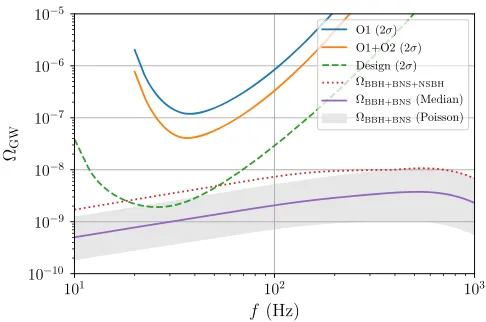
In Fig. 3, we show the prediction of the astrophysical stochastic background from binary black holes (BBHs) and binary neutron stars (BNSs), along with its statistical uncertainty due to Poisson uncertainties in the local binary merger rate. We plot the upper limit allowed from adding the background from neutron star–black hole (NSBH) binaries as a dotted line. We use the same binary formation and evolution scenario to compute the stochastic back-ground from BBH and BNS as in Ref.[59], but we have updated the mass distributions and rates to be consistent with the most recent results given in Refs. [55,91]. For NSBHs, we use the same evolution with redshift as BNSs. As in Refs.[54], for BBHs, we include inspiral, merger, and ringdown contributions computed in Ref.[92], while for NSBH and BNSs, we use only the inspiral part of the waveform. For the BBH mass distribution, we assume a power law in the primary mass pðm1Þ∝m−2.3
1 with the secondary mass drawn from a uniform distribution, subject to the constraints5M⊙ ≤m2≤m1≤50M⊙. In Ref.[55], rate estimates were computed by two pipelines, PyCBC [93]and GstLAL[94]. We use the merger rate measured by GstLAL,Rlocal¼56−þ2744 Gpc−3yr−1[55], because it gives a more conservative (smaller) rate estimate. Using the meth-ods described in Ref. [59], the inferred amplitude of the stochastic background isΩBBHð25HzÞ ¼5.3þ−24..52×10−10. For the BNS mass distribution, following the analysis in Ref.[55], we take each component mass to be drawn from a Gaussian distribution with a mean of 1.33M⊙ and a standard deviation of 0.09M⊙. We use the GstLAL rate of Rlocal¼920−þ7902220 Gpc−3yr−1 [55]. From these inputs, we predict ΩBNSð25HzÞ ¼3.6þ−38..41×10−10. Combining the BBH and BNS results yields a prediction for the total SGWB of ΩBBHþBNSð25HzÞ ¼8.9−þ512.6.6×10−10. This value is about a factor of 2 smaller the one in Ref.[59], due in part to the decrease in the rate measured after analyzing O1 and O2 data with the best available sensitivity and data analysis techniques.
For NSBH, we assume a delta function mass distribu-tion, where the neutron star has a mass of1.4M⊙ and the black hole has a mass of 10M⊙, and we take the upper limit on the rate from GstLAL[55]. The upper limit from NSBH isΩNSBHð25HzÞ ¼9.1×10⁻¹⁰. We show the sum of the upper limit ofΩNSBHðfÞ, with the 90% upper limit on
ΩBBHþBNSðfÞ, as a dotted line in Fig.3.
[image:4.612.60.292.46.216.2]We also show the power law–integrated (PI) curves[96] of the O1 and O2 isotropic background searches. A power-law stochastic background that is tangent to a PI curve is detectable with SNR¼2 by the given search. We addi-tionally show a projected PI curve based on operating
FIG. 2. Posterior distribution for the amplitudeΩrefand slopeα
of the stochastic background, using a prior which is uniform in the logarithm of Ωref, along with contours with 68% and
95% confidence level, using combined O1 and O2 data. There is a small region of increased posterior probability centered around logΩref¼−8andα¼2. This is not statistically
signifi-cant, and similar-size bumps have appeared in simulations of Gaussian noise. An analogous plot with a prior uniform inΩref
[image:4.612.51.299.637.716.2]can be found in the Supplemental Material[87].
TABLE II. 95% credible upper limits on Ωref for different
power-law models (fixedα) as well as marginalizing overα, for combined O1 and O2 data (current limits) and for O1 data (previous limits)[68]. We show results for two priors, one which is uniform in Ωref and one which is uniform in the logarithm
ofΩref.
Uniform prior Log-uniform prior
α O1þO2 O1 O1þO2 O1
0 6.0×10⁻⁸ 1.7×10⁻⁷ 3.5×10⁻⁸ 6.4×10⁻⁸
Advanced LIGO and Advanced Virgo at design sensitivity for 2 years, with 50% network duty cycle. By design sensitivity, we refer to a noise curve which is determined by fundamental noise sources. We use the Advanced LIGO design sensitivity projection given in Ref. [95], which incorporates improved measurements of coating thermal noise relative to the one assumed in Ref.[58]. This updated curve introduces additional broadband noise at low fre-quencies relative to previous estimates. As a result, the updated design-sensitivity PI curve is less sensitive than the one shown in Ref. [58].
VII. IMPLICATIONS FOR COSMIC STRING MODELS
Cosmic strings [97,98] are linear topological defects which are expected to be generically produced within the context of grand unified theories[99]. The dynamics of a cosmic string network is driven by the formation of loops and the emission of gravitational waves [100,101]. One may therefore use the stochastic background in order to constrain the parameters of a cosmic string network.
We will focus on Nambu-Goto strings [102,103], for which the string thickness is zero and the intercommutation probability equals unity. Gravitational waves will allow us to constrain the string tensionGμ=c2, whereμdenotes the mass per unit length. This dimensionless parameter is the single quantity that characterizes a Nambu-Goto string network.
We will consider two analytic models of cosmic string loop distributions [104,105]. The former [104] gives the distribution of string loops of given size at fixed time, under the assumption that the momentum dependence of the loop production function is weak. The latter[105]is based on a different numerical simulation[106] and gives the distri-bution of non–self intersecting loops at a given time[107]. The corresponding limits found by combining O1 and O2 data areGμ=c2≤1.1×10⁻⁶for the model of Ref.[104]and Gμ=c2≤2.1×10⁻¹⁴ for the model of Ref. [105]. The Advanced LIGO constraints are stronger for the model of Ref.[105]because the predicted spectrum is larger at 100 Hz for that model. This can be compared with the pulsar timing limits, Gμ=c2≤1.6×10⁻¹¹ and Gμ=c2≤6.2×10⁻¹², respectively[108].
VIII. TEST OF GENERAL RELATIVITY
Alternative theories of gravity generically predict the presence of vector or scalar gravitational-wave polarizations in addition to the standard tensor polarizations allowed in general relativity. Detection of the stochastic background would allow for direct measurement of its polarization content, enabling new tests of general relativity[61,62].
When allowing for the presence of alternative gravita-tional-wave polarizations, the expectation value of the cross-correlation statistic becomes
hCˆðfÞi ¼X
A
βAðfÞΩAGWðfÞ ¼
X
A
βAðfÞΩAref
f fref
α A
; ð9Þ
where βA¼γAðfÞ=γTðfÞ and A labels the polarization, A¼ fT; V; Sg. The functions γTðfÞ,γVðfÞ, andγSðfÞare the overlap reduction functions for tensor, vector, and scalar polarizations [61]. Because these overlap reduction func-tions are distinct, the spectral shape ofCˆðfÞenables us to infer the polarization content of the stochastic background. While we use the notation ΩAGWðfÞ in analogy with the general relativity (GR) case, in a general modification of gravity, the quantitiesΩTGWðfÞ, ΩVGWðfÞ, andΩSGWðfÞare best understood as a measurement of the two-point corre-lation statistics of different components of the stochastic background rather than energy densities[109].
Following Refs. [61,62], we compute two Bayesian odds: oddsOS
N for the presence of a stochastic signal of
any polarization(s) vs Gaussian noise and odds ONGR GR
between a hypothesis allowing for vector and scalar modes and a hypothesis restricting to standard tensor polariza-tions. Using the combined O1 and O2 measurements, we find logOS
N ¼−0.64 and logONGRGR ¼−0.45, consistent
[image:5.612.53.296.45.206.2]with Gaussian noise. Given the nondetection of any generic stochastic background, we use Eq.(9) to place improved upper limits on the tensor, vector, and scalar background amplitudes, after marginalizing over all three spectral indices, using the priors described in the Supplemental
Material[87]. These limits are shown in TableIII, again for both choices of amplitude prior.
IX. ESTIMATE OF CORRELATED MAGNETIC NOISE
Coherent noise between gravitational-wave interferom-eters may be introduced by terrestrial sources such as Schumann resonances, which are global electromagnetic modes of the cavity formed by the Earth’s surface and ionosphere [71]. These fields have very long coherence lengths [110]and can magnetically couple to the gravita-tional-wave channel and lead to broadband noise that is coherent between different gravitational-wave detectors. As the detectors become more sensitive, eventually this source of correlated noise may become visible to the cross-correlation search and, if not treated carefully, will bias the analysis by appearing as an apparent stochastic back-ground. Unlike the lines and combs discussed in Ref.[85], we cannot simply remove affected frequency bins from the analysis because Schumann noise is broadband.
Here, we estimate the level of correlated electromagnetic noise (from Schumann resonances or other sources) in O2 following Refs.[68,111,112]. We first measure the cross-power spectral density M12ðfÞ between two Bartington Model MAG-03MC magnetometers [113] installed at Hanford and Livingston. We then estimate the transfer function TiðfÞ (i¼ f1;2g) between the magnetometer channel and the gravitational-wave channel at each site, as described in Ref. [114]. Finally, we combine these results to produce an estimate for the amount of correlated magnetic noise, which we express in terms of an effective gravitational-wave energy density ΩmagðfÞ,
ΩmagðfÞ ¼jT1ðfÞjjT2ðfÞjRe½M12ðfÞ
γTðfÞS0ðfÞ : ð10Þ
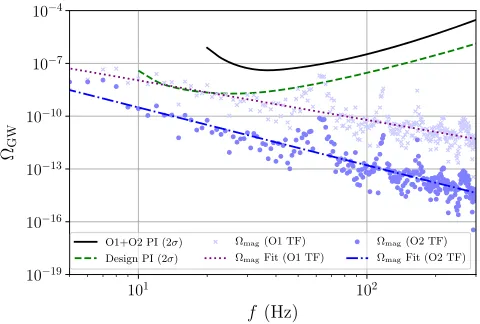
We show ΩmagðfÞ in Fig. 4, alongside the measured O1 +O2 PI curve and the projected design-sensitivity PI curve. The trend for the magnetic noise lies significantly below the O1+O2 PI curve, indicating that correlated magnetic noise is more than an order of magnitude below the sensitivity curve in O2, although it may be an issue for future runs.
Experimental improvements can mitigate this risk by further reducing the coupling of correlated noise. From O1 to O2, for instance, the magnetic coupling was reduced by approximately an order of magnitude, as indicated by the dotted and dot-dashed curves in Fig. 4. Additionally, work is ongoing to develop Wiener filtering to subtract Schumann noise[110,112,115]and to develop a parameter estimation framework to measure or place upper limits on the level of magnetic contamination[116]. This work will take advantage of low noise LEMI-120 magnetometers [117] that were recently installed at both LIGO sites, as described in the Supplemental Material[87].
X. CONCLUSIONS
We have presented the results of a cross-correlation search for the isotropic stochastic background using data from Advanced LIGO’s first and second observing runs. While we did not find evidence for the stochastic back-ground, we obtain the most sensitive upper limits to date in the approximately 20–100 Hz frequency band. We have also placed improved upper limits on the existence of a stochastic background from vector and scalar-polarized gravitational waves.
[image:6.612.318.558.46.208.2]While the upper limits on the SGWB presented in this work are the strongest direct limits in the frequency band of current ground-based gravitational-wave detectors, other
TABLE III. Upper limits on different polarizations. To obtain the upper limits, we assume a log uniform and a uniform prior on the amplitudeΩreffor each polarization, using combined O1 and
O2 data. We assume the presence of a tensor, vector, and scalar backgrounds and then marginalize over the spectral indices and two amplitudes for the three different polarization modes, as described in the main text.
Polarization Uniform prior Log-uniform prior
Tensor 8.2×10⁻⁸ 3.2×10⁻⁸
Vector 1.2×10⁻⁷ 2.9×10⁻⁸
[image:6.612.52.298.131.187.2]Scalar 4.2×10⁻⁷ 6.1×10⁻⁸
FIG. 4. Conservative estimate of correlated magnetic noise. We assume a conservative transfer function (TF) based on measure-ments as described in the text. The first Schumann resonance at 8 Hz is visible, and higher harmonics are below the noise floor. There is a zero of the overlap function at 64 Hz which leads to an apparent feature in Ωmag. Power line harmonics have been
observations place stronger constraints in other frequency bands. The NANOGrav Collaboration has reported the 95% upper limit of ΩGW <7.4×10⁻¹⁰ at a frequency of 1yr−1 after marginalizing over uncertainty in the Solar system ephemeris[118]. Combining data from thePlanck satellite and the BICEP2/Keck array constrains the tensor-to-scalar ratio from the cosmic microwave background to be r <0.064 at 95% confidence at comoving scales of k¼0.002Mpc−1, corresponding to a gravitational-wave frequency of f0.002¼ ð2πÞ−1ck¼3.1×10⁻¹⁸ Hz [119],
assuming the single field slow roll consistency condition. Using Eq.(4)of Ref.[108], this can be converted into the constraint ΩGWðfÞ≤3.2×10⁻¹⁶×ðf=f0.05Þ−r=8½16=9þ f2
eq=ð2f2Þ, where feq is the frequency of a gravitational
wave of which the wavelength was the size of the Universe at matter-radiation equality and f0.05 is the pivot scale.
Combining constraints at different frequency ranges can probe models which span many orders of magnitude in frequency [108,119].
While we have targeted an isotropic, stationary, and Gaussian background, other search techniques can probe backgrounds that violate one or more of these assumptions. Upper limits on an anisotropic gravitational-wave back-ground from O1 were presented in Ref.[120]. Furthermore, non-Gaussian searches targeting the compact binary stochastic background are currently being developed [121–124]. A successful detection of the stochastic back-ground by any of these approaches would offer a new probe of the gravitational-wave sky.
The supporting data for this paper are openly available via the LIGO Document Control Center (DCC)[86].
ACKNOWLEDGMENTS
The authors gratefully acknowledge the support of the United States National Science Foundation (NSF) for the construction and operation of the LIGO Laboratory and Advanced LIGO as well as the Science and Technology Facilities Council (STFC) of the United Kingdom, the Max-Planck-Society (MPS), and the State of Niedersachsen/Germany for support of the construction of Advanced LIGO and construction and operation of the GEO600 detector. Additional support for Advanced LIGO was provided by the Australian Research Council. The
authors gratefully acknowledge the Italian Istituto Nazionale di Fisica Nucleare (INFN), the French Centre National de la Recherche Scientifique (CNRS), and the Foundation for Fundamental Research on Matter supported by the Netherlands Organisation for Scientific Research for the construction and operation of the Virgo detector and the creation and support of the European Gravitational Observatory (EGO) consortium. The authors also gratefully acknowledge research support from these agencies as well as by the Council of Scientific and Industrial Research of India, the Department of Science and Technology, India; the Science & Engineering Research Board, India; the Ministry of Human Resource Development, India; the Spanish Agencia Estatal de Investigación; the Vicepresid`encia i Conselleria d’Innovació; Recerca i Turisme and the Conselleria d’Educació i Universitat del Govern de les Illes Balears; the Conselleria d’Educació, Investigació, Cultura i Esport de la Generalitat Valenciana; the National Science Centre of Poland; the Swiss National Science Foundation; the Russian Foundation for Basic Research; the Russian Science Foundation; the European Commission; the European Regional Development Funds; the Royal Society; the Scottish Funding Council; the Scottish Universities Physics Alliance; the Hungarian Scientific Research Fund; the Lyon Institute of Origins; the Paris Île-de-France Region; the National Research, Development and Innovation Office, Hungary; the National Research Foundation of Korea; Industry Canada and the Province of Ontario through the Ministry of Economic Development and Innovation; the Natural Science and Engineering Research Council Canada; the Canadian Institute for Advanced Research; the Brazilian Ministry of Science, Technology, Innovations, and Communications; the International Center for Theoretical Physics South American Institute for Fundamental Research; the Research Grants Council of Hong Kong; the National Natural Science Foundation of China; the Leverhulme Trust, the Research Corporation; the Ministry of Science and Technology, Taiwan; and the Kavli Foundation. The authors gratefully acknowledge the support of the NSF, STFC, MPS, INFN, CNRS, and the State of Niedersachsen/ Germany for provision of computational resources. This article has been assigned the document number LIGO-P1800258.
[1] X.-J. Zhu, E. J. Howell, D. G. Blair, and Z.-H. Zhu,Mon. Not. R. Astron. Soc.431, 882 (2013).
[2] S. Marassi, R. Schneider, G. Corvino, V. Ferrari, and S. P. Zwart,Phys. Rev. D84, 124037 (2011).
[3] C. Wu, V. Mandic, and T. Regimbau, Phys. Rev. D 85, 104024 (2012).
[4] P. A. Rosado,Phys. Rev. D84, 084004 (2011).
[5] X.-J. Zhu, E. Howell, T. Regimbau, D. Blair, and Z.-H. Zhu,Astrophys. J.739, 86 (2011).
[6] P. A. Rosado,Phys. Rev. D84, 084004 (2011).
[8] X.-J. Zhu, E. J. Howell, D. G. Blair, and Z.-H. Zhu,Mon. Not. R. Astron. Soc.431, 882 (2013).
[9] A. Buonanno, G. Sigl, G. G. Raffelt, H.-T. Janka, and E. Muller,Phys. Rev. D72, 084001 (2005).
[10] P. Sandick, K. A. Olive, F. Daigne, and E. Vangioni,Phys. Rev. D73, 104024 (2006).
[11] S. Marassi, R. Schneider, and V. Ferrari, Mon. Not. R. Astron. Soc.398, 293 (2009).
[12] X.-J. Zhu, E. Howell, and D. Blair,Mon. Not. R. Astron. Soc.409, L132 (2010).
[13] A. Buonanno, G. Sigl, G. G. Raffelt, H.-T. Janka, and E. Müller,Phys. Rev. D72, 084001 (2005).
[14] P. Sandick, K. A. Olive, F. Daigne, and E. Vangioni,Phys. Rev. D73, 104024 (2006).
[15] V. Ferrari, S. Matarrese, and R. Schneider,Mon. Not. R. Astron. Soc.303, 258 (1999).
[16] T. Regimbau and J. A. de Freitas Pacheco, Astron. As-trophys.376, 381 (2001).
[17] P. D. Lasky, M. F. Bennett, and A. Melatos,Phys. Rev. D 87, 063004 (2013).
[18] P. A. Rosado,Phys. Rev. D86, 104007 (2012).
[19] X.-J. Zhu, X.-L. Fan, and Z.-H. Zhu,Astrophys. J.729, 59 (2011).
[20] P. A. Rosado,Phys. Rev. D86, 104007 (2012).
[21] S. Marassi, R. Ciolfi, R. Schneider, L. Stella, and V. Ferrari,Mon. Not. R. Astron. Soc. 411, 2549 (2011). [22] E. Howell, T. Regimbau, A. Corsi, D. Coward, and R.
Burman,Mon. Not. R. Astron. Soc.410, 2123 (2011). [23] C.-J. Wu, V. Mandic, and T. Regimbau,Phys. Rev. D87,
042002 (2013).
[24] E. Howell, D. Coward, R. Burman, D. Blair, and J. Gilmore,Mon. Not. R. Astron. Soc.351, 1237 (2004). [25] K. Crocker, V. Mandic, T. Regimbau, K. Belczynski, W.
Gladysz, K. Olive, T. Prestegard, and E. Vangioni,Phys. Rev. D92, 063005 (2015).
[26] K. Crocker, T. Prestegard, V. Mandic, T. Regimbau, K. Olive, and E. Vangioni, Phys. Rev. D 95, 063015 (2017).
[27] T. Damour and A. Vilenkin, Phys. Rev. D 71, 063510 (2005).
[28] T. W. B. Kibble,J. Phys. A 9, 1387 (1976).
[29] S. Sarangi and S.-H. H. Tye,Phys. Lett. B536, 185 (2002). [30] X. Siemens, V. Mandic, and J. Creighton,Phys. Rev. Lett.
98, 111101 (2007).
[31] B. Abbott et al. (LIGO Scientific and Virgo Collabora-tions),Phys. Rev. D97, 102002 (2018).
[32] V. Mandic, S. Bird, and I. Cholis,Phys. Rev. Lett. 117, 201102 (2016).
[33] M. Sasaki, T. Suyama, T. Tanaka, and S. Yokoyama,Phys. Rev. Lett.117, 061101 (2016).
[34] S. Wang, Y.-F. Wang, Q.-G. Huang, and T. G. F. Li,Phys. Rev. Lett.120, 191102 (2018).
[35] R. Brito, S. Ghosh, E. Barausse, E. Berti, V. Cardoso, I. Dvorkin, A. Klein, and P. Pani, Phys. Rev. Lett. 119, 131101 (2017).
[36] R. Brito, S. Ghosh, E. Barausse, E. Berti, V. Cardoso, I. Dvorkin, A. Klein, and P. Pani,Phys. Rev. D96, 064050 (2017).
[37] X.-L. Fan and Y.-B. Chen, Phys. Rev. D 98, 044020 (2018).
[38] L. Tsukada, T. Callister, A. Matas, and P. Meyers,Phys. Rev. D99, 103015 (2019).
[39] R. Bar-Kana,Phys. Rev. D50, 1157 (1994).
[40] A. A. Starobinski˘ı, Sov. J. Exp. Theor. Phys. 30, 682 (1979).
[41] R. Easther, J. T. Giblin, Jr., and E. A. Lim,Phys. Rev. Lett. 99, 221301 (2007).
[42] N. Barnaby, E. Pajer, and M. Peloso, Phys. Rev. D85, 023525 (2012).
[43] J. L. Cook and L. Sorbo,Phys. Rev. D85, 023534 (2012). [44] A. Lopez and K. Freese,J. Cosmol. Astropart. Phys. 01
(2015) 037.
[45] M. S. Turner,Phys. Rev. D55, R435 (1997).
[46] R. Easther and E. A. Lim,J. Cosmol. Astropart. Phys. 04 (2006) 010.
[47] S. G. Crowder, R. Namba, V. Mandic, S. Mukohyama, and M. Peloso,Phys. Lett. B726, 66 (2013).
[48] B. P. Abbottet al.(LIGO Scientific and Virgo Collabora-tions),Phys. Rev. Lett.119, 141101 (2017).
[49] B. P. Abbottet al.(LIGO Scientific and Virgo Collabora-tions),Astrophys. J. Lett.851, L35 (2017).
[50] B. P. Abbott et al. (LIGO Scientific and Virgo Collaborations), Phys. Rev. Lett.118, 221101 (2017). [51] B. P. Abbottet al.(LIGO Scientific and Virgo
Collabora-tions),Phys. Rev. Lett.116, 241103 (2016).
[52] B. P. Abbottet al.(LIGO Scientific and Virgo Collabora-tions),Phys. Rev. Lett.116, 061102 (2016).
[53] B. P. Abbott et al. (LIGO Scientific and Virgo Collaborations), Astrophys. J. Lett.832, L21 (2016). [54] B. P. Abbottet al.(LIGO Scientific and Virgo
Collabora-tions),Phys. Rev. Lett.119, 161101 (2017).
[55] B. P. Abbottet al.(LIGO Scientific and Virgo Collabora-tions),arXiv:1811.12907.
[56] J. Aasi et al., Classical Quantum Gravity 32, 074001 (2015).
[57] F. Acerneseet al.,Classical Quantum Gravity32, 024001 (2015).
[58] B. P. Abbottet al.(LIGO Scientific and Virgo Collabora-tions),Phys. Rev. Lett.116, 131102 (2016).
[59] B. P. Abbottet al.(LIGO Scientific and Virgo Collabora-tions),Phys. Rev. Lett.120, 091101 (2018).
[60] T. Callister, L. Sammut, S. Qiu, I. Mandel, and E. Thrane,
Phys. Rev. X6, 031018 (2016).
[61] T. Callister, A. S. Biscoveanu, N. Christensen, M. Isi, A. Matas, O. Minazzoli, T. Regimbau, M. Sakellariadou, J. Tasson, and E. Thrane, Phys. Rev. X 7, 041058 (2017).
[62] B. P. Abbottet al.(LIGO Scientific and Virgo Collabora-tions),Phys. Rev. Lett.120, 201102 (2018).
[63] D. M. Eardley, D. L. Lee, A. P. Lightman, R. V. Wagoner, and C. M. Will,Phys. Rev. Lett.30, 884 (1973). [64] D. M. Eardley, D. L. Lee, and A. P. Lightman,Phys. Rev. D
8, 3308 (1973).
[65] C. M. Will,Living Rev. Relativity17, 4 (2014).
[66] J. D. Romano and N. J. Cornish,Living Rev. Relativity20, 2 (2017).
[67] N. Christensen,Rep. Prog. Phys.82, 016903 (2019). [68] B. P. Abbottet al.(LIGO Scientific and Virgo
Collabora-tions),Phys. Rev. Lett.118, 121101 (2017).
[70] B. P. Abbottet al.(LIGO Scientific and Virgo Collabora-tions),Phys. Rev. D100, 062001 (2019).
[71] W. Schumann, Z. Naturforsch. A7, 250 (1952). [72] P. A. R. Adeet al.,Astron. Astrophys.594, A13 (2016). [73] N. Christensen,Phys. Rev. D46, 5250 (1992).
[74] B. Allen and J. D. Romano, Phys. Rev. D 59, 102001 (1999).
[75] Strictly speaking, the optimal search would also include the detector autocorrelation in the likelihood, effectively describing subtraction of the noise power spectrum. However, in practice, the Advanced LIGO noise spectrum is not known well enough for this approach to be effective. [76] V. Mandic, E. Thrane, S. Giampanis, and T. Regimbau,
Phys. Rev. Lett.109, 171102 (2012).
[77] T. Regimbau,Res. Astron. Astrophys.11, 369 (2011). [78] C. Caprini and D. G. Figueroa,Classical Quantum Gravity
35, 163001 (2018).
[79] J. C. Driggerset al.(LIGO Scientific Collaboration),Phys. Rev. D99, 042001 (2019).
[80] D. Davis, T. J. Massinger, A. P. Lundgren, J. C. Driggers, A. L. Urban, and L. K. Nuttall,Classical Quantum Gravity 36, 055011 (2019).
[81] J. C. Driggers, M. Evans, K. Pepper, and R. Adhikari,Rev. Sci. Instrum.83, 024501 (2012).
[82] G. D. Meadors, K. Kawabe, and K. Riles, Classical Quantum Gravity31, 105014 (2014).
[83] V. Tiwari et al.,Classical Quantum Gravity 32, 165014 (2015).
[84] More precisely, we require that both detectors are in observing mode and that no Category 1 vetoes are applied
[125].
[85] P. Covaset al.(LSC Instrument Authors),Phys. Rev. D97, 082002 (2018).
[86] LIGO Scientific and Virgo Collaborations, Data for A search for the isotropic stochastic background using data from Advanced LIGO's second observing run, 2019 Data,
https://dcc.ligo.org/LIGO-T1900058/public(2019). [87] See Supplemental Material at http://link.aps.org/
supplemental/10.1103/PhysRevD.100.061101 for more details on our parameter estimation framework, and a comparison of LEMI and Bartington magnetometers for measuring Schumann resonances.
[88] J. T. Whelan, E. L. Robinson, J. D. Romano, and E. H. Thrane,J. Phys. Conf. Ser.484, 012027 (2014). [89] C. Cahillaneet al.(LIGO Scientific Collaboration),Phys.
Rev. D96, 102001 (2017).
[90] A. Viets et al., Classical Quantum Gravity 35, 095015 (2018).
[91] B. P. Abbottet al.(LIGO Scientific and Virgo Collabora-tions),arXiv:1811.12940.
[92] P. Ajith et al.,Phys. Rev. D77, 104017 (2008). [93] S. A. Usmanet al.,Classical Quantum Gravity33, 215004
(2016).
[94] C. Messicket al.,Phys. Rev. D95, 042001 (2017). [95] L. Barsotti, P. Fritschel, M. Evans, and S. Gras,https://dcc
.ligo.org/T1800044-v5/public.
[96] E. Thrane and J. D. Romano, Phys. Rev. D 88, 124032 (2013).
[97] T. W. B. Kibble,J. Phys. A9, 1387 (1976).
[98] A. Vilenkin and E. P. S. Shellard, Cosmic Strings and Other Topological Defects(Cambridge University Press, Cambridge, England, 2000).
[99] R. Jeannerot, J. Rocher, and M. Sakellariadou,Phys. Rev. D68, 103514 (2003).
[100] T. Vachaspati and A. Vilenkin, Phys. Rev. D 31, 3052 (1985).
[101] M. Sakellariadou,Phys. Rev. D42, 354 (1990);43, 4150 (E) (1991).
[102] Y. Nambu, Lectures at the Copenhagen Symposium, 1970 (unpublished).
[103] T. Goto,Prog. Theor. Phys.46, 1560 (1971).
[104] J. J. Blanco-Pillado, K. D. Olum, and B. Shlaer,Phys. Rev. D89, 023512 (2014).
[105] L. Lorenz, C. Ringeval, and M. Sakellariadou,J. Cosmol. Astropart. Phys. 10 (2010) 003.
[106] C. Ringeval, M. Sakellariadou, and F. Bouchet,J. Cosmol. Astropart. Phys. 02 (2007) 023.
[107] These models are dubbed modelM¼2and modelM¼3 in Ref.[31]. We do not discuss modelM¼1of Ref.[31], which assumes that all loops are formed with the same relative size, since such a hypothesis is not supported by any numerical simulation of Nambu-Goto string networks. [108] P. D. Laskyet al.,Phys. Rev. X6, 011035 (2016). [109] M. Isi and L. C. Stein,Phys. Rev. D98, 104025 (2018). [110] M. W. Coughlinet al.,Phys. Rev. D97, 102007 (2018). [111] E. Thrane, N. Christensen, and R. Schofield,Phys. Rev. D
87, 123009 (2013).
[112] E. Thrane, N. Christensen, R. M. S. Schofield, and A. Effler, Phys. Rev. D90, 023013 (2014).
[113]http://www.bartington.com.
[114]https://alog.ligo-wa.caltech.edu/aLOG/index.php? callRep=39199.
[115] M. W. Coughlin et al., Classical Quantum Gravity 33, 224003 (2016).
[116] P. M. Meyers, Cross-correlation searches for persistent gravitational waves with Advanced LIGO and noise studies for current and future ground-based gravita-tional-wave detectors, Ph.D. thesis, University of Minnesota, 2018.
[117]http://www.lemisensors.com.
[118] Z. Arzoumanian et al. (NANOGRAV Collaboration),
Astrophys. J.859, 47 (2018).
[119] Y. Akramiet al.(Planck Collaboration),Astrophys. Space Sci.364, 69 (2019).
[120] B. P. Abbottet al.(LIGO Scientific and Virgo Collabora-tions),Phys. Rev. Lett.118, 121102 (2017).
[121] E. Thrane,Phys. Rev. D87, 043009 (2013).
[122] L. Martellini and T. Regimbau,Phys. Rev. D89, 124009 (2014).
[123] L. Martellini and T. Regimbau,Phys. Rev. D92, 104025 (2015).
[124] R. Smith and E. Thrane, Phys. Rev. X 8, 021019 (2018).
B. P. Abbott,1R. Abbott,1T. D. Abbott,2S. Abraham,3F. Acernese,4,5K. Ackley,6C. Adams,7V. B. Adya,8,9C. Affeldt,8,9 M. Agathos,10K. Agatsuma,11N. Aggarwal,12O. D. Aguiar,13L. Aiello,14,15A. Ain,3P. Ajith,16G. Allen,17A. Allocca,18,19 M. A. Aloy,20P. A. Altin,21A. Amato,22A. Ananyeva,1S. B. Anderson,1W. G. Anderson,23S. V. Angelova,24S. Antier,25 S. Appert,1K. Arai,1M. C. Araya,1J. S. Areeda,26M. Ar`ene,27N. Arnaud,25,28K. G. Arun,29S. Ascenzi,30,31G. Ashton,6 S. M. Aston,7P. Astone,32F. Aubin,33P. Aufmuth,9 K. AultONeal,34C. Austin,2 V. Avendano,35A. Avila-Alvarez,26 S. Babak,36,27P. Bacon,27F. Badaracco,14,15M. K. M. Bader,37S. Bae,38P. T. Baker,39F. Baldaccini,40,41G. Ballardin,28
S. W. Ballmer,42S. Banagiri,43J. C. Barayoga,1S. E. Barclay,44B. C. Barish,1 D. Barker,45K. Barkett,46S. Barnum,12 F. Barone,4,5 B. Barr,44L. Barsotti,12M. Barsuglia,27D. Barta,47J. Bartlett,45I. Bartos,48R. Bassiri,49A. Basti,18,19 M. Bawaj,50,41 J. C. Bayley,44M. Bazzan,51,52 B. B´ecsy,53M. Bejger,27,54I. Belahcene,25A. S. Bell,44D. Beniwal,55 B. K. Berger,49G. Bergmann,8,9S. Bernuzzi,56,57J. J. Bero,58C. P. L. Berry,59D. Bersanetti,60A. Bertolini,37J. Betzwieser,7
R. Bhandare,61J. Bidler,26I. A. Bilenko,62 S. A. Bilgili,39G. Billingsley,1J. Birch,7 R. Birney,24O. Birnholtz,58 S. Biscans,1,12S. Biscoveanu,6A. Bisht,9M. Bitossi,28,19M. A. Bizouard,25J. K. Blackburn,1 C. D. Blair,7D. G. Blair,63 R. M. Blair,45S. Bloemen,64N. Bode,8,9 M. Boer,65Y. Boetzel,66G. Bogaert,65F. Bondu,67E. Bonilla,49R. Bonnand,33 P. Booker,8,9 B. A. Boom,37C. D. Booth,68R. Bork,1 V. Boschi,28S. Bose,69,3K. Bossie,7 V. Bossilkov,63J. Bosveld,63 Y. Bouffanais,27A. Bozzi,28C. Bradaschia,19P. R. Brady,23A. Bramley,7 M. Branchesi,14,15 J. E. Brau,70T. Briant,71 J. H. Briggs,44F. Brighenti,72,73A. Brillet,65M. Brinkmann,8,9V. Brisson,25,aP. Brockill,23A. F. Brooks,1D. D. Brown,55
S. Brunett,1 A. Buikema,12T. Bulik,74H. J. Bulten,75,37 A. Buonanno,36,76D. Buskulic,33C. Buy,27R. L. Byer,49 M. Cabero,8,9 L. Cadonati,77G. Cagnoli,22,78 C. Cahillane,1 J. Calderón Bustillo,6 T. A. Callister,1 E. Calloni,79,5 J. B. Camp,80W. A. Campbell,6 M. Canepa,81,60 K. C. Cannon,82H. Cao,55J. Cao,83E. Capocasa,27F. Carbognani,28 S. Caride,84M. F. Carney,59G. Carullo,18J. Casanueva Diaz,19C. Casentini,30,31S. Caudill,37M. Cavagli`a,85F. Cavalier,25
R. Cavalieri,28G. Cella,19 P. Cerdá-Durán,20G. Cerretani,18,19E. Cesarini,86,31O. Chaibi,65 K. Chakravarti,3 S. J. Chamberlin,87M. Chan,44 S. Chao,88P. Charlton,89E. A. Chase,59E. Chassande-Mottin,27D. Chatterjee,23 M. Chaturvedi,61B. D. Cheeseboro,39H. Y. Chen,90X. Chen,63Y. Chen,46H.-P. Cheng,48C. K. Cheong,91H. Y. Chia,48 A. Chincarini,60A. Chiummo,28G. Cho,92H. S. Cho,93M. Cho,76N. Christensen,65,94Q. Chu,63S. Chua,71K. W. Chung,91
S. Chung,63 G. Ciani,51,52A. A. Ciobanu,55 R. Ciolfi,95,96 F. Cipriano,65A. Cirone,81,60F. Clara,45J. A. Clark,77 P. Clearwater,97 F. Cleva,65C. Cocchieri,85E. Coccia,14,15P.-F. Cohadon,71D. Cohen,25R. Colgan,98M. Colleoni,99 C. G. Collette,100C. Collins,11L. R. Cominsky,101M. Constancio Jr.,13L. Conti,52S. J. Cooper,11P. Corban,7T. R. Corbitt,2 I. Cordero-Carrión,102K. R. Corley,98N. Cornish,53A. Corsi,84S. Cortese,28C. A. Costa,13R. Cotesta,36M. W. Coughlin,1 S. B. Coughlin,68,59J.-P. Coulon,65S. T. Countryman,98 P. Couvares,1 P. B. Covas,99E. E. Cowan,77D. M. Coward,63
M. J. Cowart,7 D. C. Coyne,1 R. Coyne,103J. D. E. Creighton,23T. D. Creighton,104 J. Cripe,2 M. Croquette,71 S. G. Crowder,105T. J. Cullen,2A. Cumming,44L. Cunningham,44E. Cuoco,28 T. Dal Canton,80 G. Dálya,106 S. L. Danilishin,8,9S. D’Antonio,31K. Danzmann,9,8A. Dasgupta,107C. F. Da Silva Costa,48L. E. H. Datrier,44V. Dattilo,28
I. Dave,61M. Davier,25D. Davis,42E. J. Daw,108 D. DeBra,49M. Deenadayalan,3J. Degallaix,22M. De Laurentis,79,5 S. Del´eglise,71W. Del Pozzo,18,19L. M. DeMarchi,59N. Demos,12T. Dent,8,9,109R. De Pietri,110,57J. Derby,26R. De Rosa,79,5
C. De Rossi,22,28R. DeSalvo,111 O. de Varona,8,9 S. Dhurandhar,3 M. C. Díaz,104T. Dietrich,37L. Di Fiore,5 M. Di Giovanni,112,96T. Di Girolamo,79,5A. Di Lieto,18,19B. Ding,100S. Di Pace,113,32I. Di Palma,113,32F. Di Renzo,18,19 A. Dmitriev,11Z. Doctor,90F. Donovan,12K. L. Dooley,68,85S. Doravari,8,9I. Dorrington,68T. P. Downes,23M. Drago,14,15
J. C. Driggers,45Z. Du,83 J.-G. Ducoin,25P. Dupej,44I. Dvorkin,36 S. E. Dwyer,45P. J. Easter,6 T. B. Edo,108 M. C. Edwards,94A. Effler,7P. Ehrens,1J. Eichholz,1S. S. Eikenberry,48M. Eisenmann,33R. A. Eisenstein,12R. C. Essick,90 H. Estelles,99D. Estevez,33Z. B. Etienne,39T. Etzel,1M. Evans,12T. M. Evans,7V. Fafone,30,31,14H. Fair,42S. Fairhurst,68 X. Fan,83S. Farinon,60B. Farr,70W. M. Farr,11E. J. Fauchon-Jones,68M. Favata,35M. Fays,108 M. Fazio,114 C. Fee,115 J. Feicht,1M. M. Fejer,49F. Feng,27A. Fernandez-Galiana,12I. Ferrante,18,19E. C. Ferreira,13T. A. Ferreira,13F. Ferrini,28 F. Fidecaro,18,19I. Fiori,28D. Fiorucci,27M. Fishbach,90R. P. Fisher,42,116J. M. Fishner,12M. Fitz-Axen,43R. Flaminio,33,117 M. Fletcher,44E. Flynn,26H. Fong,118J. A. Font,20,119 P. W. F. Forsyth,21J.-D. Fournier,65S. Frasca,113,32 F. Frasconi,19 Z. Frei,106A. Freise,11R. Frey,70V. Frey,25P. Fritschel,12V. V. Frolov,7P. Fulda,48M. Fyffe,7H. A. Gabbard,44B. U. Gadre,3
J. George,61L. Gergely,123V. Germain,33S. Ghonge,77Abhirup Ghosh,16Archisman Ghosh,37S. Ghosh,23 B. Giacomazzo,112,96J. A. Giaime,2,7K. D. Giardina,7A. Giazotto,19,aK. Gill,34G. Giordano,4,5L. Glover,111P. Godwin,87 E. Goetz,45R. Goetz,48B. Goncharov,6 G. González,2 J. M. Gonzalez Castro,18,19A. Gopakumar,124M. L. Gorodetsky,62 S. E. Gossan,1 M. Gosselin,28R. Gouaty,33A. Grado,125,5 C. Graef,44M. Granata,22A. Grant,44S. Gras,12P. Grassia,1 C. Gray,45R. Gray,44G. Greco,72,73A. C. Green,11,48R. Green,68E. M. Gretarsson,34P. Groot,64H. Grote,68S. Grunewald,36 P. Gruning,25G. M. Guidi,72,73H. K. Gulati,107Y. Guo,37A. Gupta,87M. K. Gupta,107E. K. Gustafson,1 R. Gustafson,126 L. Haegel,99O. Halim,15,14 B. R. Hall,69E. D. Hall,12E. Z. Hamilton,68G. Hammond,44M. Haney,66M. M. Hanke,8,9
J. Hanks,45C. Hanna,87O. A. Hannuksela,91J. Hanson,7 T. Hardwick,2 K. Haris,16J. Harms,14,15 G. M. Harry,127 I. W. Harry,36 C.-J. Haster,118 K. Haughian,44F. J. Hayes,44 J. Healy,58A. Heidmann,71M. C. Heintze,7 H. Heitmann,65 P. Hello,25 G. Hemming,28M. Hendry,44I. S. Heng,44J. Hennig,8,9A. W. Heptonstall,1 Francisco Hernandez Vivanco,6 M. Heurs,8,9S. Hild,44T. Hinderer,128,37,129D. Hoak,28S. Hochheim,8,9 D. Hofman,22A. M. Holgado,17N. A. Holland,21 K. Holt,7 D. E. Holz,90P. Hopkins,68 C. Horst,23J. Hough,44E. J. Howell,63C. G. Hoy,68A. Hreibi,65E. A. Huerta,17 D. Huet,25B. Hughey,34M. Hulko,1S. Husa,99S. H. Huttner,44T. Huynh-Dinh,7B. Idzkowski,74A. Iess,30,31C. Ingram,55 R. Inta,84G. Intini,113,32B. Irwin,115H. N. Isa,44J.-M. Isac,71M. Isi,1B. R. Iyer,16K. Izumi,45T. Jacqmin,71S. J. Jadhav,130 K. Jani,77N. N. Janthalur,130P. Jaranowski,131A. C. Jenkins,132J. Jiang,48D. S. Johnson,17A. W. Jones,11D. I. Jones,133
R. Jones,44R. J. G. Jonker,37 L. Ju,63 J. Junker,8,9 C. V. Kalaghatgi,68 V. Kalogera,59B. Kamai,1S. Kandhasamy,85 G. Kang,38 J. B. Kanner,1 S. J. Kapadia,23S. Karki,70K. S. Karvinen,8,9 R. Kashyap,16 M. Kasprzack,1 S. Katsanevas,28 E. Katsavounidis,12W. Katzman,7S. Kaufer,9 K. Kawabe,45N. V. Keerthana,3F. K´ef´elian,65D. Keitel,44R. Kennedy,108
J. S. Key,134F. Y. Khalili,62H. Khan,26I. Khan,14,31S. Khan,8,9 Z. Khan,107E. A. Khazanov,135M. Khursheed,61 N. Kijbunchoo,21 Chunglee Kim,136J. C. Kim,137K. Kim,91 W. Kim,55W. S. Kim,138 Y.-M. Kim,139 C. Kimball,59 E. J. King,55P. J. King,45M. Kinley-Hanlon,127R. Kirchhoff,8,9J. S. Kissel,45L. Kleybolte,140J. H. Klika,23S. Klimenko,48 T. D. Knowles,39P. Koch,8,9S. M. Koehlenbeck,8,9G. Koekoek,37,141S. Koley,37V. Kondrashov,1A. Kontos,12N. Koper,8,9 M. Korobko,140W. Z. Korth,1I. Kowalska,74D. B. Kozak,1V. Kringel,8,9N. Krishnendu,29A. Królak,142,143G. Kuehn,8,9 A. Kumar,130P. Kumar,144 R. Kumar,107S. Kumar,16L. Kuo,88A. Kutynia,142S. Kwang,23B. D. Lackey,36K. H. Lai,91
T. L. Lam,91M. Landry,45B. B. Lane,12R. N. Lang,145J. Lange,58B. Lantz,49R. K. Lanza,12A. Lartaux-Vollard,25 P. D. Lasky,6 M. Laxen,7 A. Lazzarini,1 C. Lazzaro,52P. Leaci,113,32 S. Leavey,8,9 Y. K. Lecoeuche,45C. H. Lee,93 H. K. Lee,146 H. M. Lee,147H. W. Lee,137 J. Lee,92K. Lee,44J. Lehmann,8,9 A. Lenon,39 N. Leroy,25N. Letendre,33 Y. Levin,6,98J. Li,83K. J. L. Li,91T. G. F. Li,91X. Li,46 F. Lin,6 F. Linde,37S. D. Linker,111T. B. Littenberg,148J. Liu,63 X. Liu,23R. K. L. Lo,91,1N. A. Lockerbie,24L. T. London,68A. Longo,149,150M. Lorenzini,14,15V. Loriette,151M. Lormand,7 G. Losurdo,19J. D. Lough,8,9C. O. Lousto,58G. Lovelace,26M. E. Lower,152H. Lück,9,8D. Lumaca,30,31A. P. Lundgren,153 R. Lynch,12Y. Ma,46R. Macas,68S. Macfoy,24M. MacInnis,12D. M. Macleod,68A. Macquet,65F. Magaña-Sandoval,42 L. Magaña Zertuche,85R. M. Magee,87E. Majorana,32I. Maksimovic,151A. Malik,61N. Man,65V. Mandic,43V. Mangano,44
G. L. Mansell,45,12M. Manske,23,21M. Mantovani,28F. Marchesoni,50,41 F. Marion,33S. Márka,98 Z. Márka,98 C. Markakis,10,17A. S. Markosyan,49A. Markowitz,1E. Maros,1A. Marquina,102S. Marsat,36F. Martelli,72,73I. W. Martin,44
R. M. Martin,35 D. V. Martynov,11K. Mason,12 E. Massera,108 A. Masserot,33T. J. Massinger,1M. Masso-Reid,44 S. Mastrogiovanni,113,32 A. Matas,43,36 F. Matichard,1,12 L. Matone,98N. Mavalvala,12N. Mazumder,69 J. J. McCann,63
R. McCarthy,45D. E. McClelland,21S. McCormick,7 L. McCuller,12 S. C. McGuire,154 J. McIver,1 D. J. McManus,21 T. McRae,21S. T. McWilliams,39D. Meacher,87G. D. Meadors,6M. Mehmet,8,9A. K. Mehta,16J. Meidam,37A. Melatos,97 G. Mendell,45R. A. Mercer,23L. Mereni,22E. L. Merilh,45M. Merzougui,65S. Meshkov,1C. Messenger,44C. Messick,87 R. Metzdorff,71P. M. Meyers,97H. Miao,11C. Michel,22H. Middleton,97E. E. Mikhailov,155L. Milano,79,5A. L. Miller,48 A. Miller,113,32 M. Millhouse,53 J. C. Mills,68M. C. Milovich-Goff,111 O. Minazzoli,65,156 Y. Minenkov,31A. Mishkin,48
C. Mishra,157T. Mistry,108S. Mitra,3V. P. Mitrofanov,62G. Mitselmakher,48 R. Mittleman,12G. Mo,94D. Moffa,115 K. Mogushi,85S. R. P. Mohapatra,12M. Montani,72,73C. J. Moore,10D. Moraru,45G. Moreno,45S. Morisaki,82B. Mours,33 C. M. Mow-Lowry,11Arunava Mukherjee,8,9D. Mukherjee,23S. Mukherjee,104N. Mukund,3A. Mullavey,7 J. Munch,55 E. A. Muñiz,42M. Muratore,34P. G. Murray,44A. Nagar,86,158,159 I. Nardecchia,30,31L. Naticchioni,113,32R. K. Nayak,160
D. J. Ottaway,55H. Overmier,7B. J. Owen,84A. E. Pace,87G. Pagano,18,19M. A. Page,63A. Pai,122 S. A. Pai,61 J. R. Palamos,70O. Palashov,135C. Palomba,32A. Pal-Singh,140Huang-Wei Pan,88B. Pang,46P. T. H. Pang,91C. Pankow,59
F. Pannarale,113,32 B. C. Pant,61F. Paoletti,19A. Paoli,28A. Parida,3 W. Parker,7,154 D. Pascucci,44A. Pasqualetti,28 R. Passaquieti,18,19 D. Passuello,19M. Patil,143 B. Patricelli,18,19 B. L. Pearlstone,44C. Pedersen,68M. Pedraza,1 R. Pedurand,22,162 A. Pele,7S. Penn,163C. J. Perez,45 A. Perreca,112,96H. P. Pfeiffer,36,118 M. Phelps,8,9 K. S. Phukon,3 O. J. Piccinni,113,32M. Pichot,65F. Piergiovanni,72,73 G. Pillant,28L. Pinard,22M. Pirello,45M. Pitkin,44R. Poggiani,18,19
D. Y. T. Pong,91S. Ponrathnam,3 P. Popolizio,28E. K. Porter,27J. Powell,152 A. K. Prajapati,107J. Prasad,3 K. Prasai,49 R. Prasanna,130 G. Pratten,99T. Prestegard,23S. Privitera,36 G. A. Prodi,112,96 L. G. Prokhorov,62O. Puncken,8,9 M. Punturo,41P. Puppo,32M. Pürrer,36H. Qi,23V. Quetschke,104P. J. Quinonez,34E. A. Quintero,1R. Quitzow-James,70
F. J. Raab,45H. Radkins,45N. Radulescu,65 P. Raffai,106 S. Raja,61C. Rajan,61B. Rajbhandari,84M. Rakhmanov,104 K. E. Ramirez,104 A. Ramos-Buades,99Javed Rana,3 K. Rao,59P. Rapagnani,113,32 V. Raymond,68 M. Razzano,18,19 J. Read,26T. Regimbau,33L. Rei,60S. Reid,24D. H. Reitze,1,48W. Ren,17F. Ricci,113,32C. J. Richardson,34J. W. Richardson,1
P. M. Ricker,17K. Riles,126 M. Rizzo,59 N. A. Robertson,1,44R. Robie,44F. Robinet,25A. Rocchi,31L. Rolland,33 J. G. Rollins,1 V. J. Roma,70M. Romanelli,67J. D. Romano,84R. Romano,4,5 C. L. Romel,45J. H. Romie,7 K. Rose,115
D. Rosińska,164,54 S. G. Rosofsky,17 M. P. Ross,165 S. Rowan,44A. Rüdiger,8,9,a P. Ruggi,28G. Rutins,166K. Ryan,45 S. Sachdev,1 T. Sadecki,45M. Sakellariadou,132 L. Salconi,28M. Saleem,29A. Samajdar,37L. Sammut,6 E. J. Sanchez,1
L. E. Sanchez,1 N. Sanchis-Gual,20V. Sandberg,45J. R. Sanders,42K. A. Santiago,35 N. Sarin,6 B. Sassolas,22 B. S. Sathyaprakash,87,68P. R. Saulson,42O. Sauter,126R. L. Savage,45P. Schale,70M. Scheel,46J. Scheuer,59P. Schmidt,64 R. Schnabel,140R. M. S. Schofield,70A. Schönbeck,140E. Schreiber,8,9B. W. Schulte,8,9B. F. Schutz,68S. G. Schwalbe,34
J. Scott,44S. M. Scott,21E. Seidel,17 D. Sellers,7 A. S. Sengupta,167N. Sennett,36D. Sentenac,28 V. Sequino,30,31,14 A. Sergeev,135Y. Setyawati,8,9D. A. Shaddock,21T. Shaffer,45M. S. Shahriar,59M. B. Shaner,111L. Shao,36P. Sharma,61
P. Shawhan,76 H. Shen,17R. Shink,168D. H. Shoemaker,12D. M. Shoemaker,77 S. ShyamSundar,61K. Siellez,77 M. Sieniawska,54D. Sigg,45A. D. Silva,13L. P. Singer,80N. Singh,74A. Singhal,14,32A. M. Sintes,99S. Sitmukhambetov,104 V. Skliris,68B. J. J. Slagmolen,21T. J. Slaven-Blair,63J. R. Smith,26R. J. E. Smith,6S. Somala,169E. J. Son,138B. Sorazu,44 F. Sorrentino,60T. Souradeep,3E. Sowell,84A. P. Spencer,44A. K. Srivastava,107V. Srivastava,42K. Staats,59C. Stachie,65 M. Standke,8,9 D. A. Steer,27M. Steinke,8,9 J. Steinlechner,140,44S. Steinlechner,140D. Steinmeyer,8,9 S. P. Stevenson,152
D. Stocks,49R. Stone,104D. J. Stops,11K. A. Strain,44G. Stratta,72,73S. E. Strigin,62A. Strunk,45 R. Sturani,170 A. L. Stuver,171 V. Sudhir,12T. Z. Summerscales,172L. Sun,1 S. Sunil,107 J. Suresh,3 P. J. Sutton,68B. L. Swinkels,37 M. J. Szczepańczyk,34M. Tacca,37S. C. Tait,44C. Talbot,6 D. Talukder,70D. B. Tanner,48 M. Tápai,123 A. Taracchini,36
J. D. Tasson,94R. Taylor,1 F. Thies,8,9 M. Thomas,7 P. Thomas,45S. R. Thondapu,61 K. A. Thorne,7E. Thrane,6 Shubhanshu Tiwari,112,96 Srishti Tiwari,124 V. Tiwari,68K. Toland,44M. Tonelli,18,19 Z. Tornasi,44A. Torres-Forn´e,173
C. I. Torrie,1 D. Töyrä,11F. Travasso,28,41 G. Traylor,7 M. C. Tringali,74A. Trovato,27L. Trozzo,174,19R. Trudeau,1 K. W. Tsang,37 M. Tse,12R. Tso,46L. Tsukada,82D. Tsuna,82 D. Tuyenbayev,104K. Ueno,82D. Ugolini,175 C. S. Unnikrishnan,124A. L. Urban,2 S. A. Usman,68H. Vahlbruch,9G. Vajente,1 G. Valdes,2 N. van Bakel,37 M. van Beuzekom,37J. F. J. van den Brand,75,37C. Van Den Broeck,37,176 D. C. Vander-Hyde,42J. V. van Heijningen,63 L. van der Schaaf,37A. A. van Veggel,44M. Vardaro,51,52V. Varma,46S. Vass,1M. Vasúth,47A. Vecchio,11G. Vedovato,52 J. Veitch,44P. J. Veitch,55K. Venkateswara,165G. Venugopalan,1D. Verkindt,33F. Vetrano,72,73A. Vicer´e,72,73A. D. Viets,23 D. J. Vine,166J.-Y. Vinet,65S. Vitale,12T. Vo,42H. Vocca,40,41C. Vorvick,45S. P. Vyatchanin,62A. R. Wade,1L. E. Wade,115 M. Wade,115 R. Walet,37M. Walker,26L. Wallace,1 S. Walsh,23G. Wang,14,19H. Wang,11J. Z. Wang,126W. H. Wang,104 Y. F. Wang,91R. L. Ward,21Z. A. Warden,34J. Warner,45M. Was,33J. Watchi,100B. Weaver,45L.-W. Wei,8,9M. Weinert,8,9 A. J. Weinstein,1R. Weiss,12F. Wellmann,8,9 L. Wen,63E. K. Wessel,17P. Weßels,8,9 J. W. Westhouse,34K. Wette,21
J. T. Whelan,58B. F. Whiting,48C. Whittle,12 D. M. Wilken,8,9D. Williams,44 A. R. Williamson,128,37J. L. Willis,1 B. Willke,8,9 M. H. Wimmer,8,9W. Winkler,8,9 C. C. Wipf,1 H. Wittel,8,9 G. Woan,44J. Woehler,8,9 J. K. Wofford,58 J. Worden,45J. L. Wright,44D. S. Wu,8,9D. M. Wysocki,58L. Xiao,1R. Xu,105H. Yamamoto,1C. C. Yancey,76L. Yang,114 M. J. Yap,21M. Yazback,48D. W. Yeeles,68Hang Yu,12Haocun Yu,12S. H. R. Yuen,91M. Yvert,33A. K. Zadrożny,104,142 M. Zanolin,34T. Zelenova,28J.-P. Zendri,52M. Zevin,59J. Zhang,63L. Zhang,1T. Zhang,44C. Zhao,63M. Zhou,59Z. Zhou,59
(LIGO Scientific and Virgo Collaboration)
1
LIGO, California Institute of Technology, Pasadena, California 91125, USA 2Louisiana State University, Baton Rouge, Louisiana 70803, USA 3
Inter-University Centre for Astronomy and Astrophysics, Pune 411007, India 4Universit `a di Salerno, Fisciano, I-84084 Salerno, Italy
5
INFN, Sezione di Napoli, Complesso Universitario di Monte S.Angelo, I-80126 Napoli, Italy 6OzGrav, School of Physics & Astronomy, Monash University, Clayton 3800, Victoria, Australia
7
LIGO Livingston Observatory, Livingston, Louisiana 70754, USA
8Max Planck Institute for Gravitational Physics (Albert Einstein Institute), D-30167 Hannover, Germany 9
Leibniz Universität Hannover, D-30167 Hannover, Germany 10University of Cambridge, Cambridge CB2 1TN, United Kingdom 11
University of Birmingham, Birmingham B15 2TT, United Kingdom
12LIGO, Massachusetts Institute of Technology, Cambridge, Massachusetts 02139, USA 13
Instituto Nacional de Pesquisas Espaciais, 12227-010 São Jos´e dos Campos, São Paulo, Brazil 14Gran Sasso Science Institute (GSSI), I-67100 L’Aquila, Italy
15
INFN, Laboratori Nazionali del Gran Sasso, I-67100 Assergi, Italy
16International Centre for Theoretical Sciences, Tata Institute of Fundamental Research,
Bengaluru 560089, India
17NCSA, University of Illinois at Urbana-Champaign, Urbana, Illinois 61801, USA 18
Universit `a di Pisa, I-56127 Pisa, Italy 19INFN, Sezione di Pisa, I-56127 Pisa, Italy 20
Departamento de Astronomía y Astrofísica, Universitat de Val`encia, E-46100 Burjassot, Val`encia, Spain 21OzGrav, Australian National University, Canberra, Australian Capital Territory 0200, Australia
22
Laboratoire des Mat´eriaux Avanc´es (LMA), CNRS/IN2P3, F-69622 Villeurbanne, France 23University of Wisconsin-Milwaukee, Milwaukee, Wisconsin 53201, USA
24
SUPA, University of Strathclyde, Glasgow G1 1XQ, United Kingdom 25LAL, Univ. Paris-Sud, CNRS/IN2P3, Universit´e Paris-Saclay, F-91898 Orsay, France
26
California State University Fullerton, Fullerton, California 92831, USA
27APC, AstroParticule et Cosmologie, Universit´e Paris Diderot, CNRS/IN2P3, CEA/Irfu, Observatoire de
Paris, Sorbonne Paris Cit´e, F-75205 Paris Cedex 13, France 28European Gravitational Observatory (EGO), I-56021 Cascina, Pisa, Italy
29
Chennai Mathematical Institute, Chennai 603103, India 30Universit `a di Roma Tor Vergata, I-00133 Roma, Italy 31
INFN, Sezione di Roma Tor Vergata, I-00133 Roma, Italy 32INFN, Sezione di Roma, I-00185 Roma, Italy 33
Laboratoire d’Annecy de Physique des Particules (LAPP), Univ. Grenoble Alpes, Universit´e Savoie Mont Blanc, CNRS/IN2P3, F-74941 Annecy, France
34
Embry-Riddle Aeronautical University, Prescott, Arizona 86301, USA 35Montclair State University, Montclair, New Jersey 07043, USA 36
Max Planck Institute for Gravitational Physics (Albert Einstein Institute), D-14476 Potsdam-Golm, Germany
37
Nikhef, Science Park 105, 1098 XG Amsterdam, Netherlands
38Korea Institute of Science and Technology Information, Daejeon 34141, South Korea 39
West Virginia University, Morgantown, West Virginia 26506, USA 40Universit`a di Perugia, I-06123 Perugia, Italy
41
INFN, Sezione di Perugia, I-06123 Perugia, Italy 42Syracuse University, Syracuse, New York 13244, USA 43
University of Minnesota, Minneapolis, Minnesota 55455, USA 44SUPA, University of Glasgow, Glasgow G12 8QQ, United Kingdom
45
LIGO Hanford Observatory, Richland, Washington 99352, USA 46Caltech CaRT, Pasadena, California 91125, USA 47
Wigner RCP, RMKI, H-1121 Budapest, Konkoly Thege Miklós út 29-33, Hungary 48University of Florida, Gainesville, Florida 32611, USA
49
Stanford University, Stanford, California 94305, USA
50Universit `a di Camerino, Dipartimento di Fisica, I-62032 Camerino, Italy 51
Universit `a di Padova, Dipartimento di Fisica e Astronomia, I-35131 Padova, Italy 52INFN, Sezione di Padova, I-35131 Padova, Italy
53
Montana State University, Bozeman, Montana 59717, USA
55OzGrav, University of Adelaide, Adelaide, South Australia 5005, Australia 56
Theoretisch-Physikalisches Institut, Friedrich-Schiller-Universität Jena, D-07743 Jena, Germany 57INFN, Sezione di Milano Bicocca, Gruppo Collegato di Parma, I-43124 Parma, Italy
58
Rochester Institute of Technology, Rochester, New York 14623, USA
59Center for Interdisciplinary Exploration & Research in Astrophysics (CIERA), Northwestern University,
Evanston, Illinois 60208, USA
60INFN, Sezione di Genova, I-16146 Genova, Italy 61
RRCAT, Indore, Madhya Pradesh 452013, India
62Faculty of Physics, Lomonosov Moscow State University, Moscow 119991, Russia 63
OzGrav, University of Western Australia, Crawley, Western Australia 6009, Australia 64Department of Astrophysics/IMAPP, Radboud University Nijmegen,
P.O. Box 9010, 6500 GL Nijmegen, Netherlands
65Artemis, Universit´e Côte d’Azur, Observatoire Côte d’Azur, CNRS, CS 34229, F-06304 Nice Cedex 4, France
66Physik-Institut, University of Zurich, Winterthurerstrasse 190, 8057 Zurich, Switzerland 67
Univ Rennes, CNRS, Institut FOTON—UMR6082, F-3500 Rennes, France 68Cardiff University, Cardiff CF24 3AA, United Kingdom
69
Washington State University, Pullman, Washington 99164, USA 70University of Oregon, Eugene, Oregon 97403, USA 71
Laboratoire Kastler Brossel, Sorbonne Universit´e, CNRS, ENS-Universit´e PSL, Coll`ege de France, F-75005 Paris, France
72
Universit `a degli Studi di Urbino’Carlo Bo,’I-61029 Urbino, Italy 73INFN, Sezione di Firenze, I-50019 Sesto Fiorentino, Firenze, Italy 74
Astronomical Observatory Warsaw University, 00-478 Warsaw, Poland 75VU University Amsterdam, 1081 HV Amsterdam, Netherlands 76
University of Maryland, College Park, Maryland 20742, USA
77School of Physics, Georgia Institute of Technology, Atlanta, Georgia 30332, USA 78
Universit´e Claude Bernard Lyon 1, F-69622 Villeurbanne, France
79Universit `a di Napoli’Federico II,’Complesso Universitario di Monte S.Angelo, I-80126 Napoli, Italy 80
NASA Goddard Space Flight Center, Greenbelt, Maryland 20771, USA 81Dipartimento di Fisica, Universit `a degli Studi di Genova, I-16146 Genova, Italy
82
RESCEU, University of Tokyo, Tokyo, 113-0033, Japan 83Tsinghua University, Beijing 100084, China 84
Texas Tech University, Lubbock, Texas 79409, USA 85The University of Mississippi, University, Mississippi 38677, USA 86
Museo Storico della Fisica e Centro Studi e Ricerche“Enrico Fermi”, I-00184 Roma, Italyrico Fermi, I-00184 Roma, Italy
87
The Pennsylvania State University, University Park, Pennsylvania 16802, USA 88National Tsing Hua University, Hsinchu City, 30013 Taiwan, Republic of China
89
Charles Sturt University, Wagga Wagga, New South Wales 2678, Australia 90University of Chicago, Chicago, Illinois 60637, USA
91
The Chinese University of Hong Kong, Shatin, NT, Hong Kong 92Seoul National University, Seoul 08826, South Korea 93
Pusan National University, Busan 46241, South Korea 94Carleton College, Northfield, Minnesota 55057, USA 95
INAF, Osservatorio Astronomico di Padova, I-35122 Padova, Italy
96INFN, Trento Institute for Fundamental Physics and Applications, I-38123 Povo, Trento, Italy 97
OzGrav, University of Melbourne, Parkville, Victoria 3010, Australia 98Columbia University, New York, New York 10027, USA 99
Universitat de les Illes Balears, IAC3—IEEC, E-07122 Palma de Mallorca, Spain 100Universit´e Libre de Bruxelles, Brussels 1050, Belgium
101
Sonoma State University, Rohnert Park, California 94928, USA
102Departamento de Matemáticas, Universitat de Val`encia, E-46100 Burjassot, Val`encia, Spain 103
University of Rhode Island, Kingston, Rhode Island 02881, USA 104The University of Texas Rio Grande Valley, Brownsville, Texas 78520, USA
105
Bellevue College, Bellevue, Washington 98007, USA
106MTA-ELTE Astrophysics Research Group, Institute of Physics, Eötvös University,
Budapest 1117, Hungary
107Institute for Plasma Research, Bhat, Gandhinagar 382428, India 108
109IGFAE, Campus Sur, Universidade de Santiago de Compostela, 15782 Spain 110
Dipartimento di Scienze Matematiche, Fisiche e Informatiche, Universit `a di Parma, I-43124 Parma, Italy
111
California State University, Los Angeles, 5151 State University Dr, Los Angeles, California 90032, USA 112Universit`a di Trento, Dipartimento di Fisica, I-38123 Povo, Trento, Italy
113
Universit `a di Roma’La Sapienza,’I-00185 Roma, Italy 114Colorado State University, Fort Collins, Colorado 80523, USA
115
Kenyon College, Gambier, Ohio 43022, USA
116Christopher Newport University, Newport News, Virginia 23606, USA 117
National Astronomical Observatory of Japan, 2-21-1 Osawa, Mitaka, Tokyo 181-8588, Japan 118Canadian Institute for Theoretical Astrophysics, University of Toronto,
Toronto, Ontario M5S 3H8, Canada
119Observatori Astronòmic, Universitat de Val`encia, E-46980 Paterna, Val`encia, Spain 120
School of Mathematics, University of Edinburgh, Edinburgh EH9 3FD, United Kingdom 121Institute Of Advanced Research, Gandhinagar 382426, India
122
Indian Institute of Technology Bombay, Powai, Mumbai 400 076, India 123University of Szeged, Dóm t´er 9, Szeged 6720, Hungary 124
Tata Institute of Fundamental Research, Mumbai 400005, India 125INAF, Osservatorio Astronomico di Capodimonte, I-80131, Napoli, Italy
126
University of Michigan, Ann Arbor, Michigan 48109, USA 127American University, Washington, DC 20016, USA 128
GRAPPA, Anton Pannekoek Institute for Astronomy and Institute of High-Energy Physics, University of Amsterdam, Science Park 904, 1098 XH Amsterdam, Netherlands 129
Delta Institute for Theoretical Physics, Science Park 904, 1090 GL Amsterdam, Netherlands 130Directorate of Construction, Services & Estate Management, Mumbai 400094 India
131
University of Białystok, 15-424 Białystok, Poland
132King’s College London, University of London, London WC2R 2LS, United Kingdom 133
University of Southampton, Southampton SO17 1BJ, United Kingdom 134University of Washington Bothell, Bothell, Washington 98011, USA
135
Institute of Applied Physics, Nizhny Novgorod, 603950, Russia 136Ewha Womans University, Seoul 03760, South Korea 137
Inje University Gimhae, South Gyeongsang 50834, South Korea 138National Institute for Mathematical Sciences, Daejeon 34047, South Korea 139
Ulsan National Institute of Science and Technology, Ulsan 44919, South Korea 140Universität Hamburg, D-22761 Hamburg, Germany
141
Maastricht University, P.O. Box 616, 6200 MD Maastricht, Netherlands 142NCBJ, 05-400Świerk-Otwock, Poland
143
Institute of Mathematics, Polish Academy of Sciences, 00656 Warsaw, Poland 144Cornell University, Ithaca, New York 14850, USA
145
Hillsdale College, Hillsdale, Michigan 49242, USA 146Hanyang University, Seoul 04763, South Korea 147
Korea Astronomy and Space Science Institute, Daejeon 34055, South Korea 148NASA Marshall Space Flight Center, Huntsville, Alabama 35811, USA 149
Dipartimento di Matematica e Fisica, Universit `a degli Studi Roma Tre, I-00146 Roma, Italy 150INFN, Sezione di Roma Tre, I-00146 Roma, Italy
151
ESPCI, CNRS, F-75005 Paris, France
152OzGrav, Swinburne University of Technology, Hawthorn VIC 3122, Australia 153
University of Portsmouth, Portsmouth, PO1 3FX, United Kingdom 154Southern University and A&M College, Baton Rouge, Louisiana 70813, USA
155
College of William and Mary, Williamsburg, Virginia 23187, USA 156Centre Scientifique de Monaco, 8 quai Antoine Ier, MC-98000, Monaco
157
Indian Institute of Technology Madras, Chennai 600036, India 158INFN Sezione di Torino, Via P. Giuria 1, I-10125 Torino, Italy 159
Institut des Hautes Etudes Scientifiques, F-91440 Bures-sur-Yvette, France 160IISER-Kolkata, Mohanpur, West Bengal 741252, India
161
Whitman College, 345 Boyer Avenue, Walla Walla, Washington 99362 USA 162Universit´e de Lyon, F-69361 Lyon, France
163
Hobart and William Smith Colleges, Geneva, New York 14456, USA
164Janusz Gil Institute of Astronomy, University of Zielona Góra, 65-265 Zielona Góra, Poland 165
166SUPA, University of the West of Scotland, Paisley PA1 2BE, United Kingdom 167
Indian Institute of Technology, Gandhinagar Ahmedabad Gujarat 382424, India 168Universit´e de Montr´eal/Polytechnique, Montreal, Quebec H3T 1J4, Canada 169
Indian Institute of Technology Hyderabad, Sangareddy, Khandi, Telangana 502285, India 170International Institute of Physics, Universidade Federal do Rio Grande do Norte,
Natal RN 59078-970, Brazil
171Villanova University, 800 Lancaster Avenue, Villanova, Pennsylvania 19085, USA 172
Andrews University, Berrien Springs, Michigan 49104, USA 173Max Planck Institute for Gravitationalphysik (Albert Einstein Institute),
D-14476 Potsdam-Golm, Germany 174Universit `a di Siena, I-53100 Siena, Italy 175
Trinity University, San Antonio, Texas 78212, USA
176Van Swinderen Institute for Particle Physics and Gravity, University of Groningen, Nijenborgh 4, 9747
AG Groningen, Netherlands
![TABLE I.Point estimates and 1σ uncertainties for Ωref in O2,for different power-law models, alongside the same quantitiesmeasured in O1 [68]](https://thumb-us.123doks.com/thumbv2/123dok_us/1327838.86722/3.612.56.295.431.607/table-point-estimates-uncertainties-wref-different-alongside-quantitiesmeasured.webp)