
Contents lists available atScienceDirect
Journal of Manufacturing Systems
journal homepage:www.elsevier.com/locate/jmansys
The development of modelling tools to improve energy e
ffi
ciency in
manufacturing processes and systems
Victoria Jayne Mawson, Ben Richard Hughes
⁎Department of Mechanical Engineering, The University of Sheffield, Level 1, Arts Tower, Bolsover Street, Sheffield, South Yorkshire S3 7NA, United Kingdom
A R T I C L E I N F O
Keywords:
Energy modelling
Manufacturing energy analysis Discrete event simulation Digital twinning Industry 4.0
A B S T R A C T
With increasing governmental pressures to reduce energy consumption, manufacturing companies are faced with the challenge of reducing energy consumption whilst maintaining or increasing profits and productivity. Computational modelling is a powerful tool for energy analysis within the manufacturing industry as an effective decision making technique in order to optimise throughput, effectively plan and manage operations, reduce bottlenecks and test various scenarios. This study reviewed methodologies and frameworks developed for analysing energy consumption on a machine process level. Multi-level holistic analysis allowing for con-sideration of individual machines, the manufacturing process chain and built environment, with both discrete event and continuous based simulation are also presented. The requirement of a complete, high accuracy computational model is highlighted in order to understand the interaction between all relevant material, energy and resourceflows. Challenges associated with achieving a holistic simulation of the manufacturing facility with all relevant parameters is presented, along with areas for further development. Furthermore, the development of Industry 4.0 is reviewed, along with new and emerging technologies allowing for increased automation, con-nectivity andflexibility within manufacturing, as well as visual techniques to provide further understanding and clarity of manufacturing processes such as digital twins, virtual and augmented reality.
1. Introduction
The industrial sector is responsible for 55% of the world’s energy consumption, with predictions that this sector will remain the largest consumer of energy in 2040 [1]. With the UK’s goal of achieving a 60% reduction in carbon dioxide emissions by 2050 [2], manufacturing in-dustries are faced with the challenge of reducing energy usage without negatively impacting profits and productivity. Determining and un-derstanding energy use at every stage of the manufacturing process is critical for optimising manufacturing processes and facility manage-ment in order to reduce energy consumption. However manufacturing systems and plants differ considerably across companies, with the need for varying parameter considerations with no blue-print for achieving energy optimisation. Manufacturing processes and systems involve complex interactions between resources, water, compressed air, heat and energy, all of which is dependent on the process and state and well as control and operation. Interaction between these individual pro-cesses, the manufacturing production line, the building environment as
well as management and personnel is required to fully understand the operation of the facility, of which requires a computationally efficient, complete and accurate model for analysis by simulation. A study has shown that investing in energy-efficiency technologies and adopting technology to intelligently control energy uses can reduce energy consumption by 50% as opposed to making operational improvements, of which can reduce this by only 10–20% [3]
Discrete event simulation (DES) is often adopted in the manu-facturing industry as an effective method of evaluating various strate-gies for process operation, optimisation and management, and hence enhance performance of systems with regards to bottleneck locations, queue times and task scheduling [4–6]. As opposed to technical buildings services (eg AC controls) which are more suited to the con-tinuous paradigm. Manufacturing systems are dynamic, with states which change at discrete point in time, for example, the non-continuous nature of milling and turning processes, order schedules and batch sizes. Simulation has been highlighted as the most appropriate method to model dynamic material and energy flows in a manufacturing
https://doi.org/10.1016/j.jmsy.2019.04.008
Received 11 October 2018; Received in revised form 9 January 2019; Accepted 16 April 2019
Abbreviations:DES, discrete event simulation; TBS, technical building services; EPE, embodied product energy; HVAC, heating, ventilation, air conditioning; MES, manufacturing execution systems; CPS, cyber physical systems; CMSD, core manufacturing simulation data; VR, virtual reality; AR, augmented reality; CAD, computer aided design
⁎Corresponding author.
E-mail address:ben.hughes@sheffield.ac.uk(B.R. Hughes).
0278-6125/ Crown Copyright © 2019 Published by Elsevier Ltd on behalf of The Society of Manufacturing Engineers. This is an open access article under the CC BY-NC-ND license (http://creativecommons.org/licenses/BY-NC-ND/4.0/).
environment due to the complexity of process interactions and large volume of variables [7]. Therefore, at machine level, DES is an effective method of analysing materialflows and can be used to analyse energy use in machining operations. However, DES cannot simulate thermal building energy performance, and is consequently analysed in isolation to Technical Building Services (TBS), despite the significant inter-dependabilties between parameters.
This paper discusses methods of energy analysis at the machine level using DES, as well as efforts at combining manufacturing level analysis with that of the built environment to achieve a holistic un-derstanding of energyflows and consumption. Manufacturing facilities are often considered as having a multi-layer hierarchical structure, of which is utilised in developing tools and frameworks. There exists a broad range of analysed manufacturing processes, from CNC machining to casting, with conflicting aims of analysis including bottleneck re-duction, efficient factory layout and decision making. Furthermore, with the increase in automation and intelligent systems driving Industry 4.0, increased complexity in systems requires a new outlook on opti-mising and analysing manufacturing procedures and processes which is presented in this paper.
2. Discrete Event Simulation (DES) for manufacturing energy consumption
A number of studies have focused on the use of DES in the manu-facturing environment, modelling material flows with energy and re-sourceflows [8–10]. Notably, Solding and Thollander [11] investigated the electrical energy consumption of an iron foundry through the use of DES simulation, with the aim to combine material flow analysis with energy and resource flows. However accuracy of simulation results were effected as energy consumption was considered at a constant rate, neglecting dynamic behaviour of a single system [7]. This was con-sidered suitable for allowing the reduction of peak loads and costs as well as efficient production planning, which was highlighted as the main drive for the research, rather than analysis of complex machine tools and accurate determination of all relevant energy flows and consumption. Energy data was used as an input, with simulation methods used to analyse processes in order to improve system perfor-mance with respect to energy consumption.
Simulation results were validated through interviews with foundry staff, and through comparison between outputs from the model and real system, along with energy mappings. It was concluded that the model was valid, but performance of any statistical tests was not mentioned. The surrounding facility environment was not taken into consideration, with focus solely on electrical energy demand of the casting process. Due to methods of data collection, lack of detailed production data and difficulties in deciding boundaries between operating states led to an inaccurate simulation model, with the inability to produce detailed daily production planning. Adding automation to data collection methodologies and management was identified as an area for further study, along with the integration of the model with existing energy management systems to improve accuracy of results.
Seow et al. [12] presented a framework of modelling energyflows within manufacturing using indirect and direct energy consumption data to provide a breakdown of energy used during production of a single product, the embodied product energy (EPE), through the use of DES. Direct energy is energy required to manufacture a product, whereas indirect energy refers to energy consumed by the surrounding environment. The minimum energy required to carry out a process (theoretical energy) is calculated based on mathematical models or existing knowledge, whereas auxiliary energy (energy required by equipment support systems) is calculated from data available from equipment manufacturers or empirical studies. The sum of theoretical energy and auxiliary energy provides direct energy used in the process. Indirect energy is based on total energy consumed within a zone di-vided by the number of products processed in that zone per hour.
The framework provided an estimate of the energy required to manufacture a single product during operational state only, and therefore cannot obtain an accurate value for overall energy consumed on a daily or weekly basis for the manufacturing facility, or provide analysis on influential factors or interaction amongst levels. The iso-lated use of DES also neglects the continuous nature of some energy utilities. Furthermore, no case study or method of validation was per-formed using the proposed framework.
Mousavi et al. [7] proposed a state based integrated modelling ap-proach. The authors specify that specific energy is not constant and a strong function of process rate and therefore presented unique energy profiles for a unit process for each machine tool. Multiple unit processes were grouped to form a machine process line, combining empirical and state based modelling [13]. Flow of material was then simulated within production process modules. Two case studies were studied, analysing performance based on energy consumption, production time and pro-ductivity, as well as investigation into numerous process parameters on energy efficiency were carried out, however no model validation methods were discussed. Although the dynamic behaviour of machine tool operation was considered, the methodology cannot analyse or optimise on a multi machine/product scale nor optimisation of the full system [14]. The framework was able to analyse energy consumption of unit processes, and was considered appropriate for the study of op-erational planning problems and short term planning, but requires consideration of TBS and all relevant materialflows.
Kohl et al. [15] developed a new energy module which acts as an expansion to an existing DES materialflow modelling tool, Plant Si-mulation. A hierarchical approach was taken, with the factory divided into manufacturing and assembly sections, the latter of which consisted of different machines. After each change of machine state, the imported load profile of machines calculated energy consumption for each ma-chine, with a process load curve determined when combined with the full production line. The modules were able to parametrize all possible materialflow elements throughout the facility, such as water, gas and pressured air along with electrical energy, and showed a 2% error when load curves from simulated data were compared against measured va-lues. However the authors did not discuss integration with TBS or the building shell. In addition the module does not allow for dynamic si-mulation of more continuous processes, such as ovens, which requires implementation of further modules.
A recent study by Rodrigues et al. proposes a method of analysing electrical energy consumption in manufacturing processes, both the complete process or part of, using DES coupled with optimisation tools [16]. The study aimed to evaluate scenarios which wold have a positive impact on sustainability indicators, such as reducing the presence of idle machines or changes in production processes. However, the method currently under development with results from preliminary tests still to be presented. The optimisation module was also described as requiring a large number of simulation runs, of which is time con-suming and may require definition of time limits.
Solding and Thollander [11] focused on materialflow analysis with energy and resourceflows, providing limited perspective of the dy-namic nature of manufacturing processes. Likewise, Keshari et al. [17] and Prabhu et al. [18] focused on resource management and achieving the optimum combination of energy efficiency and production rate, as well as higher level energy control policies rather than primary de-termination of the energy consumption of individual processes and reduction of energy use. Such studies provide effective tools for un-derstanding interactions between equipment for more efficient process planning rather than accurate determination of energyflows.
single product or machine rather than a manufacturing facility or production line.
2.1. DES for energy consumption- integration with LCA
Life cycle analysis has been adopted in multiple studies for in-vestigations into environmental impact of manufacturing processes [9,20–26]. However LCA analysis alone has primarily focused on en-vironmental considerations, and is a static model discounting dynamic behaviour of industrial and manufacturing processes [27]. LCA also relies on data from a life cycle inventory (LCI) for analysis, which is limited to conventional processes with the inability to assess novel components and processes [24]. A review by Thiede et al. [28] high-lighted the importance of coupling DES with LCA, which allows re-lationships between resources to be modelled along with highlighting opportunities to minimise resources, as well as enabling dynamic ana-lysis on productflows along its value chain.
Lind et al. [23] present the SIMTERfindings, which aimed to de-termine environmental impact with DES and a virtual evaluation ana-lysis tool. A life cycle inventory was used as a basis for calculations to ensure the most important environmental aspects were utilised. The tool presented a hierarchal framework approach (Fig. 1), with user defined inputs such as process requirements, system constraints, tasks, energy and materialflows etc.
SIMTER provided a factual based output for decision making rather than a point solution. Estimated energy use lacked accuracy due to dependency upon equipment data provided by the manufacturer and number of process uncertainties and unknown input parameters, which, for large complex systems, resulted in the need for analysis on a sub-layout level, with re-simulation until a satisfactory set of potential so-lutions was obtained. Time dependent effects were also disregarded in the context of energyflows [28]. The model can however provide an order of magnitude of energy use and cost index for comparison of machine investment and labor. Energy hotspots were identified, al-lowing for opportunities to reduce peak loads through load shifting and use of mixed energy sources when available.
Wilson et al. [29] built on the work adding further analytical functionality and looking at energy over time as well as identifying
energy saving opportunities, through the development of a post pro-cessing toolkit. However, again, validation showed the tool lacked ac-curacy due to reliance on accurate input data and use of average power values in energy calculations. The tool is most suited to plants with existing manufacturing simulations in place with an aim to reduce the time and cost of simulation with the use of statistical data, as well as presenting energy simulation results in an interactive manner. Both Heilala et al. [30] and Johansson et al. [31] utilised the SIMTER within discussed frameworks, with Heilala combining analytical calculations with simulation models in a hybrid approach, calculating energy effi -ciency, C02emissions and environmental impacts. Johansson used the SIMTER tool to build and develop software to display how DES can be coupled with LCA to generate requirement specifications for sustainable manufacturing systems in the early design phase. A case study tested alternatives with regards to energy use, machine choice and bottlenecks and claimed the tool offered more detail and provided for better deci-sion making than non-DES analysis. However problems arise in ob-taining data for the models, along with time granularity, both of which effect accuracy of the model. Again, tools focused on the process level and production planning rather than detailed analysis of machines or integration with TBS and the building shell.
Sproedt et al. [25] presented a DES based decision support system for eco-efficiency improvements in production systems with the use of LCA. The paper provided a conceptual simulation approach consisting of seven modules, Fig. 2, aimed at providing guidance to decision makers on a production system level.
Generic definitions of process inputs and outputs allowed forfl ex-ibility in terms of level of model detail, as averaged information in the LCI database could be used rather than individual specification of parameters for each simulation. However this also reduced accuracy of the model due to model simplification and potential exclusion of energy relevant flows and processes. Unavailability of certain parameters within the database may also require system monitoring and metering for each process, leading to inconsistency in model accuracy between simulations. Consumed resources such as energy, material and water were required as inputs to the module, rather than being determined by the model.
[image:3.595.149.450.466.728.2]Four case studies were carried out analysing improvement measures
for reduction in lead time or C02emissions. Comparison of data with a previous production plan saw a deviation of 2%. The authors stated that the tool can provide a rough estimation suitable for quick assessment or analysis of individual processes deemed of low importance to the overall system. However the tool offers no consideration of technical building services, heatflows or analysis of energy at machine level.
Methodologies of data collection throughout the literature were seen to be inaccurate, and tools provided limited perspective of all re-levant layers, with focus predominately on the manufacturing process and or production chain. Studies mentioned are therefore considered effective tools for understanding interactions between equipment for more efficient process planning [7,23,25,29], analysis of peak loads and bottleneck reductions to increase efficiency is production system and aid in planning [11], and decision making [23,29,32]. Further work is required to accurately quantify energy from manufacturing processes.
Mousavis and Kohls were the only studies to capture dynamic be-haviour of the manufacturing process. Analysis of energy consumed in the study by Solding was based on a constant consumption rate, simi-larly, the SIMTER tool didn’t consider time dependent effects in the energy context and Wilson used average power consumption data to calculate energies. Seow considered energy during operational state only. Likewise, addition of TBS modules and consideration of all energy flows including compressed air, steam and heat transfer along with electrical energy is required within further research
3. DES for multi-level analysis
Herrmann et al. [33] reviewed DES with a focus on commercially available simulation tools, as well as presenting 3 paradigms within research which connect material flow simulation in a manufacturing environment with energy simulation (Fig. 3).
Paradigm A used conventional DES tools, with separation between simulation and evaluation, allowing for extensive, low effort modelling with good transferability. However this disregards energy dynamics and interdependabilities between systems. Paradigm B introduced the complexity of interactions between DES modelling and additional si-mulation (eg TBS). This allowed for a more realistic analysis but in-creased simulation run time, reduced computational performance and reduced transferability. In contrast, Paradigm C suggests integrating dynamic energy analysis with TBS and evaluation methods to provide a single data model. Based on paradigm B and C, the authors developed an energy oriented, scalable and modular simulation tool for use in manufacturing environments, with the ability to model dynamic energy
flows of all factory subsystems in a holistic approach.
Two case studies were carried out which focused on electrical consumption of an aluminium die casting process chain, with com-pressed air and steam assessed in the simulation of a weaving mill. Required variables were collected via measurement prior to the system simulation which showed consistency of above 95% in comparison to simulation data. Statistical testst-test showed statically significant re-sults. Various scenarios were tested, with determination of efficiency, production output, energy consumption and yearly electrical energy savings. Rather than a focus on simulating energy demand on the process and component level, the study was directed towards energy orientation, with the study of dynamic interactions of processes and auxiliary equipment for efficient planning of manufacturing systems. The impact of unit processes was excluded due to use of rated power for energy consumption predictions [7]. Waste heat emissions were also neglected.
With the aim of addressing the need for a holistic approach, Bleicher et al. [8] presented a co-simulation approach allowing for sub layers to be modelled using the most appropriate simulation environment or analytical approach with the use of middleware. A case study was studied, which calculated electrical power demand and heat losses for a metal cutting manufacturing facility. However, the model could not be validated, as most parts of the simulation were non-existent at the time of validation. Authors assumed the model was accurate and valid only due to validity of process sub models. Co-simulation presented a diffi -culty of conflicting time discretization resolution between models, re-sulting in numerical errors and stiffsystems of differential equations. A solution was the reduction of model complexity, focusing on the most energy intensive parameters and characteristic base models, which however, may result in the inaccurate capture and neglect of potential energy intensive processes. A number of assumptions are made due to model complexity, with presupposed sub model requirements. The proposed tool was considered suitable for energy prediction during early planning phases, with the ability to identify further potential for energy savings.
[image:4.595.118.479.61.264.2]The framework was applied to a case study for a manufacturing process in the automotive industry, coupling two continuous models, a discrete event, a hybrid and a state based model. Energy demand, costs and environmental impacts were assessed along with measurements for improvement, however the study only developed a theoretical frame-work, with no application to industry or model validation mentioned, or comparison with measured data. Focus was on water-energy nexus, rather than holistic detailed analysis of all levels and all relevant in-terlinked energy and materialflows.
Thiede et al. [10] later took this study further in order to distinguish between embodied energy and energy content of water to analyse the water-energy nexus, again using simulation tools. A case study of an automotive factory was carried out, and assessed environmental and economic impact, which allowed for consideration of dynamic fl uc-tuations but also future planning and control with set energy and water targets in terms of efficiency and effectiveness. The model was vali-dated with 2% deviation in comparison to monitored data. However, again, further implementation of the framework with additional mod-ules and to other domains is required.
Similarly, Schonemann et al. [24] presented a multilevel simulation framework (Fig. 4) for coupling models with life cycle analysis data, using DES models for the process chain, predicting energy demands for single processes and the comparison of environmental impact impacts of design alternatives.
The framework was applied to the manufacture of two products to provide a decision support tool, assessing energy demand, peak load and lead time. However the study focused on machine and process level analysis with no consideration for TBS or the building shell. Furthermore, indirect energy demands eg. compressed air, was also neglected from the study despite being present in the framework. No validation of the model was carried out, with accuracy effected by a large number of model assumptions. Reliable data about energy and resource demands were unavailable due to novelty of the components in production. The tool can provide a decision support tool, with the aim to support production planners. Further integration of additional modules and consideration of TBS is required for a holistic approach.
Liang et al. [34] developed a hybrid analytical and simulation ap-proach. The multi resolution hierarchical system allowed for interacting discrete behaviour of machines, processes and the whole system, and continuous behaviour of components on process level. Existing tools were used for the framework, with Arena being using for workshop level, machining level modelled with MATLAB’s Stateflow and cutting level modelled in MATLAB’s Simulink with Excel link used to com-municate between the tools. This allowed for specific simulation of each machine tool. On the workshop level, processing time is usually de-termined by probability functions, however to obtain more accurate representation of the actual system, time is recorded in the machining state level, thus improving accuracy. However no mention of TBS or building shell was discussed, nor thermal or liquidflows. The paper
solely focuses on framework structure with no case study application or methods of data collection or methodology discussed, therefore accu-racy of the model cannot be determined.
[image:5.595.88.510.58.206.2]Alvandi et al. [35] presented a hierarchal simulation based ap-proach at analysing energy and materialflows in manufacturing sys-tems for evaluation of system performance, retrofitting and impact on component changes through analysis of what if scenarios. The approach allowed for consideration of multiple levels, starting with the unit process level representing individual machines and their states using agent based simulation, with further decomposition on machine level to model components. Unit processes were linked to model process chains, modeling using DES, with consideration of TBS at the highest level in the hierarchy. However a generic module of single machines was used, with approximations for dynamicflow of material and energy to and from the machine using machine states. Furthermore, a constant average value was used for power consumption, neglecting dynamic fluctuations associated with manufacturing processes. Further problems in determining energy was highlighted in analysis of a case study, where intensive processes with energy consumption with a unit of MW prohibited accurate electricity metering, and therefore consumption was based on estimated values. The tool allowed for analysis across Fig. 3.Paradigms for simulating energy in manufacturing systems [7,25,29].
[image:5.595.310.552.232.502.2]multiple levels of the manufacturing facility, with determination of bottleneck locations and energy hotspots. However integration of real time data along with quantitative analysis, rather than estimations and percentage savings from different scenarios would be beneficial. Fur-thermore, use of data from different enterprise resource planning (ERP) and supervisory control and data acquisition (SCADA) systems may be problematic.
Approaches discussed inclusion of TBS and the building shell the-oretically, however when the framework was applied to a practical application, this aspect was neglected for all but Alvandi’s approach. The focus was on machine level [8–10,24,34] and process level [8–10,34] with comparison of various scenarios for increased energy efficiency rather than accurate determination of energy demand, ma-terial flows and interaction with occupants, heating, ventilation, air conditioning (HVAC) and the building shell. Furthermore, Herrmann showed no consideration to the component and process level of ana-lysis. Application to a real-life industrial case is yet to be performed. Validation of the framework was only performed by Herrmann, with further validation required for a case study application for all tools.
Although attempts have been made for holistic analysis of manu-facturing facilities, the simulation methods only focus on one level in detail, often neglecting others completely or neglecting detail and in-terdependencies between levels [9,24]. Tools offering analysis over multiple levels often lack detail, thus are considered suitable for esti-mations and as a decision support tool, aiding in efficient production planning and reducing bottlenecks rather than accurate energy ana-lysis. To accurately reflect behaviour of the facility, continuous time based simulation, required for analysis of technical building services (eg HVAC), and discrete event simulation, required of the manu-facturing processes and process chain, is to be coupled.
Coupling of data between multiple discrete and continuous based models is problematic, therefore coupling concepts have been studied based on middleware software, as demonstrated by Bleicher et al. [8,9]. Wetter [36] presented a modular software environment for co-simula-tion and real-time simulaco-simula-tion, allowing different simulation pro-grammes to be integrated with one another. The author presents ap-plications of modelling building heat transfer, HVAC system dynamics with the use of the data exchange tool. The holistic approaches are seen as the starting point for integration of TBS and manufacturing processes with all relevant energyflows. Further methods, tools and case studies with industry specific needs are required to develop frameworks and methodologies further.
4. Integration of manufacturing production lines with TBS
It has been highlighted that the top contributors of electricity con-sumption in a manufacturing environment are the manufacturing system and HVAC system [37], however tools and frameworks which consider HVAC energy models along with manufacturing are very limited. In the cases of industrial processes such as automotive paint shops, temperature control, and therefore HVAC, is vital for production quality, and therefore should be considered alongside manufacturing processes.
Michaloski et al. [38] recognised the importance of coupling Energy Management Systems (EMS), for energy related activities, with Manu-facturing Execution Systems (MES), for production activities, along with DES to aid in decision making and problem solving. EMS has components to manage power distribution, HVAC, lighting and com-pressed air, as well as the ability to reduce peak demands, which however, requires real time energy data. MES uses production planning to assign factory resources. DES is used for analysis of the EMS-MES integrated system to project different operational outcomes. A case study of a casting facility was carried out, which highlighted issues with time granularity and the need for simulation of energy to be performed in a completely parallel sequence with summation of energy based on machine state duration. Furthermore, the model required a large
amount of MES data not typically available. No validation of the tool was performed or results from the case study discussed, therefore the applicability and accuracy of the tool is unknown.
Sun et al. [39] proposed an integrated electricity demand response model for pairing the manufacturing system level with the HVAC system. Particle swarm optimisation was used to obtain the near op-timal schedule and HVAC control strategy. The opop-timal production schedule and power curve from the manufacturing operation provided the input to an EnergyPlus simulation along with building character-istics and temperature data to determine HVAC energy consumption. The production capability, electricity pricing, power demand limita-tions and temperature was considered to determine the strategies for scheduling and HVAC control. However significant simplification of the system was required, with assumption of constant HVAC performance coefficient, constant heat capacity for the facility, constant outdoor temperature and neglect of convective and radiative heat transfer from the machines. Furthermore, the plant was modelled as a single object thus not representative of a real life plant. The study was an effective pilot study providing the foundation for which further research can be developed with more complex building modelling. Furthermore, the use of DES for analysis of manufacturing processes systems would present advantages over the simplified analytical approach presented.
Similarly, Brundage et al. [37] integrated the manufacturing pro-duction line with the HVAC system, using the concept of the energy opportunity window in which allows machines to be turned offwithout loss of throughput. The thermal model was built using EnergyPlus, which allowed for consideration of changes in environment such as air temperature, internal heating loads and solar radiation. The production line was modelled using MATLAB’s Simulink and included random ef-fective processing time to account for random downtime, as for ease of analytical analysis, a continuousflow model was used which resulted in cycle times being assumed constant and downtime events not con-sidered. This addition aids in the capture of the effect of stochastic production systems and processes [40]. It was concluded that oppor-tunity windows could be coordinated with times of high energy demand and HVAC systems to optimise facility energy use and reduce cost. Further work is required to develop a model able to optimise costs of both production and HVAC systems, along with multi-zone HVAC sys-tems. Integration of compressed air and water within the model would also be beneficial. The study was highly focussed on reducing energy costs through efficient scheduling, rather than accurate determination of energy consumption and analysis of all relevant materialflows and interdependabilites within the manufacturing plant.
With increasing advancements in sensor technologies and their importance within the developments towards Industry 4.0, the use of real time monitoring and system analysis within new modelling tools is of high interest.‘Real time control of energy usage’is believed to have projected savings of 280 trillion Btu/yr [41]. The tool presented by Brundage allows for real time system monitoring, using readily avail-able plant floor data. Whereas analysis is limited to past data for methods discussed by Michaloski and Sun, of which limits accuracy and tools cannot capture the extremely random behaviour of HVAC and manufacturing systems.
A lack of case studies, validation and applicability of models to industrial cases was noted. With a large number of assumptions, the accuracy of discussed tools is unknown. The use of DES coupled with EMS and MES by Michalowski resulted in the need for a large amount of unknown data such as equipment loads, energy losses, expected process energy use and heat generation. The analytical tool presented by Sun assumed constant heat capacity and outdoor temperature, and could not model convective or radiative heat transfer from machines. Brundage also disregarded environmental conditions, assuming max temperatures in the middle of the day to correspond with max time of use charge.
data and detailed modelling of machine processes. Inclusion of material flows such as compressed air, water, lighting and heat transfer is mentioned briefly in some but not all tools. Furthermore, the focus of studies is around determination of optimal scheduling and production planning for the reduction of peak loads and energy costs, rather than the accurate determination of energy demand and resourceflows for individual processes as well as on a holistic level for the manufacturing facility.
A systematic, all-inclusive integrated approach for the analysis and optimisation of energy and material flows, encompassing manu-facturing processes on a multitude of levels including machine tool, production system, process chain along with the surrounding environ-ment, complete with lighting, HVAC, and influences of external weather conditions, building location and geometry as well as the building shell and effects of thermal bridges is required. A number of tools have attempted to bring these aspects together, however often neglect interdependabilities between layers and neglect detail, and often full layers completely. Such attempts at analysis are narrow and inaccurate, with focus towards qualitative production planning and optimisation of existing production chains and systems, rather than holistic quantitative analysis.
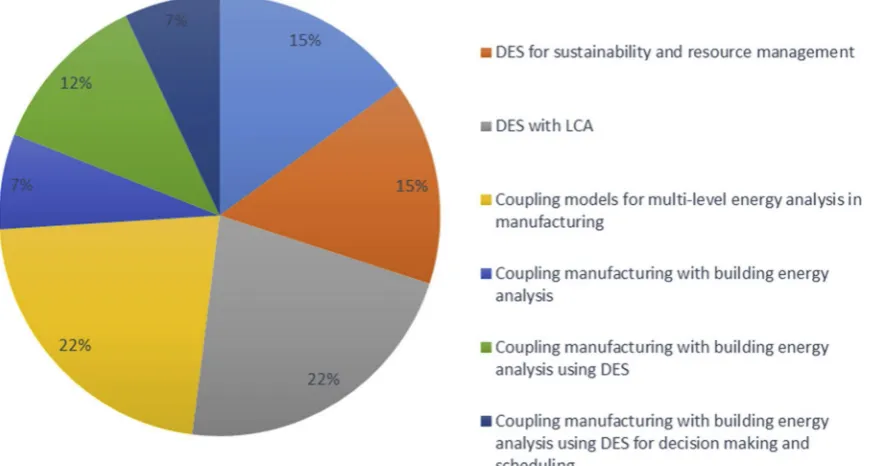
Current areas of research in energy analysis within manufacturing reviewed in this paper are summarised inFig. 5.
5. Development of Industry 4.0 for energy efficiency
The move towards a higher level of digitalisation with the increased demand for an interconnected, automated and fullyflexible approach has shaped Industry 4.0, the 4th industrial revolution, of which en-compasses cybersecurity, augmented reality, big data, robotics, additive manufacturing, cloud computing, Internet of Things, digital twinning and simulation. At the heart of Industry 4.0 is the Smart Factory, de-scribed as ‘a manufacturing solution which provides flexible and adaptive production processes to solve problems arising on a produc-tion facility with dynamic and rapidly changing boundary condiproduc-tions in a world of increasing complexity’[42]. With an increase in digitalisa-tion, incorporated within Industry 4.0 and the Smart Factory is the use of Cyber Physical Systems (CPS), which allows interoperability and communication between a set of physical devices, objects and
equipment with a virtual cyberspace [43]. The concept of a digital twin, a near-real-time digital image of a physical component, product or system enriched with sensor obtained production and operation data, shows potential for increasing accuracy of manufacturing system ana-lysis. The digital twin is seen as the next step in model based systems engineering and this‘communication by simulation’allows assistance along the full life cycle of the operation with monitoring and control of the physical system which continuously updates the virtual model [44].
5.1. Digital twinning
Due to the novel nature of the concept of digital twinning, current literature is limited, with very few studies applying the use of a digital twin to production systems and manufacturing environments for Industry 4.0. Studies mainly focussed on introducing the concept of digital twinning, highlighting its potential and importance to improve accuracy and capabilities of the manufacturing production system [45,46], as well as proposing methodologies for data acquisition and exchange between systems [43,46–49], rather than analysis of the manufacturing process and integration with other dependable features such as production chains and the facility environment. No studies have been found which use the concept of digital twinning for energy ana-lysis and integration of physical systems with the surrounding en-vironment and materialflows. Further work is required to investigate areas for application of the digital twin and benefits it can bring along with industrial case studies, and integrated analysis with the sur-rounding environment in real or near-real-time.
5.2. DES use towards achieving Industry 4.0
DES’s ability to simulate and optimise production lines, process chains and shopfloor layouts has resulted in the development of novel tools utilising DES alongside data analytics for additional insight into facility operation.
[image:7.595.82.520.491.724.2]Jackson et al. [50] used the concept of digital manufacturing along with cloud based data storage, sensor equipped kitting boxes, a man-agement portal and decision tool combining data analytics with DES to present a modular and modifiable framework, M4-‘Meggitt Modular Modifiable Manufacturing’. The framework consisted of 4 layers, the
physical components composed thefirst layer, sensors which provide operation data to the cloud made up the second, data storage the third and data from digital tools and analytic tools made up the fourth. DES was integrated with the cloud data store, along with a scheduling al-gorithm, allowing for automated update of simulation models and re-source allocation, along with consideration of stochastic events. A case study indicated the informationflow between components in the fra-mework and concluded that the technology and methodologies pre-sented hold great potential for creation of reconfigurable production systems, and allows for increased routingflexibility whilst providing operators with digital instruction. The M4 is to be integrated into Meggitts production lines after further analysis.
With the influence of Industry 4.0 and need for automated industrial process modelling, Rodičet al. [51] presented an integrated simulation model of a factory using DES software, AnyLogic, along with a heuristic optimisation algorithm using discrete event and system dynamics and Java code which generated optimised layout of machines on the shop floor. The use of XMLfiles allows easy manual or algorithmic model modifications, and along with the creation of an application in Java, input data from Excel constructed a DES model by template modifi ca-tion (Fig. 5).
However output data from simulations included time, utilisation of machines, product quantity flows, supply levels and product travel distance rather than analysis of materialflows and energy. Analysis was performed on a process level, neglecting individual machines and the surrounding environment. Although the model was verified using his-toric production data, the input data had to be manually modified in Excel due to inaccuracies and inconsistencies, and real-time data im-plementation in the model was not possible.
Jain et al. [52] presented a methodology of automatic generation of multi-resolution virtual factory models with the use of real factory data, with standard input and output data formats. The tool was able to model multiple levels, including cell/process chain using DES, ma-chines using discrete event/ agent based simulation and also process level using Java code and continuous based equations, with data in Core Manufacturing Simulation Data (CMSD) standard format, based on XML. The proposed algorithm automatically built the logic network, machine level models and 2D representation of a scenario. The ap-proach however, made multiple assumptions based on machine level and materialflow control, with use of set defaults and common queues. Furthermore, use of outputs from the process level model for the ma-chine level model resulted in accumulated uncertainties, whose effect on accuracy was not known. The algorithm was only able to build machine shop scenarios with cells composing of 5 machines or less, limiting its use to lower volume production chains. Although the ap-proach offers highly automated multi-level analysis, inclusion of en-vironmental effects and TBS would be advantageous as well as analysis in real or near-real time.
Terkaj et al. [53] used an ontology- based virtual factory approach which was continuously updated with the real plant along with use of historic models to guarantee digital continuity between the plant and the virtual model. The tool aimed to assess impacts of production, maintenance and management planning decisions through in-situ si-mulation. The 3D virtual factory model for theflow line was linked with a DES simulation and was applied to production and maintenance planning of a roll shop, with virtual reality defining the shop floor layout. However, historic data was used to mimic the behaviour of the plant, therefore real-time analysis of the plant could not be performed. A multi-scale model was mentioned, however the tool did not offer analysis over multiple levels, including machine level, process chain and interactions with the surrounding environment. Furthermore, the tool was deemed appropriate for management and planning, with use of VR to aid users visually, however accurate analysis of machine pro-cesses or an operating facility was not considered.
Studies on novel tools developed for the vison of Industry 4.0 are predominantly based around process improvements to increase
throughput and productivity, by increased automation and con-nectivity, such as multi-level analysis [52], rather than that of im-proving energy efficiency in manufacturing processes and systems. The M4 tool was based on analysing factory performance with routing and productflexibility, while Rodičfocused on optimising machine layout with no mention of material or energyflows or integration of manu-facturing processes with the surrounding environment, nor quantitative analysis of manufacturing processes. Tools presented by Jain and Terkaj focused on increased automation of the simulation process. The adop-tion of the digital twin in manufacturing facilities holds great potential for analysis of energy and materialflows due to the capabilities of ac-curate machine representation and real or near-real-time process ana-lysis. Further work is required to develop the technology with expan-sion of analysis into the manufacturing production chain with consideration of the surrounding facility environment, along with re-levant material and energyflows.
5.3. Virtual and augmented reality
Virtual reality (VR) is an environment in which the user is fully immersed in a simulated virtual world, which may or may not hold any resemblance to the real world [54]. Augmented reality (AR) is VR placed over the real world, but with the provision of additional in-formation. An enriched real world is represented rather than one that replaces it [55]. In this way, both technologies are considered linked (Fig. 6).
Use of VR in manufacturing has the potential to reduce time and costs, and lead to increased quality, reduction of design errors and improved efficiency and well-being of operators [56]. It’s been used in industry for training, assembly and disassembly of products, manu-facturing, design and virtual prototyping [56], as well as improvements in ergonomics of the workplace [57].
Jimeno et al. [55] provided an insight into the use of VR in design and manufacturing processes, and suggested the technology is highly advantageous in computer aided design (CAD) processes due to inter-active examination and ability for direct manipulation of models. De-signs can be realised before expensive prototyping processes com-mence, through the use of Virtual Prototyping. Virtual manufacturing involves simulation of a product and manufacturing processes. Shape, residual stresses and durability have been highlighted as common fac-tors for analysis in order to reduce cost of production and minimise waste. However issues were highlighted such as need for extremely high accuracy to ensure that the model is an accurate representation of the physical object, as well as need for reflection of changes to the system in real time.
[image:8.595.314.553.656.726.2]Pelliccia et al. [58] highlighted the need for including energy con-sumption in the optimisation of machine tool design and manu-facturing. The authors present 2 methodologies of energy visualisation of a milling and turning centre using VR, of which all use a discrete colour mapping technique (green for low consumption, yellow for mid consumption and red for high) for different parts of the machine tool. Energy values were determined experimentally from measurements on the machine. The 3D Sankey diagram method mentioned uses VR to add further detail to the common simple 2D Sankey diagram. However power was assumed to be a constant, with energy losses between components neglected. Furthermore, multiple energyflows and a large
number of components made the diagram unclear. Similarly, a particle system technique was mentioned along with the use of VR, which al-lowed for visualisation of dynamic changes of energy consumption over time, as well as highlighting the direction of energyflows (Fig. 7).
A CAD model of the machine was developed, however CAD geo-metries are generated without concerning energy consumption, and the methodology to which it was created is unknown, and therefore accu-racy of the model could not be determined. The methodologies dis-cussed are based on a fixed framework and are related to a single configuration of machine axes. Development of a dynamic model with multiple modes of operation, along with real time capabilities, as well as multi-machine considerations would allow for a more accurate analysis of the manufacturing process.
Niu et al. [59] used virtual reality technology along with a design for intent method to collect occupancy information in building energy design with the aim of determining the performance gap with respect to energy demand in order to identify the most energy efficient design patterns. Plug loads, backup boilers, ICT infrastructure and lighting were all highlighted as energy related activities requiring set target behaviours. Different design patterns were modelled in Building In-formation Models (BIM) depending upon setting developed in VR to model different scenarios. Implementation of the methodology into a case study highlighted unexpected problems such as highly un-predictable and erratic behaviour of occupants, with a large number of factor considerations. However it was concluded that the tool allowed designers to determine design patterns which allowed for target occu-pant behaviour, however multi-criteria decision making methods are required to address conflicting design criteria. Furthermore, quantifi -cation of energy demand and energy saved would be beneficial.
For the use of AR in manufacturing, operators can carry out ma-chine operations and also be provided with real time data and process information simultaneously without leaving the work piece [60]. En-vironmental impacts of the operation can also be viewed in this way, with users able to take immediate action dependent upon feedback. Its use in collision detection on sorting lines [61] and use in robot control [62] allows for visualisation of scenarios and process risk assessment. AR has also be used for factory layout planning and maintenance and is considered a valuable teaching tool, especially in product assembly [62,63]. Nee and Ong [63] discuss the use of AR in aiding operators in CNC machining, with reflection of dynamic tool movements providing the user with real time information on cutting parameters and CNC programs, as well as alarms and errors in machining.
In the context of energy analysis, Herrmann et al. [60] used virtual and augmented reality to determine and illustrate energy flows and environmental impact of manufacturing processes in order to determine energy hotspots and establish improvements. Implemented sensors at the machine tool allowed for consideration of electrical energy, com-pressed air, coolants and raw materials as inputs along with
temperature changes, heat losses and emissions. Data processing using time studies to perform statistical analysis of the material and energy demands along with life cycle assessment was required prior to impact visualisation. Both virtual and augmented reality were used via a touchscreen wall and a smart phone camera display (Fig. 8).
The concept was tested on a grinding machine, implemented with a power meter, compressed air, coolant, pressure and temperature sensor. The full factoryfloor was presented, with in and outflowing material and energy data displayed along with measured energy data, in terms of energy usage or C02impact. The tool was able to determine the greatest contributor to energy expenditure, but further steps are required in order to test and simulate further possible improvements, along with abilities to alter process parameters and investigation of various sce-narios. Furthermore, the ability to monitor multiple machines along an integrated process chain would allow for a more in-depth analysis of energy expenditure of a manufacturing facility.
[image:9.595.149.449.60.209.2]Current applications of VR and AR in the manufacturing industry is highly swayed towards product design and development [64]. A similar trend was identified in academia, with many studies highlighting the Fig. 7.Energy Visualisation method based on a particle system [58].
[image:9.595.313.554.452.719.2]potential of the technology along with applications to production and facility planning [59] and ability for extensive visualization techniques for machine operators [55]. Studies applying VR and AR technology to energy analysis is limited. Pelliccia [58] discuss the use of VR to the visualisation of energy paths of a milling centre, however analysis was limited to electrical energy for one tool, with no consideration of other flows such as compressed air or heat, nor enabled multi-level analysis across multiple machines in a production chain or the manufacturing facility. Herrmann discuss the use of AR for simulating multiple inputs and energyflows of a grinding machine, along with consideration of the full factoryfloor, however again, analysis was limited to one machine tool, neglecting interdependabilties between multiple machines and the manufacturing process chain, along with the surrounding building en-vironment.
No studies have been found linking concepts of Industry 4.0, such as digital twinning, virtual factories and automated model creation, with analysis of energy or material flows with a multi-level holistic ap-proach. These novel concepts have been focused towards applicability and potential within Industry 4.0, as well as introducing multiple concepts of increased automation andflexibility within smart factories. With these technological advancements, increased need for high cyber security and increased automation results in an increased energy de-mand, at a cost to industry. Therefore, highlighting energy use of manufacturing processes in the shift towards Industry 4.0 is of upmost importance.
6. Future challenges
This study has highlighted the value of DES for analysis of manu-facturing facilities, accounting for changes in machine state whether idle or working, task scheduling and production planning as well as resourceflows and non-continuous and stochastic processes.
Attempts at achieving holistic analysis of manufacturing facilities through coupling simulation tools, as well as the development of novel numerical and analytical models were presented, however these pre-sented challenges, such as availability of adequate and accurate data, as well as use of averaged model parameters and need for model simpli-fication. Furthermore, emphasis was on model structure through use of multiple levels or hierarchies, rather than input parameters and ana-lysis of all relevant resource, thermal and energyflows. Such work is limited due lack of energy strategies within organisations [65], with The Manufacturers and Manufacturer 2030 report stating that over a third of manufacturing companies do not set energy efficiency targets nor have no means of measuring improvements [66]. Furthermore, energy costs are generally not accounted for by production managers, and are considered indirect costs to maintain facility operation [16].
Multiple tools neglected dynamics or interdependency between all layers, with focus on energy associated with a single unit process or creation of an individual part. Analysis of production processes from
machine level through to process chain with interaction of machines within the production line would be advantageous. Furthermore, in-clusion of material flows and thermal effects would aid in under-standing of the facility, as heat transfer from machining processes can have a significant impact on energy consumption due to additional demands required from HVAC systems to maintain a certain environ-mental working condition. A considerable number of presented models and frameworks lack validation, which possess uncertainty with regards to the accuracy of the methodology as well as applicability to industry. Current technologies involved in developing the smart factory were discussed, with digital twinning showing great potential for increasing the accuracy of simulation, with the ability to replicate individual fa-cilities and processes with the addition of real time data rather than having to rely on a database of generic manufacturing processes or modelling assumptions and simplification during model development. Studies show the use of virtual and augmented reality can aid in un-derstanding of energyflows for less experienced workers along with providing education on how to control processes for more energy effi -cient production. It can provide a visualisation tool rather than a method of energy analysis. However due to the novel nature of these technologies, studies are limited and provide a basis of understanding as well as highlight their potential within the manufacturing industry. Emphasis has been predominately on tools providing outputs for effective decision making and process planning rather than accurate analysis of energyflows or tools for energy optimisation. Further work is required to develop a tool capable of accurate determination of re-levant energy, resource and thermal flows associated with manu-facturing processes, along with a methodology of enabling interaction between different levels within the manufacturing production en-vironment. Furthermore, further work is required for the development of novel techniques such as digital twinning and its use in the manu-facturing industry as a tool of providing computationally efficient and accurate models.
Approaches for analysis of energy analysis in manufacturing are summarised inTable 1.
Acknowledgements
The authors would like to acknowledge thefinancial contribution provided by the Engineering and Physical Sciences Research Council (EPSRC) and the Industrial Doctorial Training Centre (IDC) of Machining Science at the University of Sheffield that has enabled the production of this paper.
References
[1] U.S. Energy Information Administration. International Energy Outlook 2017 U.S. Energy Inf. Adm., no. 2017 2017.
[image:10.595.81.521.76.216.2][2] The M, Challenge E. Meeting the Energy Challenge A White Paper on Energy Meeting the Energy Challenge A White Paper on Energy May 2007 no. May 2007.
Table 1
Approaches of energy analysis in manufacturing.
Approach Reference
Use of DES to combine material with energy and resourceflows for efficient production planning [11] Use of DES to determine embodied product energy of single products [12] Use of DEs to determine state based energy use for single machines [7] Use of DES with energy modules with hierarchy approach to machines [15] Use of DES to determine energy of processes with optimisation tools for sustainability indicators [16] Use of DES for resource management [17,18] Use of DES for energy use in on/offmachine states [19]
DES with LCA [23–25,29–31]
[3] Company M. Technologies that could transform how companies use energy. 2015. [4] Wohlgemuth V, Page B, Kreutzer W. Combining discrete event simulation and
materialflow analysis in a component-based approach to industrial environmental protection. Environ Model Softw 2006.
[5] Wright AJ, Oates MR, Greenough R. Concepts for dynamic modelling of energy-relatedflows in manufacturing. Appl Energy 2013;112:1342–8.
[6] Velumani S, Tang H. Operations status and bottleneck analysis and improvement of a batch process manufacturing line using discrete event simulation. Procedia Manuf 2017;10:100–11.
[7] Mousavi S, Thiede S, Li W, Kara S, Herrmann C. An integrated approach for im-proving energy efficiency of manufacturing process chains. Int J Sustain Eng 2016. [8] Bleicher F, Duer F, Leobner I, Kovacic I, Heinzl B, Kastner W. Co-simulation
en-vironment for optimizing energy efficiency in production systems. CIRP Ann Manuf Technol 2014.
[9] Thiede S, Schönemann M, Kurle D, Herrmann C. Multi-level simulation in manu-facturing companies: the water-energy nexus case. J Clean Prod 2016.
[10] Thiede S, Kurle D, Herrmann C. The water–energy nexus in manufacturing systems: Framework and systematic improvement approach. CIRP Ann Manuf Technol 2017;66(1):49–52.
[11] Increased energy efficiency in a Swedish iron foundry through use of discrete event simulation. Proceedings of the Winter Simulation Conference. 2006. p. 1971–6. [12] Seow Y, Rahimifard S. A framework for modelling energy consumption within
manufacturing systems. CIRP J Manuf Sci Technol 2011;4(3):258–64. [13] Garwood TL, Hughes BR, Oates MR,’connor DO, Hughes R. A review of energy
simulation tools for the manufacturing sector. Renew Sustain Energy Rev 2017;81:895–911.
[14] Alvandi S, Li W, Kara S. An integrated simulation optimisation decision support tool for multi-product production systems. Mod Appl Sci 2017;6.
[15] Kohl J, Spreng S, Franke J. Discrete event simulation of individual energy con-sumption for product varieties. Procedia CIRP 2014.
[16] Rodrigues GS, Espíndola Ferreira JC, Rocha CR. A novel method for analysis and optimization of electric energy consumption in manufacturing processes. Procedia Manuf 2018;17:1073–81.
[17] Keshari A, Sonsale AN, Sharma BK, Pohekar SD. Discrete event simulation approach for energy efficient resource management in paper; pulp industry. Procedia CIRP 2018;78:2–7.
[18] Prabhu VV, Taisch M. Simulation Modeling of Energy Dynamics in Discrete Manufacturing Systems vol. 45. 2019. 6. IFAC, 23AD.
[19] Cataldo A, Scattolini R, Tolio T. An energy consumption evaluation methodology for a manufacturing plant. CIRP J Manuf Sci Technol 2015;11:53–61. [20] Duflou JR, Sutherland JW, Dornfeld D, Herrmann C, Jeswiet J, Kara S, et al.
Towards energy and resource efficient manufacturing: a processes and systems approach. CIRP Ann Manuf Technol 2012.
[21] Johansson B, Kacker R, Kessel R, McLean C, Sriram R. Utilizing combinatorial testing on discrete event simulation models for sustainable manufacturing. Proceedings of the ASME International Design Engineering Technical Conferences and Computers and Information in Engineering Conference 2009. 2010. p. 1095–101. DETC2009, vol. 2, no. PART B.
[22] Lajevardi B, Garretson IC, Paul BK, Haapala KR. Manufacturing energy analysis of a microchannel heat exchanger for high-density servers. Procedia Manuf 2015. [23] Lind S, Johansson B, Stahre J, Berlin C, Fasth A, Heilala J, et al. SIMTER - a joint
simulation tool for production development. 2009.
[24] Schönemann M, Schmidt C, Herrmann C, Thiede S. Multi-level modeling and si-mulation of manufacturing systems for lightweight automotive components. Procedia CIRP 2016;41:1049–54.
[25] Sproedt A, Plehn J, Schönsleben P, Herrmann C. A simulation-based decision sup-port for eco-efficiency improvements in production systems. J Clean Prod 2015;105:389–405.
[26] Tang Y, Mak K, Zhao YF. A framework to reduce product environmental impact through design optimization for additive manufacturing. J Clean Prod 2016. [27] Newcomb PJ, Carmichael C, Bras B, Reap J. Improving life cycle assessment by
including spatial, dynamic and placebased modelling. ASME 2003 Des Eng Technol Conf Comput Inf Eng Conf 2003:1–7.
[28] Thiede S, Seow Y, Andersson J, Johansson B. Environmental aspects in manu-facturing system modelling and simulation-State of the art and research perspec-tives. CIRP J Manuf Sci Technol 2013.
[29] Wilson J, Arokiam A, Belaidi H, Ladbrook J. A simple energy usage toolkit from manufacturing simulation data. J Clean Prod 2015.
[30] Heilala J, Vatanen S, Tonteri H, Montonen J, Lind S, Johansson B, et al. Simulation-based sustainable manufacturing system design. 2008 Winter Simulation Conference 2008:1922–30.
[31] Johansson B, Skoogh A, Mani M, Leong S. Discrete event simulation to generate requirements specification for sustainable manufacturing systems design. Proc. 9th Work. Perform. Metrics Intell. Syst. - Permis’09. 2009. p. 38–42.
[32] Rahimifard S, Seow Y, Childs T. Minimising embodied product energy to support energy efficient manufacturing. CIRP Ann Manuf Technol 2010.
[33] Herrmann C, Thiede S, Kara S, Hesselbach J. Energy oriented simulation of man-ufacturing systems - concept and application. CIRP Ann Manuf Technol 2011;60(1):45–8.
[34] Liang S, Yao X. Multi-level modeling for hybrid manufacturing systems using Arena and MATLAB. 2008.
[35] Alvandi S, Bienert G, Li W, Kara S. Hierarchical modelling of complex material and energyflow in manufacturing systems. Procedia CIRP 2015;29:92–7.
[36] Wetter M. Co-simulation of building energy and control systems with the building controls virtual test bed. J Build Perform Simul 2011;4(3):185–203.
[37] Brundage MP, Chang Q, Li Y, Xiao G, Arinez J. Energy efficiency management of an integrated serial production line and HVAC system. IEEE Trans Autom Sci Eng 2014;11(3):789–97.
[38] Michaloski JL, Shao G, Arinez J, Lyons K, Leong S, Riddick F. Analysis of Sustainable Manufacturing Using Simulation for Integration of Production and Building Service. 2019.
[39] Sun Z, Li L, Dababneh F. Plant-level electricity demand response for combined manufacturing system and heating, venting, and air-conditioning (HVAC) system. J Clean Prod 2016;135:1650–7.
[40] Zou J, Chang Q, Lei Y, Xiao G, Arinez J. Stochastic maintenance opportunity windows for serial production line. ASME 2015 International Manufacturing Science and Engineering Conference. 2015. p. 1–8.
[41] Bennett B, Boddy M, Doyle F, Jamshidi M, Ogunnaike T. Assessment study on sensors and automation in the industries of the future. Reports on industrial con-trols, information processing, automation, and robotics Washington DC 2004
[42] Radziwon A, Bilberg A, Bogers M, Madsen ES. The smart factory: exploring adaptive andflexible manufacturing solutions. Procedia Eng 2014;69:1184–90.
[43] Schroeder GN, Steinmetz C, Pereira CE, Espindola DB. Digital twin data modeling with automation ML and a communication methodology for data exchange. IFAC-PapersOnLine 2016;49(30):12–7.
[44] Rosen R, Von Wichert G, Lo G, Bettenhausen KD. About the importance of au-tonomy and digital twins for the future of manufacturing. IFAC-PapersOnLine 2015;28(3):567–72.
[45] Schleich B, Anwer N, Mathieu L, Wartzack S. Shaping the digital twin for design and production engineering. CIRP Ann Manuf Technol 2017;66(1):141–4.
[46] Uhlemann THJ, Lehmann C, Steinhilper R. The digital twin: realizing the cyber-physical production system for industry 4.0. Procedia CIRP 2017;61:335–40. [47] Lee J, Bagheri B, Kao H-A. Recent advances and trends of cyber-physical systems
and big data analytics in industrial informatics. Int Conf Ind Informatics 2014;2015(November). 2014.
[48] Cai Y, Starly B, Cohen P, Lee YS. Sensor data and information fusion to construct digital-twins virtual machine tools for cyber-physical manufacturing. Procedia Manuf 2017;10:1031–42.
[49] Uhlemann THJ, Schock C, Lehmann C, Freiberger S, Steinhilper R. The digital twin: demonstrating the potential of real time data acquisition in production systems. Procedia Manuf 2017;9:113–20.
[50] Jackson K, Efthymiou K, Borton J. Digital manufacturing andflexible assembly technologies for reconfigurable aerospace production systems. Procedia CIRP 2016;52:274–9.
[51] RodičB, KandučT. Optimisation of a complex manufacturing process using discrete event simulation and a novel heuristic algorithm. Int J Math Model Methods Appl Sci 2015;9.
[52] Jain S, Lechevalier D. Standards based generation of a virtual factory model. Proc. -Winter Simul. Conf.. 2017. p. 2762–73.
[53] Terkaj W, Tolio T, Urgo M. A virtual factory approach for in situ simulation to support production and maintenance planning. CIRP Ann Manuf Technol 2015;64(1):451–4.
[54] Milgram P, Takemura H, Utsumi a, Kishino F. Mixed reality (MR) reality-virtuality (RV) continuum. Syst Res 1994;2351:282–92. no. Telemanipulator and Telepresence Technologies.
[55] Jimeno A, Puerta A. State of the art of the virtual reality applied to design and manufacturing processes. Int J Adv Manuf Technol 2007;33(9–10):866–74. [56] Lawson G, Salanitri D, Waterfield B. Future directions for the development of
vir-tual reality within an automotive manufacturer. Appl Ergon 2016;53:323–30. [57] Grajewski D, Górski F, Zawadzki P, Hamrol A. Application of virtual reality
tech-niques in design of ergonomic manufacturing workplaces. Procedia Comput Sci 2013;25:289–301.
[58] Pelliccia L, Klimant P, Schumann M, Pürzel F, Wittstock V, Putz M. Energy visua-lization techniques for machine tools in virtual reality. Procedia CIRP
2016;41:329–33.
[59] Niu S, Pan W, Zhao Y. A virtual reality integrated design approach to improving occupancy information integrity for closing the building energy performance gap. Sustain Cities Soc 2016;27:275–86.
[60] Herrmann C, Zein A, Wits WW, Van Houten FJAM. Visualization of environmental impacts for manufacturing processes using virtual reality. Proceedings of the 44th CIRP Conference on Manufacturing Systems 2011.
[61] Tůma Z, Tůma J, Knoflíček R, Blecha P, BradáčF. The process simulation using by virtual reality. Procedia Eng 2014;69:1015–20.
[62] Novak-Marcincin J, Barna J, Janak M, Novakova-Marcincinova L. Augmented reality aided manufacturing. Procedia Comput Sci 2013;25:23–31.
[63] Nee AYC, Ong SK. Virtual and Augmented Reality Applications in Manufacturing 46. IFAC; 2013. no. 9.
[64] PWC. For US manufacturing, virtual reality is for real,”2015 Disruptive Manufacturing Innovations Survey [Accessed: 10:10:2016], [Online]. Available. 2015https://www.pwc.com/us/en/industrial-products/next-manufacturing/ augmented-virtual-reality-manufacturing.html.
[65] Fysikopoulos A, Pastras G. An approach to increase energy efficiency energy effi-ciency at production line level. Adv Prod Manag Syst Innov Knowl-Based Prod Manag a Glob World SE - 6 2014;439:205–12.
![Fig. 1. Information flow within the SIMTER tool [23].](https://thumb-us.123doks.com/thumbv2/123dok_us/1345935.88278/3.595.149.450.466.728/fig-information-ow-simter-tool.webp)
![Fig. 2. Modules involved in the proposed framework [25].](https://thumb-us.123doks.com/thumbv2/123dok_us/1345935.88278/4.595.118.479.61.264/fig-modules-involved-proposed-framework.webp)
![Fig. 3. Paradigms for simulating energy in manufacturing systems [7,25,29].](https://thumb-us.123doks.com/thumbv2/123dok_us/1345935.88278/5.595.310.552.232.502/fig-paradigms-simulating-energy-manufacturing-systems.webp)
![Fig. 6. Reality-Virtuality Continuum [54].](https://thumb-us.123doks.com/thumbv2/123dok_us/1345935.88278/8.595.314.553.656.726/fig-reality-virtuality-continuum.webp)
![Fig. 7. Energy Visualisation method based on a particle system [58].](https://thumb-us.123doks.com/thumbv2/123dok_us/1345935.88278/9.595.313.554.452.719/fig-energy-visualisation-method-based-particle.webp)

