The Small Nonstructural Protein
(NS2)
of the Parvovirus
Minute
Virus of Mice Is Required for Efficient
DNA
Replication and
Infectious Virus Production
in
a
Cell-Type-Specific Mannert
LISA KAY NAEGER, JEAN CATER, ANDDAVIDJ. PINTEL*
Department ofMolecularMicrobiology andImmunology, Schoolof Medicine, University of Missouri, Columbia, Missouri 65212
Received31July 1990/Accepted12September 1990
Seven mutations which affectonly the small nonstructural protein NS2wereintroduced into theinfectious
cloneof theautonomousparvovirus, minutevirus of mice(MVM).Themajorityof thesemutantswereseverely
defective forreplication following transfectionof normal host murine A9fibroblasts; however,allwerefound
toreplicatemoreefficiently and produce infectious virusincertainother celltypes,includinghumanNB324K. Theisolation of viral stocksfrom NB324K cellspermitteda moredetailedanalysis of themutantdefectonA9
cells. NS2 mutantNS2-2018wasshownto beapproximately 10-fold deficient for viral monomer
replicative-form DNA production within a single-burst cycle in infected A9 cells and produced a reduced amount of
progeny single strand. Mutant NS2-2018 generated wild-type levels ofmonomer replicative-form DNA on
NB324K cells but made reduced levels of progeny single strand and small plaques on these cells. The
accumulation of NS1 is reduced late inNS2-2018 infection of A9cells, but NS1 accumulatestowild-type levels lateinNB324K cellinfections. NS1 nuclear localization isnotdependentonNS2 in A9orNB324K cells. These
resultsindicate that NS2participatesinMVM DNAreplicationandisrequired for efficient viral growth.The
requirement forNS2 during MVM replication is also host cellspecific.Thisrequirementissignificantly more pronounced inthenormal host murineA9cells thanin certainother celltypes, including NB324K.
Theautonomousmurineparvovirus, minute virus of mice (MVM), contains a 5.1-kb, linear, single-strand DNA ge-nome that encodes only four translation products: two
capsid proteins, VP1 and VP2, andtwo nonstructural pro-teins, NS1 and NS2, which appear prior to the capsid proteins during infection (1, 6, 8-10). The 83-kDa NS1 is a
stable, nuclear phosphoprotein (8, 10, 13) translatedfrom the viral Rl mRNA (1, 9). The 25-kDa NS2, a relatively labile
phosphoprotein (7, 8, 10, 13), is encoded by the R2 mRNA (1, 7, 9, 20, 24). NS1 is encoded by uninterrupted open
reading frame 3 (ORF 3) until its terminationat nucleotide (nt) 2276 (1, 9, 10). NS1 and NS2areidentical for the first 85
amino acids(1, 8, 9); however, the R2 mRNA is then spliced between nts514 and 1990, which shifts NS2 into ORF 2 (1, 7, 9, 10, 13, 20, 24, 25). Additional, alternate splicing of R2 between mapunits 44to46generatesthree isoforms of NS2 ininfected cells which differattheircarboxyl termini (1, 7, 9, 13, 20, 24).
Asimilar butdifferent ensembleof nonstructural proteins
has been identified for various types ofparvoviruses, and they playacritical, multifunctional role in the life cycle of all parvoviruses (2, 10).
Thefunctionalproperties ofMVMNS1 havebeguntobe revealed. NS1is covalently attachedtothe 5' terminiof both replicative and virion DNA (11, 12) and is required for viral DNAreplication (28, 33)aswellasfor efficient expression of
the viralP38promoterlate ininfection (14, 15, 26,27,29, 33).
NS1 from MVMand the closely related parvovirus Hi has
beenshowntopositively trans-activate the viral capsidgene promoter (14, 15, 21, 26, 27, 29) and both positively and negatively trans-activate its own promoter in transient cotransfectionassays(14, 15, 29). Expression of this protein
*Correspondingauthor.
tDedicatedtothe memoryof Luis Carbonell.
has also been correlated with viral cytotoxic effects (5, 27). Analogous nonstructural rep proteins of the parvovirus
adeno-associated virus have also been shown to have
heli-case activity and to specifically nick the adeno-associated virusgenomewithin its origin of replication (19, 30).
Little is known, however, about the function of NS2 during infection. Analysis of cDNAsexpressing MVM NS2 (7), aswell asother studies (5), has demonstrated that NS2
does havecytotoxic effects. No direct evidence hasyetbeen presentedtodemonstratearolefor this protein in either viral
geneexpressionor DNAreplication.
Wehavegenerateda series of mutations in theprototype
strainofMVM, MVM(p),designedtosolely affect NS2 inan
effort to identify its function. We report that NS2
partici-patesinviral DNAreplication withinasingle infection cycle
and is required for efficient virus production in murine A9 fibroblasts. The role ofNS2isprobablynotmerely the result ofan indirect effect on the synthesis or localization of the knownreplication protein NS1. Furthermore,weshow that
the requirement for NS2 is surprisingly cell type specific, i.e., the requirement for NS2 during MVM replication is significantlymore pronounced in murine A9 fibroblasts than
in certainother celltypes, including human NB324K cells. (A preliminary report of this data has been presented in abstractform[L. K. Naeger, K. E. Clemens, G. Tullis, and D. J. Pintel, EMBO Workshop Mol. Biol. Parvovirus 1989, abstr. 2-1,p.
21].)
MATERIALS ANDMETHODS
Cells and virus. Murine A9 (32), simian virus 40-trans-formedhumanNB324K(32),monkey CV1 (16), simian virus 40-transformed monkey COS-1 (16), adenovirus-trans-formed293 (17), BHK(3), and DMN4A(4) cells, the last a
chemically transformed BHK derivative, were propagated as previously described. Where indicated, neuraminidase
6166
0022-538X/90/126166-10$02.00/0
Copyright © 1990, American Society for Microbiology
on November 10, 2019 by guest
http://jvi.asm.org/
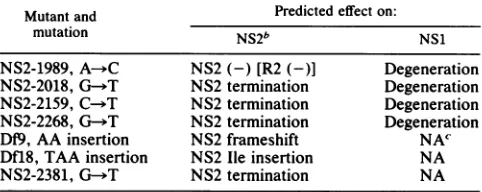
TABLE 1. Description ofNS2 mutants" used in this study
Mutantand Predicted effect on:
mutation NS2b NS1
NS2-1989, A-*C NS2(-) [R2(-)] Degeneration NS2-2018, G-.T NS2termination Degeneration NS2-2159, C--T NS2termination Degeneration NS2-2268, G- T NS2termination Degeneration Df9, AA insertion NS2 frameshift NAC' Dfl8,TAAinsertion NS2lie insertion NA
NS2-2381, G--T NS2 termination NA
aMost mutants are named to designate the nt changed by mutagenesis. Df
mutantsare ntinsertions at the DdeI site at nt 2278. Mutation, changes on the
+or(c) strandof MVM(p).
bAll NS2isoforms are affected in each mutant except NS2-2381, in which only the most abundant NS2 isoform is affected.
cNA, Notapplicable (mutation lies outside of NS1-coding sequences).
(Sigma type X; Sigma Chemical Co., St. Louis, Mo.) was
addedto 0.1 Uofculturemediaper ml. Viral plaque assays,
virus growth, and isolation were as previously described
(32). Since MVM has an absolute requirement for cellular
S-phase factors for replication, infections were done in highly synchronized cells utilizinganisoleucine deprivation-aphidicolin (Sigma Chemical Co.) protocol, as previously described(6,10).DNAtransfections andtransfection plaque
assays weredone onnonsynchronous cellsusing the CaPO4 technique essentially as previously described (33). In situ hybridization plaque assays of highly synchronized infec-tions using radioactive probes to detect and monitor infec-tious centers were done as described by Yakobson et al.
(34). Nick-translated cloned MVM was used as probe. Reconstructionexperiments were done toverifythat infec-tiouscentersresultedfromasingle, infected cell. Forthese
experiments, duplicate in situ hybridization plaque assays wereperformedon three sets of cells. One setof cells was
overlayed
withagar, oneset wasoverlayed
withmedia,
and one set wasoverlayed
with mediaplus
neuraminidase. Filter lifts from all threewereessentially
identical24hpostrelease, indicating that hybridization signals resulted from infection ofasingle
cell.Isolation and characterization of cell lines stably
trans-formed and
inducibly
expressing
MVMgene products weredoneby cotransfection withasimian virus 40-driven neomy-cin resistance vector, as previously described (7). Two constructs wereused for
expression
ofMVMgeneproducts.The first
plasmid
construct containedwild-type
MVM se-quencesstarting
fromnt225, withthe MMTVlong terminalrepeat
replacing
the MVM P4 promoter (7). The secondplasmid
construct was identical to the first except that it contained the GtoTtransversionat nt2018, whichtruncatesNS2 but leavesNS1 unaltered.
Mutant construction. TheEcoRI A
fragment
(nts 1086to3521) of MVM(p)wasclonedinto
M13mpl9
for introduction of NS2 ochre mutations by site-directedmutagenesis,
aspreviously
describedby Kunkel (22).Oligonucleotides
with single-base mismatches were used, and the nucleotidechanges introduced are shown in Table 1. NS2-2381 intro-ducedanochreterminator after1amino acid intheterminal
exonof themostabundant isoform of NS2
(spliced
between nts2280and2377),leavingthe otherisoformsunaltered. Df9 and Dfl8are2- and 3-ntinsertions, respectively
(seeTable1),made at the
DdeI
siteatnt2278,aspreviously described(33). The Df9 frameshift is predicted to alter the most
abundant isoform of NS2 so that its terminal exon is
com-posed of24 different amino
acids,
the last 15 ofwhich arethose normallyfound on the rare isoform ofNS2(the rare
form issplicedbetween nts 2280 and 2399); the less abundant isoforms are fused to the VP1 ORF. Dfl8 results in an in-frame isoleucine insertion. After mutagenesis and M13
replicativeform (RF) preparation, fragments containing the mutations were inserted into the infectious clone of MVM(p). After final construction, each mutant was
se-quenced across the entire inserted fragment to verify that
only the expected mutations had been introduced, and the
clones were marker exchange rescued by resubstitution of
the analogous wild-type fragment. A second, independent
mutant-containing clone ofMVM(p) was also isolated and
shown by transfection plaque assay to have the same phe-notype as thefirstisolate.
Immunoprecipitation and immunofluorescence assays.
La-beling with [35S]methionine and [35S]cysteine (Trans
35S-label; ICN Radiochemicals, Irvine, Calif.),
immunoprecipi-tations,andimmunofluorescence assays were aspreviously
described(7,23). Monospecific anti-NS1andNS2 anti-bodyweregenerated in rabbitsbyusing purified Escherichia coli fusion proteins generated from expression vectors
kindly providedby CotmoreandTattersall (9).Monospecific anti-NS1 antibody was generated in response to fusion products in ORF 3 between nts 1110 and 1638, and
mono-specific anti-NS2 wasgenerated in response tofusion
prod-ucts in ORF 2 between nts 2075 and 2291. Antibody that
recognizes the amino terminus of both NS1 and NS2,agift from Cotmoreand Tattersall(9), wasgeneratedinrabbitsin response tofusion products of ORF 3between nts225 and
534.
RNase protection assays. RNase protection assays were
performed as
previously
described (6). Forprotection
ofRNA from NS2-1989 infections, a homologous SP6 probe whichcontainedthe nt 1989mutationwasused.
DNA replication assays. Viral
replicative
forms produced48 h
following
DNAtransfections wereanalyzed bySouth-ern blotting following Hirt extractions (18), as previously described (33). Small amounts of a nonhomologous 3H
plasmid wereadded to extractsforquantitation.
Viralreplicative forms producedfollowing highly synchro-nized viral infection were analyzed after
quantitation
of cellular DNA as follows. Cells were labeled with[3H]
thymidine for12 to 24 h
prior
tosynchronization (using
theisoleucine
deprivation-aphidicolin
protocolpreviously
de-scribed[6,
10])
sothattrue-cellequivalents
ofDNAcouldbecompared. Cells were collected and
lysed
in a solutioncontaining
0.2% sodiumdodecyl sulfate,
0.4 MNaCl,
10 mM Tris(pH8), 10 mMEDTA, and1p.m of DNase-freeRNaseat37°C,
andthen0.4 mgofproteinase
Kper mlwasadded;
the solution was incubatedovernight
andsubsequently
ex-tracted with phenol-chloroform and
precipitated
with etha-nol. IndividualDNA samples were matched for equivalent3H
counts intriplicate
andrun on asingle
agarosegel
with ethidium bromide.Samples
werephotographed
onPolaroidtype 55
film,
negatives
of ethidium bromidestaining
werescanned by laser
densitometry,
and thesamples
weread-justed again. (Parallel experimentswere donetodetermine thelinearrange ofthis
film.) Equivalent
amountsofcellular DNA were thenanalyzed
for viralreplicative
formsby
Southern
analysis
andby using
laserdensitometry,
aspre-viouslydescribed(33). Differencesin the inhibition of cellu-lar DNA replicationinresponse to mutant versus
wild-type
infection were nottaken into account.
Equivalent
amountsof nonradioactive markers were also loaded on the outside
lanes ofeach
gel
to ensureequivalent
transfers for different gels. Theprecision
ofthisprotocol
wasverifiedby
on November 10, 2019 by guest
http://jvi.asm.org/
A.
RI
R2 R3
1000 200o 3000 4000 5000
NS1 NS2 \_
I
vp1_2
NS2 NS2
19o 2018 2159NS2 2268 DNS2 2381NS2
1 1
1800 1900 2000 2100 2200 2300 2400 2500
RI
R2M
p2sorwM
~ -- N82Rt2m (2729
-R2rg220n%39 N82
[image:3.612.140.458.72.384.2]R3
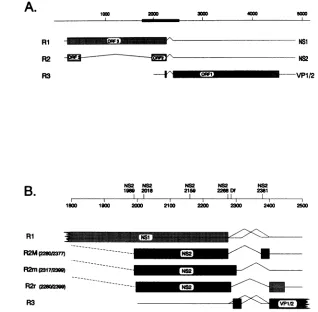
FIG. 1. (A)Map ofgenomic organizationof MVMgeneproducts.The solid baronthegenomeisenlargedinpanelB.(B)Detailedmap
of the areaof the genome inwhich NS2 mutations were introduced and theirrespective locations. All MVMmessageclasses usethree
alternativesplicingpatternsin this region; however,therare splicingpattern(nts2280to2399)isdisplayedforR2only.
ization of cellular DNA on certain Southern blots to a cellularrRNAgene (31).
RESULTS
Construction and verification of MVM NS2mutants.Seven
mutationsthatwere predictedtoaffect onlythe MVMNS2 proteinswereconstructed and introduced into the infectious
clone of MVM, as described in Materials and Methods. These mutants aredescribed in Table 1 and the location of each mutation is shown in Fig. 1B.
Four of thesemutations(NS2-2018, NS2-2159, NS2-2268,
andNS2-2381) are single-nucleotide changes that introduce translationtermination ochrecodons intoNS2-specificORF 2 at positions indicated in the mutant designation. These mutations were designed to truncate NS2 at various
posi-tions withoutalteringtheaminoacidsequenceofNS1 which is read inORF 3 fromthesamesequences. Oneof these four mutations,at nt2381, lies in the smallcarboxylexonpresent inthe most abundant isoform ofNS2 (Fig. 1B). This
muta-tionwasdesignedtoleave theotherNS2 isoformsaswellas NS1 andthe capsid proteins unaltered.
Df9andDfl8arenucleotideinsertionsplaced immediately
beyondtheochre terminatorofNS1atnt2276 andbefore the R2 small splice region at nt 2280. Df9 is a 2-nt insertion
which ispredictedtoalter themostabundant isoform ofNS2
so thatitsterminal exon is composed of24differentamino
acids, the last 15 of whichare those normallyfound onthe rareisoformofNS2 (therareNS2isoform isgeneratedfrom
R2 RNAspliced betweennts2280 and2399);theotherNS2 isoformsarefusedtoVP1. Dfl8isathree-ntinsertion which
introduces an isoleucine in-frame into NS2. As described
below, both of these mutants make proper ratios of the
capsid proteins VP1 andVP2, indicatingthat splicingin the
map unit 44to46region isunaffected.
Since the six mutations described above were each
pre-dictedto retain variable portions of the amino terminus of
NS2, a finalmutationwas constructed which was designed
topreventsplicingof the R2 mRNA and consequent
produc-tion ofNS2. MutantNS2-1989 hasanAtoC transversionin theconsensusspliceacceptorsequenceof theR2large splice and, asdescribedbelow, makes nodetectable R2 RNA.
After finalconstruction allmutantcloneswereverifiedby sequenceanalysisandmarker-exchangerescue.Inaddition,
a second, independent isolate of each mutant clone was shown to have the same phenotype as the original isolate
when assayed byDNA transfectionplaqueassay.
Transfection plaque assay and mutant virus propagation. Initially, the NS2 mutant clones were assayed for plaque formation on A9 cells by DNA transfection. All mutants
wereatleast100-fold defectivecomparedwiththe wildtype inthisassay, exceptNS2-2381, whichplaqued equivalently
tothe wild type(data notshown).
NS2-2018, NS2-2268, and Df9 were next assayed by
Southern analysis following Hirt extraction (18) for the
ability toexcise from theirplasmid backbone and replicate
48 h followingDNA transfection of murine A9 fibroblasts,
B.
q'A
NSI---I I ---
,--.
on November 10, 2019 by guest
http://jvi.asm.org/
TABLE 2. Relative viral DNA replicationa48 hfollowing transfection of NS2mutantplasmids in variouscelllines Plasmid A9-2L NB324K COS-1 CV1 BHK DMN4A 293
NS2-2018 +/- +++ ++++ - ++++ ++++ ++
NS2-2268 +/- +++ ++++ - ++++ ++++ ++
Df9 +/- +++ ++++ - ++++ ++++ ++
Wildtype +++b + + - ++++ ++++ +++
aReplication ofNS2 mutantshas beenassignedrelative toreplication of
wild-type plasmidonA9 cells.
bReplicationofwild-typeplasmidonA9cellshasbeenarbitrarily assigned
the normal MVM(p) host. These mutants werefound to be severely deficient for viral replicationonA9 cells compared with the wildtype (Table 2).
Theseclonedplasmidmutantswerethenassayed for their abilitiestoexcise and replicate 48 h following transfection of variousother cell lines. Surprisingly, anumber of other cell
lines were found to support NS2 mutant DNA replication (Table 2). The NS2 mutant plasmids replicated vigorously andsimilarlytothe wildtypein COS-1, BHK, and DMN4A (a chemically transformed BHK derivative) cells and sub-stantially,yetslightly less well, than the wildtypein293 and NB324K cells (Table 2). Cloned NS2 mutants were subse-quently shown to plaque on NB324K cells following DNA transfection enabling viral stocks of all NS2 mutants to be generated.
Mutant virus stocks, passaged fewer than three times on
NB324K cells, were then assayed for differential plaquing
abilities on A9 murine fibroblasts compared with that of
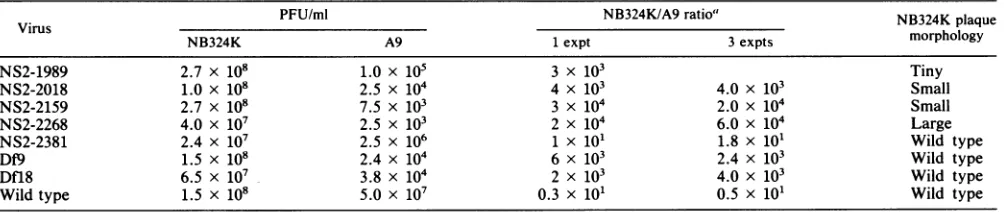
NB324K cells (Table 3). All mutants exceptNS2-2381 were
reduced approximately 3to4orders of magnitude in plaqu-ing abilityonA9 cells compared with thatonNB324K cells, whereas wild-type virus and NS2-2381 plaqued similarly on
thetwo celltypes. Interestingly, NS2-2268, Df9, andDfl8,
which are predicted to alter all MVM NS2 isoforms very
near their heterogeneous carboxyl termini, displayed the
mutant phenotype, implying that the carboxyl termini of NS2are important for efficient viral replication. However, NS2-2381,which ispredictedto truncatethe most-abundant NS2 isoform only 5 amino acids downstream of the debili-tating NS2-2268 ochre (Fig. 1B), plaques similarlytothewild
type.
The NS2 mutants have variable plaque morphologies on
NB324K cells. NS2-1989, which prevents production of NS-2, and NS2-2018 and NS2-2159, which truncate NS2 early into is second exon, generate very small plaques.
NS2-2381,Df9, and Dfl8generateplaques ofapproximately wild-type size, and surprisingly, NS2-2268generatesplaques thataresignificantly larger than those produced by wild-type
virus (datanot shown).
Mutantvirus stocks have also beengeneratedonA9cells andare currently being examined.
Analysis of NS2 mutant protein production on NB324K
cells. All NS2 mutants werethen examined for NS1, NS2,
VP1, and VP2 protein production in NB324K cells by immunoprecipitation following [35S]methionineand [35S]cys-teine labeling 10to 12 hpostrelease ofhighly synchronized infections.
Immunoprecipitations ofextracts usingantibody directed against NS2-specific sequences inORF2 betweennts 2075
and 2291 are shownin Fig. 2A. As expected, this antibody wasunable to immunoprecipitate NS2 from infections with NS2-1989 and NS2-2018(Fig. 2A, lanes 5 and 6, respective-ly). Thesameanti-NS2antibody also failed todetect
immu-noreactive NS2 from NS2-2159 infection (Fig. 2A, lane 7); however, antibody directed against sequences in ORF 3 betweennts225 and 534(sharedby the amino terminiof both NS1 and NS2)was also foundtoinconsistently immunopre-cipitate NS2 from infections with either NS2-2018or NS2-2159(datanotshown), indicating anincreased instability of thesetruncatedfragments orperhapspoorlabeling of these smallpeptides. Immunoprecipitations of NS2-2268 infection detected NS2 ofapproximately the predicted truncated size
(Fig. 2A, lane 8). Immunoprecipitations of Dfl8 and NS2-2381 (Fig. 2A, lanes 10 and 9, respectively) infections detected NS2 with mobilities similartowild-type NS2, and
Df9 (Fig. 2A, lane 11) generated a slightly larger NS2 species, as predicted. Additional immunoprecipitations of
the same extracts showed that all mutants expressed NS1, VP1, and VP2atrelativeratios and levels comparabletothe wildtype(datanotshown), indicating that the NS2mutants
are not substantially deficient in the accumulation of other virus-encoded proteins during the first 12 h postrelease of highly synchronized infections.
A precise comparison of mutant and wild-type protein levels produced in A9 cells, in which protein production is quantified relative to the number of accumulated mutant
template molecules in eachcase,is underway.
Mutant NS2-1989, predicted to alter the R2 large splice
acceptor site, was also examined by quantitative RNase
protection assay and shown to make less than 1% of the normal levels of the R2 mRNA (Fig. 2B, lane 1; the same
results werealso obtained afterlongerexposuresofthisgel [data not shown]).
NS2mutantsaredefective for viral DNA replicationwithin asingle-burst cycle. Mutant viralstocks, passaged fewer than
three times on NB324K cells, were next assayed for viral DNA replication compared with that of wild-type virus, following synchronized infection of A9 and NB324K cells. Mutant NS2-2018, which is predicted to truncate NS2 10 amino acids downstreamofthelarge R2 splice junction (Fig.
TABLE 3. Plaque assay results on A9andNB324K cellsfor low-passage mutant viral stocks generated on NB324Kcells
Virus PFU/ml NB324K/A9
ratio'
NB324K plaqueNB324K A9 1expt 3expts morphology
NS2-1989 2.7 x 10⁸ 1.0 x 10⁵ 3 x 10³ Tiny
NS2-2018 1.0 x 10⁸ 2.5 x 10⁴ 4 x 10³ 4.0 x 10³ Small
NS2-2159 2.7 x 10⁸ 7.5 x 10³ 3 x 10⁴ 2.0 x 10⁴ Small
NS2-2268 4.0 x 10⁷ 2.5 x 10³ 2 x 10⁴ 6.0 x 10⁴ Large
NS2-2381 2.4 x 10⁷ 2.5 x 10⁶ 1 x 10' 1.8 x 101 Wild type
Df9 1.5 x 10⁸ 2.4 x 10⁴ 6 x 10³ 2.4 x 10³ Wild type
Dfl8 6.5 x 10⁷ 3.8 x 10⁴ 2 x 10³ 4.0x 10³ Wild type
Wild type 1.5 x 10⁸ 5.0 x 10⁷ 0.3 x 101 0.5 x 101 Wild type
a Theratio ofplaque assay results fromone
experiment
or theaverage ofthreeexperimentsis shown.on November 10, 2019 by guest
http://jvi.asm.org/
A
B
1 2 3 4 5 6 7 8 9 10 11
NS-2
1 2
-4, _
"Om f -A -R1m
-R1M
-B -R2m -R3m -R2M -R3M
FIG. 2. Analysis of NS2-mutant gene products. (A)Immunoprecipitation ofmutantinfections.Lanes: 1and2,uninfected NB324Kcell extractsimmunoprecipitated with preimmune and anti-NS2antibody,respectively;3and4,wild-typeMVM-infected NB324Kcellextracts immunoprecipitated with preimmune and anti-NS2 antibody, respectively;5 through 11,immunoprecipitations withanti-NS2antibodyof extractsfrom NB324K cells infected with NS2-1989, NS2-2018, NS2-2159, NS2-2268, NS2-2381, Dfl8,andDf9, respectively. (B)RNase protection assays of 10 ,ug of totalRNA taken from NS2-1989 (lane 1) and wild-type MVM (lane 2) infection ofNB324Kcells, using
homologous SP6 probes asdescribed inMaterialsandMethods.R2 RNAs areabsent inNS2-1989-infected RNA.
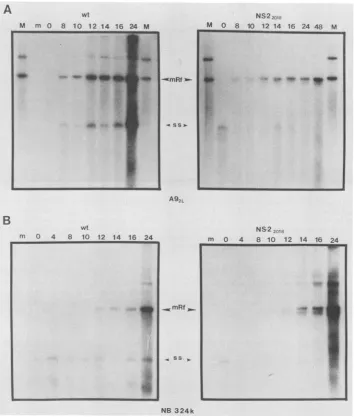
1), waschosen fortheseanalyses (Fig. 3). Equivalenttiters
ofmutant and wild-type viral stocks were used to infect
highly synchronizedcells, and DNAfromwhole-celllysates
was isolated at the indicated times after release of the infection into Sphase. Viralreplicativeformswereassessed
afterquantitation of cellular DNA,asdescribedin Materials andMethods.
Inhighly synchronized infection ofA9cellsby NS2-2018,
theaccumulation ofmutant monomerreplicative-formDNA
(mRF) was reduced approximately 10-fold compared with
wild-type infection at 24 h after release into S phase (Fig. 3A), as determined by laser densitometer scanning. NS2-2018was alsoreproducibly deficientin the accumulationof progeny single strand in A9 cells. NS2-2018 replicated its mRFtowild-typelevelsinNB324Kcells(Fig. 3B),although therewas anapparentreduction in accumulation ofprogeny
single strand. Additional replicative forms running slightly
faster than normal were also detected (Fig. 3B). A more detailed analysisof the ratio of individual replicativeforms
aswellasadditional formsproducedduring mutant infection
ofhighly synchronous A9and NB324Kcellsis under way.
Since theexperiment shown inFig. 3 wasdone in highly synchronized cells, the results imply that NS2-2018 is defi-cient in viral replication within a single, infected cell. To
examinethispointfurther, accumulation of viral replicative
formswas assayed in A9 infections in which neuraminidase was added to block viral reinfection. In such experiments, the accumulation of NS2-2018 mRF was also reduced
ap-proximately 10-foldcompared with parallel wild-type
infec-tionat24h postrelease (Fig. 4A and B), confirming a defect in viral DNA replication within a single, infectious cycle.
Wild-type RFaccumulation in infected cells decreased after
24hpostrelease inthe presenceofneuraminidase,indicating
thatneuraminidase wasblocking viralreinfection.
Interestingly, NS2-2018 accumulates essentially the same
reducedamountof viral mRF in A9 cells in the presenceor
theabsence ofneuraminidase
(Fig.
4B andC).
Thisobser-vationsuggeststhat little if anyNS2-2018 mRFproductionin A9 cells was due to reinfection. In addition, as discussed
above, although NS2-2018 generates wild-type levels of
mRF on NB324K cells, it produces a reduced amount of
progeny single strand (Fig. 3B) and very small plaqueson
these cells(Table 3). This indicatesanapparentblocktothe
production of infectious virusorperhaps less-efficientkilling
of NB324K cells by this mutant. These apparent defects in
reinfection ofA9and NB324K cells by NS2-2018 can
per-haps be accounted forby its reduction in accumulation of
progenysingle strand, although NS2-2018 isalsodeficientin mRF production in A9 cells. Whether a further block to
infectious-virusproductionorcytotoxicityexists iscurrently being investigated.
An in situ plaque hybridization assay provided an
inde-pendent confirmation of the deficiencies ofNS2mutants to
replicate within a single cycle (Fig. 5). Although similar numbers of cells appear infected by both the defective
NS2-2018 and thewild-type-likeNS2-2381, themagnitudeof
amplification ofNS2-2018 DNA withinaninfectious center
is deficient compared with the amplification of NS2-2381 DNA.Thisdeficiencyisseenbothatearly times postrelease
(reflective ofoneround ofreplication)andatlatertimes.
Localization ofNS1during infection with NS2mutants.One possible cause for the deficiency in NS2 mutant DNA
replicationin A9 cellsmightbeasecondary effect of NS2 on the proper accumulation, localization, or modification of
00
0.
0
.r:.., W; ':
Iff,
.';f-...
i
on November 10, 2019 by guest
http://jvi.asm.org/
[image:5.612.136.483.69.322.2]MVM NS2 MUTANTS 6171
wt
M m 0 8 10 12 14 16 24 M
-wmRf
m-I sso
A92L
wt
rn 0 4 8 10 12 14 16 24
S
NS-2,z
M
:_...
0 8 10 12 14 16 24 48 M_
NS-22ull
m 0 4 8 10 12 14 16 24
[image:6.612.135.489.73.490.2]NB 324k
FIG. 3. Analysisof NS2mutantDNAreplicativeforms ininfection of A9 and NB324K.(A)Infections of A9 cells.Cellextracts,prepared
asdescribed in Materials and Methods fromhighly synchronizedA9cells,infected witheitherwild-typeMVMatamultiplicityof infection
of 1(left panel)orNS2-2018atamultiplicityof infection of 2(right panel), weretakenattimes indicatedin hoursatthe topsof thegels, quantitated,andanalyzedasdescribed inMaterials and Methods. (B)Infections of NB324K cells. Conditionswere asdescribed forpanelA, exceptNS2-2018infectionwasatamultiplicityofinfection of 1.m,Mockinfection; M,markerlane(500pg[each]ofa7.6- and 5.1-kb linear
MVMplasmid);wt, wildtype; ss, single strand.
NS1, which isknown to play acritical role in viral
replica-tion.
Localization of NS1 generated in NS2 mutant infections
was assessed by immunofluoresence. Highly synchronized infections of A9 and NB324K cells with NS2-2018,
NS2-1989, orwild-type MVM were released into S phase in the
presence of neuraminidase to block reinfection and exam-inedby indirectimmunofluoresence using monospecific pri-maryanti-NS1antiseraatvarious times after release. Early
ininfection(between6to12 hpostrelease)the localization of NS1 generated in wild-type and the two types ofmutant
infections of both A9 and NB324K cells had a similar
stainingpattern; NS1 stainingwas nuclear withanordered, punctatepattern in all infections (datanotshown). At later times in the wild-type infections of A9 and NB324K cells,
NS1 characteristically filled the nucleus ofinfected cells in
increasingnumbersasthe infectionprogressedfrom 18to51 hpostrelease (datanotshown). Immunofluorescentstaining
of NS1 generatedlate in bothmutantinfections of NB324K cells filled the nucleus and appeared to accumulate and localize similarly to wild-type-infected NB324K cells,
whereas late in both mutant infections of A9 cells, NS1
staining patterns were still primarily nuclear and punctate and similar to the pattern seen early in both mutant and
wild-type infections. Itappearedthat NS1staininginmutant infections of A9 cells did not progress to the full-nucleus
pattern characteristically seen late in wild-type infections
(datanotshown). Amoredetailed microscopic analysiswill be neededtodetermine whether the similar nuclearstaining
patterns seen in both mutant and wild-type infections of NB324K and in A9early infectionweretrulyidentical.
In NS2-2018-infected NB324K cells, in which mutant
A
I
40~~ :'--:- ~
..4b
~ .'do
W.,
6
7
B
VOL.64, 1990
on November 10, 2019 by guest
http://jvi.asm.org/
6172 NAEGER ET AL.
wt
M 0 8 12 16 20 24 36 48 PA
+Neur
B
NS-2-1-M 0 8 12 16 20 24 36 48 ',
C
;j; ;,
e .N * N
FIG. 4. Characterization of NS2mutantreplicative forms in A9 cells inthepresenceof neuraminidase.HighlysynchronizedA9cellswere infectedwithwild-typeor mutantvirusat amultiplicityof infection of1 in the presenceorabsenceofneuraminidase. Cellsextracts were
preparedasdescribed in Materials and Methodsatthetime indicated(in hours)onthe topsof thegelsandSouthern blotted.(A)Wild-type
MVMinfection, with subsequent addition of0.1 U of neuraminidase per ml. (B)NS2-2018 infection with subsequentaddition of0.1U of neuraminidase perml. (C) NS2-2018 infection in the absence of neuraminidase. M,Marker lane(500pg[each]ofa7.6-anda5.1-kblinear MVMplasmid); ss,single strand; Neur,neuraminidase;wt, wildtype.
mRF is replicated to wild-type levels (Fig. 3), NS1 is
localized similarto thewildtypelate in infection. The failure
of NS1 to fill thenucleusof NS2-2018-infected A9 cells late
in infection suggeststhat either (i) NS1 nuclear localization is directly facilitated in A9 cells by wild-type NS2 or (ii)
2h 12h 241,
deficiency in the accumulation of NS2-2018mutanttemplate molecules in A9 cells results in less NS1 productionlate in
infection sothat the nucleiarenot filled.
Todistinguish between these twopossibilities, twosets of
stably transformed A9cell lines which express MVM gene
4.6
36h bOh NS 2
2018
:.%
Ulj .o* *
4.
24h
* *
of
a , 0
.*
-!
*, t0 0,0
*' *
3'6}
U6
.
S. r
*..- ,
* 4 .9S
*.
* * *~* WZ
.
*
N"
SOh
a
0
2I
*
FIG. 5. In situhybridization plaqueassay.A9cellswereinfectedin duplicate with NS2-2018 and NS2-2381atamultiplicity of infection
(m.o.i.)of0.01,and insitu hybridization plaquelifts wereperformedatindicated times,asdescribed in Materials and Methods.
A
,n,Rt
_-
5SJA-No * wF _
.. iw ge
2h 12h
m.oI.i.1o
[image:7.612.80.535.73.261.2] [image:7.612.87.533.409.700.2]NS22381.
...=_
..__...r.'
tfl] .i
J. VIROL.
.-W5.
on November 10, 2019 by guest
http://jvi.asm.org/
A~~~~~T
260
Y
225
ATGL L'2160
1 44r
_L.i5
P38 ATG ATG
- 2286 2794 l
5060
P3J ATG ATM
NS22018 ---I
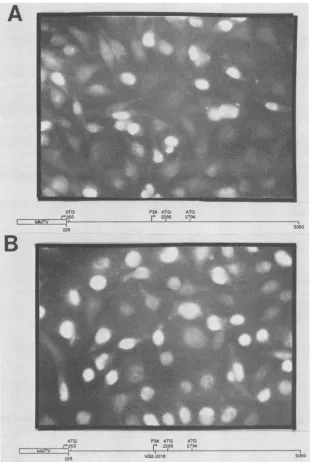
FIG. 6. Anti-NS1 immunofluoresence analysis of MVM-expressing cell lines. Cell lines weretransfected and theninduciblyexpressed constructs, asdescribed in Materials and Methods. Induction waswith 0.6,uM dexamethasone, andimmunofluoresence analysiswas as described inMaterialsand Methods. Theconstructsused for transfection of the individual cell linesarediagrammed and explained in thetext. (A) Cell linesexpressing wild-type MVM gene products. (B) Cell lines expressing wild-type NS1 and NS2 truncatedat nt2018. MMTV, Mouse mammarytumorvirus.
productswereanalyzed. The firstsetwasstably transformed
with an MVM construct in which the MVM P4 promoter was
replaced with the mouse mammary tumor virus-inducible
promoterwhich,ondexamethasoneinduction,makesall the
wild-type MVM gene products. Cell lines expressing this
constructhaverecentlybeencharacterized (7). The second
setof cell lines examined expressesaconstruct identical to the first, except that the mutation at nt 2018 had been introduced. On induction, this second set of cell lines is
expected to generate wild-type NS1 and an NS2 peptide truncatedatnt2018.Immunofluoresenceanalysisshows that
on
induction,
both cell lines shownsimilarnuclearlocaliza-tion of NS1 (Fig. 6), indicating that in the presence ofa
severely truncated NS2, nuclear localization of NS1 is
unaffected. Therefore, the punctate immunofluorescence
pattern
ofNS1seenlate inmutantinfectionofA9cellslikely
reflects thereduced accumulated levels ofNS1,rather than
suggestinga direct rolefor NS2 in the localization ofNS1.
Whether this reduced level of accumulated NS1 late in NS2-2018infection of A9 cells can be totally accounted for
by the decrease in accumulating template molecules noted above is not yet clear.
(Both
sets of cell lines show aon November 10, 2019 by guest
http://jvi.asm.org/
[image:8.612.151.464.75.537.2]decreased plating efficiency and decreased expression of
MVM gene products, presumably due to the toxicity of
MVM gene products [5, 7, 27] on prolonged induction.)
NS1 is known to be posttranslationally modified, and
these modifications are most likely important for its role in DNA replication as well as its other functions. It is possible that these modifications are different in the absence of wild-type NS2, and therefore an examination of the
phos-phorylation states NS1 in NS2 mutant infection is currently
underway.
DISCUSSION
By analysis of a series of viral mutants that prematurely
terminate MVM NS2 or prevent itsproduction entirely, we
show that NS2 is important for DNA replication within a
single-burst cycle and for the efficient production of
infec-tious MVM in murine A9 and human NB324K cells. In
addition, the requirement for NS2 during the production of
infectious virus and DNA replication is host cell specific.
Similarresults have recently been obtained in other
labora-tories using mutants of MVM (P. Tattersall, personal
com-munication)and the closely related parvovirus Hi (X. Li and S. L. Rhode, personal communication).
Therole of NS2 in viral DNA replication may be direct. In NS2 mutant infections of A9 and NB324K cells, NS1 is
produced and localized similarly to wild-type infections up to 10 to 12 h, whereas in NB324K cells, immunofluoresence
indicates that NS1 accumulates and localizes as does the wild type throughout infection. However, late in NS2-2018 infectionof A9 cells, immunofluorescence analysis shows a
reduced accumulation of NS1. Whether this deficiency in
accumulated NS1, perhaps resulting from an undetermined
NS2-dependent
mechanism, is the cause of the reducedaccumulationof viral replicative forms or, alternatively, its
consequence
(which would imply a direct role for NS2 in thereplication processin A9 cells) has not yet been determined. A more detailed analysis of the accumulation of NS1
pro-duced latein infection of A9 cells relative to the number of
available templates is currently under way.
Theaccumulationof NS2-2018 mRF in infected A9 cells is
reduced approximately 10-fold, and the accumulation of
progeny single-stranded DNA inNS2-2018-infected A9 and
NB324Kcells is also reduced. Two observations imply that
thereis atleast one additional block to NS2 mutant
reinfec-tion in addition to a block to mRF production. First, NS2-2018 DNAreplicationin A9 cells is similar in the presence or
theabsence ofneuraminidase in the culture media to block
reinfection. Second, NS2-2018 replicates mRF to wild-type
levels on NB324K cells yet yields very small plaques on these cells, indicative of either inefficient production of
infectious virus or reduced killing of NB324K cells by this
mutant. Whether theseapparent blocks to reinfection can be
accounted for by the apparent reduction in accumulated
progeny single strandor whether there are additional blocks to
infectious-virus
production or cytotoxicity in these infec-tions is currently being investigated. An analysis of rever-tants ofNS2 mutantswill likely help in clarifying this issue, andrecent resultshave indicated thatNS2mutants grown on A9cells quickly convert to virus that grows more like the wild type on the A9 host (L. K. Naeger and D. J. Pintel,unpublished data). An interesting observation perhaps re-lated to potential multiple functions for NS2 is the recent
finding that
phosphorylated
forms ofNS2are confined to thecytoplasmofinfectedA9 cells, while the majority of nuclear NS2 is
unphosphorylated
(13).Of particular interest is the host range
specificity
for the requirement ofNS2
in viralinfection. Certain cell types may be able to compensate for either one or more functionsperformed by
NS2
during infection. Forinstance,
incontrastto A9 cells, NB324K cells support wild-type
production
ofNS2-2018
mRF, even thoughNS2-2018
infections of eithercell type are not characteristically wild type. An additional
possibilityis that murine A9cells have an inhibitortoMVM DNA replication or the production ofinfectious virus,
ab-sent in permissive cells, which
NS2
can inactivate. An understanding of the cellular factors present in certain celltypes that make
NS2
dispensibleforcertain aspectsofMVM replication will be of great interest.It is perhaps surprising that
NS2
does not have a moreprofound role in the replication of MVM in cells in culture, especially in NB324Kcells. Ananalysis ofthese mutants in
viral infection of mice, rather than on tissue culture cells, may lead to the discovery of other critical roles for the
NS2
protein.
ACKNOWLEDGMENTS
We thank Sue Cotmore and Peter Tattersall for plasmid clones expressing MVM fusion products and antibodies. We thank Sue Cotmore, Peter Tattersall, and Solon Rhode III for discussion and sharing information prior to publication. We thank Jianhong Zheng for help with construction and analysis of
NS2-1989,
Rob Schoborg and Greg Tullis for important participation throughout the course of this work, and Lisa Burger for excellent technical assistance. We thank Ram Guntaka, Karen Clemens, and members of the labora-tory for critical reading of the manuscript and helpful discussion.This work was supported by Public Health Service grants
R01-A121302andK04-AI00934 from the National Institutes of Health to D.J.P. L.K.N. was partially supported by the University of Mis-souri, Columbia, Molecular Biology Program, and J.C. was partially supported by Public Health Service grant
T32-AI07276
from the National Institutes of Health during the course of this work.LITERATURE CITED
1. Astell, C. R., E. M. Gardiner, and P. Tattersall. 1986. The DNA
sequence of the lymphotropic variant of minute virus of mice, MVM(i), and its comparison to that of the fibrotropic prototype
strain. J. Virol. 57:656-669.
2. Berns, K. I., and M. A. Labow. 1987. Parvovirus gene regula-tion. J. Gen. Virol. 68:601-614.
3. Bouck, N. P., and G. di Mayorca. 1976. Somatic mutation as the basis for malignant transformation by chemical carcinogens. Nature (London) 264:722-727.
4. Bouck, N. P., and G. di Mayorca. 1982. Chemical carcinogens transform BHK cells by inducing a recessive mutation. Mol. Cell. Biol. 2:97-105.
5. Brandenburger, A., D. Legendre, B. Avalosse, and J. Rom-melaere. 1990. Synergistic action of NS-1 and NS-2 proteins in the cytopathogenicity of parvovirus MVMp. Virology 174:576-584.
6. Clemens, K. E., and D. J. Pintel. 1988. The two transcription units of the autonomous parvovirus minute virus of mice are transcribed in a temporal order. J. Virol. 62:1448-1451. 7. Clemens, K. E., D. R. Cerutis, L. R. Burger, C. Q. Yang, and
D. J. Pintel. 1990. Cloning of minute virus of mice cDNAs and preliminary analysis of individual viral proteins expressed in murine cells. J. Virol. 64:3967-3973.
8. Cotmore, S. F., L. J. Sturzenbecker, and P. Tattersall. 1983. The autonomous parvovirus MVM encodes two nonstructural
pro-teins in addition to its capsid polypeptides. Virology
129:333-343.
9. Cotmore, S. F., and P. Tattersall. 1986. Organization of the
nonstructural genes of the autonomous parvovirus minute virus of mice. J. Virol. 58:724-732.
10. Cotmore, S. F., and P. Tattersall. 1987. The autonomously
on November 10, 2019 by guest
http://jvi.asm.org/
replicating parvoviruses of vertebrates. Adv. Virus Res. 33:91-174.
11. Cotmore, S. F., and P. Tattersall. 1988. The NS-1 polypeptide of minutevirus of mice is covalently attached to the 5' termini of duplex replicative-form DNA and progeny single strands. J. Virol. 62:851-860.
12. Cotmore, S. F., and P. Tattersall. 1989. A genome-linked copy of the NS-1 polypeptide is located on the outside of infectious parvovirus particles. J. Virol. 63:3902-3911.
13. Cotmore, S. F., and P. Tattersall. 1990. Alternate splicing in a parvoviral nonstructural gene links a common amino-terminal sequence to downstream domains which confer radically dif-ferent localization and turnover characteristics. Virology 177: 477-487.
14. Doerig, C., H. Bernhard, J.-P. Antonietti, and P. Beard. 1990. Nonstructural protein of parvoviruses B19 and minute virus of mice controlstranscription. J. Virol. 64:387-396.
15. Doerig, C., B. Hirt, P. Beard, and J.-P. Antonietti. 1988. Minute virus of mice non-structural protein NS-1 is necessary and sufficient for trans-activation of the viral P39 promoter. J. Gen. Virol. 69:2563-2573.
16. Gluzman, Y. 1981. SV40-transformed simian cells support the replicationof early SV40 mutants. Cell23:175.
17. Graham, F. L., J. Smiley, W. C. Russell, and R.Nairu. 1977. Characteristics ofahumancell line transformedby DNA from humanadenovirus type5.J. Gen. Virol. 36:59-72.
18. Hirt, B. 1967. Selective extraction of polyoma DNA from infected mouse cultures. J. Mol. Biol. 26:363-369.
19. Im, D.-S., and N. Muzyczka. 1990. The AAV origin binding protein Rep68 is anATP-dependent site-specific endonuclease with DNA helicase activity. Cell 61:447-457.
20. Jongeneel, C. V.,R.Sahli, G. K.McMaster,and B. Hirt. 1986. Aprecise map of splice junctions in the mRNAs of minute virus ofmice,anautonomousparvovirus. J. Virol. 59:564-573. 21. Krauskopf, A., 0. Resnekov, and Y. Aloni. 1990. A cis
down-streamelement participates in regulation of in vitro
transcrip-tioninitiation from the P38 promoter of minute virus of mice.J. Virol. 64:354-360.
22. Kunkel,T. A.1985.Rapidandefficientsite-specific mutagenesis
without phenotypic selection. Proc. Natl. Acad. Sci. USA
82:488-492.
23. Labieniec-Pintel, L., and D. J. Pintel. 1986. The minute virus of mice P39 transcription unit can encode both capsid proteins. J. Virol. 57:1163-1167.
24. Morgan, W. R., and C. D. Ward. 1986. Three splicingpatterns are used toexcise the small intron common to all minute virus of mice RNAs. J. Virol.60:1170-1174.
25. Pintel, D.,D. Dadachanji,C. R.Astell, and D. C.Ward. 1983. The genomeof minute virus of mice, anautonomous parvovi-rus, encodestwooverlapping transcription units. Nucleic Acids Res. 11:1019-1038.
26. Rhode, S. L., III. 1985. trans-Activation of parvovirus P38 promoterby the 76Knoncapsid protein. J.Virol.55:886-889. 27. Rhode, S. L., III. 1987. Construction ofagenetic switch for
inducibletrans-activation of geneexpression in eucaryotic cells. J. Virol. 61:1448-1456.
28. Rhode,S.L.,III. 1989. Both excision andreplication of cloned autonomous parvovirus DNArequire the NS1 (rep)protein.J. Virol.63:4249-4256.
29. Rhode, S. L.,and S. M. Richard. 1987. Characterization ofthe trans-activation-responsive elementof the parvovirus H-1 P38 promoter. J.Virol. 61:2807-2815.
30. Snyder,R.O.,R.J. Samulski,and N.Muzyczka.1990. In vitro resolution ofcovalentlyjoined AAV chromosome ends. Cell 60:105-113.
31. Tantravahi, V., R. V. Guntaka,B. F.Erlanger,and0.J.Miller. 1981.Amplified ribosomalRNAgenesina rathepatoma cell line areenriched in5-methylcytosine. Proc. Natl. Acad. Sci. USA 78:489-493.
32. Tattersall, P.,andJ. Bratton. 1983. Reciprocalproductive and restrictive virus-cell interactions of immunosuppressive and prototype strains of minute virus of mice. J. Virol. 46:944-955. 33. Tullis,G.E.,L.Labieniec-Pintel, K. E.Clemens,andD. Pintel. 1988. Generation and characterization ofa
temperature-sensi-tive mutation in the NS-1 gene of theautonomousparvovirus
minute virus of mice. J. Virol.62:2736-2744.
34. Yakobson, B., T. A. Hrynko, M. J. Peak, and E. Winocour. 1989. Replication ofadeno-associated virus in cells irradiated with UVlight at 254nm. J. Virol.63:1023-1030.