Rational synthesis of normal, abnormal and anionic
NHC
–
gallium alkyl complexes: structural, stability
and isomerization insights
†‡
Marina Uzelac, Alberto Hern´an-G ´omez, David R. Armstrong, Alan R. Kennedy and Eva Hevia*
Advancing the rational design of main-group N-heterocyclic carbene complexes, this study reports the synthesis, X-ray crystallographic and NMR spectroscopic characterisation of a novel series of Ga complexes containing neutral or anionic NHC ligands using the unsaturated carbene IPr (IPr¼ 1,3-bis-(2,6-di-isopropylphenyl)imidazol-2-ylidene). Starting from normal adduct GaR3$IPr (1) (R¼ CH2SiMe3), the addition of polar LiR led to the formation of NHC-stabilised gallate species IPr$LiGaR4(2), resulting from co-complexation of the single-metal species. Contrastingly, reversing the order of addition of these organometallic reagents, by treating unsaturated free IPr,first with LiR followed by GaR3, furnished novel heteroleptic gallate (THF)2Li[:C{[N(2,6-iPr2C6H3)]2CHCGa(CH2SiMe3)3}] (3), which contains an anionic NHC ligand acting as an unsymmetrical bridge between the two metals, coordinating through its abnormal C4 position to Ga and through its normal C2 position to Li. Electrophilic interception studies of 3 using methyl triflate (MeOTf), methanol and imidazolium salt (IMes$HCl) led to the isolation and structural elucidation of the two novel neutral abnormal NHC (aNHC) complexes [CH3 C{[N(2,6-iPr2C6H3)]2CHCGa(CH2SiMe3)3}] (4) and aIPr$GaR3(5) (aIPr¼HC{[N(2,6-iPr2C6H3)]2CHC}). These studies disclose the preference of the anionic IPr ligand present in 3 to react with electrophiles via its C2 position, leaving its Ga–C4 bond intact. Abnormal complex 5 can also be accessed by a thermally induced rearrangement of its normal isomer1. Combining NMR spectroscopic and kinetic studies with DFT calculations, new light has been shed on this intriguing transformation, which suggests that it occursviaa dissociative mechanism, highlighting the importance of the donor ability of the solvent used in these thermal isomerizations as well as the steric bulk of the substituents on the NHC and the Ga reagent. These findings intimate that relief of the steric hindrance around Ga by forming an abnormal complex is a key driving force behind these rearrangements.
Introduction
Over the past two decades, N-heterocyclic carbenes (NHCs), in particular imidazol-2-ylidenes, have progressed from mere curiosities to commodity neutral s-donor ligands with a multitude of applications in synthesis and materials.1Typically,
the carbene centre is located between the two nitrogen atoms (C2 position) allowingp-donation by both adjacent N-hetero-atoms into the empty pporbital of the carbene, which makes these ligands remarkably more stable than other non-cyclic, all-carbon counterparts.2,3 Acting as strong s-donors, these
versatile ligands have been pivotal to recent breakthroughs in transition-metal catalysis.4–9 Furthermore, the application of
NHCs to main group chemistry has enabled the stabilisation of novel low valent compounds,10–17as well as the development of
several frustrated Lewis pair (FLP) systems.18,19
In parallel to these studies, a different type of NHC complex has been developed where the imidazole ring binds to the metal centre through its backbone. These less stabilised carbenes, where there is only one N-atom adjacent to their carbenic-C,20
have been termed as abnormal (or mesoionic) NHCs (aNHCs).21–23Following Crabtree's seminal report in 2001 of the
rst transition-metal complex with an aNHC, several other examples have been prepared.24However, it was only in 2009
when Bertrand succeeded in the isolation of therst stable free aNHC by the elegant deprotonation of a 1,2,3,4-tetraarylated imidazolium chloride.25,26
Interestingly, experimental and theoretical studies point to aNHCs being better donors than their normal counterparts,
which is in part attributed to their reduced steric
WestCHEM, Department of Pure and Applied Chemistry, University of Strathclyde, Glasgow, G1 1XL, UK. E-mail: [email protected]
†Dedicated to the memory of Paul von R. Schleyer.
‡Electronic supplementary information (ESI) available: CIF les giving crystallographic results, experimental details and copies of the NMR spectra. CCDC 1405459–1405464. For ESI and crystallographic data in CIF or other electronic format see DOI: 10.1039/c5sc02086g
Cite this:Chem. Sci., 2015,6, 5719
Received 10th June 2015 Accepted 3rd July 2015
DOI: 10.1039/c5sc02086g
www.rsc.org/chemicalscience
Science
EDGE ARTICLE
Open Access Article. Published on 03 July 2015. Downloaded on 25/09/2015 14:30:33.
This article is licensed under a
Creative Commons Attribution 3.0 Unported Licence.
View Article Online
congestion.25,27–29 Thus Layeld has recently reported a
ther-mally induced rearrangement of IPr$Fe(HMDS)2[IPr¼
1,3-bis-(2,6-di-isopropylphenyl)imidazol-2-ylidene, HMDS¼ 1,1,1,3,3,3-hexamethyldisilazide] which aer 3 h in reuxing toluene evolves to its abnormal isomer.30Within main group chemistry,
the number of complexes containing aNHCs remains very limited. Thus the rst example of an adduct of this type, a substituted phosphinidene complex, was reported by Carty in 2006.31 Related thermal rearrangements as that mentioned
above in iron chemistry have been proposed for
tris(penta-uorophenyl)borane NHC systems which exhibit FLP
chem-istry.32–34 Similarly, within group 13 Dagorne has shown the
isomerization of ItBu$AlMe3[IBu¼1,3-bis(tert
-butyl)imidazol-2-ylidene] to its C4 bound isomer (aItBu$AlMe3) at room
temper-ature in THF, although the mechanisms involved in these processes remain unclear.35
In addition to these isomerization studies, Robinson has demonstrated that anionic NHCs, resulting from the lithiation of the imidazole backbone of unsaturated NHCs,36 can be
employed as platforms to access aNHC-complexes of B and Zn by quenching the relevant anionic B or Zn complex with a suitable electrophile such as HCl$NEt3 or MeOTf.37–39 More
recently, Lavalloet al.have shown that implementing carborane anions as N-imidazolium substituents allows the selective formation of both normal and abnormal NHC constitutional isomers from a single precursor.40 In addition, the authors
report a thermal isomerization from abnormal to normal NHC, which can be proton catalyzed.
Building on these precedents, exporting this chemistry to the heavier group 13 metal gallium, and using the unsaturated carbene IPr as a case study, here we report a novel series of normal, anionic and abnormal NHC complexes derived from the same metal fragment, tris(alkyl)gallium Ga(CH2SiMe3)3.
Combining X-ray crystallographic, kinetic and spectroscopic studies with theoretical investigations we assess the constitu-tion and stability of these complexes. An insightful comparison between two alternative synthetic methods to access aNHC complexes: namely metallation/electrophilic interception and thermal isomerisation, is also provided. It should be noted that
although there are several examples of Ga–NHC adducts
reported in the literature,41–45 with some of them nding
applications as p-acid catalysts,46,47 the only abnormal NHC
complex known to date aIPr$GaCl339was reported as recently as
2014, although its synthesis is not straightforward as it was obtained by transmetallation of GaCl3 with an anionic NHC
mixed Li–B complex.
Results and discussion
NHC-stabilised lithium gallate complexesWe started our studies by reacting equimolar amounts of IPr and trimethylsilylmethylgallium(III)48(GaR
3) [R¼CH2SiMe3] at
room temperature in non-polar hexane which afforded colour-less crystals of the adduct IPr$GaR3(1) in a 75% isolated yield
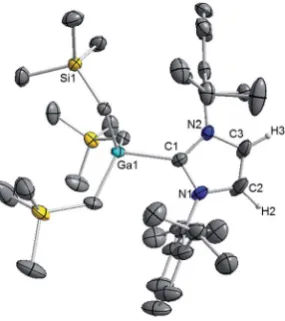
(Scheme 1). The molecular structure of1(Fig. 1) was elucidated by a single crystal X-ray diffraction analysis which revealed the formation of a complex with the four-carbon-coordinated
gallium atom attached to three alkyl groups and the C2 (i.e.C1 in Fig. 1) of a neutral carbene. A distorted tetrahedral geometry adopted by Ga centre is evidenced by the C–Ga–C bond angles
which range from 96.36(6) to 119.43(7) (average angle
108.79). The Ga–Calkyl distances range from 2.0034(15) A to˚
2.0164(16)˚A (mean 2.0106˚A) which is only slightly elongated (by2.5%) when compared to parent monomeric GaR3(Ga–C
bonds ranging from 1.952(4)A to 1.971(3)˚ A, average 1.959˚ ˚A)49
in agreement with the increase in the coordination number of Ga in1.
Noticeably, the Ga–CNHCdistance of 2.1960(16)˚A is signi
-cantly longer compared to that observed in the related Ga halide complex IPr$GaCl3 (2.016(2) ˚A).42 This elongation can be
rationalised in terms of a combination of the greater steric congestion in1imposed by the monosilyl groups as well as the stronger Lewis acidity of GaCl3compared to GaR3.
Despite the long Ga–C1 distance, it should be noted that1
retains its integrity in C6D6solution as evidenced by DOSY NMR
studies, which show that the IPr and monosilyl groups belong to the same sized species, as the cross-point for both ligand resonances are aligned in the second dimension (average D
value ¼6.2 1010 m2s1; see Fig. S39 in ESI‡). The most
informative resonance in the13C NMR spectrum is that for the carbenic carbon at 186.6 ppm, a chemical shiconsistent with retention of the Ga–C bond in solution.50
Next the reactivity of1towards LiCH2SiMe3was investigated.
Previous work by Roesky and Stalke51 has shown that when
borane adduct IPr$BH3is treated with BuLi, lithiation of the C4
position of the imidazole ring takes place affording an anionic NHC which binds through its C4 position to Li, leaving the B–C2 bond untouched.51Similar reactivity has also been described for
the alkylborane IPr$BEt3.36
Interestingly in our studies, the polar organometallic RLi fails to deprotonate the NHC ligand of 1, affording instead lithium gallate [IPr$LiGa(CH2SiMe3)4] (2) in an isolated yield of
48%. Single crystal X-ray diffraction analysis established the molecular structure of [IPr$LiGa(CH2SiMe3)4] which represents
to the best of our knowledge therst example of an alkali-metal gallate stabilised by an NHC ligand (Fig. 2).52 Compound 2
exhibits a contacted ion pair (CIP) motif where the two metals
Scheme 1 Synthesis of normal adduct1, homoleptic tetraalkyl gallate 2and heteroleptic gallate3.
Open Access Article. Published on 03 July 2015. Downloaded on 25/09/2015 14:30:33.
This article is licensed under a
are connected by two bridging alkyl groups with the neutral NHC bindingviaits C2 (i.e.C1) position to lithium.
Thesendings show that under these reaction conditions the polar Li alkyl reagent preferentially co-complexes with GaR3,
to yield [LiGaR4]53which is then trapped and stabilised by the
neutral NHC ligand, instead of lithiating the carbene backbone. Clearly the Ga atom favours coordination of another R anion rather than a neutral IPr ligand. It should be noted that a similar reactivity has been reported for IPr$ZntBu2withtBuLi in
hexane, producing zincate complex [IPr$LiZntBu
3].54Gallate2
can also be prepared by reacting polymeric [{LiGaR4}N] with free IPr. Solution state studies of2were hindered by its poor solubility in arene solvents such as C6D6; whereas in
coordi-nating THF, the adduct dissociates into free IPr and multi-THF-solvated LiGaR4, as evidenced by multinuclear NMR
spectros-copy (see ESI‡). Contrastingly, if the order of the monometallic reactants is reversed, by treatingrst IPr with LiR followed by the addition of gallium alkyl GaR3in THF, heteroleptic (THF)2Li
[:C{[N(2,6-iPr2C6H3)]2CHCGa(CH2SiMe3)3}] (3) was obtained in a
56% isolated yield. As shown in Scheme 1,3is the result of an
indirect gallation process where IPr isrst metallated at the C4 position by polar LiR,36 which in turn undergoes
trans-metallation to the lower polarity GaR3. X-Ray crystallographic
studies established the CIP structure of3where now the metals are connected by an anionic NHC which coordinates as an asymmetric bridge via its normal C2 position to Li and its abnormal C4 position to Ga (Fig. 3). The C2–Li (i.e.C1 in Fig. 3) distance is 2.093(5) ˚A which is similar to those reported for related complexes containing anionic NHC bridged in a similar C2–Li/C4–M fashion to Li/Al and Li/B pairings.36,38
The Ga–C4 distance (i.e.C3 in Fig. 3) of 2.052(2)˚A is close in value with Ga–Calkyl bonds (average 2.028 ˚A)55 and
under-standably it is signicantly shorter (by 0.144A) to that found in˚ the neutral C2 bound IPr adduct1. It is noteworthy, that unlike in1where a pyramidalization of Ga coordination sphere was evident (vide supra), in 3 gallium atom exhibits nearly ideal tetrahedral geometry with the average bond of 2.034 ˚A and mean angle of 109.46 (angles ranging from 105.68(9) to 112.99(10)). This decrease in distortion around the metal centre can be attributed to the relief of the steric congestion of3
when compared to1. From the NMR data ind8-THF solutions
(see ESI‡), metallation of IPr was demonstrated by the large downeld chemical shiof the C4 resonance in the13C NMR spectrum (from 122.3 ppm in free IPr to 155.1 in3), as well as an informative singlet at 6.64 ppm (integral 1H) in the 1H NMR spectrum of the imidazole CH (versus7.19 ppm in free IPr). In addition, a resonance in the13C NMR spectrum at 201.4 ppm for carbenic C2 conrms the formation of a NHC complex. The loss of symmetry in the imidazole ring is evidenced in the1H and13C NMR spectra with the appearance of two distinct sets of Dipp signals.
Abnormal NHC–Ga complexesviaelectrophilic interception
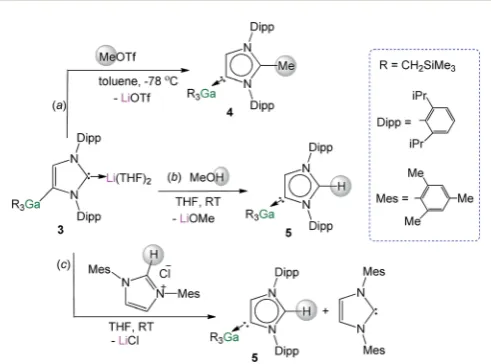
Recent studies have shown that certain anionic NHC complexes, when treated with an electrophile can be transformed into neutral abnormal adducts.38,39To explore this reactivity here, we
treated3with a molar equivalent of MeOTf in toluene at78C. The reaction occurred with the formation of a white precipitate (presumably LiOTf) furnishing a neutral abnormal NHC–Ga complex [CH3C{[N(2,6-iPr2C6H3)]2CHCGa(CH2SiMe3)3}] (4) in a Fig. 1 Molecular structure of1 with 50% probability displacement
ellipsoids. All hydrogen atoms except those on the imidazole ring and minor disorder in one isopropyl group and one monosilyl group are omitted for clarity.
Fig. 2 Molecular structure of2 with 30% probability displacement ellipsoids. All 3 CH2SiMe3groups are disordered. Only one component of the disordered model is shown above. All hydrogen atoms except those on the imidazole ring have been omitted for clarity.
Fig. 3 Molecular structure of3 with 50% probability displacement ellipsoids. All hydrogen atoms except H2 on the imidazole ring and minor disorder of THF ligand have been omitted for clarity.
Open Access Article. Published on 03 July 2015. Downloaded on 25/09/2015 14:30:33.
This article is licensed under a
[image:3.595.97.240.50.211.2] [image:3.595.43.291.544.681.2] [image:3.595.308.554.554.691.2]68% yield (Scheme 2a). Complex4results from the selective C2 methylation of the anionic NHC leaving the Ga–C4 bond intact (see ESI‡ for experimental details and NMR spectroscopic characterisation).
The molecular structure of4was established by X-ray crys-tallographic studies (Fig. 4). The bond length of 1.538(6)A for˚ C2–CMe(i.e.C1–C4 in Fig. 4) is consistent with a single bond,
while the Ga–C4 (i.e.C3 in Fig. 4) bond length of 2.087(3)A is˚ only slightly elongated to that found in the anionic variant3
(2.052(2) ˚A), and signicantly shorter than the Ga–C2 bond length in1(2.1960(16)˚A). Reecting the formation of a neutral abnormal complex, the13C NMR spectrum of4shows a reso-nance at 161.2 ppm for the C4 attached to Ga (vs.155.1 ppm in
3) whereas the methylated carbon (originally C2 carbenic posi-tion in 3) resonates signicantly upeld at 145.0 ppm in comparison with that observed for3(at 201.5 ppm).
The use of methanol as a quenching reagent resulted in clean conversion of 3 to the abnormal adduct aIPr$GaR3 (5)
(Scheme 2b). Notably,5is also formed as a protonation product from the reaction of3with the imidazolium salt IMes$HCl (1,3-bis-(2,4,6-trimethylphenyl)imidazolium chloride) (Scheme 2c). Thesendings not only demonstrate that the C2 position of3in the imidazole ring is its preferred basic site, but also the high strength of its Ga–C4 bond as it is retained in5. Furthermore in view of these results it appears that for the GaR3fragment aIPr
is a better ligand than the related normal IMes carbene (obtained from deprotonation of the imidazolium salt, Scheme 2c), as no ligand exchange occurs. Compound5was isolated as a crystalline solid in a 61% yield (see ESI‡for experimental details and NMR spectroscopic studies) and its molecular structure was established by X-ray crystallography (Fig. 4).
The Ga–C4 bond length (i.e.Ga–C2 in Fig. 4) of 2.0759(16)˚A in5is signicantly shorter than the corresponding bond in the normal congener1(by 0.1201A), supporting previous studies˚ which suggest that abnormal carbenes are strongers-donors, less sterically congested, and consequently are able to form stronger bonds with metal centres. In fact, as previously
discussed for4, despite the neutral constitution of the aNHC ligand, the strength of this interaction is similar to that observed for the Ga–C bond of the anionic carbene present in3. As mentioned above, the only example of an abnormal NHC Ga complex prior to this work has been reported by Robinson,39
where aIPr$GaCl3 was formed while attempting the
trans-metallation of mixed lithium/boron anionic NHC complex with GaCl3. Interestingly the Ga–Ccarbene distance of this complex
(1.978(3)˚A) differs only by 0.097˚A to that found for5(2.0759(16)
˚
A). This contrasts with the markedly different bond distances found when comparing the relevant normal isomer (Ga–Ccarbene
bond distance in IPr$GaX3, 2.1960(16) ˚A when X¼ R (1);vs.
2.016(2)˚A when X¼Cl), hinting that in the abnormal systems, due to the increased steric space around the metal centre, the size of the anionic groups attached to Ga has a signicantly smaller inuence than in the normal adducts.
1H NMR spectrum of5ind8-THF showed a diagnostic singlet
at 9.00 ppm belonging to the H attached to the C2 position of the carbene, whereas the remaining H in the imidazole ring resonates at 7.20 ppm. Similarly to that found in4, the13C NMR
spectrum shows two informative singlets at 162.8 and 139.1 ppm which can be assigned to Ga–C4 and NC(H)N respectively. Compound5, along with1and3constitute a rare example of a series of normal, anionic and abnormal complexes incorpo-rating the same metal–coligand partnership.56Complementary
DFT computational studies57were undertaken on these three
Scheme 2 Electrophilic interception of anionic NHC complex3with (a) MeOTf, (b) MeOH and (c) imidazolium salt IMes$HCl.
Fig. 4 Molecular structure of4(top) and5(bottom) with 50% prob-ability displacement ellipsoids. Only one component of disordered groups is shown. All hydrogen atoms except those on the imidazole rings have been omitted for clarity.
Open Access Article. Published on 03 July 2015. Downloaded on 25/09/2015 14:30:33.
This article is licensed under a
[image:4.595.44.290.519.701.2]compounds employing the B3LYP method58and the 6-311G**
basis set59 (see ESI‡ for details). Natural bond orbital (NBO)
analysis60 of the optimised structures of IPr$GaR
3 (IIIIPr),
aIPr$GaR3 (IVIPr) and (THF)2Li[:C{[N(2,6-iPr2C6H3)]2
-CHCGa(CH2SiMe3)3}] (VIPr) suggest considerable covalent
character of the Ga–C bonds. The Ga natural charges range from +1.43 to +1.35 and the Wiberg bond indices (WBIs) of the Ga–C bonds range from 0.45–0.64. Contrastingly reecting the more ionic nature of the Li–C contact inVIPr, the natural charge of Li
is +0.88 and the WBI of the Li–C is 0.08. In agreement with our experimentalndings the estimated Ga–C4 bonds inIVIPrand
VIPrare signicantly shorter (2.146 and 2.054A, WBIs˚ ¼0.56
and 0.53 respectively) than the Ga–C2 bond in the normal complexIIIIPr(2.333˚A, WBI¼0.45), although it should be noted
that forIIIIPr and IVIPr, the strength of these Ga–C bonds is
somewhat underestimated (vide infra). A comparative natural charges analysis of these three models shows that while in bimetallicVIPrthe amount of electrons transfer to the GaR3unit
is 0.34, in the case of adductsIIIIPrandIVIPrthese values are
[image:5.595.305.554.323.394.2]0.27 and 0.31 which is consistent with the neutral constitution of the NHC ligands.
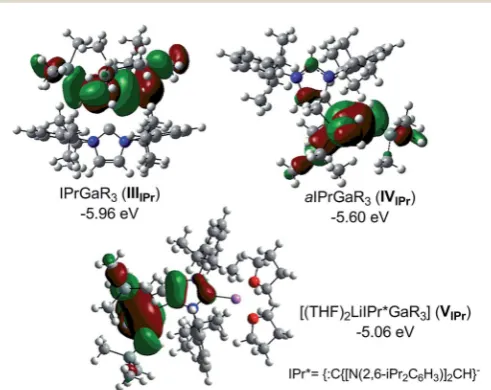
Fig. 5 shows the highest occupied molecular orbitals (HOMOs) calculated for modelsIIIIPr,IVIPrandVIPrwhich in all
cases correspond to the Ga–C bonding orbitals at the CH2
groups of the monosilyl ligands, involving also in the case of
VIPr the C4 of the anionic NHC. For this bimetallic system,
these calculations contrast with those reported for the related anionic lithium dicarbene [:C{[N(2,6-iPr2C6H3)]2CHCLi(THF)}]n
prepared by Robinson,36whose HOMO and HOMO2
corre-spond to the two strongly polarised Li–C bonding orbitals at the C2 and C4 positions of the imidazole ring.
Interestingly, calculations on the regioisomeric structure of
VIPr with the positions of the {GaR3} and {Li(THF)2}+ were
reversed, giving rise to Ga–C2 and Li–C4 coordination modes (modelVIIPrin ESI‡) showed that this model is signicantly less
stable (by 11.7 kcal mol1) which is consistent with the
formation of a signicantly weaker (longer) Ga–C bond (2.272˚A forVIIPrvs.2.054˚A forVIPr, see ESI‡for details).
Normal to abnormal isomerization
It is rare to nd examples where both normal and abnormal isomers have been structurally characterised.61Amongst them,
intriguing studies from the groups of Layeld30and Dagorne35
have shown that the systems IPr$Fe(HMDS)2 and ItBu$AlMe3
respectively, thermally isomerize to the relevant abnormal species although the possible reaction pathways for these transformations remain obscure. Similarly to ourndings for complexes1and5, in these Fe and Al examples, analysis of the metal–C distances have revealed that the abnormal NHCs bind more strongly to the metal centres than the isomeric normal carbenes. These studies also suggest the formation of the abnormal-NHC complex is thermodynamically controlled with steric factors strongly inuencing isomerization processes.
Since compound 5 was obtained using an indirect method
(metallation/electrophilic interception), we pondered if such types of thermal rearrangement would also be in operation when1was heated in solution.
Indeed, heating a d6-benzene solution of 1 at 100C and monitoring progress by1H NMR, produced5in 77% yield aer
10 h. The reaction was greatly accelerated by using the more coordinating solvent d8-THF (75% conversion in only 1 h)
Scheme 3.62Previous studies on ItBu$AlMe
3have shown that the
isomerization is much faster using a Lewis donor solvent such as THF, hinting that dissociation (at least partially) of the car-bene from the metal must play a signicant role in the process. Interestingly no isomerization is observed for IPr$GaCl3when
using smaller and stronger Lewis acid GaCl3, as mentioned
above, the carbene binds signicantly more strongly to the Ga centre. Related to thesendings, reecting the relevance of the Lewis acidic character of the metal fragment, using the related alkyl compounds of other s-block metals such as MgR2$IPr63
and ZnR2$IPr64 (6) complexes [R ¼ CH2SiMe3] no
rearrange-ments were observed aer 72 h at 100C.
The effect of the steric bulk of the substituents on the NHC ligand was assessed. IMes$GaR3(7), containing the less bulky
1,3-bis-(2,4,6-trimethylphenyl)imidazol-2-ylidene (IMes)65
car-bene, rearranges at a signicantly slower rate than1, showing aer 30 hours at 100C ind
8-THF a modest 8% conversion to its
abnormal isomer. Contrastingly, 1,3-bis(tert -butyl)imidazol-2-ylidene (ItBu) failed to form a normal adduct with GaR3,
furnishing instead only the abnormal isomer aItBu$GaR3(8) at Fig. 5 Calculated molecular orbitals HOMO of modelsIIIIPr,IVIPrand
VIPr.
Scheme 3 Thermally-induced rearrangement of1into5.
Open Access Article. Published on 03 July 2015. Downloaded on 25/09/2015 14:30:33.
This article is licensed under a
[image:5.595.44.290.504.699.2]room temperature within one hour. This reactivity contrasts with that reported for the iron complex ItBu$Fe(HMDS)2which
undergoes thermal decomposition,30and appears to be more in
line with that reported by Tamm for the B(C6F5)3/ItBu frustrated
Lewis pair system (FLP) which has been used for the activation of small molecules such as H2 or alkynes. Although the two
components fail to give an isolable normal complex, in the absence of other reactive substrates, the irreversible formation
of the relevant abnormal carbene–borane adduct is
observed.32–34
DFT calculations57
Encouraged by the formation of several aNHC–Ga complexes using this approach, we performed theoretical calculations at the DFT level employing the B3LYP method58and the 6-311G**
basis set59to optimize structures and to gain new insights into
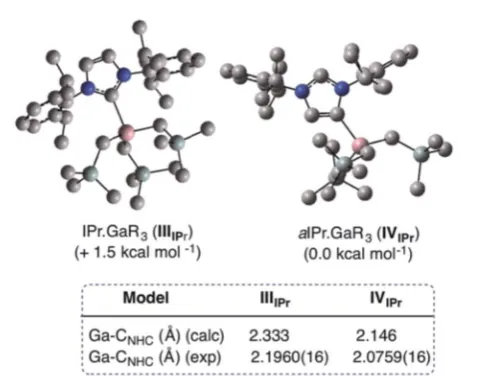
the thermodynamics involved in these processes. A comparison of geometrical parameters of optimised structures IPr$GaR3
(IIIIPr) and aIPr$GaR3(IVIPr) shows in general good agreement
with those found experimentally from the X-ray determinations of1and5respectively (see Fig. 6 and Table S3‡) although for both models there is a slight underestimation of the strength of the Ga–Ccarbeneinteraction (D[d(Ga–C)calcd(Ga–C)exp)¼0.137
and 0.070˚A for1and5respectively). Interestingly modelIVIPr
was computed to be more stable thanIIIIPrby just 1.5 kcal mol1.
Using the same level of theory we also found that free aIPr is 16.2 kcal mol1less stable than its normal isomer IPr.66Notably,
the dissociation energy ofIVIPrwas found to be 17.7 kcal mol1
higher than forIIIIPr(Fig. 7), in agreement with our experimental
ndings which suggest a greater donor ability of the abnormal NHC ligand for the GaR3fragment when compared to its normal
isomer.
These studies were extended to the related carbenes IMes and ItBu. For IMes, which is less sterically demanding than IPr, the order of stability ofIIIIMesandIVIMesis reversed, with the
normal isomer IIIIMes being 2.1 kcal mol1 more stable (see
ESI‡). Interestingly, the energy difference between free aIMes
and IMes of +16.8 kcal mol1is almost identical to that for free aIPr and IPr. As shown in Fig. 7, the calculated values for the dissociation energies ofIIIIMesandIVIMesfollow the same trend
as described for the IPr complexes, although now the dissoci-ation of IMes$GaR3(IIIIMes) is noticeably more endothermic (by
6.1 kcal mol1) than in IPr$GaR
3 (IIIIPr). These subtle but
signicant changes in the energy values could explain the lower conversions observed experimentally when IMes$GaR3 (7) is
heated ind8-THF (max yield 8% for aIMes$GaR3,vide supra), as
the dissociation of IMes$GaR3 is more thermodynamically
challenging.
A more dramatic effect is observed for ItBu, which containing aliphatictBu substituents, is signicantly bulkier than IPr, more basic and therefore a better donor, from an electronic perspective.67 Notably attempts to optimize the structure of
ItBu$GaR3 were unsuccessful, as all the obtained models
showed no stabilisation compared to the separate constituents ItBu and GaR3. This lack of coordination between ItBu and GaR3
can best be explained by steric incompatibility of tBu and
monosilyl groups and supports our experimentalndings that when ItBu and GaR
3are mixed at RT aItBu$GaR3(8) is formed.
The dissociation energy for this abnormal complex was found to be +23.9 kcal mol1(Fig. 7).
Collectively these computational results not only offer further support for the greater donor ability of abnormal NHC ligands compared to their normal isomers but also highlight the crucial role that the steric prole plays in these isomeriza-tion processes. Thus, in the case of IMes, the less bulky of the
Fig. 6 Modelled structures and relative energies of NHC-adductsIIIIPr andIVIPr.
[image:6.595.306.550.403.515.2]Fig. 7 Estimated dissociation energies (kcal mol1) of complexesIII andIV(R¼Dipp, Mes,tBu).
Table 1 Initial rates for isomerization of1into5ind8-THF at 323 K and at given initial concentrations of1, IPr and GaR3
Entry [1] M [IPr] (M) [GaR3] (M) ro106(Ms1)
1 0.17 1.950.08
2 0.29 3.260.08
3 0.37 4.810.03
4 0.42 5.040.04
5 0.29 0.07 4.670.05
6 0.29 0.15 5.710.15
7 0.29 0.26 6.400.09
8 0.32 0.16 3.390.04
9 0.32 0.31 2.300.02
10 0.32 0.42 2.060.04
Open Access Article. Published on 03 July 2015. Downloaded on 25/09/2015 14:30:33.
This article is licensed under a
[image:6.595.50.291.512.700.2] [image:6.595.302.554.595.721.2]carbenes investigated, it becomes slightly endothermic, whereas for IPr and ItBu, the formation of the abnormal
complexes is thermodynamically favoured by 1.5 and
6.6 kcal mol1respectively, in accord with their sizes.
Mechanistic implications
Both computational and spectroscopic studies suggest that the isomerization of1into5may involve a dissociative step. Sup-porting this assumption, when a mixture of1and GaR3 (two
equivalents) was heated at 100C ind8-THF, the formation of5
becomes signicantly slower (46% conversion observed aer 1 h), which can be rationalised in terms of the effect that the excess of this reagent will have in the equilibrium depicted in eqn (1), namely shiit towards the le.
GaR3–IPr#GaR3+ IPr (1)
Contrastingly, when the reaction is carried out using an excess of IPr (2 equivalents), the isomerization process occurs signicantly faster (90% aer 30 minutes). In order to shed some light on the mechanism involved in this isomerization process, kinetic analysis of a NMR scale reaction ([1]¼0.22 M) performed at 100C ind8-THF revealed a pseudo-zeroth-order
kinetics over a period of two-half lives (64% conversion).62An
identical experiment using IPrD$GaR3(1D) (IPrD¼
1,3-bis(2,6-di-isopropylphenyl)-4,5-dideutero-imidazolin-2-ylidene)68 allowed
the comparison of the subsequent zero order rate constants,
revealing no observable KIE (see ESI‡for details). These nd-ings suggest that the bond cleavage of the C4–H in the IPr ligand is unlikely to be rate-determining in the isomerization process. Encouraged by these ndings we chose to study further the mechanism of this process using the method of initial rates.69,70
Table 1 shows the results of the initial rate experiments con-ducted in a sealed NMR tube (50C,1,d8-THF). These data were
tted to the approximately linear region of the formation of5
restricted to conversions of 5–7% in order to calculate the initial rate, ro of the reaction. Entries 1–4 demonstrate a rst-order
dependence on the concentration of complex 1while Fig. 8a shows this correlation graphically. Arst-order dependence is also observed for the concentration of IPr as shown in entries 2, 5–7 and Fig. 8b, which is consistent with the dissociative step previously discussed and the involvement of free IPr in the isomerization process. By contrast to IPr, a negative order of1 is observed for the concentration of GaR3(entries 8–10, Fig. 8c).
A plausible interpretation of these results is that the isomeri-zation process takes place by the partial dissociation of1(which appears to be the rate-determining step of the reaction)71to
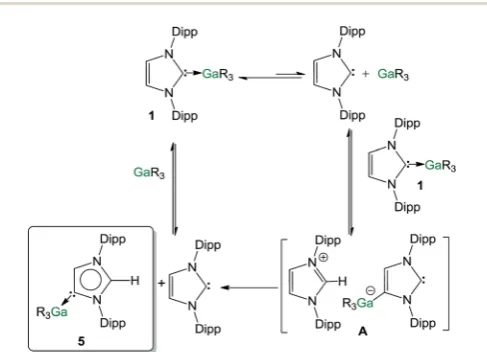
form free IPr that in turn can activate the H atom from the backbone of the NHC ligand coordinated to Ga in complex1.72
This proposedmodus operandiis similar to that described for the activation of small molecules such as acetylenes, H2 or
amines using NHC/borane FLP systems, that, as mentioned before, in the absence of another substrate form the relevant abnormal aNHC–BAr3 adducts (Ar¼C6F5or XyF6).32–34,73This
could lead to the formation of the transient ion-pair species [IPr–H]+[IPr*GaR3] (A) (IPr* ¼ :C{[N(2,6-iPr2C6H3)]2CHC),
comprising an imidazolium cation and an NHC-gallate con-taining an anionic NHC (which on the basis of the constitution of lithium gallate3, it could be expected to have its Ga center coordinated to the C4 position) (Fig. 9). This reactivity can be interpreted in terms of “thermally induced frustration,” a concept recently introduced by P´apai which refers to the thermal activation of strained dative bonds of bulky Lewis donor–acceptor pairs.74IntermediateAwill evolve fast with the
irreversible formation of abnormal complex5 and the regen-eration of free IPr. This proposed behaviour mirrors that described in Scheme 2c, for the protonation of the anionic carbene present in3by the imidazolium salt IMes$HCl, which occurs at the C2 position, forming neutral aIPr$GaR3and free
IMes. Since IPr is regenerated at the end of the process, it can then be envisaged that under the conditions studied it acts as a catalyst in the isomerization process.
Fig. 8 Initial ratesversusconcentration of (a) [1], (b) [IPr] and (c) [GaR3]1.
Fig. 9 Proposed mechanism for the isomerisation of1into5.
Open Access Article. Published on 03 July 2015. Downloaded on 25/09/2015 14:30:33.
This article is licensed under a
[image:7.595.57.551.50.145.2] [image:7.595.46.290.533.709.2]Conclusions
Progressing main-group NHC chemistry, this systematic study of the synthesis and stability of abnormal NHC–gallium complexes has demonstrated two alternative and efficient methodologies to access aIPr$GaR3(5). Studies investigating the
synthesis of anionic NHC complexes have shown that the functionalization of the imidazole backbone can be achieved by sequentially treating IPr with the polar organometallic reagent LiR followed by GaR3addition (indirect stepwise gallation), to
afford heteroleptic gallate (THF)2Li[:C{[N(2,6-iPr2C6H3)]2
-CHCGa(CH2SiMe3)3}] (3). Electrophilic interception of 3 with
MeOTf or the imidazolium salt IMes$HCl led to the isolation of neutral abnormal NHC (aNHC) complexes [CH3C{[N(2,6-iPr2
-C6H3)]2CHCGa(CH2SiMe3)3}] (4) and aIPr$GaR3 (5). These
studies disclose the preference of the anionic IPr ligand present in3to react with these electrophilesviaits C2 position, leaving its Ga–C4 interaction intact. Compound5can also be accessed by a thermally induced rearrangement of its normal isomer1. NMR spectroscopic studies coupled with theoretical calcula-tions have revealed the importance of the donor ability of the solvent used in these thermal isomerization processes as well as the steric bulk of the substituents on the N atoms of the NHC ligands and the Ga reagent, suggesting that the relief of the steric hindrance by forming an abnormal complex is one of the main driving forces behind these rearrangements and hinting at the potential FLP reactivity that these systems may exhibit. Mechanistic studies intimate that these processes occurviaa rate-determining dissociative step, supporting the formation of free NHC, which in turn can catalyse the isomerization process.
Acknowledgements
We thank the Royal Society, and the European Research Council (ERC) for their generous sponsorship of this research. We also thank Professor Robert E. Mulvey, Dr David. J. Nelson (Univer-sity of Strathclyde) and Professor Michael S. Hill (Univer(Univer-sity of Bath) for their insightful comments, Mr Alexander Clunie for his assistance in the CHN analysis of highly air and moisture sensitive compounds and Mr Craig Irving for his help with NMR spectroscopy experiments.
Notes and references
1 (a) D. Bourissou, O. Guerret, F. P. Gabba¨ıand G. Bertrand,
Chem. Rev., 2010, 100, 39; (b) M. Albrecht, Science, 2009,
326, 532; (c) W. Kirmse,Angew. Chem., Int. Ed., 2010, 49, 8798; (d) N-Heterocyclic Carbenes in Transition Metal Catalysis and Organocatalysis, ed. C. S. J. Cazin, Springer, Netherlands, 2010; (e) N-Heterocyclic Carbenes: Effective Tools for Organometallics Synthesis, ed. S. P. Nolan, Wiley VCH, 2014.
2 A. J. Arduengo III, R. L. Harlow and M. Kline,J. Am. Chem. Soc., 1991,113, 361.
3 A. J. Arduengo III, H. V. Rasika Dias, D. A. Dixon, R. L. Harlow, W. T. Klooster and T. F. Koetzle,J. Am. Chem. Soc., 1994,116, 6812.
4 M. Scholl, S. Ding, C. W. Lee and R. H. Grubbs,Org. Lett., 1999,1, 953.
5 W. Hermann,Angew. Chem., Int. Ed., 2002,41, 1290. 6 C. Valente, S. Calimsiz, K. H. Hoi, D. Mallik, M. Sayah and
M. G. Organ,Angew. Chem., Int. Ed., 2012,51, 3314. 7 S. P. Nolan,N-Heterocyclic Carbenes in Synthesis, Wiley-VCH,
Weinheim, 2006.
8 S. Diez-Gonzalez, N. Marion and S. P. Nolan, Chem. Rev., 2009,109, 3612.
9 D. Enders, O. Niemeier and A. Henseler,Chem. Rev., 2007,
107, 5606.
10 Y. Wang, Y. Xie, P. Wei, R. B. King, H. F. Schaefer III, P. v. R. Schleyer and G. H. Robinson, Science, 2008, 321, 1069.
11 A. Sidiropoulos, C. Jones, A. Stasch, S. Klein and G. Frenking,
Angew. Chem., Int. Ed., 2009,48, 9701.
12 R. S. Ghadwal, H. W. Roesky, S. Merkel, J. Henn and D. Stalke,Angew. Chem., Int. Ed., 2009,48, 5683.
13 C. Jones, A. Sidiropoulos, N. Holzmann, G. Frenking and A. Stasch,Chem. Commun., 2012,48, 9855.
14 Y. Wang, Y. Xie, P. Wei, R. B. King, H. F. Schafer III, P. v. R. Schleyer and G. H. Robinson, J. Am. Chem. Soc., 2008,130, 14970.
15 M. Y. Abraham, Y. Wang, Y. Xie, P. Wei, H. F. Schaefer III, P. v. R. Schleyer and G. H. Robinson,Chem.–Eur. J., 2010,
16, 432.
16 H. Braunschweig, R. D. Dewhurst, K. Hammond, J. Mies, K. Radacki and A. Vargas,Science, 2012,336, 1420.
17 For excellent overviews of the area see: (a) R. S. Ghadwal, R. Azhakar and H. W. Roesky, Acc. Chem. Res., 2013,46, 444; (b) Y. Wang and G. H. Robinson, Inorg. Chem., 2011,
50, 12326.
18 L. J. Hounjet and D. W. Stephan,Org. Process Res. Dev., 2014,
18, 385.
19 D. W. Stephan,Acc. Chem. Res., 2015,48, 306.
20 R. Tonner, G. Heydenrych and G. Frenking,Chem.–Asian J., 2007,2, 1555.
21 S. Gr¨undemann, A. Kovacevic, M. Albrecht, J. W. Faller and R. H. Crabtree,Chem. Commun., 2001, 2274.
22 S. Gr¨undemann, A. Kovacevic, M. Albrecht, J. W. Faller and R. H. Crabtree,J. Am. Chem. Soc., 2002,124, 10473. 23 L. N. Appelhans, D. Zuccaccia, A. Kovacevic, A. R. Chianese,
J. R. Miecznikowski, A. Macchioni, E. Clot, O. Eisenstein and R. H. Crabtree,J. Am. Chem. Soc., 2005,127, 16299. 24 (a) P. L. Arnold and S. Pearson,Coord. Chem. Rev., 2007,251,
596; (b) O. Schuster, L. Yang, H. G. Raubenheimer and
M. Albrecht, Chem. Rev., 2009, 109, 3445; (c)
R. H. Crabtree,Coord. Chem. Rev., 2013,257, 755.
25 E. Aldeco-Perez, A. J. Rosenthal, B. Donnadieu,
P. Parameswaran, G. Frenking and G. Bertrand, Science, 2009,326, 556.
26 Related to these ndings, Ghadwal et al. have recently reported a Pd catalysed methodology to access C2-arylated imidazolium salts which can be used as precursors to prepare abnormal-NHC Cu complexes, see: R. S. Ghadwal, S. O. Reichmann and R. Herbst-Irmer,Chem.–Eur. J., 2015,
21, 4247.
Open Access Article. Published on 03 July 2015. Downloaded on 25/09/2015 14:30:33.
This article is licensed under a
27 J. B. Waters and J. M. Goicoechea,Coord. Chem. Rev., 2015,
293–294, 80.
28 M. Heckenroth, E. Kluser, A. Neels and M. Albrecht,Angew. Chem., Int. Ed., 2007,46, 6293.
29 The Tolman Electronic Parameter (TEP) has been employed in transition metal complexes to evaluate the electron donating abilities of normal and abnormal NHC's, see for example: R. A. Kely III, H. Clavier, S. Giudice, N. M. Scott, E. D. Stevens, J. Bordner, I. Samardjiev, C. D. Hoff, L. Cavallo and S. P. Nolan,Organometallics, 2008,27, 202. 30 B. M. Day, T. Pugh, D. Hendriks, C. F. Guerra, D. J. Evans,
F. M. Bickelhaupt and R. A. Layeld, J. Am. Chem. Soc., 2013,135, 13338.
31 T. W. Graham, K. A. Udachin and A. J. Carty, Chem.
Commun., 2006, 2699.
32 D. Holschummacher, T. Bannenberg, C. G. Hrib, P. G. Jones and M. Tamm,Angew. Chem., Int. Ed., 2008,47, 7428.
33 D. Holschummacher, T. Bannenberg, K. Ibrom,
C. G. Daniliuc, P. G. Jones and M. Tamm, Dalton Trans., 2010,39, 10590.
34 E. L. Kolychev, T. Bannenberg, M. Freytag, C. G. Daniliuc, P. G. Jones and M. Tamm,Chem.–Eur. J., 2012,18, 16938. 35 A. L. Schmitt, G. Schnee, R. Welter and S. Dagorne,Chem.
Commun., 2010,46, 2480.
36 Y. Wang, Y. Xie, M. Y. Abraham, P. Wei, H. F. Schaefer III, P. v. R. Schleyer and G. H. Robinson, J. Am. Chem. Soc., 2010,132, 14370.
37 Y. Wang, Y. Xie, M. Y. Abraham, R. G. Gilliard Jr, P. Wei, C. F. Campana, H. F. Schaefer III, P. v. R. Schleyer and G. H. Robinson,Angew. Chem., Int. Ed., 2012,51, 10173. 38 Y. Wang, M. Y. Abraham, R. G. Gilliard Jr, P. Wei, J. C. Smith
and G. H. Robinson,Organometallics, 2012,31, 791. 39 M. Chen, Y. Wang, R. J. Gilliard Jr, P. Wei, N. A. Schwartz and
G. H. Robinson,Dalton Trans., 2014,43, 14211.
40 (a) A. El-Hellani and V. Lavallo,Angew. Chem., Int. Ed., 2014,
53, 4489; (b) M. J. Asay, S. P. Fisher, S. E. Lee, D. Borchardt, F. S. Tham and V. Lavallo,Chem. Commun., 2015,51, 5359. 41 X.-W. Li, J. Su and G. H. Robinson,Chem. Commun., 1996,
2683.
42 N. Marion, E. C. Escudero-Adan, J. Benet-Buchholz, E. D. Stevens, L. Fensterbank, M. Malacria and S. P. Nolan,
Organometallics, 2007,26, 3256.
43 C. Fliedel, G. Schnee, T. Aviles and S. Dagorne,Coord. Chem. Rev., 2014,275, 63.
44 A. Higelin, S. Keller, C. G¨ohringer, C. Jones and I. Krossing,
Angew. Chem., Int. Ed., 2013,52, 4941.
45 M. L. Cole, S. K. Furfari and M. Kloth,J. Organomet. Chem., 2009,694, 2934.
46 S. Tang, J. Monot, A. El-Hallani, B. Michelet, R. Guillot, C. Bour and V. Gandon,Chem.–Eur. J., 2012,18, 10239. 47 C. Bour, J. Monot, S. Tang, R. Guillot, J. Farjon and
V. Gandon,Organometallics, 2014,33, 594.
48 O. T. Beachley Jr and R. G. Simmons,Inorg. Chem., 1980,19, 1021.
49 M. U. Kramer, D. Robert, Y. Nakajima, U. Englert, T. P. Spaniol and J. Okuda,Eur. J. Inorg. Chem., 2007,5, 665.
50 Two singlets are observed for the monosilyl group at0.95 (Ga–CH2) and 0.18 ppm (Si(CH3)3) contrasting with the1H
NMR spectrum of GaR3 in the same solvent where both
signals accidentally overlap displaying a singlet at 0.13 ppm. 51 A. Jana, R. Azhakar, G. Tavˇcar, H. W. Roesky, I. Objartel and
D. Stalke,Eur. J. Inorg. Chem., 2011,25, 3686.
52 For both2and4the three monosilyl groups were found to be disordered. This obviously compromises any discussion of structural details such as bond distances, however in each case the crystallographic analysis does establish the gross composition and conformation of the molecular complexes. 53 The structure of this unsolvated lithium gallate has been reported recently, see: D. R. Armstrong, E. Brammer,
T. Cadenbach, E. Hevia and A. R. Kennedy,
Organometallics, 2013,32, 480.
54 D. R. Armstrong, S. E. Baillie, V. L. Blair, N. G. Chabloz, J. Diez, J. Garcia-Alvarez, A. R. Kennedy, S. D. Robertson and E. Hevia,Chem. Sci., 2013,4, 4259.
55 All four Ga–C bonds are similar in length ranging from 2.013(2)A to 2.052(2)˚ A (average 2.034˚ A) which is in good˚ agreement with other tetra-coordinated gallate species such as {[K-dibenzo-18-c-6]+[Ga(h1-C
3H5)4]} (2.029 ˚A
mean) see ref: C. Lichtenberg, T. P. Spaniol and J. Okuda,
Inorg. Chem., 2012,51, 2254.
56 As far as we can ascertain there are only two other examples containing the BEt3(see ref. 38 and 39 and Y. Yamaguchi, T.
Kashiwabara, K. Ogata, Y. Miura, Y. Nakamura, K. Kobayashi and T. Ito, Chem. Commun., 2004, 2160) and B(C6F5)3
fragments (see ref. 32 and 34 and S. Kronig, E. Theuergarten, C. G. Daniliuc, P. G. Jones and M. Tamm,
Angew. Chem., Int. Ed., 2012,51, 3240).
57 W. Kohn, A. D. Becke and R. G. Parr,J. Phys. Chem., 1996,
100, 12974.
58 (a) A. D. Becke, Phys. Rev. A, 1988,38, 3098; (b) C. T. Lee, W. T. Yang and R. G. Parr, Phys. Rev. B: Condens. Matter Mater. Phys., 1998,37, 785.
59 (a) A. D. McLean and G. S. Chandler,J. Chem. Phys., 1980,72, 5639; (b) R. Krishnan, J. S. Binkley, R. Seeger and J. A. Pople,
J. Chem. Phys., 1980,72, 650.
60 E. D. Glendening, A. E. Reed, J. E. Carpenter and F. Weinhold,NBO Version 3.1.
61 (a) T. Guo, S. Dechert and F. Meyer,Organometallics, 2014,
33, 5145; (b) M. Heckenroth, A. Neels, M. G. Garnier, P. Aebi, A. W. Ehlers and M. Albrecht,Chem.–Eur. J., 2009,
15, 9375.
62 Under these conditions the maximum conversion observed of1to5was 75%. Extended reaction times (48 h) did not lead to an increase in this conversion.
63 A. R. Kennedy, J. Klett, R. E. Mulvey and S. D. Robertson,Eur. J. Inorg. Chem., 2011, 4675.
64 ZnR2$IPr was prepared by mixing equimolar amounts of
ZnR2and IPr in hexane. See ESI‡for experimental details
and X-ray crystallographic and spectroscopic
characterisation.
65 H. Clavier and S. P. Nolan,Chem. Commun., 2010,46, 841– 861.
Open Access Article. Published on 03 July 2015. Downloaded on 25/09/2015 14:30:33.
This article is licensed under a
66 The relative stabilities of IPr/aIPr have previously been computed using a different level of theory (ZORA-BLYP/ TZ2P level using COSMO to simulate the solvent effect), withDEa–n¼12.5 kcal mol1, see ref. 30.
67 As shown in Table S4‡and in agreement with the previous calculations for IPr and IMes, normal free ItBu is 17.2 kcal
mol1more stable than its free abnormal isomer.
68 R. M. Stolley, H. A. Duong, D. R. Thomas and J. Louie,J. Am. Chem. Soc., 2012,134, 15154.
69 Attempts to study transformation of1into5under
pseudo-rst-order conditions (using a 10 molar equivalent excess of GaR3per complex1) completely inhibited the isomerization
process.
70 R. B. Jordan, Reaction Mechanisms of Inorganic and
Organometallic Systems, Oxford University Press, Oxford, UK, 3rd edn, 2007.
71 Consistent with this interpretation, the formation of aItBuGaR3(8) from an equimolar mixture of ItBu and GaR3
occurs under much milder conditions (room temperature, 60 minutes) than for5. In this case ItBu and GaR3 fail to
form a stable normal adduct, thus a dissociation step is not required.
72 NMR studies of equimolar amounts of IPrD$GaR
3(1D) and
IPr$GaR3 (1) ind8-THF were carried out in order to assess
if the transformation of 1 to 5 occurs via intra- or
intermolecular mechanism. However analysis of the NMR data proved to be inconclusive due to the overlapping of the signals from the protonated and deuterated species. 73 In particular the reactivity of 1 can be related to that
described by Tamm for ItBu$B(XyF6)3 that forms a stable
normal adduct at room temperature but heating at 110C isomerizes to aItBu$B(XyF6)3. This system exhibits FLP
reactivity and can activate CO2, HCCPh and THF, as
reported in ref. 34.
74 T. A. Rokob, A. Hamza, A. Stirling and I. P´apai,J. Am. Chem. Soc., 2009,131, 2029.
Open Access Article. Published on 03 July 2015. Downloaded on 25/09/2015 14:30:33.
This article is licensed under a