City, University of London Institutional Repository
Citation
:
Howe, J. M. and King, A. (2001). Positive Boolean Functions as Multiheaded
Clauses. Paper presented at the International Conference on Logic Programming, 26 Nov -
01 Dec 2001, Cyprus.
This is the unspecified version of the paper.
This version of the publication may differ from the final published
version.
Permanent repository link: http://openaccess.city.ac.uk/1697/
Link to published version
:
Copyright and reuse:
City Research Online aims to make research
outputs of City, University of London available to a wider audience.
Copyright and Moral Rights remain with the author(s) and/or copyright
holders. URLs from City Research Online may be freely distributed and
linked to.
City Research Online:
http://openaccess.city.ac.uk/
[email protected]
Multiheaded Clauses
JaobM.Howe
?1
andAndyKing
2
1
DepartmentofComputing,CityUniversity,London,UK
2
ComputingLaboratory,UniversityofKent,Canterbury,UK
fj.m.howe,a.m.kingguk.a.uk
Abstrat. Boolean funtions are ubiquitous in the analysis of
(on-straint)logi programs.ThedomainofpositiveBooleanfuntions,Pos,
has been used for expressing, for example, groundness, niteness and
sharingdependenies.TheperformaneofananalyserbasedonBoolean
funtionsis ritiallydependentontheway inwhihthe funtionsare
represented. This paperdisusses multiheadedlauses as a
representa-tion of positive Boolean funtions. The domain operations for
multi-headedlausesareoneptuallysimpleandanbeimplemented
straight-forwardlyinProlog.Moreovertheseoperationsgeneralise thoseforthe
less algorithmially omplex operations of propositional Horn lauses,
leadingtonaturallystratiedalgorithms.Themultiheadedlause
repre-sentationisusedtobuildaPos -basedgroundnessanalyser.Theanalyser
performssurprisingly welland sales smoothly,not requiring widening
toanalyseanyprograminthebenhmarksuite.
Keywords.Abstratinterpretation,(onstraint)logiprograms,Boolean
funtions,groundnessanalysis.
1 Introdution
Booleanfuntionsplayanimportantroleinthepratieofstatianalysis.Many
analysesare ouhedin termsof Boolean funtions,andmanipulation of these
funtions is ruial to the performane of any implementation. In partiular,
positiveBooleanfuntions havebeenapplied to theanalysis of logiprograms
forpropertiessuhasgroundness,rigidity[15℄,niteness[3℄andsharing[8℄.This
paperadvoatesrepresentingpositiveBooleanfuntionsasmultiheadedlauses
andarguesthatPrologiswellsuitedtotheirmanipulation.
Thehoieofabstratdomainforapartiularappliationinvolvesthe
strik-ingofabalanebetweeneÆienyandpreision.Thevariouspropertiestraked
usingpositiveBooleanfuntionsgiveriseinpratietodierentformsofBoolean
funtion. Hene, in some appliations, restriting to a more omputationally
tratable sublassof Pos anhaveasigniant impatonpreision(for
exam-ple,goal-independentanalysisoflibraryode),whilstinotherslittlepreisionis
lost (forexample,goal-dependentgroundnessanalysis).Elsewhere, theauthors
19℄.Here,withaneyeto awiderrangeof appliations,theauthorsadapt
teh-niquesfrom thesesublassesto Pos.
Traditionally, Booleanfuntion manipulation hasbeenperformedusing
bi-nary deision diagrams (BDDs). Groundness analysis is one of the most
im-portant topis in the stati analysis of (onstraint) logi programs and from
a logi programming point of view this analysis is the most pratial test of
Booleanfuntionmanipulation.BDD-basedanalysershaveonsistently
outper-formed those based on other representations of Boolean funtions [1,2,10,24℄
for groundness analysis, but there has been a ontinuous stream of work on
representations amenable to Prolog implementation [7℄, in partiular for the
sublassofdenitepositivefuntions,Def[12,13,19℄.Themajorityofthese
im-plementations,inludedthosebasedonBDDs,requirewideningtoanalyselarge
benhmarks.
TheDef-basedgroundnessanalyserdesribedin[19℄doesnotrequire
widen-ingand wasdesignedsothat themostfrequentlyalleddomain operationsare
themost lightweight.Thesamedesign methodologysuggeststhat aPos-based
analyser should represent Boolean funtions as onjuntions of multiheaded
lauses.Infat,in[1℄(redued)onjuntivenormalform,(R)CNF,was
investi-gated,and\performedreasonablywell",butwasultimatelyrejetedsineBDDs
performed 40% faster and, in C (their implementation language), onjuntive
normal form isno easierto odethan BDDs. Surprisingly,onjuntivenormal
formshavenotbeenonsideredsine.Thispaperrevisitslausalrepresentations
of Pos sine, in Prolog, lausal representations are muh easier to ode than
BDDs and following the methodology of [19℄ the lausal representation lends
itselfto eÆientimplementation basedonentailmentheking.
Theimportane ofthe hoie of representation islearly illustrated bythe
subtledierenebetweenmultiheadedlausesandRCNF.TheRCNF
represen-tationis reduedin thesensethat nolause subsumesanother.Thisredution
makes meet for RCNF quadrati in the size of the representation. The
mul-tiheaded lause representation may ontain redundant lauses, enabling meet
to be onstanttime. This is an important issue for performane sinemeet is
by far the most frequently applied operation. Neither multiheaded lause nor
RCNFrepresentationsareinaanonialform,thereforeequivaleneannot be
deteted by straightforward syntatiidentity. In [1℄ equivalene for RCNF is
determined by omputing the dual Blake anonial form of the formulae and
thentestingforsyntatiidentity.ThedualBlakeanonialformmaybe
expo-nentiallylargerthantheRCNFrepresentation andmust alwaysbe ompletely
omputed.Thereforethemethodisnotamenabletolteringthroughlower
om-plexityalgorithms.Logialentailment,ratherthansyntatiequivalene,ismore
exible. In pratie,entailment offormulaeanoftenbe detetedusing an
in-ompletelowomplexityalgorithm.Usingsuhahek,manyallstotheworst
asealgorithmanbelteredout.Itisthisstratieduseofentailmentheking
and blokdelarations,whilst meet redues to listonatenationimplemented
usingdierenelists.Themajorthemesandontributionsofthisworkare:
Posfuntions anbenaturallyexpressedasmultiheaded lauses,whih are
partiularlystraightforwardtounderstand,manipulateand ode.
Theentailmenthekingalgorithm (whih ispotentiallyexponentialin the
numberofvariables)isstratiedsothat heksfornaturallyourring
sub-lassesofformulaetakequadratitime(inthesizeoftheformulae);in
par-tiulartheforwardhainingalgorithmforpropositionalHornlausesis
sub-sumed.
Thedomainoperationsformultiheadedlausesmaybeodedsuintlyand
eÆiently in Prolog, resulting in fast Pos-based goal-dependent and
goal-independent groundness analysers whih do not require widening for any
programin thebenhmarksuite.
If widening is required, the representation may be simply and naturally
widenedtoDef ortothesimplerdomainEPos.
Theanalysersagaindemonstratethe valueofaprinipledapproahto the
designofastatianalysis.
An experimental evaluation of the analysers is given illustrating that a
lausalrepresentationofPosodedinProloggivesperformanesomparable
toBDDrepresentationsoded inC.
Therestofthispaperisstruturedasfollows:Setion2introduesthe
nees-sary tehnialbakgroundmaterial. Setion3details multiheadedlauses.
Se-tion4givesalgorithmsfortheabstrat operationsofPosrepresentedas
multi-headedlauses.Setion5desribesPos-basedgroundnessanalysersimplemented
with Booleanfuntions representedasmultiheaded lauses. Setion 6 givesan
experimental evaluationof these analysers.Setion 7reviewsrelated work and
Setion 8onludes.
2 Preliminaries
A Boolean funtion isafuntion f :Bool
n
!Bool where n0.LetV denote
adenumerableuniverseofvariables. ABooleanfuntionanberepresentedby
a propositional formula overX V where jXj = n. The set of propositional
formulaeoverXisdenotedbyBool
X
.Throughoutthispaper,Booleanfuntions
and propositional formulae are used interhangeably without worrying about
thedistintion.Theonventionofidentifyingatruthassignmentwiththesetof
variables M that it mapsto trueis alsofollowed. Speially,amap
X
(M):
}(X) ! Bool
X
is introdued dened by:
X
(M) = (^M)^:(_(XnM)). In
addition,theformula^Y isoftenabbreviatedasY.
Denition1. Themap model
X
:Bool
X
!}(}(X))isdened by:model
X
(f)
=fM Xj
X
(M)j=fg.Also,ountermodel
X
:Bool
X
!}(}(X))isdened
by:ountermodel
X
(f)=}(}(X))nmodel
X
(f).Observethatmodel
X
isbijetive,
henemodel
1
:}(}(X))!Bool
X
EPos fx;yg
x^y
x
x$y y
Def fx;yg
x^y
# # x
x$y y
x y y x
# # Pos fx;yg
x^y
# # x
x$y y
x y
x_y
y x # # # #
Fig.1:Hassediagrams
Example 1. IfX=fx;yg,thenthefuntionfhtrue;truei7!true,htrue;falsei7!
false,hfalse;truei7!false,hfalse;falsei7!falseganberepresentedbythe
formulax^y.Also,model
X
(x^y)=ffx;yggandmodel
X
(x_y)=ffxg;fyg,
fx;ygg.
Thefousof this paperis on the use ofsublasses of Bool
X
in traing
de-pendenies.Thesesublassesaredened below:
Denition2. A funtion f is positive i X 2 model
X
(f). Pos
X
is the set
of positive Boolean funtions over X. A funtion f is denite i M \M
0 2
model X
(f) for all M;M
0
2 model
X
(f). Def
X
is the set of positive funtions
overX thataredenite.A funtionf isGEif isdenitepositiveandforall
M;M
0
2model
var(f)
(f),jMnM
0
j6=1.EPos
X
isthesetofGEfuntionsoverX.
Note that EPos
X
Def
X
Pos
X
. Also notie that EPos
X
= f^F j F
X[E
X
g,whereE
X
=fx$yjx;y 2Xg.
Example 2. SupposeX =fx;y;zgandonsiderthefollowingtable,whihstates,
forsomeBooleanfuntions,whethertheyareinEPos
X ,Def X orPos X andalso givesmodel X . f EPos X Def X Pos X model X (f)
fal se ;
x^y f fx;yg; fx;y;zgg
x_y f fxg;fyg; fx;yg;fx;zg;fy;zg;fx;y;zgg
x y f;;fxg; fzg;fx;yg;fx;zg; fx;y;zgg
x_(y z) f;;fxg;fyg; fx;yg;fx;zg;fy;zg;fx;y;zgg
true f;;fxg;fyg;fzg;fx;yg;fx;zg;fy;zg;fx;y;zgg
Note that x _y is not in Def
X
(sine its set of models is not losed under
intersetion)andthat falseisneitherinEPos
X
,norPos
X
, norDef
X .
The 4-tuple hPos
X
;j=;^;_i is a nite lattie, where true is the top
ele-ment and ^X is the bottom element. The set of (free) variables in a
syn-tati objet o is denoted by var(o). Existential quantiation is dened by
Shroder'sEliminationPriniple, that is, 9x:f = f[x7!true℄_f[x7! false℄.
Also,9fy
1
;:::;y
n
g:f (projetout)abbreviates9y
1
:::::9y
n
:f and9Y:f (projet
onto) denotes 9var(f) nY:f. Two funtions f;f
0
are equivalent, f f
0 if
and only if f j= f
0
and f
0
j= f. Finally, for any f 2 Bool
X
, oneg(f) =
model 1
(fXnMjM2model
X
[image:5.612.130.490.66.152.2] [image:5.612.140.474.404.484.2]ABooleanfuntionispositiveifandonlyifeverylauseinitsonjuntivenormal
formrepresentationontainsatleastonepositiveliteral.Alauseisdesribedas
multiheadedifitontainsoneormorepositiveliterals.Inthispaper,multiheaded
lausesarewrittenasimpliationswiththebodyaonjuntionofvariablesand
theheadadisjuntionofvariables.Thatis,amultiheadedlausehastheform:
y 1
^:::^y
n
!x
1
_::_x
m
Observe that the y
i
and the x
j
are distint variables, otherwise the lause is
equivalentto true.Letf 2MHCdenotethatf isrepresentedasaonjuntion
ofmultiheadedlauses.
Proposition1. Foreveryf 2Posthereisf
0
2MHCsuh thatf f
0 .
Proof. It is well known that any Boolean formula is equivalent to another in
onjuntive normal form. Suppose f f
0
, where f
0
is in onjuntive normal
form.Sine f is positive, everylause of f
0
must ontainat least one positive
literal,henef
0
2MHC.
In the ase that m = 1 the multiheaded lause is simply a propositional
Horn lause. This suggests that the algorithms to alulate the domain
oper-ations might performwell ifthey naturallyspeialiseto eÆient propositional
Hornlausealgorithms.Thiswillbetheaseforentailmentheking.Moreover,
themultiheaded lausesrepresentationispartiularlyamenableto widening.If
wideningisrequired,therepresentationmayberestritedinlineartimeso that
lauses with more than, say n, heads are disarded. If n = 1, this widening
orrespondstorestritingtoDef.
4 Domain Operations for Multiheaded Clauses
This setion givesalgorithms for the domain operationsof Pos represented as
multiheaded lauses. Meet (^) is simply onjuntion of lauses and is
on-stanttime;theotherdomainoperationsdesribedarejoin (_),relative
pseudo-omplement (!), entailment heking (j=) and projetion out (9). The
algo-rithms form thebasis ofthe groundnessanalyser whose implementation is
de-sribedin thenextsetion.
4.1 Join
Consider f = f
1
_f
2
, where f
1
;f
2
2 MHC. Suppose f
1 = 1 ^:::^ n and f 2 =d 1
^:::^d
m
. Then, distributing,f f
0 =^ n i=1 (^ m j=1 ( i _d j )).Suppose i = y 1
^:::^y
k
! x
1
_:::_x
l
and d
i
= u
1
^:::^u
p
! v
1
_:::_v
q . Then i _d i y 1
^:::^y
k
^u
1
^:::^u
p
! x
1
_:::_x
l
_v
1
_:::_v
q
2 MHC.
Henef
0
Relative pseudo-omplement has reently beenused to support bakward
rea-soning.Inpartiulartotraeontrolowbakward(righttoleft)toinfermoding
propertiesofinitial queries[20℄.
Consider f = f
1
! f
2
, where f
1
;f
2
2 MHC. Suppose f
1 = 1 ^:::^ n and f 2 = d 1
^:::^d
m
. Then, f f
0 = ^ m j=1 (_ n i=1 ( i ! d j )). Suppose i = y 1
^:::^y
k
!x
1
_:::_x
l
andd
i
=u
1
^:::^u
p
!v
1
_:::_v
q .Then i !d i = ^ l i=1 (x i ^u 1
^:::^u
p
!v
1
_:::_v
q ) ^^ k j=1 (u 1
^:::^u
p
!y
j
_v
1
_:::_v
q )
Hene f
0
2MHC.Giventhat thesizeof f
0
is exponentialin thesizeof f
1
,the
operationisexponential.However,itshouldbenotedthat manyanalysesusing
positiveBooleanfuntions(inludinggroundness) donotrequirethisoperation
to bealulated.Insuhasestheostofthisoperationisnotadrawbak.
4.3 EntailmentCheking
Entailment heking for positive Boolean funtions represented in onjuntive
normalformiso-NP omplete[1℄.However,asexploitedinSATsolving,many
of theBoolean funtions that arisein pratie anbe hekedfor satisability
with lowomplexityalgorithms. Thisobservationis exploitedby thetwo
algo-rithms detailed below. The rst, entailslite, is inomplete and takes quadrati
time in the size of the input. The seond, entailsheavy, adds ase splitting to
the rstalgorithm to obtainompleteness(whih isrequiredto guarantee
ter-minationin thexpointengine).Thisstratied algorithmusuallyonlyrequires
entailslite tobeinvokedone.
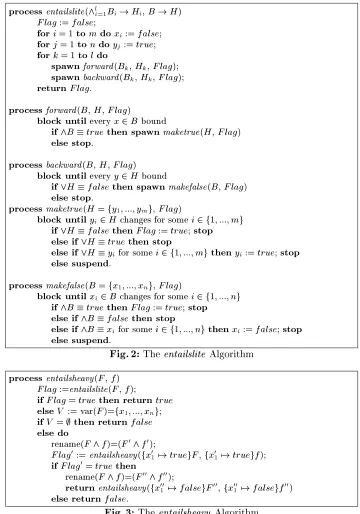
Theentailslite algorithm (seen Figure 2) is aninomplete test that a
mul-tiheadedlause is entailedby aonjuntionof multiheaded lauses:^
l i=1 B i ! H i
j= B ! H, where B = y
1
^:::^y
n
and H = x
1
_:::_x
m
. It works by
propagating deterministibindings in an attempt to detetontradition.The
algorithm terminates either when a ontradition is found or when no more
bindings anbe propagated:then Flag isreturned. Notiethat this algorithm
ontainsforwardhainingforpropositionalHornlausesasaspeialase.Also
notie that the variables are assigned values only one. The auxiliary rename
produesasyntativariantofatermwhihdoesnotshareanyvariableswith
theoriginalterm.
Thealgorithm entailsheavy (seeFigure3) appliesasesplittingifentailslite
does not detet entailment. The number of ases is potentially exponentialin
the number of variables left unbound by entailslite. However,propagation
o-ursafter eahbinding, thereforedeepasesplittingisrarelyrequired.Amore
intelligentsplittingstrategy(asinSATsolving)ouldbeapplied,butthenave
strategyperformsmorethanadequately.
Proposition2. Thealgorithmentailslite issound,butnotompletefor
proessentailslite(^ i=1
Bi!Hi,B!H)
Fl ag:=fal se;
fori=1tomdoxi:=fal se;
forj=1tondoy
j
:=true;
fork=1toldo
spawnforward(Bk,Hk,Fl ag);
spawnbakward(B
k
,H
k
,Fl ag);
returnFl ag.
proessforward(B,H,Fl ag)
blok untileveryx2Bbound
if^Btruethen spawnmaketrue(H,Fl ag)
elsestop.
proessbakward(B,H,Fl ag)
blok untileveryy2Hbound
if_Hfal sethen spawnmakefalse(B,Fl ag)
elsestop.
proessmaketrue(H=fy1;:::;ymg,Fl ag)
blok untily
i
2Hhangesforsomei2f1;:::;mg
if_Hfal sethenFl ag:=true;stop
elseif_Htruethen stop
elseif_Hy
i
forsomei2f1;:::;mgtheny
i
:=true;stop
elsesuspend.
proessmakefalse(B=fx1;:::;xng,Fl ag)
blok untilx
i
2B hangesforsomei2f1;:::;ng
if^BtruethenFl ag:=true;stop
elseif^Bfal sethen stop
elseif^Bx
i
for somei2f1;:::;ngthenx
i
:=fal se;stop
elsesuspend.
Fig.2:Theentailslite Algorithm
proessentailsheavy(F,f)
Fl ag:=entailslite(F,f);
ifFl ag=truethenreturntrue
elseV :=var(F)=fx
1
;:::;x
n g;
ifV =;thenreturnfal se
elsedo
rename(F^f)=(F
0
^f
0 );
Fl ag
0
:=entailsheavy(fx
0 1
7!truegF,fx
0 1
7!truegf);
ifFl ag
0
=truethen
rename(F^f)=(F
00
^f
00 );
returnentailsheavy(fx
00 1
7!fal segF
00
,fx
00 1
7!fal segf
00 )
elsereturnfal se.
[image:8.612.126.486.63.577.2]Asin[19℄,projetionisalulatedusingaFourier-Motzkinstylealgorithm.The
projetionofasinglevariableoutofapairoflauses,oneofwhihontainsthe
variable in the body and the other in its head is performed by syllogising as
follows:
9z:
y 1
^:::^y
p
!z_x
1
_:::_x
q
^z^y
p+1
^:::^y
n
!x
q+1
_:::_x
m
=y
1
^:::^y
n
!x
1
_:::_x
m
TheorretnessandompletenessofthisiseasilyonrmedusingShroder
elim-ination,henethealgorithmbelowisalsoorretandomplete.Ingeneral,eah
variableiseliminatedin turn,asfollows.Supposez istobeprojetedoutoff.
1. All thoselauseswith z in theheadare found,givingfC
i
ji2Igwhere I
isa(possiblyempty)indexset.
2. Allthoselauseswithz inthebodyarefound,givingfD
j
jj2JgwhereJ
isa(possiblyempty)indexset.
3. Theselausesoff arereplaedbyf9z:C
i
^D
j
ji2I;j2Jg
4. A ompat representation is maintained by eliminating redundant lauses
(absorption).
Step4meansthatthealgorithmisparameterisedbytheompationproess.
Compationdoesnotneessarilyhavetoremoveallredundantlauses(orindeed
any), henea tradeo an be made betweenkeeping the representation small
andtheostofthismaintenane.Inprojetingoutasinglevariable,syllogising
givesaquadrati blowup in the size ofthe representation.Thus thebasiost
of projetingout asingle variable is quadrati. However, theompation step
takesasitsinputarepresentationquadrati inthe size oftheoriginal andthe
overallost isdependent ontheompationalgorithm.Intheimplementation,
entailslite is used for ompation therefore the ost of projeting outa single
variableisquarti.Beauseofthesizeblowup,projetinganarbitraryfuntion
ontoaniteset ofvariablesisexponential.
5 A Pos -Based Groundness Analyser
Toassesstherepresentation,twoPos-basedgroundnessanalysersbuilton
multi-headedlauses wereimplementedin Prolog:one goal-dependentand one
goal-independent.Theanalysersillustratetheeasewithwhihthemultiheadedlause
representation anbeused. Theanalysers performsurprisingly well ompared
withotherPosanalysers(inludingthosewithBDD-basedBooleanfuntion
ma-nipulationodedinC)andomparedwithanalysersusingmoreomputationally
tratabledomains.This setiondetailsthePrologimplementation.
5.1 A GEPRepresentation
As in [2,19℄, the analyser maintains a fatorised representation, that is, as a
pat-tion(list)ofmultiheadedlauses.Inanon-groundrepresentationthearguments
of aan beinstantiated and aliasedto express simpledependenyinformation
[17℄. For example, if a = p(x
1
;:::;x
5
), then the atom p(x
1
;true;x
1
;x
4
;true)
representsaoupledwiththeformula(x
1
$x
3
)^x
2
^x
5
.Thisenablesthe
ab-strationhp(x
1
;:::;x
5
);f
1
itobeollapsedtohp(x
1
;true;x
1
;x
4
;true);f
2 iwhere f 1 = (x 1 $ x 3
)^x
2
^x
5
^f
2
. This enoding leads to a more ompat
rep-resentation and is similar to the GER fatorisation of ROBDDs proposed by
Bagnara and Shahte [2℄. The representation of all and answer patterns
de-sribedaboveisalledGEP(groundness,equivalenesandpropositionallauses)
wheretheatomapturesthersttwopropertiesandtheformulathelatter.
TheGEPrepresentationis advantageoussineit givesaompat
represen-tation whilst inurring little overhead when the representation is non-ground.
Theompatnessoftherepresentationaets memoryusageandthe
omplex-ity ofdomain operations.As demonstrated in [17℄,manydependenies arising
ingroundnessanalysisfallintotheGEomponent.ByusingtheGEP
represen-tation, many alls to expensive domain operations are avoided. Note that (as
in [19℄) theanalyserdoesnotmaintainthefatorisation stritly. Dependenies
that ould beenoded in the GE omponent may exist in the P omponent{
the advantage of this is that the implementor may hoose to update the GE
omponentonlywhenmostomputationallyonvenient.
5.2 Domain Operationsfor the GEPRepresentation
Meet Themeetof thepairsha
1
;f
1
iand ha
2
;f
2
ianbeomputedbyunifying
a 1
anda
2
and onatenatingf
1
andf
2 .
Renaming The objetsthat requirerenamingare formulaeand all(answer)
pattern GEP pairs. If adynami database is used to storethe pairs, then
re-naming isautomatially appliedeah timeapairislooked-upin thedatabase.
Formulaean berenamedwithasingleallto thePrologbuiltinopyterm.
Entailment Entailment heking works on three levels eah alled under a
negationsoasnotprodueanyproblematibindings.Therstentailmenthek
operatesonlyontheGEomponent(andisomplete forthisomponent).
En-tailmentofthefuntions enodedin theGEomponentisdenoteda
1
j=a
2
.To
testthis,bindeahdistintvariableina
1
toadistintgroundonstant,resulting
ina
0 1
.If,afterthishasbeenperformed,a
0 1
maybeuniedwitha
2
,thena
1
j=a
2 .
Otherwisea
1
6j=a
2
.Theseondentailmenthekisonlyappliedtoformulainthe
Pomponent.Thisimplementsthe(inomplete)entailslite algorithmdesribed
in setion 4.3.Thepropagating proessesare realisedusing blok delarations.
Asinglepassovertheformulaesetsuptheproessandeahlauseresultsintwo
proessesatanyonetime.Theostofsuspendingandresumingtheseproesses
thatifanyoftheoriginalvariableshaveproessesblokedonthem,thenthenew
variableswillhaveopiesoftheproessesblokedonthem.Thissavesrepeating
workintheallstoentailslite.
Projetion Projetionis only applied to formulae in the P omponent. It is
performedusingthealgorithmgiveninsetion4.4.Clausesproduedby
proje-tionthat areequivalenttotrue (thatis,the intersetionof theheadandbody
variablesisnonempty)areimmediatelydisarded.Theompationstepisbased
ontheentailslitealgorithm.However,asthepurposeofompationistoprevent
an explosion in thesize of the representation,ompation isonly performedif
therepresentationaftersyllogisingislargerthanbeforehand.Sineentailslite is
inompletesomeredundantlausesmayberetained,howeverthis ismorethan
ompensatedbythereduedomplexityofompation.
Join Calulatingthejoinofthepairsha
1
;f
1
iandha
2
;f
2
iisompliatedbythe
waythat joininteratswithrenaming.Speially, inanon-ground
representa-tion,all(answer) patternswouldbetypiallystoredinadynamidatabaseso
that var(a
1
)\var(a
2
)=;.Heneha
1
;f
1
i(orequivalentlyha
2
;f
2
i)haveto be
appropriatelyrenamedbeforethejoinisalulated.Thisisahievedasfollows.
Plotkin's anti-uniation algorithm [22℄ is used to ompute the most spei
atom a that generalises a
1
and a
2
. (But observethat ifa
1
j=a
2
, a
2
is amost
spei generalisation of the atoms.) The basi idea is to reformulate a
1 asa pair ha 0 1 ;f 0 1
i whih satises two properties: a
0 1
is a syntati variant of a; the
pair representsthe samedependeny information asha
1
;truei. A pair ha
0 2 ;f 0 2 i reformulatinga 2
islikewiseonstruted.Theatomsa,a
0 1
anda
0 2
areuniedand
theformulaf
0 =(f 1 ^f 0 1
)_(f
2
^f
0 2
)isalulated.Thisalulationislteredby
entailmentheking.Iff
1
^f
0 1
j=f
2
^f
0 2
anbedetetedusingentailslite,then
f 0 =f 2 ^f 0 2
(andsymmetrially).Inthis asetheentailmentheksavesaall
tojoin(andtheassoiatedprojetion)andthereationofanewdata-struture,
f 0
. Otherwisethe join f
0
is omputedasin setion 4.1. Redundantlauses are
removedfromf
0
usingentailslite togivef,andtherebythejoinha;fi.
5.3 FixpointAlgorithms
Thegoal-dependentanalyserisdrivenbyaninduedmagibasediteration
strat-egy, rening that used in [19℄. Indued magi was introdued in [5℄, where a
meta-interpreter for semi-nave, goal-dependent, bottom-up evaluation is
pre-sented.Simpleoptimisationsansigniantlyimpatonperformane.In
parti-ular,as notedin [18℄,evaluationsresultingfromnewallsshould beperformed
beforethoseresultingfromnewanswers,andaalltosolveforoneruleshould
nish before another all to solvefor another rule starts. These optimisations
yser is based onsemi-nave iteration. Neitherof these analysers has exploited
ondensing[16,21℄.
6 Experimental Evaluation
Toassess the feasibility of multiheaded lauses as a representationof positive
Boolean funtions, the Pos-based groundness analyserswere tested on alarge
benhmarksuite.
BDDrepresentationsofBoolean funtionshavebeenpopularforthe
imple-mentationofPos-basedgroundnessanalysers.Forthisreasonananalyserusing
aBDD pakagehas also beeninstrumented. The BDD pakage available does
not employ aGER fatorisation. However,it should benoted that turning o
the GEP fatorisation with the multiheaded lause analyser does not greatly
aet itsperformane. This isastrength oflausal representations.An RCNF
analyser wasalso implemented in Prolog to aid the assessment of MHC. The
threegoal-dependentanalyserssharethesamexpointalgorithmandtherefore
runin lok-step.
Theanalysersareodedin SICStusProlog3.8.6with theexeptionforthe
domain operations for BDD-based Pos, whih were written in C by Shahte
[23℄,and ompiled withO2 levelof optimisation.Theanalysers were run ona
296MHzSunUltraSPARC-IIwith1GByteofRAMrunningSolaris7.Programs
are abstrated followingthe elegant (two program)sheme of [4℄to guarantee
orretness.Programsontainingdisjuntionsarenormalisedtodenitelauses.
Timeoutswereset attwominutes.
Table 1 presents the experimental results for the larger programs in the
benhmark suite. The olumns detail the following information, le: the
pro-gram name;size:thenumberofabstrat lauses;abs:thetimerequiretoread,
parse,normaliseandabstrattheprogram.Forgoal-dependentanalysisthe
x-pointtimesfortheMHC,RCNFandBDDanalysersaregiven,alongwithount:
thenumberofgroundargumentpositionsintheallandanswerpatternsfound
bytheanalyser.Forgoal-independentanalysis,thexpointtimesforMHCare
given,alongwiththenumberofgroundargumentsinthesuesspatterns.
Time-out is denoted by `{'. The goal-independent ounts are oasionallarger than
thegoal-dependentountsowingto thepresene ofodeunreahablefrom the
initialquery.
Multiheaded lauses perform onsistently better than RCNF for
goal-dependentanalysis.Thisisunsurprisinggiventheostofmeetandtherelative
expenseofequivalenehekingviadualBlakeanonialform,togetherwiththe
lteringapplied to join in MHC.MHComparesfavourablywith BDDs,
espe-iallyonsideringthat theBDD operationsexploit memoisationand areoded
in C. In terms of runtime, MHC and BDDs give similar results, although as
wouldbeexpeted,thedierentrepresentationsperformeddierentlyon
le size abs MHCRCNFBDDount MHCount
bridge.lpr 680.09 0.00 0.12 0.03 24 0.08 34
onman.pl 760.05 0.00 0.00 0.03 6 0.01 6
unify.pl 770.05 0.07 0.29 0.08 70 0.09 19
kalah.pl 780.05 0.02 0.11 0.04 199 0.02 42
nbody.pl 850.07 0.05 0.13 0.06 113 0.04 57
peep.pl 850.12 0.03 0.08 0.04 10 0.02 8
sdda.pl 890.06 0.04 0.07 0.05 17 0.02 4
bryant.pl 940.07 0.32 2.38 0.15 99 0.28 9
boyer.pl 950.08 0.05 0.07 0.04 3 0.02 5
read.pl 1010.09 0.05 0.23 0.08 99 0.03 37
qplan.pl 1080.09 0.03 0.25 0.07 216 0.05 27
trs.pl 1080.13 0.10 2.28 0.26 13 0.04 7
press.pl 1090.09 0.11 0.27 0.12 53 0.04 32
reduer.pl 1130.07 0.08 0.17 0.09 41 0.05 21
parserdg.pl 1220.09 0.09 0.29 0.08 43 0.04 24
simpleanalyzer.pl 1400.10 0.16 0.48 0.13 89 0.10 31
dbqas.pl 1430.09 0.03 0.04 0.04 18 0.03 24
ann.pl 1460.11 0.16 0.43 0.10 71 0.09 12
asm.pl 1600.17 0.05 0.19 0.09 90 0.14 16
nand.pl 1790.14 0.05 1.46 0.14 402 0.68 16
lnprolog.pl 2200.10 0.08 0.19 0.12 143 0.07 31
ili.pl 2210.15 0.55 1.63 0.13 4 0.15 5
strips.pl 2400.22 0.03 0.07 0.08 142 0.06 36
sim.pl 2440.22 1.09 24.78 0.25 100 0.62 33
rubik.pl 2550.21 0.22 25.32 0.20 158 0.16 51
hatparser.pl 2810.36 0.29 1.75 0.26 505 0.30 128
simv5-2.pl 2880.23 0.07 0.33 0.16 457 0.10 37
peval.pl 3320.18 0.64 4.62 0.16 27 1.30 17
airraft.pl 3950.54 0.15 0.70 0.41 687 0.12 196
essln.pl 5950.48 0.19 20.72 0.37 162 0.30 75
hat80.pl 8831.43 0.88 4.28 0.84 855 0.64 339
aqua.pl 39283.55 7.68 67.04 { 1285 6.59 458
Table1.TimingandPreisionResults
dependentandgoal-independentanalysis.Ofourse,anyPos-basedanalyseran
bebrokenusingtheshemafrom[6,14℄;theanalyserandealwiththearity14
aseof[6℄beforetimeout(thatis,asingleprediaterequiring16384iterations).
Themajorostin entailmentheking isinurred throughasesplittingin
entailsheavy.Instrumentationhasrevealedthatthetotalnumberoftimes
entail-slite is invokedin hekingF j=f almostneverexeedsjvar(F)j. Thereforein
pratieentailsheavy exhibitsubibehaviourinthesizeoftheinputformulae.
Furtherinstrumentationhasshownthatthemaximumnumberofheadsobserved
typiallydonot detet entailment,asthe vast majority of entailmentsare
de-tetedusing entailslite.Asdisentailmentisdemonstrated by thedisoveryofa
single ountermodel, thebinding of asmall number of variablesto theirvalue
in aountermodelisoftenenoughtogeneratetherestofthisountermodelvia
propagation.Thishelpstoexplainthesuessofthestratiedentailmenthek.
7 Related Work
TheeÆienyofgroundnessanalysisdependsonthewaydependeniesare
repre-sentedandimplemented.Therepresentationdeidesthealgorithmiomplexity
of the domain operations but the implementation an introdue a prohibitive
onstantfatoror evenpushtheomplexityintoahigherlass ifthere isnota
goodmathbetweentherepresentationandtheimplementationlanguage.
EÆ-ientBDD-basedPosanalysisareusuallyimplementedinlanguageswith
muta-ble data-struturessuhas C [24℄orSML [10,11℄.State-of-the-art BDD-based
groundnessanalysersemployaGEfatorisation[2℄whih keepssimpledenite
informationseparatefromdependenyinformation.Thisleadstoapartiularly
denserepresentation(meantinformally,asmallnumberofnodes/lausesinthe
representation)andisthereforeanimportantimplementation tati.
Thedensityoftherepresentationisasimportantto PrologasitistoC:the
densitydeterminesthesizeoftheinputstothedomainoperations,aswellas
im-patingonmemoryusage.ThedualBlakeanonialformrepresentationofDef
funtions[1,9℄isattrativeasitisamenabletoPrologimplementation[12℄and
itgivesauniquerepresentationforeveryDef funtion(up tovariableordered).
However,its requirementto maketransitivevariabledependeniesexpliitan
ompromisedensity.Forexample,thefuntion(x y)^(y z)isrepresented
as(x (y_z))^(y z).BeauseofthisHoweandKing[19℄ presenta
(non-orthogonal [1℄) lausal representation of Def as onjuntions of propositional
lauses,butdonotmaintainaanonialform.Thereforeentailmenthekingis
requiredtodetetstability.
Reently, Genaim and Codish [13℄ haveproposed adual representation for
Def.Forfuntion f,themodelsofoneg(f)arenamedand f isrepresentedby
a tuple reording for eah variable of f whih of these models the variable is
in. For example,the models of oneg(x !y) are ffx;yg;fxg;;g. Naming the
threemodelsa,b,respetively,f isrepresentedbyhab;ai.Thisrepresentation
leverly allows ACI1 uniation theory to be used for the domain operations
and elegantlysupports a GEfatorisation. Promising experimental results are
reported[13℄,butawideningisrequiredto analysetheaqua benhmark.
CodishandDemoen[7℄desribeamodelbasedPrologimplementation
teh-niqueforPosthatwouldenodex
1
$(x
2
^x
3
)asthreetupleshtrue;true;truei,
hfalse; ;falsei, hfalse;false; i. The tehnique performs well against
BDD-based Pos analysis of its era [24℄ but it doesnot sale smoothly to the larger
benhmarks.Heatonetal.[17℄thereforeproposeEPos,asub-domainofDef,that
the GE fatorisation.Themain nding of [17℄ is that this sub-domain retains
reasonablypreisionforgoal-dependentanalysisandpossessesgoodsaling
be-haviour.
8 Conlusion
Positive Boolean funtions anbe naturally expressed asmultiheaded lauses
whiharestraightforwardtounderstand,manipulateandodeinProlog.
Multi-headedlauseshavebeenusedasthebasisforeÆientgoal-dependentand
goal-independent Pos-based groundness analysers. The key to the suess of these
analysersis theironstanttime meet andtheiruse ofentailment heking
su-intly and eÆiently oded using blok delarations. Entailment heking is
stratied sothat many entailments are deteted using a low omplexity
algo-rithm.Thefullexponentialalgorithmisonlyappliedwhenneessaryfor
detet-ingstability,andeventhenthenumberofasesplitsistypiallyverysmall.The
analysersdonotrequirewideningforanyofthe benhmarks; however,natural
wideningstoDefortoEPosareavailableifrequired[6,14℄.Thisworkillustrates
thesubtletyofhoosingarepresentationanditsassoiatedoperations,evenfor
a well known domain. Minor hanges to the representation an have a
signif-iant impat on performane if they aet frequently ourring operations. It
alsodemonstratestheeetiveness ofstratifying highomplexityoperationsto
avoid expensive omputation wheneverpossible. The intelligent appliation of
thesimpleentailmenthekingalgorithmistheheartoftheanalyserpresented
in thispaper.
Referenes
1. T. Armstrong, K. Marriott, P. Shahte, and H. Sndergaard. Two Classes of
Boolean FuntionsforDependenyAnalysis. Siene ofComputer Programming,
31(1):3{45, 1998.
2. R. Bagnara andP.Shahte. FatorizingEquivalent VariablePairs in
ROBDD-BasedImplementationsofPos. InSeventhInternationalConfereneonAlgebrai
MethodologyandSoftwareTehnology,volume1548ofLetureNotesinComputer
Siene,pages471{485.Springer-Verlag,1999.
3. P.Bigot, S.Debray,and K. Marriott. Understanding Finiteness Analysisusing
Abstrat Interpretation. In Joint International Conferene and Symposium on
LogiProgramming,pages735{749.MITPress,1992.
4. F.Bueno,D.Cabeza,M.Hermenegildo,andG.Puebla. GlobalAnalysisof
Stan-dardPrologPrograms. InEuropeanSymposiumonProgramming,volume1058of
Leture NotesinComputer Siene,pages108{124.Springer-Verlag,1996.
5. M. Codish. EÆient Goal Direted Bottom-up Evaluation of Logi Programs.
JournalofLogiProgramming,38(3):355{370,1999.
6. M. Codish. Worst-CaseGroundness Analysisusing Positive Boolean Funtions.
JournalofLogiProgramming,41(1):125{128,1999.
inLogiPrograms. ACMTransationsonProgrammingLanguages andSystems,
21(5):948{976, 1999.
9. P.Dart. OnDerivedDependeniesand ConnetedDatabases. Journal of Logi
Programming,11(1{2):163{188, 1991.
10. C. Feht. Abstrakte Interpretation logisher Programme: Theorie,
Implemen-tierung,Generierung. PhDthesis,UniversitatdesSaarlandes,1997.
11. C.FehtandH.Seidl.AFasterSolverforGeneralSystemsofEquations. Siene
of ComputerProgramming,35(2-3):137{162,1999.
12. M. Gara de la Banda, M. Hermenegildo, M. Bruynooghe, V. Dumortier,
G. Janssens, and W. Simoens. Global Analysis of Constraint Logi Programs.
ACMTransationsonProgrammingLanguagesandSystems,18(5):564{614,1996.
13. S.Genaimand M.Codish. TheDef-inite Approahto DependenyAnalysis. In
EuropeanSymposiumonProgramming,volume2028ofLetureNotesinComputer
Siene,pages417{32.Springer-Verlag,2001.
14. S.Genaim,J.M. Howe, andM. Codish. Worst-CaseGroundnessAnalysisusing
Denite Boolean Funtions. Theory and Pratie of Logi Programming, 2001.
Forthoming.
15. R. Giaobazzi, S. Debray, and G. Levi. Generalized Semantis and Abstrat
Interpretation for Constraint Logi Programs. Journal of Logi Programming,
25(3):191{247, 1995.
16. R. Giaobazzi and F. Sozzari. A Logial Model for Relational Abstrat
Do-mains. ACMTransations onProgramming LanguagesandSystems, 20(5):1067{
1109,1998.
17. A.Heaton,M.Abo-Zaed,M.Codish,andA.King. ASimplePolynomial
Ground-nessAnalysisforLogiPrograms.JournalofLogiProgramming,45(1{3):143{156,
2000.
18. M. Hermenegildo, G. Puebla, K.Marriot, and P.Stukey. InrementalAnalysis
ofConstraintLogiPrograms.ACMTransationonProgrammingLanguagesand
Systems, 22(2):187{223,2000.
19. J.M.HoweandA.King.ImplementingGroundnessAnalysiswithDeniteBoolean
Funtions. In European Symposium on Programming, volume 1782 of Leture
Notes in Computer Siene, pages 200{214. Springer-Verlag, 2000. Available at
http://www.s.uk.a.uk/pubs/2000/949/.
20. A.KingandL. Lu. A BakwardsAnalysisforConstraintLogiPrograms.
Teh-nialReport4-01,UniversityofKent,2001.
21. K.Marriott and H.Sndergaard. Preise andEÆient GroundnessAnalysisfor
LogiPrograms.ACMLettersonProgrammingLanguagesandSystems,2(4):181{
196, 1993.
22. G.Plotkin. ANoteonIndutiveGeneralisation. MahineIntelligene,5:153{163,
1970.
23. P.Shahte. Preise andEÆientStatiAnalysisofLogiPrograms. PhDthesis,
DepartmentofComputerSiene,TheUniversityofMelbourne,Australia,1999.
24. P. VanHentenryk, A. Cortesi, and B.Le Charlier. Evaluation of the Domain