Abstract In the recent past, the software controlled radio (SCR) plays major role in wireless communication for long range communication. The wireless communication based SCR has communicated the information for a short distance due to the low data rate and poor capacity of frequency modulation scheme. The OFDM technology has adapted the SCR for providing elimination of error due to the communication of information for long range. The synchronization error is highly reduced by applying the matched filter between transmitter and receiver antennas. The distributed antenna system is implemented with OFDM SCR communication for information transfer through the wireless channels. The AWGN, Rayleigh and Rician fading channels are used for long range communication of SCR information. The number of base stations (BS) is reduced by finding the energy efficient transmission using SCR for long range communication. The heuristic approach is used for improving the capacity of the SCR system in terms of Mbps. The Inter Symbol Interference (ISI) and Inter Carrier Interference (ICI) are reduced by applying the cyclic prefix of OFDM by applying an Advanced Per Subcarrier Channel Equalizer (APSCE). The equalizer technique is used to provide reduced Bit Error Rate (BER) with improved Signal to Noise Ratio (SNR).
Keywords: SCR, OFDM, ISI, ICI, APSCE
I.INTRODUCTION
The Orthogonal Frequency Division Multiplex (OFDM) is the most effective in wireless communication technique, it transmit the different form of information. The digital technologies are improves the evolution of wireless communication. The process of communication can be changed by make a changes to its software. The new radio model of the telecommunication system is called as Software Controlled Radio (SCR). The behavior and the operating characteristics such as bandwidth, modulation, code rate, of the system are depends upon the SCR. Software defined radio is no longer static then it becomes a dynamic element with the help of their circuits. Software defined radio have specific application in development of digital radio [1]. Software defined Radio have major role in cellular and radio standards communications. It can be implemented in advanced nanometer complementary metal oxide semiconductors (CMOS) technology. Transistors are used to implement the discrete-time radio receivers. Integration will be essential for most application. The ADC is can receive frequency channel directly from antenna for battery powered devices. SDR can make reception and transmission of several standards at a time
Revised Manuscript Received on August 05, 2019.
Parvathapuram Pavan Kumar, Research Scholar, Department of ECE, VISTAS, India
Dr. T.Jaya, Assistant Professor, Department of ECE, VISTAS, India Dr. P.Swaminathan, Vice Chanceller, Vistas, India
which have flexibility and limitless platform. To downloading new configuration is used to upgrading the SDR itself. Digitally inspired receivers increase the switching speed of nano-scale CMOS [2]. The Sample rate conversion (SRC) is essential for orthogonal frequency division multiplexing based software defined radio (SDR) and B-Spline interpolation algorithm. Signal –to- peak distortions analyze the SDC performance. SRC is used to convert the sample rates from the SDR transmitter and SDR receiver it reduces complexity. B-Spline interpolation improves the SRC performance.SRC architecture with interpolation algorithm can used for advanced orthogonal frequency division multiplexing with SDR [3]. In industrial application, wireless sensor networks are composed of wireless sensor nodes powered by batteries with limited capacity. For long range communication, multi hop techniques are used. LoRA technology is used between the nodes for extend the communication for long range communication. Floating device is done the self sustaining for energy harvesting. Sensor nodes have long term power supply using thermoelectric power. LoRA technology can technically transmit data over much long range with floating device [4]. The IEEE 802.11ah WLAN protocol is used to provide longer transmission range between the WLAN access points (APs) and stations (STAs). The physical layer (PHY) and media access control (MAC) have specific importance for WLANs interference. Link reliability of WLANs is used to improve itself. To connect meter device in outdoor utility infrastructure for remote sensing services as an alternative method. Surrounding WLANs and ambient noise are affecting the WLANs in outdoor environments. Invalid path loss model is a major problem in outdoor environments [5]. The Design and implementation of long-range and broadband aerial communication system is done by exploit directional antennas (ACDA) it integrates the Wi-Fi for quick establish in wireless channel. ACDA exploits unmanned aerial vehicle (UAV) for extend the communication range of antennas. A GPS based control algorithm is used to avoid the wind disturbance and formulate antennas according with movement of unmanned aerial vehicle. A received signal strength indicator with decentralized initial algorithm is implementing to establish the connection between the unmanned aerial vehicles. The ACDA framework is used to address routing, protocol and other networking related issues for aerial networks [6]. The Energy –Aware cooperative content distribution over wireless networks with mobile to mobile cooperation is assumed as
numbers of mobile terminals (MTs) are connected close to each other. These are
Implementation of Software Controlled Radio
for Long Range Communication with High Data
Rate and Optimal Capacity
Capacity waiting to download same content from server using long range wireless technology.
The content downloads by a particular mobile terminal and transmits to other terminal using short range wireless technology with energy efficiency such as content segmentation, resource allocation, fairness consideration. Designing of novel communication architectures, protocol, solutions, and services can reduce the energy consumption [7]. The Hybrid beam forming is having specific applications in reduced the number of costly radio frequency chains in massive multiple-input multiple-output (MIMO) systems. The Works on hybrid beam forming are limited to single user equipment (UE) or single group of UEs and it cannot be applied for multiple groups of UEs in different frequency resources in an orthogonal frequency-division multiplexing (OFDM) system. The novel practical subspace construction algorithm (SCA) based on partial channel state information can be applied to massive MIMO-OFDM systems in both time division duplex and frequency division duplex [8]. The Optimal rate and power allocation are maximizes the utility function fading OFDMA multiple access and broadcast channels. Broad band wireless transmissions are related to inter symbol interference. Superposition coding allowed per subcarrier for reduce the allocation and complexity. The Inter symbol interference significantly limits the achievable data rates. Orthogonal narrowband flat fading subcarriers from orthogonal frequency division multiple accesses are modulated by a low data rate stream and reduce the complexity based Lagrange dual based approach and the stochastic optimization tools [9]. The Heterogeneous network is most efficient technology for the factors of spectrum efficiency system capacity and it deal with power allocation and interference management in multi cell network structure. Heterogeneous network with one macro cell network and multiple cell networks based power allocation algorithm is reduce the power allocation and complexity the of the system which also increase the Quality of the Service (QoS), energy and spectrum efficiency. System parameter can be changed using cognitive radio. Reuse of idle frequency band resources are done by using cognitive radio [10].
II.RELATED WORKS
V. I. Rodríguez and J. Sánchez et.al [11] have presented GNU ratio functionality with open projects. Software radio is more effective in communication design, the new wireless communication implementation have low cost and less time when it used a physical layer as simple software stages. In C++ and Python language programs digital signal process implementation have software ratio as GNU radio. To add IT++ library into GNU ratio open projects it to be assessed and named as out-of tree module. GNU provides the needs of physical layer. Amiya Ranjan Panda and Debahuti Mishra
et.al [12] have presented the implementation process of software defined radio in FPGA based flight termination system. Highly reliable and ruggedized platform have demands of real time flight termination operation therefore FTS is implemented in FPGA, in design procedure it replaces multiple platforms based system with a single platform and it also gives effective reconfigurable, interoperable, portable, handy FTS and maintains error free, bug free and reliable implementation. David Carey and Robert Lowdermilk et.al
[13] have presented the cognitive radios based software defined synthetic instruments (SDSI). Embedded processor and FPGAs are used digital signal processing techniques for software implementation of filtering, frequency translation and modulation. Software defined radios are wireless system. The cognitive radios are special class of SDRs, it is cost effective. The architecture of SDSI is similar to SDR/CRs and SDSIs are shows essentially high performance SDR/CRs with added intelligence and measurement science, it have unique applications. Rodolfo Alvizu and Sebastian Troia et.al [14] have presented prediction technique for software defined mobile metro core network with machine learning. The mobile phone used level increases when commuting via public transportation, during lunch breaks and at night it creates predictable spatiotemporal fluctuations in traffic patterns. Machine learning to use for prediction of tidal traffic variation in mobile metro core network that make process of optimal routing reconfiguration and solution of optimization problem. Mustafa Y. Arslan and Karthikeyan Sundaresan
et.al [15] have presented cellular radio assess network from software defined network based potential and challenges. Software defined networking has effective performance and management benefits to wired network. The decoupling control data planes of SDN are already exists in RANs in the form of self –organizing networking solutions. The front haul network in a C-RAN programmed by application of SDN in the RAN based potential and challenges. FU Yonghong and BI Jun1, 3 et.al [16] have presented flexible dormant multi controller model (DMC) based on centralized multi controller architecture. Part of controllers from DMC models are used to saving system cost. Analyzes from real traffic of china education network and use the results provide effect of parameters on the system characteristics that establish total expected cost function. Optimal values minimize the system cost for deployment decision making. Valentin Goverdovsky and David et.al [17] have presented multichannel software defined radio test bed. It has low cost wideband and highly reconfigurable. It develops rapid prototyping and evaluation array processing algorithm. It can’t find the direction, the combination of hardware and software technique exists between the individual and SDR peripherals. The Test radio bed has accurate phase synchronization. Licai Fang and Defeng Huang et.al [18] have presented the linear-minimum-mean-square error with channel estimator requires a matrix inversion with cubic complexity is called orthogonal frequency division multiplexing system (OFDM). From theprocess, K terms Neumann series expansion to approximate the matrix inversion. The computational complexity is reduced per channel as O (N log L) .N –number of subcarriers, L-number of non-zero time domain channel taps. The result from extensive simulation shows that even with small K (K ≤ 2). Mahdi Khosravi and Saeed Mashhadi
et.al [19] have presented optimal set or cyclic difference set from pilot pattern forming. The design of pilot power and pattern for sparse channel estimation in OFDM system based the coherence of DFT sub matrix. The pattern and power of pilots as a solution get from the optimization of deterministic procedure. The pilot pattern formed before the allocation of power numerically to different pilots. Finally minimum coherence was selected from
presented minimization of atomic norm uses for estimation of sparse time dispersive channels. The combination of atom norm minimization, a resolution method and least square method is intended for pilot aided channel estimation in OFDM system it allows for griddles estimation of arbitrary delays it estimated using LS method. The reweighted atomic norm minimization gives the effective performance. Slavche Pejoski and Venceslav Kafedziski et.al [21] have presented analyzes of OFDM system with asymptotic capacity and pilot aided channel estimation based Bernoulli-Gaussian sparse channel with Lasso compressed sensing (CS), using replica method results to the mean square estimation error is used to obtain an asymptotic capacity lower bound for the OFDM system. The channel estimation used the average fraction of pilot subcarriers. The asymptotic capacity bound increases due to CS. Jianping Zheng and Ru Chen et.al [22] have presented the linear processing technique for OFDM based on capacity maximization. The linear process methodology to alleviate the inter carrier interference (ICI) for orthogonal frequency division multiplexing. The capability of OFDM-IM in the RTV channel springs. Then, the pre-coding and post processing matrices are designed to maximize this capability lower bound through utilizing the particle swarm improvement algorithm.
III. SYSTEM MODEL
[image:3.595.58.287.634.721.2]A SCR in its efficient kind consists a transmission and reception antenna connected to an analog to digital convertor (ADC) for receive information and a D/A converter (DAC) for transmit functions. The ADC/DAC is connected to a high performance Digital Signal Processing unit (DSP). Within the receiver network, analog signals are received at the receiver antenna are converted through a intermixture method and a neighborhood generator an intermediate frequency (IF). The analog IF is converted into digital format for exploitation of the ADC and another sampling clock method. The digital signal is presented to the DSP unit that applies algorithms to draw out and perform the radio signals. The transmitter system performs similar processes except in reverse. The DSP process performs the modulation of information digitally and processes the transmit signal, generating a digital bit stream that can be presented to the DAC. The DAC converts the digital bit stream to an analog signal to become an output of SCR unit. The analog waveform is then up-converted and transmitted by the antenna. For global applications, implementing the SCR is not, since limits in ADC/DAC information measure and dynamic variation, also as DSP process limitations preclude such implementations to process with these limitations of SCR.
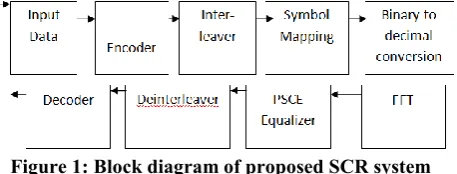
Figure 1: Block diagram of proposed SCR system The SCR OFDM system is given by Heuristic approach pilot channel estimation with cyclic prefix as shown in Figure 1. The binary data is given as input data that is sorted and mapped reliable with the modulation using Quadrature
Amplitude Modulation (QAM) technique known as signal mapping technique. The pilot data is given on any of the carrier frequency through a selected amount with normally on the information process, IFFT size can be employed to rework information process with N sequence of information into spatial domain information on the following mathematical equation:
1 1 , 2 , 1 , 0 2 1 0
Nsample n e k X k Xinputdata IFFT n x N kn j N k Where, Nsample total number of bits to be transmitted.
Following IFFT sequence with the pilot data and guard bit interval that is selected with the high data rate than the expected delay is not occurred, is provided to prevent the interferences. The interferences are eliminated by guard bit insertion and the cyclic prefix extended a part of SCR modulation information so as to remove the interferences. The resultant SCR modulation for long range communication information can be written as given below:
1 : 1 : 0 , : 1 : , Nsamples ndata ndata x Nsamples Nsamples n ndata Nsamples x nbits Xfreq (2)Here, Ng denotes length of guard bit intervalAfter following digital to analog conversion, this information is given to be sent from the transmitter with the reliable of the baseband system at the base station. The transmitted signal can have the frequency selective time variable noisy channel such as AWGN (Additive White Gaussian Noise) channel. The received signal is given by
bits
hfreq
bits
wnoise
bits
x
Youtput
freq
(3)
Here, W noise (bits) is AWGN noise and h(n) is that the channel time-varying noise, which might be diagrammatical by:
0 11 0 2
n N
r i i Tn f N j i Di e h n
h (4)
The AWGN is the unpredictable noise present in the channel that adds considerably with the transmission information as given in the equation 3. Here, total range of propagation ways is denoted as r, the impulse response of the ith path is denoted as hi, the ith path Doppler frequency shift can be represented as f Di, delay path index is represented as λ, T is that data rate of samples and i is that the ith latency of data is reduced by sampling time of intervals.During receiving information, the data is passed through the analog to digital conversion following the low pass filter in discrete domain, the guard time has to be removed as follows,
n y
nN
n0,1, N1y f g (5)
Capacity
1 , 2 , 1 , 01 1 2
0
N k e n y N bits youtput DFT k Y N kn j N n (6)Assuming there's no Inter Symbol Interference (ISI), gives the correlation of
Youtput(k) to Houtput(k)=DFT,
I with the interval K that's interference provides to frequency of Doppler Shift (SF) and Wnoise with intervals=DFT, subsequent relation is,
1 : 1 : 0 * NSamples k k Wn k In Ith Himpulse samples Xinput samples Youtput (7)Following FFT size, guard bit data are segmented with the calculable state of channel information Himpulse (Ith) for the information sub-channels is estimated in channel estimation sequence. The data after the transmission is estimated by,
ith Nsamples ith H ith Y ith Xdat e : 1 : 0 ) (8)After that, the digital information is calculated from the information de-mapping block as shown in the figure 1. The above methodology is used to eliminate the ICI and ISI.
Proposed Equalizer for SCR channel estimation
The SCR OFDM channel estimation and maximization is calculated using Advanced Per Subcarrier Channel Equalizer (APSCE).
In proposed cyclic prefix pilot data methodology channel estimation, the pilot data is inserted on the sub-carriers with a selected amount of data bits. The channel is constant throughout the transmission and it is frequency selective using selective mapping technique. Since the pilots are sent the least bit carriers, there is no interpolation error. The channel estimation is performed based on either APSCE. The equation of APSCE is given as,
1 0 1 1 0 1 , , N N LS y y y x x x diag X where y X h (9)Where, the pilot value is denoted as xi at the subcarrier of I and yi is denoted as the received data at the ith subcarrier. The spatial domain Gaussian parameter and de-correlated parameters are given Gaussian noise
during the data transmission. The Heuristic approach APSCE equalization can be estimated as,
If the instant field channels vector g is Gaussian factor and de-correlated among the channel noise n, frequency-domain Heuristic approachAPSCE guesstimate of g is agreed by:
k Ndata nsam j nk N yy gy APSCE e Ndata W and F where y R FR h 2 1 1 WN W 1 N 0 N W 00 N W
(10)
Where, Rgy and Ryy is cross variance and covariance g
and y respectively. Once channel is lower attenuation,
the transformation block is used to define the
estimation of time varying channel and the choice of
APSCE equalizer at every transmission of bits. The
channel reaction at the kth subcarrier is calculated commencing the previous data Hfreq(Ith) is accessed for calculate channel estimation of data rate of information Hfreq(Ith).
ith0:1:Nsamples1ith Hfreq ith Yfreq ith Xe (11)
The information {Xfreq(ith)}is modulated to the digital information using signal mapping technique and estimated again back through the signal de-mapping Xfreq(ith).
The channel estimation of SCR OFDM using APSCE is {He(k)} is given by:
k 0, N 1k X k Y k H pure
e (12)
Since the performance of APSCE equalizer needs to send the information for long range communication noisy channel can provide entire gain with calculable channel state information. The channel estimation provides high speed data transmission from transmitter to the receiver, during the transmission of data through SCR transmission between the channel estimation errors provides to the decimal interpolation to convert from binary to decimal and therefore the less information error provides to gain of time vary channel state estimation in terms of SNR by reducing BER. For high data rate attenuation channels, as are shown in simulations, the APSCE equalizer based SCR OFDM mostly channel estimation performs better.
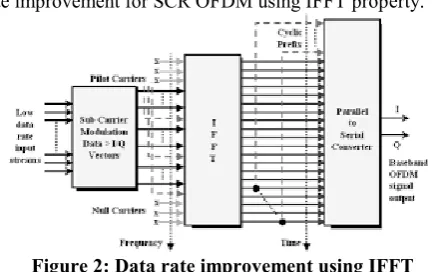
Data rate improvement for long range communication The long range communication using Heuristic approach should give the high data rate due to its coverage area improvement. The entire digital data transmission may well be designed around based special purpose FFT and IFFT that is mathematically equivalent of distinct DFT and IDFT severally. DFT remodel correlates the signal with every of its curved unrelated basis functions. The correlation for a given subcarrier solely sees energy for that corresponding subcarrier. This separation of signal energy is that the reason that the SCR OFDM subcarriers overlap while not inflicting interference. The properties of FFT imply the data rate high during the transmission of information from transmitter to receiver of SCR OFDM for
rate improvement for SCR OFDM using IFFT property.
Figure 2: Data rate improvement using IFFT Methodology for improving data rate using IFFT The SCR OFDM Heuristic approach gives the high data rate by following this given methodology. Serial to parallel regenerate low rate Forward Error Correction coded and interleaved bit stream initial regenerate to some in-phase (XI(k)) and quadrature-phase XQ(k) element based on 256 M Array QAM modulation. This method can be mapped the given M bits to a logo X(k) = XI(k)+jXQ(k), that represents part and amplitude of a selected kth subcarrier. At the transmitter, SCR OFDM system treats these symbols as if they are within the FFT frequency domain. The IFFT takes in N symbols at a time wherever N is that the several of subcarriers within the system, that depends on the appliance. Not all the carriers are wont to transmit information. As in IEEE 802.11a normal, 4 subcarriers are used for pilot data and 12 subcarriers are left out of 64 out there subcarriers. Every input information acts sort of a advanced weight for the corresponding orthogonal function. The IFFT output is that the summation of all N sinusoids. The block of N output samples from the IFFT makes up one OFDM image. Cyclic Prefix (which is that the copy of few last samples of the OFDM time symbol) is side to the output of IFFT so parallel to serial conversion takes place. For long range communication, the SCR OFDM signal is generated at base-band communication, and then modulated up to the specified RF frequency quotient modulator (analog techniques or a Digital Up Converter). A transmitted RF signal is usually a true signal because it is simply a variation in strength. It is but doable to directly generate a true OFDM signal mistreatment IFFT however therein case for 2N purpose IFFT are needed for N information carriers. Input given to the IFFT is conjugated isosceles so the output of IFFT is real.
SCR OFDM for AWGN, Rayleigh and Rician fading channels
The Rayleigh and Rician fading channels manifest itself in 2 effects. First, time spreading (in τ) of the information length among the signal, and/or, a time variant behavior (in t). In such case received signal y(t) is expressed as a convolution of the transmitted signal x(t) with the channel impulse response h(t,τ) and inherent AGWN n(t). For AWGN channel and fading channel SCR OFDM behaves same as one carrier system. One APSCE equalizer is employed to correct the amplitude and physical change due to the flat fading channel. Synchronization of SCR OFDM
In SCR OFDM systems orthogonal of the subcarriers is crucial. Time domain information and carrier frequency offsets (CFO) could cause the loss of subcarrier orthogonal. If not equalized, they will limit the performance of SCR OFDM
system as a result of they cause ICI and ISI. The phase information noise is additionally given all sensible oscillators and it manifests itself within the type of random modulation of the carrier. The synchronization method is often split into a testing part and a trailing part, if the characteristics of the random frequency and temporal order errors are legendary. In acquisition part, an initial estimate of the errors is no inheritable, exploitation a lot of complicated algorithms and presumably the next quantity of synchronization info within the knowledge signal, whereas later the trailing algorithms must correct for short-run deviations. Synchronization in SCR OFDM systems is completed using:
The maximum frequency error which will be calculable exploitation coaching sequence is given by:
Fmax=1/2DTs (13)
Where, Ts is the sampling frequency and D is the delay of transmission of information from transmitter to the receiver of SCR OFDM.
Power control for SCR OFDM
The technique for interference coordination to reduce the synchronization error is power control for SCR OFDM, where each base station adjusts it is transmit power to reduce the interference it causes to the users in the neighboring base stations. A central controller can cipher the optimum power level for each base station to interference, but it should additionally account for the performance degradation for the users served by a base station at reduced power and maintain a suitable performance level for such users further of SCR OFDM. For sensible realization during a centralized architecture interference management ought to not rely on per-frame programming selections executed by every base station. For this reason, combination the interference for all the users during a transmission and perform the optimizations at the cell level. Since interference is eliminated at the transmission level, alternating between totally different user transmissions in one cell does not impact the amount of interference it causes
different unit of SCR OFDM.
Improvement of Quality of Service of SCR OFDM The Quality of Service (QoS) of SCR OFDM covers all aspects of making certain an appropriate delivery of service during a data transmission through SCR network. This includes management of system tolerance and reliability, packet delivery latency, event detection, strength and maintenance. The SDN design permits for the QoS management tasks to require place within the controller by virtue of being logically centralized. The SDN-based WSN environment varies thanks to factors like topology changes, node failure, information measure accessibility and energy fluctuations so, there is have to integrate a mechanism for reliability of the network. The reliability of the SCR design supported OFDM through the application of models based on continuous time domain and frequency domain process using FFT process and continuous random logic techniques. The results show that network reliability is improved with the quantity of controllers and sensors and their individual error rates reduction. From the results a proposal to integrate quite one reliable controller as a reliability management strategy is created. Management of reliability has been classified into the reliability of communication
Capacity will be done through strategies such as providing duplicate nodes and redundant links. Operate alternation has been planned to manage reliability of detector tasks by facultative neighboring detector nodes to require over broken sensor node tasks mechanically providing a improving mechanism. The OFDM system will also offer a back-up for sensing tasks and knowledge to boost the reliability of tasks. Another QoS parameter is strength that could be a characteristic that defines a system ability to meet its expected performance underneath unreliable environmental conditions. To manage system robustness it's necessary to think about factors moving and busy with the system and monitor the interference patterns during a planned applied math machine learning technique. This system would yield the bar of potential interference supported previous activity patterns of interference
[image:6.595.327.529.49.160.2]IV. RESULTS AND DISCUSSION Table 1: Parameters applied for SCR OFDM
SCR OFDM Parameters Related Values Subcarrier data 128 Subcarrier of pilot 8 Spacing of channel 25 MHz Spacing (Δf) of Carrier
frequency
512 KHz
Bandwidth 26.64 MHz
=(512 kHz x 52) Guard Bit time interval 0.8 μsec Period of symbol 2.2 μsec ( =
1/ Δf )
The table 1 illustrates the parameters required to implement the SCR OFDM for long range communication. The table 2 illustrates the comparison between APSCE and smart SCR. The proposed scheme has the features of smart SCR with additional features such as given in the table 2.
Table 2 Comparison table between different proposed schemes
Scheme Features Controller Enabling Architectur
e
Technolog y
APSCE Energy harvest, Optimization , efficiency Duty cycling, data aggregation
Distributed Software and hardware
Smart Resource allocation
[image:6.595.320.535.50.268.2]Centralized Software and hardware
Table 3 Parameters achievements of SCR OFDM
Parameters Requirements
Range of the SCR module 12 bit 500 MHz
no of base stations 10
No of nodes 100
Communication rate type Dynamic
Prioritization of the nodes 360 degree circular
Modulation type 256 Array - QAM
The table 3 illustrates the requirements of SCR OFDM to implement effectively and accurately. The modulation type can be changed with other number of array to perform with other polarization methodologies.
Table 4 Capacity comparison for different channels
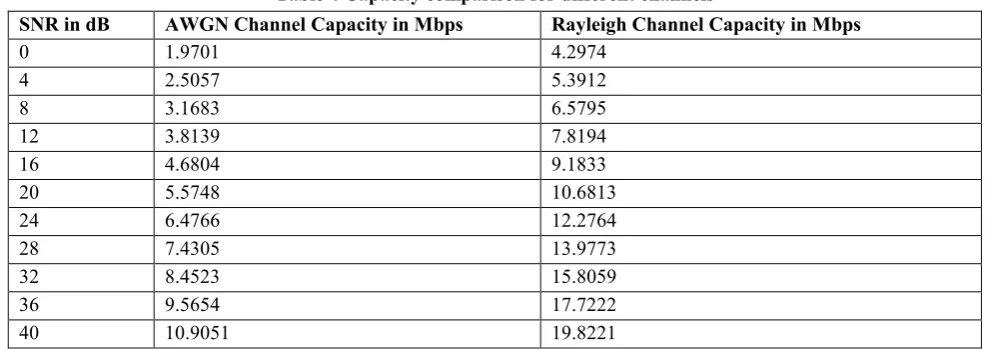
The table 4 shows the comparison between ergodic capacity improvement for AWGN and Raileigh fading channels. The unpredictable noise is occurred in AWGN channel. It gives comparatively less capacity than Rayleigh channel. It is shown in the figure 4.
SNR in dB AWGN Channel Capacity in Mbps Rayleigh Channel Capacity in Mbps
0 1.9701 4.2974
4 2.5057 5.3912
8 3.1683 6.5795
12 3.8139 7.8194
16 4.6804 9.1833
20 5.5748 10.6813
24 6.4766 12.2764
28 7.4305 13.9773
32 8.4523 15.8059
36 9.5654 17.7222
[image:6.595.47.247.251.408.2] [image:6.595.50.545.546.721.2]Figure 3. a) RSSI estimation, b) Latency minimization The figure 3 (a) shows the Received Signal Strength Indicator (RSSI) estimation for connecting various wireless sensor nodes and base stations. As the sensor nodes from base station communicate with one another for information transfer, the answer to the improvement based on RSSI values is merely an additional gain. It does not would like any extra requirements and no size and weight is to nodes that give to stay as little as achievable. The figure 3 (b) shows the Latency reduction for nodes 100 and 50 to transfer the information from transmitter to the receiver of SCR using OFDM.
[image:7.595.316.537.52.231.2]Figure 4: Capacity maximization for different channels for SCR Long range communication
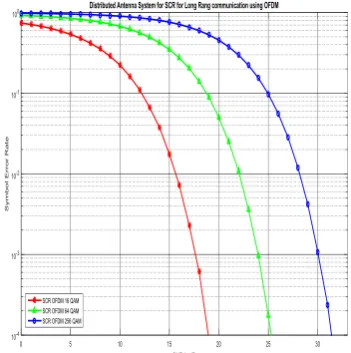
Figure 5: Performance of SCR OFDM APSCE equalizer The figure 5 shows the comparison between SCR OFDM of equalizers APSCE with LMMSE (Linear Minimum Mean Square Error) equalizer. The performance of APSCE is comparatively better than LMMSE equalizer by improving SNR reaches upto 24dB and BER is reduced effectively as shown in the figure 5. The figure 6 shows the distributed Antenna System for SCR OFDM for Long Range communication. The distributed antenna systems provide the communication of information from transmitter to the receiver for long range and distance. The different modulation techniques are tested as a result 256 QAM modulation gives optimal solution as shown.
[image:7.595.338.514.409.586.2] [image:7.595.74.264.522.692.2]Capacity
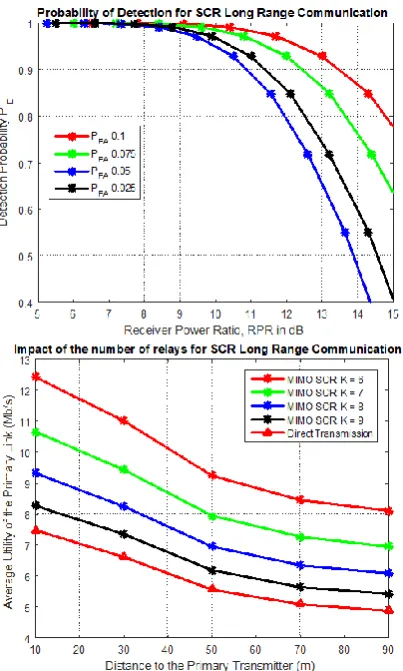
Figure 7 (a) Probability of Detection for SCR OFDM for Long Range communication, Figure 7 (b) Impact of number of relays for SCR Long range communication The figure 7 shows the probability of detection for SCR OFDM for long range communication. The probability of detection is high for lower rate of false alarm as shown in the figure. The figure 7 analyzes different ways that a one graph could relatively accurate and efficient for using various sensor and base stations in terms sensing and wireless transmission. The link quality improvement is achieved as shown in the figure 8.
V. CONCLUSION
In this paper, we have proposed and analyzed a Software Controlled Radio (SCR) using OFDM technology with 256 QAM modulation techniques. It is implemented using multisensory network and base stations to communicate the information for long range. The signal to noise ratio is highly improved by applying the proposed algorithm APSCE compare to LMMSE equalizer. The capacity is calculated for proposed algorithm with high efficiency and accuracy. The link quality is calculated to provide the distributed antenna system improvement. The SCR OFDM is proposed here for achieve the long range communication using wireless technology.
REFERENCES
1. A. F. B. Selva, A. L. G. Reis, “Introduction to the Software-defined Radio Approach,” IEEE LATIN AMERICA TRANSACTIONS, VOL. 10, NO. 1, JAN. 2012.
2. Jan Craninckx, imec, “CMOS Software-Defined RadioTransceivers: Analog Design in Digital Technology,” 0163-6804/12/$25.00 © 2012 IEEE IEEE Communications Magazine • April 2012.
3. Xiaojing Huang, Y. Jay Guo, “Sample Rate Conversion Using B-Spline Interpolation for OFDM Based Software Defined Radios,” IEEE TRANSACTIONS ON COMMUNICATIONS, VOL. 60, NO. 8, AUGUST 2012.
4. Wai-Kong Lee, Martin J. W. Schubert, “Multi-source Energy Harvesting and Storage for Floating Wireless Sensor Network Nodes With Long Range Communication Capability,” 0093-9994 (c) 2018 IEEE. Personal use is permitted, but republication/redistribution requires IEEE permission.
5. Stefan Aust, R. Venkatesha Prasad, “Outdoor Long-range WLANs:A Lesson for IEEE 802.11ah,” DOI 10.1109/COMST.2015.2429311, IEEE Communications Surveys & Tutorials.
6. Jienan Chen, Junfei Xie, “Long-Range and Broadband Aerial Communication using Directional Antennas (ACDA): Design and Implementation,” Citation information: DOI 10.1109/TVT.2017.2723802, IEEE Transactions on Vehicular Technology.
7. Lina Al-Kanj, Zaher Dawy, “Energy-Aware Cooperative Content Distribution over Wireless Networks: Design Alternatives and Implementation Aspects, IEEE COMMUNICATIONS SURVEYS & TUTORIALS, VOL. 15, NO. 4, FOURTH QUARTER 2013. 8. Dengkui Zhu, Boyu Li, “A Novel Hybrid Beamforming Algorithm
with Unified Analog Beamforming by Subspace Construction Based on Partial CSI for Massive MIMO-OFDM Systems,” information: DOI 10.1109/TCOMM.2016.2625794, IEEE Transactions on Communications.
9. Zhaoquan Li and Xin Wang, “Utility Maximization over Ergodic Capacity Regions of Fading OFDMA Channels,” IEEE TRANSACTIONS ON WIRELESS COMMUNICATIONS, VOL. 11, NO. 7, JULY 2012.
10. [10]. Yongjun Xu1, 2,*, Yuan Hu1, “Optimal Power Allocation for Multiuser OFDM-Based Cognitive Heterogeneous Networks,” China Communications • September 2017.
11. V. I. Rodríguez, J. Sánchez, “Empowering Software Radio: IT++ As A GNU Radio Out-Of-Tree Implementation,” EEE LATIN AMERICA TRANSACTIONS, VOL. 12, NO. 2, MARCH 2014. Rida, J. F. A., Bhardwaj, A., & Jaiswal, A. (2014). Design optimization of optical communication systems using carbon nanotubes (CNTs) based on optical code division multiple access (OCDMA). Int. J. Comp. Sci.
Network Security, 14, 102-112.
12. Amiya Ranjan Panda, Debahuti Mishra, “FPGA Implementation of Software Defined Radio Based Flight Termination System,”Citation information: DOI 10.1109/TII.2014.2364557, IEEE Transactions on Industrial Informatics.
13. David Carey, Robert Lowdermilk, “Testing Software Defined and Cognitive Radios using Software Defined Synthetic Instruments,” IEEE Instrumentation & Measurement Magazine 1094-6969/15/$25.00©2015IEEE. Ali, K. M. Telecommunication Planning and Maintenance for Electrical Network in Unstable Environments.
14. Rodolfo Alvizu, Sebastian Troia, “Matheuristic With Machine-Learning- Based Prediction for Software-Defined Mobile Metro-Core Networks,” VOL. 9, NO. 9/SEPTEMBER 2017/J. OPT. COMMUN. NETW.
15. Mustafa Y. Arslan, Karthikeyan Sundaresan, “Software-Defined Networking inCellular Radio Access Networks: Potential and Challenges,” IEEE Communications Magazine • January 2015. 16. FU Yonghong1,2,3, BI Jun1,3, “A Dormant Multi-Controller Model
for Software Defined Networking,” China Communications • March 2014.
Umesh, K. S., Pravin, V. K., & Rajagopal, K. (2014). Experimental Investigation and CFD Analysis of Multi-Cylinder Four Stroke SI Engine Exhaust Manifold for Optimal Geometry to Reduce Back Pressure and to Improve Fuel Efficiency. International Journal of
Automobile Engineering Research and Development, 4, 13-20.
17. Valentin Goverdovsky, David C. Yates, “Modular Software-Defined Radio Testbed for Rapid Prototyping of Localization Algorithms,” IEEE TRANSACTIONS ON INSTRUMENTATION AND MEASUREMENT.
18. Licai Fang, Defeng (David) Huang, “Neumann Series Expansion Based LMMSE Channel
Estimation for OFDM
[image:8.595.69.271.49.385.2]10.1109/LCOMM.2016.2526624, IEEE Communications Letters. 19. Mahdi Khosravi, Saeed Mashhadi, “Joint Pilot Power & Pattern
Design for Compressive OFDM Channel Estimation,” DOI 10.1109/LCOMM.2014.2371036, IEEE Communications Letters.
Das, S., & Agarwal, A. Optimal Portfolio Construction of Pharmaceutical Companies-A Study on CNX Pharma Index.
20. Slavche Pejoski, Venceslav Kafedziski, “Estimation of Sparse Time Dispersive Channels in Pilot Aided OFDM Using Atomic Norm,” IEEE WIRELESS COMMUNICATIONS LETTERS, VOL. 4, NO. 4, AUGUST 2015.
Jebaseeli, M. E., & Dhayabaran, D. P. (2013). Optimal Solution To Fully Fuzzy Time Cost Trade Off Problem. International Journal of Applied Mathematics & Statistical Sciences, 2(2), 27-34.
21. Slavche Pejoski, Venceslav Kafedziski, “Asymptotic Capacity Lower Bound for an OFDM System with Lasso Compressed Sensing Channel Estimation for Bernoulli-Gaussian Channel,” IEEE COMMUNICATIONS LETTERS, VOL. 19, NO. 3 MARCH 2015.
Hassaan, G. A. Optimal design an anti-accidents vehicle–buffer. International journal of Research in Engineering and
Technology (Impact: IJRET) ISSN (E), 2321-8843.
22. Jianping Zheng, Ru Chen, “Linear Processing for Intercarrier Interference in OFDM Index Modulation Based on Capacity Maximization,” DOI 10.1109/LSP.2017.2687471, IEEE Signal Processing Letters.
AUTHORS PROFILE
P.Pavan Kumar received the B.Tech degree in Electronics and Communication Engineering from the Institute of Aeronautical Engineering affiliated to Jawaharlal Nehru Technological University, Hyderabad, Telangana, India in 2012.
M.Tech in Electronics and Communication Engineering in Progressive Engineering College affiliated to Jawaharlal Nehru Technological University, Hyderabad, Telangana, India in 2015. Research Scholar in Electronics and Communication Engineering in Vels Institute of Science Technology & Advanced Studies (VISTAS), Chennai. His research interest includes Wireless Communication, Software Defined Radio.
Dr.T.Jaya received the B.E. degree in Electronics and Communication Engineering from the Anna University, Chennai, India, in 2008,
M.E. in Electronics and Communication Engineering (Applied Electronics) in Sathyabama University and Ph.D in Electronics and Communication Engineering in Vels Institute of Science Technology & Advanced Studies (VISTAS). , Chennai.
Currently working as Asst. Professor in Dept of ECE, Vels Institute of Science Technology & Advanced Studies (VISTAS),Chennai.
Her research interest includes Wireless Communication, Mobile Ad hoc networks, and Sensor Networks Communication networks
Dr P Swaminathan graduated with Honours in Electronics and Communication Engineering from Regional Engineering College, Tiruchirapalli, India in 1971.
He was a gold medallist at the University of Madras and later joined Indira Gandhi Centre for Atomic Research in 1972.
He underwent a one year training course in Mainframe Computer Systems from International Honeywell Bull Training Institute, Paris (1981) and holds a Doctorate in Electronics Engineering. Dr P Swaminathan is a Fellow of the Institution of Engineers (India).
He was a former outstanding scientist and group director at the Indira Gandhi Centre for Atomic Research (IGCAR), Kalpakkam, and has guided a dedicated team towards the development of intelligent instrumentation and control systems for the fast breeder reactor.
Dr Swaminathan has made a significant contribution in the usage of computers in nuclear installations in India and has over 50 publications in international journals.