an effectively closed manner .The entire process of waste input, level and segregation is monitored and controlled by the reconfigurable IO using sensors , thereby reducing the open decomposition of organic wastes, thus curbing the growth of micro organisms.
Keywords : Smart trash bin, Automatic, wireless,NI my RIO, waste segregation, epidemics, management, recycling. motor-driver.
I. INTRODUCTION
I
n most of the places in India, garbage is dumped as one, mixing degradable and non-degradable wastes, causing the spread of a lot of epidemics. In our daily life, we see the garbage bins being overfull and all the garbage spills out resulting in pollution. Due to population growth, industrialization, and economic growth, a trend. of significant increase in Municipal Solid Waste (MSW) generation has been recorded worldwide. In India, the total generated waste is expected to cross 800,000 tons in 2012. This figure is expected to grow at a rate of 30 – 50 % every year. With correspondence to the Swachh Bharath Scheme of our Honourable Prime Minister to make India clean and green, this automatic waste sorting trash bin is an initiative taken by us to make it more commendable. While the existing bins and prototypes that separate wastes, there are none in use in domestic and industrial environments. The current smart trash bins just segregate wastes that are metallic and non-metallic, or wood, paper and plastic. In this paper, an automated smart trash bin prototype is implemented with the effective garbage segregation in closed manner and avoids the unnecessary spread of microorganisms.Revised Manuscript Received on September 07, 2019
Kalpana Devi P, ECE, VelTech R.Rangarajan Dr.Sakunthala R&D
institute of Science and Technology, Chennai . India. Email:
Dharini D, ECE VelTech R.Rangarajan Dr.Sakunthala R&D institute of
Science and Technology, India . Chennai .India. Email:
J Lakshmi Vandhana, Anna University, Chennai India. Email: [email protected]
automatic smart trash bin receives the wastes and segregates them with the help of ultrasonic, infrared and proximity sensors. By using a conveyor belt, the trash is moved forward along the path of the above mentioned sensors. The sensed wastes are pushed out into small designated bins for metal, plastic (non-degradable), and paper and vegetable peels (degradable). Water is initially used to wash and separate the dust from the garbage. The water with the residue dust is led out to the plants as a means to water them. The level of water is sensed and filled automatically, with a water level sensor, or it can be done manually. The bio-degradable wastes (paper and vegetable wastes) ar e mixed to generate small manure for kitchen gardens. This smart trash bin is suitable for both home and a general office setting.
III. PROPOSED SYSTEM
Fig. 1 Block diagram for the control circuit of smart trash bin
The water present in the big bin is monitored by a water level indicator. If the water gets below the level, then water is automatically filled in, and the water out is connected to the nearby backyard or kitchen garden as a method of drip irrigation.
IV. OVERALL DESIGN
The smart dustbin consists of different sections for all kinds of waste disposal which includes:
1. Plastic Waste 2. Metal Waste 3. Liquid Waste 4. Paper waste 5. Organic wastes.
The individual will throw waste in the bin. The waste once thrown will go to a large container attached with the dustbin that segregates the waste accordingly.
HARDWARE SPECIFICATIONS:
Sensor for Garbage Segregation
In this segment various types of sensors used for effective functioning of garbage segregation is reviewed. Sensors are the basic components of the Automatic smart trash bin system in which it is used for detecting human, sense the presences of waste, sense and segregate the waste. The expeditious evolution of integrated circuits and other technologies in same stream has increased the usage of smart sensors to provide fast and accurate results with less amount of energy preservation. The AK970 IR sensor is utilized for the purpose of human detection. The operating voltage of this sensor is in the range of 1.71V to 3.63V. Human detection within the range of 5-12m can be done by these passive Infrared sensors. The second main sensor established for the purpose to sense the presence of waste in a running system is ultrasonic sensor. This ultrasonic sensor measure the distance of garbage by transmitting a sound pulse and the time delay received back received back as echo signal . Following the ultrasonic sensor the conveyor belt is used to move the waste across the metal and plastic sensors slowly and initiate the segregation process. In metal sensor electromagnetic waves are generated with high frequency and high ringing voltage. The coil becomes detuned when a metal is sensed; this in turn reduces the segregated. Following metallic sensor, plastic sensors are used to separate plastic from paper and vegetable
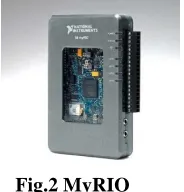
peel. The main working principle of a plastic sensor is obtained by varying the capacitive voltage between the pairs of plates by varying the dielectric medium. Thus plastic sensor completes the work of segregating biodegradable and non-biodegradable waste and vegetable peel.. MyRIO is used as the platform to code the sensors and motors into automation. MyRIO
Fig.2 MyRIO
IR sensor output is acquired by myRIO. It is an I/O processor with dual core of ARM and FPGA. To implement the multiple device control through this reconfigurable device with MXP /MSP connectors. Hence the control operations is performed by Programming in MYRIO using LabVIEW. GSM module is interfaced for wireless communication. WiFi module is enabled for remote control and embedded application. Here, MyRIO is used as the platform to code the sensors and the motors into automation.
V. WORKING MECHANISM
[image:2.595.378.470.357.453.2]Waste compression can reduce the environmental pollution. The main advantage is transforming waste into treasure through recycling. Compression reduces the consumption of land resources. The automation circuit setup is simulated and produce the operation results . The successful execution for implementing the automated smart dustbins can avoid the accumulation of the garbage in the roadside and thereby curbing the formation of microorganisms which inturn avoid the diseases. Pollution can be prevented and avoid the steet animals for the consumption of garbage .
Fig.3 Sequence Diagram
Fig.2 System Architecture
combined TCP/IP decorum stack that can give RIO processor access to your Wi-Fi network. The ESP8266 is supporting and all wifi networking functions functions from another application processor. Each ESP8266 Module is pre-programmed using LabVIEW programming. The ESP8266 wifi module is a cost effective board The properties of ESP8266 I to renovate this module in. to IoT solution . ESP8266 module is work for external logic level converter.
System Architecture
The IOT Garbage Monitoring system is a very innovative system which will help to keep the cities clean. Thus this scheme aids to remain the city spotless by updating about the trash levels of the bins by providing graphical representation of the bins via a web page. This arrangement monitors the garbage level in the bins and identifies the garbage level collected through web page.
The ultrasonic sensors positioned to detect the bins and
garbage level related to depth of the bins. The mechanism is controlled by the MYRIO processor and
Fig.5 Block diagram of trash bin structure with dimensions
for the sorting out the wastes in to metals, plastic and vegetable peels. etc.. The entire sensing process for the segregation the waste is comtrolled and monitored by MY RIO in single platform for the effective operation . This method of implementation saves time in segregation by human and affordability in domestic applications. This Smart Dustbin prototype will contribute a lot to the society to provide a clean and hygienic environment. GSM module intimate the bin status to the concerned authority for continual clearing of waste. GPS module interface to the bin will update the location for the dump. The garbage collector receives message thorough GSM module and identifies the location for garbage collection and dumps it into a segregator. This would lessen the stray trash on the streets.
REFERENCES
1. Dingrong Yuan, Shenglong Fang, Yaqiong Liu ” The design of smart
home monitoring system based on Wi-Fi electronic trash” journal of software, vol. 9, no. 2, February 2014.
2. Yann Glouche Paul Couderc ” A Smart Waste Management with
Self-Describing objects” The Second International Conference on Smart Systems, Devices and Technologies, 6, jan 2013.
3. “City Garbage collection indicator using RF (Zigbee) and GSM
technology”
4. “Better Sorting for Better Recycling.” [Online]. Available :http:
environmental passion.com /resource.php
5. ?id =2239
6. “The EUs approach to waste management,” April
2012.[Online].Available: http://ec.europa.eu/ environment
7. /waste/index.htm
8. Mor, S., Ravindra, K., Dahiya, R. P., & Chandra, A. (2006). Leachate
characterization and assessment of groundwater pollution near municipal solid waste landfill site. Environmental Monitoring and Assessment, 118, 435–456.
9. Sudhir, V., Muraleedharan, V. R., & Srinivasan, G. (1996). Integrated solid waste management in Urban India: A critical operational research framework. Socio-Economic
10. Planning Sciences, 30, 163–181Sanitation.kerala.gov.in .
http://dx.doi.org/10.1016/0038-0121(96)00012-2
11. Joardar, S. D. (2000). Urban residential solid waste management in
India: Issues related to institutional arrangements. Public Works
Management and Policy, 4, 319–330.
http://dx.doi.org/10.1177/1087724X0044006.
12. CPCB. (2000b). Status of municipal solid waste generation, collection,
treatment and disposal in class I cities (Series:
ADSORBS/31/1999-2000). Retrieved from
http://www.bvucoepune.edu.in/pdf’s/Research%20 and
Publication/Research Publication_2007-08/ International
Conference_2007-08.
Science and Technology.Her expertise in Embedded System
J.Lakshmi Vandhan B.E. Anna University Her
expertise in LabVIEW ,RIO controller
automation. She has completed CLAD