International Journal of Innovative Technology and Exploring Engineering (IJITEE) ISSN: 2278-3075,Volume-8 Issue-11, September 2019
Abstractct: The research was conducted on the process of making Sohun Noodle in Klaten, Central Java. The manufacturing process was carried out by five workers at four work stations with 18 activities. The purpose of this study was to observe, evaluate and analyze the worker posture using The Ovako Working Analysis System (OWAS) and The Workplace Ergonomic Risk Assessment (WERA) method. The steps of the study using the OWAS method are: taking a picture of work posture, identifying the weight of the load, the process of assessing work posture, and categorizing risks. The steps of the research using the WERA method are: taking pictures of work postures, identifying body postures on the neck, shoulders, back, wrists and legs, identifying weight loads, duration of work, vibrations, contact stress, identifying risk factors, assessing work postures, and categorizing risks. The next step is processing statistical data, namely: normality test, comparative test, and correlation test using Statistical Package for the Social Science (SPSS) Version 21.0 for parts shoulders/arms, back, legs posture, weight/strength. The result of the OWAS method shows that there are two very risky activities and needs improvement now, i.e. the activity of inserting zinc into a press machine, and the activity of putting zinc containing sohun noodle into first drying. The result of the WERA method indicates that all activities are included in the medium level actions so that further investigation and change is needed. The results of statistical tests using SPSS Version 21.0 are: a comparative test on shoulders/arms and back there is a significant difference and in legs posture and weight / strength there is no significant difference. Whereas in the correlation test for shoulders/arms, back, and weight / strength there is a significant correlation between the OWAS and WERA methods.
Keywords : OWAS, WERA, Sohun Noodle, Work Posture, MSDs
I. INTRODUCTION
A
lmost all activities/jobs require the use of arms and hands. Therefore, generally work musculoskeletal disorders (WMSDs) affect the hands, wrists, elbows, neck, and shoulders. Work using feet can lead to WMSDs in the legs, hips, ankles, and feet. Some back problems are also caused by repetitive activities. WMSDs disorders are related to workRevised Manuscript Received on September 05, 2019.
Indah Pratiwi*, Associate Professor, Department of Industrial Engineering, Universitas Muhammadiyah Surakarta, Indonesia. Email: [email protected]
Munfi’ah, Industrial Engineering Staff, PT. Globalindo Intimates, Indonesia. Email: [email protected]
Ratnanto Fitriadi, Assistant Professor, Department of Industrial Engineering, Universitas Muhammadiyah Surakarta, Indonesia. Email: Ratnanto. [email protected]
Mila Faila Sufa, Assistant Professor, Department of Industrial Engineering, Universitas Muhammadiyah Surakarta, Indonesia. Email: [email protected]
and public health problems. Musculoskeletal disorders begin to spread widely in workers in developing countries. The prevalence of WMSDs varies from 15 to 42% [1] highest in informal workers. MSDs that occur is around 65% of work accidents and have significant economic and social impacts [2] resulting in reduced quality and work productivity. Risk factors for MSDs often occur in movement repetition, heavy workload, vibration, and awkward posture [2], manual material handling [1], improper lifting method [3]. WMSDs disorders are mainly occured in groups of female workers rather than male, although male or female sufferers may have gender equality [4]. According to [1] WMSDs are often associated with work as a public health concern. The prevalence of WMSDs changes from 15-42%, the highest prevalence is found in unskilled workers, such as in agriculture, forest workers, and construction workers. Physical ergonomics factors including a combination of load and posture, posture activity, awkward work posture, lifting heavy loads, manual material handling (MMH), walking or standing for long periods, working with long shifts, looking necks, working monotonically or repetitively, bad work conditions, is the cause of WMSDs especially low back pain (LBP). Handling material that is done manually can cause musculoskeletal disorders (MSDs), the disorder can be muscle injury, nerve tendon injury, tendon injury, bone and cartilage injury, joint injury [5]. In the Production activities for making sohun noodle, there are activities carried out in the form of MMH. The problem is the unnatural work posture i.e. bending, standing, and sitting. Working postures that are carried out continuously for a long duration can cause ergonomic risks. Research on making sohun noodle has been done by [6] using the ManTRA method. The production process consists of four work stations, namely: dough-making work stations, pressing work stations, drying work stations, and packaging work stations. Ergonomics evaluation is needed to assess and to analyze risk factors and also to evaluate and to improve efforts to minimize the risks that occur. The OWAS method is a method to produce categories of work attitudes that can pose a risk to the musculoskeletal by evaluating the back, arms, legs and weight. The OWAS method can be easily and quickly used to identify work attitudes that can lead to workplace accidents. By using the OWAS method, information can be obtained on the assessment of posture at work, so that an early evaluation of the accident of the human body can be carried out consisting of important parts such as the back, arms, legs, and also analysis and evaluation of the weight of the body [7]. Attitudes of body parts observed for analysis and evaluation in the OWAS method are: back attitude, arm attitude, legs attitude, and weight burden.
Evaluation of Work Posture in Sohun Noodles
Workers using OWAS and WERA Method
Research using the OWAS method has been carried out in the batik cap manufacturing industry by [8] and in the tofu making industry [9]. The WERA method is used to assess work risk factors by classifying low, medium, and high levels [10]. There are six physical risk factors assessed, namely posture, repetition, strength, vibration, stress contact, and duration. The assessment process in the WERA method is using nine combinations namely, a combination of shoulder posture with shoulder repetition, wrist posture with wrist repetition, back posture with back repetition, neck posture with neck repetition, legs posture with duration of work, strength with back posture, risk of vibration with wrist posture, contact stress with wrist posture, and duration of work with strength [11]. The purpose of this study was to find out how the conditions of work posture of the manufacture of sohun noodle using the OWAS and the WERA method, to know the comparison and correlation in 4 assessment parts, namely the shoulders/arms, back, legs posture, and weight of the load or strength.
II. RESEARCH METHODOLOGY
The study was conducted on five workers making sohun noodle in Klaten Regency - Central Java. Statistical data processing is conducted at the Industrial Engineering Laboratory - UMS. Research time in January 2018.
The research steps are as follows: (1) Collected data is in the form of identity, age, length of work, work assignments, and production processes. Work attitude recording uses videos to find out work activities and to analyze work postures. Weight weighing is used for classification in the calculation of work posture. Step (2) Data Processing Phase, i.e: (a) sequences of calculation of work posture using the OWAS method are: (i) identifying back, arms, legs, and weight posture, (ii) the process of assessing OWAS work posture, (iii) categorizing the OWAS method. The categories in OWAS are: category 1 meansn that there is no action that needs to be done for repairs, category 2 means that repairs need to be done later, category 3 means that repairs need to be done as soon as possible, category 4 means that repairs are needed now. (b) calculation of work posture using the WERA method, the sequence is: (i) identifying body posture on the shoulder (posture and repetition), wrist (posture and repetition), back (posture and repetition), neck (posture and repetition), feet (posture and duration of work), strength (strength and posture), vibration (vibration and posture), contact stress (contract stress and posture), and duration of work (duration of work and strength); step (ii) WERA work posture assessment process; step (iii) categorizing the WERA method. The low action level category with a score of 18-27 means that the task can be accepted, the medium action level with a score of 28-44 means that the task needs further investigation and needs change, high action level with a score of 45-54 means that the task is unacceptable and immediately changes. Step (3) Perform statistical tests using SPSS tools Version 21.0, namely: normality test, comparative test, correlation test.
III. RESULTS AND DISCUSSION
There are 18 activities with four work stations, namely dough-making work stations, pressing work stations, drying
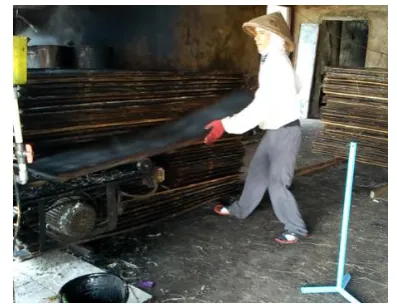
work stations, and packaging work stations. At the pressing work station there is an activity of inserting zinc into the press machine done manually by hand.
[image:2.595.329.528.93.245.2]Figure 1. Pressing Work Station with Activities Inserting Zinc into the Press Machine
[image:2.595.300.556.358.432.2]A. Processing Work Posture using the OWAS Method At the pressing station the activity of inserting zinc into the press machine is done manually by hand (see Figure 1). Identification of work posture using the OWAS method is shown in table 1.
Table 1: Identification of OWAS Work Postures for The Activity of Inserting Zinc into The Press Machine
Attitude Code Description
Back 3 Leaning sideways
Arm 1 Both arms are under the shoulder Legs 5 Stand on one leg with the knees bent Weight of the
load
1 1 Kg
Based on Table 1, the identification of the OWAS work posture obtained back attitude with code 3, which is leaning sideways, arm attitude with code 1 are both arms under the shoulder, legs attitude with code 5, stand on one leg with knees bent, and weight of the load 1 kilogram with code 1.
OWAS assessment is carried out by entering and linking the identified codes into the OWAS assessment table. Table 2 is an assessment of the OWAS method for the activity of inserting zinc into the press machine.
International Journal of Innovative Technology and Exploring Engineering (IJITEE) ISSN: 2278-3075,Volume-8 Issue-11, September 2019
Table 2: Assessment of The OWAS Method for The Activity of Inserting Zinc into The Press Machine Back Arms
1 2 3 4 5 6 7 Legs
1 2 3 1 2 3 1 2 3 1 2 3 1 2 3 1 2 3 1 2 3 Use of Force
1
1 1 1 1 1 1 1 1 1 1 2 2 2 2 2 2 1 1 1 1 1 1
X 2 1 1 1 1 1 1 1 1 1 2 2 2 2 2 2 1 1 1 1 1 1 3 1 1 1 1 1 1 1 1 1 2 2 2 2 2 2 1 1 1 1 1 1
2
1 2 2 3 2 2 3 2 2 3 3 3 3 3 3 3 2 2 2 2 3 3 2 2 2 3 2 2 3 2 3 3 3 4 4 3 4 4 3 3 4 2 3 4 3 3 3 4 2 2 3 3 3 3 3 4 4 4 4 4 4 4 4 2 3 4
3
1 1 1 1 1 1 1 1 1 2 3 3 3 4 4 4 1 1 1 1 1 1 2 2 2 3 1 1 1 1 1 2 4 4 4 4 4 4 3 3 3 1 1 1 3 2 2 3 1 1 1 2 3 3 4 4 4 4 4 4 4 4 4 1 1 1
4
1 2 3 3 2 2 3 2 2 3 4 4 4 4 4 4 4 4 4 2 3 4 2 3 3 4 2 3 4 3 3 4 4 4 4 4 4 4 4 4 4 2 3 4 3 4 4 4 2 3 4 3 3 4 4 4 4 4 4 4 4 4 4 2 3 4
B. Processing Work Posture using the WERA Method Based on Figure 1 it can be seen that shoulder posture forms an angle of 32.3 degrees, wrist posture forms an angle of 43.2 degrees, back posture forms an angle of 25.3 degrees,
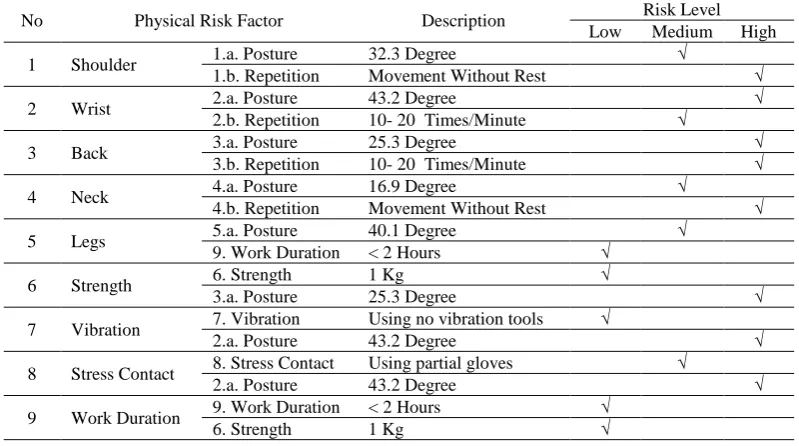
neck posture forms an angle of 16.9 degrees, and legs posture forms an angle of 40.1 degrees. For more details, identification of physical risk factors in the activity of inserting zinc into press machine is presented in the following Table 3.
Table 3: Identification of Physical Risk Factors in The Activity of Inserting Zinc into Press Machine No Physical Risk Factor Description Risk Level
Low Medium High
1 Shoulder 1.a. Posture 32.3 Degree √
1.b. Repetition Movement Without Rest √
2 Wrist 2.a. Posture 43.2 Degree √
2.b. Repetition 10- 20 Times/Minute √
3 Back 3.a. Posture 25.3 Degree √
3.b. Repetition 10- 20 Times/Minute √
4 Neck 4.a. Posture 16.9 Degree √
4.b. Repetition Movement Without Rest √
5 Legs 5.a. Posture 40.1 Degree √
9. Work Duration < 2 Hours √
6 Strength 6. Strength 1 Kg √
3.a. Posture 25.3 Degree √
7 Vibration 7. Vibration Using no vibration tools √
2.a. Posture 43.2 Degree √
8 Stress Contact 8. Stress Contact Using partial gloves √
2.a. Posture 43.2 Degree √
9 Work Duration 9. Work Duration < 2 Hours √
6. Strength 1 Kg √
After identificating risk factors and are included in the level of low, medium and high risk. The next step is to assess physical risk factors. Table 4 is the table of assessment of physical risk factors in the activity of inserting zinc into press machines. From the results of the assessment of physical risk factors for each factor, it can be seen that the score on shoulder posture obtained a score of 5, wrist posture obtained a score of 5, back posture obtained a score of 6, neck posture obtained a score of 5, foot posture obtained a score of 3, risk factors for strength obtained a score of 4, vibration risk factors obtained a score of 4, stress contact risk factors obtained a score of 5, and risk factorsx for work duration obtained score 2. Total score is 39 included in the medium risk level with information on task level action needs further investigation and needs for change.
[image:3.595.98.498.332.555.2]
Table 4: Assessment of Physical Risk Factors WERA in The Activity of Inserting Zinc into Press Machines Risk Factor Assessment Score
Shoulder Factor Wrist Posture Back Posture
Re
p
eti
ti
o
n
Risk Level L M H
Re
p
eti
ti
o
n
Risk Level L M H
Re
p
eti
ti
o
n
Risk Level L M H
L 2 3 4 L 2 3 4 L 2 3 4
M 3 4 5 M 3 4 5 M 3 4 5
H 4 5 6 H 4 5 6 H 4 5 6
Neck Posture Legs Posture Strength
Re
p
eti
ti
o
n
Risk Level L M H
Wo
rk
Du
ra
ti
o
n Risk Level L M H
Ba
ck
P
o
stu
re Risk Level L M H
L 2 3 4 L 2 3 4 L 2 3 4
M 3 4 5 M 3 4 5 M 3 4 5
H 4 5 6 H 4 5 6 H 4 5 6
Vibration Stress Contact Work Duration
Wr
ist
Risk Level L M H
Wr
ist
Risk Level L M H
S
tren
g
th Risk Level L M H
L 2 3 4 L 2 3 4 L 2 3 4
M 3 4 5 M 3 4 5 M 3 4 5
H 4 5 6 H 4 5 6 H 4 5 6
[image:4.595.73.528.287.546.2]Total Score = 39
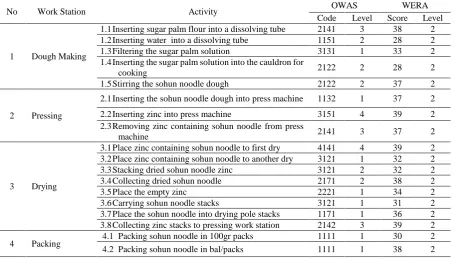
Table 5: Recapitulation Results of Processing of the OWAS and the WERA Method
No Work Station Activity OWAS WERA
Code Level Score Level
1 Dough Making
1.1Inserting sugar palm flour into a dissolving tube 2141 3 38 2 1.2Inserting water into a dissolving tube 1151 2 28 2 1.3Filtering the sugar palm solution 3131 1 33 2 1.4Inserting the sugar palm solution into the cauldron for
cooking 2122 2 28 2
1.5Stirring the sohun noodle dough 2122 2 37 2
2 Pressing
2.1Inserting the sohun noodle dough into press machine 1132 1 37 2
2.2Inserting zinc into press machine 3151 4 39 2 2.3Removing zinc containing sohun noodle from press
machine 2141 3 37 2
3 Drying
3.1Place zinc containing sohun noodle to first dry 4141 4 39 2 3.2Place zinc containing sohun noodle to another dry 3121 1 32 2 3.3Stacking dried sohun noodle zinc 3121 2 32 2 3.4Collecting dried sohun noodle 2171 2 38 2
3.5Place the empty zinc 2221 1 34 2
3.6Carrying sohun noodle stacks 3121 1 31 2 3.7Place the sohun noodle into drying pole stacks 1171 1 36 2 3.8Collecting zinc stacks to pressing work station 2142 3 39 2
4 Packing 4.1 Packing sohun noodle in 100gr packs 1111 1 30 2 4.2 Packing sohun noodle in bal/packs 1111 1 38 2
C. Statistical Testing Process
The body parts being analyzed are: the arms/shoulders, back, legs posture and weight/strenght load. Shoulder/arm body part, in the OWAS method with three categories, namely: (1) arm posture both arms under the shoulder, (2) one arm at or above the shoulder, (3) both arms at or above the shoulder, on the WERA method with three categories namely: (1) neutral shoulder posture, (2) shoulder around the chest, (3) shoulder moving upwards. The back of the body, in the OWAS method with four back attitudes, namely: (1) straight, (2) bending, (3) turning or leaning sideways, (4) bending and turning or bending forward and sideways, on the WERA method with three angular formed categories, namely: (1) 00/neutral posture, (2) 00 - 200 up/down, (3) 200 - 600 up/down.
The foot of the body parts in the OWAS method with seven footsteps, namely: (1) sitting, (2) standing resting on
International Journal of Innovative Technology and Exploring Engineering (IJITEE) ISSN: 2278-3075,Volume-8 Issue-11, September 2019
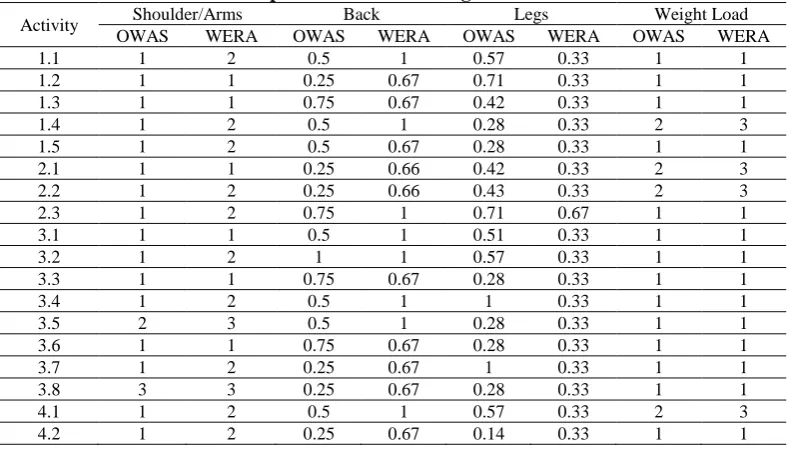
Table 6: Input Data for Processing Statistical Tests
Activity Shoulder/Arms Back Legs Weight Load OWAS WERA OWAS WERA OWAS WERA OWAS WERA
1.1 1 2 0.5 1 0.57 0.33 1 1
1.2 1 1 0.25 0.67 0.71 0.33 1 1
1.3 1 1 0.75 0.67 0.42 0.33 1 1
1.4 1 2 0.5 1 0.28 0.33 2 3
1.5 1 2 0.5 0.67 0.28 0.33 1 1
2.1 1 1 0.25 0.66 0.42 0.33 2 3
2.2 1 2 0.25 0.66 0.43 0.33 2 3
2.3 1 2 0.75 1 0.71 0.67 1 1
3.1 1 1 0.5 1 0.51 0.33 1 1
3.2 1 2 1 1 0.57 0.33 1 1
3.3 1 1 0.75 0.67 0.28 0.33 1 1
3.4 1 2 0.5 1 1 0.33 1 1
3.5 2 3 0.5 1 0.28 0.33 1 1
3.6 1 1 0.75 0.67 0.28 0.33 1 1
3.7 1 2 0.25 0.67 1 0.33 1 1
3.8 3 3 0.25 0.67 0.28 0.33 1 1
4.1 1 2 0.5 1 0.57 0.33 2 3
4.2 1 2 0.25 0.67 0.14 0.33 1 1
The results of the normal shapiro wilk test on the shoulder/arm, back, leg posture, and weight/strength showed the same results, which were not normally distributed, because the significance value was <0.05. Mann Whitney comparative test, the shoulder/arms and back asymp.ig (2-tailed) values <0.05 means that there are significant
[image:5.595.55.519.419.539.2]differences in the leg section and weight/strength asymp.ig (2-tailed) values> 0.05 means, there were no significant differences in either part. Spearman correlation test, on shoulder/arm, back, and weight/strength sig value (2-tailed) <0.05 means that there is a significant relationship in all three parts, and at the foot section sig (2-tailed) value> 0.05 means that there is no significant relationship between the two parts.
Table 7: Statistical Test in The Form of Normality Test, Comparative Test, Correlation Test Test Shoulder/Arms Back Legs Posture Weight/Strength
OWAS WERA OWAS WERA OWAS WERA OWAS WERA Normality
Test
Kolmogorov -Smirnova
.000 0,00 .013 .000 .026 .000 .000 .000
Shapiro-Wil k
.000 0,00 .006 .000 .027 .000 .000 .000
Mann Whitney U Test
Asymp. Sig. (2-tailed)
.000 .000 .906 .673
Spearman' s rho Test
Sig. (2-tailed)
.006 .006 .168 .168 .920 .920 - -
IV. CONCLUSION
The process of making sohun noodle in Klaten - Indonesia is divided into four work stations and 18 activities. The results of the work posture risk assessment using the OWAS method, there are eight activities with a risk category 1 that is no action that needs to be done for improvement, there are five activities with risk categories 2 that need improvement in the future, there are three activities with risk categories 3 that need to be done repairs as soon as possible, there are two activities with risk category 4, which need to be improved now. The result of the work posture risk assessment using the WERA method indicates that the results of the WERA score between 28-44 are included in the medium level action so that the task needs further investigation and needs change.
The statistical test results using SPSS Version 21.0 show that between the OWAS and WERA methods on the four body parts of the data are not normally distributed, the comparison test shows that the legs of posture and
weight/strength are not significantly different, and the correlation test on shoulder/arm, back, and weight/strength there is a significant correlations.
REFERENCES
1. S. Meksawi, B. Tangtrakulwanich, and V. Chongsuvivatwong, “International Journal of Industrial Ergonomics Musculoskeletal problems and ergonomic risk assessment in rubber tappers : A community-based study in southern Thailand,” Int. J. Ind. Ergon., vol. 42, no. 1, pp. 129–135, 2012.
2. M.-ève Chiasson, D. Imbeau, K. Aubry, and A. Delisle, “International Journal of Industrial Ergonomics Comparing the results of eight methods used to evaluate risk factors associated with musculoskeletal disorders,” Int. J. Ind. Ergon., vol. 42, no. 5, pp. 478–488, 2012. 3. L. Lei, P. G. Dempsey, J. G. Xu, L. N. Ge, and Y. X. Liang, “Risk
4. N. Öztürk and M. N. Esin, “International Journal of Industrial Ergonomics Investigation of musculoskeletal symptoms and ergonomic risk factors among female sewing machine operators in Turkey,” Int. J. Ind. Ergon., vol. 41, no. 6, pp. 585–591, 2011. 5. Tarwaka, S. H. Bakri, and Lilik Sudiajeng, ERGONOMI Untuk
Keselamatan, Kesehatan Kerja dan Produktivitas. 2004.
6. I. Pratiwi, M. Miftahurrohman, M. Djunaidi, and S. Suranto, “Analisis Postur Kerja Dengan Metode Manual Task Risk Assessment (ManTRA) Pada Pembuatan Mie Sohun,” J. Ilm. Tek. Ind., vol. 17, no. 1, p. 91, 2018.
7. Karhu, “Observing working postures in industry: Examples of OWAS application,” Appl ied Ergon., vol. 12, no. 1, pp. 13–7, 1981. 8. I. Pratiwi and I. Kartikasari, “Evaluation of work posture for non
repetitive job in Kampoeng Batik Laweyan using PATH and OWAS method,” in AIP Conference Proceedings, 2018, vol. 020051, p. 020051.
9. I. Pratiwi, “Evaluasi Postur Kerja Di Industri Tahu – Kartasura,” in Seminar Nasional Ergonomi, 2012, vol. Volume 1, no. 2012, pp. 52–60.
10.M. N. A. Rahman, M. S. M. M. F. H. Jaffar, M. Z. Ngali, and O. Pauline, “Exposure level of ergonomic risk factors in hotel industries,” Int. Res. Innov. Summit, vol. 012018, no. 226, pp. 1–10, 2017. 11.M. N. A. Rahman, M. R. A. Rani, and J. M. Rohani, “WERA : An
Observational Tool Development to Investigate the Physical Risk Factor Associated with WMSDs,” J. Hum. Ergol, vol. 40, no. 2011, pp. 19–36, 2011.
AUTHORSPROFILE
Indah Pratiwi is an Associate Professor, and Secretary II of Graduate Program in Industrial Engineering Department at Universitas Muhammadiyah Surakarta, Indonesia. She earned B.Sc. in Textile Engineering from Universitas Islam Indonesia, Master’s in Industrial Engineering from Institut Teknologi Sepuluh Nopember, Indonesia, Doctor in Industrial Engineering from Universitas Gadjah Mada, Indonesia. She has published journal and conference papers. Her research interests include ergonomics and human factor, work system and biomecanics, and performance measurement. She is member of PEI and PII.
Munfi’ah is a junior researcher in Logistics and Industrial Optimisation Research Center, Industrial Engineering Department at Universitas Muhammadiyah Surakarta. Ms. Munfi’ah holds a Bachelor of Science degree in Industrial Engineering from Universitas Muhammadiyah Surakarta. She is currently working at Industrial Engineering Staff, PT. Globalindo Intimates, Indonesia.
Ratnanto Fitriadi is an Assistant Professor in Industrial Engineering Department at Universitas Muhammadiyah Surakarta, Indonesia. He earned B.Sc. in Mechanical Engineering from Universitas Diponegoro, Indonesia, Master’s in Industrial Engineering from Institut Teknologi Sepuluh Nopember, Indonesia. He has published journal and conference papers. His research interests include Sustainable Manufacturing, Product Design and Ergonomics, and Automation Systems. He is member of PEI and PII.
Mila Faila Sufa is an Assistant Professor in Industrial Engineering Department at Universitas Muhammadiyah Surakarta, Indonesia. She earned B.Sc.and Master’s degree in Industrial Engineering from Institut Teknologi Sepuluh Nopember, Indonesia. She has published journal and conference papers. Her research interests include operation research, value engineering and human factor. He is member of PEI and PII.