Rochester Institute of Technology
RIT Scholar Works
Theses
Thesis/Dissertation Collections
2001
Post-test implementation of TWNTN4A
correction code at O.3m TCT
Ryuichi Machida
Follow this and additional works at:
http://scholarworks.rit.edu/theses
This Thesis is brought to you for free and open access by the Thesis/Dissertation Collections at RIT Scholar Works. It has been accepted for inclusion in Theses by an authorized administrator of RIT Scholar Works. For more information, please [email protected].
Recommended Citation
Post-Test Implementation of
TWNTN4A Correction Code at O.3m TCT
by
Ryuichi Machida
A Thesis Submitted in
Partial Fulfillment of the
Requirement for the
MASTER OF SCIENCE
IN
MECHANICAL ENGINEERING
Approved by:
Dr. Amitabha Ghosh
Department of Mechanical Engineering
Dr. P. Venkataraman
Department of Mechanical Engineering
Dr. Kevin B. Kochersberger
Department of Mechanical Engineering
Dr. Satish G. Kandlikar
Department of Mechanical Engineering
(Thesis Advisor)
(Graduate Committee)
(Graduate Committee)
(Department Head)
Permission from Author Required
Thesis Title:
Post-Test Implementation of
TWNTN4A Correction Code at O.3m TCT
I, Ryuichi Machida, prefer to be contacted each time a request for reproduction is made.
If
permission is granted, any reproduction will not be for commercial use or profit. Also,
passages in this volume must not be copied or closely paragraphed without a written
permission from the author.
If
a reader obtains any assistance from this volume, he/she must
give a proper credit in his/her own work. I can be reached at the following e-mail addresses:
Table
ofContents
Content PageNumber
Abstract i
Acknowledgement ii
ListofFigures iii
ListofTables iv
Listof
Symbols, Subscripts,
& Abbreviations v~viChapter 1 - Introduction 1-7
Chapter 2- TWNTN4A
Theory
8-14Chapter3- Numerical Procedure 15-24
Chapter4 - Semi-Automation 25-29
Chapter5- Results 30-55
Chapter 6
-Concluding
Remarks 56-58References R1-R2
Abstract
Airfoil characteristics measured in a wind tunnel
typically
differ fromthose obtainedin freeairdueto the confinement of airflowin tunnel testsections andthedevelopmentof
boundary
layer on tunnel walls. Wind tunnel measured quantities, e.g. Mach number, Reynolds
number, angle of attack, require corrections todetermine their equivalent values in free air.
TWNTN4A is a correction program capable of correcting wall interference effects in 2-D
wind tunnels. TWNTN4A was applied to correct over 300 data files obtained from tests
performed in 0.3m Transonic Cryogenic Tunnel
(TCT)
at NASA Langley. Data describeMach number range of 0.50 ~
0.82,
angle of attack ~13,
and Reynolds number3,000,000 and9,000,000. Asa new
feature,
variable grid control has been introducedto thecorrection code, and semi-automatic procedure wasdeveloped toachieve volume processing
of experimental data files. Mostof the corrected results correlated well with an interference
free viscous numerical solution given
by
Swanson/Turkel.However,
results from variablegrid control questionedthevalidityof numerical scheme usedfor lower Mach number cases
(M =0.50 ~
Acknowledgement
Many
havesupported and encouraged me to make this thesis possible. Special thanks gotomy parents (Motohiro and
Yoko)
and my brother(Yoshimasa)
forhelping
me in all thepossible ways
they
could. I want to thank my advisor, Dr. AmitabhaGhosh,
for his helpfuladvice andgivingmedirectionstocomplete this thesis. Ialso wantto thank theentire
faculty
and staffinmechanical engineering atR.I.T. fortheirsupport. Special thanksgotoall ofmy
friends from Roberts Wesleyan College and mechanical engineering department at R.I.T.
Their
friendship
has made my study in the U.S. possible and successful.Finally,
I want to thankRolfOrsagh atImpactTechnologies,
LLC for reviewing this thesis and all the peopleList
ofFigures
Figure Title Page
1.1
2.1 2.2
2.3
3.1
3.2
3.3
4.1
5.1
5.2
5.3
5.4
5.5 5.6
5.7
5.8 5.9
5.10
5.11
5.12
5.13
5.14
5.15
5.16
5.17
5.18
5.19
5.20
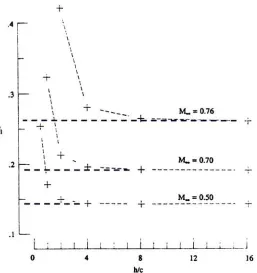
EffectofTunnel HalfHeighttoChord RatioversusLift Coefficient 3
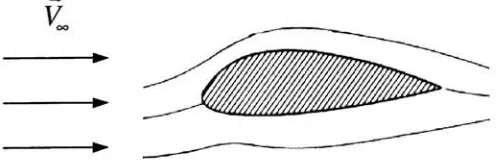
Wind Tunnel Flow 9
Free Air Flow 9
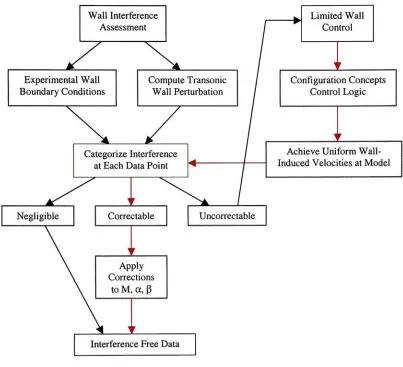
TheCorrectable Interference Transonic Wind Tunnel Concept 14
SchematicDiagramofComputational Grid(upper halfplaneonly) 18 Outer
Boundary
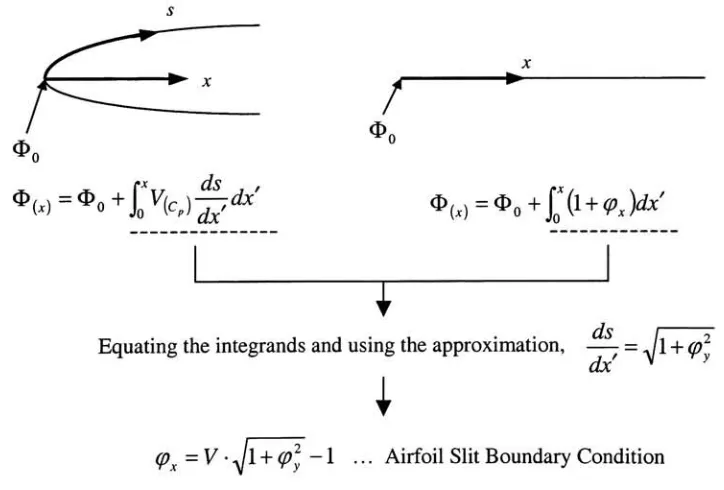
ConditionfortheTunnel Calculation 20Inner(Airfoil
Slit)
Boundary
ConditionoftheTunnelCalculation 20FlowChartoftheSemi-Automatic Procedure 26
ModelandWall ConfigurationsofAdaptive Wall Test Case 32
Equivalent Inviscid
Body
on Adaptive Wall Test Case 33Model
Cp
DistributiononAdaptive Wall Test Case 34Lift CurveonAdaptive Wall Test Case 34
Model andWall ConfigurationonSlotted Wall Test Case 35
EquivalentInviscid
Body
onSlotted Wall Test Case 36Model
Cp
DistributiononSlotted Wall Test Case 37Lift CurveonSlotted Wall Test Case 37
Drag
CurveatRe 9,000,000andC,
0on Original TWNTN4A Grids 41 Lift CurveatRe 9,000,000andM=0.50on Original TWNTN4A Grids 42LiftCurveatRe 9,000,000andM 0.65on Original TWNTN4A Grids 43
Lift Curve atRe 9,000,000andM 0.76on Original TWNTN4A Grids 44
Lift CurveatRe=9,000,000andM=0.80on Original TWNTN4A Grids 45
Drag
CurveatRe 3,000,000andQ
0onOriginal TWNTN4A Grids 47 Lift CurveatRe 3,000,000andM=0.50onOriginal TWNTN4A Grids 48Lift CurveatRe*3,000,000andM*0.65 onOriginal TWNTN4A Grids 49
Lift CurveatRe 3,000,000andM=0.76onOriginal TWNTN4A Grids 50
Lift CurveatRe= 3,000,000andM*0.80onOriginal TWNTN4A Grids 51
Lift CurveatRe=9,000,000andM 0.76onFinerGrids 53
List
ofTables
Table Title Page
5.1
Summary
ofGiven Experimental Data Sets 305.2
Summary
ofFlow PropertiesontheGiven Data Sets 305.3
Summary
ofData Representation Symbols 315.4 Swanson/Turkel Shock Wave Table 31
5.5 TWNTN4A ResultonAdaptive Wall TestCase 34
5.6 TWNTN4AResulton Slotted Wall Test Case 37
5.7
Summary
ofFlow Properties onthePart1 395.8
Summary
ofFlow PropertiesonthePart 2 395.9
Summary
ofFlow Properties onthePart3 39List
ofSymbols, Subscripts,
& Abbreviations
Symbols
b Modelspan ortestsection width b/c Model aspect ratio
c Modelchord
Cd
Drag
coefficientCi
LiftcoefficientCp
PressurecoefficientH Tunnelemptysidewall
boundary
layershapefactorat model location h/c Tunnelhalfheighttochord ratiok2
Murthy
aspect ratiofactorM Machnumber
Re Reynoldsnumberbasedon model chord
r Positionvector
S Sidewall
boundary
layercoefficientV
Velocity
vectoru Componentoftotalvelocity inx-direction v Componentoftotalvelocity iny-direction w Componentoftotalvelocity inz-direction x Stream-wise direction
(longitudinal)
y Verticaldirection(lateral)
a Angleof attack
3
Compressibility
factor,
Vl-M2y Ratioof specific heats
r Circulation
8*
Tunnel emptysidewall
boundary
layer displacementthickness Aa Angleof attack correctionAM Machnumbercorrection
A Coefficientoftransonicsmalldisturbanceequation (|> Perturbationpotential
cp Dimensionlessperturbationpotential O Total velocitypotential
Subscripts
F Freeair
M Model
(airfoil)
R Reference (Tunnel
Reference)
T Tunnel
W Wall
WT Wind Tunnel
oo
Infinity,
faraway froma model. Itindicatesthefreeair regionAbbreviations
L.E.
Leading
edgeRMS Root Mean Square
TCT Transonic Cryogenic Tunnel
Post-Test Implementation
ofChapter 1
-Introduction
Theconditions under which a model is tested in a wind tunnel are not the same as those in
free air. Wind tunnel measured quantities, e.g. Mach number, Reynolds number, angle of
attack, lift coefficient,
drag
coefficient, moment coefficient, require corrections to simulatethose that would have been measured in free air condition. In this thesis, the TWNTN4A
codeis usedtocorrect experimental data from theNASA 0.3m Transonic Cryogenic
(Wind)
Tunnel
(TCT)*
tofreeair conditions.
The presence of tunnel walls causes the difference between measurements in a
two-dimensional windtunnel andin free air. Firstofall, tunnel wall presence itself isthe root of
boundary
layer development that doesnot existin free air. Tunnel sidewallboundary
layerscan interact with shock waves spanning the test section at transonic speed to induce flow
separation in the model/sidewalljunction region. Airflow in wind tunnels is unlike free air
because tunnel walls influence airflow in the longitudinal and lateral directions in the test
section.Variouseffects are givenbelow:
1. Horizontal buoyancy. It is a variation in static pressure along theaxis ofthe testsection
resulting from the
thickening
of theboundary
layeras it progresses toward the exit andto the resultant effectivereductionofthe flowarea. Itfollowsthat thepressureis usually
progressivelymorenegative as theexit is approached, andthere is hence a
tendency
for2. Solid blockage. The presence of a model in the test section reduces the area through
which the air must flow.
Hence,
by
continuity and Bernoulli'sequation, it increases thevelocity of the air as it flows over the model. It affects all forces and moments
measurements.
3. Wake blockage. Wake behind the model has a mean velocity lower than the tunnel
stream.
According
to thelaw ofcontinuity,thevelocityoutside thewake must be higherin order that a constant volume offluid may pass through the test section. The higher
velocity in the mainstream has a lowered pressure
by
Bernoulli's principle, and thislowered pressure puts the model in a pressure gradient and results in a velocity
incrementatthemodel.Itaffects the
drag
measurement.4. Streamline curvature.Thepresence ofceilingand floorpreventsthenormal curvature of
theair stream. Themodel appears to havemore camber than it actually has. Airfoil in a
wind tunnel has too much lift and moment about the quarter chord at a given angle of
attack, and
indeed,
theangle of attackis toolargeas well.It is assumedthat errors due to customary failings of windtunnel noise, tare, angularity of
flow,
local variations in velocity, and temperature fluctuation have been already removedbeforewalleffects are considered.
Figure 1.1 illustrates the effect of tunnel half height to chord ratio
(h/c)
versus the liftcoefficient. This quantity h/c is related to some of error factors described above. For
example, the smaller the quantity
is,
the less area there will be at the test section (solidblockage)
andthe closer the model andtunnel walls are (streamline curvature). There existsnumber,angle of attack, andReynolds number;
however,
thefigure shows the measurementerror of lift coefficient in wind tunnel when the quantity h/c is small. It also shows the
extreme sensitivityoflift coefficient to the quantity
h/c,
particularlyin transonic flow. Thisresult was measuredforNACA 0012 at 1angle of attack in a
2-D,
straight wall windtunnel[1].
+
.4 I
.3
\
"*"
--... M>=0.76
+
M-0.70 +
+
J-_-_ + M_=0.50
1
J i_J12 16
h/c
Figure1.1:EffectofTunnel HalfHeighttoChordRatioversusLiftCoefficient
All of above factors affect the data measured in wind tunnels and point to the need for
[image:14.544.137.394.182.455.2]Literature Review
Windtunnelwall interferencecorrectionmethodologystarted as earlyas 1931
[2,
3,
4]. Untilthe mid 1970s
[5, 6, 7],
wind tunnel data correction utilized a combination of singularities(e.g.,
source, sink,doublet,
vortex, etc.) and relied on simple potential flow solutions tomathematically simulate the flow pattern about an airfoil. Most methods described tunnel
walls as
boundary
conditions, using also a collection of these singularities. Theoreticalmodels determined the form of singularities
imposing
idealboundary
conditions.However,
from themid 1970s
[8, 9],
theformwas determinedby
actual pressure measurementsalongtunnel walls
during
the wind tunnel testing. Then using the linearized potential flowequations and
boundary
conditions, wall singularities and model singularities arelinearly
superimposed ordecomposedtodeterminetheirrespective strengths.
Along
with the analytical methods to correct wallinterference,
slotted and adaptive walltransonic test sections are two mechanical developments that can significantly reduce wall
interference compared to straight solid wind tunnel walls. Slotted walls suck out
boundary
layers from tunnel walls so that the horizontal
buoyancy
effects can be reduced. Adaptivewalls can form flow stream configuration on tunnel walls so that it can reduce the stream
curvature effect.
However,
in eithermethod,other error factorsstill affect thedatameasuredinwindtunnels.
The TWNTN4A computer programcombined the latest analytical andthe mechanical ideas
tocorrect/assesswindtunnel wallinterference. It is anonlinear, transonic, small
disturbance,
for disturbances caused
by
the side wallboundary
layer in 2-D wind tunnels. It uses anonlinear equationtoaccurately model airflow attransonicspeed. Thecodehas asignificant
improvement over classical correction methods, particularly for transonic flows.
First,
theprogram solves nonlinear equation
including
a higher order term to enhance the transonicmodeling.
Second,
measured data are used in both the exterior and interiorboundary
conditions.
Third,
the program accounts approximately for some influence ofthe sidewallboundary
layers. Thismethod attemptsto preservethenonlinearinteraction inthetestsectionflow
field,
including
effects of shock waves andboundary
layers on both the model andtunnelwalls.
BriefHistoryofTWNTN4A
The TWNTN4A application is an upgraded version of program called TWINTAN
[10]
by
Kemp. The original TWINTAN only accounted for the
top
and bottom wall interference.Barnwell and Sewall
[11]
improved TWINTANby introducing
a simple model of tunnelsidewall
boundary
layers. This new feature accounted for the additional blockageinterferencecaused
by
thereaction of sidewallboundary
layerto the model inducedpressuregradients. This improved program is called TWINTN4
[12],
which is a full four wallcorrection scheme.
However,
this new scheme appeared to overcorrect the interference.Murthy
[13]
explainedtheovercorrection and proposed a modification toitby involving
themodel aspect ratio in theprogram. The TWINTN4 wasfurther improvedto accountforwall
interferencewithinatunnel
having
flexibly
adaptedtop
andbottomwalls. Thisis thecurrentIn this thesis, all the results were produced
by
TWNTN4A application, which includes theObjective
Theobjective ofthis thesisisto:
1. Understand how the TWNTN4A computer program assesses/corrects the interference
fromwindtunnelwalls.
2.
Develop
a pre- and post-processor of TWNTN4Aprogram to save time
by
replacingmanual operations.
3.
Apply
TWNTN4A program to given experimental datasets and analyze the consequentresults
by
comparingwithSwanson/Turkel solution, which wastreatedastheinterferencefreedata(the reference) becauseoftheabsence offlighttestresults.
4. Provide a new
feature,
variable grid control, as an option so thatusers have a control ofChapter 2
-TWNTN4A
Theory
Although TWNTN4A is an upgraded version of
TWINTAN,
it is still basedonKemp's ideasof transonic analysis procedure and correctable interference concept [14]. This procedure
formulatesthe
theory
ofTWNTN4A,
andthen theconceptintroduces thecriterion whentheprocedure canbeappliedtocorrect wallinterference ina windtunnelattransonic speeds.
Transonic Analysis Procedure
Traditional methods for analysis of wind tunnel wall interference at subsonic speeds are
based on the linear superposition of elemental perturbation potentials arising from
singularitiesrepresenting a model and tunnel walls. At subsonic flow speed, where thewall
singularities areclearly distinguishable from those representing the model, thewall induced
perturbation field can be isolated without ambiguity. At transonic speed,
however,
thenonlinear interaction among perturbations precludes such a direct definition of the
wall-induced perturbation. A transonic analysis procedure is developed here in principle, which
should yield not onlyarationally defined wallinduced perturbationfield but also a criterion
for assessing applicabilityof windtunnel datatoafreeairflightcondition.
Utilizing
theperturbation velocitypotential concept , thepotential flow ina windtunnelcanbe naturallyexpressedas:
wr=VR-r+twr
(2.1)
*
Itispresumed that the
boundary
conditions neededtodefinethe windtunnel flow are knownso thata solutionfor
Qm
canbeobtained.Theequation(2.1)
shows thewindtunnel velocitypotential is a sum of basic tunnel potential and
(total)
perturbation potential inducedby
tunnel walls andtheairfoil (Figure2.1).
VB
y///////////////////////
^
[image:20.544.142.390.172.276.2]////////////////////////
Figure 2.1: Wind Tunnel Flow
Now,
utilizingthesameidea,
afree airflowconditionwithan airfoil can beexpressedas:F=V-r+
h
(2.2)
In a free air condition, only the presence of airfoil can perturb the
incoming
flow,
whichcould be angled to the
leading
edge of airfoil, because there is nothing to perturb the flow(Figure 2.2). Theperturbation <j)M isattributableentirelyto theairfoil.
[image:20.544.144.392.520.602.2]The
boundary
conditions to be imposed on the equation(2.2)
are the analytic far fieldexpression forunboundedflowtogetherwith aninner
boundary
conditiondesignedtoassurethat the resulting perturbation
<j)M
is an appropriate representation ofthe direct influence ofairfoilin a windtunnelflow.
Any
remainingperturbationinthe tunnelflow is then attributedto thepresenceoftunnel walls
(<j)w
),
so onemaywrite:</>w=0m-<PM
(2.3)
Theproposed
boundary
conditiontobe imposedatthemodel and wakeiswritten as:Iv*J=Iy"aJ
(2-4)
where the brackets denote the
discontinuity
between the upper and lower surfaces of themodel and wake oftheenclosed perturbation velocityvector. Thestrengths ofthesource and
vortex-like singularities thatare usedtorepresentthe model are assuredtobe identical inthe
wind tunnel and free air flow. As a result of this
boundary
condition, the wall inducedvelocity field defined
by
V0W
iscontinuous acrossthemodel andwake, andany shock waveintersecting
the model or wake in the wind tunnel flow will beidentically
located on theThe basic purpose of wall interference assessment is to examine the applicability of data
measured on the model in a wind tunnel test to free air flight. To this end, it needs to be
asked whether a free air flow exists in which the model shape and surface pressure
distribution areidentical to thosein the tunnel.Askwhethertheequality
VF=Vm
(2.5)
can be satisfied everywhere on the model surface.
First,
express the wall induced velocityfieldasthecombination of even and odd(uniformandnon-uniform)parts:
Vw=V^=V^,s+V^iA
(2.6)
where the subscript S and A represent symmetric and anti-symmetric respectively.
Now,
performing mathematical manipulations:
Equation (2.
1)
=>Vm
=V<Pm
=VR+V<t>wr(2-7)
Equation
(2.2)
=>VF
=V<DF =
V
+V0M
(2.8)
Equation
(2.3)
=> V^. =V^
+V^
(2.9)
Substituting
theequation(2.7)
and(2.8)
intotheequation(2.5):?+?*=?*+***
(2-10)
Substitutetheequation
(2.9)
intotheequation(2.10):Lastly,
substituting
theequation(2.6)
intotheequation (2.11),
theexpressionbecomes:K.=V+V^>S+V^
(2.12)
Onecan set
V-=V,+V^iS
(2.13)
ifandonlyifthesymmetric
(uniformity)
criterionV<1>w,a=0otVw=Vw<s
(2.14)
is met everywhere onthemodel surface.
Now,
withthecriterionabove, one can say that theequation(2.5)
is satisfied everywhere onthemodel surface.
VF =vm
(2-5)
Repeated
The free air flow expressed
by
the equation(2.2)
can now be solvediteratively
using theequation
(2.13)
to update V. After convergence, the wall induced perturbation field isdefined
by
theequation(2.3). Ifthe symmetric(uniformity)
criterion, equation(2.14),
is metwithin acceptable limits over the model surface, the tunnel data are correctable simply
by
correctionstoMachnumber andangle of attackderived
by
expressingtheequation(2.13)
inCorrectable Interference
ConceptKemp's
[14]
correctable interferenceconcept uses the flow chart, Figure 2.3. Aspart ofthisthesis, the flow chart's red path was assumed to betrue. In otherwords, this path presumes
thatapplying wall control technologies (slotted and/or adaptive wall) achieves uniform wall
induced velocities at the model, andthen the experimentaldata is categorized as correctable
sothatTWNTN4Acorrection producesthevalidinterference free dataattheend.
This categorization
(negligible,
correctable, uncorrectable) is related to the uniformitycriterion discussed in the preceding section, the equation (2.14). This thesis checks the
criterion
by
RMSACP
value onthe model. When thevalue was close to zero, itcategorizedthe data set as negligible and/or correctable (there is no distinction between negligible or
correctable here because TWNTN4A was applied to both cases anyway). When the value
wasnot close to zero,itcategorizedthe dataset as uncorrectable. There is nobordervalueto
evaluate the closeness of zerofor theRMS
ACP
value, butthe table 5.10 (chapter5)
clearlyshows the distinction. Please see the end of Chapter 5 for the detailed discussion of this
criterion check.
Satisfaction of the uniformity criterion was usually the case
by
applying the wall controltechnologies in this project.
However,
on some occasions, experimental data fell into theuncorrectable category even with the wall control technologies. Since TWNTN4A always
WallInterference
Assessment
Limited Wall
Control
Experimental Wall
Boundary
ConditionsNegligible
ComputeTransonic
Wall Perturbation
Configuration Concepts
Control Logic
Categorize Interference
atEach Data Point
AchieveUniform
Wall-Induced VelocitiesatModel
Correctable Uncorrectable
Apply Corrections
toM,a,
P
[image:25.544.66.469.67.434.2]InterferenceFree Data
Chapter
3
-Numerical Procedure
TWNTN4A is a nonlinear, transonic, small
disturbance,
potential flow program capable ofcorrecting wall interference effects in 2-D wind tunnels
including
2- and 4-wall correctioncapabilityfordisturbancescaused
by
the side wallboundary
layers.TWNTN4Aperformsthree calculation cycles - tunnel
calculations, free-aircalculations, and
perturbation flow calculations. In the first cycle, the tunnel calculation employs an inverse
design procedure to determine an effective, inviscid geometric representation of the test
model, which includes the viscous effects of the model and the interference distortions
imposed
by
thepresence ofthe tunnel walls. Inthe secondcycle, thefree airflow aboutthisequivalentinviscid shapeiscomputedto correcttheangle of attack andMachnumber. In the
third cycle, the free air flow is again computed using the
body
shape obtained in the firstcycle and the corrected free stream condition with modified
boundary
conditions obtainedfromthesecond. The difference betweenthetotalperturbationfromthefirstcycle and model
perturbations obtainedinthethirdare attributableto thewalleffects.
In each calculation cycle, TWNTN4A solves the same governingequation on thesame grid
with different sets of
boundary
conditions. Thefollowing
describes the governing equation,Governing
EquationTWNTN4A solves 2-D small disturbancetransonic potential flow equation. It is a2-D form
of perturbationvelocity potential with airfoilinfree air.Ittakes theform of:
aA^-o0
:>..2
where:
dx2 dy'
V '
Um
dx
2Ul
[dx)
(3.1)
(3.2)
Thehigherordertermin is kept in theequation tomodel the transonic flow behavior
{dx)
more accurately. TWNTN4A uses a scaled
(non-dimensionalized)
perturbation potentialdefinedas:
<p=
UR-c
(3.3)
This dimensionless quantity allows comparisons between solutions with different values of
flow stream velocity.
Substituting
thisrelationinto theequation(3.1)
and(3.2)
constructstheTWNTN4A governingequation:
A.^?
=0dx2 dy2
(3.4)
"
where:
A=
l-Ml
-(y +l).M2
.(*-)
U
dx
2 - U\ ~y
+5
(3.5)
Thequantity
UR
isthevelocityatMR
, whereasU
isthe velocityatMm
. Theterm 5 istheeffect oftheside wall
boundary
layer developedby
Barnwell andSewall[11]
andis furthermodified
by Murthy
[13]. That is:where:
S=-2S*
(_
1 2+-MIH R
(
k2
\sinh(fc2
)
(3.6)
k2
=(3.7)
Note that the two-wall correction scheme is constructed if is taken tobe zero since the
side wall term
(5)
simply dropsout.Thetransonic analysis procedureintroduced inchapter2 isupdatedhere because TWNTN4A
utilizesthenon-dimensionalizedperturbationpotential,defined intheequation (3.3).
Equation
(2.1)
Equation
(2.2)
Equation
(2.3)
^WT T'
+(pWT
&F
=UT -cU.
Ut
c+<pM
<Pw =<Pwt-<Pm
(3.8)
(3.9)
Computational
GridFigure3.1 shows an example computational grid usedin TWNTN4Aapplication. Thegridis
geometrically stretched forward from the
leading
edge, backward fromthetrailing
edge, andvertically in both directions from the slit on which the model
boundary
conditions areimposed. The geometric stretching rate in the vertical direction is determined such that an
intermediate gridlinecoincides withthe
top
andbottomtunnel walls. Thissamestretching isused for calculation of both tunnel and unconstrained free air
flows;
thus the differencesbetween thesolutionsdue todiscritizationerror are minimized. Themaximum allowable grid
sizeis 100
(longitudinal)
x 100(lateral). A largergrid configuration will be introducedattheend ofthischapter.
Lrpper Tunnel Wall
11
[image:29.544.81.466.319.528.2]Slit
Three Calculation Cycles with
Boundary
Conditions1. Tunnel Calculation
The tunnel calculation, the first calculation cycle, employs an inverse design procedure to
determine an effective, inviscid geometric representation of the test model, which includes
the viscous effects ofthe model andthe interference distortions imposed
by
thepresence ofthe tunnel walls. In this cycle, tunnel and model wall pressure measurements are used as
boundary
conditions on the internalflow;
the free stream velocity and Mach number arespecified the same as the experimental testcase. Themeasured pressure data in the form of
pressure coefficient arefirstconvertedto V2
(velocity
squared)formusingtheexpression:^)=1
+ l-|l+^-M2-C
2 "
N r
M'
(3.H)
Figure3.2 and3.3 illustratetheouter andinner
boundary
conditions, respectively. The innerboundary
condition (upperandlowerairfoil surfaces)istransformedon a slit atthecenterline<py
- Given^=SAy-'
<Px=^V2-<p2y-l
<p=
^<pxAx
+<plv<Pyy
="A^
[image:31.544.74.484.43.251.2]<P=
f,Bny'-l+~sgn(y)
Figure 3.2: Outer
Boundary
Condition fortheTunnel CalculationNote: Wall
boundary
condition,<px
=-1,is from V
2 =u
2
+
v2 =
(l
+(px
f
+<p:
ds . ,
w=o+JX)^7^ dx
r
or
(x)=o+[(l+<PxW
J
ds
as I
Equating
theintegrandsandusingthe approximation, - =Jl
+cp
\
dx
q>x
=VJl
+ (p2
-1 ... AirfoilSlit
Boundary
Condition [image:31.544.102.464.388.633.2]Along
with these outer and innerboundary
conditions, there is an additionalboundary
condition requiredto solvethe tunnel flow calculation. It is theflow direction at thetunnel
upstream
boundary,
the vertical(upwash)
velocitycomponent alongthe forward face ofthetest section near the upper and lower
bounding
surfaces.They
are representedby
SLA(upper)
& SLB(lower)
in TWNTN4A code. In practice, these velocity components arerarely measured, which complicates the correction process
by introducing
a global iterationtodeduce thesevelocitycomponents and establishtheproper computational inflow
boundary
condition. TWNTN4A has a capability ofcalculating and updating the vertical velocity at
theinflowcornersusing aflowalignment criterion overtheforwardpart oftheairfoil.
Now,
thegoverning equation is solvediteratively
(characteristicsof nonlinearequation)withthese
boundary
conditions. After the convergence, the resulting small perturbation potentialfield constructs the equivalentinviscid
body
(abody
sensedby
the tunnel flowfield)
usingtheexpression:
2. Free Air Calculation
In the free air calculation cycle, the inviscid equivalent
body,
determinedby
the tunnelcalculation, is placedin afree air environment at an angle of attack andMach number such
that the lift is identical to that in the tunnel andthe distribution oftotal velocitymagnitude
ofattack, known as theKutta condition. Itis represented as a velocitypotential
jump
in theperturbation
theory
[18]. The angle of attack is corrected to satisfy this condition at thetrailing
edge oftheairfoilforthelift correspondingto the tunnelflow, i.e.,
a<Pt.e.
=r(3.13)
During
theconvergenceprocess, the free airboundary
conditions areincrementally
changedin an attempt to minimize the root mean square
(RMS)
difference between the velocitydistributioncomputedwith thefree air model andthevelocity distribution obtainedfrom the
pressure coefficient data measured with the tunnel model. This requires updating
Mm
tominimizeE ,
i.e.,
E2=[VT2-V?}2ds=
j
'P,Tr ^P,F
MTj
ds
(3.14)
This calculation cycle solves the same governing equation, as mentioned
before,
with outerandinner
boundary
conditions differentfromthefirstcycle.Analytically
afar fieldconditionistheouter
boundary
conditionforthefree air computations. Itmustsatisfythatdisturbancesvanish at the
infinity
(about five chord length above and below from the airfoil surfaces).Due to computer memory/storage limitations when the original TWINTAN was
developed,
an analytical formoffar field
boundary
condition (still satisfyingthevanishingdisturbancesrequirementatthe
infinity)
isusedintheprogramand carried ontoTWNTN4A.That is:r <p=
2n
sgn(z)+tan
(
x~\^,.
+ y
+1
2_2
aP
x2 +
/32z
(W)
(3.15)
Klunker
[19]
defines symbols used in theequation(3.15)
and explains it in details. On theother
hand,
the innerboundary
condition offree air cycle is aNeumann condition using thevalues of
<py
extracteddirectly
fromthe tunnelflow solution.Theboundary
condition isthenformed allowing foran angle of attack correction A
[10],
i.e.,
Dl-C-D'2
+a-(<py
I
-A)
p1
=y-P^
'
(3.16)
Bl
+CB2
where the upper and lower signs refer to the airfoil upper and lower surfaces, respectively.
Kemp
[10]
defines symbols used in the equation(3.16)
and explains it in details. After theconvergence, the correction quantities for angle of attack and Mach number are available
because thelift and
drag
are constrainedtomatchthose ofthetunnel case withthecorrectedangle of attack andMachnumber.
3. Perturbation Calculation
The third calculation cycle is required in order todetermine the classical type wall induced
perturbation velocity field. It is to define that part of the tunnel flow perturbation that is
attributable
directly
to the airfoil. This free air solution about the model is describedby
theequivalent, inviscid
body
determinedduring
the tunnel flow calculation atthecorrectedfreestream Mach number and angle of attack from the free air calculation. The wall induced
perturbation can betaken asthe difference betweenthe total perturbationobtainedin thefirst
calculation cycle andthemodelinducedperturbation obtainedin thethirdcalculation cycle.
is the same as in the first cycle (figure 3.3). After the convergence, TWNTN4A uses the
equation
(3.10)
to determine the wall induced perturbation velocity potential fieldby
asimplesubtraction.
Variable Grid Control
As a new
feature,
variable grid controlhas been introducedtoTWNTN4A application.Atthetime whenthe originalTWINTAN
[10]
wasdeveloped,
this feature was notincluded in theprogram due to the limited computer resources (memory/storage). Even
TWNTN4A,
upgraded version of
TWINTAN,
did not have this capability before this project wasassigned. Thisnewfeaturestill usesthesame geometric stretchinggridconcept,described in
the previous section, to represent the flow
field,
but now a user can control the maximumallowable grid size tomeet thecurrent computational fluiddynamics standardsthat use fine
grids tomodel theflow field.
Oneparameter,
MGS,
definesthe maximum grid sizein the program now.Ideally
this valueis specified once in the whole program;
however,
it was not possible due to inconsistentprogramming methodologies
(mainly
hard-coded multidimensional array size) employedby
several researchers over years of program modifications. It involved considerable effort to
modify
TWNTN4A,
which still requires removals of obsolete coding and streamlining theprogramflow ingeneral.
Along
withthe parameter, ausermustspecifyafewother variables(e.g.,
celllocations,
number ofcells, and cell sizein the inputfile)
to generate TWNTN4AChapter 4
- Semi-Automation
TWNTN4A is an iterative procedure requiring manual pre- and
post-processing before and
after each pass (global iteration of TWNTN4A is called pass
1,
pass2,
and pass3,
sequentially). Asemi-automatic procedure wasdevelopedas a part ofthisprojecttofacilitate
the processing of a large number of experimental data files. This procedure considerably
reducestheTWNTN4Apre- and
post-processingtime
by
replacingmanual operations. Thesepre- and
post-processing codes were written in script format that runs underthe
MATLAB*
interpreter (nota standalone executable).
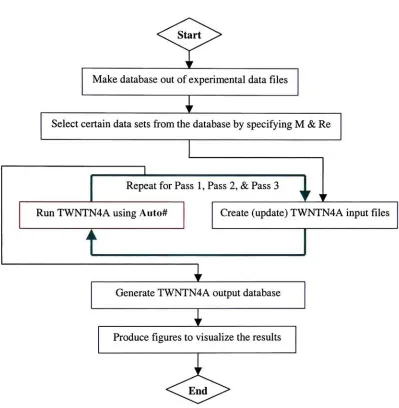
The
following
summarizes the capability of this procedure. The pre-processing functionsinclude creating a database out of experimental data files and selecting data sets based on
criteria such as Mach number and Reynolds number. The pre-processor can also
iteratively
update all three passes ofTWNTN4A input files from its own output. The post-processing
functions can store TWNTN4A output to database files for later analysis and can produce a
variety of figures to visualize the results. This semi-automation program produced all the
figuresshowninthis thesis.
Figure 4. 1 shows a flow chart oftheTWNTN4A correction process performed
by
the semiautomatic procedure. In the
figure,
the[blue
highlightedboxes|
represent MATLAB basedgreen) is a UNIX script file. Appendix includes an example Auto#
(Auto3)
and all ofMATLAB scriptsforthisprocedure.
<^JStart^>
Make databaseout of experimentaldata files
I
Selectcertaindatasetsfromthedatabase
by
specifying M & Re1
Repeat for Pass 1,Pass 2,& Pass3
Run TWNTN4A using Auto#
t
11
Create
(update)
TWNTN4Ainput files1
Generate TWNTN4Aoutputdatabase
Producefigurestovisualizetheresults
[image:37.544.79.478.103.511.2]End
SampleRunofSemi-Automatic Procedure
Thissection shows a sample run of semi-automatic procedure withtheactualMATLAB user
interface. Figuresare not numberedbecauseno referenceexistsin this thesis.
Making
databaseoutof experimental data filesBe E* ! web WMow tiff
Do* * 1% (f,' "
| K| ? |Cir.aofy:|cv,ntn4a_yrfle
_*J ,|
l Si EdttfwKwrtt:em*tIMP
Wm _Jfl]*J
ii924pptH 119 E3402pp.tu4 ).J:I il92Spp.tm 119 11928pp.t4 119 il962pp.to4 119 H963.pp.C04 119 l3407pp.CO4 131 ii9e4pp.co4 ii9 Eiseepp.tui us eSllOpptu4 131 jl9ftpptrt 119 E3409pp.to4 134 z3403pp,co4 134 IlM7pJ>.CB4 119 ll963ppt4 119 5l97ppCu4 119 El968pp.to4 119 Z3411pp.cn4 134 y0LJ2pp.EO4 201
run point onrel ft 24 I 0.5036 -4
2 2 0.4971 -4
25 2 0.6020 -4 62 2 0.5007 -4 63 2 0.5989 -4 7 2 0.1983 -4 64 2 0.SSO2 -3 66 2 0.7384 -3 10 2 0.7392 -3
9 3 0.699B -3 3 2 0.694B -3 27 2 0.7O2S -3 65 Z 0.7052 -3 67 2 0.7*03 -3 66 2 0.7B48 -3 11 3 0.7575 -3 32 165 0.S981 -2
05BB 0222 0120 0120 0120 0001 991T 0600 0307 0243 0141 0088 0039 0039 0039 13B4
3026000 _1
2991000 3019000 303 6000 9121000 901,000 8946000 9036000 903SOQQ 9056000 90B7O00 9118000 3014000 30S0O00 9052000 9)01000 912000b 9067000 8900000 . <| Ready
1
Command"mkdb"makesdatabaseout of
experimentaldata files. PorHthmuPI 1 SJMA
Selecting
certain datasetsfromthe databaseby
specifying M & ReF> Edit iffew Wcfe Wjrrfow tic*?
HBP -IsJjeJ
7ICurrerrl WrwJory:|CVmtwrtn4alD_y2fle T]
_J
pickup
BachtReynoldsnumberrange
~3
BachnuBber: 0. 1B50 toD.5150
nuabei: 6550000to94S0000
Command"pickup"selected
certaindatasets.Machnumberis
about0.5andReynoldsnumberis
about9,000,000 inthiscase.A
userhastospecifytheranges of Machnumber andReynolds
numberinthecode(Seethe Appendix).
.T-.Trrrrr'-w-^i
t>Ed' J> lfwtFormatg>
| tneMM U9t El962pp.tu4 119
E34Q7pp,to4 134
y0813pp.co4 2 OB
y0131pp.tw4 201
E310?pp.i:ii4 134 yQ902pp.tn4 209 y0921ppet4 209 V0131pp.tn4 201
yQ613pp.tt4 20B y0912pp.ts4 2 09
U962pp. tn4 119 El962ppto4 119 yO130pp.to4 201
l3407pp.t4 134
E3407pp.eu4 134
yO902pp.ttrt 209
y092lppto4 209 y0813pp.c4 20B
l3407pp.C<rt 134
hi MafjPfM
HEjoijsj 5007 -4. 49Q3 -4. S004 -2. 4993 -2. 5003 -1. 4994 -1. 4994 -1. 4996 -0. 5005 -0. 49B4 -0 50ZZ -0 5052 -0 .4992 -0 .5014 0 .4998 0 .4993 0 .5009 0 .5006 1 .4995 1 G120 0001 0162 0060 9B57 Z040 03 61 0204 0204 0204 0159 102 0102 0000 0000 0204 0312 9755 9956 trinf 9121000 034 6000 8976000 9965000 9980000 9007000 9979000
902 3000
Creating
(updating)
TWNTN4A input filesDZSiQHHaaVaM
f*> Ed* v* w* mb Hb
Da:j .;; t,ft <-I wI
plp2inp Available Nacb. Muabei
? Curat* Olfactory:|CWriwntn4\2_r -3J
ami
kD50 k065 n076 L080
Selecta uachnimbetfromChe listabove:076
Ready
"plp2inp"
standsfor "Passl toPass2
input."
Itcreated and updatedthe
TWNTN4AinputfilesforthePass2
from Passl outputfiles
by
selectingtheMachnumber.
rri
* t *w Favorites loots yelp
tti I | ProaramFie? t-JDnntwtrrta
aC\0_YZF1L
_1)TESTU9 QTEST 134
QTE5T20I
OTE5T20B
QTE5T2D9
GB-Ql_swnturb ! SiOmoso
ttQwoes , pMQ76
QPA5S1
I ffiOM060 !43-C] 3_RE3M
G4_MAT_DB
1_U5_PPLOT Iskfraaspace:31,861
.si _d 5flDATA4C01.DAT GflDATA1C02.DAT M DATA4CQ3.DAT WDATA4C04.DAT a) DATA1C05.DAT >]DATA4C06.DAT MDATA4C07.DAT 0DATA4C08.DAT WDATA4COT.DAT H DATA4C10.DAT MDATA4C11.DAT ]DATA4C12.DAT |W|DATA4C13.0AT W DATA4C14.DAT la]0ATA4CIS.DAT 0DATA1C16.DAT i)DATA4C17.DAT ajDATA4Cie.DAT <J ITvoe J
4 KB OAT Fie 4KB DAT Fie 4KB DAT Fie 4 KB OATFie 4KB DAT Fie 4KB DATHe 4 KB DAT Fie 4KB DAT Fie 4KB DAT FIb 4KB DAT FIb 4KB DATHe 4 KB OATFie 4KB DAT Fie 4KB DATFlc 4 KB DATFie 4KB DAT Re 4KB DATNe 4KB DATFla
etB |gMyComputer
*l
Running
TWNTN4Ausing Auto3 (Actualcommandis"auto3".)
JSBIJB
Auto3tasks:
1. Removedunnecessary files inthe
currentdirectory.
2. CompiledTWNTN4Aprogram
and executeditonthreedifferent
input files.
3. Kepttheoutputfilesina
directory
called"outputs"
4. Cleanedthecurrent
directory
againforthenexttimeuse.
Generating
TWNTN4Aoutputdatabaserjte fcdtt ew Web BWow uefc
DG?j X &te ft*
r-j WI ? jCurrent Directory.|CVniwntr4<iU_re9fTi
-IPlxl
3J
aktesultdb Available NactsHunbei
3
nOSfJ o065 B076 uOSO
Selecta aachnuabeifromthelistabove; noeo
Command"mkresultdb"
generatedTWNTN4Aoutput
database for plottingandlater analysis.
fa/: 'f>ite&l
0. t* JjiOMi Insert Format |4alp
^unraryofTWTN4AResultData[iu080] M
<Pass2<3valuesfrom Teat20*
areINVALID)
[j
AngleofAttack
ntesc orlg passl paao2 pass3 119 -2.0466 -1.8627 -1.6710 -1.4736 119 -0.9794 -0.8955 -0.6199 -0.7404 209 -0.0102 0.1231 0.0016 -0.6314 119 0.0216 -0.0905 -0.2036 -0.3167 j 119 0.0305 -0.13Z3 -0.2968 -0.4627 119 1.0316 0.7343 0.4323 0.1252 134 2.0019 1.6608 1.3133 0.9601 _j
119 2.0397 1.5641 1.0786 0.5B48 i
119 4.0319 3.4014 2.7562 2.1115 119 5.0093 4.4514 3.6942 3.3370 ;
LiftCoefficient
ntest orig passl pasts? pass3 119 -0.2848 -0.2870 -0.2893 -0.2915 119 -0.1642 -0.1656 -0.1671 -0.1686 209 -0.0135 -0.013S -0.0135 -0.0135
1
119 -0.D2B8 -0.0290 -0.0293 -0.0295 119 -0.0146 -0.0149 -0.0150 -0.0151 119 0. 1089 0.1097 0.1106 0.1115 134 0.3103ForHe(p,pressFl
0.3116 0.31Z9 0.3142
Producing
figurestovisualizetheresultsQS?| St, % W,1 |W|
.Jfll*!
? Curort Bdcry:IC\rmtwrtivlatt_1plol
EplC_lcv
Enter Nacb.nuiibec (n050,*065, etc.):a065
EnterReynoldsnuaber [r9, r3>, etc):r9n
Command"fplt_lcv"
plottedfour lift
curvefigures,theexperimentaldata,
Passl, Pass2,andPass3. Thereare other
commandstoplot model
Cp
distribution,Chapter 5
-Results
The TWNTN4A computer program was applied to all of given experimental data (over 300
data sets). Because most of corrected results showed the same trend, only certain cases are
reported here to avoid repetitions of the same type results.
Starting
with a description of [image:41.544.56.498.421.671.2]givendatasets, thischapter presents anddiscussesresultsfrom theTWNTN4Aprogram.
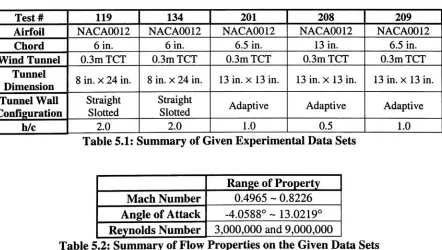
Table 5.1 summarizes the characteristics of given experimental data sets organized
by
testnumbers.Allthe testcases were conducted with NACA0012airfoil at0.3m TCT. Slottedand
adaptive walls are the two differenttunnel wall configurations. Three differentchordlengths
andtwosets oftunneldimensionmake varioustunnel half heighttochord ratios
(h/c),
whichaffectthe liftcoefficient sensitively (Seethe figure 1.1). Table 5.2 shows flow properties of
thedatasets.Datasets cover abroadrange ofMachnumber
including
transonicflow speeds.Test# 119 134 201 208 209
Airfoil NACA0012 NACA0012 NACA0012 NACA0012 NACA0012
Chord 6 in. 6 in. 6.5 in. 13 in. 6.5 in.
WindTunnel 0.3m TCT 0.3m TCT 0.3m TCT 0.3m TCT 0.3m TCT
Tunnel
Dimension 8 in.x24 in. 8in.x24 in. 13 in.
x 13in. 13in.x 13in. 13 in.x 13 in.
Tunnel Wall
Configuration
Straight
Slotted
Straight
Slotted Adaptive Adaptive Adaptive
h/c 2.0 2.0 1.0 0.5 1.0
Table 5.1:
Summary
ofGivenExperimentalData SetsRangeof
Property
Mach Number 0.4965~0.8226
AngleofAttack ~
13.0219
Reynolds Number 3,000,000and9,000,000
Table 5.3 summarizes the legend (data representation symbol) used in result figures shown
later. DOT
()
represents theresultfromslottedwall, whereasASTERISK(*)
representstheresult from adaptive wall. The solid black line in result figures represents the comparison
data from Swanson/Turkel [20]. Itis a2-D Navier-Stokes codeto represent the state ofthe
art numerical solution on the airfoil problem. The TWNTN4A results were compared and
validated with this Navier-Stokes numerical solution. Table 5.4 was constructed from
Swanson/Turkel results. It identifies the angle of attack that causes shock wave. This is
included in result figures
by
the verticalblack lines with arrows. It is important to evaluateTWNTN4A results concerning shock wave formation. Good results may not be expected
when shock wave spans windtunnel test section because ofthe interaction with the tunnel
sidewall
boundary
layerstoinduceflowseparationinthemodel/sidewalljunctionregion.Test Number 119 134 201 208 209
Wall Configuration
Straight
Slotted
Straight
Slotted Adaptive Adaptive Adaptive
H/c 2.0 2.0 1.0 0.5 1.0
Symbol *
Table 5.3:
Summary
ofData RepresentationSymbolsAngleofAttack
0
|
1|
2|
3|
4|
5 6 7 80.50 Y Y
0.65 Y Y
j
|
Y Y Y Y Y0.76 Y Y Y Y
|
' '\
Y Y Y Y Y Y Y Y0.80 Y Y Y Y Y Y Y Y Y Y Y Y Y
Tiible54:Swanson/Tur kelShockV/avelfable
Legend:
Sample ResultofAdaptiveWall DataSet
This section presents a sample result ofcorrecting wind tunnel test data from a test section
with adaptive walls. The corrections of adaptive wall data sets generally showed the same
trend. Thus the current section summarizes most of adaptive wall test cases. To avoid
repetition andto savespace, this thesisdoes notinclude adaptive wall results oneverysingle
data set. The chosen data set has test
#201,
M =0.7623,
a =1.9551,
andRe = 8,989,000.Figure 5.1 shows the model and wall configurations. It shows the adaptive wall
characteristic; streamlined tunnel walls to reduce the effect of streamline curvature (see the
chapter 1).
Test
#201,
M=0.7623,
a=1.9551,
Re=8,989,000Figure 5.1: Modeland WallConfigurationsofAdaptiveWall TestCase
TWNTN4A took about 4 seconds to converge on this data set with
170,
1274,
and 283iterations respectively for thetunnel, free air, andperturbationcalculation cycles. This is the
average computational time anditeration numbers for a single data set on most of adaptive
wall testcases. This testcaseusedtheoriginal coarsegrids. Thetunnelcalculation produced
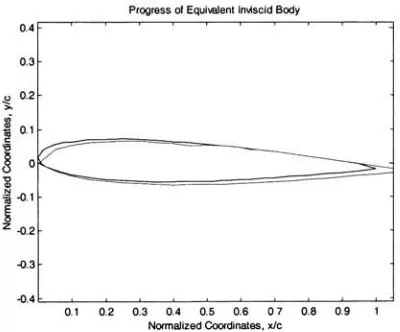
an equivalentinviscid
body
shown inthe figure5.2. Black line represents theoriginal airfoil shape from the wind tunnel testing, whereas the blue line represents the equivalent inviscidother. This indicates the successful convergence of tunnel calculation cycle.
However,
itraises a question at the
trailing
edge because it is not closed, which does not satisfy Kuttacondition to have either a stagnation point or a single velocity at the
trailing
edge. Furtheranalysis is required on this matter. After the free air calculation cycle, the uniformity
criterion was checked
by
the RMSCp
difference (netdifference)
rather than at each singlepoint on the airfoil. The RMS
ACP
value was 0.017725 that was close to zero compared tothe value of 1.4 ~ 1.8 on non-converged cases. Thus the criterion was considered to be
satisfied.
ProgressofEquivalent inviscidBody
[image:44.544.169.369.265.431.2]0.1 0.2 0.3 0.4 0.5 0.6 0 7 0.8 0.9 1 NormalizedCoordinates,x/c
Figure 5.2: Equivalent Inviscid
Body
onAdaptiveWall TestCaseDistribution ofmodel pressure coefficient is plottedin the figure 5.3. Blue points represent
Cp
distribution from the wind tunnel testing, whereas the TWNTN4A corrected result isplotted in green. The lower airfoilsurfaceis in an excellent agreement withSwanson/Turkel
noticeably
inthe liftcurveplot, figure 5.4. The arrowin thefigureindicates thedirection oftheTWNTN4Acorrection.Theright sidedotisthewindtunnel test result,andtheleftoneis
from TWNTN4Acorrection.
Model Pressure CoefficientDistribution LiftCurveof anAdaptive Wall Data Set
0.1 0.2 0.3 0.4 0.5 0.6 0.7 0.8 0.9 1 NormalizedCoordinates,x/c
0 2 4
AngleofAttack,a
Figure5.3:
Model
Cp
DistributiononAdaptiveWall TestCase
Figure 5.4:
LiftCurveonAdaptiveWallTest Case
Uncorrected Pass 1
Mach Number 0.7623 0.7544
AngleofAttack
[deg.]
1.9551 1.5684LiftCoefficient 0.3564 0.3612
Drag
Coefficient 0.0203 0.0206 [image:45.544.50.491.161.478.2]MomentCoefficient -0.0015 -0.0015
[image:45.544.45.505.460.561.2]Sample ResultofSlottedWall DataSet
This section is very similar to the previous section. It presents a sample result on a slotted
wall test case, which can be applied to most of other slotted wall data sets because ofthe
similartrend resultedin theTWNTN4A application. Thechosen datasethas test
#119,
M=0.7603,
a =2.0060,
and Re = 9,107,000. Figure 5.5 shows the model and wallconfigurations onthis testcase. Tunnel walls are straightlines unlikethe adaptivewallcase.
There are plenums on walls toremove the sidewall
boundary
layers (toreduce theeffect ofhorizontal buoyancy).
Test
#119,
M=0.7603,
a=2.0060,
Re =9,107,000Figure5.5: Modeland Wall Configurationon SlottedWall TestCase
The TWNTN4A was globally iterated on slotted wall test cases. One of input
boundary
conditions, SLA and SLB (described in chapter
3),
is always zero on straight tunnel walls.This permits the global iteration of TWNTN4A program to obtain better results. In this
thesis, theTWNTN4A was globally applied three times
(Passl, Pass2,
andPass3)
on all ofHere,
the TWNTN4A program took the average of 3 ~ 4 seconds computational time toconverge on all the passes. Iteration numbers are Passl =
{331, 607,
108},
Pass2 ={334,
504, 107},
Pass3 ={336, 402,
106}
for the tunnel, free air, and perturbation calculationcycles, respectively. The tunnel calculation computedthese equivalent
body
shapes on eachpass shown in the figure 5.6. Black line represents the original airfoil shape from the
experiment. The blue line is for
Passl,
green is forPass2,
and red is for Pass3.They
are allveryclose to theactual shape,which indicatesthesuccessful calculation andconvergenceof
thefirstcycle.
ProgressofEquivalent InviscidBody
0.1 0.2 0.3 0.4 0.5 0.6 0.7 0.8 0.9 1 NormalizedCoordinates,x/c
Figure 5.6: Equivalent Inviscid
Body
onSlotted Wall TestCaseThe RMS
Cp
difference was again checked to confirm the satisfaction of the uniformitycriterion. The firstpasshadtheRMS
ACP
=0.030192,
thesecondpasshad0.029123,
andthethirdpassresultedin 0.028297.
They
are close enoughtobezero comparedtonon-convergedcases. Figure 5.7 shows the model
Cp
distribution on this test case. The black line is fromSwanson/Turkel results. The first pass resultis on green, the second is on red, andthe third
some agreement to Swanson/Turkel results
(showing
the superiority of adaptive walltechnology);
however,
it is still in a good agreement to Swanson/Turkel results consideringthe presence of normal shock wave on the upper airfoil surface. Table 5.6 summarizes the
result on this test case.
Again,
the TWNTN4A corrected the angle of attack (about 1different from the tunnel measurement) more than other properties. Figure 5.8 shows the
directionofTWNTN4Acorrection on aliftcurve.
-1.5
Model Pressure Coefficient Distribution LiftCurveof aSlotted Wall Data Set
0 0.1 0.2 0.3 0.4 0.5 0.6 0.7 0.8 0.9 NormalizedCoordinates,x/c
Figure5.7:
Model
Cp
DistributiononSlottedWallTest Case
0.8
0.6 /
0.4
CJ-0.2
y* .
0
1
5
-0.2
-0.4
-0.6
-4 -2 0 2 4 6 8
AngleofAttack,a
Figure 5.8:
IJft CurveonSlottedWall TestCase
Uncorrected Pass 1 Pass2 Pass 3
Mach Number 0.7603 0.7545 0.7492 0.7449
AngleofAttack
[deg.]
2.0060 1.6542 j 1.2903 0.9116Lift Coefficient 0.2518 0.2543 0.2566 0.2585
Drag
Coefficient 0.0130 0.0131 0.0132 0.0133MomentCoefficient 0.0043 0.0043 0.0043 0.0043
[image:48.544.46.496.220.561.2]CollectionsofTWNTN4Aresults (Summary)
The
following
section presents alarge number ofTWNTN4A correction results. The semiautomatic procedure (chapter
4)
was utilizedtoprocessthis largenumberofdatasets. Thereare two types of plot used to presentthe results,
drag
curve andlift curve.Drag
coefficientversusMach number curveis usedtodescribeMach number corrections fora given nominal
chord Reynolds number and lift coefficient. Lift coefficient versus angle of attack curve is
used todescribe angle of attack corrections. Verticallines and arrows onlift curves indicate
thepresence of shock wave (SeeTable5.4). Referto table 5.3 forthelegendusedonfigures
presentedhere.
There are three parts in this section. The first part is a collection of results with the
TWNTN4A original grids atRe = 9,000,000. Thesecond part is also withthe original grids
butatRe =3,000,000. The thirdparthasresults onRe 9,000,000 withfinegrids generated
by
the variable grid control. Each part flow properties are summarizedin the table5.7, 5.8,
and5.9. Part 1 and2havethesame nominalMachnumbers:
0.50, 0.65, 0.76,
and0.80.Part 3is thesame asPart 1 and2 exceptthat the lower Mach number cases (0.50 and
0.65)
are notshown. Thereason will be discussed inthepart. Shockwave regionisfrom Swanson/Turkel
Parti
Drag
CurveMachNumber Reynolds Number LiftCoefficient
Figure 5.9 0.4850~0.8032
8,550,000~9,450,000
[+5%of
9,000,000]
=0
Lift Curve
Mach Number Reynolds Number ShockWave Region
(a)
Figure 5.10 0.4850-0.5150
[3%of
0.5001
8,550,000~9,450,000
[5%of
9,000,000]
a< &7.0
< a
Figure 5.11 0.6305
~0.6695
[3%of
0.650]
8,550,000~9,450,000
[5%of
9,000,000]
a < &3.0
< a
Figure 5.12 0.7573
~0.7627
[0.35%of
0.760]
8,550,000~9,450,000
[5%of
9,000,000]
a<-1.0&1.0<a
Figure 5.13 0.7968
~0.8032
[0.40%of
0.800]
8,550,000~9,450,000
[5%of
9,000,000]
Any
degree
Part2
LiftCurve
Part3
Lift Curve
Table5.7:
Summary
ofFlow PropertiesonthePart1Drag
CurveMach Number Reynolds Number LiftCoefficient
Figure5.14 0.4850~0.8032
2,850,000-3,150,000
[5%of
3,000,000]
=0
Mach Number Reynolds Number ShockWave Region
(a)
Figure 5.15 0.4850-0.5150
[3%of
0.500]
2,850,000-3,150,000
[5%of
3,000,000]
a < &7.0
< a
Figure5.16 0.6305
- 0.6695
[3%of
0.650]
2,850,000-3,150,000
[5%of
3,000,000]
a < &3.0
<a
Figure 5.17 0.7573
- 0.7627
[0.35%of
0.760]
2,850,000-3,150,000
[5%of
3,000,000]
a<-1.0&1.0<a
Figure5.18 0.7968
~0.8032
[0.40%of
0.800]
2,850,000-3,150,000
[5%of
3,000,000]
Any
degree
Table 5.8:
Summary
ofFlow PropertiesonthePart2Mach Number Reynolds Number ShockWave Region
(a)
Figure5.19 0.7573
- 0.7627
r0.35%of
0.760]
2,850,000-3,150,000
[image:50.544.52.494.69.536.2]Part 1 fRe 9.000.000^
Figure 5.9 shows the
drag
curves on each pass. The uncorrected TWNTN4A data (windtunnel measured quantities) are in reasonable agreement with Swanson/Turkel result. There
is a
tendency
tocollapseintoone point (Rememberthat theremustbe onlyone valid value atgiven Mach number, angle of attack, and Reynolds number) on Mach number ~
0.50;
however,
higher Machnumber pointsdonotshow muchimprovementon passtopass.Figure 5.10 through 5.13 show the lift curves for different Mach numbers. In all
figures,
adaptive wall test cases are already in good agreement with Swanson/Turkel result before
applying theTWNTN4Acorrection. This showsthe superiorityof adaptive wall technology.
After the first correction, adaptive wall cases did not show much movement on
figures;
however,
most of slotted wall test cases moved toward Swanson/Turkel comparison curve.After the second correction, slotted wall data sets are in excellent agreement with
Swanson/Turkel results. Liftcurve slopes arealmost identicalto thecomparison curves. Itis
surprisingto see in the figure 5.13 thatTWNTN4A corrects data sets with such high Mach
number(shockwave mustbepresent)atmoderately highangle of attack.
It seemed that the third correction was not needed on these cases. The thirdpasses showed
the overcorrection of TWNTN4A program. Notice that high angle of attack cases did not
show any improvement on lower Mach number cases. It is apparent that shock wave was
formed at these high angle of attacks; therefore, it is less
likely
the TWNTN4A programParti
Uncorrected TWNTN4A Data Points TWNTN4ACorrected-TheFirst Pass
0.65 0.7 0.75 MachNumber,M
0.65 0.7 0.75 MachNumber,M
TWNTN4A Corrected-TheSecond Pass TWNTN4ACorrected
-The Third Pass
0.65 0.7 0.75 MachNumber,M
[image:52.544.57.483.67.418.2]0.65 0.7 0.75 MachNumber,M
Parti
UncorrectedTWNTN4AData Pomls /*
4-0.8 '
0.6
-U-0.4 / l
-I
025 o
-0.2
/
"
-0.4 "
TWNTN4A Corrected-The First Pass
0 2 4 6 8 10 12
AngleofAttack,a
2 4
AngleofAttack,a
TWNTN4A Corrected
-The Second Pass
' \
0.8 '
0.6 /
-""0.4
E a
1 0.2
B
o +/
-0.2
/
-0.4\/
TWNTN4A Corrected
-The Third Pass
2 4 6
AngleofAttack,a
1
0.8
0.6
O-0.4
c .9?
I 0.2
s o
-0.2
-0.4
-06
4
*/ *
2 4 6
AngleofAttack,a
[image:53.544.55.476.69.419.2]Parti
Uncorrected TWNTN4A Data Points
0.8
0.6 /^
'
0.4 o-I 0.2 o
/ '
S-o,
-0.4
-0.6
-0.8 i
_,
TWNTN4ACorrected
-The First Pass
-2-1012345678 AngleofAttack,a
0.6
0.6
/S*
0.4
o-y
I 0.2
1
"-0.2
-0.4
-0.6
-0.8
-3 -2 -1 01 2345678
AngleofAttacka
TWNTN4A Corrected-The Second Pass
0 12 3 4 5 AngleofAttack,a
TWNTN4A Corrected-The Third Pass
0.8
-0.6 .yS
0.4
O-S 0.2 u
-1
-0.2
/ ~
-0.4 '
-0.6 '
[image:54.544.59.481.69.424.2]-4 -3 -2 -1 0 1 2 3 4 5 AngleofAttack,a
Parti
0.8
Uncorrected TWNTN4AData Points
0.6 0.4
A
*. O-0.2 / -0.2 . -0.4 ;/
-0.6 --0.8-4-3-2 1 0 1 2 3 4 AngleofAttack,a
TWNTN4ACorrected
-TheFirst Pass
0.6
A
* '' 0.4 */ * U-0.2 * y / . 1 0
&
3-0.2 -0.4 / -0.65 6 7 -4-3-2 1 0 12 3 4 5 AngleofAttack,a
0.8
TWNTTN4A Corrected-The Second Pass
0.6 0.4 / . -O-0.2 B
1
%-0.2 0.4A
-0.6TWNTN4A Corrected-The Third Pass
0.6 /. ' 0.4 '/ "-0.2 6 8 -0.2
-04"
/
-0.6
-4-3-2-1012345 AngleofAttack,a
-4-3-2-1012345 AngleofAttack,a
[image:55.544.52.475.67.416.2]Parti
Uncorrected TWNTN4A Data Points TWNTN4ACorrected-The First Pass
TWNTN4ACorrected-TheSecond Pass TWNTN4ACorrected
-The ThirdPass
10 12 3
[image:56.544.58.471.69.420.2]AngleofAttack,a
Part2 (Re 3.000.0001
Drag
curves shownin thefigure 5.14are offby
0.002(Cd)
fromthe Swanson/Turkelresults.Corrected results do not show much
improvement;
rather the correction is in the wrongdirection. Green and Newman
[21]
obtained the similar results and pointed out that a largespan-wise variation of
Cd
wasdetected,
whichTWNTN4Aprogramdoes notaccountfor.Figure 5.15 through 5.18 show lift curves. There were not enough adaptive wall test cases
available atRe = 3,000,000 from datafiles supplied
by
NASA. Slotted wall datasets showimprovement from TWNTN4Aon each pass.Thesametype ofdiscussion asthe part 1 holds
here. It takes TWNTN4A correction twice or three times to match with Swanson/Turkel
computational results.
Again,
high angle of attack datacases showed no movement on thePart 2
Uncorrected TWNTN4A Data Points TWNTN4A Corrected
-The First Pass
0.55 0.6 0.65 0.7 0.75 0.8
MachNumber,M
0.5 0.55 0.6 0.65 0.7 0.75 0.8 0.6
MachNumber,M
TWNTN4A Corrected
-The Second Pass TWNTN4A Corrected
-TheThird Pass
0.55 0.6 0.65 0.7 0.75 MachNumber,M
[image:58.544.47.470.59.408.2]).5 0.55 0.6 0.65 0.7 0.75 0.8 0.85 0.9 MachNumber,M
Part2
UncorrectedTWNTN4A Data Points
0.8
^
: t 0.6 / "-0.4 i i 2 / ' -3 0 -0.2 */ -0.4 -0.6 i-4-3-2-1 0 1 2 3 4 5 6 7 8 9 10 11 12 AngleofAttack,a
TWNTN4A Corrected
-The First Pass
/ t 0.8 0.6
/
U-0.4 /. e a> 0.2I
/v 5 o -0.2 -0.4 /--3 -2 -1 0 1 2 3 4 5 6 7 8 9 10 11 12 AngleofAttack,a
TWNTN4ACorrected-The Second Pass
0.8 0.6 O-0.4 I I 0.2
8
o -0.2 -0.4 -0.6 / : A ** ' A -4-3-2-101234567AngleofAttack,a
8 9 10 11 12
TWNTN4A Corrected-