ISSN 0252-8266
eurosta
EUROSTATISTIK
Daten zur Konjunkturanalyse
EUROSTATISTICS
Data for short-term economic analysis
EUROSTATISTIQUES
Données pour l'analyse de la conjoncture
\E2L
eurostat
DE EUROPÆISKE FÆLLESSKABERS STATISTISKE KONTOR
STATISTISCHES AMT DER EUROPÄISCHEN GEMEINSCHAFTEN
ΣΤΑΤΙΣΤΙΚΗ ΥΠΗΡΕΣΙΑ ΤΩΝ
ΕΥΡΩΠΑΪΚΩΝ ΚΟΙΝΟΤΗΤΩΝ
STATISTICAL OFFICE OF THE EUROPEAN COMMUNITIES
OFFICE STATISTIQUE DES
COMMUNAUTÉS EUROPÉENNES
ISTITUTO STATISTICO DELLE COMUNITÀ EUROPEE
BUREAU VOOR DE STATISTIEK DER EUROPESE GEMEENSCHAPPEN
L2920 Luxembourg — Tél. 43011 — Télex: Comeur Lu 3423
B1049 Bruxelles, Bâtiment Berlaymont, Rue de la Loi 200 (Bureau de liaison) —Tél. 235.11.11
Denne publikation kan fås gennem de salgssteder, som er nævnt på omslagets tredje side i dette hæfte.
Diese Veröffentlichung ist bei den auf der dritten Umschlagseite aufgeführten Vertriebsbüros erhältlich.
EUROSTATISTIK
Daten zur Konjunkturanalyse
EUROSTATISTICS
Data for short-term economic analysis
EUROSTATISTIQUES
Luxembourg: Office des publications officielles des Communautés européennes, 1984
Kat./cat.: CA-BJ-84-003-3A-C
Inhaltswiedergabe nur mit Quellennachweis gestattet
Hinweis
Die Veröffentlichung Eurostatistik — Daten zur Konjunkturanalyse ist eine von
drei Schlüsselveröffentlichungen des Eurostat, die dem Lesereinen Überblick
über die wichtigsten quantitativen Daten geben sollen, die für die Gemeinschaft
und die Mitgliedstaaten zur Verfügung stehen. Die anderen Veröffentlichungen
in dieser Reihe sind Statistische Grundzahlen mit Daten für ein bestimmtes
Jahr sowie Eurostat-Revue mit einem Zehnjahresüberblick über die
Gemeinschaft in Zahlen.
Eine monatliche Veröffentlichung mit laufenden Wirtschaftsdaten muß ständig
angepaßt und auf den neuesten Stand gebracht werden. Zu Beginn des Jahres
1982 wurde mit der Einbeziehung von Daten für Griechenland und der
Abwandlung der Aufmachung eine bedeutende Änderung vorgenommen. Im
Laufe des Jahres 1982 werden nach und nach Gesamtzahlen für die
10 Mitgliedstaaten der Gemeinschaft aufgenommen. Sobald genügend Daten
zur Verfügung stehen, wird das Basisjahr 1975, das die Grundlage für diese
Veröffentlichung bildet, durch das Jahr 1980 ersetzt werden. Zu einem
späteren Zeitpunkt ist vorgesehen, Daten für die beiden beitrittswilligen Länder
Portugal und Spanien sowie für die Vereinigten Staaten und Japan
hinzuzufügen.
Es werden vier Arten von Daten in Eurostatistik veröffentlicht. Auf den Seiten 5
und 6 findet sich ein Artikel „Kurz notiert", der sich mit den jüngsten
Tendenzen bei den verfügbaren Daten befaßt. Die Seiten 15 bis 20 enthalten
eine schematische Darstellung der wichtigsten wirtschaftlichen Reihen für die
Gemeinschaft und die Mitgliedstaaten. Die Seite 23 ist die erste von 56 Seiten
mit,, Gemeinschaftstabellen ' '. Dieser Abschnitt enthält von Eurostat auf der
Grundlage von Gemeinschaftskriterien harmonisierte Daten. Die neuesten
Daten sind vorläufig und in einigen Fällen von Eurostat geschätzt. Schließlich
enthält die Veröffentlichung noch einen Abschnitt,,Ländertabellen", dereine
Auswahl der in jedem Land am häufigsten verwendeten Konjunkturindikatoren
enthält. Hierbei handelt es sich um nationale Reihen auf der Grundlage
nationaler Definitionen. Zu Vergleichszwecken ist auch eine Tabelle für die
Vereinigten Staaten enthalten.
In allen Fällen stehen auf Anfrage Zeitreihen über die Cronos-Datenbank des
Eurostat zur Verfügung. Es werden außerdem statistische Bulletins über
Arbeitslosigkeit, Preise, industrielle Produktion, Zahlungsbilanzen,
Außenhandel und Energie monatlich oder vierteljährlich veröffentlicht. In
Eurostatistik selbst ist ein absolutes Minimum an Erläuterungen zur Methodik
enthalten. Ausführliche Informationen über Definitionen und Methodik sind bei
Eurostat erhältlich.
Inhaltsverzeichnis
Zeichen und Abkürzungen
„Kurz notiert"
5
Schaubilder
15
GEMEINSCHAFTSTABELLEN
21
1. Volkswirtschaftliche Gesamtrechnungen
—
ESVG
23
V e r ä n d e r u n g d e s V o l u m e n s
23
V e r ä n d e r u n g der Preise
24
2. Beschäftigung
25
Bevölkerung
25
Beschäftigung
26
3. Arbeitslosigkeit
28
4. Indizes der industriellen Produktion
31
Industrie, Baugewerbe
31
Erzeugung nach Kategorien
32
Erzeugung nach Produktionsbereichen
33
Konjunkturempfindliche Bereiche
35
5. Meinungsumfrage in der Industrie
(1)
37
6. Produktionsstatistik
41
Industrieerzeugnisse
41
Landwirtschaftliche Erzeugnisse
45
7.
Außenhandel
46
Hauptindikatoren
46
Handel mit Drittländern
4 9
Innergemeinschaftlicher Handel
55
Handel nach Ländern
61
8.
Preise
65
Indizes der V e r b r a u c h e r p r e i s e
65
Indizes d e r Erzeugerpreise
68
Indizes d e r Löhne u n d Gehälter in d e r Industrie . . .
69
9.
Finanzstatistik
70
W e c h s e l k u r s e
70
W i c h t i g s t e Finanzstatistiken
72
10.
Zahlungsbilanz
74
Wichtigste Salden
74
LÄNDERTABELLEN
79
Belgique/Belgle
85
Danmark
86
BR Deutschland
87
ΕΛΛΑΔΑ
88
France
89
Ireland
90
Italia
91
Luxembourg
92
Nederland
93
United Kingdom
94
—
Nichts
0
Weniger als die Hälfte der verwendeten Einheit
:
Kein Nachweis vorhanden
14
Von I b i s 4
6 + 8
6 u n d 8
%
Prozent
%,
T4/T0
Prozentualer Z u w a c h s eines Vierteljahres
g e g e n ü b e r d e m e n t s p r e c h e n d e n Vierteljahr d e s
Vorjahres
%,
T I 2/TO
Prozentualer Z u w a c h s eines M o n a t s g e g e n ü b e r
d e m e n t s p r e c h e n d e n M o n a t d e s Vorjahres
%,
SALDO
Saldo zwischen den positiven Antworten
(Zunahme, Verbesserung der Situation) und den
negativen Antworten (Abnahme,
Verschlechterung der Situation) der
Konjunkturbefragung bei den Unternehmern in
der Gemeinschaft
Saisonbereinigt (Ländertabellen)
1975=100
Basisjahr
EUR
9 = 100
Prozentuale A n g a b e n im Verhältnis zur
G e m e i n s c h a f t der 9 ( = 100)
EUR 10
=
100
Prozentuale A n g a b e n im Verhältnis zur
G e m e i n s c h a f t d e r 10 ( = 100)
MIO
Million
MRD
Milliarde
Τ
Metrische Tonne
TR0EE
T o n n e Rohöleinheiten
GWH
Gigawattstunde = 106kWh
M3
Kubikmeter
DM
Deutsche Mark
FF
Französischer Franc
LIT
Italienische Lira
HFL
Holländischer G u l d e n
BFR
Belgischer Franc
LFR
L u x e m b u r g i s c h e r Franc
UKL
Pfund Sterling
IRL
Irisches Pfund
DKR
Dänische Krone
USD
USDollar
EGU
Europäische W ä h r u n g s e i n h e i t
SZR
Sonderziehungsrechte
EG
Europäische Gemeinschaft[en]
Eurostat
Statistisches Amt der Europäischen
Gemeinschaften
EUR
9
G e s a m t h e i t d e r Mitgliedsländer d e r
E u r o p ä i s c h e n G e m e i n s c h a f t e n bis 1980
EUR
10
G e s a m t h e i t d e r Mitgliedsländer d e r
E u r o p ä i s c h e n G e m e i n s c h a f t e n ab 1981
UEBL/BLEU
Belgischluxemburgische Wirtschaftsunion
ACP
Länder Afrikas, der Karibik und des Pazifiks —
Abkommen von Lomé
ESVG
E u r o p ä i s c h e s S y s t e m Volkswirtschaftlicher
G e s a m t r e c h n u n g e n
NACE
A l l g e m e i n e Systematik der W i r t s c h a f t s z w e i g e in
d e n E u r o p ä i s c h e n G e m e i n s c h a f t e n
Eurostatistik: Kurz notiert
Ï
1. Arbeitslosigkeit: Erneuter Anstieg im Februar
Die Zahl der eingeschriebenen Arbeitslosen in der Europäischen
Gemeinschaft lag Ende Februar 1984 mit 13 Millionen genauso
hoch wie Ende Januar.
Diese Stabilität der Rohdaten zu einem Zeitpunkt, da sie aufgrund
der Saisonschwankungen rückläufig sein müßten, bedeutet de
facto einen Anstieg der Zahlen nach Saisonbereinigung, den man
mit 1 °/o ansetzen kann.
In Luxemburg, das sich Im Hinblick auf die Arbeitslosigkeit bisher
allerdings in einer sehr priviligierten Situation befand, sind die
Zah-len sehr stark angestiegen, nämlich nach Saisonbereinigung um
+ 5,6%. In Frankreich bestätigt sich mit einer Steigerung der
Arbeitslosenquote um 2,5 % die seit vier Monaten beobachtete
Verschlechterung der Arbeitsmarktlage. Die anderen
Mitgliedstaa-ten melden eine Tendenz, die dem europäischen Mittel entspricht
oder darunter liegt.
Der Anteil der eingeschriebenen Arbeitslosen an den zivilen
Erwerbspersonen hat für die Europäische Gemeinschaft erneut
zugenommen er ist nämlich von 10,6% auf 10,7% gestiegen
-während in den Vereinigten Staaten die Arbeitslosigkeit weiter
rückläufig ¡st (Verringerung von 8 , 2 % im Dezember 1982 auf
8,0 % Im Januar 1983).
In Japan ¡st die Arbeitslosigkeit weiterhin sehr gering, sie liegt bei
etwa 2,6 % der Erwerbspersonen.
2. Verbraucherpreisindex: + 0 , 6 % für die Gemeinschaft
im Februar - Jahressatz unter 8
%
Der Preisindex für die gesamte Gemeinschaft ist zwischen Januar
und Februar 1984 um 0,6 o/o gestiegen.
Merkliche Steigerungen wurden in Italien (1,1 %) und in Dänemark
(1,0 %) verzeichnet, während die Zunahmen in Belgien (0,8 % ) , in
Frankreich (0,7 o/o), ¡n den Niederlanden (0,6 %) und In Luxemburg
(0,6 %) dem gemeinschaftlichen Mittel entsprachen oder leicht
darüber lagen.
Dagegen lagen die Steigerungsraten in der Bundesrepublik
Deutschland (0,3%), im Vereinigten Königreich (0,4%) und in
Griechenland (0,4 %) unter dem Gemeinschaftsmittel.
Die Inflationsrate über 12 Monate, die durch den
Verbraucherpreis-index von Februar 1984 gegenüber Februar 1983 gemessen wurde,
beträgt 7,9 %.
Dies ¡st die niedrigste Inflationsrate auf Jahresbasis seit Dezember
1978.
Es ist jedoch darauf hinzuweisen, daß die entsprechende Rate für
die Vereinigten Staaten bei 4,2 % und für Japan bei nur 3,0 % liegt.
3. Index der industriellen Produktion: Signifikante Stei
gerung
Der Index für die Gemeinschaft (EUR 10) im Monat Januar wird auf
114,7 geschätzt, was einer Steigerung gegenüber dem Monat
Januar 1983 um 4,8 % entspricht.
Der saisonbereinigte Index für EUR 10 beläuft sich für den Monat
Januar auf 117,1, das bedeutet eine Zunahme gegenüber
Dezem-ber 1983 (116,4) um 0,6 o/o.
Der Tendenzindikator (Verhältnis zwischen den drei letzten
Mona-ten und den drei vorangegangenen MonaMona-ten) weist für die
gesamte Gemeinschaft einen ziemlich starken Anstieg aus,
näm-lich um 2 o/o.
Im Jahresmittel beträgt der Anstieg 1983 gegenüber 1982 6,5 % in
Irland, zwischen 3 % und 2,5 % in Dänemark, Belgien und im
Ver-einigten Königreich und zwischen 1,5 o/o und 0 , 5 % in Luxemburg,
blik Deutschland. In Italien ist die industrielle Produktion um
3 — 5 0/0 zurückgegangen.
Von den Ländern der Gemeinschaft, für die die Daten für Januar
1984 verfügbar sind, ist die Bundesrepublik Deutschland mit einem
Jahresanstieg von 8,6 o/o und das Vereinigte Königreich mit 4,5 o/o
zu nennen.
4. Stahl: 1983 erstmals seit 1978 Neuaufträge über dem
Niveau der Auslieferungen
Im Februar 1984 hat sich der Aufschwung der
EG-Rohstahlerzeu-gung (ohne Griechenland) fortgesetzt. Mit 10 Mio t wurden -
sai-sonbereinigt - 3,4 o/o mehr Stahl produziert als im Januar 1984 und
8,6 0/o mehr als im Februar 1983. Dieser Anstieg wird im März 1984
jedoch nicht aufrechterhalten werden können, denn nach den
Vorausschätzungen der Werke wird die Erzeugung im März < u m >
-saisonbereinigt- < — > 4 o/o unter der Februarerzeugung liegen.
Die Auftragseingänge für Massenstahl verzeichneten im Dezember
1983 - saisonbereinigt - einen Rückgang um 8,7 o/o gegenüber
November 1983. Die Bilanz für das Jahr 1983 schließt mit einem
Anstieg des Gesamtvolumens der Neuaufträge um 7,1 o/o
gegen-über dem sehr schwachen Ergebnis für 1982 ab
(EGKS-Binnen-markt + 6 o/o„ Drittländer +10,6 o/o). Im Vergleich zu 1981 ¡st
jedoch ein Rückgang um 9,9 o/o festzustellen.
Als bemerkenswert ist zu unterstreichen, daß die Neuaufträge
1983 erstmals seit 1978 wieder über dem Niveau der
Auslieferun-gen laAuslieferun-gen.
5. Energie: Wiederbelebung der Naturgasförderung und
der Einfuhren
- 1983 hat die für den Markt der Gemeinschaft zur Verfügung
stehende Naturgasmenge gegenüber 1982 beträchtlich
zuge-nommen ( + 4,6 0/o), was auf einen Aufschwung der Förderung
in der Zehnergemeinschaft ( + 3,2 %) sowie der Einfuhren aus
Drittländern ( + 8,5 o/o) zurückzuführen ist. Der Anteil der
Ein-fuhren an der insgesamt verfügbaren Naturgasmenge belief
sich auf 29 o/o.
- Die Zunahme der Förderung in der Gemeinschaft (die erste
seit 1979) beruht hauptsächlich auf der Förderung dreier
Mit-gliedstaaten, nämlich des Vereinigten Königreichs ( + 3,1 o/o),
der Niederlande ( + 5,5 o/o) und der BR Deutschland ( + 7,5 o/o).
In Italien zeigt die Förderung dagegen einen Rückgang um
11,4 0/o.
Eine besonders starke Zunahme war bei den Einfuhren aus
Drittländern nach Italien ( + 13,4%), nach Frankreich
( + 18,2%) und nach Belgien (+46,3 o/o) zu verzeichnen, was
auf eine bemerkenswerte Steigerung der algerischen
Gasliefe-rungen zurückzuführen ¡st; so stieg der Anteil des Erdgases
aus Algerlen an der Gesamteinfuhr von außerhalb der
Gemein-schaft von 13 0/0 im Jahre 1982 auf 25 o/o im Jahre 1983,
wäh-rend das norwegische Gas um 8 und das russiche Gas um
4 Punkte zurückfielen.
Für die Gemeinschaft Insgesamt sowie für die einzelnen
Mit-gliedstaaten ist im Gegensatz zu der in den letzten drei Jahren
festgestellten Entwicklung eine allgemeine
Nachfragesteige-rung in der Größenordnung von 4 o/o gegenüber 1982
festzu-stellen; sie liegt allerdings niedriger als der bei den
verfügba-ren Mengen festgestellte Anstieg, da die Lagerbestände 1983
(um 50 o/o) zunahmen.
öffentli-festgestellt, während in Frankreich bei den privaten Haushalten
die Nachfrage kräftig anstieg.
6. Handel mit Drittländern: Ausgezeichnetes
Quartal 1983 für die Gemeinschaftsausfuhren
viertes
1983 erreichten die Gemeinschaftsausfuhren nach Drittländern
etwa 300 Mrd ECU, das bedeutet eine Zunahme gegenüber
1982 um 5 o/o. Die Ausfuhrsteigerung verlief damit 1983
langsa-mer als 1982 ( + 7 o/o), doch zeichnete sich im zweiten Halbjahr
eine signifikante Verbesserung ab.
Während des vierten Quartals 1983 stiegen die Ausfuhren um
mehr als 9 % gegenüber demselben Zeitraum 1982.
Von den Mitgliedsländern erzielten Irland ( + 29 o/o) und
Däne-mark ( + 26 %) die besten Ergebnisse, während das Vereinigte
Königreich am schlechtesten abschnitt und einen Rückgang
seiner Ausfuhren um 2 o/o hinnehmen mußte.
1983 lagen die Gemeinschaftseinfuhren aus Drittländern leicht
über denen des Jahres 1982 ( + 1 % ) . Während im ersten
Halb-jahr ein leichter Rückgang festzustellen war, konnte während
der letzten sechs Monate des Jahres 1983 eine leichte
Steige-rung erreicht werden.
Die Einfuhren sind im vierten Quartal gegenüber demselben
Zeitraum 1982 um 6 o/o gestiegen. Das einzige Land, das
die-sen allgemeinen Trend nicht mitvollzogen hat, ist Frankreich,
dessen Einfuhren während des vierten Quartals um 7 o/o und
im gesamten Jahr 1983 um 5 o/o gesunken sind. Diese Tendenz
wurde allerdings im Januar 1984 umgekehrt, denn in diesem
Monat stiegen die französischen Einfuhren gegenüber Januar
1983 um 7 o/o. Es ist das erste Mal nach mehreren Monaten
des Rückgangs, daß eine Steigerung eintritt. Im vierten Quartal
1983 stiegen die Einfuhren am stärksten in Dänemark
( + 15%), in Irland ( + 15%), im Vereinigten Königreich
( + 12 0/0) und in der Bundesrepublik Deutschland ( + 12 o/o).
Die Unterteilung nach Produktionsbereichen - für die
Gemein-schaft ohne Italien, Belgien, Luxemburg und Griechenland (für
1983 liegen aus den genannten Ländern entsprechende Daten
noch nicht vor) - läßt in den Bereichen chemische Erzeugnisse
( +14 o/o), verschiedene bearbeitete Waren ( + 11 %) und
Roh-stoffe ohne BrennRoh-stoffe ( + 12 o/o) einen besonders raschen
Aufschwung erkennen. Der bedeutende Bereich Maschinen
und Fahrzeuge wies hingegen lediglich eine Ausfuhrsteigerung
um 2 o/o auf, während die entsprechende Einfuhr aus
Drittlän-dern um 15 0/0 stieg. Analog hierzu ist auch die Ausfuhr
bear-beiteter Waren nach Beschaffenheit (wozu u. a. Textilwaren
und Metalle gehören) um nur 1 o/o angewachsen, während die
entsprechende Einfuhr um 9 o/o stieg. Ein wichtiger Grund für
das insgesamt schwache Wachstum der Einfuhr besteht im
Rückgang der Brennstoffeinfuhren um rund 9 o/o, wodurch die
Einfuhrzunahme in anderen Bereichen aufgewogen wurde.
7. Handel zwischen den Ländern der Gemeinschaft: Die
Mitgliedstaaten beziehen 51 % ihrer Einfuhren aus
ihren Partnerländern
Während die Einfuhren aus Drittländern nur geringfügig gestiegen
sind, war bei den Einfuhren aus den europäischen Partnerländern
ein sehr starker Anstieg zu verzeichnen ( + 9 o/o); sie erreichten
1983 einen Wert von 330 Mrd ECU.
51 % der Einfuhren der Mitgliedstaaten kamen damit 1983 aus den
EG-Partnerländern.
Im vierten Quartal des Jahres war der innergemeinschaftliche
Han-del mit einer Steigerung um 12 o/o gegenüber dem Vorjahr
beson-ders aktiv.
8. Landwirtschaft: Steigerung der Erzeugung von
Rind-und Schaffleisch - aber wo sind die Verbraucher?
- Die Erhöhung der Rindererzeugung (ausgedrückt in Stückzahl)
wird für die gesamte Gemeinschaft für das Jahr 1984 auf 2 o/o
geschätzt. Diese Steigerungsrate liegt unter der des Jahres
1983, die 2,8 % betrug. Es ist jedoch darauf hinzuweisen, daß
der Verbrauch an Rindfleisch in der Gemeinschaft 1983
zurückgegangen ist. Die zusätzliche Erzeugung kann nur dann
leicht vom Markt absorbiert werden, wenn 1984 der Verbrauch
ansteigt, doch über die Aussichten hierfür sind die Fachleute
recht unterschiedlicher Auffassung.
Die Vorausschätzungen für die Schweinefleischerzeugung
las-sen auf eine Angebotsstagnation schließen. Das Angebot wird
wahrscheinlich in der Zeit von Dezember 1983 bis Dezember
1984 gegenüber den 12 vorangegangenen Monaten nur um
0,2 0/o steigen. Wenn der Verbrauch sich im Jahre 1984 nicht
wesentlich ändert - diese Auffassung wird von der Mehrzahl
der Sachverständigen vertreten - , so ist mit einem
Erzeugnis-niveau zu rechnen, daß die innergemeinschaftliche Nachfrage
um etwa 3,8 o/o übersteigt, was etwa einem Verbrauch von zwei
Wochen entspricht.
9. Finanzen: Diskontsatz - Erhöhung in Belgien, Senkung
in Italien
Zwei Länder, Belgien und Italien, haben Mitte Februar ihren
Dis-kontsatz geändert.
Um den Druck auf den belgischen Franken zu verringern, der in
der sechsten Woche des Jahres 1984 zu Interventionen auf dem
Devisenmarkt in einer Größenordnung von 49 Mrd Bfr geführt hat,
haben die belgischen Behörden den offiziellen Diskontsatz von 10
auf 11 o/o heraufgesetzt.
In Italien wurde der offizielle Diskontsatz von 17 o/o auf 16 o/o
gesenkt.
Notice
Eurostatistics — Data for short-term economic analysis is one of three key
Eurostat publications designed to give the reader an overview of the most
important quantitative information available for the Community and Member
States. The other publications in this series are Basic Statistics giving data fora
specific year, andEurosXaX review with its summary of the Community in figures
over the past 10 years.
A monthly publication with current economic data must be continually adapted
and updated. At the beginning of 1982 a major modification took place with the
inclusion of data for Greece and a change in presentation. Totals for the
10-member Community are being progressively introduced in 1982. Once
sufficient data are available, the base year 1975 which is fundamental to this
publication will be replaced with 1980. Ata later stage it is planned to add data
for the two applicant countries, Portugal and Spain, as well as for the United
States and Japan.
Four kinds ofinformation are published in Eurostatistics. Pages 9 and 10 offer
an article 'In brief' which looks at the latest trends in the data available.
Pages 15 to 20 provide the reader with a visual presentation of the most
important economic series for the Community and the Member States. Starting
on page 23 there are 56 pages of 'Community tables '. This section contains
data harmonized by Eurostat on the basis of common criteria. The most recent
data are provisional and in some cases estimated by Eurostat. Finally there is a
section 'Tables by country' which contains a selection of economic indicators
most often used in each country. These are national series based on national
definitions. For comparison a table for the United States is also included.
For all series, historical data are available on request from Eurostat's data bank
Cronos. Statistical bulletins on unemployment, prices, industrial production,
balance of payments, external trade and energy are also published monthly or
quarterly. Eurostatistics itself contains an absolute minimum of methodological
notes. Detailed information on definitions and methodology may be obtained
from Eurostat.
Contents
Symbols and abbreviations
'In brief' Graphics
COMMUNITY TABLES
1. National accounts ESA
V o l u m e Price
2. Employment
Population Employment
3. Unemployment
4. Index of industrial production
Industry, c o n s t r u c t i o n Production by category Production by branch Branches in difficulty
5. Opinions in industry1 6. Output
Industrial p r o d u c t s Agricultural p r o d u c t s
7. External trade
Main indicators ExtraCommunity trade IntraCommunity trade Trade by c o u n t r y
8. Prices
C o n s u m e r prices Producer prices
Wages and salaries in Industry
9. Financial statistics
Exchange rates Main financial statistics
10. Balance of payments
Main balances
TABLES BY COUNTRY
Belgique/België
Danmark
BR Deutschland
ΕΛΛΑΔΑ
FranceIreland
Italia
L u x e m b o u r g
Nederland
United K i n g d o m
United States
Page
9
15
21
6
14
+
8
23
23
24
25
25
26
28
31
31
32
33
35
37
41
41
45
46
46
49
55
61
65
65
68
69
70
70
72
74
74
79
85
86
87
88
89
90
91
92
93
94
95
%,T4/T0
%,T12/T0
%,BALANCE
•
1975=100
EUR 9 = 100
EUR 10 = 100
MIO
MRD Τ TOE
GWH
M3 DM FF LITHFL
BFR
LFR UKL IRLDKR
USD
ECU SDR EC Eurostat EUR 9EUR 10
UEBL/BLEU
ACP
ESA
NACESITC
Nil
Data less t h a n half the unit used No data available
F r o m 1 t o 4 6 and 8 Per c e n t
Percentage increase o n t h e c o r r e s p o n d i n g quarter of the previous year
Percentage increase o n t h e c o r r e s p o n d i n g m o n t h of t h e previous year
Balance b e t w e e n positive replies (increase, i m p r o v e m e n t in the situation) and negative replies (reduction, w o r s e n i n g of the situation) in the s h o r t t e r m t r e n d s enquiry c o n d u c t e d a m o n g heads of enterprises in the C o m m u n i t y
Seasonally a d j u s t e d (Tables by country) Reference year
Data f o r c o u n t r i e s e x p r e s s e d as a p e r c e n t a g e of t h e C o m m u n i t y of 9 total
Data for c o u n t r i e s e x p r e s s e d as a p e r c e n t a g e of the C o m m u n i t y of 10 total
Million
T h o u s a n d million Tonne
Tonne of oil equivalent G i g a w a t t h o u r ( = 1 06k W h ) Cubic metre
D e u t s c h m a r k French franc Italian lira D u t c h guilder Belgian franc L u x e m b o u r g franc Pound sterling Irish p o u n d Danish c r o w n US dollar
European currency unit Special Drawing Right European C o m m u n i t i e s
Statistical Office of the European C o m m u n i t i e s Total of the m e m b e r countries of the EC until
1980
Total of the m e m b e r countries of the EC f r o m 1981
B e l g o L u x e m b o u r g E c o n o m i c Union
African, Caribbean a n d Pacific c o u n t r i e s of the L o m é Convention
European S y s t e m of Integrated E c o n o m i c A c c o u n t s
Eurostatistics: 'In brief'
1. Unemployment: Further increase in February
The registered jobless figure in the European Community at the
end of February 1984 remained at 13 million as at the end of
Janu-ary.
At a time when non-adjusted figures ought to fall, this implies that
there has in fact been a rise in seasonally adjusted figures in the
order of 1o/o.
In Luxembourg, which has hitherto enjoyed a very low level of
unemployment, the rate is rising rapidly ( + 5.6o/o) in terms of
sea-sonally adjusted figures. The Increase of 2.5% in France confirms
the deterioration In the labour market which has been observed for
the last four months. In the other Member States trends remain at
the same level as or lower than the European average.
The rate of registered unemployment in relation to the civilian
working population has risen once more from 10.6 to 10.70/o in the
European Community whilst unemployment continues to fall in the
United States (going from 8.2% in December 1982 to 8 % in
Janu-ary 1983).
In Japan unemployment is still at an extremely low level at around
2.60/0 of the working population.
2. Consumer price index: + 0 . 6 % in February for the
Community and an annual rate of below 8 %
The consumer price index for the entire Community went up by
0.6% between January and February 1984.
Marked Increases were recorded in Italy (Lio/o) and Denmark (io/o)
whilst those in Belgium (O.8O/0) France (O.70/0), the Netherlands
(0.6%) and in Luxembourg (O.6O/0) are equal to or slightly above
the Community average.
On the other hand, the Increases in the Federal Republic of
Ger-many (O.30/0), the United Kingdom (O.40/0) and Greece (O.40/0) are
below the average.
The inflation rate over 12 months indicated by the change in the
consumer price index between February 1983 and 1984 Is 7.90/o.
This is the lowest annual rate of inflation since December 1978.
However, It should be pointed out that the corresponding rate for
the United States is 4.2% and, for Japan, only 3.0%.
3. Index of industrial production: significant increase
The Community index (EUR 10) for January Is estimated at 114.7,
an increase of 4.8% over January 1983.
After seasonal adjustment, the EUR 10 index for January was
117.1, an increase of O.6O/0 over the figure December 1983 (116.4).
The trend indicator (the ratio of the last three months to the
preceding three months) indicates a sharp increase of 20/o for the
whole of the Community.
National increases between 1982 and 1983, expressed as averages
over the year, are 6.50/0 in Ireland, between 3 % and 2.50/0 in
Den-mark, Belgium and the United Kingdom and between I.50/0 and
0.5% in Luxembourg, France, the Netherlands, Greece and the
Federal Republic of Germany. The drop in industrial production in
Italy is between 3 and 5%.
Of the Community states for which data for January 1984 are
avail-able, the Federal Republic of Germany and the United Kingdom
have recorded increases over the year of 8.6 and 4.50/0
respec-tively.
4. Steel: In 1983 new orders exceeded deliveries for the
first time since 1978
In February 1984 the increase in Community crude steel
produc-ally adjusted level is 3.40/0 above that of January 1984 and 8.6O/0
above that of the same month in 1983. However, according to
works estimates this increase is not likely to be sustained in March
when a drop of 40/0 in seasonally adjusted figures compared with
February is expected.
[image:11.595.292.541.54.177.2]New orders (ordinary steels) in December 1983 fell by 8.70/0 (in
seasonally adjusted figures) compared with November 1983. The
figure for the whole of 1983 shows a rise of 7 . 1 % in the total
vol-ume of orders compared with the low figure for 1982 (ECSC
mar-ket + 6O/0, third countries marmar-ket + IO.60/0) but a fall of 9.9%
com-pared with 1981.
The most striking development was that in 1983 new orders
exceeded deliveries for the first time since 1978.
Upturn in production and imports of natural
Energy:
gas
In 1983 Community natural gas resources increased
apprecia-bly, finishing the year 4.6% higher than at the end of 1982, as a
result of the upturn in production by the Ten ( + 3.2%) on the
one hand, and imports from non-member countries ( + 8.50/0)
on the other. Imported gas accounted for 290/o of total
resources.
The rise in Community production (the first to be recorded
since 1979) was mainly due to production In the United
King-dom ( + 3.10/0), the Netherlands (+5.50/0) and the Federal
Republic of Germany ( + 7.50/0); production in Italy, however,
declined by 11.40/0.
The increase in imports from non-member countries was
espe-cially marked in Italy ( +13.40/o), France ( + I8.20/0) and Belgium
( + 46.30/0), as a result of a sharp rise in supplies of Algerian
gas; the share of gas imported from Algeria in total imports
from outside the Community thus went up from 130/0 in 1982 to
250/0 in 1983, whereas the proportion of Norwegian gas fell by
80/0 and Russian gas by 4 % .
For the Community as a whole, as well as at Member State
level, an overall rise in demand of approximately 40/0 as
com-pared with 1982 was observed in contrast with the trends
recorded during the last three years. This rise was lower than
the rise In resources because of the increase in stocks
( + 50%) during 1983. Natural gas was used increasingly as a
fuel for public service power stations, especially in the
Nether-lands and Belgium, and demand from the domestic sector in
France was sustained.
Trade with non-member countries: An excellent fourth
quarter in 1983 for Community exports
In 1983 Community exports to non-member countries reached
approximately 300 thousand million ECU, an increase of 5 %
over 1982. However the rate of increase in exports was slower
than in 1982 ( + 70/0) but the second half of the year saw a
marked improvement.
During the fourth quarter exports increased by more than 90/0
over the same period in 1982.
Of the Member states Ireland ( + 290/o) and Denmark (+260/o)
performed best whilst the United Kingdom exported 20/o less.
In 1983 Community imports from non-member countries were
slightly higher (Wo) than in 1982. Whilst imports dropped
slightly in the first half of the year, they picked up a little during
the final six months of 1983.
was France, where imports dropped by 70/o during the last
quarter and by 50/o over 1983. However this trend was reversed
in January 1984 when French imports were 70/o up on January
1983. This is the first time this has happened after several
months of decline. In the fourth quarter of 1983 the sharpest
increases in imports were recorded in Denmark (15%), Ireland
( + 150/0), the United Kingdom ( + 120/o) and the Federal
Republic of Germany ( + 120/o).
Looking at the product breakdown, for the Community less
Italy, Belgium-Luxembourg and Greece (for which 1983 data is
not yet available), exports of chemicals ( + I40/0),
miscella-neous manufactured goods ( + II0/0) and raw materials
exclud-ing fuels ( + 12%) were the most rapidly recoverexclud-ing sectors.
However the important machinery and transport equipment
category saw exports rising by only 2 % whilst imports from
third countries rose by 150/o. Similarly exports of manufactured
products classified by material (which covers, inter alia, textile
products and metals) rose by only io/o whilst Imports rose by
90/0. An important reason for the low overall growth In imports
is that fuel imports fell by some 8%, thus offsetting the growth
in other areas.
7. Trade between the community countries: 500/o of
Member States' imports come from their partners
By contrast with the slight increase in imports from non-member
countries, imports from European partner countries increased at a
very steady rate ( + 9%), reaching 330 thousand million ECU in
1983.
510/0 of Member States' imports came from their partners in 1983.
In the fourth quarter of the year especially, intra-Communlty trade
was particularly brisk and increased by 12% over the previous
year.
Agriculture: Increases in cattle and pig production are
forecast, but who is to consume them?
The increase in cattle production for the whole of the
Com-munity (expressed in numbers of head) is estimated at 2 % for
1984. This rate of Increase is lower than the figure of 2.80/o
recorded in 1983. However, it should be noted that
consump-tion of beef and veal in the Community fell in 1983. The
increase in production will not be absorbed easily by the
mar-ket unless consumption picks up In 1984, which is something
the experts still differ on.
The forecasts of pig production point to a stagnation in supply,
with a probable increase of only O.20/0 from December 1983 to
1984 compared with the corresponding 12 months of the
preceding year. Unless consumption trends change
considera-bly In the course of 1984, which the majority of experts do not
expect, production will exceed domestic demand by
approxi-mately 3.8%, i.e. the equivalent of about two weeks of
con-sumption.
9. Finance: A rise in the official bank rate in Belgium and
a drop in Italy
Two countries, Belgium and Italy, changed their bank rates In
mid-February.
To reduce the pressure on the Belgian franc, for which support of
around 49 thousand million Belgian francs on the exchange market
was required during the sixth week of 1984, the Belgian authorities
raised the official bank rate from 10 to 110/0.
Avertissement
Eurostatistiques — données pour l'analyse de la conjoncture est l'une des
trois publications clés d'Eurostat, destinées à donner au lecteur un aperçu des
informations quantitatives les plus importantes disponibles concernant la
Communauté et les États membres. Les autres publications de cette série sont
les Statistiques de base fournissant des données pour une année spécifique
déterminée et la Revue de l'Eurostat qui passe en revue dix ans de la
Communauté sous forme de tableaux chiffrés.
Une publication mensuelle contenant des données économiques
conjoncturelles d'actualité doit être continuellement adaptée et mise à jour. Au
début de 1982, une modification importante est intervenue avec l'inclusion de
données concernant la Grèce et un changement de présentation. Des totaux
pour la Communauté de dix membres seront progressivement introduits en
1982. Lorsque l'on disposera de données en nombre suffisant, l'année 1975—
année de référence pour cette publication — sera remplacée par 1980. Il est
prévu ultérieurement d'ajouter les données concernant les deux pays
candidats à l'adhésion — à savoir l'Espagne et le Portugal — ainsi que pour les
États-Unis et le Japon.
Eurostatistiques publie quatre types d'informations. Les pages 13 et 14
contiennent un article «En bref» dans lequel les dernières tendances pouvant
être dégagées à partir des données disponibles sont examinées. Les pages 15
à 20 fournissent au lecteur une présentation visuelle des séries économiques
les plus importantes pour la Communauté et les États membres. Des «tableaux
communautaires» sont présentés sur 56 pages à partir de la page 23. Cette
section contient des données harmonisées par Eurostat sur la base de critères
communs. Les données les plus récentes sont provisoires et, dans certains
cas, estimées par Eurostat. Enfin, la section «tableaux par pays» contient une
sélection des indicateurs économiques les plus souvent utilisés dans chaque
pays. Ce sont des séries nationales fondées sur des définitions nationales. A
des fins de comparaison, un tableau concernant les États-Unis est également
inclus.
Pour toutes les séries, des données historiques sont disponibles sur demande
auprès de la banque de données d'Eurostat, CRONOS. Les bulletins
statistiques sur le chômage, les prix, la production industrielle, la balance des
paiements, le commerce extérieur et l'énergie sont également publiés sur une
base mensuelle ou trimestrielle. En soi, Eurostatistiques contient un minimum
de notes méthodologiques. Une information détaillée concernant les
définitions et la méthodologie peut-être obtenue auprès d'Eurostat.
Eurostatistiques est publié à la fin de chaque mois dans une seule édition en
allemand, anglais et français. Un supplément contenant les traductions des
Q
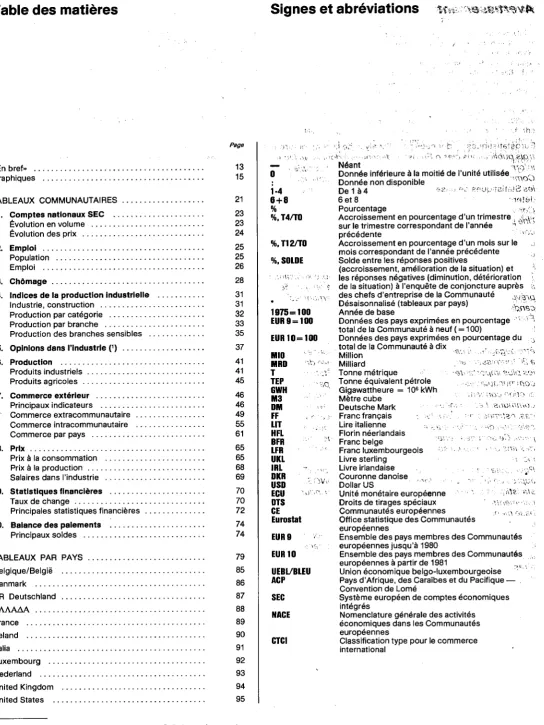
Table des matières
Signes et abréviations
Page
«En bref»
Graphiques
TABLEAUX COMMUNAUTAIRES
1. Comptes nationaux SEC
Évolution en volume
Évolution des prix
2. Emploi
Population
Emploi
3. Chômage
4. Indices de la production industrielle
Industrie, construction
Production par catégorie
Production par branche
Production des branches sensibles .
5. Opinions dans l'industrie (')
6. Production
Produits industriels
Produits agricoles
7. Commerce extérieur
Principaux Indicateurs
Commerce extracommunautaire . . . .
Commerce intracommunautaire
. . . .
Commerce par pays
8. Prix
Prix à la consommation
Prix à la production
Salaires dans l'industrie
9. Statistiques financières
Taux de change
Principales statistiques financières . .
10. Balance des paiements
Principaux soldes
TABLEAUX PAR PAYS
Belgique/België
Danmark
BR Deutschland
ΕΛΛΑΔΑ
France
Ireland
Italia
Luxembourg
Nederland
United Kingdom
United States
13
15
21
23
23
24
25
25
26
28
31
31
3?
33
35
37
41
41
45
46
46
49
55
61
65
6b
68
69
70
/o
72
74
74
79
85
86
87
88
89
90
91
92
93
94
95
—
0
14
6 + 8
%
%,T4/T0
%,T12/T0
%, SOLDE
*
1975=100
EUR 9 = 100
EUR 10=100
MIO
MRD
Τ
TEP
GWH
M3
DM
FF
LIT
HFL
BFR
LFR
UKL
IRL
DKR
USD
ECU
DTS
CE
Eurostat
EUR 9EUR 10
UEBL/BLEU
ACP
SEC
NACECTCI
x
■
Néant
Donnée inférieure à la moitié de l'unité utilisée
Donnée non disponible
D e 1 à 4
6 et 8
Pourcentage
Accroissement en pourcentage d'un trimestre
sur le trimestre correspondant de l'année
précédente
Accroissement en pourcentage d'un mois sur le
mois correspondant de l'année précédente
Solde entre les réponses positives
(accroissement, amélioration de la situation) et
les réponses négatives (diminution, détérioration
de la situation) à l'enquête de conjoncture auprès
des chefs d'entreprise de la Communauté
Désaisonnalisé (tableaux par pays)
Année de base
Données des pays exprimées en pourcentage
total de la Communauté à neuf ( = 100)
Données des pays exprimées en pourcentage du
total de la Communauté à dix
Million
Milliard
Tonne métrique
Tonne équivalent pétrole
Gigawattheure = 106kWh
Mètre cube
Deutsche Mark
Franc français
Lire Italienne
Florin néerlandais
Franc belge
Franc luxembourgeois
Livre sterling
Livre irlandaise
Couronne danoise
Dollar US
Unité monétaire européenne
Droits de tirages spéciaux
Communautés européennes
Office statistique des Communautés
européennes
Ensemble des pays membres des Communautés
européennes jusqu'à 1980
Ensemble des pays membres des Communautés
européennes à partir de 1981
Union économique belgoluxembourgeoise
Pays d'Afrique, des Caraïbes et du Pacifique —
Convention de Lomé
Système européen de comptes économiques
intégrés
Nomenclature générale des activités
économiques dans les Communautés
européennes
Eurostatistiques: En bref
■
1. Chômage: Nouvelle hausse en février
Le nombre de chômeurs inscrits dans la
Communauté Européenne
à la fin
février 1984 est
resté au même niveau de 13 millions de per
sonnes qu'à la fin janvier.
Cette stabilité des chiffres bruts à une époque où la saisonnalité
devrait les faire baisser, implique en fait une hausse des chiffres
corrigés des variations saisonnières que l'on peut chiffrer à 1 o/o.
Le Luxembourg, partant toutefois d'une situation très privilégiée en
matière de chômage, voit celuici augmenter rapidement ( +
5,6 % ) en chiffres corrigés des variations saisonnières. La France
avec une augmentation de 2,5 % confirme la détérioration du mar
ché du travail observée depuis 4 mois. Les autres pays membres
suivent une tendance égale ou inférieure à la moyenne euro
péenne.
Le taux de chômage enregistré par rapport à la population active
civile a de nouveau progressé pour la
Communauté
Européenne,
passant de 10,6 o/o à 10,7 o/o, alors que le reflux du chômage conti
nue aus
États-Unis
(le taux de chômage passant de 8,2 °/o en
décembre 1982 à 8,0 o/o en janvier 1983).
Au
Japon
le chômage reste toujours à un niveau très bas, aux
alentours de 2,6 o/o de la population active.
2. L'indice des prix à la c o n s o m m a t i o n : + 0 , 6 %
en
février pour la C o m m u n a u t é , et un taux annuel en d e s
sous d e 8
%
L'indice des prix pour l'ensemble de la Communauté a monté de
0,6 o/o entre janvier et février 1984.
Des hausses sensibles ont été enregistrées en Italie (1,1 % ) et au
Danemark (1,0 o/o), tandis que les augmentations en Belgique
(0,8 0/o), en France (0,7 o/o), au PaysBas (0,6 o/o) et au Luxem
bourg (0,6 % ) sont égales ou légèrement supérieures à la
moyenne communautaire.
Par contre, les accroissements en R. F. d'Allemagne (0,3 o/o), au
RoyaumeUni (0,4 o/o) et en Grèce (0,4 o/o) sont inférieurs à cette
moyenne.
Le taux d'Inflation sur 12 mois mesuré par l'Indice des prix à la
consommation de février 1984 par rapport à février 1983 est de
7,9 o/o.
Ceci est le taux d'inflation en rythme annuel le plus bas depuis
décembre 1978.
Toutefois, ¡I faut signaler que le taux correspondant pour les
ÉtatsUnis est de 4,2 o/o et pour le Japon de 3,0 o/o seulement.
3. L'indice de la production industrielle: Augmentation
significative
L'indice pour la Communauté
(EUR 10) du mois de décembre est
estimé à 116,9 ce qui correspond à une hausse de 4,1 o/o par rap
port au mois de décembre 1982.
L'indice corrigé des variations saisonnières
pour EUR 10 est au
niveau 115,9 pour le mois de décembre, soit pratiquement au
même niveau qu'en novembre 1983 (115,8).
L'indicateur de tendance
(rapport des trois derniers mois aux trois
mois précédents) indiquerait une hausse significative de 1,3%
pour l'ensemble de la Communauté.
En moyenne annuelle et selon les pays, les hausses sont de 6,5 o/o
en Irlande, elles seraient comprises entre 3 o/o et 2,5 % au Dane
mark, en Belgique et au RoyaumeUni, et comprises entre 1,5 % et
0,5 o/o au Luxembourg, en France, aux PaysBas, en Grèce et en
R. F. d'Allemagne. La baisse de la production industrielle en Italie
est comprise entre 3 et 5 o/o.
Pour le mois de
janvier 1984
on connaît l'indice de la production
industrielle de la R. F. d'Allemagne qui est en hausse de 8 , 6 % en
un an, et celui du RoyaumeUni qui est en hausse de 4,5 o/o. Dans
les deux cas les indices sont en hausse appréciable au cours des
derniers mois et les indicateurs de tendance (y compris le mois de
janvier) sont respectivement de 3,5 % pour la R. F. d'Allemagne et
de 1,2 o/o pour le RoyaumeUni.
4. Acier: En 1983, pour la première fois depuis 1978, les
demandes nouvelles ont été supérieures au niveau
des livraisons
En février 1984 l'augmentation de la production communautaire
d'acier brut (sans la Grèce) s'est poursuivie. Avec 10 mio t son
niveau est supérieur de 3,4 % (désaisonnalisée) à celui de janvier
1984 et de 8,6 o/o à celui du même mois 1983. Cependant, selon les
estimations faites par les usines, cette hausse ne devrait pas se
maintenir en mars où l'on s'attend à une diminution de 4 o/o (désai
sonnalisée) par rapport à février.
Les commandes nouvelles (aciers courants) en décembre 1983
ont connu une baisse de 8,7 o/o (désaisonnalisée) par rapport à
novembre 1983. Le bilan de l'année 1983 se solde par une aug
mentation du volume total des commandes de 7,1 o/o par rapport à
la faible année 1982 (marchés CECA +6o/o, marchés Pays tiers
+ 10,6 % ) mais par une diminution de 9,9 o/o comparé à 1981.
Tendance remarquable: les commandes nouvelles en 1983, ont été
pour la première fois depuis 1978, supérieures au niveau des livrai
sons.
Energie: Reprise de la production et des importations
du gaz naturel
En 1983 les disponiblités communautaires en gaz naturel ont
accusé une augmentation sensible atteignant 4,6 o/o par rap
port à 1982, suite à une reprise de la production des Dix
( + 3,2%) d'une part et des importations en provenance des
pays tiers ( + 8,5 % ) d'autre part.
La couverture des disponibilités totales à partir du gaz importé
a atteint 29 o/o.
La hausse de la production communautaire (la première enre
gistrée depuis 1979) est due principalement aux productions:
anglaise (
+
3,1 o/o), néerlandaise ( + 5,5 o/o) et allemande
( + 7 , 5 o/o) alors que l'Italie accuse un recul de 11,4 o/o.
Commerce avec les pays tiers: Un excellent quatrième
trimestre 1983 pour les exportations communautaires
En 1983 les exportations communautaires vers les pays tiers
ont atteint environ 300 milliards d'ECU ce qui représente une
augmentation de 5 o/o par rapport à 1982. Donc, la progression
des exportations fut plus lente en 1983 qu'en 1982 ( + 7 o/o)
mais le deuxième semestre de l'année fut marqué par une
amélioration significative.
Durant le quatrième trimestre de 1983, les exportations ont
augmenté de plus de 9 % par rapport à la même période de
1982.
Parmi les pays membres, l'Irlande ( + 2 9 % ) et le Danemark
( + 2 6 % ) ont réalisé les meilleures performances, alors qu'à
l'opposé on trouve le Royaume-Uni dont les exportations ont
baissé de 2 o/o.
En 1983 les importations communautaires en provenance des
pays tiers étaient légèrement supérieures ( + 1 o/o) à celles de
1982. Alors que pendant le premier semestre on a enregistré
une certaine baisse, une légère progression a pu être
consta-tée durant les six derniers mois de 1983.
Les importations ont progressé de 6 % durant le quatrième
tri-mestre par rapport à la même période de 1982. Le seul pays
qui n'a pas suivi cette tendance générale est la France dont les
Importations ont accusé une baisse de 7 o/o durant le 4ème
tri-mestre et de 5 o/o sur l'année 1983. Ce mouvement fut tout de
même renversé en janvier 1984, mois pendant lequel les
impor-tations françaises ont du augmenté de 7 o/o par rapport à
jan-vier 1983. C'est la première fols que ceci arrive après plusieurs
mois de baisse. Au 4ème trimestre 1983, les plus fortes
aug-mentations des importations ont été signalées au Danemark
( + 15 0/0), en Irlande ( + 15 0/0), au Royaume-Uni ( + 12 0/0) et
en R. F. d'Allemagne ( + 1 2 0/0).
Si l'on examine la ventilation par produit pour la Communauté
moins l'Italie, la Belgique, le Luxembourg et la Grèce (pays
pour lesquels les données de 1983 ne sont pas encore
dispo-nibles), on constate que les secteurs dans lesquels le
redres-sement des exportations a été le plus rapide sont les produits
chimiques ( + 14 0/0), les produits manufacturés divers
( + 11 0/0) et les matières premières à l'exclusion des
carbu-rants ( + 120/0). Dans l'importante catégorie des machines et
des équipements de transport cependant, les exportations ne
se sont accrues que de 2 0/0, alors que les importations en
provenance de pays tiers augmentaient de 15 %. De même,
les exportations d'articles manufacturés classés d'après la
matière première (qui couvrent entre autres les produits
texti-les et texti-les métaux) n'ont augmenté que de 1 0/0, alors que pour
les Importations la hausse est de 9 %. Le faible accroissement
global des Importations s'explique en grande partie par le fait
que les Importations de carburants ont diminué d'environ 8 0/0,
ce qui a compensé l'augmentation enregistrée'dans d'autres
domaines.
7. Commerce entre les pays de la Communauté: 51 %
des importations des pays membres proviennent de
leurs partenaires
En contrast avec la faible augmentation des importations en
prove-nance des pays tiers, les importations en proveprove-nance des
partenai-res européens ont augmenté avec un rythme très soutenu ( + 9 %)
atteignant en 1983, 330 milliards d'ECU.
51 % des importations des pays membres provenaient donc de
leurs partenaires en 1983.
C'est surtout pendant le quatrième trimestre de l'année que le
commerce intra-communautaire fut particulièrement actif avec une
augmentation de 12 0/0 d'année en année.
Agriculture: Prévisions en hausse pour la production
des viandes bovine et ovine mais qui va consommer?
L'accroissement de la production bovine (exprimée en nombre
de têtes) et pour l'ensemble de la Communauté est estimé à
2 % pour l'année 1984. Ce taux est inférieur à celui enregistré
en 1983, qui était de 2,8 %. Il faut cependant noter que la
con-sommation de viande bovine dans la Communauté a connu une
baisse en 1983. Cette production supplémentaire ne pourra
être absorbée aisément par le marché que si la consommation
connaissait une reprise en 1984, point sur lequel l'avis des
experts est encore partagé.
Les prévisions de production de viande porcine laissent
appa-raître une stagnation de l'offre: celle-ci n'augmentera
vraisem-blablement que de 0,2 0/0 au cours de la période de décembre
1983 à 1984 par rapport aux douze mois correspondants de
l'année précédente. Si la consommation ne subit pas de
gran-des modifications dans le courant de l'année 1984 - et c'est
l'avis de la majorité des experts - on peut s'attendre à un
niveau de production dépassant la demande intérieure
d'envi-ron 3,8 0/0, soit l'équivalent d'envid'envi-ron deux semaines de
con-sommation.
9. Finances: Hausse du taux d'escompte officiel en
Belgique et baisse en Italie
Deux pays, la Belgique et l'Italie, ont modifié leur taux d'escompte
à la mi-février.
En vue de réduire la pression sur le franc belge, qui avait donné
lieu à des Interventions de l'ordre de 49 milliards de FB sur le
mar-ché des changes au cours de la sixième semaine de 1984, les
autorités belges ont relevé le taux d'escompte officiel qui est
passé de 10 à 11 0/0.
REGISTRo ARBEITSLOSIGKEIT
2 _
i
INSGESAriT
INSGESAHT/SAISONBEREINIGT HAENNER/SAISONBEREINIGT FRAUEN/SA ISONBEREINIGT
REGISTERED UNEMPLOYMENT
EUR 10 ΠΙΟ TOTAL
TOTAL/SEASONALLY ADJUSTED riEN/SEASONALLT ADJUSTED WOrlEN/SEASONALLT ADJUSTED
CHOMAGE ENREGISTRE
TOTAL
TOTAL/DESAISONNALISE HOnnES/DESAISONNALISE FEHHES/DESAISONNALISE
Ι ι ι ' J I I I L J I I I I I l_ J I I I L· J I I I L ' ι ι l
I ! ! I
1¿
13 12 1 1 10 9 8 1
s
5 4 3
i
1980
1 9 8 1
-1982
1 9 8 3
1 9 8 4
INDUSTRIELLE PRODUKTION
TENDENZ EUR 10
INDUSTRIAL PRODUCTION
TREND EUR 10 19T5=100
INDUSTRIE NACE 1-¿ INDUSTRY NACE 1-¿ GRUNDST= U„ PRODUKT IONSGUETER INTERREDIATE GOODS INVESTITIONSGUETER INUESTDENT GOODS VERBRAUCHSGUETER CONSUriPTION GOODS
PRODUCTION INDUSTRIELLE
TENDANCE EUR 10
INDUSTRIE NACE 1-C BIENS INTERHEDIAIRES BIENS D'INUESTISSEHENT BIENS DE CONSOnriATION
130
115
110
1 0 5
130
125
120
1 1 0
105
100 Ι ι ι Ι ι ι I 1 1 1 1 1 1 100
1 9 8 0
1 9 8 1
1 9 8 2
1 9 8 3
1984
50
40
30
20
10
0
10
20
30
40
50
εο
ΊΟ
-~ »«·»»*
Ι Ι Ι
MEINUNGSUMFRAGE OPINIONS OPINIONS
I N DER INDUSTRIE (NACE 2 - 4 ) I N INDUSTRY (NACE 2 - 4 ) DANS L ' I N D U S T R I E (NACE 2 - 4 ) » SALDO * BALANCE x SOLDE
EUR 1 0
. . . LAGERBESTAENDE AN STOCKS OF FINISHED PRODUCTS STOCKS DE PRODUITS F I N I S FERTIGERZEUGNISSEN
J l—l I I I I I—
*» ». ·»*
,
m...
I I I I I I ! I I i I
- , .·> ·«» ■■♦
» ♦ **« . . . * * * **« .
I I I I I I I I I I L_ I t I I I I I I I I
I I 50 40 30 20 10 0 1 0 2 0 3 0 4 0 5 0 SO 7 0
1 9 8 0
1 9 8 1
1 9 8 2
1 9 8 3
1 9 8 4
28
26
24
22
20
18
16
14
12 _
AUSSENHANDEL
SAISONBEREINIGT
EINFUHR EXTRA-EG AUSFUHR EXTRA-EG
EXTERNAL TRADE
SEASONALLY ADJUSTED
EUR 10 riRD ECU
iriPORTS EXTRAEC EXPORTS EXTRAEC
Ι ι ι Ι ι ι I
COMMERCE EXTERIEUR
DESAISONNALISE
IriPORTS EXTRACE EXPORTS EXTRACE
Ι ι ι Ι ι ι I
_ 3 0
_ 2 8
2 6
_ 2 4
2 2
20
18
16
14
_ 1 2
15
14
13
12
1 1
10
i
UERBRAUCHERPREISE
uERAENDERUNG
I ! ! I
ι ι Ι ι ιI
CONSUMER PRICES
VARIATION
χ T12/T0
EUR 10
, I , I I ! ! I
PRIX A LA CONSOMMATION
VARIATION
l i i l
15
14
13
12
1 1
10
_ 1
I ! ! I ! I I
i
1 9 8 0
1 9 8 1
1 9 8 2
1 9 8 3
1 9 8 4
1 . 5
1 . 4
1 . 2
1 . 1
0.9 _
0 . 8
WECHSELKURSE
1 ECU =
1 ECU = SZR USD
EXCHANGE RATES
1 ECU = ... SDR
1 ECU = ... USD
0 . 1 L _ l I I I I I I I I I I I I I I I I I I I I I I I I I I I I I I I L
1 9 8 0 1 9 8 1 1 9 8 2
TAUX DE CHANGE
1 ECU = . . . DTS 1 ECU = . . . USD
1 . 5
_ 1 . 4
1 . 3
1 . 2
_ 1 . 1
_ 1
0 . 9
0 . 8
ι ι ι ι ι ι ι ι Ι ι ι [_j ι Ι ι ι I 0 . 1
3500
3000
2500
1000
150
600
500
400
300
250
200
115
150
125
100
15
50
30
25 _
REGISTRO ARBEITSLOSIGKEIT
REGISTERED UNEMPLOTMENT
CHOMAGE ENREGISTRE
SAISONBEREINIGT SEASONALLY ADJUSTED SEASONALLY ADJUSTED DESAISONNALISE 1 000
D
*+■+++■>♦■>·♦ t + + + + +UK
NL
+ + ♦ +++ ♦+■+ + + +B
»* »
I R L
DK
►GR
Ή «* *** '
, . * ♦ · + ♦ '
I ■ ■ I ■ ■ I
» · : : . '
.« .* **
V* ♦ ♦ * ♦ » » j » ««
. ♦ ♦ ♦ ♦ ♦ * * , ♦ « ♦ w * ♦ * * * * ♦ ♦ ■ » " · ♦ ♦ ■
»*♦*♦♦**
, ++ ♦++ +++ +**
ι ■ ■ ι . ■ I
. . , , . »*+ * * * ♦♦♦
I I I I I I I I I
3500
3000
2500
2000
1150
1500
1250
1000
150
600
500
300
250
200
115
"iso
125100
15
50
S
30
150
140 _
130
120
110 _
100 _
90 _
85
INDUSTRIELLE PRODUKTION
TENDENZ NACE 1-4
D
INDUSTRIAL PRODUCTION
PRODUCTION INDUSTRIELLE
TENDANCE NACE 1-4 TREND NACE 1-4
1915=100
*+++++++++++++t
EUR 1 0
++ ++ ++ + + ++■
UK
. « * * » * ■ " " » » » » , . , .
, ♦*■ * ♦ * ♦ *
I ■ . I ■ ■ I
+* + + + + + + +4 ■►+ '
I ■ ■ I . ■ I
I ι ι I I ! I
ι ■ ■ ι1 5 0
1 4 0
_ 130
1 2 0
1 1 0
100
_ 90
85
1 9 8 0
1 9 8 1
E I N F A C H - L O G A R I T H M I S C H E S K A L A
1 9 8 2
S E M I - L O G A R I T H H I C S C A L E
1 9 8 3
1 9 8 4
ECHELLE SEniLOCARITHPIIQUE
130
120
110 _
90 _
85
INDUSTRIELLE PRODUKTION
INDUSTRIAL PRODUCTION
PRODUCTION INDUSTRIELLE
TENDENZ NACE 1 4 TREND NACE 1 4 TENDANCE NACE 1 4 1 9 1 5 = 1 0 0
++*■+♦+♦+++♦+++ I M L + + + + + + + + + *+* Β *** *** ***+++ L + + + + + + +* ** I R L + + + + + + + + D K + + + + + + + + L ? R
EUR 10
—
+■*■ + + ++
» . . .
**
******
""
* * »
ι + * *
* ******* X** +
"*" »» **»
1 , 1 , 1 1 , | 1 | |
... ***■ "** * ' " . » ♦ * * * *
„ ♦ . < ■ ♦ « * " **
» « * ■ * * *·♦ «
* * * + ■» * " ♦ ♦
* + + + + + + , „ * * ■ * * * * * *
■+ * ' » ·< + + +Η » ' * * *
1 [ Ι 1 1 1 1 1 1 1 1
"S«
1—1 1 1 1 1 1 1 L_i_i_
********
* * * *
**
X * * * * * * * * * * * * * * *
********
ƒ
+
1 1 1 1 1 1 1 1 1 1 1 ι ι 1 1 1 1 > ι i
-1
120
_ 110
_ 100
_ 90
85
1 9 8 0
1 9 8 1
EINFACH- LOCAR tΤΗΠISCHE SKALA
1 9 8 2
SEPII- LOGARITHMIC SCALE
1 9 8 3
1 9 8 4
400
350
140
120
100
UERBRAUCHERPREISE
GESArlT INDEX
D
CONSUMER PRICES
GENERAL INDEX 1915=100
PRIX A LA CONSOMMATION
INDICE GENERAL
... UK
EUR 10
I I I I I I I
I I I I
. * * * * * * ■
ι ι ι ι ι_ι ι ι ι ι ι ι ι ι ι
L _ Iι ι ι ι_
********
********
J I I I l_l L _ i _
I ι ι I ι ι Ι ι ι I ' ' I ' ' I l o o
400
350
300
215
250
225
200
180
160
1 4 0
1 2 0
1 9 8 0
1 9 8 1
EINFACH- L O G A R I T H M I S C H E SKALA
1982
S E n i - L O G A R Ι Τ Η Π I C S C A L E
1983
1984
E C H E L L E S E n i - L O G A R Γ Τ Η Π Γ Q U E
400
350
V/ERBRAUCHERPREI SE
GESAHTINDEX
NL ♦**
*** *** ***
CONSUMER PRICES
GENERAL INDEX 1915=100
PRIX A LA CONSOMMATION
I N D I C E GENERAL
■ *+ + ++ + IRL
EUR 1 0
. DK
*GR
1 4 0
120
^ « r * ^ * * « * *
4- i
m**********
. i* ****&*****************"I I ! I I I I
. +++++■ 4- ++++♦++
+++
txx
rtt
+ + w.+ + + +^ + ^ *+ + + + + + 1+
400
350
_ 3 0 0 _ 2 1 5 2 5 0 2 2 5
2 0 0
1 8 0
1 6 0
1 4 0
GEMEINSCHAFTSTABELLEN
COMMUNITY TABLES
VOLKSW.GESAMTRECHN. ESVG
NATIONAL ACCOUNTS ESA
COMPTES NATIONAUX SEC
EUR 10 BELGIQUE BELGIË
001 BRUTTOINLANDSPRODUKT
VERAENDERUNG DES VOLUMENS
1975 | 100,0 3,9
1979 1980 1981 1982
115,3 112,2 116,6 115,8 116,3 114,5 116,9 115,8
1980 II III IV 1981 1 II IM IV 1982 1
II III IV 1983 1
II III IV
+ 0,8 +1,5 0 , 1 +0,8 0 , 9 1 , 9 1 , 4 2 , 8 0 , 6 0 , 9 + 0,3 0 , 6 + 0,9 1 , 6 + 1,0 0 , 2 + 1,4 +0,5 + 0,2 +0,2 + 0.1 0 , 7 + 0,4 1 , 6 + 0,2 2 , 6
002PRIVATER VERBRAUCH
VERAENDERUNG DES VOLUMENS
1975 | 100,0 3,8
1979 1980 1981 1982
115,2 115,3 116,8 117,8 117,1 115,9 117,7 118,0
1980 II III IV 1981 1 II III IV 19821 II III IV 1983 1
II III IV
+ 0,1 +4,5 + 1,9 +3,0 + 0,5 +0,5 0 , 4 0 , 4 + 0,8 +0,6 + 0,5 +0,4 + 0,3 0 , 6 + 0,5 0 , 1 + 0,5 1 , 9 + 0,4 2 , 0 + 1,0 0 , 6 + 0,3 4 , 5 + 0,6 8 , 6
003 BRUTTOANLAGENINVESTITIONEN
VERAENDERUNG DES VOLUMENS
1975 I 100,0 4,2
1979 1980 1981 1982
111,8 103,6 113,7 108,8 108,6 92,8 106,7 90,7
1980 II III IV 1981 1 II III IV 1982 1
II III IV 19831 II III IV
+3,0 +14,4 + 0,7 8 , 8 1 , 3 6 , 7 4 , 2 1 7 , 5 3 , 1 1 2 , 1 2 , 5 1 5 , 1 3 , 4 1 1 , 6 2 , 4 1 5 , 6 1 . 4 10,4 1 , 3 2 , 6 0 , 4 5 , 0 0 , 5 2 , 9 1 , 5 1 5 . 1
DANMARK
2,1
115,0 114,5 113,7 117,7
1.9
111,2 107,8 106,9 109,0
.
.
2,2
116,2 102,6 85.4 90,6
.
BR
DEUTSCHLAND ΕΛΛΑΔΑ FRANCE
GROSS DOMESTIC PRODUCT
CHANGE IN VOLUME
EUR 10 100
25,5 1,9 21,8
1975 100 116,6 121,7 116,2 118,9 123.7 117,5 118,9 123,2 117,8 117,7 123,2 119,7
o/o,T4/TO + 0,8 0 , 4 + 1,3 +1,8
0 . 2 +4,8 0 , 4 1 , 6 2 , 2 1 , 5 + 0,1 +0.3 + 0,6 +2.6 +0,7 + 0,6 1 , 9 +1,8 0 , 1 +2,6 +2,6 1 , 0 +2,2 1 , 8 1 , 5 +1,2 2 , 1 +1,1 +1,2 0 , 8 0 , 3 +0,7 + 0,4 +0,2 +0,5
+ 1,2 +0,6
+ 0,4
IRELAND
0,7
119,4 123,8 125.8 127,4
CONSUMPTION BY HOUSEHOLDS
CHANGE IN VOLUME
EUR 10 = 100
25,2 2,1 21,7
1975 = 100 114,9 1