ScienceDirect
Available online at Available online at www.sciencedirect.comwww.sciencedirect.com
ScienceDirect
Energy Procedia 00 (2017) 000–000
www.elsevier.com/locate/procedia
1876-6102 © 2017 The Authors. Published by Elsevier Ltd.
Peer-review under responsibility of the Scientific Committee of The 15th International Symposium on District Heating and Cooling.
The 15th International Symposium on District Heating and Cooling
Assessing the feasibility of using the heat demand-outdoor
temperature function for a long-term district heat demand forecast
I. Andrić
a,b,c*, A. Pina
a, P. Ferrão
a, J. Fournier
b., B. Lacarrière
c, O. Le Corre
c aIN+ Center for Innovation, Technology and Policy Research - Instituto Superior Técnico, Av. Rovisco Pais 1, 1049-001 Lisbon, PortugalbVeolia Recherche & Innovation, 291 Avenue Dreyfous Daniel, 78520 Limay, France
cDépartement Systèmes Énergétiques et Environnement - IMT Atlantique, 4 rue Alfred Kastler, 44300 Nantes, France
Abstract
District heating networks are commonly addressed in the literature as one of the most effective solutions for decreasing the greenhouse gas emissions from the building sector. These systems require high investments which are returned through the heat sales. Due to the changed climate conditions and building renovation policies, heat demand in the future could decrease, prolonging the investment return period.
The main scope of this paper is to assess the feasibility of using the heat demand – outdoor temperature function for heat demand forecast. The district of Alvalade, located in Lisbon (Portugal), was used as a case study. The district is consisted of 665 buildings that vary in both construction period and typology. Three weather scenarios (low, medium, high) and three district renovation scenarios were developed (shallow, intermediate, deep). To estimate the error, obtained heat demand values were compared with results from a dynamic heat demand model, previously developed and validated by the authors.
The results showed that when only weather change is considered, the margin of error could be acceptable for some applications (the error in annual demand was lower than 20% for all weather scenarios considered). However, after introducing renovation scenarios, the error value increased up to 59.5% (depending on the weather and renovation scenarios combination considered). The value of slope coefficient increased on average within the range of 3.8% up to 8% per decade, that corresponds to the decrease in the number of heating hours of 22-139h during the heating season (depending on the combination of weather and renovation scenarios considered). On the other hand, function intercept increased for 7.8-12.7% per decade (depending on the coupled scenarios). The values suggested could be used to modify the function parameters for the scenarios considered, and improve the accuracy of heat demand estimations.
© 2017 The Authors. Published by Elsevier Ltd.
Peer-review under responsibility of the Scientific Committee of The 15th International Symposium on District Heating and Cooling.
Keywords:Heat demand; Forecast; Climate change
Energy Procedia 158 (2019) 4483–4488
1876-6102 © 2019 The Authors. Published by Elsevier Ltd.
This is an open access article under the CC BY-NC-ND license (http://creativecommons.org/licenses/by-nc-nd/4.0/)
Peer-review under responsibility of the scientific committee of ICAE2018 – The 10th International Conference on Applied Energy. 10.1016/j.egypro.2019.01.764
10.1016/j.egypro.2019.01.764
© 2019 The Authors. Published by Elsevier Ltd.
This is an open access article under the CC BY-NC-ND license (http://creativecommons.org/licenses/by-nc-nd/4.0/)
Peer-review under responsibility of the scientific committee of ICAE2018 – The 10th International Conference on Applied Energy.
1876-6102 ScienceDirect
Energy Procedia 00 (2018) 000–000
www.elsevier.com/locate/proc edia
1876-6102 Copyright © 2018 Elsevier Ltd. All rights reserved. Selection and peer-review under responsibility of the scientific committee of the 10th International Conference on Applied Energy (ICAE2018).
10
thInternational Conference on Applied Energy (ICAE2018), 22-25 August 2018, Hong Kong,
China
Development of microencapsulated phase change material with poly
(methyl methacrylate) shell for thermal energy storage
Weiguang Su
a* , Tongyu Zhou
b, Yilin Li
c, Yuexia Lv
aaSchool of Mechanical & Automotive Engineering, Qilu University of Technology (Shandong Academy of Sciences), 250353, Jinan, Shandong,
China
bDepartment of Architecture and Built Environment, University of Nottingham Ningbo China, 315100, Ningbo,Zhejiang, China c School of Environment and Architecture, University of Shanghai for Science and Technology, 516 Jungong Road, 200093,Shanghai, China
Abstract
This research focused on the development of MEPCMs for thermal energy storage in low carbon buildings with poly (methyl methacrylate) (PMMA) shell. The experimental results showed that the best MEPCM sample was prepared with 1 wt% of the thermal initiator and the surfactant of S-1DS. The differential scanning calorimetric (DSC) analysis showed that the best sample has a latent heat of 170 kJ/kg and a melting temperature of 22.68 ℃. Meanwhile, the core material contents and encapsulation efficiencies were calculated according to the measured results of the DSC. Those two values for the sample of PMMA-3 and PMMA-5 were even higher than theoretical values due to the evaporation of shell monomer during encapsulation processes. Finally, the thermogravimetric (TG) analysis of the fabricated MEPCM samples showed good thermal stability behaviors above 161 ℃ and therefore satisfy the environmental requirements for most applications.
Copyright © 2018 Elsevier Ltd. All rights reserved.
Selection and peer-review under responsibility of the scientific committee of the 10th International Conference on Applied Energy (ICAE2018).
Keywords: Microencapsulation, Paraffin, Thermal energy storage, Poly (methyl methacrylate)
1.Introduction
Previous studies have proved that microencapsulated phase change material (MEPCM) was one of the key potential materials for saving energy consumption in buildings because it can balance the mismatch between heating
* Corresponding author. Tel.: +86 18265416996.
E-mail address: [email protected]
ScienceDirect
Energy Procedia 00 (2018) 000–000
www.elsevier.com/locate/proc edia
1876-6102 Copyright © 2018 Elsevier Ltd. All rights reserved. Selection and peer-review under responsibility of the scientific committee of the 10th International Conference on Applied Energy (ICAE2018).
10
thInternational Conference on Applied Energy (ICAE2018), 22-25 August 2018, Hong Kong,
China
Development of microencapsulated phase change material with poly
(methyl methacrylate) shell for thermal energy storage
Weiguang Su
a* , Tongyu Zhou
b, Yilin Li
c, Yuexia Lv
aaSchool of Mechanical & Automotive Engineering, Qilu University of Technology (Shandong Academy of Sciences), 250353, Jinan, Shandong,
China
bDepartment of Architecture and Built Environment, University of Nottingham Ningbo China, 315100, Ningbo,Zhejiang, China c School of Environment and Architecture, University of Shanghai for Science and Technology, 516 Jungong Road, 200093,Shanghai, China
Abstract
This research focused on the development of MEPCMs for thermal energy storage in low carbon buildings with poly (methyl methacrylate) (PMMA) shell. The experimental results showed that the best MEPCM sample was prepared with 1 wt% of the thermal initiator and the surfactant of S-1DS. The differential scanning calorimetric (DSC) analysis showed that the best sample has a latent heat of 170 kJ/kg and a melting temperature of 22.68 ℃. Meanwhile, the core material contents and encapsulation efficiencies were calculated according to the measured results of the DSC. Those two values for the sample of PMMA-3 and PMMA-5 were even higher than theoretical values due to the evaporation of shell monomer during encapsulation processes. Finally, the thermogravimetric (TG) analysis of the fabricated MEPCM samples showed good thermal stability behaviors above 161 ℃ and therefore satisfy the environmental requirements for most applications.
Copyright © 2018 Elsevier Ltd. All rights reserved.
Selection and peer-review under responsibility of the scientific committee of the 10th International Conference on Applied Energy (ICAE2018).
Keywords: Microencapsulation, Paraffin, Thermal energy storage, Poly (methyl methacrylate)
1. Introduction
Previous studies have proved that microencapsulated phase change material (MEPCM) was one of the key potential materials for saving energy consumption in buildings because it can balance the mismatch between heating
* Corresponding author. Tel.: +86 18265416996.
44842 Author name / Energy Procedia 00 (2018) 000Weiguang Su et al. / Energy Procedia 158 (2019) 4483–4488–000
and cooling demands automatically [1, 2]. The researches pointed that the latent heat thermal energy storage materials suitable for various applications in buildings, such as melting temperatures up to 21℃ are more suitable
for cooling applications [3], 22-28℃ for thermal comfort applications, 29-60 ℃ for hot water supply and over 120℃ for waste heat recovery applications [4]. For instance, an experimental study carried out on a novel translucent full scale passive solar MEPCM wall by Berthou et al. [5] revealed that it could be used to provide significant improvement of indoor temperatures in both cold and sunny climates. Darkwa et al. developed a non-deform MEPCM [6] for thermal energy storage application. Su et al.[7] developed MEPCM for hot water supply in low carbon buildings and proved the energy storage density would increase from 84,000 kJ/m3 to 128,735 kJ/m3 by added 50 wt% MEPCM.
Previous researches also showed that polymers based methyl methacrylate (MMA) are the commonest shell materials for MEPCMs preparation with in-situ suspension-like polymerization method [8] since the MMA can be self-polymerized [9] and crosslinked with the other monomers [10]. Meanwhile, good quality MEPCMs can be produced by combining appropriate proportions of surfactants. For example, Su et al. [10] also combined two surfactants (Brij-30 and Brij-58) to develop MEPCM samples. Wang et al. [11] stabilized oil/water emulsion with organically modified SiO2/TiC nanoparticles as surfactants and developed organic-inorganic hybrid shell MEPCMs. Su et al. [12] also successfully fabricated MEPCM samples with the surfactant of nanosilicon dioxide hydrosol. To this end, different types of surfactants (i.e. nano-silicon dioxide hydrosol and Sodium 1-dodecanesulfonate (S-1DS)) were used to prepare MEPCM samples with paraffin wax and poly (methyl methacrylate) (PMMA) in this research. Meanwhile, the effects of weight percentage of initiator and types of surfactants were also studied.
2. Materials and methods
2.1.Materials
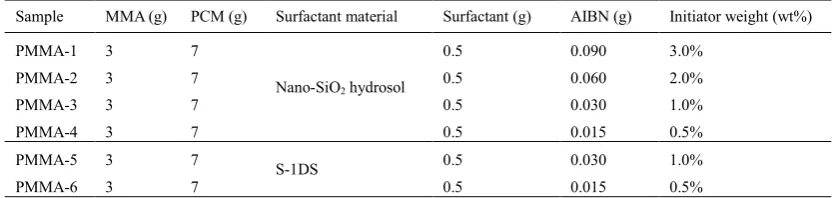
[image:2.544.63.481.470.569.2]As summarized in Tab.1, the paraffin of n-octadecane was introduced as a core material because of its relatively high latent heat capacity and appropriate phase change temperature. While the MMA (purity of 98 %, Sinopharm Chemical Reagent Co.,Ltd.) was used as shell monomer. Nano-SiO2 hydrosol (ZS-30, 30 wt%, Zhejiang Yuda Chemical Industry Co., Ltd) and sodium 1-dodecanesulfonate (S-1DS) (Sinopharm Chemical Reagent Co.,Ltd) were used as a surfactants. Usually, based on the weight of shell monomer, thermal initiators in the range of 0.5 wt% to 3wt% are used for crosslinking PMMA [13]. To this end, the AIBN (purity of 98 %, Aladdin) with the weight percentages of 0.5 %, 1.0 %, 2.0 % and 3.0 % was used as oil-soluble thermal initiator.
Table 1: Raw materials of MEPCM preparation with PMMA shell
Sample MMA (g) PCM (g) Surfactant material Surfactant (g) AIBN (g) Initiator weight (wt%)
PMMA-1 3 7
Nano-SiO2 hydrosol
0.5 0.090 3.0%
PMMA-2 3 7 0.5 0.060 2.0%
PMMA-3 3 7 0.5 0.030 1.0%
PMMA-4 3 7 0.5 0.015 0.5%
PMMA-5 3 7 S-1DS 0.5 0.030 1.0%
PMMA-6 3 7 0.5 0.015 0.5%
2.2.Fabrication process
The microencapsulation reaction was then carried out in the flask immersing in a water bath of 80 °C and was continuously agitated under a speed of 250 rpm for 5 hours. Finally, the microcapsules were collected, washed and then dried in an oven at 60 °C for 20 hours.
3. Results and discussion
3.1.Morphology analysis of MEPCM samples
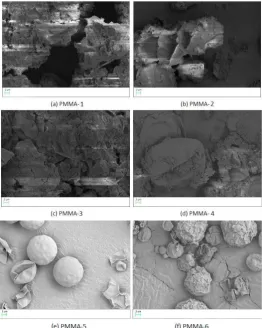
[image:3.544.141.404.279.608.2]The fabricated MEPCM samples were depicted by a scanning electron microscope (SEM) manufactured by Sigma VP (Carl Zeiss Co. Ltd.), as demonstrated in Fig. 1. The SEM images showed that the particle sizes of PMMA capsules are in the range of 5-20 μm and that is the same as the initial diameters of MEPCM particles in slurry. However, most of the capsules manufactured with the surfactant of nano-SiO2 hydrosol in Fig. 1 (a) to (d) were deformed after drying due to some weakness of the PMMA shell. On the other hand, the capsules fabricated with the surfactant of S-1DS showed much better morphology and integrity, and the PMMA-5 demonstrated the best particle morphology and integrity, while the PMMA-6 showed a lot of wrinkles on the surfaces of the capsules. That means the morphologies of microcapsules were particularly influenced by the type of surfactant and the dosage of the thermal initiator. In this research, the optimization of the capsules morphology was achieved with the surfactant of S-1DS and 1 wt% thermal initiator.
4486 Weiguang Su et al. / Energy Procedia 158 (2019) 4483–4488
4 Author name / Energy Procedia 00 (2018) 000–000
3.2.Energy storage capacity
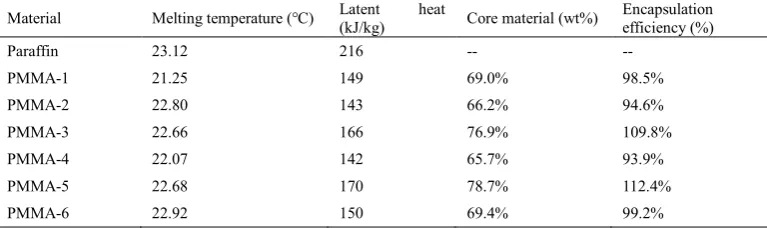
According to differential scanning calorimetric (DSC) (DSC6220, SII Nanotechnology) measurement results, the melting points of MEPCMs were reduced by 0.2-1.87 ℃ compared with the n-octadecane (PCM core material), as shown in Fig. 2. Meanwhile, the thermal energy storage capacities of fabricated MEPCM samples were achieved as much as 149 kJ/kg, 143 kJ/kg, 166 kJ/kg, 142 kJ/kg, 170 kJ/kg and 150 kJ/kg for the 1, 2, PMMA-3, PMMA-4, PMMA-5 and PMMA-6, respectively. The DSC analysis results also showed that the dosage of thermal initiator did effect on the thermal energy storage capacities and the core material contents of MEPCM samples, and the highest core material contents for the surfactant of nano-SiO2 and S-1DS were achieved by using 1 wt% of thermal initiator. The research outcomes by Romio et al. [14] showed that the polymerization rate of MMA was increased by a higher initiator dosage. To this end, the dosage of AIBN need to be optimized and the best concentration of initiator is 1 % in this study.
[image:4.544.116.432.327.523.2]According to the initial core/shell ratio in Tab.1, the theoretical core material content should be 70 % with the latent heat of 151.2 kJ/kg. However, the experimental results in Tab.2 showed the energy storage capacity of PMMA-3 and PMMA-5 were higher than 70 % and that means the encapsulation efficiencies [15] were more than 100 %. However, the high encapsulation efficiency did not mean good encapsulation quality since deform of MEPCM capsules existed in Fig. 1. On the contrary, the high encapsulation efficiency was mainly due to the reducing of weight percentage of shell that caused by the evaporation of shell monomer. The evaporation resulted by the low flash point of MMA which is only 9 ℃ and relatively high reaction temperature of 80 ℃ for the self-crosslinking of MMA [16].
Figure 2: DSC curves of MEPCM samples
Table 2: Properties of paraffin and MEPCM samples
Material Melting temperature (℃) Latent heat (kJ/kg) Core material (wt%) Encapsulation efficiency (%)
Paraffin 23.12 216 -- --
PMMA-1 21.25 149 69.0% 98.5%
PMMA-2 22.80 143 66.2% 94.6%
PMMA-3 22.66 166 76.9% 109.8%
PMMA-4 22.07 142 65.7% 93.9%
PMMA-5 22.68 170 78.7% 112.4%
[image:4.544.81.465.562.676.2]3.3.Thermal stability
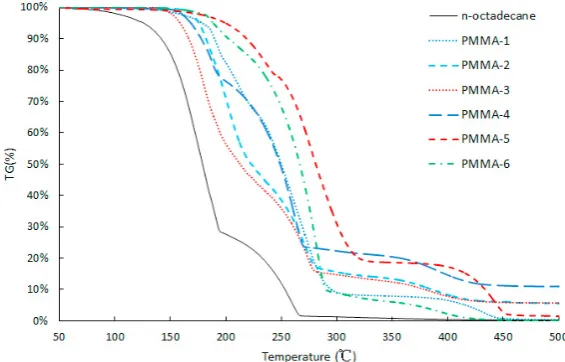
[image:5.544.130.413.259.440.2]As shown in Fig. 3, the thermogravimetric (TG) (EXSTAR6000 TG/DTA6300, SII NanoTechnology Inc.) analysis results showed that the weight loss starting temperatures for n-octadecane, PMMA-1, PMMA-2, PMMA-3, PMMA-4, PMMA-5 and PMMA-6 were at 129.0 ℃, 178.6 ℃, 167.6 ℃, 161 ℃, 165.8 ℃, 204.4 ℃ and 192.9 ℃, respectively. That means the thermal stability of the MEPCMs was enhanced more than 32 ℃by the PMMA shell compared with the paraffin core of n-octadecane after encapsulation. However, due to the deformed state of the capsules fabricated with the surfactant of nano-SiO2, the thermal stability of those samples (PMMA-1 to PMMA-4) was demonstrated much lower than the capsules fabricated with the surfactant of S-1DS (PMMA-5 and PMMA-6). For instance, compared with the original core material the weight loss starting temperature at 129.0 ℃, the weight loss starting temperatures for PMMA-5 and PMMA-6 were increased more than 63.9 ℃ while the maximum value for the capsules manufactured with the surfactant of nano-SiO2 was only 49.6 ℃. Especially for the PMMA-5 the thermal stability was increased by 75.4 ℃ due to the integrated nature of the shell. The TG analysis also proved the best MEPCM sample of PMMA-5 has the highest thermal stability.
Figure 3: TG curves of MEPCM samples
4. Conclusions
In general this study has developed several MEPCM samples for thermal energy storage in low carbon building. The experimental results proved that the qualities of capsules were mainly affected by the type of surfactants and the dosage of initiator. Meanwhile, capsule morphologies, thermal storage capacities, core material contents, encapsulation efficiencies and thermal stabilities were analysed and evaluated by SEM, DSC and TG, respectively. The key findings are summarized as follows:
1) The core material contents and encapsulation efficiencies of the PMMA-3 and PMMA-5 were higher than theoretical values due to the evaporation of MMA (shell monomer) during encapsulation processes.
2) The experimental results show that the thermal stabilities of PMMA samples were between 161 ℃ and 204.4 ℃ and enhanced by more than 32 ℃.
44886 Author name / Energy Procedia 00 (2018) 000Weiguang Su et al. / Energy Procedia 158 (2019) 4483–4488–000
Acknowledgements
The authors are thankful for the Doctoral Scientific Research Foundation of Qilu University of Technology (No. 0412048475) and Natural Science Foundation of Shandong Province (No. ZR2017LEE017).
References
[1] Konuklu Y, Ostry M, Paksoy HO, Charvat P. Review on using microencapsulated phase change materials (PCM) in building applications. Energy and Buildings. 2015;106:134-55.
[2] Souayfane F, Fardoun F, Biwole P-H. Phase change materials (PCM) for cooling applications in buildings: A review. Energy and Buildings. 2016;129:396-431.
[3] Oró E, de Gracia A, Castell A, Farid MM, Cabeza LF. Review on phase change materials (PCMs) for cold thermal energy storage applications. Applied Energy. 2012;99:513-33.
[4] Agyenim F, Hewitt N, Eames P, Smyth M. A review of materials, heat transfer and phase change problem formulation for latent heat thermal energy storage systems (LHTESS). Renewable and Sustainable Energy Reviews. 2010;14:615-28.
[5] Berthou Y, Biwole PH, Achard P, Sallée H, Tantot-Neirac M, Jay F. Full scale experimentation on a new translucent passive solar wall combining silica aerogels and phase change materials. Solar Energy. 2015;115:733-42.
[6] Darkwa J, Su O, Zhou T. Development of non-deform micro-encapsulated phase change energy storage tablets. Applied Energy. 2012;98:441-7.
[7] Su W, Darkwa J, Kokogiannakis G. Development of microencapsulated phase change material for solar thermal energy storage. Applied Thermal Engineering. 2017;112:1205-12.
[8] Su W, Darkwa J, Kokogiannakis G. Review of solid–liquid phase change materials and their encapsulation technologies. Renewable and Sustainable Energy Reviews. 2015;48:373-91.
[9] Yang Y, Ye X, Luo J, Song G, Liu Y, Tang G. Polymethyl methacrylate based phase change microencapsulation for solar energy storage with silicon nitride. Solar Energy. 2015;115:289-96.
[10] Su W, Darkwa J, Kokogiannakis G, Zhou T, Li Y. Preparation of microencapsulated phase change materials (MEPCM) for thermal energy storage. Improving Residential Energy Efficiency International Conference. Wollongong, Australia2017.
[11] Wang H, Zhao L, Song G, Tang G, Shi X. Organic-inorganic hybrid shell microencapsulated phase change materials prepared from SiO2/TiC-stabilized pickering emulsion polymerization. Solar Energy Materials and Solar Cells. 2018;175:102-10.
[12] Su W, Darkwa J, Kokogiannakis G. Nanosilicon dioxide hydrosol as surfactant for preparation of microencapsulated phase change materials for thermal energy storage in buildings. International Journal of Low-Carbon Technologies. 2018:cty032-cty.
[13] Weston RC, Dungworth HR. Particulate compositions and their manufacture. Google Patents; 2004.
[14] Romio AP, Sayer C, De Araujo PHH, Alhaydari M, Wu L, Rocha SRPD. Nanocapsules by Miniemulsion Polymerization with Biodegradable Surfactant and Hydrophobe. Macromolecular Chemistry and Physics. 2009;210:747-51.
[15] Zhang H, Wang X. Synthesis and properties of microencapsulated n-octadecane with polyurea shells containing different soft segments for heat energy storage and thermal regulation. Solar Energy Materials and Solar Cells. 2009;93:1366-76.