Experiences of early labour management from perspectives of women, labour
companions and health professionals: A systematic review of qualitative evidence.
Sarah Beake
a*[email protected]
Yan-Shing Changa [email protected]
Helen Cheyne
b[email protected]
Helen Spiby
c[email protected]
Jane Sandall
d[email protected]
Debra Bick
a#[email protected]
a Florence Nightingale Faculty of Nursing and Midwifery, King's College London, London, UK b Faculty of Health Science and Sport University of Stirling, Stirling, UK
c School of Health Sciences, University of Nottingham, Nottingham, UK
d Division of Women’s Health, King’s College London, Women’s Health Academic Centre King's Health Partners, London, UK
Abstract
Objectives: To examine evidence of women’s, labour companions’ and health professionals’ experiences of management of early labour to consider how this could be enhanced to better reflect women’s needs.
Design: A systematic review of qualitative evidence.
Setting and participants: Women in early labour with term, low risk singleton pregnancies, not booked for a planned caesarean birth or post-dates induction of labour, their labour companions, and health professionals responsible for early labour care (e.g. midwives, nurse-midwives, obstetricians, family doctors). Studies from high and middle income country settings were considered.
Findings: 21 publications were included from the UK, Ireland, Scandinavia, USA, Italy and New
Zealand. Key findings included the impact of communication with health professionals (most usually midwives) on women’s decision making; women wanting to be listened to by sympathetic midwives who could reassure that symptoms and signs of early labour were ‘normal’ and offer clear advice on what to do. Antenatal preparation which included realistic information on what to expect when labour commenced was important and appreciated by women and labour companions. Views of the optimal place for women to remain and allow early labour to progress differed and the perceived benefit of the support and help offered by labour companions varied. Some companions were supportive and helped women to relax, while other others were anxious and encouraged women to seek early admission to the planned place of birth. Women are were turning to wWeb-based sources of information are increasingly used by women, with mixed views of the value of information accessed.
Key conclusions and implications for practice: Women, labour companions and health professionals midwives find early labour difficult to manage well, with women unsure of how decisions about admission to their planned place of birth are taken. It is unclear as to why women are effectively left to manage this aspect of their labour with minimal guidance or support. Tailoring management to meet individual needs, with provision of effective communication could reassure women and facilitate timely admission from the perspectives
of women, their companions, midwives and other health professionals. Information on labour onset and progress, and approaches to pain management, should be shared with women’s labour companions to enable them to feel more confident to better support women. Further research is needed of the impact of different models of care and increasing use of web-based information on women’s approaches to self-management when labour commences.
PROSPERO xxxxxxx xxxxxxx.
Keywords:
Early labour Latent phase Labour onset ExperiencesQualitative synthesis
Highlights:
Women require realistic information on what to expect and what early labour may feel like
Some labour companions were supportive of women remaining at home. Others supported early admission to the planned place of birth because they were anxious or unsure of their role
Further research is needed into interventions which could reduce women’s anxiety when labour commences
Introduction
The clinical definition of early labour (or ‘latent phase’), usually includes the onset of painful contractions and evidence of cervical change, however there is no agreed definition (Hanley et al. 2016). Most women in high-income countries commence labour at home unless induction is required or caesarean birth planned (Spiby et al 2008)., with data for births in England in 2015-2016 indicating that around two-thirds of women had spontaneous onset of labour where data on this was known (NHS Digital 2016). There is limited evidence of the optimal way to advise and support women or their labour companions with respect to when they should contact their midwife or seek admission for labour care at their planned place of birth. Several international studies have reported that admission prior to the onset of active labour increases the risk of medical intervention including epidural analgesia, augmentation and caesarean birth (Holmes et al 2001, Klein et al 2004, Indraccolo et al 2011). For women advised to return home following clinical assessment, if labour progress is rapid, they may face the risk of an unplanned home birth and a baby born before arrival at their planned place of birth (Loughney 2006).
The clinical definition of early labour (or ‘latent phase’), usually includes the onset of painful contractions and evidence of cervical change, however there is no agreed definition (Hanley et al. 2016). Clinical pPractice recommendations, for example in the UK, include that early assessment of labour should take place with a dedicated telephone triage midwife, with face to face early assessment available for all low risk nulliparous women at home or their planned place of birth (NICE 2014, 2017). The recently updated NICE (2017) guidance on intrapartum care recommends that women not in active labour should be offered individualised support and encouraged to remain at, or return to home, although the content of ‘individualised support’ is not described.
This qualitative systematic review aimed to examine evidence of women’s, labour companions’ and health professionals’ perceptions and experiences of early labour management in high and middle income countries, to inform an aspect of maternity care where women’s needs are not currently being met. It also explored how clinical management could be enhanced to reflect needs of women and labour companions, reduce anxiety, increase confidence to remain at home, and support decision making on when to seek admission to planned place of birth. A search of the Cochrane Library, Joanna Briggs Institute and PROSPERO found no current or planned reviews on this topic.
Methods
The review was developed using the ‘gold standard’ principles and processes underpinning the recommendations of the Joanna Briggs Institute (JBI) for systematic reviews of qualitative studies (JBI 2014). The JBI is an international research and development organisation that encourages a broad, inclusive approach to evidence that promotes systematic reviews of randomised controlled trials and other approaches including qualitative research (see
www.joannabriggs.org).
The review included studies that drew on the perceptions and experiences of women, labour companions and health professionals on the management of early labour, including care, advice and support offered, regardless of women’s planned place of birth or parity. It sought to identify how approaches to content of information, advice and management could improve experiences. The review did not specifically search for evidence on context of care, how care was provided and by whom, unless considered relevant to answer our review questions. The review is registered on the University of York, Centre for Reviews and Dissemination PROSPERO International prospective register of systematic reviews (PROSPERO:xxxxxxxxx xxxxx).
‘Inclusion criteria
Publications were considered if relevant to primiparous or multiparous women in early labour with term, singleton pregnancies not booked for planned caesarean birth or post-dates induction of labour, in high and middle income countries as defined by the World Bank (2014). Publications which included women’s labour companions (partners, other relatives or doulas as defined by study authors) and health professionals responsible for the care of women in early labour (e.g. midwives, nurse-midwives, obstetricians, family doctors) were also considered.
Searches were undertaken for studies published in English from January 2003 to June 2016, these years selected as publication of primary research into early labour management increased substantially from 2003 onwards, with publication of NICE guidance on intra-partum care (NICE 2007, 2014) and further policy support for women centred approaches in pregnancy and labour management which built on major policy changes from 1993 onwards (Department of Health 1993, 2004, 2007). Published and grey literature which presented primary research data from qualitative studies (grounded theory, phenomenology, ethnography, action research), mixed methods studies with a qualitative element and open-ended comments in surveys were included. Publications such as policy documents, guidelines and opinion papers which did not report primary research data were excluded.
To examine the available evidence, seven specific review questions were developed (two primary and five secondary).
Primary questions:
What are women’s, labour companions’ and health professionals’ perceptions and experiences of early labour management, including advice and support offered, prior to confirmation of onset of active labour?
What are the physical and psychological care needs of women and their labour companions during early labour, prior to confirmation of onset of active labour?
Secondary questions:
What is the impact on a woman’s physical and psychological health and well-being of how her early labour was managed at an individual, clinical and organisational level?
What types of intervention and support could improve women’s and their labour companions’ confidence and reduce their anxiety to remain at home when signs and symptoms of labour start?
What information is needed to support a woman’s and her labour companion’s early labour decision-making?
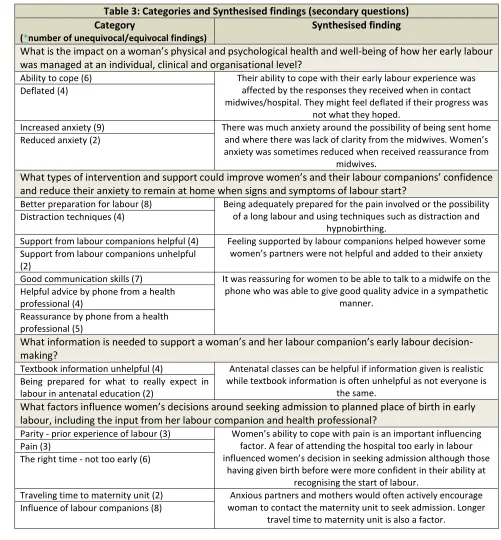
What factors influence women’s decisions around seeking admission to planned place of birth in early labour, including the input from her labour companion and health professional?
How can early labour management be improved to enhance women’s, their labour companions’ and health professionals’ perceptions and experiences of this phase of pregnancy and birth care?
Search strategy
A three-step search strategy was utilised to identify relevant publications. An initial limited search of MEDLINE and CINAHL was undertaken followed by analysis of text words contained in the title, abstract, and subject headings. A second search using all identified keywords was undertaken across all included databases (CINAHL, MEDLINE, EMBASE, PsycINFO, Scopus, Maternal & Infant Care, DARE, Web of Science). The reference lists of identified reports and articles were searched for additional studies. Initial keywords included labour, early labour, labour onset, latent phase, triage, maternity, midwifery, obstetrics, perinatal, antenatal, perceptions, satisfaction, experience, expectation, information and support. Figure 1 provides an example of the search strategy from one bibliographical database.
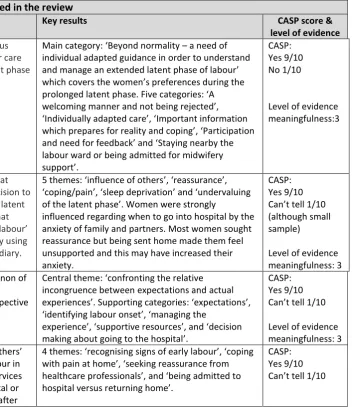
Publications were also assessed (Figure 2) to consider the level of evidence presented relevant to the review aims. All presented level 3 evidence, apart from one cross-sectional study which was assessed as level 4b (Table 1).
Evidence synthesis
The JBI approach to of meta–synthesis (for synthesis of qualitative evidence) involved the aggregation of findings to generate a set of statements to represent the synthesis (JBI 2014, Lockwood et al. 2015). Meta-aggregation reflects the processes of a systematic review while maintaining the traditions and requirements of qualitative research (JBI 2014). A verbatim extract of the author’s analytical interpretation of their data is used to develop categories from which synthesised findings are formed. Synthesised findings are generally statements developed into recommendations or implications for practice and policy, which do not require a re-interpretation of findings unlike other methods of qualitative synthesis such as meta-ethnography.
A three-step approach to thematic analysis was used. Firstly the extraction of author findings, from all included studies were entered onto a database. Each finding was supported by an illustration, usually a direct quote from a participant in the study. A level of credibility was allocated to each finding; unequivocal, equivocal or unsupported depending on the supporting illustration. If there was no supporting illustration it was graded as ‘unsupported’. Findings were then placed in categories based on the similarity in meaning, each category requiring a minimum of two findings. Unsupported findings were not used to form categories or contribute to the synthesised findings. Finally the categories were subjected to meta-synthesis to produce a comprehensive set of meta-synthesised findings. At least two categories were required to form each of the synthesised finding (Lockwood et al. 2015).
Findings
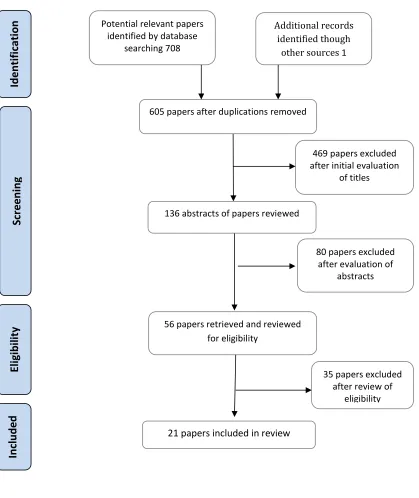
Following the initial systematic search, 709 publications were identified (Figure 3). After removing duplicate publications (n=104) titles were screened for relevance and 136 abstracts obtained for further analysis. Abstracts were independently read by two reviewers (xx, xx) after which 56 full texts were retrieved. The full texts were read and after further assessment, 20 were critically appraised using the appropriate critical appraisal checklist. An included study report (Spiby et al. 2007) could not be assessed using a checklist as it presented findings from a mixed methods study including questionnaires, interviews and focus groups from which only qualitative findings were extracted.
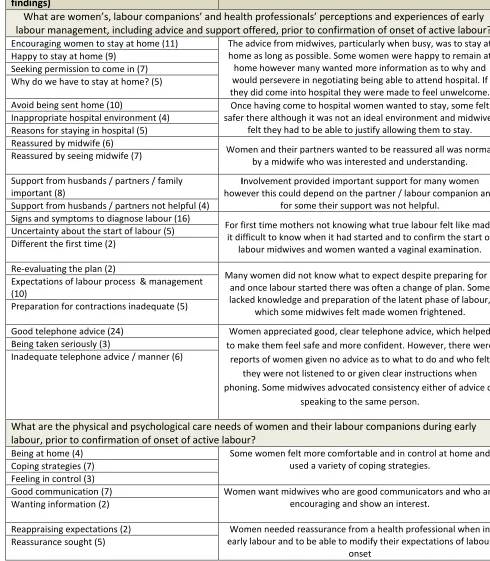
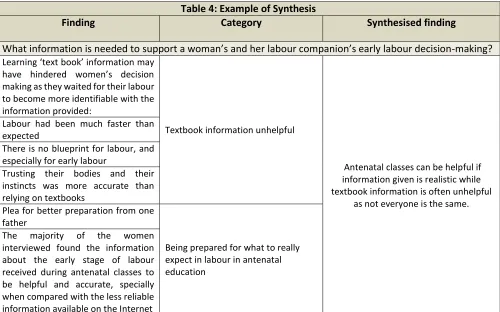
A total of 270 findings were identified. Two hundred and thirty-eight were assessed as either ‘unequivocal’ or ‘equivocal’ and supported by an illustration such as a direct quote from a study participant. The remaining 32 findings were ‘unsupported’ by an illustration and not used to develop categories. From the 238 illustrated findings a total of 65 categories were created, of which 45 were used to form 18 synthesised findings. The two primary questions had a total of 10 synthesised findings and the secondary questions a total of eight (see Tables 2 and 3). One secondary question did not have sufficient categories to form any synthesised findings. Some findings supported more than one review question. Table 4 provides an example of the synthesis process for one of the questions.
Primary questions
Given the similarity of the synthesised findings for the two primary questions findings are presented together.
What are women’s, labour companions’ and health professionals’ perceptions and experiences of early labour management, including advice and support offered, prior to confirmation of onset of active labour?
What are the physical and psychological care needs of women and their labour companions during early labour, prior to confirmation of onset of active labour?
Expectations and preparation for onset of labour
Although included studies referred to women preparing for labour by attending antenatal classes, primiparous women often did not know what to realistically expect. When labour commenced, these women would frequently revise labour management plans, particularly for pain relief, as the pain they experienced was worse than anticipated. Lack of knowledge and preparation of what to expect was acknowledged by women and labour companions. Midwives considered that women often felt very frightened and unprepared when labour started, as the following quotes from a woman and a midwife illustrate:
‘... getting on the floor, trying everything but nothing was easing it and I was getting louder and louder … I thought I had prepared myself for the worst but it was ten times worse than that.’ (woman: Barnett et al. 2008 p151)
‘You realise that they have not a clue of what to expect and therefore they’re scared.’ (midwife: Cheyne et al. 2006 p630)
The experiences of women having a second or subsequent labour and their labour companions reflected a more ‘relaxed’ approach to labour onset:
‘As it was our second baby, it was much more relaxed….We were much more in control and could concentrate on getting some rest.’ (labour companion: Nolan et al. 2012 p71)
Primiparous women found it difficult to differentiate between latent and established labour. Contrary to guidance (NICE 2017) which recommends vaginal examination is not always necessary to assess labour onset, women considered vaginal examination was important as findings would confirm labour had commenced and cervical dilatation had progressed:
‘I just wanted her [the midwife, to do], the first one to see how dilated I was because I wanted to know.…’ (woman: Dixon et al. 2013 p14)
Evidence from midwives highlighted that although they would ask women to describe their signs and symptoms, they would assess progress by observing the strength, length, frequency and regularity of contractions and how the woman reacted to these. Midwives appeared to prioritise clinical assessment over listening to the woman. Some midwives described vaginal examinations as useful to quickly confirm labour onset, the quote below from one midwife highlighting that these examinations were a ‘priority’ as the information gained would enable them to plan/consider their workload:
‘That’s why it can be important to check them fairly quickly. It’s about priorities, it’s about time, and then you know what you can talk about afterwards.’ (midwife: Eri et al. 2011 p288)
Smart phone apps designed to monitor labour contractions were being used by women to self-assess their labour progress:
‘I downloaded a program on my phone, because they tell you to score the contractions when they arrive, how long they last, etc […] It calculates the duration, then makes a graph based on the duration of the contractions.’ (woman: Cappelletti et al. 2016 p201)
Importance of clear communication and advice on what to do
The importance of clear communication particularly during a telephone call provided the largest number of findings. The call outcome frequently made a difference to whether a woman decided to attend her planned place of birth or remain at home. Individualised care was a priority for women, with advice provided by health professionals who were good communicators and showed an interest in them. Women wanted clear and consistent advice which could make them feel safe and more confident in their decision making.
‘I was given clear instructions, not ‘well it might be better’, which was what I needed…. I waited till the contractions were doing what the midwife said then phoned, they said come in…. I took the advice they gave and waited for it to happen…I knew it would be OK to go in.’ (woman: Green et al. 2012 p2221)
The impact of a call which a woman considered had not gone well was apparent. This could include women feeling they were not listened to, or not offered clear advice on how to self-manage their pain at home.
Women in some cases wanted to confirm that symptoms they reported were normal and that they could remain at home, as one woman described:
‘Then when I explained how things were, the midwife said that, well, it is probably the mucus plug, it’s as it should be, and it’s probably not the right time to come in yet. Well, I hadn’t intended to, of course, but I just wanted to ask someone, what’s this?’ (woman: Carlsson et al. 2012 p89)
Midwives also felt it was important to reassure women that what they were experiencing was ‘normal’:
‘I feel as well that it’s a lot about normalising what they are feeling, that it’s normal and it’s a start.’ (midwife: Eri et al. 2011 p289)
Involvement of the woman’s labour companion
A key role was played by women’s labour companions, however, women’s experiences varied depending on their labour companion’s attitude. Some reported that their companions were unsure of their role, a finding reiterated by one male labour companion who described:
‘It’s always a difficult time for fathers; they never know exactly what to do and often feel helpless. Sometimes us men don’t really understand, so you do the best you can. Basically she was glad to go to the birth unit and to be dealt with by professionals. I think fathers are superfluous at these moments.’ (labour companion: Nolan et al. 2012 p16)
Reasons and views on remaining at home
Some women and labour companions were happy to remain at home as they felt more comfortable and in control of what was happening.
‘Staying at home as long as possible really helped reduce the stress of labour since it was a comfortable, familiar environment.’ (labour companion: Nolan et al. 2012 p15)
However others did not understand the reason why they should remain at home and would persevere in negotiating admission to their planned place of birth.
‘It felt like a constant battle with the midwife on the phone as to whether we should be coming in.’ (labour companion: Nolan et al. 2012 p16)
Decisions as to whether a woman should remain at home were influenced by factors other than labour progress, most notably the midwives’ workload. At these times the advice offered by midwives was more likely to be that the women should remain at home as long as possible, as the following quote illustrates:
‘well I haven't really got any beds at the moment so I will do my damdest to put this lady off until later and sometimes you use every delaying and distraction tactic you have got.’ (midwife: Spiby et al. 2014 p1039)
Women who attended their planned place of birth who were not in established labour frequently wanted to remain there. It was not always an ideal environment to support labour progress and some felt unwelcome:
‘I came to hospital thinking that I would find a safe place where I could be reassured. Instead it wasn't like that.[…] I didn't feel helped, it's more like I was abandoned.’ (woman: Capelletti et al. 2016 p202)
Midwives described that they sometimes could not admit a woman due to a lack of beds, staff shortages or because admission of women in early labour did not comply with unit protocols and guidelines.
‘She may want to stay for the reassurance, and you are desperately trying to shove her out the door because you are just heaving at the seams and you’ve got nowhere to put her or no midwife to look after her.’ (midwife: Cheyne et al. 2006 p631)
Some midwives on the other hand felt they could justify admitting a woman if she had attended her planned place of birth on several occasions or was clearly distressed.
‘Sometimes you’ll have a lady who comes in, cervix only 50% effaced, maybe one cm, quite posterior, but she’s so distressed you just couldn’t possibly send her home. So you would keep her in, not because she’s in labour but she’s not coping, she needs reassurance.’(midwife: Cheyne et al. 2006 p630)
Secondary questions
Four of the five secondary questions had sufficient categories to form synthesised findings, with findings described below.
What is the impact on a woman’s physical and psychological health and well-being of how her early labour was managed at an individual, clinical and organisational level?
Feeling deflated
The content of the feedback women received when they consulted a health professional impacted on their perceptions of their ability to cope with active labour. In some cases, women would feel ‘deflated’ if labour progress was not as advanced as they hoped it would be:
‘You go in thinking I’ll maybe be about two centimetres you know, you hear about all the people who go in early and are sent home – that they think they are further on and they’re not. I felt deflated that I was not even one centimetre you know, and I was in this pain… so you think you are in labour ... but established labour, whatever that is, it just wasn’t happening at all.’(woman: Barnett et al. 2008 p151)
Lack of clarity or a vague response from the health professional contacted about what women should do in early labour could increase women’s anxiety. In one case a woman was told to ‘hang on a bit longer and see how you go’ rather than offered specific advice on how to cope.
There were several examples of women’s anxieties resolving on being admitted to their planned place of birth. However for some, the possibility of being sent home if labour was not established only increased their anxiety. One woman referred to her labour pains increasing on being sent home following assessment:
‘... they said that there was nothing really they could do, just to take Co-dydramol … for some reason when I seemed to be in the hospital it didn’t seem to be as bad, but then the minute I came home it just seemed to get worse, every time I came home it got worse and worse.’ (woman: Barnett et al 2008 p151)
What types of intervention and support could improve women’s and their labour companions’ confidence and reduce their anxiety to remain at home when signs and symptoms of labour start?
Antenatal preparation
The need for antenatal information for early labour including management on pain management and awareness that labour could last longer than anticipated was reported in several studies. One midwife was clear that better antenatal education was needed:
‘But if they (women) had a better education about latent phase then they wouldn't feel so frightened. I think that being in pain at home doesn't feel normal does it, but if they know that it is ok, then they won't phone in as quickly.’ (midwife: Spiby et al. 2014 p1039)
To prepare for labour onset, some women learned self-management techniques such as hypnobirthing or other ways to ‘distract’ from labour pains:
‘Thinking of early labour as the first step on a ladder of childbirth helped me stay focused, calm and positive about the whole birthing experience.’ (woman: Nolan et al. 2009 p36)
One midwife considered that a benefit of women attending active birth workshops was that they often delayed contacting their planned place of birth when labour started.
‘Certainly the women who went to an active birth workshop tend to phone in later’ (midwife: Spiby et al. 2014 p1039)
Practical support offered by a labour companion
Some women described the importance of practical support offered by their labour companions:
For other women the support offered by a female relatives, for example, their sister or mother was the most useful:
‘My sister was here, so I felt safe with her here too, and then my mother-in-law kept telling them ‘she will know when it’s time to go to the hospital.
’
They were all supportive of me being here. I think that helped me relax being here and knowing I was doing the right thing.’
(woman: Beebe & Humphreys et al.2006 p351 )Clear, sympathetic communication offered by health professionals
The importance of being offered clear advice in a sympathetic manner by a midwife or other health professional was apparent:
‘The assistance provided meant that I found it possible to remain at home longer than I would have otherwise on my own. My first child was induced so this was my first labour that happened naturally. I was still sent home after my first visit but this would have probably been the second visit without the helpful advice of the midwife with whom I spoke’ (woman: Weavers & Nash 2012 p336)
What information is needed to support a woman’s and her labour companion’s early labour decision-making?
Realistic information
Women and their labour companions wanted information which prepared them for the realities of labour. Antenatal classes which offered ‘realistic’ information were especially helpful, as one woman referred to:
‘The Internet is useful, but I think it's misleading because you find a lot of negative experiences. On the other hand, the antenatal course gives you information about what happens in reality’. (woman: Cappelletti et al. 2016 p200)
Women found ‘textbook information’ unhelpful, especially if labour onset and progress did not follow the ‘normal’ pattern that the information they were offered described. One woman explained how her two pregnancies had differed from her prior expectations:
‘I did not expect such intensity as quickly as all the books and classes prepare you for a build up of contractions. I never had this with either of my two labours.’ (woman: Nolan et al 2009 p36)
Some labour companions wanted specific information to enable them to feel that they could better support women particularly with respect to managing labour pain:
‘Wish I had more guidance on the …process prior to birthing…I wish I was prepared for how uncomfortable my partner would be during contractions before it was necessary to go to the hospital.’ (partner: Nolan et al. 2012 p17)
Internal factors
Internal factors included those that originated from the woman herself, such as her ability to cope with pain or fear of attending her planned place of birth too soon. Women who had given birth previously were more confident in their ability to recognise the start of labour and ‘trust’ their bodies:
‘And when we arrived they said that ‘you’re perfect and came exactly in the appropriate time’ and, yes, ‘you are a perfect patient. We were afraid of being sent home. We didn’t want to arrive there too early.’ (woman: Nyman et al. 2011 p131)
External factors
A woman’s labour companion or a female relative could actively encourage a woman to contact their planned place of birth to seek admission if the companion or relative were themselves anxious about a woman’s condition.
‘... my mum was like that, “no I canna watch you doing this any more. I’ve got to take you up.” So I ended up going back to the hospital still 2 centimetres dilated ... She couldn’t see me in that much pain any longer…’ (woman: Barnett et al. 2008 p148)
Another important influencing factor was if the woman and her companion were aware that time had to be factored in to reach her planned place of birth. This was also a particular concern for some:
‘My wife and I live 17 miles away from the hospital and in rush hour, it can take one and a half hours to get to the hospital. I was concerned about that.’ (labour companion: Nolan et al. 2012 p15)
Discussion
The management of early labour remains a challenge for women, labour companions and health professionals, a situation compounded by a continuing lack of consensus of how labour onset is defined (Hanley et al 2016). Over the last two decades, despite publication of studies of alternative management approaches which mainly focused on content of clinical care, evidence to support best practice is lacking as highlighted in a recent Cochrane review (Kobayashi 2017). Our review of women’s experiences contributes new evidence and new perspectives to support that approaches to early labour should be planned and tailored to individual women’s need and that equal priority is accorded to labour onset as placed on all other aspects of a woman’s pregnancy and birth ‘journey'. It is unclear as to why women are effectively left to manage this aspect of their labour with minimal guidance or support from health professionals.
Communication
Several key findings were identified, including the impact of how midwives communicated with women when offering telephone triage advice, listened to women’s ‘stories’ and content and quality of advice offered. Communication by telephone is frequently the first point of contact offered to women, and a source of advice, support and ‘permission’ to be admitted to their planned place of birth. It formed the essence of six of our 18 synthesised findings, showing that what women wanted was to be listened to by a sympathetic health professional, who communicated clearly, offered reassurance and clear advice on what to do. Women and midwives considered that getting the content and tone of communication right could reduce women’s anxiety about remaining at home.
The recommendations of the OPAL (OPtions for Assessment in early Labour) study (Spiby et al 2007) included that midwifery training in conducting telephone assessments needed to be reviewed, and training offered where required. The OPAL authors also recommended that when women telephoned in early labour or were discharged home following assessment, they should be offered clear advice on when to contact their planned place of birth again, and the rationale for this advice explained. Exploring ways to promote effective communication skills of relevant health professionals, including over the telephone, is an area that warrants further research. Effective communication between health professionals and between health professionals, women and their families, is core to promoting safe, high quality maternity care nationally and internationally (Royal College of Obstetricians and Gynaecologists 2007, 2008, Department of Health 2010, WHO 2017), with women’s experiences of maternity care viewed as important as clinical care in terms of achieving desired person-centred outcomes (Tuncalp et al 2015). The extent to which OPAL recommendations have been implemented into routine practice is unclear.
Antenatal preparation
Lack of appropriate antenatal preparation was raised by women and midwives. Nulliparous women did not know what to expect and even if they had attended antenatal education or accessed other sources of information, their experiences of early labour differed widely from expectations. One synthesised finding of how women’s confidence to remain at home could be enhanced was adequate preparation on how to manage early labour pain, together with realistic information on the likely overall duration of labour. None of the findings identified referred to the value of a woman knowing her midwife or influences of a particular model of care, including continuity of care models, on women’s decision making. This was despite the inclusion of several UK studies, where continuity and choice of care has been at the centre of maternity service policy for well over two decades (DoH 1993, 2004, 2007, 2010, Cumberlege 2016). Possible reasons could be the lack of priority accorded to discussing and planning early labour management, with all attention focused on outcomes of different models of maternity care during pregnancy and in active labour, and lack of choice offered to women about how their early labour progress could be managed.
support from other women. The growth in online resources includes those developed by research groups in the UK such as healthtalk.org, which includes pregnancy and birth stories from women (www.healthtalk.org), health organisations such as NHS Choices (www.nhs.uk) and UK parenting organisations such as the NCT (www.nct.org.uk) could help midwives and other health professionals to sign-post women to other reliable sources of information on signs and symptoms of early labour.
Individual approaches to pain management
Another approach may be to present scenarios of how labour progress varies among individuals and how individuals may react differently to contraction pain. Rather than offering ‘one stop shop’ information for all women, better insight into how a woman’s early labour could be managed to suit her individual need could be of value. Alternative approaches to antenatal preparation such as active birth workshops should also be considered to assess the extent to which they could reduce anxiety around labour onset. A Cochrane review of mind-body interventions during pregnancy to prevent or treat women’s anxiety and influence perinatal outcomes (Marc et al 2011) included one study
of
133 women which used imagery (an individual is encouraged to imagine a pleasant experience or object) with results suggesting that compared with usual care, imagery may have a positive effect on reducing maternal anxiety in the early and middle stages of labour (Ipp et al 2009). The small sample size limits the extent to which individual study findings can be generalised, but mind-body interventions could benefit some women with further rigorous research needed.Evidence of the potential benefit of self-hypnosis on women’s anxiety and fear of labour and birth is also increasing although studies to date have not focused on early labour. An RCT by Werner et al (2013) reported that a brief antenatal intervention in self-hypnosis improved nulliparous women’s experiences of childbirth compared with outcomes of women randomised to a relaxation and mindfulness group or usual care. Downe et al (2015) in their RCT of self-hypnosis training in pregnancy to better manage labour pain in nulliparous women showed as a secondary outcome that women in the intervention group had lower actual than anticipated levels of anxiety and fear between baseline (around 27 weeks gestation) and two weeks postnatally. Although a response rate of 67% limits the generalisability of this finding, it is nevertheless important to consider approaches to prevent and/or minimise maternal anxiety and fear at the onset of labour.
Advice to remain at home
Although current UK guidance recommends that it is not always necessary to include vaginal examination to confirm labour onset (NICE 2017) some women and midwives explained why this examination was important, albeit from different perspectives, which also supported findings of Bick et al (2009). Of concern is that our review found some women felt ‘deflated’ if their labour had not progressed as anticipated, while others who were admitted to their planned place of birth to await active labour onset felt unwelcome.
Role of labour companions
Women’s views of the optimal place for early labour were underpinned by our synthesised findings on the role of labour companions. For some women, companions were supportive and helped them relax and remain at home, while others encouraged women to seek early admission, possibly to allay their own anxieties. Further attention should be given to exploring how labour companions can feel more confident, less anxious and more able to support women. If the planned place of birth is some distance from the woman’s home or there are other potential logistical issues with respect to travel, these should also be discussed well in advance of labour onset given the likely anxiety and influence on decision making they are likely to generate. The role of doula support for women in early labour was not a focus in any of the included papers.
Women’s use of technology
A recent study by Cappelletti et al (2016) reported on the increasing role of technology on early labour management and experiences of women giving birth for the first time, with a range of apps now available to enable women to count the frequency and duration of their contractions. Other devices, including wearable abdominal monitors are also now being advertised which purport to enable women to distinguish between a contraction and abdominal cramps. There has also been a huge growth in websites women can access for information on pregnancy and birth, which often include women’s stories about labour and birth and personal ‘blogs’, although as described earlier information accessed can sometimes be misleading or present a negative picture of events. Further research is needed to investigate the potential benefits and harms of technology-based approaches on women’s self-management of early labour and influence on women’s decision making.
Strengths and Limitations
The review was conducted using a robust search strategy to identify all relevant evidence to address our primary and secondary questions. Included studies were subject to critical review and appraisal to meet planned aims and objectives. Although findings are relevant for high income countries, information about women’s, labour companions and health professional’s experiences of early labour onset and its management are likely to be applicable to other settings. The decision to exclude non English language studies and our search dates could have introduced selection bias, and it may have been more appropriate to have focussed on one broad question rather than seven different questions, as there was some repetition in the synthesised findings.
Conclusion
guidance and support from midwives and other health professionals. Tailoring early labour management to meet individual women’s needs, underpinned with high quality communication could reassure women and potentially prevent early admission to planned place of birth. Protocols and pathways to support labour management should be shared and discussed with women and their companions during pregnancy. The influences of labour companions on women’s decision making requires further investigation, as do use of interventions which could reduce anxiety on labour onset. Further research is needed of the impact of different models of care and increasing use of web-based information on women’s approaches to self-management.
Acknowledgments
DB and JS are part-funded by the NIHR CLAHRC South London.
Debra Bick is the Editor-in-Chief of the Midwifery and Jane Sandall is an Associate Editor of Midwifery but neither were involved in the peer review, or editorial decisions, regarding this manuscript. There are no other conflicts of interest.
References
Ängeby, K., Wilde-Larsson, B., Hildingsson, I., Sandin-Bojö, A-K,. 2015. Primiparous women’s preferences for care during a prolonged latent phase of labour. Sexual & Reproductive Healthcare 6, 145–150.
Barley, E. A., Murray, J., Walters, P., & Tylee, A. (2011). Managing depression in primary care: A meta‐synthesis of qualitative and quantitative research from the UK to identify barriers and facilitators. BMC Family Practice, 12(47).
Barnett, C., Hundley, V., Cheyne, H., et al. 2008. `Not in labour': impact of sending women home in the latent phase. British Journal of Midwifery 16(3): 144, 146, 148, 150-153.
Beebe, K.R., Humphreys, J., 2006. Expectations, perceptions, and management of labor in nulliparas prior to hospitalization. Journal of Midwifery & Women's Health 51(5): 347-353.
Bick, D., Rycroft-Malone, J., Fontenla, M., 2009. A case study evaluation of implementation of a care pathway to support normal birth in one English birth centre: anticipated benefits and unintended consequences. BMC Pregnancy and Childbirth Oct 5; 9:47.
Cappelletti, G., Nespoli, A., Fumagalli, S., Borrelli, S.E., 2016. First-time mothers’ experiences of early labour in Italian maternity care services. Midwifery 3, 198-204.
Carlsson, I.M., Hallberg, L.R., Odberg Pettersson, K., 2009. Swedish women's experiences of seeking care and being admitted during the latent phase of labour: a grounded theory study. Midwifery 25(2): 172-180.
Cheyne, H., Dowding, D.W., Hundley, V., 2006. Making the diagnosis of labour: Midwives' diagnostic judgment and management decisions. Journal of Advanced Nursing 53(6): 625-635.
Cheyne, H., Terry, R., Niven, C., Dowding, D., Hundley V., McNamee, P., 2007. Should I come in now?: a study of women's early labour experiences. British Journal of Midwifery 15(10): 604-609.
Cheyne, H., Hundley, V., Dowding, D., Bland, J.M., McNamee, P., Greer, I., Styles, M., Barnett C.A., Scotland, G., Niven, C., 2008. Effects of algorithm for diagnosis of active labour: cluster randomised trial. Br Med Journal; 337:a2396 doi: 10.1136/bmj.a2396
Cumberlege J (2016). The National Maternity Review. Better Births: Improving outcomes of maternity services in England. NHS England.
Department of Health (1993) Changing childbirth: report of the expert maternity group (Cumberlege report). HMSO: London.
Department of Health. 2004. National Service Framework for Children, Young People and Maternity Services. London, DH.
Department of Health. 2007. Maternity Matters: choice access and continuity of care in a safe service. London, DH.
Department of Health. 2010. Midwifery 2020: Delivering expectations. London, DH.
Downe, S., Finlayson, K., Melvin, C., Spiby, H., Ali, S., Diggle, P., Gyte, G., Hinder, S., Miller, V., Slade, P., Trepel, D., Weeks, A., Whorwell, P., Williamsonb, M., 2015. Self-hypnosis for intrapartum pain management in pregnant nulliparous women: a randomised controlled trial of clinical effectiveness. BJOG An International Journal of Obstetrics & Gynaecology. DOI: 10.1111/1471-0528.13433
Dixon, L., Skinner, J., Foureur, M., 2013. Women's perspectives of the stages and phases of labour. Midwifery 29(1): 10-17.
Eri, T.S., Blystad, A., Gjengedal E., Blaaka G. 2010. Negotiating credibility: first-time mothers’ experiences of contact with the labour ward before hospitalisation. Midwifery 26(6): e25-30.
Eri, T.S., Blystad, A. Gjengedal, E., Blaaka, G., 2011. ‘Stay home for as long as possible’: Midwives’ priorities and strategies in communicating with first time mothers in early labour. Midwifery 27: e286-92.
Eri, T.S., Bondas. T., M. Gross, M.M., Patricia Janssen, P., Josephine M. Green, J.M., 2015 A balancing act in an unknown territory: A metasynthesis of first-time mothers׳ experiences in early labour : http://dx.doi.org/10.1016/j.midw.2014.11.007
Green, J.M., Spiby, H., 2009. Early labour: What’s the problem? Birth 36:4 332-339.
Hanley, G.E., Munro, S., Greyson, D., Gross, M.M., Hundley, V., Spiby, H., Janssen, P.A., 2016 Diagnosing onset of labor: a systematic review of definitions in the research literature. BMC Pregnancy and Childbirth 16(71). DOI: 10.1186/s12884-016-0857-4
Hodnett, E.D., Stremler, R., et al. 2008 Effect on birth outcomes of a formalised approach to care in hospital labour assessment units: international randomised control trial. BMJ 2008;337:a1021 doi:10.1136/bmj.a1021
Holmes, P., Oppenheimer, L.W., Wen, S.W., 2001. The relationship between cervical dilatation at initial presentation in labour and subsequent intervention. BJOG 108:1120- 1124
Indraccolo U, Filippo D, Iorio D, Marinoni E, Roselli D, Indraccolo S. Effect of epidural analgesia on operative vaginal birth rate. Clin Exp Obstet Gynecol. 2011;38(3):221–224.
Ip WY, Tang CS, Goggins WB. An educational intervention to improve women’s ability to cope with childbirth. Journal of Clinical Nursing 2009;18(15):2125–35.
Janssen, P.A., Iker, C.E., et al 2003. Early labour assessment and support at home: a randomized controlled trial. Journal of Obstetrics & Gynaecology Canada 25(9): 734-741.
Janssen, P.A., Still, D.K., et al. 2006. Early labour assessment and support at home versus telephone triage: A randomized controlled trial. Obstetric and Gynecology 108(6): 1463-1469. Joanna Briggs Institute. 2014. Joanna Briggs Institute Reviewers’ Manual: 2014 edition. JBI: The University of Adelaide.
Joanna Briggs Institute. 2014. Reviewer’s manual. The Joanna Briggs Institute, The University of Adelaide
Klein M, Kelly A, Kaczorowski J, Gryzbowski S. The effect of family physician timing of maternal admission on procedures in labour and maternal and infant morbidity. J Obstet Gynaecol Can. 2004;26(7):641–645.
Kobayashi S, Hanada N, Matsuzaki M, Takehara K, Ota E, Sasaki H, Nagata C, Mori R. Assessment and support during early labour for improving birth outcomes. Cochrane Database of Systematic Reviews 2017, Issue 4. Art. No.: CD011516. DOI:
10.1002/14651858.CD011516.pub2.
Larkin, P., Begley, C.M., Devane, D. 2012. ‘Not enough people to look after you’: An exploration of women's experiences of childbirth in the Republic of Ireland. Midwifery 28(1): 98-105.
Lockwood, C., Munn, Z., Porritt, K., 2015. Qualitative research synthesis: methodological guidance for systematic reviewers utilising meta-aggregation. International Journal of Evidence-Based Healthcare; 13: 179-187.
Loughney A, Collis R, Dastgir S. Birth before arrival at delivery suite: associations and consequences. British Journal of Midwifery 2006;14(4):204–8.
Mackintosh, N., Watson, K., Rance, S., & Sandall, J. (2015). I’m Left in Fear: An Account of Harm in Maternity Care. Case Studies in Patient Safety, Ed Johnson,J. et al. Burlington MA, Jones and Bartlett Learning.
Marc I, Toureche N, Ernst E, Hodnett ED, Blanchet C, Dodin S, Njoya MM. Mind-body interventions during pregnancy for preventing or treating women’s anxiety. Cochrane Database of Systematic Reviews 2011, Issue 7. Art. No.: CD007559. DOI:
10.1002/14651858.CD007559.pub2.
NHS Digital. Hospital Maternity Activity 2015-2016. Downloaded from
http://content.digital.nhs.uk/catalogue/PUB22384/hosp-epis-stat-mat-summ-repo-2015-16-rep.pdf
National Institute for Health and Care Excellence. 2007. Intrapartum care: Care of healthy women and their babies during childbirth. CG55. NICE, London.
National Institute for Health and Care Excellence. 2014. Intrapartum care of healthy women and babies. CG190. NICE, London.
National Institute for Health and Care Excellence. 2017. Intrapartum care of healthy women and babies. CG190. NICE, London.
Nolan, M., and Smith, J., 2010. Women's experiences of following advice to stay at home in early labour. British Journal of Midwifery 18(5): 286-291.
Nolan, M., Catling, J., Smith, J., 2012. At home in early labour: what fathers do and how they feel - Part 3. Practising Midwife 15(3): 14-17.
Nyman, V., Downe, S., Berg, M., 2011. Waiting for permission to enter the labour ward world: First time parents' experiences of the first encounter on a labour ward. Sexual and Reproductive Healthcare 2(3): 129-134.
Royal College of Obstetricians and Gynaecologists, Royal College of Anaesthetists, Royal College of Midwives, Royal College of Paediatrics and Child Health 2007. Minimum Standards for the Organisation and Delivery of Care in Labour. RCOG Press: London.
Royal College of Obstetricians and Gynaecologists, Royal College of Anaesthetists, Royal College of Midwives, Royal College of Paediatrics and Child Health 2008 Standards of Maternity Care. RCOG Press: London.
Spiby, H., Green, J., Hucknall, C., et al. 2006. Labouring to better effect: studies of services for women in early labour. The OPAL study (OPtions for Assessment in early Labour). National Institute for Health Research Service Delivery and Organisation Programme, Southampton.
Spiby, H., Green, J.M., Hucknall, C., Richardson, H., Andrews, A., 2007. Labouring to better effect: studies of services for women in early labour. Final report to the NIHR Service Delivery and Organisation Programme. SDO/64/2003. NCCSDO, London.
Spiby, H., Green, J.M., Richardson-Foster, H., et al. 2013. Early labour services: Changes, triggers, monitoring and evaluation. Midwifery 29(4): 277-283.
Spiby, H., Walsh, D., Green, J., et al. 2014. Midwives' beliefs and concerns about telephone conversations with women in early labour. Midwifery 30(9): 1036-1042.
Spiby H, Green JM, Darwin Z, Willmot H, Knox D, McLeish J, et al. Multisite implementation of trained volunteer doula support for disadvantaged childbearing women: a mixed-methods evaluation. Health Serv Deliv Res 2015;3(8).
Tuncalp, O., Were, W., MacLennan, C., Oladapo, O.T., Gulmezoglu, A.M., Bahl, R, et al. 2015 Quality of care for pregnant women and newborns—The WHO vision. BJOG;122:1045–9
Weavers, A., Nash, K., 2012. Setting up a triage telephone line for women in early labour. British Journal of Midwifery 20(5): 333-338.
Werner A, Uldbjerg N, Zachariae R, Wu CS, Nohr EA. Antenatal hypnosis training and childbirth experience: a randomized controlled trial. Birth. 2013 Dec; 40(4):272-80.
Figure 1: Electronic search strategy for Medline
1. *Labor Onset/ or labour onset.mp.
2. limit 1 to (english language and humans and yr="2003 - 2016")
3. early labour.mp.
4. limit 3 to (english language and humans and yr="2003 - 2016")
5. early labor.mp.
6. limit 5 to (english language and humans and yr="2003 - 2016")
7. latent phase.mp.
8. limit 7 to (english language and humans and yr="2003 - 2016")
9. *Triage/
10. limit 9 to (english language and humans and yr="2003 - 2016")
11. 2 or 4 or 6 or 8 or 10
12. *Prenatal Care/ or *Pregnancy/ or *Midwifery/ or *Hospitals, Maternity/ or maternity.mp. or
*Maternal Health Services/
13. limit 12 to (english language and humans and yr="2003 - 2016")
14. *Obstetrics/
15. limit 14 to (english language and humans and yr="2003 - 2016")
16. *Perinatal Care/
17. limit 16 to (english language and humans and yr="2003 - 2016")
18. 13 or 15 or 17
19. *Personal Satisfaction/
20. limit 19 to (english language and humans and yr="2003 - 2016")
21. experiences.mp.
22. limit 21 to (english language and humans and yr="2003 - 2016")
23. experience.mp.
24. limit 23 to (english language and humans and yr="2003 - 2016")
25. expectation.mp.
26. limit 25 to (english language and humans and yr="2003 - 2016")
27. *Communication/ or information.mp.
28. limit 27 to (english language and humans and yr="2003 - 2016")
29. support.mp. or *Social Support/
31. 20 or 22 or 24 or 26 or 28 or 30
[image:23.595.91.499.145.697.2]32. 11 and 18 and 31
Figure 2. The Joanna Briggs Institute levels of evidence
Levels of evidence for effectiveness
Level 1 Experimental designs (strongest evidence)
Level 1.a – Systematic review of Randomized Controlled Trials (RCTs) Level 1.b – Systematic review of RCTs and other study designs Level 1.c – RCT
Level 1.d – Pseudo-RCTs
Level 2 Quasi-experimental designs
Level 2.a – Systematic review of quasi-experimental studies
Level 2.b – Systematic review of quasi-experimental and other lower study designs Level 2.c – Quasi-experimental prospectively controlled study
Level 2.d – Pre-test – post-test or historic/retrospective control group study
Level 3 Observational – analytical designs
Level 3.a – Systematic review of comparable cohort studies
Level 3.b – Systematic review of comparable cohort and other lower study designs Level 3.c – Cohort study with control group
Level 3.d – Case – controlled study
Level 3.e – Observational study without a control group
Level 4 Observational – Descriptive studies
Level 4.a – Systematic review of descriptive studies Level 4.b – Cross-sectional study
Level 4.c – Case series Level 4.d – Case study
Level 5 – Expert Opinion and Bench Research
Level 5.a – Systematic review of expert opinion Level 5.b – Expert consensus
Level 5.c – Bench research/ single expert opinion
Levels of evidence for meaningfulness
1. Qualitative or mixed-methods systematic review 2. Qualitative or mixed-methods synthesis
3. Single qualitative study
Figure 3: Flow chart of stages of searching
80 papers excluded after evaluation of
abstracts 469 papers excluded after initial evaluation
of titles Potential relevant papers
identified by database searching 708
136 abstracts of papers reviewed
35 papers excluded after review of
eligibility
21 papers included in review
Id
e
n
ti
fi
cat
ion
Scr
e
e
n
in
g
El
ig
ib
ili
ty
In
cl
u
d
e
d
605 papers after duplications removed
Additional records identified though
other sources 1
Table 1 Papers included in the review
Paper Methodology Study population Aim of study Key results CASP score & level of evidence Angeby et al. 2015
(Sweden) Focus groups and individual interviews. Interviews 2 months PN.
16 women; primips (with a history of prolonged latent phase of labour). Low risk on admission to hospital.
To investigate primiparous woman’s preferences for care during a prolonged latent phase of labour.
Main category: ‘Beyond normality – a need of individual adapted guidance in order to understand and manage an extended latent phase of labour’ which covers the women’s preferences during the prolonged latent phase. Five categories: ‘A welcoming manner and not being rejected’, ‘Individually adapted care’, ‘Important information which prepares for reality and coping’, ‘Participation and need for feedback’ and ‘Staying nearby the labour ward or being admitted for midwifery support’.
CASP: Yes 9/10 No 1/10
Level of evidence meaningfulness:3
Barnett et al. 2008 (UK) Self-completed, semi-structured diaries and follow up interviews. Interviews 1-4 months PN.
6 women diaries / 5 women interviews (aimed to recruit 40 women, 21
consented)
To explore the factors that influence a woman’s decision to go to a maternity unit in latent labour and the impact that being sent home ‘not in labour’ has on her and her family using a self-completed labour diary.
5 themes: ‘influence of others’, ‘reassurance’, ‘coping/pain’, ‘sleep deprivation’ and ‘undervaluing of the latent phase’. Women were strongly
influenced regarding when to go into hospital by the anxiety of family and partners. Most women sought reassurance but being sent home made them feel unsupported and this may have increased their anxiety.
CASP: Yes 9/10 Can’t tell 1/10 (although small sample)
Level of evidence meaningfulness: 3 Beebe & Humphreys 2006 (USA) Ethnographic study. Semi-structured interviews.
23 women; primips To explore the phenomenon of labour prior to hospital
admission from the perspective of primiparous women.
Central theme: ‘confronting the relative incongruence between expectations and actual experiences’. Supporting categories: ‘expectations’, ‘identifying labour onset’, ‘managing the
experience’, ‘supportive resources’, and ‘decision making about going to the hospital’.
CASP: Yes 9/10 Can’t tell 1/10
Level of evidence meaningfulness: 3 Cappelletti et al.
2016 (Italy)
Phenomenologic al study. Face-to-face semi- structured interviews.
15 women; primips To explore first-time mothers’ experiences of early labour in Italian maternity care services when admitted to hospital or advised to return home after
4 themes: ‘recognising signs of early labour’, ‘coping with pain at home’, ‘seeking reassurance from healthcare professionals’, and ‘being admitted to hospital versus returning home’.
Interviews 48-72hrs PN
maternity triage assessment in an Italian maternity hospital.
Level of evidence meaningfulness: 3
Carlsson et al .2009 (Sweden) Grounded theory. Interviews. Interviews 2-6 weeks PN. 18 women:
11 primips, 7 multips
To gain a deeper understanding of how women who seek care at an early stage experience the latent phase of labour.
Core category; ‘handing over responsibility’ to professional caregivers. Categories, related to the core category: ‘longing to complete the pregnancy’, ‘having difficulty managing the uncertainty’, ‘having difficulty enduring the slow progress’, ‘suffering from pain to no avail’ and ‘oscillating between powerfulness and powerlessness’.
CASP: Yes 10/10
Level of evidence meaningfulness: 3
Carlsson et al. 2012 (Sweden) Constructivist grounded theory. Interviews. Interviews 2 days to 2 weeks PN.
19 women; primips To examine midwives’
perceptions of the way in which they diagnose labour.
Core category: ‘maintaining power’ was identified as explaining the women’s experience of having enough power when the labour started. Related categories: ‘to share the experience with another’, ‘to listen to the rhythm of the body’, ‘to distract oneself’ and ‘to be encased in a glass vessel’, explained how the women coped and there by maintained power.
CASP: Yes 9/10 Can’t tell 1/10
Level of evidence meaningfulness: 3
Cheyne et al. 2006 (UK)
Focus groups 13 midwives To examine midwives’
perceptions of the way in which they diagnose labour.
2 categories: those arising from the woman ‘physical signs’, ‘distress and coping’, ‘woman's expectations’, ‘social factors’ and those from the institution ‘midwifery care’, ‘organizational factors’, ‘justifying actions’. Midwives' decision-making process could be divided into two stages. The diagnostic judgement was based on the physical signs of labour. The management decision would then be made by considering the diagnostic judgement as well as cues such as how the woman was coping, her expectations and those of her family and the requirements of the institution.
CASP: Yes 9/10 Can’t tell 1/10
Level of evidence meaningfulness: 3
Cheyne et al. 2007 (UK)
Semi-structured interviews
21 women: 16 primips, 5 multips
To determine the main themes and issues surrounding women’s early labour
2 main themes: ‘preparation for labour’ and ‘being in labour’. A combination of uncertainty, pain and anxiety influenced women’s early labour decisions.
experiences and factors which influence their decision making processes regarding when to go to hospital.
While many felt they were coping well with their labour on admission, women often wanted to be in hospital ‘just in case’ and lacked the confidence to cope with labour at home.
Level of evidence meaningfulness: 3
Dixon et al. 2013 (New Zealand)
In depth interviews. Interviews within 6 months PN
18 women: 6 primips, 12 multips.
7 hospital birth, 7 stand-alone midwife led unit, 7 home births
To determine whether the discourse of labour as stages and phases resonated with women who had experienced spontaneous labour and birth.
Key findings: the stages and phases were known by the participants but were considered to be obscure and intangible. The onset of labour was clearly and easily identified by the participants who asked the midwife when they needed more information and support. Multiparous women often relied on their own previous experiential knowledge to locate themselves in their labour. There was still a reliance on the vaginal examination to determine cervical dilatation as a means of gauging the labour process.
CASP: Yes 9/10 Can’t tell 1/10
Level of evidence meaningfulness: 3
Eri et al. 2010 (Norway) Qualitative. In depth interviews. Interviews 1-6 weeks PN
17 women; primips To explore primiparous women's experiences of communication and contact with midwives at the labour ward in the early phase of labour.
4 themes that were central to how labouring women decided to make contact with the labour ward and how they experienced this contact with the staff: ‘negotiating on two fronts’, ‘avoiding being sent home’, ‘searching for regularity’, ‘experiencing vulnerability’.
CASP: Yes 9/10 Can’t tell 1/10
Level of evidence meaningfulness: 3 Eri et al. 2011
(Norway)
Qualitative. Focus groups
18 midwives To explore the priorities and strategies midwives in a labour ward use in their
communication with
primiparous women who seek contact in the early phase of labour.
5 themes constituted the key elements in the communication were identified: 'getting the picture', 'normalising the situation', 'giving concrete advice', 'letting the woman make the decision', and 'staying at home for as long as possible'.
CASP: Yes 9/10 No 1/10
Level of evidence meaningfulness: 3
Green et al. 2012 (UK) Mixed methods study using structured telephone interviews to collect
46 women; primips To report women’s experiences of and satisfaction with, telephone communications within the All Wales Clinical Pathway for Normal Labour (‘the Pathway’).
Women were not well prepared for the Pathway (staying at home); however, satisfaction was more strongly related to interpersonal interactions with midwives. Dissatisfied women reported unclear advice, unmet needs, unaddressed anxieties and negative midwife manner. 'Very satisfied' women
CASP: Yes 9/10 Can’t tell 1/10
qualitative and quantitative data. Interviews 6-10 weeks PN.
were distinguished by feeling welcome to attend the maternity unit and by the perceived adequacy of the advice given.
Larkin et al 2012 (Republic of Ireland) Focus groups held 10-18 weeks PN 25 women:
9 primips, 16 multips
Explore women's experience of childbirth in Ireland
3 main themes; ‘getting started’, ‘getting there’ and ‘consequences’. Midwives played a pivotal role in enabling or disempowering positive experiences. Control was an important element of childbirth experiences. Women often felt alone and unsupported. The busyness of the hospital units precluded women centred care both in early labour.
CASP: Yes 8/10 Can’t tell 1/10 No 1/10
Level of evidence meaningfulness: 3 Low & Moffat 2006
(USA)
Semi-structured interviews. Interviews 1 week to 3 months PN.
24 women To explore women’s
perceptions of transitioning to the birth facility when in labour.
3 themes: ‘don’t trust your body, trust us’, ‘this is not right’ ‘this is too labor!’. Pain was identified as the primary reason for transitioning to the hospital. Once arriving at the hospital, women often felt pressure to “get it right” and not make multiple trips.
CASP: Yes 9/10 Can’t tell 1/10
Level of evidence: 3
Nolan & Smith 2010
(UK)
Semi-structured PN interviews
8 women:
7 primips, 1 multip.
To explore women’s
experiences of staying at home following advice from an obstetric triage unit.
4 themes: ‘reassurance’ (the need to have labour validated by health professionals), ‘uncertainty about early labour’, ‘pressure from women’s families to go to hospital’, and ‘seeking permission to come in’. The overall theme reflected women’s sense that advice to stay at home was a professional rather than a woman-centred response to early labour.
CASP: Yes 10/10
Level of evidence meaningfulness: 3
Nolan et al. 2012 (UK)
Web-based survey.
Reported results of final open ended question.
263 men. babies were born; hospital 85% birth centre 5%
home 10%
Experience of being at home with their partners in early labour.
Themes: ‘relaxed and positive versus fearful and anxious’, ‘feeling included’, ‘feeling excluded’, ‘good communication’, ‘poor communication’, ‘a difficult time for fathers’.
CASP: Yes 5/10 Can’t tell 5/10
Level of evidence meaningfulness: 3 Nyman et al. 2011
(Sweden) A hermeneutic, reflective life world research 37 women: individual interviews.
To explore the meaning of first time mothers' and their partners' first encounter with
4 themes: ‘timing it right’, ‘waiting to be informed’, ‘being in an inferior position’, ‘facing reality with a mosaic of emotions’. The final interpretation of the