White Rose Research Online URL for this paper:
http://eprints.whiterose.ac.uk/99230/
Version: Accepted Version
Proceedings Paper:
Brucker, A.D. orcid.org/0000-0002-6355-1200 and Wolff, B. (2016) Monadic Sequence
Testing and Explicit Test-Refinements. In: Aichernig, B.K. and Furia, C.A., (eds.) TAP 2016:
Tests and Proofs. 10th International Conference, TAP 2016, Held as Part of STAF 2016,
July 5-7, 2016, Vienna, Austria. Lecture Notes in Computer Science, 9762 . Springer,
Cham , pp. 17-36. ISBN 978-3-642-38915-3
https://doi.org/10.1007/978-3-319-41135-4_2
[email protected] https://eprints.whiterose.ac.uk/ Reuse
Unless indicated otherwise, fulltext items are protected by copyright with all rights reserved. The copyright exception in section 29 of the Copyright, Designs and Patents Act 1988 allows the making of a single copy solely for the purpose of non-commercial research or private study within the limits of fair dealing. The publisher or other rights-holder may allow further reproduction and re-use of this version - refer to the White Rose Research Online record for this item. Where records identify the publisher as the copyright holder, users can verify any specific terms of use on the publisher’s website.
Takedown
If you consider content in White Rose Research Online to be in breach of UK law, please notify us by
B.K. Aichernig et al. (Eds.): TAP 2016: Tests And Proofs, pp. 1–19, 2016. c
2016 Springer-Verlag. This is the author’s version of the work. It is posted athttp: //www.brucker.ch/bibliography/abstract/brucker.ea-monadic-sequence-testing-2016by permission of Springer-Verlag for your personal use.
and Explicit Test-Refinements
Achim D. Brucker1 and Burkhart Wolff2
1
Department of Computer Science, The University of Sheffield, Sheffield, UK [email protected]
2
LRI, Univ Paris Sud, CNRS, Centrale Suplélec, Université Saclay, France [email protected]
Abstract We present an abstract framework for sequence testing that is implemented in Isabelle/HOL-TestGen. Our framework is based on the theory of state-exception monads, explicitly modelled in HOL, and can cope with typed input and output, interleaving executions including abort, and synchronisation.
The framework is particularly geared towards symbolic execution and has proven effective in several large case-studies involving system models based on large (or infinite) state.
On this basis, we rephrase the concept of test-refinements for inclusion, deadlock and IOCO-like tests, together with a formal theory of its rela-tion to tradirela-tional, IO-automata based norela-tions.
Keywords:Monadic sequence testing framework·HOL-TestGen
1
Introduction
Automata-based theoretical foundations for test and model-checking techniques are omnipresent; it can be safely stated that a huge body of literature [7, 16, 19, 20, 22] uses them as a framework for conceptual argument, comparison, and scientific communication. Usually based on naïve set-theory (in the sense of Halmos [14]) and paper and pencil notations, they proved as a very intuitive and flexible framework. In our view, this omnipresence overshadows the fact that automata theory is a kind of mould into which not everything fits. This is to a lesser extent a burden on the purely theoretical side: naïve set theory is known to be inconsistent, and the sheer number of variants of automata notions makes comparisons more delicate as one might think.
of symbolic versions of test-systems like TGV (e. g., STG [16]) or SIOCO [12] remained in a prototypical stage.
In this paper, we present an alternative to the automata-paradigm, as far as their application in the field of testing of behavioural models are concerned. Motivated by several projects aiming at the synthesis of test-algorithms for be-havioural models with very large and usually infinite state-spaces, we developed aMonadic Sequence Testing Framework (MST). It is formalised in Isabelle/HOL and has been used in several major case-studies [2, 4, 5]. While the framework is tuned for mechanised deduction, in particular symbolic execution based on derived rules, it provides a number of theoretic properties which are interesting in its own. MST combines 1. generalised forms of non-deterministic automata with input and output, 2. generalises the concept of Mealy-Machines, 3. gener-alises the concept of extended finite state machines [13], and 4. genergener-alises some special form of IO Automata, IO LTS’s, etc. [19]. Overall, MST shares with [26] the vision of a unified framework for generalising and analysing formalism for symbolic test case generation. Due to shallow representations of programs and pre-post-condition-based program specifications, the MST approach is intrin-sic symbolic; no complicated “lifting” of IO Automata or IO LTS’s to symbolic versions thereof like IOSTS’s is necessary.
We will introduce paper-and-pencil notions for basic automata constructions (Sec. 2), the general concept of test theories (Sec. 3). In Sec. 4, we introduce higher-order logic (HOL) Sec. 4 and sketch our formalization of Sec. 2 in HOL. Finally we introduce our monadic framework, which is demonstrated in Sec. 4.4 on a small example based on an extended infinite automata. In Sec. 5, we gen-eralise the key-concepts of the MST one step further to a formal definition of test-refinements; it is shown that this definition is powerful enough to capture a family of widely known, but up to now unrelated concepts of (sequence) test conformance. We will show that this is of pragmatic interest for proven correct test-optimisations as well as theoretic interest due to its link to IO-automata.
2
A Guided Tour on Automata Notions for Testing
In this section, we provide a brief overview of behavioural automata models, focusing on on symbolic versions of automata concepts.
The Mealy-machine. A Mealy Machine (MM) [20] is a 6-tuple (S, S0, Σin, Σout, T, G)consisting of the following: –a finite set of statesS –a start state (initial state)S0which is an element ofS–a finite set of, the input alphabetΣin –a finite set of symbols, the output alphabet Σout –a transition function T :
S×Σin→Smapping pairs of a state and an input symbol to the corresponding next state.–an output functionG:S×Σin→Σoutmapping pairs of a state and an input symbol to the corresponding output symbol. In some formulations, the transition and output functions are coalesced into a single functionT :S×Σin,→
related to Moore machines [21] which are equivalent. If the finiteness constraints are removed, one speaks of a Generalised Mealy Machine (GMM).
The Deterministic Automata. The deterministic finite automaton (DFA) M is a 5-tuple, (S, S0, Σ, T, F), consisting of – a finite set of states S, – an initial or start state S0 ∈ S, – a finite set of symbols, the alphabet Σ, – a transition function T :S×Σ→S, and –a set of accept states F ⊆S. If the finiteness-constraints are lifted, we speak of adeterministic automaton (DA). If T is generalised to a relationP(S×Σ→S), one speaks of a non-deterministic finite automaton (NDFA) or a non-deterministic automaton (NDA) respectively. If the alphabetΣis structured as a set of pairsΣin×Σout of input-and output labels, we speak of input-output-tagging of the automata versions. The astute reader will notice that input-output-tagged NDFA’s and NDA’s can be mapped to generalised Mealy machines GMM and vice versa.
The interest into symbolic versions of these automata notions was raised surprisingly recently: Veanes et al. presented Finite Symbolic Automata as a tool (REX [27]) and investigated their theoretic properties [9].
The Input/Output Automata Input-output labelled transition systems are going back to the notions of Lynch and Tuttle [19]. This line of automata defini-tions, which were later on referred as “labelled transition systems,” emphasises the annihilation of the difference between input and output to enable some form of asynchronous communication between tester and the system under test SUT as well as some rudimentary form of time (the concept supports silent τ ac-tions to express time elapsing while someinternal action in the machine is per-formed). The theory supports in principle that a SUT can non-deterministically decide either to accept input or to emit output; in practical testing scenar-ios, this possibility is usually ruled out. Formally, an IO-automata is defined as a 5-tuple (S, S0, Σ, T,Task) consisting of: – a (not necessarily finite) set of states S, – a start state (initial state) S0 which is an element of S, – an al-phabet, thesignature Σwhich is partitioned into three disjoint sets of symbols Σ=inIOA∪outIOA∪outIOA∪intIOAare calledinputactions,outputactions, and
internal actions,–a transitionrelation T ⊆S×Σ×S, and–a task-partition
Task which is defined as an equivalence relation on outIOA∪outIOA∪intIOA. In contrast to input-output tagged NDA’s, whereΣis theCartesian product of input and output, IO Automata constructΣas disjoint union.
The task partition is used to define fairness conditions on an execution of the automaton. These conditions require the automaton to continue giving fair turns to each of its tasks during its execution. This component of the original formula-tion is often dropped and replaced by other ones in related approaches [15, 24].
denotes the type of d.–Θ is the initial condition, a Boolean expression on V, – S is a nonempty,finite set of states and S0 ∈ S is the initial state. –Σ is a nonempty, finite set of symbols, which is the disjoint union of a set Σ?of input actions and a set Σ! of output actions. For each action a ∈ Σ, its signature sig(a) = (p1, . . . , pk)∈Pk(k∈N)is a tuple of parameters.–T is a set of tran-sitions. Each transition is a tuple(s, a, G, A, s)made of: a locations∈S, called the origin of the transition, an actiona∈Σ, called the action of the transition, a Boolean expressionGonV∪sig(a), called the guard, an assignmentA, which is a set of expressions of the form(x:=Ax)
x∈V such that, for eachx∈V, the right-hand side Ax of the assignment x:=Ax is an expression on V ∪sig(a), a location s ∈ S called the destination of the transition. Similar attempts to generalise IO Automata to symbolic versions of IO-LTL’s are [12].
Extended Finite State Machines. An extended finite state machine (EFSM) [7] is a 7-tupleM = (S, D, I, O, F, U, T)where–Sis a set of symbolic states,–I is a set of input symbols,–Ois a set of output symbols,–Dis an n-dimensional linear space D1× · · · ×Dn,–F is a set of enabling functionsfi :D → {0,1}, – U is a set of update functions ui : D → D, – T is a transition relation, T : S ×F ×I → S ×U ×O EFSM’s have been motivated from the very beginning by (symbolic) testing techniques [7].
Many variants have been discussed in the literature that attempt to give a concrete syntax (e. g., a term-language, just assignments) forF andU; however, we will refrain from this and try to keep our MST framework abstract on the level of functions and not their syntactic representations.
Some Common Notions of Automatons. We distinguish the notion of a
trace: Traces(A)contains the set of lists of symbols [a1, a2, a3, . . .] in A(which is an arbitrary automaton DA, NDA, DFA, NDFA, . . . ), which describe a path in A. Here, we consider the case of an ESFM similar to an input-output tagged DA or NDA. Arunis a list of triples[(s1, a1, s2),(s2, a2, s3), . . .]which describes a path inA; Run(A)contains the set of runs in A. With StatesA(t)we denote the set of reachable states after a trace t ∈Trace(A). Ift ∈Trace(A)(A is an input-output tagged DA or NDA, IO Automaton, IOSTS, EFSM), we denote with InA(t) the set of possible input symbols after t; with OutA(t) the set of possible output symbols. We call an automaton IO-deterministic, iff for each tracet∈Trace(A), there is at most one reachable state aftert:|StatesA(t)| ≤1. For automata A (which is again an input-output tagged DA or NDA, IO Automaton, IOSTS, EFSM), we define the notion of input-sequences of a trace as projection of traces into its input components: ift= [(i1, o1),(i2, o2),(i3, o3), . . .] is in Trace(A), then[i1, i2, i3, . . .] is the corresponding input-sequence oft.
In other words, the relation between a sequence of input-output pairs and the resulting system state must be a function.
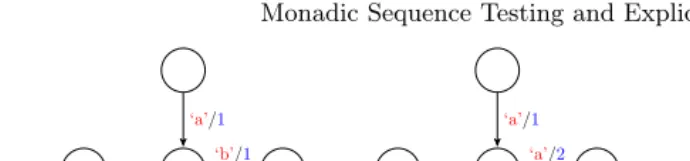
‘a’/1
‘a’/1
‘b’/1
(a) IO-Deterministic SUT.
‘a’/1
‘a’/1
‘a’/2
(b) IO-Deterministic SUT.
‘a’/1
‘b’/1
‘b’/1
[image:6.612.46.391.45.125.2](c) Non-IO-Deterministic SUT. Fig. 1.IO-Determinism and Non-IO-Determinism
adding some notion of time), but most practical approaches do assume it as we do throughout this paper. There are approaches (including our own [3]) that allow at least a limited form of access to the final (internal) state of the SUT.
A sequence of input-output pairs through an automatonAis called a trace, the set of traces is written Trace(A). The function In returns for each trace the set of inputs for whichA is enabled after this trace; in Fig. 1c for example,
In [(“a”,1)]is just{“b”}, in Fig. 1a, just{“a”,“b”}. Dually,Out yields for a trace tand inputι∈In(t)the set of outputs for whichAis enabled aftert; in Fig. 1b for example,Out([(“a”,1)],“a”)this is just{1,2}.
3
A Gentle Introduction to Sequence Testing Theory
Sequence testing is a well-established branch of formal testing theory having its roots in automata theory. The methodological assumptions (sometimes called
testability hypothesis in the literature) are summarised as follows:
1. The tester can reset the system under test (SUT) into a known initial state, 2. the tester can stimulate the SUT only via theoperation-callsandinput of a known interface; while the internal state of the SUT is hidden to the tester, the SUT is assumed to beonly controlled by these stimuli,
3. the SUT behaves deterministic with respect to an observed sequence of input-output pairs (it isIO-deterministic).
The latter two assumptions assure the reproducibility of test executions. The latter condition doesnot imply that the SUT is deterministic: for a given input ι, and in a given state σ, the SUT may non-deterministically choose between the successor states σ′ and σ′′, provided that the pairs(o′, σ′)and (o′′, σ′′)are
distinguishable. Thus, a SUT may behave non-deterministically, but must make its internal decisions observable by appropriate output.
Equipped with these notions, it is possible to formalise the intended con-formance relation between a system specification (given as automaton SPEC
labelled with input-output pairs) and aSUT. The following notions are known in the literature:–inclusion conformance[18]: all traces in SPECmust be pos-sible in SUT, – deadlock conformance [10]: for all traces t ∈ Traces(SPEC)
4
Monadic Sequence Testing Framework
4.1 Higher-Order Logic and Isabelle/HOL
Higher-order logic (HOL) [1, 8] is a classical logic based on a simple type sys-tem. Types have been extended by Hindley/Milner style polymorphism: they consist of type variables ′α,′β,′γ, . . . and and type constructors such as _ ⇒
_,_set,_list,_×_,_+_,bool,nat, . . . (for function space, typed sets, lists, Cartesian products, disjoint sums, Boolean, natural numbers, etc) with type classes similar to Haskell:(′α: : linorder)listconstrains the set of possible types, for example, to those types that posses an ordering symbol which satisfies the properties of a linear order. The simple-typedλ-calculus underlying Isabelle en-forces that any λ-expression emust be typed by a type-expression τ; we write e : : τ for e is well-typed and has type τ. Being based on a polymorphically typed λ-calculus, HOL can be viewed as a combination of a programming lan-guage such as SML or Haskell, and a specification lanlan-guage providing powerful logical quantifiers ranging over elementary and function types.
HOL provides the usual logical connectives, e. g., _∧_, _→_,¬_ as well as the object-logical quantifiers∀x. P xand∃x. P x; in contrast to first-order logic, quantifiers may range over arbitrary types, including total functionsf: : α⇒β. HOL is centred around extensional equality _=_: : α⇒α⇒bool.
Isabelle/HOL offers support for extending theories in a logically safe way: a theory extension isconservative if the extended theory is consistent provided that the original theory was consistent. Conservative extensions can beconstant definitions,type definitions, datatype definitions, primitive recursive definitions
andwell-founded recursive definitions.
For example, the polymorphic option-type is defined as:
datatype’αoption = None | Some(the: ’α)
which implicitly introduces the constructors NoneandSome, the selectorthe as well as a number of lemmas over this data-type (e. g.,None6=Some x,the (Some x)= x, induction). The option type is also used to model partial functions’α⇀’β
which is synonym to ’α⇒’βoption.
4.2 Formal Presentations of Automata: Direct Approach
A record of n fields is an n-ary Cartesian where the components have names. Equipped with this machinery, it is for example simple to formalise the concepts of, e. g., NA, NDA, ESFM, as introduced semi-formally in Sec. 2. For example, we can define NA by:
record(’α, ’σ) DA = init :: "’σ"
step :: "’σ ×’α⇒’σ" accept :: "’σ set"
Constraining the (general, infinite) DA to the more common DFA is straight-forward: One can define the type-class of “all finite types” in Isabelle/HOL by
class fin = assumesfinite: " finite ({x ::’αset . True})"
where the carrier-set of a type ’αis restricted to be finite (finite is a library con-cept). Thus, it is possible to formalise the DFA by adding type class constraints such as (’α:: fin ,’σ:: fin )DA.
4.3 Formal Presentations of Automata: The Monadic Approach
As shown before, the obvious way to model the state transition relationT of an NDA is by a relation of the type(σ×(ι×o)×σ) set, (or, for the case of the partial DA: (σ×ι(→o×σ) option). Now, types can be isomorphic, i. e.there exists a bijection of the underlying carrier-sets. This is the case for types like ’α×’β to
’β×’α (Cartesian isomorphism) as well as: ’α×’β⇒’γ to ’α⇒’β⇒’γ (Currying) as well as ’αset to ’α⇒bool(foundational in HOL). Thus, one can also model the transition relation isomorphically via:
ι⇒(σ⇒(o×σ) set)
or for a case of a partial deterministic transition function: ι⇒(σ⇒(o×σ) option)
In a theoretic framework based on classical higher-order logic (HOL), the dis-tinction between “deterministic” and “non-deterministic” is actually much more subtle than one might think, and a more detailed discussion is necessary here. First, even in an (infinite) DA setting where the transition is a function, the modelled SUT is not necessarily deterministic with respect to itsinput sequence, as the difference between Fig. 1b and Fig. 1c reveals. Actually, provided that sufficient information can be drawn from the output (recall that we assume the SUT to be input-output deterministic), an arbitrary pre-post-condition style specification modelling the input-output relation of a system transition is possi-ble. This is the “usual” kind of non-determinism we need in a specification of a program. We argue therefore that a framework like IOLTS, where systems may non-deterministically decide to accept input or to omit output were an over-generalisation of little use. Second, a transition function can be under-specified via the Hilbert-choice operator built-in the HOL-logic and ZFC. This classical operator, writtenSOME x. P(x)chooses an arbitrary elementxfor whichP holds true. We can only infer fory = SOME x. x∈{a,b,c}that y must beaorb orc.
From the above said, it follows that transition functionT in NA or NDA can be isomorphically represented by:
step ι σ={(o, σ′)|post(σ, o, σ′)}
or respectively:
for some post-condition post. In the former “truly non-deterministic” case step
can and will at run-time choose different results, the latter “under-specified de-terministic” version will decide in a given model always the same way: a choice that is, however, unknown at specification level and only declaratively described viapost. For many systems (like system scheduler [4], processor models [3], etc.) it was possible to opt for an under-specified deterministic stepping function. The generalisation to a partial deterministic transition paves the way to cover EFSM’s; their enabling functionF, practically equivalent of a pre-condition of the transition, can be represented in a partial function by their non-applicability: F(x)≡x /∈dom(step).
We abbreviate functions of type σ ⇒ (o×σ) set or σ ⇒ (o ×σ) option
MONSBE(o, σ) or MONSE(o, σ), respectively; thus, the aforementioned state transition functions of NDA and DA can be typed byι→MONSBE(o, σ)for the general andι→MONSE(o, σ)for the deterministic setting.
If these function spaces were extended by the two operationsbind andunit
satisfying three algebraic properties, they form the algebraic structure of a
monad that is well known to functional programmers as well as category theo-rists. Popularised by [28], monads became a kind of standard means to incorpo-rate stateful computations into a purely functional world.
Throughout this paper, we will choose as basis for our Monadic Testing Framework under-specified deterministic stepping functions. Consequently, we will concentrate on the MONSE(o, σ)monad which is called the state-exception
monad in the literature.
The algebraic structure of a Monad comes with two operationsbind andunit; like functional or relational compositionsf◦gresp.ROS,bindcan be seen as the "glue" between computations, while unit represents a kind of neutral element.
bind generalizes sequential composition by adding value passing; together with
unit, which embeds a atomic value into a computation, it can be defined for the special-case of the state-exception monad in HOL as follows:
definitionbindSE :: "(’o ,’σ)MONSE ⇒(’o⇒(’o ’,’σ)MONSE)⇒(’o’,’σ)MONSE" where "bindSE f g = (λσ. casef σ of None⇒None
| Some (out, σ’) ⇒g out σ’) "
definitionunitSE :: "’o ⇒ (’ o, ’σ)MONSE" ("(return _)" 8) where "unitSE e = (λσ. Some(e,σ))"
Generalizing f ◦g, bindSE takes input and output also into account (in the sense that a later computation may have the output of prior computations as input, and that a prior computation may fail (caseNonein the case distinction). Following Haskell notation, we will will write x ← m1; m2 equivalently for
bindSEm1(λ x.m2). Moreover, we will write returnfor unitSE.
This definition ofbindSE and unitSEsatisfy the required monad laws:
bind_left_unit: (x ←return c; P x) = P c
bind_right_unit: (x←m; return x) = m
bind_assoc: (y ←(x←m; k x); h y) = (x←m; (y←k x; h y))
valid iff its execution is performed from the initial stateσ, no exception occurs and the result of the computation is true. More formally,σ|=mholds iff(m σ6= None∧fst(the(m σ))), wherefstandsndare the usualfirstandsecondprojection into a Cartesian product.
We define avalid test-sequence as a valid monad execution of a particular format: it consists of a series of monad computationsm1. . .mnapplied to inputs ι1 . . .ιn and a post-condition P wrapped in a return depending on observed output. It is formally defined as follows:
σ|=o1←m1ι1;. . .;on←mn ιn; return(P o1· · ·on)
Since each individual computation mi may fail, the concept of a valid test-sequence corresponds to a feasible path in an NDA, (partial) DA, ESFM or a GMM, that leads to a state in which the observed output satisfiesP.
The notion of a valid test-sequence has two facets: On the one hand, it is executable, i. e., a program, iff m1, . . . , mn, P are. Thus, a code-generator can map a valid test-sequence statement to code, where the mi where mapped to operations of the SUT interface. On the other hand, valid test-sequences can be treated by a particular simple family of symbolic executions calculi, characterised by the schema (for all monadic operationsmof a system, which can be seen as the its step-functions):
(σ|= returnP) =P
Cmι σ m ι σ= None
(σ|= ((s←m ι;m′ s))) = False (1)
Cmι σ m ι σ= Some(b, σ′)
(σ|=s←m ι;m′ s) = (σ′|=m′ b) (2)
This kind of rules is usually specialised for concrete operationsm; if they contain pre-conditionsCm(constraints onιand state), this calculus will just accumulate them and construct a constraint system to be treated by constraint solvers used to generate concrete input data in a test.
4.4 Example: Bank
To present the effect of the symbolic rules during symbolic execution, we present a model of toy bank that allows for checking the account balance as well as for depositing and withdrawing money. State of the bank system is modelled as a map from client and account information to the account balance:
type_synonymclient = string
type_synonymaccount_no = int
type_synonymdata_base = ( client×account_no)⇀int
event : deposit(c,no,m) guard : (c,no) dom(var_tab) send : deposit_ok! action : var_tab[c,no]+=m
event : balance(c,no) guard : (c,no) dom(var_tab) send : balance_ok(n)! action : n=var_tab[c,no] event : release(c,no,m) guard : (c,no) dom(var_tab) ⋀var_tab[c,no]>m send : release_ok!
[image:11.612.63.371.56.139.2]action : var_tab[c,no]-=m var_tab
Fig. 2.SPEC: An Extended Finite State Machine for they toy Bank
datatypein_c = deposit client account_no nat | withdraw client account_no nat | balance client account_no
The output symbols are:
datatypeout_c = deposit_ok | withdraw_ok | balance_ok nat
Fig. 2 shows an extended finite state-machine (EFSM), the operations of our system model SPEC. A transcription of an EFSM to HOL is straight-forward and omitted here. However, we show a concrete symbolic execution rule derived from the definitions of theSPEC system transition function, e. g., the instance for Equation 2:
(c,no)∈dom(σ) SPEC (deposit c no m)σ= Some(deposit_ok, σ′) (σ|=s←SPEC (deposit c no m);m′ s) = (σ′|=m′ deposit_ok)
whereσ=var_tabandσ′=σ((c,no) := (σ(c,no) +m)). Thus, this rule allows
for computing σ, σ′ in terms of the free variables var_tab, c, no and m. The
rules forwithdrawandbalanceare similar. For this rule,SPEC (deposit c nom)
is the concrete stepping function for the input event deposit c no m, and the corresponding constraintCSPEC of this transition is(c,no)∈dom(σ).
The symbolic execution is deterministic in the processing of valid test-sequences and computes in one sweep all the different facets: checking enabling conditions, computing constraints for states and input and computing symbolic representa-tions for states and output. Since the core of this calculus is representable by a matching process (rather than a unification process), the deduction aspects can be implemented in systems supporting HOL particularly efficiently.
A Simulation of Test-Driver Generation by Symbolic Execution. We state a family of test conformance relations that link the specification and ab-stract test drivers. The trick is done by a coupling variable res that transport the result of the symbolic execution of the specification SPEC to the attended result of the SUT.
σ|=o1←SPEC ι1;. . .;on←SPEC ιn; return(res= [o1· · ·on])
Successive applications of symbolic execution rules allow to reduce the premise of this implication toCSPECι1 σ1−→. . .−→CSPECιnσn−→res= [a1· · ·an] (where the ai are concrete terms instantiating the bound output variables oi), i. e., the constrained equationres= [a1· · ·an]. The latter is substituted into the conclusion of the implication. In our previous example, case-splitting over input-variables ι1, ι2 and ι3 yields (among other instances) ι1 = deposit c1 no1 m, ι2 = withdraw c2 no2 n and ι3 = balance c3 no3, which allows us to derive automatically the constraint:
(c1,no1)∈dom(σ)−→(c2,no2)∈dom(σ′)∧n < σ′(c2,no2)−→
(c3,no3)∈dom(σ′′)−→res= [alloc_ok,release_ok,status_ok(σ′′(c3,no3)] whereσ′=σ((c
1,no1) := (σ(c1,no1)+m)))andσ′′=σ′((c2,no2) := (σ(c2,no2)− n))).
In general, the constraintCSPECi ιi σi can be seen as an symbolic abstract test execution; instances of it (produced by a constraint solver such as Z3 inte-grated into Isabelle) will provide concrete input data for the valid test-sequence statement overSUT, which can therefore be compiled to test driver code. In our example here, the witness c1 = c2 = c3 = 0, c1 = c2 = c3 = 5, m = 4 and n= 2satisfies the constraint and would produce (predict) the output sequence res = [deposit_ok,withdraw_ok,balance_ok 2] for SUT according to SPEC. Thus, a resulting (abstract) test-driver is:
σ|=o1←SUT ι1;o2←SUT ι2;o3←SUT ι3;
return([alloc_ok,release_ok,status_ok 2] = [o1, o2, o3])
A code-generator setup of HOL-TestGen compiles this abstract test-driver to concrete code in C (for example), that is linked to the real SUT implementation.
Experimental Results gathered from the Example. The traditional way to specify a sequence test scenario in HOL-TestGen looks like this:
test_spectest_balance:
assumesaccount_def : "(c0,no)∈domσ0"
and accounts_pos : " init σ0" and test_purpose : "test_purpose c0 no S"
and sym_exec_spec : "σ0|=(s←mbindFailStopS SYS; return (s = x))" shows "σ0 |=(s ←mbindFailStop SPUT; return (s = x))"
where the assumptions of this scenario (also called test purposes) are:
– account_defthat the initial system state σ0 is a map that contains at least
a clientcO with an accountno,
– the constraint init σO constrains the tests to those σO where all accounts
have a positive balance, and
– test_purpose constrains the set of possible input sequences Sto those that
contain only operations of clientc) and two of his accounts.
test_spectest_balance3:
"PUT⊑ITh{σ. initσ∧(c0,no)∈domσ},{ιs . test_purpose c0 noιs}iSYS"
apply(ruleinclusion_test_I_opt, simp,eruleconjE) (∗ 1∗)
using[[no_uniformity]]apply(gen_test_cases 4 1 "PUT") (∗ 2∗)
apply(tactic "ALLGOALS(TestGen.REPEAT’(ematch_tac
[@{thmbalance.exec_mbindFStop_E},@{thmwithdraw.exec_mbindFStop_E},
@{thmdeposit.exec_mbindFStop_E},@{thmvalid_mbind’_mt}]))") (∗ 3∗)
apply(auto simp: init_def) (∗ 4∗)
using[[no_uniformity=false]]
apply(tactic "ALLCASES(uniformityI_tac @{context} [\"PUT\"])") (∗ 5∗)
mk_test_suite"bank_simpleNB3" (∗ 6∗)
(∗ ... ∗)
gen_test_data"bank_simpleNB3" (∗ 7∗)
The HOL-TestGen generation process in itself has been described in detail in [6] to which the interested reader is referred. For space reasons, we can only high-light the above test-generation script in the Isar language. It starts with the stages of a test generation from the explicit test-refinement statement over ele-mentary massage involving the test optimisation theorem inclusion_test_I_opt
(see Sec. 5) labelled (∗ 1∗), the splitting-phase of the input sequence labelled
(∗ 2∗), the symbolic execution phase labelled (∗ 3∗), a simplification of the resulting constraints in (∗ 4∗), the separation of the constraint systems and test-hypothesises (∗ 5∗) and the generation of the resulting test-theorem. Re-call that a test-theorem captures both abstract test-cases and test-hypothesises and links them to the original test specification (see [6]). In (∗ 6 ∗), an inter-nal data-structure called test container—named "bank_simpleNB3"where this choice has no particular importance—is created into which the test-theorem is stored.
The call of the command gen_test_data performs the test-data selection phase (in our example by using Z3) for the test-container "bank_simpleNB3", i. e. it converts abstract test cases in concrete tests by finding ground solutions for the constraints in the abstract test cases. We omit the further phases that compile the test cases to concrete test-oracles in C, which were linked to the im-plementation ofPUTwhich is just an uninterpreted constant in this specification.
For example, we pick from the list of the abstract test cases:
∀x∈domσ0. 0≤the(σ0 x)−→σ0(c0, no) = Some y−→int n’≤y + int n−→ σ0 |=os←mbindFailStop[deposit c0no n, withdraw c0 no n’, balance c0 no]PUT;
unitSE(os=[deposit_ok, withdraw_ok, balance_ok(nat(y+ int n−int n’))])
This abstract test case says: for any σ0 which has only positive values, and a
y with the balance of the account of client c0 on his accountno, and sufficient
Table 1.Run-time and number of test cases of the bank example.
(∗ 2∗) (∗ 3 ∗) (∗ 4∗) (∗ 5∗) (∗ 7∗)
n sec no sec no sec no sec no sec no
3 15.1·100 7 0.9 7 0.1 7 0.8 7 0.7 7
4 63.3·100 15 1.7 15 2.1 15 2.5 15 1.8 15
5 7.2·103 42 6.1 42 10.3 42 28.0 42 3.8 42
6 >88.0·103 - - - - - - - -
-requires at some points natural numbers and at integers on others; this kind of complication is very common in constraints generated from programs or models. The test-selection phase chooses, e. g., the following concrete tests from the abstract test shown above:
(λa. Some 15)|=os←mbindFailStop[deposit c0 6 (nat 17), withdraw c0 6 (nat 30), balance c0 6]PUT;
unitSE(os = [deposit_ok, withdraw_ok, balance_ok(2)]))
This concrete test states: if we start with a system state where any account of any client has the balance 15, then we can run onPUT the sequence: deposit 17
for client c0 on his account no 6, withdraw 30, and we should observe that all
three operations went well and the result of the final one is 2. This concrete test is now finally a computable function,i. e. aprogram; the reader interested in the technical process that compiles it into a test driver in C is referred toBank.thy in the HOL-TestGen distribution.
In the following, we are interested in a few experimental measurements that we did on a conventional laptop with2.5Ghz i7 processor and 16 Mb Ram, using Isabelle/HOL-TestGen version 1.8.0. We omit the phases (∗ 1 ∗)and the test-oracle generation, which were more or less constant and small in the experimental range. We vary over the first parameter of the test-splitting phase, which is4in the above test-script and nin the following. It defines the length of the input sequences that were result of the splitting. Since we have 3 different input events in our model (deposit, withdraw, balance), the space of abstract test-cases grows asymptotically with this length by3n. We count the number of seconds and the number of abstract/concrete tests found (see Tab. 1).
The splitting phase was not optimised—this is what we usually do in larger case-studies, where we use a number of switches and screws in HOL-TestGen to basically prune the splitting process early 3. The standard pruning catches already the constraint stemming fromtest_purposethat abalance-operation has to appear at the end and that clients and account numbers are restricted; this explains why the abstract tests indicated here are below 3n. Note furthermore that the example is somewhat atypical since the generated abstract tests are all feasible and all together represent an easy game for the constraint solver.
3
5
A Formal Theory on Conformance Relations
This schema of a test-driver synthesis can be refined and optimised: we show three examples of the formalisation of conformance relations as well as formal proofs of their connection possible in our framework. All notions and lemmas mentioned here are formally proven in Isabelle/HOL.
Preliminaries and Observations. First, for iterations of stepping functions anmbindoperator can be defined, which is basically a fold overbindSE. It takes a list of inputsιs= [i1, . . . , in], feeds it subsequently intoSPECand stops when an error occurs. The standard definition looks as follows:
fun mbind :: "’ι list ⇒ (’ι ⇒ (’ o ,’σ) MONSE)⇒(’o list ,’σ) MONSE" where"mbind [] iostepσ = Some([], σ)"
| "mbind (a#S) iostepσ= (caseiostep a σ of
None ⇒Some([], σ)
| Some (out,σ’) ⇒(casembind S iostepσ’ of
None ⇒Some([out],σ’)
| Some(outs,σ’’) ⇒Some(out#outs,σ’’)))"
When generalisingbindSEto sequences of computations over an input sequence, three different variants are possible:
1. The failsave mbind (our default; written mbindFailSave if necessary). This operator has a similar semantics than a sequence of method-calls in Java with a catch-clause at the end: If an exception occurs, the rest of the sequence is omitted, but the state is maintained, and all depends on the computations afterwards in the catch clause.
2. The failstopmbind (written mbindFailStop). This operator corresponds to a C-like exception handling: System haltand the entire sequence is treated as error. This variant is gained from the above by replacingSome([], σ) in the 5th line of the definition above byNone.
3. Thefailpurgembind. This variant, which we do not detail further in this pa-per, ignores the failing computations and executes a stuttering step instead. In the modelling of some operating system calls, we found this behaviour use-ful in situations when atomic actions may fail, report an error, and certain subsequent atomic actions have to be ignored to avoid error-avalanches. With thesembind operators, valid test sequences for a stepping-function (be it from the specification SPEC or theSUT) evaluating an input sequenceιs and satisfying a post-condition P can be reformulated to:
σ|=os←mbind ιsSPEC; return(P ιs os)
test-conformance notion between an implementationI and a specificationS:
(I⊑hInit,CovCrit,confiS)≡(∀σ0∈Init.∀ιs∈CovCrit.∀res.
σ0|=os←mbind ιs S; return(conf ιsos res)
−→σ0|=os←mbindιs I; return(conf ιs os res))
Here, Init is a set of initial states, CovCrit a super-set constraining the input sequences (this set can be either considered as “test purpose” or as “coverage cri-terion”), acoupling variableresestablishing the link between the possible results of the symbolic execution and their use in a test-oracle of the test-execution. We call conf a conformance characterisation which represents the exact nature of the test-refinement we want to characterise.
Inclusion Tests and Proven Correct Test-Optimisations. This means we have a precise characterisation of inclusion conformance introduced in the previous section: We constrain the tests to the test sequences where no exception occurred (as result of a violated enabling condition) in the symbolic execution of the model. It suffices to choose for the conformance characterisation:
confIT ιs os res≡(length(ιs) = length(os)∧res=os)
With this conformance characterization, we can define our first explicit test-refinement notion formally by instantiating the test-test-refinement schema above:
(I⊑IThInit,CCiS)≡(I⊑hInit,CC,confITiS)
The setting forconfIT(IT for inclusion test) has the consequence that our sym-bolic executions were only successful iff possible output-sequence are as long as the input sequence. This implies that no exception occurred in possible symbolic runs with possible inputs, i. e., all enabling conditions have to be satisfied.
Now, it can be formally proven by induction that:
σ|=os←mbindFailSave ιs f; return(length(ιs) = length(os)∧P ιs os) = σ|=os←mbindFailStop ιs f; return(P ιs os)
This means that in inclusion test-refinements, both mbindFailSave-occurrences can be replaced by mbindFailStop. This has a minor and a major advantage:
– At test-execution time, the generated code is slightly more efficient (less cases to check, simpler oracle).
A consequence is the following theoreminclusion_test_I_opt, which reads presented as natural deduction rule as follows:
hσ0∈Init, ιs∈CC,
σ0os←mbindFailStop ιs S; unitSE(os=res)
i
σ0 ιsres
· · ·
σ0os←mbindFailStop ιs I; unitSE(os=res)
I⊑IThInit,CCiS
Deadlock-Inclusion. Using pre-and postcondition predicates, it is straight-forward to characterise deadlock conformance: in this kind of test, we investigate that theSUT blocks (in the sense: enabling condition violated) exactly when it should according to the specification. Such test scenarios arise, for example, if a protocol is checked that it only does what the specification admits. In other words, we test the absence of back-doors in the implementation of a protocol.
This kind of test is expressed in our framework by the conformance charac-terisation:
confDF pre ιsos res = (length(ιs) = length(os)−1∧res=os∧ ¬pre(last(ιs))
With this conformance characterisation, we can define our second explicit test-refinement notion formally by instantiating the test-test-refinement schema:
(I⊑DFhInit,CCiS)≡(I⊑hInit,CC,confDF preSiS)
wherepreS ιis the enabledness condition ofSfor some inputι. Here, we assume that preS only depends on the input and not on the state after the execution of the input sequence. However, this can be easily remedied by a slightly more powerful pattern.4
The Connection to “traditional” IO Conformance. Another application of our formalisation is the possibility to actually put standard notions based on automata-theoretic notion into relation with our MST Framework. Of natural interest is the IO-Conformance relation mentioned earlier. We pick from a wealth of alternative definitions [23].
However, recall that our framework assumes synchronous communication be-tween tester and SUT; and so far ignores concepts such as quiescence. An equiv-alence between a ioco in the sense of [23] and IOCO in the sense of our MST Framework is therefore only possible for IO-LTS specifications of a particular form. Formalising an IO-LTS in this sense results in:
record(’ι, ’o, ’σ) io_lts = init :: "’σ set"
trans :: "(’σ ×(’ι + ’o) ×’σ) set"
4
This version of [23] just possesses a disjoint sum of input and output actions; other versions of the same author provide also one or several internal actions ’τ; this would result in (’ι + ’o + ’τ).
We skip the straight-forward definitions for “Straces”, “out” and “after” (syn-onym to “States” in Sec. 2) and define:
definitionout :: " [(’ι,’ o ,’σ) io_lts ,’σ set ] ⇒ (’ o ) set"
where "out TS ss≡{a. ∃s ∈ss . ∃s ’. (s , Inr a,s ’) ∈(trans TS)}"
definitionioco :: " [(’ι,’ o ,’σ)io_lts ,(’ι,’ o ,’σ)io_lts ] ⇒bool" (infixl"ioco" 200)
where "i ioco s ≡(∀ t∈Straces(s ). out i ( i after t) ⊆out s (s after t))"
On the other hand, we may formalise our own notion of IOCO conformance and relate these two. To this end we specify a conformance characterisation and the resulting third explicit test-refinement notion:
confIOCO post ιsos res≡(res=os∧length(ιs) = length(os)∧post(lastιs))
(I⊑IOCOhInit,CCiS)≡(I⊑hInit,CC,confIOCO postSiS)
For the following main result of this paper, we introduce an auxiliary notion: we call anio_lts Astrictly IO-alternating iff allt∈Straces(A)that finish in an input action ι all prolongations in t′ (that is: t@t′ ∈Straces(A) start with an output action5). Moreover, we define a function
two_stepthat serves essentially as wrapper interface to SUT that sends an input action, waits for the returned output-action and binds the latter to the rest of the computation (rather than comparing them to a pre-conceivedo and stating “inconclusive” if the observed output does not match to the pre-computed one as in [23].) This enables us to prove the following theorem that links Tretmanns iocowith ours by:
theoremioco_VS_IOCO:
assumes"strictly_IO_alternating S" and "io_deterministic S"
shows"∃ S’. I ioco S = ((two_step I)⊑IOCOh{x.T rue},{x.T rue}iS’"
Proof Sketch: We give an existential witness for S’ by defining a conversion functionconvert2SEthat convertsSinto its monadic counterpart. This is done by constructing the Runs ofSwhich must have the form [...,( σn,ιm,σn+1), (σn+1,
’om+1,σn+2),...]. Thus, from the set of Runs, the relation (’ι ×(’σ ⇀ (’ o×
’σ))setcan be reconstructed, which under the assumptionsstrictly_IO_alternating
andio_deterministicrepresents a function.
6
Conclusion and Future Work
We see several conceptual and practical advantages of a monadic approach to sequence testing, the MST Framework:
1. MST’s generalise GMM’s, io-tagged DA’s and NDA’s, as well as EFSM’s; they are equivalent to particular forms of IO-LTL’s and IO-STS’s in IOCO conformance settings.
5
2. MST’s can cope with non-deterministic system models (provided they are input-output-deterministic, which we consider a reasonable requirement for system testability).
3. In case of under-specification-non-determinism, substantial case-studies of substantial complexities show the feasibility of our approach [4].
4. the monadic theory models explicitly the difference between input and out-put, between data under control of the tester and results under control of the SUT,
5. the theory lends itself for a theoretical and practical framework of numerous conformance notions, even non-standard ones, and which gives
6. ways to new calculi for efficient symbolic evaluation enabling symbolic states (via invariants) and input events (via constraints) as well as a seamless, theoretically founded transition from system models to test-drivers.
We see several directions for future work: On the model level, the formal theory of sequence testing should be further explored and extended. It is particularly tempting to incorporate in our MST theory partial-order reduction techniques for further test refinement optimisations.
Acknowledgement. This work was partially supported by the Euro-MILS project funded by the European Union’s Programme [FP7/2007-2013] under grant agreement number ICT-318353.
References
[1] Andrews, P.B.: Introduction to Mathematical Logic and Type Theory: To Truth through Proof. 2nd edn. Kluwer Academic Publishers, Dordrecht (2002)
[2] Brucker, A.D., Brügger, L., Wolff, B.: Formal firewall conformance testing: An ap-plication of test and proof techniques. Software Testing, Verification & Reliability (STVR)25(1), 34–71 (2015).
[3] Brucker, A.D., Feliachi, A., Nemouchi, Y., Wolff, B.: Test program generation for a microprocessor: A case-study. In: Viganò, L., Veanes, M. (eds.) TAP 2013: Tests And Proofs, no. 7942 in LNCS, pp. 76–95. Springer-Verlag (2013).
[4] Brucker, A.D., Havle, O., Nemouchi, Y., Wolff, B.: Testing the IPC protocol for a real-time operating system. In: Gurfinkel, A., Seshia, S.A. (eds.) Verified Software: Theories, Tools, and Experiments, Lecture Notes in Computer Science. Springer-Verlag (2015).
[5] Brucker, A.D., Wolff, B.: Test-sequence generation with HOL-TestGen – with an application to firewall testing. In: Meyer, B., Gurevich, Y. (eds.) TAP 2007: Tests And Proofs, no. 4454 in LNCS, pp. 149–168. Springer-Verlag (2007).
[6] Brucker, A.D., Wolff, B.: On theorem prover-based testing. Formal Aspects of Computing (FAC)25(5), 683–721 (2013).
[7] Cheng, K.T., Krishnakumar, A.S.: Automatic functional test generation using the extended finite state machine model. In: International Design Automation Conference, DAC ’93, pp. 86–91. ACM, New York, NY, USA (1993).
[9] D’Antoni, L., Veanes, M.: Minimization of symbolic automata. In: Jagannathan, S., Sewell, P. (eds.) The 41st Annual ACM SIGPLAN-SIGACT Symposium on Principles of Programming Languages, POPL, pp. 541–554. ACM (2014). [10] Feliachi, A., Gaudel, M., Wenzel, M., Wolff, B.: The circus testing theory revisited
in Isabelle/HOL. In: Formal Methods and Software Engineering, pp. 131–147 (2013)
[11] Fraenkel, A., Bar-Hillel, Y.: Foundations of Set Theory. Studies in Logic and the Foundations of Mathematics. North-Holland (1958)
[12] Frantzen, L., Tretmans, J., Willemse, T.A.C.: A symbolic framework for model-based testing. In: Havelund, K., Núñez, M., Rosu, G., Wolff, B. (eds.) Formal Approaches to Software Testing and Runtime Verification,Lecture Notes in Com-puter Science, vol. 4262, pp. 40–54. Springer (2006).
[13] Gill, A.: Introduction to the theory of finite-state machines. McGraw-Hill (1962) [14] Halmos, P.: Naive Set Theory. Undergraduate Texts in Mathematics. Springer
(1974).
[15] Jard, C., Jéron, T.: TGV: theory, principles and algorithms. STTT7(4), 297–315 (2005).
[16] Jéron, T.: Symbolic model-based test selection. Electr. Notes Theor. Comput. Sci. 240, 167–184 (2009).
[17] Kalaji, A.S., Hierons, R.M., Swift, S.: Generating feasible transition paths for test-ing from an extended finite state machine (EFSM) with the counter problem. In: Third International Conference on Software Testing, Verification and Validation, ICST, pp. 232–235. IEEE Computer Society (2010).
[18] de Len, H.P., Haar, S., Longuet, D.: Conformance relations for labeled event structures. TAP7305, 83–98 (2012)
[19] Lynch, N., Tuttle, M.: An introduction to input/output automata. CWI-Quarterly 2(3), 219–246 (1989)
[20] Mealy, G.H.: A method for synthesizing sequential circuits. Bell System Technical Journal, The34(5), 1045–1079 (1955).
[21] Moore, E.F.: Gedanken-experiments on sequential machines. In: Shannon, C., McCarthy, J. (eds.) Automata Studies, pp. 129–153. Princeton University Press, Princeton, NJ (1956)
[22] Rusu, V., Marchand, H., Jéron, T.: Automatic verification and conformance test-ing for validattest-ing safety properties of reactive systems. In: Fitzgerald, J.S., Hayes, I.J., Tarlecki, A. (eds.) FM,LNCS, vol. 3582, pp. 189–204. Springer (2005). [23] Tretmanns, J., Belifante, Z.: Automatic testign with formal methods. In: 7th
Eu-ropean International Conference on Software Testing, Analysis and Review (Eu-roSTAR ’99) (1999)
[24] Tretmans, J.: Test generation with inputs, outputs and repetitive quiescence. Soft-ware - Concepts and Tools17(3), 103–120 (1996)
[25] Tretmans, J.: Model based testing with labelled transition systems. LNCS4949, 1–38 (2008)
[26] Veanes, M., Bjørner, N.: Alternating simulation and IOCO. STTT14(4), 387–405 (2012).
[27] Veanes, M., Bjørner, N.: Symbolic automata: The toolkit. In: Flanagan, C., König, B. (eds.) Tools and Algorithms for the Construction and Analysis of Systems (TACAS),LNCS, vol. 7214, pp. 472–477. Springer (2012).