C0M(89) 226 final
Brussels, 12 May 1989
Proposal for a COUNCIL DECISION
adopting a specific research and technical development programme for the European Atomic Energy Community
in the field of management and storage of radioactive waste (1990-94)
ABSTRACT
1. INTRODUCTION
2. THE PREVIOUS PROGRAMME (1985-1989) 4 2.1 Contents, progress and results 4
2.2 Exchange of Information 6 2.3 Intra Community co-operation 6 2.4 Extra Community co-operation 7
2.5 Evaluation 7 3. THE PROPOSED PROGRAMME (1990-1994) 8
3.1 Justification 8 3.2 General objectives 9
3.3 Contents 10 3.4 Implementation and management 12
3.5 Budget and staff 13 3.6 Intra Community co-operation 14
3.7 Extra Community co-operation 14
Annex 1 - Results obtained during the previous programme. 15
Annex 2 - Description of the proposed programme. 20
Annex 3 - Financial record sheets. 31 Annex 4 - Opinion of the Management and Coordination Advisory 35
Committee.
Annex 5 - Opinion of the Scientific and Technical Committee. 36
The present proposal concerns one of the specific programmes through which the "framework programme for Community activities in the field of research and technological development (1987-1991)" is to be implemented.
The proposed programme, the fourth five year programme on Management and Storage of Radioactive Waste, is composed of two parts :
Part A : Waste management and associated R&D actions
Part B : Construction and/or operation of underground facilities open to Community joint activities.
It resumes the broad lines of the previous programme with some modifications for taking into account the results obtained sofar and future needs. The main objective is to contribute to the demonstration and to bring to maturity a complete system for radioactive waste management, which ensures the safety of the population and the protection of the environment during all the handling phases, and in particular during the final disposal phase. International cooperation is in particular promoted in the projects under Part B.
production in the European Community and contributes to its policy of diversification of energy sources. In parallel, the safety of the population and the protection of the environment must be ensured; the necessary efforts thereto must be pursued as foreseen in the policy and in the action programme of the Community in the field of the environment (1) and in the framework programme 1987-1991 for Community activities in the field of research and technological development (2). The framework programme foresees therefore under the activity "Ener-gy" an item "Fission : nuclear safety", aiming at reinforcing the scientific and technical basis necessary to strengthen the safety aspects of nuclear power plants and of other nuclear activities. The framework programme precises that radioactive waste mana-gement is one of the areas of highest relevance. It Indicates that the R&D activities include waste treatment and conditioning, quality assurance of waste packages, demonstration of safe long-term waste disposal options in geological formations, accompanied by attempts to reach an european consensus on a common approach on waste management.
Moreover, the broad lines defined by the Community twelve year Plan of Action in the field of radioactive waste (1980-1992), which was approved by the Council in 1980 (3), and revised in 1983, 1985 and 1989, emphasize, inter alia, that "the Council is resolved to ensure the continuity of the R&D programmes (in the field of radioactive waste) during the plan". This guide line has therefore been adopted and materialized in the framework programme.
The present proposal for a new programme 1990-1994 on management and storage of radioactive waste complies with the requests above concerning the continuation of shared-cost R&D actions, coordinated at Community level. It resumes the broad lines of the current programme (1985-1989) with some modifications for taking into account the results obtained and the future needs, in particular the feasibility and safety of disposal, the management of waste resulting from the decommissioning of nuclear
installations, (in coordination with the R&D programme on decommissioning of nuclear installations), and the quality of processes and products. The new programme also takes account of the activities performed in the framework of the programme of the Joint Research Centre.
1) Resolution of the Council of the European Communities concerning the continuation and the realisation of a policy and an action programme of the European Communities in the field of the environment (1987-1992).
Through its Decision of 12 March 1985 (1), the Council adopted a five-year programme covering the following fields :
A. Waste management studies and associated R&D actions Task 1 : Systems studies
Task 2 : Improvement of radioactive waste treatment and conditioning technologies
Task 3 : Evaluation of conditioned waste and qualification of engineered barriers Task 4 : Research in support of the development of
disposal facilities; shallow burial and geological disposal studies
Task 5 : Safety of geological disposal
Task 6 : Joint elaboration of radioactive waste management policies
B. Construction and/or operation of underground facilities open to Community joint activities (initially for the three projects listed below, but taking into account that additional proposals are likely)
Project 1 : Pilot facility in the Asse mine (Federal Republic of Germany)
Project 2 : Pilot underground facility in the argillaceous layer located under the Mol nuclear site (Belgium)
Project 3 î Experimental underground facility in France in a geological medium of complementary nature (2) This programme differed substantially from its predecessors in that it comprised activities related to underground facilities (Part B ) . Like its predecessors, it was executed through share-cost contracts, concluded with public and privately owned bodies in the Member States under the overall supervision of the Commission. In the discharge of this task the Commission was assisted by a management and co-ordination advisory committee (CGC 6 ) . The budget of the programme was 62 MECU.
(1) O.J. No L 83, 25.03.1985, p.20
feasibility and safety of deep geological disposal In salt, granite and clay.
Some highlights are given hereafter; a detailed summary of progress and results is given in annex I.
With regard to waste treatment and conditioning, the application of advanced processes for the treatment of liquid waste, namely those arising at nuclear power plants and reprocessing plants, should enable to reduce by several tenths the release of radioactive effluents in rivers or seas. Volume reduction factors up to five seem also feasible for waste concentrates.
With respect to the behaviour of conditioned waste, studies on the retention of radionuclides in the embedding matrices have shown that long lived radionuclides remain immobilized in cimentised waste for several hundred years, even after mechanical degradation of the cement; a testing campaign with 15 laboratories participating has confirmed the protecting role played by the corrosion layer formed on the surface of the vitrified waste forms under disposal conditions. With regard to the feasibility of deep repositories, works performed on deep rock formations permit to understand and predict their behaviour and to realize excavations adapted as needed : drilling of large diameter holes in granite, excavation and backfilling of large caverns in salt and excavation and support, at reasonable costs, of representative galleries in plastic clay. The underground test drift realised at Mol (Belgium) at 220 m depth is the first of its kind in the world.
With regard to safety of deep disposal the MIRAGE (1) project has provided valuable experimental data on the migration of radionuclides through the geosphere. In parallel scientists from different Member States, who have worked together during the last two programmes in the Community project PAGIS (2), have shown that during thousands of years no radioactivity would escape from underground repositories for vitrified high level waste, if these installations are well designed and the sites well chosen. This conclusion, drawn on the basis of existing technology and scientific knowledge in Europe, confirms the ones obtained previously outside the Community on different bases, namely in Sweden and Switzerland.
Finally, in the framework of a study on waste management practices and policies, a certain number of areas have been Identified, in which a common approach and/or harmonization should be developed.
(1) MIRAGE : Migration of Radionuclides through the Geosphere
results of the work carried out in the framework of the programme was assured at the operational level by periodical progress meetings of working groups, for the various tasks and projects. Some 70 bodies within the Community were involved (43% national bodies and research centres, 36% private industries, 21% universities and Institutes). Exchange of information and experience has also been achieved in depth by means of participation of one EC country research team to a project of another EC country, notably In the framework of part B of the programme (see paragr. 2.3).
The results of the research contracts are published in final reports and frequently presented at International seminars and conferences. The Commission itself organizes or cosponsores several of them.
The overall results of the programme, the third of its kind, will be presented, as usual, to the worldwide scientific community, at the third European Conference on Radioactive Waste Management to be held in September 1990.
Exchange of information with non EC-countries has been assured by means of the co-operative agreements (see paragr. 2.4).
In addition, the Commission has been issuing since 1983 a six monthly news letter, EC FOCUS, which reports the main events, the salient scientific results, the publications made during the period under consideration, and the meetings to come.
2.3 Intra Community co-operation
The launching of specific coordinated research projects within Part A of the programme has promoted the co-operation between various teams within the Member States. Half of the contracts concluded were dedicated to such projects as MIRAGE and PAGIS and Round Robin Tests (see par. 2.1).
The cooperation within the projects of Part B of the programme, regarding the construction and/or operation of underground facilities declared open for joint Community activities, was very successful. The bilateral co-operation between Gesellschaft fur Strahlen und Umweltforschung mbH (GSF-FRG) and the Energieonderzoek Centrum Nederland (ECN-NL) in the HAW project at Asse (FRG) has been enlarged by the participation of the Agence Nationale pour la Gestion des Déchets Radioactifs (ANDRA-F) and the Empresa Nacional de Residuos Radloactlvos S.A. (ENRESA-E) in the project. In the second project of Part B, the HADES underground facility at Mol (B), international co-operation has been established between the Studle Centrum voor Kernenergie
Five year agreements for specific co-operation were reached with Atomic Energy of Canada Ltd (AECL) in October 1980 and renewed in 1985, with the United States Department of Energy (US-DOE) in October 1982 and renewed in 1987, with the Swiss National Co-operation for the Storage of Radioactive Waste (NAGRA) in June 1984 and with the Swedish Nuclear Fuel and Waste Management Company (SKB) in February 1986. Moreover a cooperation agreement in the form of an exchange of letters has been concluded in 1989 with the Republic of Finland. These co-operations result in
fruitful exchanges of information in the fields of common concern, in particular where the disposal of waste is concerned. Moreover some organisations from these countries are participating in some of the specific coordinated research projects launched by the Commission and mentioned above.
Cooperation with international nuclear bodies, particularly with the Nuclear Energy Agency (OECD/NEA) and the International Atomic Energy Agency (IAEA) have continued very satisfactorily. In particular several international conferences, seminars and workshops were jointly organised with IAEA and/or NEA and some reports jointly published with NEA.
2.5 Evaluation
The programme is evaluated by a panel of independent experts in accordance with the Community research and development activities (1). In the summary conclusions, the panel judged that the programme 1985-1989 is a logical and fruitful follow-up of previous Community activities in the field of radioactive waste R&D. Those activities resulted in a significant increase in scientific and technical knowledge which will contribute to future decision-making. The panel also noted that the programme created an appropriate European context where most of the problems relevant for waste management have been dealt with in common. Finally, the panel welcomed the structure of the programme in two parts A and B.
The panel supports therefore the extension of the Community programme, stressing that the nature of the research involved requires an effort spread over long periods of time, including in situ research, inter-comparisons, reviews and public information. This programme should have spin-off in other sectors. The panel stresses the importance of mantalning the expertise in the teams engaged in the programme and the consequent need for continuity of funding.
It no longer seems necessary nowadays to justify the interest of Community research on radioactive waste management, as underlined by the obtained results and the adoptions since 1973 by the Council and the Parliament of successive five yearly Community programmes. Moreover such a research area is part of the framework programme 1987-1991 as mentioned above.
As far as the necessity to pursue the research on Community level by means of the new proposed programme, this is based on the remarks hereafter :
- Nuclear energy provides today for 32% (1987) of the electricity needs in the Community; the production at present of all categories of waste from all sectors (nuclear, industrial, medical, research) is in the order of 70.000 m9/year. The accident which occured at Goiania (Brazil) in 1987, due to abandonment of a source for medical radiotherapy, has recalled that the problem of radioactive waste has to be be dealt with by all countries, whether they have nuclear programmes or not.
- Treatment and conditioning of radioactive waste have been
practised for a number of years for most of the wastes; it is however advisable to complement the range of available processes in the Community and to benefit from the technological progress in general, in order to further reduce radioactive releases In the environment, releases which do not recognise borders.
- Only disposal of low and medium level short lived waste has been practised up to now; long lived waste and high level waste
(vitrified waste resulting from reprocessing of spent nuclear fuel of those fuels themselves if not reprocessed) are stored awaiting the development of disposal options. The ongoing works in the Member States, to a large extent integrated in the Community programme, show that the deep geological disposal concept is feasible and safe in its various options (saliferous argillaceous, crystalline formation, etc) if the site is well chosen and if the design and the construction of the underground repository are based on sound practises. It is thus advisable tc develop and to verify the concept in a concrete manner, namely by means of the experimental facilities which take profit of the different geological formations available in the Community.
The Community programme 1985-1989, of which the main results are presented In par. 2.1 and in Annex 1, has contributed up to now in a major manner to advancing in this work. The Community effort however has to be pursued, if not enlarged, as it regards a long and exacting task.
aspects, the influence of the Community programme on the promotion of a consensus on waste management practises and on the development of an appropriate regulatory framework should be taken into account.
The positive impact of such a programme on the promotion of contacts between universities and industries and on small and medium enterprises (notably in the field of instrumentation) should be taken into consideration as well, even if an important part accounts for the public sector and has to be granted to large national public organisations.
Finally in the past it has been shown that the Community programme on radioactive waste management is a privileged framework for an intensive exchange of information between scientists from the Community, to fertilize individual efforts, and to make a certain Integration of research possible. It is therefore very desirable to maintain this framework.
3.2. General objectives
The first objective of the programme is to contribute to the
demonstration and to bring to maturity a complete system for radioactive waste management, which ensures the safety of the population and the protection of the environment during all the management phases, and, in particular, during the final phase, the disposal. That objective had already been set in the previous programme; it is however clear that such an objective cannot be reached in some years, in particular with regard to final disposal of high level and/or long lived waste. The priorities of the present programme are :
- with regard to the waste :
the reduction of quantities and the releases into the environment
the development of waste containment with a view to disposal - with regard to disposal :
. the demonstration of the feasibility of deep geological disposal, thanks to the pilot facilities
. the confirmation of the safety» thanks to the continuation of community projects related to the study of migration of radionuclides through the geosphere and to the development of engineering and safety studies
- with regard to the whole system :
the promotion of quality assurance and its control, concerning processes, waste packages» facilities and software
Moreover, similar to the previous programmes, the proposed programme must pursue the objective to be a framework for exchange of information and reflections between the different researchers in the Community, permitting, among other things, the search for a european consensus on common approaches and to harmonize practices if needed. The programme has also to promote the scientific and technological co-operation between Member States, a source of efficiency and economy in time and money.
3.3 Contents
The proposed programme is composed of two parts A and B with mainly the same subjects as the current (1985-1989) programme. Part A deals with waste management studies and associated research and development actions, whereas in Part B the construction and operation of underground pilot and/or site validation facilities for deep geological disposal of radioactive waste are covered.
The proposed content is the following (1) :
Part A : Waste management and associated R&D actions
Task 1 - System studies and harmonization of waste management practices and policies
Task 2 - Treatment of radioactive waste
Task 3 - Characterization and qualification of waste forms, packages and their environment
Task 4 - Radioactive waste disposal, research in support of the development of underground repositories
Task 5 - Safety assessment
Part B : Construction and/or operation of underground facilities open to Community joint activities
Project 1 - Pilot underground facility in the Asse salt mine in the F.R. of Germany
Project 2 - Pilot underground facility in the argillaceous layer under the Mol nuclear site in Belgium Project 3 - Underground validation facility in France Project 4 - Underground validation facility in the United
Kingdom
It resumes the broad lines of the previous programme 1985-1989 with some modifications for taking into account the results obtained, the future needs, and the priorities mentioned above (parag. 3.2.).
A first modification is the enlargement of the programme to other waste types than those studied in the previous programmes (waste resulting from operation of reactors and installations associated with the fuel cycle), in order to include, notably, the waste resulting from dismantling operations of nuclear installations and the spent fuel when it is not possible or not desirable to reprocess them. This enlargement is in particular necessary with regard to the dismantling waste, because they form, during the next century, an important part of the waste production; moreover this enlargement forms an indispen-sable addition to the Community research programme on "Decommissioning of nuclear Installations", which covers the dismantling operations themselves and the evaluation of the arising waste but doesn't include management and disposal aspects. That modification concerns the whole of the programme and in particular Task 1, 3, 4 and 5 and may be Project 1 of Part B.
A second modification concerns the important development which is foreseen to allocate to Quality assurance of processes (Task 2) and of software (calculation tools ; Task 4 and 5) and to quality control of waste packages proposed for disposal (which would form a significant part of Task 3 ) . This last point regards the development, up to industrial level, of methods and techniques permitting to verify whether the radionuclide contents and caracteristics of waste packages meet with the safety requirements formulated by the authorities responsible for disposal.
One notes as well the priority allocated to the study of deep geological disposal conducted in order to open to a larger extent Part B to other projects and to allocate to Part B a slightly Increased budgetary weight. The experimental and safety studies (PAGIS project) conducted in the previous programme have indeed shown the determining influence of the site selected for the disposal and the caracteristics of the deep surroundings around the underground repository on the safety. It appears also necessary, judging from the knowledge already gathered on crystalline formations (granite), clays and salt, to know more on the varieties present in each of the rock types and liable for hosting a final repository. As a consequence, new projects (3 and 4) have been added to projects 1 and 2, already started successfully during the previous programme.
Furtheron, one remarks that Task 1 (merger of Tasks 1 and 6 of the previous programme) should permit to ensure a close liaison between management strategy studies and harmonization of practises and
po-licies. Task 1 should also permit to place from a technico-regulatory point of view, the management of radioactive waste with respect to industrial toxic waste and to obtain Interesting observations con-cerning these two sectors.
3.4 Implementation and management
The proposed programme will be carried out on the Commission's responsibility mainly through shared-cost contracts with competent public organisations or private firms, including small and medium enterprises, within the Member States. The Community's contribution will not normally exceed 50% of the total allowable cost of the project. Alternatively, in respect of universities and similar organizations, the Community may bear up to 100% of the marginal costs which are additional to the normal recurrent costs without the execution of the project.
The Commission will, like in previous programmes, promote cooperation within the framework of specific research projects. In the selection of research proposals, the Commission will therefore give priority to proposals which can be inserted in such specific projects. In particular international cooperation within the projects of Part B will be promoted.
The progress of the research will be periodically presented and discussed in various working parties for each specific research area and/or project. These working parties consist of representatives of the contractors and of experts from the Member States. In addition for each project of part B of the programme, a project Committee will be established made up of the project leader and a representative of each of the organizations participating financially or in kind in the project.
In carrying out the programme, the Commission will again have the assistance of the Management and coordination advisory committee "Nuclear fission energy - Fuel cycle/processing and storage of
waste" (CGC-6)(1).
3.5 Budget and staff
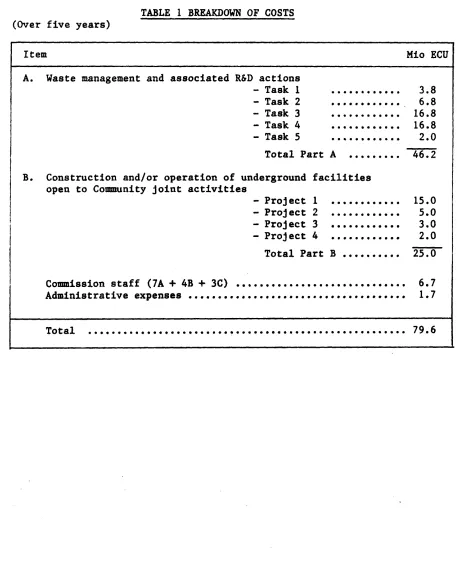
The proposed programme would require a Community funding of 79.6 Mio ECU and a staff of fourteen. Table 1 gives a breakdown of
[image:14.612.99.556.143.725.2]the costs.
TABLE 1 BREAKDOWN OF COSTS (Over five years)
Item Mio ECU A. Waste management and associated R&D actions
- Task 1 3.8 - Task 2 6.8 - Task 3 16.8 - Task 4 16.8 - Task 5 2.0
Total Part A 46.2 B. Construction and/or operation of underground facilities
open to Community joint activities
-Project 1 15.0 - Project 2 5.0 - Project 3 3.0 - Project 4 2.0
Total Part B 25.0
Commission staff (7A + 4B + 3C) 6.7
Administrative expenses 1.7
3.6 Intra Community co-operation
The bi- and multilateral co-operation between bodies in the Member States established and intensified in the previous programme (see par. 2.3), will be continued. In particular the co-operation in the projects under Part B will be further promoted, as these projects have been declared open to Community co-operation by the responsible bodies in the Member States on whose territory the facilities are built.
3.7 Extra Community co-operation
The co-operation agreements mentioned in paragraph 2.4 (Canada, USA, Switzerland, Sweden and Finland) which have been concluded for a five year period, partially cover the new proposed prog-ramme. This will assure, as in the past, the necessary scien-tific and technical exchanges with other countries outside the Community carrying out important R&D programmes in the field of radioactive waste.
ANNEX 1
THE PREVIOUS PROGRAMME 1985-1989 CONTENTS, PROGRESS AND RESULTS
The programme was divided into two parts :
Part A : Waste management studies and associated R&D actions, aiming at :
- developing efficient waste treatment and conditioning processes
- developing the concept of deep geological storage and evaluating its safety
- optimizing waste management systems.
- continuing the study of the administrative, legal and financial framework which must encompass waste management Part B : Construction and/or_o£eration_ofunderground^
o£en to Community Joint activities,
aiming at validating the basic results obtained so far on the subject of disposal, thanks to the construction and operation of experimental underground facilities.
With regard to waste treatment and conditioning, most activities were focussed on testing and demonstrating processes and techniques in pilot facilities. Advanced processes are being developed and tested aiming in general at reducing the volumes of waste, decreasing the discharge of radioactive effluents in the environment and trans-formation of the waste in a form increasing the possibility of ulterior safe disposal.
Good results were e.g. obtained with the flocculation centrifugation process for the treatment of liquid effluents arising during operation of LWR's and with thermal denitration of reprocessing concentrate which last process should lead to a volume reduction factor between 4
and 5 in comparison with the conventional bituminisation process. Reduction of the volume of arising waste has also been obtained in the fabrication process of plutonium fuels. By installing a fourth containment barrier in the glove-boxes line of fuel fabrication it was possible to reduce the volume of Pu-contaminated waste by 10-15 % while decreasing the Pu-content of waste with 80 %.
With respect to the evaluation of the properties of the conditioned waste forms and waste packages, the list of reference waste forms for
low and medium level waste investigated during the previous programme has been updated and extended. The nuclide releases of most reference materials have been measured by leach testing of fully active samples. For the measurement of leach rates under disposal conditions lysimeter tests have begun. With respect to solidified high level waste forms an international joint project was organized by the CEC in which 15 laboratories were participating. The project was focused on the experimental examination, analysis and modelling of waste glass reactions with the surrounding repository materials and leachants under conditions representative of performance analysis scenarios. The results showed the close agreement of measured data and a wide consensus on corrosion and release models.
A new action was launched on quality assurance of waste packages in which significant progress was achieved in the field of non-destructive testing e.g. a prototype high resolution CT scanner was developed and applied in detecting voids, cracks and
inhomogeneities in drums of LLW and in full size simulated waste glass blocks. Moreover an interlaboratory test on non-destructive assaying of actinide concentration in waste drums was set up which led to improvements of the data interpretation methods and allowed to define the limitation of the various systems.
Regarding research on the development of geological repositories activities have been concentrated on the characterization of potential sites and host rocks and on the study of migration phenomena of radionuclides through the geosphere. The European Catalogue of suitable formations for waste disposal, established in previous programmes, has been completed with an inventory of the relevant formations on the Spanish territory.
For the characterization of potential sites on-land, measurement techniques have been improved, e.g. electromagnetic borehole probes for the detection of fractures in granite and gas emanation measure-ment techniques for the detection and characterization of fractures snd faults in clays. The understanding of large-scale rock mass behaviour under the influence of excavation-induced and/or thermal stresses has been improved by large in situ investigations in granite
(Fanay-Augères - F ) , in clay (Mol - B) and in salt (Asse - D ) . The in situ data about the rheology of salt was used for the project COSA
The MIRAGE project (Migration of Radionuclides in the Geosphere), co-ordinated and launched in 1983 by the Commission with the aim of providing experimental data and of supporting safety analyses has been continued. The main thrust of the project is on in-situ investigations and on the benchmarking of measurement techniques, concepts and computer codes.
Within the COCO-club (Colloids and Complexes) over twenty laboratories put together their research efforts on complexation of radionuclides with natural and man-mades organic substances, colloid generation in groundwaters and basic rentention mechanisms in aquifer systems. Intercomparison exercises were performed about characterization of natural humic acids and natural colloids, which resulted in a substantial improvement of knowledge about these sensitive questions. In situ migration experiments (tracer tests) are performed in the underground laboratory in the clay at Mol (B) and in the sandy aquifer in Drigg (UK).
For the long term prediction of migration processes, advanced groundwater flow and geochemical codes have been developed and improved. In order to ascertain the EC capabilities for geochemical modelling, an international exercise called CHEMVAL was implemented in which fourteen teams were participating. This exercise permitted the development of a geochemical data base for modelling purpose and the verification and validation of geochemical codes.
Much emphasis was put on the study of naturally occurring analogues of processes which are significant in predicting the long-term behaviour of repositories. In particular, the CEC took the Initiative of establishing, in 1985, an international "Natural Analogue Working Group", which held regular plenary meetings and a major symposium in Brussels in 1987. This informal alliance of experimentalists and modellers, drawn from research and assessment teams in all the major
international programmes, has progressed a considerable way towards clarifying the needs for natural analogues, their realistic potentials to support performance assessment modelling and the principles involved in applying them sensibly.
The PAGIS project for evaluating the safety of the disposal systems (Performance Assessment of Geological Isolation Systems) initiated in 1982, was terminated. The essential aim of the project has been to assess the general capability of possible waste disposal systems to confine or restrict to acceptable levels, the release of radionuclides incorporated in conditioned high level radioactive waste after the closure of the underground repositories.
Normal evolution and altered evolution scenarios, considering possible perturbative events, were defined. Deterministic approach- and stochastic calculations were performed, the last ones for uncertainty and global sensitivity analyses. None of the results obtained give rise to doubts about the feasibility of safely disposing high level radioactive waste in any of the analysed options if appropriate sites are selected and the repositories are designed according to sound engineering principles. This is so even taking into account the many uncertainties still affecting the present data and models.
In 1986, as a complement to the PAGIS project, the PACOMA project (Performance Assessment of confinements for MLW and Alpha waste) was launched. The study applies the same methodology as set up in the PAGIS project. Data on the waste inventory and on the repository design were collected and near field models set up. Calculations are under way and results are expected in the middle of 1989.
Considering the several partial and specific results obtained during the previous programmes and becoming available in the present programme it appeared necessary to evaluate and optimise the various overall management schemes of radioactive waste. Two categories of waste have in particular been considered namely reactor waste and hulls. Moreover a comparison has been made between waste management aspects of direct disposal of spent fuel and reprocessing. Flow sheets of waste streams and management routes were defined, based on current practices in Member States and hence as close as possible to reality. In the further evaluation various aspects are considered such as feasibility, availability and radiological and economic features. In order to allow comparison of management options with large differences in cost and radiation exposure procedures have been developed to provide a rational base for comparative evaluations. In parallel to these system studies also a start was made with the joint elaboration of criteria for waste management and disposal and with the evaluation of possible approaches at Community scale for waste disposal. A report was elaborated giving an overview of principles, standards and technical criteria etc. applicable to radioactive waste disposal in the European Community. Areas for possible common approaches have been identified.
The underground facilities involved under part B of the programme are being declared open to Community co-operation by the responsible bodies in the Member States on whose territory the facilities are being built. At the beginning of the programme in 1985, three projects were defined, respectively the HAW project in the Asse salt mine (FRG), the HADES project in the Boom clay at Mol (B) and the ATLAS project in France. During the programme period 1985-1989 only the first two projects could be implemented, the third one being delayed due to a decision of the french government in 1987.
The HAW-project concerns the emplacement of thirty high radioactive canisters, borosilicate glass blocs spiked with Cs-137 and Sr-90, in six boreholes located in two test galleries at the 800 m level in the Asse salt mine in the Federal Republic of Germany. They are scheduled to be emplaced in the Asse mine in the beginning of 1989 and would remain there for a period of five years. For the handling of the radioactive canisters and their emplacement, the complete technical system consisting of transportation casks, transport vehicle, disposal machine and borehole slider has been developed and tested, therefore the first of the objectives has been achieved. The project is being carried out by the "Institut fur Tieflagerung ôf the Gesellschaft fur Strahlen- und Umweltforschung mbH".
From the beginning of the project there was already a close co-opera-tion between GSF and the Netherlands Energy research Foundaco-opera-tion (ECN). This international co-operation has been enlarged with the participation of the "Agence National pour la Gestion des Déchets Radioactifs" (ANDRA) (F) and the "Empresa Nacional de Residuos Radio-activos S.A." (ENRESA) (E). This project, which is a first of its kind, has developed to an international project in which a number of organisations from Member States are participating.
The second project concerns the HADES project, where in the Boom clay layer under the nuclear site at Mol (B),a Test drift was successfully excavated between April and December 1987. The drift is 63 m long and has a 3.5 m inner diameter, and was realized in close co-operation between SCK/CEN (B) and ANDRA (F). The first section, about 45 m long, was made on behalf of SCK/CEN and is lined with concrete segments ; the second section is lined with sliding steel ribs and was realized for ANDRA. This co-operation has still been enlarged by the participation of the Geotechnical Consulting Group (UK).
Building the test drift has been the direct and successfull demons-tration of mining capabilities in a plastic clay with properties and conditions representative of an argillaceous host formation for disposal of radioactive waste. The two different lining techniques were succesfully applied and the results of tests show that the
ANNEX 2
DESCRIPTION OF THE PROPOSED PROGRAMME
PART A TASK 1
System Studies and Harmonization of Waste Management Practices and Policies
OBJECTIVES : * TO ASSESS THE FEASIBILITY, AVAILABILITY, ECONOMICS, AND RADIOLOGICAL IMPACT OF VARIOUS OVERALL MANAGEMENT SCHEMES FOR DIFFERENT TYPES OF RADIOACTIVE WASTE
* TO ELABORATE IN COMMON RADIOACTIVE WASTE MANAGEMENT AND DISPOSAL CRITERIA
* TO ASSESS VARIOUS APPROACHES TO DISPOSAL AT COMMUNITY SCALE
* TO EVALUATE THE POSSIBLE APPLICABILITY OF RADIOACTIVE WASTE RESEARCH ON INDUSTRIAL TOXIC WASTE MANAGEMENT AND DISPOSAL PROBLEMS
System studies on nuclear reactor and fuel cycle waste have been performed during the previous programme; common features and disparities in national regulatory frameworks and radioacive waste management practices have been reviewed as well. The work should be extended to other radioactive waste types, to a comparative assessment of toxic waste disposal practices, to harmonization studies when a need has been identified and to aspects of radioactive waste management of community concern.
1. System studies
- System 1 t Radioactive waste resulting_from the decommissioning
The information gained during the implementation of the comm-unity programme on "Decommissioning of nuclear installations" will be used as an input.
The adequacy of the disposal schemes currently under study to accommodate decommissioning waste will be examined; the specific requirements of this waste category will be identified as well.
- System 2_:_S£ent_fuel£_when_declared^
Besides the case of the spent fuel coming from commercial nuclear power plants, special consideration will be given to
TASK 3
Characterization and Qualification of Waste Forms, Packages and their Environment
OBJECTIVES : * TESTING AND VALIDATION OF MODELS AND DATA BASE
DESCRIBING THE LONG-TERM EVOLUTION OF DISPOSED WASTE PACKAGES
* DETERMINATION OF THE RELEVANT PROPERTIES + PERFORMANCES OF THE WASTE FORMS AND THEIR ENVIRONMENT
* IMPROVEMENT OF PRODUCT QUALITY CONTROL
During the past programmes, a number of candidate waste forms and barrier materials were investigated. * Many of the materials tested were found satisfactory in short-term testing but results of
longer-term experiments are still needed. In addition to the existing waste forms, new products will be studied to comply with recent regulatory developments, as well as packages resulting from decommissioning operations.
A major effort will be devoted to the validation of source term models and data bases required for risk assessment of disposal. Confirmation of the validity of long-term predictions will be sought by testing the models against natural analogues representative of vitreous waste forms. In addition, the development of quality control procedures and test equipment initiated in the preceding programme will be conducted as a co-ordinated research action which unites the interests of waste processors, waste disposal agencies' and regulatory authorities.
1. Quality and performance of low- and intermediate level waste forms
- Characterization of heterogeneous waste forms
- Influence of waste loading and package size on product quality - Effects of radiation, corrosion, biodégradation, etc. on waste
for stability
- Gas generation by corrosion radiolysis + biological decom-position
- Solubility of nuclides in conditioned waste, mobility of colloids and the effects of complexing agents
- Modelling of the source term for low- and intermediate waste disposal
2. Characterization of solidified high level and actinide waste - Structural damage by alpha and neutron radiation
- Homogeneity of full scale waste products
- Mechanisms of nuclide release under repository conditions
3. Properties and performance of containers, and surrounding materials
- Corrosion resistance of waste containers
- Safety of container handling-integrity under accident cond-itions
- Performance of containers under conditions of prolonged inter-mediate storage
- Chemical and physical interactions of backfill/buffer materials with waste packages - Modelling of migration phenomena
- Permeability of materials to gases and liquids
4. Radionuclide assay : development of standard methods and equip-ment for specific applications
- On-line monitoring of waste treatment and conditioning proc-esses
- Destructive and non-destructive measurements of the nuclide inventories
- Active and passive methods of alpha and neutron assaying - Mobile assaying equipment
5. Quality control of waste products and development of test methods (other than 4.)
- Establishment of sampling procedures and techniques - Verification of chemical composition
- Detection of unwanted or undeclared substances
- Detection/measurement of waste/matrix interaction, gas gener-ation, container corrosion, and swelling
- Measurement of physical properties of waste products and packaging - homogeneity, setting, mechanical strength, etc. Where applicable, preference will be given to the development of non-destructive testing.
- S^stem_3__^_Waste_>exem£ted of regulatory control
A parametric Investigation of the consequences on waste management systems of various levels of exemption will be performed, notably where concrete rubble resulting from dismantling operations is concerned.
2. Harmonization of radioactive waste management practices and policies
- Development of common criteria for exemption of particular waste streams from regulatory control (re-inforced concrete,
contaminated soil, etc.)
- Elaboration of harmonized classification schemes for typical disposal options and geological formations
- Multinational dimensions of radioactive waste management; inter-community handling of waste components; regional disposal systems.
3. Comparative assessment of disposal practices for various toxic and radioactive waste management schemes
- To compare and contrast the management practices of the two types of waste
- To identify sectors where the R&D activities and results
related to radioactive waste may be of interest for toxic waste management and disposal.
TASK 2
Treatment of Radioactive Waste
OBJECTIVES : * MINIMISATION OF THE RADIOACTIVE DISCHARGES INTO THE ENIRONMENT
* VOLUME REDUCTION OF WASTES FOR DISPOSAL
* ACTIONS AT SOURCE TO PREVENT GENERATION OF RADIOACTIVE WASTE
* APPLICATION OF IMPROVED CONTROL
The need to further reduce both the radioactive discharges into the environment and the cost of radioactive waste management require the continuation of research efforts in the treatment of radioactive waste. In addition, comprehensive process control schemes for waste
treatment and conditioning have to be developed to make sure that waste products meet the technical specifications and regulatory
requirements. It is intended to pursue investigations on the following items, taking into account the results of the system studies performed during the preceedlng programme :
1. - Minimisation of radioactive/toxic discharges from nuclear facilities
. Improvement of the decontamination performances of conventional treatment processes for low and medium level liquid waste
. Removal of toxic species from low level liquid effluents 2. - Reduction of waste volumes and arisings
. Volume reduction of wastes by melting, thermal denitration, dewatering.
. By application of high performance decontamination processes, use of very selective extractants, oxidative or reducing agents, to achieve changes of waste category where possible to levels below regulatory concern.
. By actions at source to prevent generation of radioactive wastes.
Priority will be given to the research actions involving treatment of genuine samples of radioactive waste at a representative scale.
3. Advanced process control and monitoring
. Development of reliable and sensitive monitoring and control systems : in particular for on-line application.
TASK 4
Radioactive waste disposal;
research in support of the development of underground repositories
OBJECTIVES: * DEVELOPMENT OF DISPOSAL FACILITIES AND ASSESSMENT OF THE LONG-TERM BEHAVIOUR OF THE GEOLOGICAL BARRIER FOR
PREDICTIVE MODELLING.
Previous research has significantly improved knowledge about the potential geological horizons for waste disposal, the candidate materials and techniques for backfilling of repositories, and the phenomena governing the possible migration of disposed radionuclides through the geological barrier. The implementation of the concept of geological disposal however requires further research and development work on the geological media under consideration (such as granite, clays, salt domes or layers), on the construction and operation of repositories, and on the actual isolation properties of the whole system. To this end, studies will deal with:
1. Research related to sites and their characterization
. Data acquisition and modelling of the geological systems by means of laboratory and in-situ tests ; improvement of the knowledge about geodynamic factors (geoprospective).
. Development and improvement of adequate techniques for measuring relevant properties of geological formations e.g. borehole probes for measuring groundwater geochemistry, detection and character-ization of fractures, investigation on groundwater flow and gas permeability.
2. Design, construction and operation of underground repositories . Technology of disposal; assessment of emplacement schemes and
methodologies.
. Development and testing of suitable materials, technologies,, and engineering procedures for the backfilling and sealing of the various disposal boreholes, galleries and shafts in underground
repositories.
3. Radionuclide migration in the geosphere (MIRAGE project)
. Geochemistry of actinides and fission products in natural aquifer systems; role of organics and complexes on radionuclides transport; basic retention mechanisms.
. Natural evidences of geological migration processes (natural analogues) for the understanding of long term behaviour of geological isolation systems.
• Development, improvement and intercomparison of concepts,
computer codes and data bases for use in predictive radionuclide migration models.
TASK 5
Safety Assessment
OBJECTIVE : * EVALUATION OF THE SAFETY OF DISPOSAL SYSTEMS
The projects PAGIS (Performance Assessment of Geological Isolation Systems, for vitrified waste) and PACOMA (Performance Assessment on the Confinement of Medium-level and Alpha waste) have been completed during the preceding programme. They have shown that the radiological impact of radioactive waste disposal facilities may remain within the regulatory limits, provided that some parameters and factors are well chosen. In addition, a European methodology for safety assessment has been established. In the light of what has been learnt during the implementation of these two pluriannual projects, it is necessary :
to review, improve and structure the methodology to make it fit as well as possible with realistic situations;
to investigate the sensitivity of the results of a performance assessment to various parameters and factors (e.g. relative
importance of near- and far-field» and in particular of the engineered barriers);
to perform complementary assessments with additional radioactive packages» like spent fuel casks;
to harmonize approaches in performance evaluation.
PART B
CONSTRUCTION AND/OR OPERATION OF UNDERGROUND FACILITIES
OPEN TO COMMUNITY JOINT ACTIVITIES
The specific projects involved in this part of the programme are, by nature, projects of long duration. Projects 1 and 2 have already been started during the previous programme and will be continued. All these projects have been declared open to Community co-operation by the responsible bodies in the Member States on whose territory the facilities are built. They deal with experimental and pilot facilities without industrial purposes. These facilities make it possible to confirm on site the design criteria to be taken into consideration for building industrial disposal facilities, to develop radioactive waste emplacement techniques or to validate the site as being convenient for waste disposal.
Radioactive waste or materials, which will be used in some projects for studying operating conditions similar to those envisaged for an industrial facility, will be retrievable.
As in the previous programme, the co-operation includes, inter alia, participation of scientists from other Member States to the projects, especially by means of temporary secondment of personnel, and the possibility of complementing the projects by specific activities; in the latter case modalities are specified on a case-by-case basis and a project committee will be set up for each project.
The control of, and the responsibility for the projects will be ensured by the hosting bodies.
In addition to the projects described below, others could be added in the course of the programme.
PROJECT No 1 : PILOT UNDERGROUND FACILITY IN THE ASSE SALT MINE *
Within the previous programme, the project dealing with the test disposal of high level waste has been started, including the emplacement of thirty radioactive high level waste sources at the -800 m level of the As se salt mine. Dutch, French and Spanish organizations are participating in complementary research activities. Besides this project, new activities will start in the Asse salt mine dealing with the test disposal of other waste types and the demonstration of gallery sealing.
The work covered by the Community programme for 1990-1994 will be the following:
- Test disposal for high level waste. This test will be pursued further; the behaviour of the irradiated and heated salt mass will be continuously monitored and studied. Periodical testing of the technical emplacement system and components will be performed. All waste sources will be retrieved at the end of the test period.
- Test disposal aiming at developing and testing suitable methods for the disposal in salt of heat generating intermediate level radio-active waste (hulls from spent fuel elements, fuel element struc-tural components, fuel clarification sludges) and irradiated fuel elements from high temperature reactors. The waste drums will be emplaced in four large diameter boreholes. Real waste will be used and retrieved after a three year emplacement period.
- Test disposal dealing with the demonstration of the technical feasibility of the direct disposal of spent fuel elements from light water reactors and the observation of the containment, the
back-filling as well as the surrounding rock salt along the emplacement drifts. Six POLLUX containers will be emplaced in two parallel galleries and the spent fuel will be simulated by electrical heat-ers. The testing phase will last 5 years.
- Large scale test on the sealing of access drifts to the disposal area aiming at demonstrating that it is possible to efficiently seal those parts of an industrial repository filled with radioactive wastes from the parts which are still in operation. A
multi-component dam will be constructed in a full size gallery and is designed for two-sided loading in case of possible intrusion or occurrence of brine or gas. The test period is planned to last 4 years.
Community contribution, including complementary studies : 15.0 M ECU over 5 years.
PROJECT No 2 : PILOT UNDERGROUND FACILITY IN THE ARGILLACEOUS LAYER UNDER THE MOL NUCLEAR SITE (*)
In the previous programme, a test drift was excavated in the Boom clay layer at 220 m beneath the Mol nuclear site, demonstrating the feasibility of constructing full size galleries in deep plastic clay. In addition, a French organization tested successfully an alternative gallery lining system. French and British organizations are also participating in the experimental programme performed in these galleries.
The work covered by the Community programme in 1990-1994 will be the following :
. monitoring of the running experiments such as mine-by test, gallery heating test and a combined heating irradiation test.
. demonstration of the in-gallery waste disposal concept, by
excavating an additional gallery from the existing one, emplacement of an electrically heated, full size dummy container string, back-filling of the gallery and monitoring;
. design studies of a large scale pilot facility.
Community contribution, including complementary studies: 5.0 M ECU over 5 years.
PROJECT NO 3 : UNDERGROUND VALIDATION FACILITY IN FRANCE *
The French programme foresees the selection of one potential site for deep disposal of radioactive waste in 1991. At present, four sites have been pre-selected, respectively in clay, granite, salt and schists. The suitability of the selected site will be investigated by means of an underground validation facility scheduled to be in operation in 1994.
The work covered by the Community programme 1990-1994 will be the following :
. mine-by test and characterization of the formation during the construction of the access shaft;
. design of the underground validation facility and definition of the experimental programme.
Community contribution, including expected complementary studies : 3.0 M ECU over 5 years.
PROJECT No 4: UNDERGROUND VALIDATION FACILITY IN THE UNITED KINGDOM** The British plan for deep disposal of intermediate and low level waste foresees the naming of some potential sites in 1989. After exploratory investigations on these sites, one site will be selected around 1993. The suitability of the site will then be investigated by means of an underground validation facility scheduled to be in operation after 1994.
The work covered by the Community programme 1990-1994 will be the following :
. characterisation of the selected disposal site from the ground surface;
. study of the formation during the construction of an access shaft;
. preliminary design of the underground validation facility.
Community contribution, Including expected complementary studies : 2.0 M ECU over 5 years.
(*) Presented by the French Authorities
ANNEX 3
FINANCIAL RECORD SHEET 1. Budget heading
Code No 7351
Title: Radioactive Waste management.
Programme included in the framework programme 1987-1991 under action line No 5.1
2. Legal basis
Article 7 of the Treaty establishing the EAEC. 3. Description and objective of the action
This action concerns a five-year (1990-1994) shared-cost research programme, which is a follow-up of the programme ending in 1989 that was adopted by Council Decision 85/199/Euratom of March 12 1985 (0J No L83,25.03.1985, p.20). The present programme is one of the components of the "Framework programme for Community activities in the field of research and technological development (1987 to 1991)"concerned by Council Decision 87/516/Euratom, EEC of 28 September 1987 (OJ No L 302, 24.10.1987, p.l).
The programme covers the following two parts :
Part A : Waste Management and associated R&D actions
Task 1 - System studies and harmonization of waste management practices and policies
Task 2 - Treatment of radioactive waste
Task 3 - Characterization and qualification of waste forms, packages and their environment
Task 4 - Radioactive waste disposal; research in support of the development of underground repositories Task 5 - Safety assessment
Part B : Construction and/or operation of underground facilities open to Community joint activities
Project 1 - Pilot underground facility in the Asse salt mine in the FR Germany
Project 2 - Pilot underground facility in the argillaceous layer under the Mol nuclear site in Belgium Project 3 - Underground validation facility in France
Project 4 - Underground validation facility in the United Kingdom
The objective of the programme is to ensure the best protection of the population and environment and to continue the joint development and perfectioning of radioactive waste management.
The action concerns in particular :
authorities responsible for nuclear safety and radiation protection;
operators of nuclear installations;
4. Justification of the action
The action is necessary to attain the objective given under item 3 above.
The need for Community action in this field was repeatedly recognised by the Council, namely in the two Decisions mentioned under item 3 above.
5. Financial implications of the action in respect of expenditures 5.1 Total cost over the whole duration :
Amount deemed necessary - 79.6 MioEcu 5.2 Breakdown of financing :
Expected total expenses in the frame of the action are about 150 MioECU, and 53% of this amount (i.e. 79.6 MioECU) is to be covered by the Community budget.
5.3 Multiannual timetable of appropriations
The timetable of appropriations for commitment and for payment is given expecting an adoption of the action before the end of 1989. Nevertheless, in order to cover the possibility of a delayed adoption during the year 1990, the draft budget for 1990 has been set up earmarking 1 MioECU of appropriations for commitment and payment in the previous (1985-1989) action. This amount will cover expenses for the present staff (6A, 3B, 3C) up to 0.913 MioECU and the administrative expenses up to 0.087 MioECU even in the absence of a programme decision. Correspondingly the 1990 appropriations for the 1990-1994 action in the draft budget have been reduced from 30 to 29 MioECU for commitment and from 9 to 8 MioECU for payment. Any
expenses in the new action performed on appropriations of the previous programme will be transferred to the new action as soon as the programme decision is taken.
Staff
Administration Contracts
Total
1990 1991 1992
1.212 1.300 1.370 0.390 0.335 0.330 28.398 22.265 14.300
30.000 23.900 16.000
1993 1.373 0.325 6.002 7.700 1994 1.408 0.315 0.277 2.000 1995 -1990-1994 6.663 1.695 71.242 79.600
Appropriations for payment (Mio ECU)
Staff Administratlor Contracts Total 1990 1.212 0.390 7.398 9.000
1991 1992 1993
1.300 1.370 1.373 0.335 0.330 0.325 15.016 16.287 13.319
16.651 17.987 15.017
1994 1.408 0.315 8.594 10.317 1995 10.628 10.628 1990-1994 6.663 1.695 71.242 79.600
5.4 Method of calculation 5.4.1. Staff expenditure
The appropriations were evaluated on the basis of the following staff : 6 category A officials in 1990» 7 A officials from 1991 on
4 category B officials 3 category C officials.
The calculations are based on the data established for the Provisional Draft Budget for 1990 (i.e. : A: 93,000 ECU ; B: 58,000 ECU ; C: 37,000 ECU) and on an annual increase rate of 4% taking into account the trend in the general level of prices in the Community.
Staff attached to the previous 1985-1989 programme consists of 6A» 3B and 3C officials; this number is to be increased by IB official in 1990 (calculated in 50% of the annual expense for a B official during the year of appointment) and 1A official in 1991 (again calculated in 50Z of the annual expense for an A official during the year of appointment).
Administrative expenditure covers :
organisation of working group meetings;
use of data processing and telecommunication facilities; supporting coordination activities;
The calculations are based on average requirements and experience made with the 1985-1989 programme.
5.4.3. Contract expenditure
The appropriations cover the financial contribution of the Community (typically 50%) to the expenditures incurred by contractors in perfor-ming research and development work under the programme. Provisions are made for programme evaluation and contract audits.
6. Financing of expenditures
The appropriations required to cover the financial participation of the Community in this action will be entered into the future Community budgets.
7. Control system to be applied
Administrative control by the Directorate General for Financial Control and by the Contract Division of the Directorate General for Science, Research and Development, as regards the implementation of the budget and regularity of expenditures.
Scientific Control by the competent Management and Coordination Advisory Committee (CGC) and by responsible officials in the Direct-orate General for Science, Research and Development.
ANNEX 4
OPINION OF THE MANAGEMENT AND COORDINATION ADVISORY COMMITTEE CGC6 "NUCLEAR FISSION ENERGY- FUEL CYCLE/PROCESSING AND STORAGE OF WASTE"
The Management and Coordination Advisory Committee "Nuclear fission energy - Fuel cycle/processing and storage of waste" (CGC 6), at its meeting of 16 February 1989, examined a proposal for a 1990-1994 research and development shared-cost programme on the management and storage or radioactive waste (document CGC6/88-22 Rev. 1).
The proposed programme is a follow-up of the current programme 1985-1989 and is based on the positive and encouraging results obtained so far. As previously, the new programme will be composed of two main parts : Part A will deal with waste management and associated R&D actions and Part B with the construction and/or operation of underground facilities open to community joint activités.
The proposed programme would be implemented through cost-sharing contracts with competent private firms and public organisations in the Member States, with a budget of 79.6 million ECU and a staff of 14.
The Committee considered that the programme provides a suitable basis for well balanced activities comprising : (a) system studies and harmonization of waste management practices and strategies, (b) activités in the field of waste treatment, conditioning and disposal,
(c) safety assessment of waste disposal and (d) underground pilot installations.
The Committee considered that the construction and/or operation of underground pilot facilities in several Member States is of paramount importance at this stage of the development of waste disposal systems. It recommended nevertheless to carefully monitor, during the course of the programme, the balance of the budget allocated to both parts of the programme in order to ensure the transfer of funds from Part B to Part A if it is justified by the rate of progress on underground pilot facilities and considerations of expenditure and relative priorities of projects at that time.
The Committee noted with satisfaction that the new programme will also take into consideration the management of other types of waste such as
decommissioning waste and spent fuels when considered as waste.
As a conclusion» the Committee supports unanimously the programme proposed by the Commissi©» services, both for its technical content and the amount of funding.
J. LEFEV**