Proceedings Paper:
Ponglertsakul, S., Dolan, S. and Winstanley, E. orcid.org/0000-0001-8964-8142
(Submitted: 2015) Black hole solutions in Einstein-charged scalar field theory. In:
Proceedings of the Fourteenth Marcel Grossman Meeting on General Relativity. 14th
Marcel Grossman Meeting . (Submitted)
[email protected] https://eprints.whiterose.ac.uk/
Reuse
Unless indicated otherwise, fulltext items are protected by copyright with all rights reserved. The copyright exception in section 29 of the Copyright, Designs and Patents Act 1988 allows the making of a single copy solely for the purpose of non-commercial research or private study within the limits of fair dealing. The publisher or other rights-holder may allow further reproduction and re-use of this version - refer to the White Rose Research Online record for this item. Where records identify the publisher as the copyright holder, users can verify any specific terms of use on the publisher’s website.
Takedown
If you consider content in White Rose Research Online to be in breach of UK law, please notify us by
arXiv:1507.02462v1 [gr-qc] 9 Jul 2015
Black hole solutions in Einstein-charged scalar field theory
SUPAKCHAI PONGLERTSAKUL∗, SAM DOLAN and ELIZABETH WINSTANLEY
Consortium for Fundamental Physics, School of Mathematics and Statistics, The University of Sheffield, Hicks Building, Hounsfield Road,
Sheffield, S3 7RH, United Kingdom
∗E-mail: [email protected]
We investigate possible end-points of the superradiant instability for a charged black hole with a reflecting mirror. By considering a fully coupled system of gravity and a charged scalar field, hairy black hole solutions are obtained. The linear stability of these black hole solutions is studied.
Keywords: Superradiant instability; Charged black hole; Black hole stability.
1. Introduction
In classical general relativity, there is a process by which energy can be extracted from a black hole. This phenomenon is known as superradiant scattering. More specifically, the amplitude of a bosonic field around black hole will be amplified if the frequencyωand the chargeqof the field satisfy1,ω < qΦH, where ΦHis electric potential at the outer horizon. Note that this inequality is the charged version of superradiant condition.
Via superradiant scattering, an instability of the background spacetime can occur if the bosonic field can be trapped within the proximity of the black hole. Wave modes are repeatedly scattered off and amplified by a black hole, so ultimately their back-reaction on the background becomes non-negligible. For a charged scalar field with non-zero mass, this instability can be triggered by surrounding a charged black hole with a reflecting mirror2.
Superradiant instabilities for charged black holes have been extensively studied in the linear regime. Although, the end-point of these instabilities remains un-known and a fully non-linear analysis is needed. Therefore in this talk, one possible end-points of the superradiant instability for charged black holes in a cavity is in-vestigated. When a fully coupled system of gravity and a charged scalar field with a mirror is considered, we find black hole solutions with scalar field hair. Considering linearised perturbations of these black holes, we perform a numerical analysis of the stability of these hairy black hole solutions. Here we present a summary of our results. More details of this work are to appear in Ref. 3.
2. Massless charged scalar perturbation of Reissner-Nordstr¨om spacetime with a mirror
As a preliminary, we consider a massless charged scalar field φ on the Reissner-Nordstr¨om (RN) background with a mirror. In the test-field approximation, the usual Klein-Gordon (KG) equation in curved spacetime is obtained. This can be solved by using the ansatz φ ∼ e−iσt
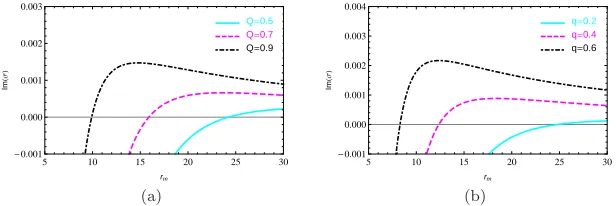
frequency and the radial part of the scalar field. We impose an ingoing wave condi-tion near the horizonr→rh and at the mirror the scalar field vanishesR(rm) = 0, where rm is the location of the mirror. We integrate the KG equation numerically and obtain the corresponding frequency. Figure 1 shows an example plot of the frequency of the scalar field against the mirror radius when the black hole mass is fixed to beM = 1. The superradiant instability can be clearly seen from Figs. 1(a) and 1(b), since there are regions where Im(σ)>0 indicating an unstable mode.
5 10 15 20 25 30
-0.001 0.000 0.001 0.002 0.003
rm
Im
H
Σ
L
Q=0.5
Q=0.7
Q=0.9
(a)
5 10 15 20 25 30
-0.001 0.000 0.001 0.002 0.003 0.004
rm
Im
H
Σ
L
q=0.2
q=0.4
q=0.6
[image:3.595.141.449.266.369.2](b)
Fig. 1. The imaginary part ofσis plotted as a function of the location of the mirrorrm, (a) for
fixed scalar chargeq= 0.5 and different values of the black hole chargeQ, (b) for fixedQ= 0.9 and different values ofq.
Therefore from Fig. 1, a massless charged scalar field on the RN spacetime with a mirror experiences a superradiant instability. These results are in agreement with with previous work done by Herdeiro et al.2, where a superradiant instability of a massive charged scalar field on a charged black hole in a cavity has been discussed. To proceed further, in the next section, we will investigate a fully coupled system of gravity and a charged scalar field.
3. Hairy black hole in Einstein-Maxwell-Klein-Gordon theory with a mirror
We are interested in a fully coupled system of gravity and a charged scalar field. This system is described by the action
S= Z
d4x√−g
R 16πG−
1 4FabF
ab
−12gabD∗
(aφ∗Db)φ
, (1)
where Fab=∇aAb− ∇bAa,Aa is the electromagnetic potential,Da=∇a−iqAa,
q is the scalar field charge andX(ab)=12(Xab+Xba). The line element of a static
spherically symmetric spacetime is given by
ds2=−f(r)h(r)dt2+f(r)−1dr2+r2 dθ2+ sin2 θ dϕ2
, (2)
the electromagnetic vector potential is Aa ≡[A0(r),0,0,0] and the scalar depends
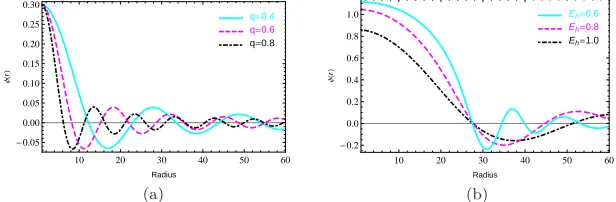
In Fig. 2, the profile of the scalar field outside the black hole event horizon is illustrated, where the black hole radius is fixed atrh= 1. For each curve, there are three parameters that need to be specified, namely, φhthe value of the scalar field on the horizon,Eh≡A′0(rh) the electric field on the horizon andq. The oscillatory behaviour of the scalar field allows us to put the mirror at any zero ofφ. Here we consider only the case for which the mirror is located at the first zero of φ. This is because these black hole solutions with the mirror at the first zero are expected to be stable.
10 20 30 40 50 60
-0.05 0.00 0.05 0.10 0.15 0.20 0.25 0.30
Radius
Φ
H
r
L
q=0.4
q=0.6
q=0.8
(a)
10 20 30 40 50 60
-0.2 0.0 0.2 0.4 0.6 0.8 1.0
Radius
Φ
H
r
L
Eh=0.6 Eh=0.8 Eh=1.0
[image:4.595.140.448.278.379.2](b)
Fig. 2. The scalar fieldφ(r) is plotted as a function of radius (a) for fixedφh= 0.3,Eh = 0.6
and different values ofq, (b) for fixedq= 0.1 and different values ofEh.
By changing one of these three parameters, we obtain different hairy black hole solutions. Figure 2(a) displays three distinct black hole solutions with varying scalar charge and three different mirror radii. However, as shown in Fig. 2(b), it is possible that different solutions could share the same mirror location.
4. Stability of the hairy black holes
We are now ready to perform a stability analysis of these equilibrium solutions. If these solutions are shown to be stable, they could represent the end-point of the superradiant instability for a massless charged scalar perturbation on the RN background with a mirror as discussed in Sec. 2.
To investigate the stability of the equilibrium solutions, we perturb the four field variables (f, h, A0, φ) in the theory as follows,f = ¯f(r) +δf(t, r) and similarly for the other three quantities. In this formalism, ¯f is the equilibrium quantity andδf is the perturbation. By linearising the field equations, three coupled perturbation equations forδA0and the real and imaginary parts ofδφare obtained. The pertur-bation equations are solved by assumingδφ∼e−iσt˜
φ(r), and similarly for the other perturbations. These perturbation modes need to satisfy the following boundary conditions, ˜φ(r) and other perturbations modes follow an ingoing wave-like condi-tion near the horizon. The scalar field vanishes at the mirror ( ˜φ(rm) = 0).
20 25 30 35 0.08
0.10 0.12 0.14 0.16 0.18 0.20
rm
Re
H
Σ
L
Eh=0.8 Eh=1.0 Eh=1.2
(a)
20 25 30 35
-0.025 -0.020 -0.015 -0.010 -0.005 0.000
rm
Im
H
Σ
L
[image:5.595.134.450.129.264.2](b)
Fig. 3. The real (a) and imaginary part (b) of the perturbation frequencyσare plotted against the location of the mirrorrmwith the scalar charge is fixed atq= 0.1,φhvarying from 0.1 to 1.4
and different values ofEh.
is shown in Fig. 3. In each plot, the charge of the scalar field is q = 0.1 and the initial value of the scalar field varies between φh = 0.1−1.4. Each point in this plot represents the perturbation frequency for one distinct hairy black hole solution. More precisely, with the mirror at the first zero of the static scalar field φ, we find one value of σ that satisfies the boundary conditions. The key result here is in Fig. 3(b) where Im(σ)<0 indicates that the perturbation modes decay exponentially in time. Thus it is clearly shown that these black hole solutions are linearly stable.
5. Summary
We have studied the possible end-point of the superradiant instability of a massless charged scalar field on the RN spacetime with a mirror. Numerical black hole solutions with charged scalar hair are obtained. Numerical study suggests that these hairy black hole solutions appear to be stable. Thus, they could represent the end-point of the superradiant instability.
Acknowledgments
The work of EW and SRD is supported by the Lancaster-Manchester-Sheffield Con-sortium for Fundamental Physics under STFC grant ST/L000520/1. The work of SRD is supported by EPSRC grant EP/M025802/1.
References
1. J. D. Bekenstein, Extraction of energy and charge from a black hole,
Phys.Rev.D7949 (1973).
2. J. C. Degollado, C. A. R. Herdeiro and H. F. R´unarsson, Rapid growth of super-radiant instabilities for charged black holes in a cavity, Phys.Rev. D88 063003 (2013).