c
\
Hydroelectric Generation
by
Nenad Tufegdzic, B.Sc.E.E, M.Sc.E.E
Department of Electrical and Electronic Engineering
submitted in fulfilment of the requirements
for the degree of
Doctor of Philosophy
This thesis contains no material which has been accepted for award of any other
higher degree or graduate diploma in any tertiary institution. To best of my
knowledge and belief, this thesis also contains no material previously published
or written by another person, except where due reference is made.
~<>J<f:L
L__
Nenad Tufegdzic
I
l
llts
+~e.s.1£.
""4/
b.Q
wic.
de.
a"ai
(id,
le,
~<
Ol '1\
d \:. "";
k
~
\'.D~
'1
'"'~
'."'
o.. c_c..o..-da"'
ce,w'c
IL
lo~'(""\~"'-t
1\c_\; \
~b~
.
.J\/~~J ~t:icl_____
The optimal operation of a power system has been investigated since early days
of power systems. Special attention has been given to the optimal generation
schedule, because significant savings can be achieved in this area. As
predominantly hydro systems are not common, treatment of hydro in many
cases has been connected with thermal operation and thermal fuel cost. Today
with the open electricity market becoming reality in many countries, and
decentralisation of the power industry representing the main trend, an
independent hydro generator will become a reality and the necessity for
optimisation of the predominantly or solely hydro system will increase.
The major factors which affect optimal operation of the hydro system are:
- Operation at maximum efficient point
- Target level achievement(connected with mid and long term optimal operation)
- Inflow (and load) uncertainty
- Operation at the best head
- Start up cost
The new algorithm has been developed to take into account all those factors and
produce optimal operation for a predominantly hydro system.
Mixed Integer Linear Programming (MILP) is chosen as the solution algorithm,
because the linear programming part models the hydro network very effectively
and the integer variables can be used to control the unit start-up and shut-down
behaviour.
The new techniques are developed to accommodate implementation of the MILP
algorithm, such as power balance constraint relaxation, specific search
techniques for integer solution and more detailed connection with mid-term
optimisation.
The algorithm is implemented on the Tasmanian Hydro Electric Commission's
hydro system. It is tested off-line using historical operating plans. A
conservative estimate is that the savings will be up to six hours daily of an
operator's time plus 0.5% in annual stored energy savings. There is the
possibility for savings in the mid term optimisation by decreasing the risk of
spill through better control of short term storage levels.
There are many people, and a number of organisations, that I would like to
thank for their support and encouragement during the course of this study.
Special thanks to my supervisor. Dr. Michael Negnevitsky for his advises and
guidance and Mr. Paul Hyslop, project manager of EMS project for his
encouragement and support during the project. I would like to thank Mr. Walter
Stadlin from Macro Corporation, USA for advise and support during the project.
I would also like to extend my appreciation to the University of Tasmania and
Hydro Electric Commission of Tasmania, especially System Operation Group.
Abstract
iv
Acknowledgments
vi
Contents
vii
List of Figures
xi
Preface
xiv
Abbreviations
xvii
Glossary
xix
1. Introduction
1
1.1. Short-term scheduling 7
1.2. Real-time-economic dispatch
14
2.1. Introduction 18
2.2. An overview of the methods
22
2.3. A new approach 26
3. Optimisation in a Pure Hydro System and Independent
Hydro Generation in Open Electricity Market
30
3 .1. Introduction 30
3.2. Effect of the long-term and mid-term planning on real-time 33
scheduling
3.3. Effect of the load and inflow prediction on real-time scheduling 34
4. Algorithm for the Real-time Short-term Hydro
Scheduling
4.1.Introduction
4.2.Energy allocation function
4.3.Generation scheduling function
viii
36
36
38
5. Mathematical Model of the Large Scale Hydro System 49
5.1.Introduction 49
5.2.Energy allocation hydro simulator 50
5.3.Generation scheduling mathematical model 51
5.3.1. Introduction 51
5.3.2. Generator model 52
5.3.3. Constraints model 59
5.3.4. Objective function 74
5.4.Dynamic hydro economic dispatch mathematical model 77
5 .4.1. Introduction 77
5.4.2. Generator model 77
5.4.3. Constraints model 79
5.4.4. Objective function 80
6. Case Studies: Hydro Electric Power System
of Tasmania
6.1.Introduction
6.2.Example of the real system schedule
6.3.Performance of the new algorithm
ix
82
82
83
7 .1.Results and Contributions 95
7.1.1. An overview 95
7 .1.2. Model improvements 97
7 .1.3. Algorithm improvements 98
7 .1.4. Practical implementation 99
7 .2.Future work 99
Appendix
101
A: Typical machine curves used in the model 101
B: Tasmanian map with powerstations an high voltage network 108
C: Author's thesis based publications 110
References
139
Bibliography
144
1.1. Figure:Planning hierarchy 2
1.2. Figure:A typical load curve 4
1.3. Figure: Short-term scheduling problem structure 8
2.1. Figure:P/q curve 25
2.2. Figure:Eff/q curve 25
2.3. Figure: Functional HHierarchy 27
2.4. Figure:Flow chart of the main functions 28
3.1. Figure: Hydro optimisation process 31
3.2. Table: Comparison of different scheduling enviroments 32
4.1. Figure: Flow chart of the main functions 37
4.3. Figure: Incremental curves
4.4. Figure: Typical reservoir model
5 .1. Figure: Maximum efficiency flow vs gross head
5.2. Figure: Unit input/output curve
5.3. Figure: Multimachine input/output curve
5 .4. Figure: Fixed run unit input/ output curve
5.5. Figure: Reservoir spill flow vs volume
5.6. Figure: Reservoir target levels penalty function
5.7. Figure: Cost function
5.8. Figure: Station input/output curve
6.1. Figure: Demand/generation curve
6.2. Figure: 'Frequency station' generation (Gordon)
6.3. Figure: Savings based on maximum efficiency deviation operation
xii
42
45
54
56
58
59
67
69
75
78
84
85
6.5. Figure: First option for decommitment 87
6.6. Figure: Second option for decommitment 87
6. 7. Figure: Operation of one station (Poatina) 88
6.8. Figure: Extra 50MW load
89
6.9. Figure: Different operation for the same energy 90
6.10. Figure: Lake levels based on different generation timing 90
6.11. Figure: Operation of Gordon power station 92
6.12. Figure: Operation of Devils Gate power station 93
6.13. Figure: Operation of Anthony power station 93
The original purpose of this work was to develop a short-term hydro scheduling
and real-time economic dispatch optimisation for a pure hydro system, to be
used as a part of Hydro Electric Commission's new Energy Management
System. The thesis also discusses implementation of the algorithm in the open
electricity market environment and possible use of the algorithm for the
optimisation of the hydro part of a mixed hydro thermal system. Although
coordinated approach has been implemented in the real pure hydro system
operated by the Hydro Electric Commission Tasmania, further improvements
can be included to decrease computational time and include long-term hydro
planning.
The work reported in the thesis has taken place between September 1992 and
December 1996. The research was initiated in the Hydro Electric Commission
of Tasmania, where most of the research was performed. In October 1992 the
research was continued in parallel on Faculty of Electrical and Electronic
Engineering, University of Tasmania, where the work was completed.
Thesis Organisation
The thesis is organised into seven chapters. The first two chapters are
state in this area of research. The second chapter presents a brief overview of
different optimisation techniques used to solve the hydro optimisation problem.
It discusses the reasons why the new algorithm has been chosen with a reference
list of specific approaches. The third chapter defines the optimisation problem
of a pure hydro system. It also introduces similar problem for the independent
hydro generator in open electricity market environment. The fourth chapter
explains a new algorithm used for the optimisation. Chapter five explains a
detail mathematical model used in the optimisation process. The sixth chapter
discusses application of the algorithm on the real hydro electric system operated
by the Hydro Electric Commission, Tasmania. Chapter seven concludes the
thesis with the emphasis on the achievements and recommendations and areas of
further research.
Supporting Publications
A number of technical journals and conferences papers connected to the thesis
are listed below.
1. N.Tufegdzic, P.Hyslop, W.Stadlin, "A Unique Concept for Hydro Economic
Dispatch", Proceedings of the 1993 ISEDEM symposium on Electricity
Distribution and Energy Management, Singapore, 1993
2. N.Tufegdzic, R.J.Frowd, W.O.Stadlin, "A Coordinated Approach for
Real-Time Short-Term Hydro Scheduling", IEEE 96 WM 169-3 PWRS,
Baltimore, USA
accepted for publishing in Electric Power Systems Research
Reprints of publications are provided in the appendix.
The following abbreviations is used in the thesis:
MILP - Mixed Integer Linear Programming
LP - Linear Programming
DP - Dynamic Programming
cumec - cubic meter per second
hr -hour
eff - efficiency
SCAD A - Supervisory Control and Data Acquisition
AGC - Automatic Generation Control
RED - Hydro Economic Dispatch
HSC
EA
GS
HS
RTHSC-EA
RTHSC-GS
RTHSC-DHED
EOL
DOSL
- Hydro Scheduling and Commitment
- Energy Allocation
- Generation Scheduling
- Hydro Simulator
-Real-Time Hydro Scheduling and Commitment - Energy Allocation
-Real-Time Hydro Scheduling and Commitment-Generation Scheduling
-Real-Time Hydro Scheduling and Commitment-Dynamic Hydro Economic Dispatch
- Economic Operating Level
- Danger of Spill Level
The following variable notation is used in the thesis:
Qij,t =flow rate on branch between node i to node j in time increment t
cm
t = water flow rate through unit n in time increment t'
Sqij,t =spill on branch between node i to node j in time increment t
'tij = branch travel time between node i to node j
Sk,t = volume in reservoir k at the end of time increment t
hu i = upper level reservoir for unit i
'
h1,i = lower level reservoir for unit i
Pn,t = net power generated by unit n in time increment t
Dt = demand in time increment t
Yn,t = unit n start-up variable (0,1) for time increment t
zn,t = unit n shut-down variable (0,1) for time increment t
Ii,t =inflow into node i in time increment t. This value is the net of the forecast inflow and scheduled Riparian outlet flow.
Introduction
A power system is one of the most complex systems in today's civilisation. The
cost of running the system and investments in power industry are enormous and
any savings or improvement in system operation represent significant benefit.
The operation and planning of the system are difficult tasks. They include
different aspect which affect security, reliability, quality of supply and cost of
running the system. Managing the cost of running the system is one of the
biggest challenges for engineers who work in the real system operation
environment. As each power system presents a unique combination of loads,
generations and electric network, the global objective of minimising the cost of
the system while still satisfying all technical requirements, has different
limitations dependant on the structure of the system.
The system planning and operation has different time horizons divided into four
categories:
• long-term planning
• medium term planning
• short-term scheduling and
- long-term load and inflow forecast
Medium-term planning
- fuel planning - maintenance
Short-term scheduling
- actual status
[image:22.572.117.448.95.410.2]- short-term load and inflow forecast Real-time operation
Figure 1.1. Planning hierarchy
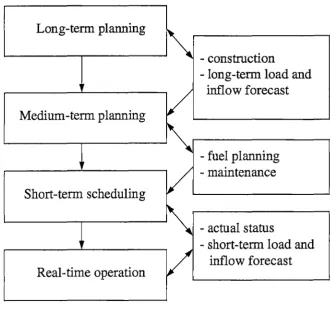
Figure 1.1. shows hierarchical structure and connection between the different
planning groups.
Long-term planning is the major planning tool to ensure the long term/strategic
viability of the power system. It represents strategic study for a period of a few
years up to a decade. It ensures that new generation and transmission is built
into the system to satisfy anticipated load growth and appropriate plant to
support system reserve, frequency regulation and other ancillary services
requirements. It is based on the long-term load forecast and long term inflow
forecast (for hydroelectric power plants). Today it takes into account solar
radiation, wind, waves and geo-thermal energy for non conventional energy
resources.
Long term planning results form part of the impact to medium-term planning.
produces an optimal plan to ensure the best day to day operation of the system.
Short-term scheduling represents part of system operation planning which optimises predicted resources and supports the best real-time system operation.
It is a schedule for up to seven days in advance, including continuous revision and update of the plan. In this chapter, short-term scheduling and the real-time economic dispatch aspect will be further discussed.
The major characteristic of the electric power system is the requirement that generation should mach the load at each point in time. This requirement is also known as frequency regulation of the system, as standard frequency determines that generation match the load. Any frequency deviation means that this balance is affected and needs to be corrected.
and economic dispatch.
Another important factor in planning and operation of the system is the
composition of the generators in the system. Based on their cost characteristic
and other constraints (like technical minimum of operation, start-up time, ramp
rate) different schedules can be produced to minimise cost. The generators can
be divided into different categories. The following classification is based on
their effect on short-term scheduling and economic dispatch:
• slow start thermal and nuclear plants;
• fast start gas generators;
• run-of-the-river hydroelectric plants;
• hydroelectric plants with storage accumulation;
• non conventional energy sources.
Each of the group has specific characteristics.
p
[MW]
base load
24 t [hr]
load plant with lower operational cost than gas generators and lower investment
than hydro plant. Their main limitation is low ramp rate and long start-up
process, which means that they can not react to sudden load changes and hence
have to be planned for commitment well in advance. They are also connected
with significant start-up cost and once when started need to be run for a long,
continuous period to spread this cost.
Gas generators are built in areas where hydro resources are not available or their
investment cost is less economical than investment in gas turbines. They can
respond quickly to system changes and are often used for peak load support,
because of their fast start and stop ability. However their operating costs are
high.
Hydroelectric power plants are high investment, low operating cost generators
which are usually used to respond to real-time load changes because of their
start/stop flexibility and good power output response rate. A major problem is
that they can be only built where sufficient water flow exists for investment
return. Run-of-the-river plant are those with small storages where flexibility is
limited by the size of the storage. Hydoelectric power plant with storage
accumulation are generators which play the main role in medium term planning
and short-term scheduling to ensure that ancillary services requirements are met.
Non conventional sources are not significant in modem power systems, but in
the future their influence may increase. The main characteristic of this sources is
their stochastic nature and that they can be treated as negative load (with the
The scheduling and dispatch problem vary for different compositions of
generators in the system. In an all-thermal system, objectives are concentrated
on minimising the fuel cost, with respect to all imposed constraints. Mixed
hydrothermal system objectives are on maximising the usage of limited low cost
hydro resources by substituting the most expensive thermal resources and
minimising the fuel cost with respect to both thermal and hydro power plants
constraints. For all hydro system the objective is to minimise water usage for the
forecast load requirement and respecting all constraints in the system.
As the generation has to reach the load, a set of network constraints needs to be
accommodated as well as security and stability constraints, to ensure safe and
smooth operation of the system. In many cases other constraints are imposed on
the system by other users like multipurpose water storage in the hydro part of
the system or gas emission requirement which becomes more important and
taken into account through environmental constraints.
Another important aspect of planning and real-time operation is the time
limitation for planning and changing planned decisions in real-time. Modern
computer equipment and sophisticated programs are available for operators and
engineers to support them in system operation.
The main objective of system operation is to provide cheap and high quality
energy supply for the customer. The overall cost depends on capital investment,
maintenance and operational cost and many other factors, but also on technical
decisions made in system planning and operation. Short-term scheduling and
term scheduling and real-time economic dispatch as one complex function is
presented in this thesis.
1.1. Short-term scheduling
Short-term scheduling is a planning process of the optimal generation units
operation for the given short-term period, such that minimum production cost is
reached, based on the forecast status of the system and respecting limitations of
the system.
Defined in such a way, the short-term scheduling problem represents a
stochastic problem, because of uncertainty in the load and inflow forecasts,
assessment of non conventional energy production and reliability of generation
units and other power system elements. But the size of any short-term schedule
makes this a large scale problem and the stochastic approach is not practical. It
is also assumed that the most of uncertainty factors in the short-term future
period can be predicted with a high degree of accuracy, and that transfers the
problem into the deterministic framework.
The short-term scheduling problem is extremely complex. Figure 1.2. shows the
Load
forecast Short-term scheduling
Inflow forecast
Unit commitment Generation schedule
Figure 1.3. Short-term scheduling problem structure
Load forecast curves usually have a cycling nature with a cycle interval of 24
hours. There are different numbers of maxima and minima load curve points for
different systems. Load forecast is usually predictable with a reasonable degree
of accuracy for the following day. Prediction further into the future is at reduced
accuracy. This is the reason why short-term, scheduling in most cases refers to
unit operation for the following day and maximum up to seven days in advance.
To make the problem practical, load is divided into 24 or 48 time increments
which represent half-hourly or hourly load forecast prediction.
Inflow forecast is applicable for systems which consist of hydroelectric power
plant. Accuracy of inflow plays an important role for the plant with small
storages and short time delay between rainfall and rise of the river level. It
affects the accuracy of generation production predictions for these units. There
Input data into short-term scheduling is the availability of system elements. That
takes into account only planned outages. It provides sets of available generators
(including availability based on fuel supply) and also network configuration.
The major uncertainty is in forced outages which can not be predicted. They are
covered by assigning appropriate spinning and idle reserve for the system.
Another set of data, network penalty factors are derived from power flow or
optimal power flow studies. They take into account the losses in the network
based on power flow. They adjust incremental cost of the operation by applying
penalty factors to the generators which will increase transmission losses.
As the schedule has to represent a realistic plan for the generation operation, a
set of actual telemetered data needs to be provided as a set of initial conditions.
In modem Energy Management Systems this set of data is retrieved through the
Supervisory Control and Data Acquisition (SCADA) system.
The output results of short-term scheduling are: proposed unit commitment and
schedule level of generation for each time increment of the study period.
The global objective of the short-term scheduling problem is to minimise the
cost of energy production. Different models are applied based on type of
generator in the system[22]. Generator models are usually connected with the
cost of energy production or water usage. A set of global constraints imposed on
the scheduling function is:
• power balance constraint;
• electrical transmission constraints;
• emission constraint and fuel limitation (for thermal units); and
• available water (for hydro units).
Additional constraints which usually depend on the structure of the system are:
• units specific construction constraint (maximum heat storage level, minium
and maximum discharge);
• ramping limits;
• number of starts and stops;
• minimum up and down time;
• maximum participation in reserve;
• maximum power output;
• minimum power output when unit is on-line; and
• water balance constraint (hydro units).
To solve this complex problem various types of optimisation algorithms were
used in the past[2,22].
The simplest algorithm is the heuristic algorithm based on a priority list. The
main part of this algorithm is ranking the units based on their start-up cost and
incremental fuel cost. Today this technique has been slowly transformed into an
expert system, by applying a number of sets of rules for ranking the generating
units.
Enumeration is another method to solve the unit commitment problem. This
method is based on searching all possible combinations and by choosing the
best comperative option. The major problem with this method, as with all other
searching methods, is the size of the problem. The problem can be solved only
Another well known method based on search techniques is dynamic
programming. It is a very popular method in the industry for solving thermal
unit commitment, as well as for small hydro cascades. The main problem with
this method is the required time to achieve a solution for a practical size of
system. There are many variation of this method which improve speed, but none
completely solve the problem. Some of them are:
• discrete dynamic programming;
• discrete differential dynamic programming;
• constrained differential dynamic programming;
• incremental dynamic programming;
• dynamic programming successive approximation;
• principle of progressive optimality dynamic programming;
• binary state dynamic programming;
• truncated dynamic programming;
• fuzzy dynamic programming; and
• intelligent dynamic programming.
Linear programming is another simple method. This method can handle large
scale problem and an enormous number of constraints, but the model needs to
be linear. The main problem with linear programming is the necessity to
linearise processes which are non linear. As unit commitment is a non linear
process, linear programming is usually not enough alone to solve the problem.
Often it is combined with other methods to solve the problem. One way to
resolve non linearity is to add dynamic programming in an iterative process with
linear programming. The problem is usually divided into sub problems where
linear programming finds the optimal solution for the linearised model.
Dynamic programming is then used to adjust that solution for the non linear and
Another combination with linear programming is integer programming.This
represents a different approach where linear programming problem is solved
first and the global non integer optimum is found. After that integer
programming is used to define on/off status of the units. The main problem with
mixed integer programming is that the search, which like all other search
techniques, fails to solve general large scale problem and needs long
computational time.
Integer programming is a technique which is based only on on/off decision
making.
A very popular method for solving part of the hydro subproblem in a mixed
hydro-thermal systems is network flow programming. Network flow structure is
similar to the hydrological structure of the system, especially hydro cascades.
This algorithm is quick to provide the hydro sub problem solution excluding the
on/off decision for the units. The same time consuming problem applies for this
algorithm when start/stop behaviour needs to be included.
Lagrangian relaxation is another method which breakes the problem into a
master problem and more manageable subproblems which are then solved
independently. The Lagrangian multipliers are computed on the master level,
then passed to subproblem. The solution of subproblems are then, in iterative
approach, passed back to master problem until the iteration gap is reduced to a
satisfactory level.
The techniques which are in the development stage are expert systems and
artificial neural networks. Expert systems are based on the knowledge of
forth~ operator. Artificial Neural Networks are based on a database set of load
and predefined economic unit commitments. The main part of the process is
off-line training which will supply sufficient information about economic operation
to solve the problem.
These are the general methods and to find a particular solution modifications are
often required or a special search technique is used. Until mathematical methods
and computer technology are improved to the level where a global problem can
be solved by any of the optimisation techniques, effort will be put into of line
preparation and using heuristic expert experience which is the area of combining
expert system and artificial neural networks with some of the mathematical
optimisation techniques to achieve the best results in short-term scheduling.
Another important aspect of short-term scheduling is execution of the plan in a
real system. It is important that the scheduling plan has the flexibility to be
adjusted during a real-time operation for all the inaccuracies in the prediction.
This is done through real-time economic dispatch where the actual data is
available and the initial scheduling plan can be adjusted.
When deviation from the plan is significant, economic dispatch may not be able
to follow the optimisation set in the planning process. For those systems where
the predictions are not reliable, rescheduling needs to be consider as an option
to ensure that the plan passed to economic dispatch can be supported and
1.2.
~eal-timeeconomic dispatch
Real-time economic dispatch is a process of generation allocation to the on-line
units in a way that load may be supplied entirely and in the most economic
manner. It also represents the economic adjustment connection between
short-term planned operation and actual real-time control of the system. It has to take
into account the actual status of the system including transmission network and
to respect all constraints which affect operation of the system.
The mam system requirement to maintain nominal frequency is enforced
through primary and secondary regulation of the frequency. Economic dispatch
represents economical generation allocation readjustment after frequency
regulation. In some literature[ 4] economic dispatch based on optimal power
flow is referred to as tertiary regulation. The primary regulation of the system is
provided by the generator governors. This is the process where individual
governors, according to their construction and setting, respond to the changes in
the system frequency and allow the system to be return to the new stable
frequency point. However this frequency point is not the nominal frequency
point and automatic generation control represents the secondary regulation to
change generation to the level which will produce nominal frequency.
Secondary regulation is a centralised function which distributes required power
output back to the assign individual governors. Movement of machine power
output in automatic generation control is based on regulation and allocation
participation factors defined by the characteristics of the specific units and their
suitability for secondary regulation, rather than in optimal economic manner.
Economic dispatch is the process to readjust those movement in the most
efficient way. If the only requirement is to maintain nominal frequency, this
regulation. In isolated systems usually time error correction is added to the
automatic generation control function.
The most common economic dispatch is based on the incremental cost of the
on-line units. This method is also known as the "coordination equation" method
derived from Lagrangian multiplier. It is an approach where the units with the
lowest incremental cost is first to increase power and units with the highest
incremental cost are the first to reduce power output subject to set of
constraints.
In the interconnected system automatic generation control has a role to maintain
predefined energy transfer between interconnections. In this case economic
dispatch has the role to adjust generators in the area to ensure constant power
exchange between interconnected areas. This is similar to the flat frequency
with the exception that governors in both interconnected areas react in primary
regulation. The power output is then reallocated on generators in secondary
regulation and economic dispatch to ensure both nominal frequency in the
region and constant interconnection flow.
Until now only cost of fuel has been discussed and minimisation of that cost.
However there are other cost which may be incurred by transmission losses in
the system. Transmission costs are incurred both by active and reactive power
transfer. Minimising the transmission looses are one of the added objective to
the economic dispatch. In systems where reactive power regulation comes from
capacitors banks and regulation transformers, economic dispatch usually takes
into account only active losses. But for systems where portion of the reactive
regulation is provided by generators, both reactive and active power can be
taken into account. This is the method of utilising optimal load flow for the
which can be taken into economic dispatch consideration. Some of them are
security and environmental constraints.
Most of the dispatches represent static economic dispatch, because they
consider operating cost only in one steady-state isolated interval. In many cases,
especially in hydro systems, it may cause non optimal trajectory. Dynamic
economic dispatch is dispatch which includes load forecasted to optimise
trajectory rather than one step optimisation. In the case of economic dispatch for
the hydro part of the system, the trajectory of target levels needs to be followed
according to the schedule to avoid emptying small ponds or increase risk of
spill. It is because hydrological procesess present slow change compared to
electrical processes. It is usefull to have dynamic dispatch where appropriate
electric power output changes can be used to influence slower hydrological
changes.
They are many techniques[ 4] used in economic dispatch including techniques
used for optimal power flow. All these techniques have to provide quick
; solution as one of the most import characteristics of economic dispatch is its
closed loop control with the real power system through AGC. The model of the
system is very complex and includes a full set of constraints, such as: minimum
and maximum generation, ramp rates, disallowed operation region and etc. In
the case of a hydro unit the problem can be even more complex as the
hydrological constraint connected with operation of hydro plant has to be taken
into account, such as: minimum discharge, reservoir target levels and allowed
draw/fill of the reservoir and all limitation of the waterflow paths. Appropriate
modeling is necessary, because any error in the results of the economic dispatch
Both short-term scheduling and economic dispatch effect operating cost of the
system, but also security, reliability and quality of supply. These processes
represent the most important aspects in day to day operation of the power
system. They need to be automated because they require huge man power for
manual operation, and for the same reason it is difficult to adjust them according
to the changes in the system. Today's approaches do not solve the global
problem, but they present useful tools for system operators and can be used to
support operator decisions. Special techniques can be and they are apply in real
power systems to solve short-term scheduling and real-time economic dispatch
Chapter 2
Review
of
Hydro
Power
Plants
Optimisation
2.1. Introduction
The optimal operation of the power system has been investigated since early
days of power systems. Special attention has been given to the optimal
generation schedule, because significant savings can be achieved in this area. As
pure hydo systems are not common, treatment of hydro in many cases has been
connected with thermal operation and thermal fuel cost. Today when an open
electricity market is becoming an reality in many countries, and a
decentralisation of the power industry is representing the main trend, the
independent hydro generation will become a reality and the necessity for
optimisation of the pure hydro system.
Operation of the hydro system can be divided into three part:
• long term operation (few years up to few decades in advance)
• mid-term operation (few weeks up to two years in advance)
• short-term and real-time (daily up to one week in advance)
an llll:derstanding of the requirements of the other component as the objectives
and constraints may not be the same for different time horizons.
The most important part of any optimisation is the objective and constraints
imposed on the optimisation. In the following sections, an optimisation will be
discussed as the unconstrained optimisation, constrained optimisation in the
isolated system condition and optimisation with other generation available
(market or semi-market condition).
Long-term assessment of hydro system operation, also known as system rating,
is a simulation process. The simulation is done for the long term period in the
future(up to few decades) and is usually done only for pure hydro or mostly
hydro systems to determine probable energy production for the selected period.
The simulation process is extremely complicated as the number of the possible
combinations increase rapidly with the complexity of the hydro scheme and
imposed constraints.
The simplest assumption is an unconstrained system. The assumption for the
objective (optimal) is that maximum amount of energy for available water need
to be produced. In this case, each cascade can be treated separately, which
breaks the problem into more manageable subproblems. The overall result are
achieved by summation of the optimal operation of subproblems. In that case
subproblem can be solved by set of repeated rule based simulation (in this case
even with optimisation) which will give the maximum energy production.
However all real systems have different constraints which need to be modelled,
like:
• power balance constraint
• oth:er users requirements
• reliability standard constraint
By introducing the power balance constraint and network constraint we
effectively require an integrated simulation of whole system. Even if we assume
that some rules based simulation can bring us to reasonable solution for those
two constraints, reliability constraint causes the major problem for assessment.
Reliability constraint is based on the inflow probability and chosen set of data
for synthetic inflow data and allowed percentage based failure of the system.
There are few major potential problems with long term simulation:
• The amount of historical data necessary to chose appropriate synthetic inflow
data. Only if the same output data can be achieved with different sets of
historical data then the assumption can be made that we have enough data
(full cycle) to model appropriate synthetic data. Otherwise, in the case of
different output results, interpretation of data, may produce variety of
conclusions, especially in connection with percentage failure;
• Reliability operation of the system require a reserve in mid term storages to
avoid failure of the system during dry years, which reduce the rating of the system;
• Difficulty in choosing a reliability factor that is appropriate for the losses
incurred by system failure;
• Actual inflow may change as the global weather changes and it also may
In the market or semi-market environment reliability does not represent the
constraint for the generator, because market operator takes reliability
responsibility. The unconstrained simulation can be used for system rating and
post simulation analysis can be applied to determine system rating now required
for level of long term contracts. Flexibility of the system is increased as
opportunity for short term contracts (few years) exist based on actual storage
levels.
The mid-term optimal operation (also referenced as long term optimal
operation) represents the optimal operation for the future period up to two years
in advance. This optimisation is the most important optimisation task as the
benefit of the optimal operation can provide the most returns.
The whole analysis described in long term can be applied to mid-term with
taking into account actual storage level and actual maintenance planning. In the
lohg term optimisation system rating is treated as constraints for large reservoir
levels to ensure long term reliable operation of the system.
The objective of mid-term optimisation is to optimise operation of the medium
storages (more than a week) based on actual levels and maintenance plan (it
may also produce optimal maintenance plan based on mid-term release strategy)
and balance of long term storages (more than one year accumulation). It has
more flexibility than system rating, because the time horizon is only one year
and actual storage level on the beginning of the study period may be significant.
The analysis of spill losses and efficient use of water from medium term
storages plays the most important part as the actual storage levels has been
incorporated.
produce release policy for medium term storages and directly affect short-term
and real-time operation.
The main difference between mid(long)-term optimisation and short-term
optimisation is in deterministic approach for short-term optimisation.
Short-term optimisation objective is to maximise energy production based on
mid-term optimisation release, which means the most efficient use of available
water. That is enforced in the real-time operation based on actual load and
inflow.
It is important to understand that short-term optimisation represent constraint optimisation, with full set of constraints, which means that optimisation can be
done only inside those constraints. The major constraint represent mid term
optimisation which define available water for each power station.
The short-term optimisation present an operational plan which is adjusted by
hydro economic dispatch in real-time operation.
2.2. An overview of the methods
An overview of reservoir management and generation scheduling and dispatch
optimisation are given by S. Yakowitz [1] in 1982, W.W-G. Yeh [2] in 1985,
A.I Cohen and V.R Sherkat [3] in 1987 and B.H.Chowdhury and S.Rahman [ 4]
in 1990. They presented an overview of different optimisation techniques which
have been used for the optimal short term scheduling and real-time economic
dispatch. The main optimisation methods can be divided into the following
categories:
• lin~ar programming; • dynamic programming; • non-linear programming;
• network flow method;
• expert systems and artificial neural network.
Dynamic programming and different modifications of dynamic programming have been very popular techniques as the only one which can handle many of the problems connected with hydro power system: unit commitment, non-linearity and non convexity. The size of the problem is so large that today's computer can solve only small problems in reasonable time. Different dynamic programming methods listed in reference [1] were improving speed of search, but they did not manage to fully resolve the sizeof the problem. Even today's computers are limited to a five reservoir problem, and only with different approximations can be used for more than five reservoirs[S]. The main conclusion for dynamic programming techniques is that they can be implemented on a small cascade [21], but they cannot be used for large systems.
Non linear programming techniques [6] were not widely used, because of difficulties in handling unit commitment, non-convexity and the most important connection between intervals and water travel time.
non ~~twork constraints connected with power constraints, head variation and
unit start-up.
Very similar to network flow is linear programming [12,13], but it is more used
in the pure hydro system, as it concentrates on more sophisticated hydro
optimisation. The advantage of this algorithm is easy handling of any additional
constraint, that invoke cost in computational time. Linear programming still uses
node and arcs network techniques to build the model. The major problem with
this technique is that it cannot treat minimum power output or hydro unit
commitment. Some of the authors [12] assume that start up cost of hydro units
are low and so can be ignored, others believe that costs can be significant [14].
A major problem for both network flow and linear programming is that hydro
units presented with linear models have the same efficiency operation from zero
MW to maximum efficiency MW, because of the nature of the efficiency point
to represent the tangent on the p/q curve which passes through zero. This is
represented in figure 2.1. Any linear programming techniques will calculate that
operation between zero and maximum efficiency represent the same use of
water per MW. On figure 2.2 are represented real MW I cumec curve and
MW/ cumec curve for linear approximation.
As the power production, in some form, is included in the objective function,
discrepancy will always exist between real and calculated efficiency. Some
authors tried to overcome this problem [10], but that affect computational time
performance. Linear model treatment of operation below maximum efficiency,
and start up cost are possible but difficult; however these aspects are important
p [MW]
q[cumec]
Figure 2.1 : P/q curve
eff [MW/cumec]
q[cumec]
Figure 2.2: eff/q curve
Expert system techniques are predominantly used in thermal systems [22]. Some
recent papers introduce artificial neural network in hydro system [15]. They are
definitely very fast and efficient, but a major problem is that they do not
represent real optimisation techniques as the solution depends on the historical
data and learning pattern. Heuristic methods have been used in the past and they
can be valuable support, but their ability to achieve an optimum result is not
easy to prove. Development and research will be significant in the future in this
area [30] and some techniques will probably find a place in iteractive operator
decision support.
Based on the preceding overview the following characteristics correspond to
possible optimisation techniques of hydroelectric power system:
• hydro model is a network type problem with additional not network
constraint - network flow and linear programming are ideal for this
formulation with very good computational performance, but has serious
problems in neglecting the non-linear part of the p/q curve, especially in the
• It is non-linear problem - DP and non-linear techniques can handle this, but it
affects computation time.
• Start-up costs are often neglected and units leave to start and stop as
continuous process
There are other important characteristics of an hydroelectric power system:
• Operation of the power system is connected with uncertainties in inflow and
load prediction and dynamic adjustment is necessary [18,19].
• Coordination of water usage is very important to avoid shortages or
unnecessary spill [17].
2.3. A new approach
There are four major factors which affect optimal operation of the hydro system:
• Operation at maximum efficient point;
• Operation at the best head;
• Start up cost;
• Target level achievement( connected with mid and long term optimal
operation).
By monitoring the operation of hydro systems, especially those with significant
number of run-of-river or weekly storages, the most important factor in
operation are uncertainty of predictions. Hydro plants are usually those which
follow the load changes, and any load uncertainty will affect hydro production.
Inflow is also basic fuel for hydro - any change in inflow will require a revised
plan to meet target levels. That prompted the implementation of the coordinated
actua~ data which will take care of uncertainty in optimal manner. The algorithm
is functionally divided into three parts and illustrated in figure 2.3.
The Energy Allocation (EA) and Generation Scheduling (GS) functions execute
on a daily basis for the next day and up to 8 future days. Rescheduling is done
on the half hour basis. Dynamic Hydro Economic Dispatch (DHED) executes
for a period of up to 4 hours every five minutes.
Load Forecast Inflow Forecast
i
Energy Allocation (Mid-term release policy) Unit Status
Available water •
Generation Scheduling and Unit Commitment Unit Schedule
Storage Levels ,,
Dynamic Hydro Economic Dispatch
•
Real time unit dispatch
Figure 2.3: Functional Hierarchy
EA is a storage policy interpreter and represents set of rules to define water
release. It can be understood as tool to transfer mid-term optimisation
requirements into short-term optimisation constraint. GS is scheduling function
which uses mixed integer linear programming to solve the scheduling and unit
commitment problem. GS is closely coupled with DHED to ensure better
prediction uncertainty treatment. DHED receives real-time data and has a look
ahead algorithm. It uses linear programming techniques and heuristic search for
The flow chart of operation of these functions is shown in figure 2.4.
rrunutes oo HSC function
energy allocation
generation scheduling! rescheduling
5 minutes loo
hydro dispatch
AGC - 4 sec loop
Figure 2.4: Flow chart of the main functions
GS function assumes maximum efficiency operation of machines and also
ensures that target levels will be satisfied. It also schedules start-up of the
machines so that minimum costs are incured and optimises head. The economic
dispatch has the major part in real-time scheduling algorithm. It can achieve
optimisation based on maximum efficiency operation and target level
achievement by following the reservoir target levels set by the GS function.
Another important feature is that the allocation of water is performed
continuously according to real-time updated load and inflow prediction.
The major components of the new algorithm are:
• real-time scheduling which is performed through constant rescheduling and
dynamic economic dispatch;
• full hydro model including head variation and start-up costs.
The advantages of the algorithm compare to other algorithms are:
• the optimal solution is less dependent on the uncertainty from inflow and
load prediction;
• real-time planning and dispatch can be achieved by introducing a coordinated
approach;
Chapter 3
Optimisation in a Pure Hydro System and
Independent Hydro
Electricity Market
3.1. Introduction
Generation
ID
•Open
Optimisation of the generation production in a pure hydro system has to incorporate the specific characteristics of a hydro system:
• operating cost is low;
• fuel supply is dependent on accuracy of prediction and it is not controllable. The fuel is not equally spread over the year. The fuel can be accumulated in the mid-term and long-term storages;
• the system is flexible for start up and shut down;
• other water users may affect the system.
In regards to these characteristics, optimisation of the hydro system should contain the following components:
• constraint optimisation with respect to other users requirements.
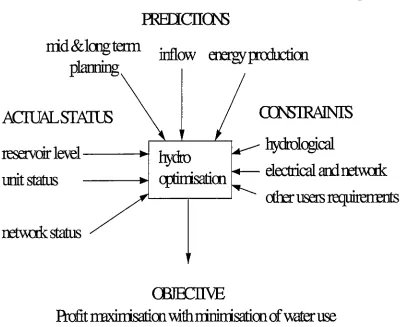
The figure 3.1. represents general diagram for hydro optimisation process.
nid&lrngterm
planning
ACIUALSTATIB
FRFilCIICM
reservoir level---
hydro
qXirrisatim
unit status
CHJECIIVE
Cil\SIRAINIS
hydrological
electrical
arrlretwlk
ctrer
users
requirenms
Ru.fit
mOOrrisatim wthrrininisatim
of
\\filer
use
Hgt.re 3.1: Ifydro qXirrisatim
precess
Actual status and constraints are different for each hydro system, but can be
[image:51.570.57.464.171.498.2]modelled in the same manner with mixed integer linear programming.
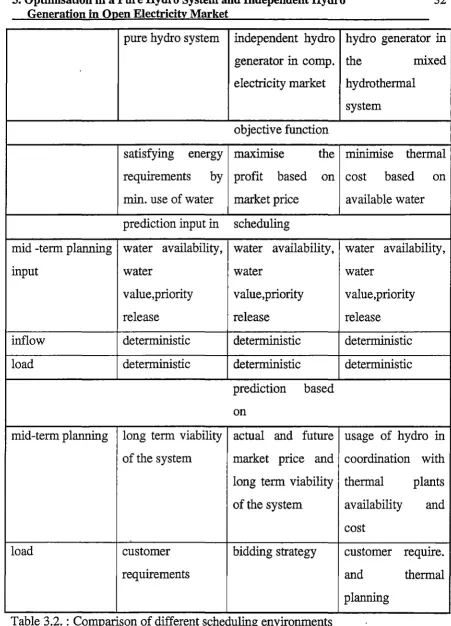
Table 3.2. represent a comparison of hydro systems in three different optimisation
pure hydro system independent hydro hydro generator in generator in comp. the mixed electricity market hydrothermal
system
objective function
satisfying energy maximise the II1ll11I1llSe thermal requirements by profit based on cost based on min. use of water market price available water
prediction input in scheduling
mid -term planning water availability, water availability, water availability,
input water water water
value, priority value, priority value, priority
release release release
inflow deterministic deterministic deterministic
load deterministic deterministic deterministic
prediction based on
mid-term planning long term viability actual and future usage of hydro in
of the system market price and coordination with long term viability thermal plants of the system availability and
cost
load customer bidding strategy customer require.
requirements and thermal
[image:52.570.41.492.40.666.2]planning
The table shows that differences exist only in the objective function and how the
predictions are prepared. The objective function will be discussed later in the
mathematical model part. The following two sections discuss the long/mid-term
planning and load prediction aspects.
3.2. Effect of the long-term and mid-term planning on real-time
scheduling
From the real-time short-term hydro scheduling aspect, mid-term and long-term
planning policies represent, an input which ensures appropriate release from
medium and major storages in the system.
The following elements can be provided as an output of the mid-term policy:
• release priority;
• expected value of MW/cumec to be achieved from the medium/major storage
and all downstream storages for storage levels;
• relative water value for the full range of storage level.
A release priority from the medium and major storages depends on the long term
strategy and fill/empty cycle of storages.
The expected value is a supplement of release priority and is usually connected
with the cascade hydro plants with a medium or major storages the headwater of
the cascade. This value takes into account an actual inflow into downstream
run-of-river stations. In the case of a high inflow into run-of-river storage can be
use of stored water. This expected value is changeable and depends on the level in
the storage ~d power system requirements for hydro generation. If the level is low
then the high value is to be achieved on the cascade. The maximum expected value
is the sum of maximum efficiency point of the whole cascade. As the level
increases the expected value is lower. At the time when the level approaches to the
full supply level, it becomes equal to the value of the headwater storage power
station above.
A relative water value has a different meaning for different hydro system
environments. In a pure hydro system this value is only a signal of current status of
storages and can trigger analysis for possible energy rationing or additional energy
support to ensure long-term viability of the system.
For an independent hydro generator, it gives the price which generator is willing to
accept on the spot market.
For mixed hydrothermal power systems, it gives comparative price with thermal
operating cost to ensure long term hydro share of generation.
3.3. Effect of the load and inflow prediction on real-time
scheduling
A load prediction in a pure hydro system is based on the customer load demand.
For the independent hydro generator, it is based on the prediction of a share of the
generation based on customer demand and expected spot price on the market. In a
demand, thermal units availability and operating cost. In the hydro scheduling
function loa~ is treated deterministically. It is also important to take into account
that hydro generation often takes a role of regulating reserve in the system, which
means that load prediction in the case of hydro is very uncertain.
Inflow prediction is also an important factor, especially in those systems where
significant energy production comes from run-of-river power stations. Any change
in inflow will require increase/decrease in storage station release.
These two uncertainties are very important in the decision making processes,
especially to track target levels of storages, minimise the number of start-up/shut
downs, maximise the head and minimise the deviation from maximum efficiency.
This is the most important reason why the real - time hydro scheduling concept is
developed with the main features of constant rescheduling based on real time data,
Chapter 4
Algorithm for the Real-time Short-term
Hydro Scheduling
4.1. Introduction
The Real - Time Hydro Scheduling and Commitment (RTHSC) function is used to optimally schedule and dispatch the generating units.
This scheduling is performed in three phases:
1. RTHSC - EA. The water release for each station is determined using the rules based simulation based on mid-term policy.
2. RTHSC - GS. An optimal half-hourly generation schedule is determined to meet the water release determined by the EA.
3. RTHSC - DHED. An optimal generation schedule is determined based on real-time data.
30rrnnutes
RTIJSC function
energy allocation
generation scheduling/
rescheduling
5minutes 1
hydro dispatch
AGC - 4
sec
loop
Figure 4.1: Flow
chart
of the
mlin
functions
The input data for the RTHSC function includes the half-hourly system load
forecast, the reservoir inflows from the inflow forecast and the generating unit
maintenance schedule from the outage plan. Other input data includes initial and
historical state of generating units, reservoir levels, river flows and storage
release policy data in the form of storage release priorities, minimum expected
values and reservoir target levels.
RTHSC first determines the scheduled water release using the storage release
priorities, minimum expected values and reservoir target levels from the
RTHSC then utilises a detailed mathematical model of the hydrological system
which incorporates models of the unit power/turbine flow/head characteristics to
solve for the generating unit schedule which maximises the electrical energy
produced by the released water from the storages and the natural inflows.
The RTHSC-DHED is performed by allocating the desired hydro generation so
that the reservoir target levels obtained from a previously executed GS solution
are respected. The DHED function ensures that the hydro units are dispatched at
the theoretical maximum efficiency point for the real-time telemetered head
level. It also refines unit commitment/decommitment based on real-time load
and inflow data.
The RTHSC GS and DHED functions share the same hydrological models and
all three functions share the same database.
4.2. Energy allocation function
The first step is to define the water release and energy allocation for each station
using the rules from the mid-term plan.
The following factors are used to determine the release of water from the
medium and major storages:
1. Release priority and Minimum Expected Value. Medium and major storages
are given a priority order based on the long-term storage strategy. In
addition, a Minimum Expected Value in MW/cumec can be applied to a
is _then released from storage according to a user-specified priority, provided
that the actual incremental water value is greater than or equal to the
Minimum Expected Value for the reservoir operating level. The incremental
value of the water is determined by the downstream inflow conditions and
the availability of the plant.
2. Economic Operating Levels (EOL) are target levels which may be set for any
storage for any period during the study. If these values are set for a particular
storage, water will be released so that the reservoir level remains at or above
these levels at the end of the study. These levels are derived from long/mid
term planning adjusted for actual system conditions.
3. Specific rules may be applied for some catchments and power stations based
on other constraints in the system.
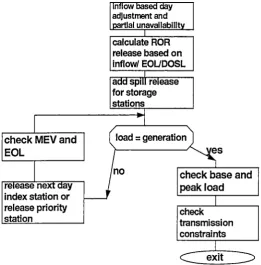
The Energy Allocation is performed using a Hydro Simulator (HS) algorithm to
simulate the downstream flows and energy output while iteratively releasing
water from the storages until the daily energy requirement is met. The algorithm
for performing the Energy Allocation is illustrated in the general flow chart in
Figure 4.2.
Initially the medium storage releases are set to zero, unless a storage station is
spilling, in which case the release is set to use as much of the spill flow as
possible. The Hydro Simulator is solved to determine the energy output from the
check MEV and EOL
re ease ne ay
index station or release priority station
load
=
generationcheck base and peak load
check
transmission constraints
[image:60.569.133.395.104.370.2]exit
Figure 4.2 : Energy Allocation Flow Chart
The energy production from the station is calculated as follows:
1. If the average scheduled water flow is less than the maximum efficiency
discharge, the number of hours of generation at maximum efficiency is
calculated and the energy production is calculated using the maximum
efficiency conversion factors.
2. If the average scheduled water flow is greater than maximum efficiency and
the reservoir levels, natural inflows and upstream flows are such that the
reservoir will not reach danger of spill level within the study period, the
station is operated at maximum efficiency for the whole period and the
energy production is calculated using the maximum efficiency conversion