THE CONTRIBUTION
OF
METAEVALUATION TO
THE
This is to certify that the following thesis presented by Barry John Bannister as the result of research conducted between 1982 and 1987 - and supervised by Professor Phillip Hughes and Dr Brian Caldwell - was examined and duly recommended as fulfilling the requirements of the degree of Doctor of Philosophy. The examiners of the thesis were Dr William Mulford, Dr Edward Booth, and Dr Keith Andrews.
SUPERVISORS
PROFESSOR PHILLIP HUGHES
DR BRIAN CALDWELL
EXAMINERS
DR WILLIAM MULFORD
DR EDWARD BOOTH
DR KEITH ANDREWS
L41,1
1
THE CONTRIBUTION
OF METAEVALUATION
TO THE DEVELOPMENT OF
EVALUATION THEORY AND PRACTICE:
AN EXPLORATORY STUDY.
by
Barry John Bannister
(B.A. T.
Cert. B. Litt. Grad. Dip. Curr. Dev. M.Ed.)
in the
Department of Teacher Education
submitted in fulfilment of the requirements
for
the degree of
Doctor of Philosophy
CERMFOCA10OH 71IE DEMORMILENY OF UHE RESEARCH
I certify that this thesis is entirely my own work and has not been
submitted previously to fulfil the requirements of an award at any university or institute of higher education. To the best of my knowledge and belief, the thesis contains no material previously published or written by another person, except when due reference is made in the text of the thesis.
aCKHOWLECOENIEHU
I should like to express my appreciation to those who have assisted in the preparation of this thesis. The support of my family and especially of my wife Susan over the past six years has been indispensable, particularly during my periods of absence while fulfilling residency requirements.
The advice and constructive criticism of my supervisors, Professor Phillip Hughes and Dr Brian Caldwell, were always of the highest quality. Their willingness to assist in the solution of the numerous dificulties that arose throughout my candidature has been a source of continuing encouragement.
Thanks are due also to those who so willingly participated in the evaluations which formed part of the research study. Without their cooperation, the survey information and the evaluation reports used in the study would not
have been available. In order to protect its confidentiality, this information has been placed in a separate volume and will be subject to limited release at the discretion of the author in consultation with those involved in the evaluations.
SUMAG\HY OF CON7ER176
TOPIC
FLA_caL
Title Page (i)
Certification (ii)
Acknowledgement (iii)
Summary of Contents (iv)
Table of Contents (v)
Abstract 1
Chapter 1 Introduction to the Study 4
Chapter 2 Review of Related Literature 22
Chapter 3 Theoretical Framework and Methodology 97
Chapter 4 The Primary Evaluation 148
Chapter 5 Metaevaluation ... of the Primary Evaluation 173
Chapter 6 Conclusions, Recommendations, and
Implications of the Study 223
Thesis Summary 242
Bibliography 246
71BLE OF CORTITENUS
Title Page (i)
Certification (ii)
Acknowledgement (iii)
Summary of Contents (iv)
Table of Contents (v)
Abstract
Chapter
Chapter 1
2
Introduction to the Study
1. Introduction
2. Identification of Recent Trends in Evaluation
3. Framework for Metaevaluation
4. Need for the Study
5. Purpose of the Study
6. Significance of the Study
7. Contribution to Theory and Practice
8. Definition of Key Terms
9. Outline of the Study.
10. Structure of the Thesis
11. Conclusion
12. Summary
Review of Related Literature
1 Background to Evaluation
1.1 Historical Perspective ... 1.2 The Role of Curriculum
Reform and Accountability 1.3 Reconceptualisation
1.4 Evaluation in Australia 32
1.5 Definitions of Evaluation 36
1.5.1 Using a Mapping Sentence 37
2. Theories and Models of Evaluation 40
2.1 Tyler's Perspective 42
2.2 Stake, Scriven, Stufflebeam 43 2.3 Scriven's Evaluation Checklist 46 2.4 Formative & Summative Evaluation 48
3. Quantitative and Qualitative Evaluation 51 3.1 A Critique of the Quantitative
Approach 52
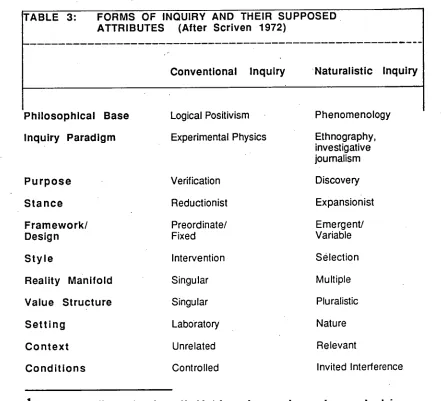
3.2 Conventional and Naturalistic
Inquiry 53
3.3 Subjectivity and Objectivity 55 3.4 A Basis for Combining Qualitative
and Quantitative Approaches 57
4. Case Study as a Method of Inquiry 59 4.1 Distinguishing Features of the
Case Study Approach 61
4.2 Case Study as Methodology 62
4.3 Generalising from a Case Study 63 4.4 Role of Action Research
in the Methodology 65
4.5 Criticism of the Case Study Method 66
4.6 A Note on Self-Evaluation 68
5. Metaevaluation 69
5.1 Metaevaluation Defined 70
5.2 Formative and Summative
Metaevaluation 71
5.3 Metaevaluation Techniques 73
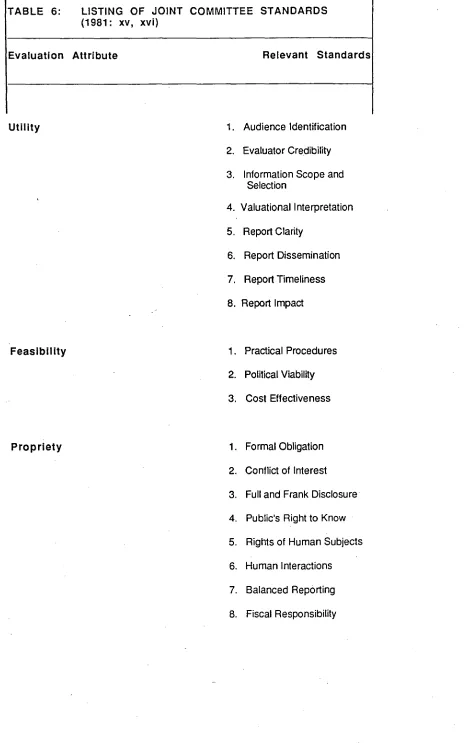
5.4 Metaevaluation Standards 74
5.5 Evaluation 'Theses' 78
5.6 Measuring Evaluation Impact 80 5.7 Evaluation Quality as
a Metaevaluation Criterion 82
5.8 Models of Metaevaluation 85
5.9 Values in Metaevaluation 88
6. Conclusions and Implications arising
from the Review of Literature 92
7. Summary 94
Chapter 3 Theoretical Framework and Methodology
of the Study 97
vii
2. Statement of the Research Problem 99
3. Research Design 100
3.1 A Research Design Issue
4. The Potential of the Case Study Approach 101
5. Case Study as a 'Multi-Method' Approach 102
6. Diagrammatic Representation
of the Research Design 104
7. Outline of the Theoretical Framework 105 7.1 Details of Theoretical Framework 107
8. Basis for Using a Mixed Methodology 110
9. The Scope of the Primary Evaluation 113
10. Details of Phases in Primary Evaluation 115
11. The External Metaevaluation 119
11.1 Details of Phases in the
External Metaevaluation 119
12. The Internal Metaevaluation 120
12.1 Phases of the Internal
Metaevaluation 122
12.2 The Checklist used for the
Internal Metaevaluation 123
12.3 Relationship of Evaluation Standards to
Checklist Items 124
13. Discussion of Data Gathering Techniques
Used in the Primary Evaluation 125
14. Questionnaire Validity and Reliability 126 14.1 The Validity and Reliability
of Student Ratings 128
14.2 Questionnaire 'A' 130
14.3 Questionnaire 'B' 131
14.4 Mid-Semester Review Exercise 133
15. Using Interviews to 'check' or
'triangulate' Data Sources 134
15.1 Monitoring Withdrawals 137
15.2 Interviews with
Chapter
Chapter 5
16. Triangulation as an Aid to Validity
17. Data Analysis
18. Delimitations, Assumptions, Limitations
19. Conclusion
20. Summary
The Primary Evaluation
1. Introduction
2. Summary of Techniques and Results of the Case Study
3. Background to Evaluation Reports
4. Evaluation Report No. 1
5. Evaluation Report No. 2
6. Evaluation Report No. 3
7. Evaluation Report No. 4
8. Evaluation Report No. 5
8.1 First Part of Report No. 5 8.2 Second „
8.3 Third " 8.4 Final "
9. Conclusion
10. Summary
Metaevaluation of the Primary Evaluation
1. Introduction
2. External Metaevaluation 2.1 Evaluation Design 2.2 Consultation Process 2.3 Reports
2.4 Analysis of the Data 2.5 Review of Use of the
ix
2.6 Assessment of the Accuracy
of Evaluation Reports 197
2.7 Appropriateness of the Evaluation Design for the
Evaluation of Other Courses 198
3. Summary of External Metaevaluation
Findings 199
4. Internal Metaevaluation Report 200
4.1 Checklist and Standards
5. The Primary Evaluation in Relation to
the 'Joint Committee' Standards 202
5.1 Utility Standards 203
5.2 Feasibility Standards 206
5.3 Propriety Standards 209
5.4 Accuracy Standards 215
6. Conclusion 220
7. Summary 221
Chapter 6 Conclusions, Recommendations,
and Implications of the Study 223
1. Introduction 223
2. Implications of the Study 224
3. Metaevaluation 224
3.1 Revised Approach to Evaluation 226 3.2 Responsibilities of Evaluation
Participants 227
3.3 Implications for Metaevaluation
Generally 229
4. Evaluation Quality 231
5. Development of Evaluation Theory
and Practice 232
5.1 Paradigm and Methodology 233
5.2 Implications for 'Formative,
Low Budget' Evaluations 234
5.3 Implications for an Emergent
Methodology 235
6. Recommendations for Further Research 235
Thesis Summary 242
Bibliography 246
Appendix (Contained in Volume 2)
Appendix Table 1: 'Summary of Evaluation Activities from 1973 to mid 1978, Australia'. Table 2: 'Four Methodological Approaches in
Program Evaluation' (Mitzel et. al. 1982: 600)
291
Appendix 2 Figure: 'A Layout of Statements and Data to be Collected by the Evaluator
of an Educational Program', (Stake in Madaus et. al. 1983: 296)
294
Appendix 3 Questionnaire 'A' 297
Appendix 4 Questionnaire 'B' 303
Appendix 5 Evaluation Report No. 1 309
Appendix 6 Evaluation Report No. 2 324
Appendix 7 Evaluation Report No. 3 346
Appendix 8 Evaluation Report No. 4 363
Appendix 9 Evaluation Report No. 5 376
Appendix 10 External Metaevaluation Report 393
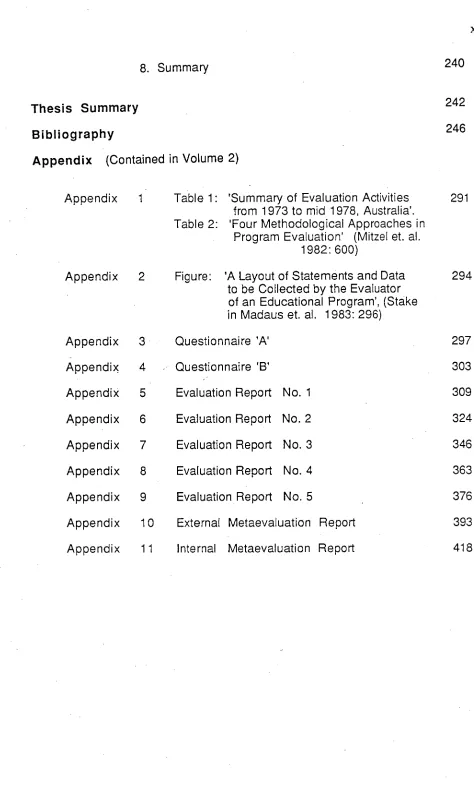
[image:12.559.40.514.10.795.2]7ango, 00@grrerno @nd Maucro
ITEM TITLE PAGE
Chapter 1
Diagram Structure of Thesis 18
Table 1 Timeline for the Study 19
Chapter 2 xi Figure 1 Table 1 Table 2 Table 3 Table 4 Table 5 Table 6 Table 7
Mapping Sentence Definition
of Evaluation 38
Scriven's Evaluation Checklist 46 Relevance of Four Evaluation Types to
Decisionmaking and Accountability 49 Forms of Inquiry and their Attributes 54 Quantitative and Qualitative Aspects of
Objectivity and Subjectivity 55
Shared Characteristics of Methodologies 59
Joint Committee Standards 76
Evaluation Quality: Seven Factors ... 82
Chapter 3
Table 1
Table 2
Table 3
Table' 4
Diagram of Research Design Diagram of Theoretical Framework Phases in Primary Evaluation Phases in External Metaevaluation Phases in Internal Metaevaluation Relationship of Evaluation Standards to Checklist Items
Use of Student Responses to Evaluation Interview Checklist for Students
withdrawing from Course
Numbers of Students Withdrawing
Chapter 4
Table 1 Techniques and Results of Case Study 150 Table 2 Summary of Metaevaluation Techniques
and Results 151
Chapter 5
Diagram 1 Diagram 2
Table 1
Table 2 Table 3 Table 4 Table 5
Information Flow During Primary Evaluation 181 Consultation Involved in One Phase
of Formative Evaluation 182
Topics and Checklist Items included in
Metaevaluation Proforma 201
Utility Standards & Primary Evaluation 204 Feasibility Standards & Primary Evaluation 206 Propriety Standards & Primary Evaluation 210 Accuracy Standards & Primary Evaluation 216
Chapter 6
Table 1
Table 2
Factors Influencing Revised Approach to Evaluation
Responsibilities of Participants in Revised' Evaluation Approach
227
&11337RAC7
The thesis arises from a belief that more attention needs to be given to methods of improving evaluation theory and practice. Metaevaluation - or the evaluation of evaluation - would seeem to be a potentially significant element in the determination of evaluation quality, which is accepted as a major metaevaluation criterion. The study is concerned, therefore, with demonstrating the extent of this potential by evolving an approach to evaluation based on insights emerging both from the research literature and from the situation in which the study is conducted.
The review of research indicates the uneven development of evaluation theory and practice in recent decades, partly as a result of proponents of 'traditional' and 'alternative' paradigms defining or re-defining their respective positions in reaction to each other. This led to the proposition that one's epistemological assumptions in some way determined the research method or evaluation techniques available; further analysis revealed that one's methodology is not pre-determined in this manner, because of the absence of a sustainable - logical or causal -
link between ideology, paradigm, and method-type.
Acceptance of this point of view facilitated the adoption of a case study approach to the design and implementation of the evaluation and metaevaluation which formed the case study element of the overall study. Evidence of the need for an exploratory study of the type reported on in this thesis, was found in the literature and particularly in requests by the Joint Committee on Standards for Educational Evaluation, concerning the need for research efforts which would test the validity and utility of current metaevaluation standards in field settings.
In general terms, the problem examined in the study was proposed as follows:
1. What is the contribution of metaevaluation to the improvement of evaluation theory and practice?
2. What is the most appropriate method of facilitating this investigation?
The case study method suggested in the review of literature, and suited to the context of the overall research study, employed the techniques of questionnaire, interview, and checklisting to gather data. The analysis of these data in turn produced insights of relevance to the development of metaevaluation procedures, as well as to their role in the improvement of evaluation.
The results of the case study were presented and analysed with the outcomes of the formative evaluation being recorded by means of a summary of the periodic evaluation reports prepared during the three years of the case study. At the end of this 'formative' period, an external metaevaluation assessed the impact and validity of the primary evaluation, and this was supplemented by an internal metaevaluation using a checklist based on the Joint Committee Standards referred to above.
CHaPUEM 1 BMCDOWMON UO UK E BMW
CHAPTER 1 INTRODUCTION TO THE STUDY
This first chapter provides the background information necessary for an understanding of the overall nature and scope of the research study on which the thesis reports. The sub-topics discussed throughout the chapter are as follows
1. Introduction
2. Identification of Recent Trends in Evaluation 3. Framework for Metaevaluation
4. Need for the Study 5. Purpose of the Study 6. Significance of the Study
7. Contribution to Theory and Practice 8. Definition of Terms
9. Outline of the Study 10. Structure of the Thesis 11. Conclusion
12. Summary
1. INTRODUCTION
with the resources required to support 'this new form of management aid'. He adds that
the perception of evaluation as the decisionmaker's best friend is reflected in the management orientation given to
most evaluations in education.
This management emphasis is reflected in definitions and conceptualisations of evaluation which highlight its role in guiding decisions at various levels in a number of different settings. While the level of debate about evaluation has steadily increased - and the literature provides evidence of general agreement on the central concerns of evaluation - there has not been comparable attention given to its methodology, or to the means by which the quality of evaluation is assessed.
The present study is concerned with this latter aspect, and so is undertaken in the context of evaluation, with the primary focus being on metaevaluation. The purpose of the case study conducted within the overall research study is to demonstrate empirically the extent of the role played by metaevaluation in the monitoring and determination of evaluation quality. The research literature - for example, Joint Committee on Standards in Educational Evaluation (1981) - recommends the use of widely accepted standards as a point of reference in the conduct of metaevaluation, and urges the testing of these standards in circumstances different from those in which they were developed.
The suggestion that the Standards be applied to a variety of field settings has already been taken up in Israel by Lewy (1984), and in Brazil by de Oliveira et. al. (1985). The present study intends, as part of its overall purpose, to apply the Standards in an Australian context in which the effectiveness of a formative evaluation programme is assessed on the basis of these Standards.
2. IDENTIFICATION OF RECENT TRENDS IN EVALUATION
This chapter contains a summary of recent trends in evaluation and establishes the need for the study, the purpose of which is provided along with a statement of the problem for research and the definition of key terms. The significance of the study in relation to its contribution to the development of evaluation theory and the improvement of evaluation practice is outlined.
The measurement of the effectiveness of evaluation at different levels of private and public enterprise is currently a matter of international interest and concern. At the same time, Scriven (1983: 238) writing of trends in North America that may well be . universal, alludes to the fundamental biases underlying evaluation ideologies that exude a sort of "valuephobia" which avoids not only the evaluative act itself, but also involves" the denial or rejection of self-reference". Scriven (1983: 230) continues
This is most clearly seen in the failure of evaluators to turn their attention to the procedures by which they are themselves evaluated as - and which they use to evaluate others - members of the scientific community.
• The Stanford Evaluation Consortium (1980), the Joint Committee on
Part of the evidence for this increasing interest in evaluation, and to a lesser extent the aspect of metaevaluation, is a consciousness that evaluation should to be useful, have impact, and be cost effective. There is also a growing awareness of the need to conserve resources, and hence not squander them on 'unevaluable' programmes. Rutman's (1985) research on evaluability assessment has presented local evaluators with a conceptualisation of this aspect of evaluation to guide their own work in this and related areas.
Brinkerhoff's (1982) attention to the staff development implications of evaluation in an organisational environment, and the potential of metaevaluation standards in the training of evaluators, has generated a _considerable amount of interest and debate amongst members of bodies such
as the Australasian Evaluation Society at recent international conferences. The literature - for example, Madaus et. al. 1983: 383) - also contains evidence of this increased evaluation activity in its reference to the growth of journals, societies, and standards dedicated to the academic advancement and 'professionalisation' of evaluation.
Much of the literature dealing with the trends mentioned above is concerned primarily with descriptions and conceptualisations of evaluation. Parlett and Hamilton (1972), Hughes (1981), Cronbach (1980), and Stufflebeam et. al. (1983) provided reviews of the development of evaluation and the movement towards new ways of conceptualising evaluation in the United Kingdom, Australia, and the United States respectively. Interestingly though, only Stufflebeam an Cronbach specifically mentioned the role of metaevaluation in this reconceptualisation, although this may have been - as the literature review will indicate - because the evaluation movement is long
established in the United States, as compared with Australia, and to a lesser extent the United Kingdom.
3. FRAMEWORK FOR METAEVALUATION
Research on the role of metaevaluation has to date not moved beyond tentative conceptualisations and formulations of how it operates in practice. The standards developed by the Joint Committee for Standards in Educational Evaluation seem to offer a framework for the planning and implementation of evaluation reviews, but stop short of a comprehensive metaevaluation framework. Not all researchers agree on the necessity or desirability of standards for reviewing evaluations - for example, Nillson and Hogben (1983) - and the Joint Committee apparently was conscious of the perceived benefits and risks asssociated with developing standards
the Joint Committee was guided by the assumption that evaluation is an inevitable part of any human undertaking and by the belief that sound evaluation can promote the understanding and improvement of education, while faulty evaluation can impair it. The Committee was also guided by the belief that
a set of professional standards could play a vital
role in upgrading the practice of educational evaluation. (1981: 5)
4. NEED FOR THE STUDY
concentrate on testing them in practical situations (1981: 12). As noted earlier, this recommendation contributed to the decision to conduct a study incorporating selected standards as integral elements within an overall metaevaluation strategy.
Apart from such evidence of the need for metaevaluation activity, there is a dearth of literature relating to its role in the promotion of more effective and efficient evaluation practices, or to the theory on which they are based. The need for a study in this area is apparent if one considers the importance of being able to document, assess, and make judgements about the adequacy of evaluations as a prelude to the implementation of improvements in theory and practice. The study therefore responds to this need in the form of an exploratory investigation not only of the nature of metaevaluation as.presented in the available research literature, but also of its purposes, processes, and possible outcomes. This was considered an especially significant need in Australia where - unlike North America, for example - no systematic formulations, or examples of formal metaevaluation studies were known to exist.
The context of the two metaevaluation sub-studies - and of the primary evaluation on which they were based - is considered appropriate in view of the presence of an organisational setting conducive to evaluation, although it was a context in which evaluation programmes had not previously existed. This environment facilitated the conduct of a case study in which an evaluation methodology was developed and then itself evaluated as a means of applying evaluation standards in a field setting.
The call by Smith (1983: 385) for evaluation research in field settings highlights the requirement for a study such as that proposed in the present context; he suggests that
10
We need research on evaluation; we especially need grounded, empirical studies of evaluation practice.
We have almost no descriptive information on the practice of evaluation, few field studies of evaluation impact, and scant attention to the empirical study of evaluation method.
Insofar as the study inquires into these processes, it not only contributes to knowledge of the procedures related to evaluation methodology and impact, but also lays the foundation for what Smith (1983: 385) refers to as "a theory of evaluation practice".
5. PURPOSE OF THE STUDY
The general purpose of the study is to investigate the role of metaevaluation in the development of evaluation theory and practice. More specifically, the purpose of the study may be expressed as a research problem in the following terms
1. If metaevaluation may be defined as 'the evaluation of evaluation', does this imply that it encompasses
.1 the evaluation of particular evaluations,
and .2 the evaluation of evaluation generally?
2. If so, what are the most appropriate means of conducting an investigation to demonstrate empirically how metaevaluation techniques and standards may
SIGNIFICANCE OF THE STUDY
As mentioned already, the need for the study was suggested not only by the current attention currently being given to topics such as evaluation quality, and evaluation impact, but also by the development of standards whose authors recommend their practical application and further testing. These three aspects combine to highlight the significance of a study which is designed to assess overall impact and quality by means of those standards relevant to the assessment of a formative evaluation.
The significance of the study is enhanced further by the relative paucity of research on metaevaluation in an Australian context where statutory requirements, or accountability, are not yet perceived to be factors stimulating the growth of evaluation activity, as they have been in North America and in the United Kingdom respectively.
An additional element which indicates the significance of the study is the view expressed by the President of the Australasian Evaluation Societyl that the two metaevaluations conducted as part of the study, are the first Australian examples of formal educational metaevaluations using the Joint Committee Standards as a basis for assessment. It is proposed that the delimitations described in chapter three - particularly those relating to the decision to use the case study approach - enhance rather than diminish the significance of the study, for reasons explained in that chapter. The significance of the study, then, may be seen primarily in the contribution it makes to the development of the
I Personal communication from the President of the Rustralasian Evaluation Society, 28 July 1986. RES is an association of leading evaluators from throughout the Rustralasian region.
theory and conduct of evaluation, with a particular focus on the aspect of metaevaluation.
7. CONTRIBUTION TO THEORY AND PRACTICE
The study contributes to theory in that it is concerned with the identification of quality as a major metaevaluation criterion, and proposes a methodological approach to its measurement. It also adds to the literature on metaevaluation standards as applied in a particular setting in which not all standards may be perceived as having an equivalent role in the assessment of evaluation quality.
The study contributes to practice in its design and implementation of a case study approach which includes an integral requirement for internal and external metaevaluation sub-studies. The resultant theoretical framework is proposed as having utility in circumstances similar to those of the context in which it was developed, and demonstrates specifically that a metaevaluation approach incorporating widely accepted standards, does facilitate the assessment of evaluation quality.
8. DEFINITION OF KEY TERMS
The following are terms used throughout the study and whose definition may be of assistance in clarifying their meaning in the present context:
CASE STUDY
13
appropriate where outcomes are hard to measure, where modifications and further development are possible, and where those trying to understand cannot experience the programme at first hand. The context of the case study which formed the basis of the research for the thesis involved the longitudinal [three year] evaluation of a course in which the evaluator was formally a member of the course team, and hence - by definition - an insider.
COURSE
refers to the educational programme - in this case, an Associate Diploma in Public Administration - which was the subject of the primary evaluation conducted as part of the research study.
COURSE ADVISORY COMMITTEE
comprises representatives of all involved in or affected by the primary evaluation, and is the main audience for evaluation reports.
COURSE COORDINATOR
is responsible for the overall development of the course being evaluated,
and for liaison with the evaluator.
COURSE REVIEW COMMITTEE
is a sub-committee of the Course Advisory Committee responsible for overseeing the results of the evaluation programme, and is concerned particularly with ensuring the confidentiality of evaluation data.
EFFECTIVENESS
concerns the extent to which an activity is perceived to be successful in achieving some agreed purpose. Despite Drucker's (1969) 'popular'
- "doing the thing right", terms such as effectiveness, quality, and impact are sometimes used synonymously.
EVALUATION
briefly, to evaluate is to place a value upon something - to judge. In more detail, it is a process of discovering, collecting, and using information to form judgements which in turn are to be used in decisionmaking. Formative
evaluation provides information relevant to the monitoring and modification of programmes during their developmental phase; while summative evaluation
provides information relevant to assessing the overall worth or merit of a completed programme.
EVALUAND
is the object of an evaluation, or that which is being evaluated.
EVALUATOR
is one who provides information - including judgements and recommendations concerning worth and merit - to facilitate decision-making related to products, programmes, or personnel. The evaluator - in the present study - is colleague and advisor to the primary audience ( program staff), 'honest broker' to other audiences such as students and employers, and member of a Course Team as far as the reviewer / external evaluator is concerned.' The thesis report and appendix further clarify the role of the evaluator in relation to participants.
RESEARCHER
15
external metaevaluation. Essentially, the researcher employs a methodology capable of assessing programme effectiveness at three levels of operation.
FACULTY
refers to the Faculty of Business at Darwin Institute of Technology in which the primary evaluation, and the two metaevaluations contained in the
research study were conducted.
MERIT
may be defined as " the excellence of an object as assessed by its intrinsic qualities or performance". (Joint Committee 1981: 153)
METAEVALUATION
involves the examination of a primary evaluation in order to assess its strengths and weaknesses. The term is used also in the sense of the evaluation of evaluation.
NEED
Various types of need are referred to in the literature, for example: normative, comparative, felt, computed, or expressed need. The last of these is implied when the term is used in the study, and may be defined as the perceived gap between what is, and what ought to be the case. 1
PARADIGM
refers to a world view, a general perspective, which tells what is important, legitimate, or reasonable, without long existential and epistemological consideration. (After Patton, 1978). On the basis of a particular paradigm one may reasonably select a methodology which encompasses the scope of possible approaches to a research problem, and which in turn suggest specific techniques of use in the selection, collection, and analysis of data. This implies, therefore, a hierarchical relationship between the above three elements: both in theory and in practice.
METHODOLOGIES
(in relation to the present study) relate to the use of emergent, reflexive approaches which seek to respond to issues identified by different audiences at key points in the development of the research programme. In all phases of this programme a mixed quantitative-qualitative methodology employed in order to maximise the range of perspectives available to the evaluation researcher. This is discussed in more detail in chapter three of the thesis doocument.
PRIMARY EVALUATION
is an evaluation which is the subject of a metaevaluation.
QUALITY
in respect to evaluation comprises two aspects: technical adequacy (appropriate design and implementation, and the absence of major conceptual errors), and usefulness
17
STANDARDS
are statements of minimum acceptable performance on a particular criterion and which assist in the assessment of the utility, feasibility, propriety and accuracy of an evaluation. The Joint Committee refers to a standard as a "principle commonly agreed to by experts in the conduct and use of evaluation for the measure of the value or quality of an evaluation." (1981: 155)
VALUE
a stated opinion of what is or is not desirable.
WORTH
the value of an object in relationship to a given purpose. (Joint Committee 1981: 156)
9. OUTLINE OF THE STUDY
This chapter briefly summarises recent trends in evaluation, and establishes the need for an exploratory study of the nature, purposes, and operation of metaevaluation. The contribution of such a study to the development of evaluation theory and practice is noted, the research problem outlined, and key terms defined. ,
chapter five. Chapter six synthesises the findings of the preceding chapters, suggests their implications for evaluation theory and practice, and recommends areas for further research. Each chapter contains a listing of sub-topics at the beginning and a summary at the end; while the longer chapters - two, three, and five - have, in addition, a number of paragraphs entitled 'synthesis', which draw the discussion together at appropriate points in its development.
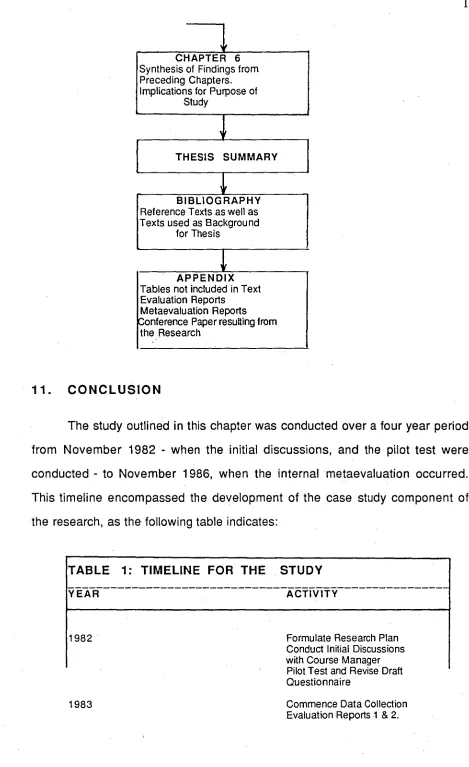
10. STRUCTURE OF THE THESIS
The Thesis is structured as follows
ABSTRACT
1
CHAPTER 1
Purpose, Research Problem, Significance of the Study
Definitions
CHAPTER 2
Review of Literature: 1. Evaluation
2. Case Study Methodology 3. Metaevaluation
Implications for Study
CHAPTER 3
Theoretical Framework Methodology, Assumptions Limitations, Delimitations
CHAPTER 4
Description and Results
of Primary Evaluation A
CHAPTER 5
19
CHAPTER 6 Synthesis of Findings from Preceding Chapters. Implications for Purpose of
Study
THESIS SUMMARY
BIBLIOGRAPHY Reference Texts as well as Texts used as Background
for Thesis
APPENDIX Tables not included in Text
Evaluation Reports Metaevaluation Reports
c
onference Paper resulting from the Research11. CONCLUSION
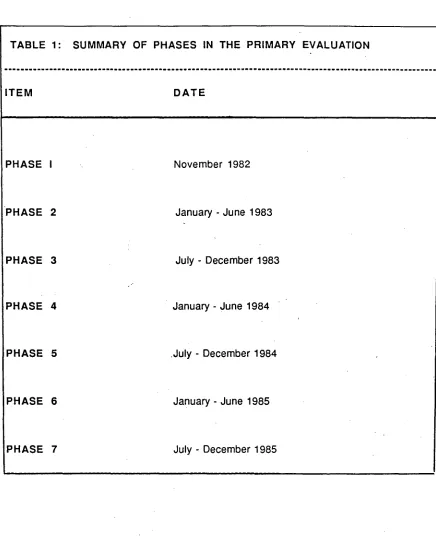
[image:35.559.50.519.36.803.2]The study outlined in this chapter was conducted over a four year period from November 1982 - when the initial discussions, and the pilot test were conducted - to November 1986, when the internal metaevaluation occurred. This timeline encompassed the development of the case study component of the research, as the following table indicates:
TABLE 1: TIMELINE FOR THE STUDY
YEAR ACTIVITY
Formulate Research Plan Conduct Initial Discussions with Course Manager
Pilot Test and Revise Draft Questionnaire
Commence Data Collection Evaluation Reports 1 & 2. 1982
Submission of Detailed Research Proposal
1984 Oral Defence of Research Topic (February)
Evaluation Reports 3 & 4
1985 Evaluation Report 5
1986 Metaevaluation Reports
1987 Thesis Report Submitted
As an instance of metaevaluation research, the study incorporates a two-stage sub-study which firstly develops a primary evaluation of a part time course over a three year period, and then reviews its effectiveness by means of metaevaluations conducted by an external consultant, and by the internal evaluator. The data from this sub-study are analysed on the basis of insights provided by the research literature, and the implications for evaluation theory and practice flowing from this analysis are discussed. In the following chapter, the literature relevant to the study is reviewed as a starting point in the design and implementation of the conceptual framework for the study.
12. SUMMARY
21
LTVERZYTUM
22
CMQPVEGa
nEworEv
c)
nE-'1,XTED
ILETErhanDnIE
This chapter reviews the literature on evaluation in relation to the fundamental concerns of the study. For this purpose the review has been organised into six main sections dealing firstly with aspects of evaluation in a general sense, and then progressively focussing on the dimensions of metaevaluation and case study methodology which are of central interest in the present research context.
23
1. BACKGROUND TO EVALUATION
1.1 Historical Perspective on Evaluation 1.2 The Role of Curriculum Reform and
Accountability
1.3 A Suggested Reconceptualisation of Evaluation 1.4 Evaluation in Australia
1.5 Definitions of Evaluation
1.5.1 Using a Mapping Sentence to Define Evaluation
2.. THEORIES AND MODELS OF EVALUATION
2.1 Tyler's Perspective
2.2 Stake, Scriven, Stufflebeam, Parlett and Hamilton
2.3 Scriven's Evaluation Checklist
2.4 Formative and Summative Evaluation
3. QUANTITATIVE AND QUALITATIVE EVALUATION
3.1 A Critique of the Quantitative Approach 3.2 Conventional and Naturalistic Inquiry 3.3 Subjectivity and Objectivity
4. CASE STUDY AS A METHOD OF INQUIRY
4.1 Distinguishing Features of the Case Study Approach
4.2 Case Study as Methodology 4.3 Generalising from a Case Study
4.4 Role of Action Research in the Methodology , 4.5 Criticism of the Case Study Method
4.6 A Note on Self-Evaluation
5. METAEVALUATION
5.1 Metaevaluation Defined
5.2 Formative and Summative Metaevaluation 5.3 Metaevaluation Techniques
5.4 Metaevaluation Standards 5.5 Evaluation 'Theses'
5.6 Measuring Evaluation Impact
5.7 Evaluation Quality as a Metaevaluation Criterion 5.8 Models of Metaevaluation
5.9 Values in Metaevaluation
6. IMPLICATIONS - FOR THE STUDY - OF ISSUES ARISING FROM THE REVIEW OF LITERATURE
7. SUMMARY
1. BACKGROUND TO EVALUATION
1.1 HISTORICAL PERSPECTIVE ON EVALUATION
Much of the current literature implies that evaluation is predominantly a contemporary phenomenon, for example, Posavac & Carey (1985: 2); Franklin & Thrasher (1976: 1); Smith in Madaus (1983: 383). Other writers - with perhaps a profounder appreciation for the historical development of the process - point to a rather longer time line in its evolution as a discipline. Nillson and Hogben (1983: 95) suggest that "evaluation is as old as rational discourse itself, which has a history of considerable achievement". Scriven, Stufflebeam and Madaus (1983:4), for example, propose a developmental period encompassing six 'Ages' which commence with the Age of Reform (1800-1900) and finish with the Age of Professionalisation (1973 to the present).
Provus (1969 & 1971), Hammond (1967), Eisner(1967) Metfessel and Michael (1967), proposed reformation of the Tyler model. Glaser (1963), Tyler (1967), and
Popham (1971) pointed to criterion-referenced testing as an alternative to norm-referenced testing. Cook (1966) called for the use of the systems analysis approach to evaluate programs. Scriven (1967), and Stufflebeam (1967 & 1971, with others), and Stake (1967) introduced new models of evaluation that departed radically from prior approaches.
A number of these approaches to evaluation will be discussed further in later sections of the review.
1.2 THE ROLE OF CURRICULUM REFORM AND ACCOUNTABILITY
Borich (1982: 3) points out that the curriculum reform movement in the United States in the immediate post-Sputnik era led to a number of educational advances, however
of greatest significance to the field of evaluation was the fact that with a more systematic approach to curriculum development, the previously isolated concepts of instructional development and evaluation were drawn closer together.
An important concomitant of this period of reformation was the commencement of national projects employing curriculum analysis strategies which - as Borich claims - were later to become known as
for the present study as it underpins the theoretical approach used in the investigation, and particularly that of the case study which forms part of the overall research study.
Borich (1982: 4) suggests that, despite the influence of this curriculum reform movement, there was still relatively little emphasis on the evaluation of educational programmes by the mid-1960s; and furthermore, that the accountability requirements of the E.S.E.A. Act mentioned above ultimately provided the stimulus needed to produce a situation where educators were for the first time required to formally evaluate their own courses.
The role of accountability in promoting evaluation activity in the United Kingdom was noted by Hughes (1980: 6 ) in his reference to the work of the Assessment of Performance Unit and the national currriculum projects conducted by the Schools Council, the Nuffield Foundation and the various Departments of Education. As will be noted later in the review, it was also in this context that many of the 'new wave' evaluators were given the opportunity of developing their alternative approaches to evaluation.
SYNTHESIS
rise to our current perspective, in particular those pertaining to the curriculum reform and educational accountability movements
1.3 A SUGGESTED RECONCEPTUALISATION OF EVALUATION
Cronbach (1963: 672-83) was one writer to take issue with the work of evaluators during the fifties and early sixties. In his seminal article in the
Teachers College Record which criticised the relevance and utility of then current evaluation methodology and results, he recommended a reconceptualisation of evaluation in terms of its contribution to course improvement, and its role in providing an indication of course effectiveness. However, it seemed that this critique of
post hoc evaluations based on comparisons of the norm-referenced test scores of experimental
and control groups (Madaus 1982: 12)
went largely unnoticed at the time, and it was almost a decade later before the first concrete proposals for reform were made.
These came in the form of the diagnosis supplied by the National Study Committeee on Evaluation (Stufflebeam et. al. 1971: 4) that evaluation was "seized with a great illness" whose symptoms were respectively
1. the avoidance symptom - evaluation may expose
problems, and therefore is avoided if possible
2. the anxiety symptom - the ambiguities in the evaluation process evoke anxiety in evaluator and participants
3. the immobilization symptom - despite evaluation requirements of funded programmes, people are reticent to
become involved
4. the lack of theory and guidelines symptom - disagreement amongst 'experts' leaves practitioners confused on possible models or approaches.
Borich (1982: 6) examined the situation described by this committee and concluded that these 'symptoms' were not the only maladies affecting the state of evaluation at the time. He suggested that to these symptoms were to be added
the lack of trained personnel, the lack of knowledge about decision processes, the lack of values and criteria for judging evaluation results, the need to have different evaluation approaches for different types of audiences the lack of techniques and mechanisms for organising, procuring, and reporting evaluative information
as well as new training methods for evaluators. Borich (1982:7) however, saw these deficiencies in a rather different light and claimed they
were symptoms of more fundamental ills: the lack of an adequate definition of evaluation, the lack of adequate evaluation theory, and a failure on the part of evaluators to fully appreciate the context in which evaluation occurs.
These were matters of basic concern to theorists and practitioners alike at the time they were expressed, and while not suggesting they have been satisfactorily dealt with during the intervening years, it is true that the field of evaluation is richer in theory and practice now than it was twenty years ago. However, a note of warning is sounded by Rutman (1984: 9) in his view that evaluation activity at the program level is in decline in the United States
the level of interest in program evaluation has declined significantly in the past few years ... many social programmes with built-in evaluation requirements have been transferred to the states ... there is no longer major social experimentation as occurred in the previous two decades, and the demand for evaluating on-going programmes has declined.
Ideological differences still persist, as the writings of a number of the major theorists such as Scriven, Stake, Stufflebeam, Guba and Lincoln, Eisner, and Madaus attest. In the United States at least, according to Madaus et.al . (1983:17)
in spite of growing search [sic] for appropriate
methods, increased communication and understanding among the leading methodologists, and the
development of new techniques, the actual practice of evaluation has changed very little in the great
majority of settings.
Quoting Kaplan (1964), Madaus surmises that because of this situation
there is a need for expanded efforts to educate evaluators to the availability of new techniques, to try out and report the results of using the
new techniques, and to develop additional techniques.
This latter view is of direct relevance to the research questions posed in the present study in which the prospects for improved theory and practice are examined in the context of evaluation standards applied to an actual evaluation effort.
SYNTHESIS
1.4 EVALUATION IN AUSTRALIA
No major study was located which examined the historical development of evaluation in Australia. Through a Glass, Darkly (1979) the Report from the Senate Standing Committee on Social Welfare, investigated the possible impact of evaluation on the social welfare system in Australia, and in so doing reviewed a number of national initiatives in evaluation-related contexts. The literature in this area is relevant to the discussion since as Borich (1982:2) points out - referring to a social welfare definition of evaluation
This definition is representative of those found in the mental health literature ... and reflects the same view of evaluation's purpose as prevails in education.
The researchers who compiled the above report found that at the time of publication - 1979 - evaluation activity was inadequate and lacking in quality; while their review of the field for the period prior to 1973 showed an almost complete absence of "formal evaluation activity" -apart from
a few inquiries ... which could not be considered as adequate evaluation exercises. (1979: 17)
As far back as 1912 there were attempts by various government joint committees to survey issues of national interest such as unemployment, nutrition, and health, which - given that evaluation was not widely discussed or understood at the time - were adequate for existing information needs.
An indication of the increase in public sector evaluation activity since 1973 is provided in Table 1, Appendix 1. A brief analysis of the evaluations
reported in this table shows that - in terms of purposes, comprehensiveness, and relevance - they were concerned mainly with
1. The adequacy of administrative structures
2. Duplication of services between departments
3. The adequacy and cost-effectiveness of services
4. The need for radical changes to services
According to the Senate Standing Committee Report (1979: 24) these inquiries employed evaluation criteria such as
efficiency of performance, level of service provision... its acceptability to those involved, ... whether there were organisational overlaps in service provision
This did not ensure, however, that evaluated programmes were responsive to needs, or cost effective in their operation, nor take account of the following factors
1. whether the evaluation answered the important questions being asked by policy makers
2. the timing of the activity in the ongoing development of policies or programmes
3. the location, organisation and staffing of the evaluation activity
4. the appropriateness of the data available to answer the type of evaluation questions being posed
5. the methods of presentation and dissemination of the evaluation reports
These factors are of significance to the research study insofar as they indicate standards and criteria which may applied to evaluations in attempts to improve their quality. In particular, point number six relates to the aspect of metaevaluation which will be discussed later in this review.
There remains a dearth of material on the development of evaluation in Australia, although there have been a number of educational enquiries in recent years which indicated a lively interest in the process as a prerequisite for policy making. Activity in the tertiary education sector has been increasing since the mid 1970s when courses in evaluation became available at a number of institutions, and research efforts such as the Teachers as Evaluators Project (Hughes, Russell, McConachy: 1978) and the Institute for Social Program Evaluation (Straton: 1981) were established. The work of the National Curriculum Development Centre in commissioning research and publication has contributed significantly to the development of evaluation in recent times, as has the formation of professional associations such as the Australasian Evaluation Society in 1986, following a gestation period during which it had - as an informal network - sponsored two national evaluation conferences.
Hughes (1980) refers to recent trends in the school sector towards more democracy and participation, as seen in an emphasis on teacher responsibility for the development and evaluation of curricula, and in increased autonomy for individual schools. This perception is reflected in the Schools Commission Report (1979-81) in which evaluation is seen as
having the potential for facilitating self-scrutiny and participative decision making at the school level.
In the late 1980s, evaluation in Australia has developed to the point where it is an increasingly common activity in both public and private sectors, with evaluation consultants and in-house evaluators providing advice to decision makers in a variety of settings. One area in need of further attention, however, is that of the development of methods for assessing the quality and effectiveness of evaluations, using standards and criteria which have been developed overseas and not yet tested for their relevance to the Australian context.
SYNTHESIS
Evaluation in Australia is underdeveloped compared with the United Kingdom and North America where an evaluation 'tradition' has existed for some time. The service areas of social welfare and education have shown a steadily increasing interest in the process in recent years, such that evaluation is now a fact of organisational life - at least in the public sector. The work of Hughes, Russell, and McConachy, in Canberra, and Straton in
1.5 DEFINITIONS OF EVALUATION
A traditional definition of evaluation tended to restrict its ambit to the processes of assessing the worth of a textbook, a syllabus, or a student's academic progress in relation to prespecified objectives. In the period from the 1920s to the 1950s, for example, the terms 'measurement' and 'evaluation' were interchangeable in many instances. (Davis 1981: 17) These and related terms began to be differentiated in the texts books (Mehrens & Lehmann 1973, & 1978: 5) in order to distinguish evaluation from less inclusive notions and in response to the proposal of new definitions ( Stufflebeam et. al. 1971: xxv).
An important perspective - Grotelueschen (1980: 2) - proposed that
How evaluation is defined is largely dependent upon a person's general philosophy of education and how he intends to use the acquired evaluation information. Consequently, evaluation means different things to different people ...
To administrators the term 'evaluation' often means accreditation visits or staff appraisal; to teachers it may mean assessing student performance against instructional objectives, or, indeed, having their own performance assessed by someone else; to parents or tax payers it sometimes denotes the assessment of the worth of the benefits which accrue from educational programmes. Evaluation is all of these and much more besides. One of the earliest attempts (Cronbach 1963: 672) to formulate a succinct definition of evaluation which avoided the ambiguities of the past, claimed that it was
the collection and use of information to
make decisions about an educational program.
The emphasis on utility and decision making was maintained in later definitions (Stufflebeam et. al. 1971: xxv) which saw evaluation as
the process of delineating, collecting and providing information useful for judging decision alternatives.
Other definitions, Worthen & Sanders (1973), focus attention on the role of judgement in evaluation, so that it becomes
the determination of the worth of a thing. It includes obtaining information for use in judging the worth of a program, product, procedure or objective, or potential utility of alternative approaches designed to attain specified objectives.
There is a degree of overlap in these definitions in that they require the collection and reporting of evaluative data, while the main difference is in the method of presenting results: either as information alone, or as information accompanied by judgements concerning the worth or merit of the object being evaluated.
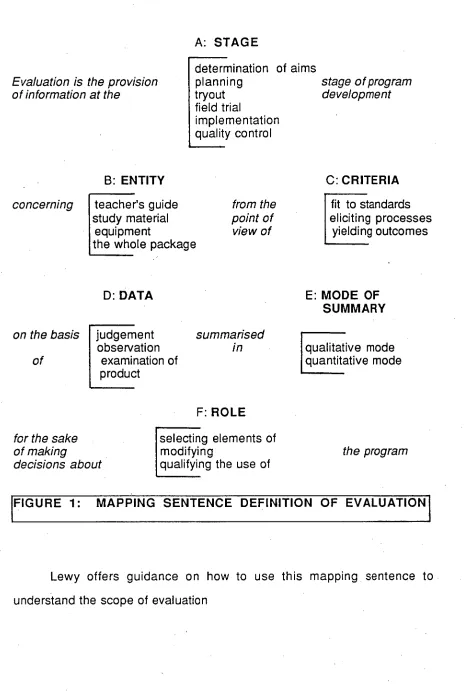
1.5.1 USING A MAPPING SENTENCE TO DEFINE EVALUATION
elements of the curriculum evaluation process together, Lewy proposes the following detailed definition
A: STAGE
Evaluation is the provision of information at the
determination of aims
planning stage of program
tryout development
field trial
implementation quality control
B: ENTITY C: CRITERIA concerning teacher's guide from the
study material point of
equipment view of
the whole package
fit to standards eliciting processes
yielding outcomes
D: DATA E: MODE OF SUMMARY
on the basis
of
judgement summarised
observation in
examination of product
qualitative mode quantitative mode
F: ROLE for the sake
of making
decisions about
selecting elements of modifying
qualifying the use of
[image:55.562.50.515.118.809.2]the program
FIGURE 1: MAPPING SENTENCE DEFINITION OF EVALUATION
38
one may define a particular substudy ... by selecting a single line from the six facets appearing in the mapping sentence. Thus for example, one may conduct a small scale study at the planning stage of a science program concerned with the safety of the equipment to be used by the
students. Observational data, qualitatively analysed will facilitate the decision about whether or not
to include that particular instrument in the program.
Another of the advantages proposed by the author of the mapping sentence approach to defining evaluation is that it indicates the variety of studies that may be undertaken during the life of a new programme. In this sense it is also of relevance to the evaluation conducted within the present
research study.
Cook et. al. (1973: 432) identified two characteristics of a well-conducted evaluation, firstly that it should occur continuously - not be occasional or intermittent - and secondly, that it should be comprehensive, including as many aspects of the process as possible. Their research also suggested four reasons for conducting an evaluation
1. to receive feedback ... to guide future teacher and pupil actions
2. to make concrete diagnoses that form a valid basis for change
3. to promote re-examination of the purposes of education
4. to equip teachers to reply to criticism and justify their classroom practices.
useful, information; for Scriven (1967) it is "judging the worth of a program", for Stake (1967) it is "describing a program as fully as possible", for Tyler (1942) it is "documenting how well program objectives are met".
SYNTHESIS
While ideological differences persist among evaluation theorists, there seems to be a consensus on the definition of what evaluation actually entails. The related notions of judgement, value, quality, and worth, as well as those of improvement and decision making are considered integral to a comprehensive view of the process, while Lewy's 'mapping sentence' definition outlined the possible role of evaluation at every stage of the curriculum development cycle. Finally, within this context, evaluation was viewed as a process that occurs continuously, and takes into account as many factors as possible.
2. THEORIES AND MODELS OF EVALUATION
The review of literature generally indicated the lack of an overt consensus on evaluation models, but this might have been expected following the different definitional perspectives noted earlier. It is clear that even during the last fifteen years there has been a proliferation of models, styles, and approaches, such that practitioners are faced with confusion - and perhaps frustration - when faced with the prospect of choosing a method or theory to guide an evaluation exercise. Antonoplos (1977: 9) sees this as partly because
today we find ourselves up to our ears in evaluation models ... with energy expended more to maintain their status and identities rather than demonstrate their utility for evaluation
Even if Antonoplos' view is not universally shared, there are other researchers who acknowledge the need to somehow rationalise the vast array of theoretical approaches facing practitioners. Worthen (1976) and Gephart (1977) propose a solution in terms of eclecticism and synthesis respectively, recalling that the blind man and the elephant is a suitable analogy for the current multi-model state of evaluation theory.
2.1 TYLER'S PERSPECTIVE
Tyler's perspective on evaluation claimed to represent an advance not only on existing practices - mentioned earlier - which were based on norm-referenced testing, but also on the practices of those relying on measurement under experimental conditions as their main source of evaluative data. He asserted the importance of techniques such as observation, interview, questionnaire, and document search in data gathering (1949: 27) and so acknowledged the role of quantitative and qualitative information in decision making.
Theorists such as Bloom (1956), Glaser (1967), and Popham (1973), extended a number of the themes first articulated by Tyler, while others - notably Eisner (1967) - dissented from the positions they adopted and more particularly from those concerned with the relevance of objectives in the evaluation of instruction. Retrospective assessments by Scriven, Stufflebeam, and Madaus (1983: 8) indicate Tyler's place as a founder of educational evaluation, and as practice affirms, evaluations are conducted - in all but a few cases - with at least some attention being paid to the role of goals or programme objectives.
The approaches advocated by subsequent evaluation writers widen the perspective on what inputs, processes and results might be considered part of the evaluation process, rather than replacing or rejecting the Tylerian 'objectives' model. Cronbach (1963), Stake (1967), Stufflebeam (1971), Parlett and Hamilton (1976), for example, suggested in their respective critiques of the objectives model that evaluation should also take account of course improvement, informal curriculum processes, decision making , and
the learning milieu. Cronbach's (1963) emphasis on the need for evaluation to be useful and to assist decision making, was followed closely by the initial prescriptions of Stake (1967), Scriven (1967), and Stufflebeam (1967).
2.2 STAKE, SCRIVEN, STUFFLEBEAM, PARLETT &
HAMILTON
Stake's original statement The Countenance of Educational
Evaluation (1967: 523-40) differentiated between the formal and informal
aspects, and between the descriptive and judgemental roles of evaluation. His conception of a framework for the collection and processing of data has been widely used in field studies which have attempted to be 'responsive' to the audience for the evaluation. (see Figure 1, Appendix 2) Briefly stated, Stake's position emphasises
1. the desirability of 'full description' in rendering or 'portraying' the 'antecedents', 'transactions' and 'outcomes' of a programme
2. reliance on the values, judgements, and perspectives of participants
3. the integration of formal (checklists, tests) and informal techniques (observations, qualitative judgements )
44
5. the notion of examining consistencies and congruences betweeen aims, processes, and outcomes.
Hughes et. al. (1979: 4) found a consistency between the approach developed by Stake and that of evaluators in the United Kingdom
these patterns of development [Stake's] are mentioned here since they have their parallel in the United
Kingdom and in fact there seems to be a remarkable degree of congruence in current thinking in spite of some radically different starting points and
educational contexts.
In particular, the work of Parlett and Hamilton (1976) shows, according to Hughes, distinct similarities to that of Stake's view of evaluation as portrayal. He contends that
the British authors draw a strong distinction between what they describe as the "agricultural paradigm" of evaluation, traditionally used, and their own preferred form, the "social anthropology paradigm". ... Parlett and Hamilton use the term 'progressive focussing' to describe their three stage approach: first, an overall study to identify significant
features; second, the selection of a number of such features for more intensive inquiry; and third, the attempt at 'explanation' through seeking general principles ...
its different assumptions and methodology - a topic that will be taken up in more detail in a later section of the review.
Two major criticisms raised by Scriven and Stufflebeam (1984) concern the question of whether personal interpretation can in any way be scientific, and whether illuminative evaluation is useful in anything but small 'close-up' studies. Hughes et. al. ( 1979: 11) provided a more thorough-going critique of studies based on the anthropological paradigm, concluding that they have
evolved criteria out of certain shortcomings and dissatisfactions with the experimental model and do not represent a complete alternative.
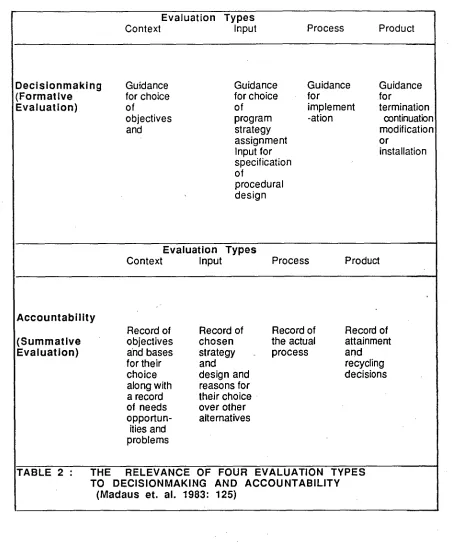
Where Scriven argues that evaluation is essentially an exercise in judging the worth of something, Stufflebeam sees it as including decision making and accountability. His approach related four types of evaluation - context, input, process, and product - to the sorts of decisions required in the analysis of a programme or system.
Table 2 summarises the details of the prescriptions for each of these types. In practice, context evaluation helps to provide a rationale for programme objectives rather than merely accepting those recommended by the sponsors; input evaluation examines possible evaluation designs;
2.3 SCRIVEN'S EVALUATION CHECKLIST
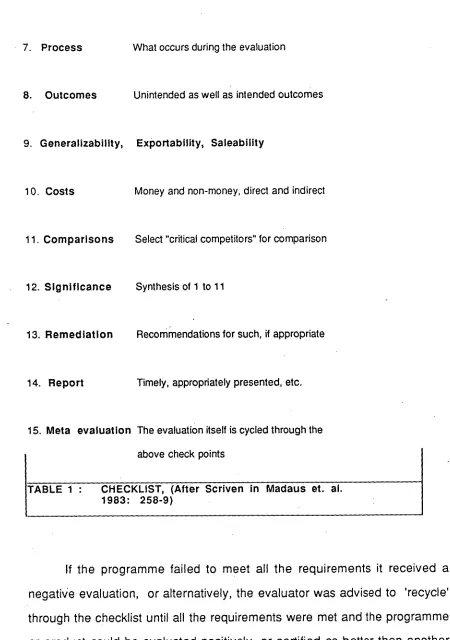
Michael Scriven (1973: 327) demonstrated that product evaluation can be achieved not by reference to objectives, but rather by the use of what he referred to as 'goal-free' evaluation. This approach - which initially refrained from referring to statements of programme goals - used a fifteen point checklist, as in the Table below, to discover whether the programme satisfied each of the listed requirements.
SCRIVEN'S KEY EVALUATION CHECKLIST
1. Description "the description with which we begin the iterative cycles through the checklist is the client's
description ... we finish up with ... the evaluators".
2. Client Person who commissions the evaluation
3. Background and Context Not included initially if the evaluation has a goal-free phase
4. Resources For the evaluation and the evaluand
5. Consumer Distinguish different audiences
6. Values Survey the source of values for the evaluation
7. Process What occurs during the evaluation
8. Outcomes Unintended as well as intended outcomes
9. Generalizability, Exportability, Saleability
10. Costs Money and non-money, direct and indirect
11. Comparisons Select "critical competitors" for comparison
12. Significance Synthesis of 1 to 11
13. Remediat ion Recommendations for such, if appropriate
14. Report Timely, appropriately presented, etc.
15. Meta evaluation The evaluation itself is cycled through the
[image:64.560.42.492.45.685.2]above check points
TABLE 1 : CHECKLIST, (After Scriven in Madaus et. al. 1983: 258-9)
The perspective provided by goal-free evaluation allows one to scrutinise more closely an approach derived from a goal based model and thus avoid the alleged inherent difficulties referred to by many of the writers who have reacted to the formulations of the objectives model. The goal-free approach is claimed to be useful where an external consultant is appointed to undertake all or part of an evaluation and thus provide a 'second opinion' unaffected by the paraphenalia of the course, or of the internal evaluation. In the research study reported on in the present thesis, such an approach is adopted, and an external goal-free assessment of the quality of the course and of the evaluation is included during the latter stages of the methodology.
2.4 FORMATIVE AND SUMMATIVE EVALUATION
Scriven (1967: 39-83) made a lasting contribution to evaluation theory and practice with his distinction between formative and summative evaluation. Formative evaluation provides information relevant to the monitoring and modification of programmes during their developmental phase, while summative evaluation provides information relevant to assessing the overall worth of a completed programme. In Stufflebeam's theoretical approach, the role of formative evaluation approximates to that of decisionmaking, and the role of summative evaluation to that of accountability, as demonstrated in the following Table.
Evaluation Types
Context Input Process Product
Decisionmaking Guidance Guidance Guidance Guidance
(Formative for choice for choice for for
Evaluation) of of implement termination objectives program -ation continuation and strategy modification
assignment or
Input for installation specification
of
procedural design
Evaluation Types
Context Input Process Product
- Accountability
Record of Record of Record of Record of
(Summative objectives chosen the actual attainment
Evaluation) and bases strategy process and for their and recycling choice design and decisions along with reasons for
a record their choice of needs over other opportun- alternatives
[image:66.559.48.504.72.622.2]ities and problems
TABLE 2 : THE RELEVANCE OF FOUR EVALUATION TYPES TO DECISIONMAKING AND ACCOUNTABILITY
(Madaus et. al. 1983: 125)