promoting access to White Rose research papers
White Rose Research Online
[email protected]
Universities of Leeds, Sheffield and York
http://eprints.whiterose.ac.uk/
This is an author produced version of an article published in
Journal of Health
Services Research and Policy.
White Rose Research Online URL for this paper:
http://eprints.whiterose.ac.uk/75809/
Published article:
Ward, V, House, A and Hamer, S (2009)
Developing a framework for transferring
knowledge into action: a thematic analysis of the literature.
Journal of Health
Services Research and Policy, 14 (3). 156 - 164.
Source Details
1 Aita, M., M. C. Richer, et al. Illuminating the processes of knowledge transfer in nursing. Worldviews on Evidence-Based Nursing. 2007; 4(3): 146-155.
Two models are presented: the problem solving model and the linkage model
2 Anderson, M., et al., The use of research in local health service agencies. Social Science & Medicine. 1999; 49(8): 1007-1019.
A model for research transfer development
3 Berwick, D. M. Disseminating Innovations in Health Care. Journal of the American Medical Association. 2003; 289(15): 1969-1975.
Recommendations for health care executives who want to accelerate the rate of diffusion of innovations within their organizations
4 Chunharas, S. An interactive integrative approach to translating knowledge and building a "learning organization" in health services management. Bulletin of the World Health Organization, 2006; 84(8): 652-7.
Highlights various dimensions that determine the complexity of knowledge translation
5 Davis, D., M. Evans, et al. The case for knowledge translation: shortening the journey from evidence to effect. British Medical Journal. 2003; 327(7405): 33-35.
Pathman-PRECEED model for knowledge translation
6 Dobbins, M., D. Ciliska, et al. A framework for the dissemination and utilization of research for health-care policy and practice. Online Journal of Knowledge Synthesis for Nursing. 2002; 9(7).
A framework for research dissemination and utilization
7 Dobrow, M. J., V. Goel, et al. The impact of context on evidence utilization: A framework for expert groups developing health policy recommendations. Social Science & Medicine. 2006; 63(7): 1811-1824.
A conceptual framework for the consideration of evidence and context in the development of health policy recommendations.
8 Elliott, H. and Popay, J. How are policy makers using evidence? Models of research utilisation and local NHS policy making. Journal of Epidemiology and Community Health. 2000; 54(6): 461-468.
Three alternative models for research utilisation: problem solving model; interactive model; dialogical model
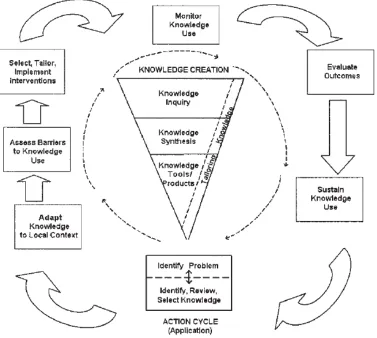
9 Graham, I. D., J. Logan, et al. Lost in knowledge translation: Time for a map? Journal of Continuing Education in the Health Professions. 2006; 26(1): 13-24.
Knowledge to action framework
10 Greenhalgh, T. and et al. Diffusion of innovations in service organizations: systematic review and recommendations. Milbank Quarterly. 2004; 82(4): 581-629.
A conceptual model for considering the determinants of diffusion, dissemination and implementation
11 Grol, R. and J. Grimshaw Evidence based implementation of evidence based medicine. Joint Commission Journal on Quality Improvement. 1999; 25(10): 503-513.
A framework for changing implementation behaviour
12 Havelock, R. G. et al. Planning for Innovation: A Comparative Study of the Literature on the Dissemination and Utilization of Scientific Knowledge. 1969
A framework based on the factors related to successful dissemination and utilization
13 Huberman, M., Research utilization: the state of the art. Knowledge and policy. 1994; 7(4): 13-33
A theory to practice model based on the relationship between diffuser and user
14 Jacobson, N., D. Butterill, et al. Development of a framework for knowledge translation: understanding user context. Journal of Health Services Research and Policy. 2003; 8(2): 94-99.
A framework for increasing familiarity between researchers and users
15 Kitson, A., J. Rycroft Malone, et al. Evaluating the successful implementation of evidence into practice using the PARIHS framework: theoretical and practical challenges. Implementation Science. 2008; 3(1).
A framework for promoting action on research implementation in health services (PARiHS)
16 Kramer, D. M. and Cole, D. C. Sustained, Intensive Engagement to Promote Health and Safety Knowledge Transfer to and Utilization by Workplaces. Science Communication. 2003; 25(1): 56-82.
A conceptual framework for research knowledge transfer and utilization
17 Kramer, D. M. and Wells, R. P. Achieving Buy-In: Building Networks to Facilitate Knowledge Transfer. Science Communication. 2005; 26(4): 428-444.
A conceptual framework for building interorganisational networks
18 Lavis, J. N. Research, public policymaking, and knowledge-translation processes: Canadian efforts to build bridges. Journal of Continuing Education in the Health Professions. 2006; 26(1): 37-45.
Identification of five knowledge transfer processes
19 Lavis, J. N., Robertson, D., et al. How Can Research
Organizations More Effectively Transfer Research Knowledge to Decision Makers? The Milbank Quarterly. 2003; 81: 221
A framework for knowledge transfer
20 Lester, J. P. The utilization of policy analysis by state agency officials. Science Communication. 1993; 14(3): 267-290.
A conceptual model of knowledge utilization
21 Logan, J & Graham, I, Toward a comprehensive interdisciplinary model of health care research use. Science Communication. 1998; 20(2): 227-246
The Ottawa model of healthcare research use)
22 Nieva, V., R. Murphy, et al. From Science to Service: A Framework for the Transfer of Patient Safety Research into Practice. Advances in Patient Safety: From research to implementation. Volume 2. 2005
A conceptual framework to help maximize and accelerate the transfer of research results
23 Oldham G, McLean R. Approaches to Knowledge-Brokering. 1997.
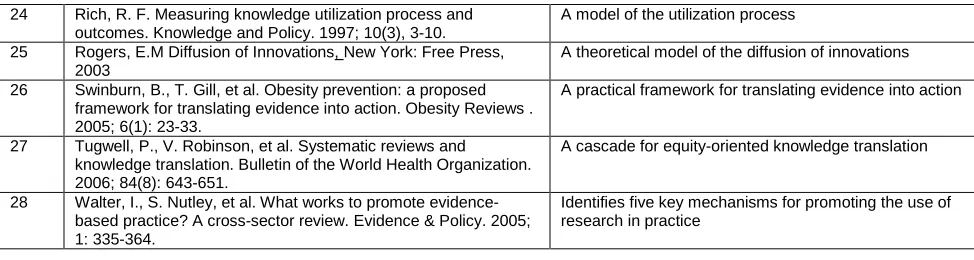
24 Rich, R. F. Measuring knowledge utilization process and outcomes. Knowledge and Policy. 1997; 10(3), 3-10.
A model of the utilization process
25 Rogers, E.M Diffusion of Innovations, New York: Free Press, 2003
A theoretical model of the diffusion of innovations
26 Swinburn, B., T. Gill, et al. Obesity prevention: a proposed framework for translating evidence into action. Obesity Reviews . 2005; 6(1): 23-33.
A practical framework for translating evidence into action
27 Tugwell, P., V. Robinson, et al. Systematic reviews and knowledge translation. Bulletin of the World Health Organization. 2006; 84(8): 643-651.
A cascade for equity-oriented knowledge translation
28 Walter, I., S. Nutley, et al. What works to promote evidence-based practice? A cross-sector review. Evidence & Policy. 2005; 1: 335-364.
[image:3.595.85.572.70.200.2]Identifies five key mechanisms for promoting the use of research in practice
Table 1
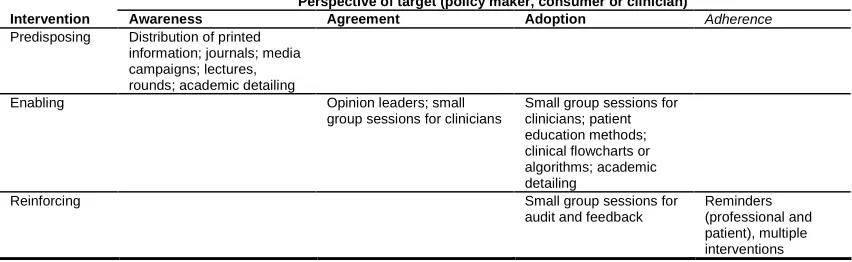
Pathman-PRECEED model for knowledge translation
Perspective of target (policy maker, consumer or clinician)
Intervention Awareness Agreement Adoption Adherence
Predisposing Distribution of printed information; journals; media campaigns; lectures, rounds; academic detailing
Enabling Opinion leaders; small
group sessions for clinicians
Small group sessions for clinicians; patient education methods; clinical flowcharts or algorithms; academic detailing
Reinforcing Small group sessions for
audit and feedback
[image:4.595.85.511.119.250.2]Reminders (professional and patient), multiple interventions
Table 2
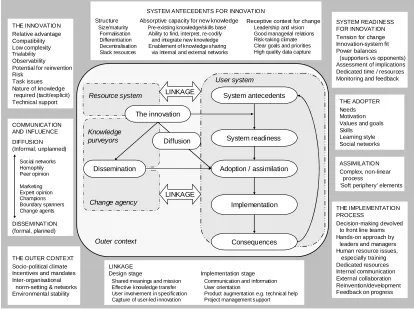
Figure 1
COMMUNICATION AND INFLUENCE DIFFUSION (Informal, unplanned) Social networks Homophily Peer opinion Marketing Expert opinion Champions Boundary spanners Change agents DISSEMINATION (formal, planned) SYSTEM READINESS FOR INNOVAT ION Tension for change Innovation-system fit Power balances
(supporters vs opponents) Assessment of implications Dedicated time / resources Monitoring and feedback
THE OUTER CONTEXT Socio-political climate Incentives and mandates Inter-organisational
norm-setting & networks Environmental stability
User system
Adoption / assimilation System antecedents System readiness Implementation Consequences Outer context Knowledge purveyors Resource system The innovation Change agency Dissemination Diffusion LINKAGE LINKAGE LINKAGE
Design stage Implementation stage
Shared meanings and mission Communication and information Effective knowledge transfer User orientation
User involvement in specification Product augmentation e.g. technical help Capture of user-led innovation Project management support
THE IMPLEMENTATION PROCESS
Decision-making devolved to front line teams Hands-on approach by
leaders and managers Human resource issues,
especially training Dedicated resources Internal communication External collaboration Reinvention/development Feedback on progress SYSTEM ANTECEDENTS FOR INNOVATION
Structure Size/maturity Formalisation Differentiation Decentralisation Slack resources
Receptive context for change Leadership and vision Good managerial relations Risk-taking climate Clear goals and priorities High quality data capture Absorptive capacity for new knowledge
Pre-existing knowledge/skills base Ability to find, interpret, re-codify
and integrate new knowledge Enablement of knowledge sharing
via internal and external networks
THE ADOPTER Needs Motivation Values and goals Skills Learning style Social networks THE INNOVATION Relative advantage Compatibility Low complexity Trialability Observability Potential for reinvention Risk
Task issues Nature of knowledge
required (tacit/explicit) Technical support
ASSIMILATION Complex, non-linear
process
[image:6.595.89.503.129.438.2]‘Soft periphery’ elements