A Flexible Payment Scheme
and Its Role-Based Access Control
Hua Wang, Jinli Cao,
Member,
IEEE Computer Society, and Yanchun Zhang
Abstract—This paper proposes a practical payment protocol with scalable anonymity for Internet purchases, and analyzes its role-based access control (RBAC). The protocol uses electronic cash for payment transactions. It is an offline payment scheme that can prevent a consumer from spending a coin more than once. Consumers can improve anonymity if they are worried about disclosure of their identities to banks. An agent provides high anonymity through the issue of a certification. The agent certifies reencrypted data after verifying the validity of the content from consumers, but with no private information of the consumers required. With this new method, each consumer can get the required anonymity level, depending on the available time, computation, and cost. We use RBAC to manage the new payment scheme and improve its integrity. With RBAC, each user may be assigned one or more roles, and each role can be assigned one or more privileges that are permitted to users in that role. To reduce conflicts of different roles and decrease complexities of administration, duty separation constraints, role hierarchies, and scenarios of end-users are analyzed.
Index Terms—Electronic-cash, anonymity, integrity, trace ability, hash function.
æ
1
INTRODUCTION
R
ECENTadvances in the Internet and WWW have enabled rapid development in e-commerce. More and more businesses have begun to develop or adopt e-commerce systems to support their selling/business activities. While this brings convenience for both consumers and vendors, many consumers have concerns about security and their private information when purchasing over the Internet, especially with electronic payment or e-cash payment. Consumers often prefer to have some degree of anonymity when shopping over the Internet. There are a number of proposals for electronic cash systems [1], [2], [3]. Probably, it is accurate to say that most of them lack flexibility in anonymity. Chaum [1], for example, first proposed an online payment system that guarantees receiving valid coins. This system provides some anonymity against a collaboration between shops and banks. However, con-sumers have no flexible anonymity and banks have to keep a very large database for consumers and coins.The systems mentioned above are online payment systems. They need sophisticated cryptographic functions for each coin, and require additional computational re-sources for banks to validate purchases. Forcing banks to be online at payment is a very strict requirement. Online payment systems protect merchants and banks against customer fraud since every payment needs to be approved
by the customer’s banks. This increases the computation cost, proportional to the size of the database of spent coins. If a large number of people start using a payment system, the size of this database could become very large and unmanageable. Keeping a database of all the coins ever spent in the system is not a scalable solution. Digicash [4] plans to use multiple banks, each minting and managing their own currency, with interbank clearing to handle the problems of scalability. It seems likely that the host bank machine has an internal scalable structure so that it can be set up not only for a 10,000 consumer bank, but also for a 1,000,000 consumer bank. Under the current circumstances, the task of maintaining and querying a database of spent coins is probably beyond today’s state-of-the-art database systems [5].
In an offline protocol, merchants verify payments using cryptographic techniques, and commit payments to pay-ments authority later, in an offline batch process. Offline payment systems were designed to lower the cost of transactions due to the delay in verifying batch processes. However, they suffer from the potential of double spend-ing, whereby the electronic currency might be duplicated and spent repeatedly.
The first offline anonymous electronic cash was intro-duced by Chaum et al. [24]. The security of their scheme relied on some restricted assumptions, such as requiring a function which is similar to random oracle, and has to map onto a special range. There is also no formal proof attempted. Although hardly practical, their system demon-strated how offline e-cash can be constructed and laid the foundation for more secure and efficient schemes. In 1995, Chan et al. [7] presented a provable secure offline e-cash scheme that relied only on the security of RSA [8]. This scheme extended the work of Franklin and Yung [9] who aimed to achieve provable security without the use of general computation protocols. The anonymity of consu-mers is based on the security of RSA and it cannot be
. H. Wang is with the University of Southern Queensland, Toowoomba, QLD 4350, Australia. E-mail: [email protected].
. J. Cao is with the Department of Computer Science and Computer Engineering, La Trobe University, Bundoora, Melbourne Vic. 3083, Australia. E-mail: [email protected]..
. Y. Zhang is with the Internet Technologies and Application Research Lab, School of Computer Science and Mathematics, Victoria University, Ballarat Road, Footscray PO Box 14428, Melbourne City MC VIC 8001, Australia. E-mail: [email protected].
Manuscript received 14 May 2004; accepted 4 Aug. 2004; published online 19 Jan. 2005.
For information on obtaining reprints of this article, please send e-mail to: [email protected], and reference IEEECS Log Number TKDE-0131-0504.
changed dynamically after the system is established. NetCents [10] proposed a lightweight, flexible, and secure protocol for micro payments of electronic commerce over the Internet. This protocol is designed only to support purchases ranging in value from a fraction of a penny and up. In 2000, Pointcheval [11] presented a payment scheme in which the consumer’s identity can be found any time by a certification authority. So, the privacy of a consumer cannot be protected.
Furthermore, the issue of privilege management across multiple domains poses a number of additional challenges. First, there is a need to represent different types of privileges for different services in a purchase process. Our payment scheme is able to support a range of access policies, including role-based access control (RBAC). RBAC has gained much popularity in access control, though the idea of partitioning privileges in terms of specific job functions and roles has been well known for several decades. Second, there is a need to verify the correctness and the validity of the privileges at the time of access to a service. The security management model should be flexible enough to specify a range of privileges and to evaluate them to make appropriate decisions in an efficient manner.
To demonstrate the importance of management policies, consider the unconstrained actions of Nicholas Leeson, who led to the bankruptcy of England’s oldest investment firm in 1995 [12]. Leeson was granted the right to do both the financial derivatives trading operation and back office functions where trades were settled. This is a mix of roles that can be dangerous. In any firm serious about preventing fraud in its operations, this arrangement is conflicting. Management at Barings PLC should never have had the same person making and settling trades. Such a conflict of interest policy can be specified centrally by management, and enforced effectively using RBAC technology.
Role-based access control (RBAC) has been widely used in database system management and operating system products [13], [14], [15]. Many RBAC practical applications have been implemented [16], [17], [18] because RBAC has many advantages such as reducing administration cost and complexity. Another use of RBAC is to support integrity. Integrity is a requirement that data and processes be modified only in authorized ways by authorized users. Within a role-based system, the principal concern is protecting the integrity of information: who can perform what acts on what information. However, there has been little research done on the usage of RBAC in payment scheme management [19].
As mentioned above, online e-cash payments need more computing resources. Most of the previously designed offline schemes are only for micro payments. They rely on the heuristic proofs of security and, therefore, do not formally prevent fraud and counterfeit money. Under these conditions, most online and offline payment schemes do not provide efficient anonymity for consumers. Hence, a new payment scheme for the purchases over the Internet with the following properties are very useful and important:
1. Offline: It spends less computational resources and reduces network communication.
2. Flexible anonymity: It can provide high-level anon-ymity for some consumers with high security requirements.
3. Untrace ability: No one can trace consumers from cash. However, the identity of a consumer can be found if he/she uses a coin twice.
4. RBAC management: It can decrease the complexities of a system and improve system security such as integrity.
In this paper, we analyze the electronic-payment model first, then propose a new offline electronic cash scheme in which the anonymity of consumers is scalable. Consumers can get the required anonymity without showing their identities to any third party. Furthermore, to reduce administration cost and complexity and to improve the security of management, we analyze how to use RBAC to manage the new payment scheme.
The paper is organized as follows: In the first two sections, some basic definitions and simple examples are reviewed. The payment model and the anonymity provider agent are described in Section 3. The design of a new offline electronic cash scheme and its security analysis, including a logical proof for security, are detailed in Section 4. The RBAC management of the new scheme such as the relationships of roles and end-user use scenarios is presented in Section 5. An example of the new e-cash scheme and how to use it for Internet purchases are given in Section 6. Conclusions are included in Section 7.
2
SOME
BASIC
DEFINITIONS
2.1 Hash Functions
HðxÞ is a hash function. For a given value W, it is computationally hard to find an x such that HðxÞ ¼W, i.e., collisions are hard to find, wherexmight be a vector.
Hash function is a major building block for several cryptographic protocols, including pseudorandom genera-tors [20], digital signatures [21], and message authentication.
2.2 DLA and ElGamal Encryption System
Discrete Logarithm Assumption (DLA) is an assumption that the discrete logarithm problem is believed to be difficult.
The discrete logarithm problem is as follows: Given an elementgin a groupGof orderq, and another elementyof
G, findx, where 0< x < q1, such that yis the result of multiplying g with itself x times, i.e., y¼gx. In some
groups, there exist elements that can generate all the elements of G by exponentiation (i.e., applying the group operation repeatedly) with all the integers from 0 toq1. When this occurs, the element is called a generator and the group is called cyclic. Rivest [22] has analyzed the expected time to solve the discrete logarithm problem both in terms of computing power and cost and shown that it is computationally hard to getyfromx.
Table 1 indicates that the message m can be obtained only by the person who has the secret keysk.
2.3 Undeniable Signature Scheme and Schnorr
Signature Scheme
The undeniable signature scheme, devised by Chaum and Antwerpen [6], is a non-self-authenticating signature scheme, where signatures can only be verified with the signer’s consent. However, if a signature is only verifiable with the aid of a signer, a dishonest signer may refuse to authenticate a genuine document. Undeniable signatures solve this problem by adding a new component, called the disavowal protocol, in addition to the normal components of signature and verification.
An undeniable proof scheme consists of the following algorithms:
1. The key generation algorithm K which outputs random pairs of secret and public keysðsk; pkÞ. 2. The proof algorithm Pðsk; mÞ which inputs a
message m, returns an “undeniable signature” S
on m. However, this proof “S” does not convince anybody by itself. To be convinced of the validity of the pairðm; SÞ, relative to the public keypk, one has to interact with the owner of the secret keysk. 3. The confirmation process confirms ðsk; pk; m; SÞ,
which is an interactive protocol between the signer and the verifier, where the signer tries to convince of the validity of the pairðm; SÞ.
4. The disavowal process is an interactive protocol between the signer and the verifier, where the signer can prove that a forged signature really is a forgery. We simply recall the following example shown in Table 2 that is an undeniable signature scheme [25]. The disavowal process is detailed below.
The signer is not able to deny the signature S¼ ðe; yÞ
because the signature can be produced by the owner of the secret key sk only. The signature S¼ ðe; yÞ is confirmed only if x¼gypkeðmod pÞ and checks e¼hðx; mÞ with the public keypk. In the disavowal process, the verifier chooses a random number R1 and sends to the signer. The latter
picks a random r1, computes hðx1Þ; y1¼r1þSR1, where
x1¼gr1, sends hðx1Þ and y1 to the verifier, the verifier
computesx¼gy1pkR1 and checks ifhðx
1Þ ¼hðxÞ.
2.4 Role-Based Access Control
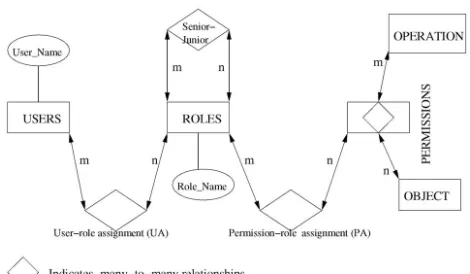
RBAC is described in terms of individual users being associated with roles as well as roles being associated with permissions (each permission is a pair of objects and operations). As such, a role is used to associate with users and permissions. A user in this model is a human being. A role is a job function or job title within the organization associated with the authority and responsibility.
Permission is an approval of a particular operation to be performed on one or more objects. The relationship between roles and permissions is shown in Fig. 1, arrows indicate a many-to-many relationship (i.e., a permission can be associated with one or more roles and a role can be associated with one or more permissions). The RBAC security model has two components: MC0 and MC1.
Model component MC0, called the RBAC authorization
database model, defines the RBAC security properties for authorization of static roles. Static properties of an RBAC authorization database include role hierarchy, inheritance, cardinality, and static separation of duty. MC1, called the
RBAC activation model, defines the RBAC security properties for dynamic activation of roles. Dynamic properties include role activation, permission execution, dynamic separation of duties, and object access. Asession
is a mapping of one user to possible roles. In other words, a user establishes a session during which the user activates some subset of roles that he/she is a member of. In particular, the RBAC model supports the specification in Table 3.
We note that propertiesbandchave to be decided when a system is designed. This is because the relationship of different roles may be in conflict, compromising the integrity of the system. Properties b and c can decrease the complexities of management and reduce the conflicts of
TABLE 1
ElGamal Encryptiom Scheme
TABLE 2
Schnorr Signature Scheme
different roles. Therefore, this paper focuses on relation-ships of roles such as Role hierarchies, SSD, and DSD.
3
NEW
PAYMENT
MODEL
We show the basic payment model and then discuss the new payment model in this section.
3.1 Basic Payment Model
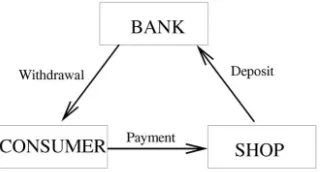
Electronic cash has sparked wide interest among crypto-graphers ([22], [26], [27], etc.). In its simplest form, an e-cash system consists of three parts (a bank, a consumer, and a shop) and three main procedures, as shown in Fig. 2 (withdrawal, payment, and deposit). In a coin’s life-cycle, the consumer first performs an account establishment protocol to open an account with the bank.
The consumer and the shop maintain an account with the bank, while
1. The consumer withdraws electronic coins from his account, by performing a withdrawal protocol with the bank over an authenticated channel.
2. The consumer spends a coin by participating in a payment protocol with a shop over an anonymous channel.
3. The shop performs a deposit protocol with the bank, to deposit the consumer’s coin into his account. The system is offline if the shop does not communicate with the bank during payment. It is untraceableif there is no p.p.t. TM (probabilistic polynomial-time Turing Ma-chine) that can identify a coin’s origin even if one has all the information of withdrawal, payment, and deposit transactions. It is anonymous if the bank, in collaboration
with the shop, cannot trace the coin to the consumer. However, in the absence of tamperproof hardware, electronic coins can be copied and spent multiple times by the consumer. This has been traditionally referred to as spending. In an online e-cash system, double-spending is prevented by having banks check if a coin has been deposited before. In an offline e-cash system, however, this solution is not possible; instead, as proposed by Chaum et al. [24], the system guarantees that, if a coin is double-spent, the consumer’s identity is revealed with overwhelming probability.
There are also three additional processes, such as the bank setup, the shop setup, and the consumer setup (account opening). They describe the system initialization, namely, creation and posting of public keys and opening of bank accounts. Although they are certainly part of a complete system, these are often omitted as their function-alities can be easily inferred from the description of the three main procedures. For clarity, we only describe the bank setup and the consumer setup for the new scheme in the next section because the shop setup is similar to the consumer setup.
Besides the basic participants, a third party, the named Anonymity Provider (AP) agent, is involved in the scheme. The AP agent helps the consumer to get the required anonymity, but is not involved in the purchase process. The new model is shown in Fig. 3. The AP agent gives a certificate to the consumer when he/she needs a high level of anonymity.
3.2 Anonymity Provider Agent
Here, we explain what an AP agent is. Assume a consumer owns a valid coinc¼’ðpkB; pku; yÞwith its certificateCertc,
where’ðpkB; pku; yÞis a function of the public keys of the
bank, the consumer, and a variabley, i.e.,ðpkB; pku; yÞ. The
certificateCertcguarantees correct withdrawal from a bank,
whether a coin is valid or not depends on its certificate.
Certc is a coin certificate and does not contain any
information about a customer. After the following processes with the AP agent, the consumer owns a new valid coin
c0¼’ðpkB; pku; yþvÞwith its certificateCertc0, wherevis a
variable. Please note that a certificate can be a signature of a issuer:
fV alue:IssuerName:IssuerSerial:IssuerNumber
[image:4.612.322.503.73.192.2]:T imeg: TABLE 3
Specification of RBAC
Fig. 2. Basic processes of an electronic cash system.
[image:4.612.73.234.658.744.2]Therefore, certificates made by a bank and an AP agent are different and do not include a customer’s identity.
1. The consumer reencrypts the coincinto
c0¼’ðpkB; pku; yþvÞ:
2. The consumer provides an undeniable signatureS, and the equivalence between cand c0. This equiva-lence is guaranteed by the variablev.
3. The consumer confirms the validity of this signature
Sto the AP agent.
4. The AP agent certifies the new coin c0 and sends
Certc0 to the consumer.
Indeed, after Steps 2 and 3, the AP is convinced that the conversion has been performed by the owner of the coinc;
c0is equivalent toc. The owner ofcis not able to denyS(the
relation between c and c0). The AP agent should be an electronic notarized participant in the system. It does not need to know any private information about consumers; it only verifies the information of consumers.
3.3 Proof of Ownership of a Coin
This section shows how consumers prove the ownership of a coin. Let us assume thatY is the public key of a bank,xuis
a secret key of a consumer, andI¼gxu is the identity of a consumer. Hðx; yÞ is a hash function. A coin is the encryption of I: c¼ ða¼gr; b¼YrIsÞ, which is afterward certified by the bank, wherer; sare random numbers. With the certificate of the bank, one knows that the encryption is valid. Therefore, in order to prove his ownership, the consumer has just to convince of his knowledge ofðxu; r; sÞ
such thatb¼YrIs. This can be expressed as in Table 4.
Then, a scrambled coin is gotten by multiplying both parts of the old one by the respective bases,gandY, both to the same random exponent:
c0¼ ða0¼ga; b0¼YbÞ ¼ ðgrþ; YrþIsÞ:
Then, if the owner of the old coin has certified the message
m0¼h, the equivalence of both coins can be proven with
the proof of equivalence of three discrete logarithms:
loghm0¼loggða0=aÞ ¼logYðb0=bÞ;
wherehis a public variable.
4
ANONYMITY
SCALABLE
PAYMENT
SCHEME
In this section, we propose an anonymity self-scalable payment scheme. The new payment scheme has two mainfeatures. The first is that a consumer can have a high level of anonymity himself and the second is that the identity of a consumer cannot be traced unless the consumer spends the same coin twice.
Our scheme includes two basic processes in system initialization (bank setup and consumer setup) and three main protocols: a new withdrawal protocol with which a consumer withdraws electronic coins from a bank while his account is debited, a new payment protocol with which a consumer pays the coin to a shop, and a new deposit protocol with which the shop deposits the coin to the bank and has his account credited. If a consumer wants to get a high level of anonymity after getting a coin from the bank (withdrawal), he/she can contact the AP agent.
4.1 System Initialization
The bank setup and the consumer setup are described as follows, and the details of the shop setup are omitted (because the shop setup is similar to the consumer setup).
4.1.1 Bank Setup (Performed Once by the Bank)
Primes p and q are chosen such that jp1j ¼þk, for a specified constant , and p¼qþ1, for a specified small integer. Then, a unique subgroupGq of prime orderqof
the multiplicative group Zp and generator g of Gq are
defined. Secret keyxB2RZq for a denomination is created,
where a2R A means that the element a is selected
randomly from the set Awith uniform distribution. Hash function H from a family of collision intractable hash functions is also defined. The bank publishesp; q; g; H, and its public keyY ¼gxBðmod pÞ.
The secret key xB is safe under the DLA. The hash
function is used in payment transactions.
4.1.2 Consumer Setup (Performed for Each Consumer)
The bank associates the consumer with I¼gxuðmod pÞ, where xu2Gq is the secret key of the consumer and is
generated by the consumer.
After the consumer’s account and the shop’s account are opened, the new payment scheme can be described.
4.2 New Offline Payment Scheme
We now describe the new anonymity scalable electronic cash scheme, which includes withdrawal, payment, and deposit.
4.2.1 Withdrawal (Consumers Withdraw Coins from the Bank)
Usually, an anonymous coin is a certified message which embeds the public key of a consumer. In our scheme, the message is an encryption of this consumer’s public key, using the public keyY of the bank.
Instead of using intricate zero-knowledge proofs to convince the bank of the validity of the encryption, the consumer shows some information to the bank, including a signature. So, the bank certifies the encryption with full confidence.
The consumer I¼gxu constructs a coin c¼ ða¼gr; b¼
YrIsÞusing the public keyY of the bank, wheresis a secret
key of the coin which is kept by the consumer andr is a random number in Zq. Using the private key xu, the TABLE 4
consumer signs a Schnorr signatureSon the message of c
together with the date, etc. He/she sendsðc; SÞto the bank together with r; I. Then, the bank can check the correct encryption. With the signature of the coin and the date, only the legitimate consumer could have done it. After having modified the consumer’s account, the bank sends back a certificate Certc. The consumer needs to remember
ðr; s; CertcÞonly.
4.2.2 Anonymity Scalability (Performed between Consumers and the AP Agent)
The consumer can use the coin now without a high level of anonymity since the bank can easily trace any transaction performed through the coin. This is because some informa-tion of the consumer such asI; Certchas been known by the
bank. To solve this problem, an AP agent is established to help the consumer to achieve a high level of anonymity: The consumer can derive a new encryption of his identity in an indistinguishable way. However, the consumer needs a new certificate for a new issued cipher text. The AP agent can provide this new certificate. Before certifying, the consumer requires both the previous coin ðc; CertcÞ and
the proof of equivalence between the two cipher texts. Details are described below.
The consumer contacts the AP agent if he/she needs to get a high level of anonymity. The consumer chooses a randomand reencrypts the coin:
c0¼ ða0¼ga; b0¼YbÞ:
1. The consumer generates a Schnorr signature S on
m¼h using the secret key x
u, as shown in
Section 2.3. Because of S, the consumer is not able to deny his knowledge of later. Furthermore, nobody can impersonate the consumer at this step since the discrete logarithm xu of I is required to
produce a valid signature. So, there is no existential forgery.
2. The consumer also provides a designated verifier proof of equality of discrete logarithms
loghm¼loggða0=aÞ ¼logYðb0=bÞ: ð1Þ
3. The consumer finally sends c; c0; S; m to the AP agent.
4. The AP agent checks the certificate Certc on c, the
validity of the signature S on the messagem, then certifiesc0, and sends back a certificateCertc0 to the
consumer.
After these processes, the consumer gets a new certified coin c0¼ ða0¼ga; b0¼YbÞand a new certification Cert
c0,
which is now strongly anonymous from the point of view of the bank. The AP agent has to keepðc; c0; m; SÞto be able to prove the link between c and c0, with the help of the consumer. If the number of consumers gets large, databases for the AP agent and banks is huge, data back up is required. We may backup data once a month or once every two weeks to support the system.
Following the process, the AP agent can also give many smaller new coins for an old one since the amount of a new one can be embedded in the certificateCertc0.
4.2.3 Payment (Performed between the Consumer and the Shop over an Anonymous Channel)
When a consumer possesses a coin, he/she can simply spend it at shops by proving knowledge of the secret key
ðxu; sÞ associated with the coin c or c0. This proof is a
signature S¼ ðe; u; v; t1Þ of the new certificate Certc0,
purchase, date, etc., with the secret keyðxu; sÞ associating
the coin to the receiver (which is later forwarded to the bank).
4.2.4 Deposit (The Receiver Deposits a Coin to a Bank)
Since the system is offline, the shop sends the payment transcript to the bank later. The transcript consists of the coin c or c0 (if the consumer applied a high level of anonymity), the signature, and the date/time of the transaction. The bank verifies the correctness of payment and credits the coin into the shop’s account.
The receiver (shop) deposits the coin into its bank account with a transcript of the payment. If the consumer uses the same coinctwice, then the consumer is traced: Two different receivers send the same coin c to the bank. The bank can easily search its records to ensure that chas not been used before. If the consumer uses c twice, then the bank has two different signatures. Thus, the bank can isolate the consumer and trace the payment to the consumer’s accountI.
4.3 Security Analysis
Based on the point of view with electronic cash system, an offline e-cash scheme is secure [9] if the following requirements are satisfied:
1. Unreusable: If any consumer uses the same coin twice, the identity of the consumer can be computed. 2. Untraceable: Withn withdrawal processes, no p.p.t. (probabilistic polynomial time) Turing Machine can computeðnþ1Þthdistinct and valid coin.
3. Unforgeable: With any number of the customer’s withdrawal, payment, and deposit protocols, no p.p.t. Turing Machine can compute a single valid coin.
4. Unexpandable: With any number of the customer’s valid withdrawal, payment, and deposit protocols, no p.p.t. Turing Machine can compute a legal consumer’s identity.
The security in the e-cash scheme is based on the hardness of Discrete Logarithms [28] and hash functions. The system preserves the above four requirements.
4.3.1 Unreusable
When a consumer spends a coin, he/she hands over the coin, together with a signature S¼ ðe; u; v; t1Þ, to a shop. If the
consumer uses a coin twice, then we have two signatures
S1¼ ðe1; u1; v1; t11ÞandS2¼ ðe2; u2; v2; t12Þ, where
u1¼k1re1ðmod qÞ; v1¼sxue1ðmod qÞ:
u2¼k2re2ðmod qÞ; v2¼sxue2ðmod qÞ:
Then,ðv2v1Þ=ðe1e2Þ ¼xu; this is the secret key of the
4.3.2 Untraceable
When a consumer constructs a coin, he/she uses the secret keys xu and s, both of which are not shown to any other
parts in the purchase process. So, no one can trace the consumer and the coin.
4.3.3 Unforgeable
We first discuss whether the bank and the AP agent can forge a valid coin or not. To produce a valid coin, the first requirement is making a encryption c¼ ða¼gr; b¼YrIsÞ
of I. The second requirement is using the secret key xu of
the consumer to sign a Schnorr signature ofctogether with the current time. The bank can do the first step, but cannot do the second step since it does not know the secret keyxu.
This means the bank cannot forge a valid coin. Similarly, the AP agent cannot forge a valid coin either. It should be noted that, even though both the bank and the AP agent know a valid coin, they still could not use it. This is because there is a signature in the payment process which can only be done by the consumer.
As already seen, the secret key xu of a consumer is
never revealed, only used in some signatures. A consumer is therefore protected against any impersonation, even from collusion of the bank, the AP agent, and the shop. Only the consumer can construct a valid coin since there is an undeniable signature embedded in the coin. To prevent the bank from framing the consumer as a multiple spender in the scheme, we use digital signature Is for s
which is known only by the consumer. Then, the system is unforgeable.
4.3.4 Unexpandable
For a legal consumer and a valid coin, the secret keyxuand
the random number s are never shown to others at any time. Furthermore, the random number s is changed for different coins. Withnwithdrawal proceedings, the random numbersis changedntimes. Then, no one can compute the
ðnþ1Þthdistinct and valid coin even if they seenprocedure withdrawals.
The AP cannot cheat shops and banks. For example, AP knows c; c0; S; m from a consumer but not the secret key
ðxu; sÞ. In the payment process, a signature is needed when
the coin c or c0 is used. The secret key ðxu; sÞ is used to
produce the undeniable signature. It means that the AP cannot use the old coincto the new coinc0and, thus, the AP
cannot cheat shops.
4.4 Logical Proof for Security
We have demonstrated that the e-cash system satisfies secure requirements. This section examines the system issues and use stages using logical proof [29]. Logical proof allows analysis of trust between principals involved in authentication. The e-cash approach is about who has rights to access and not about authentication, hence the analysis is different from analysis of authentication protocols. The goal is not to prove an identity of principals but to prove that a user has been granted privilege to use a coin. The use of logical proof requires the transformation of the e-cash approach into an idealized protocol and then refinement
until the required trust is obtained. The idealized protocol associated to a coin for logical proof is as below:
. M1:Bank!Consumer:I.
. M2:Consumer!Bank:ðc; S1; r; IÞ.
. M3:Bank!Consumer:Certc.
. M4*:Consumer!AP:ðc; c0; S 2; mÞ.
. M5:AP!Consumer:Certc0.
. M6:Consumer!Shop:S3¼ ðe; u; v; tlÞ.
We have the following assumptions with PKI technol-ogy, whereKBC; KAC, andKSCmeans shared keys between
Bank and Consumer, AP agent and Consumer, and Consumer and Shop, respectively.
. A1: Bank! Consumer: Bank !KBC
Consumer (A1is used inM3).
. A2: AP agent believes: AP agent !KAC
Consumer. . A3: Consumer believesCertcandCertc0 are fresh.
. A4: Consumer believes: Consumer !KSC Shop. . A5: Bank believescandSl are fresh.
. A6: AP agent believesc0andS2are fresh.
. A7: Shop believesS3is fresh.
To verify the approach, we need to reach the following states:
. P1: Bank believes Consumer believesðc; S1; r; IÞ.
. P2: AP agent believes Consumer believes
ðc; c0; S2; mÞ:
. P3: Consumer believesCertc andCertc0.
. P4: Shop believes Consumer believesS3¼ ðe; u; v; tlÞ. P1; P2; P3 relate to the e-cash creation process of the system and the other one relates to payment processes. We prove these states as below.
Proof.AfterM1andM2:
. R1: Bank seesðc; S1; r; IÞ.
Since S1 is an undeniable signature of the
Consumer, from R1, and the message meaning rule [29].
. R2: Bank believes the Consumer once said
ðc; S1; r; IÞ.
Since Bank believes c, Sl are fresh (A5) and
using thenonce verification rule[29].
. R3: Bank believes Consumer believesðc; S1; r; IÞ.
(P1) has been proven. AfterM4,
. R4: AP agent seesðc; c0; S2; mÞ.
SinceS2 is a Schnorr signature of Consumer,
fromR4andA2and themessage meaning rule. . R5: AP agent believes Consumer once said
ðc; c0; S2; mÞ.
Since AP agent believes c0, S2 are fresh (A6)
and using thenonce verification rule.
. R6: AP agent believes Consumer believes
ðc; c0; S2; mÞ.
(P2) has been proven. AfterM3andM5,
. R7: Consumer seesCertcandCertc0, fromR7and
. R8: Consumer believes Bank and AP agent once saidCertc andCertc0.
Since Consumer believes,Certc andCertc0 are
fresh. UsingM3and thenonce verification rule. . R9: Consumer believes Bank and AP agent
believeCertc andCertc0.
FromM3; M5,
. R10: Consumer believes Bank and AP agent controlCertc andCertc0.
FromR9,R10, and thejurisdiction rule[29], . R11: Consumer believesCertc andCertc0.
P3has been proven.
AfterM6, Shop seesS3. FromA4and themessage meaning rule.
. R12: Shop believes Consumer saidS3, using the nonce verification ruleandA7.
. R13: Shop believes Consumer believesS3.
P4has been proven. tu
5
RBAC MANAGEMENT
As we mentioned before, this paper focuses on the relationships of roles such as Role hierarchies, SSD, and DSD. In this section, we analyze RBAC management for the new system, which includes two parts duty separation constraints and the scenario of end-users.
5.1 Duty Separation Constraints
With RBAC, users cannot associate with permissions directly. Permissions must be authorized for roles and roles must be authorized for users. In RBAC administration, two different types of associations must be managed, i.e., associations between users and roles and associations between roles and permissions. When a user’s job position changes, only the user/role associations change. If the job position is represented by a single role, then, when a user’s job position changes, only two user/role associations need to be changed: the removal of the association between the user and the user’s current role and the addition of an association between the user and the user’s new role.
Both SSD and DSD relations must be included in the implementation. Once implemented, they may be config-ured for the specific application policy and may be altered at any time during the operational life of the system. SSD relations are enforced at administration time. DSD relations are enforced during runtime.
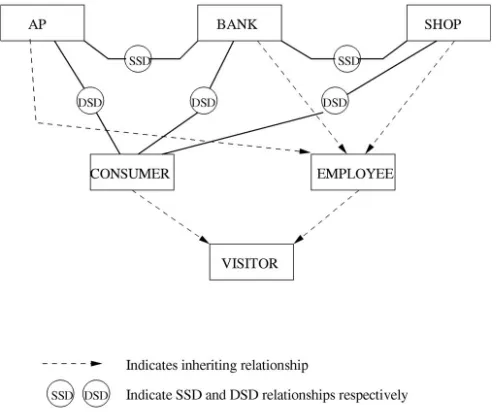
Now, we consider the RBAC management of the new payment scheme. There are four major roles in the system, the AP agent, the consumer, the bank, and the shop. The AP agent, the bank, and the shop would be companies comprised of many participants. We do not discuss the relationships of all the participants in these companies since they are beyond the scope of this paper. We only consider duty separation constraints. In Fig. 4, for example, since all staff in the AP agent, the bank, and the shop are employees, their corresponding roles inherit the employee role. It is similar to the relationship of the consumer and the visitor. The roles AP agent, the shop, and the bank have a DSD relationship with the role consumer. This indicates that an individual consumer cannot act the roles of the AP agent,
the shop, or the bank simultaneously. The staff in these three companies have to first log out if they want to register as consumers. For example, a consumer who is a staff member of the AP agent can ask the AP agent to help him to get high anonymity. But, as a consumer, since the shop and the bank need to check the new coin’s certificateCertc0and
signature, he/she cannot give herself/himself a new certificate Certc0 of a coin when he/she works for the AP
agent. Another staff member of the AP agent can help this person.
The AP agent has an SSD relationship with the bank. This is because the duty of the AP agent is to help a consumer to get high anonymity. The bank knows the old coin c¼ ðgr; YrIsÞ and its certificate Cert
c. The AP agent
sends the new certificate Certc0 of the new coin c0¼
ðgrþ; YrþIsÞ to the consumer. The bank knows the new
certificate Certc0 when the AP agent and the bank are
authorized by a staff member common in both. If so, the consumer cannot have the required anonymity of coin. The shop also has an SSD relationship with the bank since the bank verifies the payment as well as depositing the coin to the shop’s account. The SSD relationship is also a conflict of interest relationship like the DSD relationship, but much stronger. If two roles have an SSD relationship, then they may not even be authorized to the same individual. Thus, these three roles may never be authorized to the same individual.
After analyzing duty separation constraints, we see what a user needs to do when using the system on the Internet.
5.2 Scenarios of End-Users
[image:8.612.292.541.69.275.2]not violate any DSD relationships and asked to choose. The subset in the list, taken from the set of all possible assigned roles, contains the largest subset, which does not violate any DSD relationships. Once the choice is made, the session is established with all authorized roles (i.e., assigned roles along with all roles which the assigned roles inherit) being placed in the ARS. The ARS automatically establishes all authorized roles if there are no DSD relationships among the roles assigned to the user.
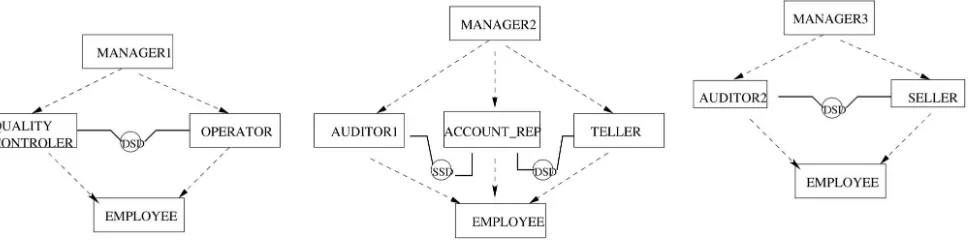
For example, in Fig. 5, a user is assigned the consumer’s role, the ARS is {Consumer} since the role of a consumer has a DSD relationship with the AP agent, the shop, and the bank. The user can perform a consumer’s activities only. If a user is assigned a manager in the AP agent, the set of ARS is {Manager, Operator, Quality controller}, as shown in Fig. 6. This means the user can perform as a manager, an operator, and a Quality controller. In the AP agent, the manager inherits the operator and the quality controller. However, the ARS of the Operator in the ARS at the AP agent is {Operator} since the operator has a DSD relationship with the quality controller. The ARS of the manager in the bank is {Manager, Account_rep, Auditor, Teller} because the Manager inherits the Account_rep (account representative), the Auditor, and the Teller. The manager can act as a
manager and an account representative, an auditor, and a teller. The details are in Table 5.
6
AN
EXAMPLE AND
IMPLEMENTATIONS
In this section, we give a simple example and analyze two different purchase procedures. We show how to use the new e-cash for Internet purchases and how to get some smaller coins from the AP agent. This demonstrates the efficiency of the payment protocol.
6.1 An Example
This example shows the main steps in the e-cash scheme. We omit the details of two undeniable signatures in withdrawal and the scalable anonymity process because they are only used for verifying the user. In the following example, the module 47 is used.
6.1.1 Bank Setup
Supposeðp; q; ; kÞ ¼ ð47;23;2;4Þ, thenGq¼ f0;1;2;. . .;22g
is a subgroup of order 23.g¼3is a generator ofGq. The bank’s
[image:9.612.41.263.72.180.2]secret key xB¼4and hash function Hðx; yÞ ¼3x5y. The
Fig. 5. An end user’s scenario.
[image:9.612.292.540.77.222.2]Fig. 6. Role relationships.
TABLE 5
[image:9.612.38.522.513.634.2]bank publishesHðx; yÞandfp; q; gg ¼ f47;23;3g. The public key of the bank isY ¼gxB ¼34ðmodule47Þ.
6.1.2 User Setup
We assume the secret of a user isxu¼7and the user sends I¼gxu ¼25ðmodule47Þ to the bank. After checking some identifications, like social security card or driver’s licence, the bank authorizes the user (consumer) withI.
After the bank setup and the user setup, the user can purchase.
6.1.3 Withdrawal
The user choosesðr; sÞ ¼ ð2;3Þand computes
c¼ ðgr; YrIsÞ ¼ ð9;24Þ ðmodule47Þ;
then signs a Schnorr signature S for the message
m¼ ðc; currenttimeÞ. The user sends c¼ ð9;24Þ and S to the bank; the latter sends back a certificateCertc.
The user contacts the AP agent if he/she needs a high level of anonymity or uses the coin in a shop directly (see Payment). The user and the AP agent follow the processes below. We supposeh¼37is a public number.
6.1.4 Anonymity Scalability
The user reencrypts the coinc, chooses¼4, and computes
c0¼ ða0¼ga; b0¼YbÞ ¼ ð24;16Þ ðmodule47Þ and signs a
Schnorr signature S on m¼h¼36ðmodule47Þ. Finally,
the user sendsðc; c0; S; mÞto the AP agent. The latter verifies the Schnorr signatureSand (1) and sends a certificateCertc0
to the user if they are correct.
Since the new coinc0¼ ð24;16Þ and its certificateCertc0
have no relationship with the bank, the user has high anonymity.
6.1.5 Payment
The user signs a signature S¼ ðe; u; v; t1Þ of a message m
which includes c0; Certc0 and purchase time, etc., to prove
the ownership of the new coin. For convenience, we assume
m¼11. The user choosesk¼5, then computes
t¼Ykgs¼1ðmodule47Þ; e¼Hðm; tÞ ¼20ðmodule47Þ; u¼11ðmodule23Þ;
v¼1ðmodule23Þ; t1¼34ðmodule47Þ:
The shop who is convinced that the user is the owner of the coin computest0¼34ðmodule47Þif the equation oft0¼
tt1and the signatureSis successful. He/she does not know
who the user is.
6.1.6 Deposit
The bank puts the money into the shop’s account when the checking of the coin C0¼ ð24;16Þ and the signature S¼ ðe; u; v; t1Þ ¼ ð20;11;1;34Þare correct. The shop can also see
that the money in his account is added.
When the user uses the old coin ð9;24Þ again, then another signatureS1¼ ðe1; u1; v1; t12Þis produced. Suppose
m¼3 and k¼1, we have e1¼30 and v1¼0. Therefore,
ðv1vÞ=ðee1Þ ¼7¼xuðmod23Þ. It means no double
spending of the old coin and the new coin.
6.2 Purchase Procedures
6.2.1 Purchase Procedure 1
In purchase procedure 1, a consumer decides how much money should be paid to the shop, withdraws the money from the bank, and pays it to the shop.
1. Consumer to shop: The consumer wants to buy some goods in a shop, so he/she contacts the shop for the price.
2. Consumer to bank: The consumer gets the money from the bank, the amount being embedded in the signature.
3. Anonymity scalability: If the consumer wants to maintain a high level of anonymity, he/she can ask the AP agent to certify a new coin which can be then used in the shop.
4. Consumer to shop: The consumer proves to the shop that he/she is the owner of the money and pays it to the shop. Then, the shop sends the goods to the consumer.
5. Shop to bank: The shop deposits the e-cash in the bank. The bank checks the validation and that there is no double spending of the coin. The bank transfers the money to the shop’s account.
6.2.2 Purchase Procedure 2
In purchase procedure 2, the consumer does not have to ask the bank to send money since the consumer already has enough e-cash in his “wallet.” All the consumer needs to do is to get some smaller e-cash from the AP agent to pay the shop.
There are four steps in purchase procedure 2. They are: 1)consumer to shop, 2)consumer to AP agent, 3)consumer to shopagain, and (4)shop to bank. Step 2,consumer to AP agent, is different from Step 3 in procedure 1, but the other three steps are similar to those in procedure 1. Therefore, we focus only on Step 2, consumer to AP agent. It should be noted that electronic-cash is a digital message and a certification. We say that the AP agent can provide certificates of coins then provide a service in changing to small coin.
Consumer to AP agent: The consumer advises the AP agent of the amount of money to pay the shop from his wallet. He/she then asks the AP agent to make some smaller coins. By doing this, the consumer can also get a high level of anonymity. After checking the old money sent by the consumer, the AP agent creates some new coins of an equivalent value to the original coin. One of these new coins can be used in the shop.
We have already seen that the consumer can keep money in his wallet or get money from the bank. In both purchase procedures 1 and 2, most computations are done by the consumers, so the system is very convenient for Internet purchases.
7
CONCLUSIONS
Consumers have a low level of anonymity if they want to spend coins directly after withdrawing them from the bank. They can achieve a high level of anonymity through the AP agent without revealing their private information and are more secure in relation to the bank because certification comes from the AP agent, who is not involved in the payment process. There is little research available on RBAC for electronic cash schemes. We first canvas RBAC for payment schemes in this paper. With RBAC, the conflicts of different roles can be reduced and the complexities of the scheme can be decreased. The duty separation constraints of roles, role hierarchies, and scenarios of end-users are discussed in details.
ACKNOWLEDGMENTS
The authors would like to thank the reviewers for their constructive suggestions and comments.
REFERENCES
[1] D. Chaum, “Blind Signature for Untraceable Payments,” Proc. Advances in Cryptology–Crypto ’82,pp. 199-203, 1983.
[2] B. Cox, J.D. Tygar, and M. Sirbu, “NetBill Security and Transaction Protocol,” Proc. First USENIX Workshop Electronic Commerce,1995.
[3] MastercardVisa, SET 1.0—Secure Electronic Transaction Specifica-tion, http://www.mastercard.com/set.html, 1997.
[4] D. Chaum, “DigiCash, an Introduction to E–Cash,” http:// www.digicash.com, 1995.
[5] H. Wang, J. Cao, and Y. Kambayashi, “Building a Consumer Anonymity Scalable Payment Protocol for the Internet Purchases,”
Proc. 12th Int’l Workshop Research Issues on Data Eng.: Eng. E-Commerce/E-Business Systems,pp. 159-168, 2002.
[6] D. Chaum and H. Antwerpen, “Undeniable Signatures,” Proc. Advances in Cryptology–Crypto ’89,pp. 212-216, 1990.
[7] A. Chan, Y. Frankel, and Y. Tsiounis, “An Efficient Off-Line Electronic Cash Scheme as Secure as RSA,” NU-CCS-96-03, Northeastern Univ., 1995.
[8] R. Rivest, A. Shamir, and L. Adleman, “A Method for Obtaining Digital Signatures and Public-Key Cryptosystems,”Comm. ACM,
vol. 21, pp. 120-126, 1978.
[9] M. Franklin and M. Yung, “Secure and Efficient Off-Line Digital Money,” Proc. 20th Int’l Colloquium Automata, Languages, and Programming,pp. 265-276, 1993.
[10] T. Poutanen, H. Hinton, and M. Stumm, “NetCents: A Light-weight Protocol for Secure Micropayments,”Proc. Third USENIX Workshop Electronic Commerce,1998.
[11] D. Pointcheval, “Self-Scrambling Anonymizers,” Proc. Financial Cryptography,pp. 259-275, 2001.
[12] D. Ferraiolo, J. Cugini, and D. Kuhn, “Role-Based Access Control (RBAC): Features and Motivations,” Proc. Computer Security Applications Conf.,pp. 241-248, 1995.
[13] D. Ferraiolo, R. Sandhu, S. Gavrila, R. Kuhn, and R. Chandra-mouli, “Proposed NIST Standard for Role-Based Access Control,”
ACM Trans. Information System Security,vol. 4, no. 3, pp. 224-274, 2001.
[14] R. Sandhu, D. Ferraiolo, and R. Kuhn, “The NIST Model for Role-Based Access Control: Towards a Unified Standard,” Proc. Fifth ACM Workshop Role-Based Access Control, pp. 47-63, http:// doi.acm.org/10.1145/344287.344301, 2000.
[15] V. Gligor, S. Gavrila, and D. Ferraiolo, “On the Formal Definition of Separation-of-Duty Policies and Their Composition,”Proc. 19th IEEE CS Symp. Research in Security and Privacy, http:// citeseer.ist.psu.edu/gligor98formal.html, 1998.
[16] J. Barkley, K. Beznosov, and J. Uppal, “Supporting Relationships in Access Control Using Role Based Access Control,”Proc. Fourth ACM Workshop Role Based Access Control,pp. 55-65, 1999.
[17] D. Ferraiolo, J. Barkley, and D. Kuhn, “Role-Based Access Control Model and Reference Implementation within a Corporate In-tranet,” ACM Trans. Information and System Security (TISSEC),
vol. 2, pp. 34-64, 1999.
[18] R. Sandhu, “Role Activation Hierarchies,” Proc. Third ACM Workshop Role Based Access Control, http: www.list.gmu.edu/ confrnc/rbac/ps-ver/r98hier.ps, 1998.
[19] R. Sandhu, “Future Directions in Role-Based Access Control Models,” Proc. Int’l Workshop Information Assurance in Computer Networks, pp. 22-26, 2001, http://www.list.gmu.edu/confrnc/ misconf/.
[20] M. Bellare, O. Goldreich, and H. Krawczyk, “Stateless Evaluation of Pseudorandom Functions: Security beyond the Birthday Barrier,” Proc. 19th Ann. Int’l Cryptology Conf. Advances in Cryptology,pp. 270-287, 1999.
[21] R. Canetti, O. Goldreich, and S. Halevi, “The Random Oracle Methodology”Proc. 30th ACM Symp. Theory of Computing (STOC ’98),pp. 209-218, 1998.
[22] R. Rivest, “The MD5 Message Digest Algorithm,” Internet RFC 1321, 1992.
[23] T. EIGamal, “Public Key Cryptosystem and a Signature Scheme Based on Discrete Logarithms,”IEEE Trans. Information Theory,
vol. 31, pp. 469-472, 1985.
[24] D. Chaum, A. Fiat, and M. Naor, “Untraceable Electronic cash,”
Proc. Advances in Cryptology–Crypto ’88,pp. 319-327, 1990.
[25] C. Schnorr, “Efficient Signature Generation by Smart Cards,”
Cryptology,vol. 4, pp. 161-174, 1991.
[26] T. Yiannis, “Fair Off-Line Cash Made Easy,”Proc. Advances in Cryptology–Asiacrypt ’98,pp. 240-252, 1998.
[27] T. Okamoto, “An Efficient Divisible Electronic Cash Scheme,”
Proc. Advances in Cryptology–Crypto ’95,pp. 438-451, 1995.
[28] T. Yiannis and M. Yung, “On the Security of ElGamal-Based Encryption,”Proc. Int’l Workshop Practice and Theory in Public Key Cryptography, http://www.ccs.neu.edu/home/yiannis/papers/ eg.ps, 1998.
[29] M. Burrows, M. Abadi, and R. Needham, “A Logic of Authentication,” Proc. Royal Soc., http://citeseer.nj.nec.com/ burrows90logic.html, 1996.
[30] H. Wang and Y. Zhang, “Untraceable Off-Line Electronic Cash Flow in E-Commerce,”Proc. 24th Australian Computer Science Conf. (ACSC 2001),pp. 191-198, 2001.
[31] H. Wang, Y. Zhang, J. Cao, and V. Varadharajan, “Achieving Secure and Flexible M-Services through Tickets,” IEEE Trans. Systems, Man, and Cybernetics,special issue on M-Services, vol. 33, no. 6, pp. 697-708, 2003.
[32] D. Goldschlag, M. Reed, and P. Syverson, “Onion Routing for Anonymous and Private Internet Connections,” Comm. ACM,
vol. 24, pp. 39-41, 1999.
Jinli Caoreceived the PhD degree in computer science from the University of Southern Queens-land in 1997. She is a senior lecturer in the Department of Computer Science and Computer Engineering at La Trobe University, Australia. She was a lecturer at the James Cook Uni-versity, and University of Southern Queensland from 1998 to 2002. She is a member of the IEEE Computer Society. Her research interests in-clude transaction management, distributed da-tabases, mobile database management, Internet and Web information systems, electronic commerce, and Web services. She has served a number of international conference as a program committee member. She is a member of the editorial reviewer board for the International Journal of Distance Education Technologies.
Yanchun Zhang received the PhD degree in computer science from the University of Queensland in 1991. He is an associate professor in the School of Computer Science and Mathematics and the director of the Internet Technologies and Applications Research Lab (ITArl) at Victoria University of Technology. He is a founding editor and co-editor-in-chief ofWorld Wide Web: Internet and Web Information Sys-tems (WWW Journal), and a founding book series editor on Web information systems engineering and internet technologies for Kluwer Academic Publishers, and a cochairman of the Web Information Systems Engineering (WISE) Society and steering committee chair of the WISE conference series. His research areas cover database and information systems, distributed databases and multidatabase systems, database support for cooperative work, electronic commerce, Internet/Web information systems, Web data management, Web mining, Web search, and Web services. He has published more than 100 research papers in refereed international journals and conference proceedings and has edited more than 10 books/proceedings and journal special issues. He has been a key organizer of several international conferences such as the APWeb ’05 program committee cochair, APWeb ’03 and APWeb ’04 publication chair, RIDE ’02 PC cochair, WISE ’01 publication chair, WISE ’00 general cochair, CODAS ’99 cochair, etc. He is a member of the IFIP Working Group WG 6.4 on Internet Applications Engineering.