TRUST AND TECHNOLOGY DIFFUSION WITHIN THE MEAT
SUPPLY CHAIN: A CONCEPTUAL FRAMEWORK
Roberta Chua and Latif Al-Hakim Faculty of Business
University of Southern Queensland Queensland 4350, AUSTRALIA
ABSTRACT
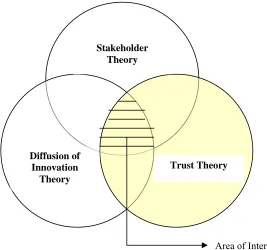
Literature lacks theoretical framework to direct empirical research on establishing critical success factors affecting the competitiveness of meat supply chain management. This paper fills the gap in the literature. The suggested framework stems from Freeman’s definition of stakeholder theory. Based on his definition, this research concentrates only on the area of interception between three theories employed: stakeholder theory, trust theory, and diffusion of innovation (DOI) theory. That is, from the viewpoint of trust theory, the research considers only the stakeholders’ perceptions of technology diffusion within the meat supply chain, and from the DOI theory viewpoint, the research considers only the stakeholders’ perception of trust within the meat supply chain.
Keywords: Critical Success Factors, Diffusion of Innovation Theory, Meat Supply Chain Management, Stakeholder Theory, Trust Theory.
INTRODUCTION
Australia’s red meat industries are becoming more consumer-focused and cost competitive through research, development and adoption of supply chain management (MLA, 2004). Supply chain management (SCM) includes managing supply and demand, sourcing raw materials and parts, manufacturing and assembly, distribution across all channels, and delivery to the customer (Supply Chain Council, 2004). In 1985, the Australian Meat and Livestock Corporation (AMLC) recognized of the importance of customer requirements and satisfaction in both local and global meat markets. AMLC initiated a program to change the meat industry culture from being ‘production-driven’ to being ‘customer-driven’ (Bindon and Jones, 2001). Introduced in 1997, the Meat Standards Australia Scheme attempted to enhance the quality of the meat production. Since then, AMLC and Meat and Livestock Australia (MLA) instigated several initiatives and programs to enhance collaborations and strategic alliances within the meat supply chain which include SCM Learning, E-Business, SCM Action, and SCM Funding.
The two sections that follow briefly discuss the lamb and beef production industrial sectors in Australia. Next, the critical success factors affecting the meat supply chain are identified followed by an overview of research motivation as well as the proposed contributions from the research. This is followed by the development of a theoretical framework.
THE LAMB INDUSTRY
majority of these lamb producers are wool producers shifting into lamb production when wool prices are down and/or when lamb prices seem promising. Although lamb consumption has declined over the last 20 years, lamb export sales has consistently increased, quarter by quarter since 1990 (MLA, 2001a). During the 1990s, lamb exports had expanded by 400% and this trend is expected to continue. A decrease in sheep population around the world and the on-going disease scares also resulted in an increase in Australian mutton exports. A five-year strategic plan (2001 – 2006) was developed by MLA and the Sheepmeat Council of Australia to support the development of SCM practices in order to maintain the vision of “Australia as the leading global food market provider of lamb and sheepmeat products” (MLA, 2001b).
THE BEEF INDUSTRY
Low cattle numbers worldwide and expanding markets in Pacific Asian region provide a potentially advantageous position for the Australian beef export industry. Australia with only 2.5% of world cattle numbers in 2001 (Bindon and Jones, 2001), retain the position of number two beef trader after USA – about 21% of global beef export in 2001 (Seng, 2003). A major influence on the Australian beef markets over the past decade was the increment in live cattle exports to Indonesia, Malaysia and Philippines. In Queensland, the beef industries comprise about 47% of total Australia cattle numbers and 28% of specialist beef properties (ABARE, 1998). Around 80% of Queensland beef is exported in 2001 (DPI, 2001).
The Australian Meat Research Corporation (AMRC) kicked off a four-year program, referred to as BeefNet (Beef Marketing Support Network), in June 1997. BeefNet aims to support the establishment of producer groups throughout Australia, and foster a supply chain culture across the meat industry (MLA, 2002). However, these projects have not overcome some noteworthy limitations in acquiring a greater market share, such as a lack of forward price or risk management systems; and producers’ reluctance to commit supply of products due to seasonal uncertainty with grass-field livestock (MLA, 2001b).
THEORETICAL FRAMEWORK
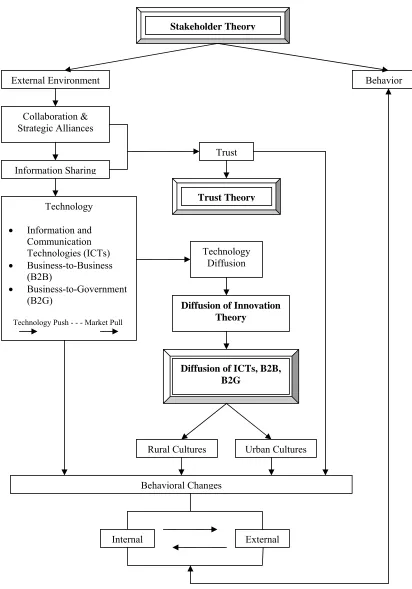
Freeman (1984) explains the stakeholder theory (ST) as the relationship of the firm to its external environment, and its behavior within this external environment. However, a problem exists with Freeman’s definition of ST. The organizational behavior within the internal environment of the firm has a direct influence on its behavior in the external environment. Accordingly, this research considers the organizational behavior within its internal environment as well as its external environment.
Business-to-Business (B2B) refers to business transactions between organizations (Chopra and Meindl, 2004). To widen this scope, it also relates to an exchange of information between firms. However, to build effective, real-time information sharing of sales and production without any delays, the information and communication technology (ICT) medium(s) between the collaborative organizations, such as the intranet and electronic data interchange (EDI), are required to be compatible and consistent in their infrastructures (Henriott, 1999; Mariotti, 1999). To put it simply, it requires the same level of technology diffusion.
Diffusion theory is synonymous with the term diffusion of innovation (DOI) theory which is developed by Rogers (1995). The common dimension of innovation diffusion is the source of the newness, such as the organization, the market, the technology, the product and the process (Kamm, 1987). Previous innovation diffusion research has been concerned with various issues including the definition of innovation diffusion (Rhodes and Wield, 1994; Afuah, 1998), the generation of innovation diffusion (Forsgren and Johanson, 1992; Nohria and Ghoshal, 1997), innovation diffusion in organizations (Daft, 1986; Damanpour, 1991), innovation diffusion in marketing (Simmonds, 1986), technological innovation diffusion (Howell and Higgins, 1990; Lawless and Anderson, 1996), process innovation diffusion (Davenport, 1993), value innovation diffusion (El Sawy, Malhotra, Gosian and Young, 1999) and innovation diffusion in information systems (Allen, 2000; Cooper and Zmud, 1990; Swanson, 1994). Among the various diffusions, this research focuses specifically on the diffusion of ICT, dealing as it does with B2B.
Rogers (1995) asserts that innovation diffusion may vary with differing cultures of urban and rural environments. Meat supply chain entities include farmers, producers, abattoirs, distributors and such, are located in rural areas, while a large number of retailers and consumers are mainly located in urban areas (Figure 1). Technology diffusion in rural areas is much slower than that in urban areas (Newell, Swan and Galliers, 2000). This research argues that a gap exists between the degrees of ICT diffusion within the various meat supply chain entities. This gap has a direct influence on the flow of information through the meat supply chain, which ultimately affects information sharing. Prior research indicates that ICT diffusion, trust, as well as rural and urban cultures may bring about a change in organizational behavior, as shown in Figure 2. This change in stakeholders’ behavior, can take place both internally and externally.
Retailers Abattoirs Farmers
Producers
Distributors
Consumers
Rural Areas
[image:4.612.199.454.65.580.2]Urban Areas
Figure 2. Theoretical Framework.
Technology
• Information and Communication Technologies (ICTs) • Business-to-Business
(B2B)
• Business-to-Government (B2G)
Technology Push - - - Market Pull
External Environmen
Information Sharin Collaboration & Strategic Alliances
g
Behavior t
Trust
Trust Theory
Internal External Behavioral Changes
Urban Cultures Rural Cultures
Diffusion of Innovation Theory
Technology Diffusion
Stakeholder Theor
Diffusion of ICTs, B2B, B2G
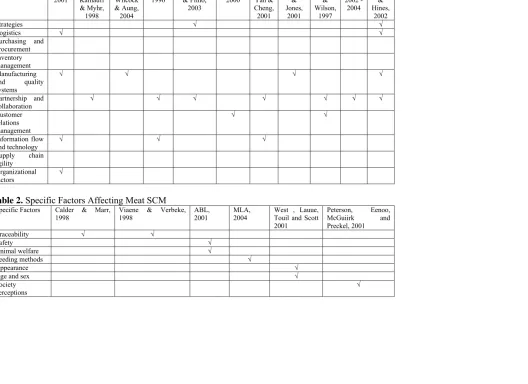
Table 1. Categories Affecting Meat Supply Chain Categories ABL, 2001 Spekman, Kamauff & Myhr, 1998 Hepner, Wilcock & Aung, 2004 Palmer, 1996 Zylbersztajn & Filho, 2003 Verbeke, 2000 Yu, Yan & Cheng, 2001 Bindon & Jones, 2001 McNeil & Wilson, 1997 MLA, 2002 - 2004 Sadler & Hines, 2002
Strategies √ √
Logistics √ √
Purchasing and procurement Inventory management Manufacturing and quality systems √ √ √ √ Partnership and
collaboration √ √ √ √ √ √ √
Customer relations management
√ √
Information flow
and technology √ √ √
Supply chain agility
Organizational factors
√
Table 2. Specific Factors Affecting Meat SCM
Specific Factors Calder & Marr,
1998
Viaene & Verbeke, 1998
ABL, 2001
MLA, 2004
West , Lauue, Touil and Scott 2001
Peterson, Eenoo, McGuiirk and Preckel, 2001
Traceability √ √
Safety √
Animal welfare √
Feeding methods √
Appearance √
Age and sex √
Society perceptions
Stakeholder Theory
Diffusion of Innovation
Theory
Trust Theory
[image:7.612.179.446.84.334.2]Area of Interest
Figure 3.Theoretical Boundaries.
CRITICAL FACTORS
The concept of critical success factors (CSFs) was first defined by Rochart (1997) as the limited number of identified operational goals shaped by the industry, the firm, the manager, and the broader environment that are believed if they are satisfactory, will ensure successful competitive advantage performance for the organization (Laudon and Laudon, 2002). The CSF approach has become an accepted top-down methodology for corporate strategic planning (Chen, 1999). It highlights the key requirements of top management (Byers and Blume, 1994). One can conclude from the literatures that identifying CSF forms the first step for developing a roadmap for improving performance and hence competitive advantage (Laudon and Laudon, 2002).
There are numerous researches investigating the CSFs of general and manufacturing supply chain (Al-Hakim, 2003; Chopra and Meindl, 2004; Handfield and Nichols, 1999; Lambert and Cooper, 2000; Lummus and Vokurka, 1999; The Supply Chain Council, 2004; Power, 2004). Factors affecting supply chain can be grouped into ten categories: strategies; logistics; purchasing and procurement; inventory management; manufacturing and quality systems; partnership and collaboration; customer relations management; information flow and technology; and organizational factors.
Link with Theoretical Framework
Evidence to show that there is a lack of research concentrating within the realm of the suggested three theories in meat supply chain. In addition, Table 1 and Table 2 show that there is a lack of studies that consider comprehensively both the general factors and specific factors affecting the meat supply chain. As such, an empirical study for identifying critical factors affecting meat supply chain within the suggested theoretical framework will make two new contributions to the literature:
1. It will identify the gap between the degrees of ICT diffusion within the meat supply chain entities. This gap directly influences the flow of information within the meat supply chain and affects information sharing between entities. The entities of the meat supply chain can be separated into two specific areas of occurrence: rural and urban. As Rogers (1995) suggests, the technology diffusion within these two areas is significantly different. And;
2. It deals with the interception of the three theories (stakeholder theory, trust theory, and DOI theory); that is, from the trust theory viewpoint, the stakeholders’ perceptions of ICT diffusion will be taken into account; and from the ICT diffusion viewpoint, the stakeholders’ perceptions of trust will be taken into account.
Given the fact that Australia is one of the leading countries in exporting meat globally, having an empirical study within the suggested theoretical framework study will enhance the competitiveness of the Australian meat supply chain.
CONCLUSION
This research deals with a specific type of supply chain in Australia, that is, the red meat supply chain which involves mainly lamb and beef products. It provides a brief summary of the development in both meat sectors in Australia and emphasises that Australia is one of the leading countries in exporting meat globally. Accordingly, developing a
theoretical framework to direct field research and empirical studies will enhance the competitiveness of the Australian Meat supply chains.
This research raises the importance of information sharing between organizations and points to two main issues hindering the flow of information across the meat supply chain. The first is the trust as many organizations are still reluctant in releasing information to be shared with other entities of the supply chain. The second issue is the gap of
technology diffusion in rural and urban areas. Meat supply chain entities include farmers, producers, abattoirs, distributors are located in rural areas, while a large number of
retailers and consumers are mainly located in urban areas.
To deal with information sharing affectively, the research concentrates on stakeholder perceptions on collaboration issues which are directly influenced by trust and technology diffusion. The research develops a theoretical framework that considers trust theory, diffusion of innovation (DOI or technology diffusion) theory in connection with
stakeholder theory, trust theory, and DOI theory. From the viewpoint of trust theory, this research takes into consideration the stakeholders’ perceptions of ICT diffusion.
Similarly, from the viewpoint of technology diffusion, the research considers the
REFERENCES
ABARE 1998. The Australian Beef Industry 1998. ABARE Research Report No. 98.7,
Canberra, Australia.
Afuah, A. 1998. Innovation Management: Strategies, Implementation and Profits, Oxford
University Press, Oxford.
Al-Hakim, L. 2003. Designing a future for Australian meat industry. Project Proposal,
Faculty of Business, University of Southern Queensland, Australia.
Allen, J. 2000. Information systems as technology innovation. Information Technology & People, Vol. 13, pp. 210 – 221.
Australian Business Limited (ABL). 2001. Asian Foodbuyers’ Survey. Agri Chain
Solutions Ltd.
Bindon, B. and Jones, N. 2001. Cattle supply, production systems and markets for Australian beef. Australian Journal of Experimental Agriculture, Vol. 41, pp. 861
– 877.
Byers, C. and Blume, D. 1994. Tying critical success factors to systems development.
Information & Management, Vol. 26, pp. 51 – 61.
Calder, R. and Marr, P. 1998. A beef producer initiative in traceability: Scottish borders TAG. Supply Chain Management, Vol. 3, pp. 123 – 126.
Chen, T. 1999. Critical success factors for various strategies in the banking industry.
International Journal of Bank Marketing, Vol. 17, pp. 83 – 91.
Chopra, S. and Meindl, P. 2004. Supply Chain Management: Strategy, Planning, and Operations Second Edition. Pearson Education, Inc., New Jersey.
Cooper, R. and Zmud, R. 1990. Information technology implementation research: a technology diffusion approach. Management Science, Vol. 36, pp. 123 – 139.
Daft, R. 1986. Organizational Theory and Design, 2nd Edition, West Publishing, St Paul,
MN.
Damanpour, F. 1991. Organizational innovation: a meta-analysis of effects of determinants and moderators. Academy of Management Journal, pp. 555 – 590.
Davenport, T. 1993. Process Innovation, Harvard Business School Press, Boston, MA.
DPI (2001). Queensland Value Chain Analysis: Beef. Department of Primary Industries,
Queensland Government. http://www.dpi.qld.gov.au/beef/5498.html, accessed on 26 July 2004.
Dyer, J. and Singh, H. 1998. The relational view: cooperative strategy and sources of interorganizational competitive advantage. Academy of Management Review, Vol.
23, pp. 660 – 679.
El Sawy, O., Malhotra, A., Gosain, S. and Young, K. 1999. IT-intensive value innovation in the electronic economy: insights from Marshall Industries. MIS Quarterly, Vol.
23, pp. 305 – 335.
Forsgren, M. and Johanson, J. 1992. Managing Networks in International Business,
Gordon and Breach, Paris.
Freeman, R. 1984. Strategic Management: A Stakeholder Approach, Ballinger, Boston,
Handfield, R. and Nichols, E. 1999. Introduction to Supply Chain Management,
Prentice-Hall, Inc., New Jersey.
Henriott, L. 1999. Transforming supply chains into e-chains. Supply Chain Management Review, Global Supplement, Spring, pp. 15 – 18.
Hepner, I., Wilcock, A., and Aung, M. 2004. Auditing and continual improvement in the meat industry in Canada. British Food Journal, Vol. 106, pp. 553 – 568.
Howell, J. and Higgins, C. 1990. Champions of technological innovation. Administrative Science Quarterly, pp. 317 – 341.
Hoyt, J. and Huq, F. 2000. From arms-length to collaborative relationships in the supply chain: an evolutionary process. International Journal of Physical Distribution & Logistics Management, Vol. 30, pp. 750 – 764.
Kamm, J. 1987. An Integrative Approach to Managing Innovation, Lexington Books,
Lexington, MA.
Lambert, D. and Cooper, M. 2000. Issues in supply chain management. Industrial Marketing Management, Vol. 29, pp. 65 – 83.
Laudon, K. and Laudon, J. 2002. Management Information Systems: Managing the Digital Firm. Prentice-Hall, Inc., New Jersey.
Lawless, M. and Anderson, P. 1996. Generational technological change: effects of innovation and local rivalry on performance. Academy of Management Journal,
pp. 1185 – 1217.
Lengnick-Hall, C. 1998. Customer contributions to quality: a different view of the customer-oriented firm. Academy of Management Review, Vol. 21, pp. 791 – 824.
Lummus, R. and Vokurka, R. 1999. Defining supply chain management: a historical perspective and practical guidelines. Industrial Management & Data Systems,
Vol. 99, pp. 11 – 17.
Mariotti, J. 1999. The trust factor in supply chain management. Supply Chain Management Review, Spring, pp. 70 – 77.
McNeil, M. and Wilson, R. 1997. Satisfaction in the wholesaler – retailer relationship: the experience of red meat retailers in Western Australia. Agribusiness, Vol. 13,
pp. 569 – 577.
MLA. 2001a. Lamb and Sheep Research and Development Program: Strategic Plan 2001-2006. Meat & Livestock Australia, Sydney, Australia.
MLA. 2001b. Growth in the Australian Lamb Industry. Meat & Livestock Australia,
Sydney, Australia.
MLA. 2002. BeefNet Final Report. Meat & Livestock Australia, Sydney, Australia.
MLA. 2004. Supply Chain Management Program. Meat & Livestock Australia, Sydney,
Australia.
Monczka, R., Petersen, K., Handfield, R. and Ragatz, G. 1998. Success factors in strategic supplier alliances: the buying company perspective. Decision Sciences Journal, Vol. 29, pp. 533 – 578.
Newell, S., Swan, A. and Galliers, R. 2000. A knowledge-focused perspective on the diffusion and adoption of complex information technologies: the BPR example.
Information Systems Journal, Vol. 10, pp. 239 – 259.
Palmer, C. 1996. Building effective alliances in the meat supply chain: lessons from the UK. Supply Chain Management, Vol. 1, pp. 9 – 11.
Peters, J. and Hogensen, A. 1999. New directions for the warehouse. Supply Chain Management Review, Global Supplement, Spring, pp. 23 – 25.
Peterson, E., Eenoo Jr, E., McGuirk, A., and Preckel, P. 2001. Perceptions of fat content in meat products. Agribusiness, Vol. 17, pp. 437 – 453.
Porter, M. 1980. Competitive Strategy. The Free Press, New York.
Power, D. 2004. Supply chain management integration and implementation: a literature review. International Journal of Supply Chain Management, to appear.
Rhodes, E. and Wield, D. 1994. Implementing New Technologies: Innovation and Management of Technology, NCC, Blackwell, Oxford.
Rochart, J. 1997. Chief executives define their own data needs. Harvard Business Review, Vol. 57, pp. 81 – 92.
Rogers, E. 1995. Diffusion of Innovation, The Free Press, New York, NY.
Sadler, I. and Hines, P. 2002. Strategic operations planning process for manufacturers with a supply chain focus: concepts and a meat processing application. Supply Chain Management: An International Journal, Vol. 7, pp. 225 – 241.
Seng, P. 2003. Global export markets in the 21st century – global competition and global
partnerships. Proceedings: 2003 Beef Australia Conference, Rockhampton.
Simmonds, K. 1986. Marketing as innovation: the eighth paradigm. Journal of Management Studies, September, pp. 479 – 500.
Spekman, R., Kamauff Jr, J., and Myhr, N. 1998. An empirical investigation into supply chain management: a perspective on partnerships. Supply Chain Management,
Vol. 3, pp. 53 – 67.
Swanson, E. 1994. Information systems innovation among organizations. Management Science, pp. 1069 – 1092.
The Supply Chain Council 2004. http://www.supply-chain.com, accessed on 26 July 2004.
Verbeke, W. 2000. Influences on the consumer decision-making process towards fresh meat: insights from Belgium and implications. British Food Journal, Vol. 102,
pp. 522 – 538.
Viaene, J. and Verbeke, W. 1998. Traceability as a key instrument towards supply chain and quality management in the Belgian poultry meat chain. Supply Chain Management, Vol. 3, pp. 139 – 141.
West, G., Larue, B., Touil, C., and Scott, S. 2001. The perceived importance of veal meat attributes in consumer choice decisions. Agribusiness, Vol. 17, pp. 365 – 382.
Yu, Z., Yan, H., and Cheng, T. 2001. Benefits of information sharing with supply chain partnerships. Industrial Management & Data Systems, Vol. 101, pp. 114 – 119.
Zylbersztajn, D. and Filho, C. 2003. Competitiveness of meat agri-food chain in Brazil.