Application of ontologies to traceability in the dairy
supply chain
L. Magliulo1, L. Genovese1, V. Peretti2, N. Murru2
1
Penelope SpA, Naples, Italy; *Corresponding Author: [email protected]
2
Department of Veterinary Medicine and Animal Production, University of Naples “Federico II”, Naples, Italy Received 2013
ABSTRACT
Systems for tracking products through supply chains range from paper-based records main-tained by producers, processors, and suppliers to sophisticated ICT-based solutions. In addition to supporting product traceability, ICTs may also support data capture, recording, storage, and sharing of traceability attributes on processing, genetics, inputs, disease/pest tracking and mea- surement of environmental variables. A key suc-cess factor for a traceability system is the capa-bility to integrate and share information along the supply chain. ICT represents a tool to over-come integration problems, data fusion and in-formation dissemination. In this paper we illus-trate the application of ontology as a tool to model business processes and rules within an agri- food chain. The business case is represented by the Bovlac project: a scientific and technologic platform to trace fresh cheese production. Keywords:Information Integration; Business Process; Ontology; Agri-food Supply Chain; Dairy Chain, Value Chain
1. INTRODUCTION
Food safety is a global concern. Food recalls frighten consumers throughout the world, leading to a widespread awareness about the need to adopt mandatory food trace-ability systems.
However, mandatory provisions on traceability require the food-processing industry to record only partial details of the full process, usually limited to adjacent suppliers clients. This is also named the one-step-up, one-step- down approach.
On the other hand, sophisticated consumers start de-manding more information about the actual quality stan-dards of the food they eat. Transparency about the ingre-dients being used as well as proven genuineness of origin
for distinctive or traditional food and general nutrition information for functional food are becoming increas-ingly relevant.
The aim of this paper is to introduce the ICT system for the traceability in the dairy and discuss the benefits of tracing data pertaining to the quality of the food process throughout the entire supply chain. Along with data about product movements, this helps optimize traceabil-ity and provides a measure of the overall performance of the value chain.
2. TRACEABILITY IN FOOD CHAINS
2.1. Food Safety and TraceabilityFood safety is a top priority for consumers and the food industry. The attention paid by the media to food safety and possible food quality problems, the globaliza-tion of the internaglobaliza-tional marketplaces, the ever increasing risks associated with liability, the growing complexity of the supply chains all represent strong drivers of trace-ability. Eventually, safety and security represent the two most important drivers in the food industry as dramatic recalls have frequently been reported around the world.
According to EU law, food and feed businesses - whether they are producers, processors or importers - must make sure that all foodstuffs, animal feed and feed ingredients can be traced right through the food chain, from “farm- to-fork”. Each business must be able to identify its sup-pliers and which businesses it supplied in a one-step-up, one-step-down approach.
In the meantime, some visionary businesses have fa- voured the development of voluntary traceability, which consists of recording what-goes-where, during the trans-formation process and along the supply chain.
Even though voluntary traceability involves more tracking activity than in the mandatory framework, the captured data is limited to each single move of the product (what-goes-where). Indeed, the final purpose of both man- datory and voluntary traceability approaches is to allow retrieval of data in a fast and accurate manner all along the supply chain in order to identify the desired items.
The more complex a traceability system is, the more data it will has to handle. Consequently, input data is limited to that of critical events, i.e. the tracing of move-ments that significantly affect the food product. In this context data pertaining to quality is not perceived as critical and therefore remains excluded from the trace-ability systems.
Nevertheless, consumers today ask for more informa- tion about the quality, origin and handling of the food they purchase and eat. News of recalls and exposure to unsafe practices have made consumers wary.
All the above withstanding, the availability of a tra- ceability system capable of capturing valuable data dur-ing the food processdur-ing phases and designed to carry this information all along the supply chain, may well repre-sent a remarkable opportunity for a business to differen-tiate itself in the market.
2.2. ICT and Traceability
As argued by Hall [1], traceability systems are intro-duced for three main reasons. First, traceability makes it easier, faster, and cheaper to do crisis management. Second, traceability can provide information to consum-ers and other participants in the distribution chain, and can increase trust in that information (“credence” quali-ties). Third, companies use traceability in search of effi-ciency gains, reasoning that better information about how their food moves will help them streamline supply chains.
Systems for tracking products through supply chains range from paper-based records maintained by producers, processors, and suppliers to sophisticated ICT-based so-lutions. In addition to supporting product traceability, ICTs may also support data capture, recording, storage, and sharing of traceability attributes on processing, ge-netics, inputs, disease/pest tracking, and measurement of environmental variables.
A key success factor for a traceability system is the capability to integrate and share information along the supply chain. ICT represents a tool to overcome integra-tion problems, data fusion and informaintegra-tion dissemina-tion.
The agri-food enterprises operate in a complex and dynamic environment, so, to meet increasing demands of consumers, government and business partners, they have to work on innovations of products, processes and ways of cooperation in the supply chain [2]. ICT provides sev-eral technologies, integrated in frameworks, to solve is-sues related to cooperation along the supply chain [3].
In [4], authors make a survey on the application of ICT technologies to the agri-food supply chain. Several technologies are analyzed and proposed in three different use cases within the application domain of the food sector.
In this paper we propose the use of ontology as a tool to model business processes and rules within an agri- food chain. The business case is applied in the dairy in-dustry.
2.3. The Bovlac Platform
The broader vision of extending traceability to quality data has been taken in the Bovlac project. A project de-signed by a consortium composed of a dairy industry (ICCA Spa), research teams in veterinary medicine and biotechnologies at the University of Naples “Federico II” and an ICT company (Penelope spa), and funded by Re-gione Campania – Italy.
The initial idea was to make each process step trans-parent, from the stable to the consumer, and provide spe-cific information on each single food product as a means of promoting the functional food principle that quality food "is good and does “good”.
Within Project Bovlac, the principles described above are fulfilled through the implementation of a computer system capable of tracing not just the production and packaging of the specific product “Fior di latte Napoli”(a traditional Pasta Filata cheese of Naples), but also make all data pertaining to the origin (stable, cow, milk, tem-perature, etc.) accessible to consumers.
Once traced, the “identity card” of the “Fior di Latte di Napoli” will display information on the breeding of cows, date of milking, milk quality, cow diet, milk production date, milk transfer date and “Fior di Latte Napoli” pro-duction date and packaging.
The ValueGo® ICT platform has been developed for the traceability. The system allows consumers – simply scanning the Qr-Code on the package with their smart-phones –full reading of the “Fior di Latte di Napoli” his-tory data while purchasing.
ValueGo® is basically a system that uses a web-cen-tric communication infrastructure between active tags and over a wi-fi network for the acquisition and dis-patching of data and information. Developed in an open source environment, ValueGo® technology features two distinctive elements: domain ontologies and active and passive tags, i.e. RFID and NFC.
A semantic database implements the application do-main ontology. Through the use of ontologies, the con-cepts related to any business or product domain can be shared in multiple application environments, and do-main-specific knowledge can be further enriched.
The resulting software architecture builds on standard components and a specific ValueGo® Java Framework, a set of java classes implementing specific services; it in-cludes classes to manage an EPCIS Repository.
Furthermore, ValueGo® operates on standard hard-ware products, configured in a three-tier architectural
2.5. Ontology Application in Dairy Chains
model. The system architecture provides three levels of interactions, catering to all active stakeholders in the
manufacturer’s ecosystem. Within ValueGo ontologies have been used to define
the operational and business models of a specific produc-tion, the fresh cheese Pasta Filata.
ValueGo® employs identification technologies based on radio frequency (RFID or NFC) and bar code (1D and 2D), suitable for professional use and to facilitate inter-action with consumers.
Specifications have been analyzed w.r.t. the definition of product characteristics (like geographical area of milk origin and characteristics of the cheese) and processing chain of the milk-cheese.
Data acquired during the various production phases is transmitted in real-time to a portal that can be consulted by anyone interested. The consumer, by using a smart-phone equipped with an NFC reader or with an applica-tion capable of reading a 2D-barcode, is addressed to a web page describing the product being considered for purchase. The system is also accessible via internet.
In particular, the concept of "Pasta Filata" can be de-fined as a function of a series of fundamental properties, such as the aging time, the temperature of the curd, the consistency of the dough, the fat content and the place of origin. In addition, the concept of "Pasta Filata" can cer-tainly be defined as a specialization of the concept of "Cheese" and the concept of "FiordiLatte-di-Napoli" as a specialization of the concept of "Italian-Cheese". The taxonomy of the previous concepts is reported here: (Figure 1)
2.4. Ontology in Information Management
A key technology in ValueGo is the domain ontolo-gies.
The general concept of "Cheese" is related to the other concepts of the taxonomy through the following properties: Ontologies play an important role in information
mod-elling and management. In [5], Gruber defines an ontol-ogy as a set of representational primitives with which to model a domain of knowledge. The representational primitives are typically classes (or sets), attributes (or properties), and relationships (or relations among class members). Ontologies are typically specified in lan-guages that allow abstraction away from data structures and implementation strategies. Due to their independence from lower level data models, ontologies are used for integrating heterogeneous databases, enabling interop-erability among disparate systems, and specifying inter-faces to independent, knowledge-based services.
• has-vesting-time • has-temperature-curd • has-pasta-consistency • has-fat-content • has-origin-area
The first four properties are of type "ObjectProperty" and they are given the sets of permissible values, the remaining ones are of type "DatatypeProperty" and they are the types of values that can take.
The concept "Fiordilatte-of-Naples" can be defined through the following properties:
• Fiordilatte-of-Naples Several researches argue about the application of
ontol-ogy in enterprise and business process modeling. In [6] a Business Process Modelling Ontology is proposed as a part of an approach to modeling business processes at the se-mantic level, integrating knowledge about the organisational context, workflow activities and Semantic Web Services.
has-aging-time Aging Fast has-temperature-curd Pasta-Spun has-pasta-consistency Spring-Pasta has-fat-content Fat Cheese has-origin-area Naples
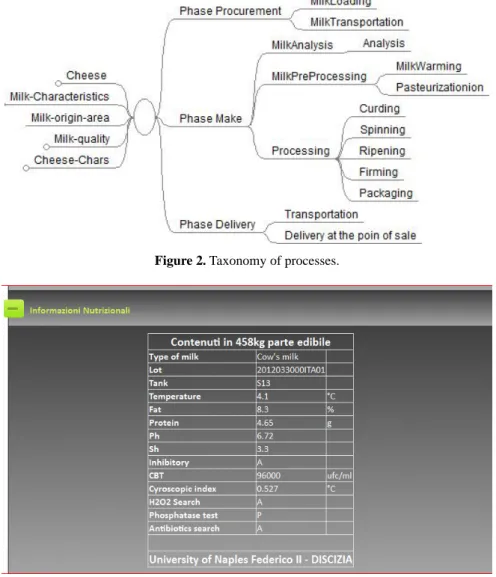
Business processed have been modelled w.r.t. the en-tire dairy chain in terms of specific business use cases. These use cases describe the people involved in all stages of the process, their roles and activities of each of them. The use cases can be traced to the macro-phases of the supply chain, as follows: (Figure 2)
The knowledge of the domain of interest, formalized in business use cases of business, allows to identify, in addition to significant figures involved, also all concepts and properties required to model, the activities of each stage. In particular, this modeling was performed by rep-resenting the events related to the transitions between activities of each stage of the production process.
2.6. Tracing the Product
Concepts modeled with ontologies have been used to trace information made available to consumer via smartphone or computer. Organization of traceability information re-flect the structure of the model. As example information
about quality of milk are associated to concepts Milk- Characteristic and Milk-Quality in the ontology. (Figure 3)
3. CONCLUSIONS
Making the quality of products transparent for the consumer means being able to monitor the work proce-dures of each individual company (internal traceability), all along the supply chain. This view is consistent with the principle stating that: “The creation of systems of internal traceability is a prerequisite without which there can be no traceability”. This implies the ability to certify the quality of production with tools capable of automati-cally recording information about each transformation process and the subsequent distribution.
What makes ValueGo® a suitable instrument is its ability to adapt to different product processes and various supply chain models. Adaptation of ValueGo® to a spe-cific production model takes place at the value chain
Figure 2. Taxonomy of processes.
Figure 3. Traceability of milk quality.
level. Firstly, by tuning the software rules, which may be standardized for most businesses but still need some de-gree of customisation, Secondly, working on characteris-tics of product and processes that are more company- specific.
Through the adaptation of the specific business proc-esses, ValueGo® is able then to detect and record in a database all quality-related events throughout the lifecy-cle of each product, thus enabling the consumer to easily trace all available product information at purchase time.
4. ACKNOWLEDGEMENTS
Project Bovlac is funded by Regione Campania PSR Misura 124 Ref. n.774 of 28/12/2010 CUP B35C10001760004
REFERENCES
[1] Hall, D. (2010) Food with a visible face: Traceability and
the public promotion of private governance in the Japa-nese food system. Geoforum, 41, 826-835.
doi:10.1016/j.geoforum.2010.05.005
[2] Wolfert, S., Verdouw, C.N., Verloop, C.M., Beulens.
A.J.M.(2010) Organizing information integration in agri-food— A method based on a service-oriented
archi-tecture and living lab approach. Computers and
Electron-ics in Agriculture, 70, 389-405.
doi:10.1016/j.compag.2009.07.015
[3] Verdouw, C.N., Beulens, A.J.M., Trienekens, J.H. and
Wolfert, S. (2010) Business process modelling in de-mand- driven agri-food supply chains. Available: http://centmapress.ilb.uni-bonn.de/ojs/index.php/proceedi ngs/article/view/58/56
[4] Lehmann, R.J., Reiche, R. and Schiefer, G (2012) Future
internet and the agri-food sector: State-of-the-art in
lit-erature and research. Computers and Electronics in
Agri-culture, 89, 158-174.doi:10.1016/j.compag.2012.09.005
[5] Gruber, T. (2009) Ontology in Encyclopedia of Database
Systems, Ling Liu and M. Tamer Özsu (Eds.), Springer-Verlag, 2009.
[6] Cabral, Liliana; Norton, Barry and Domingue, John
(2009). The business process modelling ontology. In: 4th
International Workshop on Semantic Business Process Management (SBPM 2009), Workshop at ESWC 2009, 1 June 2009, Crete, Greec.