Proceedings
of
AUQF2009
Internal & External Quality Assurance:
Tensions & Synergies
conference proceedings, themed collections of articles, special issues, reports and monographs. Aims of the Series are to:
• contribute to the enhancement of quality practices and quality assurance in Australian higher education (wherever offered) and internationally
• provide a means for sharing insights, research and analysis that is responsive to identified or emerging needs of quality facilitators in higher education
• stimulate discussion and reflection on directions, evolution and progress in quality improvement relevant to higher education and external quality assurance agencies
• explore the breadth and diversity of approaches to quality assurance in Australian higher education
• provide substantial scholarly contributions to the literature on quality assurance in higher education that would otherwise not be available to a wide audience
The AOP Series is not intended to duplicate the function of other academic journals that address quality in higher education. Rather, it is intended to provide a vehicle for the publication of works relevant to AUQA’s activities and the Australian higher education sector, as indicated above. Works in the AOP Series are expected to demonstrate a high standard of research, scholarship and critical reflection. Publications in the Series will be substantial works such as monographs, edited compilations or analytical reports, normally between 10,000 and 30,000 words. The Series also includes the Proceedings of the annual Australian Universities Quality Forum (AUQF). A list of current publications is at:
www.auqa.edu.au/qualityenhancement/publications/occasional/publications/
The papers and workshop outlines in these Proceedings have been included as provided to the AUQF organisers. Minimal formatting and editing of grammatical errors has been undertaken but responsibility for the content, style and referencing remains with the authors.
AUQA Occasional Publications Number 19 ISSN 1446-4268
ISBN 978-1-921561-13-9
© 2009 by the authors
Published by:
Australian Universities Quality Agency Level 10, 123 Lonsdale Street
Melbourne, Victoria, 3000 T: +61 3 9664 1000 F: +61 3 9639 7377 E: [email protected] W: www.auqa.edu.au
Proceedings of AUQF2009
C o n t e n t s
Contents... i
Preface and Acknowledgements ...iii
AUQF Joint Steering Group ... v
Alice Springs Reference Group... vi
Keynote Addresses ... 1
The Changing Architecture of Quality Assurance ... 1
Professor Roger Brown1 Quality and Standards ... 12
Professor Chris Brink
Plenary Session ... 27
The International Student Experience in Australia ... 27
Professor Dean Forbes
Paper Sessions... 36
Quality and Standards in Higher Education Discourse: A Linguistic Overview ... 36
Dr Dennis Alexander Academic Tensions in Financial Quality Assurance – A Way Forward... 44
Associate Proessor Vivienne Blake, Professor Shelda Debowski, Renu Sharma Indigenisation of Curricula – Intent, Initiatives and Implementation ... 50
Kathleen Butler, Dr Anne Young Zen, Motorcycle Maintenance, and the Metaphysics of Quality ... 56
Rob Carmichael External and Internal Quality Assurance – Towards a Model for Integration ... 63
Sarah Carr, John M Jennings Assessment Reform and the Quality Context: Tensions and Synergies ... 69
Lynda Davies Meeting Internal and External Demands: the Challenge of Developing English Language Proficiency in an Australian University ... 75
Associate Professor Katie Dunworth Growing-Our-Own – Interfacing AUQA’s Audit Report, University Policies and the Bradley Report 80 Professor Alison Elliott, Dr June Slee Beyond the Numbers: Achieving Best Practice in Learning and Teaching ... 88
Jacqueline Flowers, Bronwyn Kosman
The Place of the Internal Reviewer in Internal Reviews... 94
Dr Lucy Jarzabkowski
Closing the Loop: A Case Study of a Post-evaluation Strategy... 100
Dr Megan Kek, Professor Lynne Hunt, Dr Michael Sankey
Indicators of University Community Engagement: Learning from the AUCEA Benchmarking Pilot 106
Anne Langworthy
Strengthening Internal Quality to Ensure Changing External Requirements Are Met ... 114
Bernie McKenna
Ensuring that External Funding for Teaching Development Grants: Supports Internal Quality
Assurance Processes... 122
Professor Carmel McNaught
External and Internal Indicators of Student and Graduate Satisfaction: Tensions and Synergies ... 130
Dr Beverley Oliver, Julie-Ann Pegden
Australian Theological Education: Issues for the AUQA Audit Process... 137
Dr Charles Sherlock
The Rise of Private Higher Education in Australia: Maintaining Quality Outcomes and Future
Challenges ... 143
Mahsood Shah, Dr George Brown
Are We There Yet? Using Strategy Maps in Higher Education to Drive Performance ... 151
Dr Anne Young, Professor Kevin McConkey
Workshops... 157
Preparing for an External Quality Audit: Does it add any Value? The Experience of a Private Higher Education Institution ... 157
Dr George Brown, Mahsood Shah
Developing Indicators of Quality Teaching and Learning for use in Universities... 159
Professor Denise Chalmers
Curriculum Diversification and the Implications for Academic Standards ... 162
Professor Richard James, Dr Kerri-Lee Harris
Leading Quality... 164
Professor Geoff Scott
Strategic Key Performance Indicators – Current Practices at Australian Universities ... 165
Proceedings of AUQF2009
Closing the Loop: A Case Study of a Post-evaluation Strategy
Dr Megan Kek a Professor Lynne Hunt b
Dr Michael Sankey c
a Lecturer, Learning and Teaching Support Unit, University of Southern Queensland, Australia b Pro Vice-Chancellor (Learning and Teaching), Office of Vice Chancellor and President, University of
Southern Queensland, Australia
c Acting Director, Learning and Teaching Support Unit, University of Southern Queensland, Australia
Abstract
This paper establishes the broad context of evaluation about learning and teaching in universities. It refers particularly to student feedback, indicating that current practice is less than satisfactory because universities complain of low response rates and students complain that they are not informed of results or any actions taken to improve courses and programs as a consequence of their feedback. The paper addresses the importance of valuing students’ views by communicating back to them and ensuring quality transformation of student feedback by ‘closing the loop’. It describes the Course and Program Review (CPR) model, designed by the University of Southern Queensland (USQ) and the new post-evaluation strategy.
Keywords: closing the loop, student feedback, online evaluation, post-evaluation.
Introduction
Institutional research is fundamental to university quality assurance because it provides an evidence-base for continuous quality improvement. In the domain of learning and teaching, evidence normally includes information about retention, progression, grade distribution and student satisfaction. To date, attention has been focused on the development, validity and reliability of data. The Australian Learning and Teaching Council project on Teaching Quality Indicators Project www.altc.edu.au/carrick/go/home/op/edit/pid/370
is an example of the level of interest in establishing appropriate measures.
The reasons for refining measures of learning and teaching outcomes arise, in part, from governmental interest in university teaching standards, not only because universities build capacity for ‘clever countries’ but also because tertiary education is big business that attracts export income. Government standards are embedded in National Protocols and policies and agencies such as the Australian Universities Quality Agency (AUQA) are charged with exploring the extent to which universities can demonstrate compliance. This broad context, then, is concerned with the achievement of standards. The approach meets resistance in the university context, which is understood to be qualitatively different from a corporate approaches based on industry standards and productivity. For example, Coady (1999, p. 10) refers to corporate university managers as the ‘myopics’.
The issue, then, is to bridge the gap between corporate requirements and staff and student engagement through a feedback cycle that is meaningful. To this end, this paper describes the newly designed post-evaluation strategy at the University of Southern Queensland (USQ) and shows how the process is designed to engage staff and students and to lock-in quality so that it becomes routine practice. In particular, it shows the importance of closing-the-loop by establishing systems to provide feedback to students on the outcomes of their evaluations of learning and teaching.
The USQ Approach to Quality Improvement
USQ’s approach to quality recognises that it is not a fixed or static procedure. Rather, it arises from an ongoing commitment to the values of USQ and a cycle of review and improvement. A fundamental value is the commitment to the student learning journey. It is a relationships-based and holistic approach that focuses attention on the student as a whole person (Hunt, Peach, Lovegrove & Baker, 2007). It provides a framework for evaluating the performance of the University at every stage of students’ contact with it, from pre-entry to alumni. Student feedback is, therefore, central to the evaluation process and USQ deploys the customary reviews of courses and programs, and it also engages with the AUSSE survey.
The University’s quality policy is designed to engage staff with quality processes and outcomes. Quality is everyone’s business and the intended outcome is a change-capable culture at USQ. The post-evaluation strategy www.usq.edu.au/learnteach/topics/eval/posteval/ accords with this approach and it is designed to embed the continuous quality improvement of courses and programs in templates
www.usq.edu.au/learnteach/topics/design/ and sustainable systems, in particular the recently designed
Course and Program Management System (CPMS).
The USQ post-evaluation strategy is based on the premise that good evaluation should lead to action, continuous improvement, and communication back to students and relevant stakeholders about actions taken (Harvey, 2003). However, ‘Closing the loop’ in this way has been noted as a demanding and challenging phase of the process (Watson, 2003) and it is evident that the practice has not been widespread because 40% of AUQA Cycle 1 Audits included recommendations about ‘…monitoring and reporting of the results of student evaluations … [and] providing feedback to students on the actions taken in response to those evaluations’ (AUQA, 2002–2007). The strategy described in this paper is quantitative and qualitative. It is designed to be reflective and to provide program-level ownership of the outcomes of student feedback and a system that offers students opportunities to see what happened as a consequence of their feedback.
An important reason for developing an approach that ‘Closes the loop’ is that it may help to increase the response rates of student surveys, particularly in online evaluation, which many universities are now implementing to streamline organisation and reduce the costs of data collection. Unfortunately, universities are also reporting that the response rates of online evaluation surveys are only 10–30%. In contrast, paper-based and classroom evaluations surveys can have response rates as high as 100%, certainly for those in attendance on the day. Low response rates draw into question the reliability of results and it is difficult to see how such evidence might meaningfully inform quality improvement. It is a vicious circle because if students do not see action arise from their feedback, they become cynical about the evaluation process, which risks giving rise to low response rates. (Powney & Hall, 1998). However, the battle is not yet lost because students do still feel that feedback surveys are important. They only question if any use was made of the data (Ballantyne, 1997).
The development of the post-evaluation strategy was part of USQ’s whole-of-institution change management project, which aimed to achieve, by the later half of 2009, a suite of ICT supported systems and project-based workflow processes, that will provide a consistent approach to the accreditation, design, delivery and evaluation of courses and programs. It had a whole-of-program focus, with objectives that included the development of:
• sustainable processes for the development and maintenance of high quality courses and programs;
• a course and program management system; and
• a cycle of program quality review and improvement.
Proceedings of AUQF2009
This is a risk for the University when students come to respond to the CEQ, which invites them to provide feedback on the entire program.
Course and Program Management System
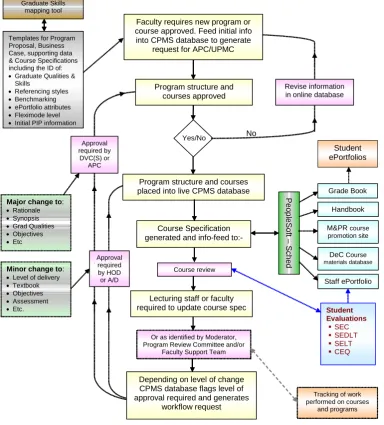
The CPMS design (Figure 1) locks-in approval processes and provides a single, official source for course and program data, thereby facilitating a consistent, University-wide approach to quality. The three main tasks associated with the CPMS were to provide mechanisms to manage, in one integrated system, the processes of:
• course and program approval, accreditation, and re-accreditation (CPA);
• course and program mapping (CPM); and
• course and program review (CPR).
This paper describes all three processes to provide a context for a particular focus on the CPR system, which addresses student feedback.
Program structure and courses approved Faculty requires new program or course approved. Feed initial info into CPMS database to generate
request for APC/UPMC
Program structure and courses placed into live CPMS database
Yes/No
Revise information in online database
No
Course Specification generated and info-feed to:-
Lecturing staff or faculty required to update course spec Templates for Program
Proposal, Business Case, supporting data & Course Specifications including the ID of:
• Graduate Qualities & Skills
• Referencing styles
• Benchmarking
• ePortfolio attributes
• Fleximode level
•Initial PIP information
Peo pleS of t – Sched Grade Book Handbook
M&PR course
promotion site
Depending on level of change CPMS database flags level of approval required and generates
workflow request Approval required by DVC(S) or APC Approval required by HOD or A/D
Minor change to:
• Level of delivery
• Textbook
• Objectives
• Assessment
• Etc.
Major change to:
• Rationale
• Synopsis
• Grad Qualities
• Objectives
• Etc
DeC Course
materials database
Or as identified by Moderator, Program Review Committee and/or
Faculty Support Team
Staff ePortfolio Student Evaluations SEC SEDLT SELT CEQ Graduate Skills mapping tool Course review
Tracking of work performed on courses
and programs Student ePortfolios
Figure 1: Course and Program Management System
[image:7.595.56.441.275.701.2]Course and Program Approval and Accreditation / Re-accreditation (CPA)
The CPA sub-system facilitates the design and development of new programs and courses through a series of templates and embedded workflows. It uses the functionality of a Sharepoint 2007 repository/database. The system allows for the development of course specification and business cases required for the range of accreditation bodies across the university. The system houses key documents required for the planning and review processes for both new programs and courses and the reaccreditation of those already in existence. All information is created in provided fields, within template documents referenced to standard libraries for items such as graduate skills (attributes), market related data and additional resources. Essentially whatever is associated with running a course at the university is captured in the CPA design.
Course and Program Mapping (CPM)
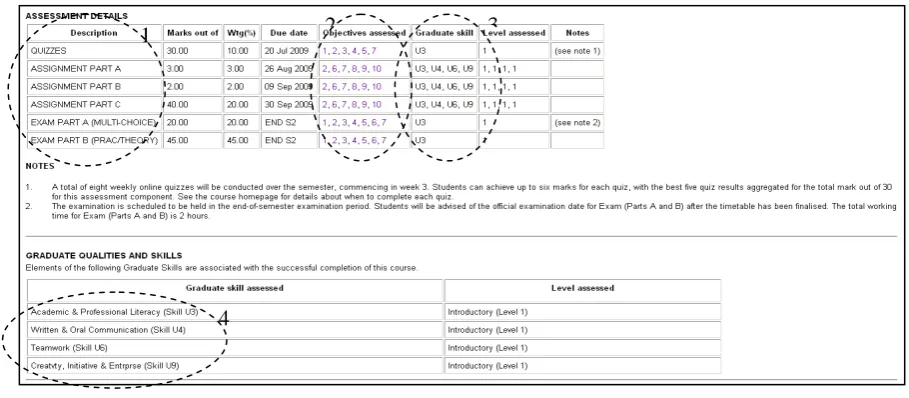
The data associated with all courses and programs are housed within a database, elements of which may be used to map features, such as graduate qualities, across a range of programs. This means that courses that are used in more than one program are appropriately tracked for any changes that will affect them all. Accordingly, when course related documents are prepared for accreditation in the CPA system, there are fields that are also used to create maps of key data such as which graduate qualities and skills are associated with which course. This may then be used to feed other systems. An example of how the mapping appears in a USQ course specification may be found in Figure 2, which illustrates a portion of a university Course Specification indicating to a student which assessment item (1) is assessing which Course Objective (2) and which graduate skills (3) are associated with the assessment. The skills are then identified/reinforced (4).
3
1 2
4
Figure 2: Assessment table and Graduate Skills portions from a USQ Course specification
Once captured, the data can then be mapped to other systems. For example, when a student successfully completes an assessment item associated with a graduate skill it can be automatically identified in a student’s e-Portfolio, so that, by the time a student has completed a program, the e-portfolio has a map of the graduate skills each student has attained whilst studying their courses. This also assists students to achieve a whole-of-program focus when planning their studies.
Course and Program Review (CPR)
[image:8.595.70.525.373.572.2]Proceedings of AUQF2009
changed, then consideration needs to be made of other assignments in the course and program and the alignment of graduate attributes and learning objectives. When a staff member changes anything within the system, an approval workflow is initiated that draws on the key mapped data, providing those responsible for approval a clear indication of the impact of any requested change.
Data can also be made available to staff e-Portfolios from the CPR system. For example, when academic
he CPR is designed to provide response data back to students. When a staff member has reviewed
t the end of each semester students are asked to provide feedback about their courses. The last time this course was
here were also areas previous students thought could be improved. As a result the teaching team has implemented
LACE THIS TEXT
our feedback is useful in guiding us: it confirms what we are doing well as teaching professionals, and clarifies is
igure 4: The Response Template
staff prepare for promotion or teaching excellence awards they can access key data from the CPR system to provide evidence to support their application.
T
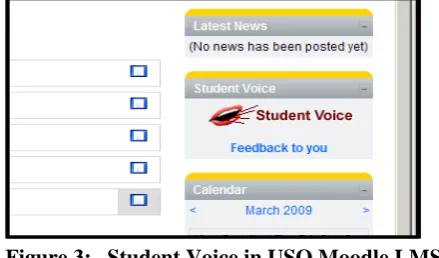
student evaluation of a course they may provide a response to students through the ‘Student Voice’ field (Figure 3). This will be achieved by using the functionality of the USQ Moodle learning management system (LMS) in association with the CPR. In simple terms, staff members have a facility to provide feedback to future students about what has been done to address students’ evaluation of courses and programs.
template response form has been developed (Figure 4). This feedback is then automatically linked to
Figure 3: Student Voice in USQ Moodle LMS
A
the ‘Feedback to You’ hyperlink found directly under the student voice icon in the Student Voice block in the LMS for all students enrolled in the course to see. This is currently being trialled in over 25 courses in Semester 1 2009.
A
run students provided feedback about a number of issues. This feedback was positive in terms of: 1. REPLACE THIS TEXT
2. REPLACE THIS TEXT 3. REPLACE THIS TEXT
T
adjustments in the course, in order to improve your study experience this semester. The following adjustments have been made:
1. REP
2. REPLACE THIS TEXT 3. REPLACE THIS TEXT
Y
areas where we can improve. At the end of this semester you will be asked for your feedback about the course. Th space shows that this feedback will be considered and acted on.
F
[image:9.595.54.274.277.406.2]Conclusion
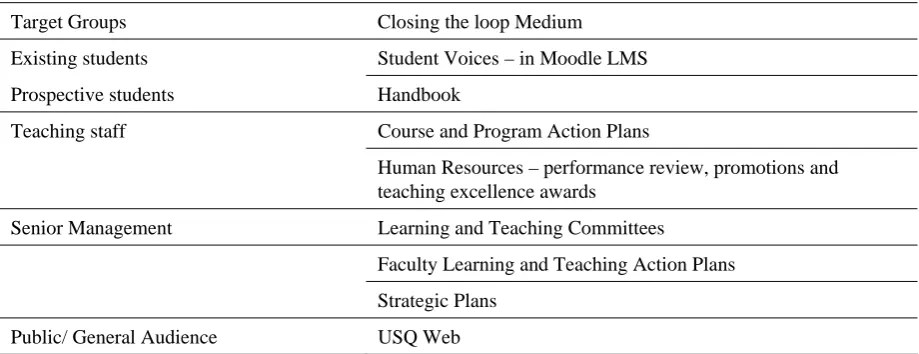
According to Harvey (2003), student feedback should provide internal information to guide a university’s continuous improvement work and external information for prospective students and stakeholders, for accountability and compliance requirements. USQ’s closing-the-loop strategy not only includes existing and potential students, key stakeholders, such as the University Learning and Teaching Committee and University Council, but also the teaching staff, who need the data to inform their teaching, assessment and curriculum design strategies, and to enhance their teaching practices (Richardson, 2005). Table 1 shows how the closing-the-loop will be rolled out when it is fully operational.
Table 1: Closing the Loop Tactics
Target Groups Closing the loop Medium
Existing students Student Voices – in Moodle LMS
Prospective students Handbook
Teaching staff Course and Program Action Plans
Human Resources – performance review, promotions and teaching excellence awards
Senior Management Learning and Teaching Committees
Faculty Learning and Teaching Action Plans
Strategic Plans
Public/ General Audience USQ Web
The CPR model was developed with the strategic view of producing meaningful participation in course and program evaluation for students and academic staff. It is systemic and locks in the use of data for improvement actions and communication of those actions as a routine part of the university’s daily work. It is currently at the pilot stage and use of the system for quality improvement and provision of feedback to students will be monitored as part of USQ’s drive to enhance learning and teaching scholarship.
References
AUQA (2002–2007). Quality Audits: Universities, Retrieved January 14, 2009, from AUQA Quality Audit website: www.auqa.edu.au/qualityaudit/universities/
Ballantyne, C. (1997). Improving university teaching: Giving feedback to students. In R. Pospisil & L. Willcoxson (Eds), Learning Through Teaching. Proceedings of the 6th Annual Teaching Learning Forum (pp. 12–15). Murdoch University, Perth: Murdoch University.
Coady, T. (Ed.) (1999). Why Universities Matter: A conversation about values, means and directions. St Leonards: Allen & Unwin.
Harvey, L. (2003). Student Feedback. Quality in Higher Education, 9 (1), pp. 3–20.
Hunt, L., Peach, N., Lovegrove, B., & Baker, G. (2007). Evolution and Renewal in Quality Assurance: The Student Learning Journey – A Holistic Approach to Quality Assurance in Learning and Teaching in Higher Education [Electronic Version]. AUQF 2007, Hobart, Australia, Retrieved September 18, 2007, from www.auqa.edu.au/auqf/pastfora/2007/program/papers/a4.pdf
Powney, J., & Hall, S. (1998). Closing the loop: The impact of student feedback on students’ subsequent
learning. Edinburgh: Scottish Council for Research in Education.
Richardson, J. T. E. (2005). Instruments for obtaining student feedback: A review of the literature.
Assessment and Evaluation in Higher Education, 30 (4), 387–415.
Watson, S. (2003). Closing the feedback loop: Ensuring effective actions from student feedback. Tertiary
[image:10.595.75.535.220.397.2]