Rochester Institute of Technology
RIT Scholar Works
Theses
Thesis/Dissertation Collections
8-3-2016
An empirical study on code comprehension: DCI
compared to OO
Hector A. Valdecantos
[email protected]Follow this and additional works at:
http://scholarworks.rit.edu/theses
This Thesis is brought to you for free and open access by the Thesis/Dissertation Collections at RIT Scholar Works. It has been accepted for inclusion in Theses by an authorized administrator of RIT Scholar Works. For more information, please [email protected].
Recommended Citation
R
OCHESTER
I
NSTITUTE OF
T
ECHNOLOGY
M
ASTERT
HESISAn empirical study on code
comprehension: DCI compared to OO
Author:
Héctor A. VALDECANTOS
Supervisor:
Dr. Mehdi MIRAKHORLI
A thesis submitted in partial fulfillment of the requirements for the degree of Master of Science in Software Engineering
in the
B. Thomas Golisano College of Computing and Information Sciences Department of Software Engineering
Rochester, New York
i
The thesis “An empirical study on code comprehension: DCI compared to OO” by Héctor A. VALDECANTOS, has been examined and approved by the following Exami-nation Committee:
Dr. Mehdi Mirakhorli Thesis Committee Chair Assistant Professor
Dr. Meiyappan Nagappan Assistant Professor
ii
ROCHESTER INSTITUTE OF TECHNOLOGY
Abstract
B. Thomas Golisano College of Computing and Information Sciences Department of Software Engineering
Rochester, New York
Master of Science in Software Engineering
An empirical study on code comprehension: DCI compared to OO
by Héctor A. VALDECANTOS
iii
Acknowledgements
Thanks to the object-composition group, the community behind DCI, that helped me in the understanding of the DCI paradigm and trygve language, specially thanks to Matthew Browne, Andreas Söderlund, Trygve Mikkjel Heyerdahl Reenskaug, and Rune Funch Søltoft. Thanks to James O. Coplien for his collaboration in the first part of this investigation and for playing an important role that favored the direction of my line of study to something that I like. Thanks to Mehdi Mirakhorli to accept being my advisor and support the realization of this thesis. Thanks to Mehdi’s research group, specially Palak Sharma, Raghuram Gopalakrishnan, and Danielle Gonzales. Thanks to Ibrahim Mujhid for helping with the java versions, and to my friend and professional colleague Alexis Sarghel to review the questions and to set the server where our web application was deployed to run the experiment. Thanks to José Vargas, a friend and former colleague and IT professional, to Hernán Wilkinson, co-founder of 10Pines, and Darío Korec from Axoft Argentina to help in the recruitment for the experiment.
iv
Contents
Abstract ii
Acknowledgements iii
1 Introduction 1
1.1 Context . . . 1
1.2 Thesis organization . . . 3
2 Motivation 5 2.1 State of the problem. . . 5
2.1.1 Classical Object-oriented inherent problems . . . 7
2.1.2 Maintenance. . . 9
2.2 Research objectives . . . 11
2.3 Research questions . . . 12
3 Data, contexts, and interactions 14 3.1 DCI paradigm . . . 14
3.2 What the system is . . . 15
3.3 What the system does. . . 16
3.4 The computational metaphor of theater . . . 17
3.5 End user mental model . . . 18
3.6 The trygve language . . . 19
3.6.1 Trygve program structure . . . 21
3.6.2 Classes and interfaces . . . 22
3.6.3 Contexts and roles . . . 22
3.6.4 Code example explained. . . 23
4 Related work 28 4.1 Program comprehension experimentation . . . 28
4.2 A mental model for program comprehension . . . 32
5 Research approach 36 5.1 Scope . . . 36
v
5.3 Experiment time-line design . . . 38
5.4 Experimental parameters and variables . . . 39
5.5 Participants . . . 41
5.6 Instrumentation . . . 42
5.7 Experimental units . . . 43
5.7.1 An experimental unit centric model perspective . . . 45
5.7.2 Code equivalence . . . 46
5.7.3 Descriptive metrics of system examples . . . 47
5.8 Experimental tasks . . . 48
6 Analysis and results 50 6.1 Overview. . . 50
6.2 Correctness analysis . . . 50
6.3 Timing analysis . . . 54
6.4 Centrality analysis . . . 57
7 Discussion and Conclusion 63 7.1 Threats to validity . . . 63
7.1.1 Conclusion validity. . . 63
7.1.2 Internal validity. . . 64
7.1.3 Construct validity . . . 65
7.1.4 External validity . . . 65
7.2 Conclusion . . . 66
7.3 Future work . . . 69
A Supporting data 70 A.1 Code metrics . . . 70
A.2 Experimental tasks metrics. . . 70
A.3 Centrality and time . . . 71
vi
List of Figures
2.1 A execution of system functionality as shown in (Dunsmore, 1998, p. 21). 8 2.2 Activities to find code rationale as shown in (LaToza, Venolia, and
De-Line, 2006). . . 10
3.1 Software system entities interactions diagram. . . 19
5.1 Experiment time-line design . . . 38
5.2 Web application display code . . . 43
5.3 Web application displaying the question . . . 44
5.4 Generic unit centric model perspective . . . 45
5.5 Unit centric model perspective, example . . . 46
5.6 Unit centric model perspective view . . . 46
6.1 Box plot of correctness ranks. . . 51
6.2 Box plot of correctness ranks per system example . . . 52
6.3 Box plot of correctness ranks per task type. . . 53
6.4 Box plot of timing scores . . . 54
6.5 Box plot of time consumption per system example . . . 55
6.6 Box plot of time consumption per task type . . . 56
6.7 CNLE for Menu system - DCI-trygve approach . . . 58
6.8 Centrality and Time - Library system . . . 59
6.9 Histogram of centrality classes - Library system . . . 61
6.10 Raster plot - File count over systems and centrality degree classes . . . . 62
A.1 Centrality-Time analysis Bank system . . . 71
A.2 Centrality-Time analysis Library system . . . 72
A.3 Centrality-Time analysis Menu system . . . 73
A.4 Centrality-Time analysis Spell Checker system . . . 74
vii
List of Tables
3.1 DCI main separation. . . 16
4.1 Consulted controlled experiments with human subjects on program com-prehension . . . 32
5.1 Experimental variables description.. . . 40
5.2 Java code . . . 47
5.3 trygve code . . . 48
6.1 Mann-Whitney U test for scores. . . 51
6.2 Mann-Whitney U test for scores per system. . . 52
6.3 Mann-Whitney U test for scores per task type. . . 53
6.4 Mann-Whitney U test for time consumption. . . 54
6.5 Mann-Whitney U test for time consumption per system. . . 55
6.6 Mann-Whitney U test for scores per task type. . . 56
6.7 Wilcoxon rank signed test for centrality segments - Library system (DCI-trygve). . . 60
6.8 Wilcoxon rank signed test for centrality segments - Library system (OO-java). . . 60
6.9 Centrality-Time correlation. . . 61
6.10 Centrality class count for most central files. . . 62
A.1 Simple code metrics per system example. . . 70
A.2 Experimental tasks per system example. . . 70
A.3 Wilcoxon rank signed test for centrality segments - Library system (DCI-trygve). . . 71
A.4 Wilcoxon rank signed test for centrality segments - Bank system (OO-java). 71 A.5 Wilcoxon rank signed test for centrality segments - Library system (DCI-trygve). . . 72
A.6 Wilcoxon rank signed test for centrality segments - Library system (OO-java). . . 72
viii
A.8 Wilcoxon rank signed test for centrality segments - Menu system (OO-java). . . 73 A.9 Wilcoxon rank signed test for centrality segments - Spell checker system
(DCI-trygve).. . . 74 A.10 Wilcoxon rank signed test for centrality segments - Spell checker system
(OO-java). . . 74 A.11 Wilcoxon rank signed test for centrality segments - Spell checker system
(DCI-trygve).. . . 75 A.12 Wilcoxon rank signed test for centrality segments - Tower of H. system
ix
List of Abbreviations
CNLE CognitiveNetwork ofLanguageElements
DCI DataContextInteraction
OO Object-Oriented
1
Chapter 1
Introduction
1.1
Context
Comprehension and readability of source code affect software development, especially its maintenance where reading code is a central activity. (Raymond, 1991). Further-more, the phase that a software system stays longer throughout its evolution is the maintenance phase that consumes over 70% of the total life-cycle cost of successful software developments (Boehm and Basili, 2005). “Indeed, the ratio of time spent reading versus writing is well over 10 to 1. We are constantly reading old code as part of the effort to write new code” (Martin, 2009). A computer system expressed through programming languages references all the technologies required to execute it, these are libraries, databases, frameworks, patterns, etc, but it also comprises the pro-gramming paradigms used that arranges, gives form, and organizes the source code as text to be read. Therefore, a programming paradigm imposes a style of arranging the source code that is aligned with a way of thinking toward a computable solution. In our research work we measure how Data Context Interaction (DCI) paradigm affects comprehension of source code in programmers by comparing it with classical Object-Oriented (OO) paradigm.
Chapter 1. Introduction 2
Measuring the comprehension of source code is similar to measure the comprehen-sion of natural language texts1, but with the addition that the source code text written by programmers is unequivocally interpreted by a computer that tyrannically shows the results of its execution as a reality presented to other humans. That way, the source code is an element of communication between the members of the development team that serves as a blueprint for a reality that has to be agreed between end users and pro-grammers for a software system to be considered successful. With that idea in mind, the architecture of a software system only exists in the run-time and becomes an ex-pression of a social intention that seems to keep a strong similarity to the dynamics of language in the pragmatic sense. Consequently, the source code today is not only to be executed by a computer to produce an output to end users, it is also used for com-munication purposes between programmers within a team that jointly describes the reality to be shown to end users, therefore the comprehension of source code is a key aspect to understand these phenomena2. “Experimentation provides a systematic, dis-ciplined, quantifiable and controlled way of evaluating human-based activities. This is one of the main reasons why empirical research is common in social and behavioral sciences” (Wohlin et al.,2012). Throughout the development of our research we have discovered that comprehending source code is maybe one of the activities with a high load of social and psychological aspects in software engineering, hence, comparing comprehension of source code is a very hard task to do and it is subject to unreliable results due to multiples human confounding factors.
The main topic of our research is directly related to human interactions, is about language and thinking, meaning and realities, time and space, about the constant dumping of knowledge in a computing machinery that resembles the human mind. Connecting all this high level philosophy of computing to specific metrics related to source code, comprehension questions, spent reading time and centrality degree of language elements may seen fictional but it is an starting point to understand the hu-man part of computing. The key to link both parts is in what we understand for pro-gramming paradigms. During the experiment we give subjects tasks with code com-prehension questions to count their correct answers, to measure their time of reading, and to capture how the system code is read. The data gathered from these tasks give us an insight about program comprehension, that analyzed from a software engineer-ing point of view allows us to take distance from all psychological and social factors to study the paradigms as a set of rules applied by programmers.
Traditionally, source code comprehension prescribes measures regarding time and
1The cognition model of how programmers comprehend source code is based on models made first
for natural languages. We write more about it in Section4.
2In the Immanuel Kant sense,phenomenonis an observable manifestation, in contrast tonoumenonthat
Chapter 1. Introduction 3
correctness, and more recently eye-tracking techniques have been used to start observ-ing the behavior of programmers in front of the source code. Because the characteris-tics of our research, we don’t need the level of detail that eye-tracking techniques give, we are looking at bigger conceptual chunks of code as language elements like classes, interfaces, or contexts that conform the blue print of running systems. By considering the reading time a programmer spends on a file we get valuable information at system level to evaluate properties of the source code regarding the paradigm used. These measures and observations represent a method to investigate the properties of source code regarding comprehension at system level.
In this thesis we review some issues that repeatedly appears in Object-Oriented systems regarding code comprehension and we present the novel Data Context Inter-action paradigm as an alternative. In our research work, we explain the design of the code comprehension experiment we have run and we report the results together with all the decisions we took and the implications and consequences they meant for the investigation.
1.2
Thesis organization
In the following item we summarize the content of each chapter:
Chapter 2: we present the evidence found in the literature that made us recon-sider classical Object-oriented thinking. Since the introduction of OO paradigm there were detractors from other language communities. We visualize how main-tenance might be affected because of the problems found in OO. Finally we show our objectives and our research questions that have motivated the investigation.
Chapter 3: this chapter is dedicated to the Data Context Interaction paradigm. We explain the main ideas behind DCI and the metaphor of theater for com-puter programs. We briefly presenttrygvelanguage, a new DCI-centric language, showing and explaining its main language elements through an small example.
Chapter 4: we first present the related works regarding the experimentation that researchers have been done on program comprehension. Then, we present those related to the creation of a mental model for program comprehension based on text comprehension.
Chapter 1. Introduction 4
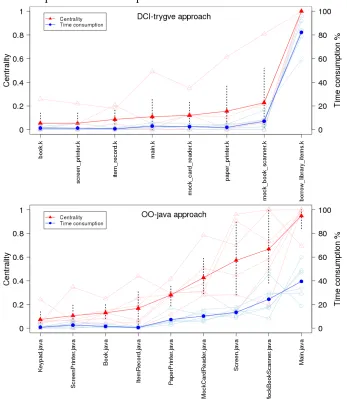
Chapter 6: we show the statistical analysis we followed to answer our research questions regarding correctness, timing, and centrality. We observe program-mer’s focus of attention by analyzing the centrality or importance of files and the reading time spent during comprehension tasks.
5
Chapter 2
Motivation
2.1
State of the problem
Since its beginning, professional programmers have been reluctant to accept some of the ideas behind Object-Oriented (OO) paradigm. It tooks a long journey to become what is now the most widely used paradigm, but, still today there is some kind of op-position or resistance to it, like a non-ending search to fully understand what Object-Oriented is about. Even though, there is a general common consensus on what this paradigm involves, but there are also so many particular variations of interpretations since its origin that speaking of OO would definitely bring some disagreement between communities of programmers. For our case, we think it is better to tie the paradigm to a language to make a more specific reference of what flavor of OO paradigm we are talking about, after all, a programming language is the language a community of programmers use as a mean to express a computer system in a specific paradigm. It might be the case that what we call OO is not what the mainstream calls OO. To avoid confusion, as we said, we combine the paradigm with the language as one term. We use OO-Java to make a reference to the paradigm thinking that can be identified as Object-Oriented as usually seen in java code. For example, Object-Oriented thinking may differ substantially from java to ruby or javascript communities. This divergent thinking might also be an evidence of the misunderstanding of what OO is, because a paradigm should transcend languages but we see that different characteristics of the language produce a different understanding of the paradigm, maybe as a Whorfian effect. Some may consider the so-called pillars of Object-Oriented to explain what this paradigm is about, by stating that it is about abstraction, encapsulation, inheritance, and polymorphism. A less technical view may consider objects passing messages with-ing a network of collaboratwith-ing objects to explain what OO paradigm is about.
Chapter 2. Motivation 6
classes. In the user’s manual for thetrygve language1it is stated that “Java tried to be a pure OO language by outlawing global functions, but that is a simplistic hope at best. It ended being only a class-oriented programming language. Like most languages of its kind it has many features to finesse class relationships. These features encourage class-oriented thinking, ... So you will find neitherfriends, orstaticobjects, or the con-cept ofsuper, nor theprotectedaccess property in trygve” (Coplien,2016).
A class-oriented approach has multiple undesired effects in the code, the running system, and in the software development business. Class-oriented programming over-emphasized classes as the main building block for a computer system, this raises prob-lems primarily in its design and maintenance. For example, having the state and be-havior together encapsulated in one entity results in building blocks with elements that change at different rates; a system conceived only through class decomposition will end with the system intelligence or behavior scattered among classes; a class has no business value for itself inside a business perspective, it is not a deliverable as a use case is, but there is no building block that represents in the code the context were a use case or system functionality happens.
“Today’s programming languages, most of which relate to object orientation, tend to focus
on data as the primary organizing structure. Classes featured heavily as the main building blocks of these programs”(Coplien,2012)
The act of classifying is mostly static and declarative as it has been used for years in biology, botany, and zoology to explain through hierarchies of commonalities the taxonomy of species. Classes do not express time, at least not at today digital comput-ing time scale. We can use classes to explain changes at species time scale and figure out the evolution and relationships between living or extinct organisms. It is not easy nor possible to express the run-time of a computer system using only classes in this sense. We can not pretend that by describing a class we will be able to instantiate an object to make it magically do its part within a system functionality. If this is true, there is two possibilities here: we are instantiating living things as a living organism, or we are mixing inside a class the behavioral run-time description of objects that does not belong to a class. As much as we would like, we are definitely not creating living organisms with the shape of objects. “An object-oriented program’s run-time struc-ture often bears little resemblance to its code strucstruc-ture. The code strucstruc-ture is frozen at compile-time; it consists of classes in fixed inheritance relationships. A program’s run-time structure consists of rapidly changing networks of communicating objects. In fact, the two structures are largely independent. Trying to understand one from the
1Thetrygveprogramming language is the first language that implements the ideas of Data Context
Chapter 2. Motivation 7
other is like trying to understand the dynamism of living ecosystems from the static taxonomy of plants and animals, and vice versa” (Vlissides et al.,1995, p. 22)
2.1.1 Classical Object-oriented inherent problems
The kind of problems that practitioners tend to encounter in a OO system have been mitigated through years of experience, but these problems seem to be inherent to some parts of the paradigm. Proponents of Object-oriented paradigm compiled valuable knowledge as in design pattern and principles, but generally this mitigation comes together with an accidental complexity. This is the case of some design patterns from which we can gain flexibility and reduce coupling between classes at the cost of loosing comprehensibility of the written code and impede a manageable maintenance. An empirical study of the impact of design patterns on the reusability, understandability and expandability of source code shows that design patterns not always improve these quality attributes (Khomh and Guéhéneuc, 2008). From the software craftsmanship movement there are proponents that have organized the knowledge collected through continuous practices, for example, (Martin,2009) and the clean code and TDD practice that result in Object-oriented code that is test-dependent as a way to counteract its lack of understandability, and it is maintenance time consuming as a result of maintaining a parallel testing system. The lesson learned through years of experience is valuable and still useful to understand how to develop software systems, but unseen root problems in the paradigm will always delude our intentions.
Chapter 2. Motivation 8
p. 247). The complicated trace of execution due to inheritance and polymorphism re-veals a lack of a place to find system functionalities in the code. “In object-oriented design, control is dispersed and sequencing occurs only as a result of message passed between objects and resultant behavior of objects. Thus, there is only local knowledge of objects and a lack of global knowledge of control” (Lee and Pennington,1994, p. 5).
FIGURE 2.1: A execution of system functionality as shown in (Dun-smore,1998, p. 21).
Abbes et al. have studied the effects on program comprehension when anti-patterns2 are lurking around the source code (Abbes et al., 2011). They have worked with Spaghetti3and Blob4code and they could not find a statistically significant difference when those considered negative patterns appears in the code in isolation to hinder pro-gram comprehension. “Collected data showed that the occurrence of one anti-pattern in the source code of a system does not significantly make its comprehension harder for subjects when compared to a source code without any anti-pattern.” (Abbes et al., 2011). “Surprisingly, subjects appear to perform better ... when there is an occurrence of the Spaghetti Code.” (Abbes et al.,2011) On the other hand, they did find that com-bination of the studied anti-patterns impacted negatively and significantly in program comprehension. These results may speaks about some properties of these called “anti-patterns” patterns that favor code comprehension, maybe these both cases studied by Abbes et al. are demanding for an identifiable space in the code to describe a system behavior.
2The term anti-pattern seems not right if we are aware of what a pattern is. If a pattern results in
something that is judged negatively we might have not seen or considered all the forces that guide that pattern to resolve in such a manner.
3This pattern can be perceived in classes with a poor separation of concern, with long methods that
uses global variables and method’s names that suggest procedural programming.
4This pattern is observable in large and complex classes where it is centralized part of a system
Chapter 2. Motivation 9
After reviewing the related works we detected specific items that matched the claims stated in works done by Coplien and Reenskaugh about the problems related to OO5:
• Obfuscated code: in object-oriented systems, when more flexible and modifiable
the code is, we usually get more complex and spread implementation of sys-tem functionalities. This is observed in related works, as in (Ramalingam and Wiedenbeck,1997) that concludes that “the OO style programs appears to have obscured operations and control flow”.
• Data-centric design: the design is based on the decomposition of the data, where behavior is subsumed to the form of the data. Classes not only define behavior on objects that modifies its own state, but define behavior that modifies other objects states, this degrade cohesiveness.
• Poor traceability: the discovery cost of knowing where to find a particular sys-tem function in code is often high in OO syssys-tems. A syssys-tem functionality is often spread over multiple classes.
• Lack of global knowledge: we can observe a lack of locality in the code to un-derstand a system running an operation, we have to read small pieces of code in multiple classes. Object-oriented systems bear from a lack of locality of in-tentionality (Coplien and Reenskaug,2012, p. 26) because system operations are spread over object interfaces making the source code hard to understand.
• Weak run-time understanding: reading the execution flow in OO systems is only achievable by jumping around through different language elements that defines the system. “With such disparity between a program’s run-time and compile-time structures, it’s clear that code won’t reveal everything about how a system will work. The system’s run-time structure must be imposed more by the de-signer than the language. The relationships between objects and their types must be designed with great care, because they determine how good or bad the run-time structure is” (Vlissides et al., 1995, p. 23). Objects are the main run-time building blocks, nevertheless in classical OO systems we program behavioral in-teraction between objects within classes.
2.1.2 Maintenance
In the evolution of a successful software project, maintenance take the big portion of time dedicated to a system. Maintenance refers to activities that take place at any time
5For a deep explanation about where OO fails we recommend reading (Coplien and Reenskaug,2012)
Chapter 2. Motivation 10
after the newly development project is implemented and deployed, this includes: fix bugs, code enhancements, changes to perform old features under new conditions, and new feature additions. This activities can be included in the classical categorization of corrective, adaptive, and perfective that were used and expanded in (Kemerer and Slaughter,1999). In a IEEE feature article by A. Mayrhauser and A. Marie Vans, au-thors use a similar categorization of activities associated with software maintenance: adaptive, perfective, and corrective, plus reuse and code leverage. They show that these categories require different aspects of code understanding, and some of the ac-tivities within a maintenance task, such as “understand the system”, are common to several tasks (Von Mayrhauser and Vans, 1995). It is estimated that more than 50% of all professional programmer’s time is spent on program maintenance tasks that in-volve modifications and updates of previously written programs. Because the pro-grams are most often written by other programmers, comprehension plays a central role in this endeavor (Pennington,1987b).
Developers also look other sources to understand the code, but the source code is indeed the first resource to find the rationale behind it. This tells us that not all in-formation is adequately expressed in the code. In a survey report is stated that “when investigating a piece of code, developers turn first to the code itself: on average respon-dents spent 42% (±29%) of their understanding time examining the source code, 20% (±17%) using the debugger, 16% (±19%) examining check-in comments or version diffs, 9% (±10%) examining the results, 8% (±12%) using debug or trace statements, and 3% (±14%) using other means. In other words, the code itself is the best source of information about the code. However it is not flawless. Developers commonly be-come disoriented in unfamiliar source code, and discerning the relationship between observed program behavior and the source code is often difficult” (LaToza, Venolia, and DeLine,2006).
Chapter 2. Motivation 11
A trend in OO language communities that impedes maintenance regarding state and behavior unification is noted by Coplien and Reenskaug: “Class-oriented pro-gramming puts both data evolution and method evolution in the same shear layer: the class. Data tends to remain fairly stable over time while methods change regularly to support new services and system operations. The tension in these rates of change stresses the design” (Coplien and Reenskaug,2012).
2.2
Research objectives
We want to find measurable results related to source code comprehension and give an empirical answer to the claims made by DCI proponents. Our research will help software developers in selecting an alternative way to construct software in order to reduce costs in maintenance. By measuring the comprehension level of DCI-tryge and OO-java source code and detecting where the focus of attention resides when program-mers read code, we will be also testing some of the claimed benefits of DCI approach to counteract some of the above mentioned disadvantages of traditional OO approach. A lot of thinking have been around the history of computer and programming languages. One persistent tendency is that we, programmers as humans, have been dumping knowledge into computer programs to delegate part of our mental opera-tions. We went first from well defined mathematical operations stored in mechanical gears, then, to programs run by people switching plugs between modules of com-putable semantic to achieve results from repeatable operations, up to storing the whole program instruction into the machine itself. Nowadays software systems are complex and developed by a group of people that configure a culture within the team, and more and more we are dumping human related information in our computer programs. What we have started to do is introducing the end user thinking into the program itself. A long time has passed since end users are not computer engineers or math-ematicians writing their own programs, today computers are used mostly by people unaware of how to program or create software. Due to the complexity of software sys-tems required today, we need the end user thinking reflected in a more direct way in the code as a part of the computation to be performed if we want to achieve expectable results.
Chapter 2. Motivation 12
have to cross the boundaries of established way of thinking and try to foresee the con-sequences of changing direction. This is a way to hurry up changes that have been naturally happening in the history of programming languages. With this work we are accelerating the process of adoption or rejection of these new ideas by presenting an empirical study to compare a well established way of programming, like OO using java language, with a the new DCI paradigm using trygve language.
Code comprehension is usually not taken part of the curricula of computer science of software engineering in undergraduate degrees. Reading large system is not like reading an algorithm that usually keeps in an entire page. Furthermore, reading and comprehending a software system that is spread out in multiple files is programming paradigm dependent. We want to create consciousness of the importance of knowing how to read large systems. The centrality metric taken from social network analysis applied to the network of cognitive language elements that programmers built in order to comprehend a system seems to reflect the paradigm thinking. Paying attention on how programmers understand source code at system level will help to improve the code itself and the system it descries.
The results we can get from our research might seem distant from the general ob-jectives we have presented in this section, but we believe they are a small step that can help in considering computation not something that happens only in the computer but also in the mind of people and in the society that depends more and more on software. We are discovering the needs to raise the level of communication of source code to understand what we are doing when writing, reading, and comprehending a software system.
2.3
Research questions
We want to investigate the effects of using DCI paradigm regarding the comprehension of source code. We are looking for empirical evidence to support the claimed benefits that comes when using DCI paradigm compared to using OO paradigm.
RQ1: Does DCI-trygve source code increase correctness of program comprehension compared to OO-java source code?
Chapter 2. Motivation 13
understand a system. For this purpose we count the correct answers that scores the level of comprehension in each subject. A correct answer means that the source code was understood and a the answer match our expectation of correctness.
RQ2: Does the comprehension of system functionalities using DCI-trygve source code take less or more time than using OO-java source code?
In our second research question we introduce the role of time consumed when understanding a source code. This is important because one of our objectives is to help in reducing the maintenance time. The measure of time spent on comprehension tasks has been used in most of the research works we have consulted when researchers were trying to compare the benefits of two or more different paradigms or languages. Specially close to our research are (LaToza et al.,2007) and (Salvaneschi et al.,2014). This research question is behind the idea to find a technique, paradigm, or way of thinking that helps to reduce the wasted time when comprehending a system through its source code.
RQ3: Is programmer’s attention more focused using DCI approach than using OO approach during source code comprehension?
Our third research question is related to the focus of attention when a programmer is reading source code to comprehend a system. This is about the importance and the permanence time spent in specific locations in the code. It is similar to the location of fixation usually studied in eye-tracking research works, but we call focus of attention to remark the cognitive aspects involved during program comprehension at system level. We want to know first if there is a noticeable central element in the systems in terms of network theory structural analysis, and second, if the centrality degree of lan-guages elements are correlated to the time spent on reading. Our method to observe the properties of the paradigms involved in the experiment regards how subject ap-proach the information contained in files. It differs from other researches that have looked how the information regarding a software system is read, as in (Corritore and Wiedenbeck,2001) that observed the access to documentation and source code regard-ing the directions and breath of comprehension. In our work we observe the program-mer’s attention on files that contain the source code that describe the system. This will shed light on understanding the cognitive role of context elements intrygvelanguage in terms of centrality and reading time. We want to know if that element is actually functioning as central building block during the cognitive task of system comprehen-sion. Conversely, we do not expect to find a most noticeable central element in the
14
Chapter 3
Data, contexts, and interactions
3.1
DCI paradigm
DCI stands for Data, Context, and Interaction. Even though it is not a new idea, this paradigm is not well spread and it remains unknown within software engineers nowa-days. We can find traces of DCI concepts in MVC (Model View Controller) pattern1 where “The top level goal was to support the user’s mental model of the relevant infor-mation space and to enable the user to inspect and edit this inforinfor-mation” (Reenskaug, 2003). DCI concepts give a new meaning to OOP (Object Oriented Paradigm) or a new start from its roots (Reenskaug and Coplien,2009b). The main ideas behind the DCI are design methodologies likeResponsibility-Driven Approach(Wirfs-Brock and Wilker-son,1989) andObject-Oriented Role Analysis and Modeling – OOram(Reenskaug, Wold, Lehne, et al.,1996). DCI was conceived by Trygve Reenskaugh and further developed jointly with Coplien et al. (Coplien and Bjørnvig,2011).
With DCI paradigm we consider that the programmer’s mental model and the end user’s mental model should be aligned to reduce errors and surprises in running com-puter systems. That means we should strive to implement in code the end user’s con-cepts about the system. This is strong related with the direct manipulation metaphor in MVC pattern to give “the sense that end users are actually manipulating objects in memory that reflect the images in their head” (Reenskaug and Coplien, 2009b). The traditional work products in a software development process that actually capture the end user’s ideas of how a system works are use cases as described by Jacobson in (Ja-cobson,1992) and (Jacobson, Spence, and Bittner,2011). System behavior is specified in use cases and they determine the network of interacting objects that follows estab-lished set of steps toward achieving a goal for specific users or actors. From analyzing use cases we can extract the roles that objects play when interacting with other objects. These roles will define a system behavior within a use case or context independently from the type of objects that are capable of playing those roles. In DCI terminology we call the description inside contexts as the what-the-system-doespart; whereas domain
1MVC pattern was conceived in 1978 by Trygve Reenskaug when dedicated to Alan Kay’s vision of
Chapter 3. Data, contexts, and interactions 15
objects with the data they hold will represent the system state or what-the-system-is
part.
The algorithm that specifies a use case is implemented directly in the code within the body of a context and its roles as first-class language constructs. Contexts orches-trate system execution by specifying object interactions through roles assignments and by declaring methods to trigger use cases. All of this makes traceability easy between requirements and implementation, and it also makes the run-time behavior more vis-ible in the code than traditional Object-Oriented approaches. With DCI we reach an strong separation of what changes at different rates, thus DCI thinking helps in ad-dressing modifiability too. In DCI , only when executing a use case at run-time, i.e. a system functionality, we can have complete objects playing its assigned roles ready to interact with the right behavior injected at the right time toward achieving a specific goal. In that way, DCI allows developers to pay more attention to the architecture of the running system. The idea of an end user’s mental model written in the code makes DCI appropriate to address functional requirements. The end users’ point of view is about what the system can do for them. A DCI architecture allows programmers to fo-cus in system behavior, not in smaller individual units of isolated behavior. DCI stands for Data, Context, and Interaction to denote three essential perspectives and to make an strong reference to the run-time of a system.
• Data: are uniquely identifiable objects within a single address space. Represent the data interface an all possible intrinsic behavior each object has. Data define the structure of the space in a running system.
• Context: is the responsible to initiate inter-object communication. A context pro-vides the structure of the run-time, the algorithm that objects undergo to imple-ment a use case or system functionality.
• Interaction: is the actual inter-object communication where the high-level
se-quencing of execution is governed by role methods that drives the communica-tion between objects.
3.2
What the system is
Chapter 3. Data, contexts, and interactions 16
objects that has not side effect on other objects nor other data than in the data encapsu-lated in the object itself. We call this behavior described inside classes as the intrinsic operations within objects.
When we think about a system we start defining conceptually its parts in terms of the domain. We explain the system from the domain expert’s point of view. The concepts of classes of objects needed to build the system appear and we start using the domain vocabulary to begin naming these classes. Abstract classes factors out com-monalities and guide the programming activities, they shape the form of the system regarding the data. In a DCI architecture, classes only define dumb objects2, we want the classes being stable as long as possible. We don’t define the interaction between objects within class definitions as in traditionalobject-orientedprogramming. We want to separate what the system is from what the system is capable to do. Furthermore, why would we want to have an object with all possible behavior available when a sys-tem functionality may only need part of its behavior at specific time? An object should be only smart enough to provide the required functionality at the right time and in the right context.
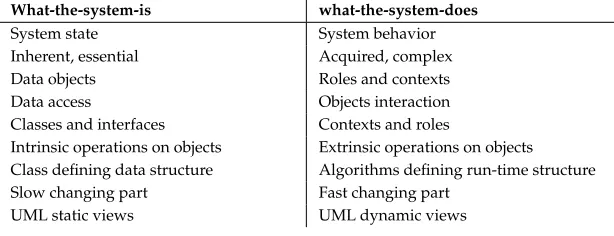
We can see in Table3.1the main separation DCI paradigm proposes. This division is just a general reference to know what can be included in these partitions, this is not a blunt division or a strict rule to follow. This division is based on an strong idea about parts that change at different rates. It represents the separation in the highest level of abstraction in a DCI architecture.
What-the-system-is what-the-system-does
System state System behavior
Inherent, essential Acquired, complex
Data objects Roles and contexts
Data access Objects interaction
Classes and interfaces Contexts and roles
Intrinsic operations on objects Extrinsic operations on objects Class defining data structure Algorithms defining run-time structure Slow changing part Fast changing part
UML static views UML dynamic views
TABLE3.1: DCI main separation.
3.3
What the system does
The services that the system provides to the end user and all the interactions that hap-pen is what the system does in order to accomplish its purpose. We are not referencing here the intrinsic capabilities of data objects, withwhat-the-system-doeswe are focused
2Coplien usually references asdumb objects to objects that are only responsible for its own data to
[image:27.612.167.474.432.550.2]Chapter 3. Data, contexts, and interactions 17
in the relation between objects and theirs interactions, this is the collaborating network of objects toward achieving a system goal. What the system does is described in the roles, this behavior does not belong to any object until the moment of executing a use case or context. The services the system provides are implemented in the roles envi-sioned by the end users to name the domain objects. Roles are used to give a name and meaning to domain objects when interacting with other objects. With roles the end user abstracts the unneeded behavior for specific services to emphasize only the important aspects for the function being performed. The end user names domain objects with the role they need to play in order to deliver a service. These system services change at human scale according to business needs. What the system does is related to“the tasks the system carries out for users and the way those tasks are structured"(Coplien and Bjørn-vig,2011, p. 32). The structure is declared or designed in the source code within the roles implementation, and these role are orchestrated in contexts to accomplish some system functionality. The end user’s view of services are key to design what the system does part of a system.
The main elements involved inwhat-the-system-doespart are contexts and roles. To define roles we need the end user’s view of the services that the software is going to provide, these are the use cases in requirement analysis. A use case is a sequence of tasks toward a goal. Use cases define the scope of system functionalities and in a DCI system they are implemented as contexts. The real architecture of a system exists only in run-time and DCI dedicates specific parts of the source code to describe the execution of a system, therefore we are closer to model more accurately the architecture in the code.
3.4
The computational metaphor of theater
Objects are the actors of a series of acts and scenes of a play that represent the use cases and its deviations that finally shape what end users can do with a computer system. The programmer is like the stage manager of the play that writes the lines that cue actors or objects to carry out their parts in specific moments in order to interact with other actors or objects toward the completion of a scene or a system functionality within the entire system. The same play, this is the set of scenes or contexts, can be reinterpreted by different actors or objects over and over again.
There is a strong use of the theater metaphor in trygve language, we can deduce that from the vocabulary used in the DCI paradigm related works, specially in the trygve language manual (Coplien,2016). In DCI thinking, methods are called scripts
Chapter 3. Data, contexts, and interactions 18
specifically in Human-Computer Interaction field. DCI thinking shares the vision em-bodied in the search of a better metaphor for human-computer experiences. End users incrementally build a model of the system’s internal processes based on their own ex-perimentation. This model brings end users expectations into line with the capabilities of the software system (Laurel,1991, p. 30). Laurel explores in her book named Com-puter as theater a deeper vision of the meaning of an interface in general and in the general sense. DCI thinking follows this vision by incorporating the end user’s mental model in the code.
In the history of computer programming, programming languages have departed more and more from the language that machines understand. New languages usually incorporate not only high level constructs that compress lower level chunks of code related to the problem to be solved, but also adds mechanisms useful to communicate the intention of programmers to human beings. The computational metaphor of the-ater pursues, in part, this goal. For example, in a theatrical playcuesare not part of the play, they are part of the script used to produce and reproduce the play multiple times. In a similar manner, we can think cues as not being part of a trygve language program for the computer, they are actually for humans. Humans need these cues to enhance program understanding by expressing better the intention of programmers.
3.5
End user mental model
During the development of a software system there are three generic entities that de-serve a thorough observation to understand what the source code should include. These entities are humans, computers, and programs. They might seem too general entities, but they will help us to realize the reasons why the end user’s mental model, this is his or her vocabulary and thinking, should also be written in the source code text besides just the programmers mental model of the system.
Who deals with the program or source code of a system? Mostly programmers do, but also architects, and less frequently testers, and rarely business people. Who deals with the running system? We cannot deny that most frequently end users do, then testers and also programmers, and often business people too. Then, the question that raises is where the mental model of end users is in the system. We generally find end users mental model in the analysis documents, like in use cases or requirements. If the end user interact with the system most frequently than any other stakeholders, shouldn’t the end user mental model be expressed in the source code too?
Chapter 3. Data, contexts, and interactions 19
FIGURE3.1: Software system entities interactions diagram.
human entity indicating interactions between humans that is missing in the computer entity figure.
From a general point of view, DCI is about aligning the end user’s mental model with the programmer’s mental model. “For a smooth interaction between man and machine, the computer’s "mental" model (also the programmer’s mental model) and the end user’s mental model must align with each other in kind of mind-meld. In the end, any work that users do on their side of the interface manipulates the objects in the code. If the program provides accurate real-time feedback about how user ma-nipulations affect program state, it reduces user errors and surprises” (Reenskaug and Coplien,2009b). It means that, as end users deals, or will deal, with the actual system (i.e. they only interact with the system on execution or running system) the description of the run-time should be clearly expressed from their perspective to avoid surprises later. End users describe use cases with their own vocabulary where nouns are roles that give different meanings to domain objects in different contexts, therefore use cases should be written in the source code.
3.6
The trygve language
From a naive view oftrygvewe may consider this language a slightly variation ofjava
Chapter 3. Data, contexts, and interactions 20
examine the DCI paradigm and it is open-sourced in github3. “The trygve language is designed to reduce the transition from run-time to scripting and back again” (Coplien, 2016). We have the structure of the behavior or run-time written inside contexts in the roles that objects will play, and the structure of the state or data in classes and inter-faces. Trygve language has the following general characteristics:
• Trygve is built upon java VM and shares most of the java syntax.
• Nofriend,static,super,protectedkeywords exists to avoid class-oriented programming.
• Only one value:null.
• Semicolons are optional;
• Method declarations can beconstto create read-only methods.
Regarding the type checking system, the new language trygve is a strongly typed language. It is strongly type-checked at run-time, and roles types are duck-typed. In trygve there is no exception handling mechanism, no RTTI (Run-Time Type Informa-tion), and no concurrency. The trygve language strive for stateless computation within roles scripts and has a strong focus in avoiding class programming. In trygve we will find only declarations and expressions, the DCI community that is designing the lan-guage choose to leave no room for statements. An expression is evaluated as the value of the last expression executed. For example, an if-else is usually an statement in many languages, but as we can see in Listing3.14we can return the last executed expression in an if-else structure, in that way we can get rid of intermediate identifiers necessary otherwise to hold those values. Classes and contexts are declarations that can contain other declarations as nested declarations, and method and roles are also declarations but they cannot contain inner declarations.
1 int fact(int n) {
2 return if (n <= 1) 1 else n * fact(n-1)
3 }
LISTING3.1: If-else as an expression.
3Rich information about trygve language can be found in https://github.com/jcoplien/
trygve.
4Example taken from ACCU 2016 conference from the presentation ‘Aglimpse of trygve: From
Chapter 3. Data, contexts, and interactions 21
3.6.1 Trygve program structure
In Listing 3.2 we show a general program structure that a trygve program usually follows. From line 1 to line 6 we have an interface and a class declarations. Interfaces and classes remain similar to java but with paradigmatic differences, for example, in classes will not appear complex code describing the interaction between objects.
1 interface Interface {
2 // interface definition
3 }
4 class Class {
5 // class definition
6 }
7 context Context { 8 role Role {
9 public void starts() {
10 // execution description
11 }
12 // more role methods
13 } requires {
14 // list of role-player object’s method signatures
15 } 16
17 public Context(Role o) { 18 Role = o
19 }
20 public void trigger() { 21 Role.starts
22 } 23 } 24 {
25 Class object = new Class()
26 new Context(object).trigger() 27 }
LISTING3.2: Trygve general program structure.
Chapter 3. Data, contexts, and interactions 22
where dumb objects are assigned a role to become smart role-player objects. A context usually has one or more trigger methods to start the use case as shown in line 20 to 22. A trygve program is not complete without an enactment block, from line 22 to 25 is declared the enactment bloc where objects are instantiated from classes, and context are created to be triggered. After the execution of a context, the objects that has played a role in it become to its original behavioral form as before being assigned a role.
3.6.2 Classes and interfaces
Today, most object systems express and organize concepts closer to the program data model than to its process or behavioral model (Coplien and Reenskaug,2012). Trygve programmers have similar intentions in mind when using a class (i.e. to represent a domain concept) or an interface (i.e. to approach different domain objects) than in java, but, in trygve, classes won’t contain complex computation between objects, and interfaces will be used to organize the structure of aggregated objects in classes. Thus, classes describe simple or dumb objects, and classes and interfaces together define the form of the data.
3.6.3 Contexts and roles
A context is a use case in code, and roles are the behavior to be attached to objects during the execution of the use case. Contexts are responsible to assign or map roles to objects and to define the triggers that run a use case. Within roles is specified the net-work of collaborating object that pushes toward a goal or use case completion. In other words, in a context we are describing the structure of the run-time for the execution of a system functionality.
Passing different objects that are capable of playing the specified roles declared in a context allows programmers to maintain the structure of a system execution and change the way data is accessed. This is where polymorphism resides in DCI , where different types of objects can play a role within a context in different executions. This does not disrupt the main use case execution flow as dynamic polymorphism does in classical OO, the structure of the execution remains the same, it only changes how data is accessed. As long as objects that play roles can satisfy the requires clause, we are accessing different data with the same run-time structure defined in contexts.
Chapter 3. Data, contexts, and interactions 23
3.6.4 Code example explained
The following code example is presented from Listing3.3to Listing3.8and it is about a clock timer and two type of clocks (digital and analog) to show the hour based on the timer5. The system functionality of moving time (context) creates a network of interacting objects to keep the timer moving and the clocks printing the hours. The digital and analog clock types are described by simple classes that implements the
Clock interface. This interface helps to organize the types of clocks as clocks that their hour can be updated. The ClockTimer class declares a timer for objects that maintain their own states, these are the data for hours, minutes, and seconds. The only system functionality of this small example is declared in the contextMoveTimethat moves times and makes the clocks show the hours. The interaction between objects is described within roles where the timer interacts with the clocks, the clocks get updated, and the timer keeps moving. To start this system functionality we need to instantiate the context as a regular object and run the use case, this happens in the enactment block shown in Listing3.8.
1 interface Clock {
2 public void update(Clocktimer timer) const; 3 }
LISTING3.3: Clock Interface.
The interface shown in Listing 3.3 is required to structure the data used within a generic list of different clocks as shown in line 5 in Listing3.8.
1 class DigitalClock implements Clock {
2 public void update(Clocktimer timer) const {
3 System.out.println("[" + timer.getHour().toString() +
4 ":" + timer.getMinute().toString() +
5 ":" + timer.getSecond().toString() + "]");
6 } 7 }
LISTING3.4: Digital clock class.
1 class AnalogClock implements Clock {
2 public void update(Clocktimer timer) const {
3 System.out.println("{" + timer.getHour().toString() +
4 "|" + timer.getMinute().toString() +
5 "|" + timer.getSecond().toString() + "}");
6 } 7 }
LISTING3.5: Analog clock class.
Chapter 3. Data, contexts, and interactions 24
Listings 3.4and3.5are straightforward classes that define objects to represent the analog and digital clocks. It has only one method and it does not modifies the state of the instance. The methodupdateis post-fixed by aconstto prevent this method from changing the state of the object.
1 class Clocktimer { 2 private int hour; 3 private int minute;
4 private int second;
5
6 public Clocktimer() { 7 hour = 0;
8 minute = 0; 9 second = 0; 10 }
11 public int getHour() const { return hour; }
12 public int getMinute() const { return minute; } 13 public int getSecond() const { return second; } 14 public Clocktimer getTimer() const { return this; } 15 public void tick() {
16 incrementSecond(); 17 }
18 private void incrementSecond() {
19 second++;
20 if(second == 60) { 21 second = 0;
22 incrementMinute(); 23 }
24 }
25 private void incrementMinute() {
26 minute++;
27 if(minute == 60) { 28 minute = 0; 29 incrementHour(); 30 }
31 }
32 private void incrementHour() {
33 hour++;
34 if(hour == 24) { 35 hour = 0; 36 }
37 } 38 }
LISTING3.6: Clock timer class.
Chapter 3. Data, contexts, and interactions 25
second. The state of a new brand object of typeClockTimeris set in the constructor defined in lines 6 to 10 that sets the hour, minute, and second to zero. Simple accessors are declared from lines 11 to 14, where theconstkeyword specifies them as read-only methods, meaning that when any of these method are invoked the object that receives the message won’t change its state. From line 15 to 37 are declared mutator methods, one public method that unchains the remaining private methods. All method in the
ClockTimer class are instance methods, remember that there is no class method or static keyword in trygve. Furthermore, this methods are intended to only modifies the data on the same instance. There is no complex object interactions within a class declaration in a DCI system, class declares simple data objects with intrinsic behavior capable to access only to its own data.
1 context MoveTime {
2 public MoveTime(Timer timer, List<Clock> clocks) {
3 Timer = timer;
4 Clocks = clocks; 5 }
6 public void run() { 7 Timer.moves_time(); 8 }
9 role Timer {
10 public void moves_time() {
11 tick();
12 Clocks[0].updates_state(); 13 Thread.sleep(1000);
14 Timer.moves_time; 15 }
16 public Clocktimer gets_timer() {
17 return getTimer();
18 }
19 } requires {
20 public Clocktimer getTimer() const;
21 public void tick();
22 }
23 stageprop [] Clocks {
24 public void updates_state() {
25 Clocks[index].update(Timer.gets_timer());
26 if (index < lastIndex) Clocks[index + 1].updates_state(); 27 }
28 } requires {
29 public void update(Clocktimer theChangedSubject) const; 30 }
31 }
Chapter 3. Data, contexts, and interactions 26
Listing3.7shows the unique context in this simple trygve example. In the construc-tor (lines 2 to 5) the objects passed as parameters get assigned a role, this is where ob-jects become role-player. In this case aClockTimertype object get assigned aTimer
role and aList<Clock>type object get assigned the role vectorClocks. We can use a role type instead of a class type as a parameter in a method signature, as in line 2 with first argument. In this case we use the Timerrole type instead of a class type, this is known as duck typing. It meas that the objecttimershould meet the contract established in therequiresclause ofTimerrole (lines 19 to 22). A duck type relies on what the object can do instead of what type the object should be. In our exam-ple, the object timer should implement getTimer() andtick()methods. If we see where the instantiation of theMoveTimecontext happened (Listing3.8line 7), we see that the object passed as first parameter is of typeClocktTimerthat implements both methods stated in the role’s requires clause. We can also see the assignment of the
List<Clock>object to the roleClocksas a duck type but with the object argument depending on a class type.
There are two types of roles declared insideMoveTimecontext:TimerandClocks. Roles cannot exist outside contexts, they only make sense inside contexts. First, you should note that astagepropis a role that itsrequiresclause only containsconst
methods, meaning that its role-player object won’t change state during the context ex-ecution. On the other hand, a role declared using the keyword role contains in its requires clause at least one method that mutates the state of the role-player object.
Another thing to note in Listing3.7regarding role declarations is that thestageprop
role is a role vector. A role vector is used to specify the same role for a collection of objects, in our case theDigitalClockandAnalogClockobjects. A role vector de-clares theindexandlastIndexkeywords to be used in its body as we use in lines 25 and 26.
1 {
2 Clocktimer clockTimer = new Clocktimer(); 3 Clock dc = new DigitalClock();
4 Clock ac = new AnalogClock();
5 List<Clock> clocks = new List<Clock>(); 6 clocks.add(dc); clocks.add(ac);
7 MoveTime tt = new MoveTime(clockTimer, clocks);
8 tt.run(); 9 }
LISTING3.8: Enactment.
Chapter 3. Data, contexts, and interactions 27
role-player object to update their states (line 25). As this is a role vector we can deduce that each clock object in turn interacts with theTimerrole-player object.
Finally, in Listing 3.8 is the enactment block for the system example where the context get instantiated in line 7 and then get triggered in 8. Enactment block are simple piece of code that deploy the complexity of the system.
28
Chapter 4
Related work
4.1
Program comprehension experimentation
Research works like (Sjøberg et al.,2005) and (Falcao et al.,2015) are useful to have an overview of the existent researches related to controlled experiments in software engi-neering in general and program comprehension in particular. Both research works im-plement a systematic literature review and report data of experimental research works done in the spam of time that goes from 1993 to 2013. In (Sjøberg et al.,2005) authors selected 103 articles that report controlled experiments with human subjects from years 1993 to 2002, this represents 1.9% of all published articles in 12 leading journals authors looked at. They used IEEE keyword taxonomy and found that 2.9% of researches were related to experiments with programming paradigm and also 2.9% for software psy-chology1. Students were used as participant in 81% of the cases. Authors remark that using students as subjects may reduce experimental realism, but it may still be useful for testing novel approaches and initial hypotheses. In (Falcao et al., 2015), a short systematic review report that used data from (Borges et al.,2015), authors looked also at controlled experiment with human subjects and found 135 articles from years 2003 to 2013, that represents a 15% of total articles reviewed, but they don’t detail whether the experiment was related to program comprehension or not. Their results show that subjects involved in experiments were recruited mostly by convenience, 78.2% were students. Participation were mandatory in 20% of the experiments, 31% voluntary, 53% unclear stated. In our case participation is voluntary and we use a convenience sample of students from our Universities and professionals from former colleagues connections. Running controlled experiments using human subject in the field of pro-gram comprehension is not the most common type of experiment, but we realized that experimenting with human subject seems to be a reasonable approach given that Soft-ware Engineering encompasses a set of activities with a strong load on social aspects (Juristo and Moreno,2013, p. 26).
Chapter 4. Related work 29
With the arrival and the stay of object-oriented paradigm and the appearance of object-oriented languages, new experiments emerged to measure their benefits or to be compared with existent procedural or functional languages. This is the case of (Lee and Pennington,1994) where authors investigate how procedural and object-oriented paradigms differed in practice. Their research is motivated by the inconvenience found when switching from procedural to object-oriented design, as well as the difficulties to learn the OO paradigm for expert procedural designers. Through an experiment in-volving a design exercise with 10 designers (3 procedural experts, 4 OO experts, and 3 OO novices that were procedural experts), authors analyze the differences through nine categories of design activities. They used think out loud verbal protocol with a dual purpose, to track the progression of design activities by annotating each action the designers took, and to find design activity categories. Authors have measured the amount of time devoted to each category to conclude about which paradigm may favor which category. They have also reviewed the resulting design solutions, and they have run three trials to measure the effect of learning on subjects. Even though they have a low statistical power because of the small amount of subjects involved in the exper-iment (3 procedural experts, 4 OO experts, and 3 OO novices), their research resulted interesting for us regarding the theories or assumptions they were testing. Consid-ering expertise, they have found that procedural subjects spent more time analyzing the problem than solving it, OO subject spent more time describing data abstractions (classes-objects) and also evaluating their design. Regarding design results, procedural designers got more variation on their design solutions, whereas OO design solutions matched across designers in terms of class definition and its relationships. In our ex-periment, subjects are not asked to produce a design solutions or modify code, we are interested in measure the comprehension of source code only by reading. When pro-ducing code by writing or modifying it, design skills are involved, and develop these skills for a novel paradigm, like DCI, would take more time than just learn to read and comprehend code.
Chapter 4. Related work 30
not correspond to single program units. The complex plan which realizes one goal is usually a delocalized plan in an OO program” (Burkhardt, Détienne, and Wiedenbeck, 1997). This definition of delocalized plan is what we know as a system functionality, that DCI proponents claims to represent a problem in OO systems regarding program comprehension. In DCI, a system function directly corresponds to a specific location in the source code where thecontextis defined. Burkhardt et al. evaluated the validity of the cognitive distinction of program model and situation model finding that this distin-tion is still valid in OO programmers. They found that the “situadistin-tion model (or domain model) is more fully developed using the OO paradigm even on early phase of com-prehension”. This contrasts Pennington’s findings in procedural paradigm for smaller programs where she stated that first it was develop a program model and just after that the domain model. Our research is not as ambitious as theirs, we have a smaller scope, we are not creating a general comprehension model neither evaluating one for DCI. We are evaluating the paradigm-language factor being OO or DCI and how it affects comprehension in terms of time, correctness, and focus of attention. Even though, the literature reviewed on this topic is useful for our research work in terms of what was understood by object orientation and how the experiments approached this and other paradigms.
An empirical study about source code comprehension done by (Salvaneschi et al., 2014) to compare Reactive Programming and Object-Oriented Programming is closer to our purposes. We are going to do a similar work but focused in system function-alities instead of the reactive part of applications. The research approach used by the authors is useful regarding the experiment design and methodology. They recruited 38 subjects and made 2 groups, the OO group with 20 programmers and the RP with 18 programmers. The tasks proposed for their experiment only involve code inspection, they did not included code-writing tasks because they consider a different factor to be measured. A first approach for our experiment would have included tasks where subject should modify and change the source code, but we were not able to give an appropriate training to reach the necessary level of paradigm adoption. Besides, we agree with Salvaneschi et al. in considering that code intervention requires different skills than code comprehension.
Chapter 4. Related work 31
to compare paradigms or languages exclusively, and others to test specific techniques. Our research is comparative in nature and simple in terms of the experimental design, but also most effective in terms of the resulted data. The complexity of these kind of empirical researches resides in the interpretation of the results and in the management of all possible threats to validity. In Table4.1we show a summary of all experiments with human subjects we have reviewed. The objective column explains which goals were primarily addressed. Withmental modelwe refer those experiments in which the objectives were to evaluate or develop a mental model of programmers using differ-ent kind of paradigms or languages, we have classified asexpertise those works were researchers compare how previous knowledge affect comprehension, we use the word
phaseto indicate experiments that are longitudinal and involve more that one trial to measure the learning effect over time, with task we refer to studies that investigate the effects of different tasks in the comprehension process, and we useparadigm-lang
to identify research works that tried to find a better suited paradigm or language for program comprehension in general or for specific factors. Ours is on the last category and is similar to (Salvaneschi et al.,2014), (Walker, Baniassad, and Murphy,1999), and (Wiedenbeck et al.,1999). Other researches are still handy regarding the experience of carrying out an experiment. What differentiates our work is that we are also measuring the focus of attention regarding the source code, the type of task, and the paradigm, i.e a result of the programmer’s behavior during the process of program comprehension. A common measure in program comprehension in all research works is time, even thought it is used in different ways, e.g. with upper limit or unlimited time. It seems an implicit agreement and common sense that less time to comprehend means easy understandability. But, of course time is used along together some measure of correct-ness. We use