Open Access
Study protocol
Can an EASYcare based dementia training programme improve
diagnostic assessment and management of dementia by general
practitioners and primary care nurses? The design of a randomised
controlled trial
M Perry*
1, I Draškovi
ć
2, T van Achterberg
2, GF Borm
3, MIJ van Eijken
2,
PL Lucassen
4, MJFJ Vernooij-Dassen
2and MGM Olde Rikkert
1Address: 1Department of Geriatric Medicine of Radboud University; Nijmegen Medical Centre, Nijmegen, The Netherlands, 2Centre for Quality of
Care Research; of Radboud University; Nijmegen Medical Centre, Nijmegen, The Netherlands, 3Department of Epidemiology and Biostatistics;
Radboud University; Nijmegen Medical Centre, Nijmegen, The Netherlands and 4Department of General Practice, of Radboud University;
Nijmegen Medical Centre, Nijmegen, The Netherlands
Email: M Perry* - [email protected]; I Drašković- [email protected]; T van Achterberg - [email protected]; GF Borm - [email protected]; MIJ van Eijken - [email protected]; PL Lucassen - [email protected]; MJFJ Vernooij-Dassen - [email protected]; MGM Olde Rikkert - [email protected]
* Corresponding author
Abstract
Background: Early diagnosis of dementia benefits both patient and caregiver. Nevertheless, dementia in primary care is currently under-diagnosed. Some educational interventions developed to improve dementia diagnosis and management were successful in increasing the number of dementia diagnoses and in changing attitudes and knowledge of health care staff. However, none of these interventions focussed on collaboration between GPs and nurses in dementia care. We developed an EASYcare-based Dementia Training Program (DTP) aimed at stimulating collaboration in dementia primary care. We expect this program to increase the number of cognitive assessments and dementia diagnoses and to improve attitudes and knowledge of GPs and nurses.
Methods: The DTP is a complex educational intervention that consists of two workshops, a coaching program, access to an internet forum, and a Computerized Clinical Decision Support System on dementia diagnostics. One hundred duos of GPs and nurses will be recruited, from which 2/3 will be allocated to the intervention group and 1/3 to the control group. The effects of implementation of the DTP will be studied in a cluster-randomised controlled trial. Primary outcomes will be the number of cognitive assessments and dementia diagnoses in a period of 9 months following workshop participation. Secondary outcomes are measured on GP and nurse level: adherence to national guidelines for dementia, attitude, confidence and knowledge regarding dementia diagnosis and management; on patient level: number of emergency calls, visits and consultations and patient satisfaction; and on caregiver level: informal caregiver burden and satisfaction. Data will be collected from GPs' electronic medical records, self-registration forms and questionnaires. Statistical analysis will be performed using the MANOVA-method. Also, exploratory analyses will be performed, in order to gain insight into barriers and facilitators for
Published: 2 April 2008
BMC Health Services Research 2008, 8:71 doi:10.1186/1472-6963-8-71
Received: 20 December 2007 Accepted: 2 April 2008
This article is available from: http://www.biomedcentral.com/1472-6963/8/71
© 2008 Perry et al; licensee BioMed Central Ltd.
implementation and the possible causal relations between the rate of success of the intervention components and the outcomes.
Discussion: We developed multifaceted dementia training programme. Novelties in this programme are the training in fixed collaborative duos and the inclusion of an individual coaching program. The intervention is designed according to international guidelines and educational standards. Exploratory analysis will reveal its successful elements. Selection bias and contamination may be threats to the reliability of future results of this trial. Nevertheless, the results of this trial may provide useful information for policy makers and developers of continuing medical education.
Trial registration: ClinicalTrials.gov ID NCT00459784
Background
Diagnosing dementia in primary care
Dementia is an increasing challenge for health care and social systems in developed countries. In Europe, 6.4% of the elderly over 65 years suffer from dementia, with an increase from 0.8% in the group aged 65–69 years to 28.5% at age 90 years and older. The total number of dementia patients in Europe is expected to increase from 7 million in 2000 to over 16 million in 2050 [1]. Cur-rently, dementia seems to be under-diagnosed [2-4]. More than 50% of dementia patients living in the community have not been diagnosed by a GP or specialist [5,6]. In the Netherlands, detection of dementia takes place around one year before admission to a nursing home and three years before death [7], which is rather late.
Early diagnostic evaluation of patients possibly suffering from dementia is beneficial for both patient and caregiver. Reversible causes of dementia will be identified and treated timely. Formal disclosure of dementia diagnosis allows patients and carers to make future plans and pro-vides early access to support services [8]. These actions may prevent or decrease psychological distress in patients [9]. Early education and support for caregivers facilitates adjustment over a longer period of time; it prevents crisis situations and delays nursing home admissions [10,11]. Non-pharmacological interventions, such as psychosocial interventions (10;11) and occupational therapy [12], have been shown to play a key role in dementia manage-ment. Pharmacological treatment may primarily be bene-ficial when started in the early stages of dementia. However, drugs that are currently available have only moderate effect on cognitive symptoms and ADL [13]. In the near future, disease-modifying drugs might become available since they are already subject to phase two and three trials.
Despite the acknowledged benefits of early diagnosis of dementia, both patients and doctors are reluctant to initi-ate cognitive assessment. Patient-reliniti-ated delay in early rec-ognition of dementia is often caused by lack of insight into their condition, their view of memory loss symptoms
as being normal for their age and fear of the negative con-sequences of dementia diagnosis [4]. GPs report that their own lack of knowledge and skills in diagnosing and treat-ing dementia prevents them from starttreat-ing diagnostic work-up in the early stages of dementia [14]. Other GP-related barriers include the absence of clear diagnostic guidelines and reliable, user-friendly screening tools, lack of time, of financial reward, of adequate resources such as access to neuropsychological consultations and neuro-imaging investigations, and lack of prescription right for cholinesterase inhibitors [15]. Thus, many GPs are scepti-cal about the benefits of early diagnosis, because they feel they have little to offer dementia patients and their car-egivers [14,16,17]. Moreover, disclosure of diagnosis is considered to be difficult, because it may negatively influ-ence patient-doctor relationships and take away patients' and caregivers' hopes [18,19]. GPs also fear the risk of diagnostic errors. Evidence of under-recognition of dementia has also been shown in primary care nurses for similar reasons [20]. Also, collaboration between primary care nurses and GPs is not very well developed, although dementia diagnosis and management may profit from it. This lack of collaboration is caused by conflicting expecta-tions, domain discussions and poor coordination of care [21].
Developing a Dementia Training Program (DTP) for primary care providers
ses-sions, a Computerized Clinical Decision Support system (CDSS) [27], and internet support [28,29].
The educational programs in the studies discussed above primarily focused on GPs. However, dementia care man-agement performed by collaborative interdisciplinary teams was found to be more effective in improving the quality of care than that performed either by GPs or pri-mary care nurses [31]. Therefore, we designed a Dementia Training Program (DTP) for collaborative duos of GPs and primary care nurses, focused on teaching them how to share tasks in early diagnosis and management of demen-tia. Another unique component of our DTP is individual coaching, which has shown promising results in modify-ing behaviour of health professionals [32]. Furthermore, our Dementia Training Program is a multifaceted program [33] and consists, in addition to individual coaching, of two small-group interactive workshops [34,35] and a Computerized Clinical Decision Support System.
Objectives
The objective of this paper is to describe the design of a randomised controlled intervention study, aimed at deter-mining the effectiveness of a multifaceted Dementia Training Program (DTP) for general practitioners and pri-mary care nurses, based on current national guidelines. We expect the DTP to improve professional performance in dementia diagnostics and disease management and GPs' and nurses' attitudes and knowledge regarding dementia.
Methods
Study design and setting
This study is an outcome assessor-blinded randomised controlled trial. A cluster-randomised design will be used to compare duos of GPs and nurses (Figure 1).
Study population
We plan to recruit 100 duos of GPs and practice or district nurses in the province of Gelderland, the Netherlands. We will approach all general practitioners in this province by mail and ask them to participate in the study. Participat-ing GPs may choose to cooperate with their own practice nurse or with a district nurse. All GPs and affiliated nurses within the county are eligible for this study.
Frail elderly people, suspected of suffering from cognitive problems are the target group to be diagnosed and treated according to Dutch dementia guidelines. [22,25]. From this target group additional data on satisfaction and infor-mal carer burden will be obtained. Informed consent will be obtained from patients and from their legal represent-atives. The Local Medical Ethical Committee, Commissie Mensgebonden Onderzoek Regio Arnhem – Nijmegen, concluded that this study did not include experiments
with patients and therefore did not need to be tested for approval.
Bias control and randomisation
Randomisation will take place after measurement of base-line data. Duos of GPs and nurses will be randomly allo-cated to one of the two conditions: 1. Dementia Training Program (DTP) and 2. no training at all; control group. (Figure 1). Randomization will be concealed; a person who is not responsible for recruiting subjects and has no knowledge of the study conduct will perform it on a com-puter.
Cluster-randomisation will be performed in order to avoid contamination by the effects of possible exchange of information within a cluster. A cluster was defined as all GPs working in the same practice or as all GPs working together with the same nurse.
In order to assure an equal distribution of baseline char-acteristics, duos will be randomised with adaptive weights regarding cluster size (one vs. more than one GP), age, sex, high or low percentage of elderly patients in practice (< or > 15%), practice location (rural or urban area) and nurse affiliation (district or practice).
Adherence to guidelines will be assessed by two inde-pendent researchers. In order to exclude the possibility of detection bias, these researchers will be blinded to the outcome of randomization.
Intervention: Dementia Training Program (DTP)
DTP consists of two workshops and an individual coach-ing programme, includcoach-ing case-based consultation either by phone or by e-mail. Participants have access to an internet forum for discussion with colleagues, additional literature and individual training on dementia diagnosis and management. A Computerised Clinical Decision Sup-port System on dementia diagnostics and management will be available to support GPs in decision making in daily practice. The content of the DTP and the CDSS is based on the recently published, evidence-based Demen-tia Guideline for Primary Care [36]. The DTP is graphi-cally presented in Figure 2[37].
Methods used in the DTP to stimulate collaboration between GPs and nurses are the following:
2. Collaboration and training in fixed duos.
3. Training in collaborative workout of a dementia case assignment.
4. Presentation and discussion of 'task sharing' between GPs and nurses in dementia diagnostics and manage-ment.
5. Availability of a Dementia Guideline for Primary Care, which has exclusively been written for this project, based on evidence-based Dutch guidelines [22,25] and recent studies investigating the diagnosis and management of dementia in primary care. This Dementia Guideline for Primary Care contains a flow chart and recommendations
regarding 'task sharing' and consultation moments between GPs and nurses.
Workshops
Two workshops were developed according to approved educational standards [38]. The first workshop was designed for both GPs and nurses to train collaboration in diagnosis and management of dementia. During the sec-ond workshop, nurses and GPs will be educated sepa-rately. The second workshop for GPs focuses on dementia diagnostics and pharmacological options, while the sec-ond workshop for nurses concentrates on dementia care issues.
Procedure of recruitment and randomization Figure 1
Procedure of recruitment and randomization.
Refusers and non-responders
1169 GPs invited by mail for participation with their practice nurse or district nurse
Cluster randomization and minimisation on GP level
Intervention group (65) DTP
Control group (35) No tr aining Baseline measurements
Questionnaire knowledge and attitude
9 months follow up and data collection
DTP 100 duos of GPs and nur ses
Case-based coaching program
After attending to the workshops, GPs and nurses will select eligible patients in their own practices during the following 9 months. GPs and nurses will be coached in their performance of these patients' assessments. Three geriatric nurses will coach the participating nurses; a trained GP specialized in geriatrics will coach the partici-pating GPs. Coaching will be performed by telephone. The coaching program is divided into two phases; in phase 1 the participants will be intensively supervised, whereas phase 2 is demand led. To gain insight into the exact content of the coaching program, coaches will keep diaries of their own performances.
Phase 1 Nurses
The first patient assessment will be discussed with a coach directly before and after completing the assessment. The second patient assessment will be performed with coach-ing directly afterwards. The third patient assessment will be performed without direct coaching. Diagnostic
work-up and management of the first, second and third patient will be discussed with one of the coaches six weeks and three months after the nurse completed the assessment.
GPs
GPs will perform the assessment of the first, second and third patient on their own. Diagnostic work-up and man-agement of the first, second and third patient will be dis-cussed with the coach six weeks and 3 months after the GP completed the assessment.
Phase 2
After their participation in the workshops, and evaluation of the diagnostic work-up and management of the first three patients, GPs and nurses are expected to have been sufficiently trained to perform diagnosis and manage-ment adequately on their own. For questions during this phase, nurses and GPs will have the possibility to consult the coaches by telephone and e-mail.
Graphical depiction of the interventions of this trial on improving primary dementia care Figure 2
Graphical depiction of the interventions of this trial on improving primary dementia care. a) Dutch Dementia Guidelines for general practitioners and for community nurses. b) Workshop on dementia diagnosis and management for GPs and nurses as a duo. c) Coaching of GPs and nurses on dementia diagnostics and management in daily practice according to national guidelines and using the EASYcare assessment. d)e) Usual dementia care performed by GPs without coaching. f) Avail-ability internet forum for patient questionnaires (MMSE, GDS, EASYcare assessment), discussion with colleagues, additional lit-erature. g) Availability Computerised Clinical Decision Support System on dementia diagnosis.
Time line
DTP
Contr ol
Randomisation
Baseline
a
a
b
c
During 9 months from
baseline
9 months
Measurements of outcomes
d
f
e
Computerized Clinical Decision Support System (CDSS)
A CDSS is an information system designed to improve clinical decision making by using reminders [39]. Turner et al. developed and tested a CDSS especially for dementia diagnosis and management in primary care [40]. The use of this tool increased the number of dementia diagnoses reported in general practice. There was no evidence of improvement in adherence to dementia quality indicators [27]. The CCDS in the DTP has been developed for the purpose of this study. The content is based on the Demen-tia Guideline for Primary Care and the summarizing flow chart. It is a pro-active computer programme, which sup-ports dementia decision making in diagnostic work-up.
Control group
Duos in the control group will not receive the training during the trial. They will, however, be given the opportu-nity to attend to the DTP after the trial. This means that duos in the control group will enter the DTP with a 9 months' delay.
Outcome measures and data collection
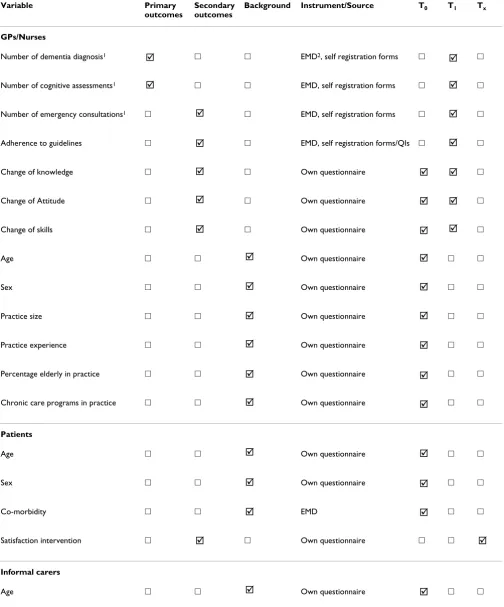
Primary outcome measures are the numbers of cognitive assessments and dementia diagnoses over a period of nine months, which will be measured at baseline (T0) and nine months later, at the end of the study (T1). Secondary out-comes are GPs' and nurses' attitude, confidence and knowledge regarding dementia diagnosis and manage-ment, which will be measured at baseline (T0) and nine months later, at the end of the study (T1). Other second-ary outcomes are the rate of adherence to national guide-lines for dementia diagnosis and management, patient satisfaction, informal carer burden and satisfaction, number of emergency calls, visits and consultations. Base-line demographic characteristics collected from GPs and nurses are: age, sex, practice experience, practice size, per-centage of elderly people > 65 years and the availability of chronic disease management programs in practice. Base-line demographic characteristics collected from patients and their informal caregivers are: age, sex and co-morbid-ity (Table 1).
Data on adherence to national guidelines, the number of emergency situations and the number of cognitive assess-ments and dementia diagnoses will be retrieved from GPs' Electronic Medical Records (EMD), from interviews with GPs and nurses and from self registration forms [41]. Self-made questionnaires will provide information on base-line characteristics, on data on GPs' and nurses' attitudes, competencies and knowledge regarding dementia diagno-sis and management and on patient and informal carer satisfaction. Burden of informal carers will be assessed using the Short Sense of Competence Questionnaire (SSCQ) [42]. Data on duos' performance during the 'coaching phase' will be included in the analysis.
Sample size calculations
We expected a change in the primary outcome measure of the incidence of dementia diagnoses and cognitive assess-ments from 50% to 65% of the total population of dementia. In previous studies on implementation of sev-eral other guidelines in gensev-eral practice the average change was 10% [43]. However, these implementation studies focused on diseases, to which GPs already showed a high adherence to the guidelines. Because of the low adherence to dementia guidelines we saw more room for improvement and therefore we expected a change of 15% to be realistic. Cluster randomisation was taken into account when we calculated the sample size needed. In this calculation, the ratio between the number of duos in the control group and the number of duos in the interven-tion group was 1:2. Clusters are expected to include 5 patients on average. Intra class correlation (ICC) is expected to be 0.05 or lower. For a power of 0.80, and two-sided testing at 0.05, a total of 91 general practition-ers is required.
Statistical analysis
In addition to a confirmatory analysis using the MANOVA-method, we will also perform an exploratory analysis. The aim of the exploratory analysis is to gain more insight into possible causal relations between the rate of success of the intervention components and the outcomes. Possible mediator variables are change in knowledge, attitudes and collaboration rate. We will design a path-model, specifying hypothesized relations between predictors, mediators, moderators, and effects, and we will test its goodness of fit with the data. In this way we hope to be able to specify the most plausible inter-dependence pattern between the variables used in the present study.
Discussion
Table 1: Outcome measures
Variable Primary outcomes
Secondary outcomes
Background Instrument/Source T0 T1 Tx
GPs/Nurses
Number of dementia diagnosis1 䊐 䊐 EMD2, self registration forms 䊐 䊐
Number of cognitive assessments1 䊐 䊐 EMD, self registration forms 䊐 䊐
Number of emergency consultations1 䊐 䊐 EMD, self registration forms 䊐 䊐
Adherence to guidelines 䊐 䊐 EMD, self registration forms/QIs 䊐 䊐
Change of knowledge 䊐 䊐 Own questionnaire 䊐
Change of Attitude 䊐 䊐 Own questionnaire 䊐
Change of skills 䊐 䊐 Own questionnaire 䊐
Age 䊐 䊐 Own questionnaire 䊐 䊐
Sex 䊐 䊐 Own questionnaire 䊐 䊐
Practice size 䊐 䊐 Own questionnaire 䊐 䊐
Practice experience 䊐 䊐 Own questionnaire 䊐 䊐
Percentage elderly in practice 䊐 䊐 Own questionnaire 䊐 䊐
Chronic care programs in practice 䊐 䊐 Own questionnaire 䊐 䊐
Patients
Age 䊐 䊐 Own questionnaire 䊐 䊐
Sex 䊐 䊐 Own questionnaire 䊐 䊐
Co-morbidity 䊐 䊐 EMD 䊐 䊐
Satisfaction intervention 䊐 䊐 Own questionnaire 䊐 䊐
Informal carers
Age 䊐 䊐 Own questionnaire 䊐 䊐
; ;
; ;
; ;
; ;
; ; ;
; ; ;
; ; ;
; ;
; ;
; ;
; ;
; ;
; ;
; ;
; ;
; ;
; ;
ing. We avoid selection bias by computerized randomiza-tion and minimisarandomiza-tion. Two independent blinded out-come assessors will contribute to overcoming detection bias. In addition to a confirmatory analysis, we will per-form an exploratory analysis. In this way, we can clarify how certain intervention components influence the rate of success and through which pathways.
Below, we describe the design characteristics that may interfere with the reliability and validity of the future results. Firstly, the method of participant recruitment may threat the external validity of the study: GPs and nurses are free to decide whether they want to participate. This may mean that this group of participants is more interested in dementia care than their average colleagues. Therefore, they may be more motivated to learn and perform better than their non-participating colleagues would do after receiving the same training. In addition, they may already be taking better care of dementia patients and their car-egivers than their non-participating colleagues. However, the possible effects of this bias would run counter to our hypotheses by negatively affecting the chances to detect differences between the experimental and the control group. These effects might affect the probability of making a type II error (incorrectly accepting H-0) but they cannot cause the making of a type I error (incorrectly rejecting H-0).
Secondly, we cannot exclude the possibility of contamina-tion arising by chance contacts and possible knowledge exchange between GPs and nurses from different alloca-tion condialloca-tions. We try to overcome this problem by clus-ter randomization: GPs from the same practices and GPs working with the same nurses are allocated to the same group.
Finally, performance bias can occur. GPs and nurses are fully aware of their assignment to either the experimental or the control group. We try to overcome this problem by
reminding participants in the control group every two months of their involvement in the study.
In spite of these elements of bias, the results of this trial may provide useful information for policy makers and developers of continuing medical education. The inter-vention is designed according to recently reported MRC guidelines and educational standards; exploratory analy-sis will reveal its successful elements. In the study design, bias is avoided if possible and still its setting is one of every day practice. Dissemination of the results of this study is planned for 2009.
Competing interests
This study was funded by "Province of Gelderland, The Netherlands" and "ZonMw: The Netherlands Organisa-tion for Health Research and Development." MP and ID were financially supported by the funding bodies. The funding bodies did not play a role in any part of the study. The other author(s) declare that they have no competing interests.
Authors' contributions
MP and ID were responsible for the research question. MP, ID and MOR designed the study. MP was wrote the first draft of the manuscript and was responsible for revi-sions. ID and MOR contributed to the drafting of the manuscript. GB gave advice on the statistical analysis. TA, ME, PL and MVD commented on the design and the man-uscript. All authors read and approved the final manu-script.
References
1. van der Flier WM, Scheltens P: Epidemiology and risk factors of dementia. J Neurol Neurosurg Psychiatry 2005, 76 Suppl 5:v2-v7. 2. Lopponen M, Raiha I, Isoaho R, Vahlberg T, Kivela SL: Diagnosing
cognitive impairment and dementia in primary health care -- a more active approach is needed. Age Ageing 2003, 32:606-612.
3. Olafsdottir M, Skoog I, Marcusson J: Detection of dementia in pri-mary care: the Linkoping study. Dement Geriatr Cogn Disord 2000, 11:223-229.
Sex 䊐 䊐 Own questionnaire 䊐 䊐
Satisfaction intervention 䊐 䊐 Own questionnaire 䊐 䊐
Burden informal caregiver 䊐 䊐 SSCQ3 䊐 䊐
T0 is baseline measurement
T1 is follow up measurement, after 9 months Tx is 3 months after starting each assessment
1 measurement of 'number' during a period of 9 months 2 Electronic Medical Dossier
[image:8.612.55.560.89.185.2]3 Short Sense of Competence Questionnaire
Table 1: Outcome measures (Continued)
; ;
; ;
4. Valcour VG, Masaki KH, Curb JD, Blanchette PL: The detection of dementia in the primary care setting. Arch Intern Med 2000, 160:2964-2968.
5. Boustani M, Peterson B, Hanson L, Harris R, Lohr KN: Screening for dementia in primary care: a summary of the evidence for the U.S. Preventive Services Task Force. Ann Intern Med 2003, 138:927-937.
6. Eefsting JA, Boersma F, van den Brink W, van Tilburg W: Differences in prevalence of dementia based on community survey and general practitioner recognition. Psychol Med 1996, 26:1223-1230.
7. Meerman L, van de Lisdonk EH, Koopmans RT, Zielhuis GA, Olde Rikkert MG: Prognosis and Vascular Co-morbidity in Demen-tia a Historical Cohort Study in General Practice. J Nutr Health Aging 2008, 12:145-150.
8. Derksen E, Vernooij-Dassen M, Gillissen F, Olde RM, Scheltens P: Impact of diagnostic disclosure in dementia on patients and carers: qualitative case series analysis. Aging Ment Health 2006, 10:525-531.
9. Bates J, Boote J, Beverley C: Psychosocial interventions for peo-ple with a milder dementing illness: a systematic review. J Adv Nurs 2004, 45:644-658.
10. Brodaty H, Green A, Koschera A: Meta-analysis of psychosocial interventions for caregivers of people with dementia. J Am Geriatr Soc 2003, 51:657-664.
11. Woods RT, Moniz-Cook E, Iliffe S, Campion P, Vernooij-Dassen M, Zanetti O, Franco M: Dementia: issues in early recognition and intervention in primary care. J R Soc Med 2003, 96:320-324. 12. Graff MJ, Vernooij-Dassen MJ, Thijssen M, Dekker J, Hoefnagels WH,
Rikkert MG: Community based occupational therapy for patients with dementia and their care givers: randomised controlled trial. BMJ 2006, 333:1196.
13. Birks J: Cholinesterase inhibitors for Alzheimer's disease.
Cochrane Database Syst Rev 2006:CD005593.
14. Turner S, Iliffe S, Downs M, Wilcock J, Bryans M, Levin E, Keady J, O'Carroll R: General practitioners' knowledge, confidence and attitudes in the diagnosis and management of dementia.
Age Ageing 2004, 33:461-467.
15. Olafsdottir M, Foldevi M, Marcusson J: Dementia in primary care: why the low detection rate? Scand J Prim Health Care 2001, 19:194-198.
16. Renshaw J, Scurfield P, Cloke L, Orrell M: General practitioners' views on the early diagnosis of dementia. Br J Gen Pract 2001, 51:37-38.
17. Waldorff FB, Moller S: Diagnostic evaluation of dementia in general practice in Denmark. A national survey. Scand J Prim Health Care 2001, 19:117-121.
18. Janson J, Derksen E, Vernooij-Dassen MJFJ, Lucassen P, Olde Rikkert MGM: De huisarts en het meedelen van de diagnose demen-tie: een systematisch literatuuronderzoek. Huisarts Wet 2006, 49 (11):538-543.
19. van Hout H, Vernooij-Dassen M, Bakker K, Blom M, Grol R: General practitioners on dementia: tasks, practices and obstacles.
Patient Educ Couns 2000, 39:219-225.
20. Manthorpe J, Iliffe S, Eden A: Early recognition of dementia by nurses. J Adv Nurs 2003, 44:183-191.
21. Waldorff FB, Bulow LB, Malterud K, Waldemar G: Management of dementia in primary health care: the experiences of collabo-ration between the GP and the district nurse. Fam Pract 2001, 18:549-552.
22. Wind AW, Gussekloo J, Vernooij-Dassen MJFJ, Bouma M, Boomsma LJ, Boukes FS: NHG-Standaard Dementie. Huisarts Wet 2003, 46:754-767.
23. Eccles M, Clarke J, Livingstone M, Freemantle N, Mason J: North of England evidence based guidelines development project: guideline for the primary care management of dementia.
BMJ 1998, 317:802-808.
24. Musicco M, Caltagirone C, Sorbi S, Bonavita V: Italian Neurological Society guidelines for the diagnosis of dementia: revision I.
Neurol Sci 2004, 25:154-182.
25. Boomsma LJ, de Bont M, Engelsman C, Gussekloo J, Hartman C, Per-soon A, Sprey M, Wind AW: Landelijke Eerstelijns Samenwerk-ings Afspraak Dementie. Huisarts Wet 2005, 48 (3):124-126. 26. Waldorff FB, Almind G, Makela M, Moller S, Waldemar G:
Imple-mentation of a clinical dementia guideline. A controlled
study on the effect of a multifaceted strategy. Scand J Prim Health Care 2003, 21:142-147.
27. Downs M, Turner S, Bryans M, Wilcock J, Keady J, Levin E, O'Carroll R, Howie K, Iliffe S: Effectiveness of educational interventions in improving detection and management of dementia in pri-mary care: cluster randomised controlled study. BMJ 2006, 332:692-696.
28. Vickrey BG, Mittman BS, Connor KI, Pearson ML, la Penna RD, Gani-ats TG, Demonte RW Jr., Chodosh J, Cui X, Vassar S, Duan N, Lee M: The effect of a disease management intervention on qual-ity and outcomes of dementia care: a randomized, control-led trial. Ann Intern Med 2006, 145:713-726.
29. Chodosh J, Berry E, Lee M, Connor K, DeMonte R, Ganiats T, Heikoff L, Rubenstein L, Mittman B, Vickrey B: Effect of a dementia care management intervention on primary care provider knowl-edge, attitudes, and perceptions of quality of care. J Am Geriatr Soc 2006, 54:311-317.
30. Milne AJ, Hamilton-West K, Hatzidimitriadou E: GP attitudes to early diagnosis of dementia: evidence of improvement. Aging Ment Health 2005, 9:449-455.
31. Callahan CM, Boustani MA, Unverzagt FW, Austrom MG, Damush TM, Perkins AJ, Fultz BA, Hui SL, Counsell SR, Hendrie HC: Effec-tiveness of collaborative care for older adults with Alzhe-imer disease in primary care: a randomized controlled trial.
JAMA 2006, 295:2148-2157.
32. Thomson O'Brien MA, Oxman AD, Davis DA, Haynes RB, Freeman-tle N, Harvey EL: Educational outreach visits: effects on profes-sional practice and health care outcomes. Cochrane Database Syst Rev 2000:CD000409.
33. Davis DA, Taylor-Vaisey A: Translating guidelines into practice. A systematic review of theoretic concepts, practical experi-ence and research evidexperi-ence in the adoption of clinical prac-tice guidelines. CMAJ 1997, 157:408-416.
34. Davis D, O'Brien MA, Freemantle N, Wolf FM, Mazmanian P, Taylor-Vaisey A: Impact of formal continuing medical education: do conferences, workshops, rounds, and other traditional con-tinuing education activities change physician behavior or health care outcomes? JAMA 1999, 282:867-874.
35. Cauffman JG, Forsyth RA, Clark VA, Foster JP, Martin KJ, Lapsys FX, Davis DA: Randomized controlled trials of continuing medical education: what makes them most effective? J Contin Educ Health Prof 2002, 22:214-221.
36. Perry M, Lenkens M, Theunisse L, Draskovic I, Olde Rikkert MGM: Handleiding dementie. Diagnostiek en behandeling in de eerste lijn. 2006. 37. Perera R, Heneghan C, Yudkin P: Graphical method for depicting randomised trials of complex interventions. BMJ 2007, 334:127-129.
38. Draskovic I, Holdrinet R, Bulte J, van Leeuwe J: Modeling small group learning Instructional Science edition. 2004, 32:447-473.
39. Garg AX, Adhikari NK, McDonald H, Rosas-Arellano MP, Devereaux PJ, Beyene J, Sam J, Haynes RB: Effects of computerized clinical decision support systems on practitioner performance and patient outcomes: a systematic review. JAMA 2005, 293:1223-1238.
40. Turner S, Iliffe S, Downs M, Bryans M, Wilcock J, Austin T: Decision support software for dementia diagnosis and management in primary care: relevance and potential. Aging Ment Health 2003, 7:28-33.
41. Spies TH, Mokkink HG, De Vries Robbe PF, Grol RP: Which data source in clinical performance assessment? A pilot study comparing self-recording with patient records and observa-tion. Int J Qual Health Care 2004, 16:65-72.
42. Vernooij-Dassen, A.Felling, E.Brummelkamp, M.Dautzenberg, Bosch G, R.Grol.: A short sense of competence questionnaire (SSCQ): measuring the caregiver's sense of competence. J Am Geriatr Soc 1999, 47:256-257.
43. Engers AJ, Wensing M, van Tulder MW, Timmermans A, Oostendorp RA, Koes BW, Grol R: Implementation of the Dutch low back pain guideline for general practitioners: a cluster rand-omized controlled trial. Spine 2005, 30:559-600.
Publish with BioMed Central and every scientist can read your work free of charge
"BioMed Central will be the most significant development for disseminating the results of biomedical researc h in our lifetime."
Sir Paul Nurse, Cancer Research UK
Your research papers will be:
available free of charge to the entire biomedical community
peer reviewed and published immediately upon acceptance
cited in PubMed and archived on PubMed Central
yours — you keep the copyright
Submit your manuscript here:
http://www.biomedcentral.com/info/publishing_adv.asp
BioMedcentral
Pre-publication history
The pre-publication history for this paper can be accessed here: