City, University of London Institutional Repository
Citation
: Lorencatto, F., West, R., Seymour, N. and Michie, S. (2013). Developing a
method for specifying the components of behavior change interventions in practice: the example of smoking cessation. Journal of Consulting and Clinical Psychology, 81(3), pp. 528-544. doi: 10.1037/a0032106
This is the unspecified version of the paper.
This version of the publication may differ from the final published
version.
Permanent repository link:
http://openaccess.city.ac.uk/3308/Link to published version
: http://dx.doi.org/10.1037/a0032106
Copyright and reuse:
City Research Online aims to make research
outputs of City, University of London available to a wider audience.
Copyright and Moral Rights remain with the author(s) and/or copyright
holders. URLs from City Research Online may be freely distributed and
linked to.
City Research Online: http://openaccess.city.ac.uk/ [email protected]
1
Developing a method for specifying the components of behaviour change interventions in
practice: the example of smoking cessation
Fabiana Lorencatto, 1, 2
Robert West,3 ,1
Natalie Seymour, 1
& Susan Michie. 2,1
1
NHS Centre for Smoking Cessation and Training, Dept. Clinical Educational & Health Psychology, University College London.
2
Centre for Outcomes Research and Effectiveness, Dept. Clinical Educational & Health Psychology, University College London.
3
CRUK Health Behaviour Research Centre, Dept. Epidemiology & Public Health, University College London.
Author note: Correspondence concerning this article should be addressed to Fabiana Lorencatto at the Dept. of Clinical, Educational, & Health Psychology, University College London, WC1E 7HB, London, UK. Email: [email protected].
This work was supported by a grant awarded to the NHS Centre for Smoking Cessation and Training by the Department of Health (DOH T336/BSS/M award number 49945).
2
ABSTRACT
Objective: There is a difference between interventions as planned and as delivered in practice. Unless we know what was actually delivered, we cannot understand “what worked” in effective interventions. This study aimed to: i) assess whether an established taxonomy of 53 smoking cessation behaviour change techniques (BCTs) may be applied or adapted as a method for reliably specifying the content of smoking cessation behavioural support consultations ii) develop an effective method for training researchers and practitioners in the reliable application of the taxonomy.
Methods: Fifteen transcripts of audio-recorded consultations delivered by English Stop Smoking Services were coded into component BCTs using the taxonomy. Inter-rater reliability and potential adaptations to the taxonomy to improve coding were discussed following three coding waves. A coding training manual was developed through expert consensus and piloted on ten trainees, assessing coding reliability and self-perceived competence before and after training.
Results: An average of 33 BCTs from the taxonomy were identified at least once across sessions and coding waves. Consultations contained on average 12 BCTs (range: 8-31). Average inter-rater reliability was high (88% agreement). The taxonomy was adapted to simplify coding by merging co-occurring BCTs and refining BCT definitions. Coding reliability and self-perceived competence significantly improved post-training for all trainees.
3
Key words: behaviour change, smoking cessation, intervention delivery, fidelity
INTRODUCTION
The effectiveness of a range of interventions in promoting behaviour change in health behaviours, such as physical activity and healthy eating, has been established (Michie, Abraham, Whittington et al., 2009). However, there is limited knowledge as to which intervention components are the ‘active ingredients’ contributing to effective outcomes. Behaviour change
interventions are typically complex in that they are broadly defined and comprise multiple, potentially interacting, component behaviour change techniques (BCTs). Furthermore, limited information is often provided regarding how much of an intervention’s original protocol was
actually delivered by intervention providers. Methods have recently been developed to accurately specify the content of interventions described in treatment protocols and published reports using taxonomies of BCTs. This has been achieved for healthy-eating, physical activity, alcohol use and smoking cessation (Michie, Ashford, Sniehotta, et al. 2011; Michie, Whittington, Hamoudi, et al. 2012; Michie, Hyder, West et al. 2010; Michie, Churchill, West 2011). Yet, methods for specifying the content of interventions as actually delivered in practice are currently lacking. This study sets out to develop such a method in the context of smoking cessation behavioural support interventions.
4
medications and free weekly behavioural support sessions to approximately 800,000 smokers annually. Considerable variation in quit outcomes across individual trials and services exist (Lancaster & Stead, 2009; NHS 2011). Heterogeneity in quit outcomes is likely to be attributable in part to variation in the content of behavioural support provided across individual trials or services. However, due to their complexity, there is limited understanding or clarity as to what the content of currently delivered behavioural support interventions is. Although guidance documents are available outlining the recommended content of behavioural support sessions in terms of specific BCTs (West, McNeil & Raw, 2000), the level of detail and terminology typically used to describe intervention content is often inconsistent (Michie, Fixsen, Eccles et al. 2009). Conversely, biomedical and pharmacological interventions are defined precisely; with the pharmacological composition, dose, frequency of administration and mechanism of action for medications clearly established. Such contrast is of particular relevance to health behaviours such as smoking cessation for which both biomedical (e.g. nicotine replacement therapies) and behavioural interventions (e.g. behavioural support) are available. Unclear descriptions of intervention content limits the ability to replicate and readily implement effective trials in practice, as well as hampering evidence synthesis and the establishment of the causal mechanisms underpinning behaviour change.
5
components. Each BCT is classified hierarchically according to one of four behaviour change functions: 1) boosting motivation; 2) maximising self-regulatory capacity; 3) adjuvant activities; 4) general aspects of the role/interaction. The latter functions were derived from the PRIME theory of motivation and applied to smoking cessation (West, 2009).
The taxonomy has been used as a coding framework for specifying the content of the behavioural support interventions in published trial reports and English NHS Service treatment protocols in terms of component BCTs (Michie et al. 2010; Michie, Churchill, West, 2011; Lorencatto, West, Michie 2012), plus to investigate the association between BCTs in protocols and quit outcomes (West, Walia, Michie et al., 2010). Such efforts represent important first steps towards highlighting the active ingredients comprising behavioural support interventions delivered in both research trials and practice settings, and towards establishing the causal mechanisms underlying intervention outcomes.
Descriptions of intervention content in published trial reports and service protocols represent ‘intended’ or ‘recommended’ practice and may not reflect what was actually done in the
6
enhance susceptibility to inconsistencies in delivery and the likelihood of key intervention components being modified or omitted (Mihalic, 2001).
Methods for describing the content of interventions as delivered in terms of their specific component BCTs have been developed for physical activity (Hardeman, Michie, Fanshawe et al. 2009); and excessive alcohol use (Tober, Clyne, Finnegan, et al. 2008). Both involve the gold-standard method for monitoring and objectively verifying delivery of interventions: audio-recording intervention sessions and coding session transcripts using a-priori defined criteria to ascertain which intervention components were actually delivered by practitioners (Borrelli, 2011). There is currently no such method for smoking cessation behavioural support.
The taxonomy of smoking cessation BCTs has demonstrated reliability for coding published and protocol descriptions of behavioural support. By reliability we refer to the consistency with which the same techniques may be identified by independent researchers in intervention descriptions using the taxonomy as a coding framework. Identifying techniques as delivered in practice is inherently different from identifying BCTs in protocols, where techniques are specified as single instructions (i.e. ‘set a quit date with the client’). On the other hand, in
practice techniques are embedded in conversation and clinical interactions, with interventions differing according to provider, context and client. The extent to which the taxonomy may be used to specify the content of behavioural support as delivered whilst maintaining reliability is unclear.
7
Smoking Services. A secondary aim of this study was to develop and evaluate the effectiveness of a manual for training novice coders in the application of the taxonomy.
METHODS
The study received ethical approval from the University College London departmental ethics committee (CEHP/2010A/015).
Stage 1: Applying and evaluating the taxonomy to specify BCTs delivered in behavioural support for smoking cessation
Sample and materials
The original published taxonomy and list of competences (Michie et al., 2011; Michie et al., 2010), 53 BCTs in total, was expanded into a coding framework for specifying BCTs in transcripts of audio-recorded behavioural support consultations. The taxonomy’s original structure, behaviour change functions, BCT codes, labels and definitions were retained. Additional sections for data extraction and accompanying coding guidelines were included in the framework. These were informed by existing coding frameworks for physical activity and excessive alcohol use interventions (Hardeman et al. 2009; Tober et al. 2008).
8
quitting: pre-quit (n=7), quit-day (n=4) and post-quit (n=4). Informed consent was obtained from both practitioners and smokers prior to recording the consultation. The NCSCT audio-recording was of simulated behavioural support consultations, scripted to illustrate the delivery of specific BCTs. It thus served as ideal material on which to pilot the initial version of the taxonomy coding framework.
Procedure and Analysis
Transcripts were coded in three distinct coding waves in the following order: the NCSCT transcript, the NHS pharmacy service transcripts, and the core NHS service transcripts. Transcripts were coded independently by three research psychologists with prior coding experience (coder initials: FL, NS, and EK). Using the taxonomy coding framework, coders identified and categorised BCTs embedded within the practitioner’s speech, and assigned BCT
labels from the taxonomy where appropriate. The number of transcripts each BCT featured in, and the frequency with which each BCT featured within and across transcripts was examined. Specific instances of BCT use were extracted as exemplary quotes.
After each coding wave inter-rater reliability was assessed between pairs of coders using percentage agreement. If coders identified the same BCT within a section of text, agreement was registered. Where two coders identified a BCT and the other not, or a different BCT was identified, disagreement was registered. If an instance arose in which no BCT label from the taxonomy suitably described the support being delivered, coders recorded and discussed the instance as potential identification of a new technique. Discrepancies were resolved through discussion or consultation with a behaviour change expert (SM). Percentage agreement was used rather than Cohen’s Kappa as the latter corrects for potential chance agreement amongst multiple
9
selecting a particular BCT code is low, and use of kappa may therefore produce a conservative estimate of reliability.
Following Wave 1 of piloting, issues emerging from the reliability analysis informed changes to the taxonomy to improve reliability or simplify coding. The adapted framework was then piloted in waves 2 and 3 and reliability re-assessed in a cyclical and iterative process until high reliability (at least 75% agreement; Cohen, 1968) was achieved.
Stage 2: Development and evaluation of a BCT coding training manual
Samples and materials
Existing manuals for coding the content of other health behaviour interventions (Hardeman et al. 2009; Tober et al. 2008) were used by experienced coders (FL, NS, and SM) to inform the development of a manual for training new coders to use the taxonomy to specify the content of behavioural support interventions. There were two sections: i) a background to smoking cessation, behavioural support, and taxonomies; and ii) an introduction to the coding framework, detailed coding instructions, guidelines, hints and tips, plus four practice exercises enabling trainees to familiarise themselves with individual BCTs and the taxonomy, and practice applying the taxonomy to code excerpts of behavioural support transcripts.
To evaluate the training, a 13-item questionnaire assessing trainees’ self-perceived coding competence on a scale from 1 ‘not at all confident’ to 5 ‘highly confident’ was developed (Items
10
Administration of the transcripts for the coding exercises was counterbalanced. The BCT codes agreed upon by experienced coders in stage 1 were taken as a ‘gold standard’ and used as the
answer-key for the coding exercise. BCTs identified by trainees were compared against BCTs in the gold standard answer key and inter-rater reliability assessed. Trainee demographics were also recorded.
Participants
Ten trainees, purposively sampled to include equal number of research psychologists (n=5) and non-psychologist practitioners (tobacco programme delivery managers and project coordinators) (n=5).
Procedure
i) Delivery of training
Trainees were sent the coding competence questionnaire and pre-training coding exercise to complete one week prior to attending a coding training workshop lasting approximately three hours where the trainers (FL, NS) presented the core content of the training manual. Trainees individually completed the four practice exercises, discussed answers with a partner and then as a group. Trainers addressed any emerging questions or issues.
ii) Evaluation of training
11
coding exercises were compared to the relevant “gold standard” set of agreed codes and
percentage agreement assessed. Discrepancies between percentage agreement levels pre and post training were examined for each trainee and average percentage improvement calculated.
RESULTS
Stage 1: Applying and evaluating the taxonomy to code behavioural support in practice
Coding Wave 1: NCSCT training-video transcript
Of the 53 BCTs originally included in the taxonomy, 42 (79.3%) were accurately and reliably identified and categorised at least once in the NCSCT transcript (Appendix 1). Inter-rater reliability across transcripts was high (93.4% agreement). All discrepancies were resolved through discussion. No new BCTs were identified or any major theoretical or structural problems with the taxonomy. Three minor adaptations were proposed: i) reduce the number of items in the framework by merging typically co-occurring and theoretically related BCTs, and ii) enhance clarity and facilitate distinctions between BCTs by refining existing BCT definitions and labels, or iii) creating definitions where previously absent. A full list of adaptations is available in Appendix 2, and summary examples of each in Appendix 3. The refined taxonomy comprised 40 BCTs (Table 1).
Coding Wave 2: Community pharmacy transcripts re-piloting of the revised taxonomy
12
‘goal setting,’ facilitate restructuring of social life,’ and ‘emphasise choice.’ Average inter-rater
reliability was high (78.4%) and no additional BCTs or further potential adaptations to the taxonomy were proposed.
Coding Wave 3: Core NHS Service transcripts- re-piloting of the revised taxonomy.
Of the 40 BCTs in the revised taxonomy, 37 (92.5%) were identified at least once (Table 1). Core NHS behavioural support sessions lasted on average 11 minutes 49 seconds (range 5:17-17:43) and contained on average 20 BCTs per session (range 12-31) (Table 1). Eight BCTs were featured in all sessions (n=9), including ‘provide feedback on performance,’ ‘provide reassurance,’ and ‘provide normative information on others’ experiences.’ Of those featured at least once, the least frequently delivered BCTs were ‘prompt commitment from the client there
and then (n=2),’ ‘prompt self-recording (n=1),’ and ‘advise on weight control (n=1).’ Average inter-rater reliability across transcripts was high (95.7%) and no further proposed adaptations to the taxonomy or additional BCTs identified. An illustration of the application of the taxonomy to deconstruct and code an excerpt from a transcript of a core NHS service behavioural support session into component BCTs is provided in Figure 1.
Stage 2: Development and evaluation of a BCT coding training manual
Trainee characteristics
Trainees had an average age of 29.3 years (range: 23-38). None had prior experience of coding. Five were psychologists, familiar with qualitative methodology and had heard of the original taxonomy; the other five had minimal familiarity with qualitative methods and had not heard of the taxonomy.
13
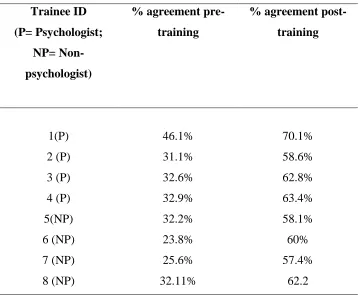
Complete follow-up data on coding performance was obtained for eight trainees (n=2 missing). Before training percentage agreement between trainees and the gold-standard was on average 32.2% (‘poor,’ Cohen, 1963), but improved significantly to 61.6%) (‘good’) post-training (Table 2). The average increase was 29.5%, t(7) = -19.7, p<0.001. There were no significant differences between the more experienced psychologist and less experienced trainees.
Self-perceived coding competence
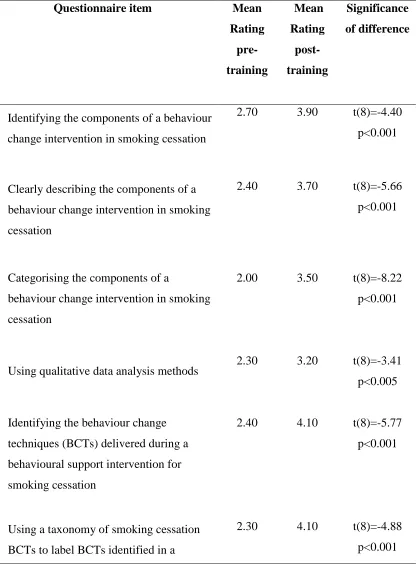
Before training, average self-perceived coding competence was 2.39 (SD 0.26), equating to ‘low’ confidence. Post-training, average ratings for all 13 items increased, with a mean rating of 3.74 (SD 0.29) post-training (‘moderate’ – ‘good’ confidence). Improvements were statistically significant for all questionnaire items (Table 3)
Course evaluation
Seven trainees completed the course evaluation. The average course rating was 4.86 (SD 0.23), equivalent to ‘excellent.’ The elements of the course most frequently cited as beneficial to training were the practice exercises (n=6) and group discussions (n=4).
Discussion
14
body of evidence illustrating the reliability and versatility of taxonomy coding approaches for specifying the content of complex behaviour change interventions (Michie, Whittington, Hamoudi et al. 2012; Michie, Abraham, Whittington et al. 2009; West et al. 2010). Establishing a method for specifying the content of behavioural support interventions in practice represents an important first step towards counter-acting the typically inconsistent and poor specification of the content of complex behaviour change interventions (Craig, Dieppe, Macintyre et al., 2008). To our knowledge, this is the first published attempt to systematically specify the content of smoking cessation behavioural support as delivered in practice. This study also developed an effective training manual to train new, inexperienced coders from multi-disciplinary professional backgrounds to reliably specify intervention content using the taxonomy. To our knowledge, this manual is also the first of its kind to be formally evaluated and represents a feasible, easily administered approach to train future coders.
15
Applying taxonomies in research can also aid theoretical understanding: specifying the content of interventions in terms of specific BCTs enables identification of mechanisms of action by which effective outcomes are achieved. The original taxonomy has previously been applied to code the content of NHS service manuals into component BCTs and examine associations between identified BCTs and quit outcomes (West et al. 2010). A sub-set of sixteen BCTs significantly associated with self-reported and CO-validated quit outcomes were identified, such as ‘strengthen ex-smoker identity’ and ‘facilitate relapse prevention and coping.’ These results
identify which specific BCTs appear to be effective and further our current understanding as to what comprises effective behavioural support. These results have also been combined with BCTs identified in effective behavioural support trials selected from relevant Cochrane Reviews (Lancaster & Stead, 2009; Stead & Lancaster, 2005) to provide the basis for the learning outcomes and curricula of a national stop smoking practitioner training programme available across England and Wales by the NCSCT (NCSCT, 2011). Having established the reliability of the taxonomy to code the content of support delivered in practice, such analyses need to be repeated using representative samples of audio-recorded behavioural support consultations to establish which BCTs are effective in practice. Furthermore, the presently developed methods will support the evaluation of the NCSCT training programme by enabling comparisons of, not just questionnaire ratings of competence, but measures of actual practice pre- and post-training.
16
A further limitation to this methodological approach is that audio-recordings were used rather than video-recordings. Audio-recordings are more practical and economical. While video-taped consultations provide additional non-verbal content, with the exception of few BCTs such as ‘building rapport,’ all BCTs within the taxonomy require a degree of verbalization in order to be
delivered, and can therefore be coded on the basis of audio data. Also, one question is whether or not BCTs have been delivered; another is how well they have been delivered. Methods to assess and quantify quality of delivery have been established in medicine (Salgado, Moles, Benrimoj et al. 2011) and are emerging for health behaviour change interventions (Hardeman et al. 2011; Tober et al. 2008). The development of such quality assessment methods should be the focus of future research.
17
REFERENCES
Abraham, C., & Michie, S. (2008). A taxonomy of behaviour change techniques used in interventions. Health Psychology, vol. 27 (3), pp.379-387. doi: 10.1037/0278-6133.27.3.379
Bellg, A., Borrelli, B., Resnick, B., et al. (2004). Enhancing treatment fidelity in health behaviour change studies: best practices and recommendations from the NIH Behaviour Change Consortium. Health Psychology, vol. 22 (5), pp. 443-451. doi:10.1037/0278-6133.23.5.443
Borrelli, B. (2011). The assessment, monitoring and enhancement of fidelity in public health clinical trials. Pub Health Dentistry, vol. 71, p.52-63.
Cohen, J. (1968). Weighted kappa: Nominal scale agreement with provision for scaled disagreement or partial credit. Psychological Bulletin70 (4): 213–220. doi:10.1037/h0026256
Craig, P., Dieppe, P., Macintyre, S., Michie, S., et al. (2008). Developing and evaluating complex interventions: the new Medical Research Council guidance. BMJ, vol. 337, 1655. doi: 10.1136/bmj.a1655
Hardeman, W., Lamming, L., Kellar, I., et al. (2011). Fidelity of a nurse-led intervention to support medication taking in type 2 diabetes (SAMS trial). Psychology and Health, vol. 26 (2).
Hardeman, W., Michie, S., Fanshawe, T., Prevost, T., et al. (2009). Fidelity of delivery of a physical activity intervention: predictors and consequences. Psychology and Health, 23 (1), 11-24.
18
Lancaster, T., & Stead, L. (2009). Individual behavioural counseling for smoking cessation (review). The Cochrane Database of Systematic Reviews, 2008 Issue 4. DOI: 10.1002/14651858.CD001292.pub2.
Lorencatto, F., West, R., & Michie, S. (2012). Identifying evidence-based behaviour change techniques for smoking cessation in pregnancy. Nicotine & Tobacco Research, vol. 14 (9), pp. 1019-1026.
McEwen, R., McRobbie, H., & West, R. (2005). Effectiveness of specialist group treatment for smoking cessation vs. one-to-one treatment in primary care. Addictive behaviours, vol. 31 (9), p.1650-1660
Michie, S., Whittington, C., Hammoud, Z., Tober, G., & West, R. (2012). Behaviour change techniques to reduce excessive alcohol use and their associations with outcome. Addiction, vol. 107 (8), 1431-1440. DOI: 10.1111/j.1360-0443.2012.03845.x
Michie ,S., Churchill, S., & West, R. (2011). Identifying evidence-based competences required to deliver behavioral support for smoking cessation. Annals Beh Med, vol. 40, p.59-70.
Michie, S., Walia, A., Hyder, N., West, R. (2010). Development of a taxonomy of behaviour change techniques used in individual behavioural support for smoking cessation. Addictive behaviours, 36, p.315-319.
Michie, S., Fixsen, D., Grimshaw, J., & Eccles, M. (2009). Specifying and reporting complex behaviour change interventions: the need for a scientific method. Implementation science,vol. 4 (40), doi:10.1186/1748-5908-4-40.
19
NHS Centre for Smoking Cessation and Training (2011). http://www.ncsct.co.uk
NHS Information Centre (2011) Statistics on NHS Stop Smoking Services: England, April 2010 to December 2010. NHS IC. Accessed on 01-11-2011. Retrieved from: http://www.ic.nhs.uk/statistics-and-data-collections/health-and-lifestyles/nhs-stop- smoking-services
Salgado, T., Moles, R., Benrimoj, S., & Fernandez-Llimos, F. (2011). Pharmacists’ interventions in the management of patients with chronic kidney disease: a systematic review. Nephroogy. Diaysis. Transplant, doi: 10.1093/ndt/gfr287 .
Tober, G., Clyne, W., Finnegan, O., Farrin, A., Russell, I., et al. (2008). Validation of a scale for rating the delivery of psycho-social treatments for alcohol dependence and misuse: the UKATT process rating scale (PRS). Oxford Journals, Medicine, Alcohol and Alcoholism, 43 (6), pp. 675-682.
West, R., Walia, A., Michie, S., & Walia, A. (2010). Behaviour change techniques used by English Stop Smoking Services and their associations with short- term quit outcomes. Nicotine & Tobacco Research, vol. 12 (7), pp. 742-747. doi:10.1093/ntr/ntq074
West, R. (2009). The multiple facets of cigarette addiction and what they mean for encouraging and helping smokers to stop. Journal of Chronic Obstructive Pulmonary Disease, vol. 6, pp. 277-283. doi:10.1080/15412550903049181
20
Table 1. Results from coding Waves 2 and 3, including total number of community and core NHS Service (SSS) transcripts each BCT was identified in, plus the total number of citations per BCT.
CORE NHS SSS COMMUNITY PHARMACY SSS BCT
Label
BCT Code BCT Description Total No. of transcripts featured in Max n=9 Total. No. Citations across sessions Total No. of transcripts featured in Max n=5 Total. No. Citations across sessions
‘BM’ Specific focus on behaviour (B) and addressing motivation (M)’
BM1 Provide information on the health
consequences of smoking and smoking cessation
Give, or make more salient, information about the physical/healthharms caused by smoking and the benefits of stopping; distinguish between the harms from smoking and nicotine; debunk myths about low tar and own-roll cigarettes.
4 6 3 9
BM2 Boost motivation and self-efficacy
Give encouragement and bolster confidence in ability to stop. Can includetelling the person that they can successfully stop smoking, arguing against self-doubts and asserting that they can and will succeed.
9 84 5 2
BM3 Provide feedback on current behaviour and progress
Give feedback arising from assessment of current self-reported or objectively monitored behaviour (e.g. expired-are CO) and/or progress towards becoming a permanent non-smoker.
9 68 3 13
BM4 Provide rewards contingent on not smoking
Give praise or rewards if the person has not smoked.
5 9 0 0
BM5 Provide normative information about others’ behaviour and experiences
Involves providing information about how the smoker’s experience compares with that of other smokers who are trying to quit, as to indicate that a particular behaviour or sequence of behaviours are common, or uncommon, amongst other smokers trying to quit.
9 34 3 7
BM6 Prompt commitment from the client there and then
Encourage the smoker to affirm or reaffirm a strong commitment to start, continue or restart the quit attempt.
2 5 0 0
BM7 Provide rewards contingent on effort or progress
Give praise or other rewards for the effort the smoker is making in relation to smoking cessation and if the smoker has engaged in activities that aid cessation, such as correct medication use.
6 10 0 0
BM8 Strengthen ex-smoker identity
Explain the importance of regarding smoking that is ‘not an option,’ including the ‘not a puff’ rule, and construct a new identity as someone who ‘used to smoke’
5 14 1 1
BM9 Facilitate identification of reasons for wanting and not wanting to stop smoking
Help the smoker to arrive at a clear understanding of his or her feelings about stopping smoking, why it is important to stop and any conflicting motivations.
7 15 3 2
BM10 Explain the importance of abrupt cessation
Explain why it is better to stop abruptly rather than cut down gradually if at all possible.
3 3 0 0
BM11 Measure CO and explain the purposes of CO monitoring
Measure expired- air carbon monoxide concentration and explain to the smoker the reasons for measuring CO at different time points (e.g. before and after the quit date)
7 47 2 4
BM12 Conduct motivational interviewing
Adopt a formal motivational interviewing protocol
0 0 0 0
[image:21.612.74.548.153.692.2]21 BS1 Facilitate barrier
identification and problem solving
Help the smoker identify general barriers that might make it harder to stay off cigarettes (e.g. susceptibility to cigarettes). Help the smoker develop general ways of addressing and overcoming these, and increasing facilitators (e.g. by generating alternative courses of action and pros and cons of each and weighing them up)
5 19 0 0
BS2 Facilitate relapse prevention and coping
Help the smoker understand how lapses occur and how they lead to relapse.Plan how to maintain behaviour that has changed, by helping identify in advance situations in which the changed behaviour may not be maintained, and develop specific strategies for preventing lapses or avoiding lapses turning into relapse.
5 21 0 0
BS3 Facilitate action planning/ develop a treatment plan
Work with the smoker to encourage generation of a clear, detailed quit plan including preparations for the quit attempt (e.g. obtaining medication).
6 19 1 2
BS4 Facilitate goal setting Help the smoker set a quit date and goals that support the aim of remaining abstinent
6 42 1 4
BS5 Prompt review of set goals
Review how far the smoker has achieved the main goal of abstinence and any other goals that are supportive of it (e.g. putting in place plans to avoid triggers). In most cases this will follow previous goal setting and an attempt to act on those goals, followed by a version of revision or readjustment of goals and/or means to attain them.
4 7 2 1
BS6 Prompt self-recording Help the smoker establish a routine of recording potentially useful information (e.g. situations or times when urges are strong and less strong)
1 1 0 0
BS7 Advise on changing routine
Advise on ways of changing daily or weekly routines to minimize exposure to smoking cues
4 12 0 0
BS8 Advise on environmental restructuring
Advise on ways of changing the physical environment to minimize exposure to physical smoking cues (e.g. removing ashtrays from the house)
3 20 0 0
BS9 Set graded tasks Set small achievable goals where appropriate (e.g. take one day at a time)
0 0 0 0
BS10 Advise on conserving mental resources
Advises on ways of minimizing stress and other demands on mental resources (activities that require mental effort)
4 5 0 0
BS11 Advise on avoiding social cues for smoking
Give specific advice on how to avoid being exposed to social cues for smoking (e.g. explaining to friends that you have stopped and asking them not to smoke around you)
7 22 0 0
BS12 Facilitate restructuring of social life
Advise on ways of changing social interactions so that they support rather than interfere with smoking cessation
4 15 1 1
BS13 Advise on methods of weight control
Advise on methods of weight control, including diet and/or exercise
1 1 0 0
BS14 Teach relaxation techniques
Teach specific relaxation techniques and how and when to apply them
0 0 0 0
Promoting adjuvant activities ‘A’ – including general aspects of the interaction focusing on delivery of the intervention
A1 Advise on stop smoking medication
Includes one or more of the following: - explaining the benefits of medication, safety, potential side-effects, contra-indications, how to use them most effectively,
- advising on the most appropriate medication for the smoker
- promoting effective use
- explaining how to obtain medications, enacting the necessary procedures to ensure the smoker gets their medication easily and without charge where appropriate
9 179 3 60
A2 Advise on/facilitate use of social support
Advise on or facilitate development of social
22 buddies.
A3 Ask about experiences of stop smoking medication that the smoker is currently using
Asses usage, side effects and benefits experienced of medication that the smoker is currently using.
7 38 0 0
A4 Give options for additional and later support
Give information about options for additional support where these are available (e.g. websites, self-help groups, telephone helpline)
5 12 3 2
‘RC’ General aspects of the interaction (R) focusing on general communication (C)
RC1
Build general rapport Establish a positive, friendly and professional relationship with the smoker and foster a sense that the smoker’s experiences are understood
9 46 5 10
RC2 General practitioner communication approaches
Communication that Includes one or more of the following: eliciting and answering questions, using reflective listening, summarizing information, and confirming client decisions
9 311 5 78
RC3 Emphasise choice Emphasise client choice within bounds of evidence based practice
4 12 1 0
RC4 Provide reassurance Give general reassurance to the smoker that his/her experiences are normal and time limited, and provide positive expectations of success based on experience with other smokers in the same situation
9 94 5 20
RC5 Tailor interactions appropriately
Use relevant information from the client to tailor the behavioural support provided
4 6 0 0
RC6 Offer/direct towards appropriate written materials
Distinguish what are, and are not, appropriate written materials and offer/direct clients to these in ways that promote their effective use
4 7 0 1
RC7 Information gathering and assessment
Any information gathering that provides the practitioner with the knowledge needed from the client for appropriate behaviour change techniques to be delivered. Includes one or more of the following:
- Assessing current and past smoking behaviour
- Assessing current readiness and ability to quit
- Assessing past history of quit attempts
- Assessing withdrawal symptoms
- Assessing nicotine dependence - Assessing number of contacts
who smoke
- Assessing attitudes to smoking - Assessing level of social
support
- Assessing physiological and mental functioning
9 47 5 15
RC8 Explain how tobacco dependence develops
Give an explanation of the development of tobacco dependence and the effect of nicotine
4 12 2 8
RC9 Explain expectations regarding the treatment programme
Explain to the smoker the treatment programme, what it involves, the active ingredients, and what it requires of the smoker
7 24 3 6
RC10 Provide information on withdrawal symptoms
Describe to smokers what are and are not nicotine withdrawal symptoms, how common they are, how long they typically last, what causes them and what can be done to alleviate them.
23
Table 2. Trainee coding inter-rater reliability pre- and post- training
Trainee ID
(P= Psychologist;
NP=
Non-psychologist)
% agreement
pre-training
% agreement post-
training
1(P) 46.1% 70.1%
2 (P) 31.1% 58.6%
3 (P) 32.6% 62.8%
4 (P) 32.9% 63.4%
5(NP) 32.2% 58.1%
6 (NP) 23.8% 60%
7 (NP) 25.6% 57.4%
24
Table 3. Average trainee ratings of self-perceived coding competence (from 1= ‘not at all confident’ to 5 =’highly confident’) pre-and post training
Questionnaire item Mean
Rating
pre-training
Mean
Rating
post-training
Significance
of difference
1. Identifying the components of a behaviour change intervention in smoking cessation
2.70 3.90 t(8)=-4.40 p<0.001
2. Clearly describing the components of a behaviour change intervention in smoking cessation
2.40 3.70 t(8)=-5.66 p<0.001
3. Categorising the components of a
behaviour change intervention in smoking cessation
2.00 3.50 t(8)=-8.22 p<0.001
4. Using qualitative data analysis methods 2.30 3.20 t(8)=-3.41 p<0.005
5. Identifying the behaviour change techniques (BCTs) delivered during a behavioural support intervention for smoking cessation
2.40 4.10 t(8)=-5.77 p<0.001
6. Using a taxonomy of smoking cessation BCTs to label BCTs identified in a
[image:25.612.80.496.137.701.2]25
behavioural support session
7. Applying a coding framework based on a taxonomy of smoking cessation BCTs to identify and categorise BCTs
2.40 3.90 t(8)=-5.29 p<0.001
8. Conducting a content analysis of
transcripts of audio-recorded behavioural support sessions
2.10 3.60 t(8)=-4.13 p<0.005
9. Describing what a BCT for smoking cessation is
3.00 4.00 t(8)=-4.40 p<0.05
10.Explaining the aims and components of behavioural support interventions for smoking cessation
2.50 3.70 t(8)=-3.77 p<0.005
11.Assessing how often different BCTs are used during a behavioural support session
2.30 3.80 t(8)=-4.91 p<0.001
12.Pointing out when a stop smoking practitioner delivers a BCT
2.50 3.90 t(8)=-5.66 p<0.001
13. Deconstructing a health behaviour change intervention into its functional
components (i.e. active ingredients)
26
27
APPENDICES
APPENDIX 1: BCTs and total number of citations identified in the NCSCT transcripts
BCT Code
BCT label BCT definition Total
No. Citations
BM1 Provide information
on consequences of smoking and smoking cessation
Give, or make more salient, information about the harm caused by smoking and the benefits of stopping or staying quit; distinguish between the harms from smoking and nicotine; debunk myths about low tar and own-roll cigarettes and cutting down
3
BM2 Boost motivation
and self efficacy
Give encouragement and bolster confidence in ability to stop 10
BM3 Provide feedback on
current behaviour and progress
Give feedback arising from assessment of current self-reported or objectively monitored behaviour (e.g. expired-air CO) and/or progress towards becoming a permanent non-smoker
8
BM4 Provide rewards
contingent on successfully stopping smoking
Give praise or other rewards if the person has not smoked 4
BM5 Provide normative
information about others' behaviour and experiences
Give information about how the smoker’s experience compares with other people’s 17
BM6 Prompt commitment
from the client there and then
Encourage the smoker to affirm or reaffirm a strong commitment to start, continue or restart the quit attempt
4
BM7 Provide rewards
contingent on effort or progress
Give praise or other rewards for the effort the smoker is making and if the smoker has engaged in activities such as correct use of medication that aid cessation
7
BM8 Strengthen
ex-smoker identity
Explain the importance of regarding smoking as something that is ‘not an option’, including the ‘not a puff’ (NAP) rule, encourage the smoker to re-evaluate the attraction to smoking, and construct a new identity as someone who ‘used to smoke’
11
BM9 Conduct
motivational interviewing
Adopt a formal motivational interviewing protocol 5
BM10 Identify reasons for wanting and not wanting to stop smoking
Help the smoker to arrive at a clear understanding of his or her feelings about stopping smoking, why it is important to stop and any conflicting motivations
4
BM11 Explain the importance of abrupt cessation
Explain why it is better to stop abruptly rather than cut down gradually if at all possible 1
BM12 Measure carbon monoxide (CO)
Measure expired air CO to assess extent of smoke exposure prior to quitting and to confirm successful abstinence; use the measurement as a motivational tool
28
Specific focus on behavior (B) maximising self-regulatory capacity/skills (S)
BS1 Facilitate barrier
identification and problem solving
Help the smoker to identify general barriers (e.g. susceptibility to stress) that might make it harder to stay off cigarettes and develop general ways of addressing these
6
BS2 Facilitate relapse
prevention and coping
Help the smoker understand how lapses occur and how they lead to relapse and to develop specific strategies for preventing lapses or avoiding lapses turning into relapse
3
BS3 Facilitate action
planning/develop treatment plan
Work with smoker to generate a clear quit plan including preparations for the quit attempt (e.g. obtaining medication)
2
BS4 Facilitate goal
setting
Help the smoker to set a quit date and goals that support the aim of remaining abstinent 8
BS5 Prompt review of
goals
Review how far the smoker has achieved the main goal of abstinence and any other goals that are supportive of it (e.g. putting in place plans to avoid triggers)
6
BS6 Prompt
self-recording
Help the smoker to establish a routine of recording potentially useful information (e.g. situations or times when urges are strong and less strong)
0
BS7 Advise on changing
routine
Advise on ways of changing daily or weekly routines to minimise exposure to smoking cues
0
BS8 Advise on
environmental restructuring
Advise on ways of changing the physical environment to minimise exposure to smoking cues (e.g. removing ashtrays from the house) or to provide cues to sustain quitting
3
BS9 Set graded tasks Set small achievable goals where appropriate (e.g. take one day at a time) 0
BS10 Advise on conserving mental resources
Advise on ways of minimising stress and other demands on mental resources (activities that require mental effort)
3
BS11 Advise on avoidance of cues for smoking
Give specific advice on how to avoid being exposed to social or other cues for smoking (e.g. staying away from places where people smoke)
1
BS12 Facilitate restructuring of social life
Advise on ways of changing social interactions with family, friends and colleagues so that they support, rather than interfere with, the goal of remaining abstinent
2
BS13 Advise on methods of weight control
Advise on ways of minimising weight gain that do not increase motivation to smoke (e.g. take exercise, carry around ‘healthy snacks’)
0
BS14 Teach relaxation techniques
Teach specific relaxation techniques and how and when to apply them 0
Promote adjuvant activities (A)
A1 Advise on
stop-smoking medication
Explain the benefits of medication, safety, potential side effects, contra-indications, how to use them most effectively, and how to get them; advise on the most appropriate medication for the smoker and promote effective use
24
A2 Advise on/facilitate
use of social support
Advise on or facilitate development of social support from friends, relatives, colleagues or ‘buddies’
29
A3 Adopt appropriate
local procedures to enable clients to obtain free medication
Enact the necessary procedures of a stop smoking service to ensure that the smoker gets his/her medication easily and without charge where appropriate
0
A4 Ask about
experiences of stop smoking medication that the smoker is using
Assess usage, side effects and benefits experienced of medication(s) that the smoker is currently using
4
A5 Give options for
additional and later support
Give information about options for additional support outside the programme where these are available (e.g. websites, self-help groups, telephone helpline)
0
General aspects of the interaction (R) focusing on delivery of the intervention (D)
RD1 Tailor interactions
appropriately
Use relevant information from the client to tailor the behavioural support provided 1
RD2 Emphasise choice Emphasise client choice within the bounds of evidence based practice 0
General aspects of the interaction (R) focusing on information gathering (I)
RI1 Assess current and
past smoking behaviour
Assess amount smoked, age when started, pattern of smoking behaviour 6
RI2 Assess current
readiness and ability to quit
Assess current level of motivation to stop and confidence in success 1
RI3 Assess past history
of quit attempts
Assess number and duration of past quit attempts and experiences related to these, including factors that led back to smoking
2
RI4 Assess withdrawal
symptoms
Assess the presence and severity of nicotine withdrawal signs and symptoms 1
RI5 Assess nicotine
dependence
Assess the degree of nicotine dependence 2
RI6 Assess number of
contacts who smoke
Assess how many friends, relatives and work colleagues smoke 1
RI7 Assess attitudes to
smoking
Assess positive and negative beliefs and feelings about smoking 0
RI8 Assess level of
social support
Assess the extent to which friends, relatives and work colleagues will be supportive of the quit attempt and more generally
2
RI9 Explain how
tobacco dependence develops
Explain the process by which smokers become addicted to cigarettes and the role that nicotine plays in this
4
RI10 Assess physiological and mental functioning
Assess physiological functioning such as lung function and mental states such as anxiety and depression levels
30
General aspects of the interaction (R) focusing on general communication (C)
RC1 Build general
rapport
Establish a positive, friendly and professional relationship with the smoker and foster a sense that the smoker’s experiences are understood
4
RC2 Elicit and answer
questions
Prompt questions from the smoker and answer clearly and accurately 6
RC3 Explain the purpose
of CO monitoring
Explain to the smoker the reasons for measuring CO at different time points, e.g. before and after the quit date
3
RC4 Explain expectations
regarding treatment programme
Explain to the smoker the treatment programme, what it involves, the active ingredients and what it requires of the smoker
8
RC5 Offer/direct towards
appropriate written materials
Distinguish what are, and are not, appropriate written materials and offer/direct clients to these in ways that promote their effective use
0
RC6 Provide information
on withdrawal symptoms
Describe to smokers what are, and are not, nicotine withdrawal symptoms, how common they are, how long they typically last, what causes them and what can be done to alleviate them
9
RC7 Use reflective
listening
Adopt a style of interaction that involves listening carefully to the smoker and where appropriate reflecting back to the smoker key elements of what s/he is saying
8
RC8 Elicit client views Prompt the client to give views on smoking, smoking cessation and any aspects of the
behavioural support programme
3
RC9 Summarise
information / confirm client decisions
Provide a summary of information exchanged and establish a clear confirmation of decisions made and commitments entered into
3
RC10 Provide reassurance Give general reassurance to the smoker that his/her experiences are normal and time limited, and provide positive expectations of success based on experience with other smokers in the same situation
31
Appendix 2: Full list of adaptations to the original published taxonomy of smoking cessation BCTs (Michie et al. 2010)
BCT Code BCT Label Original BCT description Adaptation
BM1 Provide
information on the consequences of smoking and smoking cessation
Give, or make more salient, information about the harm caused by smoking and the benefits of stopping; distinguish between the harms from smoking and nicotine; debunk myths about low tar and own-roll cigarettes and cutting down
Existing BCT description refined for clarification purposes; ‘cutting down’ removed as conflicted with BM10- explain importance of abrupt
cessation.
BM2 Boost
motivation and self-efficacy
Give encouragement and bolster
confidence in ability to stop. Can include
telling the person that they can
successfully stop smoking, arguing against self-doubts and asserting that they can and will succeed.
Existing BCT description refined for clarification purposes.
BM4 Provide
rewards contingent on successfully stopping smoking not smoking
Give praise or rewards if the person has not smoked.
Existing BCT label was refined to greater reflect the corresponding BCT description. The BCT
description implies that this BCT is not necessarily about a successful quit attempt but rather about ‘not smoking.’ ‘Successfully stopping smoking’ was omitted to clarify.
BM5 Provide
normative information about others’ behaviour and experiences
Give information about how the smoker’s experience compares with other people’s.
Involves providing information about how the smoker’s experience compares with that of other smokers who are trying to quit, as to indicate that a particular behaviour or sequence of behaviours are common, or uncommon, amongst other smokers trying to quit.
Existing BCT description expanded to include a clearer, more detailed definition adopted from other existing taxonomies of BCTs (Michie and Abraham, 2008) for clarification and understanding purposes.
BM8 Strengthen
ex-smoker identity
Explain the importance of regarding smoking that is ‘not an option,’ including the ‘not a puff’ rule, encourage the smoker to re-evaluate the attraction to smoking, and construct a new identity as someone who ‘used to smoke.’
Existing BCT description refined. Text was removed to minimize confusion with BCT BM9- help identify reasons for wanting and not wanting to stop smoking.
BM9 Help
Facilitate
identification of reasons for
Help the smoker to arrive at a clear understanding of his or her feelings about stopping smoking, why it is important to
32
wanting and not wanting to stop smoking
stop and any conflicting motivations.
BM11 RC3 [previously] Measure CO and explain the purposes of CO monitoring
Measure expired- air carbon monoxide concentration and explain to the smoker the reasons for measuring CO at different time points (e.g. before and after the quit date)
Originally separate BCTs BM11 (measure CO) and RC3 (explain purpose of CO monitoring)
were merged together as they typically co-occur together in practice.
BM12 Conduct
motivational interviewing
Adopt a formal motivational interviewing protocol
Description created.
BS1 Facilitate
barrier identification and problem solving
Help the smoker identify general barriers that might make it harder to stay off cigarettes (e.g. susceptibility to cigarettes). Help the smoker develop general ways of
addressing and overcoming these, and increasing facilitators (e.g. by
generating alternative courses of action and pros and cons of each and weighing them up)
Existing BCT description expanded to better differentiate between BCTs BS1, BS2 and BS3. Definitions expanded using BCT descriptions from other taxonomies of BCTs.
BS2 Facilitate
relapse prevention and coping
Help the smoker understand how lapses occur and how they lead to relapse.Plan how to maintain behaviour that has changed, by helping identify in advance situations in which the changed
behaviour may not be maintained, and
develop specific strategies for preventing lapses or avoiding lapses turning into relapse.
Existing BCT description expanded to better differentiate between BCTs BS1, BS2 and BS3. Definitions expanded using BCT descriptions from other taxonomies of BCTs.
BS5 Prompt review
of set goals
Review how far the smoker has achieved the main goal of abstinence and any other goals that are supportive of it (e.g. putting in place plans to avoid triggers). In most cases this will follow previous goal setting and an attempt to act on those goals, followed by a version of revision or readjustment of goals and/or means to attain them.
Existing BCT description expanded using BCT descriptions from other taxonomies for clarification and understanding purposes.
BS8 Advise on
environmental
Advise on ways of changing the physical
environment to minimize exposure to physical smoking cues (e.g. removing
33
restructuring ashtrays from the house) from BS11- advise on avoidance of
social cues for smoking
BS12 Facilitate
restructuring of social life
Advise on ways of changing social interactions so that they support rather than interfere with smoking cessation
Description created.
BS13 Advise on
methods of weight control
Advise on methods of weight control, including diet and/or exercise
Description created.
BS14 Teach
relaxation techniques
Teach specific relaxation techniques and how and when to apply them
Description created.
A1
A3
[previously]
Advise on stop smoking medication
Includes one or more of the following:
- explaining the benefits of medication, safety, potential side-effects, contra-indications, how to use them most effectively,
- advising on the most appropriate medication for the smoker
- promoting effective use
- explaining how to obtain medications, enacting the necessary procedures to ensure the smoker gets their medication easily and without charge where appropriate
Originally separate BCTs A1 (advising on stop smoking medication) and A3 (adopt appropriate local procedures to enable clients to obtain free medication) were merged, as they typically co-occur. RC2 Merge of previous BCTs: RC2, RC7, RC9, RC8 General practitioner communicati on approaches
Communication that Includes one or more of the following: eliciting and answering questions, using reflective listening, summarizing information, and confirming client decisions
New BCT label was created by merging several BCTs such as eliciting and answering questions, using reflective listening,
34 repetitive and not very informative.
RC3 Emphasise
choice
Emphasise client choice within bounds of evidence based practice
BCT moved from sub-function RD to function RC.
RC5 Tailor
interactions appropriately
Use relevant information from the client to tailor the behavioural support provided
BCT moved from sub-function RD to function RC.
RC7 Merge of previous BCTs: RI1, RI1, RI3, RI4, RI5, RI6, RI7, RI8, RI10 Information gathering and assessment
Any information gathering that provides the practitioner with the knowledge needed from the client for appropriate behaviour change
techniques to be delivered. Includes one or more of the following:
- Assessing current and past
smoking behaviour
- Assessing current readiness and
ability to quit
- Assessing past history of quit
attempts
- Assessing withdrawal
symptoms
- Assessing nicotine dependence
- Assessing number of contacts
who smoke
- Assessing attitudes to smoking
- Assessing level of social support
- Assessing physiological and
mental functioning
BCTs merged/ New BCT label created. All previous assessment related BCTs originally under the information gathering behaviour change sub-function (RI) were merged to form one large information gathering for simplification purposes.
RC8 Explain how
tobacco dependence develops
Give an explanation of the development of tobacco dependence and the effect of nicotine
Description created. Moved from
35
Appendix 3: Types of adaptations to the original taxonomy of smoking cessation BCTs
Type of Adaptation No. of
BCTs
applied
to
Example
Merging theoretically similar and/or co-occurring BCTs
17 Merged BM11 (Measure CO) and RC3 (Explain purposes of CO monitoring)
Expand/refine existing BCT definitions
11 BS5 Prompt review of set goals: ‘Review how far the smoker has achieved the main goal of abstinence and any other goals supportive of it. [Expanded to include] In most cases this will follow previous goal setting and an attempt to act on those goals, followed
by a version of revision or readjustment of goals
and/or means to attain them.
Create new BCT definitions where previously unavailable