This is a repository copy of
Influence of design parameters on the starting torque of a
single-phase PM brushless DC motor
.
White Rose Research Online URL for this paper:
http://eprints.whiterose.ac.uk/876/
Article:
Bentouati, S., Zhu, Z.Q. and Howe, D. (2000) Influence of design parameters on the
starting torque of a single-phase PM brushless DC motor. IEEE Transactions on
Magnetics, 36 (5 (Par). pp. 3533-3536. ISSN 0018-9464
https://doi.org/10.1109/20.908890
[email protected] https://eprints.whiterose.ac.uk/
Reuse
Unless indicated otherwise, fulltext items are protected by copyright with all rights reserved. The copyright exception in section 29 of the Copyright, Designs and Patents Act 1988 allows the making of a single copy solely for the purpose of non-commercial research or private study within the limits of fair dealing. The publisher or other rights-holder may allow further reproduction and re-use of this version - refer to the White Rose Research Online record for this item. Where records identify the publisher as the copyright holder, users can verify any specific terms of use on the publisher’s website.
Takedown
If you consider content in White Rose Research Online to be in breach of UK law, please notify us by
Influence of Design Parameters on the Starting
Torque of a Single-Phase PM Brushless DC Motor
S. Bentouati, Z. Q. Zhu, Member, IEEE, and D. Howe
Abstract—The starting torque of a single-phase permanent magnet brushless dc motor is investigated, for both radial and parallel magnetization. Finite element analysis is used to assess the relative merits of alternative methods of introducing the required airgap asymmetry, viz. tapered airgap, stepped airgap, asymmetric airgap, and slotted teeth. The predicted results are validated experimentally.
Index Terms—Brushless dc motor, electrical machine, perma-nent magnet, reluctance torque.
I. INTRODUCTION
S
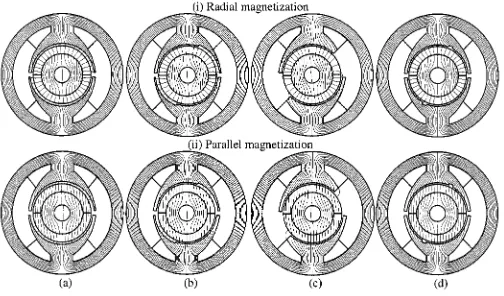
INGLE-PHASE permanent magnet brushless dc motors are likely to be adopted for many low cost applications. How-ever, with a smooth airgap single-phase excitation produces zero starting torque, and the direction of rotation is indeterminate [1]. In order to develop a starting torque and impart a preferred direction of rotation, an asymmetric airgap is employed as a means of introducing a reluctance torque component to com-plement the excitation torque. Fig. 1 illustrates four ways by which airgap asymmetry can be introduced, viz. tapered airgap, stepped airgap, asymmetric airgap, and slotted teeth, together with open-circuit field plots for both radial and parallel magne-tization of the 2-pole, surface-mounted magnet rotor. Although the issue of starting torque has been investigated extensively, publications are usually restricted to a consideration of a spe-cific motor topology [1]. In this paper, the relative merits of all four methods of introducing the airgap asymmetry, on both the starting torque and the net torque, are compared. Finite element predictions are validated against measurements, and motor de-signs, which result in a high specific torque, the required starting torque, and a relatively smooth torque waveform, are identified.II. ANALYSIS OFALTERNATIVEAIRGAPPROFILES
In order to ensure accurate predictions, the torque has been calculated by both Maxwell stress integration and from the rate of change of co-energy, particular attention being paid to the local and global finite element mesh discretization [2]. How-ever, they gave essentially identical results. Throughout, the cal-culations are for a 2-pole/2-slot motor, for which the outside diameter and the active axial length are 76 mm and 87.5 mm, respectively, the minimum airgap being 1 mm, and the rotor
Manuscript received February 14, 2000.
The authors are with the Department of Electronic and Electrical Engi-neering, University of Sheffield, Mappin St., Sheffield S1 3JD, UK (e-mail: [email protected]).
[image:2.612.306.558.167.315.2]Publisher Item Identifier S 0018-9464(00)07966-8.
Fig. 1. Alternative topologies of single-phase permanent magnet brushless dc motor. (a) Tapered airgap; (b) Stepped airgap; (c) Asymmetric airgap; (d) Slotted teeth.
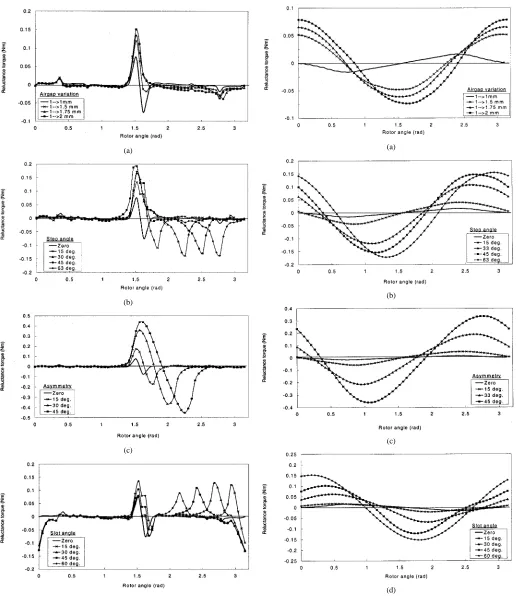
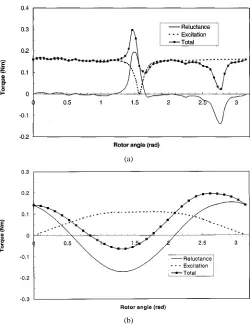
having a bonded NdFeB ring magnet with radial thickness of 5 mm, an outside diameter of 36 mm, and a remanence of 0.5 T. Figs. 2 and 3 show how the reluctance torque waveform varies as the airgap asymmetry is changed. As will be seen, the reluc-tance torque waveforms which result with a parallel magnetized rotor are essentially sinusoidal for all the motor topologies. Ra-dial magnetization results in much more complex torque wave-forms. With a uniform airgap, the reluctance torque waveform exhibits a positive peak and a negative peak of equal ampli-tude over a pole-pitch, due to the slot openings. With a tapered airgap and radial magnetization, Fig. 2(a), the torque waveform exhibits a positive peak which is significantly larger than the negative peak, the difference increasing with the airgap taper, since the reluctance torque is due primarily to the interaction of the edges of the magnets with the sides of the tooth-tips. As the taper is increased, the effect of the tooth-tip at one side of the slots, which produces the negative reluctance torque compo-nent, is reduced. Fig. 4 compares typical reluctance and excita-tion torque waveforms. With a stepped airgap motor, Fig. 2(b), the reluctance torque waveform may exhibit one positive peak and two negative peaks over a pole-pitch, although the negative peak associated with the tooth tips near the longer airgap is very small. Therefore, a stepped airgap is equivalent to having a wide slot opening, an increase in the width of the step resulting in an increase in the angular separation between the positive and neg-ative torque peaks. However, the negneg-ative peaks have almost the same magnitude as the positive peaks, the resultant torque wave-form, Fig. 5, can exhibit a high torque ripple, with zero or neg-ative torque regions if the motor is not properly designed. The asymmetric airgap motor, Fig. 2(c), is very similar, although it only exhibits one positive torque peak and one negative torque
3534 IEEE TRANSACTIONS ON MAGNETICS, VOL. 36, NO. 5, SEPTEMBER 2000
(a)
(b)
(c)
(d)
Fig. 2. Reluctance torque waveforms (radial magnetization). (a) Tapered airgap (b) Stepped airgap (c) Asymmetric airgap (d) Slotted teeth.
peak over a pole-pitch. Increasing the airgap asymmetry in-creases the angular separation between the positive and negative torque peaks, which are relatively large and almost equal, since the resultant slot openings are wide and deep. Hence, the resul-tant torque may also exhibit a high torque ripple and negative
(a)
(b)
(c)
[image:3.612.41.559.59.655.2](d)
Fig. 3. Reluctance torque waveforms (parallel magnetization). (a) Tapered airgap (b) Stepped airgap (c) Asymmetric airgap (d) Slotted teeth.
(a)
[image:4.612.40.287.61.369.2](b)
Fig. 4. Torque components in tapered airgap motor. (airgap variation from 1–2mm). (a) Radial magnetization (b) Parallel magnetization.
(a)
(b)
Fig. 5. Torque components in stepped airgap motor. (63 step). (a) Radial magnetization (b) Parallel magnetization.
(a)
[image:4.612.372.480.64.321.2](b)
Fig. 6. Influence of pole transition of impulse magnetization on field distribution. (a) Ideal radial magnetization (b) Actual magnetization.
Fig. 7. Influence of magnetization transitions on reluctance torque.
In summary, although it is usually possible to obtain the required unidirectional starting torqueusing any of the four methods, a tapered airgap is most effective, in terms of min-imum torque ripple, for both radial and parallel magnetized magnets.
III. INFLUENCE OFIMPULSEMAGNETIZATION AND
EXPERIMENTALVALIDATION
[image:4.612.305.559.367.531.2] [image:4.612.39.289.409.733.2]3536 IEEE TRANSACTIONS ON MAGNETICS, VOL. 36, NO. 5, SEPTEMBER 2000
with both an idealized radially magnetized rotor and a rotor which has been impulse magnetized in a custom designed ra-dial-field fixture. It will be seen that, in general, good agree-ment is achieved between the predicted and measured reluctance torque waveforms.
IV. CONCLUSION
Starting torque is one of the most important considerations in the design of single-phase permanent magnet brushless dc mo-tors. Finite element methods have been used to investigate the
effectiveness of various methods of introducing the required re-luctance torque, and it is concluded that a tapered airgap is the most appropriate, since it results in a smoother resultant torque waveform. It has also been shown that the magnetization tran-sition regions have a significant influence.
REFERENCES
[1] C. Koechli, Y. Perriard, and M. Jufer, “One phase brushless dc motor analysis,” in Proc. Int. Conf. on Elect. Mach., 1998, pp. 639–644. [2] D. Howe and Z. Q. Zhu, “The influence of finite element discretization