Calibration and Control
Thesis submitted in accordance with the requirements of the
University
of
Liverpool
for the
Degree of Doctor in Philosophy
by
Zongyan Li
Statement of Originality
This thesis is submitted for the degree of Doctor in Philosophy in the Faculty of Engi-neering at the University of Liverpool. The research project reported herein was carried out, unless otherwise stated, by the author in the Department of Engineering at the University of Liverpool between 1/11/2008 and 31/10/2012.
No part of this thesis has been submitted in support of an application for a degree or qualification of this or any other University or educational establishment. However, some parts of this thesis have been published, or submitted for publication, in the following papers:
• Li Z. and Shenton A.T. (2010) Nonlinear Model Structure Identification of Engine
Torque and Air/Fuel Ratio. 6th IFAC Symposium Advances in Automotive Control. IFAC, Munich pp 1-6
• Li Z. and Shenton A.T. (2010) Structure Selection for Identified Multi-Model Dynam-ic Fuel Maps. 10th International Symposium on Advanced VehDynam-icle Control. AVEC, Loughborough pp 1-6
• Shenton A.T. and Li Z. (2012) Multi-Modelling of Torque and Air/Fuel Ratio Based
on Engine Operating Regions. 15th IFAC Workshop on Control Applications of Opti-mization, Volume.15, Part 1. IFAC, Rimini
• Li Z. and Shenton A.T. (2012) I.C. Engine Inverse Dynamic Multi-Model Identification. In Proceeding of Powertrain Modelling and Control Conference, Paper 16, Bradford
Zongyan Li
20th October 2012
Abstract
This thesis develops and investigates the application of novel identification and structure
identification techniques for I.C. engine systems. The legislated demand for reduced
vehi-cle fuel consumption and emissions indicates that improved model-based dynamical engine
calibration and control methods are required in place of the existing static set-point based
mapping methods currently used in industry. The choice of structure of any dynamical engine
model has significant consequences for the accuracy and the calibration/optimization time of
engine systems. This thesis primarily addresses the issue of this structure selection.
Linear models are well understood and relatively easy to implement however the modern
I.C. engine is a highly nonlinear system which restricts the use of linear structures. Further
the newer technologies required to achieve demanding fuel consumption and emission targets
are increasingly more complex and nonlinear. The selection of appropriate nonlinear model
regressor terms presents a combinatorial explosion problem which must be solved for accurate
engine system modelling. In this thesis, two systematic nonlinear model structure selection
techniques, namely stepwise regression with F-statistics and orthogonal least squares method
with error reduction ratio, are accordingly investigated. SISO algebraic NARMAX engine
models are then established in simulation studies with these methods and demonstrate the
effectiveness of the approach.
The thesis also investigates the development and application of multi-modelling
tech-niques and the expansion of the model structure selection techtech-niques to the identification of
the local models terms within the multi-model structures for the engine. Based on the
en-gine operating regions, novel multi-model networks can be established and several alternative
multi-modelling techniques, such as LOLIMOT, Neural Network, Gaussian and log-sigmoid
function weighted multi-models, for the multi-model engine system identification are explored
and compared. An experimental validation of the methods is given by a black box
cation of SISO engine models which are developed purely from the experimental engine test
data sets. The results demonstrate that the multi-model structure selection techniques can
be successfully applied on the engine systems, and that the multi-modelling techniques give
good model accuracy and that good modelling efficiency can also be achieved.
The outcome is a set of techniques for the efficient development of accurate nonlinear
black-box models which can be acquired from experimental dynamometer test-bed data which
should assist in the dynamic control of future advanced technology engine systems.
I am very grateful to my supervisor Dr Tom Shenton. His guidance and support were
indispensable and much appreciated in the completion of this work. I also want to thank my
supervisor Prof. Huajiang Ouyang for his timely and valuable advice while I was progressing
the PhD. I would like to thank Dr Ahmed Abass, Dr Paul Dickinson, Ke Fang, Ming-yen
Chen and Kamil for kindly offering their valuable suggestions and assistance. I would like to
thank my parents for their inspiration and selfless financial support for my study in the UK.
Finally, my gratitude goes to my wife, Qin Chen, for her love and patience.
Contents
Abstract ii
List of Figures viii
List of Tables x
Acronyms xii
1 Introduction 1
1.1 Systems identification of SISO and MIMO models . . . 2
1.2 Overview . . . 3
1.3 Contributions . . . 5
2 Background 6 2.1 Dynamical System Identification for IC Engine . . . 6
2.1.1 Static and Dynamical Modeling . . . 6
2.1.2 Dynamic Engine Identification . . . 6
2.1.3 White-box Models . . . 11
2.1.4 Black-box Models . . . 12
2.1.5 Grey-box Models . . . 16
2.1.6 Dynamic Engine Calibration . . . 16
3 Experimental and Virtual Test Bed Setup 18 3.1 Ford Port-Fuel-Injected (PFI) Zetec Engine . . . 18
3.2 Variable Cam Timing(VCT) Engine . . . 21
3.3 Diesel Engine with VGT and EGR . . . 24
4 Engine SISO Model Identification 30
4.1 Method of Least Squares Parameter Identification . . . 30
4.1.1 Definition of the vector norm . . . 30
4.1.2 Least-squares via the minimum error-squares . . . 31
4.1.3 Least-squares via QR algorithm . . . 32
4.1.4 Least-squares via SVD algorithm . . . 33
4.1.5 Least squares via Recursive Least-Squares (RLS) algorithm . . . 34
4.2 Engine SISO Model identification using LS algorithm . . . 38
4.2.1 The coherence of the SISO input/output . . . 40
4.2.2 The transfer function of the ARX model . . . 40
4.2.3 Nonlinear SISO model . . . 44
4.3 Conclusions . . . 46
5 Identification of MISO Dynamic Engine Systems 48 5.1 Structure Identification Technique . . . 48
5.1.1 Model Representation . . . 48
5.1.2 Stepwise Regression with F-statistics . . . 52
5.1.3 Regression Analysis Using Orthogonal Model Components . . . 58
5.1.4 Analysis of Variance (ANOVA) . . . 59
5.2 PFI Engine Modelling . . . 61
5.2.1 Experiment Data . . . 61
5.2.2 Estimation of Torque and Air/Fuel Ratio . . . 61
5.2.3 Model Validation . . . 62
5.3 Conclusion . . . 66
6 Multi-Model Identification 69 6.1 Introduction . . . 69
6.2 General Procedure of Multi-Model Identification . . . 71
6.2.1 Input Signal Design and Optimization . . . 71
6.2.2 Choice of Scheduling Variables . . . 72
6.2.3 Data Partitioning . . . 72
6.2.4 Weighting Function . . . 73
6.2.5 Local Models . . . 76
6.3 One Dimensional Multi-modelling . . . 77
6.4 LOLIMOT Identification . . . 83
6.4.1 Definition of LOLIMOT algorithm . . . 83
6.4.2 Engine MISO Identification using LOLIMOT strategy . . . 85
6.5 Conclusion . . . 90
7 Forward and Inverse IC Engine Multi-modelling 93 7.1 Introduction . . . 93
7.2 Multi-model Identification of WAVE-RT Engine . . . 94
7.2.1 Weighting Functions for Local Models . . . 96
7.2.2 The Estimation of Torque and Air/Fuel Ratio . . . 98
7.3 Inverse Multi-modelling for Throttle Angle and Spark Advance . . . 100
7.4 Conclusion . . . 101
8 Conclusions and Future Work 105 8.1 Introduction . . . 105
8.2 Conclusions . . . 106
8.3 The Perspective of Future Work . . . 108
References 110 Appendices 119 .1 A. M-Function for Stepwise Regression with F-statistics . . . 119
.2 B. M-Function for Orthogonal Least Squares with ERR . . . 140
List of Figures
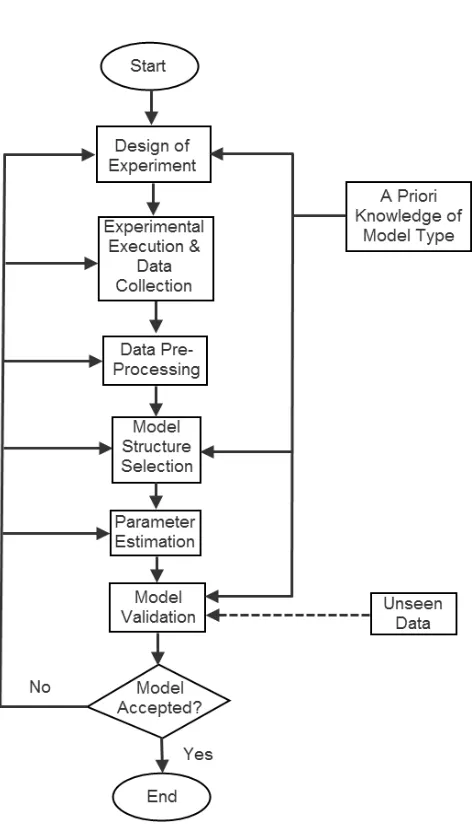
2.1 The Flow Chart of System Identification . . . 8
2.2 Black-box and White-box Models comparison . . . 12
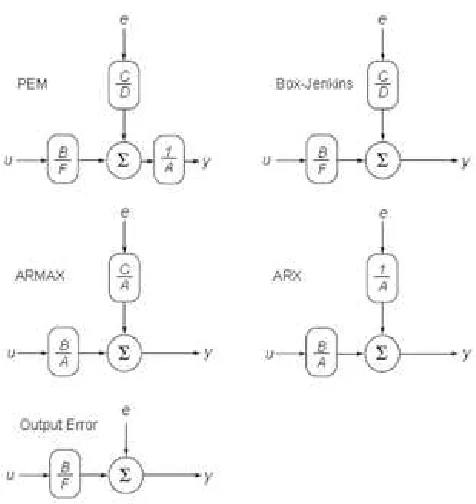
2.3 Linear black-box model classes . . . 14
2.4 The identified dynamical model with a series of unit tapped delays . . . 15
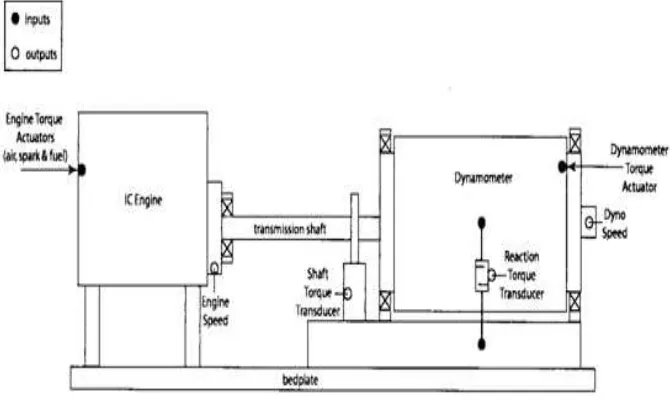
3.1 A schematic structure of the engine connecting with dynamometer . . . 19
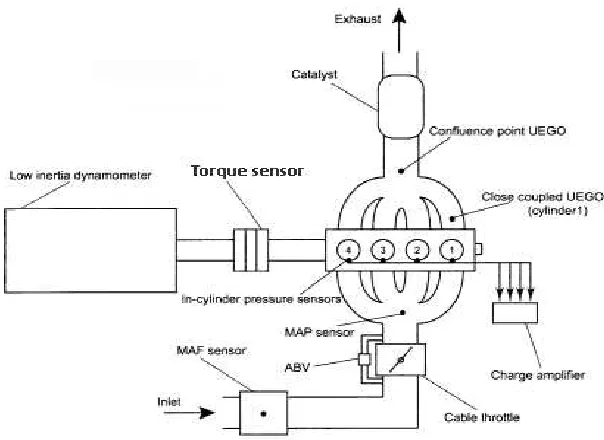
3.2 The key control devices for the engine test . . . 20
3.3 Variable Camshaft Timing scheme . . . 22
3.4 Inputs and Outputs of the VCT Engine . . . 24
3.5 VCT Engine Simulation Model in Simulink . . . 25
3.6 Throttle and Manifold Simulation Model . . . 25
3.7 VCT Engine Torque Model . . . 26
3.8 Inputs and Outputs of the Diesel Engine with VGT mechanism . . . 27
3.9 WAVE model developed for GTDI engine . . . 29
4.1 The data used for the SISO model identification . . . 39
4.2 The data used for the SISO model validation . . . 39
4.3 Coherence estimate via Welch’s method . . . 41
4.4 Order selection analysis . . . 41
4.5 The ARX model validation . . . 43
4.6 The investigation of the models obtained by different algorithms . . . 43
4.7 The structure of NARX model estimator . . . 44
4.8 The NARX model validation in Simulink . . . 46
4.9 The NARX model residual . . . 47
5.1 Pool of Regressors . . . 51
5.2 Structure Selection Flow Chart . . . 51
5.3 Stepwise Regression with F-statistics . . . 54
5.4 Orthogonal Least Squares with ERR detection . . . 59
5.5 Input Channels . . . 64
5.6 Prediction of torque using correlation criteria and ERR criteria . . . 65
5.7 Prediction of air/fuel ratio using correlation criteria and ERR criteria . . . . 65
6.1 The taxonomy of multi-models . . . 70
6.2 The generic multi-model structure . . . 71
6.3 Gaussian bell curves . . . 74
6.4 Log-sigmoid curves . . . 75
6.5 ARX/NARX model as block diagram with tapped time delays . . . 76
6.6 Relations between model fitness and regressor number . . . 78
6.7 Relations between model fitness and multiplication number . . . 78
6.8 Log-Sigmoid weighting function . . . 80
6.9 The infrastructure of the neural network model . . . 81
6.10 The test data of engine speed . . . 81
6.11 Torque Estimation using Nonlinear Multi-Affine Model . . . 82
6.12 Torque Estimation using Neural Network Model . . . 82
6.13 Air/fuel ratio Estimation using Nonlinear Multi-Affine Model . . . 82
6.14 Air/fuel ratio estimation using neural network model . . . 83
6.15 2D partitioning of LOLIMOT algorithm . . . 85
6.16 Flow chart of the LOLIMOT algorithm . . . 86
6.17 The LOLIMOT structure as a neural network . . . 86
6.18 Test data sets for LOLIMOT identification . . . 87
6.19 Data partitioning process (N: Engine speed L: Lambda) . . . 88
6.20 Weighting function curves . . . 89
6.21 Validation of the LOLIMOT model . . . 89
6.22 Local model number analysis . . . 90
7.1 Input channels for multi-model identification . . . 95
7.3 2D Scheduling for Torque and Air/Fuel Ratio . . . 97
7.4 Estimated vs Measured Air/Fuel Ratio by Error Reduction Ratio Analysis . . 98
7.5 Estimated vs Measured Torque Output by F-statistic Analysis . . . 99
7.6 R2 vs Multi-model Number for Air/Fuel Ratio Estimation . . . 99
7.7 Inverse MISO multi-model structure . . . 100
7.8 WAVE-RT engine test setup for inverse MISO multi-model . . . 101
7.9 Data channels of the inverse multi-model . . . 102
7.10 Data partitioning tree . . . 102
7.11 2D data partitioning with MAP and RPM . . . 103
7.12 The validation result of Inverse multi-model for spark advance (SA) . . . 103
7.13 The validation result of Inverse multi-model for throttle angle (THR) . . . . 103
7.14 A open-loop simulation of the inverse control . . . 104
8.1 The boundaries for the curve of the weighting function . . . 109
List of Tables
5.1 Input and Output Channels . . . 63
5.2 Stepwise Regression Using F-statistics (Reg: Regressor number) . . . 63
5.3 Regressers and Parameters in the Torque Model . . . 67
5.4 Regressers and parameters in the Air/Fuel Ratio Model . . . 68
5.5 Model Prediction Quality . . . 68
6.1 CORR and ERR Structure Selection Process at 1750rpm . . . 79
6.2 Local Linear Models for Torque(y1)and Air/Fuel Ratio(y2) . . . 92
7.1 Input and Output Channels . . . 94
7.2 Model Prediction Quality . . . 98
ABV Air-Bleed Valve
ACF Auto-Correlation Function
AFR Air-Fuel Ratio
AIC Akaikes Information Criterion
PRBS Modulated Pseudo-Random Binary Sequence
ATDC After Top Dead Centre
ARMAX AutoRegressive Moving Average with eXogeneous inputs
ARX AutoRegressive with eXogeneous inputs
BDC Bottom Dead Centre
BIC Bayesian Information Criterion
BJ Box-Jenkins
BTDC Before Top Dead Centre
DoE Design of Experiment
ECU Engine Control Unit
EGR Exhaust Gas Recirculation
EMS Engine Management System
FPE Final Prediction Error
FPW Fuel Pulse Width
FIR Finite Impulse Response
GDI Gasoline Direct Injection
GTDI Gasoline Turbocharged Direct Injection
HEGO Heated Exhaust Gas Oxygen
IC Internal Combustion
INJ Injected fuel mass
MAP Manifold Air Pressure
MIMO Multiple-Input-Multiple-Output
MISO Multiple-Input-Single-Output
MLE Maximum Likelihood Method
MSE Mean Squared Error
NARX Non-linear AutoRegressive Moving Average
NN Neural Network
OE Output Error
OLS Ordinary Least Square
PEM Prediction Error Method
PFI Port Fuel Injection
PRBS Pseudo Random Binary Sequence
PS Pattern Search
PSD Power Spectral Density
RBS Random Binary Signal
RPM Revolutions Per Minute
RT Real Time
SA Spark Advance
SAN Simulated ANnealling
SEM Simulation Error Method
SI Spark Ignition
SISO Single-Input-Single-Output
SQP Sequential Quadratic Programming
TDC Top Dead Centre
THR Throttle Angle
TRR Trust Region Reflective
TWC Three Way Catalyst
UDRN Uniformly Distributed Random Number
UEGO Universal Exhaust Gas Oxygen
VGT Variable Geometry Turbocharger
Introduction
The modern automotive I.C. engine system requires accurate and multi-dimensional
calibra-tion in order to meet increasingly strict emission and fuel consumpcalibra-tion regulacalibra-tions. The trend
of engine development is to the use of additional actuators, sensors and of more complex
tech-nologies with more prevalent transient dynamics. As a result, the number adjustable variables
in the engine operating space are increasing significantly which means that even more data
samples clustered across the larger operating space are needed to determine sufficient
informa-tion for statistically reliable engine calibrainforma-tion. Because the number of required data points
and corresponding optimisation effort increases exponentially with the number of adjustable
variables, this phenomena is known as ’curse of dimensionality’ [1]. Notwithstanding the
sig-nificant improvements brought by advanced numerical optimisation and design-of-experiment
(DoE) methods, due to the ’curse of dimensionality’ the cost of experimental based engine
tests to support the conventional static calibration procedures is becoming exponentially
time-consuming and costly. One potential way of addressing this issue is to capture
experi-mental data in a dynamic model during non-steady-state testing [2]. An additional advantage
of a dynamic modelling is that it may allow control of the engine dynamics which are likely to
become of increasing significance in forthcoming legislated drive cycles which have significant
engine transients and tightened emissions [3].
To capture the nonlinear dynamical behaviour of the advanced I.C. engine system
CHAPTER 1. INTRODUCTION 2
ever requires an efficient and reliable way to determine model type and subsequently model
parameters in the system-identification. Dynamic black-box identified polynomial models
have been widely considered by researchers for engine management system (EMS) mappings
instead of the current steady-state static pseudo-dynamic methods [4]. Hybrid structured
multi-models have been reported as being able to provide a capability to represent complex
nonlinear characteristics with the desired simple structure, however there are many choices
for the multi-model structure, including nonlinear terms, partition size, weighting choice,
lin-ear vs nonlinlin-ear etc. [5]. Such dynamic maps have the potential to improve emissions and fuel
consumption in transient operations for reduced computational time and ease of
implemen-tation including comprehension and calibration. Accordingly, structure selection methods
are required to choose the simplest effective models. Structure identification techniques to
determine the optimal structures of black-box models are the principal subject of this thesis.
1.1
Systems identification of SISO and MIMO models
The study of Single-Input-Single-Output (SISO) systems offer a way to reveal the cause
and effect interconnection between two variables and it is the central concern of system
identification. For a newly designed system or a manufactured item, we would always ask the
question like how will all the inputs affect the system outputs or what uncertainties the system
has. SISO models can be used to relate variables of any component in the engine whether
it is a small part such as a spark plug or a larger mechanism namely a turbocharger. The
SISO models are generally identified based on input/output data and physical information
gathered from the system [6]. Three significant areas are required to be considered before
the identification:
• Prior knowledge about physical phenomena
The behavior of the systems is guided by a series of physical principles such as Newton’s
laws and energy conservative laws, therefore, some outputs of the system are fully
predictable according to the physical analysis. For example, in an engine intake system,
of the cross section. Engine speed can be derived from the brake torque and crankshaft
inertia.
• Observed data
The observed data is the key information source for a complex system because physical
analysis becomes unfeasible due to the curse of dimensionality. The input signal design
is a significant procedure to make sure the information contained in the data is rich
enough. Meanwhile, the measured data is used to compare with the model output and
thus validate the model quality. The observed data can be measured directly by the
sensors in the system or indirectly calculated by measured data.
• Accuracy requirement of the model
Most of the model structure determination process runs iteratively thus a stopping
criteria is necessary for the identification process. This means the identified models are
only acceptable when certain thresholds are satisfied. The model with high accuracy is
significant but complex model structures may cost a long time in training the data and
calculating the output. A balance must be found otherwise it would make the model
difficult to be implemented in the real-time control systems.
In this thesis, SISO identification and structure selection techniques and also
Multiple-Input-Single-Output (MISO) system identification are investigated. In a complex engine
system, the output is always affected by various inputs and their cross relations. The proposed
strategy for a MIMO identification problem is to convert the Multiple-Input-Multiple-Output
(MIMO) identification problem into a network of MISO models which can be solved separately
when the outputs of the system are relatively independent of each other. With proper data
acquisition interface, such as dSPACE A/D conversion module, the data can be captured
and processed when the target system is in operation. In this case, the time-domain MIMO
models can also be identified in real-time by recursive least-squares estimation [7].
1.2
Overview
This thesis investigates various model structure selection techniques. Novel SISO and MISO
CHAPTER 1. INTRODUCTION 4
identified and validated on both a real and virtual engine setups.
Following this introduction, Chapter 2 introduces the general procedures of system
i-dentification. Both the static and dynamic system properties are discussed. The white-box,
black-box and grey-box model categories are described, especially the linear and nonlinear
black-box models. The model-based engine calibration is discussed as well.
Chapter 3 shows the infrastructures of four different engine test beds used in studies in
this thesis and introduces the sensors and actuators mounted on them.
Chapter 4 gives a detailed study of the application of Least Squares algorithm in
deter-mining the parameters of dynamical polynomial models. A series of dynamical SISO engine
models including linear and nonlinear ABV-RPM model are established and validated.
Chapter 5 demonstrates two major model selection techniques: the stepwise regression
with F-statistic analysis and the orthogonal least squares with error reduction ratio analysis.
The ANOVA algorithm is also introduced in this chapter. The dynamic models constructed
with these techniques are currently limited to linear, square and cubic regressors terms but
can be readily extended if necessary. A novel MISO dynamical model is developed by
appli-cation of the model structure selection techniques.
Chapter 6 extends the scope of model structure selection to the multi-model
identifi-cation. A number of multi-model structures are investigated, namely the LOLIMOT, and
the Neural Network. The general procedure of multi-modelling is described in this chapter.
Several novel dynamical multi-models are developed for different types of engines.
Chapter 7 applies an multi-model identification process to produce a novel forward and
inverse multi-model. The WAVE-RT virtual engine is adopted as the experiment test bed.
The forward model gives accurate estimation of the engine torque and air/fuel ratio whilst the
identified inputs.
Chapter 8 reviews the main outcomes of this thesis and discusses the thesis contributions
together with the future possible developments of these efforts.
1.3
Contributions
The novel contributions of this thesis are as follows:
• SISO dynamical models were developed based on PFI gasoline engine in Chapter 4.
The model structure are found by Matlab identification toolbox and validated by the
measured data. The polynomial model structure was adopted, especially, the
least-squares technique is adopted to determine the parameters of the models. Finally, both
ARX and NARX models of the engine system has been obtained.
• MISO dynamical models for IC engine was developed using stepwise regression and
orthogonal least squares techniques in Chapter 5. At the same time the detailed steps
of the iterative structure selection procedure are presented.
• A LOLIMOT model and a log-sigmoid weighted multi-model was established for IC
engines. The optimal number of local models is analysed according the multi-modelling
results.
• An inverse multi-model has been identified on a state-of-the art virtual engine model. The inverse model has been implemented to track the engine outputs of torque and
Chapter 2
Background
2.1
Dynamical System Identification for IC Engine
2.1.1 Static and Dynamical Modeling
A model for a system describes part or all of its characteristics depending on its application.
If we define two time pointst1 and t2 with u(t1) =u(t2) as their corresponding inputs, for
the static model, the model outputs would turn out to be y(t1) = y(t2). The relationship
between inputs and outputs remained unchanged with time in a static system. However, in
a dynamical system, the relationship is constantly evolving with time. In other words, the
outputs of static system only depend on the current inputs, but the outputs of dynamical
system will be affected by both current and previous inputs along the time line. In detail,
some modeling and control strategies for dynamic systems has been researched in [8, 9, 10].
2.1.2 Dynamic Engine Identification
System identification is a fundamental problem in systems engineering applications. The
application of system identification overlaps the boundaries of engineering and physical
sci-ence. Many other fields of study, such as economics and medicine, can also benefit from the
employment of system identification technology. Generally, system identification is the
termination of a mathematical model for a system or a process by observing its input-output
relationships [11]. In another word, a specific mathematical model which is equivalent in
input-output behaviour to a physical system can be obtained by this technology.
As the foundation of system identification, the input and output data should be
col-lected in a pre-designed experiment. Initially, the engine system is monitored by a set of
sensors and actuators according to our a priori knowledge, then a mathematical model for
the engine is developed by using structure selection and parameter estimation algorithms.
The engine model should be capable of reproducing the dynamics of the system over different
operating regimes. An accurate identified engine model is significantly beneficial for engine
calibration and control purposes. A schematic flow chart of the identification process is given
in Figure. 2.1 [12, 13, 14]
Design of Experiment
Dynamic system behaviour is represented by the current and past values of inputs and outputs
especially the transient response between the inputs and outputs. The experiment design
process applies clustering algorithm to locate a set of feasible operating points in order to
established dynamical model on a pre-defined working range with satisfying accuracy [15, 16].
To start an identification and control task, the input and output signals are to be
de-termined at the beginning. In the process of designing the experiment, a strategy of how
to efficiently and accurately acquire the information from the available experimental setup
should be established. In the case of engine test, the input and output signals are typically
transmitted into an A/D converter and processed in the computer. This means the resolution
and the sampling time of the sensor and actuator mounted on the engine must be
consid-ered in order to make sure the I/O data can be collected and managed in a sensible way.
Some prior knowledge of the system is vital because any experimental system has its
operat-ing limitations and experiment should always be conducted within the safe operatoperat-ing range.
Furthermore, the input and output signals need to be measurable within the experimental
budget. It is wise to avoid some parameters which are difficult to measure by indirectly
mea-suring related parameters. For instance, the throttle valve duty cycle is replaced by the Air
CHAPTER 2. BACKGROUND 8
instead of fuel injection mass. There are three major concerns in the design of the input
signals to be used for identification:
• Frequency Spectrum and Perturbation Time
The bandwidth of a dynamic system should be much wider than that of a static system.
Therefore, a proper input perturbation signal should be capable of exciting the system
across its bandwidth and revealing its nonlinearity as accurately as possible. In many
cases, step-shaped input signals, which change abruptly from one input value to another,
are preferred because they are equivalent to the superpositions of sinusoidal components
across an infinite number of frequencies. However, it is necessary to be aware that
instant change of the magnitude of input signal may result in damage to the test
equipment. The Pseudo Random Binary Sequence (PRBS) is another preferred option
in a digitally controlled experiment. The PRBS signal has the advantage of a wide
range of frequency content and a flat power spectrum density which is suitable for
dynamic identification. Other than the bandwidth of the PRBS signal which covers
a large spectrum between its lower frequency and upper frequency, the perturbation
time is also a deciding matter. The identified model of a dynamic system can only
be recognized as a good representation when the perturbation time is longer than the
delays of the system.
• Amplitude of the Signal
The amplitude of the signal does not pose any significant threat to the model accuracy
in linear identification applications because the gain of the system’s transfer function
is constant, in which case the output signal is proportional to the input. Therefore, the
PRBS signal with its two distinct levels is well accepted. For largely nonlinear systems,
the random walk signals which generated by uniformed random PRBS, a gain and an
integrator is believed to be a good choice. The variation of the signal amplitude of the
random walk signal aims to cover all the operating range of the nonlinear system and
capture the uncertainty within the nonlinear system.
• Sampling rate
The sampling rate refers to the time interval between the current and the subsequent
record of the signal generated by the sensors. The main constraint on achieving an
CHAPTER 2. BACKGROUND 10
achieve the speed of sampling required. It has been recommended [14] that the sampling
rate to be 10 times that of the interested variable’s bandwidth. For best results, the
highest sampling rate is usually adopted in any engine test and the researcher will then
be able to decide the down-sampling strategy depending on the modeling requirements.
It is worth noting that the down-sampling can only be applied after any sort of digital
anti-aliasing filtering [17]. At the same time, the test input signal designer should also
keep the input signal rate lower than that of the sampling rate.
Data Processing
Due to various requirements of an identification algorithm, the experimental data collected
from an engine test should be adjusted into suitable form. The oversampling of the recorded
data, the associated sensors noise and the switching of electronic noise should all be considered
as factors in the data processing.
1. Offsets Removal and Data Detrending
In a general engine test system, the sensors for physical measurement could lead to
bias or offset. To remove the offsets such as those existing in absolute pressure or
tem-perature measurement from the data greatly improves the quality of the identification
process [18]. Therefore, the mean value of the data is eliminated from the raw data
samples respectively. Alternatively, the offset term can be deducted from the I/O
sig-nal in the identification process. Offsets can be revealed in the raw data or detected
in general trends like linear drifts or seasonal trends, and thus the best fitted trend is
subtracted from the I/O data in order to cancel these trends [17]. Usually, the sampling
rate is taken as higher than necessary in order to improve the optimizing result with the
amount of increase in rate based on the specific accuracy requirements. Since a system
with high order dynamics can have both fast and slow modes such a system may need
to be measured at high rate over a longer time requiring many more data samples than
for a system with low order dynamics. Further a high order system may require a much
faster sampling rate to capture its transient nonlinear behaviour, whereas a lower order
model containing a similar nonlinearity can be obtained with a much reduced sampling
2. Elimination of Outlier Points
Outlier points are the non-normal data which may be caused by localized anomalous
events or measurement errors involved in the system. These data points will break the
regulation of the data and dramatically affect the accuracy of the results. Hence the
outlier points ought to be eliminated before the identification. Due to the severe cost
to the identification process, it is better to avoid it in the experiment design stage.
Otherwise, the outlier points can be recognized as lost data which can be deleted from
the raw data.
3. Pre-filtering
A frequency domain filter is designed to modify the frequency response of a system,
normally by either emphasizing or attenuating certain frequency ranges. A
significan-t regulasignifican-tion has been found significan-thasignifican-t, for significan-the linear syssignifican-tem, filsignifican-tering bosignifican-th significan-the inpusignifican-t and
output data by the identical filter does not impact the relationship between input and
output signals [14]. Hence the filter can be used while collecting the original data and
the type of filter is decided by the application region and the sort of the disturbance.
For the data sampling applications, an anti-aliasing filter should be utilized, with a
separate frequency in the middle position of the sampling frequency which named as
Nyquist frequency. And then the ambiguity caused by aliasing of high frequency
com-ponent at low frequency can be eliminated. However, if the noise and disturbances
is in the region of well defined frequency, then the band-stop filter can be applied for
identifying the attenuation of specific frequency bands. Moreover, a band-pass filter
can be adopted while identifying the dynamics in a particular frequency range. Since
the influence of unknown external noise sources or disturbances is always existent in
the data used for identification. It can be concluded that the choice of filtering strategy
is significant factor which concerns whether the satisfactory results can be obtained for
system identification.
2.1.3 White-box Models
A white-box model is transparent from outside viewers. It usually integrates key physical
CHAPTER 2. BACKGROUND 12
the dynamic system. In order to develop the model, various scientific laws can be used,
including thermodynamic laws, Kirchhov’s laws, Newton’s laws and reaction kinetics [19].
An illustrative physical modelling which described a powertrain system was presented in [20].
An engine in-cylinder model based on the principles of thermodynamics are introduced in [21]
and another kinematical model is established in [22]. Therefore, the white-box model is also
recognized as phenomenological or physical model. With the confirmation of the physical
parameters in the model, the engine system dynamics can be fully understood. However, in
a complex system like a powertrain engine, the white-box models lacks the ability to make
approximations in order to simplify the identification process thus difficult to be implemented
in digital device such as Engine Control Unit (ECU) .
Figure 2.2: Black-box and White-box Models comparison
2.1.4 Black-box Models
The black-box approach of modelling relies entirely on the input/output data from the test
bed. In this sense, system identification can be seen as a behavioural approach for model
development. [13]. Since the system’s physical property is assumed to be unknown, the
model structures are mainly constructed by weighted combinations of basis functions or time
delayed regressors obtained from the real system’s I/O channels. Black-box models can be
identified as either parametric or non-parametric models. Parametric models are developed
by determining the parameters in relevant transfer functions or state-space matrices, while
non-parametric models are focused on estimating a model in frequency domain, such as
impulse responses and frequency responses. A predefined quality criterion, such as goodness
black-box model because it is not interpretable in the physical sense. The trial and error tests are
needed as stated in [23] because the black-box models are only valid over the operating range
where the models are identified and could become unreliable elsewhere.
Linear black-box models
As demonstrated in [24], the simplest dynamical black-box model is called the Finite Impulse
Response (FIR) model. In Equation 2.1, the FIR model is represented as:
y(t) =B(q)u(t) +e(t)
=b1u(t−1) +· · ·+bnu(t−n) +e(t) (2.1)
whereq is the shift operator andB(q) is a polynomial in q−1. Hence the predictor ˆy(t|θ) =
B(q)u(t) of this FIR model are only formed by regressors of input delays. The regressor
vector is then defined as
φ(t) = [u(t−1), u(t−2),· · ·, u(t−n)] (2.2)
As we involve more delayed terms in the regressor vector, the model is able to reflect more
system dynamics. However, in practice, the regressors in the vector should be selected and
the noise term e(t) are assumed to be Gaussian distributed or to be modelled in different
ways.
The general structure of black-box model family is proposed in [14] as:
A(q)y(t) = B(q)
F(q)u(t) +
C(q)
D(q)e(t) (2.3)
Specially, various classes of models can be derived from Equation 2.3. As shown in Figure 2.3,
the linear black-models are categorised as Prediction Error Method (PEM) model as shown in
Equation 2.3, the Box-Jenkins (BJ) model whenA= 1, the ARX model whenF =C=D=
CHAPTER 2. BACKGROUND 14
The predictor of the model output can be defined as the regression form in [25]:
ˆ
y(t|θ) =θTφ(t, θ) (2.4)
[image:28.595.205.443.211.463.2]where the parameter vectorθ= [θ1, θ2, θ3, ...].
Figure 2.3: Linear black-box model classes
Nonlinear black-box models
The nonlinear black-box model estimator is able to be described as a nonlinear functiong(·)
of regressor vectorφ(t) and corresponding parameter vectorθ as
ˆ
y(t|θ) =g(φ(t), θ) (2.5)
In the case of discrete system, the time shift operator q is transformed into z and
the output dynamics of the system is revealed by difference dynamics or tapped delays [6].
Figure 2.4 demonstrates the dynamical model with tapped delays. The past inputs and
outputs of the system can be restored by these delay taps and recycled into the dynamical
1), y(t−2)...y(t−n) are used in the feedback, the dynamical model is named as NARX
(Nonlinear AutoRegressive with eXogenous input) model. On the other hand, if the model
outputs ˆy(t),yˆ(t−1), ...,ˆ(y−n) are adopted as the feedback, the model should be categorised
as the NOE (Nonlinear Output Error) Model. From the prospect of model identification, it is
likely that NOE mode will offer better simulation results than that from an ARX or NARX
model which are identified using the measured data.
Figure 2.4: The identified dynamical model with a series of unit tapped delays
Here we define input and output regressor asu(t−nu),y(t−ny), the model predicted
output as ˆy(t−ny|θ). Then the simulated output ˆyu(t−ny|θ) can be defined as the model
output ˆyu(t|θ) at time t with all measured outputs y(t−ny) replaced by the simulated
output ˆyu(t−ny)|θ) computed k-step ahead. Therefore, the model prediction error becomes
e(t−ne) =y(t−ny)−yˆ(t−ny|θ) and the simulation error iseu(t−ne) =y(t−k)−yˆu(t−ny|θ).
Based on these expressions, the corresponding nonlinear version of the model types are
defined as [26, 27]:
• NFIR models which only includes input regressors u(t−nu)
• NARX models which contain both input and output regressorsu(t−nu) andy(t−ny)
CHAPTER 2. BACKGROUND 16
• NOE models which useu(t−nu) and ˆy(t−ny|θ) as regressors when the simulated model output is calculated iteratively as ˆyu(t)|θ)
• NBJ models which adoptu(t−nu),y(t−ny),e(t−ne|θ) andeu(t−ne|θ) as regressors. In this model class, the simulated output ˆyu is determined by using the structure of
Equation 2.5 at the same time substituting e and eu by zero vectors in the regression
vector φ(t, θ).
2.1.5 Grey-box Models
A comparison between Black-box and White-box models is shown in Fig. 2.2. The white-box
model’s high interpretability is most advantageous, but it requires exact knowledge of the
system. On the other hand, the black-box model is capable of fast simulation of the system but
not interpretable in physical sense. In reality, model identification lies in somewhere between
the two ends. These model classes can be called the Grey-box models which offers higher
flexibility in system identification process. When we has some a priori physical knowledge
about the system but are not able to solve the parameters associated with it, the data-based
black-box approach can be applied. In terms of interpretability, the physical implication of
the model parameters can be retained and assessed by the designer of the control system.
A series of grey-box models, namely neuro-fuzzy systems and semi-physical models can be
found in [28, 29].
2.1.6 Dynamic Engine Calibration
Engine calibration aims to develop the optimal engine operating scheme under varies
restrain-s, such as: emission legislation, fuel consumption and requests from the driver [30]. The best
trade-off are required to be found because these requirements contradict in the engine
mech-anism. Some of the extensive applications of engine dynamical calibration are documented
in [16]. The engine systems is conventionally calibrated by static mapping techniques which
are based on multi-dimensional tables describing the relationship among the engine inputs
and outputs. With more advanced technology being applied to the engine system, the
Consequently, the calibration time of the engine will be rising enormously due to the curse of
dimensionality. A lot of researchers suggest that the dynamic models are capable to overcome
the shortcomings of the static calibration, mainly the time-consuming experiment [31, 32].
The model-based calibration is introduced to meet the challenge of more advanced
en-gine calibration. The enen-gine properties is represented by mathematical models instead of
look-up tables. The engine control scheme is then developed based on the engine mapping
generated by engine model testing. Consequently, it is essential for the engine model to be
accurate enough to predict the engine dynamic behaviour. Various types of engine models
were investigated extensively by researchers. The examples of physical models of the air, fuel
and mechanical systems can be found in [33, 34]. The neural networks have also been applied
to engine modelling. The manifold pressure and mass flow processes were modelled in [35]
with eternal recurrent networks.
In this thesis, the engine system is recognized as a complex dynamical system which
memorizes its previous states. From this point of view, the calibration of the engine can
be based on a series of dynamic I/O models. With proper designed test cycle, namely New
European Driving Cycle or random walk signal, the engine static or dynamical model can be
developed solely from the information contained in the data set. It can be concluded that
the model-based engine calibration can significantly reduce the pre-production time thus it
Chapter 3
Experimental and Virtual Test Bed
Setup
This chapter describes the experimental equipment and setup used for investigation of the
identification techniques for multi-model development and local model structure
identifica-tion.
3.1
Ford Port-Fuel-Injected (PFI) Zetec Engine
The Liverpool University low inertial dynamometer system installed with Ford Zetec 1.6L PFI
4 cylinder S.I. engine is used for the experimental studies in this thesis. A schematic picture
of an engine dynamometer is represented in Figure 3.1. The engine dynamometer system
comprises a test engine and a dynamometer with a connecting transmission shaft. The engine
torque can be controlled by a combination of air, fuelling, spark angle inputs. An in-line
torque transducer is available to measure the torque, and a total reaction torque measurement
arrangement is also available. The other dynamometer parameter is the rotational speed of
the engine shaft and it is measurable by a shaft encoder. A detailed comparison between
PFI and GDI engine mechanism can be found in [36]. The direct injection techniques are
offen used to achieve better fuel dispersion and homogeneity. The control strategies of GDI
combustion is briefly introduced in [37, 38].
Figure 3.1: A schematic structure of the engine connecting with dynamometer
The results obtained from the engine dynamometer identification provide the data to
determine the effectiveness for any engine modelling or control strategies. Four basic control
modes may be adopted to control the dynamometer [39]:
• Independent Mode: In this mode, the dynamometer torque position is controlled open-loop, which means the disturbances to the model state will not affect the input to the
dynamometer actuator.
• Speed: Here, the speed of the dynamometer is adjusted using closed-loop control with dynamometer speed as the tracked variable.
• Torque: the closed loop system is adopted in this mode to track a desired shaft torque. This mode is useful for the simulation of external loads to increment or decrement the
tracked torque and is obtained by the addition of disturbance signals to the
dynamome-ter torque actuation channel.
• Power: The engine power is determined by the product of torque and rotational speed. Hence the engine power is controlled by adjusting both of them simultaneously.
For identification purposes, the engine system is regarded as a black box. Hence the
main objective of the experiment is to provide the information to reveal the characteristics
CHAPTER 3. EXPERIMENTAL AND VIRTUAL TEST BED SETUP 20
to collect and record the raw data from the engine test. The data thus obtained from the
experiment are inputs to the identification process to determine the mathematical model
and provide the evidence for the validation of the resulting model. The directly measured
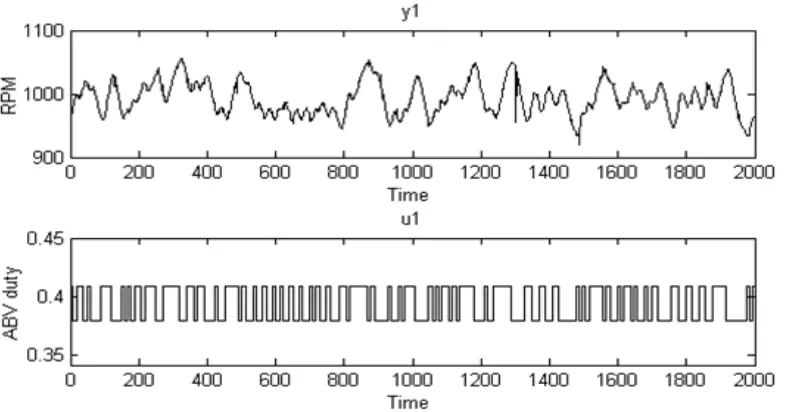
variables include ABV (Air Bleed Valve) Duty Cycle, MAP (Manifold Air Pressure), ABV,
SA and RPM of the engine crank. Among these parameters, for modelling in this thesis, the
ABV Duty Cycle and MAP are regarded as measured input signal while the RPM and UEGO
[image:34.595.168.470.261.481.2]readingλare chosen as the measured output. The experimental set is shown in Figure 3.2.
Figure 3.2: The key control devices for the engine test
The test engine is a four cylinder engine with four strokes cycle providing four strokes
every 720◦. The number of raw data, the samples can achieve 1 million, since samples are
collected by the software each degree of crank angle. In order to simplify the input control,
the throttle switch is turned off which corresponds to a fixed throttle angle of 8◦, thus almost
all the entered air is bypassed through the ABV. In order to reduce the error, it is necessary
to collect adequate amount of data samples for data processing. Before the test is started, the
engine speed is adjusted to around the idle speed of 1000 rpm and a braking load is applied
by the dynamometer. The dSPACE system is used to collect all the signals and sample them
3.2
Variable Cam Timing(VCT) Engine
For conventional gasoline engines, the intake and exhaust valves are driven by the camshafts
and the cam timing is adjusted by a timing belt which binds the crankshaft and the camshaft.
By adjusting the phase difference between the camshaft and the crankshaft angle, the timing
belt can synchronize the valve and piston movements in a fixed timing. With optimized
timing of inlet and outlet valve opening in variable valve timing (VVT) engine, the volumetric
efficiency is boosted and the torque output can be increased in all the engine operating regions
thus the fuel economy is improved [40]. Meanwhile, the retard of exhaust valve opening will
reduce or replace the use of exhaust gas recirculation system which would generate more CO
and NOx emissions [41].
Variable Camshaft Timing (VCT) is an automotive variable valve timing technology in
current advanced engines used by many manufacturers including the Ford Motor Coperation.
The VCT technology is an innovation used to minimize the engine emissions whilst providing
also satisfactory fuel economy and driver experience. It has been proved effective and applied
extensively in the industry. This technology has offered considerable merits: it is able to
reduce emissions such as oxides of nitrogen(N Ox) and unburned hydrocarbons(HC) [42],
and also to improve the full load performance of the engine [43]. The specific feature of the
VCT engine, the cam timing is precisely advanced on retarded according to the engine speed
as determined by an optimized engine mapping.
VCT offers another effective way to reduce NOx and HC emissions other than the
ex-haust gas recirculation(EGR) valve systems. However, the VCT mechanism requires more
sophisticated control schemes to achieve the emission reduction target. As shown in Fig 3.3
, the exhaust gas is sucked back in to the cylinder after TDC is reached. The gas mixture
in the cylinder is diluted by the retained exhaust gas which reduces the combustion
temper-ature. Therefore, the NOx generation is suppressed under lower tempertemper-ature. Meanwhile,
the recirculated exhaust gas containing unburned HC from the cylinder or piston wall
inter-face will undergo combustion in the next engine cycle. The camshaft of the VCT engine is
actuated by a hydraulic mechanism and the valve timing is adjusted according to the engine
inlet and exhaust cycle. There are several cam timing schemes, namely Dual Variable Cam
tim-CHAPTER 3. EXPERIMENTAL AND VIRTUAL TEST BED SETUP 22
ing of Dual-VCT is adjusted simultaneously with the fixed phase differences. On the other
hand, the Ti-VCT adjusts the intake and exhaust camshaft separately in order to produce
higher power and torque and at the same time keep the emissions to a minimum. However,
the Ti-VCT scheme will increase the complexity of the timing actuator and the cost of the
engine.
Figure 3.3: Variable Camshaft Timing scheme
In this thesis, a VCT engine model developed by Stefanopoulou [44] is investigated by
establishing a Matlab Simulink model and simulating the dynamical properties obtained from
the empirical polynomial model given in Stefanopoulou’s work.
The calibration and control target of our study is to maintain the stoichiometric Air/Fuel
Ratio while minimizing the HC and NOx emissions. The key features of the engine, such
as the throttle angle, engine pumping rate, torque generation and NOx and HC emissions
are included as the calibration variables. In detail, the manifold air pressure is physically
determined by the mass flow rate into the throttle body and cylinder as shown in
Equation-s (3.1) (3.2).
Km =
R·T Vm
= 287
J
Kg·K ·288K
0.007m3 = 0.118bar/g (3.1)
(288K),Vm represents the manifold volume (0.007m3), andKm is the resulting constant.
The rate of change of the manifold pressure is determined by:
d
dtPm=Km( ˙mθ−m˙cyl) (3.2)
where ˙mθ represents the mass air flow rate into the manifold and ˙mcyl is the engine pumping
mass air flow rate. These two air flow rates can be calculated by Equations (3.3) and (3.4)
respectively:
˙
mθ =g1(Pm)·g2(θ) (3.3)
˙
mcyl=F(1, CAM, CAM2, CAM3, Pm, Pm2, Pm3, N, N2, N3) (3.4)
where CAM is the camshaft angle, N is the engine speed, Pm is the manifold pressure, θ
represents the throttle angle and
g1(Pm) =
1 if Pm ≤P0/2, P0= 1 atm
2/P0
p
PmP0−Pm2 if Pm> P0/2
(3.5)
and
g2(θ) =F(1, θ, θ2, θ3) (3.6)
The cylinder mass air flow, torque and NOx and HC emissions are modeled by the
static algebraic functions of cylinder air charge (CAC), camshaft angle (CAM), manifold
air pressure (Pm), air/fuel ratio (A/F) and engine speed (N). The schematic output model
structure is outlined in Equation (3.4) (3.7) (3.8) and (3.9):
CHAPTER 3. EXPERIMENTAL AND VIRTUAL TEST BED SETUP 24
N Ox =F1(1, N, N2)·F2(1, CAM)·F3(1, A/F, A/F2, A/F3)·F4(1, Pm, Pm2) (3.8)
HC=F1(1, N, N2)·F2(1, A/F, A/F2, A/F3)·(F3(1,
1
Pm
) +F4(1, CAM,
CAM
P
1 16 m
)) (3.9)
A new Simulink realization which simulates this VCT engine model is shown in
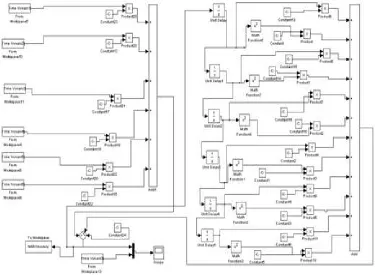
Fig-ure 3.5. The Simulink model is constructed in four subsystems which determine the four-stoke
phases: throttle and manifold intake, air/fuel compression, ignition and combustion, exhaust
generation. Each subsystem has its own physical and empirical sub-models with
correspond-ing inputs and outputs. For the intake system, air flow rate, throttle angle and manifold air
pressure are recognized as inputs. In the final stage, the brake torque is a modelled output
of the combustion system while the NOx and HC emissions are estimated outputs of the
exhaust system.
Figure 3.4: Inputs and Outputs of the VCT Engine
3.3
Diesel Engine with VGT and EGR
Diesel Engines are widely used in heavy-duty vehicles due to its higher torque output and
Figure 3.5: VCT Engine Simulation Model in Simulink
CHAPTER 3. EXPERIMENTAL AND VIRTUAL TEST BED SETUP 26
Figure 3.7: VCT Engine Torque Model
the turbocharger and the supercharger. However, these two mechanism adopts different
working strategy. The turbochargers utilize the kinetic energy of the exhaust gas flow and
improved the energy efficiency of the engine, but it only works effectively when the engine
operates at relatively high speed. Meanwhile, the superchargers are directly connected with
the crankshaft which is driven by the engine main combustion power, therefore its response
time is shorter and working consistently during the engine operating time. Nevertheless, the
supercharger requires to keep drawing power from the engine which reduce the power and
torque output on the wheels [45].
For the purpose of minimizing the emission within the legislated limit, exhaust
recir-culation and variable-geometry turbochargers have been introduced into the Diesel engine
design. A well-established Diesel engine model which is presented in [46] was adopted as
a test template for the multi-model. This model was peer-reviewed and validated from the
industrially obtained experimental data [47] [48] [49]. As shown in Figure 3.8, eight state
variables are involved in the engine model structure: the intake manifold pressurepim, the
exhaust manifold pressure pem, the intake oxygen mass fraction XOim, the exhaust oxygen
mass fractionXOem, the turbocharger speedωt, and three actuator state variableuδ,uegr,uvgt
where uδ is the mass of injected fuel, uegr represents the EGR valve position and the uvgt
is the VGT valve position. The valve position value varies from 0(closed) to 1(fully open).
form of Equation 3.11:
u= (uδ uegr uvgt)T (3.10)
whereuδis the injected fuel,uegris the position of EGR valve, anduvgtis the actuator position
of the VGT.
The state-space model:
˙
x=F(x,u, N) (3.11)
where the function F(·) is developed by combining the dynamic physical properties of all
the key components shown in Figure 3.8 [50]. The dynamic testing of the Diesel engine
was conducted by generating randomly input sequences foruand then observing the output statesxat different engine speed(N) through the time of the test.
Figure 3.8: Inputs and Outputs of the Diesel Engine with VGT mechanism
3.4
WAVE-RT Petrol Engine Model
The model structure identification techniques is applied to a high accurate industrially
CHAPTER 3. EXPERIMENTAL AND VIRTUAL TEST BED SETUP 28
disturbances, namely, temperature and moisture, could cause system uncertainty and
com-promise the validation results however in terms of experimental effectiveness, the
computer-aided engine simulator is able to conduct highly repeatable engine test within relative low
time and cost budget. At the same time, the engine model maintains good flexibility to
changing component units and parameters. The subject engine for WAVRT model is an
E-coBoost 2.0-Litre GTDI engine provided by the Ford Motor Co.. The WAVE real-time model
is built on an ISO approved software package named RICARDO WAVE platform [51, 52].
The WAVE platform contains a library of modelling components in the area of
compressible-flow fluid networks and machinery. In terms of engine modelling, it offers elements such
as piston compressor, engine cylinder, throttle, turbocharger and turbine. The time-variant
variables for the engine, including temperature, cylinder pressure and air mass flow rates, can
be measured directly in SI or Imperial units and monitored within the simulation process.
WAVE is recognized as a state-of-the-art industrial design tool and has extensive
appli-cation in engine performance assessment. From early concept studies to detailed engine
pro-duction investigations, the WAVE model can be used throughout the engine design process.
Common applications include torque response, fuel consumption, turbocharger response,
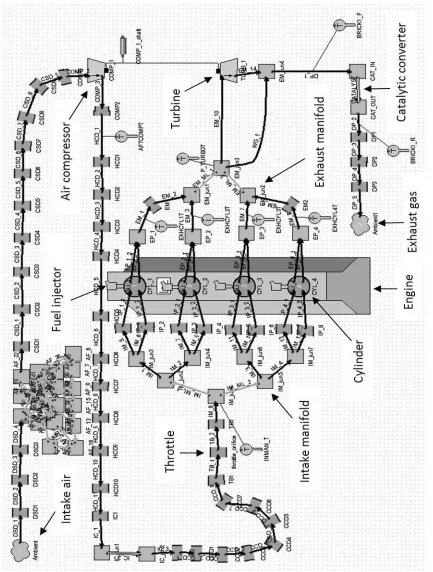
E-GR studies, valve profile design and timing optimization. As shown in Figure 3.9, for the
sake of simplicity of use, the Wave-RT model is mainly comprised of a series of connection
of physical models of engine components along with the engine breathing pipeline, including
throttle and cylinder intake mechanism. As a concept engine design tool, the wave model is
recognized by Ford engineers as a realistic alternative to the real engine for conducting initial
stages of a control scheme. The engine simulation results obtained from the WAVE model
can be plotted in various standard graphical formats and validated by different types of real
Chapter 4
Engine SISO Model Identification
4.1
Method of Least Squares Parameter Identification
The methods used for the data processing are the most significant factors which affect the
accuracy and reliability of the identification results. The basic algorithm for parameter
identification, the least-squares algorithm, is introduced in this chapter.
Least-squares (LS) theory was first proposed by Karl Gauss for predicting the orbit of the
planets. Since then, the LS theory has become a principle tool for parameter estimation from
experimental data. The LS method is easy to comprehend and does not require an extensive
knowledge of mathematical statistics; thus it is widely used among scientists and engineers.
Furthermore, estimates obtained by LS methods have optimal statistical properties which are
consistent, unbiased and efficient [11] . Before applying LS theory, the choice of input and
output signal of the system are required to be decided.
4.1.1 Definition of the vector norm
The concept of vector norms is described in the mathematical representation. A vector norm
onRn is a functionf :Rn→R that satisfies the following properties [53]:
f(x)≥0 x∈Rn, (f(x) = 0 if f x= 0) (4.1)
f(x+y)≤f(x) +f(y) x, y∈Rn (4.2)
f(αx) =|α|f(x) α∈R, x∈Rn (4.3)
Such a function is denoted with a double bar notation: f(x)=kxk. With different sub-scripts on the double bar, various norms can be distinguished. Then the p-norms are defined
by:
kxkp= (|x1|p+· · ·+|xn|p) 1
p p≥1 (4.4)
Three of these norms are the most significant:
kxk1 =|x1|+|x2|+· · ·+|xn| (4.5)
kxk2= (|x1|2+|x2|2+· · ·+|xn|2) 1
2 = (xTx) 1
2 (4.6)
kxk∞=max1≤i≤n|xi| (4.7)
Note that a unit vector is a vector x which satisfieskxkp=1.
4.1.2 Least-squares via the minimum error-squares
an n-tuple setX= (x1,x2,· · · ,xn) are related linearly to a variable y:
CHAPTER 4. ENGINE SISO MODEL IDENTIFICATION 32
whereθ= (θ1, θ2,· · · , θn)T is an n-tuple constants so thaty=Xθ. Let the sum of squares of errors be determined as follows [54]:
J = N
X
t=1
e2(t) =eTe
= (y−Xθ)T(y−Xθ)
=yTy−θTXTy−yTXθ+θTXTXθ (4.9)
The equation to determine the stationary point for derivation of the minimum of J with
respect toθis:
dJ
dθ =−2X
Ty+ 2XTXθ= 0 (4.10)
which leads to
XTy=XTXθ (4.11)
The second derivative ofJ can be represented as:
d2J
dθ2 = 2X
TX (4.12)
which requires XTX > 0 for a minimum and therefore the stationary point obtained from Equation 4.11 is able to make the sum of squares J minimum. Hence the least square estimator
(LSE) for the polynomial model 4.8 is
xLS = ˆθ=
XTX−1
XTy (4.13)
4.1.3 Least-squares via QR algorithm
Let X ∈ Rm×n with m
≥ n and b ∈ Rm and suppose Q ∈ Rm×m is an orthogonal matrix
such that
QT =Q−1
whereI is the identity matrix. The QR algorithm starts from the matrix formation that
QTX =R=
R1,n×1
0(m−n)×1
(4.15)
where the matrix X is formed asX= [x1, x2, x3..., xn]T and if
QTb=
hn×1
g(m−n)×1
(4.16)
In the least-squares algorithm, the aim is to determine ˆθwhich is able to minimizekXθ−bk22.
Obviously, this problem is equivalent to the minimization ofQTXθ−QTb
2
2. In this case
kXθ−bk22 =QTXθ−QTb
2
2 =kR1θ−hk 2
2+kgk22 (4.17)
For any x ∈Rn, if rank(X)=rank(R
1)=n, then ˆθ is defined by the upper triangular system
such that
R1ˆθ=h
ˆ
θ=R−1
1 h (4.18)
Based on this QR Algorithm, the coefficient vector of ˆθ can be obtained.
4.1.4 Least-squares via SVD algorithm
In linear algebra, the SVD is a vital factorization of a rectangular real or complex matrix,
with several applications in signal processing and statistics. Applications which employ the
SVD include computing the pseudo-inverse, matrix approximation, and determining the rank,
CHAPTER 4. ENGINE SISO MODEL IDENTIFICATION 34
Q and Z are orthogonal matrices such that
QTXZ =T =
T11 0r×(n−r)
0(m−r)×r 0(m−r)×(n−r)
r =rank(X)
kXθ−bk22=
(QTXZ)ZTθ−QTb
2
2=kT11a−ck 2
2+kdk22 (4.19)
where in the Equation 4.19,X= [x1, x2, x3..., xn]T,
ZTθ=
ar×1
b(n−r)×1
QTb=
cr×1
d(m−r)×1
If the 2-norm ofx is minimum, b must be zero and a=T11−1c. Therefore,
xLS = ˆθ=Z
T−1 11 c
0
(4.20)
4.1.5 Least squares via Recursive Least-Squares (RLS) algorithm
The requirement for recursive solutions arise when fresh experimental data are continuous
in supply and on-line results are required. With recursive formula, the LS estimates can be
updated at each experimental data sample. The recursive methods are often called sequential
or on-line estimation methods.
If the first m groups of data are embedded in matrixXm and ym, then
ym =Xmθ (4.21)
Hence the least squares estimator can be written as:
ˆ
θ(m) = (XTmXm)−1XTmym (4.22)
Assume a vector of new experimental datax(m+ 1) and y(m+ 1) are then obtained, where
if we define
xT(m+ 1) = [x1(m+ 1), x2(m+ 1),· · · , xn(m+ 1)] (4.24)
Then the output of next time point is
y(m+ 1) =xT(m+ 1)θ (4.25)
Consequently, the new data system including the (m+ 1)th equation can be written as
ym+1 =xm+1θ (4.26)
in which
ym+1=
y(1) y(2) .. .
y(m)
y(m+ 1)
= ym
y(m+ 1)
(4.27)
Xm+1=
x1(1) · · · xn(1) ..
. . .. ...
x1(m) · · · xn(m)
x1(m+ 1) · · · xn(m+ 1)
= Xm
xT(m+ 1)
(4.28)
Hence the new least-squares estimator of next iteration is
ˆ
θ(m+ 1) = [XTm+1Xm+1]−1XTm+1ym+1 (4.29)
Without matrix inversion, the new estimator ˆθ(m+ 1) can be calculated by simply updating
CHAPTER 4. ENGINE SISO MODEL IDENTIFICATION 36
this. Let A,C and A+BCD be nonsingular square matrices; then the following
Sherman-Morrison-Woodbury formula holds [11]:
(A+BCD)−1 =A−1−A−1B(C−1+DA−1B)−1DA−1 (4.30)
whereA is n-by-n matrix,U is n-by-k, C is k-by-k and V is k-by-n matrix. If we define the
matrixP(m) as
P(m) = (XTmXm)−1 (4.31)
then
P(m+ 1) = (XTm+1Xm+1)−1 = (XTmXm+x(m+ 1)xT(m+ 1))−1 (4.32)
Applying the matrix inversion lemma described in Equation 4.30, let A = P(m)−1, B =
x(m+ 1), C= 1 and D=xT(m+ 1), then P(m+ 1) can be written as follows:
P(m+ 1) = [P(m)−1+x(m+ 1)xT(m+ 1)]−1=P(m)−
P(m)x(m+ 1)[1 +xT(m+ 1)P(m)x(m+ 1)]−1xT(m+ 1)P(m) (4.33)
From Equation 4.27 and 4.28
XTm+1ym+1=XTmym+x(m+ 1)y(m+ 1) (4.34)
Substituting Equation 4.32 and 4.34 into Equation 4.29, the following relation holds:
ˆ
θ(m+ 1) =P(m+ 1)[XTmym+x(m+ 1)y(m+ 1)] = (P(m)−P(m)x(m+ 1)[1 +xT(m+ 1)P(m)x(m+ 1)]−1
The above equation can be transformed into
P(m)XTmy(m)−P(m)x(m+ 1)[1 +xT(m+ 1)P(m)x(m+ 1)−1
·xT(m+ 1)P(m)XTmym+P(m)x(m+ 1)y(m+ 1)
−P(m)x(m+ 1)[1 +xT(m+ 1)P(m)x(m+ 1)]−1
·xT(m+ 1)P(m)x(m+ 1)y(m+ 1) (4.36)
The last two terms of Equation 4.36 can then be rearranged into the form
P(m)x(m+ 1)[1 +xT(m+ 1)P(m)x(m+ 1)]−1
·[1 +xT(m+ 1)P(m)x(m+ 1)
−xT(m+ 1)P(m)x(m+ 1)]·y(m+ 1)
=P(m)x(m+ 1)[1 +xT(m+ 1)P(m)x(m+ 1)]−1y(m+ 1) (4.37)
From Equation 4.22 and 4.31, the following relations can be obtained:
ˆ
θ(m) =P(m)XTmym (4.38)
Finally, the ˆθ(m+ 1) can be written as
ˆ
θ(m+ 1) = ˆθ(m)−P(m)x(m+ 1)[1 +xT(m+ 1)P(m)x(m+ 1)]−1
·xT(m+ 1)P(m)XTmym +P(m)x(m+ 1)[1 +xT(m+ 1)P(m)x(m+ 1)]−1y(m+ 1) = ˆθ(m) +P(m)x(m+ 1)[1 +xT(m+ 1)P(m)x(m+ 1)]−1
·[y(m+ 1)−xT(m+ 1)ˆθ(m)] (4.39)
The result obtained in Equation 4.39 shows that the next estimator is calculated by the
previous one plus a correction term. Therefore, the recursive least-squares estimation can be
executed by the following equations:
ˆ