Creativity and Collaboration in the
Recording Studio: An Empirical Study
Thesis submitted in accordance with the requirements of the University of Liverpool
for the degree of Doctor in Philosophy by:
Paul Thompson
October 2015.
Abstract
There is increasing evidence that creativity is the result of a dynamic system of interaction where the individual is only one part. Csikszentmihalyi describes a ‘creative system’ that includes three main elements: the domain, the field and the
individual (Csikszentmihalyi: 1988, 1997, 1999 & 2004). During creative work, the individual must draw from the domain in order to select a suitable arrangement of
ingredients from this body of knowledge and symbol system. This selection of
ingredients is then presented to the field, the social organization that recognises, uses
and alters the domain, to decide upon its creativity and inclusion into the domain
(Csikszentmihalyi, 1997). In the context of rock music this occurs when the completed
record is released to the public and the field of rock record production (TV, radio,
popular music press, other musicians, engineers and producers etc.) decides upon the
record’s novelty and its relevant addition to the domain through an often complex and
iterative process. However, little has been written from a creative system’s perspective
about what happens inside the recording studio before the record is released.
Consequently, the interaction of the creative system’s main elements during smaller
acts of creativity, such as the individual generation of ideas, and the collaborative
exchanges that take place during group creativity, have been relatively underexplored.
This thesis explores the creative process of making a rock recording inside the
recording studio using the framework of the creative system. Ethnographic methods
such as participant-observation, video and sound recording were used to observe the
interaction between the performing musicians, the engineer and the record producer as
they collaborated during the recording process. This helped to reveal the complex
interaction between the participants and the creative system’s main elements during the
creative tasks of performing, engineering and producing. Importantly, it helped to
show for the first time that this interaction occurred on both an individual level and a
group level, and highlighted how a creative-systems approach can be used to gain a
Declaration of Authorship
I, Paul Thompson declare that this thesis and the work presented in it is my own and
has been generated by me as the result of my own original research. I confirm that:
1. This work was done wholly while in candidature for a research degree at the
University of Liverpool;
2. Where any part of this thesis has previously been submitted for a degree or any
other qualification at this University or any other institution, this has been clearly
stated;
3. Where I have consulted the published work of others, this is always clearly
attributed;
4. Where I have quoted from the work of others, the source is always given. With the
exception of such quotations, this thesis is entirely my own work;
5. I have acknowledged all main sources of help;
6. Where the thesis is based on work done by myself jointly with others, I have made
clear exactly what was done by others and what I have contributed myself;
7. Parts of this work have been published as:
Thompson, P., & Lashua, B. (2014). ‘Getting It on Record: Issues and Strategies for
Ethnographic Practice in Recording Studios'. Journal of Contemporaty
Ethnography, Vol. 43(3). pp. 746-769.
Thompson, P., & McIntyre, P. (2013). Rethinking Creativity in Record Production
Education: Addressing the field. Journal on the Art of Record Production,
Dec, 2013. Available from:
Acknowledgements
The premise of this study is that creativity is the result of collaboration and this has
certainly been the case in the creation of this thesis with the assistance and guidance of
numerous people. First and foremost the completion of this thesis would have been
inconceivable without the dedicated help and guidance of Phillip McIntyre. I owe a
debt of gratitude for your continued support, encouragement, expertise, advice and
generosity throughout the entire process and it’s an honour to be counted as your
friend. Secondly, this study would have also been impossible without the passionate
engagement of all of the participants and I would like to thank all of those who took
part and offered their time, insight and expertise so freely throughout. Marc, Paul,
Chris, Mike, Rory, Nick, Jess, Phil and Darren I thank you.
Huge thanks too to my supervisor Sara Cohen for her unrelenting critique and feedback
that has contributed so much to the cohesion of this thesis and thank you too to Rob
Strachan. I would also like to thank my fellow colleague and friend Brett Lashua
whose critical eye and understanding of the finer points of ethnography were pivotal in
bringing the methodology chapter to life. I have had also had the pleasure of being a
member of the Association for the Art of Record Production and I would like to thank
all members, past and present, for their lively debate during conferences, their
camaraderie and friendship. It is here that I’ve found my academic home and an outlet
for my research. Thank you too to all of the musicians I have worked with over the
years who have helped me to celebrate the joy of making music and making records.
Finally, and most importantly, I would like to thank my family who have nurtured and
supported my interest in music my entire life and who continue to inspire and
encourage me. One of my earliest memories is listening to Elvis Presley on my
Grandad’s record player and it is here that my fascination for records began. Without
you all, and your encouragement, none of this would have been possible so Mum, Dad,
Dedication
This thesis is dedicated to the eternal memory of family members who have
passed…you are gone but not forgotten:
Table of Contents
ABSTRACT ... 2
DECLARATION OF AUTHORSHIP ... 3
ACKNOWLEDGEMENTS ... 4
DEDICATION ... 5
TABLE OF CONTENTS ... 6
LIST OF FIGURES ... 8
INTRODUCTION ... 9
RESEARCH INTO CREATIVITY ... 16
INTRODUCTION ... 16
1.1THE CREATIVE PERSONALITY ... 19
1.2CREATIVITY AND COGNITIVE PSYCHOLOGY... 21
1.3CREATIVITY AND CULTURAL PRODUCTION ... 24
1.4CREATIVITY AS A SYSTEM IN ACTION ... 29
1.6CREATIVITY AND THE GROUP ... 35
1.7STUDIES OF GROUP CREATIVITY... 36
1.8GROUP CREATIVITY AS A SYSTEM ... 39
CONCLUSION ... 44
STUDIES INSIDE THE RECORDING STUDIO ... 46
INTRODUCTION ... 46
2.1THE SOUND ENGINEER IN THE RECORDING STUDIO ... 48
2.2THE RECORD PRODUCER IN THE RECORDING STUDIO ... 51
2.3THE PERFORMER IN THE RECORDING STUDIO ... 54
2.4COLLABORATION AND CREATIVITY IN THE RECORDING STUDIO... 57
CONCLUSION ... 61
METHODOLOGY: GETTING THE CREATIVE AND COLLABORATIVE PROCESSES ‘ON RECORD’ ... 63
INTRODUCTION ... 63
3.1GETTING IN ... 65
3.2GETTING ON ... 72
3.3GETTING IT DOWN ... 77
3.4GETTING IT ‘ON RECORD’ ... 85
CONCLUSION ... 88
THE DOMAIN OF ROCK RECORD PRODUCTION, THE PARTICIPANTS INSIDE THE RECORDING STUDIO & THEIR DOMAIN KNOWLEDGE ... 90
INTRODUCTION ... 90
4.1THE PARTICIPANTS AND THEIR ROLES IN THE RECORDING STUDIO ... 91
4.2THE DOMAIN OF ROCK RECORD PRODUCTION ... 92
4.2.1MUSICAL ASPECT OF THE DOMAIN ... 93
4.2.2TECHNICAL ASPECT OF THE DOMAIN ... 97
4.2.3CULTURAL ASPECT OF THE DOMAIN ... 100
4.3THE PARTICIPANTS’PROCESS OF DOMAIN ACQUISITION ... 105
4.3.1MUSICAL DOMAIN ACQUISITION ... 107
4.3.2TECHNICAL DOMAIN ACQUISITION ... 113
4.3.3CULTURAL DOMAIN ACQUISITION AND ENCULTURATION ... 119
4.3.4INFLUENCES ON DOMAIN ACQUISITION ... 123
4.4STAGES OF CREATIVE ACTIVITY:DEVELOPING A ‘HABITUS’ AND INTUITION ... 125
THE FIELD OF ROCK RECORD PRODUCTION: ITS MECHANISMS AND CRITERIA
FOR SELECTION ... 131
INTRODUCTION ... 131
5.1CULTURAL INTERMEDIARIES WITHIN THE FIELD OF ROCK RECORD PRODUCTION ... 134
5.2THE RECORDING INDUSTRY AS PART OF THE FIELD ... 135
5.3THE MEDIA AS PART OF THE FIELD ... 142
5.3.1THE RADIO ... 144
5.3.2TELEVISION AND MUSIC VIDEOS ... 150
5.3.3THE POPULAR MUSIC PRESS ... 153
5.4THE AUDIENCE AS PART OF THE FIELD ... 156
5.5PARTICIPANTS INSIDE THE RECORDING STUDIO AS PART OF THE FIELD ... 159
CONCLUSION ... 164
PERFORMING IN THE RECORDING STUDIO ... 166
INTRODUCTION ... 166
6.1THE ROLE OF THE PERFORMING MUSICIAN ... 168
6.2PRE-PRODUCTION ... 169
6.3PRODUCTION ... 174
CONCLUSION ... 191
ENGINEERING IN THE RECORDING STUDIO ... 193
INTRODUCTION ... 193
7.1THE ROLE OF THE ENGINEER ... 195
7.2PRE-PRODUCTION ... 196
7.3PRODUCTION ... 198
7.4POST-PRODUCTION ... 211
7.4.1MIXING... 211
7.4.2MASTERING ... 214
7.5DEVELOPING A ‘FEEL’ FOR ENGINEERING ... 216
CONCLUSION ... 217
PRODUCING IN THE RECORDING STUDIO ... 219
INTRODUCTION ... 219
8.1THE ROLE OF THE RECORD PRODUCER ... 220
8.2PRE-PRODUCTION ... 222
8.3PRODUCTION ... 228
8.4POST-PRODUCTION ... 236
8.4.1MIXING ... 236
8.4.2MASTERING ... 244
CONCLUSION ... 244
CREATIVITY AND COLLABORATION IN THE RECORDING STUDIO ... 247
INTRODUCTION ... 247
9.1COLLABORATION IN THE RECORDING STUDIO ON AN INDIVIDUAL LEVEL ... 248
9.2COLLABORATION IN THE RECORDING STUDIO ON A GROUP LEVEL ... 251
9.3GROUP PROCESSES DURING COLLABORATION IN THE RECORDING STUDIO ... 253
9.4BEYOND THE GROUP LEVEL OF COLLABORATION IN THE RECORDING STUDIO ... 257
CONCLUSION ... 259
CONCLUSION ... 260
BIBLIOGRAPHY ... 268
APPENDICES ... 291
GLOSSARY ... 291
APPENDIX I–QUESTIONS THAT GUIDED THE FIRST ROUND OF SEMI-STRUCTURED INTERVIEWS ... 292
APPENDIX 2–INTERVIEW AND SESSION DETAILS ... 295
List of Figures
Fig. 1: ‘The increasingly large concentric circles in this simplified schematic
represent the major levels at which creativity forces operate’ (Hennessy &
Amabile, 2010: 571).
Fig. 2. ‘Componential Model of Creativity’ (Amabile: 1996: 113).
Fig. 3. Systems Model of Creativity (Csikszentmihalyi, 1999: 315).
Fig. 4. ‘General Model of Creativity’ (Csikszentmihalyi & Wolfe 2000: 81). Fig 5. ‘A Generic Model of Group Creativity’ (Nijstad and Paulus, 2003: 334). Fig. 6. ‘Revised Systems Model of Creativity incorporating creative practice’.
(Kerrigan 2013: 114).
Fig. 7. ‘The field of Commercial Record Production’ (Thompson & McIntyre, 2013). Fig. 8. ‘The Interrelated Tasks of Record Production Inside the Recording Studio’. Fig. 9. ‘The Four Camera Perspectives inside Elevator Studios’.
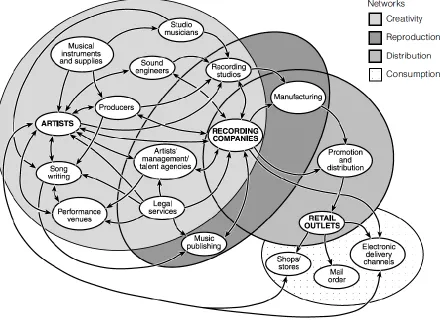
Fig. 10. ‘Musical Networks’ (Leyshon, 2001: 61). Fig. 11. ‘Nested Audiences’ (Sawyer, 2012: 218). Fig. 12. ‘Model of Flow’ (Csikszentmihalyi, 1997: 74). Fig. 13. ‘Group Flow’ (Sawyer, 2003: 168).
Fig. 14. ‘2D Model of the filtering of Musical Parts by the Immediate Field’.
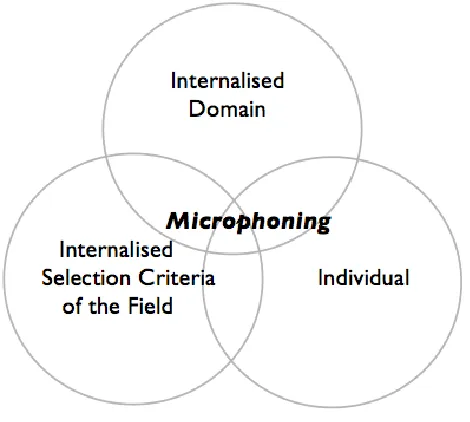
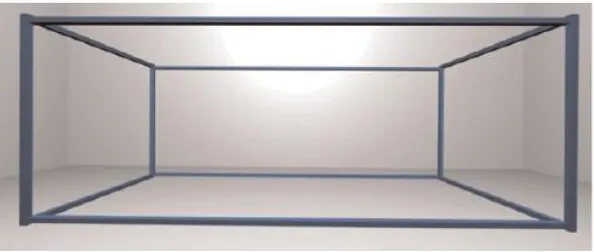
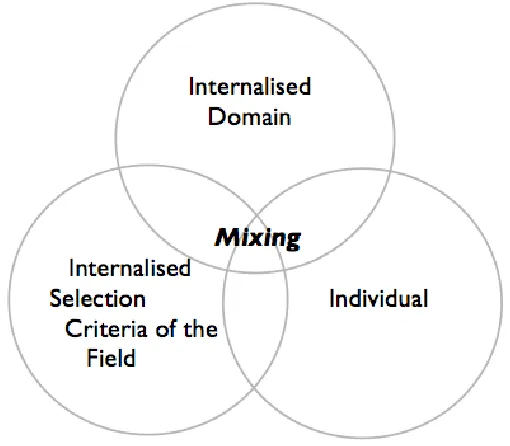
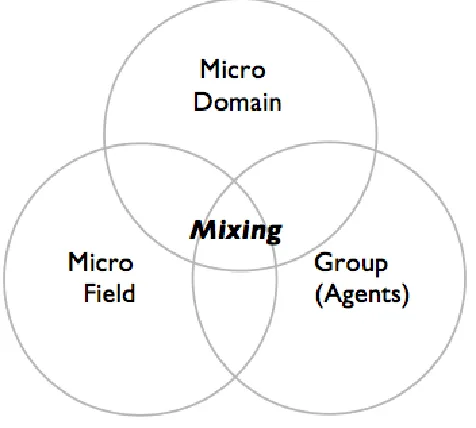
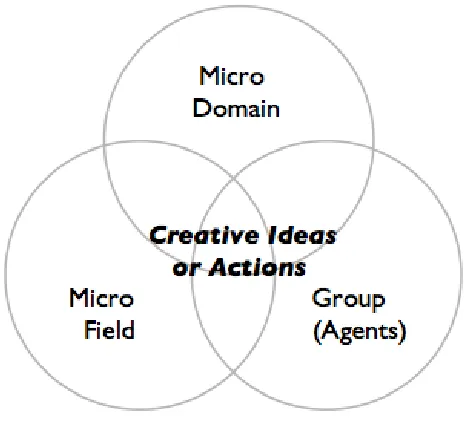
Fig. 15. ‘Revised 2D Model of the filtering of Musical Parts by the Immediate Field’. Fig. 16. ‘The Systems model scaled to an individual level during microphoning’. Fig. 17. ‘The Systems model scaled to a group level during microphoning’. Fig. 18. ‘The Sound-box template’ (Moore and Dockwray, 2010a: 184). Fig. 19. ‘The Systems Model Scaled to an Individual Level During Mixing’. Fig. 20. ‘The Systems Model Scaled to a Group Level During Mixing’. Fig. 21. ‘The Systems model scaled to an individual level’.
Fig. 22. ‘The Systems model of Creativity scaled to a Group Level’.
INTRODUCTION
In a recording studio, on a side street in Liverpool, record producer Marc is sitting
beside sound engineer Darren in front of Elevator studio’s spaceship-like mixing desk.
They are both listening intently to the group of rock musicians recording their third
run-through of their song ‘Southpaw Billy’ in the room below them. During the final
chorus, Marc turns to Darren and smiles, “this is a good one, isn’t it?” Darren nods in
agreement. This scenario is played out in countless recording studios around the world
as musicians, engineers and record producers engage in the record making process.
However, despite the primacy of recordings within the sphere of rock music1 (Gracyk,
1996; Moore, 2001) very little has been written critically about how rock records are
actually made. Even after a century of sound recording: ‘the process of making records
remains at least a partial mystery to the majority of those who listen to them’ (Zak,
2001: 26).
Researchers have historically given their attention to audiences, their reception and use
of sound recordings, often overlooking the cultural producers, who wrote, performed,
recorded or directed them (Berger, 1995:145-146). Where attention is given to cultural
producers in the field of rock music and rock record production, it is the musician who
is deemed worthy of study and the contributions of engineers and record producers are
often overlooked or diminished. Moreover, rock musicians are typically portrayed as
the sole creative entities during the recording process (Williams, 2007), endorsing the
Romantic ideal of a musical ‘genius’ whose artistic expressions are connected to the
mystical and seen to be free from any constraint (Zolberg 1990, Petrie 1991, Watson
2000, Sawyer 2006). These Romantic images form part of the numerous myths that
surround the rock artist in the recording studio, the record production process and
creativity more generally. These Romantic ideas are so embedded into the culture of
1
the commercial recording industry that they are considered to be ‘common sense’
(McIntyre, 2012). Consequently, Romanticism is: ‘reflected in the way artists are sold
to audiences, the way audiences think about what happens when records are made’
(McIntyre, 2012: 149).
These Romantic images and portrayals of creativity in rock record production are
problematic however, particularly when one considers that a record is rarely the result
of an individual artist’s sole contribution (Zak, 2001). In the opening scenario, the
engineer, the record producer and recording musicians are working together inside the
recording studio and therefore making a rock record is intrinsically collaborative and
involves: ‘the efforts of a “composition team” whose members interact in various
ways’ (Zak, 2001: 63). Romantic ideas of the record-making process however have
historically been difficult to disprove because of the private nature of the recording
studio where the process often takes place behind closed doors. Moreover, the
recording studio has also been relatively neglected in the field of ethno-musicology
with only a handful of dedicated studies published in this area (Fitzgerald 1996;
Meintjes 2003; Hennion, 2005; Porcello 2004; Bates, 2008; McIntyre, 2008 & 2012).
The opening scenario therefore poses a number of questions related to the creative
process of record-making. Firstly, what is involved in making a record? How do the
engineer, record producer and recording musicians collaborate whilst making a record?
What are their roles and what are the elements that govern their interaction? And,
importantly, how can the record producer and engineer judge whether it is a good or a
bad take and what are the contributing factors in making this judgement? Some of
these questions have been addressed within disciplines such as cognitive psychology
and sociology. Sociological studies of creativity have concluded that creative products,
such as rock records, are the result of a creative system in action (Csikszentmihalyi,
1997). Mihalyi Csikszentmihalyi argued that creativity isn’t simply the result of an
individual’s efforts. Rather, creativity occurs through the interaction between the
system termed the ‘domain’; a social group that understands and uses the domain termed a ‘field’ and finally the individual. The individual is therefore only one element
in a dynamic and interrelated creative system of causality (Csikszentmihalyi, 1997).
The creative system therefore provides a useful starting point to investigate the creative process of making a recording. The system posits that the individual must draw from the domain during creative work in order to select a suitable arrangement of
ingredients from this body of knowledge and symbol system. This selection of
ingredients is then presented to the field, the social organization that recognises, uses
and alters the domain, for evaluation (Csikszentmihalyi, 1997). The function of the
field is then: ‘to select promising variations and to incorporate them into the domain’ (Csikszentmihalyi, 1988: 330). If the field accepts the individual’s variation then this variation is considered to be ‘creative’. In the context of commercial rock music this
process occurs when the completed record is released to the public and the field of rock
record production (TV, radio, popular music press, audiences, social media, other
musicians, engineers and producers etc.) decide upon the record’s novelty and its
addition to the domain through a complex and non-linear process. For an idea or
product to be creative it must therefore use the domain to create something with an
element of originality, it must be valued by the social organisation that understands and
uses the domain, and it must be included into the domain. In other words, it must be:
‘original, valued and implemented’ (Csikszentmihalyi and Wolfe, 2000: 81).
In relation to the opening scenario in the recording studio above however, this
perspective appears to exclude creative ideas or products that do not alter the domain
in some way or leave a trace in the cultural matrix. The creative system therefore appears to discount smaller acts of everyday creativity and creative products that are
not accepted into the domain. This creates a misleading distinction between the type of creativity that alters the content of a domain, and the type of creativity that does not.
Employing a systems approach to the study of creative ideas or products that are not
implemented into the domain, such as a rock record that has yet to be judged by the
systems model of creativity in a group context because the original model only refers
to an individual. As the production of rock records is fundamentally a collaborative
process (Hennion, 1990; Wicke, 1990; Zak, 2001), using a systems framework appears
to be difficult. Finally, the apparent grandiose scale of the model presents the issue that
it does not apply to the individual’s generation of creative ideas and their internal
evaluative processes as they undertake creative work inside the recording studio
because the interaction between the system’s main elements is not immediately
evident.
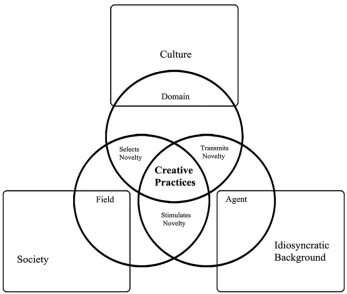
Recent revisions to the systems model however have begun to illustrate how the creative system can be applied to both the collaborative context of the recording studio and from a perspective that includes everyday creativity (Boden, 2004; Kerrigan, 2013). Susan Kerrigan’s revised model of creativity (2013) demonstrates how the creative system’s framework can be applied to a specific creative context, such as making a rock record, by re-contextualizing each of the generic elements of the creative system (Kerrigan, 2013). Furthermore, the ‘individual’ has also been replaced
with ‘agent’, which allows the systems model to accommodate creative groups as well
as individuals.These revisions still endorse the useful definition that creativity is: ‘an
idea or product that is original, valued and implemented’ (Csikszentmihalyi and Wolfe,
2000: 81), and further allows the study of creativity to extend to creative ideas or
products that don’t (or may not yet) alter the content of the domain2
because they are
the product of the creative system in action.
There were however still two pertinent issues to address in using a systems approach to creativity. Firstly, exactly how the elements of the creative system interacted on a group level as the recording musicians, engineer and record producer collaborated on
the production of the record. And secondly, how the creative system’s elements interacted on an individual level in devising and evaluating creative ideas. Having
worked on countless records as a recording engineer myself, I had two broad aims for
this study. Firstly, to illuminate and explore some of the processes involved in making
2
a record, such as performing, engineering and producing. And secondly to investigate
how an engineer, a record producer and recording musicians creatively interact as they
collaborate to make the record by using the creative system as a useful way to structure
and frame my observations. The principal tasks involved in rock record production
typically include songwriting, arranging, performing, engineering and producing (Zak,
2001), however the musicians in this study had already written and arranged the songs
and the investigation primarily focuses on the observable tasks of performing,
engineering and producing inside the recording studio.
The revised systems model of creativity (Kerrigan, 2013) provided a fundamental framework to investigate the creative and collaborative processes involved in
undertaking these tasks. The domain and the field have therefore been contextualised
so that they apply to the specific context of rock record production. For example, the domain of rock encompasses various aspects such as the instrumentation of rock, the song, its arrangement, and specific terminology. The contextualised field includes the participants inside the recording studio as the social group that understands and applies
the domain in assessing the creativity of each individual’s creative contribution. A
creative contribution, in the context of this study, includes creative ‘actions’ as well as ‘ideas’ that are: ‘original, valued and implemented’ (Csikszentmihalyi and Wolfe,
2000: 81) because they require the interaction between the system’s elements.
In order to explore the creative ideas, actions, processes and practices involved in
completing the three main tasks a number of ethnographic approaches were employed.
Firstly, participant-observation throughout the entire record-making process was
crucial in gaining a first-hand perspective on the interaction between the musicians,
engineer and record producer in the often-private setting of the recording studio.
Engineering one of the sessions also helped to gain an insider’s perspective on the way
in which the participants worked together. Multi-angle film cameras were used to
create a more permanent visual record of the participants’ movements and interactions
and provided a useful resource to guide my in-depth interviews with them. Sound
as they externalised their creative thoughts and ideas. Participant-observation, video
and sound recordings, and in-depth interviews allowed the interaction between the
three main elements of the creative system to be explored as the participants undertook
their creative tasks inside the recording studio. Closer analysis of these interactions led
to the development of two scaled system models in order to address some of the
previously stated apparent problems of using the creative system to investigate smaller
acts of creativity.
This thesis has been structured to first present the re-contextualised elements of the
creative system as they apply to rock record production, and then illustrate the
interaction of these elements during the three principal tasks of performing,
engineering and producing. The first two chapters provide the foundation for this thesis
by reviewing research into creativity and then related studies inside the recording
studio. Chapter one presents the systems model of creativity in more detail and
illustrates its aforementioned revisions (Kerrigan, 2013) within the context of this
study inside the recording studio. Furthermore, I make the argument that the creative
system is scalable by drawing on the concept of ‘holons’ (Koestler, 1975), or systems
within systems, so that the creative system’s framework can be used to investigate
creative actions and ideas on an individual level as well as a group level inside the
recording studio. The second chapter follows on from research into creativity and
explores studies inside the recording studio within the context of the three observable
tasks that are investigated in this thesis: performing, engineering and producing. The
chapter concludes by defining the aims of this study in relation to previous studies into
creativity and collaboration in the recording studio (Fitzgerald, 1996; McIntyre, 2008,
2012).
The third chapter introduces the ethnographic methods that have been used to
empirically explore the creative system inside the recording studio. Although the study
has a reduced singular cultural and historical focus than in previous studies in this area
(Meintjes 2003; Hennion, 1990; Bates, 2008) employing ethnographic methods in the
more generally. Issues of access to the data, cultivating and maintaining relationships
with participants, observing and collecting data in the specialised and unique
construction of the recording studio, and the interpretation and representation of the
participants’ actions and interactions are all discussed.
Chapters four and five begin the contextualisation of the creative system to apply to the
specific context of making a rock record inside the recording studio. Chapter four
introduces the participants inside the studio and illustrates the domain of rock based
record production and the participants’ knowledge of it. The fifth chapter introduces
the field of rock record production, its institutions and its: ‘complex network of experts
with varying expertise, status, and power’ (Sawyer 2006:124). The participants’
knowledge of the field and its selection criteria is presented alongside the discussion.
Chapters six, seven and eight are concerned with performing, engineering and
producing inside the recording studio respectively. Each chapter illustrates how, during
each task, the participants inside the recording studio interacted with the elements of
the creative system to produce creative ideas, actions or practices. Using specific
examples within each of the tasks, it is uniquely illustrated how the creative system can
be scaled to on an individual level and a group level. The penultimate chapter
illustrates how, during collaboration inside the recording studio, the system’s three
principal elements (agent, field and domain) interact in a complex system of causality
I I
RESEARCH INTO CREATIVITY
Introduction
Sound recordings hold a critical place in the popular music industry and specifically
within the musical style and culture of rock3 (Gracyk, 1996; Ray, 1992; Zak, 2001).
Although a wealth of anecdotal literature on recording and studio practice exists, little
has been written critically about the creative and collaborative processes that are
necessary for sound recordings to be made and it has been argued that: ‘a critical
interrogation of creativity should be central to any understanding of musical
production’ (Negus and Pickering in Hesmondhalgh & Negus 2002: 147). Record
production is fundamentally a collaborative, creative process (Hennion, 1990; Wicke,
1990; Zak, 2001), and although there is now growing empirical evidence of this (e.g.
Davis 2008, McIntyre 2008a & 2012, Moorefield 2005, Howlett 2012), the creative
and collaborative processes involved in record production still remain enshrined in
mysticism in the popular imagination (Warner, 2003; Williams, 2011). Furthermore,
creativity has become an often-misused term because of its broad range of application
to all manner of everyday processes, procedures, approaches and notions of inspiration
or new ideas (Csikszentmihalyi, 1997; Negus and Pickering, 2004). The general
understanding ofcreativity is often perceived as something ‘inexplicable’ or
‘mysterious’ (Boden, 2004: 11) and this mysteriousness of creativity relates to the
often-unchallenged dictionary definition of creativity: ‘to bring into being or form out
of nothing’ (Boden, 2004: 11). If this definition is considered literally then creativity
3
appears to be the result of an impossible process because musicians and music-makers
cannot make something from nothing (Boden, 2004).
The modern Western-notion of the term creativity has its etymological origins in
Judeo-Christian tradition, in which the celestial creation of the earth is central to both
Jewish and Christian faiths (Boorstin, 1992). Expressions of a divine nature of
creativity were evident in the philosophical writings of both Socrates and Plato in
which they describe the voice of God speaking through the poets (Barfield, 2011). The
etymological origin and the paradoxical nature of creativity have therefore implicitly
influenced popular beliefs about creativity in which there are two general views:
‘inspirational’ and ‘Romantic’ (Boden, 2004). These views assume that creativity
cannot be systematically explored or reduced to its constituent parts and, importantly,
these popular views are: ‘believed by many to be literally true but they are rarely
critically examined’ (Boden, 2004: 14). These mythical ideas of creativity typically
function to: ‘express the values, assuage the fears, and endorse the practices of the community that celebrates them’ (Ibid). The celebration and praise of these practices
however: ‘doesn’t necessarily mean that exceptional or highly innovative creative acts
are simply equivalent to them’ (Negus and Pickering, 2004: 200).
The unchallenged historic and cultural ideas connected to creativity often place the
individual at the centre of creativity and the creative process. However more recent
research has determined that the individual is only one part of the creative process and
there is growing evidence that creativity occurs though a convergence of multiple
factors within a dynamic system of interactions (Csikszentmihalyi: 1988, 1997, 1999 &
2004). In parallel with research into creativity, the definition of creativity has moved
beyond the inexplicable and a limited focus beyond the individual to acknowledge
these broader interactions. There are then complex influences placed on individuals as
they undertake creative work, which include: ‘a variety of interrelated forces operating
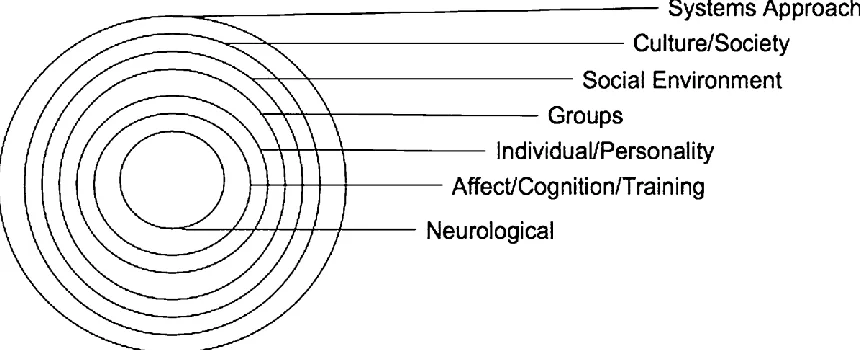
at multiple levels’ (Hennessy & Amabile, 2010: 569). These interrelated forces include
social group, the group’s culture and the broader influence of society as shown in
[image:18.612.120.550.135.310.2]Figure 1 below:
Fig. 1: ‘The increasingly large concentric circles in this simplified schematic represent
the major levels at which creativity forces operate’ (Hennessy & Amabile, 2010: 571).
The following chapter reviews research into creativity that draws upon a range of
disciplines including psychology (in several of its variants), philosophy, sociology, and
literary and cultural theory. It has been argued that an interdisciplinary approach to the
study of creativity is necessary in order to appreciate the: ‘variety of interrelated forces
operating at multiple levels’ (Hennessy & Amabile, 2010: 569) within a creative
system.
Each section of the chapter therefore explores the literature on creativity according to
its discipline and, where possible, in chronological order to illustrate both the historical
trends of creativity research and the various perspectives afforded by each discipline.
The first section reviews research that broadly relates to creativity and the individual,
which includes the creative personality, cognitive psychology and creativity, and
finally creativity from a sociological perspective. The subsequent section reviews
studies on group creativity and identifies approaches to studying groups, group
behaviour and group processes. The chapter concludes by defining the adopted
1.1 The Creative Personality
Early studies into creativity focused primarily on the individual and their biological
makeup. For example, Sir Francis Galton (1869) undertook the earliest known study
into creativity concentrating on the notion of ‘hereditary genius’ by investigating its
systems and consequences through historical analysis. Although in later editions of his
work Galton expressed the wish to substitute the word ‘genius’ with ‘ability’, his
introductory statement outlined his central argument that: ‘a man's natural abilities are
derived by inheritance, under exactly the same limitations as are the form and physical
features of the whole organic world’ (1869: 1). The investigation into heredity genius
focused on a number of different categories of historically prominent individuals such
as judges, statesmen, kings, commanders, writers, scientists, poets, painters, musicians,
scholars, oarsmen and wrestlers, and attempted to illustrate their inherited ability
simply through the depiction of family lineage. Even within his own results Galton
found anomalies and irregularities, and creativity research subsequently progressed
beyond a focus on basic genetic legacy, concentrating more on the ‘creative’ individual
with an emphasis on the creative personality.
The creative ‘personality’ has been investigated by studying a creative individual’s
personality traits and their personality type. Personality traits are defined as: ‘the
smallest units of individual variation that are consistent, reliable and valid (Sawyer,
2012: 63). Personality types are a finite set of personality characteristics that can be
used to classify creative individuals. The study of creative personality traits began with
the foundation of the Institute for Personality Assessment and Research (IPAR) at the
University of California in the United States in 1949. Studies involved the invitation of
a peer-reviewed selection of creative people from a particular field who were subjected
to a series of tests to determine their personality traits. After 20 years of research at the
Institute, and profiling a number of creative personality traits, it was found that the
initial model of an ‘egghead…longhair…withdrawn’ (MacKinnon, 1978 as cited in
Sawyer, 2012) personality was almost entirely inaccurate. Rather, the personality traits
attraction to complexity, independence of judgement and flexible decision making)
were traits of content and productive individuals.
Creative personality research continued into the 1970s studying personality types as
well as traits, in which numerous personality theorists developed their own personality
type models. The most widely-used personality type model is the ‘five factor model’
(Furnham, 2008), commonly termed the OCEAN model, an acronym derived from the
five factors of Openness to experience, Conscientiousness, Extraversion,
Agreeableness and Neuroticism (Costa & McCrae, 1992). Of all of the five traits,
openness to experience has been shown to be the most closely connected to creativity:
Openness to fantasy (a good imagination); aesthetics (being artistic); feelings
(experiencing and valuing feelings); actions (trying new things and having
many interests); ideas (being curious and smart, and welcoming challenges);
and values (unconventional and liberal) (Sawyer, 2012: 66).
Research into creative personalities (Barron & Harrington, 1981; Feist, 1998; Tardif &
Sternberg, 1988) found that one of the most prominent features of creative people is a
distinct ability to identify a relevant problem in their domain and pose the most
pertinent questions and, importantly: ‘why highly creative people tend to be creative in
one specific domain: it takes a lot of experience, knowledge and training to be able to
identify good problems’ (Sawyer, 2012: 65). However, this attribute cannot be
ascribed to an innate biological predisposition alone. Rather, it is suggested that
individuals develop this ability through their immersion into a particular field, through
the exploration of knowledge, the accumulation of experience and the undertaking of
domain-specific training (Sawyer, 2012). This particular point highlights the complex
interaction between the creative individual’s biology, personality and their social
environment. It also demonstrates how the ability to be creative only partially depends
on the creative individual’s personality; rather it is the combination of interactions
between the individual and their social environment (Csikszentmihalyi 1997). A more
worlds have therefore demonstrated how creativity emerges as a social process, and as
something learned, rather than as something that is biologically inherent
(Csikszentmihalyi, 1997).
Research into the creative personality has been beneficial in identifying personality
traits that some creative individuals exhibit (independence, high energy, willingness to
take risks, attraction to complexity, independence of judgement, flexible decision
making) and rebutting the common myth of the solitary, tormented genius. A common
attribute of creative people highlighted by the research is the individual’s capacity to
identify a pertinent problem in their chosen field and the development of related
questions to solve it. However, these traits on their own do not determine creativity,
rather they signify how personality traits are part of a broader system of contributing
factors since: ‘creativity is the property of a complex system, and none of its
components alone can explain it’ (Csikszentmihalyi, 1997: 56). Consequently, a
psychological approach to creativity can only provide limited insight into the creative
process inside the recording studio. Viewing creativity from a perspective that allows
us to view the cognitive processes that are common to all individuals can help to give a
more inclusive overview of the creative process.
1.2 Creativity and Cognitive Psychology
Cognitive psychology has further explored some of the elements that have been
highlighted by creative personality research, and this has been advantageous in gaining
new insights into creativity by investigating the mental processes and cognitive
capacity that the majority of people share. According to Sawyer, cognitive psychology
research into creativity can be broadly divided into two contending theories: Idealist
theory and Action theory (Sawyer, 2000). Idealist theories consider the end product of
the creative process to be a creative ‘idea’ that doesn’t have to be shared, implemented
or explained in order for it to be considered creative. Idealist theory, commonly
termed the Croce-Collingwood theory (Sawyer, 2000), has several flaws however not
an idea simply arrives fully formed from the unconscious psyche of the inventor or
artist. In addition, and fundamentally, Idealist theories make it difficult to perceive and
describe the creative process due to their subjective and internal nature
(Csikszentmihalyi, 1997). Creativity research has found Action theory more valuable
in explaining the creative process from a cognitive perspective because it views the
process as practically driven. In addition, the creative idea has to be realised in order
for the creation to be evaluated, improved, altered or discarded. The realisation of the
creative idea allows these processes to take place and helps to explain why the final
outcome may be entirely different than the one that was first implemented.
A number of psychological frameworks have been developed from the principles of
Action theory (Wallas, 1976; Gordon, 1961; Bransford & Stein, 1984; Isaksen, Dorval
& Treffinger, 2000; Kelley, 2001; Scott et al, 2004; Sternberg, 2006; Sawyer, 2012)
and describe the cognitive creative process as a series of discreet stages. Graham
Wallas for instance describes a four-stage process: ‘preparation, incubation,
illumination and verification’ (1976: 69-73). Whilst there is experimental evidence to
support the stages of preparation, illumination and verification, there is a distinct issue
with the stage of incubation because there is extremely limited evidence to advocate
that it is a vital stage in the process (Weisberg 1993). Furthermore, considering the
creative process as a series of discreet stages that appear in a linear fashion distorts the
actual view of the creative process because creative individuals rarely struggle through
the final stage of elaboration (Csikszentmilahyi, 1997). Rather, this specific part of the
process is frequently interrupted by insights, which lead to further insight into the
original idea. The creative process is therefore: ‘less linear than recursive. How many
iterations it goes through, how many loops are involved, how many insights are
needed, depends on the depth and breadth of the issues dealt with’ (Csikszentmilahyi,
1997:80-1).
The idea that the creative process is recursive, rather than linear, helps to demonstrate
how some of the creative stages proposed by Wallas (1926/76) can often appear as a
process that may be shared by all humans. Tony Bastick labels this process ‘intuition’
(Bastick, 1982), which he describes as the: ‘non-linear parallel processing of global
multicategorised information’ (1982: 215). He argues that Wallas’ first three stages
(preparation, incubation and illumination) can be integrated into the term intuition and
that the creative process can therefore: ‘be thought of as just two stages…intuition, as a
form of global processing of multicategorised information, followed by verification’
(1982:310-311). These assertions are useful in illustrating how more experienced
individuals can appear to make an imperceptible leap from preparation to illumination
almost instantaneously. Rather than viewing creativity as a staged process, ‘intuition’
points towards a more systemic process in which individuals, through experience,
develop specific strategies, ways of thinking, acting and doing (Bastick, 1982).
Studying creativity from the perspective of cognitive psychology is useful in
highlighting the cognitive stages that an individual may go through during the creative
process inside the recording studio. Rather than a single stage, or flash of inspiration,
cognitive psychology studies have shown that the process is significantly more
complex with non-linear, overlapping stages that may take days, months or years to
coalesce into a complete idea. Furthermore, it has been shown that through experience,
individuals develop the ability to internalise the creative stages of preparation,
incubation and illumination, which is labeled ‘intuition’ (Bastick, 1982). These ideas begin to usefully illustrate the complexity involved in studying an individual’s creative
process inside the recording studio. However, a cognitive perspective is limited in its
ability to identify how these internal processes of the creative individual interact with
their broader social and political structures. Therefore, the socio-cultural conditions of
the individual must also be considered in the study of creativity inside the recording
1.3 Creativity and Cultural Production
Studies of psychological and cognitive processes have been useful in illuminating
some elements of creative activity, however all of these processes occur within a social
context and studies into cultural production have emphasised the collective process of
art making. Within this collective and collaborative process there is often a division of
labour (Becker, 1982), which takes place within an ‘art world’. In this division of
labour artists and supporting personnel develop a customary series of tasks and it is
this series of tasks that characterise an ‘art world’ (Becker, 1982: 9). Although these
divisions of labour are often viewed as straightforward they aren’t necessarily ‘natural’
(Ibid: 9-10), particularly when one considers the social, political or industrial context
of art-making. For instance, the main tasks involved in record production are
‘songwriting, arranging, performing, engineering and producing’ (Zak, 2001: 164) and
initially, in commercial record production, a separate individual or group of individuals
would undertake each of these specific tasks. In contemporary record production:
The process, however, is fluid and tasks often merge or overlap. A vocalist
may re-shape the work of a songwriter through improvised embellishments. A
mixing engineer can affect a track’s arrangement simply by manipulating the
equalization and loudness controls of the mixing console. Producers may act
as arrangers, performers, songwriters or engineers. In short…distinctions
among the roles need not be definitive (Ibid).
The highly collaborative process of record making and the merging of roles and
overlapping ‘bundle of tasks’ (Becker, 1982) highlights an important aspect of
commercial rock record production because it is typically the recording artist who
receives ‘top billing’ (Zak, 2001: 178). However, the status of particular activities
within an art world can change, for instance: ‘sound mixing, once a mere technical
speciality, had become integral to the art process and recognized as such’ (Kealy,
1979: 25). This change occurred because in the division of labour within the art world
activities’, such as singing on a record, and other activities that support the core
activities, such as engineering (Becker, 1979).
Although this distinction depends upon the nature of the art world, they are generally
related to the amount of perceived expertise required to perform particular tasks in
which core activities are those which possess the distinguishing feature of ‘art’ and have the related connotation of ‘genius’ (McIntyre, 2012). In relation to record
production, the core tasks that are considered to be ‘art’ or have qualities of ‘genius’
are those performed by the recording artist and more recently the record producer. The
supporting or related tasks are considered to be craft-like activities that have closer
connotations to the everyday and in the context of record production include the task of
engineering. Importantly, in order for the supporting tasks to effectively support the
core tasks, cooperation is necessary, which further requires a shared framework since:
‘people who cooperate to produce a work of art usually do not decide things
afresh…they rely on earlier agreements…that have become part of the conventional way of doing things in art’ (Becker, 1982: 28-29).
The ability for an artist to make particular choices, or their agency, is therefore
constrained by the institutional boundaries of the cultural field in which they work.
These boundaries include current technology, practices that implement that technology
and the limits that the current institution can assimilate (Becker, 1982). This final
point highlights the problematic nature of considering only the individual in the
creation of art works because it ignores the influence of technologies, their
accompanying cultural practices and the additional personnel who contribute to what is
often a collective process. The collective nature of creativity therefore points towards a
process that is more social and collegiate than has been traditionally or Romantically
presented. It can then be concluded that the creation of artworks has never been
separate from the social and political situation of the artist, and that: ‘the idea of the
artist as sole originator of a work obscures the fact that art has continued to be a
collective product’ (Wolff, 1981:27). The work of art, or in Wolff’s terms cultural
influences, which have been: ‘mediated through the formal structures of the text
(literary or other), and owing its existence to the particular practice of the located
individual’ (Ibid: 139).
In bringing together the perspectives that all art is socially produced and that creativity
is a collective process, it becomes evident that creativity cannot simply be considered
the work of sole individuals. Taking this idea one step further, Roland Barthes
presented an argument that further de-emphasised a focus on the individual and the
author or sole creator, by exclaiming that the author was dead (1977). Rather than
denying that there is a producer or author Barthes’ central intention was to challenge
the idea of authorship and acknowledge the receiver (the audience who interprets the
work), as the creator rather than the producer. This perspective argues against the
simplistic modernist idea that there is one relationship: that of the author and the work.
Rather, Barthes argued that a more complex relationship exists between the work and
the field, one that is: ‘active, creative, and practical’ (Seidman, 1994: 266). The work
or ‘text’ therefore undergoes ‘an endless process of meaning production’ (McIntyre, 2012: 58), and the idea that: ‘the author as fixed, uniform and unconstituted creative
source has indeed died. (Wolff, 1981:136). It may be more realistic therefore to
consider the creative process of meaning making as an on-going interchange between
the creator, the creative product and the interpreters of the creative product, which
involves a continual alternating power relationship between all of these elements (McIntyre, 2012: 68).
Although not studying creativity as such, French sociologist Pierre Bourdieu addressed
some of these issues in his writings on theories of practice (1977, 1990, 1993 and
1996). These studies acknowledged the dynamic relationship between the social
structure of the field and the individual. Fields are identified as specialist areas of
practice such as music, painting or cinematography, and through experience
Included in the field is the ‘field of works’, which contain both the accumulation of
established cultural work or knowledge, and conventional codes and methods of
practice. The agent must negotiate these conventional codes, methods of practice and
field of works in order to be presented with particular possibilities or creative choices.
As Bourdieu explains:
The heritage accumulated by collective work presents itself to each agent as
a space of possibles, that is as an ensemble of probable constraints which are
the condition and the counterpart of a set of possible uses (1996: 235).
In other words, an agent’s ability to perform a particular action depends upon the
interaction of their knowledge of previous works and their ‘disposition’ (Bourdieu,
1996), which is the interrelationship between an agent’s gender, race, education or
social class. All of these inform the agent’s subjectivity and eventually their creative
actions. These elements are combined within the term ‘Habitus’ (Bourdieu, 1984, 1990
and 1993), which is a:
Mediator between social relations – class, race, gender, education and so on –
and what people think and do – their ‘practice’….it disposes musician-agents
to play, write, record or perform in a particular way (Toynbee, 2000: 36).
Therefore, the likelihood of selecting certain possibilities over another will depend
upon the agent’s disposition and the association of their work within a particular field.
With experience of creating in a given field agents develop a:
Feel for the game’, a ‘practical sense’ (sens practique) that inclines agents to
act and react in specific situations in a manner that is not always calculated
and that is not simply a question of conscious obedience to rules. Rather it is a
set of dispositions which generates practices and perceptions (Johnson in
These ideas have been explored in the context of popular music and its institutions and
in acknowledging that creative agents, in this instance musicians, make a difference to
a musical tradition and add to the field of works. However, it is important to
acknowledge that: ‘the musical creator is restricted in how much difference s/he can
make at any given moment. In other words the unit of creativity is a small one’
(Toynbee, 2000: 35). The restrictions placed on musicians therefore refer to the
broader sociological aspects of agency and its complex relationship with structure, in
which there can be: ‘no possibility without constraint’ (Toynbee, 2000:39). This
fundamental point illustrates how the agency of the musician is directly connected to
the structures they work within. The negation between these two aspects has been
explained by using the term ‘likelihood’ (Toynbee, 2000), which describes the process
by which some possibles are more likely to be selected than others due to the culture,
the domain and the structures that a musician operates within at a given point in time.
Previous descriptions of constraint (Bourdieu, 1996) can be divided into two distinct
areas: likelihood and unlikelihood (Toynbee, 2000) and represented as a ‘radius of
creativity’ in which:
The selection and combination of possibles is their distance from the
dispositive centre of the musician’s habitus. Instead of congruence the
operative principle here is divergence which makes certain possibles in the
field of works ‘hard to hear’….part of the skill in selecting unlikely
combinations of possibles is to demonstrate their possibility by providing
some associative link back, as it were, to existing convention (Toynbee, 2000:
40).
In other words the ‘radius of creativity’ (Toynbee, 2000) can be pictured as the
individual at the centre of a circle and the range of possibilities extending towards to
the circumference of the circle. The individual then selects their possibles based upon
their habitus within a given framework of convention. The more closely related a
possible is to an individual’s habitus, the closer it will appear within the individual’s
radius of creativity Toynbee has inadvertently privileged the individual within the
creative process. By doing so, some of the other complex relationships that exist
between the individual, their environment and their socio-economic context have been
overlooked. Therefore, to study the creative processes inside the recording studio, it is
necessary to consider the creative process beyond a focus on the individual and
acknowledge the broader sociological and cultural factors that influence creative
activity.
1.4 Creativity as a System in Action
Studies of psychological and cognitive processes have been useful in illuminating
some elements of creative activity, and sociological studies have underlined the
dynamic relationship between broader social, political, economic and institutional
structures of a cultural domain and the agency of a creative individual who operates
within it. Focussing solely on the individual therefore ignores these interrelated
cultural and social factors so much so that: ‘to study creativity by focusing on the
individual alone is like trying to understand how an apple tree produces fruit by
looking only at the tree and ignoring the sun and the soil that support its life’
(Csikszentmihalyi quoted in McIntyre 2008a). In other words, to usefully study
creativity it is important to also consider the other elements that interact with the
individual during creative work.
Because of the interrelated complex factors that govern creativity, contemporary
research in this area is increasingly directed towards models of confluence (Sternberg
1999) in which the convoluted socio-cultural exchanges between the individual and
their milieu are acknowledged (Hennessy & Amabile 2010). A number of confluence
models of creativity have been proposed (Amabile 1983 & 1996, Gruber 1988, Dacey
& Lennon 1998, Simonton 2003, Feldman, Csikszentmihalyi & Gardner 1994,
Csikszentmihalyi 1988, 1997 & 1999, Weisberg 1993 and Sternberg & Lubart 1991 &
cognitive processes and social influence on the creative process. Figure 2 below
demonstrates the 5 interrelated stages of the creative process: 1. Problem/Task
identification, 2. Preparation, 3. Response Generation, 4. Response Validation and
Communication and 5. Outcome.
Fig. 2. ‘Componential Model of Creativity’ (Amabile: 1996: 113).
In addition, the model illustrates how each of the interrelated stages interact with the
relative skills of the individual, that of Task Motivation, Domain-Relevant Skills and
Creativity Relevant Skills. Although useful in acknowledging the interrelated factors of
the individual, the social environment and the individual’s disposition, the model
ignores the complex non-linearity of the creative process by displaying five serial
stages that may (or may not) necessarily be discreet or occur in order. The limitations
of the model begin to usefully demonstrate the complexities of the interrelated
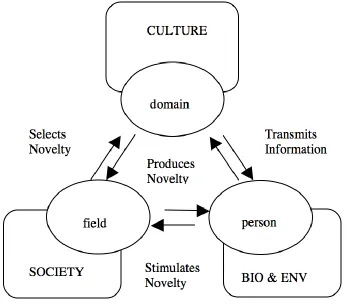
process as non-linear. The ‘systems model of creativity’ proposed by
Csikszentmihalyi (1988, 1997 & 1999) addresses this issue of non-linearity through the
introduction and integration of dynamic causality. The model demonstrates that
creativity is the result of an on-going dynamic process that contains three parts: a set of
symbolic rules, practices and guidelines called a ‘domain’, an ‘individual’ who brings something unique into that domain and a ‘field’ of specialists or experts who recognise
and substantiate that novelty (Csikszentmihalyi 1996: 6). The systems model of
creativity is illustrated in Figure 3 below:
Fig. 3. ‘Systems Model of Creativity’ (Csikszentmihalyi, 1999: 315).
Unlike previous componential models of creativity (Amibile, 1996), the illustration of
the systems model in Figure 3 displays the on-going interactions that occur between
the domain, the field and the individual, which do not have distinct stages or a specific
[image:31.612.156.502.259.566.2]‘dynamic links of circular causality’ (Csikszentmihalyi, 1988: 329). In other words, the
principal elements of domain, field and person both influence, and are influenced, by
each other. From this perspective it is argued that for creativity to occur there must
exist a domain, which contains a set of symbol systems, a body of knowledge and
culture of practice. An individual must acquire a comprehension of that domain and
produce something that has an element of novelty. This novelty is then evaluated and
validated, by the field.
A domain is made up of a: ‘set of symbolic rules and procedures’ (Csikszentmihalyi,
1996: 27-8) and domains are embedded within the culture or symbolic knowledge of a
particular group, institution, society or humanity more broadly. In order for individuals
to be creative, a working knowledge of the domain is essential, particularly because:
‘creative products are firmly based on what came before. True originality evolves as
the individual goes beyond what others had done before’ (Weisberg in Sternberg,
1988: 173). This idea is in opposition to the Romantic notion of creativity, in which it
is the creator’s genius and inherent knowledge that produces great works. Rather, this
idea reinforces the notion that in order to produce something new, the creative
individual must first gain knowledge and understanding of previous creative works.
This domain-specific knowledge: ‘serves to provide the background so that the
individual can begin to work in an area and also serves to provide ways in which to
modify early products that are not satisfactory’ (Ibid).
As well as internalising knowledge of the domain, the individual must also learn the
rules that govern selection of creative work by the field (Csikszentmihalyi, 1996: 47).
Therefore the individual and their knowledge of the domain are important but not
sufficient on their own. For creativity to occur, the field must provide the right
conditions for creative contributions and include: ‘training, expectations, resources,
recognition, hope, opportunity and reward. Some of these are direct responsibilities of
the field, others depend on the broader social system’ (Csikszentmihalyi, 1997: 330).
In addition to providing the right conditions for creativity to occur, it is also the
important to note that: ‘no judgment ever occurs in a vacuum…those who hold the
knowledge are also important contributors to the system as they have the background
to make those necessary judgments’ (McIntyre, 2012:151). The field is therefore not a
socially isolated group, the field is both a contributor to, and user of, the domain and it
is the field that decides whether or not an idea or product should be valued or
implemented into the domain (Csikszentmihalyi & Wolfe, 2000: 81). Figure 4
demonstrates this relationship:
Fig. 4. ‘General Model of Creativity’ (Csikszentmihalyi & Wolfe 2000: 81).
Creativity therefore occurs at the intersection of these interacting elements
(Csikszentmihalyi & Wolfe 2000: 81), and for an idea or product to be creative it must
be valuable to a particular group of people (the field), original and implemented into
the cultural matrix or symbol system (the domain).
This conclusion however creates an apparent distinction between creativity that alters
the domain in some way and smaller acts of creativity, such as making a creative
contribution during the making of a rock record. However, this apparent distinction is
addressed by considering creativity in two senses: psychological (P-creative), and
historical (H-creative) in which: ‘the psychological sense concerns ideas that are
which had the idea. The historical sense applies to ideas that are novel with respect to
the whole of human history’ (Boden, 2004: 43). The connection between P-creativity
and H-creativity is made when one considers that in order to be H-creative, the idea or
product must first be P-creative. This fundamental connection between the two
seemingly opposed distinctions of creativity supports the: ‘mutually constitutive
relation between ordinariness and exceptionality of creativity’ (Negus & Pickering,
2004: 159)’.
This perspective on creativity connects the reified and the everyday and further
explains how the extraordinary and the ordinary can exist together. Therefore: ‘The
ordinary is not at odds with the exceptional, but continually open to the possibility of
becoming exceptional’ (Negus & Pickering, 2004: 158). Consequently, there are: ‘a
number of circumstances that must be in place for anyone to perform H-creativity.
These circumstances depend on temporal, spatial, psychological, biological, social and
cultural circumstances coinciding for this to occur’ (McIntyre, 2012: 198). There are
then several dynamic, interrelated and uncontrollable factors involved in H-creativity,
which explains why some rock records are considered to be creative at different points
in history. This is because they are subject to different historical and political
conditions that exist within the broader sociological sphere of creativity and the
changing criteria for selection of the field. Rock records that are currently considered
to be H-creative by the field of rock record production, that is records that altered the
content of the domain, began as P-creative. It is from this perspective that this study
considers the creative process inside the recording studio. Time and circumstance will
1.6 Creativity and the Group
To this point, research into creativity has only applied broadly to the individual.
Studies within personality research, cognitive psychology and sociology have all
emphasised that creativity involves the complex interaction between the individual, the
social, political and economic situation and the established cultural work, knowledge,
conventional codes and methods of practice within a given field. Moving beyond a
focus on the individual reinforces the idea that creation is never ex-nihilo but built on
the shoulders of predecessors’ (Sarimento and Stahl, 2008:1). It is therefore important
to acknowledge that creativity is: ‘a group-cognitive achievement’ (Ibid), particularly
in the instance of collaborating on the production of a record.
Psychologists in the 1980s, concerned with socio-cultural phenomena, studied
individuals in a variety of cultural and social situations with a particular focus on
aspects of planning, thinking, learning and remembering (Sawyer, 2003). They
discovered however that individual cognitive processes were not easily attributable to
the individual because of the ‘deeply embedded group processes’ (Ibid: 21) that
operate during collaboration. Studying group creativity, rather than the creativity of
individuals, is therefore a more challenging process because the creative contributions
of individuals must be considered in equal terms to the: ‘complex relations between
them, [and] the communication patterns leading to unique emergent group properties’
(Glăveanu, 2010: 2). Therefore, creativity as it relates to both the individual and the
group must be considered when studying group creativity inside the recording studio.
The following section explores creativity as a collective and collaborative practice,
1.7 Studies of Group Creativity
Studies of group creativity have been predominantly conducted in the areas of social
psychology and management studies using two wide-ranging approaches: the
input-output (IO) approach and the process approach (Sawyer, 2012). The IO approach is
typically conducted under laboratory-style conditions and is concerned with the
analysis of a group’s output in relation to their input. For example, a group may be
given a series of objects and asked to make something specific from those objects. The
IO approach has historically been concerned with two fundamental variables: ‘the
effect of group composition on group performance, and the effect of different process
instructions’ (Ibid: 93). Research using the IO approach has been useful in determining
that in some instances groups made up of diverse individuals, with contrasting
educational and social backgrounds, can be more creative than groups that are more
homogenous (Bantel and Jackson, 1989; Hambrick, Cho and Chen, 1996; Keck, 1997).
There are however contrasting studies that demonstrate the opposite: that creativity can
be adversely affected by the diversity of the group (ie Ancona and Caldwell, 1992;
Knight et al, 1999; Pelled, Eisenhardt and Xin, 1999).
In contrast to the IO study method, the process approach is generally more concerned
with qualitative data through the analyses of the interactions that occur between the
individuals in the group across the duration of a particular task (Sawyer, 2012). Process
studies have been conducted on group interaction and idea generation (Nijstad &
Stroebe, 2006; Paulus & Brown, 2003) and intrinsic and extrinsic motivation (Collins
and Amabile, 1999; Hennessey, 2003). Process studies have also identified some of the
ways in which groups develop over time, categorising some of the phases experienced
by a group and producing a number of staged models to illustrate these (For a summary
of ‘Classic’ Group and Team Developmental Models see Weiner, I., Schmitt, N.,
Highhouse, S., 2013: 426). However, there are a number of issues with viewing group
creativity as a staged process in the study of group creativity because the staged
models have not considered the context of the group and their cultural knowledge and