This is a repository copy of
Self-consistent energy balance simulations of hole dynamics in
SiGe/Si THz quantum cascade structures
.
White Rose Research Online URL for this paper:
http://eprints.whiterose.ac.uk/1691/
Article:
Ikonic, Z., Harrison, P. and Kelsall, R.W. (2004) Self-consistent energy balance simulations
of hole dynamics in SiGe/Si THz quantum cascade structures. Journal of Applied Physics,
96 (11). pp. 6803-6811. ISSN 1089-7550
https://doi.org/10.1063/1.1805727
[email protected] https://eprints.whiterose.ac.uk/ Reuse
See Attached
Takedown
If you consider content in White Rose Research Online to be in breach of UK law, please notify us by
Self-consistent energy balance simulations of hole dynamics
in SiGe/ Si THz quantum cascade structures
Z. Ikonić,a) P. Harrison, and R. W. Kelsall
Institute of Microwaves and Photonics, School of Electronic and Electrical Engineering, University of Leeds, Leeds LS2 9JT, United Kingdom
(Received 21 July 2004; accepted 17 August 2004)
Analysis of hole transport in cascaded p-Si/ SiGe quantum well structures is performed using self-consistent rate equations simulations. The hole subband structure is calculated using the 6
36 k · p model, and then used to find carrier relaxation rates due to the alloy disorder, acoustic, and
optical phonon scattering, as well as hole-hole scattering. The simulation accounts for the in-plane
k-space anisotropy of both the hole subband structure and the scattering rates. Results are presented
for prototype THz Si/ SiGe quantum cascade structures. © 2004 American Institute of Physics.
[DOI: 10.1063/1.1805727]
I. INTRODUCTION
The development of III-V semiconductors based
inter-subband transition quantum cascade lasers(QCL)emitting in
the mid- and, more recently, far-infrared sTHzd range, has
intensified research efforts to realize analogous devices in Si/ SiGe strained-layer technology. The possibility of mono-lithic integration of silicon based electronic and optoelec-tronic components is a strong incentive for this research. It is presently considered that p-type Si/ SiGe structures are more promising candidates for QCLs than n-type ones, because the valence band takes a larger share of the band gap disconti-nuity at heterostructure interfaces. Evolving from the earlier
proposals of suitable structure,1,2 the present status of the
research includes the demonstration of successful growth of long Si/ SiGe cascades, and observations of
electrolumines-cence in both the mid-infrared3,4 and far-infrared5,6
wave-length ranges. Bias-tunable emission wavewave-length has also
been obtained,7 although full laser operation has yet to be
achieved.
The gain depends on the scattering rates between differ-ent subbands and also between differdiffer-ent in-plane momdiffer-entum
states within a subband (carrier heating/cooling effects).
These effects have been extensively studied in QCLs based on conduction band intersubband transitions. One approach
relies on self-consistent solutions of rate equations.8–13
An-other approach uses the microscopic, and computationally
more demanding Monte Carlo technique.14–16Although the
latter does not make the assumption of equilibriumlike car-rier distributions over states within any single subband, and therefore gives a deeper insight into the electron dynamics, the former are much faster while still giving quite good es-timates of device characteristics.
While there have been previous theoretical studies of
hole transport in quantum confined Si/ SiGe systems,17,18
based on a fully anisotropic 636 k · p description of the
sub-band structure, these have focused on in-plane transport as is relevant for microelectronic devices, rather than on vertical transport as is of interest for quantum cascade structures. We
have recently reported on Monte Carlo simulations of hole transport in p-Si/ SiGe cascades, but with hole-hole
scatter-ing neglected.19The problem is generally similar to the case
of n-type cascades, but is more complex because the subband structure and scattering rates are anisotropic and strongly de-pendent on the in-plane momentum of the hole states. Here we describe the development and implementation of a self-consistent energy balance method for calculating hole dy-namics in p-Si/ SiGe quantum cascade structures, with hole-hole scattering included.
II. CALCULATION DETAILS
A. Hole subband structure and scattering rate calculation
The calculation of hole subband structure and
single-hole scattering rates have been described in detail
previously,19and are therefore summarized only briefly here,
and more extensive details are provided for the calculation of hole-hole scattering, and for the self-consistent energy-balance approach. The subbands of a biased cascade are found by solving the Schrödinger equation in a structure with
a limited number of unit cells, or periods(each of which may
be structurally simple, comprising a single quantum well and
barrier, or quite complex), subject to either box or periodic
boundary conditions. Their wave functions are usually local-ized in a single period of the cascade. In a long cascade the states show quasiperiodicity; i.e., by translating the wave function of a state by one period, and shifting its energy by the potential drop across one period, another actual state of
the system (the one mostly localized in the next period) is
obtained. Having a set of states assigned to a particular
(hereafter called the central) period, the corresponding sets
assigned to other periods may be constructed simply by us-ing quasiperiodicity.
The hole band structure is calculated using the 6
36 k · p scheme in the plane wave implementation, as
de-scribed previously,20using Foreman’s boundary conditions.21
The accuracy of the method is good for the class of
struc-tures of interest in this work.22 In some cases, such as
mid-infrared cascades which involve higher transition energies
a)
Electronic mail: [email protected]
and therefore larger in-plane wave vectors skid, it may be necessary to include more bands and use the recently
devel-oped 14314 k · p model.23 For the scattering rate
calcula-tions one would then also need the hole-phonon coupling Hamiltonian and its parameters, beyond those established for
the 636 k · p model, so the latter seems a reasonable choice
at present. Indeed, much of the recent work on hole mobility in Si or SiGe, of either Monte Carlo or scattering-rate type,
was also carried out within the 636 model.17,18Mixing of
heavy-hole shhd, light-holeslhd, and spin-orbit split-off ssod
valence band states results in both a prominent in-plane non-parabolicity and anisotropy of hole subbands, so the energies and wave functions of the subbands of interest are tabulated
at a number of ki values. This is done in the irreducible
wedge of the two-dimensional (2D) Brillouin zone (for the
usual,[001]grown structures this is 1/8 of the full 2D
Bril-louin zone), and the symmetry properties are used to
recon-struct states outside this wedge by rotation (in contrast, for
parabolic-dispersion electronic subbands it suffices to find states at ki= 0 only). Tracking particle dynamics in a cascade requires all the states to be assigned to individual periods, generally based on the wave function localization. Special care is taken to avoid double counting when hybridization i.e., anticrossing of states otherwise localized in two different
periods, appears19(for holes this is a ki-dependent
phenom-enon, because states which are well separated in energy, e.g.,
at ki= 0 may come closer and anticross at some other value
of ki, which swaps their localization properties).
The main inelastic scattering mechanism for holes in
SiGe is the deformation potential scattering(via acoustic and
nonpolar optical modes). Optical phonon scattering in the
alloy layers is described by assuming three distinct modes, corresponding to Ge-Ge, Ge-Si, and Si-Si interatomic vibra-tions, each with its own frequency and deformation potential, as well as an appropriate weight, according to the number of
interatomic bonds present in the alloy.24 For acoustic
phonons, on the other hand, the weighted averages of the sound velocities and deformation potentials of Si and Ge are taken. The phonons are considered to be bulklike, and the tensorial, rather than scalar, form of the hole-phonon
inter-action Hamiltonian is used.25–29 Optical phonons are
as-sumed to be nondispersive, while acoustic phonons are taken to have linear dispersion; i.e., the quasielastic approximation is not used. Another important scattering mechanism in SiGe is the alloy disorder scattering, which is purely elastic, but nevertheless can induce hole transitions between different
subbands.30–32,20 Due to the nonparabolicity and anisotropy
of the hole subbands, the scattering rates are evaluated
nu-merically, using the linear tetrahedron method17,33–36 of
ap-propriate dimensionality.
Upon calculating the microscopic (cell to
mesh-cell)scattering rates, these are averaged37by weight factors
corresponding to the population of the intial state, and
ac-counting for the population of the final state (via the Pauli
exclusion principle). Fermi-Dirac distribution functions
(with independent carrier temperatures, generally different
from the lattice temperature)are used for this purpose. The
averaged scattering rates then depend on carrier densities in both the initial and final states. However, direct calculations
show that this dependence becomes significant only at very low values of carrier (not lattice) temperature, or large(
de-generate)densities of carriers, none of which is encountered
in cascade structures of practical interest. This may not al-ways be true for electrons, where the effective mass is small and the Fermi level may be close to, or above, the subband minima. Holes have a considerably larger effective mass and the Fermi level is, under usual conditions in cascades, suffi-ciently below the subband minima to imply relatively small occupancy of states. Therefore, the averaged scattering rates may be taken, to a very good approximation, to be indepen-dent of actual carrier densities, as well as of the final state temperature, while depending on the temperature of the ini-tial state.
Carrier-carrier scattering (Auger interaction) has been
recognized as an important mechanism in quantum cascade lasers, particularly in devices with closely spaced subbands. This is a two-body process, in which holes in the initial states si , kiid and sj , kijd scatter into final states sf , kifd and sg , kigd, where some or all of the state indices may be the
same. Electron-electron scattering in QCLs has been
exten-sively studied,38,39assuming single subband static screening
within the random phase approximation(RPA). Simulations
of actual cascade structures which include electron-electron scattering calculated in this manner show quite good
agree-ment with experiagree-ments.10–12 Although the validity of this
screening model may seem questionable in view of the re-sults of calculations which use the dynamic RPA dielectric
function,40the latter is computationally too demanding to be
manageable for structures of the complexity encountered in present QCLs. For holes, with their nonparabolicity and an-isotropy, the dynamic screening approach would be even slower. In this work we have therefore used static screening, the only modifications being the replacement of the conven-tional, truly single subband, by “weight-averaged” static
screening,41 and accounting for the spinor structure of hole
wave functions when evaluating the interaction matrix ele-ments. The hole-hole scattering rate is thus calculated from Eq. (49)in Ref. 38; or Eq.(2.1)in Ref. 39. Previous calcu-lations of intersubband Auger processes for holes in SiGe
single quantum wells(for photodetectors)42 (using a simple,
somewhat arbitrarily chosen, constant screening factor)
indi-cate that this may be a fast process. It is interesting to note
that, due to the mixed parity of hole subbands for general ki
even in symmetric structures, there are no selection rules for the subband indices for hole-hole scattering, in contrast to
the case of electrons.39 The expression for carrier-carrier
scattering is usually written in a somewhat asymmetric man-ner, giving the scattering rate of a particle in statesi , kiidwith
all particles in subband j, but any value of kij. Evaluation
would then require the 4D linear tetrahedron method.36,43
However, to find microscopic scattering rates we fix the wave vectors kii and kij of both initial states(to the centers
of their mesh cells), and use the 2D tetrahedron method.
Concerning the scaling properties of hole-hole scatter-ing, as the hole density varies, conclusions similar to those for single-hole scattering processes apply. Except at very low temperatures and very high densities, the total scattering rate from the pair of initial states i and j into final states f and g
is proportional, to a very good approximation, to the product of populations of these states, ninj, and the proportionality constant wi,j,f,gthen depends on hole temperature(s)in these two subbands but not on any of the populations.
B. Rate equations in a cascade
Carrier transport in a quantum cascade structure is de-scribed within a tight-binding-like picture. Any state in a long cascade is associated to one of its periods. A biased periodic cascade, assuming a globally linear variation of the
internal electrostatic potential (i.e., no domain formation),
has a self-similar potential, invariant upon translation by a period D and energy shift by the potential drop across a
period DV, Consequently, if cszd is a solution of the
Schrödinger equation at energy E, thencsz − Ddis a solution
at E −DV (quasiperiodicity). This allows all the states in a cascade to be constructed as replicas, shifted in space and energy, of the set of states assigned to one of its periods. Among the states actually calculated in a structure with a finite number of periods, those which are mostly localized near the middle of the structure are clearly most trustworthy as representatives of states in an infinite cascade, because they are sufficiently remote from the boundaries, and are
used in the “replication” process.19To keep the problem
trac-table the number of states N assigned to a single period is limited, based on the expectation that high-energy states will be virtually unpopulated, because most of the carriers will scatter into lower energy states of subsequent periods rather than remain in ever higher states as they move along the cascade. States assigned to the central period will be labeled as ci,si = 1 , . . . , Nd, and those assigned (by construction) to
its kth nearest neighbor will be labeled as ci+kN, si
= 1 , . . . , Nd, where k.0 for right and k,0 for left neighbors. The number of neighboring periods taken in any practical
calculation is also limited to some value sMd, based on the
fact that there is normally a very small overlap of wave func-tions belonging to more distant periods, resulting in negli-gible scattering between such states.
Having calculated all the wave functions and scattering rates, the system of rate equations can be written as
dnf
dt =
o
i niwi,f− nfo
i wf,i+o
i,j,gninjwi,j,f,g− nf
o
i,j,gngwf,g,i,j, s1d
where i, j, f, and g run over all states in the cascade, in all of its periods.
The assumption of a globally linear potential variation
(no bowing)inside the cascade enables the use of “periodic
boundary conditions” for the particle densities: these are
taken to be identical in all periods of the cascade, i.e., ni
= ni+kN (where i = 1 , . . . , N and k = ± 1 , ± 2 , . . .), and the total
density equals the sheet doping density per period ntot. It then
suffices to account explicitly for particles in a single period, with a relatively small number of states, rather than in the whole cascade. The rate equations may then be written as
dnf dt =k=−M
o
M
o
i=1 Nniwi+kN,f− nf
o
k=−M N
o
i=1 Nwf,i+kN
+
o
k, k8, k9= − M
suDkuøMd M
F
o
i,j,g=1 N
ninjwi+kN,j+k8N,f,g+k9N
− nf
o
i,j,g=1 N
ngwf,g+k9N,i+kN,jk8N
G
. s2dFurthermore, the scattering rates are shift invariant: e.g., for single particle scattering rates we have wi,j= wi+kN,j+kN, or wi−N,j= wi,j+N, and similarly for the hole-hole scattering
coef-ficients. Although the scattering-rate subscripts in Eq. (2)
take both positive and negative values, it is always possible to use the shift-invariance property and make all the sub-scripts positive. For instance, the first two terms in Eq.(2), which describe single-hole scattering, may then be written as
o
i=1 Nniwi,f− nf
o
i=1 Nwf,i+
o
k=1 MF
o
i=1 Nniswi,f+kN+ wi+kN,fd
− nf
o
i=1 Nswf,i+kN+ wf+kN,id
G
. s3dTherefore, only the scattering rates within the central period,
and those linking it to its right neighbors(up to the desired
order)need be evaluated. Wave functions of the left
neigh-bors are not explicitly required. In calculating the central cell wave functions, however, it is still advisable to have all the left neighboring periods present, for the purpose of finding these wave functions more accurately, and in their full spatial extent as necessary for evaluation of “overlap” type integrals for scattering. This is a sufficient condition to warrant
accu-racy under all circumstances(e.g., the occurence of
hybrid-ization between some of central-period states and states of
remote periods). In conduction-band cascades it is simple to
check, by visual inspection of wave functions, whether hy-bridization of remote states occurs or not, and in the latter
case it may be sufficient to consider just 2 or 212 periods.
However, in valence-band cascades hybridization may
ap-pear for some kiÞ0 even if it was not observed at ki= 0, and
the wave function computational window should thus cover both the left and right neighboring periods.
Out of the total of N, there are N − 1 linearly independent equations, so one of them is replaced by the particle conser-vation law: Sni= ntot. If the carrier temperatures, and hence
the scattering rates, are known, Eqs.(2)may be solved in the
steady statesd / dt = 0d or, given the initial conditions, in the nonstationary case. Although the system is nonlinear if hole-hole scattering is included, solving is still very fast compared to the cost of evaluating all the scattering rates, due to the assumption that the rates wi,jand wi,j,f,gdo not depend on the
[image:4.612.330.558.48.166.2]A more refined model accounts for the fact that subbands exchange energy, as well as particles, in all the scattering processes—elastic or inelastic. The kinetic energy transfer rates between subbands can be found in a similar manner as the particle scattering rates, where the kinetic energy is
de-fined as the hole energy at wave vector ki relative to the
minimal value in the same subband(usually at the zone
cen-ter). A hole leaving subband i takes its own energy out of the
ensemble in this subband, while the ensemble in the subband
f in which the hole arrives increases its total energy by the
kinetic energy corresponding to the hole wave vector in this subband. The quantized parts of the subband energies, and
the energy of the scatterer(nonzero in case of phonons)here
have the role of potential energy. There is no conservation of either the kinetic or the full energy of the hole subsystem, because energy may be exchanged with the lattice. Here the two kinetic energies are completely unrelated to each other, and depend on the scattering process which has taken place. Therefore, instead of a single energy transfer rate that occurs
in the i→f transitions, two rates are defined: wif
e+
and wife−, which denote the kinetic energy increment rate in subband f, and the kinetic if energy decrement rate in subband i,
respec-tively, due to i→f transitions. Within the nondegenerate
ap-proximation both rates depend only on the hole temperature in subband i and the total rates are proportional to the hole density in subband i. The kinetic energy rate equations for the total kinetic energy Eftotstored in a state f read
dEtotf
dt =
o
i niwif e+− nf
o
iwe−fi +
o
i,j,g ninjwijfg
e+
− nf
o
i,j,gwfgije− ng,
s4d
and can then be written in terms of neighbor-order
contribu-tions, in the same manner as in Eq.(2). All N equations are
linearly independent.
Similar considerations for conduction subbands in
cas-cades have been presented previously,13but the electron
tem-perature was assumed equal in all subbands, while the hole subband temperatures here are considered as independent variables. The case of a single carrier temperature, common for all subbands but distinct from the lattice temperature, is
formally recovered by summing Eq.(4)over all states of a
period, and using the single carrier temperature in evaluating all wi,j and wi,j,f,gterms.
It should be noted that intrasubband scattering rates,
where particle(s)remain in the initial subband, do not enter
(i.e., are cancelled out)in the particle-density rate equations
(2). However, they are present in the kinetic energy rate
equations (4), because carriers may exchange energy with
the lattice via inelastic scattering mechanisms, and the net flow of energy is nonzero if the carrier temperature differs from that of the lattice. There is another role of intrasubband scattering processes in particle-density rate equations, which is only implicit at the rate equation level of description. This is to drive the particle distributions towards their
equilibri-umlike(Fermi-Dirac)forms, on which the rate equation
ap-proach relies. The fastest mechanism which performs this function is the intrasubband carrier-carrier scattering44 (with
a temperature unrelated to the lattice temperature, however),
while the generally slower carrier-phonon scattering drives the carrier temperature towards the lattice value.
In quantum cascade structures only the scattering
be-tween adjacent periods is normally considered (“nearest
neighbor approximation”15), and only when including higher,
more continuumlike, states, or in photodetectors, may it be-come necessary to include interactions with more distant states. If scattering to all neighbors is taken into account, the precise way of state assignment to individual periods would in fact be irrelevant, because all the scattering processes would be accounted for anyway. However, if interaction with only a limited number of nearest neighbors is to be taken, proper assignment becomes very important, because this de-termines which states are remote in real space, such that scattering between them can be justifiably neglected. In this work we consider only the nearest neighbor interactions. For hole-hole scattering, in accordance with Eq.(2), we interpret this to mean that the initial and final states of both carriers
belong to at most two(not three)adjacent periods.
In the steady state the system(2)and(4), which
consti-tutes the self-consistent energy-balance (SCEB) model, is a
set of 2N nonlinear equations in N values of densities and N temperatures. In these equations the density dependence is extracted in analytic form, because this is a very good ap-proximation to the true dependence which would be calcu-lated numerically, while the dependence on temperatures
(which control the scattering rates) must be evaluated
nu-merically. Solving this system is therefore a difficult numeri-cal problem, and is performed iteratively, using the Broyden method. It does not require the derivative information at start, but rather builds successively better approximations to the Jacobian as it walks through the space of variables. How-ever, as is quite common in solving nonlinear sets of equa-tions, the outcome may not always be the true solution; i.e., the code may settle in a local minimum, which depends on the initial guess(starting point of the procedure). If the initial guess is very remote from the solution we find that it is unlikely the solution will be reached in any reasonable num-ber of iterations, if at all, and the procedure has to be re-started. In such situations it is helpful to find first the single carrier-temperature solution of the system, which can be
ob-tained using simple bisection for the temperature(which
al-ways converges)in conjunction with the fast solution of the
particle rate equations at each temperature point. Using this solution as the input to Broyden procedure for the full SCEB calculation greatly improves the chances of finding the com-plete solution.
By observing that particle conservation in a period may be written as oi=1
N s
Î
nid2= ntot, it is clear that N densities can
be expressed in terms of N − 1 anglesfi, i = 1 , . . . ,, N − 1, by
hyperspherical parametrization
Î
n1= R cossf1dÎ
n2= R sinsf1dcossf2dÎ
n3= R sinsf1dsinsf2dcossf3dA
Î
nN−1= R sinsf1d. . . sinsfN−2dcossfN−1dÎ
nN= R sinsf1d. . . sinsfN−2dsinsfN−1d, s5dwhere R =
Î
ntot. If all the densities are to be non-negative, theangles have to satisfy 0øfiøp/ 2, and any point within
such a hypercube gives a different, physically allowed set of
densities ni. The order of the system is then reduced to 2N
− 1. Within this implementation the Broyden procedure goes along a different path than within the direct implementation
(of order 2N). While both of them usually work well, we
have encountered examples where one or the other failed to converge to the solution, and so care should be taken when using either approach.
The current density is evaluated by accounting for all carriers which pass through some reference plane, e.g., the interface between the central period and the adjacent period to the right, and is given by
J =
o
k, k8= − M
suDkuøMd M
o
i,f=1N
niwi+kN,f+k8NfQsk
8
d−Qskdg+
o
k, k8, k9k-= − M
suDkuøMd M
o
i,j,f,g=1N
niniwi+kN,j+k8N,f+k9n,g+k-N
fQsk
9
d+Qsk-
d−Qskd−Qsk8
dg, s6dwhere Qskd= 1 if kPs1 , Md, and Qskd= 0 if kPs−M , 0d. Again, using the shift invariance of scattering rates helps to
simplify this expression, e.g., the first term (due to
single-hole scattering)may then be written as
o
i=1 Nni
o
k=1 Mk
o
f=1 N
swi,f+kN− wi+kn,fd. s7d
III. NUMERICAL RESULTS AND DISCUSSION
Self-consistent energy balance simulations have been performed for several p-Si/ SiGe quantum cascade struc-tures. In the band structure calculation the material param-eters for Si and Ge were take from Refs. 45 and 46. The acoustic and optical phonon deformation potentials were taken from Ref. 27(set C), and the alloy scattering potential
was set to 0.3 eV (normalized to the primitive cell
volume).32,47
The first example is a cascade of the simplest possible structure; i.e., a heterostructure stack of alternating wells and barriers. It has 16 monolayers4.41 nmdGe0.3Si0.7wells and
8 monolayer s2.15 nmd wide Si barriers, grown on a
Ge0.2Si0.8 virtual substrate. The structure is strain balanced, and can in principle be grown with an arbitrarily large num-ber of periods. It has just two low-lying states per period, the ground HH1 and the first excited, LH1 state; the next, HH2 state is sufficiently higher in energy to remain almost inac-cessible to holes throughout the range of biases used in the calculation. The LH1-HH1 energy spacing in the Si/ SiGe system is primarily determined by the strain in the quantum well layers, and here amounts to 27.5 meV. In a biased
cas-cade the alignment of the HH1 state from the preceding
(higher) well and the LH1 state of the next (lower)well at
ki= 0 occurs at a field of 42 kV/ cm. However, for finite ki
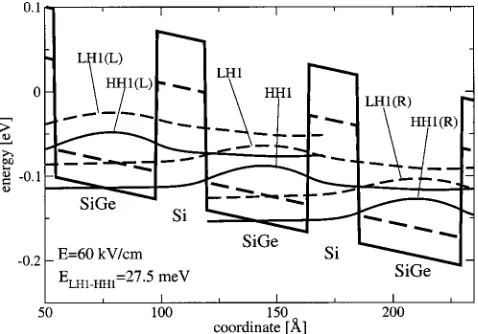
the alignment appears at different fields, because of the dif-ferent dispersions of the HH and LH states, so the phenom-enon of resonance is not so strong as in the case of n-type heterostructures. As the bias field varies, the spacing between LH1 and HH1 states of the same well changes only slightly, and most of the potential drop per period manifests in the displacement of the sets of states belonging to adjacent peri-ods. The position of states at 60 kV/ cm bias is shown in Fig. 1.
Such a structure offers potential as an intersubband THz
laser, where the lasing transition would be the interwell(
di-agonal)HH1→LH1sRdtransition, while the intrawell(
verti-cal) LH1→HH1 is the relaxation transition, emptying the
lower laser state(see Fig. 1 for notation). There are two main
reasons for using an interwell optical transition: (i) optical
matrix elements for both in-plane and normally polarized light are larger for the interwell than for the intrawell HH1
-LH1 transition, and (ii) it is plausible to expect that the
upper state will be less populated than the lower state in the same well, which would imply that a population inversion would automatically exist for the interwell transition. The
HH1→LH1sRd interwell transition energy can be tuned by
the bias field, which is an attractive feature: at ki= 0 it is zero at 42 kV/ cm, and increases by 6.6 meV for each 10 kV/ cm of excess bias.
[image:6.612.318.557.49.216.2]The results of simulations of such a quantum cascade structure are shown in Figs. 2–7. The LH1 state population and the current density, calculated either within the multiple-temperature or single-multiple-temperature models, or with the carrier temperatures set equal to the lattice temperature, are given in Fig. 2. There may be a significant difference between the predictions of different models, particularly at lower values of the lattice temperature, which points to the importance of finding the carrier temperature via the fully self-consistent FIG. 1. Relevant hole states in the central and the two adjacent periods of a
p-Si/ SiGe cascade comprising 16 monolayers4.41 nmdGe0.3Si0.7wells and
8 monolayer(2.15 nmdSi barriers, grown on a Ge0.2Si0.8virtual substrate.
The wave functions of HH and LH states, as well as the valence band edges for heavy and light holes(different in this strained system), are denoted by
solid and dashed lines, respectively. The labelssLd andsRddenote states
energy balance solution. Both the LH1 state population and the current have peaks in the broad range of the
HH1-LH1sRdalignment bias(hence the population inversion
is worst there, but this is not the working bias for lasing
anyway, as explained above). In Fig. 3 we plot the carrier
temperatures, calculated both within the single-temperature and multiple-temperature models, without hole-hole scatter-ing, for different values of the lattice temperature. Carrier temperatures calculated within the single-temperature model depend on the lattice temperature, though not in a simple additive manner; i.e., the carrier heating decreases with
in-creasing lattice temperature. Similarly to nLH1and I, the
tem-peratures calculated within the multiple-temperature model, but not the single-temperature model, show characteristic features around the alignment bias. Although these originate from microscopic scattering rates as they are, it is also pos-sible to give a more “macroscopic” explanation. Near the alignment bias the injection from HH1 into the LH1 of the next well is efficient, and the hole density in LH1 is large. The intrawell HH1-LH1 spacing in this structure is only a
little less than the smallest sGe-Ged optical phonon energy,
so that a relatively small increase in the LH1 subband
tem-perature, relative to the lattice temtem-perature, will start to open this channel of heat dissipation into the lattice—but this need not be excessive, because the electrical power input is still small. At larger biases, however, the carrier temperatures in-crease more or less monotonically: carriers have to heat up, and open all channels of heat dissipation, in order to acco-modate the increased electrical power input. It should be noted that the individual temperatures of the two subbands may have very dissimilar values and behavior with varying
bias, but their weighted average (in respect to the subband
populations)roughly corresponds to the value obtained from
the single carriers temperature model. It is also interesting to
note that the agreement between the results of Monte Carlo19
and self-consistent energy balance simulations (both with
hole-hole scattering neglected)is reasonable in terms of the
subband populations and current density, but the Monte Carlo method predicts considerably larger carrier tempera-tures. Similar differences between the carrier temperatures have been found in simulations of n-GaAs/ AlGaAs cascades.13,14
[image:7.612.316.556.48.214.2]The influence of hole-hole scattering, for different values of the total hole sheet density in this cascade is shown in
[image:7.612.55.293.50.207.2]FIG. 3. The bias dependence of the HH1 and LH1 subband temperatures in the p-SiGe cascade described in Fig. 1, calculated within the single-temperature or multiple-single-temperature models, but without hole-hole scatter-ing, at different values of the lattice temperature Tlatt.
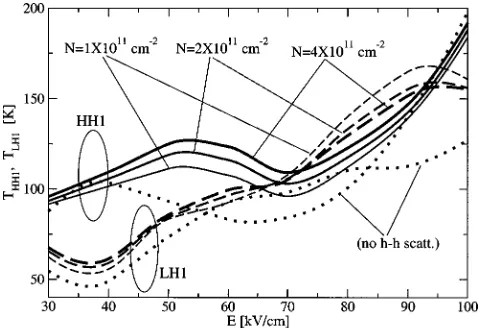
FIG. 4. The bias dependence of hole temperature in the p-SiGe cascade described in Fig. 1, calculated within the single-temperature model, for dif-ferent values of hole sheet density per period, at Tlatt= 20 K.
FIG. 5. The bias dependence of the HH1 and LH1 subband temperatures in the p-SiGe cascade described in Fig. 1, calculated within the multiple-temperature model, for different values of hole sheet density per period, at
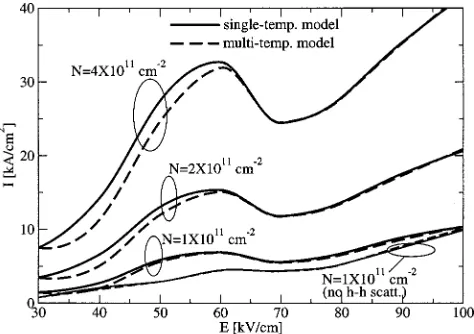
[image:7.612.316.555.546.710.2]Tlatt= 20 K. FIG. 2. The bias dependence of the LH1 subband population and the current
density in the p-SiGe cascade described in Fig. 1, calculated without hole-hole scattering, at Tlatt= 20 K.
[image:7.612.52.292.547.709.2]Figs. 4 and 5. The carriers temperature generally increases with increased hole density, but the dependence is relatively small. The hole temperatures in the two subbands may be quite different for some values of bias, or similar for other values. In a conduction subband cascade this would hardly have any effect on the optical spectra, because of the identi-cal dispersions of subbands and the wave vector conserva-tion in optical transiconserva-tions, but may be important in transport. On the other hand, in p-type cascades the different values of hole temperatures are important for intersubband optical properties as well, because these depend on the hole distri-butions in the strongly and unequally dispersive subbands.
The population of the LH1 subband, and the current den-sity are shown in Figs. 6 and 7. Hole-hole scattering clearly increases both quantities above the values which would hold without this mechanism. Yet, throughout the range of param-eters explored in these calculations, the LH1 population re-mains smaller than that of the HH1 state, implying the
exis-tence of population inversion on the interwell HH1→LH1
optical transition. There is a regions60– 70 kV/ cmdof
nega-tive differential resistance (NDR), and this is more
promi-nent for larger hole densities, because of the increasing role of hole-hole scattering. NDR appears as the interplay of the bias-dependent rate of the interwell processes of this type
(which favor small spacing between subbands), and the
bias-dependent asymmetry of right→left and left→right
trans-fers, which requires somewhat larger subband spacings. Al-though the peak/valley current ratio may not be very large, there exists the possibility of domain formation in the cas-cade, which would locally shift the energy of the lasing tran-sition and adversely influence the gain.
With two initial and two final states, the number of dif-ferent hole-hole scattering processes is clearly much larger than the number of single-hole processes. As the number of states per period increases it soon becomes impossible to account for all of them in any realistic computation time. It is therefore necessary to limit the number of processes by a suitable selection criterion. A possible simple choice that we
have explored here (given that the structure has just two
subbands localized in a single well) is to retain only those
processes which involve just two different states, i.e., the
subscripts in any particular scattering rate wi,j,f,g may take
only two values, but these will of course run over all states in the system. This greatly reduces the number of processes included, e.g., in a system with six states per period the sav-ing is almost by a factor of 20. The scattersav-ing matrix ele-ments generally decrease when spatially more displaced states are involved, indicating that this might be a good ap-proximation. On the other hand, the number of processes discarded by such a restriction is usually much larger than the number of processes retained, which makes the approxi-mation questionable. This is best resolved by direct calcula-tion.
[image:8.612.55.294.47.214.2]A cascade with two states per period is a good testing grounds for the quality of the above approximation, because the total number of processes is just three times larger than the number in the restricted set, so both calculations are man-ageable in real time. Results obtained in case of a large hole density, where hole-hole scattering is relatively more impor-tant, are compared in Fig. 8. Using the restricted set of hole-hole scattering processes leads to some underestimate of the FIG. 6. The bias dependence of the LH1 subband population in the p
-SiGe cascade described in Fig. 1, calculated within the multiple-temperature model, for different values of hole sheet density per period, at
[image:8.612.319.557.48.204.2]Tlatt= 20 K.
FIG. 7. The bias dependence of the current density in the p-SiGe cascade described in Fig. 1, calculated within the multiple-temperature model, for different values of hole sheet density per period, at Tlatt= 20 K.
FIG. 8. A comparison of population, temperature, and the current density in the p-SiGe cascade described in Fig. 1, calculated within the
single-temperature model, for the sheet hole density of 431011cm−2, using either
[image:8.612.55.292.552.719.2]current, and also of the LH1 state population, by no more than 20%. The errors in the calculated hole temperature are smaller. These results are obtained within the single-temperature model, but the comparison is quite similar for multiple-temperature model. Therefore, with quite accept-able overall accuracy, the above process selection rule was adopted in calculations of more complex structures. While the number of discarded processes in such cases will be far larger than those retained, it is also true that most of the former include states which are more remote than are the states in the simple cascade, and so their contribution to hole-hole scattering is negligible. Therefore, we believe that using the restricted set of processes in complex structures generally provides a similar level of accuracy as in simple cascades. Yet another selection criterion might be based on the energy of the states, because carrier-carrier scattering fa-vors small energy differences. This is less safe to employ for holes than for electrons, because hole subbands may greatly change their energy spacing as the in-plane wave vector var-ies, and such additional selection was not implemented in this work. Certainly, in structures which have more than two subbands localized in a single well there may exist efficient hole-hole processes which include, for example, three
differ-ent subbands,39and the above selection criterion should then
be appropriately expanded.
Next we consider two Si/ SiGe quantum cascade struc-tures which are more complex, having three wells per period, in order to explore the role of optical phonon scattering in
cooling of holes. It has been argued13that electron cooling in
the injector portion of AlGaAs based QCLs requires spacing between subsequent subbands to be somewhat less than the optical phonon energy. In such a case only those electrons in the upper subband which are hot, i.e., have sufficient in-plane kinetic energy, will be able to emit an optical phonon
(by the fast, Frölich polar interaction) and terminate in the
lower subband with a small kinetic energy. However, there is no polar optical phonon scattering in SiGe, and the nonpolar deformation potential scattering differs considerably in its dependence on the initial carrier energy. Although the Ge-Ge mode phonon energy is almost the same as that for LO phonons in GaAs, nonpolar optical phonon scattering is still slow when the subband spacing is equal to or slightly
greater than the phonon energy (whereas the polar optical
phonon scattering rate peaks in this case). Only at
substan-tially larger subband spacings does nonpolar phonon scatter-ing become a very fast process.
Cascade A has the structure: 9 ML Ge0.36Si0.64/ 6 ML
Si/ 16 ML Ge0.3Si0.7/ 6ML Si/ 14ML Ge0.3Si0.7/ 6ML Si(ML
5crystalline monolayer, <2.75 Å), and is grown on
Ge0.2Si0.8virtual substrate. We will refer to these three wells as No. I, No. II, and No. III, respectively. Each of the wells
has two low-lying states(HH1 and LH1), spaced by 36 meV
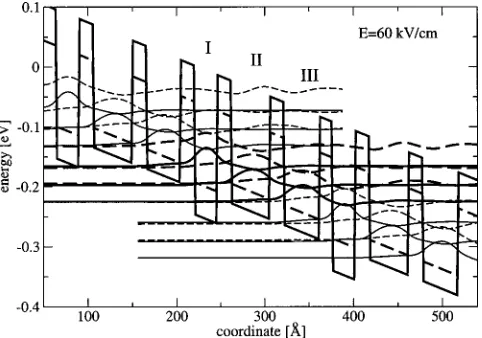
in well No. I, and by 30 meV in wells No. II and No. III. At a bias of 60 kV/ cm the HH1 state from any preceeding well is almost aligned with the LH1 state of the next well, as shown in Fig. 9. The aligned subbands are localized in
indi-vidual wells at ki= 0, because HH and LH show(almost)no
interaction at the zone center, but for any small finite kithey
become strongly hybridized, and scattering between them
should be fast and with little carrier heating. Hence, it is more meaningful to talk about the average temperature of the hybridized pairs of states, than of individual states. Using the same reasoning as for electrons in a GaAs/ AlGaAs cascade one would expect that the hole temperature decreases when
going from well No. I(where the optical phonon transitions
generate no carrier heating) into No. II and then No. III
(where these transitions should cool the holes). However,
calculations(performed at Tlatt= 20 K and hole sheet density
of 1011cm−2)show that quite the opposite happens: the
tem-perature of the hybridized pair [HH1 No. III +LH1 No. I
sRd]is 261 K, that of(HH1 No. II +LH1 No. III)is 211 K,
and that of(HH1 No. I +LH1 No. II)is 126 K. Although at
these temperatures many holes have sufficient kinetic energy to compensate for the 6 meV deficiency and emit an optical
phonon(and those which do so will indeed cool), the process
is still slow to make a significant influence on overall tem-peratures. The transport between wells is here mostly due to
acoustic phonons or fully elastic processes (alloy and
hole-hole scattering), and these induce only heating of holes,
while the role of cooling is left to intrasubband acoustic pho-non scattering.
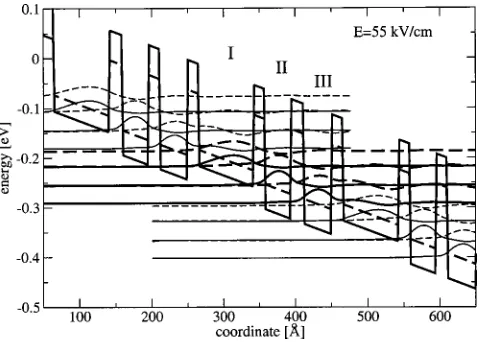
In another cascade (B, Fig. 10), that has the
struc-ture: 30 ML Ge0.3Si0.7/ 6ML Si/ 13ML Ge0.35Si0.65/ 6ML
Si/ 14ML Ge0.35Si0.65/ 6ML Si, also grown on a Ge0.2Si0.8
virtual substrate, the HH1-LH1 spacing is 30 meV in the well No. I, and by 38 meV in wells No. II and No. III. Similarly as in cascade A, the alignment of HH1 and LH1 states from subsequent wells here occurs at a bias of
55 kV/ cm. The temperatures of the[HH1 No. III +LH1 No.
I sRd],(HH1 No. II +LH1 No. III), and(HH1 No. I +LH1
No. II)pairs of states are now calculated to be 122, 183, and
210 K, respectively. The generally lower temperatures in this
case partly result from a smaller current(twice smaller than
[image:9.612.317.558.49.218.2]in cascade A), but it is interesting to note that the temperature gradient is now reversed. Therefore, although in this case all holes in wells No. II and No. III can emit optical phonons, which results in their increased kinetic energy in the lower subband, it still appears advantageous to allow for some FIG. 9. The potential profile in cascade structure A, described in the text,
and the wave functions calculated at ki= 0. Wave functions assigned to the
central period are shown in thick, and their replicas in the adjacent two
periods in thin lines(solid—heavy hole, dashed—light hole states).
amount of interwell optical phonon scattering to replace other processes which are almost or fully elastic, and hence produce much more heating. However, for much larger HH -LH spacing the optical phonon scattering would become a dominant process and, being very fast, it would only lead to both large current density and heating.
IV. CONCLUSION
A self-consistent energy balance method for the simula-tion of hole transport in p-Si/ SiGe quantum cascade struc-tures has been developed and used to study carrier distribu-tions and carrier heating effects. The scattering mechanisms included in the model are the alloy disorder, acoustic and optical phonon scattering, and hole-hole scattering account-ing for the in-plane anisotropy of both the hole subband structure and the scattering rates. In simple cascade struc-tures with just one HH and one LH subband per period the HH and LH temperatures can differ by up to a factor of 2, although the weighted average is close to the value obtained from a single carriers temperature simulation. In more com-plex structures, the carrier temperatures of subbands in adja-cent wells differ markedly, and we have shown how such a device can be designed to optimize carrier cooling via optical phonon scattering. The effect of hole-hole scattering on car-rier dynamics and carcar-rier heating has also been investigated. Hole-hole scattering results in increased carrier temperatures
in a simple(superlattice)cascade, and in much stronger
cou-pling between states in adjacent wells. This leads to substan-tially higher currents, and more pronounced NDR features in the current-voltage response.
ACKNOWLEDGMENTS
This work is supported by DARPA /USAF Contract No.
F19628-99-C-0074. The authors thank R. A. Soref(Hanscom
AFB for useful discussions.
1
R. A. Soref, L. Friedman, and G. Sun, Superlattices Microstruct. 23, 427
(1998).
2
L. Friedman, R. A. Soref, G. Sun, and Y. Lu, IEEE J. Sel. Top. Quantum Electron. 4, 1029(1998).
3
G. Dehlinger, L. Diehl, U. Gennser, H. Sigg, J. Faist, K. Ensslin, D.
Grutzmacher, and E. Muller, Science 290, 2277(2000).
4
L. Diehl et al., Appl. Phys. Lett. 81, 4700(2002).
5
S. A. Lynch et al., Appl. Phys. Lett. 81, 1543(2002).
6
D. J. Paul et al., Physica E(Amsterdam) 16, 147(2003).
7
R. Bates et al., Appl. Phys. Lett. 83, 4092(2003).
8
K. Donovan, P. Harrison, and R. W. Kelsall, J. Appl. Phys. 89, 3084
(2001).
9
K. Kalna, C. Y. L. Cheung, and K. A. Shore, J. Appl. Phys. 89, 2001
(2001).
10
D. Indjin, P. Harrison, R. W. Kelsall, and Z. Ikonić, J. Appl. Phys. 91,
9019(2002).
11
D. Indjin, P. Harrison, R. W. Kelsall, and Z. Ikonić, Appl. Phys. Lett. 81,
400(2002).
12
D. Indjin, P. Harrison, R. W. Kelsall, and Z. Ikonić, IEEE Photonics
Tech-nol. Lett. 15, 15(2003).
13
P. Harrison, D. Indjin, and R. W. Kelsall, J. Appl. Phys. 92, 6921(2002).
14
R. C. Iotti and F. Rossi, Appl. Phys. Lett. 78, 2902(2001).
15
R. C. Iotti and F. Rossi, Phys. Rev. Lett. 87, 146603(2001).
16
H. Callebaut, S. Kumar, B. S. Williams, Q. Hu, and J. L. Reno, Appl. Phys. Lett. 83, 207(2003).
17
R. Oberhuber, G. Zandler, and P. Vogl, Phys. Rev. B 58, 9941(1998).
18
M. V. Fischetti, Z. Ren, P. M. Solomon, M. Yang, and K. Rim, J. Appl. Phys. 94, 1079(2003).
19
Z. Ikonić, R. W. Kelsall, and P. Harrison, Phys. Rev. B 69, 235308(2004).
20
Z. Ikonić, P. Harrison, and R. W. Kelsall, Phys. Rev. B 64, 245311(2001).
21
B. A. Foreman, Phys. Rev. B 48, 4964(1993).
22
Z. Ikonić, P. Harrison, and R. W. Kelsall, Phys. Rev. B 64, 125308(2001).
23
M. El kurdi, G. Fishman, S. Sauvage, and P. Boucaud, Phys. Rev. B 68, 165333(2003).
24
K. Bhaumik, B. K. Ridley, and Y. Shacham-Diamand, J. Appl. Phys. 74, 5546(1993).
25
F. L. Madarasz and F. Szmulowicz, Phys. Rev. B 24, 4611(1981).
26
F. Szmulowicz, Phys. Rev. B 28, 5943(1983).
27
J. M. Hinckley, and J. Singh, J. Appl. Phys. 76, 4192(1994).
28
K. Reimann, R. A. Kaindl, and M. Woerner, Phys. Rev. B 65, 045302
(2001).
29
K. Greipel and U. Rössler, Semicond. Sci. Technol. 7, 487(1992).
30
D. C. Look, D. K. Lorance, J. R. Sizelove, C. B. Stutz, K. R. Evans, and
D. W. Whitson, J. Appl. Phys. 71, 260(1992).
31
K. Yeom, J. M. Hinckley, and J. Singh, J. Appl. Phys. 80, 6773(1996).
32
M. J. Kearney and A. I. Horrell, Semicond. Sci. Technol. 13, 174(1998).
33
G. Gilat and N. R. Bharatiya, Phys. Rev. B 12, 3479(1975).
34
S.-Y. Ren and W. A. Harrison, Phys. Rev. B 23, 762(1981).
35
S. I. Kurganskii, O. I. Dubrovskii, and E. P. Domashevskaya, Phys. Status Solidi B 129, 293(1985).
36
H. Eschrig, in Optimized LCAO-method(Springer, Berlin, 1989), p. 113–
219 Chap. 6.
37
P. Harrison, Quantum Wells, Wires and Dots: Theoretical and
Computa-tional Physics(Wiley, Chichester, 1999).
38
J. H. Smet, C. G. Fonstad, and Q. Hu, J. Appl. Phys. 79, 9305(1996).
39
P. Kinsler, P. Harrison, and R. W. Kelsall, Phys. Rev. B 58, 4771(1998).
40
S. C. Lee and I. Galbraigth, Phys. Rev. B 59, 15796(1999).
41
S. C. Lee and I. Galbraith, Physica B 272, 237(1999).
42
C. J. Williams, E. Corbin, M. Jaros, and D. C. Herbert, Physica B 254, 240(1998).
43
D. M. Newns, and P. C. Pattnaik, Phys. Rev. B 54, 16313(1996).
44
D. K. Ferry, S. M. Goodnick, and K. Hess, Physica B 272, 538(1999).
45
A. Kahan, M. Chi, and L. Friedman, J. Appl. Phys. 75, 8012(1994).
46
C. G. Van de Walle and R. M. Martin, Phys. Rev. B 34, 5621(1986).
47
[image:10.612.54.294.48.219.2]P. Murzyn et al., Appl. Phys. Lett. 80, 1456(2002).