Validation of an extracted tooth model
of endodontic irrigation
Hope, C.K.*, Burnside, G., Chan, S.N., Giles, L.H., and Jarad, F. University of Liverpool, School of Dental Sciences, Liverpool. UK.
Corresponding Author
Dr Chris Hope,University of Liverpool, School of Dental Sciences, Research Wing,
Daulby Street, Liverpool. L69 3GN
Tel: 01517065296 Fax: 01517065809 Email: [email protected]
Abstract
An extracted tooth model of endodontic irrigation, incorporating reproducible inoculation and
irrigation procedures, was tested against Enterococcus faecalis using a variety of different irrigants in a Latin square methodology. ANOVA revealed no significant variations between the twelve teeth or
experiments undertaken on different occasions; however, variation between irrigants was
significant.
Keywords
Endodontic irrigantsIn dentistry, the treatment of the tooth pulp, root canals and surrounding tissue is termed
endodontics. Bacteria established within the root canals of the teeth are beyond the reach of host
defences or systemic antibiotics and so require effective disinfection using endodontic files and
irrigation for successful treatment (Sjogren et al., 1997). Enterococcus faecalis (Ef) is frequently isolated from failed endodontic restorations (Zoletti et al., 2006) and is implicated in persistent root
canal infections, often occurring as a monoseptic infection (Fabricius et al., 1982). A typical
sequence for endodontic restoration would be to remove the infected pulp tissue and flush the root
canal with an antimicrobial agent, such as sodium hypochlorite (NaOCl) (Walker, 1936). However,
the dangers associated with exposing soft-tissues to NaOCl (Spangberg et al., 1979) makes the use of
less cytotoxic irrigants such as chlorhexidine (CHX) (Siqueira et al., 2007) and electrochemically
activated water, also known as super-oxidised water (SOXH2O) (Gulabivala et al., 2004) attractive
alternatives. A laboratory model capable of evaluating the antimicrobial efficacy of endodontic
irrigants needs to be not only clinically relevant, but it should also be reproducible and demonstrate
minimal variability between experiments.
Twelve extracted, single rooted teeth were prepared for endodontic treatment using modified
double flare technique to a size 40 master apical file. This process represents the standard
preparatory procedure at Liverpool University Dental Hospital during endodontic restoration which
basically makes a hole in the occlusal (biting) surface of the tooth in order to gain access to the root
canal. The roots and apices of all teeth were sealed using Prime and Bond NT (Dentsply, Weybridge,
Surrey, UK) to allow them to retain liquid. The teeth were then mounted in cold cure silicone
(Zhermack, Badia Polesine, Veneto, Italy) to hold them vertically and placed in glass jars before
autoclaving. Liquid cultures of Ef (NCTC 775) were grown at 37ºC in 10 ml of brain heart infusion (BHI) broth (Sigma-Aldrich Company Ltd., Poole, Dorset, UK). After 16 hours, the cultures were
centrifuged and the cell pellet washed in phosphate-buffered saline (PBS) (Oxoid, Basingstoke,
adjusted to 0.1 units (OD 650 nm) with additional BHI; this contained 5 x 10⁷ colony forming units
(cfu) ml-1.
Each tooth was inoculated with 20 µl of the Ef culture and incubated aerobically for 48 hours before irrigation with either PBS (control), 1% NaOCl (Sigma), 2% CHX (Sigma) or SOXH2O (Sterilox®,
Optident, Ilkley, West Yorkshire, UK). A Latin-square was formulated so that each of the four
irrigants were used on three of the twelve teeth each week. The clinical irrigation procedure was
mimicked in the laboratory by using an electronic dispensing pipette (Proline 50 – 1000 µl, Biohit,
Torquay, Devon, UK) to supply irrigant at a reproducible flow rate. A standard ‘blue’ laboratory
pipette tip was loaded with 1 ml of irrigant, which was in turn push fitted into an endodontic
capillary tip (0.014” / 356 µm, Ultradent Products Inc, South Jordan, UT, USA) (Figure 1). With this
pipette set at an output speed setting #3 the flow rate was 0.5 ml s-1 (manufacturer’s data) which
corresponded to a flow velocity at the capillary tip of ~1 m s-1. The pipette was then primed to purge
air from the tips. Irrigant was dispensed into the tooth as a series of five consecutive 200 µl aliquots;
the final aliquot of irrigant was allowed to remain for one minute. Upon completion of irrigation,
the root canal was flushed with casein peptone lecithin polysorbate broth (CPLP) (Fluka, Buchs, St.
Gallen, Switzerland) containing 40 ml l-1 polyoxyethylene sorbitan monolaurate (Tween® 20, Sigma,
Gillingham, Kent, UK) and 0.1 g l-1 sodium metabisulfite (Sigma), which was applied in a manner
identical to that used during the irrigation procedure. The formulation of CPLP is similar in
composition to Letheen broth, which is used to neutralise quaternary ammonium compounds
(el-Falaha et al., 1987) and also served to flush residual NaOCl from the root canal in order to minimise
its carry-over into the sampling and dilution phases. Bacteria were recovered from the teeth using a
series of five, ISO 40 paper points (Dentsply) which were in turn rubbed against the walls of the root
canal and allowed to draw up their full capacity of liquid before being transferred to PBS and
vortex-mixed for 30 seconds. Viable counts of Ef were performed by serial dilution and growth on nutrient agar (Oxoid) after 48 hours aerobic incubation at 37ºC. On completion of the Latin-square, the
of viable bacteria recovered from the teeth following in vitro endodontic irrigation were used to investigate the three null hypotheses that had been postulated:
1. There are no significant differences between the different teeth within the cohort.
2. There are no significant differences between each leg of the experiment (i.e. week-to-week)
3. There are no significant differences between the four irrigants.
Three-way ANOVA of between subject effects (Table 1) showed that there were no significant
differences between the twelve teeth, likewise there were no significant differences between each
leg of the experiment over eight weeks. However, the differences between the four irrigants were
significant which shows that the model is capable of elucidating the effectiveness of antimicrobial
endodontic irrigants.
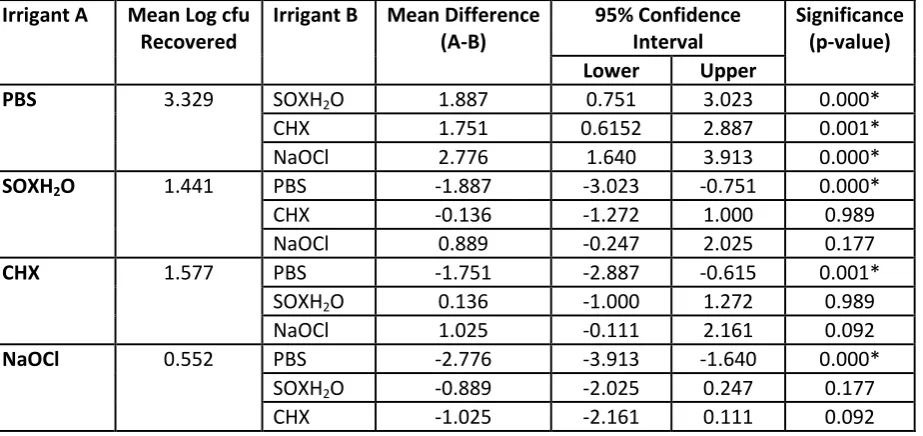
The number of viable bacteria recovered from the teeth following irrigation (Table 2) with the PBS
control was 3.329 (log10 cfu), whilst the antimicrobial irrigants 1% NaOCl, 2% CHX (Sigma) and
SOXH2O yielded 0.552, 1.441 and 1.577 (log10 cfu) respectively. However, only the difference
between PBS and 1% NaOCl was statistically significant following using Tukey’s post-hoc pairwise
test.
In conclusion, the extracted tooth model is a useful method for evaluating the effectiveness of
antimicrobial endodontic irrigants. In these preliminary experiments, the most effective irrigant was
1% NaOCl.
This project was internally funded by the University of Liverpool, School of Dental Sciences as a
Figures and Tables
Table 1: Three-way ANOVA of between subject effects (n=96)
Variable Type III Sum
of Squares
Degrees of freedom
Mean Square F Significance
(p-value)
Irrigant 97.190 3 32.397 14.449 0.000*
Tooth 26.897 11 2.445 1.091 0.381
Week-to-week 28.956 7 4.137 1.845 0.091
Error 165.915 74 2.242
Table 2: Post-hoc pairwise testing of irrigants, measured as mean log10 cfu of Ef recovered from root
canals following endodontic irrigation, using Tukey’s test (n=24 per irrigant)
Irrigant A Mean Log cfu Recovered
Irrigant B Mean Difference (A-B)
95% Confidence Interval
Significance (p-value)
Lower Upper
PBS 3.329 SOXH2O 1.887 0.751 3.023 0.000*
CHX 1.751 0.6152 2.887 0.001*
NaOCl 2.776 1.640 3.913 0.000*
SOXH2O 1.441 PBS -1.887 -3.023 -0.751 0.000*
CHX -0.136 -1.272 1.000 0.989
NaOCl 0.889 -0.247 2.025 0.177
CHX 1.577 PBS -1.751 -2.887 -0.615 0.001*
SOXH2O 0.136 -1.000 1.272 0.989
NaOCl 1.025 -0.111 2.161 0.092
NaOCl 0.552 PBS -2.776 -3.913 -1.640 0.000*
SOXH2O -0.889 -2.025 0.247 0.177
[image:6.595.71.533.303.521.2]el-Falaha, B.M., Furr, J.R., Russell, A.D., 1987. Quenching of the antibacterial activity of chlorhexidine and benzalkonium by Letheen broth and Letheen agar in relation to wild-type and envelope mutant strains of gram-negative bacteria. Microbios. 49, 31-37.
Fabricius, L., Dahlen, G., Holm, S.E., Moller, A.J., 1982. Influence of combinations of oral bacteria on periapical tissues of monkeys. Scand J Dent Res. 90, 200-206.
Gulabivala, K., Stock, C.J., Lewsey, J.D., Ghori, S., Ng, Y.L., Spratt, D.A., 2004. Effectiveness of
electrochemically activated water as an irrigant in an infected tooth model. Int.Endod.J. 37, 624-631. Siqueira, J.F., Jr., Paiva, S.S., Rocas, I.N., 2007. Reduction in the cultivable bacterial populations in infected root canals by a chlorhexidine-based antimicrobial protocol. J.Endod. 33, 541-547. Sjogren, U., Figdor, D., Persson, S., Sundqvist, G., 1997. Influence of infection at the time of root filling on the outcome of endodontic treatment of teeth with apical periodontitis. Int.Endod.J. 30, 297-306.
Spangberg, L., Rutberg, M., Rydinge, E., 1979. Biologic effects of endodontic antimicrobial agents. J.Endod. 5, 166-175.
Walker, A., 1936. A definitive and dependable therapy for pulpless teeth. Journal of American Dental Association. 23, 1418-1424.