THE STRUCTURES OF THE IONIC CRYS'r.us
BROOKITE Al\JD COLU.MBlTE
Thesis
by
James Holmes Sturdivant
In partial fulfillment of the requirements
for the degree of Doctor of
Philosophy
California Institute of Technology
Pasadena, California
239
· XV. The crystal structure of brookite.
By
Linus Pauling and J. H. Sturdivant in Pasadena. (With 6 figures.:
I. Introduction.
In the study of the structure of a crystal with X-rays the effort has been made by .many workers, especially Wyckoff and Dickinson in America, to eliminate rigorously all but one of the possible atomic arrangements consistent with the smallest unit of structure permitted by the experimental data, without reference to whether or not the arrangements were chemically reasonable or were in accord with assumed interatomic distances. The importance of this procedure arises from the certainty with which its results can be accepted. For although structure determinations by less rigorous methods have been found to be false, no important error has yet been detected in any investigation which interpreted photographic data solely with space-group theory aided by . merely qualitative assumptions regarding the factors affecting the
inten-sity of X-ray reflection. It would accordingly be desirable to conduct all structure determinations by this method; but unfortunately the labor involved in its application to complex crystals, involving more than a very few parameters, makes this impossible. J.<'urthermore, if several different atoms are present in the structure, it is often necessary to make quantitative assumptions regarding their relative reflecting powers, so that for this reason too the rigorous method cannot be used.
But complex crystals are of great interest, and it is desirable that structure determinations be carried out for them even at the sacrifice of rigor. The method which has been applied in these cases is this: one atomic arrangement among all of tl::ie possible ones is chosen, and its agreement with the experimental data is then examined. · If the agreement is complete or extensive, it is assumed that the structure is the correct one. Striking regularities· in the intensities of reflection from simple planes may suggest an approximate structure. This occurred in
240
Linus Pauling and ,J. H. SturdivantDickinson's ,study of tin tetraiodide1); he then considered values of the five parameters involved which differed only slightly from those suggested by the intensities of simple reflections, and found a set giving complete agreement with the Laue photographic data. On account of the large amount of experimental information accounted for by it, this structure can be confidently accepted as correct. In other cases it is necessary to make use quantitatively of relative reflecting powers or F-curves, and often agreement is found between the assumed structure and data from rotation photographs or ionization chamber measurements only; then the struclure can usually be accepted as approximately correct, the uncertainty depending upon the paucity of the experimental data or the lack. of agreement with them.
As a result of the recent increase in knowledge of the effective radii of various ions in crystals, Professor W. L. Bragg has suggested and applied
2)
a simple and useful theory leading to the selection of possible structures. His fundamental hypothesis is this: if a crystal is composed of large ions and small ions, its structure will approximate a close-packed arrangement of the large ions alone, with the small ions tucked away in the interstices. In case all of the close-packed positions are not occupied by large ions an open structure results. To apply this theory one determines the unit of structure in the usual way, and finds by trial some close-packed arrangement of the large ions of known radius (usually oxygen ions with a crystal radius of about 1,35 A) com-patible with this unit. The other ions are then introduced into the possible positions in such a way as to give agreement with the observed intensities, and if necessary the large ions are shifted somewhat from the close-packed positions. With the aid of this close-packing method Bragg and his co-workers have made a promising attack on the im-portant problem of the structure of the silicate minerals.During the investigation of the structure of brookite, the ortho-rhombic form of titanium dioxide, another method of predicting a possible structure for ionic compounds was developed. This method, which is described in detail in Section III of this paper, depends on the assumption of a coordination structure. It leads to a number of possible simple structures, for each of which the size of the unit of structure, the space-group symmetry, and the positions of all ions are fixed. In some cases, but not all, these structures correspond to close-packing of the large ions; when they do, the method further indicates
l) R. G. Dickinson, J. Am. Chem. Soc. 45, 958. 1923.
2) W.L.BraggandG.B.Brown, Pr.Roy. Soc., A, 110, 34. l01!6; \V.L.Bragg
Tho cdato.1 structure: of brookite.
241
the. amount and nature of the distortion from the close-packed ar-rangement.
The general method of investigation which we used is the following. Spectral photographs from the three pinacoids provided accurate dimen-sions of the possible units of structure. Data from Laue photographs then led to the determination of the smallest allowable unit, and the pl'esence and absence of reflections on Laue photographs served as criteria in finding the space-group symmetry. (Laue photographs rather than rotation photographs were used because the chance of error in assigning indices to Laue spots is very small1).) On applying the co-ordination theory we found that one of the predicted structures had the same space-group symmetry and unit of structure as the crystal itself. The predicted parameter values agreed reasonably well with the intens1t1es of reflections on rotation photographs, and better agreement was obtained by changing one of the nine parameters slightly. On
account of lack of knowledge of F-curves the intensities of Laue spots were not accounted for.
II. The unit of structure and space-group.
Three forms of titanium dioxide, Ti02, are known. Of these the ' crystal !!truclures of the two tetragonal forms, rutile and anatase, have been thoroughly investigated 2); in each case only one parameter is involved, and the atomic arrangement has been accurately determined.
The third form, brookite, is orthorhombic, with axial ratios
o,sA.•
6 : 1 :o,9Ut.
Data obtained from photographs of the K-radiation of molybdenum reflected from the ground pinacoids of a hrookite crystal (variety arkan-site from .Magnet L:ove, Ark.)~) are given m Table L These lead to a unit with d100/n1 2,291
A,
do10/n2=
2,7181, and do0ifn3 = 1,284-A,
in which n1 , n2, and n3 are the orders of reflection of the first lines on the photographs. Laue photographs were taken with the incident beam of X-rays at various small angles with the normal to (100) of a thin plate of brookite tabular on {I 00} (from Iliedertobel, Uri Canton,l) As an example of an incorrect space-group determination result.ing from e~ror in assigning indices to reflections on rotation photographs mention may be made of the assignment of olivine to
VR
by Rinne, Leonba.rdt, and Hentschel (Z. Krist. 59, 548, 1924). Bragg and Brown (Z. Krist. 63, 538. 1926) determined the space· group of olivine to be V),0 and pointed out the source of lhe previous error.2) L. Vegard, Phil. Mag. 1, 1151. 1926; G. Greenwood, ibid. 4:8, 654. HIM; M. L.Huggins, l:'hys. Rev. 27, 638. 1926.
242 Linus Pauling and J. H. Sturdivant Table I.
Spectral data.
·hkl) I
Oril~r
of I Line. . I Angle ofI
d/n· ' 1 Hellecfi'on (MoK; , Reflectionl
~~~
, -,~
=~:54,~C-~
1
586 ,~
(010)
(001)
i.,,.1 a 5 t13,t1 4,tis~
3n1 a1 13 24 4,580 3nt a2 13 29 4,581 4 n1 ;' 15 4 t 4 ,585 4 n1 fJ 15 59 4,583 4n1 u1 17 59 4,584
18 6
6 1,0 7 30,5 13 H
1a 25 15 5
15 H 13 58
14 14 16 0 H 6
2,748 2,716 2,718 2,720 2,721 2,718 1,2835 1,':!833 1,':!841 1,2840
Switzerland). The short wave-length limit of X-radiation present in the incident beam was 0,24
A;
values of nA. calculated for Laue spots on the basis of the unit obtained by putting n1=
n2=
n3 = 1 were found oftento be much smaller than 0,24
A,
so that this unit cannot be the correct one. The smallest unit which will account for the Laue data is that with n1 = &., n2 = 2, n~=
&.; i. e.7 with 1)dioo 9,·16(}
A,
d010=
iJ,436A,
d001 ts,1::rnA.
The presence of all observed Laue spots, produced by planes belonging to over two hundred different forms, is accounted for by this unit. {Representative Laue data are recorded in Table II.) :i'o evidence was found for the existence of a larger unit; hence this unit may be ac-cepted as the true one. All indices used in this paper (including Table II) are referred to the axes of this unit of structure. The unit contains 8 Ti02 ; the density calculated from the X~ray data is 4-112, within the range 4.,03-4,22 of the experimental determinations reported in Groth1
The cristal structure of brookite.
243
Table II.
Laue data for
n'A
between o,35 and o,~5A.
(hlcl; du1 nA Estimated inlonsity
---~·--- --~
2 4 1 1,25A. 0,42.A 0,02
. 2 1 4 1,20 ,36 ,5 1 4 2 1,18 ,44 ,8
1 2 4 1,l5 ,44 ,1
3 4 2 1,H ,37 ,5
2 4 3 1,03 ,40 a
2 3 7i 1,02 ,37
3 5 1,00 ,41 0,3
1 l 5 1,00 ,44 ,01
I ti 2 0,99 ,36 ,1
4 7i 1i ,96 ,42 ,2
3 4 5 ,95 ,36 ,2
1 2 5 ,95 ,35 ,1
2 5 3 ,89 ,42 ,4
2 5
,ss
,35 ,83 5 3 ,87 ,40 ,5
2 li I\ ,R7 ,H ,0:1.
3 3 5 ,85 ,38 ,05
1 l 6 ,84 ,35 1"
'"
1 1 6 ,84 ,43 ,2
4 6 1 ,83 ,39 ,15
5 5 3 ,s2 ,H ,2
5 6 1 ,so ,43 ,1
3 5 4 ,so ,37 ,02
3 5 4
,so
,43 ,031 6 3 ,79 '45 ,2
5 6 2 ,77 ,36 ,15
1 3 G ,77 ,42 ,2
2 7 1 ,75 ,43 ,05
5 5 ,74 ,42 ,02
7 2 ,74 ,39 ,2
1 4 6 ,72 ,40 ,2
5 3 6 '71 ,45 ,05
2 7 ,70 ,36 ,1
2 2 7 ,70 ,35 ,01
2 2 7 ,70 ,45 ,05
3 2 7 ,69 ,44 ,l5
3 7 1l ,68 ,40 ,05
5 7 2 ,68 ,37 ,o5
7 3 6 ,66 ,43 ,1
7 7 1 ,66 ,45 a
2 7 4 ,65 ,44 0,2
244 Linus Pauling and J. H. Sturdivant Table II (cont.).
(hkl1 dhkl nl.. Estimated
intensity
4 G 5 · O,li5 o,ss 0,1
7 7 2 ,Gt. ,41 ,15
7 T 7 ,63
,.,.1
,17 2 7 ,G2 ,37 ,03
6 7 4 ,61 ,4 1 ,l
5 r; 7 ,61 ,4;) ,or. 4 s lf ,60 '41 ,o3
2 ~ 8 ,oo ,37 ,1
5 6 6 ,59 ,3!\ ,02
7 8 3 ,57 ,39 ,04
3 7 6 ,51) ,43 ,05
7 5 7 ,55 ,41 ,05
9 4 - ,54 ,38 ,02
4 2 9 ,54 ,43 ,o 3
4 4 !l ,~I .H ,os
5·H·2 ,51 ,45 ,02
5·10. 2 ,51 ,39 ,02
10·1·9 ,47 ,36 ,02
10 .1. 9 ,47 ,38 ,o 3
and in good agreement with the experimental value i,125 obtained by Schroder.
The presence of first- order reflections from all types of pyramidal planes (Table
II)
eliminates from consideration all space-groups based on any but the simple orthorhombic lattice T0 • Of these the followingare further definitely eliminated 1) by the occurrence of first-order reflections from the prism planes given in Table III:
C:j_v,
Cf
v• CJv, qv, q'v•
q~, v~, v~, v~, v~, v~, v~, v~0, 1~:.21 v~;\ v~.\ v~6.
If the structure is based on one of the space-groups
a1
0
2
04as
v1
v2
V3vc1 vi vi
y;,
orv21,
~v' 2v' 2v' "1!' l l ' ' h' J1l hl "
it is very difficult to account for the fact that no first-order reflections were observed from planes with h 0 and k odd, k 0 and l odd1
or l
=
0 and h odd; these space-groups may accordingly be removed from consideration. But just these absences are required for any ar-rangement derived from V~5, which may hence be accepted as the correct space-group.The crystal structure of brookite.
245
Table IH.
Prism rellections.
a) Incident beam normal to (100).
(hkl) dhkl n.< Estimated
intensity
1,33 0,43 a
l 0 1,26 ':rn 0,15 1 0 4 1,26 ,37 ,20
2 5 1,00 ,43 a
2 0
r)
1,00 '4;) a2 7 o,7G ,2s 0,03
7 ,73 ,49 a
4 7 ,73 ,H a
0 ·7 ,70 ,12 a
5 0 11 ,60 ,41 0,02
b) Crystal tipped 14°
0 3 1, 70 I 0,47 a
I
() 3 2 1,47 ,44 a
2 3 1, 4 4 ,42 3,5
1 l, 31 ,a:;
',2
5 1,07 ,48 a
0 3 1,06 ,32 1,8
0 3 1,04 ,31 a
1 0 ;; 1, 01 ,43 a
1 0 6 ,Ra ,33 v, 3
0 5 4
,s2
,24 a0 5 ,81 ,21, a
2 0 ,76 ,41
o,s
6 -7 0 ,69 ,48 ,2
3 8 ,63 ,38 ,1
c; Crystal tipped 20°.
0 2 T 2,39
I
0,29 2
0 4 1 1,31 ,47 l ,9
0 T 1,31 ,27 0,5
4 1, 'l4 ,40. a
3 1,06 ,44 0,3
5 1 1,06 ,36 a
5 T 1,06 ,24 a
0 3 1,04 ,43 a
3 5 0 l ,02 ,a9 a
1 5 1,00 ,34 a
3 0 5 ,97 ,30. a
0 2 !) ,96 ,36 0,2
4 0 5 ,93 ,49 a
0 6 ,85 ,40 o,;
u (i 4 ,82 ,34 a
246
Linus Pauling and J. H. SturdivantTable III (cont.).
c) Crystal tipped 20° (cont.).
(hkl) dhkl
I nl. I Estimated intensity
-~-5 6 0
o,s•
A
5 0 6 ,77
2 7 0 '76 I
o,47 A a
,42 0,2
,47 ,6
4 0 7 ,73 ,32 a
2 0 7 ,72 ,43 a
6 ·7 0 ,69 ,42 O,l 7
3 0 8 ,63 ,4 3 ,1
7 8 0 ,60 ,39 a
2 9 0 ,59 ,B2 0,02
3 8 0 ,50 ,35 a
The coordinate positions for equivalent atoms provided by V~5 are1) 4a: 0 0 0;
t t
0; 0 {t; t
0l;
4b:itt; 00-~; -~00; 01;0;
8c:x,y,x;
x,y,z;
·t+x,i--y,z;
x,
t+y,
t-x;
x,l-Y,
t
. t
+
x,
y,l -
;v.-~·
x,
t
y,x;
-~--x,
y,
t+x;
Six parameters must be evaluated to determine the positions of 8 Ti
and 16 0 in the unit in case that both the no-parameter positions 4 a and 4 b are occupied, and nine parameters in case that aU atoms are in positions 8 c. A structure dependent on such a large number of parameters can not be determined by. rigorous methods.
III. The prediction of a structure with the coordination theory.
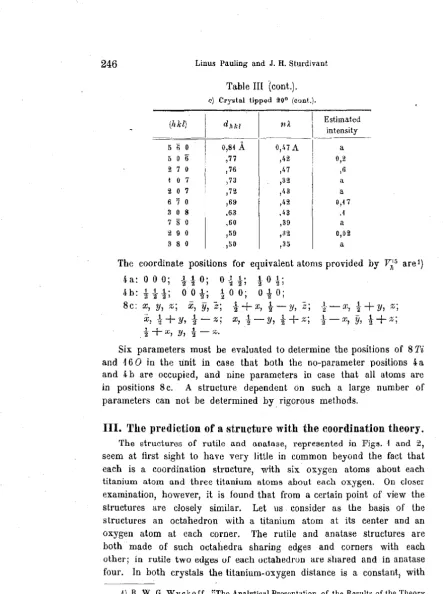
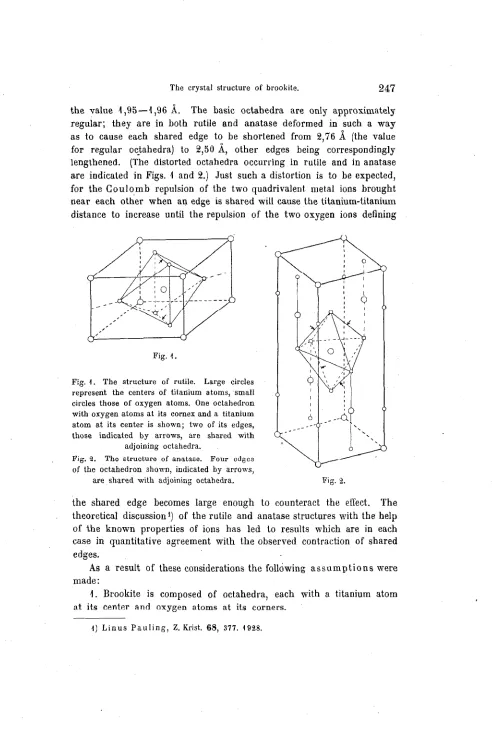
The structures of rutilc and ano.to.se, represented in Figs. 1 and 27 seem at first sight to have very little in common beyond the fact that each is a coordination structure, with six oxygen atoms about each titanium atom and three titanium atoms about each oxygen. On closer examination, however, it is found that from a certain point of view the structures are closely similar. Let us consider as the basis of the structures an octahedron with a titanium atom at its center and an oxygen atom at each corner. The rutile and anatase structures are both made of such octahedra sharing edges and corners with each other; in rutile two eclgeis uf each octahedrun are shared and in anatase four. In both crystals the titanium-oxygen distance is a constant, with
[image:10.617.58.503.69.663.2]The crystal structure of brookite.
247
the value i 195-i ,96
A.
The basic octabedra are only approximately regular; they are in both rutile and anatase deformed in such a way asto
cause each shared edge to be shortened from 2, 76A
(the value for regular oc_tahedra) to 2,50A,
other edges being correspondingly lengthened. (The distorted octahedra occurring in rutile and in anatase are indicated in Figs. 1 and2.)
Just such a distortion is to be expected, for the Coulo.mb repulsion of the two quadrivalent metal ions brought near each other when an edge is shared will cause the titanium-titanium distance to increase until the repulsion of the two oxygen ions definingFig. 1.
Fig. 1. The structure of rutile. Large circles represent the centers of titanium a.toms, small circles those of oxygen atoms. One octahedron with oxygen atoms at its cornex: and a titanium atom at its center is shown; two of its edges, those indicated by arrows, are shared with
adjoining octahedra.
Fig, 'I. Tho structure of ana.tase. Four odgcs
of the octahedron shown, indicated by arrows,
are shared with adjoining octahedra. Fig. 2.
the shared edge becomes large enough to counteract the effect. The theoretical discussion 1) of the rutile and anatase structures with the help of the known properties of ions has led to results which are in each case
in
quantitative agreement with the observed contractionof
shared edges.As
a
resultof
these considerationsthe
following assumptions were made:1. Brookite is composed of octahedra, each with a titanium atom
at its centP.r and oxygen atoms at its corners.
[image:11.612.55.547.46.792.2]248 Linus Pauling and J. H. Sturdivant
~. The octahedra share edges and corners with each other to such an extent as to 3ive the crystal the correct chemical composition.
3. The titanium-oxygen distance throughout is about ,1,95
A.
The octahedra are not regular, but are distorted in such a way as to maintain the titanium~oxygen distanr,es rrrnstnnt. nnrl to shorten each shared edge to the length 2,50A.
An infinite number of structures satisfy these conditions. The number of simple structures, that is, structures referable to a small unit, which
Fig. 3. A staggered string of octahedra with shared edges.
do so is small. vVe made no attempt to consider exhaustively the possible simple structures, but instead investigated the two which presented themselves first. The second of these we have found to be the structure of brookite.
In rutile there occur strings of octahedra in parallel orientation connected by shared edges; these strings, which extend in the direction of the c-axis, then are connected by sharing corners to form the complete crystal. This suggested that staggered strings such as are represented in Fig. 3, with two edges of each octahedron shared, might combine to form a reasonable structure. If
the combination is effected by the sharing of corners alone the simple structure re-p resented in Fig. 4 results. This structure, Structure .A, has orthorhombic symmetry, and in fact the spar.e-gronp RymmPt.ry
VA
4-lts unit of structure contains four octahedra
( 4 Ti02), and, if distortion is neglected, has thA dimensions 4,79
A,
~,t:i'I1,
and 5,52A.
It is not the structure of brookite.
The crystal structure of brookite.
249
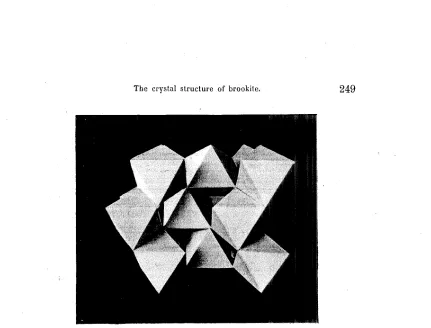
Fig. 4. A model representing a possible structure for Ti02 (Structure A), composed
of staggered strings of oclahedra (Fig. 3) combined hy sharing octahedron corners only.
[image:13.612.78.509.48.376.2] [image:13.612.47.527.62.715.2]250
Linus Pauling and J. H. SturdivantThe fact that brookite also was found experimentally to have the symmetry of
V1
5 and to have 8 Ti02 in the unit suggests strongly that our second structure is to be attributed to this crystal. There is also approximate agreement (within 7%) in the dimensions of the unit. It/..
· is worthy of mention that theL.
F'ig. 6. A portion of the brookite structure, showing the three edges of each octahedron which are shared with adjoining octahedra,
and the resulting deformation.
choice of axes for comparison is not completely arbitrary: assuming that 9,02
A
(model) is to be compared with 9,166:A
(crystal), then the space-gronp requires that 5152A
be compared with 5,4-36A
and 4-179A
with 5,135.A.
Since the analytical conside-ration of the effect of deformation appearedto be too complicated to permit its execution, the following method based upon t.hP. l'.ondruction and measure-ment of a model was used. The basic distorted octahedron employed is shown in Fig. 6; in it all titanium-oxygen distances are equal to 1195
1;
the three shared edges are 2,50A
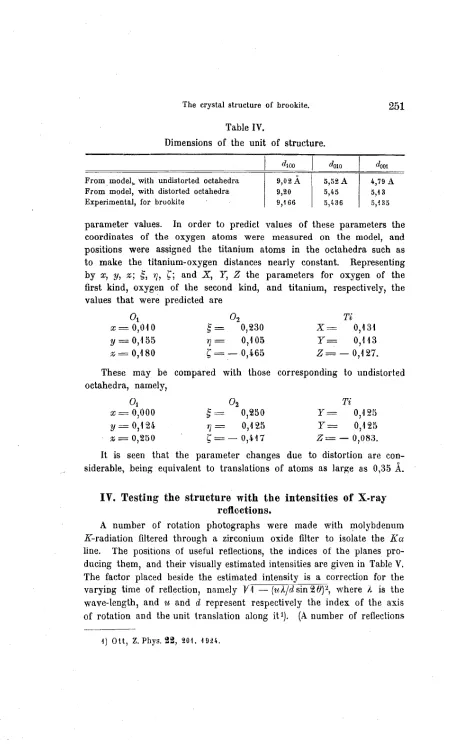
long; and the other edges are chosen so as to be distorted as little as possible from their ori0inul lengths. Such octahedra were constructed to scale (2,54 cm.= 1 1) from heavy paper, und were then glued together to re-present a section of the crystal including one unit of structure (Fig. 5). The carefully measured dimen-sions of the unit were found to be 23165 cm., ·14,0 cm., and 13,2 cm.; if these are reduced in the ratio 2,57 cm. ·I
A
(the increase in scale being due to incomplete coirn;iueuce uf ei.10e:-s autl corner:; uf Lhe uclC!heura) they give the values shown in Table IV, which agree within the limit of error of the measurement with the experimental values for brookite.The crystal structure of brookite.
251
Table IV.
Dimensions of the unit of structure.
d100 do10 d-001
From_ model,. with undistorted octahedra 9,02.A 5,52A 4,79 A
From model, with distorted octahedra 9,20 5,45 5,13
Experimental, for brookite 9,166 5,436 5,i35
parameter values. In order to predict values of these parameters the coordinates of the oxygen atoms were measured on the model, and positions were assigned the titanium atoms in the octahedra such as to make the titanium-oxygen distances nearly constant. Representing by
x,
y,x;
§, r;, ~; and X,Y,
Z the parameters for oxygen of thefirst kind, oxygen of the second kind, and titanium, respectively, the values that were predicted are
01
X = 0,010
y
=
0,155x
=
0,18002
§ = 0,230r;
=
0,105 ~=- 0,465Ti X= 0,131
Y= 0,113
Z= - 0,127. These may be compared with those corresponding to undistorted octahedra, namely,
01
X = 01000
y 0,124.
x
=
0,250§=
r;=
~02
0,250 0,125 o,417 Tiy
0,125y
0,125z
- 0,083.It is seen that the parameter changes due to distortion are con-siderable, being equivalent to translations of atoms as large as 0,35
A.
IV. Testing the structure with the intensities
of
X-ray
reflections.
A number of rotation photographs were made with molybdenum K-radiation filtered through a zirconium oxide filter to isolate the Ka
line. The positions of useful reflections, the indices of the planes pro-ducing them, and their visually estimated intensities are given in Table V. The factor placed beside the estimated intensity is a correction for the varying time of reflection, namely
Y
1 - (t('A/d sin 2tJp,
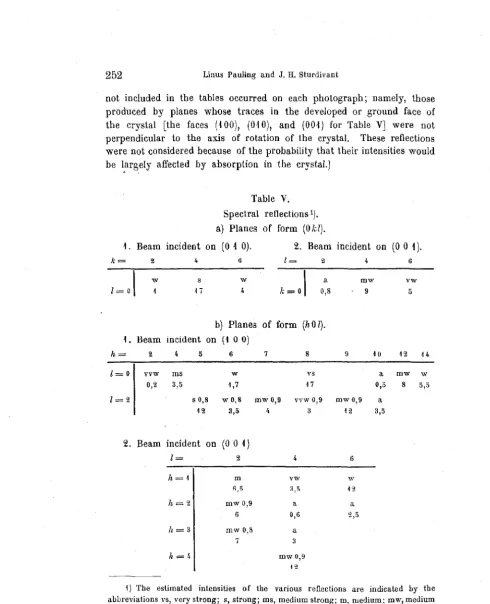
where 'A is the wave-length, and u and d represent respectively the index of the axis of rotation and the unit translation along it1). (A number of reflections [image:15.612.48.509.33.778.2]252 Linus Pauling and J. H. Sturdivant
not included in the tables occurred on each photograph; namely, those produced by planes whose traces in the developed or ground face of the crystal [the faces ( 100), (01 O), and (001) for Table VJ were not perpendicular to the axis of rotation of the crystal. These reflections were not considered because of the probability that their intensities would be I_argely affected by absorption in the crystal.)
Table V. Spectral reflections 1). a) Planes of form (Okl).
1. Beam incident on (0 1 0). 2. Beam incident on (0 0 1 ).
k= 2 4 6 l= ll 4 6
l
=
oI
w s w
le= o
I
a mw vw
.Ji 4 0,8 9 5
b) Planes of form (hOl). 1. Beam incident on (1 0 0)
h= 2 4 5 6 7 8 9 10 12 14
l= 0 vvw ms w vs a mw w
0,2 3,5 1,7 17 0,5 8 5,5
l=2 s 0,8 w o,s mw0,9 vvw 0,9 mw0,9 a
12 3,5 4 3 12 3,5
2.
Beam incident on (0 04}
l= 2 4 6
h=l m vw w
/; ,~ " :lit:\ 12
h=2 mw0,9 a a
6 0,6 2,5
h=3 mw 0,8 a
7 3
h=4 mw0,9
19
[image:16.618.53.543.64.667.2]The crystal structure of brookite.
253
c) Planes of form (hkO).
l. Beam incident on
(1
0 0)h= 2 6 8 10
k=1 s U,'/ VW U,!l m a m
8 2 4 3 10
k 2 w0,8 a vw 0,9 a
2 1,5 o,7 2,5
2. Beam incident on (0 1 0)
k 2 3 4 5 i; 7
h=2 s 0,7 vw 0,9 s 0,9 a a a a
8 2,5 10
o,s
5 6,5 Hh=4 w 0,6 a vw 0,9 a mw0,9
2,5 0,2 4 0,4 6
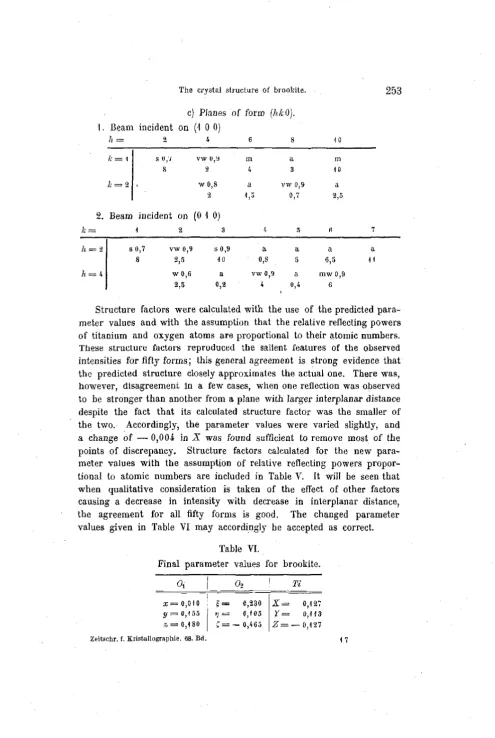
Structure factors were calculated with the use of the predicted para-meter values and with the assumption that the relative reflecting powers of titanium and oxygen atoms are proportional to their atomic numbers. These structure factors reproduced the salient features of the observed intensities for fifty forms; this general agreement is strong evidence that the predicted structure closely approximates the actual one. There was, however, disagreement in a few cases, when one reflection was observed to be stronger than another from a plane with larger interplanar distance despite the fact that its calculated structure factor was the smaller of the two. Accordingly, the parameter values were varied slightly, and a change of - 0,004 in X was found sufficient to remove most of the points of discrepancy. Structure factors calculated for the new para-meter values with the assumption of relative reflecting powers propor-tional to atomic numbers are included in Table V. It will be seen that when qualitative consideration is taken of the effect of other factors causing a decrease in intensity with decrease in interplanar distance, the agreemerit for all fifty forms is good. The changed parameter values given in Table VI may accordi,ngly be accepted as correct.
Table VI.
Final parameter values for brookite.
x=0,010
y 0,155
%=0,480 Zeitschr. f. Kristallographie. 68. Bd.
~=
o,2ao
X= r;= 0,105 Y=!:= - o,465
z
0,127
O,H3
[image:17.615.53.549.51.790.2]254 Linus Pauling and J, H. Sturdivant
'I'll'' ftrw rie11111ining dhwrP.panf'i~l'l :1r.~ proh:1hly due lo P1Tnr in the>
assumed relative rellecling powers. To test lhis, we made use of rn
/r'-cu!'ve for
o=
obtained lry linear exfrapolalion from ,\",{' <111dor,
and Ulli> for 'l'iY" frf,nJ (fl ;:ind Ii' 'l'h~;;;1• /r'-1•111·ve;; (·whieh HNl nnl1•1,p1·n-duc·~d lL!rn ht\c.rnse uf uncertuilllJ in tl1tir dahaiion) J.ead to s!ruclurL falll•:..rs which are, for Hie 6311.1.:: final paraMeler 1 alue;,;, also JJJ i:,uud
J,111 ni.1 r•fompl:'.lf• :1grf!f•lll·!llt \Vith il1R n! •• ;erv..:d inl d1>iti·!,;. P.-1,•ild)
~01newhal different fl~curve;:; (correspoilding to no11-Jinear extrapolation)
•vould ghe better <lgreement, but because of the arhitrarines;; of this [H'neMlurP. no :itlP.rnpl. wa;; m;iclr. ·to ulilizA ii
It is worthy of mention that the rotation photographs yield infor-mation substantiating lhe choiee of
1T
as the correct space-group. Thu:;no r<>tlf!r.liomi or.1'11rrr.d from {·100},
poo},
{iHlO}, {700}, {900}, {11.0.0},{1
1
a.o.o},
{ao1 }, {t>oq,
{701 J, {901 J,{1 HJ·'1}, {401}, {601}, {so.q,
{110.0 ..f},
{12·0·il}, etc. on one photograph recorded in Table V, althoughp!HnP.;; of all the;;A form;;; were in pn;;it.ions faxorahle to rellf.etion. Similnr
failures to reflect were observed on the uther photographs.
On account of the lack of delinite knowledge of the F-cunes no attempt was made to account for the intensilies of Laue spots.
V. Discussion of' the structure and the coordination method.
The structure found for hrookile is that shown in Fig. 5. Each titanium atom is surrounded by six oxygen atoms and each oxygen by
three titanium atoms. The various interatomic distances, given in Table VII, are similar to those in rutile and anatase; for example, the a\·erage titanium-oxygen dis lance is 1 ,95 .\.. The oxygen-oxygen distances and the distortion of the basic octahedra have been discussed in the previous sections in the course of derivation of the structure.
Table VII.
tnteratom1c distances in brookite. 'l'i-01 1,919 A 01-03
:J'i-0~ 1,94 2 02-0;i
1ri-Oa i ,929 02-01
Ti-04 1 ,975 Oz-06
'l'i-0; 1,983 Ui-0., '1'(-0.; i ,953 Oi-01
04-0;,
01-Ch :!,508 04-011
01-a1 2,869 O,,-nd
01- 05 2,;HI
t.,767 A
The crystal structure of brookite.
255
We believe that our c.onclusions can be accepted with considerable certainty, for the agreement lielweeu Lhe predil.:ted structure and the experimental results in regard to space-group symmetry, size of the unit of structure, and intensities of reflections on rotation photographs is so striking as to remove nearly completely from consideration the possi-bility of its being accidental.
The arrangement of the oxygen atoms approximates double hexagonal close-packing1). It is evident, then, that Bragg's close-packing method of deriving a possible structure might have b"een used. But both hexa-gonal and double hexahexa-gonal close-packing of oxygen ions are roughly compatible with the observed unit (compare Rows 1 and 3 of Table IV). To decide between these possibilities intensity comparisons would be required, and in the absence of information regarding the nature of the deformation from regular close-packing this procedure might be very laborious. In anatase the oxygen ions approximate cubic close-packing; the axial ratio is, however, increased from 2,0 to 2,5 by deformation, and a knowledge of the size of the unit of structure would not suggest the close-packed arrangement with much certainty. Rutile provides an example of a structure which is easily derivable by means of the co-ordination theory, but in which the oxygen ions do not approach any type of close-packing whatever.
The close-packing method is more generally applicable in the case of crystals containing cations smaller than the titanium ion and showing correspondingly less deformation. The method is very powerful and simple, and already in the hands of Professor Bragg has led to a number of interesting structure d.eterminations. The coordination method, though also simple in principle, is somewhat less easy to apply. The two methods are not .distinct and mutually exclusive, but instead supplement each other and should be used together.
VI. Summary.
Brookite, Ti02, is found with the use of Laue and spectral photo-graphs to have an orthorhombic unit of structure with d100 9,166
A,
d010 5,436A,
and d001 5,135A,
containing 8 Ti02, and to have the symmetry of space-groupVh5·
A structure predicted by means of the1) There are three close-packed layers. from which all of the infinite number of close-packed structures can be built; namely, A; with an atom at X
=
o, Y=
O (X, Y, Z being hexagonal coordinates); B, with an atom at X=
:J-, Y =}; and 0, with an atom at X = t, Y = f. For hexagonal close-packing these layers are super-posed in the order AB.AB.AB ... , for cubic close-packing in the order .ABC.ABO ... ,and for double hexagonal close-packing in the order AB.A CABA 0 ...
256 Linus Pauling and J. H. Sturdivant, The cristal structure of brookite.
coordination theory had the same unit and space-group symmetry, and gave an atomic arrangement accounting for the intensities observed on rotation photographs. In this structure the eight titanium atoms and the sixteen oxygen atoms (in two groups of eight each) are in positions 8 e witl:t the parameter values given in Table VI. The basic unit of the arrangement is an octahedron of oxygen ions about a titanium ion; the octahedra are combined as shown in Fig. 5 so that each shares three edges with adjoining ones. Interatomic distances
are
given in Table VILGates Chemical Laboratory, California Institute of Technology. Contribution No. 177.
557
Sonderdruck aus ,,Zeilschrift fi.ir Kristallographie". Bd, 69, Heft 5/6. Akademische Verlagsgesellschaft m. b, H. in Leipzig, rn2t1.
J. H. Sturdivant and Linus Pauling (Pasadena): Note on the Paper of A. Schroder: Beitrlige zur Kenntnis des Feinbaues des Brookits usw. (With 2 figures.)
We have recently found
4)
the space-group symmetry of brookite, the orthorhombic form of titanium dioxide, to be that of VJ,'. In our space-group determination, use was made of the presence or absence of reflections on Laue photographs only. Reflections from all types of bipyramidal planes were observed, requiring that the structure be based on the simple ortho-rhombic lattice I'0• No first- order reflections were observed from prism planes of the following classes, although many such planes were in positions favorable to reflection:k
=
0 and l odd;l
= (}
and h odd;h = 0 and k odd.
The space-group criteria for Vt,," are that no odd- order reflections shall occur from just these planes. These criteria were afterwards found to be satisfied by reflections observed on several rotation photographs.
~) Gemeint ist dabei die Deformation der farblosen geliisten lonen Hg++ und
J-bei ihrer Vereinigung zum Salz.
2) H. Ley, Z. angew. Ch. H, 845. 1928.
I
558 Kiirzere Originalmilteilungen und Nolizen.
On page 2 41 of our paper we pointed out the desirability of basing a space-gr·oup determination on Laue photo13ra pli:; n1Ll1er tlrnu uu rulaliun photographs, on account of the small chance of erro1· in assigning indices Lo the planes producing Laue spots and the much larger uncertJinty in identifying planes producing reflections on rotation photographs. An example ol' an incorrect choice of space-gt'oup arising from the use of rotation photographs was cited. A. Sc hr oder 1) has published data on rota lion photographs of brookite which are incompatible with the space-group V),". He reports the observation of odd-orde1• reflections from the following claaacs of prian1 planes:
k = 0 and
l
even,l
=
0 and h even, h =o
without restriction.Reflections reported by Schroder which do not satis(y the criteria for V);'
are: (051), (032), (052), (0,13), (033), (012), (015), (031), (034).
I
II
I013 OZJ 01.1 O~J
I
I
I
1.il ZSJII
I
I
I
I
II
OJl. Ofl.L 0.'i2 052
I
I
I
I
I
I
I
021
""' 051
I
I
I
020 O•O 060
I
I
I
I
I
II
OZ1 O'l1 151251I
0711I
l
060I
211I
080I
I
I
II
I I I
I
I
I
I I
I
I I I
I I I
II
I
rFig. 1. Fig. 2.
Fig. L Diagram of Sch1•oder's rolalion photograph No. 3, showing his assignment of indices. The X-ray beam was incident on (01 O), the crystal rotating through
20° about (001].
Fig, 2. Diagram of a photograph made by the writers wilh the crystal oriented as for Fig. 1, but rotating through 4 5°. The proper assignment of indices is shown
for those lines which it is considered practical to identify.
On our Laue photographs the following planes, listed in Table Ill of our paper, failed to reflect in the fast order, although in position to do so: (Oaf), (051), (032), (015), (031), (034). The following planes not listed in our paper also failed to produce Laue spots, allhough in a position to refle~t radiation of the wave-lengths indicated: (052) at n'A = 0,28 and 0138 A, (o 13) at n'A
=
0,59A,
(012) at n'A = 0,641.
These observations show that eight of the nine reflections reported by Schroder to disagree with the criteria of V)," do not occur on Laue photographs. The presence or absence of the remaining reflection, ( O 3 3 ), cannot be determined from J, au e photographs on account of its superposition on (022).There is additional evidence that Schroder's supposed observation or reflections which we find not to occur arose from error in his assignment
[image:22.615.52.528.40.773.2]Kii.rzere Originalmitteilungen und Notizen.
559
of indices Lo reflections on rotation photographs. The distance between n:llcdiuus tluc Lu IJIH.ues uf furm (o kl) and of form (I kl) on a photograpll made with the film t O cm. from the crystal is 0,7 mm. Measurements of the position of the central point of a given line referred to the central point of the undeviated image can accordingly scarcely be rendered snf'ficiently trustworthy to decide between two possible sets of indices differing so slightly as ( t kl) and (okl). The distance between two reflections which lie close together, however, can afford a more decisive test. We have made a rotation photograph with the X-ray beam incidcul on the (010) plane of brookite, and with the crystal rotatiug through 45° about the a-axis; the crystal-to-film distance was t 0 cm. and the JJfoKa radiation was isolated with a zirconia filter. This photograph corresponds to Schroder's photograph No. 3, reproduced with his assignment of indices in fig. f. On our photo-graph, the principal reflections of which are represented in fig. 2, there appears on the right of the line numbered (05f) by Schroder a slightly
:.tronger reflection. The11e two reflection& are Llue lo twu uf the vI1.1ues (051 ),
( 151 ), and (2 5 t ). In both lines, the Ka doublet was resolved. We calculate the following theoretical separations for the MoKa1 reflections from these
planes:
(051) to ( tlil)
=
07074 cm. (05t) to (251)=
07221 cm. ( t5 t ) to ( 2 5 t) O, U 7 cm.The separation of the two Ka1 reflections was measured on the film as
o,143 + 0,003 cm. These two refleetions are accordingly due to the planes
(t5t) and (25t), and Schroder's assignment of one of them to the prism plane (051) is incorrect1).
The same error was no doubt made in his assignment of indices to the other reflections.
Summary.
It is shown that Schroder's reported observation of X-ray reflections from hrookit.e not allowed for 11 strnr.tnre hlHPd nn thl? «pi:1ee-group Vf'
is due to error in his assignment of indices to lines on rotation photographs.
Gates Chemical Laboratory, California Institute of Technology. Contribution No. t 9 5.
Received October f 3th, t 9 2 8.
TRE CRYSTAL ST:i.UCTURE OF
COLUJ~:BITEColumbite and tantalite1 form a series of mixed
crystals of composition (Fe,W.n)(Cb,Ta) 2
o
6 ,
with
ortho-rhombic holohedral symmetry.
The crystal used in the
present
investigation was a short columbite prism from
Norway,
2
showing developed pinacoids, blackt with a density
of 5.71
~C.l (determined on a powdered sample with a
pyc-nometer).
Laue and oscillation photographs
pre:farCd with
i t
served for determining the space group and unit cell, while
i.to find
possible
atomic pos}ions use was made of the
coBrdi-nation theory and of close packing.
I. The Unit Cell and Space Group
Oscillation
photographs for the
determination of
the lattice constants were made with molybdenum K-radia.tion
ref~lpted
from the
pinacoidst a
calcite
spectrum being recorded
simultaneously for a comparison.
Table
I
shows the data
obtained.
The indices of the reflecting pinacoids are
2
elements; the space group axes
~rerelated to the
crystallo-graphic axes
(after
Dana)
by
cyclic
permutation:
a_ '-"'"'b,
--JJana
-b
....,-...
c
c
... a.
The tabulated
interferences lead
to a
·-Dana - ' -Dana
-unit
with d100
/n
1
=
2. 541
l,
d
010
/n
2
=
7 .119
A,
d
001
/n
3
=
2.865
l;
n1 , n2 , and n3
are
the orders of reflection of the
first lines on the respective photographs. Laue photographs
were taken with the incident beam
of X-rays
inclined
at various
small
angles
to
the normals of three
thin
slips ground
~1rallelto
(100), (010),
and
(001),
respectively.
The short
wave-length limit of the incident spectrum (from a tungsten target)
was 0.24
1.
The smallest unit which will give calculated
values of
n~
not less than 0.24
l
for
all
Laue spots is that
corresponding
to n
1
=
n
2
=
n
3
=
2;
since this unit accounts
for all reflections observed on the two Laue photographs which
were completely analyzed,
i t
is to be accepted as the correct
one.
(Table II lists a few typically useful Laue interf
er-ences appearing on one photograph; on the two photographs
mentioned, ·a total of approximately two hundred forms
reflected.) The fundamental translations are:
0 0 0
dlOO:;;.:.. G.082 A,
do10
~14.238 A,
doo1
~5.730 A.
These are
conf.:ti?ed
bythe
application
of the
rola.nyi
formula.
3
Table I
Meaeu.rementl:i of tht: axial lengths
(hkl)
Order
(Mo K)
Line
9
d/n
Average
(100)
n1·
f3
70
B.
'
2.542 A
0n1
0(8
1.5
2.543
2
n1
(3
14
24.
2.540
2
n1
ex"
16 11.
2.541
..
2
n1
O(~16 17.
2.541
2.541
A
(010)
2 n2
~5 43.5
7.117
3
nl')
~
7
38.5
?.120
,.;,
3
n
2
C(48
35.
7.119
7.119
(001)
n3
(3
6
19.5
2.865
n3
°"
76.5
2,.8682
n
3
°'"
14 19.
2.863
[image:26.612.57.536.43.754.2]4
Table II
Selec.ted first-order pyramidal reflections
from a
ty~icalLaue photograph
X-ray
beam
at
small angle to (010); 170 mah., 51.5 kv.
peak.
Form
n~
{hklJ
.A
311
.40 •
• 44
434
.30, .3b, .38,
.43
335
• 30,
.. 33,
.39, .43
136
.30,
.31,
.. 41,
.42
405
.24, .28,
• 3.0,
.31
337
.25, .27
731
.. 24,
.25
762
.35,
.37,
.40,
.41
499
.32,
.34,
.38, .40
[image:27.615.44.558.174.780.2]5
of this unit of structure.
The axial ratio calculated from the X-ray data is
a:b:c
=
0.3569 : 1 : 0.4024.
This may be compared with the
3
axial ratio given
by
Dana for a columbite crystal:
aD
:bD
:cD·
::::::. 0.82850 : 1 : 0.88976, or
a;b;c
-=-a.na.
a.na
ana
3
x 0.3G80 : l : 3 x 0.4023.
If the crystal were pure columbite, with any
ratio of iron to manganese, the observed unit would contain
4.24 molecules of (Fe,N.in)Cb
2
o
6
•
The com.position
(Fe,1.il:n)Ta2
o
6 ,
corresponding
to pure
tantalite,
would
require
2.?9 molecules in the unit cell. The unit cell must therefore
contain
either three or four molecules of
(Fe,llfn)M
2
o
6 • With
the former alternative, the specimen must consist of 73.5%
Ta2o5 , 11.5% Cbz05; with the latter, of 14.1% Ta2o5, 65.8%
Cb2
o
5 •
A
decision between the two possibilities
may
be made
by
reference to
l.!a.rignac's
table showing the relation between
density
and composition or columbites
an~ tantalites
4
(or
to
other summaries of analytical results):
Density
5.36
5 .. 65
5.70
5.74
5.92
Percent Ta2
o
5
3.3
15.8
13.8
13.4
27.l
6.05
...
7.03
30 .. 4
...
65.6
6
the latter with a density of 5.7. The unit of columbite
therefore contains four molecules.
Since first-order Laue reflections are observed
from all types of pyramidal planes (Table II), the space
group is based on the simple orthorhombic lattice
r;.
Of
the s:pa.ce groups derived from
~
the following are
eliminated
5
by observed first-order reflections on Laue
photographs from the prism planes listed in Table III:
3
0
8
0
9
10
2
3
4
6
8 . 9 VlO
ul2 Vl5
C2v'
2v•
2v
10 2v'
Vh, Vh, Vh, Vh, Vh, Vh,
h '
vh ' h •Of the remaining seventeen space groups, only one requires
the first-order absences which were regularly observed.;
na.~ely,forms having
h
=-
0, k
+ 1
odd,
k
=
O,
i
odd, or
i,
~O, h odd.
These absences are exactly those required for any structure
14
based on Vh , and therefore this is taken to be the correct
space group. No observable reflections upon the oscillation
photographs contradict the preceding conclusion; over one
hundred absences upon them confirm it.
The four groups of
coerdin~tepositions permitted
14
6
by Vh
for equivalent atoms are:
4a. ••
o o o·
, ' , i 2•2"•2> i i .o
•<ift:2J 1i.
i 2• 'o o
•4b:
t.o.!;
o.t.o;
~.t,o;
o,o,i.
Table III
Prism reflections on Laue photographs
Intensity I
>
0 unless otherwise noted.
(hkl}
d.11...kl
n1'
I-
5.31
l
0011
0.34 A
021
4.46
.48
0
-021
"
.29
0
031
3.65
.29
031
..
.23
031
"
.39
071
1.92
,44
013
1.89
.38
0.10.1
1.39
.5?
0
0.11.2
1.18
.46
0
0.12.1
1.16
.49
0
035
1.11
.45
0.13.l
1.08
.38
0.13.l
tt.42
0.13.2
1 .. 00
.28
0
0.15.1
.94
.29
0.15.1
"
.32
0.15.2
.90
.55
0
0.15.2
"
.41
0
[image:30.614.55.530.127.757.2]8
Table III, Continued
(hkl}
dhkl.
nA
!
O.l7.2
a.so
1
o.31
1
0
0.19.l
• ?4
.33
0.19.2
.73
.35
0
038
• '71
.26
0
o.~i.2
.66
.29
0
0.23.2
.60
• 24
0
0.23.3
• 59
.37
o.21.5
• 58
.35
0.25.3
• 55
.41
0.9.11
.49
.34
0.9.11
••
..28
105
1.12
.43
0
105
"
.54
0
501
1.00
.37
0
501
tt.32
0
502
.96
.38
106
.94
.29
-106
It.39
106
n
.48
107
.73
.27
0
-108
.71
• 30
?02
.?O
.32
[image:31.615.57.540.62.771.2]Table III, Continued
(hkl)
dhkl
nA
I
-
() 0702
0.70 A
0.33 A
'702
It.38
703
.60
,30
0
308
.66
.42
308
"
.47
?04
.65
.41
902
.55
.25
0
902
"
.34
3.0.10
• 54
.32
3.0.10
ll.3?
904
.53
• 36
904
"
.39
904
"
.37
904
"
.41
230
2.24
• 31
310
1.68
.46
0
1.10.0
1.3?
.49
0
290
l.~4.31
1.11.0
1.25
.46
0
430
1.23
.44
i.12.0
1.15
.43
0
[image:32.613.59.545.68.757.2]10
Table III, Continued
(hkl)
dh.kl.
nA
I
-
0o.42
A.
1.13.0
1,07 A
0
1.13.0
"
.40
0
i.14.o
1.00
.4~0
.,.__
1.14.0
u
.36
0
1.14.0
"
.38
0
530
.99
.38
0
530
H.4?
0
1.15.0
.93
.3?
0
1.15.0
..
• 32
0
1.15.0
..
.36
0
1.16.0
.88
.32
0
1.17.0
.83
.32
0
1.18.0
• '78
.26
0
?30
.72
.25
0
[image:33.613.56.507.43.764.2]11
Bd:
.x-t,y,z-f;
x+f,
-~-Y.•~-z;
x-f,!-y,z+f;
x+i,y.i-z;
The minimum number of :parameters which must be evaluated to
determine the atomic positions of the 4 Fe, 8 Cb, and 24 O
is seven, and a larger number is necessary if the atoms are
to be homogeneously distributed throughout the unit cell.
Recourse to the non-rigorous principles developed in recent
years for the solution of complex ionic structures is
accordingly indicated.
Cb
5t-II. The Application of the Coerdination Principles,
with Closest Packing?
crystal radius of
Fe~+
0Since the
is 0.75 A, of
is
0.10
1,
and
of
o=
is
1.40
1.
8
it
may be assumed that
0
the metal-to-oxygen distances in tantalite are
2.0
±
0.2 A.
From the univalent cryetal ra.diuB of Cb
5
+,
a.
cuOrdinatiun
number of six for the ion in oxides has been predicted
9
;
z+12
the central ion and from its low valence compared to
t:t.at of
the columbium, the distortion will be left for determination
by the intensity data.
Union of the octahedra to form the
completed structure will be accomplished without the sharing
of faces (three oxygens) between columbium octahedra or
between columbium and iron octahedra, and the number of
shared edges should be small. Lastly, it is expedient to
assume that the oxygen framework is derivable by distortion
of a close-packed assemblage with the normal to the layers
parallel
to
the b-axis
of
columbite.
The
four assumptions
of reasonable metal-to-oxygen distances, of fairly regular
octahedra, of limited sharing of oxygens, and of close
packing
suffice
to definet under the restrictions
imposed by the space group and unit cellt a small class of
structures from which one may be selected for detailed
testing with the observed intensities of reflection.
Arrangements of ions in closest packing have been
described lO in terms of the order of superposition of the
three fundamental layer5 from v;hich all of the inf'ini te number
of close-packed structures can be built; namely, A, with an
atom at X= 0, Y
=
0 (X,Y,Z being hexagonal co6rdinates);
B,
with an
aton1a.t
X
= ·
1/3, Y::::.
2/3;
and C, with an atom at
X
=
2/3, Y==- 1/3. The effective thickness of a layer of
13
to alter the height per layer
by
a
maxirmlm
of 15%, the
lene;th
oi'
the b-axie of columbite
then requires that the
sue-cession of layers have a periodicity six. Accordingly, the
I.ayers
may
be superposed in the order ABABAB ••• , glving
hexagonal
close
packing;in the order .A.B.ABAC ••• •
g:i.v:ingtriple-hexagonal close
packing;
in the order ABCABC •..•
givir1g cubic close packing; in the o!'der ABCACB ••. , giving
double-cubic close
J'.QCking;
and in no other non-equive.lent
sequence.
Tn.e
triple-hexagonal close-packed assemblage lacks
a diagonal glide plane normal to the layers and containing
a two-fold rotation axis parallel to them.
The unit with
space-group symmetry
v~
4therefore cannot be derived from
such an oxygen skeleton. 11 The cubic close-packed framework
of oxygens ·with triad a.xis parallel to b is similarly
elim-inated.
Normal to the
layers
of the
double-cubic
close-packed arrangement there is only one distinct set of glide
planes
vvith
a diagonal translation, and .normal to these
planes
and to
the
layers only one distinct set of symmetry planes
with
a simple glide.
The
clooc-:pa.oked
aseembl~gecan be inserted
into a unit
with
spa.ce group
vi:i
4
in only one distinct way.
The oxygens are in three sets of 8d :positions. with parameter
14
x,
-
5/6
xz.:::.
5/6
x
J=
1/2
y
I
-
1/12
Yz.
=
5/12
Y;,
=-
3/4
z,
-
1/8
z
2..=
1/8
Z3=
1/8
...
x,
If
the oxygen ion is assigned the diameter 2.76
the
a.xi al
lengt11s o,re
(:! --
-
4. 78
1,
b
0 0
=
13. 5
A,
c:::.5.52
A;
they
deviate
by
6,
5, and 4%, respectively, from thoo e
of
the
actual structure.
This is the arrangement shown in Figure 2.
If
four iron atoms are
inserted
into this
oxygen :framework
in the unique :positions 4a or 4b, there are no reasonably
regular octahedra of oxygen ions about them,
smd
the
shortest iron-to-oxygen distance is only 1.4
i;
the unique
:positions are therefore not available.
If, however, they
are placed in positions 4c, w1th u
=
~/8,each is surrounded
0
by
oxygen
atoms at a distance of 1.95 A, arranged in a
regular octahedron, and
each octahedron shares two edges
with the adjoining ones to form parallel to
the~axis strings
of the ty:pe which were observed in brookite
12
(Fig.1).
Save
for the
equivalent parameter value u ::;::: -1/8, there is
no other
value
of~which places the iron atoms within reasonably
0
regular octahedra or at distances of the order of 2 A from
the
neighboring
oxygens.
(Small parameter variations,
15
[image:38.618.58.537.37.761.2]5.52A~-- ~. •
3
>
3 / 3 ,,r•
·r
•-r---\--•
9
I ;1
: \
I
\
I \i - \ 1 , \
I )-.;. I 5/ T 5 \J; I
\><
U I
Q
0 0 U • U\ , I
\\ 7 ' I /
@ @ .
\ 1·
\ )(
3
!A
~,
r\
!J
~®\
I \~
{ /M4
1\6 '
'6
/~\/B\
6
I\51'
!HA :
I • \ • \ :
L •
q.
I\
7"6
')31,
~:r~
\
0
1~ ~
ff :
~
3
l!f
3I
~
7 ' I 7
o
I?
~Ai6
Fe
•
Cb@
5
0
I I
0
i9
I 00
9•
16
Fig. 2. The projection of (100) of Structure E,
undistorted.
The edges of the unit cell are outlined, and
the uppermost face of each octahedron is indicated. The
[image:39.613.58.517.58.619.2]17
sets of positions for the columbium atoms; both place the
metals within strings of staggered octahedra, with
metal-to-o~ygen
distances 1.95
l.
If the columbiums are in one of
these sets of positions,
8d:
x
=
2/3,
y =1/6,
z
=3/8,
each
colu~biumoctahedron shares two edges with columbium
octahedra of the same string, two edges with an iron
octa-hedron, and two corners with columbium octahedra of an
adjacent string. This set of :parameters is improbable; it
is discarded for this and for another more convincing
reason which will appear later. 13 If the second set of
available parameter values is chosen,
8d:
x
=
2/3,
y
=l/6,
z
=
7/8,
each
columbium string is joined to an adjacent iron string
~y
the sharing of one additional edge per octahedron (the
type of linking observed in brookite); and only corners are
shared between successive columbium strings. The
electro-static valences of the three groups of oxygens are
l~,2,
and 2i,
respectively. Fig.
2
shows this structure, hereafter
called Structure E.
The examination of the hexagonal close-packed
arrangement (with its hexagonal axis parallel to b) is
similar to that of the double-cubic close packing.
Only
one distinct unit can be derived from it which has the
14
space group Vh and the basal translations of which
[image:40.612.56.529.61.792.2]z
•
I I IZI
I
I
5
0
9 ®·
3
®
5 I
?26 JB
I
3 I
@ I
r
, ,
5I
1~6
37 ) , \ i?
®
I~
1:
6
6
Fig. 3. The projection
on
(100) of Structure
c.
See Fig. 2 for explanation of symbols. The lower numeral
beside an atom, when two are present, refers to the
numbering in Table VI.
[image:41.613.59.540.91.760.2]Fig. 4. A model
representing
half of the unit of
structure of oolumbite, showing the strings of octahedra
qombined
by
sharing corners only.
[image:42.612.55.547.41.793.2]20
of
8d
positions (see
Fig.
3);
their parameters
are:
'
x=
f1/3
X
2=
1/3
X3=
l/3
Y1
==
l/12
y
2=
5/12
Y3=-
3/4
z.:::.
1/8
z
2.:::.1/8
z
:s
0:::::1/8
The iron atoms must lie in positions
4c
with
u
=
5/8.
(Settfng u
=
1/8 produces an equivalent arrangement.)
The columbium atoms must be in one of two sets of 8d positions.
If they
have the parameter values
x
=
0. y :: 1/
6.
z
=
5/8.
each columbium octahedron shares a face with an iron
octahedron; this structure disagrees
with
our
original
hypotheses.
They must then have the positions corresponding
to
x
=
0 '
y :::.
1/
6.
z
=
1/8 •
The resulting unit, hereafter called Structure C, is shown
in Fig.
3,
and
e.
model of a
portion
of
it
in Fig. 4.
It
hae
been found to be the structure of columbite. All of the
metal atoms lie within regular octahedra of oxygen atoms.
Iron octe.hedra share two eclges each to form strings parallel
to the
~axis, and columbium octahedra do likewise; each
string of staggered octahedra is joined to two adjacent
strings
by
the sharing of corners only. The electrostatic
valences of the three groups of oxygens are 2,
li, a.nd
2i",
respectively.
In short, Structure C differs from Structure
[image:43.612.55.535.57.772.2]21
iron and columbium octahedra..
The principles which have been
adopted indicate that Structure C is slightly more probable