Research Article
Stochastic Geometry Analysis and Additional Small Cell
Deployment for HetNets Affected by Hot Spots
Nan E and Xiaoli Chu
Department of Electronic and Electrical Engineering, University of Sheffield, Sheffield S1 3JD, UK
Correspondence should be addressed to Xiaoli Chu; [email protected]
Received 7 September 2015; Revised 3 January 2016; Accepted 13 January 2016
Academic Editor: Pedro M. Ruiz
Copyright © 2016 N. E and X. Chu. This is an open access article distributed under the Creative Commons Attribution License, which permits unrestricted use, distribution, and reproduction in any medium, provided the original work is properly cited.
Hot spots (HSs) of mobile users that were not expected in the original network planning may occur after a heterogeneous network (HetNet) has been deployed and affect the network performance. In this case, deploying additional small cells on top of the existing HetNet without changing the existing network infrastructure is considered as a solution. In this paper, we first provide a stochastic geometry analysis for a HetNet affected by a large HS and for the additional small cells that need to be deployed based on the spatial bivariate Poisson point process. The optimal numbers of additional small cells required in the HS and non-HS areas are obtained by minimizing the difference between the numbers of macrocell users after and before the HS occurs based on the analytical results. We then propose an algorithm to maximize the average user throughput by jointly optimizing the locations of additional small cells and user associations of all cells. Simulation results show that the proposed algorithm can maintain the average user throughput above a threshold with excellent fairness among all users even for a very high density of HS users.
1. Introduction
Small cell deployment in heterogeneous networks (HetNets) has been considered as an efficient solution to the rapid growth of mobile data demand under limited radio resources. It is anticipated that deploying low-power small cells will increase the area spectral efficiency [1]. In a HetNet, some small cells are deployed by the users, with their locations uncontrollable by the operators. Moreover, once a HetNet has been deployed, persistent hot spots (HSs) of user equipment (UE) that were not expected in the original network planning may occur, causing extra traffic demand. As the mobile traffic demand goes beyond the network capacity, the quality of service (QoS) of UE in the HetNet will be affected. In this case, deploying additional small cells on top of the existing HetNet by the operators would become necessary.
Considering cost effectiveness for network operators, it is desirable to optimize the number and locations of additional small cells to be deployed without changing the existing HetNet infrastructure. This relies on a thorough analysis of the HetNet. Stochastic geometry and the theory of random geometric graphs have been used in the analysis and design of wireless networks [2]. The internodal distances were modeled
using a spatial bivariate Poisson point process (PPP) in [3]. However, the existence of significant HSs in HetNets has not been specifically considered in stochastic geometry based analysis of mobile networks.
In this paper, we analyse a HetNet before and after an unexpected HS occurs and additional small cells that would be required to mitigate the HS effect under a spatial bivariate PPP model. We model the spatial distributions of different network nodes (e.g., existing small cells, additional small cells to be deployed, HS UE, and non-HS UE) into five possible events. By minimizing the difference between the amounts of macrocell UE after and before the HS occurs based on the analytical results, the optimal numbers of additional small cells required for the HS and non-HS areas are obtained. We then propose an algorithm to maximize the average UE throughput in a HetNet affected by unexpected HS by jointly optimizing the locations of additional small cells on top of the existing HetNet and the user associations of all cells. The relationship between HS UE intensity and additional small cell intensities in HS and non-HS areas is analysed. The sim-ulation results show that our proposed algorithm can effec-tively maintain the average UE throughput requirement with Volume 2016, Article ID 9727891, 9 pages
excellent fairness among all UE even for a very high intensity of HS UE.
The rest of the paper is organized as follows. In Section 2, the system model is presented. The analysis based on the spatial bivariate PPP and the analytical results are provided in Section 3. The optimization of additional small cell deploy-ment and the algorithm to solve it are provided in Section 4. Simulation results and performance evaluation are presented in Section 5. Conclusions are drawn in Section 6.
2. Related Work
Using the stochastic geometry analysis, the authors of [3] studied the distribution of the distances between an arbitrary point and its dissimilar neighboring points as a spatial bivariate Poisson point process. In this paper we will extend the model of [3] into five events for our stochastic geometry analysis in Section 3.
As for small cell deployment in HetNets, the femtocell deployment with an arbitrary topology was optimized by maximizing the number of users supported with QoS con-straints in [4]. In [5], the deployment locations of macro base stations (BSs), pico-BSs, and relays are optimized by selecting a subset of candidate sites. In [6], the locations of small cells are sequentially determined by maximizing the weighted sum of the received signal strength and load, but without consider-ing the user associations. The small cell deployment strategy in [7] considering the movement of UE is proposed.
Although HS mitigation has been studied for wireless sensor networks [8], most existing works on small cell deploy-ment strategies have focused on optimizing the deploydeploy-ment of small cells on top of a conventional macrocell network or the deployment of a whole new HetNet from scratch [4–6]. In [9], the dynamic placement of small cells for hot spots is optimized by minimizing the data delivery cost and by mini-mizing macrocell utilization, respectively, where the locations of additional small cells are chosen from the set of known can-didate sites. As a result, the maximum number of additional small cells is limited by the number of candidate locations.
3. System Model
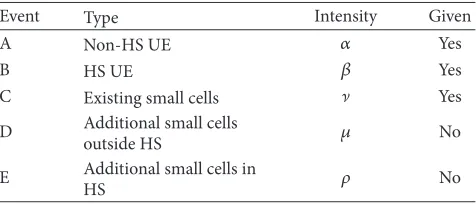
[image:2.600.311.549.86.188.2]We consider a two-tier HetNet that contains macrocells and small cells. In each macrocell coverage area, the location of the macro-BS is constant, while the small cell BSs and UE are considered as random points [10]. Based on the spatial bivariate PPP [3], we define five events for the problem of deploying additional small cells on top of an existing HetNet as presented in Table 1. Event A represents non-HS UE (which is not jointly distributed with event C, which will be explained later), with the spatial intensity𝛼. Event B denotes the HS UE (which is not jointly distributed with event E, which will be explained later) in the HS area with the spacial intensity𝛽. Since the HS area overlaps with the macrocell coverage, non-HS UE may also occur in the non-HS area. Event C represents the existing small cells. We assume that each existing small cell serves at least one non-HS UE and that each existing small cell BS is jointly distributed with a non-HS UE. Hence, event C is considered as an existing small cell and a non-HS
Table 1: Events.
Event Type Intensity Given
A Non-HS UE 𝛼 Yes
B HS UE 𝛽 Yes
C Existing small cells ] Yes
D Additional small cells
outside HS 𝜇 No
E Additional small cells in
HS 𝜌 No
UE jointly occurring at a random point𝑦. Event D denotes additional small cells that will be deployed in non-HS areas, with intensity 𝜇. Event E denotes additional small cells deployed in the HS area with intensity𝜌, each serving at least one HS UE. Thus, each event E node is jointly distributed with a HS UE.
After a significant HS occurs and additional small cells are deployed, the overall spatial intensity of small cells in non-HS areas is]+ 𝜇and that of small cells in the HS area is]+ 𝜌[11]. For event C, denote 𝑓1(‖𝑥U − 𝑦‖) and 𝑔1(‖𝑥S − 𝑦‖) as the probability density functions (PDFs) of a UE at𝑥U and an existing small cell at𝑥S when event C occurs at𝑦, respectively. Zero-mean isotopic Gaussian distributions with standard deviations 𝜎𝑓1 and 𝜎𝑔1 are chosen for 𝑓1(𝑋) and
𝑔1(𝑋), respectively [3].
Before the HS occurs, the probability of event C occurring at any point in the macrocell coverage area is calculated as [3]
Pr{C} = ℎ1(𝑥U, 𝑥S)
≜ ∫
𝑦∈RM
𝑓1(𝑥U− 𝑦) 𝑔1(𝑥S− 𝑦) 𝑑𝑦
= ℎ1(𝑥U− 𝑥S, 0) = ℎ1(𝑋1, 0)
= 1 2𝜋𝜎2
1
𝑒−‖𝑋1‖2/2𝜎21,
(1)
whereRMis the macrocell coverage area,𝑋1= 𝑥U− 𝑥S, and
𝜎21= 𝜎𝑓21+𝜎𝑔21, which is a correlation factor that is determined by the distance of a non-HS UE to its jointly distributed existing small cell BS for event C.
Similarly, for event D, denote𝑓2(‖𝑥HSU−𝑦‖)and𝑔2(‖𝑥NS−
𝑦‖)as the PDFs for a HS UE occurring at𝑥HSUand an addi-tional small cell BS deployed at𝑥NSin the HS area, respec-tively.𝑓2(𝑋)and𝑔2(𝑋)are zero-mean isotopic Gaussian dis-tributions with standard deviations𝜎𝑓2and𝜎𝑔2, respectively. The probability of a joint event between a HS UE at𝑥HSUand an additional small cell BS at𝑥NSoccurring in the HS area is given by [3]
ℎ2(𝑥HSU, 𝑥NS)
≜ ∫
𝑦∈RH
𝑓2(𝑥HSU− 𝑦) 𝑔2(𝑥NS− 𝑦) 𝑑𝑦
= ℎ2(𝑋2, 0) = 1 2𝜋𝜎2
2𝑒
−‖𝑋2‖2/2𝜎2 2,
(2)
3.1. The Network without HS. By using the given intensities of event A and event C andℎ1(𝑥U, 𝑥S)in (1), we can calculate the expected amount of non-HS UE in the coverage of an existing small cell BS at𝑥S,𝑥S∈RM, as follows:
𝜒AC(𝑟S) = ∫
𝑥U∈CS
(𝛼 + ℎ1(𝑥U, 𝑥S)) 𝑑𝑥U
= 𝛼𝜋𝑟S2+ (1 − 𝑒−𝑟2S/2𝜎21) ,
(3)
whereCS is the coverage area of a small cell and 𝑟S is the coverage radius of a small cell.
The expected number of existing small cells in the macrocell coverage area is given by
𝜒C(𝑟M) = ∫ 𝑥S∈RM
]𝑑𝑥S=]𝜋𝑟2M, (4)
where𝑟Mis macrocell coverage radius.
The expected total amount of non-HS UE in the macrocell coverage area before HS occurs is given by
𝐸 {𝑁U} = ∫
𝑥U∈RM
𝛼 𝑑𝑥U+ ∫
𝑥U∈RM
]ℎ1(𝑥U, 𝑥S) 𝑑𝑥U
= 𝛼𝜋𝑟M2 + (1 − 𝑒−𝑟2M/2𝜎12)]𝜋𝑟2
M.
(5)
3.2. The Network with HS. After a HS with UE intensity𝛽 occurs in the coverage of a macrocell, by usingℎ2(𝑥HSU, 𝑥NS) in (2), the expected amount of UE (including HS UE and non-HS UE) in an additional small cell coverage which is in the non-HS area can be written as
𝜒ABE(𝑟S) = ∫
𝑥HSU∈CS
(𝛽 + ℎ2(𝑥HSU, 𝑥NS)) 𝑑𝑥HSU
+ ∫
𝑥U∈CS
𝛼 𝑑𝑥U
= (𝛼 + 𝛽) 𝜋𝑟S2+ (1 − 𝑒−𝑟S2/2𝜎22) ,
(6)
where𝜎2is defined in (2).
The expected amount of UE (including HS UE and non-HS UE) in an existing small cell coverage that overlaps with the HS area is given by
𝜒AB(𝑟S) = 𝜒AC(𝑟S) + ∫
𝑥HSU∈CS
𝛽 𝑑𝑥HSU
= (𝛼 + 𝛽) 𝜋𝑟S2+ (1 − 𝑒−𝑟2S/2𝜎21) ,
(7)
where Ch is the area of the small cell coverage in the HS area. For simplicity, we assume that the existing small cell is completely in the HS area in (7).
The expected amount of non-HS UE served by additional small cells in non-HS areas is given by
𝜒AD(𝑟S) = ∫
𝑥U∈CS
𝛼 𝑑𝑥U= 𝛼𝜋𝑟S2. (8)
The expected number of existing small cells in non-HS areas is
𝜒C= ∫
𝑥S∈RnH
]𝑑𝑥S=]𝜋 (𝑟M2 − 𝑟HS2 ) , (9)
whereRnHis the non-HS area in the macrocell coverage. The expected number of additional small cells in the HS area is given by
𝜒E(𝑟HS) = ∫
𝑥NS∈RH
]𝑑𝑥NS= 𝜌 (𝜋𝑟HS2 −]𝜋2𝑟HS2 𝑟S2) , (10)
where𝑟HSis the radius of the HS area, which is assumed to be a disc area, andRHis the HS area excluding the coverage area of existing small cells in the HS. Since the HS area overlaps with the existing network, the coverage areas of existing small cells located in the HS need to be removed from the calculation of additional small cells in the HS area.
The expected number of existing small cells in the HS area is given by𝜒C(𝑟HS)following (5).
The expected number of additional small cells in non-HS areas is
𝜒D= ∫
𝑥NS∈RnH
𝜇 𝑑𝑥NS= 𝜇𝜋 (𝑟2M− 𝑟HS2 ) . (11)
The expected total amount of UE in the macrocell cov-erage area after the HS occurs is given by
𝐸 {𝑁U} = 𝛼𝜋𝑟M2 +]𝜋𝑟M2 (1 − 𝑒−𝑟M2/2𝜎21) + 𝛽𝜋𝑟2 HS
+ 𝜌 (𝜋𝑟HS2 −]𝜋2𝑟HS2 𝑟S2)(1 − 𝑒−𝑟HS2/2𝜎22) . (12)
4. Intensity of Additional Small Cells
We assume that all the UE in the HetNet is satisfied with its service before a significant HS occurs. After a significant HS occurs, without deploying additional small cells, the HS UE that cannot be accommodated by existing small cells will be served by the macrocell. This extra burden on the macro-BS may reduce the QoS of macrocell UE. In order to avoid over-loading the macrocell, we aim to keep the amount of macro-cell UE after the HS occurs as close as possible to that before the HS occurs.
The expected amount of macrocell UE before the HS occurs is given by
𝐸 {𝑁MU} = 𝐸 {𝑁U} − 𝜒AC(𝑟S) ⋅ 𝜒C(𝑟M) . (13)
After the HS occurs and additional small cells are deployed, the expected amount of UE served by the existing small cells in non-HS areas can be calculated as
𝐸 {𝑁NHS} = 𝜒AC(𝑟S) ⋅ 𝜒C. (14)
The expected amount of UE served by the existing small cells in the HS area can be calculated as
The expected amount of UE served by additional small cells in the HS area can be calculated as
𝐸 {𝑁HS} = 𝜒ABE(𝑟S) ⋅ 𝜒E(𝑟HS) . (16)
The expected amount of UE served by additional small cells in non-HS areas can be calculated as
𝐸 {𝑁NHS } = 𝜒AD(𝑟S) ⋅ 𝜒D. (17)
Hence, the expected amount of macrocell UE after the HS occurs can be calculated as
𝐸 {𝑁MU }
= 𝐸 {𝑁U}
− (𝐸 {𝑁NHS} + 𝐸 {𝑁HS} + 𝐸 {𝑁HS } + 𝐸 {𝑁NHS}).
(18)
We optimize the intensities of additional small cells in the HS and non-HS areas through minimizing the difference between the amounts of macrocell UE after and before the HS occurs as follows:
arg min
𝜌,𝜇 𝐸 {𝑁
MU} − 𝐸 {𝑁MU}
s.t. 𝜌, 𝜇 ≥ 0.
(19)
By using the results in (3)–(18), the objective function in (19) can be rewritten as
arg min
𝜌,𝜇 𝑎 ⋅ 𝜌 + 𝑏 ⋅ 𝜇 + 𝑐,
𝑎 = [(𝛼 + 𝛽) 𝜋𝑟2S+ (1 − 𝑒−𝑟S2/2𝜎22)]
⋅ (𝜋𝑟HS2 −]𝜋2𝑟2HS𝑟S2) ,
𝑏 = 𝛼𝜋𝑟2
S(𝜋𝑟M2 − 𝜋𝑟HS2 ) ,
𝑐 = (𝛽𝜋𝑟S2+ 𝑒−𝑟S2/2𝜎21− 𝑒−𝑟S2/2𝜎22)]𝜋𝑟2
HS− 𝛽𝜋𝑟2HS.
(20)
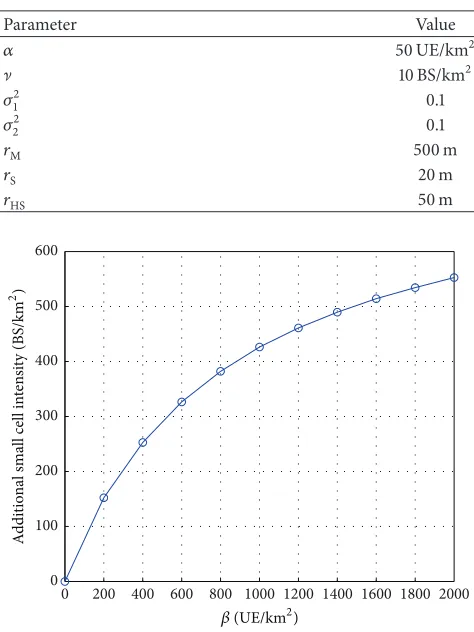
[image:4.600.309.546.84.400.2]The optimization problem in (19) can be readily solved using numerical methods. Here we present numerical solu-tions of the optimal 𝜌 and 𝜇 obtained under the system parameters in Table 2. The center of the HS area is randomly generated in the macrocell coverage area while ensuring the whole HS area is within the macrocell coverage area with a minimum distance from the macrocell BS of 100 m. The intensity of additional small cells in the HS area versus the intensity of HS UE is presented in Figure 1. It can be seen that the intensity of additional small cells in the HS area increases with the intensity of HS UE at a decreasing rate. Figure 2 shows the intensity of additional small cells in non-HS areas versus the intensity of HS UE. Comparing Figure 2 with Figure 1, the intensity of additional small cells in the HS area is much higher than that in non-HS areas; the rapid increase of the intensity for additional small cells in non-HS areas when𝛽 < 1000UE/km2is because the intensity of additional small cells in the HS area is not enough to serve all the HS UE,
Table 2: System setting.
Parameter Value
𝛼 50 UE/km2
] 10 BS/km2
𝜎2
1 0.1
𝜎2
2 0.1
𝑟M 500 m
𝑟S 20 m
𝑟HS 50 m
Additional small cell intensity in HS area
200 400 600 800 1000 1200 1400 1600 1800 2000
0
𝛽(UE/km2)
0 100 200 300 400 500 600
A
ddi
tio
n
al small cell in
te
n
si
ty (BS/km
2 )
Figure 1: The intensity of additional small cells in the HS area (𝜌) versus the intensity of HS UE.
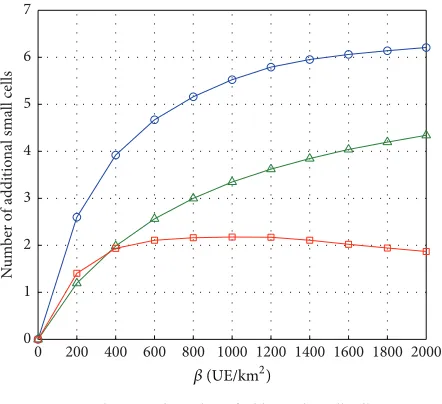
thus requiring additional small cells in non-HS area to share the extra burden caused by HS UE to the cellular network. For large values of𝛽, the intensity of additional small cells in non-HS areas decreases with𝛽, because the additional small cells in the HS area are now able to serve the majority of HS UE. Figure 3 shows the expected numbers of additional small cells in the HS and non-HS areas under the setting in Table 2.
5. Deployment of Additional Small Cells
Based on the analytical results in Section 3, we propose to maximize the average UE throughput among all UE by jointly optimizing the locations of new small cells and user associations of all cells for a HetNet affected by a HS not expected in the original network planning.
We consider the downlink (DL) of a two-tier HetNet consisting of one central macrocell and⌈𝜒C(𝑟M)⌉small cells randomly distributed in the macrocell coverage area. The number of existing BSs is𝑁eBS= 1 + ⌈𝜒C(𝑟M)⌉. Each cell has access to the total of𝑁RB resource blocks (RBs). Denoting the number of additional small cells to be deployed in the HS area as𝑁NS1and the new small cells to be deployed in non-HS area as𝑁NS2, the total number of BSs is given by𝑁BS= 𝑁eBS+
[image:4.600.62.285.394.526.2]Additional small cell intensity in non-HS area
200 400 600 800 1000 1200 1400 1600 1800 2000
0
𝛽(UE/km2)
0 0.5 1 1.5 2 2.5 3
A
ddi
tio
n
al small cell in
te
n
si
ty (BS/km
[image:5.600.57.284.71.262.2]2 )
Figure 2: The intensity of additional small cells in non-HS areas (𝜇) versus the intensity of HS UE.
Total expected number of additional small cells Expected number of additional small cells in HS area Expected number of additional small cells in non-HS areas 0
1 2 3 4 5 6 7
N
u
m
b
er o
f addi
ti
o
n
al small cells
200 400 600 800 1000 1200 1400 1600 1800 2000
0
[image:5.600.58.279.333.535.2]𝛽(UE/km2)
Figure 3: An example of the total number of new small cells under the setting in Table 2.
According to the system model in Section 2, the expected amount of HS UE is given by
𝜒BE(𝑟HS) = 𝛽𝜋𝑟HS2 + (1 − 𝑒−𝑟2HS/2𝜎22)]𝜋𝑟2
HS. (21)
Let𝑁NHS = ⌈𝐸{𝑁U}⌉denote the amount of non-HS UE and let𝑁HS= ⌈𝜒BE(𝑟HS)⌉denote the amount of HS UE in the macrocell coverage area. The set of all UE is given byNU =
{1, 2, . . . , 𝑁U}, where𝑁U= 𝑁NHS+ 𝑁HS.
The throughput of the𝑖th UE (𝑖 = {1, 2, . . . , 𝑁U}) is given by
𝛾𝑖=𝑁∑BS
𝑗=1
𝑁𝑗RB⋅ 𝑊 ⋅log2(1 +𝑃𝑗⋅ 𝑔𝑖,𝑗⋅ 𝑢𝑖,𝑗
𝐼𝑖,𝑗+ 𝑁0 ) , (22)
where𝑢𝑖,𝑗= 1if the𝑖th UE is served by the𝑗th BS and𝑢𝑖,𝑗= 0 otherwise;𝑊is the bandwidth of a RB; without considering power control, 𝑃𝑗 is the DL transmit power of the 𝑗th BS in a RB; and𝑃𝑗 = 𝑃M(S)if it is a macro-BS (small-cell BS). Assuming that the channel on each RB sees independent and identical Rayleigh fading, the channel power gain of the link between the𝑖th UE and the𝑗th BS in a RB is expressed as
𝑔𝑖,𝑗= 𝑔f,𝑖𝑗⋅ 𝑔pl,𝑖𝑗, (23)
where𝑔f,𝑖𝑗 is the exponentially distributed fading gain with unit mean and𝑔pl,𝑖𝑗is the path loss as given in [1];𝑁𝑗RBis the number of RBs per UE in cell𝑗and is given by
𝑁𝑗RB= ⌊ 𝑁RB
∑𝑁U
𝑖=1𝑢𝑖,𝑗
⌋ , ∀𝑗, (24)
where, as illustrated and proven by Ye et al. in [12], equal resource allocation among the UE in all cells is optimal for the logarithmic utility; we assume that all the available RBs are allocated in each cell following the round robin algorithm with full bandwidth allocation [13], so that each cell is fully loaded and there will be intercell interference in each RB;𝑁0 is the additive white Gaussian noise (AWGN) power; and𝐼𝑖,𝑗 is the interference power in a RB received by UE𝑖from BSs other than BS𝑗; that is,
𝐼𝑖,𝑗= 𝑁∑BS
𝑗=1,𝑗 ̸=𝑗
𝑃𝑗⋅ 𝑔𝑖,𝑗, ∀𝑗 ∈NBS. (25)
The additional small cell deployment optimization prob-lem is formulated as
arg max
U,(x1,y1),(x2,y2)
∑𝑁U
𝑖=1𝛾𝑖
𝑁U
s.t. (x1,y1) ∈ HHS,
(x2,y2) ∈ HNHS
𝑁BS
∑
𝑗=1𝑢𝑖,𝑗= 1, ∀𝑖 ∈NU,
𝛾𝑖≥ 𝛾th, ∀𝑖 ∈NU,
𝑁RB≥ 𝑁𝑗RB> 0, ∀𝑗 ∈NBS,
𝑢𝑖,𝑗∈ {0, 1} , ∀𝑖 ∈NU, ∀𝑗 ∈NBS,
(26)
the 𝑁NS2 × 1 location vectors of additional small cells in non-HS areas;|HHS|and|HNHS|are the feasible deployment areas [14] for additional small cells in the HS and non-HS areas, respectively; and𝛾th is the minimum UE throughput threshold.
Note that the joint optimization of the locations of additional small cells and the user associations of all cells in (26) is a mixed integer programming problem, which is NP-hard and requires a high computational complexity to find the global optimal solution. Therefore, we propose a practical algorithm in Algorithm 1 to solve the optimization problem in (26).
In Algorithm 1, the binary constraint of user association indicators is relaxed to 0 ≤ 𝑢𝑟𝑖,𝑗 ≤ 1 [15]. All user association indicators are initialized as 0. Denote X1 and X2 as the sets of additional small cells in the HS and non-HS areas, respectively. The two sets are both initialized as empty. The sizes𝑁NS1and𝑁NS2of vectors(x1,y1)and(x2,y2), respectively, are initialized based on the analytical results in Section 3. The optimized numbers of additional small cells to be deployed will be refined in the algorithm. The addi-tional small cells’ locations are optimized by the generalized reduced gradient (GRG) method [16].
6. Simulation Results
In this section, we present simulation results to evaluate the performance of the proposed algorithm for deploying additional small cells on top of an existing HetNet affected by HS. In the simulation, in addition to Table 2 we set the transmit power of the macro-BS and a small-cell BS as 46 dBm and 23 dBm, respectively, the bandwidth of each RB
𝑊 = 180kHz, the minimum UE throughput threshold𝛾th=
3Mbps, the number of RBs in each cell 𝑁RB = 50, and
𝑁0= −174dBm/Hz.
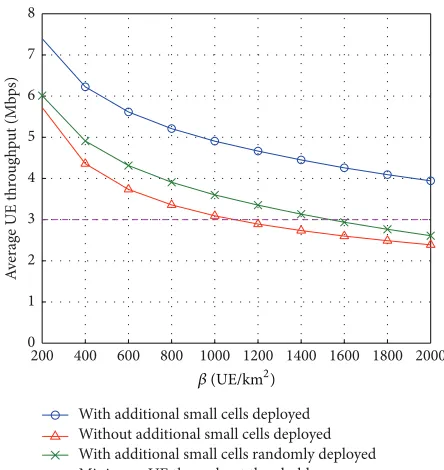
Figure 4 shows the average UE throughput with or with-out additional small cells deployed following our proposed algorithm and with the same number of additional small cells randomly deployed versus the spatial intensity of HS UE. We can see that, by deploying additional small cells following our proposed algorithm, the average UE throughput is much higher than without deploying any additional small cells or randomly deploying the same number of additional small cells. The average UE throughput can be kept above the threshold even for a very high intensity of HS UE. If without deploying additional small cells or randomly deploying the additional small cells the average UE throughput drops below the threshold as the intensity of HS UE increases, indicating that some of the UE will have unsatisfactory QoS.
In order to evaluate the load balancing performance of our algorithm, we calculate the fairness index of all UE [17] as
F= (∑
𝑁U
𝑖=1𝛾𝑖)2
𝑁U⋅ ∑𝑁U
𝑖=1𝛾𝑖2
. (27)
The fairness index versus the intensity of HS UE is shown in Figure 5. Since the number and locations of additional small cells and user associations are optimized, the fairness index
With additional small cells deployed Without additional small cells deployed With additional small cells randomly deployed Minimum UE throughput threshold 0
1 2 3 4 5 6 7 8
A
verag
e UE t
h
ro
ug
h
p
u
t (Mb
ps)
400 600 800 1000 1200 1400 1600 1800 2000
200
[image:6.600.316.538.70.305.2]𝛽(UE/km2)
Figure 4: Average UE throughput versus the intensity of HS UE.
With additional small cells deployed Without additional small cells deployed With additional small cells randomly deployed 0
0.1 0.2 0.3 0.4 0.5 0.6
F
air
ness index
400 600 800 1000 1200 1400 1600 1800 2000
200
[image:6.600.313.540.360.571.2]𝛽(UE/km2)
Figure 5: Fairness index versus the intensity of HS UE.
Initialization:
(1)𝑢𝑟𝑖,𝑗← 0,∀𝑖, 𝑗; X1,X2← ⌀; MAX← 0; 𝑁NS1← ⌊𝜒E(𝑟HS)⌋; 𝑁NS2← ⌊𝜒D⌋
Main Function:
(2)|HHS| ← |H|X1 (3)|HNHS| ← |H|X2
(4) (𝑔,U𝑟,X∗1,X∗2) ←GRG solve (22) for X1,X2
(5) if (22) is feasible, U𝑟∈Z+then
(6) if 𝑔 >MAX then (7) MAX← 𝑔(U𝑟, (X1,X2))
(8) U∗←U𝑟
(9) X∗1 ←X1
(10) X∗2 ←X2
(11) if 𝑁NS1= ⌊𝜒E(𝑟HS)⌋then
(12) 𝑁NS1← ⌈𝜒E(𝑟HS)⌉
(13) return
(14) else if𝑁NS1= ⌈𝜒E(𝑟HS)⌉,𝑁NS2= ⌊𝜒D⌋then
(15) 𝑁NS2← ⌈𝜒D⌉
(16) return
(17) else if𝑁NS1= ⌈𝜒E(𝑟HS)⌉,𝑁NS2= ⌈𝜒D⌉then
(18) return
(19) end if
(20) else if 𝑔 ≤MAX then
(21) if 𝑁NS1= ⌈𝜒E(𝑟HS)⌉then
(22) 𝑁NS1← ⌊𝜒E(𝑟HS)⌋ (23) 𝑁NS2← ⌈𝜒D⌉
(24) return
(25) else if 𝑁NS1= ⌊𝜒E(𝑟HS)⌋,𝑁NS2= ⌈𝜒D⌉then
(26) 𝑁NS2← ⌊𝜒D⌋
(27) return
(28) end if
(29) return
(30) end if
(31) return MAX, U∗,X∗1,X∗2
(32) else if (22) is feasible, U𝑟∉Z+ then
(33) for all𝑢𝑟𝑖,𝑗∉Z+ do
(34) 𝑔(𝑢𝑟𝑖,𝑗= 0) →U𝑟,X1,X2, MAX
(35) 𝑔(𝑢𝑟𝑖,𝑗= 1) →U𝑟,X1,X2, MAX
(36) end for
(37) else if (22) is infeasible, then
(38) return
(39) end if
[image:7.600.150.447.66.538.2]Algorithm 1
Figure 6 shows the area spectral efficiency (ASE) [18] with additional small cells deployed following our proposed algorithm and with the same number of additional small cells randomly deployed versus the spatial intensity of HS UE. We can see that by deploying additional small cells following our proposed algorithm, the ASE is much higher than randomly deploying the same number of additional small cells, and the gain in ASE increases with the intensity of HS UE. This is because the numbers of additional small cells deployed in HS and non-HS areas are, respectively, optimized for given intensity of HS UE, as shown in Figure 3.
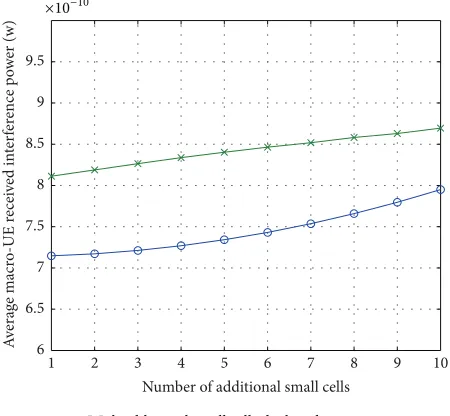
We also perform simulation to evaluate the average interference power received by a macro-UE caused by the additional small cells. The simulation result is presented in Figure 7. We can see that the average macro-UE received
interference power caused by additional small cells increases with the number of additional small cells. However, com-pared with randomly deploying the same number of addi-tional small cells, our proposed algorithm results in much less interference for any given number of additional small cells.
7. Conclusion
With additional small cells deployed With additional small cells randomly deployed 50
60 70 80 90 100 110 120 130 140 150 160 170 180 190 200
Ar
ea
sp
ec
tral efficienc
y (b
ps/H
z/km
2)
400 600 800 1000 1200 1400 1600 1800 2000
200
[image:8.600.55.286.69.281.2]𝛽(UE/km2)
Figure 6: Area spectral efficiency versus the intensity of HS UE.
With additional small cells deployed With additional small cells randomly deployed
×10−10
6 6.5 7 7.5 8 8.5 9 9.5
A
verag
e macr
o-UE r
ecei
ve
d
in
te
rf
er
ence p
o
w
er (w)
2 3 4 5 6 7 8 9 10
1
Number of additional small cells
Figure 7: Macro-UE received interference power versus the number of additional small cells.
the average UE throughput (after unexpected HS occurs) by jointly optimizing the locations of additional small cells and the user associations of all cells. Simulation results show that the proposed algorithm for optimizing the deployment of additional small cells on top of an existing HetNet can guarantee the QoS requirement of all UE even for a very high density of HS UE while achieving excellent load balancing performance with a lower interference to macro-UE for the HetNet.
8. Future Work
In our future work, we plan to extend our work in two directions: (1) stochastic geometry analysis and (2) small cell deployment optimization, both considering the possible occurrence of multiple HSs (with independent HS UE inten-sities), which is closer to real HetNets. User movement and mobile traffic patterns will also be considered in the small cell deployment algorithm.
Conflict of Interests
The authors declare that there is no conflict of interests regarding the publication of this paper.
References
[1] 3GPP TR 36.912 V2.0.0, “3GPP; technical specification group radio access network; feasibility study for further advancements for eutra (release 9),” August 2009.
[2] M. Haenggi, J. G. Andrews, F. Baccelli, O. Dousse, and M. Franceschetti, “Stochastic geometry and random graphs for the analysis and design of wireless networks,”IEEE Journal on Selected Areas in Communications, vol. 27, no. 7, pp. 1029–1046, 2009.
[3] A. Babaei and B. Jabbari, “Distance distribution of bivariate Poisson network nodes,”IEEE Communications Letters, vol. 14, no. 9, pp. 848–850, 2010.
[4] H.-Y. Hsieh, S.-E. Wei, and C.-P. Chien, “Optimizing small cell deployment in arbitrary wireless networks with minimum ser-vice rate constraints,”IEEE Transactions on Mobile Computing, vol. 13, no. 8, pp. 1801–1815, 2014.
[5] W. Zhao, S. Wang, C. Wang, and X. Wu, “Cell planning for heterogeneous networks: an approximation algorithm,” in Pro-ceedings of the 33rd Annual IEEE International Conference on Computer Communications (INFOCOM ’14), pp. 1087–1095, IEEE, Toronto, Canada, April-May 2014.
[6] Y. Park, J. Heo, H. Kim et al., “Effective small cell deployment with interference and traffic consideration,” inProceedings of the 80th IEEE Vehicular Technology Conference (VTC ’14), pp. 1–5, IEEE, Vancouver, Canada, September 2014.
[7] S. F. Chou, T. C. Chiu, Y. J. Yu, and A. C. Pang, “Mobile small cell deployment for next generation cellular networks,” in Proceedings of the IEEE Global Communications Conference (GLOBECOM ’14), pp. 4852–4857, Austin, Tex, USA, December 2014.
[8] M. Tahani and M. Sabaei, “A distributed data-centric storage method for hot spot mitigation in wireless sensor networks,” in Proceedings of the International Symposium on Telecommunica-tions (IST ’10), pp. 401–408, Tehran, Iran, December 2010. [9] M. Qutqut, H. Abou-zeid, H. Hassanein, A. Rashwan, and F.
Al-Turjman, “Dynamic small cell placement strategies for LTE heterogeneous networks,” inProceedings of the IEEE Symposium on Computers and Communication, pp. 1–6, Madeira, Portugal, June 2014.
[10] T. C. Brown, B. W. Silverman, and R. K. Milne, “A class of two-type point processes,”Zeitschrift f¨ur Wahrscheinlichkeitstheorie und Verwandte Gebiete, vol. 58, no. 3, pp. 299–308, 1981. [11] J. E. Paloheimo, “A spatial bivariate poisson distribution,”
Biometrika, vol. 59, no. 2, pp. 489–492, 1972.
[image:8.600.58.283.348.556.2]cellular networks,”IEEE Transactions on Wireless Communica-tions, vol. 12, no. 6, pp. 2706–2716, 2013.
[13] 3GPP TR 36.814 V9.0.0, “Evolved Universal Terrestrial Radio Access (E-UTRA); Further Advancements for EUTRA Physical Layer Aspects (Release 9),” March 2010.
[14] J. Wu, X. Chu, D. L´opez-P´erez, and H. Wang, “Femtocell exclusion regions in hierarchical 3-sector macrocells for co-channel deployments,” inProceedings of the 1st IEEE Interna-tional Conference on Communications in China (ICCC ’12), pp. 541–545, Beijing, China, August 2012.
[15] J. M. Ortega and W. C. Rheinboldt,Iterative Solution of Nonlin-ear Equations in Several Variables, vol. 30, SIAM, Philadelphia, Pa, USA, 1970.
[16] L. S. Lasdon, A. D. Waren, A. Jain, and M. Ratner, “Design and testing of a generalized reduced gradient code for nonlinear programming,”ACM Transactions on Mathematical Software, vol. 4, no. 1, pp. 34–50, 1978.
[17] R. Jain, D. Chiu, and W. Hawe, A Quantitative Measure of Fairness and Discrimination for Resource Allocation in Shared Computer Systems, vol. 38, Eastern Research Laboratory, Digital Equipment Corporation, Hudson, Mass, USA, 1984.
Submit your manuscripts at
http://www.hindawi.com
Computer Games Technology
International Journal of
Hindawi Publishing Corporation
http://www.hindawi.com Volume 2014
Hindawi Publishing Corporation
http://www.hindawi.com Volume 2014 Distributed
Sensor Networks International Journal of
Advances in
Fuzzy
Systems
Hindawi Publishing Corporation
http://www.hindawi.com Volume 2014
International Journal of Reconfigurable Computing
Hindawi Publishing Corporation
http://www.hindawi.com Volume 2014
Hindawi Publishing Corporation
http://www.hindawi.com Volume 2014
Applied
Computational
Intelligence and Soft
Computing
Advances in
Artificial
Intelligence
Hindawi Publishing Corporationhttp://www.hindawi.com Volume 2014
Advances in
Software Engineering Hindawi Publishing Corporation
http://www.hindawi.com Volume 2014
Hindawi Publishing Corporation
http://www.hindawi.com Volume 2014
Electrical and Computer Engineering
Journal of Journal of
Computer Networks and Communications
Hindawi Publishing Corporation
http://www.hindawi.com Volume 2014
Hindawi Publishing Corporation
http://www.hindawi.com Volume 2014
Multimedia
International Journal of
Biomedical Imaging
Hindawi Publishing Corporation
http://www.hindawi.com Volume 2014
Artificial
Neural Systems
Advances inHindawi Publishing Corporation
http://www.hindawi.com Volume 2014
Robotics
Journal ofHindawi Publishing Corporation
http://www.hindawi.com Volume 2014 Hindawi Publishing Corporationhttp://www.hindawi.com Volume 2014
Computational Intelligence and Neuroscience
Hindawi Publishing Corporation
http://www.hindawi.com Volume 2014
Modelling & Simulation in Engineering Hindawi Publishing Corporation
http://www.hindawi.com Volume 2014
The Scientific
World Journal
Hindawi Publishing Corporation
http://www.hindawi.com Volume 2014
Hindawi Publishing Corporation
http://www.hindawi.com Volume 2014
Human-Computer Interaction
Advances in
Computer EngineeringAdvances in
Hindawi Publishing Corporation
![Figure 6 shows the area spectral efficiency (ASE) [18]with additional small cells deployed following our proposed](https://thumb-us.123doks.com/thumbv2/123dok_us/7832301.175156/7.600.150.447.66.538/figure-shows-spectral-efficiency-additional-deployed-following-proposed.webp)