Theses Thesis/Dissertation Collections
8-2016
Joint Source-Channel Coding Optimized On
End-to-End Distortion for Multimedia Source
Ebrahim Jarvis
[email protected]Follow this and additional works at:http://scholarworks.rit.edu/theses
This Thesis is brought to you for free and open access by the Thesis/Dissertation Collections at RIT Scholar Works. It has been accepted for inclusion in Theses by an authorized administrator of RIT Scholar Works. For more information, please [email protected].
Recommended Citation
On End-to-End Distortion for Multimedia
Source
by
Ebrahim Jarvis
A Thesis Submitted in Partial Fulfillment of the Requirements for the Degree of Master of Science
in Computer Engineering
Supervised by
Associate Professor Dr. Andres Kwasinski Department of Computer Engineering
Kate Gleason College of Engineering Rochester Institute of Technology
Rochester, New York August 2016
Approved by:
Dr. Andres Kwasinski, Associate Professor
Thesis Advisor, Department of Computer Engineering
Dr. Sohail Dianat, Professor
Committee Member, Department of Electrical Engineering
Dr. Shanchieh Jay Yang, Professor
Rochester Institute of Technology Kate Gleason College of Engineering
Title:
Joint Source-Channel Coding Optimized On End-to-End Distortion for Multimedia Source
I, Ebrahim Jarvis, hereby grant permission to the Wallace Memorial Library to
repro-duce my thesis in whole or part.
Ebrahim Jarvis
Dedication
Acknowledgments
I would like to thank my advisor Dr. Kwasinki for his continuous support and help in my
research. I would also like to thank Dr. Dianat and Dr. Yang for their valuable input and
Abstract
Joint Source-Channel Coding Optimized On End-to-End Distortion for Multimedia Source
Ebrahim Jarvis
Supervising Professor: Dr. Andres Kwasinski
In order to achieve high efficiency, multimedia source coding usually relies on a use of
predictive coding. While more efficient, source coding based on predictive coding has been
considered to be more sensitive to errors during communication. With the current volume
and importance of multimedia communication, minimizing the overall distortion during
communication over an error-prone channel is critical. In addition, for real-time scenarios
it is necessary to consider additional constraint such as fix and small delay for a given bit
rate. To comply with these requirements, we seek an efficient joint source-channel coding
scheme.
In this work, end-to-end distortion is studied for a first order auto regressive synthetic
source that represents a general multimedia traffic. This study reveals that predictive coders
achieve the same channel-induced distortion performance as memoryless codecs when
ap-plying optimal error concealment. We propose a joint source-channel system based on
incremental redundancy that satisfies the fixed delay and error-prone channel constraints
and combines DPCM as a source encoder and a rate-compatible punctured convolutional
(RCPC) error control codec. To calculate the joint source-channel coding rate allocation
that minimizes end-to-end distortion, we develop a Markov Decision Process (MDP)
ap-proach for delay constrained feedback Hybrid ARQ, and we use a Dynamic Programming
Contents
Dedication. . . iii
Acknowledgments . . . iv
Abstract . . . v
1 Introduction. . . 1
1.1 Motivation . . . 1
1.2 Contributions In This Thesis . . . 2
2 Background . . . 4
2.1 Previous Work . . . 4
2.2 Predictive Coding . . . 7
2.2.1 Optimal Linear Prediction for Autoregressive Sources . . . 9
2.2.2 Source Key Properties . . . 11
2.2.3 DPCM System Description and Statistical Overview . . . 14
2.2.4 DPCM Coding Error and Gain . . . 15
2.3 Rate-Compatible Channel Codes . . . 16
2.3.1 Performance of RCPC Codes . . . 19
2.4 Joint Source-Channel Coding . . . 23
2.5 Delay-Constrained JSCC using Incremental Redundancy with Feedback . . 29
2.6 Summary . . . 32
3 Distortion Analysis . . . 33
3.1 Problem Setup . . . 33
3.2 System Setup . . . 34
3.2.1 Properties of DPCM Codecs . . . 35
3.3 Source Encoding Distortion . . . 36
3.4 End-to-End Distortion . . . 39
3.4.1 Suboptimal Error Concealment Distortion Analysis . . . 57
3.6 Conclusion . . . 67
4 Distortion Optimized Joint Source Channel Coding using Incremental Redundancy . . . 68
4.1 System Description . . . 71
4.2 System Design . . . 75
4.2.1 Mathematical Setup . . . 75
4.2.2 Dynamic Programming Solution . . . 79
4.2.3 Distortion as a Ratio of Costs . . . 80
4.2.4 Optimization Problem . . . 81
4.2.5 Minimum as a Zero of the Lagrangian . . . 82
4.2.6 Optimization by Dynamic Programming . . . 83
4.2.7 Policy Iteration algorithm for Optimalλ . . . 85
4.3 Simulation Results . . . 86
5 Conclusions . . . 90
6 Future Work . . . 92
List of Figures
2.1 predictive source encoder . . . 8 2.2 DPCM encoder and decoder . . . 14
2.3 Rate-Compatible Punctured Convolutional Channel Code example. . . 18
2.4 Performance of different codes from the same family of RCPC codes with
mother code rate 1/4, memory 8 and puncturing period 8 (reproduced from [1]). . . 20 2.5 Free distance as a function of channel coding rate r for two families of
RCPC codes (reproduced from [1]). . . 21 2.6 Number of error events with Hamming weightdf as a function of channel
coding rate r for two families of RCPC codes (reproduced from [1]). . . 22 2.7 Block diagram of a joint source and channel coding scheme . . . 23 2.8 A typical end-to-end distortion curve as a function of SNR . . . 26 2.9 The single-mode D-SNR curves and the resulting D-SNR curve for a speech
source(reproduced from [1]). . . 27 2.10 The single-mode D-SNR curves and the resulting D-SNR curve for a video
source(reproduced from [1]). . . 27 2.11 Block diagram of the communication system to implement delay-constrained
JSCC using incremental redundancy . . . 30
3.1 Gillbert Elliot channel model . . . 63 3.2 End-to-end distortion simulation of proposed work with differentα
coeffi-cients . . . 64 3.3 End-to-end distortion withα = 1coefficient . . . 65
4.1 Block diagram of DPCM coded with ARQ/FEC transmission scheme . . . 71
4.2 Markov chain of codetypes . . . 78
4.3 End-to-end distortion vs. Es/N0 for AWGN channels with and without
Chapter 1
Introduction
1.1
Motivation
The ever-growing demand for applications based on multimedia communications requires
more efficient use of communication resources. However, multimedia sources, like video,
are communication bandwidth intensive. Even though the new technology may support the
communication channels with ever-increasing bandwidth, compression of the information
source is still play an essential role in communication. This is due to the fact that with
the rate of data is growing at higher rate of bandwidth growth that force us to achieve a
more efficient bandwidth utilization. For example, in terrestrial TV broadcasting, online
gaming, virtual reality, video conferencing, satellite TV and cable TV applications, more
high-resolution video channels can be delivered within the allocated bandwidth if each
video signal is compressed for transmission. Therefore, the development of an efficient
framework to do source compression has attracted considerable research interest.
To address the multimedia source compression problem, numerous techniques have
been proposed. Predictive coding technique has shown to be highly efficient in compressing
the source data. However, there is widely spread misconception among some researchers,
who questions the performance of predictive coding over a noisy channel. They suggest
that presence of a transmission error at the decoder would cause the performance of these
To increase throughput in data transmission various transmission schemes have been
studied. Numerous studies suggest that feedback-based transmission system such as
Hy-brid ARQ with incremental redundancy can provide considerable gains in throughput over
pure (no feedback) Forward Error Control (FEC) system. This occurs because, Hybrid
ARQ system assumes there is a significant probability of correctly receiving data protected
with a weak channel code, and hence it is not necessary to add large redundancy in
ev-ery transmission. Despite these gains application of feedback based schemes to real-time
communication has been limited due to the challenges presented by inherent delay related
problems regarding transmission of incremental redundancy.
1.2
Contributions In This Thesis
The primary goal of this thesis is to address the source-channel rate allocation problem so
as to the end-to-end distortion will be minimized for the communication of a multimedia
source. First, we propose a synthetic source that abstracts the fundamental components of
video. This is because, working with video is difficult due to complexity of source model.
Furthermore, in the proposed source, we assume that the first sample is memoryless and
the rest is DPCM coded using the memory between the samples. The precise and novel
mathematical expressions have been used to indicate the end-to-end behavior of such
sys-tem. Furthermore, our simulation results show that the performance of predictive coders in
the presence of errors not only will not be catastrophic but also with the proper use of error
concealment it leads to having the same performance as the memoryless system. Second,
we address the joint source-channel rate problem in the incremental redundancy Hybrid
from modeling our problem with a Markov Decision Process (MDP). A Dynamic
Program-ming algorithm is used to find the optimal source and channel rates. Our simulation results
Chapter 2
Background
In this chapter, we discuss various technologies and techniques relevant to this work. The
chapter is divided into five parts. First, we will briefly introduce previous studies that deals
with similar problem. Then we study the basic structure of predictive coding. In Section
2.2.3 we will investigate the statistical properties of the source. Then, we focus our study on
differential pulse code modulation (DPCM). We also describe the overall features of DPCM
encoder and decoder. In third part of this chapter we will discuss the idea behind variable
rate codes. We describe the channel model and decoding mechanism, recognizing that
understanding the performance of such system is essential to design joint source-channel
codes. In the fourth part of this chapter, we extend the study of RCPC codes, and look
into joint source-channel coding. In the last part of this chapter, we discuss the use of
incremental redundancy bits in the joint source-channel coding system.
2.1
Previous Work
Of the works with similar objective as ours, the work most closely related to this thesis is
that by Chou et al. [2], which addresses the problem of streaming packetized media over
a lossy packet network by rate-distortion optimization. Assuming that each data unit of
the video stream is independent of one another, the authors showed that the problem of
optimization for a single unit data. Furthermore, the authors derived a practical algorithm
to address a variety of transmission scenarios such as sender driven or receiver driven
trans-mission, and streaming over the best effort network. This algorithm used a Markov decision
process framework, where the cost-error model differentiate different transmission
scenar-ios from each other. The expected rate-distortion optimization was done by using a general
iterative algorithm to form a convex hull that can be solved by Lagrange multiplier
opti-mization technique. Furthermore, authors assume a fix short delay (up to several seconds)
in the beginning of the data transmission that is independent of the length of the
presenta-tion. In addition, their rate optimization system is primarily based on the usage of buffer
and playback on the receiver side, where incremental redundancy can be more suitable for
a more constrained delay and buffer space. By considering the distortion that is suffered by
each single data unit independent of each other and developing an error-cost model based
on each frame, concluding the optimal rate-distortion will be approximation of the optimal
scenario (scenario that studies the affect of error on current frame to the future frame).
The work [3], studies the performance of DPCM predictive coding method under an
error prone channel. This research shows that DPCM works reasonably well to compress
the signal. However, the performance degrades considerably when errors occur during
transmission. The authors concluded that this is due to error propagation at the decoder,
which originates from the DPCM mechanism that relies on previous samples at decoder.
The authors suggest that this leads to a catastrophic performance with the even single error
during transmission. Furthermore, this study showed that a low-rate feedback channel
would improve the overall performance.
The work of Kwasinski et al. [4], presented a joint-source channel coding scheme based
under strict delay constraints. The proposed scheme works with a constant bit rate and
de-lay (one frame dede-lay). In order to add incremental redundancy to the frame when its coded,
the source is encoded with a lower bit rate. The underlying design technique uses a Markov
chain by introducing various code types, where each code type describes the different
com-positions of the frames. In the work, there are three possible outcomes to a transmission.
The authors assumed three successively transmitted frames, referred in time as previous,
current and next frames, and the corresponding source blocks as previous, current and next
source blocks. The feedback-based transmission scheme is described as, when the previous
block is received with errors, the current block will contain the codeword for the current
frame and incremental redundancy for the previous one and will lower the channel code
rate when possible (the maximum number of different code rates not reached). If the
cur-rent block was received without errors after channel decoding, then the curcur-rent frame will
consist entirely of the current frame’s bits without incremental redundancy. The result of
the work [4], showed distortion value decrease compare to no feedback transmission and
hence,28%increase in the simultaneous calls that can be supported on the CDMA network.
In [5], Zhihai He et al. shed more light on the source and channel distortion
model-ing. The authors developed a rate-distortion model for DCT-based video by considering
the macroblock intrarefreshing rate. Using this R-D model, the authors estimated the
dis-tortion given the bit rate and intrarefreshing rate. Furthermore, in this work the behavior of
channel error on video coding and transmission is described through closed form
expres-sions. However, the accuracy of their distortion estimation is largely based on the size of
2.2
Predictive Coding
A data compression system could be translated into any scheme that operates on source
data to eliminate possible redundancies so that only those values needed to reproduction
are preserved. There are two main approaches to address redundancy issues namely, time
and frequency domain techniques. In the first category, compression is performed through
prediction of source samples by exploiting the fact that source samples are serially
corre-lated. Therefore, predictive coding system codes the difference between the source sample
and the predicted value instead of coding the source. Common time domain coders include
differential pulse code modulation (DPCM) and delta modulation (DM). In frequency
do-main methods, first, the source spectrum is divided into several frequency bands through
subband filtering. Then a procedure called frequency decomposition is applied. This is
fol-lowed by assigning quantizers to the subbands. If we increase the number of the subbands,
we will get less correlation between the subband. Wavelet, subband, and transform coders
such as traditional JPEG, MPEG- 1, MPEG-2, H.261, H.263, and H.265 are standard for
frequency-based domain coding. Scalar quantization of each source sample independently
is a suboptimal method, when there is time correlation between samples. The correlation in
time between samples may appear as two samples that are close in time show little change
in value. Speech and audio sources both show time correlation between samples because
the physical mechanism by which they are generated create a signal that changes smoothly
over time. The same can be expressed about image and video sources for time and spatial
correlations. When two neighbor samples are correlated, one can use the quantized
infor-mation from one sample and reduce the amount of data needed to code the other one.
One of the methods that exploit the correlation between samples (memory) is predictive
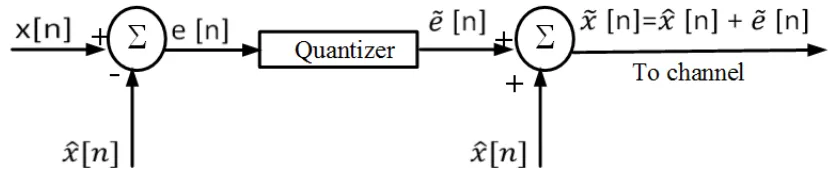
Figure 2.1: predictive source encoder
the source sample x[n]before quantization. The same quantity is added to the quantized difference ˜e[n] to generate the reconstructed output x˜[n]. An important property of pre-dictive coding is that the reconstruction error equals the quantization error. The following
equations prove this fact:
e[n] = x[n]−xˆ[n]
˜
x[n] = ˜e[n] + ˆx[n]
x[n]−x˜[n] = e[n] + ˆx[n]−(˜e[n] + ˆx[n])
= e[n]−˜e[n]. (2.1)
The best choice of predicted value as notedxˆ[n]in the figure 2.1, to produce a difference
e[n], can be yield using two main methods namely, maximum a priori probability (MAP) and linear minimum squared estimate (LMMSE). MAP obtainsxˆ[n]from a group of neigh-boring samples. Let us denote the adjacent samples by g[n]. The MAP estimatexˆ[n]of
x[n]is given by,
ˆ
x[n] =arg maxxp(
The optimization solution calculated by MAP is often considered as too slow due to the
complexity and number of operations so that one may take into account a suboptimal
set-tlement to this problem. In the case of adjacent samples in the source sequence showing
high dependency (strong correlation), the simplest solution is the previous samplex[n−1]. Note that under this condition the difference e[n] = x[n]−x[n −1] is most likely to be small. The main issue with MAP is that to predictx[n]the solutionx[n−1]does not take into consideration the correlation between samples.
As mentioned to estimatex[n]we can use the linear minimum squared estimate (LMMSE). This method uses a linear combination of samples in the neighbor groupg[n]. The follow-ing section will review the design of the optimal LMMSE for an autoregressive source as
will be considered in this thesis.
2.2.1 Optimal Linear Prediction for Autoregressive Sources
From [6], let...., x[−1], x[0], x[1], x[2], .., x[n]be a zero mean, stationary source sequence. The linear prediction ofx[n]from the pastLsamples can be implemented as,
ˆ
x[n] = L X
k=1
akx˜[n−k], (2.2)
where a1, a2, ..., aL are the prediction filter coefficients. The solution that minimizes the
MSE E
ˆ
x[n] −x[n]2
for the vector of prediction coefficients a∗ = (a1∗,a2∗, . . . ,aL∗),
comes from the orthogonality principle [7] that the errorx[n]−xˆ[n]should be orthogonal to the past sample values,
E
(x[n]−xˆ[n])x[n−k]
The orthogonality principle generates the Yule-Walker equation [6],
φx(L)a∗ =φx, (2.4)
where in 2.4,φx(m) =E[x[n]x[n−m]]is the autocorrelation function of the source with
different lag m, m = 1,2, ..., L; andφx = (φx(1), φx(2), ..., φx(L))T. Then for the L-th
order autocorrelation matrix of the source we have,
φx(L) ={φ(|k−m|)}L −1
k,m=0. (2.5)
We can express 2.4 in an expanded form of the Yule-Walker that shows the individual
elements as
φx(0) φx(1) . . . φx(L−1)
φx(1) φx(0) . . . φx(L−2)
..
. ... ... ...
φx(L−1) φx(L−2) . . . φx(0) ×
a∗1 a∗2
.. .
a∗L
=
φx(1)
φx(2)
.. .
φx(L)
The MMSE can be described as,
e2min = min E[|x[n]−xˆ[n]|2]
= φx(0)−φTxa0
= φx(0)−φTx(φ(xL)) −1φ
x (2.6)
Note that thee2min is always less thanφx(0)since the autocorrelation matrixφL is always
non-negative definite. This condition will assure that the inverse (φ(xL))−1 is also definite
positive thenφTx(φ(xL))−1φx >0for any vector φx. Therefore, the minimum error variance
2.2.2 Source Key Properties
To study the source statistical properties, we are assuming the input source x[n]follows a first autoregressive, AR(1), source model, we can express the source model as,
x[n] =ρx[n−1] +z[n], (2.7)
where the innovation process z[n] forms a sequence of independent and identically dis-tributed random-valued samples following a Gaussian distribution with zero mean and
variance σ2
z. The source probability distribution follows a first-order Markov
(Markov-1) process, since the current random variable x[n] only depends on the previous sample
x[n−1]and the innovation processz[n]and it does not depend on other past samples. The source is encoded by operating on blocks ofMsamples{x[0], x[1], . . . , x[M−1]}. We assume the first sample (x[0]) is encoded using a memoryless source encoder and the rest of samples are encoded using predictive coding encoder (DPCM). This mechanism
models the main components of the video encoder. In the video encoder the first frame
in a block of frames is encoded independent from other frames and without considering
the time-correlation (as I frame), and the rest of the frames are encoded by exploiting the
temporal correlation with the previous frames (as P frames). Following a simplified model
for motion compensated video coding, the first sample is encoded at a rate R0 bits per
sample using a scalar memoryless encoder and all subsequentM−1samples are encoded using a DPCM encoder with a rate ofRnbits per sample for samplex[n]. Note that through
samples only:
x[n] = ρx[n−1] +z[n]
= ρ(ρx[n−2] +z[n−1]) +z[n]
= ρ2x[n−2] +ρz[n−1] +z[n]
= n X
j=0
ρjz[n−j]. (2.8)
Since x[n] = Pn j=0ρ
jz[n−j], a linear combination of Gaussian random variables, x[n]
is also Gaussian. This is, x[n] ∼ N(0, σ2
x). From this result, we can now calculate the
expected value forx[n],
E[x[n]] =Eh
n X
j=0
ρjz[n−j]i= n X
j=0
ρjE[z[n−j]] = 0 (2.9)
samplesx[n] =P∞j=0ρjz[n−j]. In this case, the autocorrelation is
φ(k) = E[x[n]x[n−k]]
= E
hX∞
i=0
ρiz[n−i] X∞
j=0
ρjz[n−k−j] i = ∞ X i=0 ∞ X j=0
ρi+jE[z[n−i]z[n−k−j]]
(#) =
∞ X
j=0
ρk+2jσz2
= ρkσz2
∞ X
j=0
ρ2j
= σ2z ρ
k
1−ρ2,
where equality (#) follows because the innovation process samplesz[n]are uncorrelated,
Ehz[n−i]z[n−k−j]i =
σz2, ifi=k+j,
0, otherwise.
(2.10)
Now, since by definitionσ2
x=φ(0), it follows that
σx2 = σ 2 z
1−ρ2. (2.11)
Therefore, the covariance of the source can be expressed as,
φ(k) =σx2ρk, k≥0. (2.12)
Using this result and that the autocorrelation function is even, it follows that
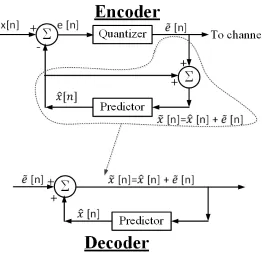
Figure 2.2: DPCM encoder and decoder
Finally, we can conclude thatx[n]∼ N 0, σz2/(1−ρ2), ρ≥0.
2.2.3 DPCM System Description and Statistical Overview
The principle of differential pulse code modulation (DPCM) is based on ideas from
predic-tive coding. DPCM was first introduced in [8] to improve the efficiency of communication
systems by taking advantage of the correlation between the source samples. DPCM is a
compression method which is even today widely used. Where other compression methods
may offer better compression ratio, DPCM offers simplicity results in low cost
implemen-tation, which is highly efficient especially in high speed compression.
Figure 2.2, shows the architecture of the DPCM encoder and decoder. It can be seen
that the DPCM main components are comprised of two main components: predictor and
sourcex[n]and a predicted valuexˆ[n], then it quantized to˜e[n], which is then transmitted to the destination. The predicted value xˆ[n]is obtained from a linear combination of the pastLvalues of the sourcex˜[n−1], . . . ,x˜[n−L], which are derived frome˜[n]accordingly. As a result, the current reconstruction ofx˜[n]is the sum of the predicted valuexˆ[n]and the quantized prediction residual˜e[n]. Note that the reconstruction error can be yield the same way as discussed in predictive coders in (2.1).
As Figure 2.2 illustrates, DPCM uses a linear prediction filter with the input-output
relation given by,
ˆ
x[n] = L X
k=1
akx˜[n−k], (2.14)
for a predictor of order L with coefficients ak. In the particular case of a first order
au-toregressive, AR(1), source,L = 1and we havexˆ[n] = a1x˜[n−1]. From (2.7), it is well
known ([6]) that to minimize the mean square prediction error the coefficientashould be,
a =ρ, making the optimum linear predictor bexˆ[n] =ρx˜[n−1].
The main challenge for DPCM comes from the fact that the prediction is made from
the past values which are not available at the destination because their reconstructed values
contains error. If the predictor works by storing the past M values in the memory and the destination tries to reconstruct the samples, the reconstruction error will accumulate.
Therefore the DPCM predictor at encoder side uses the source reconstructed values which
are the same as those at the destination.
2.2.4 DPCM Coding Error and Gain
The prediction residuals (e[n]) are a scalar source signal, with values quantized indepen-dently of each other, as shown in Figure 2.2. In DPCM linear prediction is obtained similar
squared value of the prediction residual and is closely related to the variance of the source.
However, the coding error for DPCM is not the same value as the e2min in (2.6), since in DPCM the prediction method is done differently. In (2.6), the prediction takes place on the
actual past values while in DPCM it takes place on previously reconstructed values.
If we assume that the transmission is done at high rates while the quantization error
is small then we can approximate that the predictor coefficients are calculated using the
source covariancesEx[n]x[n−l], l = 0,1, . . . , L. Alsoxˆ[n], is approximately derived from the same past values. Using this approximation the coding error can be approximates
as [6],
Ehˆe[n]2i ≈φx(0)−φTx(φ (L) x )
−1φ
x. (2.15)
The gain in DPCM coding over PCM can be defined as,
GDP CM/P CM =
DP CM
DDP CM
. (2.16)
Which is derived from the ratio of the their corresponding coding errors. Since they both
have the same unit variance distortion versus rate function the ratio will be the ratio of their
source variance which is,
GDP CM/P CM =
φx(0)
φx(0)−φTx(φ (L) x )−1φx
. (2.17)
Note that the gain will be more than one in the case of the source with memory.
2.3
Rate-Compatible Channel Codes
Rate-compatible channel codes offer flexibility in adapting the channel code rate when it
is used for joint-source channel coding applications. This is because in these applications
codes, the members are derived from the lowest rate code which is called the ”mother
code”. The higher rate codes in the rate-compatible family can be encoded using puncture
tables that operates on the mother code. For each RCPC code, there is a puncturing table
to determine the bits that are being removed from the output of mother code encoder. The
puncturing table consists of rows which related to each output encoder and columns that
show the order of bits. The zero element in the table means that bit from the mother code
to be punctured and one indicates that the mother code in that position not to be punctured.
Note that since the number of columns are limited, the puncturing operation is repeated
periodically. The length of this repetition is called the puncturing period for RCPC codes.
The rate compatible restriction over puncturing table ensures that all code bits of high rate
codes are used by lower rate codes. If we express that the mother code is extended by
puncturing a low rate N1 with period P anda as the punctured matrix andl as the matrix sequence number, latter restriction can be expressed as,
if aij(l0) = 1 then aij(l) = 1 for all l ≥l0 ≥1, (2.18)
or equivalently,
if aij(l0) = 0 then aij(l) = 0 for alll≤l0 ≤(N −1)(P −1). (2.19)
Rate-compatible channel codes can be constructed from any linear code, but it is more
efficient and straightforward when based on the use of convolutional codes in which case
they are called rate-compatible convolutional codes (RCPC).
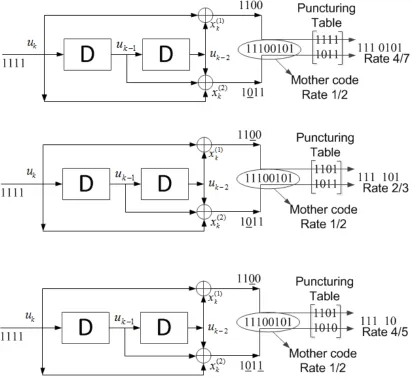
Figure 2.3 shows an example of generating various coding rates using the same
convo-lutional code. The figure shows three codes are derived with coding rates decreasing from
the zero puncturing we get the rate which is equal to the rate of the mother code and any
positive number of puncturing results in higher coding rate compare to the mother code.
The top code has the largest rate in the example of Figure 2.3 at 4/7, and is derived from puncturing one bit out of four bits. The punctured bit corresponds to an entry of zero in
puncturing table corresponding to the output of the bottom line of the encoder. The deleted
bit is shown as underlined. For the example of the top code in Figure 2.3, the puncturing
table is,
1 1 1 1
1 0 1 1
where it can be seen that the punctured bits are the second, sixth, tenth, etc. The puncturing
period here is four.
The decoding of RCPC codes can be done the same way as the other punctured
convo-lutional codes. As a matter of fact, the common way of implementing the decoder is to use
Viterbi decoder. As it is discussed in [9], the soft decision Viterbi algorithm can be utilized
for decoding all the RCPC codes with various puncturing rules.
2.3.1 Performance of RCPC Codes
The performance of RCPC codes can be calculated in the same way as other convolutional
codes. Therefore, it can be measured based on the probability of making a decoding error.
The applied puncturing rules will affect the strength of the code. Higher rate codes are
weaker regarding correcting errors. This point is shown in Figure 2.4, where the BER is
plotted as a function of channel SNR for different RCPC codes from the same family.
The analysis of the performance of RCPC codes depends on the channel model and
decoding mechanism, since they affect the probability of making a decoding error. It was
Figure 2.5: Free distance as a function of channel coding rate r for two families of RCPC codes (reproduced from [1]).
metric Viterbi decoder. Assuming, that the input to the encoder is the all zero sequence.
The probability of making a decoding error is calculated as the probability of not choosing
the right path (all zero in this case) in the corresponding trellis diagram of the decoder.
Note that the input can be a stream of bits with not a fixed length necessarily. Therefore,
the performance is measured as the probability that the path which separates and rejoins all
the zero path for the first time has a path metric larger than the all zero path. This problem
can be related to calculating the probability that the Hamming distance between one path
and the zero path isd. According to [1], this probability can be expressed as,
Pe(d|γb) = 1 2 erfc
p
drγb, (2.20)
where ris the channel code rate, γb = Eb/N0 is the received SNR per bit and erfc (γ) is
the complementary error function defined as,
erfc(γ) = 2/π
Z ∞
γ
e−u2du. (2.21)
Figure 2.6: Number of error events with Hamming weightdf as a function of channel coding rate r
for two families of RCPC codes (reproduced from [1]).
distance asdf, the upper bound probability of decoding error can be written as,
P(γb)≤ ∞ X
d=df
a(d)Pe(d|γb), (2.22)
wherea(d)is the number of paths with Hamming distance dfrom the all zero path. Note that in RCPC codes both danda(d) depends on the channel code rate. Figure 2.5 shows this relation in more detail where the free distance decrease with increasing in channel code
rate. This observation can be expressed as,
df =ke−cr, (2.23)
wherekandcare constants. Figure 2.6 illustrates the fact that the behavior of the function
a(d)can not be approximated as a simple function of channel coding rate (r).
Finally, as we shall see in section 2.4, rate compatible channel codes, by providing a
simple mechanism to adapt channel coding rate while using the same decoder, they are very
useful when implement joint-source channel coding techniques. Specifically, in the case of
Figure 2.7: Block diagram of a joint source and channel coding scheme
other words, we tend to transmit the source bits with the highest channel rate, where the
SNR is high. Using this method in conjunction with the technique that is called
“Incremen-tal Redundancy” results in efficient multimedia communication. Incremen“Incremen-tal redundancy
transmission scheme heavily relies on the use of flexible channel codes. Incremental
re-dundancy technique will be discussed in more detail in section 2.5.
2.4
Joint Source-Channel Coding
Shannon’s source-channel separation theorem states that, in point-to-point communication
systems, source coding (compression) and channel coding (error protection) can be
per-formed separately and sequentially, while maintaining optimality. In many practical
appli-cations, the conditions of the Shannon’s separation theorem can not be used. This is due to
the optmality condition remains true only in the case of asymptotically long block lengths
of data. Thus, significant interest has developed in various schemes of joint source-channel
coding.
The most shared and simple way to design a joint source-channel coding system is by
implementing each source and channel separately while configuring them to work jointly
together. In this approach, called concatenated joint source and channel coding we
con-nect separate source and channel coding blocks serially but their operating parameters are
jointly optimized. As figure 2.7 shows, while, the source and channel encoding blocks are
parameters as a single coding unit. Then for this purpose, the source and channel codes are
chosen such that they can be easily modified. Two of the common mechanisms employed
are embedded source codecs and rate-compatible punctured channel codecs.
The primary goal in designing a concatenated joint source-channel is to assign a proper
rate to the channel and source encoder. The resource allocation for joint source and the
channel coding is done for a given channel signal to noise ratio (SNR). In addition, it is
assumed that the total number of bits transmitted through the channel is fixedW bits. The main goal regarding the joint allocation of the source and channel coding rate is
to minimize the end-to-end distortion. The end-to-end distortion is the combination of the
source coding distortion and the channel-induced distortion. Source coding distortion is
related to the quantization and compression processes, and channel-induced distortion is
caused by channel errors that occur during transmission and cannot be corrected by the
channel coding process. As such, the end-to-end distortion can be mathematically written
as,
D(rs, rc, γ) =DFPr(γ) +DS(rs)
1−Pr(γ)
, (2.24)
where rs is the source encoding rate measured in bits/sample, rc is the channel coding
rate, γ is the channel SNR, DF is the total distortion when an error occurs during
trans-mission and cannot be corrected by the channel code, Pr(γ) is the probability of having
post-decoding channel errors andDS is the source encoding distortion.
Note that in (2.24), the possibility of not having an error during transmission is 1−
Pr(γ), in which case the end-to-end distortion is equal to the source encoding distortion
DS(rs) only. When an error happens in the channel during transmission and the channel
lost information needs to be estimated or concealed by an error concealment mechanism.
In this situation, the distortion introduced is the sum of the source distortion, and
channel-induced distortion denoted asDF.
The distortionDF value is usually observed to be much larger than DS, and it is
re-lated to various variables, including the level of compression, the algorithm used for error
concealment and the source statistics. In some cases the value ofDF can be derived from
statistical considerations. In the absence of any extra information, it is known that the
op-timal error concealment consists of replacing the lost source samples with their expected
value. In the case of a memoryless Gaussian source with zero mean, the error concealed
value isˆs=E[s] = 0andDF is,
DF =E h
(s−ˆs)2 i
= 1. (2.25)
The quality of communication perceived by the end user depends on the reconstructed
sam-ples at the receiver side, which also rely on the overall end-to-end distortion. To receive a
better quality, then, the goal is to minimize the end-to-end distortion by appropriate choice
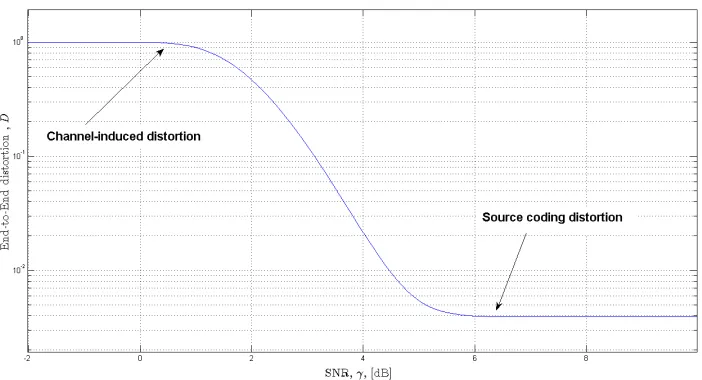
of source coding rate(rs)and the channel coding raterc. Figure 2.8 illustrates the typical
plot of the end-to-end distortion as a function of channel SNR. It can be observed in
Fig-ure 2.8, that when the channel SNR is high, the probability of post channel decoding error
(Pr(γ)) is very low, close to zeroPr(γ)≈0, and the value ofD(rs, rc, γ), using (2.24) can
be expressed as,
D(rs, rc, high γ)≈DS(rs). (2.26)
Figure 2.8: A typical end-to-end distortion curve as a function of SNR
value of the end-to-end distortion will be,
D(rs, rc, low γ)≈DF. (2.27)
It can be seen that between the high and low SNR regions there is a transition, whereby
decreasing the SNR value the end-to-end distortion value will increase from DS(rs) to
DF. Since the total transmitted bits are fixed then by decreasing the SNR, we have the
situation where the number of uncorrected errors increases. Figure 2.9 and 2.10, illustrate
the typical results when plotting the end-to-end distortion as a function of channel SNR.
These figures provide insight into the basic trade offs associated with joint bit rate allocation
for concatenated JSCC. The mechanism linking source and channel coding rate implies that
choosing a smaller channel coding rate will result in adding more redundancy and having
Figure 2.9: The single-mode D-SNR curves and the resulting D-SNR curve for a speech source(reproduced from [1]).
Figure 2.10: The single-mode D-SNR curves and the resulting D-SNR curve for a video
[image:37.612.131.486.456.603.2]The source and channel coding rates in concatenated joint source-channel coding are
jointly chosen for a given SNR value. In a practical scenario, the possible choices for
cod-ing rates are selected from a finite number of discrete choices. Letrs ={rs1, rs2, . . .}and
rc ={rc1, rc2, . . .}, andΩ = {Ωi}, be the finite set that defines possible source encoding
rates, possible channel encoding rates and all possible working combination of source code
rate and channel code rate as operating mode, respectively. Since the total number of bits
are fixed (W), the source and channel rates only are one independent variable, since they are relates as,
W ≥N rs/rc, (2.28)
where N is the number of source sample at the input of the source encoder during one encoding period. The inequality (2.28), provides us with numerous choices for the value of
rs given a fixedrc, but only the largest possible value is reasonable, because given a fixed
SNR, the value of Pr(γ)is also fixed, so the largest possiblerswill minimize theDS(rs)
and end-to-end distortion. Therefore, the choice of rs givenrc is the one where (2.28) is
closest to an equality. Consequently, the operating mode can be identified through only the
choice of rc or the choice ofrs. In practice since we are working with discrete numbers,
this condition may not exactly meet, and some padding bits may be added. If we define the
operating mode by the source coding rate we have, Ω = {Ωi} = {rsi}, then the equation
(2.24), will change notation accordingly to the following,
dΩi =DFPΩi(γ) +DS(Ωi)
1−PΩi(γ)
, (2.29)
where PΩi(γ) is the frame error probability for the given operating mode (Ωi), DS(Ωi)is
the source codec D-R function, and DF is the distortion when an error happened during
end-to-end formula (2.29) is called the single mode D-SNR curve, since for each mode we
have a different D-SNR curve.
The goal of concatenated joint source-channel coding design is to find the operating
mode that minimizes the end-to-end distortion. Mathematically, this goal can be defined
as,
min Ω
DFPΩi(γ) +DS(Ωi)
1−PΩi(γ)
,
such that W ≥N rs/rc.
The optimization problem for a range of channel SNRs forms an overall minimum
distor-tion funcdistor-tion that is called the “D-SNR curve”. This optimization problem is discussed in
more detail in chapter 4.
2.5
Delay-Constrained JSCC using Incremental Redundancy with
Feed-back
Studying delay-constrained joint source-channel coding is motivated by the ever
increas-ing demand over sendincreas-ing real-time multimedia sources with constrained delay. As it is
described in [10], delay-constrained video coding applications requires a total delay, which
consists of buffer delay and transmission delay, to be smaller than the interval between two
frames. This results in using Forward Error Correction (FEC) as the primary method for
error control.
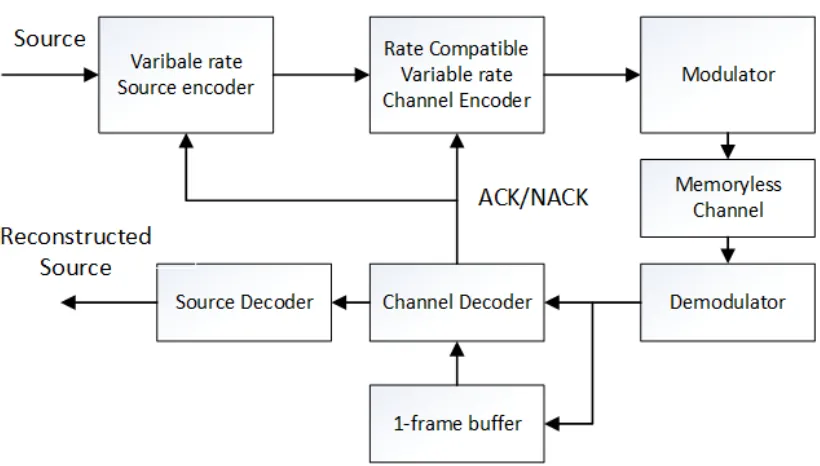
Figure 2.11 illustrates the block diagram of the communication system to implement
delay-constrained JSCC using incremental redundancy. The source encoder works on a
Figure 2.11: Block diagram of the communication system to implement delay-constrained JSCC using incremental redundancy
fixed number of bits are generated to encode the source samples. These bits form source
blocks. In the next step codewords are generated from source blocks using a concatenation
of an outer error detection code and an inner error correction code selected from a rate
compatible family of codes.
Since the transmission is synchronous over a wireless channel, it can be assumed
fixed-size frames per source block sample. Incremental redundancy is used with feedback based
transmission mechanism. The transmission system uses ACK/NACK feedback to
deter-mine what codewords should be included in a frame. A frame may contain codewords and
partial codewords for one or two source blocks depending on the feedback.
To see the operation of the system in Figure 2.11, let’s consider three frames in three
consecutive time-frames regarded as previous, current and next frames with
correspond-ing source blocks followcorrespond-ing the same sequence in time. If the feedback received at sender
to codewords of the current source block. At the receiver, the current frame will be
de-coded to retrieve the current source block. The channel coding operation determines the
success or failure of this transmission and will send one bit ACK/NACK through a
feed-back channel to notify the sender. If the sender receives an ACK for the current frame, it
would continue sending the next frame with the same operation as for the current frame.
If a NACK is received, which indicates the failure during transmission of a current frame,
the channel encoder would choose lower rate channel code for the current source block
(can be achieved through rate compatibility of channel codes by adding extra parity bits).
These extra parity bits, referred to as Incremental Redundancy bits, are sent as a part of
the next frame combined with the codeword for the next source block. Because the frame
size is fixed, the source and channel coding rate in the next frame will be chosen so as to
accommodate the incremental redundancy for the current source. On the receiver side, the
decoder will decode the next codeword and also will try to decode the current codeword
to the best of its capability by combining the previously received source block and the
re-ceived incremental redundancy. Note that upon receiving the incremental redundancy the
currently decoded source block is accepted without further attempts at using incremental
redundancy. Thus, the maximum delay, in this case, will be one frame to decode a source
block which is in compliance with the condition mentioned in [10]. Note that, in this
mechanism the essential property is to reduce the source encoding rate in the next frame, to
allow for the transmission of incremental redundancy bits to help error recovery of the
cur-rent source. As a result, the decoded next source block may suffer higher average distortion
than the current source. However, it will help to decode the current source and reduce its
channel-induced distortion.
is discussed in chapter 4.
2.6
Summary
In this chapter, we have summarized the elements of predictive coding system and focused
on DPCM as an instance of such a system. Then we described the source fundamental
properties. Also, we considered the performance of DPCM through end-to-end
distor-tion that is the combinadistor-tion of source encoding distordistor-tion and channel-induced distordistor-tion.
To address the channel-induced distortion we studied the rate-compatible channel codes.
Then, to optimize the overall end-to-end distortion we used RCPC codes in conjunction
with joint-source channel coding. Finally, we highlight the importance of the incremental
redundancy when designing a system based on the delay-constrained joint source-channel
Chapter 3
Distortion Analysis
3.1
Problem Setup
Because multimedia sources usually exhibit some form of correlation between samples,
the source codecs are frequently built around a DPCM-type codec, where the correlation of
source samples is exploited through the use of predictive coding. However, it has become
a broadly spread notion that transmission errors significantly degrade the performance of
DPCM-type codecs (e.g. [3]). Yet, in an often overlooked comment in [11], this notion
is noted as a misconception. Nevertheless, this misconception persisted after [11], maybe
because this is only a passing comment within a section that is focused on an analysis
that does not provide the full insights into the mechanism at play. In fact, the comment
in [11] made no attempt at presenting an unequivocal case to dispel the misconception by
not going any further than a single comment and not conducting any study about when
transmission errors significantly degrade the performance of DPCM-type codecs and when
this is not the case. In this chapter we present an analysis that leads to a closed-form
expressions to characterize the main elements that determine the end-to-end distortion of
multimedia codecs, allowing for an in-depth study of the effects of transmission errors.
To achieve this, we extract and model the core operational elements in multimedia source
codecs by focusing on a simpler DPCM-based source coding scheme. The insight from
experience the same distortion due to transmission errors, even when DPCM-type codecs
suffer from error propagation while memoryless codecs do not. Furthermore, the analysis
will show that the reasons for this result are the DPCM coding gain and the better error
concealment performance that are achieved in a DPCM system by exploiting the source
memory and by using the optimal predictor in the DPCM coding loop.
The rest of this chapter is organized as follows, section 3.2, describes the problem and
the setup used to study the problem. Section 3.3 derives the equations related to source
encoding distortion. Subsection 3.4 leads to formulate the end-to-end distortion followed
by discussion and numerical results.
3.2
System Setup
In order to mimic the main configuration of multimedia codecs, we study the end-to-end
distortion of a communication system that transmits a block of M samples using a mem-oryless source encoder for the first sample and a DPCM (predictive coding) encoder for
the rest of samples. This setup models the main elements in the encoding of video, where
the fist frame in a block-of-frames is encoded without exploiting the source sample
time-correlation (making it an I-frame), and the encoding of the rest of the frames can use the
temporal correlation with previous frames (as P frames). The considered DPCM encoder
and decoder are shown in Fig. 2.2, wherex,xˆandx˜are the source, predicted and decoded samples respectively. We will assume a synthetic source that is designed to instantiate the
most fundamental characteristics of a video-like source. As such, we assume a source that
follows a first order autoregressive - AR(1) - process: x[n] = ρx[n −1] +z[n], where the innovation process z[n] forms a sequence of independent and identically distributed random-valued samples following a Gaussian distribution with zero mean and varianceσ2
Accordingly, A DPCM uses a linear prediction filter with the input-output relation given
by,
ˆ
x[n] = L X
k=1
akx˜[n−k],
For a predictor of orderLwith coefficientsak. In the particular case of a first-order
autore-gressive, AR(1), source,L= 1, and we have,
ˆ
x[n] =a1x˜[n−1]. (3.1)
From ([6]), it is well known that to minimize the mean square prediction error,a=ρ. Note that the source statistical properties show the same behavior as formulated in
sub-section 2.2.3.
3.2.1 Properties of DPCM Codecs
Note that in a DPCM encoder the signale[n]is the input to a scalar, memoryless quantizer, whilee˜[n]is the corresponding output. In the case of scalar, memoryless quantizers it was shown in [7] that the input and output from the scalar, memoryless quantizer exhibits the
property that,
E
e[n]˜e[n] =E
˜
e[n]2
. (3.2)
Also, since for a good predictive codec the prediction errors at different times are
un-correlated, quantized or not,E(e[n]˜e[n−k] = 0andE˜e[n]˜e[n−k]and, thus,
3.3
Source Encoding Distortion
In the designed system to transmit a block of M samples, we assume the first sample is encoded using memoryless source encoder and the rest of samples are DPCM encoded.
Therefore, to understand the distortion due to source encoding, we need to differentiate
between the memoryless encoded source and the DPCM encoded source. LetDS denote
the source encoding distortion for ideal, memory-less encoding. For a source encoding rate
ofRbits per source samples, from [12], we have,
DS(R) =σx22
−2R = σz22 −2R
1−ρ2 ,
when in the second equation we have used (2.11).
For scalar, memoryless quantization under the high rate approximation, the source
en-coding distortion isDq ≈ ∆ 2
12,[6], where∆is the average width of the quantization interval.
This approximation is valid for uniform and non-uniform quantizers with source sample
with symmetric probability density function (pdf). Assuming the dynamic range of the
quantizer to be in the rangex ∈ [−4σx,4σx], there are k-2 decision intervals in this range
wherek= 2R. Then, we have,
∆ = 8σx
k−2 ≈ 8σx
k
Dq= 16
3
σx2 k2 =
16 3 σ
2 x2
−2R = 16
3 DS. (3.4)
Next, letDm[n]be the source encoding distortion at timenwhen using DPCM
encod-ing. Using the property of DPCM codec in (2.1), the source encoding distortion can be
Dm[n] =E[(x[n]−x˜[n])2] =E[(e[n]−e˜[n])2]. (3.5)
Making the approximation that the predictor coefficients are formed from actual past values
and the prediction from reconstructed and actual values are about the same, the source
encoder predictor error (σe2) yields,
σe2 = E(x[n]−xˆ[n])2
= E
(x[n]−xˆ[n])(x[n]−xˆ[n])
= E
x[n]−xˆ[n]
x[n]
−E
x[n]−xˆ[n] ˆ
x[n]
(†)
= E
x[n]−xˆ[n]
x[n]
(‡)
= σx2−
L X
k=1
akE
x[n]x[n−k]
= σx2−
L X
k=1
akφ(k), (3.6)
where equality(‡)follows because the predictor can be approximated as
L X
k=1
akx˜[n−k]≈ L X
k=1
akx[n−k]. (3.7)
This clearly shows that in DPCM prediction is done based on reconstructed past values.
E x[n]−xˆ[n]xˆ[n] = Eh x[n]−xˆ[n] L X
k=1
akx˜[n−k] i
from (3.7)
≈ Eh x[n]−xˆ[n] L X
k=1
akx[n−k] i
= L X
k=1
akE
x[n]−xˆ[n]x[n−k]
(♠)
= 0.
Here, equality (♠)uses the orthogonality principle for the MMSE predictor as showed in
(3.3) (input samples are orthogonal to filter prediction error). Note that whenL= 1(AR(1) process), from (3.6),
σe2 = σx2−aφ(1)
= σx2−aρσx2
= σx2(1−aρ). (3.8)
From inspecting figure 2.2, it can be seen that the input to the scalar, memoryless quantizer
is the signal e[n]. At the same time, (3.5) indicates that the distortion of the DPCM codec equals the quantization mean squared error experienced by the signale[n]. Assuming high rate approximation and that the pdf ofe[n]is symmetric,Dmis the distortion for the signal
e[n]when it is being quantized by a DPCM encoder. Using (3.4),
Dm = 16
3 σ 2 e2
−2R.
Then, for an AR(1) source, the source encoding distortion (Dm), from (3.9) and (3.8)
can be expressed as,
Dm = 16
3 (1−aρ)σ 2 x2
−2R
= (1−aρ)Dq. (3.10)
The coefficient 1−aρ is the source coding gain of DPCM source coding over the memo-ryless source coding. Not that when the source shows high correlation this gain increases.
3.4
End-to-End Distortion
Calculation of the end-to-end distortion involves the computation of the source encoder
distortion (discussed above) and the channel-induced distortion. One factor that affects
the magnitude of the channel-induced distortion is the error concealment operation that
is being applied at the source decoder. In this section, we assume that the optimal error
concealment is being applied. Also, in the next section, we will study the effect of having
suboptimal error concealment. In this work, we assume that an error in the transmission of
the first sample encoded using a scalar memoryless quantizer is concealed by replacing it
with its expected value. For the M −1subsequent samples, which are DPCM-encoded, a
transmission error is concealed by estimating the lost sample using the reconstructed value
of the previous sample (i.e. replacing the corrupted value by its predicted value). Since,
the studied system uses both memoryless and DPCM coding, the analysis of the
channel-induced distortion requires considering different cases. We first consider cases results in
unsuccessful transmission of the first sample. As indicated, when the sample received at
time0has uncorrectable errors (which will be denoted asx˜0[0]), it is concealed as
˜
Let the average end-to-end distortion at time 0, when there is an error in the transmission
of the sample at time0be denoted asDee,0[0]. This distortion is,
Dee,0[0] = E[(x[0]−x˜0[0])2]
= E[(x[0]−x˜[0] + ˜x[0]−x˜0[0])2]
= E[(x[0]−x˜[0])2] +E[(˜x[0]−x˜0[0])2]
+2E[(x[0]−x˜[0])(˜x[0]−x˜0[0])] (z)
= Dq+E[˜x[0]2], (3.12)
where(z)follows from the following reasons:
• 2E[(x[0]−x˜[0])(˜x[0]−x˜0[0])] = 0 as was shown in [7] under the assumption of
optimal quantization and sample reconstruction.
• By definitionE[(x[0]−x˜[0])2] =Dq.
• Because of error concealment,x˜0[0] =E[x[0]] = 0,E[(˜x[0]−x˜0[0])2] =E[˜x[0]2].
Next, to derive E[˜x[0]2]in (3.12), sinceD
q = E[(x[0]−x˜[0])2] = E[x[0]2] +E[˜x[0]2]− 2E[x[0]˜x[0]], we have that
E[˜x[0]2] =Dq−E[x[0]2] + 2E[x[0]˜x[0]]. (3.13)
From (3.2), now with input and output samplesx[0]andx˜[0], respectively, it follows that
E[˜x[0]2] = Dq−σx2+ 2E[˜x[0] 2
],
⇒E[˜x[0]2] = σx2−Dq ,D0[0]. (3.14)
Combining (3.12) and (3.14), it yieldsDee,0[0] =Dq+D0[0], which provides meaning to
D0[0]as the distortion at timen = 0that is added to the source encoding distortion due to
a transmission error at timen = 0. Also, this result implies that
Dee,0[0] =Dq+σx2 −Dq =σ2x. (3.15)
Next, we look into different scenarios for DPCM-AR(1) coding. To obtain a similar
deriva-tion for the end-to-end distorderiva-tion denotes asDee[1], we should recognize that transmission
error can happen at time0, at time1or both. First we consider the situation, when a
trans-mission error happens at time0. In this case the output of the DPCM decoder at timen= 1
is (with error concealment as in (3.11) ),
˜
The average end-to-end distortion in this case is,
Dee,0[1] = E[(x[1]−x˜0[1])2]
= E[(x[1]−x˜[1])2] +E[(˜x[1]−x˜0[1])2]
−2E[(x[1]−x˜[1])(˜x[1]−x˜0[1])] ([)
= Dm[1] +E[(ax˜[0] + ˜e[1]−e˜[1])2]
= Dm[1] +E[(ax˜[0])2] from (3.14)
= Dm[1] +a2(σ2x−Dq)
= Dm[1] +a2D0[0], (3.17)
where([)follows follows from the following reasons:
• By definition,E[(x[1]−x˜[1])2] =D m[1].
• Because of (3.16) andx˜[1] = ax˜[0] + ˜e[1](recall thatx˜[1]is the output with no error and no error propagation),E[(˜x[1]−x˜0[1])2] =E[(ax˜[0] + ˜e[1]−e˜[1])2],
• The fact that,
E[(x[1]−x˜[1])(˜x[1]−x˜0[1])] = E[(x[1]−x˜[1])˜e[1]]
from (2.1)
= E[(e[1]−e˜[1])˜e[1]] = E[e[1]˜e[1]]−E[˜e[1]2] from (3.2)
= 0.
Note how (3.17) shows that the error introduced at time 0, through the error concealment,
procedures, at an arbitrary timek,
Dee,o[k] =Dm[k] +a2kD0[0] =Dm[k] +a2k(σx2−Dq). (3.18)
We now consider the case of a transmission error at timen = 1only (when transmitting
˜
e[1]). In this case, error concealment takes the formx˜1[1] =ax˜[0]and the average
end-to-end distortion at timen= 1is,
Dee,1[1] =E[(x[1]−x˜1[1])2]
=E[(x[1]−x˜[1])2] +E[(˜x[1]−x˜1[1])2]−2E[(x[1]−x˜[1])(˜x[1]−x˜1[1])]
=Dm[1] +E[(˜x[1]−x˜1[1])2]−2E[(x[1]−x˜[1])(˜x[1]−x˜1[1])] (\)
=Dm[1] +E[(ax˜[0] + ˜e[1]−ax˜[0])2]
=Dm[1] +E[˜e[1]2]
=E[(x[1]−x˜[1])2] +E[˜e[1]2]
=E[(e[1]−e˜[1])2] +E[˜e[1]2]
=E[e[1]2]−2E[e[1]˜e[1]] +E[˜e[1]2] +E[˜e[1]2] from (3.2)
= E[e[1]2] + 2E[˜e[1]2]−2E[˜e[1]2]
=E[e[1]2]
=σ2e
from (3.8)
where equality(\)follows fromx˜[1] =ax˜[0]+˜e[1],x˜1[1] =ax˜[0]andE[(x[1]−x˜[1])(˜x[1]− ˜
x1[1])] = 0due to
E[(x[1]−x˜[1])(˜x[1]−x˜1[1])] = E[(x[1]−x˜[1])(˜x[1]−ax˜[0])]
= E[(x[1]−x˜[1])˜x[1]]−aE[(x[1]−x˜[1])˜x[0]]
= E[(x[1]−x˜[1])(ax˜[0] + ˜e[1])]−aE[(x[1]−x˜[1])˜x[0]]
= aE[(x[1]−x˜[1])˜x[0]]−aE[(x[1]−x˜[1])˜x[0]]
+E[(x[1]−x˜[1])˜e[1]]
= E[(x[1]−x˜[1])˜e[1]] from (2.1)
= E[(e[1]−e˜[1])˜e[1]]
= E[e[1]˜e[1]]−E[˜e[1]2] from (3.2)
= 0.
The average distortion at timen = 1 due to a transmission error at timen = 1 can be written as,
D1[1] = E[˜e[1]2] = (1−aρ)σx2−Dm[1],
which follows fromDee,1[1] =Dm[1] +D1[1].
We can now calculate the the average end-to-end distortion at a general timej when a transmission error occurs at the same timen=j,Dj[j]. In this case the error concealment
average end-to-end distortion, we get,
Dj[j] = E[(x[j]−x˜j[j])2] (3.19)
= E[(x[j]−ax˜[j −1])2]
= E[(ax˜[j−1] + ˜e[j]−ax˜[j−1])2]
= E[˜e[j]2] ♦
= σ2e−Dm[j]
= (1−aρ)σx2−Dm[j], (3.20)
where equality♦follows because,
Dm[j] = E[(x[j]−x˜[j])2] from (2.1)
= E[(e[j]−e˜[j])2]
= E[e[j]2]−2E[e[j]˜e[j]] +E[˜e[j]2]
= E[˜e[j]2] from (3.2)
= σ2e−2E[˜e[j]2] +E[˜e[j]2]
= σ2e−E[˜e[j]2]
Using the superposition principle, the average end-to-end distortion at timen= 1when there are transmission errors both at timesn= 0andn = 1is,
Dee,01[1] = E[(x[1]−x˜01[1])2] (3.21)
= a2(σ2x−Dq) +σx2(1−aρ) (3.22)
Considering now a last specific scenario for a single transmission error, the end-to-end
distortion at timen= 2when the error happens at time 1 follows from considering that the reconstruction will use the previous error-concealed sample x˜1[1]in the reconstruction of ˜
x1[2],x˜1[2] =ax˜1[1] + ˜e[2]. Therefore,
Dee,1[2] = E[(x[2]−x˜1[2])2]
= E[(x[2]−x˜[2])2]
+E[(˜x[2]−x˜1[2])2]−2E[(x[2]−x˜[2])(˜x[2]−x˜1[2])]
= Dm[2] +E[(˜x[2]−x˜1[2])2]
−2E[(x[2]−x˜[2])(˜x[2]−x˜1[2])] (F)
= Dm[2] +E[(ax˜[1] + ˜e[2]−ax˜1[1]−e˜[2])2]
= Dm[2] +a2E[(˜x[1]−x˜1[1])2]
from (3.19)
= Dm[2] +a2D1[1]
from (3.20)
Where (F) follows because, x˜[2] = ax˜[1] + ˜e[2], x˜1[2] = ax˜1[1] + ˜e[2] and E[(x[2]− ˜
x[2])(˜x[2]−x˜1[2])] = 0since,
E[(x[2]−x˜[2])(˜x[2]−x˜1[2])] = E[(x[2]−x˜[2])(ax˜[1] + ˜e[2]−ax˜1[1]−e˜[2])]
from (2.1)
= E[(e[2]−˜e[2])(ax˜[1]−ax˜1[1])]
= E[(e[2]−˜e[2])a(ax˜[0] + ˜e[1]−ax˜[0])]
= E[(e[2]−˜e[2])a(˜e[1])]
= aE[(e[2]−˜e[2])˜e[1]] from (3.3)
= 0
To study the general end-to-end distortion case, we denoteDee,j[k]as the overall average
distortion at time k > 0when an error happened at timej (0 < j ≤k) and with the error concealed as,
˜
xj[j+ 1] =ax˜[j] (3.23)
Dee,j[k] = E[(x[k]−x˜j[k])2]
= E[(x[k]−x˜j[k])2] +E
(˜x[k]−x˜j[k])2]−2E[(x[k]−x˜[k])(˜x[k]−x˜j[k])
= Dm[k] +E(˜x[k]−x˜j[k])2]−2E[(x[k]−x˜[k])(˜x[k]−x˜j[k])
()
= Dm[k] +a2(k−j)E[˜e[j]2]−2E(x[k]−x˜[k])(˜x[k]−x˜j[k])
()
= Dm[k] +a2(k−j)E[˜e[j]2]
= Dm[k] +a2(k−j)
(1−aρ)σx2−Dm[j]
, (3.24)
where()follows from applying recursion onx˜[k]−x˜j[k],
˜
x[k]−x˜j[k] = a(˜x[k−1]−x˜j[k−1])
= a2(˜x[k−2]−x˜j[k−2]),
and continuing the recursion, untill we eventually obtain,
˜
x[k]−x˜j[k] = ak−j(˜x[k−(k−j)]−x˜j[k−(k−j)])
= ak−j(˜x[j]−x˜j[j])
= ak−j(ax˜[j−1] + ˜e[j]−ax˜[j−1])
= ak−je˜[j] (3.25)
Also, in the derivation ofDee,j[k], equality()is due toE
(x[k]−x˜[k])(˜x[k]−x˜j[k])
=
0, because, from (2.1), (3.3) and (3.25), E(x[k] −x˜[k])(˜x[k] − x˜j[k])
= E(e[k]−
˜
We now proceed to calculate the overall average end-to-end distortion at a time n, that
combines all possible events (errors may or may not occur), Dee[n]. Let Pn denote the
probability of a transmission error at time n. At time n = 0 the distortion will equalDq
when there is no transmission error (with probability 1−P0) andDee,0[0]when there is a
transmission error (with probability P0). Using (3.12) and (3.14) to findDee at time 0, we
get,
Dee[0] = Dq(1−P0) +Dee,0[0]P0
= Dq(1−P0) +σx2P0
= Dq+P0(σx2−Dq). (3.26)
Note that this expression shows how we always (with probability one) have a distortionDq
(source encoding distortion) and to this distortion we add a distortionD0[0]with probability
P0to account for possible transmission errors.
The overall average end-to-end distortion at timen = 1is calculated by combining the distortion from four possible events: a transmission error happened only at time n = 0
(an event with probabilityP0(1−P1)), a transmission error happened only at timen = 1
(an event with probability (1−P0)P1), a transmission error happened at timesn = 0 and
probability(1−P0)(1−P1)). Therefore, the overall end-to-end distortion is,
Dee[1] = Dm[1](1−P0)(1−P1) +Dee,0[1]P0(1−P1)
+Dee,1[1](1−P0)P1+Dee,01[1]P0P1
= Dm[1](1−P0−P1+P0P1) (3.27)
+Dee,0[1](P0−P0P1) +Dee,1[1](P1−P0P1) +Dee,01[1]P0P1.
When there are multiple transmission errors the average end-to-end distortion is calculated
by applying the superposition principle. Therefore, it is possible to observe the relation
Dee,jk[n] = Dee,j[n] +Dee,k[n]−Dm[n], where the source encoding distortion Dm[n]is
subtracted to compensate for being accounted for both in Dee,j[n]and in Dee,k[n]. Using
this relation, replacing Dee,01[1] = Dee,0[1] +Dee,1[1]−Dm[1]in (3.27) and simplifying
the resulting expression, yields
Dee[1] = Dm[1](1−P0−P1) +Dee,0[1]P0+Dee,1[1]P1 (3.28) ()
= Dm[1](1−P1) +a2(σ2x−Dq)P0 (3.29)
+(1−aρ)σx2P1, (3.30)
where equality () follows from replacing Dee,0[n] = Dm[n] + a2n(σx2 −Dq) (as per
(3.18)) and Dee,k[n] = Dm[n] +a2(n−k)
(1−aρ)σ2
x)−Dm[k]
(as per (3.24)) followed
by simplifications and collecting common terms. Both expressions (3.28) and (3.29) are
insightful in their own different way to characterize how the overall average end-to-end
from time n = 0and timen = 1. Also, the equation (3.29) shows the value of the end-to-end distortion from timen= 0decreased at timen = 1with the coefficient ofa2.
The derivation of the end-to-end distortion at timen = 2follows the same procedure as for the time n = 1with the only addition that now it will be necessary to consider the end-to-end distortion in the case when there was three transmission errors (at timesn= 0, 1 and 2). For this case, it will be necessary to use the relation Dee,jkl[n] = Dee,j[n] +
Dee,k[n] +Dee,l[n]−2Dm[n], derived from the application of the superposition principle.
Note how now source encoding distortion Dm[n] is subtracted twice to compensate for being accounted for in allDee,j[n],Dee,k[n]andDee,l[n]distortions. Consequently,
Dee[2] = Dm[2](1−P0 −P1+P0P1)(1−P2) +Dee,0[2](1−P1−P2+P1P2)
+Dee,1[2]P1(1−P0−P2+P0P2) +Dee,2[2]P2(1−P0−P1+P0P1)
+Dee,01[2](P0P1 −P0P1P2) +Dee,02[2](P0P2−P0P1P2)
+Dee,12[2](P1P2 −P0P1P2) +Dee,012[2]P0P1P2
= Dm[2](1−P0−P1−P2) +Dee,0[2]P0+Dee,1[2]P1+Dee,2[2]P2
= Dm[2](1−P0−P1−P2) +Dm[2
![Figure 2.4: Performance of different codes from the same family of RCPC codes with mother coderate 1/4, memory 8 and puncturing period 8 (reproduced from [1]).](https://thumb-us.123doks.com/thumbv2/123dok_us/76744.7238/30.612.115.488.228.524/figure-performance-different-family-mother-coderate-puncturing-reproduced.webp)
![Figure 2.5: Free distance as a function of channel coding rate r for two families of RCPC codes(reproduced from [1]).](https://thumb-us.123doks.com/thumbv2/123dok_us/76744.7238/31.612.134.487.97.250/figure-free-distance-function-channel-coding-families-reproduced.webp)
![Figure 2.6: Number of error events with Hamming weight df as a function of channel coding rate rfor two families of RCPC codes (reproduced from [1]).](https://thumb-us.123doks.com/thumbv2/123dok_us/76744.7238/32.612.128.489.96.247/figure-number-hamming-weight-function-channel-families-reproduced.webp)

![Figure 2.9:The single-mode D-SNR curves and the resulting D-SNR curve for a speechsource(reproduced from [1]).](https://thumb-us.123doks.com/thumbv2/123dok_us/76744.7238/37.612.131.486.456.603/figure-single-mode-curves-resulting-curve-speechsource-reproduced.webp)