Rochester Institute of Technology
RIT Scholar Works
Theses
Thesis/Dissertation Collections
3-2009
Past with Present: A Design Process
Spencer Knape Biegler
Follow this and additional works at:
http://scholarworks.rit.edu/theses
This Thesis is brought to you for free and open access by the Thesis/Dissertation Collections at RIT Scholar Works. It has been accepted for inclusion in Theses by an authorized administrator of RIT Scholar Works. For more information, please [email protected].
Recommended Citation
Past with Present
A Design Process
Spencer Knape Biegler
Rochester Institute of Technology
Industrial Design MFA
Contents
Abstract Introduction Investigations
Choice of Artifact The 3D Sketch
Disassembly and Subversion Arms
Bobèche Chandelier Form Scattered Design
A History of the Chandelier Curly Chandy
Bio Chandy Sketchwork Ring Chandy Design Réseau
Conclusions on the Artifact Design Réseau
Focused Design Deco Chandy Thatched Chandy Tent Chandy 40-Chandy Conclusions
Possible Applications: Door Possible Applications: Luggage A Final Note
Appendices
Appendix A: The Evolution of Artifacts Appendix B: Culture and Design Endnotes
The design process detailed in this thesis addresses how a designer brings a design that is both relevant but dated into the present. Four stages make up the design process: investigation, scattered design, design ré-seau, and focused design, and the process covers the choice of artifact, historical and cultural research, and the conclusions derived from research. The chandelier acts as artifact in this design process iteration. The goal of the thesis project is a process that stresses both innovation as well as the cultural and symbolic importance of older designs; the outcome of this design iteration is honed chandelier concepts with prototypes.
How does a designer bring a design that is both relevant but dated into the present? The response to a question using “how” must take the form of an explanation, offer direction, or out-line a process. A designer brings a design that is both relevant
but dated into the present through a process—a design process.
Henceforth the process under discussion will be known as “the design process.”
Only select artifacts are eligible for the design process explored in this thesis. The appropriateness of the selection depends on
the artifact fulfilling the stipulations of “relevant” and “dated.”
Along with “present,” these terms warrant further attention. “Relevant,” in this case, conveys that the design still possesses positive qualities. The relevant qualities are probably the reason for the selection of the design.
“Dated” communicates that the design in question has skeuo-morphs and vestigial elements, rendering the design unsatisfying, inappropriate, or limiting new designs.
“Present” could, in some contexts, be defined as any design be -ing created or produced at current, but in this instance “present” will be the constraints derived from the perceived needs of the present-day imposed upon the design process.
A good candidate for the design process has elements that are to be retained, other elements that will be eliminated, and a set of constraints that address contemporary life.
The inspiration for creating a design process that both innovates and incorporates elements from the past derives from observing a duality when it comes to designing certain kinds of artifacts. Either the designer copies or nearly copies artifacts that have ex-isted for centuries, or the designer redesigns with little regard for the history of the artifact. Between the two extremes of mimicry and a process stressing just innovation exists unexplored design space.
Introduction
Underpinning the stated thesis topic are a number of assump-tions: namely, that the past is important, innovation is important, and topical constraints are important. The goal of the process outlined in this document is to both focus on history and on innovation.
The Past and Design
Objects do not exist in a cultural or a historical vacuum. Even when completely alien, artifacts will be approached and assimilated using cultural mores and group and individual past experiences. For objects that are not alien, the artifact means something and communicates to the culture. The use of an artifact connects con-sciously and subconcon-sciously to all other contact with that artifact, creating a complex tapestry of meaning as we the users interact with the world.
The extent and depth of meaning attributed to objects is de-bated, and some argue meaning can vary from object to object and artifact to artifact. Ellen Dissanayake, in Homo Aestheticus, calls art the act of “making special,” and human life as well as human objects fall into categories of either special or normal, or can be placed along a continuum between these two ideas.1
How exactly specialness translates into meaning is complicated. Adrian Frutiger proposes that symbolic content has its limits; ev-eryday objects lack symbolic content. “Tools, crockery, clothing, and housing are too close to humans’ daily life to be charged with any mythological content.”2 It is only through association
with certain objects or organisms that they obtain symbolic force. Other theorists argue the opposite point, that familiarity with an object can augment its “specialness” or its symbolic force.
How objects acquire and shed meaning is beyond the scope of this thesis. The design process assumes that artifacts have roles and that objects communicate in the context of a culture. Appendix
B focuses on office design and office culture to illustrate the
broader links between culture, meaning, and design. Discovering what an artifact means is a key component to the design process, allowing the object to retain its relevant features.
Innovation
Design is a discipline of creation, change, and by extension,
de-struction. The purpose of design can be described as finding good
The design process presented in this thesis attempts to counter the fact that innovation, at times, fails to consider the symbolic power or the history of an artifact, ignoring cultural context in the quest for change. Innovation rests at the heart of design, but change should not ignore the history or cultural meaning of artifacts.
The following four sections correspond to the four steps of the design process explored in this thesis. A division into four sections is the simplest breakdown of the process without diluting or com-promising the stages. The stages move from initial investigations through producing a series of designs, then combining and
evalu-ating the designs, and finally focusing on a select number of the
designs. The process inherently produces standards with which to
judge the final set of designs. The aim of the entire process is to
move from an array of varying design concepts to an output with
Investigations
Investigation begins with a choice of artifact. The word “arti-fact” refers to a class of objects. Examples of artifacts include sofas, cell phones, and trash cans. Three-dimensional work in
this first stage focuses on building a quick version of the artifact
and disassembling and subverting older designs of the artifact.
Choice of Artifact
It is important to chose an artifact that fits certain criteria. Ideally
the choice of artifact has a long history and possesses a number of elements that will continue in the new design. The artifact remains important in some capacity to the current culture, but instances of the artifact should be outdated. What constitutes outdated can be debated, but a case must be made that the arti-fact is outdated in some capacity.
The chandelier is a good candidate for the design process and is used in this thesis to demonstrate the process. The chandelier has a long and tortuous history, and, in the last century and a half, the artifact has been subject to the transition from candle to gas and then to electric lighting technologies. The candle was origi-nally a central determining element in chandelier design, but the new lighting technologies render most chandelier designs tech-nologically obsolete. Culturally, though, chandeliers continue to be produced, bought, used, valued; chandeliers exude meaning and possess a role in many cultures. Designs that focus on new lighting technologies overwhelmingly overlook the cultural role of the chandelier. Chandeliers pose interesting design challenges, presenting the designer structural, luminescent, electrical, and
reflective challenges in addition to the concerns of the individual designs. The chandelier has an added benefit of falling squarely
The 3D Sketch
The aim of this step is to familiarize the designer with the artifact. The model produced should be quickly assembled, possibly out of scrap parts, and preferably at a full scale. It should ideally be a working model to be a fully effective learning tool.
The 3D sketch for the chandelier is constructed out of coat-hanger wire, Christmas lights, and pull ties. A number of issues came to the forefront during the creation of this model, including a need to consider light quality, lamp intensity, overall produced lumens,
light reflectivity, the type and location of wires, size and orienta -tion of the chandelier, arm spacing, symmetry, and bulb and light direction. Because the chandelier hangs, balance comes into play; if the designer has neglected balance the form might tremble or list. With a chandelier, the designer is typically trying to power multiple, separate points of light, which can be challenging.
The 3D sketch for the chandelier was successful for its quickness and ease of construction, and because of the unveiled consider-ations to be revisited in later designs.
Coat hanger frame of 3D sketch
Completed 3D sketch with stu-dio background to show context and scale
Disassembly and Subversion
After the 3D Sketch is completed, two design strategies, disassem-bly and subversion, allow the designer to break down the artifact into manageable pieces and then play with the segments.
Three chandeliers from Habitat for Humanity Restore translated into a ready supply of arm, body, bobèche, and candle pieces. Key at this juncture in the process is familiarization with the materials traditionally used in the manufacture of the artifact. The three chandeliers conform to typical chandelier assembly conventions
and rely on a specific type of screw thread. Typically, pieces that
combine to form the chandelier are stacked on a single axis, parts being either screwed together or held from slipping off the main
pipe by nuts, loops, or final screws.
Almost all electric lamp parts, which include chandeliers, use “lamp pipe,” which typically is rated at 1/8 IPS with a diameter of 3/8”. The IP stands for “iron pipe size,” a sizing convention
that is a holdover from when fixtures were being converted to
gas power. Sizes 1/4 and 3/8 IP are less common, and lamp pipe frequently has a pitch of 27 per inch, so the most common size is technically 1/8-27 IPS.1
Within the lighting industry the term “lamp” often refers just to the light bulb and not to the entire lighting structure. A light bulb socket would then be called a “lamp holder.”
Arms
In two of the acquired chandeliers the arm shape is a common chandelier “S,” and the arm investigation kept the essential form of these arms and focused on a manipulation of materials.
Chartreuse yarn was the first material chosen because of its vi -brant and, for a chandelier, a-typical hue. The texture of the yarn arm had a “cottage” feel; application was quick and easy.
The use of copper segments for the second arm suggests the types of metal normally found in chandeliers, though copper rarely makes an appearance in its pure form like the copper in
this model, but as a part of the alloy brass. The similar reflectiv -ity of the different metals might lead the copper to signify some amount of opulence; the arrangement of the copper segments had the unexpected consequence of appearing armored, convey-ing the ideas of “military” and “strength.”
The materials applied to the third and fourth arms are infre-quently associated with chandeliers. In an attempt to signal concepts of “clean” and “synthetic,” polystyrene was molded by being vacuum formed over the arm. The yellow tape used to fasten the two polystyrene pieces altered the impact of the white
When assembled into one object the subverted arms ap-pear disjointed and
fight each other for
visual dominance.
Left, yarn arm.
PS tremendously. For the other arm red Plasti Dip gave the arm a rubbery, “grippy” appearance. Both of these investigations were pleasing in their marriages of older form and infrequently uti-lized materials.
The arm investigation was fairly successful in its main objectives: connecting the designer to the wide range of material choices available for application to future designs and familiarizing the designer with a portion of the main artifact.
Bobèche
Because the drip pans on the Habitat for Humanity chandeliers were so similar in shape, the bobèche investigation sought to sub-vert the typical bobèche vocabulary. The choice of polystyrene seemed appropriate because of its neutral texture and color.
Ceramics and bowls from thrift stores made excellent molds and the polystyrene successfully vacuumed. The resulting forms do not differ in any drastic way from a drip pan in most chande-liers, but the curve of their bowls seem unusual for a chandelier, signaling that chandeliers typically adhere to a fairly strict shape vocabulary for the bobèche. Subtle alteration is enough to shift the drip pans from a common form.
Close-up of two of the dish shapes used as molds. The vacuum holes were drilled by special ceramic bits.
Vacuumed shapes prior to being cut out.
Chandelier Form
The size of a typical chandelier can present challenges when in-vestigating the overall form. Scaled models are an appropriate re-sponse, but CAD (computer aided design) software has an equally
generous set of benefits. Though CAD can distance and blind a
designer to physical constraints and construction considerations, software is ideal for large, abstract investigations into form.
By using NURBS as a mathematical model, AliasStudio lends it-self to the sculpted shapes chandeliers often take more so than programs such as SolidWorks, which is a parasolid-based solid modeler. The variation and subversion of the overall form came about through manipulation of the “S” shaped arm, the base unit in this investigation. Different iterations displayed changes in arm quantity, arm orientation, and overall orientation. In cases such as this one, momentary disregard to certain constraints, in this case materials and scale, can free the investigation, allowing for
profitable experimentation.
The base unit of the form manipula-tion
Subversion by ex-ceeding the expect-ed number of arms.
Subversion of the arm orientation.
In the second stage, scattered design, the designer expands on different concepts to produce a range of designs and design con-cepts; a concept is the underlying idea behind a design or a group of designs.
The designer undertakes most of the historical research during the scattered design stage. Historical research provides the de-signer a deeper and more robust understanding of the artifact at hand. Research should commence the moment the artifact is cho-sen, culminate during the scattered design phase, and taper off as
the designer focuses on specific designs. Learning the technical,
economic, and cultural forces that shaped the artifact’s history allows the designer to more fully understand the obsolescence and the cultural space the artifact occupies, both of which help the designer understand the artifact elements to retain.
In keeping with the spirit of the transformation that the chande-lier is undergoing during the design process, the term “chandy” is assigned to the more advanced designs, a modernized form of the word chandelier.
A History of the Chandelier
The chandelier typically traces its origins to abbeys and religious buildings of medieval Europe. Histories of the chandelier ex-clude Asian and other non-European lighting. Structures similar to the chandelier exist, including certain Chinese and Japanese lamps, but these designs follow a different linage. For a deeper discussion into the general nature of the evolution of artifacts, see Appendix A. While lighting systems of other cultures would
Scattered Design
no doubt be illuminating and inspirational, the design process at hand is concerned with the chandelier in particular and the cul-tural role of the chandelier, both of which are decidedly Western. Adding other cultural elements into the history would generate confusion. For the sake of clarity what follows is a Western
his-tory of artificial illumination with special attention given to the
chandelier.
Until the appearance of coal gas lights in the nineteenth century, lighting technology had changed little in thousands of years.
Apart from wood, the fuel used for interior artificial illumination
was typically animal fats or plant oils, both of which were prone to being consumed as food instead of fuel in times of want, espe-cially in the case of the plant oils.
Open flames had a tendency to be messy, expensive, and a bit
dangerous. Beeswax was a luxurious alternative, as tallow could go rancid, melt in the summer, and oil could congeal in the win-ter months. Rushlights, lamps using rushes as wicks, dripped and were enormously messy, and the quantity of smoke produced was a concern. Fire was a constant danger. Wicks of tallow candles had to be trimmed every quarter hour, meaning that a single person could tend to only ten candles at any given time, so those who could afford servants could afford lights, and those that could not were limited in the number of candles they could and did light.1
Candles gradually became more common, over a several hundred year period, beginning in the seventeenth century. Prior to this time, ample evidence supports claims that candles were used rarely. Candlemaking was not considered a necessary skill in a wife nor a need for a village, and the choice to burn candles was
also a moral choice, as artificial illumination could imply neglect -ing responsibilities or unscrupulous opulence.2
For most individuals, contact with candles took place in a church. Because candles were used so rarely, they became staple features for religious or ceremonial buildings, used symbolically for cer-emonies, for sinners, and for the dead. The candle represented
“stark differences in everyday life—light from darkness, wake -fulness from sleep, the solemn from the everyday.”3 The first
chandeliers illuminated the large, dark spaces of certain medieval buildings, which were typically religious in nature. A drip pan had a spike in the center onto which a candle could be thrust. A simple, early chandelier design consists of two planks of wood arranged into a cross, upon which the drip pans sit. Another early design consisted of a circular structure with candles atop on the parameter. For any candle-burning chandelier replacing the can-dles is obviously important, and the rope that held the chandelier
aloft could be slackened, lowering the chandelier to the floor to
The upper classes began to use artificial light much more fre -quently in the eighteenth century, but for lower classes and, originally for all people, light was almost wholly solar. The sched-ule of the sun, in turn, determined meal and bedtimes, and it is little wonder that the sun was treated with reverence by so many cultures. Solar light shaped both daily and monthly rou-tines and was a free and, for the most part, readily available light source. Country dwellers planned night activities to coincide with the brightest phases of the moon. Originally, using any technol-ogy for light implied a degree of additional effort and economic
costs. The attractiveness of artificial illumination stemmed from the perceived benefits versus the costs and availability of artifi -cial light for that particular culture. Cultural attitudes towards light impacted adoption of new technologies and the use of old ones; candles were originally associated with sleeping rather than nighttime endeavors, an association that was aristocratic in na-ture, as a candle at night implied beeswax as well as a servant to
tend to the flame throughout the night.
The chandelier addressed the problem of lighting a larger spacial area than could be lit by a single candle, a task also taken up
by girandoles and sconces, the defining differences being that girandoles are supported from the floor, sconces attach to a wall.
The ways of amplifying the light include increasing the number of candles, positioning the candles in a central area, increasing the
amount of flame, or using reflectors or refractors to direct the light. Increasing the flame consumes more fuel, and the fireplace,
and later stove, was primarily used to generate heat. Compared
with a chandelier, a broad open flame used vastly larger amounts
of fuel, had to be ventilated, produced a great deal of heat com-pared to candles, and, for all of these reasons, was often placed
in walls in the form of a fireplace. The chandelier became a useful response to the limitations inherent in large, open flames as a
light source.
As artificial light became more accepted in the seventeenth cen -tury, more distinct connections emerged between social status and type of illumination. Technological advances combined with
shifts in cultural or social mores to augment the use of artificial
illumination, as French theater provided the prototype for new, fantastic lighting effects.4 “Elaborate lighting carried
connota-tions of excess and extravagance, although an absence or inad-equacy of candle lighting could signify poverty and depravity as well.”5 Darkness was equated with danger; the wealthy would
travel with their own light sources.
The messages of artificial illumination remained strong indicators
of class, taste, and status.6 Around 1800, public gas lighting
be-gan to be installed in cities—beginning with the most luxurious
commercial districts or symbolic city elements.7 Arc lights, the first
The transitions from solid and liquid to gas fuels and then to electricity affected chandeliers, as gas burners and electric wir-ing made appearances in the new designs and were physically installed in older chandeliers. Gas lighting typically protected
the flame with a glass chimney, which controlled the flow of air. Incandescent lamps (see definition of “lamp” on p 9) might be
covered with shades or colored glass to try and temper the bright-ness of the lamp.
Curly Chandy
The Curly Chandy is the first design that moves away from simple subversion to a more complex creation. Like the form investiga -tion, the designs for the Curly Chandy continue to use AliasStudio. The design is still a subversion, as the arm spacing, consistent arm shape, and drip pan placement all run counter to traditional chandelier logic. The models and sketches for the Curly Chandy
do begin to feel more like a finished design than the form in -vestigations, but the concepts behind the Curly Chandy are fairly simple. Without designated materials, lamp type, and construc-tion method, the design remains an abstracconstruc-tion.
Curly Chandy from the side, a view which em-phasizes different arm lengths and shapes.
Curly Chandy viewed from an angle typically ex-perienced by a user
Bio Chandy
The Bio Chady began as an observation about the link between Art Nouveau and nature as inspiration, and grew out of an at-tempt to draw inspiration from nature in a contemporary
man-ner—resulting in a scientific understanding of the natural world.
The first underlying logical constraint calls for equal spacing of
the light producing entities on a single plane. Many chandelier designs follow such a logic, though sometimes more tiers, or planes, are situated above or below the main plane. In the major-ity of existing chandeliers, the structural response to such a logic uses arms to hold one or two of the light points. The arms conjoin at a central point and branch in a radial fashion.
Diagrams depict-ing branchdepict-ing di-vided into sections of two, three, and four initial branch-es. The black circles are the lamp units.
Left, other ideas that coincided with the Bio Chandy di-agrams
Right, the basic lamp of the Bio Chandy unit and the range of possi-ble support options
The Bio Chandy branches in a non-radial fashion following
ex-amples set by floral and arboreal structures, and becomes almost
more mathematical than biological. The curves on the Bio Chandy are obviously different than archetypal chandeliers. The material could be recycled plastic, such as recycled PVC, or a thermoplastic. There were questions as to whether this kind of concept, with
scientific inspiration, satisfies the constraint of being “in the pres -ent,” an issue that was not fully resolved as attention shifted to other designs.
An iteration from below; 2-2-2-2 branching logic with a 2-2-2 second tier cross aligned
Chandy from above with a 45º second tier.
Sketchwork
At this stage in the design process, the designer should have ideas and be recording them in the form of two and three dimensional sketches. Many of the sketches are not and will not be as de-veloped as the Curly Chandy or the Bio Chandy. The following sketches represent a range of underlying concepts.
Both pages dem-onstrate working through LED char-acteristics, limita-tions, and appli-cation—including LED arms as plug-in parts
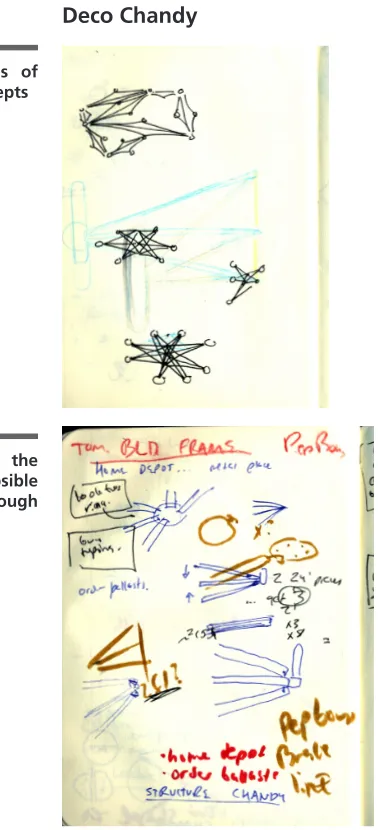
Left page, sketches precede the Deco Chandy and are focused on the con-cept of “structure.”
Right page, full and partial LED plug-in concepts
Left page, ideas on how to hang a single candle or candle/pan unit.
A 3D sketch of “wiggle chandy,” a design which sub-verts arm shape. Pipe cleaners, rub-ber washers, and electrical wire (can-dles)
Left page, total form concepts.
Right page, hang-ing and fabric-ori-ented ideas
Collapsible design;
flat arms use tabs
to become three di-mensional
Left page, full back-bone chandy with
fiber optic nerves
Ring Chandy
The Ring Chandy model was produced later in this particular
de-sign process, but the dede-sign fits much better with the scattered
design. The fact the design calls for such a small chandelier runs counter to later conclusions about the role of the chandelier in contemporary culture.
The impulse behind designing the Ring Chandy took the form of a question: “what kind of chandelier and what scale object do
LEDs naturally want to light? “Naturally” is a tricky word, but the thinking was that an LED is physically a tiny object, and as such
wants to light a similarly scaled object. The shape and
arrange-ment of LEDs was an homage to early medieval chandelier variet -ies that were found in monaster-ies. The base is a cross section of thick pipe, roughly cut, which hints at an industrial style.
The light might be a candidate for portability, or the fixture is fitting in a setting with more confining space. The power cord
remains a dilemma. The model represents an interesting
begin-ning for a light fixture but does not qualify, according to research
conclusions, as a chandelier, mainly because of its size.
Ring Chandy from the side. Fixture is 8” across.
Left, Ring Chandy with ACDC con-verter box. Right, detail of LED strip
and reflective den -tal panels
As viewed by a typ-ical user; note the awkward electrical chord placement
and fishing line
In the third stage all the scattered designs are arranged in a single space, the “design réseau,” where the designs are grouped ac-cording to common traits. As historical research begins to wane, the designer should begin forming conclusions about the
sig-nificance of the artifact. The investigations, designs, and research
should now indicate what is worth preserving from past artifacts and what elements should be altered or deleted, and why.
Conclusions on the Artifact
When considering the role of the chandelier, two ideas stand out: the link between chandeliers and wealth or status, and the chandelier as a ceremonial and domestic artifact. These ideas are what the chandelier mean. Certain elements support what the chandelier means, and the meaning of the chandelier dictates the manifestations of the elements. As such, the meaning and the
elements re-affirm and perpetuate each other.
Some important elements for a chandelier include the cost and type of materials, the size of the chandelier and the space the artifact occupies, the setting, the kind of light the artifact emits, and the chandelier form. Many of these elements listed have a dual nature; size can be big or small, for instance. The chandelier typically prefers that which enhances the idea of wealth, domes-ticity, or ceremony, which is the trait big, in this case.
Great size communicates wealth in a number of ways. Typically, a voluminous artifact has an inherently high cost stemming from the price of materials, assembly, and transportation. Often as important is the volume of space itself; interior space, especially
domestic space, can be costly. Providing the chandelier sufficient
room is an economic consideration. The cost of the typical raw materials used, the number of parts, and the degree of assembly required also plays a role in elevating the cost of the chandelier.
The setting of the chandelier is critical when focusing on the ideas
of ceremonial and domestic. Large interior spaces are typically
dances, ballrooms. Theaters, churches, and certain government buildings all contain chandeliers, and they can be found in entry-ways and over stairs, which are often ceremonial in nature. Not only does a new artifact have to replace the chandelier techno-logically, but the artifact must take on the role of the chandelier.
Many settings are decidedly non-domestic and are not ceremonial in the same manner, and considering these settings provides an
interesting contrast to the home. Stadiums, offices, and factories
all fall under this another type of setting. Design for factories
and for office interiors has a different vocabulary than domestic design. Executive offices, which are set apart from normal of
-fice design and communicate status, can be, at times, domestic
or ceremonial. Usually, though, what might suggest comfort at
home can be seen as informal or inappropriate for an office; what signals efficient in a cubicle sometimes comes off as cold
or impersonal in one’s apartment. Chandeliers, being so strongly associated with non-work activities, would have to shed a lot of
their signifiers to become appropriate for work, that is unless the
piece in question could be construed as historical or artistic, as is the case when a chandelier happens to be in an older building or the chandelier is installed as art. In this last case, the business or organization in question might be communicating a certain cultured status, which is demonstrated by their knowledge and preference for history, art, or design.
Certain buildings are neither work-related nor domestic. Public artifacts can be more austere, making them seem hygienic or ap-propriate for a population with divergent tastes. Some civic and government artifacts must take into account constant use, theft, vandalism, and general disrespect. Chandeliers are exempt from some public considerations because they can be placed out of reach of the user, but the danger of misuse remains, especially for what is often a fragile construction. The message of a chandelier often fails to coincide with municipal aims, which include demon-strations of frugality and neutral opinions. Of course the opposite
is also true—civic artifacts are group objects, and as such demon -strate the status or wealth of the group. The United States Capitol
building illustrates this point well. Local and regional wealth is
demonstrated by the ability of the government to support aes-thetic, artistic, recreational, and other life-enhancing endeavors.
dining, residence, and, at times, governmental and athletic struc-tures, the chandelier is more welcome.
Placing chandeliers outdoors lacks serious precedent and rarely happens. Candles did a relatively poor job lighting anything but the interior, and construction and design of chandeliers made them particularly vulnerable to the elements. Various varieties of streetlamp were much more common, and when electricity be-came widespread there was less resistance to electric use outside,
as incandescents and then fluorescents could illuminate where
candles, and to an extent even gas, had failed.
Light quality is another supporting element. According to Richard Kelly, artificial illumination falls into either an ambient, a focal,
or a sparkle category. A chandelier sparkles, a “microscopic bom-bardment of points of light-the most exciting kind of light there is ... it stimulates and arouses appetites of all kinds.”1 Though a
chandelier does not have to sparkle, perhaps it is this effect that makes the chandelier such a good candidate for eating, socializ-ing, and other special activities. In regards to lightsocializ-ing, the sparkle category is rarely used; most light is solar, either direct or indirect, or it is focal or ambient, and usually a combination of these types.
Work atmospheres typically want sufficient illumination so that
employees or customers can see clearly, using a mix of ambient and focal lighting. Other types of interior lighting strives for a contrast between shadows and the light. Sparkle enters the retina with dozens of points of light, temporarily overwhelming the eye with its unique variety of light. The tendency to use this particular type of light helps cement the chandelier’s use in special social circumstances.
Because of the brightness of lamps, the designer is often faced with the technical problem of how to soften or dampen the glow
from the lamp, a problem common to incandescent, fluorescent,
and halogen lamp types. Many lamp types can become hot; halo-gen lamps can become quite hot. Fluorescent lamps traditionally buzzed, required ballasts, emitted an off-color light, and con-tained mercury.2 The last few years have brought many changes
to fluorescents: they now fit into Edison screw sockets, come in
more pleasing colors, do not buzz as much, and as a result have received a great deal of media attention on their energy and cost savings. Fluorescents do still contain mercury and require ballasts.
Governments are considering banning the sale of incandescents
in coming years. This shift to fluorescents means that the chan
-delier is under additional technical strain; fluorescents are even
less suited for the multiplicity sought after in chandeliers: they require ballasts, which can cost more and take up space, and the possible unappealing light color is a consideration. Some plug-in,
compact fluorescents are candle shaped, as if the entire candle
From an economic standpoint, most chandeliers are designed to last long periods of time and to have a sluggish birth-death cycle. Classically, the materials in play signify opulence: polished metal alloys, crystal, glass, and at times precious metals, iron, or even wood. The artifact has a fairly weak upper-economic limit, that is, because the chandelier conveys wealth and status, the barrier limiting materials, scale, and implementation is proportional,
loosely, to the artifact’s luxury status. Few want a luxury file cabi -net or a luxury coffee mug, but demand for fairly to very luxuri-ous chandeliers is much greater.
Radical design changes to the chandelier in the form of materials, form, color, and textures could very well push the class connota-tions of the design even higher. Both consumers and designers are familiar with sudden design transformation being linked to high-design, with high-design being expensive or elite. What might be termed cutting edge design often strives to reach those highest and lowest on the economic scale, or in certain cases the
design targets specific sub-cultures that have their own unique design ideals. Low-cost materials might counter this effect.
Whole families of materials are technologically underrepresented in chandelier design: plastic and aluminum, the two Modern fa-vorites, as well as fabric, rubber, particle board, and paper
prod-ucts. In terms of illumination, designers have been using LEDs,
which continue to develop as technology reduces the production
costs and continues to address the LED’s limitations: angle of light dispersal, cost, and light color. Their small size, efficient energy usage, and inclination towards sparkle make LEDs a wonderful
chandelier light source. Exciting technological advances are in store for illumination, the coming of bioluminescence not least amongst these changes.
Design Réseau
The design réseau brings together the best of the scattered design into a single location so as to highlight the similarities, differences, relationships, and over-arching concepts that exist between the different designs. The word itself is French for the mesh used in lacemaking or the grid on a telescope that connects networks of stars. The closest synonym is “network,” but all other words, including “web” or “map,” whose arrangements are ei-ther too regular or too irregular, fail to fully describe an asym-metrical structure based on groupings and relationships.
The subversion families are marked red, with arm alter-ations that tweak typical arrange-ment, spacing, shape, and orienta-tion
Light source fo-cal point concepts with the candle/ bobèche unit as principle entity. These designs are non-structural so-lutions to hang-ing light sources in space.
Additional subver-sion with single arm as manipulat-able pice
A focus on struc-tural arrangements of parts
An emphasis on
light reflection
and a secondary emphasis on stack-ability
Ideas of hanging as
The circles represent the four
designs chosen for the final
stage: the focused design. The chosen concepts avoid strict subversion, tending towards tension, structure, collapsibility, alternate illumination and LEDs, multiplicity, temporary installa-tion, alternate materials, and a
Focused Design
Focused design is simply the execution of a small number of designs that have been plucked from the réseau. The designer
Deco Chandy
The stylistic similarities to Art Deco led to the namesake of the Deco Chandy. The use of aluminum as a material and the trian-gular frame that makes up the arm is reminiscent of industrial structures and bridges of early and mid century America. The
con-figuration of the lampholder and exposed electrical cords further
support the industrial aesthetic, as does the choice of lamp, an intermediate E-17 screw base lamp normally seen in exit signs that
strongly displays its numerous filament coils.
Initial sketches of structure concepts
Determining the best collapsible connectors through sketches
[image:37.612.197.386.57.472.2]Collapsibility and portability were the driving concepts behind
the Deco Chandy. Lightweight and easily installed, the chandy
was intended for use at outdoor events. Unfortunately, the strong stylistic associations, aluminum and electrical materials, and lamp type all undermined the design requisite of “present,” and ultimately the design was deemed unsuccessful.
First lampholder segment prototype
Full single lamp-holder prototype with short arm con-nectors
Left, materials for Deco Chandy: aluminum tub-ing, lampholders, wire. Right, detail of mounted proto-type arm
Thatched Chandy
A fascination with multiplicity was the genitive force behind the Thatched Chandy. The perception of abundance creates a sense of heightened opulence. The craftsmanship necessary for the ex-ecution of the design coupled with the visual qualities of so many pieces leads to visual richness.
Centuries-old thatching techniques helped the initial concept. Thatching in and of itself is an old technology, but thatching a chandelier is an uncharacteristic application of the technique,. The thatched material was also atypical, so the fact the design uses thatching does not date the design.
The model uses red polystyrene straws glued to bent galvanized conduit. For the model, hot glue melted the straw tips into place before the pipe quickly dissipated the heat, contributing to a
significant production time difference between a conductive and
non-conductive base. A plastic base, for example, did not dissi-pate heat and tripled the time a straw needed to be supported before it was independently secure.
A test of the spa-cial requirements of thatching galva-nized pipe
An early thatching experiment on par-ticle board
The original goal was to have the chandy glow internally and at different intensities, the light diminishing in brightness as it trav-eled to the tips of the straw. Numerous obstacle prevented this in the scale model, including the danger of melting the PS, the
difficulty in making pipe porous to light, challenges inherent in a
transparent base, including attaching straws to a material other than metal, and wiring and installing illumination that was small
enough and still bright enough, such as LEDs. A single, bright source of illumination is another option, as is the use of fiber
optics, though this solution seemed fraught with familiar light intensity and technical problems. The model, as shown, is lit by
exterior sources—an acceptable but not ideal option.
Production of this design could be accomplished in a number of manners. A jig that encircled the curved base with thousands of holes could hold the thatch pieces in place until a glue dried. Another scenario involves a jig that would move along the length of the base. Still a third method is to cast single sections that hold many pieces. The section of thatch might be a single ring or mul-tiple rings, perhaps out of silicone, to form the “straw,” which
Detail of thatching on a single arm
A finished arm, top
Full model for
the-sis exhibit; the first
attempt at joining multiple arms
Six arm full model in an appropriate domestic setting
could be slipped onto the base. It should be noted that in produc-tion the straw cannot be made from Polystyrene as in the model; the plastic degrades and is sensitive to heat.
Tent Chandy
The idea behind the Tent Chandy was a structure that would use
flexible poles to establish tension in fabric and then drape or hang slack pieces of fabric around the light source. In the final
model tent poles provide the tension and structure, and three pieces of fabric create most of the volume.
Many small and half-sized models preceded the final model.
Achieving the correct amount of tension in the fabric was
dif-ficult, and the early work on the Tent Chandy focused on this
aspect. The tautness in the fabric had to counter the tension from the poles; the slack fabric was designed to envelop the light source. A plywood board with eyehooks provided a perfect test-ing ground for achievtest-ing correct tension and experimenttest-ing with how slack fabric behaves.
With a contemporary constraint of collapsibility, the Tent Chandy
satisfies the conditions set forth in the premise of the design
process. Through its size and presence, the chandelier retains its cultural role, and many of the skeuomorphs are phased out. The
fabric is heat-proof, and is specifically designed for high heat situ -ations and theatrical environments. Even so, incandescents should not be used with this fabric, which represents a major change
from the final model. Like the other collapsible chandeliers, the
Tent Chandy is meant for temporary, ceremonial events and out-door settings.
Model of single fabric segment with center slack and a taut edge. The model is on a half-scale board that simulates ten-sion.
All 360 degrees of fabric, half-scale model with edge slack and center tautness
Unpinned patterns intended to have both edge and cen-ter slack. The pat-terns here dropped awkwardly and failed to hang as expected.
Three-fabric model similar in nature to
the final prototype.
Possible applica-tion for the collaps-ible, portable Tent Chandy: a recep-tion
One single, full-sized segment with single pole out of
the three final seg -ments
Finished, lit proto-type from below
Chandy-40
Like the Tent Chandy, the Chandy-40 comes from the collapsibil -ity section of the design réseau. For the Chandy-40, part of the portability is achieved through stackability. The design consists of identical, thin pieces radially anchored when assembled.
One-third of the arms have LEDs on the top surface; the light reflects
from the underside of higher arms. The DC current passes through circuits embedded in the base of the arm.
The design calls for the circuits to be printed on the surface of the arm. Circuit boards are typically printed through different forms of etching, that is, material is removed from a solid piece of cop-per till circuits remain. In the last decade, much work has been done on alternative methods for printing circuits, and these arms would not be printed like circuit boards, but should be printed with the addition of the exact amount of copper to the arm
sur-face. The copper will be sealed by a transparent film, the copper
Sketches of LED arms, stacked arms,
and reflected light
Seeking the correct arm shape, a shape that avoids
com-municating “flower
ink visible on the surface of the arm for aesthetic purposes. In the base of the arm, vias will connect the surface circuits to the arms
underneath. The strips of LEDs used in the final model might be
a manufacturing option in production, but printing with desktop
printers, printing LEDs, flexible printing, and printing on various
surfaces are all emerging technologies that could be utilized.
A working model displays how the chandelier would look lighted and a demonstration model shows the printed circuits and the
packaging. For the working model, LEDs pre-arranged into a strip
were soldered onto leads and secured to arms. A nexus of wires ran upwards and eventually through an AC-DC converter.
For both models, 14-ply illustration board, white on one side, yel-low or olive on the other side, became the arms. The grain of the ply affected the bend of the arm; going with the grain down the length of the arm provided stability and sagged less than going against the grain. Because the arm in the model was a paper-based product, and possibly because the paper was not protected against the air, the arms sagged after hanging aloft for a few months.
The Chandy-40 is technologically and culturally current, addresses portability and tries to harness a relatively new manufactur-ing process. Through the artifact’s size and light quality, the
chandy fits into the cultural niche occupied by the chandelier.
Furthermore, the compact packaging is economical and could also be considered environmental due to saved fuel and range of pos-sible paper materials; the shipping arrangement of the chandelier
Left, first work -ing arm prototype.
Right, test of LED
reflectivity on the
underside of an-other arm
Left and Right: the cutting and paint-ing of the display prototype
Display prototype next to packag-ing. Arms, spacers, electrical chord, pipe, washers, and a converter are all included in the package
Left, display model in packaging. Right, display model next to outer packaging
takes up a fraction of the space of similarly sized chandeliers. The single concern relates to the artifact’s chandelier-ness due to the lack of conventional arm, bobèche, candle shapes, or typical lamp types, a fear that is addressed through by the overall size, the use of arms and materials, and the avoidance of an industrial or an overwhelmingly Modern vocabulary, such as the use of metal, aluminum in particular, or plastic. The Chandy-40 in particular
Illustration of a sin-gle arm and spac-ers. The printed circuits are clearly visible. In the upper right of the illustra-tion the underside of a piece shows the connection points to the vias
Conclusions
Through text and pictures the final design section conveyed the
successes, failures, and work yet to be accomplished for each
de-sign. Generally, the final designs were portable, used a variety
of materials unconventional for the artifact, dabbled in alternate and various light sources, and, for the most part, retained the cor-rect traits and jettisoned other elements deemed vestigial from the traditional artifact. In many of the designs, the chandeliers
continued to fill their prescribed role, and this iteration of the
design process was a good one.
But was the process itself successful? The process has an inherent, initial set of constraints and a second set of constraints produced during the process prior to the design réseau. The process does al-low a designer to move from a single artifact to a set of completed
designs, and fulfills the thesis question of how to bring a strong
but dated object into the present. Other types of responses to the thesis question are certainly possible, but the response presented in this document is successful.
The chandelier has been the sole artifact used to demonstrate a single cycle of the design process. A hypothetical run-through of the process using other artifacts will hopefully further ex-plain the design process and expand on techniques and possible application.
Possible Application: Door
The archetypal domestic door in America consists of a hinged swing door on a vertical axis with panels and a metal knob or a metal lever. If a key is present it too is metal. The ritualistic and
ceremonial role of doors are critical to their design, and doors often serve as metaphors for change, protection, home, and for-bidden space. For all these reasons doors are a strong artifact.
The interest in door design is heightened when comparing the archetypal domestic door with business or retail doors. A typical convenience store might have steel framed doors whose surface area is primarily glass. These doors slide open mechanically when activated by a motion sensor, and are usually larger than domestic doors. Because different door designs are fairly segregated, stark differences exist between kinds of doors, signaling possible dated artifacts and a large area of untapped design space with which
to work, offering the possibility of a profitable cross-breading of
door types.
Using the design process outlined in this thesis document, the designer might begin quickly assembling a full-scale or half-scale door. Once completed, investigations and subversions could begin. Hinge function and material, locks, door form, and door material are all good candidates for the investigations. The hypotheti-cal begins to become hazy in the next step without conclusions from the investigations. The designer should begin sketching and building models that address any number of overriding concepts. The réseau brings these designs together, where the designer
decides on the candidates that best fulfill the conclusions. If, for
instance, the designer wanted to focus on the concept of
“secu-rity,” certain designs would be plucked from the réseau. The final
step is the actualization of the designer’s selections.
Possible Application: Luggage
Though perhaps merely the opinion of this author, suitcases before 1900 represented something far grander than today’s scuffed bags. Perhaps due to the fact that travel typically took much longer than today’s trips, many old suitcases and trunks emanated self-importance and were a metaphor for a journey or for change. One can almost envision the trunks stacked on deck of a ship steaming into Ellis Island. The luggage was leather,
metal, wicker—and perhaps the sum of the materials, size, care,
and story made suitcases seem more treasured than the bags used
The system luggage functions in today has changed dramati-cally from a hundred years ago. For the chandelier, the system of energy consumption in the West shifted. For luggage, personal modes of transport have shifted from boats and trains to cars and planes. The latter has tighter restraints on size than the former, and planes have restricted size to an even greater extent recently, causing a stark decline in large suitcase sales. Additionally, the way luggage is handled by automatic luggage systems, the need for light materials in the case of planes, and increased security concerns have all helped dictate the way the materials and design for luggage have morphed in recent decades.
The investigations might focus on size, structure, form, handles, wheels, opening, and travel history. The challenge that would be confronted by the design process would be to co-opt the gran-deur of old luggage while addressing constraints like three di-mensional space, weight, security, and portability.
Luggage on dis-play at the Ellis Is-land Immigration Museum. Photo by Heather Cross, on-line at (http://go-nyc.about.com/od/ photogalleries/ss/ ellis_island_2.htm)
A good demon-stration of a con-temporary suitcase as evinced by the solid, black color, wheels, materials, handle, size, and zippers. Photo from SmartBargins.com, a Traveler’s Choice 22” Suitcase, El Do-rado line.
A final note
Many other design processes exist, and there are other possible processes that possess similar aims as the goal of this thesis. The process presented in this document focuses on the dual impor-tance of innovation and the historical, cultural context of a base artifact. The process responds to how a designer can incorporate both innovation and context.
In the future it would be exciting to witness the process presented here applied to another artifact. At the very least, this document will hopefully be inspirational and provocative for designers that chance upon this thesis. The best of luck to future R.I.T. design students.
Appendices
Two of the following sections outline some of the research which led to conclusions concerning the importance of environment and cultural context in the design process. Originally the goal of the thesis research was to understand how designs change over time, and researched subject matter included semiotics, time, technology, and economics. Only the two most applicable and useful subjects of research are present here: design evolution and design and culture.
Because the following research was not directly applicable or part
of the design process, but did influence the development of the
process, the research is included here. Additionally, the topics are
interesting and beneficial in their own right.
In writings on design history it is not uncommon to find descrip -tions of how a particular artifact “evolved.” The temptation to attribute design change to a kind of evolution is easy to
under-stand—biological evolution is a ready-made system of change.
Unfortunately, evolution as a metaphor can also be downright misleading, yet the differences between biology and anthropol-ogy are as enlightening as the similarities, and, with a foreknowl-edge of the limits of the metaphor, considering the link between design and evolution can be quite rewarding.
Because the thesis statement mentions bringing a dated object in the present, grasping how an artifact correctly evolves is a
relevant area of study. One benefit to the research was viewing
artifacts as organisms, a mental step that led to seeing that
arti-facts must coexist and fit into their environments and their sur -rounding systems. A critically important step in the design process became understanding what about the chosen artifact was still
relevant, and to sculpt the final designs accordingly. Realizing the relevance of the artifact came about when considering the fitness
of organisms.
What follows if a brief history of biological analogies and sur-vey of evolution and design. The artifact is the focus because, as George Bassala notes in The Evolution of Technology, the artifact is the primary unit of study in evolutionary change. He defends using evolution as a metaphor for design change, arguing that:
Metaphors are not ornaments arbitrarily superim-posed on discourse for poetic purposes. Metaphors or analogies are at the heart of all extended ana-lytical and critical thought. Without metaphors literature would be barren, science and philosophy would scarcely exist, and history would be reduced to a chronicle of events1
The relationship between the concepts of designing and evolv-ing is a complex one. Evolution, if one were to try and capture the basic tenets, calls for a system that designs the best solutions based on the ability of different designs to survive and reproduce. In classic Darwinian evolution, organisms do inherit traits from
The Evolution of Artifacts
changes in the environment elicit changes in the organism, and organisms can pass these changes that were made during life to
their children. The change in the Lamarkian system is not random,
but deterministic or willed on the part of the organism.13 Though
refuted by gene theory, Lamarkian is better suited in explaining
design change.
In a number of ways, the metaphor of evolution can be useful when thinking about design change, as different designs often share traits in a way similar to organisms, and traits are shared be-tween parents and offspring or bebe-tween siblings or other familial relations. As often commented, designs are also produced in an environment of amazing diversity. The transformation from de-sign to artifact or organism depends on a set of strict criteria and the availability of and ability to attain certain resources called for in the design, and in both, “selection must be made from among competing novel artifacts.”14 Artifacts, like organisms, have a
birth/death cycle, and each has species or types. Organisms and artifacts both have a continuity in form and appearance between successive generations, and there is often a gradual transforma-tion with small alteratransforma-tions. There is a geographical diffusion of designs for both.15
The differences between design morphology and evolution are equally essential. The central tenet of Darwinian evolution is that the designs themselves are hardwired to compete against other designs directly. The competition can include their own species, other species that use the same resources, and the resources themselves, when disinclined to be used as food. Human designs and artifacts do not normally compete in the same manner, but instead rely on human intellect, culture, or consumerism to
de-termine the fitness of the design, depending on the prescribed
school of thought. In the 250 plus pages of The Evolution of Design Steadman utterly fails to bring the reproductive struggle into the argument.
Designs do not directly give their genetic code to offspring and do not typically reproduce. Thus, even if the outcome is the same (a halt in the use of a certain design or the extinction of a spe-cies), the determining factors in human design are human deci-sions and the ability and resources to produce a design. Designs become extinct through production cessation of a design and the destruction of existing instances of the design, though artifacts sometimes deteriorate to the point of destruction without help from people.
synonymous with the classical ideal of beauty. The qualities of wholeness, of integrity, of a unity in structure such that the parts all contribute to the effect or purpose of the whole, and no part may be removed without some damage to the whole.6
Biological applications to design expanded in the eighteenth cen-tury, when paleontologists were busy collecting and cataloging plant and animal specimens, archaeologists and anthropologists began gathering man-made artifacts from past and present hu-man cultures, and architects started documenting structures from around the world on a larger scale. There was plenty of cross-breeding between the output of scientists, naturalists, and ar-chitects, and an especially common topic of interest was method
of classification.7 Buildings and tools began to be recorded and
ordered like living specimens.8
More recently, evolutionary thinking and the application of evo-lutionary metaphors as relevant to industrial design is colorfully displayed in a Harper’s article from 2005. In “A Romance of Rust: Nostalgia, Progress, and the Meaning of Tools,” Donovan Hohn
trails his uncle-in-law Tom as Tom visits auctions and flea markets,
accumulating tools for his already vast collection. Most of the 25,000 tools in Tom’s collection are his preferred tool, the wrench. Previously a biology teacher, Tom belongs to a larger culture of galoots, or tool lovers, and Hohn suggests that Tom did not just collect tools, “he was a taxonomist of tools, a naturalist of tools. He’d progressed from Gray Dogwoods to Succulents to wrenches, as if the age-old distinction between nature and culture were the folly of philosophers.”2
Biology and design were, and still are, linked by comparisons using anatomical metaphors; skeletons were the load bearing structural elements, exteriors the skin or scales, and so forth.9
The zoological techniques used by Tom to order the collection prompts Hohn to explain that “divorced from usefulness and
sub-jected to morphological classification, [the tools] looked like fos -sils of Cenozoic mollusks or the wristbones of tyrannosaurs,” and, concluding, Hohn states “everything evolves … Even Hammers. Even Keys.”3
paradoxically to be a mystical belief in the intuitive process.”10
Modernism’s claims become easier to ingest when ‘environment’ is equated with technology, culture, fashion, economy, or any of
a range of influences, meaning that Modernism proclaims that design is the result of everything that influences design.
Differing opinions aside, it was generally agreed that changes made to successive generations of artifacts by “primitive” peoples were part of a gradual process. It was more apt, then, to say that the designs of the artifacts “evolved,” as one could trace the small changes made to similar artifacts from the archaeological specimens. Balfour traces production changes in primitive people, where humans began to adapt available forms, imitated and styl-ized these forms over time, and then through successive copying and unconscious variation, established a stable system of repli-cation that incorporated change.11 In Notes on the Synthesis of
Form, Christopher Alexander calls this kind of production unself-conscious, versus our selfconscious manner of design and produc-tion. The unselfconscious method is characterized by being
ho-meostatic, by consistently producing “well-fitting” forms, by the
coupling of myths with building habits, by a belief in rightness without question, and most simply by a simultaneous rigid adher-ence to tradition and a proclivity for immediate action or change
in the face of misfits.12 Alexander blames modern design failures
on the individual; “architecture did actually fail from the very mo-ment of its inception” because all that’s really needed, according
to Alexander, is correction of misfits and object replication.
Hohn visits industrial designer Bary van Deursen of Stanley tools, who Hohn labels “goofy for Progress” and “gonzo for Change.”4
To Hohn, the primary feature of today’s tools is to “outperform the competition not in the workshop but at Home Depot and
Wal-Mart. Functional refinements, like BladeArmor, are minor
compared with the cosmetic changes the tools neverendingly undergo.”5 The commercial or consumerist element, both in the
design process and in industrial design’s history, should not be undervalued. Equally as important is the danger inherent to the concept of “progress.”