University of Southern Queensland
The Application of Variable Speed Limits to
Arterial Roads for Improved Traffic Flow
A dissertation submitted by
Hamdi Abdulkareem Mohammed Al-Nuaimi
B.Sc. Eng., M.Sc. Eng.
For the award of
Doctor of Philosophy
i
ABSTRACT
Traffic congestion problems continue to increase in large cities due to rapidly
increasing travel demand and a lack of transport infrastructure. Congestion causes
mobility and efficiency loss, safety reduction, increased fuel consumption and
excessive air pollution. A number of traffic management strategies have been
proposed and some are applied in cities, such as diverting traffic from peak periods
to off-peak periods using congestion pricing, reduced speed limits, coordinated
traffic signals along major arterial roads, or adding additional lanes where network
expansion is feasible. Among the many solutions to traffic congestion, operational
treatments for existing road networks provide more cost efficient traffic operation
due to their relatively low cost. This research looks to improve efficiency through the
application of Variable Speed Limits (VSLs). While VSLs have been used to
improve traffic conditions on congested motorways in terms of mobility, safety and
travel time, they are largely untested on signalized urban arterial roads.
Griffith Arterial Road (GAR) U20 was selected as the case study for the
research. GAR is part of the Brisbane Urban Corridor (BUC), and is approximately
11.5 km long and lies between the Gateway Motorway and the Ipswich Motorway.
The average daily traffic volume (ADT) is between 18,000 vehicles to 24,000
vehicles. The number of lanes at approaches to signalised intersection varies from 1
to 4.
In the context of this research, the study used STREAMS data and real world
data collected using six high definition (HD) video cameras to develop a VISSIM
model and to discern the effectiveness of applying VSL control. VISSIM is a time
step and a psycho-physical car following model developed to model urban traffic and
public transit operations. The VISSIM model was extensively calibrated and
validated with the empirical data collected regarding measure of effectiveness such
as traffic volumes, volume distribution, and saturated headway along the west bound
(WB) and eastbound (EB) directions.
The simulated model allowed the testing of
different control strategies for VSL and Integrated Traffic Control System (ITCS)
under different scenarios and circumstances. It helped to contrast the traffic flow
parameters of invariant (no controlled speed) and VSL (controlled speed) conditions.
Multiple simulation runs were considered in the calibration and evaluation process.
The measures of effectiveness used to characterise the operational quality of
signalized intersections were delay, queue length, and number of stops. In addition,
flow, speed and density parameters were used to characterise the changes in traffic
performance for the arterial road.
iii
Certification of Dissertation
I certify that the thoughts, experimental work, numerical outcomes and conclusions
reported in this dissertation are entirely my own efforts, except where otherwise
acknowledged. To the best of my knowledge, I also certify that the work presented in
this thesis is original, except where due references are made.
……….
/ / 2014
Signature of Candidature
Hamdi Abdulkareem Mohammed
Date
ENDORSEMENT
………
/ / 2014
Signature of Supervisor
Prof. Ron Ayers
Date
………...
/ / 2014
Signature of Supervisor
Prof. Frank Bullen
Date
……….
/ / 2014
Signature of Supervisor
Dr. Kathirgamalingam Somasundaraswaran
v
Acknowledgments
I would like to express my sincere gratefulness to Prof. Ron Ayers, my principal
supervisor, for his guidance, encouragement, persistence, patience and expert advice.
I would also like to thank my associated supervisor Prof. Frank Bullen for his expert
advice and valuable input to my research. It is my luck and great honour to be their
student. Without their guidance, I would not be able to complete this research. Also,
I am very thankful to my associated supervisor Dr. Kathirgamalingam, who provided
me with invaluable help and support.
I owe my deepest gratitude to the spirit of my father, who always in my heart and
dreams and to my mother, who without her pray, I wouldn’t reach this stage.
My admiration and respect go to my wonderful wife, Enas, who without her
support and encouragement I could not be able to finish my study. My thanks go to
my smart son, Diyar, to my beautiful daughter, Dima, to my little gorgeous
daughters Diane and Dania for their encouragement, patience and endless love
during my PhD study.
Many thanks go to my brothers, sisters and relatives for their inspiration and pray.
Great thanks and attitudes go to my brother, Husham Al-Nuaimi, for his infinite
support and encouragement during all the period of my life.
I would like to extend my thanks to the University of Southern Queensland (USQ)
and special thanks to Faculty of Civil Engineering and Surveying for their support
throughout my academic studies. I would also like to acknowledge all the staff
members of PTV vision in Brisbane and especially Dr. Julian Laufer and Dr. Mamun
Rahman for their cooperation and support during the course of this research.
Furthermore, great thanks go to the Department of Transport and Main Roads in
Queensland for their help in providing and collecting traffic data for the Griffith
Arterial Road.
vii
Associated Publication
Al-Nuaimi, H
, Ayers, R & Somasundaraswaran, K (2013), ‘
Modelling interrupted
flow conditions on an arterial road using VISSIM software’
, proceeding paper
presented to 14th Road Engineering Association of Asia and Australasia Conference
(REAAA 2013): The Road Factor in Economic Transformation, 26-28 Mar 2013,
Kuala Lumpur, Malaysia.
ix
Table of Content
List of Figures
xiii
List of Tables
xvii
List of Abbreviations
xix
Chapter 1 Introduction
1.1
Background
1
1.2
Objectives of the study
1
1.3
Significance of the study
2
1.4
Study methodology
3
1.5
Thesis layout
4
Chapter 2 Literature Review
2.1
Introduction
5
2.2
The performance of signalised intersections
7
2.2.1 Delay
7
2.2.2 Vehicle queuing
10
2.2.3 Number of stops
13
2.3
Traffic control management strategies
15
2.3.1 Road pricing strategies
15
2.3.2 Constraint traffic flow strategy
17
2.3.3 Metering flow strategies
21
2.3.4 Variable speed limit Strategy (VSL)
25
2.4
The implementation of VSL on arterials
28
2.4.1 Coordination traffic system with no queued vehicles
28
2.4.2 Coordination traffic system with queued vehicles exist
29
2.4.3 Coordination traffic system with spill back exist
31
2.4.4 VSL and the performance of signalised intersection
33
2.4.5 VSL use when the queued vehicles consume the entire green interval
34
2.4.6 Applying VSL under spill back conditions
35
2.4.7 Using VSLs in urban areas
37
2.4.8 Mathematical approach of VSLs in urban areas
38
2.5
Summary
40
Chapter 3 Survey & Data Collection
3.1
Introduction
41
3.2
Selection of study area
42
3.3
Data Collection
45
x
3.3.2 Field data
50
3.3.3 Field data processing
52
3.4
Floating car test
65
3.5
Summary
67
Chapter 4 Modelling the Griffith Arterial Road using VISSIM software
4.1
Introduction
69
4.2
VISSIM an overview
69
4.3
Development of VISSIM modelling
72
4.3.1 Physical road network & traffic signal timing
72
4.3.2 Coding traffic Data
72
4.3.3 Driving behaviour
72
4.4
Calibration and validation processes
72
4.4.1 VISSIM calibration
72
4.4.2 Validation criteria
75
4.5
Calibration and validation implications
76
4.5.1 Calibration results of mainstream flow
76
4.5.2 The variability of simulated flow at peak hour
78
4.5.3 Calibration results of flow distribution
79
4.5.4 Calibration results of saturated headway
81
4.6
Summary
83
Chapter 5 Description of Local Traffic Situation at Griffith Arterial Road
5.1
Introduction
85
5.2
The study site
85
5.3
Traffic flow description
86
5.3.1 Description of traffic flow in WB direction
86
5.3.2 Description of traffic flow in EB direction
95
5.4
Summary
105
Chapter 6 Evaluation of VSL Application to the Griffith Arterial Road
6.1
Introduction
107
6.2
Speed Limits management
107
6.3
Evaluation of Scenario 1 on the performance of intersection 2
109
6.3.1 Evaluation of average queue length
109
6.3.2 Evaluation of average delay parameter
110
6.3.3 Evaluation of average stopped delay
114
6.3.4 Evaluation of average number of stops
115
6.4
Evaluation of Scenario 1 on the performance of the congested link
117
6.4.1 Evaluation of average traffic flow
117
xi
6.4.3 Evaluation of average density
122
6.5
Evaluation of Scenario 2 on the performance of intersection 2
123
6.5.1 The influence of Scenario 2 on the intersection parameters
123
6.5.2 Evaluation of Scenario 2 on the performance of the congested link
126
6.6
Evaluation of Scenario 3 on the performance of intersection 2
129
6.6.1 The influence of Scenario 3 on the intersection parameters
129
6.6.2 Evaluation of Scenario 3 on the performance of the congested link
132
6.7
Evaluation of Scenario 4 on the performance of intersection 2
135
6.7.1 The influence of Scenario 4 on the intersection parameters
135
6.7.2 Evaluation of Scenario 4 on the performance of the congested link
138
6.8
Comparison and optimisation of VSL scenarios
141
6.8.1 Evaluation of effectiveness of VSL at busy Intersection
141
6.8.2 Evaluation of effectiveness of VSL on busy link
143
6.9
The influence of VSLs optimisation on the total travel time
145
6.10
Summary
146
Chapter 7 Evaluation of Signalised / VSL Integrated Traffic Control System
7.1
Introduction
149
7.2
Traffic scenario descriptions
149
7.2.1 Traffic Scenario 1 (ITCS 1)
149
7.2.2 Traffic Scenario 2 (ITCS 2)
150
7.3
The aim of ITCS
151
7.4
Evaluation procedure of ITCS
151
7.5
Results and discussions
152
7.5.1 Effect of ITCS 1 on the performance of Intersection 2
152
7.5.2 Evaluation of ITCS1 on the performance of macroscopic traffic flow
parameters
161
7.5.3 Evaluation of ITCS 2 on the performance of intersection 2
169
7.5.4 Evaluation of ITCS 2 on the performance of traffic flow parameters
179
7.6
Comparison of VSL applications and ITCS scenarios
187
7.7
Influence of ITCS on total travel time
191
7.8
Summary
192
Chapter 8 Summary and Conclusion
8.1
Main conclusions from this study
195
8.1.1 The impact of VSL and ITCS on intersection parameters
195
8.1.2 The impact of VSL and ITCS on macroscopic traffic characteristics
195
8.1.3 The impact of VSL and ITCS on TTT
196
8.2
The impact of VSL and ITCS on annual savings
196
8.3
Summary
197
xii
References
199
Appendix A
A.1
Development of VISSIM modelling
209
A.1.1 Physical road network & traffic signal timing
209
A.1.2 Coding traffic data
211
A.1.3 Driving behaviour
213
A.2
Calibration process
217
A.2.1 Identification of the measure of effectiveness (MOE)
217
A.2.2 Initial iteration run
218
A.2.3 Error messages
218
A.2.4 Visual evaluation
219
A.2.5 Determination of the minimum number of runs
220
Appendix B Evaluation of VSL Applications on Intersection 6
B.1
Preface
225
B.2
VSL control management
225
B.3
Evaluation of scenario 1
227
B.3.1 Evaluation of intersection parameters
227
B.3.2 Evaluation of macroscopic traffic characteristics
230
B.4
Evaluation of Scenario 2
233
B.4.1 Evaluation of intersection parameters
233
B.4.2 Evaluation of macroscopic traffic characteristics
236
B.5
Evaluation of Scenario 3
239
B.5.1 Evaluation of intersection parameters
239
B.5.2 Evaluation of macroscopic traffic characteristics
234
B.6
Evaluation of Scenario 4
245
B.6.1 Evaluation of intersection parameters
245
B.6.2 Evaluation of macroscopic traffic characteristics
249
B.7
Comparison and optimisation of VSL scenarios
251
xiii
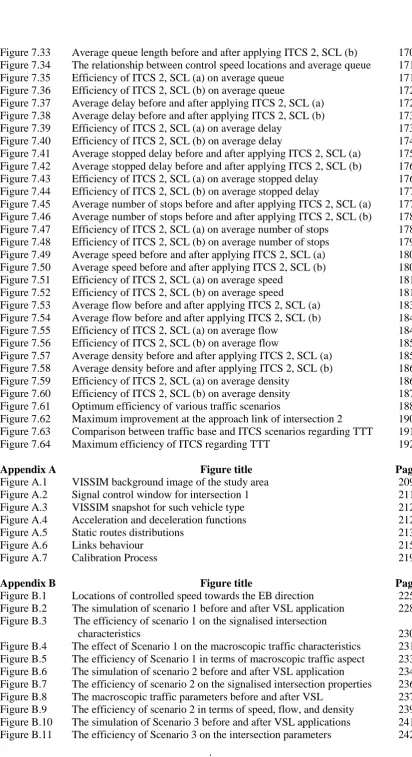
List of Figures
Chapter 1 Figure title Page
Figure 1.1 Schematic illustration showing the scope of the current research 3
Figure 1.2 Study methodology 4
Chapter 2 Figure title Page
Figure 2.1 Delay components, Source: (TRB, 2000) 8
Figure 2.2 Traffic entering the restricted zone under electronic road pricing 16
Figure 2.3 Traffic entering the restricted zone under ERP, (1998) 17
Figure 2.4 The shape of MFD 20
Figure 2.5 Average vehicle travel time for different control modes 21
Figure 2.6 A general traffic network 22
Figure 2.7 Two cases: (a) without ramp metering control and (b) with ramp
metering control; grey areas indicate congestion zones 23
Figure 2.8 Spatial equity and mobility on Trunk Highway 169 24
Figure 2.9 Flow-density diagram versus VSLs. Where b=1, 0.8 and 0.6 26
Figure 2.10 (a) Potential VSL impact on under-critical mean speeds and (b) cross-
point of diagrams with and without VSL 27
Figure 2.11 Ideal offset 28
Figure 2.12 The effect of speed on the traffic operation 29
Figure 2.13 The effect of queued vehicles on the offset calculation 30
Figure 2.14 The operation of traffic flow under using normal offset 32
Figure 2.15 Equity offset process 32
Figure 2.16 VSL plan 33
Figure 2.17 Offset operation pre-speed limit initiation 34
Figure 2.18 Arrival flow under post- speed limit control 35
Figure 2.19 Schematic of using new spill back management 36
Figure 2.20 Bottleneck activation view of roadway without using VSLs 37
Figure 2.21 Schematic view of roadway traffic flow control using VSLs 37
Figure 2.22 Schematic view of traffic flow details 38
Figure 2.23 VSLs control algorithm 40
Chapter 3 Figure title Page
Figure 3.1 Survey design 42
Figure 3.2 U20 Griffith Arterial Road, Brisbane, Queensland (QLD), Australia 43
Figure 3.3 Study area layout 44
Figure 3.4 ADT for EB arterial links 46
Figure 3.5 Variation in traffic volumes at the EB direction 47
Figure 3.6 Variation in traffic volumes at the WB direction 47
Figure 3.7 Video camera locations 51
Figure 3.8 Snapshot photo for intersection 1 52
Figure 3.9 Virtual Dub snapshot for intersection 2 53
Figure 3.10 Traffic distribution at intersection 1 54
Figure 3.11 Variation of HV for intersection 1 55
Figure 3.12 Traffic variations at intersection 2 55
Figure 3.13 Variation of HV at intersection 2 56
Figure 3.14 Traffic variations at intersection 3 56
Figure 3.15 Variation of HV at intersection 3 57
Figure 3.16 Traffic variations at intersection 4 57
Figure 3.17 Variation of HV at intersection 4 58
Figure 3.18 Traffic variations at intersection 5 58
Figure 3.19 Variation of HV at intersection 5 59
xiv
Figure 3.21 Variation of HV at intersection 6 60
Figure 3.22 Saturated headway at EB of intersection 2, first trial 61
Figure 3.23 Saturated headway at EB of intersection 2, second trial 61
Figure 3.24 Saturated headway at EB of intersection 2, first trial 62
Figure 3.25 Saturated headway at EB of intersection 2, second trial 62
Figure 3.26 Saturated headway at WB of intersection 2, first trial 62
Figure 3.27 Saturated headway at WB of intersection 2, second trial 63
Figure 3.28 Schematic of signal phases 65
Chapter 4 Figure title Page
Figure 4.1 Car following model by Wiedemann: Source PTV 2011 70
Figure 4.2 Calibration process 73
Figure 4.3 Coefficient of variation of simulated flow under high traffic volumes 79
Figure 4.4 Coefficient of variation of simulated flow versus field flow 79
Figure 4.5 Comparison of saturated headway for EB/TH 82
Figure 4.6 Comparison of saturated headway for EB/RT 82
Figure 4.7 Comparison of saturated headway for WB/TH 83
Chapter 5 Figure title Page
Figure 5.1 Study site 86
Figure 5.2 Speed-flow relationship for WB link of intersection 1 87
Figure 5.3 Speed variation for various survey days of STREAMS data 89
Figure 5.4 Speed-flow relationship for WB link at intersection 2 90
Figure 5.5 Speed variations for WB link at Intersection 2 92
Figure 5.6 Speed-flow relationship for WB link at intersection 3 93
Figure 5.7 Speed variations for the WB link at Intersection 3 94
Figure 5.8 Speed-flow relationships for the EB link at intersection 6 96
Figure 5.9 Speed variations for the EB link at Intersection 6 97
Figure 5.10 Speed-flow relationships for the EB link at intersection 5 98
Figure 5.11 Speed variations for the EB link at Intersection 5 100
Figure 5.12 Speed-flow relationships for the EB link at intersection 4 101
Figure 5.13 Speed variations for the EB link at Intersection 4 102
Figure 5.14 Speed-flow relationships for the EB link at intersection 3 104
Figure 5.15 Speed variations for the EB link at Intersection 3 105
Figure 5.16 Speed distributions in the WB and EB direction 106
Chapter 6 Figure title Page
Figure 6.1 Locations of controlled speed in the WB direction 108
Figure 6.2 Average queue length for Scenario 1 110
Figure 6.3 The efficiency of Scenario 1 on the average queue length 110
Figure 6.4 The trend of delay under applying scenario 1 111
Figure 6.5 Efficiency of scenario 1 on delay indicators 112
Figure 6.6 Annual time savings due to Scenario 1, VSL 113
Figure 6.7 The impact of scenario 1 on the average stopped delay 114
Figure 6.8 The efficiency of scenario 1 on stoped delay indicators 115
Figure 6.9 The application of scenario 1versus average number of stops 116
Figure 6.10 The efficiency of scenario 1 on the number of stops 116
Figure 6.11 Annual savings due to reduced rear-end collisions by Scenario 1, VSL 117
Figure 6.12 Link throughput before and after VSL application 118
Figure 6.13 The efficiency of scenario 1 on the throughput of the congested link 118
Figure 6.14 Average speed before and after VSL application 119
Figure 6.15 The efficiency of Scenario 1 on average speeds 119
Figure 6.16 Traffic density before and after VSLs application 122
Figure 6.17 The efficiency of Scenario 1 on the traffic density 122
xv
Figure 6.19 The efficiency of scenario 2 on the signalised intersection
characteristics 126
Figure 6.20 The effect of Scenario 2 on the characteristics of congested link 127
Figure 6.21 The efficiency of Scenario 2 in terms of traffic macroscopic aspect 128
Figure 6.22 The parameters of signalised intersection 2 before and after Scenario 3 130
Figure 6.23 The efficiency of Scenario 3 on the signalised parameters 132
Figure 6.24 The macroscopic characteristics before/after the application of
Scenario 3 133
Figure 6.25 The efficiency of Scenario 3 on the characteristics of congested link 134
Figure 6.26 Signalised intersection parameters under application of Scenario 4 136
Figure 6.27 The efficiency of Scenario 4 on the performance of intersection 2 138
Figure 6.28 The application of Scenario 4 on the link traffic characteristics 139
Figure 6.29 The efficiency of Scenario 4 on the link traffic parameters 141
Figure 6.30 Optimum efficiency of traffic scenarios regarding the intersection
characteristics 142
Figure 6.31 Annual delay time cost before and after applying VSL scenarios 143
Figure 6.32 Optimum efficiency of traffic scenarios regarding the link
characteristics 144
Figure 6.33 Annual vehicle accessibility after applying VSL scenarios 145
Figure 6.34 TTT comparison under control/non-control condition 145
Chapter 7 Figure title Page
Figure 7.1 Flow chart for traffic Scenario 1 (ITCS1) 150
Figure 7.2 Flow chart for traffic Scenario 2 (ITCS2) 151
Figure 7.3 Average queue length before and after applying ITCS1, SCL (a) 152
Figure 7.4 Average queue length before and after applying ITCS1, SCL (b) 153
Figure 7.5 Efficiency of ITCS 1, SCL (a) on average queue length 154
Figure 7.6 Efficiency of ITCS 1, SCL (b) on average queue length 154
Figure 7.7 Average delay before and after applying ITCS 1, SCL (a) 155
Figure 7.8 Average delay before and after applying ITCS 1, SCL (b) 155
Figure 7.9 Efficiency of ITCS 1, SCL (a) on average delay 156
Figure 7.10 Efficiency of ITCS 1, SCL (b) on average delay 156
Figure 7.11 Average stopped delay before and after applying Scenario1, SCL (a) 157
Figure 7.12 Average stopped delay before and after applying ITCS 1, SCL (b) 158
Figure 7.13 Efficiency of ITCS 1, SCL (a) on average stopped delay 158
Figure 7.14 Efficiency of ITCS 1, SCL (b) on average stopped delay 159
Figure 7.15 Average number of stops before and after applying Scenario1, SCL (a) 159
Figure 7.16 Average number of stops before and after applying Scenario1, SCL
(b) 160
Figure 7.17 Efficiency of ITCS 1, SCL (a) on average number of stops 160
Figure 7.18 Efficiency of ITCS 1, SCL (b) on average number of stops 161
Figure 7.19 Average speed before and after applying Scenario1, SCL (a) 162
Figure 7.20 Average speed before and after applying Scenario1, SCL (b) 162
Figure 7.21 Efficiency of ITCS 1, SCL (a) on average speed 163
Figure 7.22 Efficiency of ITCS 1, SCL (b) on average speed 163
Figure 7.23 Average flow before and after applying Scenario1, SCL (a) 165
Figure 7.24 Average flow before and after applying Scenario1, SCL (b) 166
Figure 7.25 Efficiency of ITCS 1, SCL (a) on average flow 166
Figure 7.26 Efficiency of ITCS 1, SCL (b) on average flow 167
Figure 7.27 Annual vehicle accessibility after activating CS1 at SCL (b), ITCS1 167
Figure 7.28 Average density before and after applying Scenario1, SCL (a) 168
Figure 7.29 Average density before and after applying Scenario1, SCL (b) 168
Figure 7.30 Efficiency of ITCS 1, SCL (a) on average density 169
Figure 7.31 Efficiency of ITCS 1, SCL (b) on average density 169
xvi
Figure 7.33 Average queue length before and after applying ITCS 2, SCL (b) 170
Figure 7.34 The relationship between control speed locations and average queue 171
Figure 7.35 Efficiency of ITCS 2, SCL (a) on average queue 171
Figure 7.36 Efficiency of ITCS 2, SCL (b) on average queue 172
Figure 7.37 Average delay before and after applying ITCS 2, SCL (a) 172
Figure 7.38 Average delay before and after applying ITCS 2, SCL (b) 173
Figure 7.39 Efficiency of ITCS 2, SCL (a) on average delay 173
Figure 7.40 Efficiency of ITCS 2, SCL (b) on average delay 174
Figure 7.41 Average stopped delay before and after applying ITCS 2, SCL (a) 175
Figure 7.42 Average stopped delay before and after applying ITCS 2, SCL (b) 176
Figure 7.43 Efficiency of ITCS 2, SCL (a) on average stopped delay 176
Figure 7.44 Efficiency of ITCS 2, SCL (b) on average stopped delay 177
Figure 7.45 Average number of stops before and after applying ITCS 2, SCL (a) 177
Figure 7.46 Average number of stops before and after applying ITCS 2, SCL (b) 178
Figure 7.47 Efficiency of ITCS 2, SCL (a) on average number of stops 178
Figure 7.48 Efficiency of ITCS 2, SCL (b) on average number of stops 179
Figure 7.49 Average speed before and after applying ITCS 2, SCL (a) 180
Figure 7.50 Average speed before and after applying ITCS 2, SCL (b) 180
Figure 7.51 Efficiency of ITCS 2, SCL (a) on average speed 181
Figure 7.52 Efficiency of ITCS 2, SCL (b) on average speed 181
Figure 7.53 Average flow before and after applying ITCS 2, SCL (a) 183
Figure 7.54 Average flow before and after applying ITCS 2, SCL (b) 184
Figure 7.55 Efficiency of ITCS 2, SCL (a) on average flow 184
Figure 7.56 Efficiency of ITCS 2, SCL (b) on average flow 185
Figure 7.57 Average density before and after applying ITCS 2, SCL (a) 185
Figure 7.58 Average density before and after applying ITCS 2, SCL (b) 186
Figure 7.59 Efficiency of ITCS 2, SCL (a) on average density 186
Figure 7.60 Efficiency of ITCS 2, SCL (b) on average density 187
Figure 7.61 Optimum efficiency of various traffic scenarios 188
Figure 7.62 Maximum improvement at the approach link of intersection 2 190
Figure 7.63 Comparison between traffic base and ITCS scenarios regarding TTT 191
Figure 7.64 Maximum efficiency of ITCS regarding TTT 192
Appendix A Figure title Page
Figure A.1 VISSIM background image of the study area 209
Figure A.2 Signal control window for intersection 1 211
Figure A.3 VISSIM snapshot for such vehicle type 212
Figure A.4 Acceleration and deceleration functions 212
Figure A.5 Static routes distributions 213
Figure A.6 Links behaviour 215
Figure A.7 Calibration Process 219
Appendix B Figure title Page
Figure B.1 Locations of controlled speed towards the EB direction 225
Figure B.2 The simulation of scenario 1 before and after VSL application 228
Figure B.3 The efficiency of scenario 1 on the signalised intersection
characteristics 230
Figure B.4 The effect of Scenario 1 on the macroscopic traffic characteristics 231
Figure B.5 The efficiency of Scenario 1 in terms of macroscopic traffic aspect 233
Figure B.6 The simulation of scenario 2 before and after VSL application 234
Figure B.7 The efficiency of scenario 2 on the signalised intersection properties 236
Figure B.8 The macroscopic traffic parameters before and after VSL 237
Figure B.9 The efficiency of scenario 2 in terms of speed, flow, and density 239
Figure B.10 The simulation of Scenario 3 before and after VSL applications 241
xvii
Figure B.12 The macroscopic traffic parameters before and after VSL 244
Figure B.13 The efficiency of Scenario 3 on speed, flow and density 245
Figure B.14 The evaluation of Scenario 4 in term of intersection properties 247
Figure B.15 The efficiency of Scenario 4 in terms of intersection parameters 248
Figure B.16 The influence of Scenario 4 on speed, flow, and density 250
Figure B.17 The efficiency of Scenario 4 on the intersection properties 251
Figure B.18 Optimum efficiency in term of the intersection characteristics 252
Figure B.19 Optimum efficiency in term of the link characteristics 252
Figure B.20 TTT comparison 253
Figure B.21 The efficiency of VSL application on the TTT 253
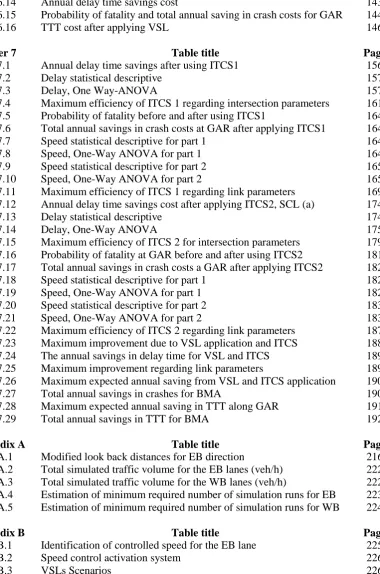
List of Tables
Chapter 2 Table title Page
Table 2.1 Motor vehicle LOS thresholds at signalized intersections 10
Chapter 3 Table title Page
Table 3.1 Intersection names 44
Table 3.2 Number of lanes 44
Table 3.3 ADT for two weeks survey 46
Table 3.4 Speed and flow normalisation values 49
Table 3.5 Video camera locations and manual traffic recording 51
Table 3.6 Signal timing plan of the selected area 64
Table 3.7 Travel time field data for EB 66
Table 3.8 Travel time data for WB 66
Table 3.9 Optimum signal offsets 67
Chapter 4 Table title Page
Table 4.1 Total simulated traffic volume (veh/h) for the EB direction 74
Table 4.2 Total simulated traffic volume (veh/h) for the WB direction 74
Table 4.3 Estimation of minimum required number of simulation runs for EB 75
Table 4.4 Estimation of minimum required number of simulation runs for WB 75
Table 4.5 Calibrating simulated flow versus field observed flow for Beatty EB 77
Table 4.6 Calibrating the simulated flow versus field observed flow for Beatty
NB 77
Table 4.7 Calibrating the simulated flow versus field observed flow for Mains
EB 78
Table 4.8 Statistic validation for VISSIM modelling 81
Table 4.9 Comparison of simulated capacity and field capacity 83
Chapter 6 Table title Page
Table 6.1 Identification of controlled speed for WB 108
Table 6.2 Control speed activation system 108
Table 6.3 VSLs Scenarios 109
Table 6.4 Annual time savings from Scenario 1 113
Table 6.5 Delay statistical descriptive 114
Table 6.6 Delay, One-Way ANOVA 114
Table 6.7 Probability of fatality at GAR before and after utilising VSL 120
Table 6.8 Speed statistical descriptive for part 1 120
Table 6.9 Speed, One-Way ANOVA for part 1 120
Table 6.10 Speed statistical descriptive for part 2 121
Table 6.11 Speed, One-Way ANOVA for part 2 121
xviii
Table 6.13 The max efficiency of all proposed scenarios under each subcategory 141
Table 6.14 Annual delay time savings cost 143
Table 6.15 Probability of fatality and total annual saving in crash costs for GAR 144
Table 6.16 TTT cost after applying VSL 146
Chapter 7 Table title Page
Table 7.1 Annual delay time savings after using ITCS1 156
Table 7.2 Delay statistical descriptive 157
Table 7.3 Delay, One Way-ANOVA 157
Table 7.4 Maximum efficiency of ITCS 1 regarding intersection parameters 161
Table 7.5 Probability of fatality before and after using ITCS1 164
Table 7.6 Total annual savings in crash costs at GAR after applying ITCS1 164
Table 7.7 Speed statistical descriptive for part 1 164
Table 7.8 Speed, One-Way ANOVA for part 1 164
Table 7.9 Speed statistical descriptive for part 2 165
Table 7.10 Speed, One-Way ANOVA for part 2 165
Table 7.11 Maximum efficiency of ITCS 1 regarding link parameters 169
Table 7.12 Annual delay time savings cost after applying ITCS2, SCL (a) 174
Table 7.13 Delay statistical descriptive 174
Table 7.14 Delay, One-Way ANOVA 175
Table 7.15 Maximum efficiency of ITCS 2 for intersection parameters 179
Table 7.16 Probability of fatality at GAR before and after using ITCS2 181
Table 7.17 Total annual savings in crash costs a GAR after applying ITCS2 182
Table 7.18 Speed statistical descriptive for part 1 182
Table 7.19 Speed, One-Way ANOVA for part 1 182
Table 7.20 Speed statistical descriptive for part 2 183
Table 7.21 Speed, One-Way ANOVA for part 2 183
Table 7.22 Maximum efficiency of ITCS 2 regarding link parameters 187
Table 7.23 Maximum improvement due to VSL application and ITCS 188
Table 7.24 The annual savings in delay time for VSL and ITCS 189
Table 7.25 Maximum improvement regarding link parameters 189
Table 7.26 Maximum expected annual saving from VSL and ITCS application 190
Table 7.27 Total annual savings in crashes for BMA 190
Table 7.28 Maximum expected annual saving in TTT along GAR 191
Table 7.29 Total annual savings in TTT for BMA 192
Appendix A Table title Page
Table A.1 Modified look back distances for EB direction 216
Table A.2 Total simulated traffic volume for the EB lanes (veh/h) 222
Table A.3 Total simulated traffic volume for the WB lanes (veh/h) 222
Table A.4 Estimation of minimum required number of simulation runs for EB 223
Table A.5 Estimation of minimum required number of simulation runs for WB 224
Appendix B Table title Page
Table B.1 Identification of controlled speed for the EB lane 225
Table B.2 Speed control activation system 226
[image:20.595.103.484.89.664.2]xix
List of Abbreviations
ABS
Australian Bureau of Statistics
AD
Australian Dollar
AIMSUN
Advanced Interactive Microscopic Simulation for Urban and
Non-urban Networks
ALINEA
Asservissement Lineaire d’Entree Autoroutiere
AMOC
Advanced Motorway Optimal Control
ARE
Absolute Relative Error
ATC
Area Traffic Control
BMA
Brisbane Metropolitan Area
BTRE
Bureau of Transport and Regional Economics
CORSIM
CORridor SIMulation
DTMR
Department of Transport and Main Roads
EMME
Equilibre Multimodal, Multimodal Equilibrium
EP
Evening Period
FMS
Freeway Management Systems
GAR
Griffith Arterial Road
GEH
Geoffrey E. Havers
HCM
Highway capacity manual
HDC
High Definition Cameras
HV
Heavy Vehicle
ITCS
Integrated traffic control system
LOS
Level of Service
METANET
Modèle d’Ecoulement du Trafic Autoroutier: NETwork
MFD
Macroscopic Fundamental Diagram
MOE
Measures of Effectiveness
MP
Morning Period
MPC
Model Predictive Control
MTFC
Mainstream Traffic Flow Control
PARAMICS
PARAllel MICroscopic Simulation
QDTMR
Queensland Department of Transport and Main Roads QDTMR
QLD
Queensland
RLC
Red-Light Camera
RLR
Red-Light Running
SATURN
Simulation and Assignment of Traffic to Urban Road Networks
SCL
Speed Control Limit
STREAMS
Synergised
Transport
Resources
Ensuring
an
Advance
Management System
TDM
Travel Demand Management
TFL
Transport for London
TH, RT, LT
Through, Right turn, Left turn
TRANSYT
TRAffic Network StudY Tool
TRB
Transportation Research Board
TTT
Total Travel Time
TU, WE, THU Tuesday, Wednesday, Thursday
VISSIM
Verkehr In Städten-SIMulationsmodel
VMS
Variable Message Sign
VSL
Variable Speed Limit