dimension of community
research in the fifth European
framework programme
A synthesis report on the integration of
the socio-economic related research activities
of the European Community (1998-2002)
IMPROVING HUMAN RESEARCH POTENTIAL
A synthesis report on the integration of
the socio-economic related research activities
of the European Community (1998-2002)
Directorate-General for Research
The Directorate 'Knowledge-based economy and society'(Directorate K) contributes to the realisation of the European Research Area in the fields of the social sciences, economic, science and technology foresight, and the respective analyses. To this end, it monitors and encourages science and technology foresight activities, conducts the economic analyses necessary for the work of the Directorate-General, and co-ordinates policy as regards the relevant political, economic, human and social sciences. It prepares the European reports on science and technology indicators, and it contributes to the development and implementation of the Framework Programmes in these fields. It monitors the progress made in the implementation of the Lisbon Strategy. It is responsible for encouraging investment in research and technological innovation.To this end, it develops policies and measures to improve framework conditions (e.g. Intellectual Property Rights) for private investment and the effectiveness of public financing instruments.
As part of implementing the Framework Programme, the Directorate also ensures co-ordination of the integration of social, political sciences and humanities in the various thematic and horizontal priorities of the specific programmes. This task is implemented with the support of the internal group of socio-economic correspondents and through the production of periodic reports on the integration of the socio-economic dimension in the Framework Programme.
Director: Jean-François Marchipont Scientific Officer: Gilles Lequeux E-mail: [email protected]
This synthesis report highlights how the socio-economic dimension has been integrated into the specific programmes of the Fifth Framework Programme to take full account of the needs of European society and of the economic and social challenges it faces.
Establishing a common vision on the socio-economic dimen-sion around the strategic goal set by the European Union in Lisbon of becoming "the most competitive and dynamic knowledge-based economy in the world, capable of sustainable economic growth with more and better jobs and greater social cohesion" by 2010, is a constant challenge for scientists, socio-economists and politicians alike.
The Sixth Framework Programme and the broader purpose of creating a European Research Area, mobilising and enhancing the European potential for research in the field of social sci-ences and humanities, will permit the pursuance of this approach which addresses socio-economic issues related to research in the context of the Lisbon Strategy.
Finally, I hope that this report will be a valuable contribution to the scientific and political debate on what is at stake within the European Union's research and technology policies.
Philippe Busquin
European Commissioner for Research
Overall, knowledge stands out as the common reference point and the unifier of the three major areas of activity and invest-ment, which comprise research, education and training, and innovation. It is also the key to industrial competitiveness and employment.
Europe is playing an important role in the process of develop-ing a knowledge-based society which must face major eco-nomic and social challenges.
First of all, the external challenges are the globalisation of the economy which modifies the sphere of international competi-tiveness, and the continual increase in research effort by our main competitors.
The enlargement of Europe towards new Member States and the social objectives linked to improving employment are other internal key challenges for Europe.
With a direct link to research, democratic governance must ensure that social and economic issues are taken into consid-eration in research activities, and that citizens are informed about and are aware of the social aspects with regard to sci-entific and technological progress.
In order to meet the European challenges associated with the transition to a knowledge-based society, the Fifth European RTD Framework Programme was designed in a different way to its predecessors in terms of both content and operation. The intention was to move away from research for its own sake and to turn the research towards current socio-economic problems, that is, research with the potential to accomplish the changes expected by the general public. In this respect, the Fifth Framework Programme was the first to significantly reinforce European support with regard to socio-economic related research activities.
In the Decision of the European Parliament and the Council adopting the Fifth Framework Programme (FP5) of the European Community for research, technological development and demonstration activities (1998-2002), the Human Potentialprogramme has been assigned the task to "...ensure, through appropriate monitoring and co-ordinating mechanisms, the adequate incorporation of socio-economic considerations into the research activities of the thematic programmes"(1).
In addition, the Council Decision which adopted the specific programme for research, technological development and demonstration on "Improving the Human research Potential and the socio-economic knowledge base"(2)(IHP), stipulates
that the Human Potentialprogramme will co-ordinate and support relevant activities throughout the Framework Programme. In relation to socio-economic research, it is stated that "co-ordination will be achieved through participation in the elaboration of the work programmes, support in the cre-ation of appropriate evalucre-ation mechanisms, in particular through the participation of socio-economic scientists, and collection and dissemination of relevant information, in order to ensure that the socio-economic dimension is consistently taken into account in the specific programmes".
The monitoring, co-ordination and support of the socio-economic related research activities in the various specific programmes of FP5 have been carried out by the Directorate K of the Directorate-General for Research by means of the Key Action on "the improvement of the socio-economic knowledge base" in the IHP programme.
This synthesis report covers the whole period of FP5 and fol-lows two annual reports (1999 and 2000) already published. It provides an analysis and overview of the socio-economic aspects integrated in all relevant specific FP5 programmes before proposing some recommendations for future Euro-pean research activities in this area.
The external expertise of Mr Andrea Ricci has con-tributed to the conception and analysis required for the production of this synthesis report. Sincere thanks is also given to all European Commission staff members of the socio-economic Group who have given their support in the realisation of this report.
EXECUTIVE SUMMARY . . . .10
1 OBJECTIVES . . . .13
2 METHODOLOGY . . . .14
3 DEFINING THE BASIC CONCEPTS ASSOCIATED WITH SE ASSESSMENTS . . . .15
3.1 SE IMPACT AND IMPACT TOUT COURT . . . .15
3.2 ASSESSING SE IMPACTS . . . .15
3.3 DIRECT AND INDIRECT SE IMPACTS . . . .15
3.4 SE IMPACT AND SE DIMENSION . . . .16
4 ANALYSING THE SE CONTENTS OF FP5 . . . .17
4.1 SE DIMENSION (INPUTS) . . . .17
4.1.1 Qualitative indicators . . . .17
4.1.2 Quantitative indicators . . . .18
4.2 SE IMPACT (OUTPUTS) . . . .18
4.2.1 Qualitative assessment . . . .18
4.2.2 Quantitative assessment . . . .19
5 DISCUSSING THE SE DIMENSION OF THE MAIN FP5 PROGRAMMES AND KEY ACTIONS . . . .20
5.1 IMPROVING THE HUMAN POTENTIAL AND SOCIO-ECONOMIC KNOWLEDGE BASE (IHP) . . . .21
5.1.1 Overall . . . .21
5.1.2 The KA Improving socio-economic knowledge base . . . .22
5.1.3 Support for the development of scientific and technological policies . . . .24
5.1.4 Supporting training and mobility of researchers . . . .24
5.1.5 High Level Scientific Conferences . . . .25
5.1.6 Raising public awareness in S&T . . . .25
5.2 QUALITY OF LIFE (QOL) . . . .26
5.3 COMPETITIVE AND SUSTAINABLE GROWTH (GROWTH) . . . .29
5.4 INFORMATION SOCIETY TECHNOLOGIES (IST) . . . .34
5.5 ENERGY, ENVIRONMENT AND SUSTAINABLE DEVELOPMENT (EESD) . . . .36
5.5.1 Part A: Environment and sustainable development . . . .37
5.5.2 Part B: Energy . . . .39
5.6 CONFIRMING THE INTERNATIONAL ROLE OF COMMUNITY RESEARCH . . . .41
6 THE (POTENTIAL) SE IMPACT OF THE MAIN FP5 PROGRAMMES AND KEY ACTIONS . . . .43
7 CONCLUSIONS AND RECOMMENDATIONS . . . .52
7.1 SOCIO-ECONOMIC RESEARCH IN FP5 . . . .52
7.1.1 Basic concepts and tools for SE assessment . . . .52
7.1.2 The limits to harmonisation . . . .52
7.1.3 Quantitative vs qualitative performance . . . .53
7.1.4 Evidence provided by the project evaluation process . . . .53
7.2 RECOMMENDATIONS FOR FUTURE RTD FRAMEWORK PROGRAMMES . . . .54
7.2.1 Increasing SE visibility . . . .54
7.2.2 Devising effective tools and procedures for SE contents representation . . . .55
7.2.3 Enhancing the effectiveness and the role of ex-anteimpact evaluation tools and methods . . . .57
8 ANNEXES ANNEX 1: MAIN DOCUMENTARY SOURCES AND REFERENCES . . . .60
ANNEX 2: WEBSITES AND ELECTRONIC SOURCES OF INFORMATION . . . .63
ANNEX 3: THEORETICAL FRAMEWORK FOR SE ASSESSMENT OF RESEARCH . . . .65
ANNEX 4: CLASSIFICATION OF RTD TOPICS BY DISCIPLINE . . . .66
ANNEX 5: SAMPLE OF SE-RELEVANT FP5 PROJECTS . . . .68
titative and qualitative terms) are committed. This leads to the distinction between the SE dimensionof research (the inputs) and its SE impact (the outputs). Both must be appraised, and a tentative set of basic indicators (qualitative and quantitative) is proposed for reference.
Chapter 4 discusses the extent to which the current organisation of RTD monitoring and evaluation (in FP5) allows for documentation of the above indicators.
• The explicit reference to SE topics and disciplines(e.g. in the description of work in individual projects, when available) pro-vides a basic indication of their socio-economic relevance, and an appraisal of the degree of multi-disciplinaritycan supplement the qualitative evaluation of projects' SE dimension. However, even such basic evidence requires that the corresponding information is made available in a systematic, harmonised and consistent way, which is not always the case within FP5. • On quantitative grounds, the SE dimension of projects could
be analysed through the amount of resourcesthat are expli-citly committed to SE-relevant objectives, provided such information is made available at the outset.
• As for SE impacts,no systematic quantitative assessmentcan be credibly carried out in the current state of play, owing pri-marily to the lack of appropriate datasets. It is stressed, how-ever, that within FP5 itself, significant progress has been made in the development of specific methods and tools for impact assessment as a whole. These will undoubtedly prove extremely useful in establishing a dedicated framework for SE impact evaluation of research.
• On the other hand, a qualitative approach to impact assessment can be attempted following the well-known method of the socalled "citation index": searching for research activities that have inspired policy actions (directives, legislation, etc.) then allows it to be ascertained whether the results of research have been effectively transferred outside the scientific community and, more importantly, if they have been concretely recognised as useful in the process of policy formulation.
In Chapter 5, the report reviews the principal FP5 Program-mes and Key Actions (KAs) with a view to highlighting their The creation of the European Research Area (ERA) has
become the central axis of today's European research policy and also represents the main component of the Lisbon Strategy setting the ambitious goal for the Union to become, by 2010,"the most competitive and dynamic knowledge-based economy in the world, capable of sustainable economic growth with more and better jobs and greater social cohesion". Assessing the social and economic (SE) dimension of European research programmes is, however, an extremely challenging exercise, due primarily to the lack of commonly agreed definitions, con-sistent datasets and robust assessment methods.
As explained in Chapter 1, this report summarises the find-ings of a review that was carried out to appraise the socio-economic relevance of the Fifth Framework Programme (FP5) of the European Community for research, technological devel-opment and demonstration activities (1998-2002).
Although a significant sample of individual Research and Technological Development (RTD) projects are featured, the findings presented in this report are based mainly on evidence related to Programmes and Key Actions as laid out in
Chapter 2and in the relevant annexes.
Chapter 3 highlights the main conceptual issues to be addressed when devising an appropriate framework for the assessment of the SE contents of research programmes. • Socio-economic impact should not be considered as just one
among other components of a multi-criteria evaluation frame-work (along with, for example, technical, organisational and other criteria), but rather as thecriterion by which to assess the ultimate success (or failure) of research activities, whereby societal problems drive the identification of research needs. • On the other hand, the SE effects of a given research activity
may not be visible in the short term, and their materialisation may depend on the deployment of further targeted initiatives (dissemination, exploitation, additional research): impact assessment should be carried out within a time frame which can be extended accordingly.
quan-main SE-relevant features and achievements. Given the highly heterogeneous availability of information across Programmes and KAs, no systematic comparison is provided at the disag-gregate level.
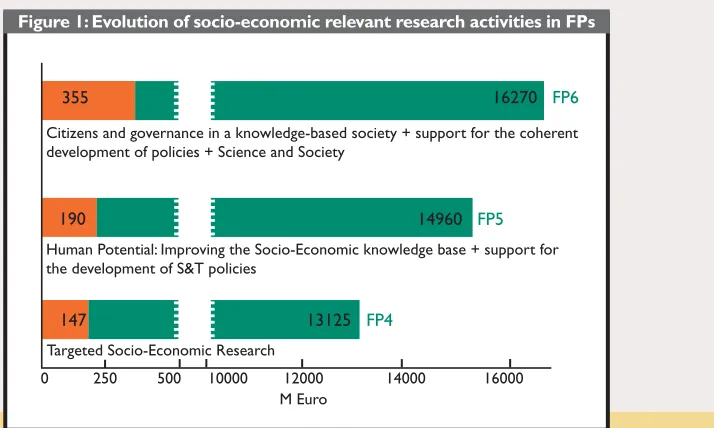
• The IHP Programme (Improving the Human research Potential and the socio-economic knowledge base) is inherently focused on SE-relevant research. In this programme, socio-economic methods, tools and issues are the central object of the Key Action, while in the other parts of the programme they are instrumental, or consequential, to research activities that primarily aim at developing innovation in other areas. With reference to its FP4 predecessor (TSER - Targeted Socio-Economic Research), the funds available for SE-relevant research activities in IHP have increased significantly, resulting in a total budget of about 190 MEuro (see Figure 1 below). Within IHP, both the Improving the socio-economic knowledge base KAand the Support for the development of scientific and technological policiesaction are deemed to devote the entirety of their budgets (165 and 25 MEuro respectively) to SE-rele-vant research. Other IHP budget lines include training activities (through the Marie Curie fellowships and the Research Training Networks), financing the Access to Research Infrastructures, and the organisation of High Level Scientific Conferences.Within those, the share attributed to prevailing SE topics varies considerably from one activity to the other (i.e.
between 2% and 20% approximately), with a total expenditure of approximately 98 MEuro. By comparison, in FP6 priorities addressing, on the one side, the Citizens and governance in a knowledge-based societyand, on the other, the support for the coherent development of policies and the interactions between Science and Society, are inherently focused on SE-rel-evant research. In addition, this effort will be complemented by socio-economic research and innovation carried out within the other thematic and horizontal priorities of the Sixth Framework Programme (FP6).
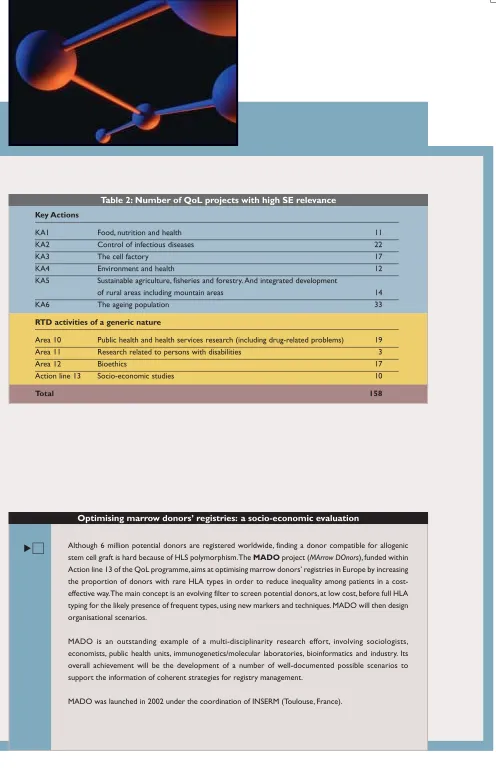
• Throughout FP5, the QoL Programme (Quality of Life) has funded some 160 projects with direct and prevailing SE rele-vance, corresponding to a total budget of ca. 200 MEuro. Socio-economic projects can be found in each of the six Key Actions in QoL, as well as within those activities of a generic nature. Within the latter, a specific action line on socio-economic studies has allowed for the funding of ten projects (ca. 10 MEuro in total).
• Within the GROWTH Programme (Competitive and Sustainable Growth), all Key Actions have a strong and imme-diately recognisable SE-relevance: innovation in company organisation impacts on the quality of the working environ-ment, the health of the workforce, their quality of life and ultimately their welfare; the design of new production
Citizens and governance in a knowledge-based society + support for the coherent development of policies + Science and Society
Human Potential: Improving the Socio-Economic knowledge base + support for the development of S&T policies
Targeted Socio-Economic Research
16270 FP6
14960 FP5
13125 FP4
0 250 500 10000 12000 14000 16000 M Euro
355
190
147
[image:10.595.157.514.576.790.2]Chapter 6presents the results of an extensive search carried out on the EURLEX(3)database in order to identify RTD
pro-jects that have provided direct input to policy formulation (i.e. projects which are quoted explicitly in EU policy documents). Although the findings cannot be considered as exhaustive, this search has allowed some 20 major references to be identified, spread across the Programmes and KAs, ranging from sustain-able development policies to the security of networks, from the fight against communicable diseases to the promotion of 'intermodal' transport options, etc. The references identified are summarised in this chapter, while additional details are pre-sented in the relevant annex.
Finally,Chapter 7outlines the main conclusions and formu-lates recommendations in view of future RTD programmes. As a general remark, and despite difficulties in providing quantita-tive evidence on the role of socio-economic sciences in EU research, it was found that the SE relevance of projects funded within FP5 is generally high.When looking at future prospects, therefore, efforts would appear necessary not so much on increasing the amount of SE-related research, but rather on the enhancement of the SE value that can be drawn from research programmes, and of its visibility.This calls for a multi-fold action, focusing primarily on the development and sys-tematic use of:
• tools and procedures for SE content representation that will allow for the monitoring (in progress) and assessment (ex post) of the actual achievements of research in solving soci-etal problems. Proposals for a basic set of assessment indica-tors are set out.
• advanced impact assessment methods, to guide policy- and decision-makers in the priority and target setting process, and to establish the necessary yardsticks for ex-post assess-ment exercises.
(3)http://europa.eu.int/eur-lex/fr/index.html
processes, along with the development and use of new materials, inducing a reduction in pollutant emissions and a more rational use of natural resources, while product innovation (safer consumer products, cleaner vehicles, etc.) directly tar-gets people's needs and improvements in their quality of life, also by promoting changes in consumption patterns. However, direct quantitative analysis is impossible because of the overall lack of specific SE-related data.
• Within the IST Programme (Information Society Technolo-gies), an important innovative effort has been deployed in FP5 to integrate socio-economic research with technological RTD. A number of major thematic areas have emerged where explicit socio-economic research is carried out, namely: i) Industrial organisation, ii) Legal and regulatory aspects, iii) Work and employment issues, iv) Regional aspects, v) Corporate social responsibility, and vi) Statistical indicators. Altogether, the IST Programme has funded about 60 individual projects (throughout FP5) with a clearly preva-lent SE dimension.Two Cross-Programme Action lines (CPA) have played a significant role therein, focusing respectively on cross-cutting IST issues, and on statistical methods, tools and indicators for the Information Society.
Assessing the socio-economic dimension of research pro-grammes is an extremely complex exercise. Evaluating their socio-economic impact possibly represents an even higher challenge, calling for an assessment of the nature and charac-teristics of the interaction between society and RTD activities, as illustrated schematically in Figure 2 below.
Addressing societal needs requires an appropriate set of policies. Consequently, policy-makers must be able to translate their perception of societal needsinto specifications for the RTD community (the policy needs). The RTD responsethen allows policy-makers to formulate the most appropriate feed-back (the policy response). Moreover, the continuing progress of scientific and technological knowledge allows the research community to shape its own policy vision, serving as further input to policy formulation. In such a process, policy-makers play the role of mediators between society and the RTD com-munity. But what is the nature (if any) of the direct interaction between them? And is it possible to assess the value of the impacts of RTD on society?
This report is an attempt to provide a series of assessment and evaluation inputs, notably through:
• the review of FP5 and its main SE-related features • the tentative design of a framework for the evaluation and
monitoring of the SE content of future RTD activities It deals, at varying depths, with the following main issues:
a) Defining the basic concepts ("SE dimension", "SE impact"); b) Interpreting these concepts in the context of EU
research activities;
c) Discussing the qualitative and quantitative FP5-related evidence available from various sources;
d) Discussing the SE contents and implications of the various FP5 research programmes;
e) Providing examples of FP5 projects with high SE content; and
f) Sketching the general framework for future monitoring and evaluation of the SE implications of EU research.
Policy response
Societal needs
POLICY
SOCIETY
RTD
?
RTD r
esponse
[image:12.595.44.362.581.774.2]Policy needs
Policy vision
More specifically, the following main tasks were carried out: • acquisition and analysis of readily available documentation on
FP5 and on previous SER-related assessments (both qualita-tive and quantitaqualita-tive)(4);
• interviews with RTD officers in the most relevant Units and Key Actions;
• extensive web searches to supplement and update the avail-able information(5); and
• a considerable amount of time was devoted to drawing an extensive list of FP5 activities for which explicit quotations can be found in official EU policy communications.
(4)See Annex 1 (5)See Annex 2
There have been many attempts to provide a non-ambiguous definition of SER, and the debate is still open.
Literally, SER could be defined as every research activity that has the potential to induce changes in societal values, in the organisa-tion and welfare of society, e.g. through changes in the overall avail-ability of economic resources, in their allocation and in their use.
This, however, raises a number of issues of interpretation.
3.1 SE impact and impact
tout court
The explicit objective of research – in general – is to identify new ways and means (technologies, methods, tools, etc.) that will induce an increase in the performance of systems (pro-duction systems, consumption systems, etc.).To assess the full range of impacts of a given research activity, one can therefore refer to such concepts as, for example, the degree of tech-nical/technological innovation, the efficiency in the use of resources (natural, human, financial), the contribution of research to the acceleration of desired changes, etc. However, all such impact assessment criteria are ultimately instrumental in achieving an improvement in the quality of life within a sus-tainable framework (whereby immediate improvements must not be achieved at the expense of long-term performances). When turning to the so-called SE impact, therefore, it appears that this is not just one among other components of a multi-criteria evaluation framework (along with, for example, tech-nical, organisational, and other criteria), but should rather be considered as thecriterion to assess the ultimate success (or failure) of research activities: technological innovation is only useful if it contributes to solving societal problems, and if it does so under acceptable economic conditions; changes in the organisation of production systems are only viable if they are compatible with the needs and objectives of individuals and of society as a whole; etc.
In one way, the evaluation procedures adopted in FP5 recog-nise the prominent role of SE criteria, as they generally assign a prevailing weight – within the overall evaluation score – to SE parameters. Also, the use of thresholds helps to ensure that projects with an insufficient SE potential are not retained,
irrespective of their technical value. However, these proced-ures do not explicitly reflect the logical hierarchy between technical performance and SE performance, whereby the former is instrumental to the latter.
3.2 Assessing SE impacts
The issue of SE impact assessment is intrinsically problematic and extends well beyond the evaluation of research activities. Policy decisions, investment programmes, legislation, and all other actions that interfere with the behaviour and perfor-mance of systems must also be assessed in terms of their SE implications. The methodological challenge of defining an SE-evaluation framework is, in fact, a general one which, to date, has not been resolved in a consensual, unambiguous way. Neoclassical economists are quick to claim that changes in welfare provide a comprehensive and efficient measure of socio-economic effects. However, it must be recognised that both the economic theory as such and, even more importantly, the operational tools currently available for its translation into practice (models, indicators), often fail to capture the full set of constraints and implications encountered in real life.Within FP5, targeted initiatives have been undertaken (e.g. in the EESD Programme, or in the KA Sustainable Mobility and Inter-modality) to advance the methodological state of the art in the area of impact assessment in general (e.g. welfare changes assessment with General Equilibrium Models, externality analysis). The SE evaluation of future research programmes appears to be a natural candidate for the immediate applica-tion of the corresponding findings.
3.3 Direct and indirect SE impacts
variables, data collection, elaboration of impact indicators and/or calculation of secondary variables, etc.). In the context of the present exercise, two concepts are often evoked: SE
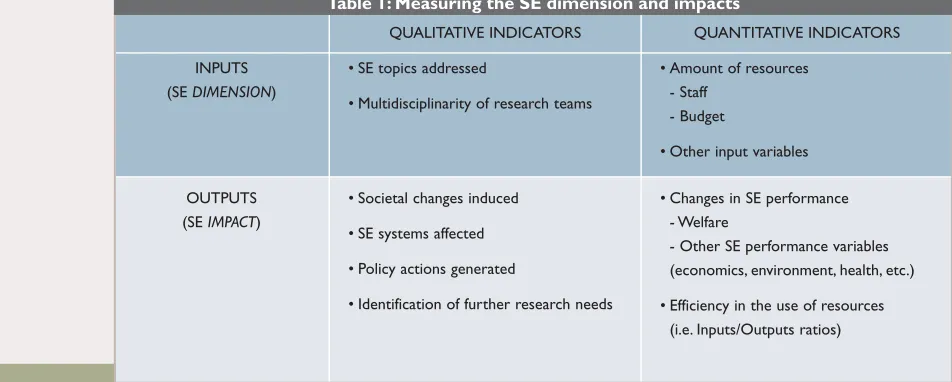
impact on the one hand, and SEdimension on the other. Borrowing from the typical System Analysis representation, we shall consider that the latter (SE dimension) can be associated to the measurement of the inputs into the RTD process, while the former (SE impact) corresponds to its output.
Inputs as well as outputs should be analysed in both quantita-tive and qualitaquantita-tive terms.
Table 1 below provides a rough classification of quantitative and qualitative terms.
The greater difficulties in documenting the above indicators are associated to the quantitative measurement of outputs (the bottom right cell) for which, as outlined above, conceptual and methodological problems are still partially unresolved. As for the other cells, the main obstacle lies in the availability and consistency of the information and data required to document the various indicators.
Later in this report is a section discussing the extent to which the current organisation of RTD monitoring and evaluation (in FP5) either allows – or may allow – for the provision of the necessary inputs.
obstacles, a further difficulty arises here, geared to the time frame of RTD impacts and the process of innovation diffusion. In case the expected SE effects (e.g. an increase in welfare, or an improvement in air quality) cannot be observed once the research has completed its planned cycle, this might be inter-preted in a variety of ways:
a) the research has failed, and the expected SE impacts will never appear;
b) the research has been successful, but it is too early for the expected SE impacts to appear; and
c) the research outcome is technically successful, but no SE impacts will be achieved unless additional actions are taken (e.g. further research, and/or complementary actions such as dissemination, policy formulation, etc.).
This shows that an effective SE impact assessment framework must account for direct (i.e. immediate and explicit) effects as well as for indirect ones (i.e. differed and/or conditional).
3.4 SE impact and SE dimension
Impact assessment methodologies have been designed in a variety of contexts, usually leading to the specification of eval-uation processes that are presented as a series of steps, each corresponding to an action to be taken in view of the actual measurement of impacts (e.g. specification of the impact
INPUTS (SE DIMENSION)
OUTPUTS (SE IMPACT)
QUALITATIVE INDICATORS • SE topics addressed
• Multidisciplinarity of research teams
• Societal changes induced • SE systems affected • Policy actions generated
• Identification of further research needs
QUANTITATIVE INDICATORS • Amount of resources
- Staff - Budget
• Other input variables • Changes in SE performance
- Welfare
- Other SE performance variables (economics, environment, health, etc.) • Efficiency in the use of resources
[image:15.595.77.553.600.791.2](i.e. Inputs/Outputs ratios)
This section briefly discusses the extent to which the current organisation of RTD monitoring and evaluation (in FP5) allows for the documentation of the above-mentioned assessment items. In fact, the picture varies considerably across Programmes and Key Actions, and a more detailed account of specific situations is provided in Chapter 5 below.
4.1 SE Dimension (inputs)
4.1.1 Qualitative indicators
• Topics addressed
Identifying the SE topics addressed by a project is not always straightforward.While certain programmes have developed a disciplinary classification scheme, which is then systematically used for both evaluation and monitoring purposes, such a classification is not used in most Key Actions, or at least not used explicitly, and by all means no formal record is kept of how projects relate to SE disciplines. In those cases where a classification is used, it provides a consistent – although rough – account of which and how many projects deal explicitly with SE themes. Moreover, thanks to the "hierarchical multiple entry" approach to project classification, whereby each pro-ject may be related to one or more (up to four) different disciplines, it is then possible to elaborate more detailed assessments, such as, for example, how many projects relate exclusively, or primarily, to SE disciplines; how many projects with a primary technological focus also include explicit (although secondary) SE concerns; which SE disciplines are more often addressed; and so on.
On the other hand, in the (majority of) cases where no such indications are readily available, it becomes difficult to provide a meaningful account of the SE intensity of projects, based on some disciplinary classification. A number of fall-back options can be considered, such as, for example, searching for SE-related keywords in the project title, or in its abstract, etc. Such a purely mechanistic approach is, however, both highly de-manding (in terms of sheer time needed to carry it out) and of limited value: while many projects include explicit references to SE relevance in their statement of objectives, it must be recognised that this often amounts to little more than a
declar-ation of intent, which does not then automatically generate a concrete SE-related added value.
It should also be noted that much depends on how the pro-gramme objectives and the calls for proposals are formulated at the outset. A clear distinction must be made in this respect between, on the one hand, programmes that follow a top-down approach in the establishment of objectives and tenders, whereby the specification of RTD needs is directly and expli-citly driven by policy objectives and strategies and, on the other, programmes that are prepared using a bottom-up approach, where the starting point is the identification of gaps in scien-tific knowledge, which can be then more or less loosely or implicitly related to specific societal issues. As to the former (top-down), one could boldly assume that, from the SE view-point, all projects are directly relevant as they are only funded if they commit in a credible way to addressing specific policy goals. This is probably a rough approximation of reality, but in the absence of better and more specific evidence it can provide a basic assessment input. As for the latter (bottom-up), policy inputs are often explicit at programme level, but a certain amount of individual project review would seem unavoidable to provide a credible account of how – and to what extent – actual projects really address SE issues (for example through the iden-tification of SE-relevant deliverables, work packages, etc.).
• Multi-disciplinarity
one hand, and Accompanying Measures (AM) and Thematic Networks (TN) on the other. This distinction is particularly relevant within the context of SE assessments although, in specific cases, AM and at times TN are de factoresearch projects in their own right, the genuine role of these two typologies being to promote the uptake, diffusion, enhance-ment, etc. of the results achieved by innovative research carried out previously, or in parallel or, possibly, to help iden-tify further research needs and priorities. Among the explicit objectives of TN, for instance, there is one on bridging the gap between the research community and policy-makers. Other typical goals are to build Europe-wide consensus on the interpretation and subsequent adoption of new tech-nologies, methods, etc. Therefore, irrespective of the dis-ciplinary focus of AM and TN, it is often assumed that their main, and possibly their exclusive justification is to ensure that research actually generates the expected (desired) socio-economic effects.
To some extent, a similar argument could be used when discussing RTD projects funded within certain specific pro-grammes, for example the INCO (International Co-operation) initiative: as will be discussed further in Section 5.1.7, the main objective of such programmes is to create a multiplier effect whereby the outreach potential of RTD is enhanced through specific actions aiming at dissemination, validation, adaptation and upgrading of the results produced by previous or ongoing RTD projects. If one assumes that transferring scientific know-ledge into practice is a precondition for achieving a series of targeted societal changes, then this kind of programme should be seen as making a major contribution to increasing the SE dimension of EU RTD spending.
4.2 SE impact (outputs)
4.2.1 Qualitative assessment
• Societal changes induced
Borrowing from the traditional distinction between effective-nessand efficiency, the capability of research to induce societal changes is the most obvious measure of its effectiveness. Here again, however, assessing the actual performance of (a standard set of disciplinary codes is used to this effect
across FP5); also, the propensity of a given project to achieve concrete results in SE terms can be assessed through its organisational structure, by means of the establishment of user groups, policy advisory groups, the staging of seminars, workshops and conferences involving participants from out-side the scientific community, and similar organisational fea-tures, and so on.
4.1.2 Quantitative indicators
• Amount of resources
An obvious quantitative indication of the importance assigned to SE issues is the amount of the research budget (in both absolute and relative terms) devoted to the corresponding projects. However, conferring its true meaningfulness to this variable is only possible if the previous discussion on qualita-tive assessment leads to conclusive evidence: only when the relevant activities (i.e. those with high SE intensity) have been identified, can their quantitative weight be evaluated (whether in terms of financial budget, of person.months or of other similar variables). The reliability and consistency (across pro-grammes) of such an evaluation is therefore directly geared to the availability of the necessary qualitative evidence.
• Other input variables
As for qualitative information, additional evidence can be sought in the specific project material, through the detailed analysis of resource allocation. Certain programmes require that each project deliverable is quantified at the outset in terms of the comparative share of the project budget absorbed for its production. In the current organisational framework for the monitoring and evaluation of FP5 activities, these and other variables cannot be extracted immediately and their assessment therefore requires a considerable amount of time.
• Project typology
specific projects is much easier as and when its SE goals have been identified at the outset. Measuring their effectiveness then amounts to comparing the statement of objectives with the results achieved. As previously mentioned, it is seldom possible to proceed in such a straightforward manner because of the lack of immediately available relevant informa-tion from the projects.
A fall-back option can be envisaged and is proposed here, along the lines of the well-known method of the so-called "citation index". Searching for research activities that have inspired policy actions then means it can be ascertained whether the results of research have been effectively trans-ferred outside the scientific community and, more importantly, if they have been concretely recognised as useful in the process of policy formulation. The rationale behind this approach is to assume that:
(i) policy actions are basically prompted by the need to address societal needs and, as such, are expected to pro-duce direct SE changes;
(ii) only those projects that have been successful are likely to provide direct input to policy-making; and
(iii) an explicit quotation of RTD results in a policy document can therefore be taken as a concrete indication that the corresponding research has – at the very least – a signifi-cant SE impact potential.
• Identification of further research needs
FP5 has marked a significant change compared to previous FPs by strongly advocating a major switch from research driven by knowledge-increase objectives to research driven by problem-solving objectives.To a large extent, the visibility of the SE value of research activities in FP5 depends on the degree to which the various programmes and Key Actions have adapted to the problem-driven philosophy.The distinction between top-down and bottom-up approaches (see above) is directly relevant here, as it can be assumed that the former have adopted the new principles more readily.
In terms of output evidence, however, measuring project per-formance in identifying future research needs would, once again, require a major effort in individual project review.
4.2.2 Quantitative assessment
This is by far the most ambitious component of the proposed assessment scheme, and it must be acknowledged that the difficulties in proceeding are such and so numerous that it is extremely difficult, at this time, to provide usable evidence. For historical reasons, quantitative assessments have mainly been developed in the framework of the energy and environment research programmes (EESD), the need for a scenario on energy consumption or on emissions of pollutants being par-ticularly important for policy definition in these areas; macro-economic and sectoral impacts, cost-effectiveness analysis or cost-benefit analysis of policies and measures, and monetary valuation of damages are areas for which tools have been developed and are currently being used. Nevertheless, the recourse to such impact assessment methods and tools is far from generalised across FP5 programmes and Key Actions, and much remains to be done in this perspective.
The main reasons behind this statement of facts are both con-ceptual (complexity of the matter, orientation of the SE research towards more social and qualitative aspects, difficulty in measuring research and innovation impacts), and technical (tools and data availability). However, it must be stressed that significant efforts have been made within FP5 to develop specific methods and tools for impact assessment in general. As requested by the Göteborg Council, impact assessment activities carried out in recent months within EESD have allowed the basis for a generalised assessment platform to be set down, particularly in the area of sustainable development and climate change.
Overall, the ideal assessment framework that was devised at the outset(6), while retaining its theoretical validity, cannot be
appropriately documented at this time. Later in this report is a section outlining basic proposals to improve the impact assessment prospects in future FPs.
programmes of the various KAs can be traced back directly to the identification of societal needs. In fact, adopting the prob-lem-solving prescription immediately leads to recognising that the scope of socio-economic research extends beyond the traditional SE disciplines (sociology, economics, political sci-ences), as it must also drive innovation in policy practice. In turn, this can only be achieved through multi-disciplinary efforts embracing both technological (hard) and socio-economic (soft) research, and seeking the active involvement of practitioners and stakeholders in RTD projects.
However, as referred to repeatedly in previous sections, the overall approaches to SER development and evaluation, and the corresponding availability of information are highly heteroge-neous from one programme to another. This applies to all assessment components (i.e. both qualitative and quantitative, inputs and outputs).As a result, it is highly dangerous to venture into a comparative assessment.The bulk of the review illustrated in the sections below therefore follows a case-by-case logic. Drawing on the above, Figure 3 below provides a schematic
representation of the main components of an ideal assessment framework, and of how FP5 appears to fit into such a picture. Socio-economic research plays a dual role therein: on the one hand, it increases and improves the body of knowledge in SE sciences (sociology, economy, political sciences, law, etc.), thereby directly contributing to solving societal problems through a better understanding of SE phenomena and the identification of tools and methods to address them. On the other hand, it helps in translating societal needs into RTD requirements, therefore feeding directly into the identification of research priorities. In turn, scientific and technological research (sometimes referred to as hard research) has the responsibility of producing the innovation required to gen-erate the most effective technical response to societal needs. At the outset, it is important to note that FP5, through its various Key Actions, is explicitly addressing all the components of this assessment framework. Moreover, based on the "pro-blem solving prescription" inaugurated with FP5, the work
Scientific &
Technological
research
S&T quality
SE quality
SE impact of
technological
innovation
Identification of
RTD priorities
Socio-economic
research
Technological
innovation
Solving societal
problems
FP5
[image:19.595.70.554.524.772.2]Key Actions
5.1 Improving the Human Research
Potential and the socio-economic
knowledge base (IHP)
5.1.1 Overall
The IHP programme is implemented through a variety of actions which can be structured in three main categories: • Improving socio-economic knowledge and support to the
development of S&T policies;
• Training and mobility of researchers, promotion of scientific excellence, and raising public awareness of S&T; and • Access to research infrastructures.
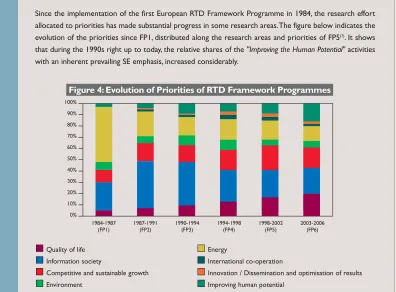
As regards the first main line of actions, whilst for most other programmes and Key Actions (KA) the challenge is to identify research that induces SE changes, the KA Improving socio-economic knowledge base (KA/SE) is about SE research. The difference is conceptually straightforward: socio-economic methods, tools and issues are the central object of IHP-KA/SE, while in the other programmes they are instrumental, or con-sequential, to research activities that aim primarily at developing innovation in other areas (mainly scientific and technological). Since the implementation of the first European RTD Framework Programme in 1984, the research effort allocated to priorities has made substantial progress in some research areas.The figure below indicates the evolution of the priorities since FP1, distributed along the research areas and priorities of FP5(7). It shows
that during the 1990s right up to today, the relative shares of the "Improving the Human Potential"activities with an inherent prevailing SE emphasis, increased considerably.
Quality of life Information society
Competitive and sustainable growth Environment
Energy
International co-operation
Innovation / Dissemination and optimisation of results Improving human potential
(7)Note: In preparing this graph, as many elements of the FP6 budget as possible have been broken down and regrouped along
the main lines of FP5. It has not been possible to perform this exercise for certain activities of a horizontal nature, therefore the equivalent budget elements have not been taken into account.
100%
80% 90%
70% 60% 50% 40% 30%
1984-1987 (FP1)
1987-1991 (FP2)
1990-1994 (FP3)
1994-1998 (FP4)
1998-2002 (FP5)
2003-2006 (FP6) 20%
10% 0%
Evolution of priorities of RTD Framework Programmes
[image:20.595.67.463.249.541.2]consider that 100% of the research carried out is devoted to the advancement of SE sciences.The focus is primarily on social sci-ences, with a lesser emphasis on quantitative analyses.The main key thematic areas forming the basis of research supported by the IHP-KA/SE are very explicit in this respect, and refer to: 1. Societal trends and structural changes
2.Technology, society and employment 3. Governance and citizenship
4. New develop models fostering growth and employment In the last call for proposals for the Key Action, preparing the research community to function effectively within the ERA was a key concern in facilitating the transition to FP6, in par-ticular to help the researchers to prepare the ERA. In this respect, proposals were requested to:
• increase the impact of existing Community and national research activities on the development of the European Research Area;
Therefore, the main outcome from IHP-KA/SE research should be an advancement in SE sciences, in the form of increased and improved availability of concepts, structures and, in general, knowledge, in disciplinary areas such as sociology, political sciences, economics, etc.
When analysing the SE dimensionof IHP-KA/SE (the inputs), it makes sense therefore to assume that all research funded under this programme has a prevailing, or even exclusive SE content.This obviously does not amount to concluding that all research in IHP-KA/SE has measurable SE impacts. Ultimately that will depend on the quality of research, and therefore on its capability to produce innovative added value.
5.1.2 The KA Improving the socio-economic knowledge base
This KA has awarded research contracts for 165 MEuro throughout FP5, which represents approximately 13% of the IHP programme's total budget. For this KA, it is indeed fair to
Fighting social exclusion with Geographical Information Systems and the Digital City
The development and use of digital information and related handling technologies are key themes in FP5, and a major feature of all policies related to the development of the Information Society, such as, for example, the e-Europe initiative launched by EU heads of state at the Lisbon Summit in 2000.
The GIS Data project, funded by the IHP programme, organises two High Level Scientific Conferences on the development of these technologies in European cities. Urban areas are recognised both as the loci for EU innovation and development and as milieux in which pockets of high technology, innovation and wealth sit side by side with those of social exclusion and deprivation. The use of spatial information and communication technologies to support public participation, as well as understanding social processes and targeting policy, are key areas of research that transcend national boundaries and require an all-European approach to minimise social divides and maximise regional cohesion.
In this context, GIS Data organises two major conferences.The theme of the first is the Digital City, focusing on the use of advanced representation technologies to enhance the quality of urban management and promote greater public participation. The second conference concentrates on the use of geographic information systems for health and the environment. It focuses on the opportunities created by GIS to link health events to the social and physical environment in which they take place, thus increasing the effectiveness of both needs assessment and service-provision targeting.
GIS Data was initiated in 2001 under the coordination of EURESCO, the European Science Foundation. It has allowed the involvement of some 140 participants from a variety of disciplinary fields.
▲
• increase the efficiency of the social sciences and humanities in the European Research Area; and
• structure the social sciences and humanities in the European Research Area.
Many of the projects funded in 2002 constitute an important step towards the ERA, and some are particularly outstanding in this respect.
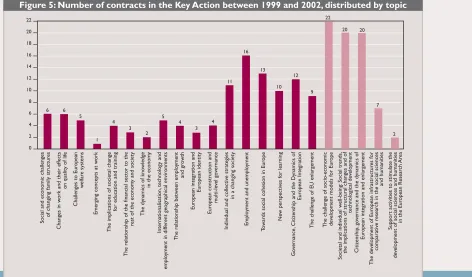
The total number of funded projects (research projects, the-matic networks and accompanying measures) from the Key Action is 286, which corresponds to almost 20% of the total number of projects within IHP, and implies that the average size of projects in the KA (ca. 0.55 MEuro) is more than double the size of the average IHP project (slightly less than 0.2 MEuro). This is easy to explain in view of the peculiar nature of the other IHP activities (see Figure 5). Overall, however, as will be seen in later sections, this average size of less than half a million Euro is well below the size of the average FP5 project as a
whole, mainly because SE research is largely of the soft type, whereas research in other programmes and KAs entails a sig-nificant amount of expenses (and investments) in hard sci-ences, where the purchase and/or development of a variety of equipment, tools and technology-related services that are highly capital-intensive often weigh heavily in the overall pro-ject budgets. In fact, it could be deduced from this observation that an additional criterion to help identifying SER could be the capital intensity of projects and activities.
Furthermore, today in the field of social sciences and human-ities, the research is largely carried out at the national level, often by individual researchers.Thus, the scientific Community in social sciences and humanities has limited experience in entering into partnerships within large consortia and, conse-quently, in the perspective of FP6, the challenge for social sci-ences and humanities to use the 'new instruments' (Integrated Projects and Networks of Excellence) for SER will, in principle, be greater than for other sciences.
Social and economic challenges
of changing famil
y structur
es
Changes in w
ork and their eff
ects
on quality of lif
e
Challenges to Eur
opean
w
elfar
e systems
Emerging concepts at w
ork
The implications of societal change
for education and training
The r
elationship of the financial sector to the
rest of the econom
y and society
The dynamics of kno
wledge
in the econom
y
Internationalisation,
technolog
y and
emplo
yment in diff
er ent geogra phical en vir onments The r elationship betw een emplo yment and gr o wth Eur
opean integration and
Eur
opean identity
Eur
opean construction and mu
lti-le
vel g
o
vernance
Individual and collectiv
e strategies
in a changing society
Emplo
yment and unemplo
yment
To
war
ds social cohesion in Eur
ope Ne w perspectiv es f or learning Go vernance
,Citizenship and the Dynamics of
Eur
opean Integration
The challenge of socio-economic development models f
o
r Eur
ope
Societal and individual w
ell-being:
Social tr
ends,
the implications of structural changes and of
technological de
velopment
Citizenship
,g
o
vernance and the dynamics of
Eur
opean integration and enlargement
The de
velopment of Eur
opean infrastructur es f o r comparativ e r esear
ch in the social sciences
and humanities
The challenge of EU enlargement Suppor
t activities to stim
ulate the
de
velopment of social sciences and humanities
in the Eur
[image:22.595.39.511.511.788.2]opean Resear ch Ar ea 18 14 16 12 10 8 6 6 5 1 4 3 2 5 4 3 4 11 16 13 10 12 9 6 4 2 0 22 20 22 20 20 7 2
sciences, the balance between economics, on the one hand, and other social sciences, on the other, is approximately the same, while within the latter the majority of grants have been awarded to political sciences and psychology.
5.1.4.2 Research Training Networks (RTN)
This action is directed towards supporting the training of young researchers within the frame of a high-level research and training project carried out by an international research consortium. The current average level of funding is 1.5 MEuro, the bulk of which (60%) must be spent on the appointment of young researchers. Similar to the Marie Curie fellowships, the share of SE-related funding is ca. 9% of this action's total budget. With 30 SE-related RTN projects being funded throughout FP5, and a corresponding budget of about 41 MEuro, more than 7 500 person.months of training will be offered to young researchers in this area. As much as 60% corresponds to economics and management science, followed by law, sociology and psychology. It should be noted that, as for all other IHP actions, no pre-set share of the budget is earmarked by disciplines.
5.1.3 Support for the development of scientific and technological policies
Two main initiatives (STRATA “Strategic Analysis for specific political issues” and CBSTII “Common Basis of Science, Technology and Innovation Indicators”) have received a total of 25 MEuro from FP5. As for the KA Improving the socio-economic knowledge, it seems fair to consider that 100% of this amount is directly relevant to SE topics.
5.1.4 Supporting training and mobility of researchers
5.1.4.1 Marie Curie fellowships
This action (and those that follow) is one of the few for which a comprehensive project-encoding system, based on a discip-linary classification, has been devised and is consistently applied(8). Altogether within FP5, fellowships amounting to a
total of 858 MEuro (ca. two-thirds of the entire IHP budget) have been awarded by this action. However, based on the above-mentioned disciplinary classification, it appears that only some 10% of this amount relates directly to SE sciences, while the vast majority of fellowships have been awarded within the so-called hard sciences. In the ca. 300 fellowships relating to SE
Promoting regional development best practices through the exchange of experiences
Experience in regional development and consequent successful best practices in one community can be ‘transferred’ to another community in order to enhance knowledge and improve the skills of its policy-makers and the other stakeholders or players who deal with regional development as a whole.
The aim of the thematic network FOREN(Foresight for Regional Development Network) – funded under IHP’s STRATA – is to gather together two communities of policy research, one on foresight activities and the other on regional development. The network aims to create a forum where participants can interchange experiences of "best-practice approaches" in the two fields, and bridge the existing gap between their respective communities.The final aim is to identify "good practices" which could be used to guide and inform specific Foresight activities at regional level in different parts of Europe. The project is intended to generate knowledge, and to lay foundations for concrete pilot projects, between policy researchers, policy-makers and other players.
The project website http://foren.jrc.es features a practical guide to regional foresight, as well as other useful documents on the successful implementation of “networked regions through foresight”.
(8)See Annex 4
▲
5.1.5 High Level Scientific Conferences
This action has a total budget of 35.5 MEuro within FP5. Given the nature of the projects, the average amount of funding awarded to successful proposals is below 60 000 euro.When it comes to SE representation, the rate is higher than in the previously described actions, and reaches ca. 20% of the total (projects with a prevailing emphasis on SE sciences). This corresponds to 118 funded conferences, of which 39 (ca. one-third) focus exclusively on SE sciences, while the other 79 also address non-SE disciplines. Within SE-related conferences, the top-ranked discipline (budget-wise) is law, receiving almost 20% of the total funding, followed by political sciences (ca. 13%).
5.1.6 Raising public awareness in S&T
Stimulating knowledge and interest in science
The will to enhance knowledge is both a challenge and an exciting element of the world of science to young people around Europe. Science and technology, stimulating interest in scientific research, simple or complex, is the core target of a six-day event held in November 2002 – funded as an accompanying measure under the IHP Raising public awareness of sciences and technologies.
This event, known as European Science and Technology Week, aims at rekindling scientific education, providing a beacon for the future of science and technology in Europe and beyond. Through thought-provoking activities and a pan-European approach, the European Science and Technology Week's mission is to create a totally new perspective on science. The emphasis is on showingEuropeans how science and technology affects them, from the simplest gadgets to the most sophisticated satellite technology and how it can be used to improve our lives, lifestyles, and our living world.
The graph above summarises the SE dimension of the IHP Programme. It shows the contribution of each main line of actions out of the overall SE-related budget of the IHP pro-gramme (ca. 288 MEuro) by taking into consideration SER-related activities and the classification in relevant disciplinary areas such as sociology, political sciences, economics, etc.
5.2 Quality of Life (QoL)
The very title of the QoL programme is a clear indication of the direct SE relevance of research undertaken therein. In fact, in the rough definition proposed above in Section 4,improving the quality of lifeappears as the ultimate common goal of all SE research. It does not come as a surprise, therefore, that SE-relevant projects are found in all programme Key Actions, whether they concern food, nutrition and health, the control of infectious diseases, cellular biology, the relationship between environment and health, the future of agriculture, fisheries and forestry, or the impact of an ageing population.
On the other hand, within the Generic Activities the QoL pro-gramme includes a specific section (Action line 13) dealing exclusively with SE issues. The three main headings within Action line 13 are very explicit in this regard, as they refer to: • 13.1 Development of indicators and knowledge bases rele-vant to public policy-making (RTD strategies/techno-logy forecasting/perceptions of new technologies)
5.1.7 Enhancing access to research infrastructure
Funds to enhance the access to research infrastructure (RIS) are available in most FP5 programmes. IHP has committed ca. 180 MEuro, representing more than 30% of the total FP5 spending in this field.Three main strands of activities are con-sidered, namely:
a) transnational access to major RIS, which aims at opening-up national facilities to transnational users and alone covers almost two-thirds of the total expenditure in this action (in terms of both budget and the number of funded proposals); b) RIS RTD projects, to develop new technologies for the enhancement of existing RIS (RIS construction and oper-ation are not eligible and must be funded by noper-ational autho-rities), representing some 25% of the total expenditure; and c) infrastructure co-operation networks, whose purpose is to bring together infrastructure operators and users, has been awarded ca. 8% of the overall budget.
Discipline-wise, a user survey has shown that SE sciences have very little prominence in the overall picture, with as few as 2% of those interviewed users actually involved in SER, whilst the lion's share goes to physics (almost 50%) and other hard sci-ences.Again, the same remark as made above on the low cap-ital intensity of SE research provides a sensible although gross explanation of this imbalance.
High Level Scientific Conferences 2%
Support for the development of scientific and
technology policies 9%
Improving the socio-economic knowledge base 57%
Supporting training and mobility of researchers (Marie Curie) 30%
Enhancing access to research infrastructure 1%
Research Training Networks 1%
% of funded SER out of the overall SER budget of the IHP Programme and according to classification
[image:25.595.73.548.192.420.2]of RTD topics by discipline
Optimising marrow donors’ registries: a socio-economic evaluation
Although 6 million potential donors are registered worldwide, finding a donor compatible for allogenic stem cell graft is hard because of HLS polymorphism.The MADOproject (MArrow DOnors), funded within Action line 13 of the QoL programme, aims at optimising marrow donors’ registries in Europe by increasing the proportion of donors with rare HLA types in order to reduce inequality among patients in a cost-effective way.The main concept is an evolving filter to screen potential donors, at low cost, before full HLA typing for the likely presence of frequent types, using new markers and techniques. MADO will then design organisational scenarios.
MADO is an outstanding example of a multi-disciplinarity research effort, involving sociologists, economists, public health units, immunogenetics/molecular laboratories, bioinformatics and industry. Its overall achievement will be the development of a number of well-documented possible scenarios to support the information of coherent strategies for registry management.
MADO was launched in 2002 under the coordination of INSERM (Toulouse, France).
Key Actions
KA1 Food, nutrition and health 11 KA2 Control of infectious diseases 22 KA3 The cell factory 17 KA4 Environment and health 12 KA5 Sustainable agriculture, fisheries and forestry. And integrated development
of rural areas including mountain areas 14 KA6 The ageing population 33
RTD activities of a generic nature
Area 10 Public health and health services research (including drug-related problems) 19 Area 11 Research related to persons with disabilities 3
Area 12 Bioethics 17
Action line 13 Socio-economic studies 10
[image:26.595.34.530.41.822.2]Total 158
Table 2: Number of QoL projects with high SE relevance
terms of the overall number of proposals and, equally import-antly, in relation to the quality of the proposals received (whereby the success ratio is as low as 1 in 6, i.e. well below the current averages of most programmes and KAs). As was highlighted by the programme managers and by the evaluators themselves, there are several reasons for this miti-gated response, including the implicit competition of Action line 13 with the IHP programme and with other KAs and Action lines within QoL itself, with particular regard to Action line 10 (Public health and health services) and Action line 12 (Biomedical ethics and bioethics). While this multiplicity of entry points should be seen as an intrinsic quality element of the programme, it would appear that it has created a certain degree of confusion within the research community, leading to uncertainties in the identification of the best channel to sub-mit proposals offering an integrated balance of pure and applied sciences. Evaluators stressed that the work pro-gramme formulation only provided very generic guidance and that, in general, the information provided to the RTD commu-nity proved insufficiently convincing. These weaknesses are possibly also responsible for the relatively low quality of the proposals themselves, whereby a frequent feature was found to be a lack of in-depth methodological inputs (reflecting the overall uncertainty of the objectives).
• 13.2 Managing technology in society (impact of genetic information/health technology from a societal view-point/implications of new technologies for policies) • 13.3 Analysis of social and economic driving forces and of
new opportunities in the bioindustries (impact of life sciences and technologies on industrial and economic growth/competitiveness and job creation/innovation systems/intellectual property rights/availability of invest-ment capital and human resources/regulations). In the absence of specific, commonly agreed criteria to weigh the SE dimension of RTD, it is once again highly hazardous to venture into quantitative assessments. However, a review of the pro-gramme's achievements provides a number of useful indications. Within the six Key Actions (see Table 2), some 160 projects have been identified as particularly relevant in terms of their SE dimension.The total budget for these projects amounts to ca. 200 MEuro, representing approximately 10% of the total QoL budget (2.200 MEuro). This figure includes the ten pro-jects funded within Action line 13, for an approximate total budget of 10 MEuro. It should be noted that the latter have been selected from 61 proposals received throughout FP5, pointing at the relative weakness of this research area, both in
Enhancing the quality of life of European haemophiliacs
The appraisal of the quality of haemophilia care in Europe, in order to enhance the quality of life of European haemophiliacs and to estimate the costs needed to attain this higher quality, is the goal of the
European study of clinical, health economic and quality of life outcomes in haemophilia treatmentproject. It involved about 2 040 patients who were recruited from haemophilia comprehensive care centres from 22 countries, in order to perform an in-depth evaluation of issues relevant to haemophilia care. The overall work consists of a QoL study, cost-of-illness, cost-effectiveness and cost-utility analysis to ascer-tain total costs due to haemophilia, to compare alternative treatments, and to determine patients’ preferences. Subsequently, haemophiliac patients of four years’ standing will be classified according to a range of charac-teristics, including the severity of haemophilia, presence of inhibitors, and treatment schemes. Clinical and health economic data are assessed at the baseline and prospectively over a six-month follow-up period. In addition, the patients are required to fill in a diary during the follow-up period.
A contribution of 1 828 840 Euro has financed the teamwork, involving several institutions and univer-sities from all over Europe, and coordinated by the Ludwig-Maximilian-University in Munich, Germany.
5.3 Competitive and sustainable growth
(GROWTH)
All Key Actions (see also Table 3) within the GROWTH pro-gramme have a strong and immediately perceivable SE rele-vance: innovation in company organisation has an impact on the quality of the working environment, the health of the workforce, their quality of life and ultimately their welfare; the design of new production processes, along with the develop-ment and use of new materials, inducing a reduction in pollu-tant emissions and a more rational use of natural resources, while product innovation (safer consumer products, cleaner vehicles, etc.) directly targets people's needs and improve-ments in their quality of life, as well as through the promotion of changes in consumption patterns.
SE objectives are closely related to industry’s competitiveness, the reduction of material content, the increase in service value, the development of innovative, safer, cleaner and less natural resource-intensive processes and products-services. The development of new methods for organising production aims at the improved use of human resources and at the improvement of quality of life at work.
Policy-driven KA, reconciling increased demand for transport and the need to reduce the transport intensity of economic growth, and thus the impacts on the physical, social and human environment. It is designed to involve all stakeholders concerned with the process of enhancing the value of innovation (new technologies, services, concepts and policies). Within the overall ambition of devising and implementing the future concept and means to consolidate European competitiveness in the transport technology area, the measurable SE impacts of this KA are linked to significant reductions in energy consumption and emissions, as well as to large increases in overall safety, reliability and accessibility.
While striving to strengthen European competitiveness in the aeronautics sector, this KA puts considerable emphasis on the sustainable growth of air transport, with particular regard to environmental and safety issues. A major challenge is in ensuring that SMEs can play a visible role, with all the SE implications this entails in terms of employment and quality of the working environment.
The main target is the development of advanced materials applications to improve quality of life, safety and reliability of products, along with the testing methods and data required to define and assess performance thereof.
They play a significant role in ensuring the effective implementation of RTD projects, through
ad hocstudies for the adaptation of objectives and priorities, the assessment of impacts, as well as a wide variety of coordination initiatives and the preparation of future initiatives.The prevailing focus is on technological objectives. However, some projects are studies of a prospective nature with a mainly socio-economic focus, and KA1 alone has spent some 10 MEuro on 15 such SE studies throughout FP5.
KA1 Innovative products, processes and organisation
KA2 Sustainable mobility and
intermodality KA3
Land transport and marine technologies
KA4 New perspectives in
aeronautics
Generic activities: “Materials” and “Measurement and testing”
[image:28.595.36.263.42.190.2]Accompanying Measures
Table 3:The SE relevance of the Growth Key Actions