City, University of London Institutional Repository
Citation:
McDonagh, L. & Helmers, C. (2013). Patent litigation in England and Wales and
the issue-based approach to costs. Civil Justice Quarterly, 32(3), p. 369.
This is the accepted version of the paper.
This version of the publication may differ from the final published
version.
Permanent repository link:
http://openaccess.city.ac.uk/13850/
Link to published version:
Copyright and reuse: City Research Online aims to make research
outputs of City, University of London available to a wider audience.
Copyright and Moral Rights remain with the author(s) and/or copyright
holders. URLs from City Research Online may be freely distributed and
linked to.
City Research Online:
http://openaccess.city.ac.uk/
[email protected]
Electronic copy available at: http://ssrn.com/abstract=2521078
369
(Originally published as L. McDonagh and C. Helmers, 'Patent litigation in England and Wales and the issue-based approach to costs' Civil Justice Quarterly 32(3) (2013), 369-384.)
Patent Litigation in England and Wales and the Issue-based approach to Costs
Luke McDonagh Christian Helmers
Introduction
In England and Wales legal procedures with regard to patents are said to be both lengthy and costly.1 Nonetheless, at present there is little factual empirical evidence on procedural and costs issues in the UK.2 This makes it difficult to comprehend the state of patent litigation within the wider framework of civil litigation.3 The provision of analysis of both the processes undertaken and the costs typically accrued at the Patents Court (PHC) is therefore of crucial importance.4
With this in mind, this article first explains the procedures for taking a patent case at the PHC and outlines the types of cases which typically occur, such as actions for infringement and challenges to patent validity. Secondly, in order to substantiate our analysis we examine a sample of 18 cases filed during 2000-2008 with regard to costs.5 We examine the discretionary, issue-based approach, the guidance given at the PHC to costs assessment judgment and the way the courts deal with interim costs issues. Our study confirms that the costs of patent litigation are high, with the average cost of a full trial at the PHC, encompassing the costs of both sides, falling between £1million and £6million. We further explore the reasons for the high costs, including the strong disclosure requirement and the need for scientific experiments and expert testimony. Finally we note that the perception of costs risks has the potential to influence the types of claims brought to the PHC, the rate of settlement of cases and the volume of cases.
1 See generally M. Burdon, “The UK: Can a High-Cost Country Change its Way?” (2010) WIPO Magazine; accessible at
http://www.wipo.int/wipo_magazine/en/2010/01/article_0003.html and K. Weatherall, E. Webster and L. Bently, “IP Enforcement in the UK and Beyond: A Literature Review” (2009) SABIP Report Number EC001 1, 40-49; accessible at http://www.ipo.gov.uk/ipresearch-ipenforcement-200905.pdf. See also A. Zuckerman, “The Jackson Final Report on Costs: plastering the cracks to shore up a dysfunctional
system” (2010) 29 Civil Justice Quarterly 263 and R. Arnold, “The Costs of Patent Litigation: A Historical Perspective” (2010) CIPA Journal 32.
2 In the UK the vast majority of patent litigation takes place in the legal system of England and Wales, which is why what happens in
England and Wales it is of significance to the UK generally
3 J. Bessen and M. Meurer, “The Patent Litigation Explosion” (2005) Boston University School of Law Working Paper Series, Law and Economics Working Paper No. 05-18 1, 1-6; accessible at http://www.researchoninnovation.org/lit.pdf and J. Lanjouw and M. Schankerman, “Protecting Intellectual Property Rights: Are Small Firms Handicapped?” (2004) 47 Journal of Law and Economics 45.
4 The PHC is a division of the Chancery Division of the High Court of England and Wales, where the majority of UK patent cases are
undertaken. The Queen’s Bench Division may hear cases related to patent licensing. The Technology and Construction Court may incidentally also deal with patents. In practice, however, most cases are heard by the PHC. In addition, the Comptroller of the UK Intellectual Property Office may also deal with patent infringement disputes, although in practice the Comptroller deals mostly with appeals against the UKIPO’s refusal to grant a patent.
5 We gratefully acknowledge financial support from the UK Intellectual Property Office (IPO) and the ZEW SEEK “Patent Litigation in
Electronic copy available at: http://ssrn.com/abstract=2521078
370
The Chronology of a typical PHC case under the Civil Procedure Rules
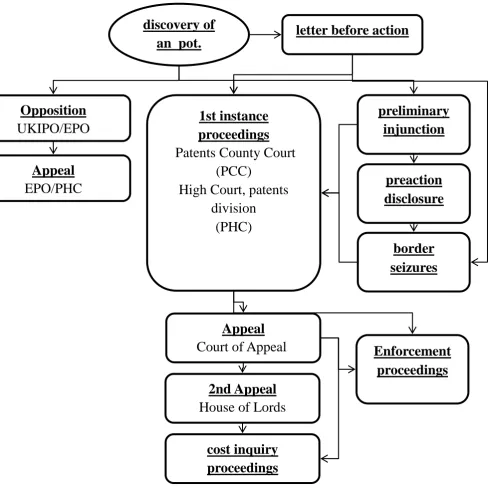
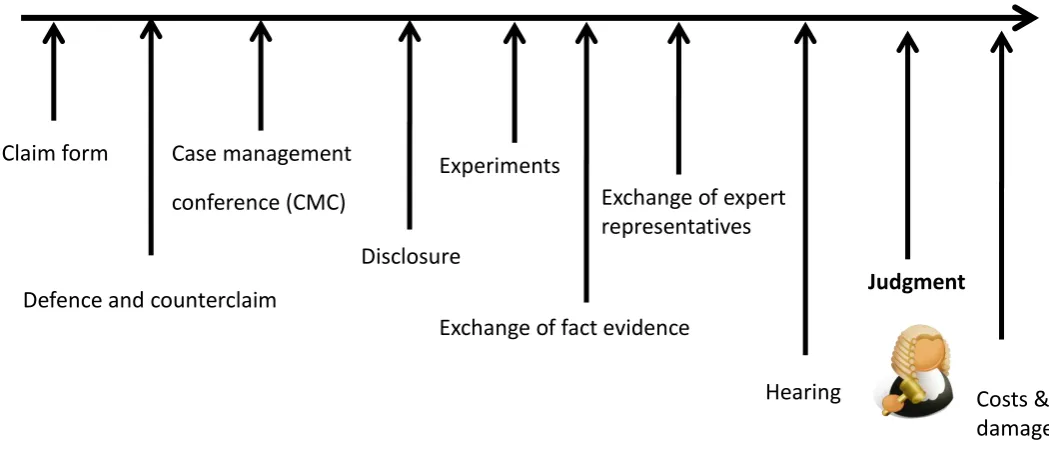
In England and Wales, there are two courts of relevance to patent litigation, the Patents County Court (PCC), which deals with low-value claims,6 and the Patents Court (PHC). Both of these courts feature specialist IP judges. The actual processes of litigation at the PHC are guided by the Civil Procedure Rules (CPR).7 In accordance with CPR 7.2 every case starts with the issuance of a ‘claim form’, which must be served within 4 months of issue, or 6 months if service is out of the jurisdictions under CPR 7.5.8 Both the structure and the timeline of a typical patent case are shown in Figures 1 and 2.
Case management is a vital part of the process. According to CPR 63 the claimant must apply for a case management conference (CMC) within 14 days of the date when all defendants who intend to file and serve a defence have done so.9 At the CMC, directions may be given with regard to disclosure of information or experiments, and a full hearing date is usually set. Richard Arnold notes the need for specialist IP judges at case management due to the overall importance of CMCs in framing a patent case.10
Regarding the length of the process, cases filed before the PHC often take a year or more to make it to full trial.11 Part of the reason why the process is lengthy relates to the overall complexity of a typical patent case, which will often require the need for the carrying out of experiments by experts. Another reason for a lengthy process is the disclosure requirement, which is particularly strong within the legal system of England and Wales in comparison to other European jurisdictions such as Germany. This requirement is on-going throughout the duration of the case.12 It is also notable that there is no ‘bifurcation’ in the UK system - the courts in England and Wales deal simultaneously with patent validity and infringement. This is a major difference compared for example to the legal system in Germany.13 The lack of bifurcation can have a major impact on the remedies granted by courts and the behaviour of litigating parties.14
Types of cases taken during 2000-2008
6 In response to concerns that small and medium sized enterprises (SMEs) were less able to avail of patent litigation primarily because of
costs concerns (see Intellectual Property Court Users Committee Working Group, “Final Report on Proposals for Reform of the Patents County Court” (2009) 1, 5-6 - accessible at http://www.judiciary.gov.uk/JCO/Core/CrawlerResourceServer.aspx?resource=24e06162-8f8f-4117-92d2-3446cd75eca1). Many of these reforms have now been enacted by the PCC.
7http://www.justice.gov.uk/courts/procedure-rules/civil
8 Under CPR 15.4 after the claim form is served, the defence has to be filed, and the general rule is that the period for filing a defence is
either (a) 14 days after service of the particulars of claim; or (b) if the defendant files an acknowledgment of service under CPR 10, 28 days after service of the particulars of claim. There is a modification to rule 15.4(1)(b) in CPR 63.7 – regarding a claim for infringement under rule 63.6, the period for filing a defence where the defendant files an acknowledgment of service under CPR 10 is 42 days after service of the particulars of claim.
9 CPR 63, Practice Direction 5.3. 10
R. Arnold, ‘Case Management, judicial specialisation and intellectual property litigation” (2010) 29 Civil Justice Quarterly 478.
11 Freshfields Bruckhaus Deringer, A Guide to Patent Litigation in Europe – England and Wales (2011) 1-6. 12 Freshfields Bruckhaus Deringer, A Guide to Patent Litigation in Europe – England and Wales (2011) 12.
13 The system in Germany is bifurcated i.e. validity and infringement issues are tried by separate courts. It is generally said that injunctions
are more easy to acquire in a bifurcated system. See Klink for a discussion of the differences in procedures between the UK and Germany - J. Klink, “Cherry Picking in Cross-Border Patent Infringement Actions: A Comparative Overview of German and UK Procedure and Practice” (2004) 26 European Intellectual Property Review 493.
14 At a recent House of Commons committee hearing, Henry Carr Q.C. stated that a preliminary injunction is more easily obtained in a
371
Unlike other European jurisdictions, such as France where most patent cases are filed as actions for infringement,15 it is common for a claimant in a case before the PHC to merely argue that the defendant’s patent is invalid on the basis that it fails one or more of the criteria for patentability, e.g. due to anticipation, lack of inventive step or insufficiency. Alternatively, or in tandem with an invalidity claim, a claimant may seek a declaration of non-infringement stating that its product does not infringe the defendant’s product. The reason for taking these types of claim is that it is expected that a competitor who is aware of a rival company’s similar invention should attempt to ‘clear the way’ before releasing a product which could infringe the other company’s patent. If the competitor does not do this, it is more likely that the PHC will grant an interim injunction preventing the sale of the potentially infringing product upon the commencement of infringement proceedings by the other company. However, ‘clearing the way’ does not occur in every case. Cases involving a claimant who alleges infringement and a defendant who counter-claims for invalidity are also commonplace.16 In total 255 patent cases were filed at the PHC over the 9-year period 2000-2008.17 We found that around half of all court cases were filed against defendants claiming the infringement of the claimant’s patent, while in around 36% of cases the claimant filed the case seeking the invalidation of the defendant’s patent.
It is notable that within these actions the actual claims can be multifaceted. For example, a patent validity action may be based on a number of grounds including anticipation, inventive step, insufficiency and added matter. The effort to substantiate every part of a multifaceted claim often requires the expounding of a large amount of resources. In this regard, a claimant may succeed overall at the PHC in establishing the patent’s invalidity, but he or she may not succeed on all grounds put forward. As discussed below, this has consequences when the issue-based approach to costs is applied - the overall winner may in fact not receive all costs expounded, or even the larger costs proportion in the case.
Costs under CPR 44 in the context of Patent Litigation
In England and Wales the substantive legal issues and the costs issues are dealt with separately.18 In most cases parties settle the issue of costs once a judgment has been handed down.19 Before the specific costs data of our study can be discussed, it must be noted that under CPR 44 the courts have wide discretion when considering costs.20 On this point, Floyd J. has remarked:
15 K. Cremers, C. Helmers, L. McDonagh, C. Schneider, G. Licht, D. Harhoff, I. Rudyk, P. Schliessler, N. van Zeebroeck, “Patent Litigation
in Europe - An Explorative Analysis” – Draft report of the ZEW SEEK project, on file with authors; details of the project can be accessed here http://www.zew.de/en/forschung/projekte.php3?action=detail&nr=1033
16 A patentee may also apply to amend a patent at the PHC. Patent ownership disputes sometimes arise, as do licensing disputes. 17 C. Helmers and L. McDonagh, “Patent Litigation in the UK” - draft IPO Report, forthcoming 2013, on file with authors.
18 Unless the costs are agreed between the parties, once the trial judge has made cost orders at the PHC costs hearing, the details of the costs
themselves are usually ‘assessed separately by a costs judge (who does not have specialist patent knowledge) for reasonableness in detailed assessment (typically recovery is around 70%)’ – SJ Berwin, “Patent Litigation Costs – Does the Winner really take it all?” (May, 2009)
Patent Update 1; accessible at http://www.sjberwin.com/Contents/Publications/pdf/77/2c7c43d6_5fca_41f1_90b1_a1a52b2885f7.pdf. It is important to note that the costs data discussed in this article are the ‘pre-assessment costs’, or ‘gross’ costs, before any separate assessment by a costs judge has taken place.
19 Freshfields Bruckhaus Deringer, Patent Litigation in Europe – England and Wales (2007) 1.
20 SJ Berwin, “Patent Litigation Costs – does the winner really take it all?” (May, 2009) Patent Update 1; accessible at
372
“In patent cases, an issue-based approach to costs is now the norm…” 21
As noted above, patent cases are often multi-issue cases involving claims of invalidity, infringement and licensing. Moreover, as detailed below, cases often result in a party winning a partial victory, rather than a complete one. In this respect, a claimant could win the revocation claim but lose on the issue of infringement. Similarly a claimant may fail to invalidate a defendant’s patent or succeed only partially. For this reason costs are generally divided on an issue-based approach, by granting each party the costs of each issue won. 22
Nonetheless, as noted below, the courts have clearly acknowledged that although the issue-by-issue approach is more likely to produce a fairer costs outcome, it will not necessarily be more precise, because the estimation of costs ‘is more an art than a science’.23
Once a party has lost on substantive grounds, the party may decide to ‘cut its losses’ and to settle out of court regarding the actual amount of costs and damages. For this reason, it is often the case that there are no court records available regarding the specific amount of costs and damages allotted to each side in each case. As a result, the analysis of the costs/damages data undertaken here is based upon an evaluation of the records which are available, in conjunction with analysis of previous studies. By analysing a sample of the 18 cases filed 2000-2008 that have records accessible online, we provide the most extensive qualitative analysis of costs of patent litigation under taken thus far with respect to the PHC.24 The analysis of the 18 cases is organised based on three themes – the use of discretion by courts in applying the issue-based approach, the courts' attitude to the issue of disproportionate costs, and the issue of interim costs.
Analysing the PHC’s use of Discretion in the context of the issue-based approach to costs
With regard to specific PHC case studies from our survey, the case of Apotex v Smithkline Beecham25 is of note because it involved significant rulings by the PHC and the Court of Appeal on costs. The PHC trial had lasted 11 days. At the PHC costs hearing, it was stated that Smithkline Beecham’s total costs up to that point amounted to £3,367,918 while Apotex’ costs amounted to approximately £2,700,000. The PHC ordered Smithkline Beecham to pay 76% of Apotex’s costs. However, while the Court of Appeal upheld the original PHC decision
21 See costs hearing in Research in Motion UK Ltd v Visto Corporation; Visto Corporation v Research in Motion & Anor [2008] EWHC 819
(Pat), at para. 6; costs hearing undertaken following full trial [2008] EWHC 335 (Pat); [2008] Bus. L.R. D89.
22 A. Goldberg, “Unravelling the costs conundrum in patent cases” (2010) New Legal Review; accessible at
http://www.cpaglobal.com/newlegalreview/4668/unravelling_costs_conundrum_pa.
23Apotex Europe Limited and others v Smithkline Beecham plc and others; Smithkline Beecham plc and others v Apotex Europe Limited and others [2004] EWCA Civ 1703, at para. 25-26.
24 Weatherall et al. have noted the general lack of evidence with respect to patent litigation in the UK including the issue of costs. K.
Weatherall, E. Webster and L. Bently, “IP Enforcement in the UK and Beyond: A Literature Review” (2009) SABIP Report Number EC001
1, 16-26; accessible at http://www.ipo.gov.uk/ipresearch-ipenforcement-200905.pdf A rare empirical study on the subject of patent litigation in the UK is provided by Moss et al. The Moss study states that for companies the risk of accruing a high level of legal costs resulting from litigation is the principal obstacle to taking litigation in the first place. In fact, despite the high costs of litigation, only about 25% of firms were said to possess IP insurance as ex ante; it is typically considered too costly by firms. G. Moss, M. Jones, and R. Lundie-Smith, “Just how `anti-patent’ are the UK courts?” (2010) 5 Journal of Intellectual Property Law & Practice 148, 148-151.
373
on non-infringement, it reversed it with regard to validity.26 With regard to costs, the Court of Appeal then stated that overall Apotex ought to have 16% of the costs arising from the first instance PHC case, and Smithkline Beecham ought to have 25% of the costs of the appeal. No further specific cost amounts were discussed at the Court of Appeal costs hearing. With regard to the costs approach taken by courts, the court laid down following statement:
“It follows that all the factors and matters set forth in CPR 44.3 apply to how the court should exercise its
discretion as to costs. Prior to the CPR a party who was successful overall was not normally deprived of its costs of an issue it took unsuccessfully unless it has done so unreasonably, see Re Elgindata (No. 2) [1992] 1 WLR 1207. But since the CPR a more issue-by-issue approach is appropriate... Even before the CPR an issue-by-issue approach was, as an exception to the Elgindata approach, applied in patent actions because of the “large number of issues and the very extensive costs that can be incurred” per Aldous LJ in Rediffusion v Singer Link [1993] FSR 369 at 410. An issue-by-issue approach is therefore one that should be applied so far as it reasonably can. On the other hand such an approach is not the be-all and end-all. Whether or not “it was reasonable for a party to raise, pursue or contest a particular allegation” remains a relevant factor to be taken into account as part of the
conduct of the parties (see CPR 44 rule (3)(a) and (5)(b).”27
The courts therefore have broad discretion in applying the issue-based costs approach. The case of Eli Lilly and Co v Human Genome Sciences Inc28, heard in the PHC in 2008, is of note in this regard. The case involved a dispute concerning the interpretation of 'industrial application' under Art. 57 EPC – specifically the case dealt with the application of this criterion in the context of biotechnology patents. Eli Lilly sought revocation of a Human Genome Sciences (HGS) patent covering the gene and protein sequences of a protein known as Neutrokine-α. The High Court stated that the patent was invalid on the basis a number of grounds including industrial application and insufficiency. However, although Eli Lilly won overall at the PHC, it had failed to establish obviousness over the Fujiwara EST and IMAGE clone. Costs following the PHC trial were estimated at £1,380,000 (Eli Lilly) and £2,220,000 (HGS). It is notable that HGS’s costs were substantially greater than Eli Lilly’s. Moreover, HGS claimed that a little over 50% of its costs could be attributed to dealing with the obviousness issue, and issue which formed part of Eli Lilly’s claims and which it lost at trial. HGS argued that
Eli Lilly should not only be deprived of this portion of its costs, but it should have to pay HGS its own costs for the issue, which amounted to a sum in excess of £1million. The court determined that the fairest result was not a precise issue-by-issue reduction because this would effectively deprive Eli Lilly, the overall winner, of any of its costs, and in fact would result in Eli Lilly making a net payment HGS. Overall, the court ruled that Eli Lilly was entitled to 60% of its costs of the action (amounting to approximately £828,000). This case therefore represents an example of the court not applying a strict issue-by-issue approach.29
26
Apotex Europe Limited and others v Smithkline Beecham plc and others; Smithkline Beecham plc and others v Apotex Europe Limited and others [2004] EWCA Civ 1568; [2005] FSR 23; costs hearing [2004] EWCA Civ 1703; [2005] 2 Costs L.R. 293.
27Apotex Europe Limited and others v Smithkline Beecham plc and others; Smithkline Beecham plc and others v Apotex Europe Limited and others [2004] EWCA Civ 1703, at para. 25-26.
28Eli Lilly and Co v Human Genome Sciences Inc [2008] EWHC 1903 (Pat); [2008] RPC 29; costs hearing [2008] EWHC 2511 (Pat). 29 The substantive issues of the cases were appealed to the Court of Appeal [2010] EWCA Civ 33; [2010] RPC 14; and eventually the
374
On the issue of discretion, the case of Monsanto v Cargill30 is significant. The PHC trial lasted 13 days. Monsanto’s costs were £2.2million and Cargill’s were 1.9million. Monsanto had won most of the issues at trial,
but had failed in respect to the validity of one of its claims. Furthermore, regarding its infringement claim Monsanto had not succeeded with regard to a minor issue of construction. Pumfrey J. (as he then was) stated that in determining costs it was first necessary to ask ‘who has won?’, secondly to ask whether the party who has won lost on a suitably circumscribed issue to make it appropriate to deprive it of costs, and thirdly, to ask whether the case was a suitably exceptional one which required the court to make a costs order against the party who has won overall. Pumfry J. decided to make an issue-based costs grant mostly in favour of Monsanto, stating that given the issues won and lost Monsanto ought to receive around two thirds of its total costs. Ultimately, Pumfrey J. ordered that a rounded off sum of £800,000 ought to be paid by Cargill to Monsanto.
The case of Ratiopharm GmbH v Napp Pharmaceutical Holdings Ltd31 demonstrates the complexity involved in the application of issue-based costs. Ratiopharm and Sandoz successfully obtained a declaration of infringement regarding Napp’s patents. However, Ratiopharm and Sandoz did not succeed on two other
non-infringement claims nor did they succeed on the validity issue. With respect to costs Floyd J. applied the 3 step criteria of Pumfrey J. in Monsanto v Cargill. In doing so Floyd J. noted that regarding the first question, Ratiopharm and Sandoz were the overall winners. Regarding the second question, Floyd J. acknowledged that in certain cases the issues of the case might be so interlinked it would be impossible for the court to separate them; nonetheless, in this case it was possible to separate the issues of validity and infringement. Floyd J. noted that the greater portion of costs had arisen due to the validity issue, which the overall winners had lost. However, he said that Ratiopharm and Sandoz were entitled to make more than one non-infringement claim, and therefore they were not liable for costs for the two unsuccessful challenges. In order to illustrate the necessity for a separation of issue-based costs, the court gave a detailed list of claimed costs, issue-by-issue for each side. In relation to Napp’s costs it was stated:
“…the following average percentage expended in relation to each of the following issues: obviousness 57%,
added matter 7%, infringement general 3%, dissolution testing 7%, matrix 4%, spheroid spheronisation and spheronising agent 8% together, coating which controls release 2%, pain relief 2%, and other 11%.”32
Regarding the costs for Ratiopharm and Sandoz, it was remarked:
“…on the main issues in the case they consider the costs are approximately as follows: general miscellaneous
matters 8.7%, common general knowledge 24.5%, construction and infringement 22.6%, obviousness 21.2%, and 10% on added matter and 6.4% on post priority date evidence.”33
30Monsanto Technology LLC v Cargill International SA; Cargill plc [2007] EWHC 2257 (Pat); [2008] FSR 7; costs hearing [2007] EWHC
3113 (Pat).
31Ratiopharm GmbH v Napp Pharmaceutical Holdings Ltd; Napp Pharmaceutical Holdings Ltd v Sandoz Ltd [2008] EWHC 3070 (Pat);
[2009] RPC 11; Costs hearing [2009] EWHC 209 (Ch); (2009) 32(4) I.P.D. 32030.
32Ratiopharm GmbH v Napp Pharmaceutical Holdings Ltd; Napp Pharmaceutical Holdings Ltd v Sandoz Ltd [2009] EWHC 209 (Ch), at
para. 3.
33Ratiopharm GmbH v Napp Pharmaceutical Holdings Ltd; Napp Pharmaceutical Holdings Ltd v Sandoz Ltd [2009] EWHC 209 (Ch), at
375
There was clearly a disparity between the sides’ costs with respect to the validity challenge, which was based on the ‘obviousness’ of Napp’s patents, and which made up 57% of Napp’s costs but only 21.2% of Ratiopharm and Sandoz’s costs. The court attributed this disparity to the importance to Napp of not having its valuable
patents invalidated; it was not thought to be unreasonable in the circumstances. Regarding the third question, Floyd J. held that Ratiopharm and Sandoz ought to pay Napp’s costs with regard to the issue of validity, but not infringement. Napp had lost overall only on narrow grounds, and had won more issues during the trial. Finally, after the deductions the court stated that Ratiopharm and Sandoz were entitled to 35% of their costs, and Napp to 54% of its costs. By making a set-off, and rounding up the remaining 19%, Floyd J. remarked that the most just outcome was for Napp to receive 20% of its total costs: This case therefore illustrates that when applying issue-based costs in patent litigation, the parties which succeed overall may not receive any of their costs. In fact, in this case the overall losing party, Napp, received a net award of costs.34
A similar conclusion was reached in Actavis UK Ltd v Merck.35 Actavis won on the basis of the ‘method of treatment’ issue, but it lost on the issue of obviousness, an issue which took up a lot of resources during trial. In
other words, although Merck lost overall, it won the issue that the court spent most time on during the 3 day hearing. Actavis’ costs were estimated at £500,000, while Merck’s costs were estimated at £600,000. Warren J. noted that the court had discretion under the CPR 44.3 to apply an issue-based approach, while bearing in mind what the overall result of this would be. Furthermore, Warren J. remarked that it was now established, as held in
Summit Property Ltd v Pitmans,36 that the issuance of an adverse costs order against the overall winner did not require improper or unreasonable conduct, instead it merely required a ‘suitably exceptional’ case:
“What has in fact happened is that the claimant has lost on the major issue in this case. On the other hand, this
case is not at the extreme in a case such as Rediffusion, but against that it is not a case either where there has been any significant overlap of factual material between obviousness and medical treatment which are relevant to the issues which have to have been both won and lost by the claimant. In my judgment, it would not be fair to adopt an approach the result of which is to leave the costs of the obviousness attack falling where they have been incurred, but neither do I think it is fair that the defendant should, as Mr. Hinchliffe submits it should, recover all of its costs on the obviousness issue. Even if I were to apply an approach recognising the win and lose on those issues, a pure issue-based approach in the sense of costs following the event would not in my judgment be an appropriate result.”37
Ultimately, Warren J. decided that Actaivis ought to get 25% of its costs, while Merck ought to receive 66.25% of its costs. In this respect, Warren J. decided to make a single net order that Actavis ought to pay Merck a total of £100,000. Once again the overall ‘loser’ was awarded a net costs order.
34Ratiopharm GmbH v Napp Pharmaceutical Holdings Ltd; Napp Pharmaceutical Holdings Ltd v Sandoz Ltd [2009] EWHC 209 (Ch), at
para. 19.
35Actavis UK Ltd v Merck & Co Inc [2007] EWHC 1311 (Ch); [2007] All ER (D) 24 (Jun); costs hearing [2007] EWHC 1625 (Pat). 36Summit Property Ltd v Pitmans (Costs) [2001] EWCA Civ 2020; [2002] CPLR 97. See also Rediffusion Simulation Ltd v Link Miles Ltd
[1993] FSR 369.
376
In other cases however, the court may decide to use its discretion to favour the overall winner. For example, in
Ivax Pharmaceuticals (UK) Ltd v Chugai Seiyaku Kabushiki Kaisha38the PHC trial lasted for 4 hearing days. Ivax incurred costs totalling £300,000, whereas Chugai's costs were estimated at £700,000. Ivax had succeeded overall, but had lost certain obviousness claims. Ivax stated that 10% of its costs were expounded on the issues it lost, and therefore it ought to receive 90% of the action. Chugai stated that between 65-90% of its costs were incurred defending issues which it ultimately won. Chugai argued that while a simple issue-by-issue approach would lead to Ivax paying 40% of Chugai’s costs, it nevertheless acknowledged that Ivax had won overall, and therefore the fairest result was for no costs order to be made. The PHC disagreed, noting that Chugai’s
assessment of its own costs appeared largely skewed towards the issues it won, and that in the court’s opinion the truer costs picture probably fell between Ivax’s estimate and Chugai’s estimate. Moreover, the court stated
that the starting point for addressing costs had to be that Ivax had won the case, which meant it ought to have the general costs of the action. However, the PHC also recognised that Ivax had lost certain issues, and therefore ordered a costs reduction so that Ivax would receive 60% of its costs from Chugai.
It is also possible that the circumstances of the case may be that any deduction from the winner’s costs will be minor. In Gemstar v Virgin the PHC heard that after the 11 day hearing the costs were estimated to be £1.9 million for Gemstar and £2.4 million for Virgin.39 Virgin had won overall but had lost on two minor prior art issues, on aspects of the infringement point and on the ‘added matter’ claim. Given the fact the overall winner had lost only minor issues, the court decided that there ought to be only a 13.5% costs deduction. Therefore 86.5% of Virgin's costs were payable by Gemstar to Virgin (amounting to approximately £2,076,000). Similarly, in Nokia v IPCom,40 the PHC heard that Nokia's costs had reached £1.3 million by the end of January 2010, while IPCom's were £300,000 at the same point of time. The PHC ruled that because Nokia had won most issues at trial Nokia was entitled to its costs, though the court declined to apportion a specific percentage. In a separate hearing on the same day, the PHC also discussed costs for other related cases in the dispute between the two parties.41 With respect to that round of costs, the PHC awarded Nokia a 66% share of its costs of around £3 million.
In the case of Generics v Lundbeck42 the use of issue-based costs led to a 60/40 split in costs between the claimants and defendant. The claimants, Generics, Arrow and Teva, challenged the validity of Lundbeck’s patent related to an anti-depressant drug on the grounds of anticipation, obviousness and insufficiency. The claimants won the case on the issue of insufficiency, but lost on the grounds of anticipation and obviousness. At the costs hearing following the PHC trial, Generics' costs were estimated at £886,000, Arrow’s were said to be £554,000 and Teva’s were stated to be £624,000. Lundbeck, the defendant, estimated its costs to be about
£1,815,000. Teva and Lundbeck agreed to settle costs, but a hearing was required to assess the apportionment of
38Ivax Pharmaceuticals (UK) Ltd v Chugai Seiyaku Kabushiki Kaisha [2006] EWHC 756 (Pat); [2006] All ER (D) 131 (Apr); costs hearing
[2006] EWHC 853 (Pat).
39Gemstar-TV Guide International Inc v Virgin Media Ltd [2009] EWHC 3552 (Pat); (2010) 33(4) I.P.D. 33023. 40Nokia GMBH v IPCom GMBH & Co KG [2010] EWHC 790 (Pat).
41Nokia GMBH v IPCom GMBH & Co KG [2010] EWHC 791 (Pat), paragraph 1.
377
costs between Lundbeck and the remaining claimants, Generics and Arrow. The PHC held that costs should be divided on the basis of a 60/40 split in favour of the claimants. Lundbeck was ordered to pay to Generics and Arrow 60% of their costs of the trial while Generics and Arrow were ordered to pay to Lundbeck 40% of its costs.43
Costs for applications can also amount to substantial sums, and an issue-based approach may be taken. With respect to striking out actions, the case of Arrow v Merck44is of note.In this case the PHC ruled against Merck’s striking out action regarding the negative declaration it sought. Following the failure of Merck’s application, Arrow sought costs of £65,000–£75,000. However, because Arrow did not succeed on every single issue at the hearing, the PHC awarded Arrow the sum total of £35,000. In some cases however, the unsuccessful applicant may have to pay all the costs of the failed application. In Mayne v Teva UK Ltd45 Mayne lost its application for an injunction at the PHC. As a result, Mayne was ordered to pay Teva’s costs for the injunction hearing,
amounting to £38,500.
In light of the above, regarding the issue of discretion under CPR 44 it can be said that each case is taken on its own terms. The whole idea of allowing discretion is to facilitate the courts in finding a fair and reasonable outcome. In some cases this may mean that the winner faces a costs deduction, while in others the overall winner may even have to pay a net sum to the loser. The existence of issue-based costs means that parties undertaking patent litigation should think very carefully about which arguments they wish to advance as part of their case - even if they win overall based on their strongest argument, if they have advanced weaker arguments which end up taking up a lot of court time they may still be hit with a costs ruling which is not in their favour.
How the courts deal with Disproportionate Costs between the parties
In RIM v Visto, the PHC stated that, as is usually the case, the costs of the case ought to be divided proportionate to the issues won at trial.46 However, the court also noted that where there is a disproportionate burden between both sides, the court can give guidance to the costs assessment judge. RIM had succeeded in invalidating Visto’s patent. Nevertheless, RIM had been forced to revoke two of its own patents when their validity was challenged by Visto. Given the issues won and lost by both sides, Floyd J. applied the issue-based approach on a percentage basis and ruled that Visto was liable to pay RIM 66% of RIM's total estimated costs. Meanwhile, RIM was ordered to pay Visto 51% of Visto's assessed costs. Nonetheless, there was a sting in the tail. RIM's costs were estimated at a much higher sum than Visto’s; RIM’s costs totalled £6 million, while Visto’s costs were estimated at £1.6 million. This meant that even despite the use of the issue-based approach, the actual burden of costs fell much more severely on Visto than on RIM. In the circumstances, Floyd J. declined to place a cap on costs, though he did recognise the reality of the costs disparity between the parties. The fact that the court did
43
The substantive issues of the case were appealed to the Court of Appeal [2008] EWCA Civ 311; [2008] RPC 19; and to the Supreme Court [2009] UKHL 12; [2009] 2 All ER 955.
44Arrow Generics Limited; Arrow Pharm (Malta) Limited v Merck & Co, Inc [2007] EWHC 2387 (Pat); costs hearing [2007] EWHC 1900
(Pat).
45Mayne Pharma (USA) Inc; Mayne Pharma Plc; Mayne Group Ltd v Teva UK Ltd; Approved Prescription Services Ltd [2005] EWHC
2141 (Pat); [2005] All ER (D) 116 (Oct); interim injunction hearing [2004] EWHC 3248 (Ch); costs hearing [2004] EWHC 2934 (Pat).
378
not place a cap on costs is of interest given the striking disparity between the two sides, and it would initially indicate that bigger firms with deeper pockets have an advantage in this context. However, Floyd J. went on to note that full costs assessment would take place and in this respect he gave guidance to the costs assessment judge along the lines that RIM’s costs appeared to be wholly disproportionate and potentially unreasonable in the circumstances. In light of the comments of Floyd J. it is likely that RIM’s costs would have been assessed down by the costs assessment judge.47 Therefore, while the party with the ‘deeper pocket’ has an advantage, the courts will not look kindly on a great disparity between the two parties’ costs and may give guidance to the costs
assessment judge on this basis.
In a similar vein, the case of Generics (UK) Ltd v Daiichi48 is of note. In this case Generics challenged the validity of Daiichi’s supplementary protection certificate (SPC). This challenge was rejected by the court.
Daichii had won most of the issues at trial, but had lost on a number of minor ones. The court noted:
“The case was a substantial one involving disclosure and experiments and expert evidence from a total of five experts.”49
At the PHC costs allocation hearing it was established that Generics’ costs of taking the case through 11 hearing days to a PHC judgment amounted to £1.3 million, whereas Daichii’s costs amounted to approximately £3.4
million. Given the issues won and lost, the claimant submitted (i) that the costs incurred by the defendants were wholly disproportionate and should be capped and (ii) that the costs should be reduced to reflect the fact that, even though the defendants could be described as being the overall winner, the defendants had lost on a number of issues. Regarding the first issue, Kitchin J. agreed that Generics’ costs were disproportionate. Nonetheless, as was the case in RIM v Visto, the court therefore declined to place a cap on costs. However, like in RIM v Visto, Kitchin J. gave guidance to the costs assessment judge, stating that the judge should regard a figure closer to £2million as more reasonable. With respect to the second issue, Kitchin J. stated that issue-based costs deduction considerations were necessarily ‘imprecise’ but that each issue ought to be considered in turn as far as
possible. Despite the disproportionate nature of the costs, Kitchin J. acknowledged that Daichii had won on most issues. After allowing for minor issue-based deductions, Kitchin J. stated that Daichii were entitled to 88% of their assessed costs of the action. As noted above, Daichii’s pre-assessment costs were estimated at £3.4 million, though this figure was likely reduced by the costs assessment judge.
Nonetheless, not every case featuring apparently disproportionate costs will result in full costs assessment. In
Abbott Laboratories v Evysio,50 Abbott had applied for revocation of three of Evysio’s patents, and also for declarations of non-infringement with regard to the three patents relating to coronary stents. Abbott largely
47 Furthermore, at a later hearing following an application by Visto, Arnold J. ruled that the parties had to provide a statement of costs to
date and an estimate of future costs of litigation in order to enable Visto to determine whether litigation was worth the costs risk - Research in Motion UK Ltd v Visto Corp [2008] EWHC 3026 (Pat); [2009] FSR 10.
48Generics (UK) Ltd v Daiichi Pharmaceutical Co Ltd; Daiichi Pharmaceutical Sankyo Ltd [2008] EWHC 2413 (Pat); [2009] RPC 4; costs
hearing [2008] EWHC 2958 (Pat).
49Generics (UK) Ltd v Daiichi Pharmaceutical Co Ltd; Daiichi Pharmaceutical Sankyo Ltd [2008] EWHC 2958 (Pat) at para. 2. 50Abbott Laboratories Ltd v Evysio Medical Devices ULC [2008] EWHC 800 (Ch); [2008] RPC 23; costs hearing [2008] EWHC 1083
379
succeeded in its claims. After a trial lasting 8 days, the PHC costs hearing attributed costs of £2.63 million to Abbott and £1.46 million to Evysio. Evysio argued that the clear disparity in costs meant that an order for costs assessment of both sides’ costs ought to be made, citing the case of RIM v Visto in support. However, the court rejected this argument, stating that the costs disparity was far less than it had been in RIM v Visto. Moreover, in applying the issue-based approach, the court acknowledged that two deductions from Abbott’s costs ought to be made. Firstly, Abbott ought to pay Evysio the costs for two prior art issues which had eventually been withdrawn by Abbott. This deduction amounted to 7.5% of the total costs. Secondly, Evysio claimed that a portion of Abbott’s costs ought to be disallowed with regard to the use of an expert witness whose testimony had been criticised at trial. The expert’s fees amounted to £139,000 and Evysio had sought a 20% reduction. The
court ruled that the deduction for this issue should be 17.5%. In total Abbott was therefore granted 75% of its costs (amounting to approximately £1,972,500).
The Courts' approach to Interim Costs
Courts are willing, where appropriate, to issue interim costs orders under CPR 27.2. For instance, in the case of
Schlumberger v Electromagnetic Geoservices (EMGS) 51 the issue of interim costs was decided at the PHC stage. Mann J. ruled that EMGS should pay 82.5% of Schlumberger's costs of the action, which were estimated at £2.286 million, and then had to address a request for interim payment. EMGS did not dispute the issue of interim costs in principle, but disputed the figure suggested by Schlumberger of £1 million, saying a figure closer to £750,000 would be more appropriate. Applying what he termed a ‘sensible assessment’ Mann J. reviewed the figures presented by both sides. Eventually he agreed with Schlumberger that £1m ought to be paid by EMGS to Schlumberger as interim costs of the action.
An application for an amendment or a stay of proceedings can also lead to the issuance of an interim costs order. With regard to amendment and injunction applications, in Hospira UK Limited v Eli Lilly52 a PHC judgment refused Hospira’s application for leave to amend, and also refused an injunction to prevent commencement of an
action. Hospira was ordered to pay the costs of the failed applications. The total costs of the application hearing were £76,000, and Hospira was ordered to pay Eli Lilly a total of £50,000 to cover its costs. However, following this ruling some later issues were resolved in favour of Hospira, which meant that it was entitled to costs.53 At the PHC costs hearing Hospira sought an interim payment of £200,000, while Eli Lilly stated it should be a much lower sum of £100,000. After weighing up the arguments of both sides, Floyd J. ordered Eli Lilly to make an interim payment of £125,000 to Hospira.
Where a stay is granted pending European Patent Office (EPO) proceedings, the costs arising from the stay can be substantial and may also result in an interim payment. In Rambus v Hynix, a case which involved two defendants, Micron Europe Limited and Hynix Semiconductor UK Ltd, a stay was granted pending the EPO
51Schlumberger Holdings Ltd v Electromagnetic Geoservices AS [2009] EWHC 58 (Ch); [2009] RPC 19; costs hearing [2009] EWHC 773
(Pat).
380
proceedings.54 After the EPO had invalidated Rambus’ patent, the PHC had to assess the costs arising from the stayed action. Micron’s costs were estimated at £698,000 while Hynix’s (previously known as Hyundai
Electronics) costs were noted at £233,000. 55 The PHC ruled that Rambus was liable for both defendants’ costs but did not make a ruling on the overall amount payable by Rambus to each defendant. However, the PHC did rule that Rambus was to pay £125,000 to each defendant as interim costs.
With regard to interim costs, it appears that foreign fees are not recoverable. In Buhler AG v FP Spomax56
Buhler took a patent infringement case against FP Spomax. FP Spomax successfully defended itself against the infringement claims. FP Spomax’s total costs amounted to £1,034,234 and it sought an interim sum of £550,000. At the PHC costs hearing Mann J. considered whether FP Spomax’s foreign legal fees ought to be
considered when ordering the interim payment of costs. Ultimately Mann J. stated that foreign fees could not come within the interim costs determination, but some interpretation and translation costs could do so. Mann J. also remarked that it was logical that company defending its patent against revocation claims would spend more on its defence than the company trying to revoke the patent, reflecting the financial importance to companies of not having their patents invalidated. By subtracting the foreign legal fees Mann J. ordered that Buhler AG were to pay £400,000 to FP Spomax as interim costs.
What are the typical costs arising from the taking of a PHC case?
In light of the above case study, it falls to consider what conclusions can be drawn regarding overall level of costs for taking a PHC case. Regarding specific cost sums, Jackson L.J. reviewed a sample of 15 IP cases, including 12 patent cases, between 1999-2007.57 3 patent cases were settled at an average cost of approximately £870,000 per case. The average cost of the remaining settlements, mostly patent cases, was approximately £650,000, with the cost ranging from £200,000 to £1.2million.58 Other sums have been mooted, including at the high end costs of £3 million (£1.5 million for each side), and at the lower end, costs ranging from £200,000 to £500,000.59 Our case study above illustrates the prevalence of high costs, totalling a sum between £1million and £6million (encompassing the costs from both sides).
It has been argued that the existence of high costs in the UK litigation system may encourage settlement.60 Given the high costs it is tempting for parties to settle as early as possible even where they think they have a strong case. The high settlement rate of around 50% of cases found in our study of the UK is likely to be
54Rambus Inc v Micron Europe Ltd/Rambus Inc v Hyundai Electronics UK Ltd, Laddie J., December 19, 2000 (unreported). 55
Rambus Inc v Hynix Semiconductor UK Ltd and another [2004] EWHC 2313 (Pat); [2004] All ER (D) 587 (Jul).
56Buhler AG v FP Spomax SA [2008] EWHC 823 (Pat); [2008] All ER (D) 291 (Apr); costs hearing [2008] EWHC 1109.
57 The report’s data on costs are applicable only to one side of the dispute. Jackson L.J., Civil Litigation Costs Review: Final Report (TSO
(The Stationery Office), 2010), 24; accessible at http://www.ciarb.org/information-and-resources/2010/01/22/Review%20of%20Civil%20Litigation%20Costs%20Final%20Report.pdf.
58
Jackson L.J., Civil Litigation Costs Review: Final Report (TSO (The Stationery Office), 2010), Appendix 3; accessible at
http://www.ciarb.org/information-and-resources/2010/01/22/Review%20of%20Civil%20Litigation%20Costs%20Final%20Report.pdf.
59 Freshfields Bruckhaus Deringer, A Guide to Patent Litigation in Europe – England and Wales (2011) 8. G. Duncan, “Challenging
Competitors' Patents in the UK - Patent Revocation” (2010) D Young & Co Intellectual Property Articles & Updates; accessible at
http://www.dyoung.com/article-patentrevocation.
60 Jackson L.J., Civil Litigation Costs Review: Final Report (TSO (The Stationery Office), 2010) 248-250; accessible at
381
influenced by costs concerns, which are in turn affected by the length of the procedures. This rate of settlement is higher than in comparative European countries such as France where costs are considerably lower.61
Why are the costs so high? Factors influencing costs
Given the existence of high costs, it is necessary to consider the reasons why the costs are so high. The overall costs of undertaking litigation are in part due to a host of factors including the effort undertaken in order to observe and assess potential incidences of infringement, the ability to identify the infringer(s), an assessment of whether the IP right is likely to stand up in court e.g. the validity of a patent, and the (substantial) direct and indirect financial costs of the litigation itself. Regarding litigation, costs are largely due to the existence of (often lengthy) oral hearings, which require the expertise of solicitors and the advocacy of barristers, the need for extensive cross-examination of expert witnesses, as well as the requirements of the on-going duty of disclosure of any relevant documents.62
In particular, Jackson L.J. noted that the cross-examination of witnesses during trial is resource-intensive:
“The costs incurred from the start of trial to judgment or settlement averaged nearly 20% of the total costs of the
cases. The trial costs were a large proportion of the total costs due to the cross examination of the expert witnesses.”63
In Abbott Laboratories Ltd v Evysio Medical Devices ULC the court outlined the particularities of the costs Firstly, the court gave an outline of the source of the costs for Abbott:
“A brief review of the schedule shows that the costs have been incurred as follows:
i) Taylor Wessing's costs: £1,446,000; ii) counsel's fees: £407,269;
iii) experts' fees: £622,659 (including some £400,000 in respect of US lawyers); and iv) disbursements: £159,332.” 64
Secondly, Evysio’s costs were stated to be as follows:
“…Evysio's costs to date are in the region of £1.46 million made up as follows: i) Bristows' costs: £947,316;
61 K. Cremers, C. Helmers, L. McDonagh, C. Schneider, G. Licht, D. Harhoff. I. Rudyk, P. Schliessler, N. van Zeebroeck, “Patent Litigation
in Europe - An Explorative Analysis” – draft report of the ZEW SEEK project, on file with authors; details of the project can be accessed here http://www.zew.de/en/forschung/projekte.php3?action=detail&nr=1033. It is notable however that like the UK the German jurisdiction also has a very high rate of settlement, despite the existence of low costs.
62 Freshfields Bruckhaus Deringer, A Guide to Patent Litigation in Europe – England and Wales (2011) 8 and Jackson L.J., Civil Litigation Costs Review: Final Report (TSO (The Stationery Office), 2010) 24; accessible at
http://www.ciarb.org/information-and-resources/2010/01/22/Review%20of%20Civil%20Litigation%20Costs%20Final%20Report.pdf.
63 Jackson L.J., Civil Litigation Costs Review: Final Report (TSO (The Stationery Office), 2010) 24; accessible at
http://www.ciarb.org/information-and-resources/2010/01/22/Review%20of%20Civil%20Litigation%20Costs%20Final%20Report.pdf.
382
ii) counsels' fees: £278,119;iii) experts' fees: £185,377; and iv) disbursements: £47,421.”65
As can be seen from the above remarks, the expert fees can be considerable – amounting to £622,659 for Abbott’s case and £185,377 for Evysio’s case. Meanwhile, the solicitor’s fees tend to account for the highest proportion of costs, while barrister fees are also high.
What can recent PCC reforms tell us about the link between costs and litigation?
From our general study, it is clear that up until recent reforms at the PCC, few patent cases were actually taken at the PCC.66 It was generally accepted that parties were dissuaded from litigating at the PCC due to high costs.67 As a result nearly all patent cases filed 2000-2008 were heard by the PHC. Nonetheless, with the advent of recent reforms limiting expert evidence and giving the judge more of an investigative role during cases management it appears that the PCC has seen a significant increase in patent cases at the PCC, showing a link between reducing costs and increasing rates of litigation.68 However, given the complexity of a typical PHC case, litigation at the PCC is simply not an option for many cases, which means that high costs continue to be the reality for patent litigation in the UK.
Conclusion
It is clear that the procedures involved in taking a PHC case are lengthy. Moreover, patent cases feature a high degree of complexity. There are substantial costs involved, and the high cost nature of patent litigation may encourage settlements, explaining in part why the PHC settlement rate is high (at around 50% of all cases). The reasons for the existence of high costs are largely due to the disclosure requirement, the length of trial, the requirements for the carrying out of experiments and the cross-examination of expert witnesses.
The PHC takes an issue-based approach to costs. This is required because it is rare for a 100% victory in patent cases. Furthermore, we note that the issue based costs system is usually adopted in a flexible manner, with judges using their discretion under the CPR in order to try to reach a fair, if not ‘precise’, costs outcome in each
case. In some cases this may even result in the overall ‘winner’ in the case having to pay a net sum to the overall ‘loser’. In light of this, it is noted in this article that parties ought to think carefully before advancing issues and
arguments which are of uncertain substance for the reason that even if a company wins the case overall, it may still have to pay costs for issues which they did not win. The court is generally unwilling to cap costs, even where great disparity between the parties exists, though costs assessment guidance can be given. Finally, the
65Abbott Laboratories Ltd v Evysio Medical Devices ULC [2008] EWHC 1083 (Pat), at para. 9.
66 C. Helmers and L. McDonagh, “Patent Litigation in the UK” - draft IPO Report, forthcoming 2013, on file with authors.
67 Nonetheless, Thambisetty has criticised the notion that SMEs are in desperate need of a low cost forum – see S. Thambisetty, “SMEs and
patent litigation: policy-based evidence making?” (2010) 32 European Intellectual Property Review 143.
68 See remarks of Colin Birss, Judge at the PCC, as reported on IP Kat, “Two years on, the Patents County Court is ready for change” -
383
[image:16.595.53.542.196.697.2]initial response to recent reforms at the PCC shows a link between lowering costs and increasing rates of litigation. This, and the other findings of this article, ought to be taken into account during the on-going negotiations for the European Unitary Patent Court, for which the seat of one court is proposed to be in London.69
Figure 1: UK Patent Litigation System
69 M. Brandi-Dohrn, “Some critical observations on competence and procedure of the Unified Patent Court” (2012) 43 International Review of Intellectual Property and Competition Law 372.
1
preliminary
injunction
1st instance
proceedings
Patents County Court
(PCC)
High Court, patents
division
(PHC)
letter before action
border
seizures
Enforcement
proceedings
discovery of
an pot.
infringement
preaction
disclosure
cost inquiry
proceedings
Appeal
Court of Appeal
2nd Appeal
House of Lords
Opposition
UKIPO/EPO
384
Figure 2: Case Timeline