Arguing over ontology alignments
L. Laera1, V. Tamma1, J. Euzenat2, T. Bench-Capon1, and T. Payne3
1 Department of Computer Science, University of Liverpool,UK 2 INRIA Rhˆone-Alpes, Montbonnot, France
3 Computer Science, University of Southampton, UK
Abstract. In open and dynamic environments, agents will usually differ in the domain ontologies they commit to and their perception of the world. The avail-ability of Alignment Services that are able to provide correspondences between two ontologies is only a partial solution to achieving interoperability between agents, because any given candidate set of alignments is only suitable in certain contexts. For a given context, different agents might have different and incon-sistent perspectives that reflect their differing interests and preferences on the acceptability of candidate mappings, each of which may be rationally acceptable. In this paper we introduce an argumentation-based negotiation framework over the terminology they use in order to communicate. This argumentation frame-work relies on a formal argument manipulation schema and on an encoding of the agents preferences between particular kinds of arguments. The former does not vary between agents, whereas the latter depends on the interests of each agent. Thus, this approach distinguishes clearly between the alignment rationales valid for all agents and those specific to a particular agent.
1 Introduction
Traditionally ontologies have been used to achieve semantic interoperability between software applications, as such applications provide the definitions of the vocabularies they use to describe the world [11], and they have proved especially effective when sys-tems are embedded in open, dynamic environments, such as the Web and the Semantic Web [4]. Interoperability relies on the ability to reconcile the differences between het-erogeneous ontologies [15]. This reconciliation usually relies on the existence of corre-spondences (or mappings) between different ontologies (ontology alignment[10]), and uses them in order to interpret or translate messages exchanged by applications. Such correspondences may be generated by a variety of different matching algorithms [13]4,
and their production usually requires several steps. These can include the definition of an initial alignment, the training of some examples, and that invariably involves an some form of interpretation of preliminary results [9]. Therefore, approaches to on-tology alignment can only be effective when used to support semantic interoperation atdesign timein closed or partially open environments, where the actors involved are often known, where ontology changes are controlled and thus the alignments can be established before the systems interact. However, these approaches are not sufficient to support semantic interoperation in open environments, where systems can dynami-cally join or leave and no prior assumption can be made on the ontologies to align. In such environments, the different systems involved need to agree on the semantics of
the terms used during the interoperation, and reaching this agreement can only come through some sort of negotiation process [1].
This paper extends the notion of reaching agreement through automated negotiation (i.e.without human intervention) by considering the type of systems that need to inter-operate, which can affect how the negotiation should proceed. Specifically,autonomous agents(within an open environment) may perform different tasks depending on their state and the service providers they interact with. Thus, such agents will differ in the domain ontologies they commit to [11]; and their perception of the world (and hence the choice of vocabulary used to represent concepts). Imposing a single, universally shared ontology on agents is not only impractical because it would result in assuming a standard communication vocabulary (and thus violate the dynamics of open environ-ments) but it also does not take into account the conceptual requirements of services that could appear in future. Instead, every agent assumes its own heterogeneous private ontology, which may not be understandable by other agents. The availability of Align-ment Servicesthat are able to provide correspondences between two ontologies is only a potential solution to achieving interoperability between agents, as any given candi-date set of alignments is only suitable to certain contexts. For a given context, agents might have different and inconsistent perspectives;i.e. interestsandpreferences, on the acceptability of a candidate mapping, each of which may be rationally acceptable. This may be due to the subjective nature of ontologies, to the context and the requirement of the alignments and so on. For example, an agent may be interested in accepting only those mappings that have linguistic similarities, since its ontology is toostructurally simpleto realise any other type of mismatch. In addition, any decision on the accept-ability of these mappings has to be made dynamically (at run time), due to the fact that the agents have no prior knowledge of either the existence or constraints of other agents. In order to address this problem, we present a framework to support agents negoti-ate agreement on the terminology they use in order to communicnegoti-ate, by allowing them to express their preferred choices over candidate correspondences. This is achieved by adapting argument-based negotiation to deal specifically with arguments that support or oppose the proposed correspondences between ontologies. The set of potential argu-ments are clearly identified and grounded on the underlying ontology languages, and the kinds of mapping that can be supported by any such argument are clearly speci-fied. In order to compute the preferred ontology alignments for each agent, we use a value-based argumentation framework [3], allowing each agent to express its prefer-ences between the categories of arguments that are clearly identified in the context of ontology alignment. Our approach is able to give a formal motivation for the selection of any correspondence, and enables consideration of an agents’ interests and prefer-ences that may influence the selection of a given correspondence. Therefore, this work provides a concrete instantiation of the “meaning negotiation” process that we would like agents to achieve. Moreover, in contrast to current ontology matching procedures, the choice of alignment is based on two clearly identified elements: (i) the argumenta-tion framework, which is common to all agents, and (ii) the preference relaargumenta-tions which are private to each agent.
of arguments that can support or attack mappings, and defines the notion of agreed and agreeable alignments for agents, whereas Section 4 proposes a procedure to find them. An example illustrating the argumentation process is given in Section 5, followed concluding remarks in Section 65.
2 Argumentation Framework
This paper focuses on autonomous agents situated within an open system. Each agent has a knowledge base, expressed using one of several possible ontologies. Themental attitudesof an agent towards correspondences are represented in terms ofinterestsand preferences, which represent the motivations of the agent, and thus determine whether a mapping is accepted or rejected. The preferences are represented as a (partial or total) pre-ordering of preferences over different types of ontology mismatches (Pref)6.
For agents to communicate, they first need to establish a mutually acceptable set of alignments between their ontologies. Potential alignments are generated at design time (by a variety of different ontology-matching approaches [13]), and provided at run-time by a dedicated agent, called anOntology Alignment Service (OAS)(Figure 1). An alignment consists of a set of all possible correspondences between the two ontologies. A correspondence (or a mapping) can be described as a tuple:m=!e, e!, n, R", where
eande! are the entities (concepts, relations or individuals) between which a relation
is asserted by the correspondence;nis a degree of confidence in that correspondence; andRis the relation (e.g., equivalence, more general, etc.) holding betweeneande!
as-serted by the correspondence [13]. Acandidate mappingis a correspondence (provided by an OAS) that could be used by the agents to align their ontologies. Each correspon-dencemis accompanied by a set of justificationsG, which provide an explanation as to
why the correspondence was generated7. This information is used by the agents when
generating and exchanging arguments, for and against a candidate mapping. In addi-tion, every agent has a private threshold valueεwhich will be compared to the degree
of confidence,n, of a mapping, to decide whether it should be considered.
!!!!!!!!!!!!!"#$%$&'()%*&"+,"#(-,./*0,
!"#$%
!&"'(#$%)%*+$ !12(!"#$%$&'
!"#$%
!12(!"#$%$&'
[image:3.612.222.395.474.576.2])&.,,3(4"3(4&.,,45%,( 4%*&"+,"#6
Fig. 1.Reaching agreement over ontology alignments
5A survey of related work is given in an extended version of this paper [12].
6Although the agents’ ontologies may differ, we eliminate the problem of integrating different
ontology languages by assuming that ontologies are encoded in the same language, i.e. OWL.
7Although few approaches for ontology alignment provide justifications [14, 5], tools such as
In order for the agents to consider potential mappings and the reasons for and against accepting them, we use an argumentation framework based onValue-based Argument Frameworks (VAFs)[3], that extends Dong’s classical argument system [7]8.
Definition 1. An Argumentation Framework (AF) is a pairAF =!AR, A", whereARis a
set of arguments andA ⊂ AR×ARis the attack relationship forAF.Acomprises a set of
ordered pairs of distinct arguments inAR. A pair!x, y"is referred to as ”xattacksy”. We also
say that a set of argumentsSattacks an argumentyifyis attacked by an argument inS.
An argumentation framework can be simply represented as a directed graph whose vertices are the arguments and whose edges correspond to the elements ofA. In this
paper, we are concerned only with arguments about mappings. We can therefore define arguments as follows:
Definition 2. An argumentx∈AF is a triplex =!G, m, σ"wheremis a correspondence
!e, e!, n, R";Gis the grounds justifying a prima facie belief that the correspondence does, or
does not hold;σis one of{+,−}depending on whether the argument is thatmdoes or does not
hold.
An argument xis attacked by the assertion of its negation ¬x, namely the counter-argument, defined as follows:
Definition 3. An argumenty∈AF rebuts an argumentx∈AF ifxandyare arguments for
the same mapping but with different signs, e.g. ifxandyare in the formx=!G1, m,+"and
y=!G2, m,−",xcounter-arguesyand vice-versa.
Moreover, if an argumentxsupports an argumenty, they form the argument (x→ y) that attacks an argument¬yand is attacked by argument¬x.
When the set of such arguments and counter arguments have been produced, it is necessary for the agents to consider which of them they should accept.
Definition 4. Let!AR, A"be an argumentation framework. LetR,S, subsets ofAR. An
argu-ments∈Sis attacked byRif there is somer∈Rsuch that!r, s" ∈A. An argumentx∈ARis
acceptable with respect toSif for everyy∈ARthat attacksxthere is somez∈Sthat attacks
y.Sis conflict free if no argument inSis attacked by any other argument inS. A conflict free set
Sis admissible if every argument inSis acceptable with respect toS.Sis a preferred extension
if it is a maximal (with respect to set inclusion) admissible subset ofAR.
In addition, an argumentxiscredulously acceptedif there issomepreferred
exten-sion containing it; whereasxissceptically acceptedif it is a member ofeverypreferred
extension. The key notion here is thepreferred extensionwhich represents a consistent position withinAF, which is defensible against all attacks and which cannot be further extended without becoming inconsistent or open to attack.
In Dung’s framework, attacks always succeed. This is reasonable when dealing with deductive arguments, but in many domains, including the one under consideration, ar-guments lack this coercive force: they provide reasons which may be more or less per-suasive. Moreover, their persuasiveness may vary according to their audience. To han-dle such defeasible reasons giving arguments, we need to be able to distinguish attacks from successful attacks, those which defeat the attacked argument, therefore we use a
Value-based Argumentation Framework , which prescribes different strengths to argu-ments on the basis of the values they promote and the ranking given to these values by the audience for the argument. This allows us to systematically relate strengths of arguments to their motivations, and to accommodate different audiences with different interests and preferences.
Definition 5. AValue-Based Argumentation Framework(V AF) is defined as!AR, A,V, η",
where(AR, A)is an argumentation framework,Vis a set ofkvalueswhich represent the types
of arguments andη:AR→ Vis a mapping that associates a valueη(x)∈ Vwith each argument
x∈AR
In section 3, the set of valuesV will be defined as the different types of ontology mis-match, which we use to define the categories of arguments and to assign to each argu-ment one category.
Definition 6. Anaudiencefor aV AF is a binary relationR ⊂ V × V whose (irreflexive)
transitive closure,R∗, is asymmetric, i.e. at most one of(v, v!),(v!, v)are members ofR∗for
any distinctv,v! ∈ V. We say thatviis preferred tovjin the audienceR, denotedvi(Rvj, if
(vi, vj)∈ R∗.
LetRbe an audience,αis aspecific audience(compatible withR) ifαis atotal orderingof
Vand∀v, v! ∈ V, (v, v!)∈α⇒(v!, v)+∈ R∗
In this way, we take into account that different agents (represented by different au-diences) can have different perspectives on the same candidate mapping. Acceptability of an argument is defined in the following way:9
Definition 7. Let!AR, A,V, η"be aV AF andRan audience.
a. For argumentsx,yinAR,xis asuccessful attackony(orxdefeatsy)with respect to the
audienceRif:(x, y)∈ Aandit isnotthe case thatη(y)(Rη(x).
b. An argumentxisacceptable to the subsetS with respect to an audienceRif: for every
y∈ARthatsuccessfully attacksxwith respect toR, there is somez∈Sthat successfully
attacksywith respect toR.
c. A subsetSofARisconflict-free with respect to the audienceRif: for each(x, y)∈S×S,
either(x, y)+∈ Aorη(y)(Rη(x).
d. A subsetSofARisadmissiblewith respect to the audienceRif:S is conflict free with
respect toRand everyx∈Sis acceptable toSwith respect toR.
e. A subsetSis apreferred extensionfor the audienceRif it is a maximal admissible set with
respect toR.
f. A subsetSis astable extensionfor the audienceRifSis admissible with respect toRand
for ally+∈Sthere is somex∈Swhich successfully attacksywith respect toR.
In order to determine whether the dispute is resolvable, and if it is, to determine the preferred extension with respect to a value ordering promoted by distinct audiences, [3] introduces the notion of objective and subjective acceptance as follows:
Definition 8. Given aV AF,!AR, A,V, η", an argumentx∈ARissubjectively acceptable
if and only if,xappears in the preferred extension for some specific audiences but not all. An
argumentx∈ARisobjectively acceptableif and only if,xappears in the preferred extension
foreveryspecific audience. An argument which is neither objectively nor subjectively acceptable
is said to beindefensible.
3 Arguments for Correspondences
Potential arguments are clearly identified and grounded on the underlying ontology lan-guage OWL. Therefore, the grounds justifying correspondences can be extracted from the knowledge in ontologies10. Our classification of the grounds justifying
correspon-dences is the following:
semantic (M): the sets of models of two entities do or do not compare;
internal structural (IS): two entities share more or less internal structure (e.g., the value range or cardinality of their attributes);
external structural (ES): the set of relations, each of two entities have, with other entities do or do not compare;
terminological (T): the names of two entities share more or less lexical features; extensional (E): the known extension of two entities do or do not compare.
These categories correspond to the type of categorizations underlying ontology match-ing algorithms [15]. In our framework, we will use the types of arguments described above as types for theV AF; henceV = {M, IS, ES, T, E}. For example, an audi-ence may specify that terminological arguments are preferred to semantic arguments, or vice versa. Note that this may vary according to the nature of the ontologies being aligned. Semantic arguments will be given more weight in a fully axiomatised ontology, compared to that in a lightweight ontology where there is very little reliable semantic information on which to base such arguments.
Table 1 presents a sample set of argument schemes, instantiations of which will compriseAR. Attacks between these arguments will arise when we have arguments for the same mapping but with conflicting values ofσ, thus yielding attacks that can be considered symmetric. Moreover, the relations in the mappings can also give rise to attacks: if relations are not deemed exclusive, an argument against inclusion is a fortiori an argument against equivalence (which is more general).
Example 1. Consider a candidate mappingm=!c, c!, ,≡"between two OWL ontologiesO1
andO2, with conceptscandc! respectively. An argument for accepting the mappingmmay
be that the labels ofcandc!are synonymous. An argument against may be that some of their super-concepts are not mapped.
InV AF s, arguments against or in favour of a candidate mapping are seen as grounded on their type. In this way, we are able to motivate the choice between preferred ex-tensions by reference to the type ordering of the audience concerned. Moreover, the pre-ordering of preferencesPref for each agent will be overV, that corresponds to the determination of an audience. Specifically, for each candidate mappingm, if there
ex-ist justification(s)Gformthat corresponds to the highest preferencesPref (with the
respect of the pre-ordering), assumingnis greater than its private thresholdε, an agent
will generate argumentsx=!G, m,+"(orx=!G, m,−"otherwise), by instantiating the argumentation schema.
Although inV AF sthere is always a unique non-empty preferred extension with
respect to a specific audience, provided theAF does not contain any cycles in a
Table 1.Argument scheme for OWL ontological alignments
Mapping σ Grounds Comment
"e, e!, n,≡$+∃mi="ES(e), ES(e!), n!,≡$eande!have mapped neighbours (e.g., super-entities,
sibling-entities, etc.) ofeare mapped in those ofe!
"e, e!, n,&$+∃mi="ES(e), ES(e!), n!,≡$(some or all) Neighbours (e.g., super-entities, sibling-entities,
etc.) ofeare mapped in those ofe!
"c, c!, n,&$+ ∃mi="IS(c), IS(c!), n!,≡$ (some or all) Properties of concept c are mapped to those
of conceptc!
"c, c!, n,&$ - ' ∃mi="IS(c), IS(c!), n!,≡$ No properties ofcare mapped to those ofc!
"e, e!, n,≡$+ ∃mi="E(e), E(e!), n!,≡$ (some or all) Instances ofeande!are mapped
"e, e!, n,&$+ ∃mi="E(e), E(e!), n!,≡$ (some or all) Instances of e are mapped to those ofe!
"e, e!, n,≡$+ label(e)≈T label(e!) Entities’s labels share lexical features (e.g., synonyms
and lexical variants)
"e, e!, n,&$
"e, e!, n,≡$ - label(e)'≈T label(e!) Entities’ labels do not share lexical features (e.g., homonyms)
"e, e!, n,&$
preference between two values in a cycle has been expressed, or because a cycle in a single value exists. The first may be eliminated by committing to a specific audience, but the second cannot be eliminated in this way. In our domain, where many attacks are symmetric, two cycles will be frequent and in general an audience may have multiple preferred extensions.
Thus, given a set of arguments justifying mappings organised into an argumenta-tion framework, an agent will be able to determine which mappings are acceptable by computing the preferred extensions with respect to its preferences. If there are multiple preferred extensions, the agent must commit to the arguments present in all preferred extensions, but it has some freedom of choice with respect to those in some but not all of them. This will partition arguments into three sets:desired arguments, present in all preferred extensions;optional arguments, present in some but not all; andrejected ar-guments, present in none. If we have two agents belonging to different audiences, these sets may differ.
Based on the above considerations, we thus define an agreed alignmentand an agreeable alignment as follows. An agreed alignment is the set of correspondences supported11by those arguments which are in every preferred extension of every agent.
Anagreeable alignmentextends the agreed alignment with those correspondences sup-ported by arguments which are in some preferred extension of every agent. Whilst the mappings included in the agreed alignments can be considered valid and consensual for all agents, the agreeable alignments have a uncertain background, due to the differ-ent alternative positions that each agdiffer-ent can take. However, given our context of agdiffer-ent communication, we seek to accept as many candidate mappings as possible. We will therefore take into consideration both set of alignments - agreed and agreeable.
4 Instantiating Argumentation Frameworks
In order to reach agent consensus about ontology alignments, first we have to build the argumentation frameworks and evaluate them to find which arguments are agreed and agreeble. There are four main steps in applying our argumentation approach:
1. Given a single agent, and for each candidate mapping, we construct an argumentation frame-work by considering the repertoire of argument schemes available to the agent, and con-structing a set of arguments by instantiating these schemes with respect to the interests of
11Note that a correspondencemissupportedby an argumentxifxis
the agent. Each argument either supports or rejects the conclusion that the mapping is valid. Internally, an argument is represented by a simple identifier (letter A,B,C, etc.), the type of value which it promoted, and optionally, the agent(s) introducing the argument. Having es-tablished the set of arguments, we then determine the attacks between them by considering their mappings and signs, and the other factors discussed above. The formulation of suitable attacks is a key part of representing the different point of views of agents. Arguments may have different strength, which depends on the values they promote. Therefore, an attack can fail, since the attacked argument may be stronger than its attacker.
2. Given multiple agents, we simply merge their individual frameworks by forming the union of their individual argument sets and individual attack relations, and then extend the attack relation by computing attacks between the arguments present in the framework of one, but not both, agents.
3. Then, for eachV AF, we determine which of the arguments are undefeated by attacks from other arguments. We employ the algorithm in [2] for computing the preferred extensions of a value-based argumentation framework given a value ordering. The global view is considered by taking the union of these preferred extensions for each audience.
4. Finally, we consider which arguments are in every preferred extension of every audience. The mappings that have only argumentsforwill be included in the agreed alignments, and thoseagainstwill be rejected. For those mappings where we cannot establish their accept-ability, we extend our search space to consider those arguments which are in some preferred extension of every audience. The mappings supported by those arguments are part of the set of agreeable alignments. Figure 2 shows how to to find such alignments.
[image:8.612.192.423.451.654.2]The dialogue between agents can thus consist simply of the exchange of individual ar-gumentation frameworks, from which they can individually compute acceptable map-pings. If necessary and desirable, these can then be reconciled into a mutually accept-able position through a process of negotiation [6]. In the course of constructing a posi-tion, an ordering of values best able to satisfy the joint interests of the agents concerned is determined. These issues are the subject of ongoing research.
5 A Walk through Example
Let us assume that some agents or services need to interact with each other using two independent but overlapping ontologies. The first agent, Ag1 uses the bibliographic ontology12from the University of Toronto, based on bibTeX; whereas the second agent, Ag2, uses the General University Ontology13from Mondeca14. For space reasons, we
only consider a subset of these ontologies, shown in Table 2, where the first and second ontologies are represented byO1andO2respectively.
We will reason about the following candidate mappings, provided by the Ontology Alignment Service (OAS):
m1=!O1:P ress, O2:P eriodical, n,=";15
m2=!O1:publication, O2:P ublication, n,=";
m3=!O1:hasP ublisher, O2:publishedBy, n,="; m4=!O1:M agazine, O2:M agazine, n,="; m5=!O1:N ewspaper, O2:N ewspaper, n,="; m6=!O1:Organization, O2:Organization, n,=".
The generation of the arguments and counter-arguments is based on the agent’s preferences and threshold. However, here we assume a degree of confidencenthat is
above the threshold of each agent, and so will not influence their acceptability.
Assume now that there are two possible audiences,R1, which prefers terminology to external structure, (T %R1 ES), andR2, which prefers external structure to
ter-minology (ES %R2 T). The pre-ordering of preferencePref will correspond to the
agents’s audience.
Table 2.Excerpts ofO1andO2ontologies
O1OntologyO2Ontology
Artif act- .Document- .
P rint M edia-Artif act P ublication-Document P ress-P rint M edia P eriodical-P ublication M agazine-P ress M agazine-P eriodical N ewspaper-P ress N ewspaper-P eriodical publication- ∀hasP ublisher.P ublisher N ewsletter-P eriodical
publication-P rint M edia Journal-P eriodical P ublisher-Organization P ublication-Document
P ublication- ∀publishedBy.Organization
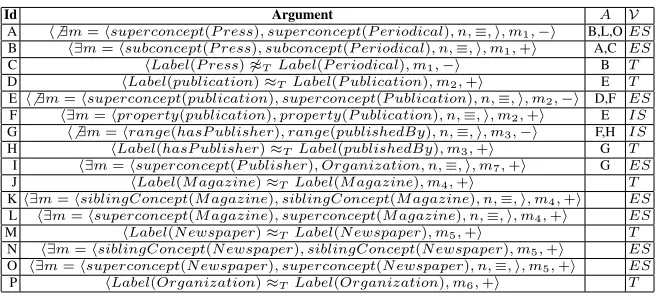
We can identify a set of arguments and the attacks between them. We assume that a set of arguments is generated by instantiating the argumentation schemes (Table 1), with respect to the interests and preferencesPref of the agents and taking into consideration the justifications G. Table 3 shows each argument, labeled with an identifierId, its
typeV, and the attacksAthat can be made on it by opposing arguments. Based upon
these arguments and the attacks, we can construct the argumentation frameworks which 12http://www.cs.toronto.edu/semanticweb/maponto/ontologies/BibTex.owl
13http://www.mondeca.com/owl/moses/univ.owl 14Note that ontologyO
2has been slightly modified for the purposes of this example. 15m
1 states an equivalence correspondence with confidencenbetween the conceptP ressin
Table 3.Arguments for and against the correspondencesm1,m2,m3,m4,m5andm6
Id Argument A V
A "' ∃m="superconcept(P ress), superconcept(P eriodical), n,≡,$, m1,−$ B,L,OES
B "∃m="subconcept(P ress), subconcept(P eriodical), n,≡,$, m1,+$ A,C ES
C "Label(P ress)'≈T Label(P eriodical), m1,−$ B T
D "Label(publication)≈T Label(P ublication), m2,+$ E T
E "' ∃m="superconcept(publication), superconcept(P ublication), n,≡,$, m2,−$ D,F ES
F "∃m="property(publication), property(P ublication), n,≡,$, m2,+$ E IS
G "' ∃m="range(hasP ublisher), range(publishedBy), n,≡,$, m3,−$ F,H IS
H "Label(hasP ublisher)≈T Label(publishedBy), m3,+$ G T
I "∃m="superconcept(P ublisher), Organization, n,≡,$, m7,+$ G ES
J "Label(M agazine)≈T Label(M agazine), m4,+$ T
K"∃m="siblingConcept(M agazine), siblingConcept(M agazine), n,≡,$, m4,+$ ES
L "∃m="superconcept(M agazine), superconcept(M agazine), n,≡,$, m4,+$ ES
M "Label(N ewspaper)≈T Label(N ewspaper), m5,+$ T
N "∃m="siblingConcept(N ewspaper), siblingConcept(N ewspaper), m5,+$ ES
O "∃m="superconcept(N ewspaper), superconcept(N ewspaper), n,≡,$, m5,+$ ES
P "Label(Organization)≈T Label(Organization), m6,+$ T
bring the arguments together so that they can be evaluated. These are shown in Figure 3, where nodes represent arguments (labelled with their Id) with the respective type valueV. The arcs represent the attacksA, whereas the direction of the arcs represents
the direction of the attack. By instantiating the general VAF according to their own preferences,Ag1andAg2obtain two possible argumentation frameworks, (a) and (b). In the argumentation framework (a), we have two arguments againstm1, and one for it: – Ais against the correspondencem1, since none of the super-concepts of theO1:P ressare
mapped to any super-concept ofO2:P eriodical.
– Bargues form1because two sub-concepts ofO1:P ress, (O1:M agazineandO1:N ewspaper),
are mapped to two sub-concepts ofO2:P eriodical, (O2:M agazineandO2:N ewspaper),
as established bym4andm5.
– Cargues againstm1, becauseP ressandP eriodicaldo not have any lexical similarity. Moreover, we have six arguments supporting the correspondencesm4,m5andm6.K,
LandMjustify the mappingm4, since, respectively, the labels ofO1:M agazineand
O2:M agazineare lexically similar; their siblings are mapped, as established bym5 and their super-concepts;O1:P ressandO2:P eriodicalare mapped bym1. There is a similar situation for the argumentsM,N andO. Clearly, argumentA attacks the
[image:10.612.144.471.117.266.2]argumentsLandO.
Fig. 3.Value-Based Argumentation Frameworks
In the second argumentation framework (b) we relate the following arguments:D
justifies the mappingm2, since the labels ofO1:publicationandO2:P ublicationare lexically similar. Their super-concepts, however, are not mapped (argumentE).
O2:publishedByare lexically similar; whereasIattacks the justification ofGstating that the ranges of these properties are similar, since a super-concept ofO1:P ublisher,
(O1:Organization), is already mapped toO2:Organization.Pstates thatO1:Organization andO2:Organizationare mapped since their labels are lexically similar.
The above analysis gives different, but sometimes overlapping reasons to argue for and against several candidate mappings. Given the audiences,R1andR2, the preferred extensions for the union of the argumentation frameworks (a) and (b) are:
Preferred Extensions for the union of (a) and (b) Audience
{A, C, J, K, M, N, D, F, I, H, P} R1 {A, C, J, K, M, N, D, F, I, H, P},{B, O, L, J, K, M, N, D, F, I, H, P} R2
{A, C, J, K, M, N, E, I, H, P},{B, O, L, J, K, M, N, E, I, H, P}
Therefore, the arguments accepted by both audiences are{I, H, J, K, M, N, P}.
ArgumentsA,C,D,E, andF are, however, all potentially acceptable, since both
au-diences can choose to accept them, as they appear in some preferred extension for each audience. This means that the mappingm1will be rejected (since B is unacceptable to R1), while the mappingsm3,m4,m5andm6will be all accepted (they are all accepted byR1and all acceptable toR2).m2will also be acceptable as the arguments support-ing it are in some preferred extension for these audiences. Theagreed alignmentsare thenm3,m4,m5andm6, while theagreeable alignmentism2. Interestingly, should an agent wish to reject the mappingsm2andm3, it can achieve this by considering a new audienceR3, whoes internal structure is valued more then external structure, which is valued more than terminology (IS%R3 ES%R3 T). In this case, the preferred
exten-sion from framework (b) is{E, G, I, P}, since the new preference allowsGto defeat
Hand resistI.Gwill also defeatFleavingEavailable to defeatD. This clearly shows
how the acceptability of an argument crucially depends on the audience to which it is addressed.
6 Summary and Outlook
interesting topic for future work would be to investigate how to argue about the whole alignments, and not only the individual candidate mapping. These arguments could oc-cur when a global similarity measure between the whole ontologies is applied.16
.
References
1. K. Aberer and et al. Emergent semantics principles and issues. InProceedings of Database
Systems for Advances Applications, 9th International Conference, DASFAA 2004, 2004.
2. T. Bench-Capon. Value based argumentation frameworks. InProceedings of Non Monotonic
Reasoning, pages 444–453, 2002.
3. T. Bench-Capon. Persuasion in practical argument using value-based argumentation frame-works. InJournal of Logic and Computation, volume 13, pages 429–448, 2003.
4. T. Berners-Lee, J. Hendler, and O. Lassila. The semantic web. Scientific American, 284(5):34–43, 2001.
5. R. Dhamankar, Y. Lee, A. Doan, A. Halevy, and P. Domingos. imap. InProceedings of the
International Conference on Management of Data (SIGMOD), pages 383–394.
6. S. Doutre, T. Bench-Capon, and P. E. Dunne. Determining preferences through argumenta-tion. InProceedings of AI*IA’05, pages 98–109, 2005.
7. P. Dung. On the acceptability of arguments and its fundamental role in nonmonotonic rea-soning, logic programming and n-person games. InArtificial Intelligence, volume 77, pages 321–358, 1995.
8. M. Ehrig and S. Staab. Qom - quick ontology mapping. InProceedings of the International
Semantic Web Conference, 2004.
9. J. Euzenat. Alignment infrastructure for ontology mediation and other applications. In Hepp, editor,Proceedings of the First International workshop on Mediation in semantic web
services, 2005.
10. J. Euzenat and P. Valtchev. Similarity-based ontology alignment in owl-lite. InProceedings
of European Conference on Artificial Intelligence (ECAI 04), 2004.
11. T. R. Gruber. A translation approach to portable ontology specifications.Knowledge
Acqui-sition, 5(2):199–220, 1993.
12. L. Laera, V. Tamma, J. Euzenat, T. Bench-Capon, and P. T. Reaching agreements over ontology alignments. InProceedings of the Fifth International Semantic Web Conference
(ISWC’06), 2006.
13. P. Shvaiko and J. Euzenat. A survey of schema-based matching approaches.Journal on data
semantics, 4:146–171, 2005.
14. P. Shvaiko, F. Giunchiglia, P. Pinheiro da Silva, and D. McGuinness. Web explanations for semantic heterogeneity discovery. InProceedings of ESWC, pages 303–317, 2005. 15. P. Visser, D. Jones, T. Bench-Capon, and M. Shave. Assessing heterogeneity by classifying
ontology mismatches. In N. Guarino, editor,Proceedings of the FOIS’98, 1998.
16AcknowledgementsThe research has been partially supported by Knowledge Web (FP6-IST