Accurate BER Analysis of QPSK Modulated
Asynchronous DS-CDMA Systems Communicating
over Rayleigh Channels
Xiang Liu and Lajos Hanzo
School of Electronics and Computer Science, University of Southampton, SO17 1BJ, UK, [email protected]
Abstract— The accurate average BER calculation of an asyn-chronous DS-CDMA system using random spreading sequences is studied in Rayleigh fading channels. An accurate closed-form expression is derived for the conditional characteristic function of the multiple access interference. An accurate BER expression is provided, which only requires a single numerical integration. Our numerical simulation results verify its accuracy, and also demonstrate the relative inaccuracy of the Gaussian approximation.
I. INTRODUCTION
Spread spectrum Code Division Multiple Access (CDMA) was originally invented for counteracting jamming in military communications and has experienced a rapid evoluation since the launch of the first commercial CDMA system in 1995. The Bit Error Ratio (BER) performance of Direct-Sequence (DS) CDMA systems has been extensively studied, especially in the context of BPSK [1]–[19] and QPSK [4], [5], [7], [9], [16], [19]–[26] modulation.
The accurate average Bit Error Ratio (BER) performance of a system can be evaluated by typically integrating, i.e. aver-aging the generic BER formula over all random parameters of all users, but this requires the evaluation of multiple embedded integrals [19], which is irrealistic when the number of users is high. Several techniques have been developed for simplifying the accurate BER calculation of various modulation schemes, such as the series expansion of [4], [16]–[18], [25], or the employment of Moment Generating Functions (MGF) [13] and Characteristic Functions (CF) [1], [2], [4], [15], [26]. Since the computational complexity of the accurate analysis is usually excessive, various Gaussian approximation techniques based on the Central Limit Theorem (CLT) have also been proposed for simplifying the calculation of the average BER performance. A few examples are the Standard Gaussian Ap-proximation (SGA) [1]–[3], [5], [6], [8]–[10], [15], [17]–[19], [22], [26], the Improved Gaussian Approximation (IGA) [1], [6], [10], [14], [17], [18], [22], [23], [26], the Simplified IGA (SIGA) [1], [6], [15], [18], [22], [26], as well as the Improved Holtzman’s Gaussian Approximation (IHGA) [15]. In addition to the calculation of the average BER performance,
The financial support of the EPSRC, UK and the EU in the framework of the NEWCOM, NEXWAY and PHOENIX projects is gratefully acknowledged.
BER bounds were also derived in [7], [8], [11], [22]. To avoid the complexity of the accurate BER analysis and the inaccuracy of various approximations, the SNR performance was investigated in [12], [20], [24].
In the existing literature, the achievable BER performance over AWGN channels is the most extensively studied sub-ject [4]–[12], [16]–[18], [20]–[23], [25], [26], but that over Rayleigh channels [1], [17] and Nakagami-m channels [2], [3], [13]–[15] was also lavishly documented. The BER per-formance attainable using both deterministic spreading se-quences [4], [7], [11], [13], [20], [21] and random spreading sequences [1]–[3], [5], [6], [8]–[10], [14]–[19], [22], [23], [25], [26] was also investigated.
However, to our knowledge, the accurate BER analysis of asynchronous DS-CDMA systems using random spreading se-quences and QPSK modulation for transmission over Rayleigh channels is an open problem. The BER performance of a similar system using BPSK modulation has been studied in [1]. Since QPSK has been favoured in existing systems [27], we will extend the results of [1] to the QPSK scenario in this paper. Due to the multiple access interference (MAI) induced crosstalk between the in-phase and quadrature-phase branches of QPSK systems, their BER performance is different from that of BPSK systems, although they are identical in the absence of MAI [28].
The organization of this paper is as follows. In Section II an asynchronous DS-CDMA system using I/Q modulation is considered in the context of a Rayleigh channel. Then in Section III an accurate BER expression based on the CF ap-proach is derived for the BER calculation of the system using random spreading sequences. In Section IV our numerical results are presented and finally, in Section V our conclusions are provided.
II. SYSTEMMODEL
We consider an asynchronous DS-CDMA system over a Rayleigh fading channel using the I/Q modulation, random spreading sequences and the rectangular chip waveform. As-sume that there areKsimultaneously transmitting users. Each user is assigned two random binary spreading sequences,
{a2k,m}Lm−=01 and {a2k+1,m}Lm−=01, having L chips for its in-phase and quadrature-in-phase branch, respectively. The kth user’s spreading sequences along with his/her data sequences,
{b2k,m}∞m=−∞ and{b2k+1,m}∞m=−∞, modulate the phase of the in-phase and quadrature-phase branch, respectively.
The rectangular pulse pT(t) having a duration of T is defined as:
pT(t) =
1, t∈[0, T),
0,otherwise. (1)
Hence the spreading signals{ai(t)}i=2k,2k+1and the data sig-nals {bi(t)}i=2k,2k+1 are expressed as follows, respectively:
ai(t) = ∞
m=−∞
ai,mpTc(t−mTc), (2)
bi(t) = ∞
m=−∞
bi,mpTs(t−mTs), (3)
whereTcandTsare the chip duration and the symbol duration, respectively, and satisfyingTs=LTc.
The received signalr(t)at the input of the coherent matched filter receiver is given by:
r(t) =
K−1 k=0
hk{a2k(t−τk)b2k(t−τk) cos[ωc(t−τk) +θk]
+a2k+1(t−τk)b2k+1(t−τk) sin[ωc(t−τk) +θk]}
+η(t), (4)
where η(t)is the zero-mean stationary Additive White Gaus-sian Noise (AWGN) having a double-sided power spectral den-sity of N0
2 ,ωcis the common carrier frequency,{θk}Kk=0−1and
{τk}Kk=0−1 are the phase shift and the time delay, respectively,
both of which are independently and uniformly distributed in [0,2π) and [0, Ts), respectively. The amplitude {hk}Kk=0−1 is mutually independent and Rayleigh distributed having a Probability Distribution Function (PDF) of fhk(x)expressed as:
fhk(x) =
x σk2
e−
x2
2σ2
k, x≥0,
0, x <0.
(5)
Without loss of generality, we assume that the 0th user’s signal is the desired one. If the phase and chip synchronization are perfect, the decision statistic of Z at the output of the correlation receiver matched to the 0th user’s signal is given by:
Z= 2
Tc
Ts
0 r(t)a0(t)Ψ(t) cos(ωct)dt
−j 2 Tc
Ts
0 r(t)a1(t)Ψ(t) sin(ωct)dt
=D+
K−1 k=1
Ik+η, (6)
whereD is the desired signal component,Ik is the co-channel interference component incurred by the kth user andηis the noise component.
The desired signalD can be expressed as:
D=DI+jDQ=h0L(b0,0+jb1,0), (7)
where DI and DQ are the in-phase and quadrature-phase components of the desired signal, respectively.
The noise component ηcan be shown to be a zero-mean complex-valued Gaussian variable having a variance ofση2=
2N0L
Tc . Hence its in-phase and quadrature-phase components,
ηI andηQ, are mutually independent, zero-mean real-valued Gaussian variables having a variance ofσ2ηI =ση2Q = NT0cL.
The co-channel interferenceIkincurred by thekth user can be expressed as:
Ik =IkI +jIkQ=hk(J2k,0cos ∆k−J2k+1,0sin ∆k
+jJ2k,1sin ∆k+jJ2k+1,1cos ∆k),(8) where II
k and IkQ are the in-phase and quadrature-phase co-channel interference components, respectively and ∆k =
−ωc(τk−τ0) + (θk−θ0)is the phase shift difference between
the kth user and the 0th user. The interference terms Ji,i,
i∈ {2k,2k+ 1}andi ∈ {0,1}, are given by [29]: Ji,i=bi,−1[ci,i(ξk−L)(1−νk) +ci,i(ξk+ 1−L)νk]
+bi,0[ci,i(ξk)(1−νk) +ci,i(ξk+ 1)νk], (9) whereξk=τk−τ0
Tc modL
,νk= (τk−τ0
Tc modL)−ξk . The aperiodic cross-correlation function between the pair of spreading sequences {akm}Lm−=01 and{aim}Lm−=01 both having a length ofL chips is defined as:
cki(ξ) =
L−1−ξ m=0
ak,mai,m+ξ,0≤ξ≤L−1, L−1+ξ
m=0
ak,m−ξai,m,−(L−1)≤ξ <0,
0, |ξ| ≥L.
(10)
Equation 10 becomes the aperiodic auto-correlation function ckk(ξ)when k=i.
III. BER ANALYSIS
In this section, we investigate the BER performance of an asynchronous DS-CDMA system conditioned on the0th user’s I/Q spreading sequences,{a0,m}Lm−=01 and{a1,m}Lm−=01. Hence we have that{∆k}Kk=0−1 and{νk}Kk=0−1 are independently and uniformly distributed over[0,2π)and[0, Tc), respectively, for the asynchronous system,{ai,m}mL−=01, i= 2k,2k+1are
mutu-ally independent and symmetricmutu-ally Bernoulli distributed [30], i.e. we have P{ai,m = ±1} = 1
2 for random
spread-ing sequences. Furthermore, the data bits {bi,m}∞m=−∞, i =
2k,2k+ 1are also assumed to be mutually independent and symmetrically Bernoulli distributed.
without the assumption of independence between these two branches.
A. Accurate Analysis
It has been shown in the context of BPSK modulation in [8] that the interference imposed by the(K−1)interfering users would be mutually independent, if and only if it was conditioned on the spreading sequence of the 0th user. It is readily to show that this is also valid for our system using I/Q modulation.
We will analyze the average in-phase BER, PI
e, of the 0th user. The average quadrature-phase BER,PQ
e , of the0th user may be derived in the same way. For the sake of simplifying the expression ofIkI in Equation 8, we define a set of(2L+2) random variables {Yi,m}Lm=0, i= 2k,2k+ 1 by:
Yi,m=
bi,−1ai,m−ξk+La0,m, m= 0, ..., ξk−1,
bi,0ai,m−ξka0,m, m=ξk, ..., L−2,
bi,−1ai,L−1−ξka0,0, m=L−1,
bi,0ai,L−1−ξkao,L−1, m=L.
(11)
Similar to [8], these random variables can be shown to be mutually independent and symmetrically Bernoulli distributed, if conditioned on{a0,m}Lm−=01. Hence the in-phase interference component IkI in Equation 8 can be rewritten as:
IkI =X2khkcos ∆k−X2k+1hksin ∆k, (12) where the random variables{Xi}i=2k,2k+1 are defined as:
Xi= L−2 m=0
Yi,m[(1−νk) +a0,ma0,m+1νk]
+Yi,L−1νk+Yi,L(1−νk), (13) and where the (L − 1) possible chip combinations of
{a0,ma0,m+1}Lm−=02 can be categorized into two sets according
to whether there is a chip value change or not. LetB andA denote the number of chip boundaries both with and without chip-value transitions within the0th user’s spreading sequence, respectively [8]. Then we have A+B =L−1andA−B=
L−2 m=0
a0,ma0,m+1=c0,0(1).
Since hk is a Rayleigh distributed random variable as defined in Equation 5 and ∆k is uniformly distributed in
[0,2π], the random variables, hkcos ∆k and−hksin ∆k, are independently and identically Gaussian distributed with zero-mean and variance of σk2 [30]. Hence IkI is also Gaussian distributed conditioned onX2kandX2k+1and its conditional
CF is given as follows:
ΦII
k|X2k,X2k+1(ω) = exp −
1 2
X22k+X22k+1
σk2ω2
(14)
Following a similar derivation to that in [1], the CF of II k conditioned onB can be expressed as:
ΦIIk|B(ω) = 2−2(L+1)
d1∈A
d2∈B
d3∈A
d4∈B
A
d1+A
2
B
d2+B
2
×
A
d3+A
2
B
d4+B
2
15
l=0
ΦIkI|λ0,λ1,λ2(ω), (15)
where the setsA,Bare defined as:
A={−A,−(A−2), ..., A−2, A},
B={−B,−(B−2), ..., B−2, B}. (16)
The conditional CFΦIkI|λ0,λ1,λ2(ω)is defined as:
ΦIkI|λ0,λ1,λ2(ω) =
exp −1 2λ0σ
2
kω2
, if λ1=λ2= 0, 1
λ1σk2ω2
1−exp−λ1σk2ω2
exp
−1
2λ0σ
2
kω2
,
if λ1= 0, λ2= 0,
√ π σkω
√
2λ2exp
1 2σ
2
kω2
λ21 λ2−λ0
×
erfc
λ√1σkω
2λ2
−erfc
σkω
λ2
2
1 + λ1 λ2
,
if λ2= 0,
(17)
where the complementary functionerfc(x)is defined as in [28] and the coefficientsλ0,λ1 andλ2 are given by:
λ0 = (d1+d2+Y2k,L)2+ (d3+d4+Y2k+1,L)2,
λ1 = (d1+d2+Y2k,L)(−2d2+Y2k,L−1−Y2k,L)
+ (d3+d4+Y2k+1,L)(−2d4+Y2k+1,L−1−Y2k+1,L),
λ2 = (−2d2+Y2k,L−1−Y2k,L)2
+ (−2d4+Y2k+1,L−1−Y2k+1,L)2.
(18)
Since the co-channel interference contributions {II k}Kk=1−1 conditioned on B are mutually independent [1], [8], the CF
of the total in-phase interferenceII =
K−1
k=1
IkI conditioned on
B is given by:
ΦII|B(ω) = K−1
k=1
ΦIkI|B(ω). (19)
Hence the in-phase BER of the0th user conditioned onB can be shown to be [1]:
PeI|B=
1 2−
σ0L √
2π
∞
0 ΦI|B(ω)Φη
I(ω) exp
−1
2σ
2 0L2ω2
dω, (20) where ΦηI(ω)is the CF of the in-phase noiseηI:
ΦηI(ω) = exp
−1
2σ
2
ηIω2
. (21)
Then the average in-phase BER of the0th user is obtained by averaging PI
e|B over all spreading sequences:
PeI = 2−(L−1) L−1
B=0
L−1
B
PeI|B. (22)
Following the same approach, we may conclude that the average quadrature-phase BER, PQ
e , of the 0th user has the same value as the average in-phase BER,PI
0 5 10 15 20 25 30
Number of users, K
10-2 2 5 10-1 2 5 100
BER
L=7
L=31
[image:4.595.53.286.53.233.2]BPSK accurate QPSK SGA QPSK simulation QPSk accurate
Fig. 1. The BER versus the number of usersK in an asynchronous DS-CDMA system using random spreading sequences and QPSK modulation. The length of the random spreading sequences isL= 7and31, respectively, the average power of all users at the receiver is equal and the background noise is ignored, i.e. whenγSNR=∞.
at the overall average BER, Pe, averaged over both the in-phase and quadrature-in-phase branches of the0th user, yielding:
Pe= 1
2(P
I
e +PeQ) =PeI. (23)
B. Standard Gaussian Approximation
Owing to its simplicity, the SGA is widely used for perfor-mance analysis, when the number of interferers is sufficiently high, where the MAI is assumed to be Gaussian owing to the CLT [30].
The variance of the interference IkI in Equation 12 can be obtained by averaging IkI over νk, hk, ∆k and all spreading sequences, yielding:
σI2I k =
4 3Lσ
2
k (24)
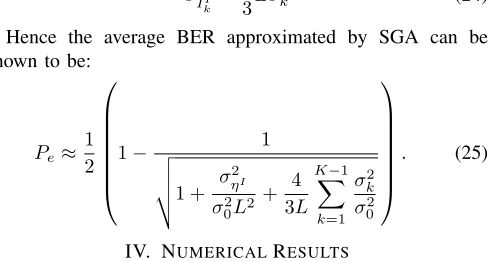
Hence the average BER approximated by SGA can be shown to be:
Pe≈1
2
1− 1
1 + σ2ηI
σ20L2 +
4 3L
K−1
k=1
σk2 σ02
. (25)
IV. NUMERICALRESULTS
We will compare the results obtained by our accurate analysis provided in Section A, by the SGA of Section III-B, by the BPSK system of [1] and those of our simulations described in this section.
Figure 1 shows that the results obtained by our accurate analysis exactly match those obtained by simulations for two different-length random spreading sequences, when using
0 2 4 6 8 10 12 14 16 18 20
SNR (dB)
10-2 2 5 10-1 2 5 100
BER
L=7
L=31
BPSK accurate QPSK SGA QPSK simulation QPSK accurate
Fig. 2. The BER versus per-bit SNR in an asynchronous DS-CDMA system using random spreading sequences and QPSK modulation. The length of the random spreading sequences isL= 7and31, respectively, the average power of all users at the receiver is equal. The number of users isK= 4.
L = 7 and 31. However, the SGA over-estimates the BER, especially in the scenario, where there is a low number of interfering users and when short spreading sequences are used. The BER of QPSK system is higher than that of BPSK systems due to the cross-talk between the in-phase and quadrature-phase branches.
Similar to Figure 1, Figure 2 also shows that the results obtained by our accurate analysis match those obtained by simulation for both different-length random spreading se-quences, i.e. forL= 7and31. By contrast, the SGA slightly over-estimates BER, particularly, when the SNR is high and where short spreading sequences are used. The BER of QPSK systems is higher than that of BPSK systems due to the cross-talk between the in-phase and quadrature-phase branches.
V. CONCLUSION
In this paper we investigated the average BER performance of an asynchronous DS-CDMA system using I/Q modulation and random spreading sequences, when communicating over Rayleigh channels. A new closed-form expression was derived for the conditional CF of the MAI. Furthermore, an accu-rate expression based on the CF approach was provided for calculating the average BER of the system, which requires only a single integration. The accuracy of our accurate BER expression was confirmed by our simulation results for various spreading sequence lengths. By contrast, the limited accuracy of the SGA was also demonstrated, which becomes more prevalent when a low number of interferers is encountered and short spreading sequences are used.
ACKNOWLEDGEMENT
[image:4.595.316.546.54.233.2] [image:4.595.56.301.493.624.2]REFERENCES
[1] J. Cheng and N. Beaulieu, “Accurate DS-CDMA Bit-Error Probability Calculation in Rayleigh Fading,”IEEE Transactions on Wireless Com-munications, vol. 1, no. 1, pp. 3–15, January 2002.
[2] ——, “Precise Bit Error Rate Calculation for Asynchronous DS-CDMA in Nakagami Fading,” inIEEE Global Telecommunications Conference, vol. 2, San Francisco, CA, 27 September-1 December 2000, pp. 980– 984.
[3] T. Eng and L. B. Milstein, “Coherent DS-CDMA Performance in Nakagami Multipath Fading,”IEEE Transactions on Communications, vol. 43, no. 2/3/4, pp. 1134–1143, February/March/April 1995. [4] E. A. Geraniotis and M. B. Pursley, “Error Probability for
Direct-Sequence Spread-Spectrum Multiple-Access Communications–Part II: Approximations,”IEEE Transactions on Communications, vol. 30, no. 5, pp. 985–995, May 1982.
[5] E. Geraniotis and B. Ghaffari, “Performance of Binary and Quater-nary Direct-Sequence Spread-Spectrum Multiple-Access Systems with Random Signature Sequences,”IEEE Transactions on Communications, vol. 39, no. 5, pp. 713–724, May 1991.
[6] J. M. Holtzman, “A Simple, Accurate Method to Calculate Spread-Spectrum Multiple-Access Error Probabilities,”IEEE Transactions on Communications, vol. 40, no. 3, pp. 461–464, March 1992.
[7] D. Laforgia, A. Luvison, and V. Zingarelli, “Bit Error Rate Evaluation for Spread-Spectrum Multiple-Access Systems,”IEEE Transactions on Communications, vol. 32, no. 6, pp. 660–669, June 1984.
[8] J. S. Lehnert and M. B. Pursley, “Error Probabilities for Binary Direct-Sequence Spread-Spectrum Communications with Random Signature Sequences,”IEEE Transactions on Communications, vol. 35, no. 1, pp. 87–98, January 1987.
[9] ——, “Multipath Diversity Reception of Spread-Spectrum Multiple-Access Communications,” IEEE Transactions on Communications, vol. 35, no. 11, pp. 1189–1198, November 1987.
[10] J. R. K. Morrow and J. S. Lehnert, “Bit-to-Bit Error Dependence in Slotted DS/SSMA Packet Systems with Random Signature Sequences,”
IEEE Transactions on Communications, vol. 37, no. 10, pp. 1052–1061, October 1989.
[11] M. B. Pursley, D. V. Sarwate, and W. E. Stark, “Error Probability for Direct-Sequence Spread-Spectrum Multiple-Access Communications– Part I: Upper and Lower Bounds,”IEEE Transactions on Communi-cations, vol. 30, no. 5, pp. 975–984, May 1982.
[12] M. B. Pursley, “Performance Evaluation for Phase-Coded Spread-Spectrum Multiple-Access Communication–Part I: System Analysis,”
IEEE Transactions on Communications, vol. 25, no. 8, pp. 795–799, August 1977.
[13] Q. Shi and M. Latva-Aho, “Accurate Bit-Error Rate Evaluation for Synchronous MC-CDMA over Nakagami-m-Fading Channels Using Moment Generating Functions,”IEEE Transactions on Wireless Com-munications, vol. 4, no. 2, pp. 422–433, March 2005.
[14] K. Sivanesan and N. C. Beaulieu, “Accurate BER Analysis of Bandlim-ited DS-CDMA System with EGC and SC Diversity over Nakagami Fading Channels,” inIEEE Wireless Communications and Networking Conference, vol. 2, New Orleans, Louisiana, USA, 13-17 March 2005, pp. 956–960.
[15] ——, “Performance Analysis of Bandlimited DS-CDMA Systems in Nakagami Fading,” inIEEE International Conference on Communica-tions, vol. 1, Paris, France, 20-24 June 2004, pp. 400–404.
[16] M. O. Sunay and P. J. McLane, “Comparison of Biphase Spreading to Quadriphase Spreading in DS CDMA Systems that Employ Long PN Sequences,” inSixth IEEE International Symposium on Personal, Indoor and Mobile Radio Communications, vol. 1, Toronto, Canada, 27-29 September 1995, pp. 237–242.
[17] ——, “Calculating Error Probabilities for DS-CDMA Systems: When Not to Use the Gaussian Approximation,” inIEEE Global Telecommu-nications Conference, vol. 3, London, UK, 18-22 November 1996, pp. 1744–1749.
[18] ——, “Sensitivity of a DS CDMA System with Long PN Sequences to Synchronization Errors,” inIEEE International Conference on Commu-nications, vol. 2, Seattle, WA, USA, 18-22 June 1995, pp. 1029–1035. [19] C. Unger and G. P. Fettweis, “Analysis of the RAKE Receiver Per-formance in Low Spreading Gain DS/SS Systems,” in IEEE Global Telecommunications Conference 2002, vol. 1, 17-21 November 2002, pp. 830–834.
[20] F. D. Garber and M. B. Pursley, “Performance of Offset Quadriphase Spread-Spectrum Multiple-Access Communications,” IEEE Transac-tions on CommunicaTransac-tions, vol. 29, no. 3, pp. 305–314, March 1981. [21] R. T. Hsu and J. S. Lehnert, “A Characterization of Multiple-Access
Interference in Generalized Quadriphase Spread-Spectrum Communica-tions,”IEEE Transactions on Communications, vol. 42, no. 2/3/4, pp. 2001–2010, FEBRUARY/MARCH/APRIL 1994.
[22] T. M. Lok and J. S. Lehnert, “Error Probabilities for Generalized Quad-riphase DS/SSMA Communication Systems with Random Signature Sequences,”IEEE Transactions on Communications, vol. 44, no. 7, pp. 876–885, July 1996.
[23] A. Mirbagheri and Y. C. Yoon, “Performance Analysis of a Linear MMSE Receiver for Bandlimited Random-CDMA Using Quadriphase Spreading over Multipath Channels,” IEEE Transactions on Wireless Communications, vol. 3, no. 4, pp. 1053–1066, July 2004.
[24] J. E. Salt and S. Kumar, “Effects of Filtering on the Performance of QPSK and MSK Modulation in D-S Spread Spectrum Systems Using RAKE Receivers,”IEEE Journal on Selected Areas in Communications, vol. 12, no. 4, pp. 707–715, May 1994.
[25] M. O. Sunay and P. J. McLane, “Effects of Carrier Phase and Chip Tim-ing Errors on the Capacity of a Quadriphase Spread BPSK Modulated DS-CDMA System,” inIEEE Global Telecommunications Conference, vol. 2, Singapore, 13-17 November 1995, pp. 1114–1120.
[26] Y. C. Yoon, “Quadriphase DS-CDMA with Pulse Shaping and the Accuracy of the Gaussian Approximation for Matched Filter Receiver Performance Analysis,” IEEE Transactions on Wireless Communica-tions, vol. 1, no. 4, pp. 761–768, October 2002.
[27] 3GPP TS 25.213 V6.3.0,Spreading and Modulation (FDD), 3rd Gen-eration Partnership Project, June 2005, http://www.3gpp.org/. [28] J. G. Proakis,Digital Communications, 4th ed. McGraw-Hill
Compa-nies, Inc., 2001.
[29] R. T. Hsu and J. S. Lehnert, “A Characterization of Multiple-Access Interference in Generalized Quadriphase Spread-Spectrum Communica-tions,”IEEE Transactions on Communications, vol. 42, no. 2/3/4, pp. 2001–2010, February/March/April 1994.
[30] A. Papoulis,Probability, Random Variables, and Stochastic Processes, 3rd ed. McGraw-Hill, Inc., 1991.