Developing an Integrated Trust and Reputation Model for
Open Multi-Agent Systems
Dong Huynh, Nicholas R. Jennings, Nigel R. Shadbolt
School of Electronics and Computer Science
University of Southampton, UK.
{
tdh02r,nrj,nrs
}
@ecs.soton.ac.uk.
Abstract
Trust and reputation are central to effective interactions in open multi-agent systems in which agents, that are owned by a variety of stakeholders, can enter and leave the system at any time. This openness means existing trust and reputa-tion models cannot readily be used. To this end, we present FIRE, a trust and reputation model that integrates a number of information sources to produce a comprehensive assess-ment of an agent’s likely performance. Specifically, FIRE in-corporates interaction trust, role-based trust, witness repu-tation, and certified reputation to provide a trust metric in most circumstances. FIRE is empirically benchmarked and is shown to help agents effectively select appropriate inter-action partners.
1. INTRODUCTION
A wide variety of networked computer systems (such as the Grid, the Semantic Web, and peer-to-peer systems) can be viewed as multi-agent systems (MAS) in which the indi-vidual components act in an autonomous and flexible man-ner in order to achieve their objectives [7]. An important class of these systems are those that are open; here defined as systems in which agents can freely join and leave at any time and where the agents are owned by various stakehold-ers with different aims and objectives. From these two fea-tures, it can be assumed that in open MAS: (1) the agents are likely to be unreliable and self interested; (2) no agent can know everything about its environment; and (3) no cen-tral authority can control all the agents.
Despite these many uncertainties, a key component of such systems is the interactions that necessarily have to take place between the agents. Moreover, as the individu-als only have incomplete knowledge about their environ-ment and their peers, trust plays a central role in facilitat-ing these interactions [9, 4]. Specifically, trust is here de-fined as the subjective probability with which an agenta
assesses that another agentbwill perform a particular ac-tion, both beforeacan monitor such action and in a context in which it affects its own action (adapted from [4]). Gener-ally speaking, trust can arise from two views: the individual and the society level. The former consists of agenta’s di-rect experiences from interactions with agentband the var-ious relationships that may exist between them (e.g. owned by the same organisation, relationships derived from rela-tionships between the agents’ owners in the real life such as friendship or relatives, relationships between a service provider agent and its registered consumer agents). The lat-ter consists of observations by the society of agentb’s past behaviour (here termed its reputation). These indirect ob-servations are aggregated in some way to define agentb’s past behaviour based on the experiences of all the partici-pants in the system.
Given its importance, a number of computational mod-els of trust and reputation have been developed (see Section 4), but none of them are well suited to open MAS. Specifi-cally, given the above characteristics, in order to work effi-ciently in an open MAS, a trust model needs to possess the following properties:
1. It should take into account a variety of sources of trust information in order to have a more precise trust mea-sure (by cross correlating several perspectives) and to cope with the situation that some of the sources may not be available.
2. Each agent should be able to evaluate trust for itself. Given the ‘no central authority’ nature of an open MAS, agents will typically be unwilling to rely solely on a single centralised trust/reputation service.
3. It should be robust against possible lying from agents (since the agents are self-interested).
To deal with these requirements, we developed a new trust and reputation model called FIRE1. In so doing, we
vance the state of the art in the following ways. We devel-oped a modular model that integrates four different types of trust and reputation: interaction trust (resulting from past experiences from direct interactions), role-based trust (defined by various role-based relationships between the agents), witness reputation (reports of witnesses about an agent’s behaviour), and certified reputation (references pro-vided by other agents about the agent’s behaviour). This breadth is important in our domain because it enables an agent to combine a variety of alternative sources of informa-tion (to cope with the inherent uncertainties) and because in various circumstances not all of these sources will be read-ily available (but a measure of trust is nevertheless needed to interact).
Of particular relevance is the introduction of a novel type of reputation — certified reputation. The other more tradi-tional ways of building a trust measure (i.e. interaction and role-based trust and witness reputation) have certain limita-tions. For example, if agentahas not interacted withb be-fore, it has no information to calculate its interaction trust. In the case of witness reputation,amay not be able to find relevant witness ratings aboutb, or the search process may take too long to finish. Finally, there may be no role-base re-lationships withb. If all these things happen at the same time (e.g. agentahas just joined the environment), agentawill not be able to assess agentb’s trustworthiness. In such sit-uations, if agentb can present certified information about its past performance toa(in the form of references from other agents who have interacted with it), agentawill then be able to make some assessment of its trustworthiness.
The remainder of the paper is organised as follows. In the next section, we will present the FIRE model and its com-ponents. The model will then be empirically evaluated in Section 3. Section 4 presents related work in the area. Fi-nally, Section 5 concludes this paper and outlines the future work.
2. The FIRE model
FIRE is an integrated trust and reputation model consist-ing of four main components: interaction trust, role-based trust, witness reputation, and certified reputation. Each of these components will be presented in turn and Section 2.5 will then show how these components are combined to pro-vide a single measure.
2.1. Interaction trust
Interaction trust (IT) models the trust that ensues from the direct interactions between two agents. Here we sim-ply exploit the direct trust component of Regret [10] since
passing through the raging fire flames.
this meets all our requirements for dealing with direct ex-periences. In more detail, consider a commercial transac-tion where agentabuys a particular product from agentb. The outcome of the transaction may consist of the prod-uct price, prodprod-uct quality, and the delivery date. From this outcome, agentamay give ratings about agentb’s service in terms of price, quality, and delivery for that particular interaction. Ratings are thus tuples in the following form:
r = (a, b, i, c, v),whereaandbare the agents that partic-ipated in the interactioni, andv is the ratingagavebfor the termc (e.g. price, quality, delivery). The range ofvis
[−1,+1], where−1means absolutely negative,+1means absolutely positive, and0means neutral or uncertain.
In order to calculate IT from past experiences, an agent needs to record its past ratings in a (local) rating database. This database stores at maximum theHlatest ratings that the agent gave to the each partner that it has interacted with. HereHis called the local rating history size. When calcu-lating the IT value for agentbwith respect to termc, agent
ahas to query its database for all the ratings that have the form(a, b, , c, ), where the ‘ ’ symbol can be replaced by any value. We call the set of those ratingsRL(a, b, c). Then
the IT (denoted byTI) is calculated as the weighted mean
of the rating values of all the ratings in the set:
TI(a, b, c) =
X
ri∈RL(a,b,c)
ω(ri)·vi, (1)
whereviis the value of the ratingriandω(ri)is the weight
corresponding tori. The weightω(ri)for each rating is
se-lected such that it gives more weight to more recent rat-ings, with a constraint thatPr
i∈RL(a,b,c)ω(ri) = 1. This
is to ensure that the trust valueTI(a, b, c) is in the range
[−1,+1].
In FIRE, each trust value comes with a reliability rat-ing that reflects the confidence of the trust model in produc-ing that trust value given the data it took into account. This value is built from the two following measures:
• ρN(a, b, c): the reliability measure based on the
num-ber of ratings that have been taken into account in com-putingTI. As the number of these ratings (n) grows,
the degree of reliability increases until it reaches a de-fined threshold (called the rating intimacy threshold, and denoted bym).
ρN(a, b, c) =
½ n
m whenn≤m
1 whenn > m , (2)
wheren is the cardinality of the set R(a, b, c). The value of functionmn ranges from0to1fornin[0, m]. Hence, the reliabilityρN(a, b, c)increases from0to1
• ρD(a, b, c): the rating deviation reliability. The greater
the variability in the rating values, the more volatile the other agent is likely to be in fulfilling its agreements:
ρD(a, b, c) = 1−
1 2·
X
ri∈RL(a,b,c)
ω(ri)·|vi−TI(a, b, c)|,
(3)
Then, the reliability measure of IT (called ρTI(a, b, c)) is
defined by the following formula:
ρTI(a, b, c) =ρN(a, b, c)·ρD(a, b, c) (4)
2.2. Role-based trust
Role-based trust (RT) models the trust resulting from the role-based relationships between two agents (e.g. owned by the same company, a service provider and its regis-tered user, friendship relationship of their owners). Since there is no general method for computationally quantify-ing trust based on this type of relationship, we use rules to assign RT values. This means end users can add new rules to customise this component to suit their particu-lar applications. Rules are tuples of the following form: rul = (rolea,roleb, c, vD, eD), which describes a rule that
ifroleaandrolebare the roles of agentaandbrespectively,
then the expected performance ofbin an interaction witha isvD(vD∈[−1,1]) with respect to the termc;eD∈[0,1]
is the default level of influence of this rule on the result-ing RT value. For example, possible rules may be:
rul1= (buyer,seller,quality,−0.2,0.3),
rul2= (friend-buyer,friend-seller,quality,0,0.6), and
rul3= (,government-seller,quality,0,0.9).
rul1expresses an agent’s belief that an ordinary seller will
usually sell a product of slightly lower quality than agreed, but the reliability of this belief is low (0.3);rul2is the
be-lief that in a close partnership the buying agent can expect the seller to do what is agreed in terms of product qual-ity; and this is also true for a governmental seller almost all of the time (rul3).
Each agent has its own set of rules which are stored in a (local) rule database. In order to determine the RT with an agentb, agentalooks up the relevant rules from its rule database. Then the value of RT is given by the following for-mula:
TR(a, b, c) =
P
ruli∈Rules(a,b,c)eDi·vDi
P
ruli∈Rules(A,B,c)eDi
, (5)
where ruli = (rolea,roleb, c, vDi, eDi) is a rule in the
set of rulesRules(A, B, c). This set is a subset of the rule database in which only the rules that are relevant to the roles ofa, the roles ofb, and the termcare selected.
Since the rules for RT are specified by the agent’s owner, the reliability of RT also needs to be set by the agent’s owner. We useρTR(a, b, c), again in the range[0,1], to
de-note this value. A reliability measure that can be used for role-based trust is:
ρTR(a, b, c) =
P
ruli∈Rules(a,b,c)eDi
|Rules(a, b, c)| , (6)
where|Rules(a, b, c)|is the cardinality of the set of rules.
2.3. Witness reputation
The witness reputation (WR) of a target agent b is built on observations about its behaviour by other agents (wit-nesses). In order to evaluate the WR ofb, an agentaneeds to find the witnesses that have interacted withb. In this com-ponent, we use a variant of the referral system in [12] to find such witnesses. In our system, agents cooperate by giv-ing, pursugiv-ing, and evaluating referrals (a recommendation to contact another agent). Each agent in the system main-tains a list of acquaintances (other agents that it knows). Thus, when looking for a certain piece of information, an agent can send the query to a number of its acquaintances who will try to answer the query if possible or, if they can-not, they will send back referrals pointing to other agents that they believe are likely to have the desired information.
In this model, each agent has a measure of the degree of likeliness with which an agent can fulfil an informa-tion query. This measure needs to be defined in an applica-tion specific manner. For example, in our testbed (described in Section 3.1), an agent is assumed to know local agents (those who are near to it) better and so we use the distance between an acquaintance and the target agent as the knowl-edge measure. Thus the nearer to the target agent, the more likely the acquaintance is to know it. When an agenta as-sesses the WR of an agentbwith respect to a termc, denoted byTW(a, b, c), it sends out a query for ratings of the form
(, b, , c, ) tonBF (called the branching factor)
acquain-tances that are likely to have relevant ratings on agentband termc. These acquaintances, upon receiving the query, try to match it to their own (local) rating databases. If they find matching ratings, it means they have had interactions with
b, and they will return the ratings found toa. If they can-not find the requested information, they will return refer-rals identifying theirnBFacquaintances that they believe are
most likely to have the relevant ratings to the query so that
acan look further. This process continues untilafinds suf-ficient witnesses or the lengths of its referral chains reach a defined threshold denoted bynRL(because the further the
witness is froma, the less reliable/relevant its information is to it). The general formula for WR is as follows:
TW(a, b, c) =
X
ri∈RW(a,b,c)
whereRW(a, b, c) is the set of witness ratings found by
agenta, the weightω(ri)for each rating is defined as per
Section 2.1, andvi is the rating value ofri. The
reliabil-ity measure for WR (denoted byρTW(a, b, c)) is also
de-fined from the ratings inRW(a, b, c)as per Section 2.1.
2.4. Certified reputation
Certified reputation (CR) are ratings presented by the rated agent (agentb) about itself which have been obtained from its partners in past interactions [6]. These ratings are cer-tifications (provided by the rating agents) of agentb’s past performance (somewhat like a reference when applying for a job). They allow an agent to prove its achievable perfor-mance as viewed by previous interaction partners2. Since agentb can choose which ratings it puts forward, a ratio-nal agent will only present its best ratings. Therefore, we should assume that CR information probably overestimates an agent’s expected behaviour. Thus, although it cannot guarantee agentb’s performance in future interactions, the CR information does reveal a partial perspective on agent
b’s past behaviour. The main benefit of this type of infor-mation is its high availability. With the cooperation of its partners, agentbcan have CR information from just a small number of interactions. Therefore, CR is available to agents in most circumstances; even in situations where the other components may fail to provide a trust measure.
In more detail, the process of CR is as follows:
• After every transaction,basks its partners to provide their ratings about its performance which it stores in its databases.
• Whenacontactsb to express its interest in usingb’s service it asksb to provide references about its past performance.
• Agentareceives the ratings ofbfromb. It assesses the ratings’ reliability and calculates a trust value for b. Specifically, the value of CR,TC(a, b, c), and its
relia-bility,ρTC(a, b, c), are calculated as per the WR
com-ponent, but the input is the set of ratings provided by the target agentbitself.
2.5. An overall value
We combine the aforementioned trust/reputation val-ues into a single composite measure to give an overall pic-ture of an agent’s likely performance. Specifically, we
2 It is assumed that some form of security mechanism (such as a public-key infrastructure) is employed to ensure that the provided references cannot be tampered with.
use the weighted mean method to calculate the compos-ite trust value (T(a, b, c)) and its reliability (ρT(a, b, c)):
T(a, b, c) =
P
k∈{I,R,W,C}wk· Tk(a, b, c)
P
k∈{I,R,W,C}wk
(8)
ρT(a, b, c) =
P
k∈{I,R,W,C}wk
P
k∈{I,R,W,C}Wk
(9)
wherewk =Wk·ρTk(a, b, c), andWI,WR,WW,WCare
the coefficients corresponding to the IT, RT, WR, and CR components. These coefficients are set by end users to re-flect the importance of each component in a particular ap-plication.
3. EMPIRICAL EVALUATION
In order to empirically evaluate FIRE, we design a testbed characterising an open MAS (Section 3.1). The methodol-ogy used for the evaluation is then described in Section 3.2. The two last sections (Section 3.3 and 3.4) present the ex-periments and their results. The former shows the overall performance of FIRE, and the latter shows the contributions of each of FIRE’s component to its overall performance.
3.1. The testbed
The testbed environment for evaluating FIRE is a multi-agent system consisting of multi-agents providing services (called providers) and agents using those services (called con-sumers). Without loss of generality, it is assumed that there is only one type of service in the testbed. Hence, all the provider agents offer the same service. However, their per-formance (i.e. the quality of the service) differs. The agents are situated randomly on a spherical world whose radius is
1.0(see Figure 1). Each agent has a radius of operation (ro
— depicted by a dotted circle around an agent in Figure 1) that models the agent’s capability in interacting with oth-ers (e.g. the available bandwidth or the agent’s infrastruc-ture) and any agents situated in that range are the agent’s neighbours.
P C 1 C3
C2
[image:5.595.319.554.75.229.2]ro
Figure 1. The spherical world and a path from consumerC1(throughC2andC3) to provider P based on neighbourhood.
on the level of performance of the provider in that interac-tion. A provider agent can serve many users at a time.
After an interaction, the consumer agent will rate the ser-vice of the provider based on the level of performance it re-ceived. It records the rating for subsequent trust evaluations and also informs the provider about the rating it made. The provider may record the rating as evidence about its perfor-mance to be presented to potential consumers3.
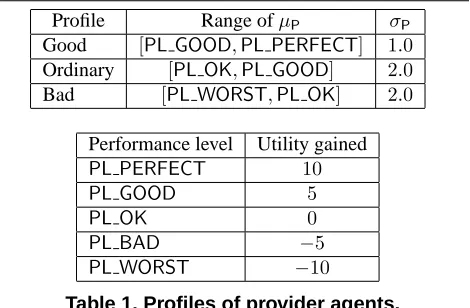
In our testbed the only difference in each situation is the performance of the provider agents. We consider four types of provider agents: good, ordinary, bad, and intermittent. Each of them, except the last, has a mean level of perfor-mance (µP). Its actual performance follows a normal
dis-tribution around this mean. The values ofµPand the
asso-ciated standard deviation (σP) of these types of providers
are given in Table 1. Intermittent providers, on the other hand, yield unpredictable (random) performance levels in the range [PL BAD,PL GOOD]. In addition, the service quality of a provider is also degraded linearly in propor-tion to the distance between the provider and the consumer to reflect the greater uncertainties associated with service delivery (e.g. increased delays or losses in information ex-changes between two agents when they are far away from each other that affect the service quality).
Moreover, in order to simulate different levels of dy-namism of an open MAS, a number of factors of the testbed are changed after each round:
• The population of agents: In an open MAS, agents can come and leave the system at anytime. This is sim-ulated by removing a number of randomly selected agents from the testbed and adding new agents into it. The numbers of agents added and removed after each
3 It is assumed that all agents are honest in exchanging information in this testbed. The problem of strategic behaviour in reporting this in-formation will be considered in future work.
Profile Range ofµP σP
Good [PL GOOD,PL PERFECT] 1.0
Ordinary [PL OK,PL GOOD] 2.0
Bad [PL WORST,PL OK] 2.0
Performance level Utility gained
PL PERFECT 10
PL GOOD 5
PL OK 0
PL BAD −5
PL WORST −10
Table 1. Profiles of provider agents.
round vary, but have an upper limit of some predefined percentage of the whole population. The population change limits for the consumer and the provider pop-ulations are denoted respectively bypCPC andpPPC.
Since providers are usually more established than con-sumers,pPPCis set to be lower thanpCPCin our
simu-lations. The characteristics of the newly added agents are set randomly but they are uniformly distributed over the the initial agent populations (i.e. the propor-tions of providers of different profiles and that of con-sumers in different groups are maintained).
• The locations of agents: During their life cycle, agents break old relationships and make new ones (reflecting the notion of continual change that are inherent in open MAS). In our testbed, this type of change is reflected by the change in an agent’s location on the spherical world. When a consumer changes its location, it will have a new set of neighbours according to itsro. In
ad-dition, the location of an agent in the testbed also re-flects its individual situation covering things such as its knowledge about other local agents (see Section 2.3) and the service delivery between providers and con-sumers (see above). Therefore, changing an agent’s lo-cation changes its relationships with others, as well as its individual situation. Specifically, we use the polar coordination(r, ϕ, θ)for agent locations on the spher-ical world. Then in order to change an agent’s location, amounts of angular changes ∆ϕ and ∆θ are added toϕandθrespectively.∆ϕand∆θare selected ran-domly in[−∆φ,+∆φ]. Thus,∆φlimits the variability of agents’ locations. Not every agent changes its loca-tions every round and, in particular,pCLCandpPLCare
used to denote the probabilities that a consumer or a provider respectively changes its location in a round.
good reputation and decide to perform selfishly to ob-tain better utility). In our testbed, the average perfor-mance of a provider (µ) is changed by an amount of
∆µrandomly selected in[−M,+M], and this happens in each round with the probability ofpµC. Moreover,
after each round, a provider can switch to a completely new provider profile with a probability ofpProfileSwitch.
The values of the variables above are selected to reflect en-vironments that have varying degrees of dynamism (see Ta-ble 2) ranging from0(completely static) to3 (highly dy-namic).
Level 0 1 2 3
pCPC 0% 1% 2% 5%
pPPC 0% 0% 1% 2%
pµC 0% 5% 5% 10%
M 0.0 0.5 1.0 1.0
pProfileSwitch 0% 1% 2% 4%
pCLC 0% 2% 5% 10%
pPLC 0% 2% 5% 10%
∆φ 0 π
[image:6.595.313.555.122.454.2]40 40π 20π
Table 2. Levels of dynamism of the testbed.
3.2. Experimental methodology
In each experiment, the testbed is populated with provider and consumer agents. Each consumer agent is equipped with a particular trust model, which helps it select a provider when it needs to use a service. Since the only difference among consumer agents is the trust models that they use, the utility gained by each agent through simulations will re-flect the performance of its trust model in selecting reliable providers for interactions. Therefore, the testbed records the
UGof each interaction along with the trust model used. In order to obtain an accurate result for performance compar-isons between trust models, each one will be employed by a large number of consumer agents (NC). In addition, the
av-erageUGof agents employing the same trust models (called consumer groups) are compared with each other’s using the two-samplet-test [2] (for means comparison) with the con-fidence level of95%. The result of an experiment is then presented in a graph with two y-axes; the first plots theUG
means of consumer groups in each interaction and the sec-ond plots the correspsec-onding performance rankings obtained from thet-test (prefixed byR., where the group of rank2 outperforms that of rank1). Each experiment is repeated for each level of dynamism from0 to3to show how dy-namism affects the performance of trust models. The exper-imental variables for the various experiments are presented
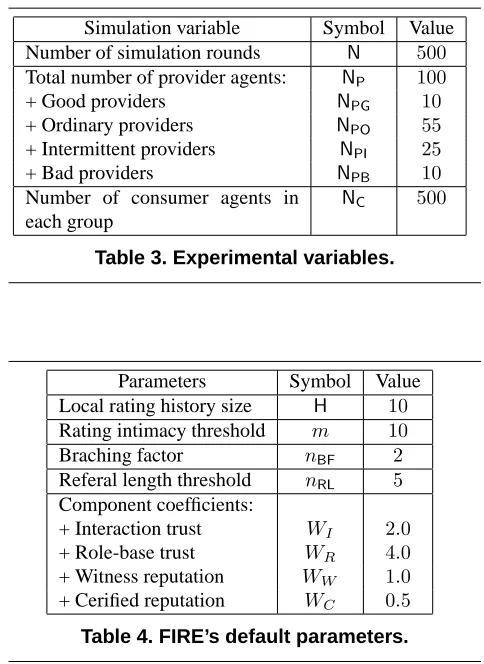
in Table 3 and their values will be used in all cases unless otherwise specified. The parameters of FIRE that are set for the experiments are also shown in Table 4.
Simulation variable Symbol Value Number of simulation rounds N 500 Total number of provider agents: NP 100
+ Good providers NPG 10
+ Ordinary providers NPO 55
+ Intermittent providers NPI 25
+ Bad providers NPB 10
Number of consumer agents in each group
[image:6.595.318.553.126.260.2]NC 500
Table 3. Experimental variables.
Parameters Symbol Value Local rating history size H 10 Rating intimacy threshold m 10
Braching factor nBF 2
Referal length threshold nRL 5
Component coefficients:
+ Interaction trust WI 2.0
+ Role-base trust WR 4.0
+ Witness reputation WW 1.0
+ Cerified reputation WC 0.5
Table 4. FIRE’s default parameters.
3.3. Overall performance of FIRE
In order to evaluate the overall performance of FIRE, we compare it with the SPORAS model4 (whose operation is described in Section 4) and a group of agents with no trust model. Hence, there are three groups of consumer agents:
FIRE,SPORAS, andNoTrust.
As can be seen from Figure 2, in a static environment (dynamism level 0), theNoTrustgroup, selecting providers randomly without any trust evaluation, performs consis-tently the lowest; andFIREoutperformsSPORAS, the sec-ond rank, throughout the interactions. It should be noted that SPORAS, being a centralised model, gathers much more
[image:6.595.65.292.225.347.2]1 -0 1 2 3 4 5 6 7 8 1 8 1 1 6 1 1 4 1 1 2 1 1 0 1 1 8 1 6 1 4 1 2 1 n o i t c a r e t n I U G 2 -1 -0 1 2 3 4 5 R a n k t s u r T o
N SPORAS FIRE R.NoTrust R.FIRE R.SPORAS
(a) Dynamism level 0
0 1 2 3 4 5 6 7 8 1 8 1 1 6 1 1 4 1 1 2 1 1 0 1 1 8 1 6 1 4 1 2 1 n o i t c a r e t n I U G 2 -1 -0 1 2 3 4 5 R a n k t s u r T o
N SPORAS FIRE R.NoTrust R.FIRE R.SPORAS
(b) Dynamism level 1
1 -0 1 2 3 4 5 6 7 1 8 1 1 6 1 1 4 1 1 2 1 1 0 1 1 8 1 6 1 4 1 2 1 n o i t c a r e t n I U G 2 -1 -0 1 2 3 4 5 R a n k t s u r T o
N SPORAS FIRE R.NoTrust R.FIRE R.SPORAS
(c) Dynamism level 2
2 -1 -0 1 2 3 4 5 6 7 1 4 1 1 2 1 1 0 1 1 8 1 6 1 4 1 2 1 n o i t c a r e t n I U G 2 -1 -0 1 2 3 4 5 R a n k t s u r T o
N SPORAS FIRE R.NoTrust R.FIRE R.SPORAS
[image:7.595.58.554.78.345.2](d) Dynamism level 3
Figure 2. Comparing FIRE with SPORAS and the no-trust case.
0 1 2 3 4 5 6 1 8 1 1 6 1 1 4 1 1 2 1 1 0 1 1 8 1 6 1 4 1 2 1 n o i t c a r e t n I U G 0 1 2 3 4 5 6 R an k l o r t n o
C WR R.Control R.WR
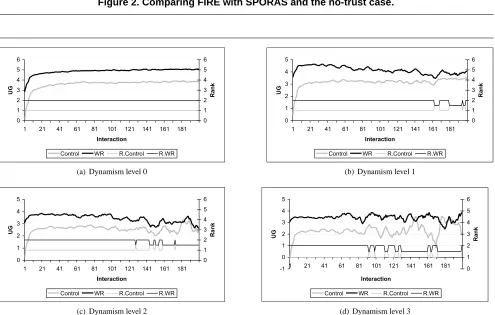
(a) Dynamism level 0
0 1 2 3 4 5 1 8 1 1 6 1 1 4 1 1 2 1 1 0 1 1 8 1 6 1 4 1 2 1 n o i t c a r e t n I U G 0 1 2 3 4 5 6 R an k l o r t n o
C WR R.Control R.WR
(b) Dynamism level 1
0 1 2 3 4 5 1 8 1 1 6 1 1 4 1 1 2 1 1 0 1 1 8 1 6 1 4 1 2 1 n o i t c a r e t n I U G 0 1 2 3 4 5 6 R an k l o r t n o
C WR R.Control R.WR
(c) Dynamism level 2
1 -0 1 2 3 4 5 1 8 1 1 6 1 1 4 1 1 2 1 1 0 1 1 8 1 6 1 4 1 2 1 n o i t c a r e t n I U G 0 1 2 3 4 5 6 R an k l o r t n o
C WR R.Control R.WR
(d) Dynamism level 3
[image:7.595.60.555.357.672.2]0 1 2 3 4 5 6 7 8 1 8 1 1 6 1 1 4 1 1 2 1 1 0 1 1 8 1 6 1 4 1 2 1 n o i t c a r e t n I U G 0 1 2 3 4 5 6 R an k l o r t n o
C CR R.Control R.CR
(a) Dynamism level 0
0 1 2 3 4 5 6 7 1 8 1 1 6 1 1 4 1 1 2 1 1 0 1 1 8 1 6 1 4 1 2 1 n o i t c a r e t n I U G 0 1 2 3 4 5 6 R an k l o r t n o
C CR R.Control R.CR
(b) Dynamism level 1
0 1 2 3 4 5 6 1 8 1 1 6 1 1 4 1 1 2 1 1 0 1 1 8 1 6 1 4 1 2 1 n o i t c a r e t n I U G 0 1 2 3 4 5 6 R an k l o r t n o
C CR R.Control R.CR
(c) Dynamism level 2
0 1 2 3 4 5 6 1 8 1 1 6 1 1 4 1 1 2 1 1 0 1 1 8 1 6 1 4 1 2 1 n o i t c a r e t n I U G 0 1 2 3 4 5 6 R an k l o r t n o
C CR R.Control R.CR
[image:8.595.60.556.73.353.2](d) Dynamism level 3
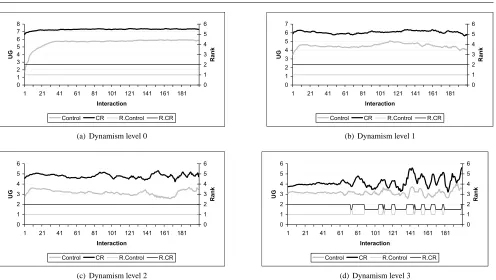
Figure 4. Performance of FIRE’s CR component.
information than FIRE (a decentralised model)5. However, the utility difference of FIRE and SPORAS is accounted for by the fact that FIRE separates direct experiences from others’ experiences (i.e. ratings) in trust evaluation, while SPORAS treats all types of ratings equally. Therefore, SPO-RAS suffers from noise in ratings (resulting from ent degrees of degradation of service quality due to differ-ent provider-consumer distances). In contrast, FIRE reduces rating noise by giving more weights to direct experiences6, which are more relevant to an individual agent’s situation.
As the dynamism of the environment increases (from dy-namism level0to1,2and3), theNoTrustgroup still per-forms consistently badly (UGaround0.0). However, the dy-namism affectsFIREandSPORASmore significantly and their performance decreases as the levels of dynamism in-creases (as expected). As discussed above, since SPORAS takes all ratings into account and treats them equally, it suf-fers a lot from the increasing level of noise due to the
in-5 After every interaction, the consumer reports its rating about the provider’s service in that interaction to SPORAS. Therefore, SPO-RAS collects all the available ratings from its users. In contrast, con-sumers employing FIRE have only ratings from a limited set of wit-nesses (from the WR component) and those presented by providers (from the CR component) in addition to their own ratings.
6 In all our experiments, we setWI,WR,WW,WCto2.0,4.0,1.0, and0.5respectively to reflect the fact that direct experiences are more reliable than those from witnesses, and CR information from the tar-get agent itself is the least reliable.
creasing dynamism. Therefore, its performance decreases dramatically; sometimes being close to that of theNoTrust
group (see Figure 2(d)). Although FIRE also suffers from the increasing dynamism, taking the recency of ratings into account (from Equation 1) allows it to quickly adapt to changing situations. In addition, FIRE reduces the adverse effect of noise by taking only relevant ratings into account and weighing the rating sources according to their reliabil-ity/relevancy (using reliability measures and predefined co-efficients for its components from Equation 8). Thanks to all these features, FIRE manages to maintain a high level of utility gained in the dynamic environments (i.e. an aver-ageUGof around5.0as compared with that of around7.0 in the static environment).
3.4. Performance of FIRE’s components
be-cause it is typically highly domain specific.
First, we benchmark the WR component. In this exper-iment, there are two groups of consumer agents. The first one uses only the IT component (called the control group). The second makes use of the WR component in addition to the IT component (called theWRgroup). The result of the experiment, presented in Figure 3, shows that the WR com-ponent substantially improves the performance of consumer agents in a static environment. Thet-test ranking also con-firms this by showing that agents using the WR component outperform agents using only the IT component in all inter-actions. In more dynamic environments, the performance ofWRdecreases since witness ratings are out of date due to changes in the environments. However, it always main-tains a higher, or at least equal, level of performance than that of the control group. This shows that witness ratings al-ways help produce more precise trust evaluation, even in continually changing environments.
In the next experiment we evaluate the CR component (using a similar setting). Here, there are two groups of con-sumer agents. The control group employs the IT and WR components, and the other employs the CR component in addition (called theCRgroup). Figure 4 shows that, by em-ploying the CR component, theCRgroup outperforms the control group by at least1.0utility units in all interactions in the first three experiments (dynamism levels0,1, and2) and in most interactions in the last experiment (dynamism level3). As can be seen, the dynamism of the environments still affects the performance of theCRgroup as in the pre-vious set of experiments (theCRgroup also employs the IT and WR components). However, theCRgroup proves the efficiency of the CR component by obtaining higher util-ity than the control group in all the experiments. Of particu-lar important is that theCRgroup achieves its high level of performance right from the very first interactions. This im-provement shows that CR information from the providers does indeed help FIRE to produce a more precise trust mea-sure right from the start of an agent’s life (whereas the IT and WR components can perform inefficiently due to the scarcity of trust information).
In summary, we can see that taking various sources of trust information into account helped FIRE produce trust evaluation in a wide variety of situations and that all com-ponents contribute to its overall performance.
4. RELATED WORK
Probably the most widely used reputation models are those on eBay [3] and Amazon Auctions [1]. Both of these are im-plemented as a centralised rating system so that their users can rate and learn about each other’s reputation. For exam-ple, an eBay user, after an interaction, can rate its partner on the scale of−1,0, or+1, which means positive, neutral and
negative rating respectively. The ratings are stored centrally and the reputation value is computed as the sum of those rat-ings over six months. Thus, reputation in these models is a global single value. However, these models are too simple (in terms of their trust rating values and the way they are ag-gregated) for applications in open MAS.
SPORAS [13] extends these models by introducing a new method for rating aggregation. Specifically, it does not store all the ratings, but rather updates the global reputation value of an agent according to its most recent rating. In ad-dition, it introduces a reliability measure based on the stan-dard deviations of the rating values. However, treating all ratings equally means SPORAS suffers from rating noise (as shown in Section 3) and its centralised approach is not suitable for our target domain.
Regret decentralises the trust evaluation process and each agent stores its ratings in its local database (see Sec-tion 2.1). This enables the model to introduce a more re-alistic trust measure from ratings of richer semantics and to give more weight to recent ratings. Regret also presents a witness reputation component along with a sophisticated method for aggregating witness reports. However, it does not show how witnesses can be located, and, thus, this com-ponent is of limited use. We overcome this in FIRE by em-ploying a referral process in which agents help each other to find witnesses based on their expertise (see Section 2.3). The CR component in FIRE has similarities to trust policy management engines such as PolicyMaker [5] and Trust-Serv [11]. These engines grant rights to an agent based on its certificates of its identity according to prede-fined policies (i.e. rules, such as ‘ifais a registered user and it possesses a valid credit card then it can book flights). In contrast, our CR component computationally evaluates (rat-ing) information provided by an agent to deduce its trust-worthiness for selecting interaction partners. Certified rat-ings in FIRE’s CR component are also similar to the concept of endorsements in [8] – certificates endorsing that a ser-vice (provider) is trusted and preferred by their issuers. Ob-viously, certified ratings provide the possibility of a richer multitude of rating values. Moreover, in our model, the rat-ings are aggregated into a CR value, which is then inte-grated into FIRE’s overall trust value. This is not done in [8] because in that work endorsements are viewed as sepa-rate from a service’s reputation.
5. CONCLUSIONS AND FUTURE WORK
vary-ing the level of dynamism of the testbed, we also showed that FIRE is able to quickly adapt to a changing environ-ment while still maintaining a high level of performance.
The main benefit of FIRE is that it can produce a trust measure and an associated reliability measure in most situ-ations. Moreover, with its generic design, FIRE can be eas-ily adapted to various domains because of its modularised design and parameterised configuration. In short, it satis-fies the first two requirements for a trust model in open MAS as specified in Section 1. However, at present, it as-sumes the agents report their trust information truthfully. As noted in the requirements, this is not suitable for our target domain and, for this reason, we plan to devise re-liability measures for witness ratings and certified ratings that take into account the possibility of lying. This will make the model more robust and ready to be used in real open MAS applications. In terms of improving its overall performance, we plan to incorporate learning abilities. At present, FIRE is a static parametric model (i.e. all its pa-rameters are set by users in order to suit a particular appli-cation domain). This is clearly limiting and so we aim to study which of FIRE’s parameters can be adjusted dynam-ically to adapt it to changes in an agent environment. For instance, if the number of lying agents in its environment increases, an agent may reduce the component coefficient of witness and certified reputation (WW andWC, see
Sec-tion 2.5); or if its environment changes too quickly (e.g. the agents alter their behaviours frequently), it can reduce the local rating history sizeHto discard older (and less rele-vant) ratings.
References
[1] Amazon Site. http://www.amazon.com. World Wide
Web.
[2] P. R. Cohen. Empirical Methods for Artificial Intelligence. The MIT Press, 1995.
[3] eBay Site. http://www.ebay.com. World Wide Web.
[4] D. Gambetta. Can we trust trust? In D. Gambetta, editor,
Trust: Making and Breaking Cooperative Relations, pages
213–237. Department of Sociology, University of Oxford, electronic edition, 2000.
[5] T. Grandison and M. Sloman. A survey of trust in internet ap-plications. IEEE Communications Surveys & Tutorials, 3(4), 2000.
[6] D. Huynh, N. R. Jennings, and N. R. Shadbolt. FIRE: An in-tegrated trust and reputation model for open multi-agent sys-tems. In Proceedings of the 16th European Conference on
Artificial Intelligence (ECAI), 2004.
[7] N. R. Jennings. An agent-based approach for building
complex software systems. Communications of the ACM, 44(4):35–41, April 2001.
[8] E. M. Maximilien and M. P. Singh. Reputation and endorse-ment for web services. ACM SIGEcom Exchanges, 3(1):24– 31, 2002. ACM Special Interest Group on E-Commerce.
[9] S. D. Ramchurn, D. Huynh, and N. R. Jennings. Trust in multi-agent systems. The Knowledge Engineering Review, 2004.
[10] J. Sabater. Trust and Reputation for Agent Societies. Phd the-sis, Universitat Autnoma de Barcelona, 2003.
[11] H. Skogsrud, B. Benatallah, and F. Casati. Model-driven trust negotiation for web services. IEEE Internet
Comput-ing, 7(6):45–52, 2003.
[12] B. Yu and M. P. Singh. Searching social networks. In
Pro-ceedings of the 1st International Joint Conference on Au-tonomous Agents and MultiAgent Systems (AAMAS). ACM
Press, 2003.