R E S E A R C H A R T I C L E
Open Access
The association between labour variables and
primiparous women
’
s experience of childbirth;
a prospective cohort study
Hanna Ulfsdottir
1, Eva Nissen
2, Elsa-Lena Ryding
2, Doris Lund-Egloff
3and Eva Wiberg-Itzel
1*Abstract
Background:Studies have suggested several risk factors for a negative birth experience among primiparas. Factors that are mentioned frequently include labour dystocia, operative intervention such as acute caesarean section or vacuum extraction, or the infant being transferred to neonatal care. Another important factor mentioned is lack of support from the midwife.
Methods:A study was made of the deliveries of 446 healthy primiparas in a prospective cohort study performed at Soder Hospital, Stockholm, Sweden. Samples of amniotic fluid were collected at delivery and the levels of amniotic fluid lactate (AFL) were measured to give an indication of the metabolism of the uterine tissue. Obstetrical data were collected from birth records.
Postpartum, all the women included in the study were asked to complete the Wijma Delivery Experience Questionnaire (W-DEQ B) that measures the experience of a woman’s delivery. The main objective of the project was to study well-known as well as new factors associated with negative experience of childbirth among a group of healthy primiparas.
Results:Risk factors for reporting a higher level of negative childbirth experience were shown to be a high level of AFL (AOR 3.1, 95%, CI; 1.1-8.9), a longer latent phase (AOR 1.8, 95%, CI; 1.03-3.1), and a low Apgar score (<7 at 1 min) (AOR 13.3, 95%, CI; 1.6-111.0). Those women who had a negative birth experience wanted the midwife to be present more of the time during labour (p = 0.003).
Conclusions:A high AFL level, as a marker of uterine metabolic status, and a longer latent phase are strongly associated with a negative experience of childbirth. A low 1 minute Apgar score of the newborn seems to have the strongest negative influence on the woman’s experience of childbirth, even when the infant recovers immediately.
Keywords:Adverse foetal outcome, Amniotic fluid lactate, Dystocia, Experience of childbirth
Background
Giving birth is a complex event. A woman’s experience of childbirth is influenced by her psychological and social situation as well as by cultural conditions. A good experi-ence of labour is important for the woman’s wellbeing, for her relationship with her baby and for breastfeeding, as well as for her planning of future pregnancies [1-3]. A negative birth experience [4-6] may lead to a desire for a planned caesarean section in subsequent pregnancies.
Previous studies have suggested several risk factors for a negative birth experience. The factors often mentioned in-clude labour dystocia, operative intervention such as acute caesarean section or vacuum extraction, lack of support from the midwife, and the infant being transferred to neo-natal care [7-16]. High levels of maternal stress and anxiety have been shown to influence the progress of labour with higher levels of epinephrine being associated with a lower uterine contractile activity as measured by Montevideo units [17].
When activity intensity is high, the body has to produce energy quickly. Energy can be produced through aerobic as well as anaerobic metabolism. The production of lactate * Correspondence:[email protected]
1
Department of clinical science and education, Section of Obstetrics and Gynaecology, Karolinska Institute, Soder Hospital, Stockholm, Sweden Full list of author information is available at the end of the article
is the final step in the glycolytic pathway where pyruvate is broken down to form energy. The concentration of lactate can increase more than tenfold in physical exertion but the rise is of short duration and depends on the oxygen supply to the tissue. One consequence of this is that a particular tissue can produce lactic acid during exertion while several other tissues may still have a good supply of oxygen.
Previous studies have shown that the level of lactate in the uterine tissue increases during labour contractions as a sign of anaerobic metabolism. In abnormal contractions, the removal of lactate appears to deteriorate and lactate and other metabolites will be accumulated. In these condi-tions, the power of the uterine contractions decreases and labour progress is halted. The level of lactate in the uterine muscle is mirrored in the level of lactate in amniotic fluid (AFL), and can easily be analysed at the bedside [18-20]. No previous investigation has been made of whether the AFL level has any association with the woman’s experience of childbirth.
An a priori hypothesis of the study was that labour dys-tocia, defined as cervical dilation slower than 1 cm per hour or a delayed progress beyond two hours, is associated with a higher level of negative childbirth experience among re-cently delivered, primiparous women. The study also aimed to explore the association of the outcome variable with other possible risk factors, including an elevated AFL level.
Methods
A prospective observational study called `the dysfunc-tional labour study´ was performed at Soder Hospital Stockholm, Sweden between April 2010 and January 2012. Healthy, Swedish-speaking, nulliparous women, with a singleton pregnancy and a gestational age between 37–42 weeks, were asked to participate. A number of criteria for inclusion were formulated: labour should have started spontaneously, the foetus should be in a cephalic presenta-tion, the cervical dilation should be at least 3 cm and regu-lar, painful contractions should be present.
A group of 25/140 midwives at the Soder Hospital clinic volunteered to assist in data collection and in-formed the labouring women about the ongoing study. In all, 561 healthy primiparous women in labour, presenting consecutively, were invited to participate in this study as they fulfilled the inclusion criteria. Of these, seven declined to participate and 107 were excluded later due to incom-plete ID or an incomincom-plete questionnaire. One woman was excluded due to intrapartum death of the infant. The remaining 446 women constituted our material for the sur-vey. A written informed consent for participation in the study was obtained from all participants. The study was ap-proved by the Karolinska Institute Human Research Ethics Committee (2010/199-31/1).
All women included were asked to complete the
Wijma Delivery Experience Questionnaire (W-DEQ B)
the day after delivery. The W-DEQ B measures the woman´s experience of childbirth after delivery. The ques-tionnaire includes 33 items, each scoring from 0–5. The sum score ranges from 0–165; the higher the score, the worse the woman’s experience. The questionnaire has shown good psychometric properties [21]. The cut-off be-tween good/moderate and negative experience of childbirth was set at a sum score of 66, which was the 75thpercentile in the original study of childbirth experience [21]. The two groups (W-DEQ < and≥66) were compared with regard to levels of AFL, and labour variables in several parameters.
In addition to the W-DEQ, seven questions were added relating to nourishment, sleep, the presence of the midwife during labour and thoughts about a subsequent pregnancy and delivery. In calculating the outcome, the same scale was used as in the original W-DEQ B questionnaire, with a scoring range from 0–5.The questionnaire was collected after delivery but before the woman was discharged from hospital.
In order to detect labour dystocia, the WHO-modified partogram was used with an alert line and a two hours dis-placed action line, as recommended in Sweden at the time of the study. The alert line was passed if the cervical dila-tion was slower than 1 cm per hour, and the acdila-tion line was passed if the delay in progress continued beyond two hours.
In line with the study guidelines, a sample of amniotic fluid was collected by the midwife at delivery. The level of lactate in AF was used as a sign of the uterine metabolic status at delivery and the analysis was performed immedi-ately by a research midwife, using a lactate measurement device, (LMU061, ObsteCare AB, Sweden) [18-20]. The test result was blinded to both the midwife and the labour-ing woman. A cut-off value for a very high AFL level was set at≥12 mmol/L. This is in line with earlier publications where there was an increased frequency of complicated deliveries in the group with a high AFL value [18-20].
Foetal scalp blood sampling was performed in the deliv-eries where a non-reassuring/pathological CTG (Cardio-toccography) trace was presented. The test was performed with the mother supine and her legs in stirrups. The scalp blood was collected in preheparinized glass capillary tubes, and the lactate analysis was carried out at the bedside.
After delivery and before the newborn’s first cry, arterial and venous cord blood samples were drawn from a seg-ment of the cord and analysed within a few minutes for ph. All cord blood analyses were performed using an ABL 800 analyser (Bayer®) available in the labour ward. Socio-demographic and obstetric background data were col-lected from the antenatal and delivery records.
descriptive measures. The difference between the groups of low/moderate or high W-DEQ (<or≥66p) was tested by t-test for parametric variables and chi-square t-test for categor-ical variables (%). The sum of the responses on the W-DEQ questionnaire was calculated. Internal missing data were re-placed by the group mean for the unanswered question, ac-cording to the guidelines for the survey. The scores from the questionnaire were then compared with the outcome of delivery. A logistic regression [22] was performed to esti-mate the association between the primary outcome (W-DEQ < or≥66p) and the following independent variables: labour dystocia (yes/no), latent phase >13 h (yes/no), full cervical dilation and non-descent of the foetal head >3 h (yes/no), AFL≥12 mmol/L (yes/no), epidural anaesthesia (yes/no), Apgar < 7 at 1 min (yes/no). Our model strategy was as follows: first, unadjusted associations with each fac-tor were studied in a univariate model. Second, the adjusted association with respect to the risk factors measured was studied in a multivariable model. Before performing the lo-gistic regression, clinically relevant interaction models were constructed (such as high lactate and low Apgar score). No significant interactions were detected.
Results
In all, 446 healthy women were included in this study of various factors that might affect women’s experience of de-livery. After all the women had completed the W-DEQ B questionnaire, four of the questions remained unanswered. According to the guidelines for the questionnaire, internal missing data could be replaced by the group mean for the unanswered question, which has been made.
44% (152/446) of the women belonged to the group with a W-DEQ score≥66, which corresponds with a higher de-gree of negative experience during delivery. The background characteristics of the women included are presented in Table 1. The mean age of the women was 30 years. No differences were presented according to BMI (Body
Mass Index), height and education. Smoking before pregnancy was more common in the group with a higher W-DEQ score.
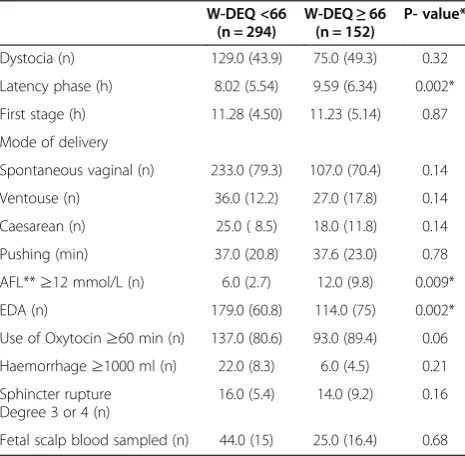
Labour outcomes are presented in Table 2. No differ-ences were shown in the method of delivery. Dystocia ac-cording to the partogram was not associated with a negative experience of childbirth. Nor were any differences found in the length of the first or second stage of labour. However, a significantly longer latent phase was shown in the group with a W-DEQ score≥66p (8.02 h vs. 9.59 h). A high W-DEQ score more often followed labours with an AFL level≥12.0 mmol/L (12 vs. 6%) and with the use of epidural anaesthesia (75% vs. 61%). The use of oxytocin to augment labour did not differ significantly between the two groups.
The outcome of the infant is shown in Table 3. No differ-ences were found in gestational age, birth weight, height or head circumference of the baby. Girls were more common in the group with a lower W-DEQ score. A low Apgar score at 1 and 5 minutes after delivery, and a transfer of the newborn to the neonatal care unit were significantly more common in the group where a high W-DEQ score was reported.
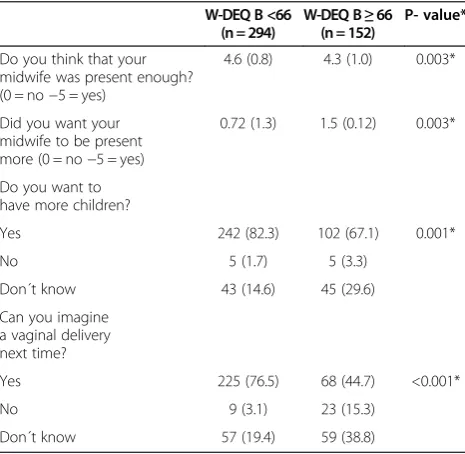
The additional questions in the questionnaire (Table 4) showed a significant difference between the two groups in that women in the high W-DEQ group were less satisfied than those in the low group with the amount of time the midwife spent in the delivery room during labour. Many of the women in the high W-DEQ group also expressed a wish for the midwife to be present more of the time
Table 1 Background characteristics for the 446 women included
Maternal age (years) 30.2 (4.3) 30.1 (4.7) 0.95
BMI^ 23.6 (8) 23.6 (8) 0.97
Height (cm) 167.2 (8.9) 166.8 (9.8) 0.64
Smoker before pregnancy (n) 36 (12.2) 27 (17.8) 0.037*
Education- primary school 26 (8.8) 16 (10.5) 0.4
High school 103 (35) 60 (39.5) 0.4
College/University 165 (56.1) 75 (50) 0.4
^
BMI = weight/(length* length).
*P-values <0.05 were considered as statistically significant. Data are presented as numbers (%) or mean (SD).
The difference between the groups was tested by t-test for parametric variables (SD) and chi-squared test for categorical variables (%).
Table 2 Labour outcome of the 446 women included
W-DEQ <66 (n = 294)
W-DEQ≥66 (n = 152)
P- value*
Dystocia (n) 129.0 (43.9) 75.0 (49.3) 0.32
Latency phase (h) 8.02 (5.54) 9.59 (6.34) 0.002*
First stage (h) 11.28 (4.50) 11.23 (5.14) 0.87
Mode of delivery
Spontaneous vaginal (n) 233.0 (79.3) 107.0 (70.4) 0.14
Ventouse (n) 36.0 (12.2) 27.0 (17.8) 0.14
Caesarean (n) 25.0 ( 8.5) 18.0 (11.8) 0.14
Pushing (min) 37.0 (20.8) 37.6 (23.0) 0.78
AFL**≥12 mmol/L (n) 6.0 (2.7) 12.0 (9.8) 0.009*
EDA (n) 179.0 (60.8) 114.0 (75) 0.002*
Use of Oxytocin≥60 min (n) 137.0 (80.6) 93.0 (89.4) 0.06
Haemorrhage≥1000 ml (n) 22.0 (8.3) 6.0 (4.5) 0.21
Sphincter rupture Degree 3 or 4 (n)
16.0 (5.4) 14.0 (9.2) 0.16
Fetal scalp blood sampled (n) 44.0 (15) 25.0 (16.4) 0.68
*P-values <0.05 were considered as statistically significant. **AmnioticFluidLactate.
during labour. Fewer women in the high W-DEQ group would consider having another vaginal birth, or even hav-ing more children. Three additional questions about sleep-ing, eating and whether the woman had been looking forward to the delivery showed no significant differences between the groups regarding the W-DEQ score (results could be shown on request).
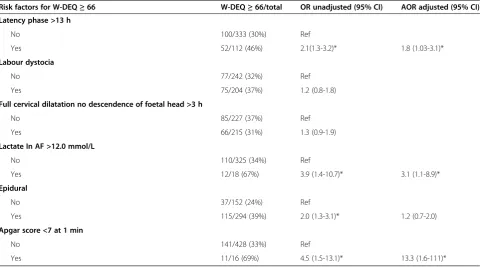
In the multivariable logistic regression analysis (Table 5), the AFL - value and obstetric factors presented in previous
publications as having an association with a negative deliv-ery experience were analysed for their association with a high W-DEQ score. A high AFL level (≥12 mmol/L) at de-livery, an extended latent phase, the use of epidural anaes-thesia and an Apgar score < 7 at 1 min after delivery all seemed to be risk factors for negative experience of child-birth in this study. No significant association between a high W-DEQ score and labour dystocia according the par-togram, nor mode of delivery, was indicated in this mater-ial. Nor was there any clear association with any of the other obstetrical variables studied.
According to the multivariable analysis, high AFL value (AOR 3.1, 95%, CI; 1.1-8.9) and a longer latent phase (AOR 1.8, 95%, CI; 1.03-3.1) seemed to be independent risk factors for having a high W-DEQ score among these 446 healthy primiparas. A low Apgar score at 1 minute after delivery also increased the risk of a negative child-birth experience (AOR 13.3, 95%, CI; 1.6-111.0).
Discussion
In this prospective observational study of primiparas’ ex-perience of childbirth, a high AFL level (≥12 mmol/L) and a long latent phase of labour seemed to be associated with a negative labour experience. A low Apgar score of the newborn at delivery was a further factor that strongly con-tributed to a high W-DEQ score.
Our main hypothesis was that labour dystocia would be associated with a negative experience of childbirth, but this was not confirmed by the study results. The results may contradict other studies describing a correlation be-tween labour dystocia and a poor labour experience for the woman [8,10,11,23]. The definition of a dystocic labour in this study is set at two hours delay from the alert line in the partogram, as these were the guidelines in Sweden at the time of the data collection. As the defin-ition of dystocia may be broad, T-tests were also per-formed with an extended labour progress as outcome (first stage > 17 h), [24] but no differences were identi-fied with this definition either.
In general, most women are still at home during the la-tent phase, as they are advised not to come to the delivery ward `too early’. This causes the latent phase to be a time of fear, anxiety and fatigue. This may be one of the main reasons why a longer latent phase is to a high degree associ-ated with a negative experience, shown by a high W-DEQ score in this study. A new and very interesting finding in this study is the association shown between a high W-DEQ score and a high AFL value at delivery. In earlier publica-tions, around 10% of deliveries have been shown to have a high level of AFL already when attending the delivery ward. In many of these deliveries, a long latent phase is also pre-sented [18-20]. With a long latent phase and a high AFL value, the woman probably experiences more painful and ineffective contractions for a very long time.
Table 3 Outcome at delivery of the 446 newborns delivered in the study
Gestational days (n) 281.4 (7.5) 282 (7.3) 0.53
Weight (g) 3570 (413) 3596 (416) 0.53
Length (cm) 51.1 (1.8) 51.1 (1.9) 0.79
Head circumference (cm) 34.9 (1.3) 35 (1.4) 0.28
Girl (n) 159 (54.1) 66 (43.4) 0.052
Arterial pH 7.25 (0.09) 7.25 (0.1) 0.67
*P-values <0.05 were considered as statistically significant. Data are presented as numbers (%) or mean (SD).
Table 4 Result of additional questions from the included women
Do you think that your midwife was present enough?
Yes 242 (82.3) 102 (67.1) 0.001*
No 5 (1.7) 5 (3.3)
Don´t know 43 (14.6) 45 (29.6)
Can you imagine a vaginal delivery next time?
Yes 225 (76.5) 68 (44.7) <0.001*
No 9 (3.1) 23 (15.3)
Don´t know 57 (19.4) 59 (38.8)
Lactic acid is mainly produced by anaerobic metabolism, when the uterine muscle receives insufficient oxygen. The AFL level is as a good marker of uterine metabolic status during labour and the production of lactate from the uterus may increase in situations of fear, anxiety and fa-tigue as a sign of poor oxygenation of the tissue [18-20]. This is something completely new, and should be followed up in subsequent studies. One of the questions to be an-swered in the future is whether the group of women with a negative labour experience also has a higher degree of abnormal uterine lactate production from the beginning, or whether the uterus produces an abnormal amount of lactate during ongoing labour.
Another interesting finding in this study was the in-creased use of epidural anaesthesia (EDA) in the group with a high postnatal W-DEQ score. Lactic acid is pro-duced by anaerobic metabolism mediates ischemic pain and occurs when there is insufficient blood flow for the metabolic needs of an organ. The pain of a heart attack is the prototypical example. Multiple compounds released from the tissue probably contribute to the discomfort dur-ing a heart attack by actdur-ing on sensory neurons. The ques-tion is whether the uterine muscle reacts in the same way. Earlier publications have shown that the use of an epidural does not have a positive effect on the subsequent child-birth experience [8,23,25-29]. In a randomised controlled trial, no differences in the woman’s satisfaction with her experience of childbirth were found following the use of
EDA [23]. Goodman et al. suggest that if women are able to manage their labour pain, they will be more satisfied with their own effort and therefore more positive about their total childbirth experience. This may also explain the higher numbers of women with a positive experience in the group without EDA and a low level of lactate in AF in this material.
Giving birth to a baby with a low Apgar score at 1 minute after delivery may be dramatic even though the baby may recover within a few minutes. The Apgar score at 1 minute after delivery was selected in this study for the logistic re-gression since the focus of the study is the mother´s post-natal experience of childbirth, not whether the baby is affected in the long term. It is obvious that giving birth to a baby with a low Apgar score is one of the most frightening experiences for a woman, even if the baby recovers rapidly.
Some limitations of this study should be mentioned. Soder Hospital is a large city hospital in Stockholm and the women included in the study were older and better educated than the national average in Sweden, which may have some influence on the findings. The numbers of women participating were also rather small, and consti-tuted only a minor proportion of all 4,333 healthy prim-iparous women delivered at the clinic at gestational age 37–42 weeks during the time of the study. The reason is that the participation of the midwives in this project was voluntary and only a limited group of midwives with an interest in the project took part and included women in
Table 5 Associations between possible risk factors and W-DEQ B score≥66
Risk factors for W-DEQ≥66 W-DEQ≥66/total OR unadjusted (95% CI) AOR adjusted (95% CI)
Latency phase >13 h
No 100/333 (30%) Ref
Yes 52/112 (46%) 2.1(1.3-3.2)* 1.8 (1.03-3.1)*
Labour dystocia
No 77/242 (32%) Ref
Yes 75/204 (37%) 1.2 (0.8-1.8)
Full cervical dilatation no descendence of foetal head >3 h
No 85/227 (37%) Ref
Yes 66/215 (31%) 1.3 (0.9-1.9)
Lactate In AF >12.0 mmol/L
No 110/325 (34%) Ref
Yes 12/18 (67%) 3.9 (1.4-10.7)* 3.1 (1.1-8.9)*
Epidural
No 37/152 (24%) Ref
Yes 115/294 (39%) 2.0 (1.3-3.1)* 1.2 (0.7-2.0)
Apgar score <7 at 1 min
No 141/428 (33%) Ref
Yes 11/16 (69%) 4.5 (1.5-13.1)* 13.3 (1.6-111)*
*P-values <0.05 were considered as statistically significant.
the study. The normal delivery rate was, however, the same (76%) in the study material as in the whole group of 4,333 women at the clinic during the period of the study.
The point in time when the women filled in the ques-tionnaire can also be discussed. It is possible that women, only one day after delivery, are overwhelmed by having a healthy baby and the negative feelings from the delivery may only emerge later. However, such an interpretation is unlikely since an earlier prospective study of women with various types of deliveries showed that lower W-DEQ scores were found at one month than at two days postpar-tum [30]. The choice of a cut-off at W-DEQ B score 66 p may perhaps also affect our results. In order to study women with a really severe experience of childbirth, it will be necessary to use a higher cut-off point. The limited ma-terial of the present study, and our wish to consider not only a traumatic delivery but a moderately negative experi-ence, dictated our choice of cut-off point. It is interesting that even with the low cut-off studied, more women with a high W-DEQ B score would not consider further preg-nancies, or another vaginal delivery in the future; at least this was their position immediately after birth.
This study raises new and interesting questions about the influence of the metabolic status of the uterus on women’s experience of childbirth. Better management of the latent phase and/or more sensitive reassurance of women whose babies have a low Apgar at 1 minute could also make a dif-ference. Of course, we do not know whether women with a high postnatal W-DEQ B score have other psychological vulnerabilities that may influence their decisions. In any event, it is clear that an extended latent phase in combin-ation with an anaerobic metabolism of the uterus is strongly associated with a negative childbirth experience for a first-time mother. The findings of this study have to be replicated in future studies in other settings to determine whether this new knowledge would be helpful in future obstetrical clinical care.
Conclusion
In this study we found that high AFL levels at delivery, as a sign of an aerobic metabolism in the uterine tissue, and an extended latent phase will associate with a negative ex-perience of labour among healthy primiparas and with the women’s postnatal experience of childbirth.
Availability of supporting data
Supporting data have been deposited at Karolinska Insti-tute, Soder Hospital and can be shown on request.
Competing interest
Each author represents and warrants that she has no financial affiliation (e.g., employment, direct payments, stock holdings, retainers, consultantships, patent-licensing arrangements, or honoraria) or involvement within the last 3 years with any commercial organisation with a potential financial interest in the subject or materials discussed in the manuscript.
Authors’contributions
EWI initiated the study and EWI, HU and DEL collected the data. EWI, HU, EN and ELR performed the data analyses. EWI, HU, EN, DEL and ELR drafted the manuscript and EWI, HU, EN, ELR, and DEL contributed all to the revision of the manuscript and approved the final version.
Acknowledgement
We wish to thank all the women who consented to participate in this study. We also wish to thank all the midwives at Soder Hospital who recruited deliveries to the study, and Hans Järnbert Pettersson for his valuable contributions to the statistical analysis.
Author details
1Department of clinical science and education, Section of Obstetrics and
Gynaecology, Karolinska Institute, Soder Hospital, Stockholm, Sweden.
2Department of Women’s and Children’s Health, Karolinska Institute,
Stockholm, Sweden.3Department of LabMed, section of Clinical Chemistry, Karolinska Institute, Huddinge Hospital, Stockholm, Sweden.
Received: 19 November 2013 Accepted: 19 May 2014 Published: 18 June 2014
References
1. Slade P, MacPherson SA, Hume A, Maresh M:Expectations, experiences and satisfaction with labor.Br J Clin Psychol1993,32(4):469–483. 2. Brown A, Jordan S:Impact of birth complications on breastfeeding
duration: an internet survey.J Adv Nurs2013,69(4):828–839. 3. Gottvall K, Waldenström U:Does a traumatic birth experience have an
impact on future reproduction?BJOG2002,109(3):254–260.
4. Nieminen K, Stephansson O, Ryding EL:Women´s fear of childbirth and preference for caesarean section- a cross-sectional study at various stages of pregnancy in Sweden.Acta Obstet Gynecol Scand2009,
88(7):807–813.
5. Tschudin S, Alder J, Hendriksen S, Bitzer J, Popp KA, Zanetti R, Hösli I, Holzgreve W, Geissbuhler V:Previous birth experience and birth anxiety: predictors of caesarean on demand?J Psychosom Obstet Gynaecol2009,
30(3):175–180.
6. Pang MW, Leung TN, Lau T, Hang Chung TK:Impact of first childbirth on change in women’s preference for mode of delivery: follow-up of a longitudinal observational study.Birth2008,35(2):121–128.
7. Waldenström U, Rudman A, Hildingsson I:Intrapartum and postpartum care in Sweden: women´s opinions and risk factors for not being satisfied.Acta Obstet et Gynecol2006,85:551–560.
8. Waldenström U, Borg IM, Olsson B, Wall S:The childbirth experience: a study of 295 new mothers.Birth1996,3:144–153.
9. Goodman P, Mackey MC, Tavakoli AS:Factors related to childbirth satisfaction.J Adv Nurs2004,46(2):212–219.
10. Mackey MC:Women’s evaluation of their childbirth performance.
Maternal Child Nurs J1995,23(2):57–72.
11. Nystedt A, Högberg U, Lundman B:The negative birth experience of prolonged labour: a case-referent study.J Clinic Nursing2005,14(5):579–586. 12. Laursen M, Johansen C, Hedegaard M:Fear of childbirth and risk for birth complications in nulliparous women in the Danish National Birth Cohort. BJOG2009,116(10):1350–1355.
13. Paarlberg KM, Vingerhoets JM, Passchier J, Dekker G, Van Geijn H:
Psychological factors and pregnancy outcome: a review with emphasis on methodological issues.Journal of Psychosom Res1995,39(5):563–595. 14. Ryding EL, Wijma K, Wijma B:fear of childbirth during pregnancy may
increase the risk of emergency cesarean section.Acta Obstet Gynaecol
Scand1998,77:542–547.
15. Istvan J:Stress, anxiety and birth outcome: a critical review of the evidence.Psychol Bull1986,100(3):331–348.
16. Adams SS, Eberhard-Gran M, Eskild A:Fear of childbirth and duration of labor: a study of 2206 women with intended vaginal delivery.BJOG2012,
119(10):1238–1246.
17. Lederman RP, Lederman E, Work B, Mc Cann:The relationship of maternal anxiety, plasma catecholamines and plasma cortisol to progress in labour.Am J Obstet and Gynecol1978,132(5):495–500.
19. Wiberg-Itzel E, Pettersson H, Andolf E, Winbladh B, Åkerud H:Lactate concentration in amniotic fluid: a good predictor of labor outcome.Eur J
of Obstet, Gynecol, Reprod Biol2010,152(1):34–38.
20. Wiberg-Itzel E, Pembe AB, Wray S, Wihlbäck AC, Darj E, Hoesli I, Akerud H:
Level of lactate in amniotic fluid and its relation to the use of oxytocin and adverse neonatal outcome.Acta Obstet Gynecol Scand2013, doi:10.1111/aogs.
21. Wijma K, Wijma B, Zar M:Psychometric aspects of the W-DEQ; a new questionnaire for the measurement of fear of childbirth.J Psychosom
Obstet Gynaecol1998,19(2):84–97.
22. Hosmer DW, Lemenshow S:Applied Logistic Regression.2nd edition. New York: Wiley; 2000. Wiley Series in Probability and Mathematical Statistics. 23. Adams SS, Eberhard-Gran M, Sandvik ÅR, Eskild A:Mode of delivery and
postpartum emotional distress: a cohort study of 55814 women. BJOG2012,119(3):298–305.
24. Kilpatrick SJ, Laros RK Jr:Characteristics of normal labor.Obstet Gynecol
1989,74(1):85–87.
25. Zar M, Wijma K, Wijma B:Pre- and postpartum fear of childbirth in nulliparous and parous women.Scand J of Beh Therapy2001,30(2):75–84. 26. Naves LA, McCleskey EW:An acid-sensing ionchannel that detects
ischemic pain.Braz J of Med Biol Res2005,38:1561–1569.
27. Howell CJ, Kidd C, Roberts W, Upton P, Lucking L, Jones PW, Johanson RB:
A randomized controlled trial of epidural compared with non-epidural analgesia in labor.BJOG2001,108(1):27–33.
28. Morgan BM, Bulpitt CJ, Clifton P, Lewis PJ:Analgesia and satisfaction in childbirth. (The Queen Charlotte’s 1000 mother survey).Lancet1982,
2:808–810.
29. Green JM:Expectations and experiences of pain in labor: findings from a large prospective study.Birth1993,20:65–72.
30. Storksen HT, Eberhard-Gran M, Garthus-Niegel S, Eskild A:Fear of childbirth; the relation to anxiety and depression.Acta Obstet Gynecol Scand2012,
91:237–242.
doi:10.1186/1471-2393-14-208
Cite this article as:Ulfsdottiret al.:The association between labour
variables and primiparous women’s experience of childbirth; a prospective
cohort study.BMC Pregnancy and Childbirth201414:208.
Submit your next manuscript to BioMed Central and take full advantage of:
• Convenient online submission
• Thorough peer review
• No space constraints or color figure charges
• Immediate publication on acceptance
• Inclusion in PubMed, CAS, Scopus and Google Scholar
• Research which is freely available for redistribution