White Rose Research Online URL for this paper:
http://eprints.whiterose.ac.uk/117916/
Version: Published Version
Article:
Brownlee, A. E. I., Burles, N. orcid.org/0000-0003-3030-1675 and Swan, J. (2017)
Search-Based Energy Optimization of Some Ubiquitous Algorithms. IEEE Transactions on
Emerging Topics in Computational Intelligence. pp. 188-201.
https://doi.org/10.1109/TETCI.2017.2699193
[email protected] https://eprints.whiterose.ac.uk/ Reuse
This article is distributed under the terms of the Creative Commons Attribution (CC BY) licence. This licence allows you to distribute, remix, tweak, and build upon the work, even commercially, as long as you credit the authors for the original work. More information and the full terms of the licence here:
https://creativecommons.org/licenses/
Takedown
If you consider content in White Rose Research Online to be in breach of UK law, please notify us by
Search-Based Energy Optimization of Some
Ubiquitous Algorithms
Alexander Edward Ian Brownlee, Nathan Burles, and Jerry Swan
Abstract—Reducing computational energy consumption is of
growing importance, particularly at the extremes (i.e., mobile de-vices and datacentres). Despite the ubiquity of the Java virtual ma-chine (JVM), very little work has been done to apply search-based software engineering (SBSE) to minimize the energy consumption of programs that run on it. We describeOPACITOR, a tool for mea-suring the energy consumption of JVM programs using a bytecode level model of energy cost. This has several advantages over time-based energy approximations or hardware measurements. It is 1) deterministic, 2) unaffected by the rest of the computational environment, 3) able to detect small changes in execution profile, making it highly amenable to metaheuristic search, which requires locality of representation. We show how generic SBSE approaches coupled withOPACITORachieve substantial energy savings for three widely used software components. Multilayer perceptron imple-mentations minimizing both energy and error were found, and en-ergy reductions of up to 70% and 39.85% were obtained over the original code for Quicksort and object-oriented container classes, respectively. These highlight three important considerations for automatically reducing computational energy: tuning software to particular distributions of data; trading off energy use against functional properties; and handling internal dependencies that can exist within software that render simple sweeps over program vari-ants sub-optimal. Against these, global search greatly simplifies the developer’s job, freeing development time for other tasks.
Index Terms—Energy, Java, search based software engineering.
I. INTRODUCTION
E
NERGY consumption related to program execution is of growing importance at all scales, from mobile and embed-ded devices through to datacentres [1]–[3]. For mobile appli-cations, battery life is a critical aspect of user experience and while several factors (such as the display, wifi and GPS) have a large impact on power consumption, CPU usage is still a major factor [4]. For example, the maximum CPU power of a Samsung Galaxy S3 is 2,845 mW, 2.53×the maximum power consump-tion of the screen and 2.5×that of the 3G hardware [5]. At theManuscript received November 5, 2016; revised April 10, 2017; accepted April 13, 2017. Date of current version May 23, 2017. This work was sup-ported by UK Engineering and Physical Sciences Research Council under Grant EP/J017515/1 (DAASE).(Corresponding author: Alexander Edward Ian Brownlee.)
A. E. I. Brownlee is with the Division of Computing Science and Mathematics, University of Stirling FK9 4LA, U.K. (e-mail: [email protected]).
N. Burles is with the IBM United Kingdom, Ltd., York YO10 5GA, U.K. (e-mail: [email protected]).
J. Swan is with the York Centre for Complex Systems Analysis, University of York, York YO10 5DD, U.K. (e-mail: [email protected]).
Digital Object Identifier 10.1109/TETCI.2017.2699193
other end of the scale, the repeated execution of specific subrou-tines by server farms offers the potential for considerable energy saving via the identification of energy-intensive ‘hotspots’ in the code. The electricity consumption by servers was estimated at between 1.1 and 1.5% of global electricity production in 2010 [6], with energy consumption reaching 50-100% of the purchase cost of the hardware over its lifetime [7]. These facts motivate the use of automated methods to reduce the energy consump-tion attributable to software, allowing computaconsump-tional search to relieve developers of the burden of finding energy-optimal soft-ware implementations. Predictive ‘decision support’ metrics, recently shown to be of little practical use [8] can then be re-placed with automatic tuning and refactorings that demonstrably reduce energy consumption. The ultimate goal is to obtain gen-eral methods that can reduce energy consumption, analogously to the familiar process of automatic compiler optimization for execution time. This is an ideal application for Search-Based Software Engineering (SBSE), the use of search based optimi-sation for software engineering problems [9], with initial work in this area showing promising results [2], [10]–[14].
Given the prevalence of the Java Virtual Machine (JVM)1, it is surprising that there has been little previous work on energy optimization of Java applications. In this paper, we describe OPACITOR, a tool implementing a new approach to measuring the energy consumption of applications running on a JVM. Pre-viously, run time [15] or system calls [16], [17] have been used as proxies for energy use, but it has been shown [18] that, in-dependent of the total number of CPU cycles, there can be large differences in the energy consumed by different opcodes. An alternative, high-level hardware measurements [19], [20], are non-trivial to implement and subject to noise that hinders a search process. In contrast, OPACITORuses a predefined cost model of the energy consumed by each JVM opcode, thereby providing a deterministic (and so noise-free) approximation of the total energy consumption. It also has the advantage of being unaffected by the rest of the computing environment, and can detect small changes in execution profile, down to opcode level. We use OPACITORto measure the effectiveness of three dis-tinct SBSE [9] approaches for minimising energy consumption of some very widely-used algorithms, and highlight three impor-tant aspects of SBSE applied to energy consumption. The focus is on Java implementations, but the techniques are general and
1Users are reminded at each installation that over 3 billion devices use Java: http://www.java.com/en/about/ , and Java is regularly reported as the most pop-ular programming language: https://www.tiobe.com/tiobe-index/
are applicable across a wide range of programming languages. The three approaches are:
1) Genetic Programming (GP) to obtain better pivot func-tions for Quicksort, a ubiquitous algorithm for in-place sorting of a sequence in random access memory, high-lighting that energy consumption can be tuned to the specific application of the code – the datasets in this case – motivating automated methods to perform this tuning.
2) Hyperparameter search over the efficiency/accuracy tradeoff of Multi-Layer Perceptrons, a popular neural net architecture for classification, incorporating novel activa-tion funcactiva-tions via Automatic Differentiaactiva-tion, demonstrat-ing that energy consumption can be traded-off against a functional property – classification accuracy in this case. 3) Genetic Algorithms (GA) using the constraints of Object
Oriented Programming for Guava and Apache Commons collection classes (OO-GI), library implementations of well-known data structures, revealing that different soft-ware components can exhibit subtle interactions with re-spect to energy, vastly increasing the search space and justifying the use of SBSE to reduce developer effort. The first two of these approaches are applicable to any lan-guage, further extending their potential impact. OO-GI is ap-plicable to any OO code beyond the collections classes that we have chosen as our focus and, more generally, wherever program behaviour is specified via ‘Design by Contract’ [21].
This work makes four major contributions. Firstly, we de-scribe and demonstrate OPACITOR, a new tool for measuring the energy consumption of Java programs. Secondly, we extend work from two earlier papers [22], [23] (respectively, proposing evolution of pivot functions for Quicksort and introducing OO-GI) with more extensive experiments and analysis, demonstrat-ing the wider applicability of both approaches. Thirdly, we pro-pose a combination of automatic-differentiation and topology parameterisation to allow search-based improvement of multi-layer perceptrons. Finally, we show that the energy consumption of three very widely-used software components can readily be improved. The results demonstrate that global search methods allow improvements in energy to be targeted to specific datasets, be traded off against other functionality, and can accommo-date hard-to-determine interactions within the code. All three of these would otherwise result in lengthy, repetitive exploration through large spaces of alternative designs. The importance to industry of these results is that automated search methods re-duce the required developer effort: the SBSE approaches we describe can achieve significant reductions in energy use for lit-tle development cost. Given the ubiquity of these components, it demonstrates the potential energy savings for a very wide range of applications.
We begin by summarising related work in Section II. We describe OPACITORin Section III. Sections IV–VI describe the experiments with each of the three studied algorithms (Quick-sort, MLP and OO collections), each including implementation details, results and discussion. We consider possible threats to the validity of the work in Section VII before drawing our con-clusions and suggesting future work in Section VIII.
II. RELATEDWORK
The energy consumption attributable to software is becoming increasingly important to software developers [1], particularly as software development moves away from the ‘mid-range’ of the desktop (and the relatively homogeneous architectural con-figuration of PCs) to the extremes of both large- and small- scale computing [2].
A variety of approaches have been described for measuring the energy consumption due to software. Often, CPU time is used as a proxy for energy use [15], but it has been found that this can be inaccurate, particularly because this omits CPU idle states [24]. As one alternative, both [16] and [17] used a re-gression model built on the number of a system calls made by a running program. Static or dynamic analysis of program paths with respect to known power consumption of hardware components can also be used [25]. Several pieces of research have measured power consumption directly using instrumenta-tion hardware. This can be in terms of the overall system power [26], which can be measured by the current drawn from the battery on mobile devices, such as in [19] and in the “Green Miner” platform [20]. Power consumption due to the CPU can also be determined via the Intel Power Gadget API [2], [27]. It is possible to make such high-level measurements with a fre-quency high enough that energy use patterns can be matched to particular source code lines [28], to the use of particular libraries [29], or specific API calls [30]. Obvious issues with hardware measurements are the need for support from the existing system components, or the non-trivial task of adding physical probes to existing circuitry. Furthermore, hardware solutions are typically course-grained, measuring the consumption of the whole sys-tem. Background processes and changing environmental condi-tions then lead to noisy, non-repeatable measurements. These must then be handled by the SBSE algorithm, often by repeat-ing the measurements, extendrepeat-ing run-times and reducrepeat-ing con-fidence in the results. A deterministic measurement of energy consumption would avoid this issue. One such approach is the static analysis of energy consumption attributable to specific instructions [31], in this case targeted to intermediate compiler representations of a program in the LLVM toolchain. While this is similar in concept to OPACITOR, the latter measures energy consumption due to each bytecode at runtime, which may be more useful where the execution pathway is highly dependent on the input. Also, to the best of our knowledge, OPACITORis the only broadly comparable tool that is targeted at the JVM.
be skipped, such as some loop iterations) was applied to the open source C implementation of the h.264 codec in [12]. A speed up of 2-3 times was achieved, with a corresponding re-duction in energy consumed by the CPU. More recently, Carte-sian GP was applied to an assembly-code implementation of a median-finding algorithm [13], reducing energy consumption in micro-controllers for a small, fixed number of inputs, using execution time as a proxy for energy. Another application con-sidered parameter tuning to find the multi-objective trade-offs between energy and packet loss ratio in Internet-of-Things de-vices [14]. General trade-offs between energy and performance are discussed by Banerjeeet al.[3]. Recently, a framework based on a regression model connecting Java source code operations to energy, and code refactoring rules has been proposed [32]: our approach broadly aligns with this framework, although our model is more fine-grained, working at the level of bytecodes.
Transforming the static configuration parameters of an ap-plication into variables that can be tuned dynamically has also resulted in programs that consume substantially less energy with little reduction in functional performance [33]. Exhaustive ex-ploration of alternative subtypes of container classes, with re-placements substituted into bytecode of Java applications, was shown to reduce energy as measured in hardware [34]. A subse-quent study proposing “Object-Oriented Genetic Improvement” using a GA [23] is extended as part of the present paper. Some interesting approaches optimize colour schemes used by appli-cations with the goal of reducing the energy consumption due to the screen of mobile devices rather than the CPU [35], [36].
With the exceptions of [32], [34], none of the above work is concerned with the JVM. Furthermore, most current work applies SBSE to specialised algorithms for niche applications, limiting the potential benefits. In contrast, our work focuses on three very widely-used software components: Quicksort, the Multi-Layer Perceptron and collection classes (such as lists, sets, and maps).
III. OPACITOR
The fitness function used by the evolutionary algorithms in our experiments is the energy consumption as measured using the OPACITORtool. This is designed to make measurements de-terministically. This ensures that results are repeatable, but can also help to reduce experimental time as OPACITORcan distin-guish between very similar execution traces without needing repeats for reliability. OPACITOR traces the execution of Java code, using a modified version of OpenJDK 82, generating a histogram of executed opcodes. This is combined with a model of the energy cost of each opcode, created and verified by Hao
et al.[18], by multiplying the number of times an opcode was executed by its cost in Joules. These energy costs per opcode are then summed together, in order to obtain a total energy cost of the execution in Joules.
This opcode model-based approach allows distinctions to be made between very similar programs: this is vital to the ef-fectiveness of the evolutionary process, which is predicated on
2http://openjdk.java.net
Algorithm 1:Pseudocode for Quicksort With Variant Pivot
Function.
double []
qsort (double [] input,
Function < double [], double >
pivotFn) {
double pivot = pivotFn.apply(input);
// pivotFn can be varied generatively
return qsort( input.filter( < pivot ),
pivotFn)
++ input.filter( == pivot ) ++ qsort(input.filter( >
pivot),pivotFn);
}
the ability to create mutant programs very similar to their pro-genitors [37]. As the Just-In-Time compilation (JIT) feature of the Java Virtual Machine (JVM) is non-deterministic, it is dis-abled during evolution. Similarly, Garbage Collection (GC) is non-deterministic and so the JVM is allocated enough memory to avoid GC. During the final testing, after evolution has com-pleted, these features are re-enabled for the final fitness mea-surements to ensure that the results remain valid under realistic conditions on an unmodified JVM.
A significant benefit of OPACITOR, compared to approaches requiring timing or physical energy measurement, is that it is unaffected by anything else executing on the experimental sys-tem. This means that it can be parallelised, or executed simul-taneously with other programs. Previous work has successfully used OPACITOR to optimize and reduce the energy consump-tion of Google Guava’s3 IMMUTABLEMULTIMAPclass [23], as well as OpenTripPlanner4 [38]. In each of these cases, a com-parison was made with an alternative timing-based estimation tool JALEN[15] in order to corroborate the assertion that the technique used by OPACITORis effective and generates reliable measurements.
IV. QUICKSORT
The Quicksort algorithm for in-place sorting [39] has prob-ably accounted for the greatest volume of executions of any sorting algorithm and remains popular [40]. For many years it was the default |qsort| implementation in most ‘C’ libraries [41]. Quicksort enjoys average case behaviour ofθ(nlogn)but worst case behaviour ofθ(n2). Crucially, Quicksort’s behaviour depends on the ‘pivot function’: a heuristic to choose the ‘pivot’ value to partition the input for subsequent divide-and-conquer recursion, as given in Algorithm 1.
A. Implementation
It is well-known that taking the median of the input array provides the Oracular choice of pivot and also yields worst case θ(nlogn) behaviour, but the associated O(n) algorithm for
doing this leads to an unacceptably large overhead. In previous work [22], we used GP to provide an automatically-generated variant of this scheme. This allows the algorithm to be tuned for an input data set, for good performance on unseen data with a matching distribution. The approach uses the TEMPLAR library, a software framework for customising algorithms via the generative technique of the template method. This allows an algorithm to be customised with little development effort by specifying one or more ‘variation points’, each of which is permitted to express a family of behaviours, constrained merely by the types of its function signature. In this specific case there is a single variation point, the pivot function, which returns the median of r random samples from the input array, with r=f(l, d), wherel is input array length anddis the current recursion depth. Here,fis a bivariate rational function generated by GP, i.e. with function set{+,−, *}and (protected) divide. As this approach is a hyper-heuristic (i.e. it ‘searches the space of heuristics’), we named the algorithmhyper-quicksort.
B. Experiments
During evolution, the training set in our experiment con-sists of the ‘pipeorgan’ distribution, in which the values in the input array increase monotonically until some randomly-specified index, then decrease monotonically. This distribution can be seen as approximating the worst case behaviour of Quick-sort (which arises on pathological distributions such as almost-sorted/reverse-sorted inputs [42]). Quicksort is known to behave poorly against data drawn from this distribution, so this case study could be also considered as an example of ‘hardening’ software against a denial-of-service attack.
In previous work [22] we used Java’s reflection to generate the bytecode of each generated pivot function, so that JALEN could record the execution time and provide an estimate for the energy consumed. OPACITORmeasures the energy consumed by running a program in an external JVM, and so this method is not suitable. Instead we generate the full source code of the new pivot function and allow OPACITORto compile and execute each candidate solution externally.
The earlier results were also limited in that, although show-ing Quicksort with the evolved pivot function to be more energy efficient when applied to the ‘pipeorgan’ distribution, they did not test performance on randomly generated arrays. We now ad-dress this shortcoming, using OPACITORto compare the evolved pivot function against commonly-used pivots on both ‘pipeor-gan’ inputs and randomly generated arrays.
The experiments used GP to evolve a pivot function for a program implementing Quicksort, which is run on a target array of numbers. As explained in Section IV-A, the terminals (in-put variables) for the generated programs are ‘array size’ and ‘recursion depth’. The template for the evolved GP function is configured as follows: the Oracular pivot value of an array of values is its median. GP is then used to generate the function:
GP :N×N→N
GP : (arraySize,recursionDepth)→numSamplePoints
and take as pivot the median ofnumSamplePoints randomly-chosen array elements. Although Quicksort is defined on any-thing with a partial order, note that this particular method only works when the array values are numeric.
The experimental setup used GP configured with a population size of 100, 200 generations per run, an initial tree depth of 2 and a maximum tree depth of 4. These values were determined empirically as a reasonable trade-off between solution quality and execution time. All other GP parameters and operators were the EpochX 1.4 defaults [43]. The training set contained 70 cases, where each case consisted of 100 arrays to be sorted, each with size 100. The fitness function to be minimized was the energy used to perform the Quicksort on the training set, using OPACITORto provide a deterministic, repeatable measurement. Evolution was repeated 30 times to obtain a range of possible pivot functions.
C. Results and Discussion
A number of different functions were generated across dif-ferent runs of the GP, however commonly-observed among the fitter functions was one that simply returnedrecursionDepth. This suggests that as the recursion depth increases (and array size decreases), performance is improved by increasing the num-ber of samples. Near the beginning of a sort, with a large array, there is a low probability of randomly selecting suitable ele-ments from which an ideal median may be estimated — as the array size decreases, this probability increases, with the overall effect that maximum recursion depth is reduced.
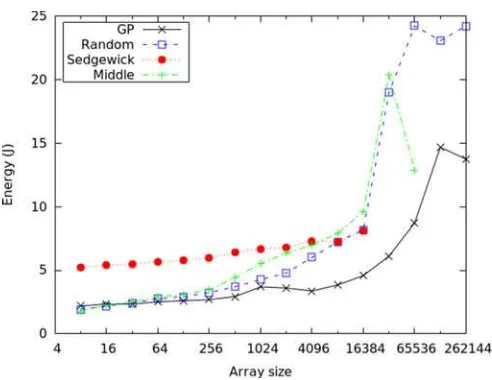
In Table I, the performance is compared with three well-known pivot functions: ‘Middle index’, ‘Random index’, and ‘Sedgewick’ (the latter returning the median of the first, middle and last elements). In this test, OPACITORwas used to calculate the energy required to sort 1000 ‘pipeorgan’ arrays of vary-ing lengths usvary-ing each pivot function. This was repeated 100 times, the mean results being shown in Fig. 1, as well as the p-values and effect size measures calculated when comparing the GP result to each of the other pivot functions. Hyper-quicksort outperforms the Sedgewick pivot in all cases, with a signifi-cant energy saving. In several cases using the ‘Sedgewick’ and ‘Middle index’ pivots the sort resulted in a stack overflow due to the recursion depth. For the smallest arrays (up to 16 elements) hyper-quicksort needs more energy than the random and middle index pivot functions. This is due to the overhead of finding the median value fornrandomly selected elements. As array size increases this overhead is mitigated by the associated reduction in recursion depth, allowing hyper-quicksort to outperform all the alternative pivot functions for array sizes of 32 elements or greater.
TABLE I
ENERGY(J) REQUIRED TOSORT1000 ‘PIPEORGAN’ ARRAYS OFVARYINGLENGTHSUSINGEACH OF THEPIVOTFUNCTIONS(MEAN OF100 RUNS, ASWELLAS THE P-VALUES(P)ANDEFFECTSIZEMEASURES(E) COMPARING THEGP RESULT TOEACH OF THEOTHERPIVOTFUNCTIONS)
Array size GP Random Sedgewick Middle
J σ J σ p e J σ p e J σ p e
8 2.19 0.18 1.93 0.07 <.001 0.06 5.22 0.09 <.001 1.00 1.80 0.02 <.001 0.00 16 2.34 0.10 2.18 0.08 <.001 0.10 5.38 0.12 <.001 1.00 2.26 0.09 <.001 0.24 32 2.34 0.12 2.43 0.08 <.001 0.77 5.50 0.14 <.001 1.00 2.50 0.14 <.001 0.94 64 2.51 0.12 2.75 0.15 <.001 0.95 5.65 0.12 <.001 1.00 2.89 0.06 <.001 1.00 128 2.60 0.14 2.93 0.10 <.001 0.98 5.80 0.13 <.001 1.00 3.10 0.11 <.001 1.00 256 2.69 0.14 3.23 0.15 <.001 1.00 5.97 0.15 <.001 1.00 3.46 0.17 <.001 1.00 512 2.93 0.16 3.71 0.26 <.001 1.00 6.40 0.10 <.001 1.00 4.43 0.53 <.001 1.00 1024 3.69 0.57 4.26 0.70 0.01 0.71 6.68 0.13 <.001 1.00 5.53 0.64 <.001 0.96 2048 3.60 0.52 4.78 1.21 <.001 0.88 6.78 0.10 <.001 1.00 6.36 1.16 <.001 0.98 4096 3.37 0.27 6.01 1.72 <.001 1.00 7.31 1.39 <.001 1.00 6.96 1.88 <.001 1.00 8192 3.72 0.31 6.09 1.36 <.001 1.00 7.20 0.19 <.001 1.00 5.64 0.78 <.001 1.00 16384 4.58 0.39 8.18 1.71 <.001 0.99 8.07 0.20 <.001 1.00 9.61 1.39 <.001 1.00 32768 6.11 0.97 18.99 8.41 <.001 1.00 - - - - 20.37 2.88 <.001 1.00 65536 8.72 2.56 24.22 10.46 <.001 0.95 - - - - 12.88 6.62 <.001 0.82 131072 14.67 5.21 23.06 13.38 0.05 0.65 - - - -262144 13.74 4.60 24.21 12.55 <.001 0.73 - - -
[image:6.594.44.290.322.512.2]-In a number of cases the sort resulted in a stack overflow, these results are therefore excluded from the table. Bold values highlight the lowest energy use for each array size.
Fig. 1. Energy (J) required to sort 1000 ‘pipeorgan’ arrays of varying lengths using each of the pivot functions. The lines with no points after a particular array size show where the sort was unsuccessful (recursion limit reached).
comparing the set of results obtained using hyper-quicksort to each of the alternative pivots in turn. In all cases the distributions of the results were significantly different (p <0.05). According to Vargha and Delaney [46], an effect size of 0.56 indicates a small difference, 0.64 indicates a medium difference, and 0.71 indicates a large difference. Given this scale, in almost all cases the evolved pivot function has provided a large energy reduction. Further than this, as the array size was increased to 32,768, the recursive algorithm caused a stack overflow in the JVM when using the Sedgewick pivot function. This also occurred with array sizes of217when using the Middle Index pivot func-tion. It is possible to increase the JVM’s stack, however this serves to emphasise that hyper-quicksort has helped to harden the algorithm against a denial-of-service attack.
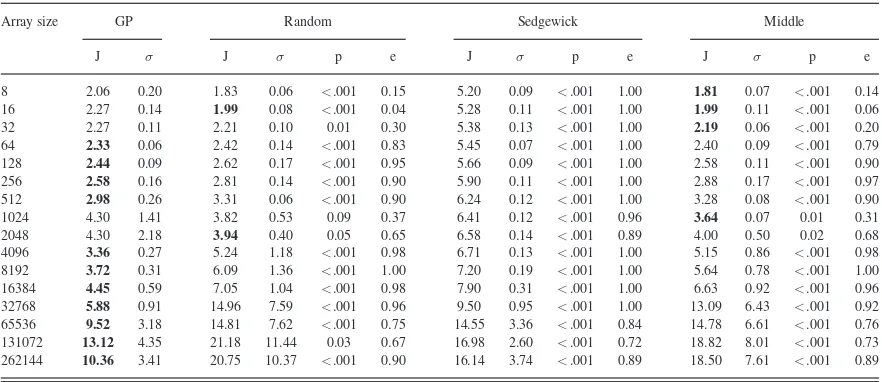
To determine how the same evolved pivot function performs on non-‘pipeorgan’ arrays, similar testing was performed—this time calculating the energy required to sort 1000 randomly gen-erated arrays of varying lengths. This test was also run 100 times, with the mean results presented in Table II and Fig. 2, as well as the p-values and effect size measures when comparing the GP result to each of the other pivot functions. Notably, although hyper-quicksort was trained specifically to sort ‘pipeorgan’ in-put arrays, the evolved pivot function is also very successful at sorting randomly generated input arrays.
Except for the Sedgewick pivot function, which was outper-formed by hyper-quicksort for all array sizes, the pivot functions are statistically inseparable with an array size of less than 4096 elements. At this point, the evolved pivot function is consistently more energy efficient than the alternatives, withp <0.05and in general a large effect size.
Although it might be expected that the energy required to sort an array will increase with array size, as the arrays in both ex-periments were randomly generated (either randomly selecting the point at which the value begins decreasing, or generating all the data at random) this is not guaranteed. All four pivot functions sorted the same arrays, but it is not possible to ensure the ‘difficulty’ of sorting each input array is the same across all array sizes. As such, some otherwise unexplained outliers exist, for example the middle index pivot function sorting arrays of size 65,536 displays a significant decrease in energy required compared to size 32,768 where the other pivot functions all show an expected increase.
TABLE II
ENERGY(J) REQUIRED TOSORT1000 RANDOMLYGENERATEDARRAYS OFVARYINGLENGTHSUSINGEACH OF THEPIVOTFUNCTIONS(MEAN OF100 RUNS, AS
WELLAS THE P-VALUES(P)ANDEFFECTSIZEMEASURES(E) COMPARING THEGP RESULT TOEACH OF THEOTHERPIVOTFUNCTIONS)
Array size GP Random Sedgewick Middle
J σ J σ p e J σ p e J σ p e
8 2.06 0.20 1.83 0.06 <.001 0.15 5.20 0.09 <.001 1.00 1.81 0.07 <.001 0.14 16 2.27 0.14 1.99 0.08 <.001 0.04 5.28 0.11 <.001 1.00 1.99 0.11 <.001 0.06 32 2.27 0.11 2.21 0.10 0.01 0.30 5.38 0.13 <.001 1.00 2.19 0.06 <.001 0.20 64 2.33 0.06 2.42 0.14 <.001 0.83 5.45 0.07 <.001 1.00 2.40 0.09 <.001 0.79 128 2.44 0.09 2.62 0.17 <.001 0.95 5.66 0.09 <.001 1.00 2.58 0.11 <.001 0.90 256 2.58 0.16 2.81 0.14 <.001 0.90 5.90 0.11 <.001 1.00 2.88 0.17 <.001 0.97 512 2.98 0.26 3.31 0.06 <.001 0.90 6.24 0.12 <.001 1.00 3.28 0.08 <.001 0.90 1024 4.30 1.41 3.82 0.53 0.09 0.37 6.41 0.12 <.001 0.96 3.64 0.07 0.01 0.31 2048 4.30 2.18 3.94 0.40 0.05 0.65 6.58 0.14 <.001 0.89 4.00 0.50 0.02 0.68 4096 3.36 0.27 5.24 1.18 <.001 0.98 6.71 0.13 <.001 1.00 5.15 0.86 <.001 0.98 8192 3.72 0.31 6.09 1.36 <.001 1.00 7.20 0.19 <.001 1.00 5.64 0.78 <.001 1.00 16384 4.45 0.59 7.05 1.04 <.001 0.98 7.90 0.31 <.001 1.00 6.63 0.92 <.001 0.96 32768 5.88 0.91 14.96 7.59 <.001 0.96 9.50 0.95 <.001 1.00 13.09 6.43 <.001 0.92 65536 9.52 3.18 14.81 7.62 <.001 0.75 14.55 3.36 <.001 0.84 14.78 6.61 <.001 0.76 131072 13.12 4.35 21.18 11.44 0.03 0.67 16.98 2.60 <.001 0.72 18.82 8.01 <.001 0.73 262144 10.36 3.41 20.75 10.37 <.001 0.90 16.14 3.74 <.001 0.89 18.50 7.61 <.001 0.89
[image:7.594.75.516.102.293.2]Bold values highlight the lowest energy use for each array size.
Fig. 2. Energy (J) required to sort 1000 randomly generated arrays of varying lengths using each of the pivot functions.
for, the search process will take care of the rest. The algorithm can then be easily retuned for new target datasets.
V. MULTILAYERPERCEPTRON
We now consider application to the training and validation phases of a very popular [47] neural net architecture — the Multi-Layer Perceptron (MLP). The MLP is a modification of the standard linear perceptron with ‘hidden’ layers of neurons with nonlinear activation functions. can distinguish data that are not linearly separable and are often applied to classification tasks like image recognition. They have seen renewed interest recently with the advent of deep learning.
We focus on two objectives for optimization. The first is the energy useǫ, of the training and validation phases of the MLP,
as determined by OPACITOR. The second is the mean square errorE of the trained MLP on validation data. The goal is to realise Harmanet al.’s Pareto Program Surface [48], comprising program variants spanning the trade-off between a functional property of the software, in this case error rate, against a non-functional property like energy. It can be envisaged that the user of a mobile device might trade-off some accuracy in an app using classification if it would extend battery life. Here we show how a multi-objective metaheuristic can easily explore this trade-off.
MLPs consist of input and output layers, with one or more ‘hidden’ layers. The multiple inputs to each neuron are subject to thresholding via anactivationfunction — typically a sigmoidal expression in terms of tanh(x) or ex. It is well-known that
a MLP with only a single hidden layer is capable of universal function approximation [49] and this, together with relative ease of use for practitioners, has led to decades of prevalence in machine learning for the MLP, both in academia and industry.
TABLE III
PARAMETERS OFMLP VARIEDDURINGOPTIMIZATION
Param. Explanation Type Range (inclusive)
a AF parameter 0 Continuous (0,1)
b AF parameter 1 Continuous (0,1)
c AF parameter 2 Continuous (0,1)
d AF parameter 3 Continuous (0,1)
h Neuron count in hidden layer Integer (2,30)
l Backpropogation learning rate Continuous (0,1)
α Backpropogation momentum Continuous (0,1)
the expression bloat of symbolic methods. In this section, we describe the novel application of AD to the online generation of AFs in order to explore the tradeoff between accuracy and energy efficiency.
A. Implementation
A wide range of alternative AFs have been explored in the literature, including logistic, Gaussian (e−x2
) trigonometric and radial basis functions [53]. Previous work on online adaptation of a piecewise linear AFs can be found in Agostinelliet al.[54]. The AF we use here is a parametric generalization of the popular logistic function1/(1 + e−x), given by:
f(x) = a
1 +becx +d (1)
The real-valued parameters{a, b, c, d}define the family of AFs to be explored by search. AD has two operation modes, ‘for-ward’ and ‘reverse’. The latter is more efficient for machine learning scenarios such as we are concerned with here, in which the derivative of the AF is required for multiple fitness cases at each fitness evaluation. Hence, the derivative of the AF was obtained via the application of reverse mode AD.
Three parameters controlling training and topology are also included, so a particular network is specified by the 7 parameter values in Table III. For each dataset, instances were divided at random into 2/3 training and 1/3 validation data.
As we have already seen,ǫvaries depending on a wide range of factors.Evaries depending on the seed for the random num-ber generator (used to set MLP starting weights) and the specific training/validation datasets chosen. This means that both objec-tives are noisy, so evaluations were repeated 5 times with the mean value used to guide the search (the 5 repeats counted as oneevaluationin the experiments).
B. Experiments
The popular multi-objective evolutionary algorithm NSGA-II [55] as implemented in JMetal 4.5 [56] was used to conduct the search. For all data sets, the parameters were the same: popula-tion size 10; terminapopula-tion after 400 evaluapopula-tions; SBX crossover with rate 0.9 and distribution index of 20.0; polynomial real mu-tation with rate 1/7 and distribution index of 20.0; and binary tournament selection.
The experiments covered 4 UCI datasets (Table IV) in-cluded with the WEKA machine learning library [57]. The
TABLE IV UCI DATASETSUSED
Dataset Instances Attributes
Pima Indians Diabetes 768 8 Glass Identification 214 10 Ionosphere 351 34
Iris 150 4
metaheuristic searched for solutions having specific values for each of the 7 parameters in Table III, seeking to minimiseǫand Eobjectives for a given training dataset. ‘Error’ in the results is the mean square error for classification on the validation dataset. Two separate runs were performed for each dataset, measuring energy for:
1) t: training only.
2) tv: training and 1,000 repeats of the validation phase. In the latter, the validation phase was repeated 1000 times so that it would impact on total energy, because its run time is much smaller than the training phase. In practice, training will be performed far less frequently than validation/classification, so energy gains for the latter will be of most benefit. These exper-iments are focused on the trade-off between objectives in terms of the application, rather than comparison of performances, so no repeat optimisation runs were performed. Statistics related to the repeats of the objective function are reported in the next section.
C. Results and Discussion
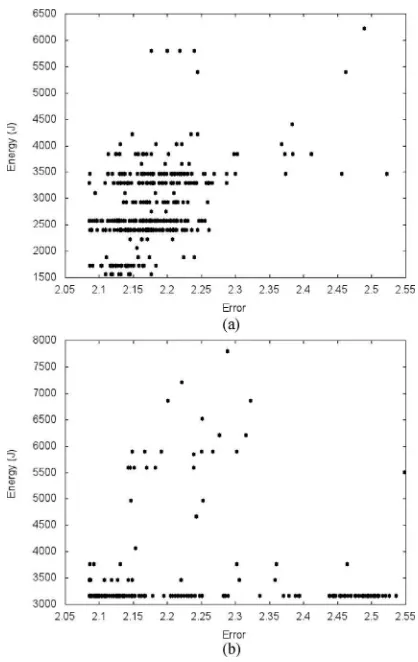
Fig. 3 shows all 400 solutions visited by the search on the Glass data set, plotted in the objectives (energy vs. error). Plots for the other three data sets have been omitted here to save space, but showed similar distributions of the solutions. For most data sets, there is little conflict between energy and error, so it is possible to minimize both. Energy is reduced to around 20% of the worse-case solutions for all data sets. For Glass, when measuring energy for training only, there is a Pareto front, albeit limited to two solutions. Energy use can be reduced from 1724 J to 1559 J (about 10%) by accepting an increase in mean square error from 2.08 to 2.11. All the results show essentially discrete steps in energy use, corresponding to the number of hidden layer neurons h. However, the search process is worthwhile because there is not always a simple linear relationship between hand energy. This was particularly true for the training phase on Diabetes, Glass and Ionosphere (Fig. 4 shows the relationship for Ionosphere).
Analysis of values taken by the variables in the optimal and near-optimal solutions found thata,dandαtook similar values for both tv and t runs, but differed per dataset. In contrast,b,c andlvaried depending on both dataset and t/tv.
Fig. 3. All evaluations for the Glass dataset, plotted in objective space: energy (J) vs. mean square error. “t” are runs where the energy measurement included training only, “tv” runs measured energy for both training and validation. Dia-betes, Ionosphere and Iris showed similar distributions. (a) Glass training. (b) Glass training & validation.
Fig. 4. Energy (J) vs. hidden layer size for Ionosphere, measuring energy for the training stage only.
contrast, cov(E) for error varied from zero to 42%, with a mean of 2%. Applying t-tests to the objective values found p0.005for the difference in means between the original and optimal configurations on all energy runs. For error,p <0.05 with diabetes-v, glass-v, glass-nv, and iris-nv. Differences in error were non-significant for the other runs.
These experiments have demonstrated that SBSE allows the developer to easily explore the trade-off between functional and non-functional properties (in this case, accuracy and energy). Such relationships are not always clear: here, one might have expected there to be a conflict between the objectives, yet often there was none. Moving the burden of exploring such a relation-ship to an automated search means that it becomes much simpler to tune the balance between these objectives for a particular sit-uation. In this case, the approach achieved the ideal result of minimising energy and error for the MLP on four well-known datasets. This could be fine-tuned per-dataset and with a bias towards improvement in the training or validation/classification phases, depending on end application. It would allow multiple configurations to be generated and stored that could be switched on-the-fly: for example, on a mobile device so that classification accuracy decreases as battery charge is exhausted.
VI. GUAVA ANDAPACHECOMMONSCOLLECTIONS
We now consider Object-Oriented Genetic Improvement (OO-GI), a technique for improvement specific to Object-Oriented programs, applied to optimization of container classes. These are implementations of well-known data structures like maps, sets, and lists. The choice of implementations for col-lections classes dramatically impact on energy consumption [58]. Our approach uses metaheuristic search to find seman-tically equivalent programs with reduced energy consumption. Semantics-preserving transformations are achieved by confor-mance to the behavioural equivalence that is central to object-orientation. OO-GI was first proposed in [23], and demonstrated using an earlier version of OPACITOR, as applied to a single class in the Google Guava framework. This earlier work is here ex-tended with a more thorough experimental study, covering a range of classes in Google Guava5 and the Apache Commons Collections library.6
Although several existing approaches in GP and Grammati-cal Evolution (GE) claim to be ‘Object Oriented’ [59]–[63], we are not aware of any concerned with the central pillar of Object Orientation, the Liskov Substitution Principle (LSP) [64] as ex-emplified via subtype polymorphism. When designed according to the LSP, subtype polymorphism permits the implementation of frameworks according to the ‘Open Closed Principle’, i.e. both framework implementers and their client programmers can be assured that their code can interoperate without unexpected behaviour. It is this principle that allows OO software to scale more effectively than purely object-based approaches. ‘Design by contract’ (DbC) is the explicit codification of the LSP via preconditions, postconditions and invariants [65]. DbC is widely understood to be a vital adjunct to methods such as Test-Driven Development, since the above conditions serve to capture a wide range of required behaviours. It was first natively supported in Meyer’s Eiffel language in 1986 and is now natively supported by a number of popular programming languages, including ADA 2012, Clojure, D and Racket. The closest search-based work of
5Version 18: github.com/google/guava/wiki/Release18
[image:9.594.55.275.454.619.2]TABLE V
CLASSESCHOSEN FORMODIFICATION BYOO-GI, WITH THENUMBER OFVARIATIONPOINTS ANDSIZE OF THERESULTINGSEARCHSPACE FOREACH
Class for modification Variation points Search space
com.google.common.collect.ArrayListMultimap 3 2 738
com.google.common.collect.ImmutableMultimap 5 674 325
com.google.common.collect.LinkedListMultimap 6 7 513 072
org.apache.commons.collections4.map.PassiveExpiringMap 3 50 653
org.apache.commons.collections4.set.ListOrderedSet 4 38 416
org.apache.commons.collections4.bidimap.DualHashBidiMap 6 2 565 726 409
which we are aware is the SEEDS framework [34], in which al-ternative subtypes of container classes are substituted into byte-code in order to minimize power consumption. SEEDS uses separate exhaustive search at each object allocation location. In contrast, OO-GI uses a genetic approach, applicable to any code following DbC, to assign subclasses to all constructor invoca-tions simultaneously. The benefit is to catch any situation where dependencies exist between variation points. It is difficult to de-termine when this might be the case by simple code inspection, meaning that simply combining results from separate searches at each variation point may be suboptimal.
A. Implementation
The improvement process is as follows:
1) Parse the source file to be improved into an Abstract Syntax Tree (AST). Identifyvariation points: i.e., source nodes in the AST corresponding to the creation of con-tainer classes from Java 8 util, Guava, or Apache collections. These comprise three types of syntax frag-ment: constructors (e.g.new HashMap<>()); factory classes (e.g.Maps.newHashMap()); and static creator methods (e.g.ImmutableList.of()).
2) Obtain the complete set of possible target substitutions T (i.e. all container classes in Guava, Apache and Java Collections. For each variation pointSiin the AST,
deter-mine the most specific abstract supertype of the created object, by checking whether it inherits from one of the following (always choosing the most specific type - the one appearing earliest in the list):
a) java.util.SortedMap b) java.util.Map
c) java.util.SortedSet d) java.util.Set
e) java.util.List
f) com.google.common.collect.Multimap g) com.google.common.collect.Multiset h) java.util.Collection
3) For eachSi, find the subset of possible target
substi-tutionst(Si)⊆Twhich are valid (i.e., are concrete,
and implement the same abstract supertype as the original class atSi).
4) Given a sequence of the k variation points [S1, . . . , Sk]from the AST, the search space is given
by all combinations from [t(S1), . . . , t(Sk)]. The
solution representation is an assignment i→s∈
t(Si),1≤i≤k, represented as an elementr∈Zk,
with constraints0≤ri<|t(Si)|.
5) Given such an assignment, the AST node for each Si is replaced with its target substitution and the
resulting mutated source file is written to disk. 6) The program containing the mutated source is
com-piled and its energy consumption evaluated by OPACITOR. By this means, combinatorial search is performed in the space of these representations by a GA to find the substitutions that minimize energy consumption.
Source file parsing and subsequent re-generation was completed automatically with an open-source library com.github.javaparser.JavaParser. A modified version of JavaParser’sSourcePrintermade the required source code substitution at each variation point.
A careless programmer might depend on functionality not guaranteed by the LSP, such as assuming that a collection is sorted, despite this not being part of the superclass type spec-ification actually visible at the point at which this assumption is made. This is a logical error by the programmer and, strictly speaking, requires rewriting of the code. We do not cater explic-itly for such programming errors in our experiments. In practice, the best that can be done is to include, as we do, any existing unit tests as a constraint on the search.
B. Experiments
The open-source Java frameworks Google Guava and Apache Commons Collections implement a variety of concrete sub-classes ofjava.util.Collection. There are well-known tradeoffs in performance characteristics between different col-lection subclasses: for example, finding a specific element in a linked list isO(n)but in a hash-set it isO(1).
An exhaustive search over all top-level concrete collections classes in Google Guava and Apache Commons Collections found 14 with 3 or more variation points. After ruling out those where some variation points were instantiations of the class itself, or used specialised classes where functionality would likely be broken by replacement with a generic container, 6 classes were chosen for closer consideration (Table V).
TABLE VI
ENERGY(J) REQUIRED TOEXERCISE THEUNITTESTS FOREACHCLASS10,000 TIMES(MEAN OF100 RUNS,ANDSTANDARDDEVIATIONσ), MEASURED BY
OPACITORWITHOUT(EXCL.)ANDWITH(INCL.) JITANDGC
The p-values (p) and effect sizes (e) compare the GA result to the original or the result of IES (in two cases the GA and IES found the same set of substitutions). Also given are the number of evaluations (evals) required by the GA to reach the best fitness found, and the percentage reduction that this represents compared to an exhaustive search of the entire space. Bold values highlight the lowest energy use for each class.
the class using randomly-generated data. Programs failing the unit tests were rejected by the search as invalid.
The first experiment used a GA to search for a solution with reduced energy consumption. The Apache Commons Math library7 GA implementation was used. The solution represen-tation used was a vector of integers r∈Zk. The representa-tion itself was constrained such that0≤ri<|t(Si)|. The GA
parameters were chosen empirically to yield good results in reasonable run time (evaluations taking 5–30 s on a 3.25 GHz CPU). These were: population size 500; termination at 100 gen-erations; single-point crossover with a rate of 75%; one-point mutation with a rate of 50%; binary tournament selection; 5% elitism. 30 repeat runs using different random number generator seeds were completed for each target class.
A second experiment ran an exhaustive search on the entire search space for each class (exceptLinkedListMultimap andDualHashBidiMapdue to their large size) to determine how close the GA came to finding the optimal solution.
A final experiment ran an exhaustive search on each variation point, following the example of [34] but on source code instead of bytecode. Each variation point is examined in turn, finding the best substitution independently of the other variation points. The set of candidate results then constitutes one program for each of these separate substitutions. Added to this set of candidates
7commons.apache.org/proper/commons-math/userguide/genetics.html
is a program containing all of the independent substitutions combined together, and the original program. The program from this set requiring the least energy is the final result—this may not be the combined candidate, if the variation points are not in fact independent. We refer to this experiment as anIndependent Exhaustive Search(IES).
C. Results and Discussion
Statistical testing was carried out using the ASTRAIEA [44] Wilcoxon/Mann Whitney U and Vargha-Delaney Effect size tests. Results were obtained with 100 samples in each dataset. In all cases exceptDualHashBidiMap, each GA run found an identical result, so this solution was used thereafter. For DualHashBidiMap, due to the large search space, 3 different results were found. The best and worst were each compared statistically to the original code and the result from IES.
For the four classes where an exhaustive search was per-formed, the best set of substitutions were the same as those found by the GA. The GA therefore reduced the search time by between 10% (ArrayListMultimap) and 98.5% (Im-mutableMultimap). Using alternative parameters for the evolution would likely improve this further—particularly in the cases with the smallest search spaces.
statistical tests are necessary. When using OPACITORwith JIT and GC enabled, the fitness was evaluated 100 times—the table shows the mean and standard deviation, as well as the p-values and Vargha-Delaney effect size measures comparing the results of the GA to the original and the results of IES.
Reductions in energy consumption were achieved for all six classes. An interesting result is that, without JIT and GC, the best result found by the GA for four of the classes was only marginally better than the original programs. Once JIT and GC were enabled for final testing the improvement becomes signifi-cant with a medium or large effect size. Deeper analysis revealed that, in these cases, the substitutions included a class from an alternative collection (Google Guava or Apache Commons) to the original class. This results in a large number of additional classes which must be imported by the JVM. When JIT is re-enabled the importing is optimized, resulting in a significant energy reduction compared to the original.
As the energy measurement during the final testing with JIT and GC is not deterministic, p-values and effect sizes vary ac-cordingly. The p-values are all near-zero, with effect sizes all at least 0.74, which Vargha and Delaney suggest indicates a large difference. Although in some cases the improvement was marginal when measured with JIT and GC disabled, in the more realistic scenario of having these enabled, 2.16–13.13J were saved over the original implementations. These represent en-ergy reductions of 9.23%–39.85% over the original.
During final testing, the GA also matched or further improved upon the lowest-energy solutions found by IES. This reflects the presence of some dependency between the variation points for some of the classes: if the points were independent then IES would find the optimal solution by combining the best value for each variation point. The possibility of such dependencies increases the search space to the product of all values at all varia-tion points, necessitating a global search like the GA. For exam-ple, inImmutableMultimap one variation point is within a nested subclass that is privately declared, which is instanti-ated at another variation point. IES requires a number of fitness evaluations approximately equal to the count of possible substi-tutions over each of the variation points, and so is significantly faster than the GA, however this speed is a trade-off with the quality of the final result. This highlights that there can be subtle interactions between sections of the code that influence energy consumption and may not be obvious to a developer. An SBSE approach is able to accommodate these interactions where they exist without the developer needing to specify where they are, achieving better performance without additional developer ef-fort.
VII. THREATS TOVALIDITY
There are several potential threats to the validity of this work. The results are dependent on the accuracy of the model: while this cannot be completely eliminated, two factors mitigate this threat. The bytecode level estimates of energy use were taken from Haoet al.[18], where hardware measurements found the model to be within 10% of the ground truth for a set of mobile applications from the Google Play store. In our previous work
[23], [38], we also validated the model by comparing against run-time based models of energy use. Additionally, in practice energy use is likely to follow a conditional distribution rather than remaining constant per-bytecode. A stochastic model is a major consideration for future study on this topic. In particu-lar, (as per [66]) energy consumption is affected by contextual factors such as opcode prefetching and cache hits. There is a clear tradeoff between the generality of a static model such as used by OPACITORand the device-specific labour required for dynamic measurement. It would however be possible to extend the static model with further contextual features. For example, the current model can be seen as a Markov chain of order 1, in which the energy cost of each opcode is independent. Another useful direction for future work is to use machine learning to build predictive models with more contextual features.
Since OPACITORis implemented for the JVM, our major re-sults are limited to that platform. Despite the popularity of Java, we cannot be sure that the results obtained would be repro-ducible in another context.
The general conclusions of our results are supported by the three examples to which we have applied SBSE. While the ap-proaches may seem application-specific, they are simply specific examples of general techniques. The search-based generation of a custom Quicksort pivot function was rapidly prototyped (via the generic method of ‘template method hyper-heuristics’ [67]) using an existing publicly-available library TEMPLAR. The only application-specific aspect was selection of the variation point (the pivot function) and its signature definition, with GP doing the rest. The HyperMLP implementation is a specific instance of hyperparameter tuning, in this case determining the network topology and (via our application of automatic differentiation) the specific activation functions in the network. OO-GI applies to any well-designed OO system, i.e. those featuring multiple concrete subclasses. Further applications of the tools we have developed will doubtless help improve confidence in the gen-eral applicability for SBSE in tuning to data sets, trading off functional and non-function properties, and dealing with depen-dencies with little developer intervention.
In all data-driven applications, energy consumption might be expected to vary between runs, dependent on the specific execu-tion paths followed. Thus, a threat lies in the choice of scenarios made for our experiments. We have tried to mitigate this where possible (e.g. Quicksort experiments explicitly include patho-logical inputs; we have many repeats of classification for the MLP). With OO-GI, the unit tests are targeted towards code coverage rather than typical use: in practice it would be impor-tant to target a series of tests closely aligned to envisaged usage patterns.
VIII. CONCLUSION
Given the widespread use of Java, it is surprising that so little has been done to to apply the power of search-based soft-ware engineering (SBSE) to minimize the energy consumption programs written for the Java Virtual Machine (JVM). We pre-sented OPACITOR, a new tool to measure the energy consumption of programs running on the JVM and used three different search based techniques to optimize the energy efficiency of Quick-sort, Multi-Layer Perceptrons and popular suites of collection classes. OPACITORhas several advantages over time-based en-ergy approximations or hardware measurements. It is determin-istic: it will always produce the same energy measurement for a given program’s compiled bytecode. This avoids the need for averaging across multiple runs that is required by other energy measurement approaches. It is unaffected by the rest of the computing environment: the energy measurements are not in-fluenced by other applications that are running. This means that optimization runs making use of OPACITORcan be distributed across multiple threads or CPUs, in parallel on the same ma-chine, without inadvertently affecting the results. The consis-tency in the energy measurements and the bytecode-level model used also mean that OPACITORis able to detect small changes in execution profile, right down to the level of single opcodes. These characteristics make the energy measurements of OPACI-TORhighly amenable to metaheuristic search. We demonstrated how the energy measurements from OPACITORcan be used by three different SBSE approaches to achieve substantial energy savings for three widely-used software components:
1) GP was used to find better pivot functions for the Quick-sort algorithm. Energy reductions of up to 70% were achieved against common alternative pivot functions. 2) Multi-objective hyperparameter search was applied to
Multi-Layer Perceptrons, incorporating dynamically-generated activation functions via automatic differenti-ation. For four benchmark datasets, we found a MLP con-figuration that minimized both energy consumption and mean square error.
3) Object-Oriented Genetic Improvement was applied to six container classes in the Google Guava and Apache Com-mons libraries. An energy reduction of up to 39.85% was achieved against original code.
Existing SBSE approaches have mainly tackled only spe-cialised applications. The first two approaches we describe, are applicable to any language, and are specific examples of generic methods (application of the template method, and hyper-parameter tuning). The third is applicable toanycode developed in accordance with ‘Design by Contract’, further widening ap-plicability. This work demonstrates that SBSE is not only suit-able for the specialist applications already tackled in the liter-ature, but also much more frequently used code, where it will have a much greater real-world impact. We have shown that the metaheuristics we applied in each setting were able to match or better alternative methods: furthermore in general metaheuris-tics can be expected to scale to larger problems better than alternative search methods, with good results being reported for very large problems indeed [68].
The work has also highlighted the strength of SBSE in accom-modating three aspects of energy optimisation without extensive developer effort. All that is required is the identification of varia-tion points in the code and a suitable representavaria-tion for possible replacements. Algorithms can be tuned to specific distributions of data; energy use can be traded off against other functionality; and the search can handle subtle interactions within the code that might otherwise be missed.
New directions for future research have been opened up. It would be interesting to explore alternative applications for OOGI, particularly where several public libraries implementing common interfaces exist. The model could also be extended to consider uncertainty in the energy attributed to each bytecode, and consider contextual features such as opcode prefetching and cache hits for improved accuracy.
ACKNOWLEDGMENT
The authors would like to thank the reviewers for their helpful feedback and suggestions.
Data Access Statement: This work made use of several existing libraries and data sets, freely available at the lo-cations cited. Data generated in this work is available at http://hdl.handle.net/11667/88.
REFERENCES
[1] P. Marks, “Let’s cut them some slack,”New Scientist, vol. 230, no. 3067, pp. 36–39, 2016.
[2] B. R. Bruce, J. Petke, and M. Harman, “Reducing energy consumption us-ing genetic improvement,” inProc. Genetic Evol. Comput. Conf.Madrid, Spain: ACM, 2015, pp. 1327–1334.
[3] A. Banerjee and A. Roychoudhury, “Future of mobile software for smartphones and drones: Energy and performance,” inProc. IEEE/ACM Int. Conf. Mobile Softw. Eng. Syst. Buenos Aires, Argentina, 2017, https://www.comp.nus.edu.sg/∼abhik/pdf/MOBILESoft17.pdf [4] A. Carroll and G. Heiser, “An analysis of power consumption in a
smartphone,” inProc. USENIX Tech. Conf.Berkeley, CA, USA, 2010, p. 21.
[5] A. Carroll and G. Heiser, “The systems hacker’s guide to the Galaxy: Energy usage in a modern smartphone,” inProc. 4th Asia-Pacific Workshop Syst.New York, NY, USA: ACM, 2013, pp. 5:1–5:7.
[6] J. G. Koomey, “Growth in data center electricity use 2005 to 2010, USA, CA, Oakland: Analytics Press, Jul. 2011.
[7] A. Hindle, “Green software engineering: the curse of methodology,”PeerJ PrePrints, vol. 3, 2015, Art. no. e1832.
[8] C. Sahin, L. Pollock, and J. Clause, “How do code refactorings affect energy usage?” inProc. ACM/IEEE Int. Symp. Empirical Softw. Eng. Meas.NY, USA: ACM, 2014, pp. 36:1–36:10.
[9] M. Harman, P. McMinn, J. T. de Souza, and S. Yoo, “Search based soft-ware engineering: Techniques, taxonomy, tutorial,”Empirical Software Engineering and Verification. Berlin, Germany: Springer-Verlag, 2012, pp. 1–59.
[10] D. R. White, “Genetic programming for low-resource systems,” Ph.D. dissertation, Computer Science, University of York, York, U.K., 2009. [11] E. Schulte, J. Dorn, S. Harding, S. Forrest, and W. Weimer, “Post-compiler
software optimization for reducing energy,” inProc. Conf. Architectural Support Program. Lang. Operating Syst.New York, NY, USA: ACM, 2014, pp. 639–652.
[12] H. Hoffmann, S. Misailovic, S. Sidiroglou, A. Agarwal, and M. Rinard, “Using code perforation to improve performance, reduce energy con-sumption, and respond to failures,” Massachusetts Institute of Technology, Cambridge, MA, USA, Tech. Rep. MIT-CSAIL-TR-2009-042, 2009. [13] V. Mrazek, Z. Vasicek, and L. Sekanina, “Evolutionary approximation
[14] X. T. Nguyen, H. T. Tran, H. Baraki, and K. Geihs, “Optimization of non-functional properties in internet of things applications,”J Netw. Comput. Appl., Mar. 2017, doi: 10.1016/j.jnca.2017.03.019.
[15] A. Noureddine, A. Bourdon, R. Rouvoy, and L. Seinturier, “Runtime monitoring of software energy hotspots,” inProc. IEEE/ACM Int. Conf. Automated Softw. Eng.Essen, Germany, 2012, pp. 160–169.
[16] K. Aggarwal, A. Hindle, and E. Stroulia, “GreenAdvisor: A tool for an-alyzing the impact of software evolution on energy consumption,” in
Proc. IEEE Int. Conf. Softw. Maintenance Evol.Bremen, Germany, 2015, pp. 311–320.
[17] S. A. Chowdhuryet al., “A system-call based model of software energy consumption without hardware instrumentation,” inProc. Int. Green Sus-tain. Comput. Conf.Las Vegas, NV, USA, 2015, pp. 1–6.
[18] S. Hao, D. Li, W. G. Halfond, and R. Govindan, “Estimating mobile application energy consumption using program analysis,” inProc. Int. Conf. Softw. Eng. San Francisco, CA, USA: IEEE, 2013, pp. 92–101. [19] A. Banerjee, L. K. Chong, S. Chattopadhyay, and A. Roychoudhury,
“Detecting energy bugs and hotspots in mobile apps,” inProc. 22nd ACM SIGSOFT Int. Symp. Found. Softw. Eng. Hong Kong: ACM, 2014, pp. 588– 598.
[20] A. Hindle, A. Wilson, K. Rasmussen, E. J. Barlow, J. C. Campbell, and S. Romansky, “GreenMiner: A hardware based mining software reposi-tories software energy consumption framework,” inProc. Mining Softw. Repositories. Hyderabad, India: ACM, 2014, pp. 12–21.
[21] B. Meyer, “Applying ‘design by contract’,”Computer, vol. 25, no. 10, pp. 40–51, Oct. 1992.
[22] J. Swan and N. Burles, “Templar: A framework for template-method hyper-heuristics,” inProc. Eur. Conf. Genetic Program.Copenhagen, Den-mark: Springer-Verlag, vol. 9025, Apr. 8–10, 2015, pp. 205–216. [23] N. Burles, E. Bowles, A. E. I. Brownlee, Z. A. Kocsis, J. Swan, and
N. Veerapen, “Object-oriented genetic improvement for improved energy consumption in Google Guava,” inProc. Symp. Search-Based Softw. Eng., 2015, pp. 255–261.
[24] C. Zhang, A. Hindle, and D. M. German, “The impact of user choice on energy consumption,”IEEE Softw., vol. 31, no. 3, pp. 69–75, May./Jun. 2014.
[25] A. Banerjee, L. K. Chong, C. Ballabriga, and A. Roychoudhury, “Energy-patch: Repairing resource leaks to improve energy-efficiency of android apps,”IEEE Trans. Softw. Eng., 2017, doi: 10.1109/TSE.2017.2689012. [26] M. Rashid, L. Ardito, and M. Torchiano, “Energy consumption analysis
of algorithms implementations,” inProc. ACM/IEEE Int. Symp. Empirical Softw. Eng. Meas.Beijing, China, 2015, pp. 82–85.
[27] H. Field, G. Anderson, and K. Eder, “EACOF: A framework for providing energy transparency to enable energy-aware software development,” in
Proc. 29th Annu. ACM Symp. Appl. Comput.Gyeongju, South Korea, 2014, pp. 1194–1199.
[28] D. Li, S. Hao, J. Gui, and W. G. J. Halfond, “An empirical study of the energy consumption of Android applications,” inProc. IEEE Int. Conf. Softw. Maintenance Evol.Victoria, BC, Canada, Sep. 2014, pp. 121–130. [29] A. Gupta, T. Zimmermann, C. Bird, N. Nagappan, T. Bhat, and S. Emran, “Detecting energy patterns in software development,” Microsoft Research, Tech. Rep. MSR-TR-2011-106, Redmond, WA 98052, Nov. 2011. [30] M. Linares-V´asquez, G. Bavota, C. Bernal-C´ardenas, R. Oliveto, M. Di
Penta, and D. Poshyvanyk, “Mining energy-greedy API usage patterns in Android apps: An empirical study,” inProc. Work. Conf. Mining Softw. Repositories. Hyderabad, India: ACM, 2014, pp. 2–11.
[31] N. Grech, K. Georgiou, J. Pallister, S. Kerrison, J. Morse, and K. Eder, “Static analysis of energy consumption for LLVM IR programs,” inProc. Int. Workshop Softw. Compilers Embedded Syst.Sankt Goar, Germany: ACM, 2015, pp. 12–21.
[32] X. Li and J. P. Gallagher, “A source-level energy optimization framework for mobile applications,” inProc. IEEE Int. Work. Conf. Source Code Anal. Manipulation.Raleigh, NC, USA, Oct. 2016, pp. 31–40. [33] H. Hoffmann, S. Sidiroglou, M. Carbin, S. Misailovic, A. Agarwal, and
M. Rinard, “Dynamic knobs for responsive power-aware computing,” in
Proc. Int. Conf. Archit. Support Program. Lang. Operating Syst.Newport Beach, CA, USA: ACM, 2011, pp. 199–212.
[34] I. Manotas, L. Pollock, and J. Clause, “SEEDS: A software engineer’s energy-optimization decision support framework,” inProc. Int. Conf. Softw. Eng. Hyderabad, India: ACM, 2014, pp. 503–514.
[35] M. Linares-V´asquez, G. Bavota, C. E. B. C´ardenas, R. Oliveto, M. D. Penta, and D. Poshyvanyk, “Optimizing energy consumption of GUIs in android apps: A multi-objective approach,” inProc. 2015 10th Joint Meet. Found. Softw. Eng, Bergamo, Italy: ACM, 2015, pp. 143–154.
[36] D. Li, A. H. Tran, and W. G. J. Halfond, “Optimizing display energy consumption for hybrid Android apps,” inProc. Int. Workshop. Softw. Develop. Lifecycle Mobile, Bergamo, Italy: ACM, 2015, pp. 35–36.
[37] S. Luke,Essentials of Metaheuristics, 2nd ed. Raleigh, NC, USA: Lulu, 2013.
[38] N. Burles, E. Bowles, B. R. Bruce, and K. Srivisut, “Specialising Guava’s cache to reduce energy consumption,” inProc. Symp. Search-Based Softw. Eng., Bergamo, Italy: Springer-Verlag, 2015, pp. 276–281.
[39] C. A. R. Hoare, “Quicksort,”Comput. J., vol. 5, no. 1, pp. 10–16, 1962. [40] M. Atallah and M. Blanton,Algorithms and Theory of Computation
Hand-book, Second Edition, Volume 1: General Concepts and Techniques. Boca Raton, FL, USA: CRC Press, 2009, pp. 3–10.
[41] P. J. Plauger,The Standard C Library. Upper Saddle River, NJ, USA: Prentice-Hall, 1992.
[42] M. D. McIlroy, “A killer adversary for quicksort,”Softw.: Pract. Experi-ence, vol. 29, no. 4, pp. 341–344, 1999.
[43] F. Otero, T. Castle, and C. Johnson, “EpochX: Genetic Programming in Java with statistics and event monitoring,” inProc. Annu. Conf. Compan-ion Genetic Evol. Comput., Philadelphia, PA, USA: ACM, 2012, pp. 93– 100.
[44] G. Neumann, J. Swan, M. Harman, and J. A. Clark, “The executable exper-imental template pattern for the systematic comparison of metaheuristics,” inProc. Companion Publ. Annu. Conf. Genetic Evol. Comput., Vancouver, BC, USA, 2014, pp. 1427–1430.
[45] A. Arcuri and L. Briand, “A practical guide for using statistical tests to assess randomized algorithms in software engineering,” inProc. Int. Conf. Softw. Eng., Honolulu, HI, USA: ACM, 2011, pp. 1–10.
[46] A. Vargha and H. D. Delaney, “A critique and improvement of the CL common language effect size statistics of McGraw and Wong,”J. Educ. Behav. Statist., vol. 25, no. 2, pp. 101–132, 2000.
[47] S. Haykin,Neural Networks and Learning Machines(Neural networks and learning machines), vol. 10. Englewood Cliffs, NJ, USA: Prentice-Hall, 2009.
[48] M. Harman, W. B. Langdon, Y. Jia, D. R. White, A. Arcuri, and J. A. Clark, “The GISMOE challenge: Constructing the Pareto program surface using genetic programming to find better programs,” inProc. IEEE/ACM Int. Conf. Automated Softw. Eng. Essen, Germany: ACM, 2012, pp. 1–14. [49] G. Cybenko, “Approximation by superpositions of a sigmoidal function,”
Math. Control, Signals Syst., vol. 2, no. 4, pp. 303–314, 1989.
[50] S. K. Sharma and P. Chandra, “An adaptive slope sigmoidal function cas-cading neural networks algorithm,” inProc. Int. Conf. Emerg. Trends Eng. Technol. Berlin, Germany: Springer-Verlag, Nov. 2010, vol. 87, pp. 105– 116.
[51] Clifford, “Preliminary sketch of biquaternions,”Proc. London Math. Soc., vol. s1-4, no. 1, pp. 381–395, 1871.
[52] J. Bell,A Primer of Infinitesimal Analysis. Cambridge, U.K.: Cambridge Univ. Press, 1998.
[53] B. DasGupta and G. Schnitger, “The power of approximating: A com-parison of activation functions,”Adv. Neural Inf. Process. Syst., vol. 5, pp. 615–622, 1992.
[54] F. Agostinelli, M. Hoffman, P. Sadowski, and P. Baldi, “Learning activa-tion funcactiva-tions to improve deep neural networks,” arXiv:1412.6830, 2014, http://adsabs.harvard.edu/abs/2014arXiv1412.6830A
[55] K. Deb, A. Pratap, S. Agarwal, and T. Meyarivan, “A fast and elitist multiobjective genetic algorithm: NSGA-II,”IEEE Trans. Evol. Comput., vol. 6, no. 2, pp. 182–197, Apr. 2002.
[56] J. Durillo and A. Nebro, “jMetal: A Java framework for multi-objective optimization,”Adv. Eng. Softw., vol. 42, no. 10, pp. 760–771, 2011. [57] M. Hall, E. Frank, G. Holmes, B. Pfahringer, P. Reutemann, and I. H.
Witten, “The WEKA Data Mining Software: An Update,”SIGKDD Ex-plorations Newslett., vol. 11, no. 1, pp. 10–18, 2009.
[58] S. Hasan, Z. King, M. Hafiz, M. Sayagh, B. Adams, and A. Hindle, “Energy profiles of Java collections classes,” inProc. Int. Conf. Softw. Eng.Austin, TX, USA: ACM, 2016, pp. 225–236.
[59] R. Abbott, “Object-oriented genetic programming, an initial implementa-tion,” inProc. Int. Conf. Comput. Intell. Natural Comput.NC, USA, 2003, pp. 26–30.
[60] W. S. Bruce, “Automatic generation of object-oriented programs us-ing genetic programmus-ing,” inProc. 1st Annu. Conf. Genetic Program.
Cambridge, MA, USA: MIT Press, 1996, pp. 267–272.
[61] S. M. Lucas, “Exploiting reflection in object oriented genetic program-ming,” inGenetic Programming, Berlin, Germany: Springer-Verlag, 2004, pp. 369–378.
[62] Y. Oppacher, F. Oppacher, and D. Deugo, “Evolving Java objects using a grammar-based approach,” inProc. Genetic Evol. Comput. Conf.NY, USA: ACM, 2009, pp. 1891–1892.
[64] B. Liskov, “‘Data abstraction and hierarchy’ (keynote address),”ACM SIGPLAN Notices, vol. 23, no. 5, pp. 17–34, Jan. 1987.
[65] B. Meyer,Object-Oriented Software Construction, 1st ed. Upper Saddle River, NJ, USA: Prentice-Hall, 1988.
[66] N. Burles, J. Swan, E. Bowles, A. E. I. Brownlee, Z. A. Kocsis, and N. Veerapen, “Embedded dynamic improvement,” inProc. Companion Publ. Annu. Conf. Genetic Evol. Comput. Conf., 2015, pp. 831–832.
[67] J. R. Woodward and J. Swan, “Template method hyper-heuristics,” in
Proc. Companion Publ. 2014 Annu. Comput.Vancouver, BC, Canada: ACM, 2014, pp. 1437–1438.
[68] D. M. Cabrera, “Evolutionary algorithms for large-scale global optimisa-tion: A snapshot, trends and challenges,”Progr. Artif. Intell., vol. 5, no. 2, pp. 85–89, 2016.
Alexander Edward Ian Brownleeis currently a Se-nior Research Assistant in the University of Stirling, Stirling, U.K., previously worked as a Software En-gineer in the industry. He has published more than 40 papers in international journals and conferences. His research interest focuses on value-added optimiza-tion: Combining metaheuristics and related methods with machine learning to both find optimal solutions and reveal insights into the problem, helping people make better decisions.
Nathan Burlesis currently a Software Engineer at IBM York, York, U.K., previously worked as a Re-search Associate at the University of York, York, U.K. He has published a number of papers in international journals and conferences, as well as refereeing for in-ternational conferences and workshops. His research interests include neural networks, metaheuristic op-timization, and machine learning.