• No results found

Linear matching method for design limits in plasticity

N/A
N/A
Protected

Academic year: 2019

Share "Linear matching method for design limits in plasticity"

Copied!
10
0
0

Loading.... (view fulltext now)

Full text

(1)

Linear Matching Method for design limits in plasticity

Haofeng Chen1

1 Department of Mechanical Engineering,

University of Strathclyde, Glasgow, G1 1XJ, UK

Abstract: In this papera state-of-the-art numerical method is

discussed for the evaluation of the shakedown and ratchet limits for an elastic-perfectly plastic body subjected to cyclic thermal and mechanical load history. The limit load or collapse load, i.e. the load carrying capacity, is also determined as a special case of shakedown analysis. These design limits in plasticity have been solved by characterizing the steady cyclic state using a general cyclic minimum theorem. For a prescribed class of kinematically admissible inelastic strain rate histories, the minimum of the functional for these design limits are found by a programming method, the Linear Matching Method (LMM), which converges to the least upper bound. By ensuring that both equilibrium and compatibility are satisfied at each stage, a direct algorithm has also been derived to determine the lower bound of shakedown and ratchet limit using the best residual stress calculated during the LMM procedure. Three practical examples of the LMM are provided to confirm the efficiency and effectiveness of the method: the behaviour of a complex 3D tubeplate in a typical AGR superheater header, the behaviour of a fiber reinforced metal matrix composite under loading and thermal cycling conditions, and effects of drilling holes on the ratchet limit and crack tip plastic strain range for a centre cracked plate subjected to constant tensile loading and cyclic bending moment.

Keywords: Limit load, Shakedown limit, Ratchet limit,

Plastic Strain Range, Linear Matching Method

1 Introduction

Engineering design and integrity assessment of components under the action of cyclic thermal and mechanical loading require the assessment of load histories for which certain types of material failure do not occur [Ainsworth (editor) (2003)]. The plastic failure mechanism of a structure subjected to cyclic loads is known as either a local low-cycle fatigue failure (alternating plasticity) or ratchetting with excessive deformation (incremental plasticity). Hence, guarding against alternating plasticity or ratchetting is important in any design involving cyclic load condition. When the load history is in excess of alternating plasticity limit but less than a ratchet limit, the amplitude of plastic strain needs to be assessed to provide information concerning fatigue crack initiation due to the low cycle fatigue mechanism. The limit load, or the load carrying capacity, which indicates the maximum load that a structure can

withstand to avoid plastic collapse, is another crucial design limit in engineering practice.

(2)

For the shakedown and limit analysis, the primary emphasis in the literature has been on the use of direct methods, which directly address the shakedown limit and limit load required in a design situation, using both the upper and lower bounding theorems [Koiter (1960); Melan (1933)]. Such methods include mathematical programming methods [Maier (1977); Staat and Heitzer (2001); Chen, Liu and Cen (2008)], the reduced modulus method [Marriott (1998)], the generalized local stress strain R-node method [Seshadri (1995)], the elastic compensation method (ECM) [Mackenzie, Boyle and Hamilton (2000)] and the linear matching method (LMM) [Ponter and Chen (2001); Chen and Ponter (2001, 2010); Chen (2010)]. The LMM originates from the reduced modulus method, R-node method and elastic compensation method, but is distinguished from these methods by ensuring that the equilibrium and compatibility are satisfied at each stage. Among these direct methods, the LMM is counted to be the method most amendable to practical engineering applications involving complicated thermomechanical load history. The LMM has been extensively applied to a range of problems [Chen, Ponter and Ainsworth (2006); Chen and Ponter (2005)], through various adaptations, extended to the calculation required for the UK assessment procedure R5 [Ainsworth (editor) (2003)] for the high temperature response of structures. The LMM describes non-linear inelastic material behaviour by linear solutions where the material coefficients vary both spatially and in time, which makes the method particularly flexible. The LMM has been regarded as an efficient and effective upper bound programming method for which, in many circumstances, strict convergence proofs may be constructed. In the past two years, the LMM has been further developed to account for the lower bound shakedown and ratchets limits, and investigate more complicated cyclic problems.

In this paper, the fundamentals of these methods for design limit in plasticity are readdressed with three objectives in mind. The first is to provide a more general and unified LMM approach for wider class of problems and potential procedures for both upper and lower bound design limits. The second is to investigate and improve the convergence issues in the iterative approach. The third objective is to verify the efficiency and effective of the LMM on the assessment of design limits in plasticity by applying it to three distinctive practical problems.

With extensions to high temperature creep, the LMM has been applied to all stages of the UK’s life assessment method R5 [Chen, Ponter and Ainsworth (2006)], for the high temperature response of structures, including the evaluation of the high temperature creep. In this paper, we confine ourselves to cyclic problems where creep is not an issue and give examples from three contrasting areas of application, the behaviour of a complex 3D tubeplate in a typical AGR superheater header, the behaviour of a fiber reinforced metal matrix composite under loading and thermal cycling conditions, and effects of drilling holes on the ratchet limit and crack tip plastic strain range for a centre cracked plate subjected to constant tensile loading and cyclic bending moment.

In the following sections, a general cyclic minimum theorem for perfect plasticity and the application of the LMM for a particular class of problems for the design limits in plasticity will be described. This is followed by the discussion of convergence and the application of three practical examples with numerical verifications of the proposed methods.

2 Cyclic behaviour

2.1 General cyclic problem

Consider a body with volume V and surface S, where the material is isotropic, elastic-plastic and satisfies the von Mises yield condition. A cyclic history of temperature

) , (xt

λθ occurs within volume V. A cyclic load history

) , (xt P

λ is applied over part of S, namely ST. Here

λ

denotes

a scalar load parameter. On the remainder of S, namely Su,

zero displacements are maintained. Both load and

temperature histories have the same cycle time Δt and, in the

following, we are concerned with the behaviour of the body

in a typical cycle 0≤t≤Δt in a cycle state. For the problem

defined above the stresses and strain rates will asymptote to a cyclic state where;

) ( )

(t ij t t

ij =σ +Δ

σ , ε&ij(t)=ε&ij(tt) (1)

This arbitrary asymptotic cyclic history may be expressed in terms of three components, the elastic solution, a transient solution accumulated up to the beginning of the cycle and a residual solution that represents the remaining changes within the cycle. The linear elastic stress solution is denoted by

ij

σ

λˆ . The general form of the stress solution is given by

) , ( ) ( ) , ( ˆ ) ,

(x t x t x r x t

ij ij ij

ij λσ ρ ρ

σ = + + (2)

where

ij

ρ denotes a constant residual stress field in

equilibrium with zero surface traction on ST and corresponds

to the residual state of stress at the beginning and end of the

cycle. The history r

ij

ρ

is the change in the residual stress

during the cycle and satisfies; (x,0) r(x, t)

ij r

ij =ρ Δ

ρ (3)

It is worth noting that the arguments in this section do not explicitly call on the properties of perfect plasticity and are therefore common to all cyclic states associated with inelastic material behaviour.

2.2 Description of design limits in plasticity

Assuming a strictly convex yield condition, which includes the von Mises yield condition in deviatoric stress space;

fij)≤0 (4)

(3)

E – Elastic region - 0λλE, where

0 ) ˆ

( ij

f λσ throughout V.

S – Shakedown - λEλλS, where

0 ) ˆ

( ij+ ij

f λσ ρ , ρijis

a constant residual stress field and plastic strain rate history

0

= pr ij

ε

& .

P – Reverse or Alternating Plasticity - λSλλR, where

0 ) ˆ

( + + r

ij ij ij

f λσ ρ ρ , and ρijr(t) is a changing residual stress

field, derived from a non-zero plastic strain rate history pr

ij

ε

& that satisfies the zero growth condition

Δt pr = ij dt

0

0 ε&

everywhere in V.

R – Ratchetting or Incremental plastic collapse - C

R λ λ

λ ≤ ≤ , where ( ˆ + + r)0

ij ij ij

f λσ ρ ρ , and ρijr(t)is a

changing residual stress field, derived from a plastic strain

rate history pr

ij

ε

&

that satisfies the growth condition

Δ Δ = t pr ij pr ij dt 0 ε

ε& where Δεijpr is a compatible accumulated strain

giving rise to non-zero displacement increment pr

i

u

Δ .

C –Plastic collapse - λC ≤λ, where pr ij ε

Δ is compatible with

0

≠ Δ pr

i

u at an instant during the cycle. The corresponding

limit load or plastic collapse load is calculated in this paper as a special case of shakedown analysis, where the number of load instants reduces to 1, i.e. from cyclic loading to monotonic loading.

3 Minimization processes of the linear matching method

The strategy of locating each of above critical limits consists of defining an appropriate class of kinematically admissible

strain rate histories c

ij

ε& then solving a corresponding

minimizing process for (

ε

c,

λ

)

ij

I & by considering the incremental form;

= = N n n c ij I I 1 ) ,

(ε& λ

(5a)

{

}

Δ − + + Δ

= Δ V n ij ij n ij n ij n ij n ij n ij n dV t t

I ( ε ,λ) σ ε (λσˆ ( ) ρ ( ) ρ ) ε (5b)

= Δ = n l l ij n

ij t t

1

) ( )

( ρ

ρ (5c)

where c

ij

ε& is replaced by a sequence of increments of strain

n ij

ε

Δ occurring at a sequence of N times tn, n=1 to N, during

the cycle. In this section, the linear matching processes for

minimization of (

ε

c,

λ

)

ij

I & are summarized for both the shakedown and ratchet limits.

3.1 Global minimization for shakedown limit

The global minimization of (

ε

c,

λ

)

ij

I & makes use of the

compatibility of the sum of the increments of plastic strain

over the cycle. When a set of increments nk

ij

ε

Δ at kth

iteration are assumed known, a linear material can be defined

so that linear shear modulus μnk ensures that the resulting

deviatoric stress is at yield, i.e.

y

nk ij

nkε ε σ

μ (Δ )=

3

2 (6)

where

ε

denotes the von Mises effective strain.

For shakedown problems, the changing component of

residual stress r =0

ij

ρ . Hence, the cyclic stress history for

shakedown problem is given by

σij(x,t)=λσˆij(x,t)+ρij(x) (7)

A set of linear incremental relationships are then defined by

] ) ( ˆ [ 2 1 1 ) 1 ( ′ =+

Δ + k+

ij n ij nk k n

ij μ λσ t ρ

ε , Δεkkn(k+1)=0 (8) where the upper ‘dash’ refers to deviatoric components. Summing over the cycle produces a relationship between the

compatible strain Δ + =

Δ +

n k n ij k ij ) 1 ( ) 1 ( ε

ε and the constant

residual stress k+1

ij

ρ with an initial stress state;

⎟ ⎠ ⎞ ⎜ ⎝ ⎛ ′ + ′ = ′

Δ (+1) +1

2 1 k ij initial ij k k

ij μ σ ρ

ε , Δ (k+1)=0

kk

ε (9a)

where =

n nk

k μ

μ

1

1 and =

n nk n ij k initial ij t μ σ λ μ

σ ˆ ( ) (9b)

The solution of the continuum problem corresponding to

equation (9) has the property that ( ε( 1),λ) ( εk,λ)

ij k

ij I

I Δ + ≤ Δ ,

which is proved by [Ponter and Chen (2001)].

3.2 Dual minimization process for ratchet analysis

We consider a structure subjected to a general cyclic load condition, which can be decomposed into cyclic and constant components, i.e. ˆ (x,t) ˆ (x,t) ˆF(x)

ij ij

ij σ λσ

σ = Δ +

.

The calculation

of the ratchet limit includes dual minimization processes, the first an incremental minimization for the evaluation of a cyclic history of residual stresses and plastic strain range in a stable cycle and the second a global minimization for the ratchet limit due to an extra constant load. By decoupling the evaluation of the changing residual stress and the constant residual stress in (5), the entire numerical procedure of ratchet analysis includes two steps [Chen and Ponter (2010)]. The first step is to calculate the history of the changing residual stress associated with the applied cyclic load

) , ( ˆij x t

Δ

σ and the corresponding plastic strain ranges for the

low cycle fatigue assessment. The second step is to locate the

ratchet limit due to the extra constant load ˆF(x)

ij σ

λ as a

conventional shakedown analysis where a constant residual stress is evaluated by global minimization (section 3.1) and the elastic stress history is augmented by the changes in residual stress calculated in the first step.

(4)

analysis to evaluate the changing residual stress r ij

ρ and the

associated plastic strain range corresponding to the cyclic

component of the elastic stress Δ

ij σˆ .

3.2.1 Incremental minimization for the varying residual stress field and plastic strain range

The incremental minimization of ( εn,λ)

ij n

I Δ assumes the

prior history of the residual stress is known and compatibility of the total elastic and plastic strain in the increment is used.

With an initial estimate of nk

ij n ij ε ε =Δ

Δ , a linear modulus is

defined by linear matching ( )

3

2 nk

ij nk

y μ ε ε

σ = Δ , where the von

Mises yield stress

y

σ could be either constant or

temperature-dependant.

An incremental linear equation is then defined; ′ Δ + ′ Δ = ′

Δ (+1) (+1) (+1)

2

1 nk

ij k n ij k Tn

ij μ ρ ε

ε (10a)

) 1 ( ) 1 ( 3 1 +

+ = Δ

Δ nk

kk k

Tn kk

K ρ

ε (10b)

{

+ +Δ

}

= ′

Δ +

− Δ

+ ( 1)

1 )

1

( ˆ ( ) ( )

2

1 nk

ij n ij n ij nk k n

ij μ σ t ρ t ρ

ε (10c)

where the prior history of the residual stress is known, i.e.

1 2

1 0

1) ( ) ...

( −

− = ijijij+ +Δ ijn n

ij t ρ t ρ ρ ρ

ρ , 0

0)

( ij

ij t ρ

ρ = (11)

The entire iterative procedure requires a number of cycles, where each cycle contains N iterations associated with N load instances. The first iteration is to evaluate the changing

residual stress 1

ij

ρ

Δ associated with the elastic solution σˆijΔ(t1)

at the first load instance. Define n

m ij ρ

Δ as the evaluated

changing residual stress for nth load instance at mth cycle of iterations, where n=1,2,...N and m=1,2,...M. At each iteration,

the above changing residual stress n

m ij ρ

Δ is calculated. When

the convergence occurs at the Mth cycle of iterations, the summation of changing residual stresses at N time points

must approach to zero ( 0

1 = Δ

= N n n M ij

ρ ) due to the stable cyclic

response. Hence the constant residual stress 0

0)

( ij

ij t ρ

ρ = over

the cycle can also be determined by

= = = Δ + + Δ + Δ = N n n M ij N n n ij N n n ij ij 1 1 2 1 1

0 ρ ρ ρ

ρ L (12)

The corresponding plastic strain magnitude occurring at time

n

t

is calculated by

⎟ ⎠ ⎞ ⎜ ⎝ ⎛ ′ + ′ =

Δ ˆΔ( ) ( )

2 1 )

(n n ij n ij n P

ij t μ σ t ρ t

ε (13)

where μnis the iterative shear modulus and ( )

n ij t

ρ is the

converged accumulated residual stress at the time instant tn,

i.e.

= Δ + = n k k M ij ij n ij t 1 0 )

( ρ ρ

ρ (14)

4 Evaluation of upper bound limits

4.1 Upper bound shakedown limit

Combining 0 ( ε( 1),λ) ( εk,λ)

ij k

ij I

I Δ ≤ Δ

≤ + and Eq. 5, with

ij

ρ and

ij

ρ eliminated and λ=λS, following inequality exists;

{

ˆ ( )

}

0

) , ( 1 ≥ Δ − Δ = Δ

∫∑

= V N n n ij n ij S n ij n ij S

ij t dV

I ε λ σ ε λσ ε (15)

S UB V N n n ij n ij V N n n ij y V N n n ij n ij V N n n ij n ij S dV t dV dV t dV e i λ ε σ ε ε σ ε σ ε σ λ = ⎟ ⎠ ⎞ ⎜ ⎝ ⎛ Δ ⎟ ⎠ ⎞ ⎜ ⎝ ⎛ Δ = ⎟ ⎠ ⎞ ⎜ ⎝ ⎛ Δ ⎟ ⎠ ⎞ ⎜ ⎝ ⎛ Δ

∫ ∑

∫ ∑

∫ ∑

= = = = 1 1 1 1 ) ( ˆ ) ( ) ( ˆ .

. (16)

Eq. 16 provides a monotonically reducing sequence of upper

bound to the shakedown limit, i.e. ( 1) S(k)

UB k S

UB λ

λ + ≤ . It is worth

noting that a limit load can be calculated by Eq.16 as a special case of the shakedown analysis, where the cyclic load condition reduces to monotonic load condition, i.e. N=1.

4.2 Upper bound ratchet limit

As described in [Chen and Ponter (2010)], once the history of

the residual stress field ρij(tn) associated with the cyclic

component of the load history has been calculated by an incremental minimization process (section 3.2.1), the numerical technique for the ratchet limit can be accommodated within the existing methods of shakedown analysis where the linear elastic solution is augmented by the changing residual stress field, i.e.

( )

xt

t

x ij

ij F ij

ij ˆ ˆ ( , ) ,

ˆ λσ σ ρ

σ = + Δ + (17)

For the von Mises yield condition and the associated flow rule, an upper bound on the ratchet limit multiplier can be obtained by

( )

(

)

dV dV t t dV V N n n ij F ij V N n n ij n ij n ij V N n n ij y R UB

∫∑

∫∑

⎟ ⎠ ⎞ ⎜ ⎝ ⎛ Δ Δ + − Δ = = = Δ = 1 1 1 ˆ ) ( ) ( ˆ ε σ ε ρ σ ε ε σ

λ (18)

which gives the capacity of the body subjected to a

predefined cyclic load history ˆij(tn)

Δ

σ to withstand an

additional constant load F

ij

σˆ before ratchetting takes place.

As for the shakedown limit, Eq.18 produces a sequence of

monotonically reducing upper bounds R

UB

λ , which converge to

the least upper bound ratchet limit for the chosen class of displacement fields. It is worth noting that within the LMM the adoption of the yield stress is flexible for both the shakedown and ratchet analyses, i.e. the yield stress of the material can be varied with both time and location. For example, when considering temperature-dependant yield stress, σy in Eq. (16) and (18) is then replaced by σy(T). 5 Evaluation of lower bound limits

Both the constant residual stress ρij(x) and varying residual

(5)

a lower bound of shakedown or ratchet limit can be constructed in the same upper bound procedure by

maximizing the lower bound load parameter λLB under the

condition where for any potentially active load/temperature path, the stabilised cyclic stresses in Eq.2 nowhere violate the yield condition.

As the upper bound iterative process provides a sequence of residual stress fields, a sequence of lower bound at each iteration can be calculated by scaling the elastic solution so that the cyclic stress everywhere satisfies yield. The lower bound of shakedown limit multiplier can be described as:

LB s

LB λ

λ =max (19a) (11a)

0 )) ( ) , ( ˆ ( .

.t f xt + x

s

λ

LB

σ

ij

ρ

ij (19b)

The lower bound of ratchet limit multiplier can be written as:

LB R

LB

λ

λ

=max (20a)

( )

,

(

))

0

)

,

(

ˆ

ˆ

(

.

.

+

Δ

+

+

x

t

x

t

x

f

t

s

λ

LB

σ

ijF

σ

ij

ρ

ij

ρ

ij (20b)

6 Convergence considerations

The discussion of sufficient condition for convergence and the strict proof for upper bounds were provided by [Ponter and Engelhardt (2000); Ponter and Chen (2001)]. In summary, the process of obtaining a convergent minimum upper bound limits requires three conditions to be satisfied: 1) The convexity of material yield surface; 2) The class of strain rates and associated strain increments ensures that the minimum upper bound is contained with this class; 3) The class of chosen compatible strain distributions needs to be sufficiently wide to ensure an acceptable upper bound. The first two conditions can be easily satisfied by an appropriate choice of a class of linear materials. Condition (3) is vital to the implementation of the LMM within a finite element scheme. Within the LMM, the equilibrium of the

residual stress field ρij relies on the class of displacement

field Δui from whichΔεij is derived, i.e.

ρ

ij is in equilibrium

if and only if

Δ =

Vρij εijdV 0

. Hence, for a given finite

element mesh, the process will converge to the least upper bound associated with the FE mesh and within this class of

displacement field

Δ

u

i. However, during the FE

implementation, the volume integration is not exact but usually depends upon the Gaussian integration to give an exact integral. Hence a point-wise condition is used to replace above equilibrium condition;

∑∑

Δ =

el k

k ij k ij k

wρ ε 0 (21)

where

w

k are the Gaussian weighting factors at the Gauss

integration points.

According to the lower and upper bound theorems, the LMM ensures that the maximum lower bound will be less than the least upper bound. However, unlike the strict convergence of the upper bound, the magnitude of lower bound may not always increase monotonically with iterations. But upon convergence, the maximum lower bound will equal to the

least upper bound, where by equilibrium condition (Eq.21) the matching condition is applied at Gauss points.

Due to the point-wise condition of equilibrium (Eq.21), whereas the deviation from convergence at a few Gauss points has little effect on the upper bound which is determined by volume integrals, the convergence of the upper bound in terms of a particular number of significant figures may allow some deviation from convergence locally. Hence the convergence of lower bound may be affected significantly as it is determined by single Gauss point. Generally the upper bound converges (monotonically) more quickly than the lower bound and the rate of convergence for lower bound depends upon the characteristic of the problem and also the adopted FE model, such as the complexity of the geometry and boundary conditions, the mesh arrangement, etc. For some cases where the lower bound converges very slowly, the convergence is usually judged entirely in terms of the upper bound. Further investigation of the convergence of the LMM iterative algorithms has been carried out and a separate paper is being prepared for this context.

7 Examples of applications

In this section, three practical examples of the LMM for differing applications are provided to confirm the efficiency and effectiveness of the method; the behaviour of a heat exchanger in a typical AGR superheater header, the shakedown and ratchet analyses of fiber reinforced metal matrix composites subjected to cyclic temperature loads and constant macro stress, and effects of drilling holes on the ratchet limit and crack tip plastic strain range for a centre cracked plate subjected to constant tensile loading and cyclic bending moment.

7.1 A heat exchanger tubeplate subjected to severe cyclic thermal loading and constant operating pressure

Tubeplate upper radius (Node 10459)

Tubeplate lower radius (Node 9330) Tubeplate ligament

Node 389

(a)

[image:5.595.304.530.509.720.2]

(b)

Figure 1: Sectional view of superheater header showing

(6)

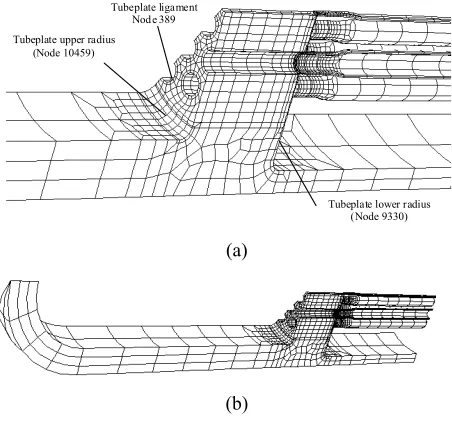
Fig. 1 gives a 1/16-th sectional view of a heat exchanger from a power plant. Such exchangers are subjected to particular severe thermal loading, resulting in the possibility of ratchetting or premature failure due to low cycle fatigue. The tubeplate experiences the most extreme temperature distributions that occur when the superheated steam supply is suddenly disconnected (Boiler Trip) and when the superheated steam supply is reconnected (Boiler Reconnect). At the same time there is a varying internal gas and steam pressure. Hence, this load cycle type is selected for the shakedown and ratchet analysis. Other load cycle types with a smaller elastic stress range are expected to be encompassed in terms of cyclic behaviour. Hence, the cyclic loading is defined by the following two extreme loading conditions: (1) Boiler Trip – The temperature distribution giving rise to the maximum von Mises thermal stress during a boiler trip transient plus the prevailing gas and steam pressure;

(2) Boiler Reconnection – The temperature distribution giving rise to the maximum von Mises thermal stress during a boiler reconnection transient plus the prevailing gas and steam pressures.

The corresponding linear elastic stress histories were evaluated and the maximum variation of effective elastic stress due to the varying temperature distribution and pressure from Boiler Trip to Boiler Reconnection was

denoted by BT RC

TP

Δσˆ . This linear solution was then scaled

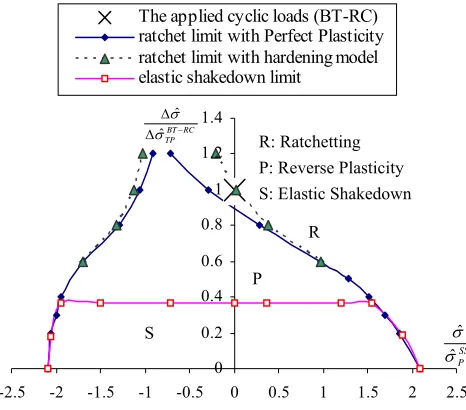
and the vertical axis of Fig. 2 BT RC

TP

Δ

Δσˆ/ σˆ corresponds to

differing scaling factors whereΔˆ/ΔˆBTRC =1

TP σ

σ corresponds

to the actual history. The horizontal axis SS

P

σ

σˆ/ ˆ corresponds

to the maximum elastic effective stress for an internal

pressure, where ˆ/ ˆSS =1

P

σ

σ corresponds to the internal

pressure experienced by the heat exchanger in normal operation. Variation of the yield stress with temperature was taken into account as this has a significant effect on the solutions.

Fig. 2 can be subdivided into three regions where shakedown (S), reverse plasticity (P) and ratchetting (R) occurs. The method is also adapted to consider cyclic hardening, which affects the position of the ratchet boundary. Using the known steady state cyclic behaviour for the material (an austenitic stainless steel), the corresponding ratchet boundary is shown in Fig. 2 as a dashed line. This method of representing the behaviour of the structure can be seen to have considerable

advantages. The actually loading history, Δˆ/ΔˆBTRC =1

TP

σ

σ ,

lies slightly outside the ratchet boundary assuming perfect plasticity. When cycle hardening is taken into account, the load point lies on the ratchet boundary. This characteristic of the problem corresponds very well with the known behaviour of the component.

Not only the location of the load point in relation to the ratchet boundary, but also the plastic strain range concerning the fatigue crack initiation in a low cycle fatigue assessment are of greatest interest, as the load point lies well outside the shakedown region. Fig. 3 presents the calculated maximum plastic strain range with increasing load amplitude. For the

perfect plasticity case, the maximum plastic strain range occurs, for lower load values, at the upper radius. For load values in excess of approximately 0.8-0.9, the maximum occurs at the tubeplate ligament (see Fig. 1). For the cyclic hardening model the maximum values always occur at the upper radius. Unlike the slight contribution of the hardening on the ratchet limit, the plastic strain ranges are significantly reduced by adopting the cyclic hardening model. Hence it is important to consider cyclic hardening to calculate this key parameter of the fatigue limit.

0 0.2 0.4 0.6 0.8 1 1.2 1.4

-2.5 -2 -1.5 -1 -0.5 0 0.5 1 1.5 2 2.5 The applied cyclic loads (BT-RC)

[image:6.595.308.541.213.418.2]

ratchet limit with Perfect Plasticity ratchet limit with hardening model elastic shakedown limit

Figure 2: The shakedown limit and ratchet limit interaction curves

for heat exchanger tubeplate with cyclic loading condition

0.0% 0.4% 0.8% 1.2% 1.6% 2.0%

0.2 0.4 0.6 0.8 1 1.2

Elastic stress range

T

h

e

m

a

xim

u

m

ef

fe

ct

iv

e

p

la

s

ti

c

s

tra

in

ra

n

g

e

[image:6.595.323.528.449.591.2]

Perfectly Plasticity Cyclic Hardening

Figure 3: The maxima of the effective plastic strain ranges with

different material models over all Gauss integration points

A full discussion of the solutions and comparisons with step-by-step solutions for complex constitutive equations are given by [Chen and Ponter (2005)]. This example demonstrates that, for these complex industrial problems, the method is capable of providing solutions that are much more illuminating than conventional analysis.

7.2 Fiber reinforced metal matrix composite subjected to cyclic temperature loads and constant macro stress

This example concerns the behaviour of a metal matrix composite material, which consists of a combination of a SS P

σ σ

ˆ ˆ

RC BT TP

− Δ

Δ σ

σ

ˆ ˆ

R

P

S

R: Ratchetting P: Reverse Plasticity S: Elastic Shakedown

P

max

ε Δ

RC BT TP

(7)

ductile matrix metal within which is incorporated, in a regular manner, a ceramic. The ceramic may be in the form of long continuous fibers or particles. Such materials have higher strength, greater stiffness and lower density than the monolithic matrix material and hence are potentially advantageous for aerospace applications. However the effect of variable temperature on such materials is potentially difficult to understand. The significantly differing coefficients of thermal expansion between ceramic and metal give rise to micro thermal stresses when the uniform temperature of the material is changed.

We consider an idealized, fiber-reinforced composite that consists of a square array of SiC fibers in an elastic-plastic matrix of Aluminum. The cell which is indicated in Fig. 4a is investigated in a quarter FE model (Fig. 4b) under plain strain condition by both the LMM and Abaqus inelastic step-by-step analysis for the verification of the LMM results. The

volume fraction occupied by the ceramic fiber Vf=11%.

A uniaxial macro-stress σPis applied in a direction parallel

to an edge of the generic cube and maintained constant. The temperature of the composite remains uniform but varies

cyclically over a range 0 to Δθ. The generic cube is subjected

[image:7.595.312.535.235.439.2]

to homogenization boundary conditions so that the surface displacement in a single cube is consistent with that of adjacent, identical cubes.

Figure 4: a) Schematic diagram of the fiber reinforced MMC

(Vf=11%) as loaded; b) The unit cell used in the FEA

0.2 0.3 0.4 0.5 0.6 0.7 0.8 0.9 1

Δθ

/

Δθ0

Upper bound ratchet limit

Lower bound  ratchet limit

Upper bound shakedown limit

[image:7.595.60.279.397.489.2]

Lower bound shakedown limit

Figure 5: Lower and upper bound shakedown and ratchet

limits for fiber-reinforced composite consisting of an

Aluminum matrix with SiC fibers where Vf=11%

Fig.5 shows lower and upper bound shakedown and ratchet limit interaction diagram where the axis are expressed in non-dimensional variables, σp/σp0 and Δθ/Δθ0. Here σp0 equals the

yield stress of Aluminum, 30MPa, and Δθ0=50ºC. The most

noticeable feature of Fig. 5 is the observation that the effective strength of the composite approaches to zero when the variable temperature Δθ/Δθ0 is greater than 0.9. It is also

clear from Fig. 5 that for both shakedown and ratchet limits, the LMM produces lower and upper bounds converge very close to each other. This indicates that the LMM is capable of producing very accurate shakedown and ratchet limits for this type of cyclic problems.

Figure 6: Maximum plastic strain range and ratchetting

strain per cycle for MMC subjected to varying cyclic thermal loads Δθ and constant σp=0

Figure 7: Maximum plastic strain range and ratchetting

strain per cycle for MMC subjected to varying cyclic thermal

loads Δθ and constant σp=8MPa

0.0% 0.2% 0.4% 0.6% 0.8% 1.0% 1.2%

0 50 100 150 200 250 300 350

Ratchetting strain per cycle by 

the LMM

Maximum plastic strain range 

by the LMM

Ratchet strain per cycle by 

step‐by‐step analysis

Maximum plastic strain range 

by step‐by‐step analysis

Temperature Δθ (°C)

von


Mise

s


e

ffec

ti

ve


st

rain

0.0% 0.2% 0.4% 0.6% 0.8% 1.0% 1.2% 1.4%

0 50 100 150 200 250 300 350

von


Mises


e

ffec

tiv

e


st

rain

Temperature Δθ (°C)

Ratchetting strain per cycle by  the LMM

Maximum plastic strain range  by the LMM

Ratchet strain per cycle by  step‐by‐step analysis Maximum plastic strain range  by step‐by‐step analysis

P

σ P

σ

[image:7.595.309.531.494.702.2] [image:7.595.65.291.533.699.2]
(8)

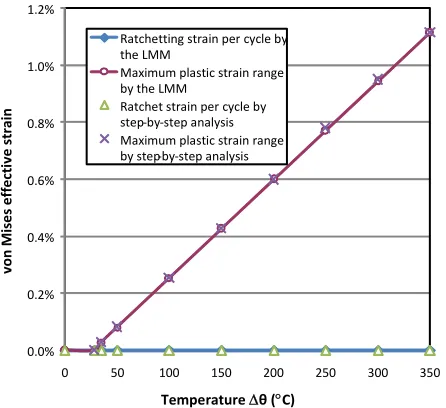
Figs. 6 and 7 present the calculated maximum plastic strain range and ratchetting strain per cycle by both the LMM and Abaqus step-by-step analysis for MMC subjected to varying

cyclic thermal loads Δθ and constant σp=0 and 8MPa,

respectively. The coincidence of LMM and Abaqus step-by-step analysis results in Figs. 6 and 7 confirms the accuracy of the LMM. However, comparing with the LMM, the Abaqus step-by-step analysis involves much more significant computer effort to produce the same results. It is also observed that there is no ratchetting when the uniaxial

macro-stress σp=0, and however, when σp=8MPa, the ratchetting

strain occurs when the variable temperature Δθ/Δθ0 is greater

than 0.75. The most interesting observation from Figs. 6 and 7 is that the magnitude of maximum plastic strain range concerning the fatigue crack initiation not only depends upon

the varying cyclic thermal loads Δθ, but is also affected by

the constant uniaxial macro-stress σp. The mild increase of

the plastic strain range due to the existence of the constant uniaxial macro-stress agrees very well with the general experimental observations.

7.3 Centre cracked plate with circular holes

The final example concerns the effect of circular holes in a centre cracked plate subjected to cyclic bending moment and constant tensile loading on the ratchet limit and crack tip plastic strain range. Drilling holes in front of the crack tip is an effective way to arrest crack growth. However the optimum location and size of the holes need to be researched to produce the smallest crack tip plastic strain range, i.e. the best fatigue crack growth life, and to have the least reduction in ratchet limit.

Figure 8: Centre cracked plate with symmetric holes

subjected to reversed bending moment range ΔM and

constant tension σp

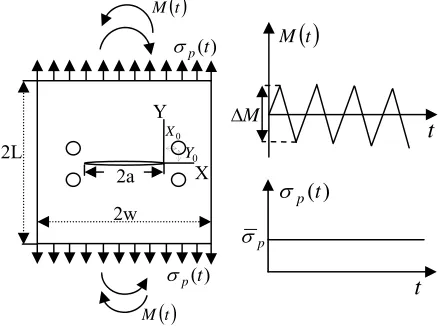
The geometrical shape and cyclic loading history of the centre cracked plate with symmetric drilled holes are shown in Fig.8, where the half-crack length a is 500 mm and the

ratios W/a and L/a are both 2. The hole locations (X0, Y0) are

referred to a co-ordinate system X, Y, the origin of which is located at the crack tip. The centre cracked plate is subjected

to cyclic reversed bending moment with rangeΔMand

constant uniaxial tension σp. By applying symmetry

[image:8.595.318.527.141.266.2]

conditions, a FE half symmetry model was adopted (Fig. 9).

Figure 9: FE half symmetry model for centre cracked plate

[image:8.595.59.278.459.622.2]

with symmetric holes

Figure 10: Ratchet limit and limit load interaction curve with

hole location at =−0.1

a

X ,

3 . 0

=

a

Y (D=100mm)

Fig. 10 presents the calculated lower and upper ratchet limit and limit load interaction diagram for the hole location at X/a= -1, Y/a=0.3 and the diameter of hole D=100mm, where the applied constant pressure in X-axis is normalized with

respect to the reference uniaxial tension σpo=100MPa,

while the amplitude of the reversed bending moment in Y-axis is normalized using the reference bending moment range

mm N

M = ⋅

Δ 0 100 . It can be seen that the ratchet limit and

the limit load curves do not coincide, which means that an increase in the loads beyond the ratchet limit will not automatically cause plastic collapse. Any combination of loads which lies between these two boundaries will result in ratchetting. As shown in Fig. 10, the accuracy of the lower and upper bound limit load boundary obtained by the LMM has been verified by ABAQUS RIKS analysis. For the verification of LMM lower and upper bound ratchet limit boundary the cyclic load points D(ΔM =1.6ΔM0,σ =p σp0), and E(ΔM =1.6ΔM0, σp=1.1σp0), which are just below and

0 0.2 0.4 0.6 0.8 1 1.2 1.4 1.6

0 0.2 0.4 0.6 0.8 1 1.2 1.4 1.6 1.8 2 2.2

Limit load boundary (upper bound) Limit load boundary (lower bound) Ratchet limit (upper bound) Ratchet limit (lower bound) ABAQUS RIKS

Reverse plasticity zone

0

2

M M

Δ Δ

Ratchetting zone

Plastic collapse zone

po p

σ

σ

D

E

2a

2a

2w 2L

Y

X

0 X

0 Y

) (t

p

σ

( )

t M

) (t

p

σ

( )

t M

( )

t M

t

M

Δ

)

(

t

p

σ

t

p

(9)
[image:9.595.316.536.134.273.2]

above the calculated upper bound ratchet limit boundary (Fig.10), respectively, are chosen for the step-by-step analysis in ABAQUS.

Figure 11: ABAQUS verification of the ratchet limit for the

[image:9.595.60.279.138.289.2]

cyclic bending moment case using detailed step by step analysis

Fig. 11 shows the plastic strain history at the crack tip for the cyclic loading D and E calculated by ABAQUS step-by-step

analysis. The calculated plastic strain for the load case D

settles to a stable cycle after about 5 load cycles showing a

reverse plasticity mechanism, and the load case E shows a

strong ratcheting mechanism, with the plastic strain increasing at every cycle. This directly confirms the accuracy of the predicted LMM lower and upper bound ratchet limits.

Figure 12: Variation of normalized ratchet limit multiplier

with varying horizontal hole location at the fixed vertical

location (Y/a=0.3) and prescribed reversed bending

moment (ΔM/2)/ΔM0 =1

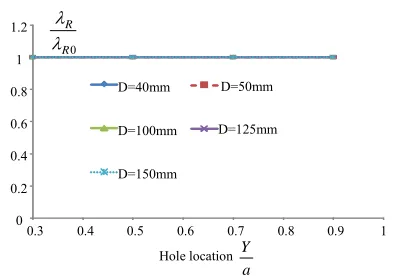
Parametric studies were performed further involving holes with different diameters drilled at different locations. Figs.12 and 13 shows the variations of the ratchet limit and crack tip plastic strain range, respectively, due to the change of the horizontal hole location and diameter. It can be seen that for all diameter D, the optimum horizontal location where the maximum plastic strain range decreases the most with minimum effect on the ratchet limit is located at a distance

10% of the semi-cracked length from crack tip opposite the ligament, i.e. X/a=-0.1.

Figure 13: Variation of normalized maximum plastic strain

range with varying horizontal hole location at the fixed

vertical location (Y/a=0.3) and prescribed reversed

[image:9.595.327.524.337.475.2]

bending moment (ΔM/2)/ΔM0=1

Figure 14: Variation of normalized ratchet limit multiplier

with varying vertical hole location at fixed horizontal

location (X/a=−0.1) and prescribed reversed bending

moment (ΔM/2)/ΔM0 =1

Figure 15: Variation of normalized maximum plastic strain

range with varying vertical hole location at fixed horizontal

location (X/a=−0.1)and prescribed reversed bending

moment (ΔM/2)/ΔM0 =1

0 50 100 150 200 250 300 350 400 450

0 5 10 15 20 25 30 35

Cyclic load case D (Fig.10) showing reverse plasticity mechanism Cyclic load case E (Fig.10) showing ratcheting mechanism

Number of cycles

N

ormalized eq

uivalent plastic

strain

0 0.2 0.4 0.6 0.8 1 1.2

- 1 - 0.9 - 0.8 - 0.7 - 0.6 - 0.5 - 0.4 - 0.3- 0.2 - 0.1 0 0.1 0.2 0.3 0.4 D=40mm D=50mm

D=100mm D=125mm

D=150mm

0

R R λ

λ

Hole location

a X

0 0.5

1 1.5

2 2.5

3

- 1 - 0.9- 0.8- 0.7- 0.6 - 0.5- 0.4 - 0.3 - 0.2 - 0.1 0 0.1 0.2 0.3 0.4 D=40mm D=50mm

D=100mm D=125mm

D=150mm

p p

0

ε ε Δ Δ

Hole location

a X

0 0.2 0.4 0.6 0.8 1 1.2

0.3 0.4 0.5 0.6 0.7 0.8 0.9 1 D=40mm D=50mm

D=100mm D=125mm

D=150mm

Hole location

a Y 0

R R

λ λ

0.2 0.3 0.4 0.5 0.6 0.7 0.8 0.9 1 1.1

0.3 0.4 0.5 0.6 0.7 0.8 0.9 1 D=40mm D=50mm

D=100mm D=125mm

D=150mm

p p

0 ε ε Δ Δ

Hole location

[image:9.595.62.271.435.576.2] [image:9.595.320.522.529.667.2]
(10)

Figs.14 and 15 presents the variations of the ratchet limit and crack tip plastic strain range, respectively, due to the change of the vertical hole location and diameter. It is observed that for the fixed horizontal location (X/a=-0.1), the ratchet limit keeps unchanged for different vertical hole locations and diameters, but the crack tip plastic strain range varies significantly with the change of vertical hole location and diameter. Hence the most significant decrease in crack tip plastic strain range with least reduction in the ratchet limit is identified for the hole size D=150mm at the optimum

location X0/a=−0.1, Y0/a=0.3, which gives a 72%

reduction in the plastic strain range and does not reduce the ratchet limit.

8 Conclusions

This paper concentrates on the behaviour of an elastic-perfectly plastic body subjected to cyclic loading. The design limits in plasticity including shakedown limit, ratchet limit, plastic strain range concerning fatigue crack initiation have been solved by characterizing the steady cyclic state using a general cyclic minimum theorem. For an approximating class of kinematically admissible strain rate histories, the minimum of the functional for these design limits are found by a simple programming method, the Linear Matching Method. Three practical examples of the LMM are provided to confirm the efficiency and effectiveness of the method and demonstrate that Direct Methods may be applied to a much wider range of circumstances than have hitherto been possible.

Acknowledgements

The author gratefully acknowledges the support of the Engineering and Physical Sciences Research Council (EP/G038880/1) of the United Kingdom, and the University of Strathclyde during the course of this work. The author would also like to thank Prof Alan Ponter of the Department of Engineering, Leicester University, for his advice and discussion on the theoretical development of the LMM.

References

ABAQUS. (2007): User’s manual. Version 6.7.

Ainsworth R.A. (editor) (2003): An assessment Procedure

for the High Temperature Response of Structures. R5 Issue 3,

British EnergyGeneration Ltd.

Carter, P. (2005): Analysis of cyclic creep and rupture. Part

2: calculation of cyclic reference stresses and ratcheting interaction diagrams. International Journal of Pressure Vessels and Piping, vol. 82, Issue 1, pp. 27-33.

Chen, S.; Liu, Y.; Cen, Z. (2008): Lower bound shakedown

analysis by using the element free Galerkin method and non-linear programming. Computer Methods in Applied Mechanics and Engineering, vol. 197, Issues 45-48, pp. 3911-3921.

Chen, H.F.; Ponter, A.R.S. (2001): A method for the

evaluation of a ratchet limit and the amplitude of plastic

strain for bodies subjected to cyclic loading. European Journal of Mechanics - A/Solids. vol. 20, pp. 555-571.

Chen, H.F. (2010): Lower and upper bound shakedown

analysis of structures with temperature-dependent yield stress. Journal of Pressure Vessel Technology. vol. 132, pp.1-8.

Chen, H.F.; Ponter, A.R.S. (2010): A Direct Method on the

Evaluation of Ratchet Limit. Journal of Pressure Vessel Technology. vol. 132, pp. 041202.

Chen, H.F.; Ponter, A.R.S; Ainsworth, R.A. (2006): The

Linear Matching Method applied to the High Temperature Life Integrity of Structures, International Journal of Pressure Vessels and Piping, vol. 83(2), pp. 123-147.

Chen, H.F.; Ponter, A.R.S. (2005): Integrity assessment of a

3D tubeplate using the linear matching method. Part 1. Shakedown, reverse plasticity and ratchetting, International Journal of Pressure Vessels and Piping, vol. 82(2), pp. 85-94.

Koiter, W.T. (1960): General theorems for elastic plastic

solids. Progress in solid mechanics, Vol.1, J.N.Sneddon and R.Hill, eds., North Holland, Amsterdam, pp. 167-221.

Mackenzie, D.; Boyle, J.T.; Hamilton, R. (2000): The

elastic compensation method for limit and shakedown analysis: a review. Trans IMechE, Journal of Strain Analysis for Engineering Design. vol. 35, pp.171-188.

Maier, G. (1977): Mathematical programming methods for

deformation analysis at plastic collapse. Computers and Structures, vol. 7, pp.599–612.

Marriott, D.L. (1998): Evaluation of deformation or load

control of stresses under inelastic condition using elastic finite element stress analysis. Proc. ASME Pressure Vessel and Piping conference, Pittsburg, PA, PVP-136, pp. 3-9.

Melan, E. (1936): Theorie Statisch Unbestimmter Systeme

aus Ideal-Plastischem Bastoff. Sitzungsberichte der Akademie der Wissenschaft,Wien, Abtiia. Vol. 145, pp. 195– 218.

Nguyen-Tajan, T.M.L.; Pommier, B.; Maitournam, H.; Houari, M.; Verger, L.; Du, Z.Z.; Snyman, M. (2003):

Determination of the stabilized response of a structure undergoing cyclic thermal-mechanical loads by a direct cyclic method. Abaqus Users' Conference Proceedings.

Ponter, A.R.S; Chen, H.F. (2001): A minimum theorem for

cyclic load in excess of shakedown, with application to the evaluation of a ratchet limit. European Journal of Mechanics - A/Solids. vol. 20, pp. 539-553.

Ponter, A.R.S.; Engelhardt, M. (2000): Shakedown limits

for a general yield condition: implementation and examples for a von Mises yield condition, European Journal of Mechanics, A/Solids, vol. 19(3), pp. 423-446.

Seshadri, R. (1995): Inelastic Evaluation of Mechanical and

Structural components Using the Generalized Local Stress Strain Method of Analysis. Nucl. Eng. Des. vol. 153, pp. 287-303.

Staat, M.; Heitzer, M. (2001): LISA a European Project for

Figure

Figure 1: Sectional view of superheater header showing tubeplate features
Figure 2: The shakedown limit and ratchet limit interaction curves for heat exchanger tubeplate with cyclic loading condition
Fig.5 shows lower and upper bound shakedown and ratchet limit interaction diagram where the axis are expressed in non-yield stress of Aluminum, 30MPa, and dimensional variables, σp/σp0 and Δθ/Δθ0
Figure 10: Ratchet limit and limit load interaction curve with XY
+2

References

Related documents

We have demonstrated a single photon emitter based on a charged exciton state confined in a columnar quantum dot1. The emitter, driven non-resonantly by the CW laser source,

In a study in the UK, in which out-of-hours calls to a general practice cooperative were randomised into two groups – namely, telephone consultations with a nurse versus usual

The relative gamma spectrometric technique was used to measure the absolute decay rate and the spontaneous fission rate of the natural radioactive elements in samples analyzed.. The

Plots of intensity versus time for the most variable Raman peak in each data set indicating the dynamics of compositional changes (see Table 1). The challenges for the cosmic

The Predicted Microclimate diagram (Figure 8) represents the temperatures along Ingram Street as suggested by the results of the experiments, with red hotspots positioned

Based upon this test case, modelling a dwelling which is poorly insulated, a good match is seen between IDEAS and SAP/BREDEM for both comfort temperature and energy