Programme Final Report
Michael Hughes Helyn Gould Patricia McKellar Paul Maharg Emma Nicol
SIMPLE September 2008 Page 3 of 93
Table of Contents
Table of Contents ...3
Acknowledgements...6
1. EXECUTIVE SUMMARY...7
1.1 Aims ... 7
1.2 Overall approach... 7
1.3 Findings ... 7
1.4 Achievements ... 7
1.5 Conclusions ... 7
2. BACKGROUND...8
2.1 Ardcalloch: The Transactional Learning Environment (TLE) ... 8
2.2 The transformative agenda ... 9
3. AIMS AND OBJECTIVES... 11
4. METHODOLOGY... 12
4.1 SIMPLE Evaluation Plan...12
4.2 Stakeholders and data sources in the evaluation ...13
4.3 Technical design...13
4.4 Educational design...14
5. IMPLEMENTATION ... 14
5.1 Initial workshop: Ross Priory...14
5.2 Project timelines ...15
5.3 Participant departments & disciplines: recruitment & support...17
5.4 Cyberdam ...19
5.5 Project evaluation...19
5.6 Project support for technical design and pedagogical design ...20
5.7 Dissemination strategy...20
5.8 Postproject implementation: SIMPLE project windup & SIMPLE community launch event...21
6. OUTPUTS... 21
6.1 Software outputs: the SIMPLE platform...21
6.2 Software outputs: the SIMPLE tools, and Narrative Event Diagram (NED) ...24
6.3 Documentation outputs: technical and user documentation ...26
7. OUTCOMES... 29
7.1 Project deliverables...29
7.2 SIMPLE Foundation...30
8. EVALUATION... 30
8.1 Evaluation data collection & analysis...30
8.2 Level one: evaluation of participant projects & stakeholder analysis ...30
8.2.1 Students...30
8.2.2 Staff: Lecturers...32
8.2.3 Staff: Tutors and research assistants ...34
8.3 Level two: implications for the HE curriculum ...35
8.3.1 Staff control: disruptive simsvs.convergent sims...35
8.3.2 Open‐field simsvs.bounded sims...35
SIMPLE September 2008 Page 4 of 93
8.3.4 Transactive knowledge object‐formingvs.knowledge object‐forming by
conventional assessment...36
8.3.5 Transactional teachingvs.conventional teaching...36
8.3.6 Front‐loaded sim‐buildingvs.conventional teaching preparation ...37
8.3.7 Interactive mentor rolesvs.conventional lecturer / tutor roles...37
8.3.8 Simulation spacesvs.teaching interventions ...38
8.3.9 Replay/remix/feedforward assessment culturevs. snapshot assessment culture ...38
8.4 Level three: implications for institutions & disciplinary educational practices ...39
8.4.1 There is no such thing as experiential learning...39
8.4.2 Learning changes in distributed environments ...39
8.4.3 ‘There is no spoon’: curriculumistechnology...40
8.4.4 Staff role‐change vs. conventional teaching/admin roles ...40
8.4.5 Trans‐systemic approaches to learning ...41
8.4.6 Simulation: an academic and professional interface ...42
8.4.7 Institutional change and innovation...42
8.4.8 Interdisciplinary and international collaboration ...43
9. CONCLUSIONS ... 43
10. IMPLICATIONS ... 45
11. FUTURE DIRECTIONS: SIMPLE COMMUNITY & FOUNDATION... 45
11.1 SIMPLE Community...45
11.2 Phase 1: the community...46
11.2.1 Goals:...46
11.2.2 Activities: ...46
11.3 Phase 2: further development...46
11.3.1 Goals ...46
11.3.2 Activities...47
11.4 The SIMPLE Foundation...47
11.4.1 Aim ...47
11.4.2 Structure ...47
11.4.3 International Board...47
11.4.4 Development Team...48
11.4.5 Promoting SIMPLE...48
12. REFERENCES ... 49
APPENDIX 1: EVALUATION SUMMARY SHEETS ... 52
University of Strathclyde, Dept of Architecture ...53
Introduction ...53
Building the simulation ...53
Running the simulation ...53
General comments:...53
University of Strathclyde, Glasgow School of Social Work ...55
Introduction ...55
Building the simulation ...55
Running the simulations...55
General comments ...55
University of Strathclyde, GGSL: Civil Court Action and Personal Injury Negotiation Projects...57
Civil Court Action...57
Personal Injury ...59
University of Strathclyde, Dept of Management Science ...61
Introduction ...61
SIMPLE September 2008 Page 5 of 93
Running the simulation ...61
General comments ...62
University of Stirling, School of Law...63
Introduction ...63
Simulation I...63
Simulation II...64
University of the West of England, Bristol Law School...65
Introduction ...65
Building the simulation ...65
General comments ...66
University of Warwick, School of Law...67
Introduction ...67
Building the simulation ...67
Running the simulation ...67
General comments ...68
University of Glamorgan, Law School...69
Introduction ...69
Building the simulation ...69
Running the simulation ...69
General comments ...69
SIMPLE core team review ...71
APPENDIX 2: A COMPARISON OF THE GGSL AND GLAMORGAN PERSONAL INJURY
TRANSACTIONS ... 72
APPENDIX 3: SIMPLE EVALUATION PLAN... 74
Introduction ...74
Stakeholders in the evaluation ...75
Evaluation methods...75
Pre‐simulation data collection activities structured by stakeholders ...78
Data collection activities during simulation: by targeted stakeholder...79
Post –simulation data collection...80
End of SIMPLE project ...81
References...81
Appendix 4: Evaluation of participant projects: stakeholder analysis diagram.... 83
APPENDIX 5: INITIAL & FINAL PROJECT EVENTS... 84
SIMPLE Initial workshop, Ross Priory, University of Strathclyde...84
SIMPLE Launch event, University of Warwick...86
APPENDIX 6: SIMPLE LAUNCH EVENT EVALUATION FEEDBACK... 88
APPENDIX 7: SIMPLE DISSEMINATION ACTIVITIES: PUBLICATIONS &
PRESENTATIONS ... 91
Publications ...91
SIMPLE September 2008 Page 6 of 93
Acknowledgements
SIMPLE was a project that was funded by JISC under the ELearning stream, LargeScale Implementation of Innovative Technologies theme. We gratefully acknowledge funding by JISC of £100,000, and matching funding by UKCLE (UK Centre for Legal Education) of £100,000.
SIMPLE September 2008 Page 7 of 93
1. EXECUTIVE SUMMARY
1.1 Aims
1.1.1 The SIMPLE project in general terms aimed to prove that simulations can effectively enhance learning across a range of disciplines, professions and institutions. It also set out to investigate the drivers and blockers to largescale implementation of innovative technologies such as simulation within HE and FE.
1.2 Overall approach
1.2.1 With a total grant of £200,000 from JISC and the UK Centre for Legal Education (UKCLE) our overall approach was to design, specify, build and then use simulation software with a range of participating HE departments and schools. We then evaluated this process as well as the use of the application by staff and students, and the resultant effect upon educational processes. Our educational design was constructivist in nature, and from this general approach we developed a specific approach to professional learning we call transactional learning, which has influenced our approach to learning design.
1.3 Findings
1.3.1 Simulation environments can be agents of substantial change and powerful learning environments across a wide range of HE undergraduate and postgraduate courses. They are potentially disruptive heuristics and staff need supportive environments in which to share good practice and experiment. Students need to be aware of the expectations made of them in these new environments. Collaboration between staff, institutions and students is essential to the growth of simulation activities.
1.4 Achievements
1.4.1 Achievements are as follows:
· We designed, specified, built and implemented opensource software within a very tight schedule. The software, now the codebase for an application that will be at the core of the SIMPLE Foundation, is supported by technical and user documentation – see http://simplecommunity.org.
· The core team developed a unique instance of a simulation learning design tool, namely the Narrative Event Diagram (NED).
· Staff in participating institutions were supported in developing and running their sim projects, and all projects were evaluated in detail.
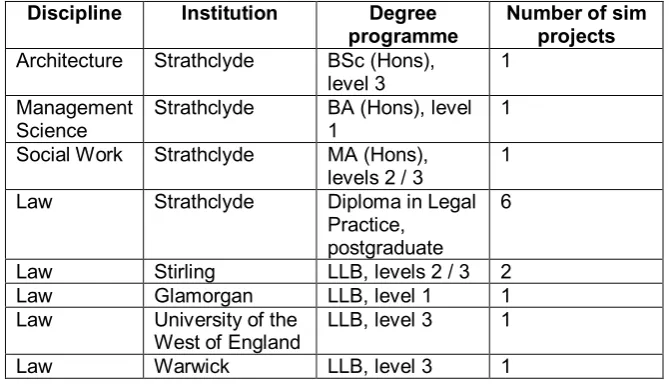
· We ran more than twice the number of projects initially envisaged (14 in total), and we ran them over a variety of institutions and disciplines.
· We improved the range of teaching and learning experiences across 12 out of 14 projects.
· We contributed to the research and scholarly literature on simulation learning.
· We have created a core of users and developers keen to take forward simulation across a range of disciplines and professions.
1.5 Conclusions
SIMPLE September 2008 Page 8 of 93
2. BACKGROUND
2.1 Ardcalloch: The Transactional Learning Environment (TLE)
2.1.1 This project is the second major iteration of a longterm project to produce, use and evaluate in iterative cycles a simulation application and platform that can be used by professional disciplines within FE and HE, and by the professions. The first iteration began in 2000 when, with the founding of the Glasgow Graduate School of Law, considerable resources were made available to create an ICT environment which would enhance the learning of law at the professional stages of legal education in Scotland, and in particular the Diploma in Legal Practice. 1 One of the initiatives formed was a virtual town, called Ardcalloch. Within this town were located the virtual law offices of postgraduate law students who interacted with resources and online fictional characters in order to complete legal transactions – for example buying and selling property over the web (Conveyancing) or winding up the estate of a deceased client of their firm (Private Client). The projects were formed iteratively and brought on stream once they had undergone initial testing. The application background altered as we gained experience, from a simple ColdFusion application to a more sophisticated application using MS Exchange Public Folders structures (mimicking the interface then used by at least one major Scottish law firm), to a true webbased application.
2.1.2 We collected feedback every year from students and staff, and redesigned accordingly. The simulation projects were supported by a range of conventional and innovative resources. Some subjects, such as Private Client, had prior to 2000 consisted of tutorials largely, without assessment, a regime that first led to open book examinations in drafting, and which later metamorphosed into simulations of transactions that were both learning and assessment zones.
2.1.3 To summarise, at this earlier stage, the Ardcalloch environment consisted of the following:
· Map and directory of a virtual town (Ardcalloch), which was used as the project context, and provided content for specific simulations. The virtual town provided the implicit simulation world of the transactions undertaken by students.
· Virtual professional workspace
· Monitoring and mentoring capabilities
· Communications routes between simulated characters, students and staff
· Teaching, learning and assessment templates, including curriculum guidelines
· Development and integration of other elearning approaches with that of the TLE.
2.1.4 Throughout, we were keenly aware of the need to develop educational approaches to simulation – an area of learning and assessment which had not hitherto been developed in any serious way in law schools beyond the experimental stage. What was important about our own advances was that first, we were seeking to integrate simulation at a deep level within every subject in the Diploma in Legal Practice. Second, we were using an identical platform to run the simulations across the curriculum, so that what had hitherto been a series of subject ‘silos’ now had a common core running through all of the subjects. Third, to create a sense of continuity and common purpose, we developed our concept of ‘transactional learning’, the characteristics of which were crucial to our project (indeed the JISC project was initially termed TLE 2.0 – Transactional Learning Environment 2.0). We defined transactional learning in the following terms, as:
active learning
through performance in authentic transactions involving reflection in & on learning,
deep collaborative learning, and holistic or process learning,
with relevant professional assessment
1
SIMPLE September 2008 Page 9 of 93 that includes ethical standards
2.1.5 While this early instantiation of the simulation environment exhibited many typical characteristics of simulation learning (high work rate for staff, improved student performance in coursework and also in examinations; problems with new forms of educational design work – see Barton & Maharg 2006 for a metareview of the research on these characteristics) perhaps the most problematic element of the project was the idiosyncratic nature of the software. Much of the focus had been on the development of educational approaches to professional simulation learning and assessment. As a result, the platform underwent almost continuous development using a variety of interfaces and approaches. While stable and effective, there was little likelihood of anyone outside the Glasgow Graduate School of Law (GGSL) using the software to create and run simulations for themselves: it required the resources of a dedicated team of IT technical staff to set up and run the simulations. To address this serious shortcoming, in 2006 we applied for joint JISC and UKCLE funding in order to recode the environment. We were successful in bidding for the funding within the Innovation stream and, in July 2006 (slightly later than our other two sister projects within the stream) we began the project.
2.1.6 The SIMPLE project builds on previous simulation work in a number of ways. The early work on MultiUser Dungeons (MUDs), well documented by Turkle and others, showed how powerful a textual simulation interface could become for participants in those worlds. Later research work by Gee, Squires, Schaffer, Steinkuhler and others demonstrated how 3D worlds were innately social spaces and could also become specific learning spaces as well. However there was no generally available, effective simulation engine that would replicate the textual universes, the docuverse, of professional working environments. We did not want SIMPLE to be a mimesis of professional practice, however. This is impossible, and given the educational mission of further and higher education is not the foremost aim of the project. SIMPLE also relies on other lines of research, which have rather more radical educational aims, which are set out in the next section.
2.2 The transformative agenda
2.2.1 The project is necessary for a number of reasons. There are almost no instances in JISC’s back catalogue of projects, or indeed in that of any educational institution or organization of a simulation engine. This is so at a time when increasingly, in the world of MMORPGs and MUVEs, there is significant development and educational use (eg in World of Warcraft and Second Life). There are no educational innovations in this particular field of simulation, and simulation itself is poorly represented within the range of innovation in HE and FE.
2.2.2 In saying this we are not arguing that the only interesting educational innovations today are in technology or that transactional learning can only be implemented through use of ICT. Far from it: the extraordinary work being done in clinical education, collaborative learning, problem based learning, transsystemic curriculum design, professional learning and many other loci throughout disciplines and professions are examples of inspiring educational initiatives. But we believe that welldesigned and implemented technological interventions are capable of contributing to the transformation of higher education. To do that we need, as Bilimoria puts it, to generate and legitimize the creation of ‘new and vital teaching and educational structures and practices conducive to improving student learning’ (Bilimoria, 2000, p. 704). While there is a rich and sustained literature developing around legal clinic and medical problembased learning, for instance, there is still insufficient theory and practice that is developed around either the use of digital simulation or games in professional education. There is plenty of compatible and useful theory, in education and information science, and in industrybased white papers and blogs. Over the last 30 years there has developed a distinguished tradition of anthropologists, ethnologists and educationalists who explore fragmented aspects of simulative activities and cybernetic concerns – Gordon Pask, Gregory Bateson, Sherry Turkle, Diana Laurillard, to name a few – and that tradition is, with the development of the internet, growing into a complex and fascinating literature. 2 It is a line of research that has attracted
2
SIMPLE September 2008 Page 10 of 93 proportionately little comment from educationalists concerned with higher education, though, given the huge uptake in ICT by Higher and Further Education in recent years. It is becoming increasingly urgent that we engage with this and other lines of research, and develop implementations based upon its insights into the relationships between technology and education specifically, and between technology and society more generally.
2.2.3 More recently there have been interesting strands of research that derive from research into Massively Multiplayer Online RolePlaying Games (MMORPGs) and MultiUser Virtual Environments (MUVEs). Definition is notoriously difficult (de Freitas, 2006). ren reynolds, in his posting at http://terranova.blogs.com/terra_nova/2005/08/the_four_worlds.html, makes the distinction between ludic worlds (or games worlds), social worlds and civic worlds. Van Eck (2007, p. 274) has set out a useful tabular matrix of game and learning taxonomies. Book (2004) has identified the following six features of social virtual worlds such as Habbo Hotel and Second Life. They consist of space shared with many other users; they have a graphical user interface either 2D or 3D; users interact in the world, for example, building objects; immediacy of action; persistence (that is, the world’s existence is separate from individuals’ presence); and socialization in the communities. Looking more widely at the field, there is now a burgeoning literature on the economics of simulated games (Castronova, 2001), their definition (Bartle, 2003; Reynolds, 2005; Koster, 2004; Salen and Zimmerman, 2004 & 2006), their ethnography (Delwiche, 2006; Yee, 2001), the effect they have on identity (Turkle, 1995; Stone, 1995) and social relations (Steinkuehler and Williams, 2006), cognition and literacy (Steinkuehler, 2005), education (Gee, 2004; de Freitas, 2008, forthcoming) and much else. Whilst we would never claim that SIMPLE is a wholly immersive environment, it has been clear for some time that textual simulations have the capacity to create & sustain communities, to affect learning in quite profound ways, and to help build aspects of professional identity. 3
2.2.4 A third strand relates to the development of simulation within a professional context. Simulation based training has been shown to be highly effective in professional disciplines. It is true of professions where work is highly governed by protocol and procedure, for instance simulator training for pilots; and also in professional situations where illstructured problems arise, and where affect and knowledge are key components of professional practice (Bloxham and Armitage, 2003; Maharg and Paliwala, 2002; Forrest et al., 2002 & 2003; Blackburn et al., 2003). In one study, nurses were taught to treat critically ill patients on a general ward via mini lectures, workshops and simulatorbased patients. The subjectmatter included assessment of respiratory, cardiovascular and renal systems, and pain management. Participants completed pre and postcourse tests, which showed statistically significant improvement; and in the followups at two months and six months later, participants reported longterm confidence in caring for acutely ill patients (Stedeford et al., 2003; Gould et al, forthcoming, 2009). Two general points can be made about this and related studies. First, the simulatorbased patients were used to assess not only patienthandling skills, but also medicoscientific knowledge. Second, simulation, as an educational approach, was used to enable students to learn the synthesis of skills and knowledge they would use in the workplace; but it was also used to assess that learning matrix.
2.2.5 These and other lines of research point to the potential for technologicallyenhanced design to transform the educational experiences of both students and staff alike. The key to transformation lies in creating positive and powerful experiences for staff and students alike. For instance we may want to shift from transmissive approaches towards the production of knowledge and capable practice, to social and constructivist approaches that enable the formation and development of tacit knowing and formal explicit knowledge. In this shift individual learners will become novice practitioners who engage in sensemaking in formal and informal situations (effectively engaging in transactional learning). No longer do they need to be told to attend a lecture at a specific place and time in order to create meaning. What they do require, however, is scaffolding in the process of becoming independent learners; and they need spaces to engage in dialogical practice, with teachers or peers (acting as facilitators or coaches) or other resources, or themselves (Cunliffe, 2002)
3
SIMPLE September 2008 Page 11 of 93 2.2.6 One practical implementation of this approach lies in conversational theory. As Pask sketched
this approach out over thirty years ago (1975), learning conversations consist of inner reflective processes (for instance Schön’s selforganised learning) and outer reflective processes, consisting in part of sociallynegotiated knowledge formation. Such outer reflective processes involve students in collaborative learning (whether cooperative, with each other, or in versions of Linda Flower’s rhetorical ‘rivalling’ activities – Flower, Long & Higgins, 2000). These forms of collaborative activity are of course not unique to Pask’s version of conversational theory. In one form or another they are part of problembased learning (Barrows, 1980; Barrows & Tamblyn, 1987; SavinBaden & Wilkie, 2006), of projectbased learning (Kilpatrick, 1918; Blumenfeld et al 1991) and many other forms of alternative curriculum design. And if they apply to student learning, they also apply to staff development. Transformational learning must involve experiential learning for them as much as for their students.
2.2.7 If the outer reflective processes are crucial to the process, we need to provide environments and tools with which students can engage in knowledge formation. Technology can play an important role here in supplying the task tools for learners. As early as 1993 Jonassen, Mayes & MacAleese suggested that technology can support such processes. It is the hypothesis of the SIMPLE project that simulation environments, properly engineered by technologists and educationalists, with simulation narratives designed by disciplinebased staff, can improve student learning across a range of disciplines, improve staff experiences in learning and teaching, and do so with longterm efficiencies in staff time and effort.
3. AIMS AND OBJECTIVES
3.1 The overall aim of the project was to prove that simulations can effectively enhance learning across a range of disciplines and professions. To achieve this aim the project identified the following objectives:
1. Through a series of detailed user consultations, project meetings, web and product scanning the project team would qualitatively investigate and analyse the functionality required of SIMPLE.
2. From the work above, the core team would create a requirements specification that would describe the features of the software product, and contain required technical information and data needed for design, including purpose, input, process and output. This would also deal with security, extensibility, maintainability, reliability, accessibility, sustainability, mobility and interoperability.
3. Following the above specification, and undertaking an ongoing consultation process with users, the programming team would iteratively build the opensource SIMPLE environment and tools, which would then be available free at point of use to the FE and HE communities.
4. The team would also create a set of technical and educational documentation for our collaborative participants.
5. Commission, support and monitor a series of pilot projects using the environment across a range of professional learning interventions in Strathclyde University and in UKCLE law school partners.
6. Evaluate student performance within the environment, institutional use of the environment, drivers, blockers and other factors affecting performance of staff and students.
7. Following on from the above work, investigation into the impact of SIMPLE on existing teaching and learning processes and any resultant organisational issues.
SIMPLE September 2008 Page 12 of 93
4. METHODOLOGY
The project divided into three broad domains: design and creation of software, design and implementation of simulation projects, evaluation of software and projects (note that these three domains were not serial, but in many respects were synchronous). The methodology adopted in each domain is outlined below.
4.1 SIMPLE Evaluation Plan
4.1.1 The methodological approach adopted for the SIMPLE evaluation is that of integrative evaluation (Draper et al, 1996). This methodology used mixed methods and multiple data sources to develop an overall picture of each participant’s use of SIMPLE, highlighting issues, drivers and barriers. While the evaluation sought to address specific aspects it also allowed for the emergence of unanticipated aspects. The use of multiple, rich, data sources allowed the triangulation of findings during analysis.
4.1.2 One of the principal elements of this approach concerned the source data used as the basis of analysis. When considering access to data or evidence, the approach adopted used any existing sources of data before introducing evaluation specific data collection mechanisms. This both minimised fatigue from excessive data collection from the subjects and also sought to reduce the Hawthorne effect commonly found in the introduction of new teaching and learning practices.
4.1.3 As the evaluation involved a number of partners implementing their scenarios at different points over the academic year, there was the opportunity to feed results from pilot to pilot, examining emergent aspects in more detail. The evaluation plan had common elements that are targeted within all the partner evaluations. Beyond this there is a layer of partner specific aspects, acknowledging the uniqueness of each instance of SIMPLE implementation.
4.1.4 Following on from the aims of the project, the specific question sets that we wished to address can be listed as follows:
1. How can SIMPLE provide a means of transforming education?
2. How do we address systemic and institutional factors in the design and development of innovative practices and the implementation of SIMPLE in particular?
3. What role does professional learning play within the partner institutions and how can and does SIMPLE contribute?
The first of these summarises our interest in the teaching and learning implications of the use of SIMPLE, while the second addresses the organisational context of this teaching and learning experience.
SIMPLE September 2008 Page 13 of 93
4.2 Stakeholders and data sources in the evaluation
4.2.1 The evaluation collected evidence from each of the main stakeholders, both in terms of their development and implementation of SIMPLE, within each partner institution. Specifically these were:
· Students
· Tutors
· Lecturers and module leaders
· Developers
· Support staff, such as Institutional IT Helpdesk staff, IT support staff and the SIMPLE Core team
4.2.2 Individual evaluation plans were structured around these stakeholders, and in terms of specific data collection activities, were focussed on a specific stakeholder. The plan grouped activities into four stages, chronologically ordered:
· Pre simulation
· During simulation
· Post simulation
· End of SIMPLE Project
4.2.3 The data collection methods combined both quantitative and qualitative elements, providing different perspectives and evidence on common areas of interest. The following specific methods were employed:
· Observations
· Tutor Interviews
· Student Interviews
· Focus groups (tutors)
· Focus groups (students)
· Diaries/logs
· Student materials
· Examining SIMPLE office
· Precourse card exercise
· Postcourse questionnaires
· System statistics
4.2.4 To manage the process of reading and assimilating this data our chief evaluation officer and evaluation officer planned and executed the evaluation activities Throughout this process the data was not shown to core team members, so as to minimise the risk of bias, particularly when core team members themselves were interviewed.
4.2.5 These sources resulted in a considerable body of data, some of it confidential. The evaluation officers therefore collated the key points from all data sources at each project centre and for each stakeholder, and presented these as a participantcentred summary report. These reports are set out below at Appendix 1.
4.3 Technical design
4.3.1 A significant proportion of the project was the development of the SIMPLE software. In this development we followed traditional software development procedures. Applying usecase analysis and developing userstories to illustrate the enduser experiences developed our ideas for functionality. The development team discussed these internally, and any significant issues raised at weekly “core team” meetings, allowing the development to discuss ideas with a representative crosssection of our audience.
SIMPLE September 2008 Page 14 of 93 implementing functional code, the agile programming model took over, implementing specific features each week, rapidly testing, rebuilding features and integrating them into the whole.
4.4.3 When the software had been built to beta use stage, documentation (which had been synchronously collated) was finalised, and both software and documentation were made available to project participants. At this point the role of technical staff changed from predominantly designers and programmers to support staff. Michael Hughes in particular played a central role on debugging and support for staff in the development of simulation via SIMPLE tools and uploading of simulations via the SIMPLE platform.
4.4 Educational design
4.4.1 Throughout the project and in particular in our support work and presentations and publications, we have drawn upon an extensive literature, to produce what we hope is a broadlybased educational design based upon constructivist principles of learning and assessment. The challenge of constructivism, as Petraglia (1998) makes clear, is one that reaches to the heart of the debates surrounding antifoundationalism, rhetoric and situated cognition. It is a challenge to our understanding of how academics constitute disciplinary and professional processes in their schools, and thus how they contribute to the process and practice of their profession in society at large. Constructivists, as Petraglia points out, prefer to rely on what he terms ‘found cognition (that is, thinking as it unfolds in natural contexts)’ (Petraglia 1998, p.62). This is alien to much of the ecology of higher education, where secondorder thinking is elaborately constructed around the development of concepts within educational processes that are highly teachercentric. 4
4.4.2 Simulation always has the capacity to become a constructivist environment, regardless of how it is coopted within a programme of study, and regardless of discipline (Barton & Maharg, 2006). However it was not our role to demand of our participating projects that they adopt a fullscale constructivist approach to teaching and learning. While we encouraged the use of simulation design that supported found cognition, we required to recognize the highrisk nature of the enterprise for staff starting out in simulation; and we therefore adopted a methodology that was flexible and pragmatic as regards individual project aims and content, and that encouraged exploration and innovation in curricular and resource design within the constraints of the SIMPLE project. Thus, transactional learning was described to project participants, but we were not prescriptive about its use. Throughout, we bore in mind the key aims of the SIMPLE project: to improve student learning while mitigating the risks and work burden upon staff when they were designing and implementing their simulations.
5. IMPLEMENTATION
5.1 Initial workshop: Ross Priory
5.1.1 It was always our intention to begin the project with a workshop event that would bring together the disparate disciplines and personnel that would make up the project. Since it was a pre condition of UKCLE funding that we include law schools from England and Wales as participating projects, the participation in the project was clearly going to go beyond the University of Strathclyde, and therefore the role of the initial workshop was all the more important in bringing together project staff.
5.1.2 Our initial workshop, held at the Strathclyde University retreat house at Ross Priory, brought together staff from all participating institutions, with the exception of Stirling, who came on
4
SIMPLE September 2008 Page 15 of 93 board later in the project. It was key in providing a sense of project aims and methodology, and the scale of participating staff time and effort. For details of the programme, see Appendix 5.
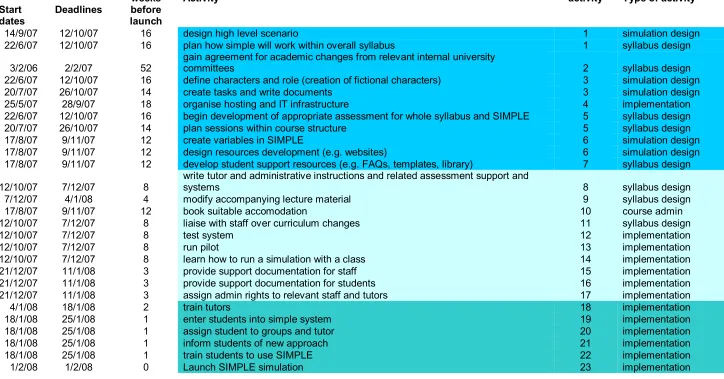
5.2 Project timelines
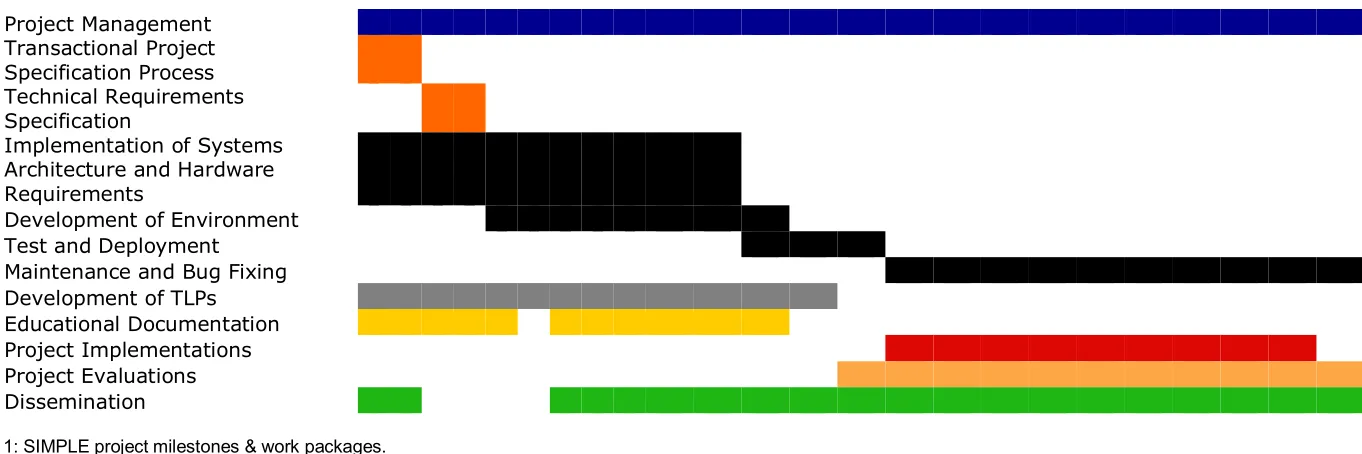
1 Project Management
2
Transactional Project Specification Process
3
Technical Requirements Specification
4
Implementation of Systems Architecture and Hardware Requirements
5 Development of Environment 6 Test and Deployment
7 Maintenance and Bug Fixing 8 Development of TLPs
[image:16.842.99.780.68.295.2]9 Educational Documentation 10 Project Implementations 11 Project Evaluations 12 Dissemination
5.2.2 Clearly the first few months of the project were dominated by the need to focus on software design, specification and build. As we said in the Aims and Objectives section above, the project objectives changed little in the course of the project, and have been met in almost all respects. Under point two, though, it is fair to say that while most aspects of security, maintainability, reliability, accessibility, mobility, interoperability and availability were addressed, there are a number of issues still outstanding. No software is ever complete in this respect: the process of building and improving is endless. Our main concern in the project was to build software that would meet the conditions of project funding, be usable by staff and students, and be a stable basis for further project development. The following table identifies the issues that have been dealt with in the project, and those that remain to be addressed:
Area Areas addressed Areas still to be addressed Security Flexible, extendable
authentication and authorisation scheme, integration with
institutional IT systems. Extensibility Extendable User Interface
design, programmatic extension points for additional user definable functionality Further extensions to be implemented, Implementation of formal Application Programming Interface (API)
Maintainability Use of object orientated (OO) programming for significant functional data units.
Migration to OO architecture for page generation functions. Reliability Based on proven, industry
standard web technologies Accessibility Best endeavour approach to
accessibility guidelines, use of CSS for layout.
JavaScript usage for User Interface experience.
Mobility Optimisation of data
transfers and caching
Interoperability Translation between
[image:17.595.96.531.188.492.2]SIMPLE XML and other formats (eg. IMS LD)
Table 1: Technical issues addressed within the project envelope.
5.2.3 In all software projects features must be included or excluded based on a number of factors, including return on investment (ROI cost of implementation vs. value of feature), complexity and demand. On the whole most of the features set down in the original Requirements Specification for SIMPLE were implemented, and in many cases additional new features were developed during the design phase. A number of requirements were scaled back from their original specification, interoperability being a prime example of these. Where we original considered using IMS:LD (an XML schema for representing learning designs) as a format for the persistence of simulation blueprints, we subsequently decided to develop our own “simpler” XML based schema, on the basis of ROI. We have however aimed to offset this restriction by investing additional effort into the extensibility of SIMPLE, so that at a later date support for other formats could be implemented.
5.3 Participant departments & disciplines: recruitment & support
5.3.1 Central to the aim of this study in largescale implementation was the recruitment of, and support for, programmes of study. This section of the report describes how recruitment and support was implemented.
SIMPLE September 2008 Page 18 of 93 English, representing a range of law schools (though with no ancient law schools among them). The choice remained stable throughout the project, and the three law schools were the responsibility of Patricia McKellar, Elearning Advisor for UKCLE. In February 2006 an open call was made to UK Law Schools who wished to participate in the SIMPLE project inviting them to become one of the project partners. The invitation made it clear to institutions that the project would develop and support the implementation of one simulation within the curriculum of the participating department. While the project itself could make no direct funding available to participating institutions beyond a minimal amount, support would be given in the educational design, development, technical specification, technical and programming expertise and implementation through the project team based at Strathclyde. The UKCLE ELearning Advisor would also support Law School projects. Each participating institution, with this support, was made aware of the responsibility of taking forward the project within their institution and to develop the simulation. We expected the department to commit to developing the simulation within the law curriculum and to identify how this would be taken forward. Institutions were advised in the submission process that the simulation itself would be discrete and would not be bolted onto an existing VLE. They were also made aware of the training requirements for both academic and IT staff and of the necessity to ensure staff were given the support and training time required.
5.3.3 Law Schools who wished to be considered for participation in the project submitted a written proposal to UKCLE to indicate how they would meet certain criteria i.e. access to a web server, sufficient IT capability and infrastructure to support such a project, departmental/faculty IT support or dedicated time from central IT support, a dedicated member of Law staff with allocated time to support project, possible support of Research assistant/s to assist with collation of documentation for project or to manage the simulation. Participating institutions were also expected to submit ideas as to how they saw the simulation operating within their course or module together with an indication as to their commitment to elearning.
5.3.4 After discussion of the submissions, the Law Schools considered for the project were visited in April and May 2006 by members of the project team to assess their suitability as partners. The project team invited University of Glamorgan, University of Warwick and University of the West of England to become project partners and in June 2006 they attended the inaugural meeting of the SIMPLE project at Ross Priory in Scotland.
5.3.5 The identification of project partners in Scotland initially proved more problematic. Within Strathclyde University we wanted a representative department from at least four of the five university faculties. There were early withdrawals for a variety of reasons before the project really got underway. In the event, three departments or schools joined us in the first few months: Social Work from Education, Architecture from Engineering and the Built Environment, and the Law School from Law, Arts and Social Sciences. Later, one of our core team (Helyn Gould) proposed and ran another project in Management Science in the Business School, which brought the total represented faculties to four out of five. We considered this a fair representation of one institution’s faculty divisions, given the size of and funding for the project. It was important for us to have interdisciplinary representation, for one of the key objectives of the project was to prove or disprove the hypothesis that the same simulation engine could be created and used effectively across a range of disciplines and professions.
5.3.6 We also wanted to consider the effect of the simulation on Scots legal education in more depth, and therefore planned to run a comparison simulation in the Law School at Glasgow University. However after several months the key member of staff involved in that project obtained a promoted post at another institution and, while she was keen to run the simulation at that institution as a secondwave participant, it was not possible for her to run the project at Glasgow University.
SIMPLE September 2008 Page 19 of 93 other researchers (Bottino, 2004). Other researchers have pointed out how affect and the use of such sophisticated ICT tools are closely related to how teachers perceive the effects of ICT on their practice. Over a decade ago Klem and Moran (1994) analyzed why teachers had negative reactions to ICT. In their study, teachers viewed ICT as bringing about a loss of power, control and authority within the traditional teaching environment. Their view of technology was that, to misquote Clayton Christensen, most technology was disruptive; very little of it was seen as being sustaining of traditional educational practices.
Penteado (2001) came to the same conclusion as Klem and Moran, but she postulated that such confrontation between old and new was inevitable, a result of teachers using technology and being forced to move from what she called relative comfort zones into risk zones. As a consequence, and at a deep level, teachers required to renegotiate their educational practice in order to use technology. Such renegotiation is dependent on many factors, including feelings of certainty about course content, experience of teaching the course, experience with some of the technology being used or none of it, the perceived riskiness of the technology in use with students, support offered by management in the use of ICT.
5.3.8 SIMPLE was always going to be seen as a highrisk venture by participants. It was plain from the experience of the GGSL team over the last six years that the implementation of curricular approaches based upon a constructivist paradigm was in many respects quite unsettling to most academic pedagogic practices. The core team therefore planned both pedagogic design support and technical support for participants. We started this process with the initial project event at Ross Priory (see Appendix 5 for details), followed by several visits to participants and workshops, and a rolling programme of support for each centre, based upon the time they could give to design and their implementation deadlines. Patricia McKellar was the main support contact for English and Welsh law schools throughout the processes of designing, building and running simulation projects, while Helyn Gould, Paul Maharg and Scott Walker were involved in pedagogic support for Strathclyde departments and Stirling Law School. Michael Hughes provided technical support for all project centres. The programme needed to be flexible, guiding the participant designers, but aware of their own timetables for preparatory work and implementation, and needed to be tailored to the demands of different programmes of study and disciplines. The extent to which the core team succeeded in this is set out in the evaluation data below, and the Summary Evaluation Sheets in Appendix 1.
5.4 Cyberdam
5.4.1 At the start of our own project there arose the opportunity to support a Dutch project called Cyberdam. This was a project continuation from an earlier initiative, funded by the Dutch Ministry for Economic Affairs, and led by the RechtenOnline Foundation, and later SURF. 5
For us in SIMPLE, the support amounted to a sharing of documentation, and the commitment to design an international simulation once SIMPLE was finished (this is currently in process). Documentation has been shared between the two projects, and it is clear that there are many points of fascinating contrast and comparison between the two approaches to professional simulation design. These will be explored in later projects and publications.
5.4.2 For the purposes of this report, and in retrospect, the link has been a fruitful one, and has not resulted in extra workload for the project team. Indeed there are many directions that international collaboration could be taken, and which the SIMPLE Foundation intends to develop. Maharg is at present forming an international simulation project with at least one institution in Utrecht, and developing links in Social Work and other disciplines, eg International Business.
5.5 Project evaluation
5.5.1 At the start of the project, Futurelab was involved as a partner with responsibilities for evaluation and possibly also coding and design support. Due to issues that arose during the
5
See:
· http://www.saganet.nl/mod/resource/view.php?inpopup=true&id=115
SIMPLE September 2008 Page 20 of 93 project it was agreed that the core team would be responsible for evaluation and coding support. Following this decision, we employed Helyn Gould as a chief evaluation officer, and Emma Nicol as evaluation officer and data collector, with Dr Sara de Freitas as external evaluator for the evaluation plan. A plan for evaluation of the remainder of the project was drawn up, submitted to Dr de Freitas and approved by her (the Evaluation Plan is in Appendix 3).
5.5.2 As each project approached implementation, our evaluation officer made contact with local staff, aided by some of the core team. During and after implementation she gathered data from all stakeholders in accordance with the evaluation plan. This process is described in greater detail in the Evaluation section below.
5.6 Project support for technical design and pedagogical design
5.6.1 The project tools were intended to be used in association with the project documentation, and to be available to project academics. We were under no illusions that further support would be required. It was, though, a key aim of the project to produce simulation tools and an environment within which academics could design and implement simulation projects. It was therefore important that academics at least be involved in the process of building their simulations using the tools available to them. Both Michael Hughes and Gavin Maxwell were on hand to support in this process, as was Helyn Gould. The process of support is discussed in the evaluation section in more detail. Once the projects started, little in the way of support for technical design or pedagogical design was required. Instead, Michael Hughes was contacted if there were problems running the software. These problems manifested themselves as general bugs, and were promptly fixed.
5.7 Dissemination strategy
5.7.1 Throughout the project dissemination has been a critical activity, third only to the design & build of software and support of participants in the project. Unlike most other JISC projects, the SIMPLE project continued innovations that had been in place in GGSL since the early years of the millennium, and therefore there was rich seam of theory and educational evidence and practice that could be drawn upon, in addition to the project’s own developments. Since this is a fastmoving field it was essential that we bring the project results to the FE, HE and simulation communities as speedily as possible. It was also important to bring on board what we describe as ‘secondwave’ participants, i.e. those academics who would be interested in using the software as part of a community of practice after the conclusion of the SIMPLE project. Dissemination activities therefore took place throughout the term of the project. A list of our publications and activities can be found in Appendix 7.
5.7.2 We intend to continue and indeed increase the profile of the simulation application through the SIMPLE community site and its forums, user groups, resourcebases, etc. We also intend to feed into the elearning community, at HEA level and subject centre levels, and in disciplines and at professional levels (e.g. Law Societies, etc). Many of the dissemination items in Appendix 7 are in fact pieces that contribute to the scholarly literature on simulation, education and professional education. Much of this feeds into preexisting debates, and in some respects leads the debate into new areas of theory and practice.
SIMPLE September 2008 Page 21 of 93
5.8 Postproject implementation: SIMPLE project windup &
SIMPLE community launch event
5.8.1 It was clear to us that some kind of event would be necessary at the end of the project. A neat bookend to the first event at Ross Priory, it would wind up the project by bringing together participants and core team, and enable local dissemination of the initial summaries of evaluations. We also envisaged that the event could be a bridge event between the SIMPLE project itself, and our plans for sustaining a community of practice thereafter. To that end we invited all those people who, through project dissemination or other means, had encountered the SIMPLE project and wished to be secondwave participants. The result was a 1.5 day workshop held in Scarman House, University of Warwick, which attracted almost 50 participants, and which was very successful in achieving its aims. Feedback from this event is listed at Appendix 5.
6. OUTPUTS
The project has four main outputs: software, documentation, evaluation and dissemination. Dissemination has been above. Evaluation will be dealt with separately below. In this section we shall describe the software platform, the tools and documentation.
6.1 Software outputs: the SIMPLE platform
6.1.1 The project has two primary software outputs, in the form of the SIMPLE platform and SIMPLE tools, collectively known as the SIMulated Professional Learning Environment, or SIMPLE. Both products are finished to beta user stage. Each of these products is aimed at different areas of the teaching ecosystem: the platform is targeted towards students & staff, and is there to provide the daytoday systems for engaging with and managing simulations. The tools, on the other hand, are targeted towards an academic or professional educator, and allow them to design professional simulations and manage all of the resources that are required to provide an engaging learning experience. Both opensource products are available to the FE and HE communities free at point of use at http://simplecommunity.org, with appropriate licence structures in place.
6.1.2 The two products are delivered differently as well. In order to allow an academic or professional educator to be effective, without placing constraints such as requiring an internet connection and to avoid conflicts in functionality between different web browsers, the tools have been developed as desktopbased application (currently only for Windows computers at present). This allows the educator to use the software wherever they have the tools, without any external requirements.
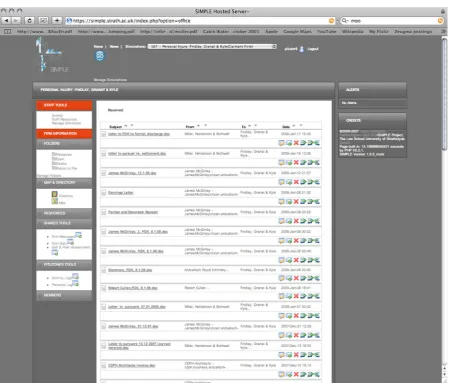
SIMPLE September 2008 Page 22 of 93 Figure 2: SIMPLE student environment
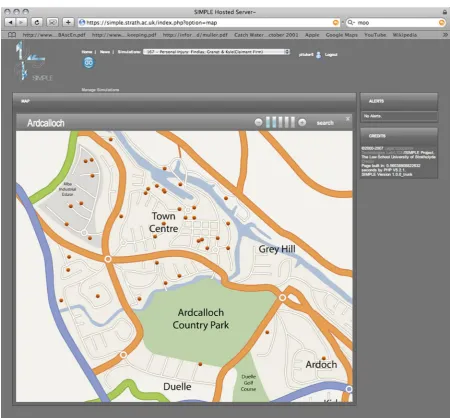
SIMPLE September 2008 Page 23 of 93 Figure 3: Map of Ardcalloch
SIMPLE September 2008 Page 24 of 93 Figure 4: Directory for the PI project
6.1.6 This figure represents the Ardcalloch directory for the Personal Injury project, containing all the institutions, organisations and citizens associated with the project. If students were unsure of addresses, they would use the directory. By contrast, the map was rarely used in this project, for students had photographs and sketch maps of the locus of the accident (though it is not difficult to imagine a locationbased project where the map would be more central to student activities).
6.2 Software outputs: the SIMPLE tools, and Narrative Event
Diagram (NED)
6.2.1 One of the unexpected developments that arose during the course of the project was the development and implementation of the Narrative Event Diagram. Whilst we consulted with various stakeholders about specification of the software (and in particular their conceptualisation and implementation of simulations), it became clear that for most constituents there was a considerable gap between their ability to conceptualise their scenarios and their ability to reproduce those scenarios as a formal design.
SIMPLE September 2008 Page 25 of 93 predecessors. Its aim is to provide a structured system for taking a scenario concept, formalising it and then enabling the formal description to be converted to be machine understandable, all in a format that is still (relatively) quick and easy to interpret. The NED uses some activities (such as activity diagrams) and ideas from structured systems analysis and attempts to wrap them in a much more accessible format.
6.2.4 As a process it is useful at two levels. First it provides a diagrammatical system that can be applied using cheap, easytomodify materials (i.e. pencil and paper) and the concepts and structure can be transferred between human beings in a relatively efficient manner. Second, as a software implementation (such as the SIMPLE tools) it is possible to then take these benefits and operationalise them to allow the production of actual code or resources.
6.2.5 One of the main concerns we had to consider whilst developing what would become the NED, was to try to ensure that we were not reinventing the wheel. However we felt that none of the options available, such as IMS LD, managed to address both our technical/functional requirements and the conceptualisation requirements. For example IMS LD uses a play metaphor as the basis for recording the structure of a learning design, but does not offer any intrinsic process for using that metaphor for conceptualisation. It is left to the user to find a process to map their scenario ideas to IMS LD. We felt it was important that this gap was addressed in whatever tool we developed.
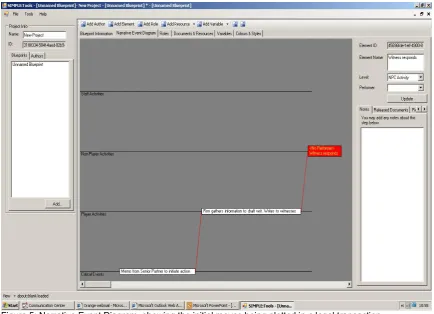
6.2.6 A Narrative Event Diagram appears as four horizontal lines, arranged in a manner similar to a musical staff, each representing one of 4 different scopes for activity:
1. Critical Events. Major scenario exposition points, such as background events preceding the start of a Player’s involvement in the scenario.
2. Player Activities. Any task that the Player (a single individual or a multiple individuals) 3. NonPlayer Character Activities. Any task or event that is performed by any entity in the
scenario who is not the Player
4. Staff Activities. Any task that is performed in administrative or managerial capacity by an overseer.
SIMPLE September 2008 Page 26 of 93 Figure 5: Narrative Event Diagram, showing the initial moves being plotted in a legal transaction.
6.2.8 The music analogy is an important element of the NED, and once this visual trait appeared we tried to maintain consistency with it where possible, as it is an efficient mechanism for visually representing complicated sequences. Thus, each node or activity forms a musical note on the stave with the information passing between entities represented by a directed line (arrows) from the right hand side of the generating activity, to the left hand side of the receiving activity. Stages in the simulation activities can be represented by bar lines, in effect defining the pace and rhythm of the simulation (Gould et al, 2009; Maharg 2007). The sign for repeat can represent repetitions or activity loops. We envisage that in later developments the idea of reading multiple activities (for example complex adversarial or thirdparty simulations) could be accommodated by representing different staves, much as a conductor will read an entire piece of music, with bass, alto, tenor and treble clef staves.
6.2.9 The creation of tools to help nontechnical staff create a simulation is always problematic. We are aware from project feedback and from the two projects that did not complete that the tool set requires revision in a number of aspects, and this will be done within the SIMPLE Foundation. Nevertheless, the concept of the NED and much of its implementation has been generally successful in introducing the complexities of simulation creation and development to staff with little or no experience of simulation design and practice.
6.3 Documentation outputs: technical and user documentation
SIMPLE September 2008 Page 27 of 93 6.3.2 The core team learned much about the process of supporting staff who had relatively little