Towards Collaborative Supply Chains
Umit S. Bititci and Mohamed Y. El Mokadem
University of Strathclyde, Glasgow, UK.
Arab Academy for science and Technology, Abukier, Alexandria, Egypt. [email protected]
Abstract
This research paper focuses on collaborative relationship within supply chain dyads. It is argued that the sufficient financial returns are critical for collaboration to occur. This research proposes a model that illustrates several factors which affect the potentiality of partners to collaborate and the intensity of their collaboration. The model was verified and modified through in-depth interviews within two case studies dyads.
Keywords: Collaboration, Intensity, Power relation, Innovation, Information
Introduction
Today, enterprises are operating in a highly competitive environment with no boundary limits. Responding quickly to satisfy customer needs becomes a major concern for each firm (Yih Wu, et al, 2004). It is widely accepted nowadays that in the new millennium competition will be between value chains, which efficiently and effectively integrate their competencies and resources in order to compete in the global economy (Bititci et al. 2007; Bititci et al, 2003). The complexities of today's organizational environment suggest that effective management must be applied not only within organizations, but also to inter-organizational relationships (Huxham and Macdonald, 1992).
Markets globalization and the current severe competition forced companies to rethink and restructure their businesses and strategies (Gunasekaran et al, 2004 and Stank et al, 1999) and strengthen their competitive advantage through collaboration (Simatupang and Sridharan, 2004). Barratt and Oliveira (2001) identified that the new competitive era are causing suppliers, manufacturers, wholesalers and retailers alike to rethink their strategic initiatives with their supply chain partners.
Despite many considerable efforts by organizations and their business partners, supply chain collaboration is to a large extent still unachievable (Barratt and Oliveira, 2001) and its implementation, in general, has been slow (Whipple and Russell, 2007). Evidence suggests that the likelihood of disappointing outputs is high (Vangen and Huxham, 2003), 70 % of collaborative enterprises fail (kanter, 1990).
that integrate through framework and demonstrate, empirically the determinants of supply chain collaboration.
This research focuses on collaborative relationship within supply chain dyads with a hybrid of factors to be examined. The research argues that the sufficient financial returns are the most important motive for companies to undertake business collaboration. The primary aim of this paper is to understand and discuss the different factors that affect the collaborative potential and intensity. The research contends that power differences and variation in innovation levels, even in the form of critical or confidential information exchange, play a significant role in shaping business relationships and determining the appropriate intensity of collaboration between business partners. Ignoring these two factors may cause the abortion of any collaborative initiatives. Hence, the typical research questions would be:
Question 1: what are the factors that affect Collaborative potential?
Question 2: How can partners identify the appropriate collaborative intensity? Question 3: To what extent the collaborative intensity affects their satisfaction?
Question 4: what is the role that gap in power and variation in innovation levels between business partners play in collaborative practices?
Research Methodology
This research is of an exploratory nature. It started with some unstructured interviews with consultants, academics and practitioners in one of the developing countries (Egypt). The aim behind the interviews was to explore the problems that companies are facing within the supply chain and to scope the literature about factors contributing to successful collaboration.
This was followed by extensive systematic literature review. This was done through preparing a scoping study (Tranfield et al, 2003). The aim was to identify high quality relevant literature to clearly understand the dimensions affecting the business partner's relation in collaborative ventures. Specific management databases, such as Web of Knowledge, Emerald Insight, ABI Inform and Science Direct, were investigated.
Abstract and citation search was carried out according to some inclusion and exclusion criteria. Because this research has a particular interest in collaboration between manufacturing companies, empirical studies focused on service sector companies are excluded. Studies focusing on information technology merely and papers written in other languages rather than English are also excluded. This research utilized 30 usable relevant articles.
After the literature review phase, the researchers were able to propose a theoretical framework drawing the relations between the different factors that affect collaborative potential and collaborative intensity and their interrelations.
A case study approach was chosen to investigate the relations between collaborative business partners and the factors that may affect the success of the relation. Case study research provides in-depth investigation and allows the researcher to fully understand the different factors within its organizational context and to draw conclusions based on real world data. The data was collected through a series of in depth semi structured face to face interviews and telephone interviews with key managers that are in a direct contact with the other partner within the case study companies.
review the primary reports prepared and identify whether they represent a fair reflection to the situation and the discussion undertaken during the interviews.
The research unit of analysis is the dyadic relationship between business partners in supply chains. Each case study represents a dyadic relation between two business partners. This means that the relation was assessed from both view sides of business partners. It is contended that this dyadic relationship should be understood in far more details. This dyadic relationship is considered as a major indicator to the relation between various supply chain partners (supply chains comprises various dyadic relations between partners).
Anonymity was guaranteed for participants as all interviewees asked that anonymity had to be guaranteed as the subject is delicate and can have negative impacts on their relation with their partners.
Since the extant literature does not provide clear-cut answers to the research questions, this case study research is designed as an exploratory and theory building study. Two case studies, each case represents a dyad, operating in two different cultures helped to gain insights into the conditions and specifics of successful collaboration. The theoretical model, developed from the literature, needs to be verified and modified empirically till it reaches its final form. The model was tested against the first dyadic relation with the aim of identifying its suitability and modifying it in accordance to the real world data. The modified model was further tested against another dyadic relation and modifications were made.
Literature and model development
Collaboration means seeking mutual benefits (Parung and Bititci, 2006) and working together towards a common aim (Bititci et al, 2004). It occurs when two or more independent companies work jointly to plan and execute supply chain operations with greater success than when acting in isolation (Whipple and Russell, 2007; Huxham and Macdonald, 1992, Vangen and Huxham, 2006). The collaborative supply chain continues to be adopted by organizations as a medium for creating and sustaining a competitive advantage (Fawcett et al, 2008).
Collaborative potential:
Bititci et al (2007) developed the synergy model with the aim of understanding the reasons behind the high failure rates of collaborative ventures and assessing partner's readiness to collaborate. The model identified strategic, operational, cultural and commercial synergies as the essential factors that would increase the chances of success for future collaborative enterprises.
The strategic synergy highlights the importance of having sufficient returns providing suitable ground for top management to be committed in a close relation. The operational synergy and cultural synergy can be seen as a platform for having suitable organizational culture and establishing sufficient levels of trust and commitment between partners. While the commercial synergy reflects the needs for sufficient return on investment (ROI), for both parties, which make them, buy-in a collaborative venture (Bititci et al, 2007).
The key to achieving desired collaborative breakthroughs is to establish wide spread strong managerial commitment to SCM (Fawcett et al, 2006). Commitment means that members are willing to make short - term sacrifices to maintain their long- term relationship (Yih Wu, et al, 2004) and the enduring intention to develop and maintain a relationship in the future (Duffy, 2008). In addition, top management commitment should empower and facilitate employee's participation to make them committed to their work (Chin et al, 2004). This also can convey the commitment to different employees and build supportive business culture to collaboration.
Building supportive corporate culture is an improtant prerequisite to collaboration (Chin et al, 2004). Supporting business culture enables partners to communicate and to exchange information freely. Communication provides the platform for frequent mutual exchange of meaningful and timely information between firms (Yih Wu, et al, 2004). Culture that is supportive of trusting behavior and openness will be of great benefit to supply chain members (Chin et al, 2004).
This leads to the third factor, which is trust. Trust within relationships is important for all firms to operate within their collaborative relations (Batt and Purchase, 2004). Trust is defined as the willingness to rely on your partner (Yih Wu, et al, 2004). It is the belief that the partner will perform actions that will result in positive outcomes for the firm and not to take unexpected actions that may result in negative outcomes (Batt and Purchase, 2004).
Although the synergy model emphasized that these factors are essential for collaboration to succeed, it is our contention that these factors only represent the platform for any collaboration venture. It identifies the collaborative potential of partners.
Determinants of collaborative intensity
Power plays an important role in determining the nature and level of supply chain integration (Skjoett, 2006 and Cox et al, 2004). However, empirical research on power and dependence is still limited (Caniels and Gelderman, 2007). The concept of power remains under-explained in a business relationship context (Hingley, 2005).
Supply chains are complex power structures (Watson, 2001), in which at many times, one party has more power than the other, because one party is more dependent on the other (Gelderman et al, 2008). However, Kumar (2005) identified that there is a scarcity in finding complete power in a relation. In general, he pointed out that business relations are characterized by interdependence power structure.
Over the past 15 years, several publications emphasized that the most appropriate way for partners to manage their relationship is to eschew short- term and adversarial approaches in favour of more transparent, equity-based, win-win and long-term collaborative ways (Cox, 2004 A).
Collaborative Intensity Collaborative Potential
Nature of Market Competition Trust
between Partners Collaborative
Culture
Level of Innovation Management
Commitment from Parties
Power Relationship
On the other hand, (Watson, 2001) identified that the power structure may challenge the search for a totally integrated supply chains. Cox (2004 A) pointed out that although collaborative, equity based approaches can be made to work. He highlighted that it only works when business partners have a clear interdependence on each other. He added that when one party dominates the relation, the dominated party will have to pass value to the dominant party while making only low returns (Cox, 2004 A and Skjoett, 2006). Collaboration does not follow an equity-based approach nor is it characterized by high levels of trust, but it is about naked power (Cox, 2004 A, B). In general, Cox (2004 A) emphasized that the appropriate sourcing strategy for a buyer depends on the power and leverage circumstances that they find themselves in.
It was noticed that there is a lack of consensus in literature about how power affects partners relation, how power differences between business partners is managed and how power affects the intensity of collaboration. It is clear that the issue of power needs further exploration especially between collaborative business partners.
The nature of the market determines the desire of each party to undertake close relations. When a trade partner provides important and critical resources, for which there are few alternative sources of it, the other partner desire to keep the relation intact increase (Yih Wu, et al, 2004).
Collaboration requires the co-ordination between different functions among different partners. It involves the disclosure of crucial information between business partners. It may involve the sharing of design, new product development and production data among the collaborating partners (Skjoett, 2006).
Collaborative intensity
Despite extensive writing in the area of characterizing partnerships, researchers state that the concept of partnerships, their nature and attributes are still poorly understood. Previous research identified that inter-organizational relationships are positioned in-between continuum anchors of market transactions and vertical integration (Duffy, 2008 and Kanter 1994).
Duffy (2008) developed a framework that highlights the different aspects of relationships to identify factors that differentiate between partnerships and lesser coordinated relationships. He pointed out that the increased level of coordination and integration are indicated by the presence of increased interaction, information exchange and higher levels of joint activities.
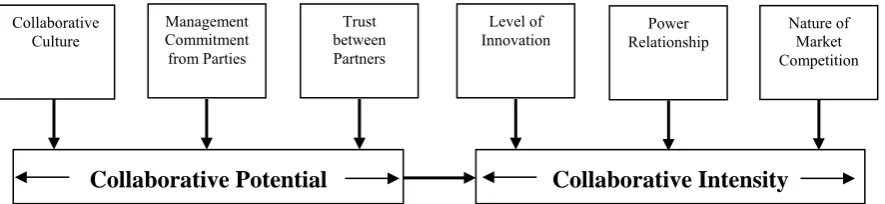
[image:5.595.79.522.627.729.2]As proposed by the model (Figure 1), it can be inferred that management commitment, business culture and trust are the main drivers for partners to undertake collaborative relations (collaborative potential). Power differences, innovation levels and market competition are the platforms for identifying the intensity of collaboration.
Case studies and findings
Two case studies were deeply investigated against the proposed model. Each case represents 2 business partners with close relations with each other. The first case study represents a dyad operating in the Whisky industry in UK. The second case study comprises two companies operating in the FMCG market.
First case study
The first case dyad comprises two SME companies, partner 1 and partner 2. Partner 1 is providing bottling activities to partner 2. They have had a long standing history of cooperation. They started their first formal collaborative venture 4 years ago; when they used SME excel methodology, facilitated by University of Strathclyde, for quantifying and demonstrating the benefits of their future collaboration.
Their participation in the SME excel project created the desire from both sides to collaborate with each other. The ability to quantify the benefits from collaboration encouraged the top management to advocate collaboration. Top management was able to demonstrate the benefits of collaboration to different employees' levels, thus implanting the first root of supportive business culture. Besides, the good and long standing personal relationship between the top managers provided the suitable platform for trust to exist. The presence of trust and supportive culture supported by top management commitment provided a good opportunity for partners to collaborate.
The previously mentioned factors are not enough for the relation to succeed. The asymmetric power relation between partners and the nature of market competition can easily disturb the relation. Partner 2 can be seen as being more powerful as he represents 50% of the other partner's total sales. The ease of moving from a bottler to another amplifies the power difference. Besides, the market competition for partner 1 is severe as there are many other bottling companies competing with each other. Exploiting this power difference and the market competition unwisely may cause the abortion of this collaboration. In fact, partner 2 exploited these factors wisely and was able to find a clear win-win situation by doing all it's bottling with partner 1.
The re-branding project undertaken by partner 2 can reflect the effect of innovation, even in its simplest form of exchanging confidential information, on the relation. Partner 2 disclosed the information about their new design exactly at the needed time for partner 1 to re-adjust their machines for the new product, which in practice were not enough. Partner 2 admitted the short notice and they jointly prepared a contingency plan to coordinate all the activities till the launch of the new design. This can reflect how any increase in the level of innovation can disturb the relation and the exchange of information between partners.
In the pace of collaboration, both companies undertake regular weekly meetings through which they exchange information. Their perception is that they usually receive the information they need on the right time and that they never suffer from any lack of information. Top management commitment to collaboration was further reflected in providing joint training and awareness trainings for new employees about the other partner's operations. Moreover, partner 2 invested in partner 1's factory to improve its production capability. Such training activities increased the awareness of each partner employees with the importance of the role of the other in the business.
collaboration performance measurement, collaboration tools for managing the relation, joint forecasts and IT linkage, both partners are quite satisfied with this level of collaboration and are not willing to do more, at least in the near future. The prevailing relation is able to produce acceptable business results for both sides. This supports the idea of intensity of collaboration with very acceptable results for both partners. It is clear that carrying out more activities will not add more to the relation.
Second case study
The second case dyad comprises two companies, partner 1 and partner 2. Partner 1, an SME operating in Saudi Arabia, is providing raw materials to partner 2, a multinational company serving North Africa and Middle East. They have had a good history of cooperation and business transactions. They started their collaborative venture when Partner 2 announced its supplier development program. Partner 2 classified their suppliers into gold, silver and bronze in accordance to the amount spent with this supplier each year and the degree of market complexity. Partner 1 was classified as a gold supplier which reflects their close relations.
The supplier development project is a clear demonstration from the multinational company to pursue collaborative relations with its gold suppliers. Partner 1 identified explicitly his commitment to have close and collaborative relation with the multinational partner. The ability of the multinational company to cause breakthrough improvements to partner 1 company was another reason for its management to pursue close relation with this partner. Training courses were conducted by the multinational company to its partner to build suitable business culture for collaboration. Besides, the good and successful history of the relationship between the two companies provided the suitable platform for trust to exist. The presence of trust and supportive culture supported by top management commitment provided a good opportunity for partners to collaborate.
However, the asymmetric power relation between partners can easily disturb the relation. The multinational company can easily be seen as being more powerful as they represent 50% of the other partner's total sales. Exploiting this power difference unwisely may cause the abortion of this collaboration. Although, the market competition for partner 1 is quite smooth, the financial abilities of the multinational company can provide them with other sourcing opportunities easily. In fact, the multinational company exploited these factors wisely and was able to find a clear win-win situation by creating a clear interdependence relation through sourcing 80% of this type of raw material from partner 1.
The launch of new products by the multinational company can reflect the effect of exchanging confidential information on the relation. The multinational company usually shares this kind of information with their partners. The partner's perception is that they usually receive the needed information at the right time and they never suffer from any lack of information. Both companies undertake regular weekly meetings through which they exchange information.
which they analyze all problems they face, identify opportunities for improvement and discover any cost saving opportunities.
In addition, further training conducted by the multinational company to the partner's employees and the fact that the multinational company attended orientation programs on partner 1's site can demonstrate both companies top management commitment to collaboration. Besides, the training activities increased the appreciation of each other's role in the success of the business. In addition, the multinational company assigned, financed and participated with third parties consultants to conduct gap analysis for partner 1 to identify their weaknesses and prepare closure programs to overcome these weaknesses.
The wise management of power differences, exchange of critical information and the smooth nature of market competition helped the partners to undertake the several collaborative practices. This was demonstrated from the aforementioned activities. This level of collaboration is able to produce acceptable business results for both sides. Although there is absence of collaboration tools for managing the relation, joint forecasts and IT linkage, the mentioned factors produced certain acceptable amount of collaboration intensity. The partners are aiming to more intensify their level of collaboration, in the near future, through having IT connections. This supports the idea of intensity of collaboration with very acceptable results for both sides.
Discussion
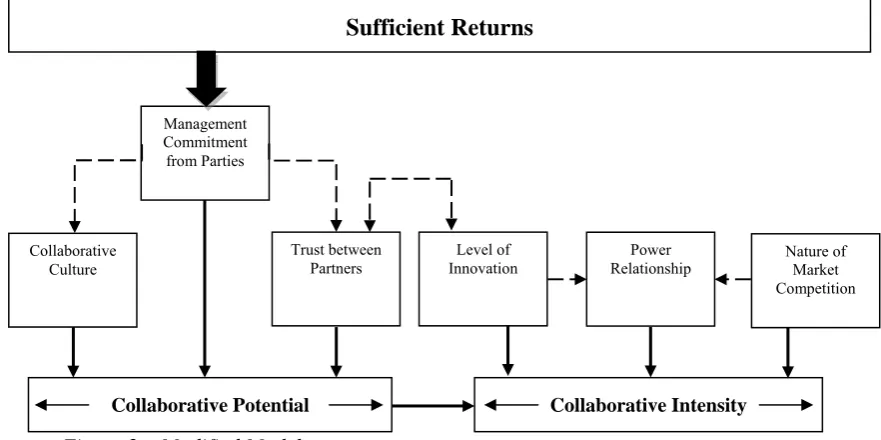
The initial argument discussed herein was that power differences and variation in innovation levels even in the form of exchanging critical information and the nature of market competition between business partners have a considerable impact on collaboration between business partners. It was argued that collaboration between parties could be achieved with different intensities. It was also claimed that the platform for any successful collaboration is the sufficient return on investment. Top management commitment, business culture and trust between partners are the main factors that indicate the potentiality and willingness of business partners to collaborate. For partners to actually collaborate, adequate and wise management for power differences and innovation (exchanging critical information) are needed. Market competition can be seen as an important factor to identify the suitable level of collaboration.
The research, having developed a model for the collaborative relations, verified the factors affecting both the collaborative potential and collaborative intensity through the 2 case studies. In addition, case studies lead to some modifications to the model (Figure 2) which appear in the interrelations between the different factors. The aforementioned factors and their interrelations make it possible for business partners to pursue collaborative ventures with different intensities.
Figure 2 – Modified Model
It was also obvious that Power differences between business partners have a considerable effect on collaboration success. Creating interdependence between partners could be seen as a desirable condition for collaboration to nourish. It was also clear that as the market competition heightens, the tendency and willingness to do business collaboratively increases from one side and diminishes from the other.
We can say that in spite of the absence of some collaborating activities (formal joint activities, collaboration tools to manage the relation, joint assessment or performance measurement and IT linkage), the relation between business partners could remain collaborative, ideal and productive.
Conclusion
It may be concluded that the main driver for partners to collaborate is the sufficient returns. Management commitment, business culture and trust are the platform for collaboration. Collaboration between partners can appear with different intensities that could vary along a continuum from high to low intensity with quite accepted results for partners. Power differences, the degree of confidentiality of information and the nature of the market competition are able to specify the suitable intensity for collaboration.
References
Barratt, M. and Oliveira, A. (2001), "Exploring the experiences of collaborative planning initiatives",
International journal of physical distribution and logistics Management, Vol. 31, No 4,
pp.266-289.
Batt, P. and Purchase, S. (2004), "Managing collaboration within networks and relationships", Industrial Marketing Management, vol. 33, pp. 169−174.
Bititci, U.S., Martinez, V., Albores, P. and Mendibil, K. (2003), “Creating and sustaining competitive advantage in collaborative systems: the what? And the how?”, International Journal of Production Planning & Control, Vol. 14, No. 4.
Bititci, U.S., Martinez, V., Albores, P. and Parung, J. (2004), "Creating and managing value in
collaborative networks", International journal of physical distribution and logistics Management,
Vol. 34 No. 3/4.
Bititci, U., Turner, T., Mackay, D., Kearney, D., Parung, J. and Walters, D. (2007), "Managing synergy in collaborative enterprises", Production Planning & Control, Vol. 18, No. 6, pp. 454–465.
Collaborative Intensity Collaborative Potential
Nature of Market Competition Trust between
Partners Collaborative
Culture
Level of Innovation Management
Commitment from Parties
Power Relationship
Caniels, M. C. J. and Gelderman, C. J. (2007), "Power and interdependence in buyer supplier
relationships: A purchasing portfolio approach", Industrial Marketing Management, Vol. 36, pp.
219 – 229.
Chin, K. S., Tummala, V.M. R., Leung, J. P. F. and Tang, X. (2004), "A study on supply chain management practices the Hong Kong manufacturing perspective", International journal of physical distribution & logistics management, Vol. 34, No. 6, pp. 505-52
Cox, A. (2004 A), "The art of the possible: relationship management in power regimes and supply chains, Supply chain management: An international journal, Vol. 9, No. 5, pp. 346–356.
Cox, A., Watson, G., Lonsdale, C. and Sanderson, J. (2004), "Managing appropriately in power regimes: relationship and performance management in 12 supply chain cases", Supply chain management: An international journal, Vol. 9, No. 5, pp. 357–371.
Cox, A. (2004 B), "The Business relationship alignment: on the commensurability of value capture and mutuality in buyer and supplier exchange", Supply chain management: An international journal,
Vol. 9, No. 5, pp. 410-420.
Duffy, R. S. (2008), "Towards a better understanding of partnership attributes: An exploratory analysis of relationship type classification", Industrial marketing Management, Vol. 37, pp. 228–244.
Fawcett, S. E., Ogden, J. A., Magnan, G. M. and Cooper, M. B. (2006), "Organizational commitment and governance for supply chain success", International Journal of Physical Distribution & Logistics Management, Vol. 36, No. 1, pp. 22-35.
Fawcett, S. E., Magnan, G.M. and McCarter, M.W., (2008), "Benefits, barriers, and bridges to effective supply chain management", Supply Chain Management: An International Journal, Vol.13, No. 1,
pp. 35–48.
Gelderman, C. J., Semeijn, J. and De Zoete, R. (2008), "The use of coercive influence strategies by dominant suppliers", Journal of Purchasing & Supply Management, Vol. 14, pp. 220– 229.
Gunasekaran, A., Patel, C. and McGaughey, E. (2004), “A framework for supply chain performance measurement”, International Journal of Production Economics, Vol. 87, pp. 333-47.
Hingley, M. (2005), "Response to comments on Power to all our Friends? Living with imbalance in supplier–retailer relationships", Industrial Marketing Management, Vol. 34, pp. 870 – 875.
Huxham, C. and Macdonald, D. (1992), "Introducing Collaborative Advantage: Achieving Inter-organizational Effectiveness through meta-strategy", Management Decision, Vol. 30, No. 3, pp.
50-56.
Parung, J. and Bititci, U. S. (2006), "A conceptual metric for managing collaborative networks", Journal of Modelling in Management, Vol. 1, No. 2, pp. 116-136.
Kanter, R. M. (1990), "When Giants Learn Cooperative Strategies", Planning Review, January.
Kanter, R. M. (1994), "Collaborative Advantage: The Art of Alliances", Harvard Business Review,
July-August.
Kumar, N. (2005), "The power of power in supplier-retailer relationships", Industrial Marketing Management, Vol. 34, pp. 863 – 866.
Simatupang, T. M. and Sridharan, R. (2004), "A benchmarking scheme for supply chain collaboration",
Benchmarking: An International Journal, Vol. 11, No. 1, pp. 9-30.
Skjøtt-Larsen, T. (2006),"Battle of the Supply Chains",European Business Forum, Issue. 24, pp. 43-48.
Stank, T.P., Daugherty, P.J. and Autry, C.W. (1999), “Collaborative planning: supporting automatic replenishment programs”, Supply Chain Management: An International Journal, Vol. 4, No. 2,
pp. 75-85.
Tranfield, D., Denyer, D. and Smart, P. (2003), "Towards a Methodology for Developing Evidence-Informed Management Knowledge by Means of Systematic Review", British Journal of Management, Vol. 14, pp. 207–222.
Vangen, S. and Huxham, C. (2006), "Achieving collaborative advantage: understanding the challenge and making it happen", Strategic Direction, Vol. 22, No. 2, pp. 3-5.
Vangen, S. and Huxham, C. (2003), "Nurturing collaborative relations: Building trust in
interorganizational collaboration", The Journal of Applied Behavioral Science, Vol. 39, No. 1, pp.
5-31.
Watson, G. (2001), "Subregimes of power and integrated supply chain management", Journal of supply chain management, Vol. 37, No. 2, pp. 36-41.
Whipple, J. M. and Russell, D. (2007), "Building supply chain collaboration: A typology of collaborative approaches", International Journal of Logistics Management, Vol. 18, No. 2, pp. 174−195.