A High Speed Multifocal Multiphoton
Fluorescence Lifetime Imaging Microscope For
Live-cell FRET Imaging
Simon P. Poland*a, b, Nikola Krstajić*c, James Monypenny*a, b, Simao Coelhoa, b, David Tyndallc, Richard J. Walkerc, d, Viviane Devaugesa, b, Justin Richardsonc, d, Neale Duttonc, Paul Barbere, David Day-Uei Lif, Klaus Suhlingg, Tony Nga,b,h, Robert K.
Hendersonc and Simon M. Ameer-Bega,b
1 a Division of Cancer Studies, Guy’s Campus, Kings College, London, UK;
b Randall Division of Cell and Molecular Biophysics, Guy’s Campus, Kings College, London, UK c Institute for Integrated Micro and Nano Systems, School of Engineering, University of Edinburgh, Edinburgh, UK;
dPhoton-Force Ltd., Edinburgh, UK
e Gray Institute for Radiation Oncology & Biology, University of Oxford, Old Road Campus Research Building,
Roosevelt Drive, Oxford OX3 7DQ.
f Strathclyde Institute of Pharmacy and Biomedical Sciences, 161 Cathedral Street, Glasgow, G4 0RE, UK; gDepartment of Physics, King's College London, Strand, London, UK;
hUCL Cancer Institute, Paul O'Gorman Building, University College London, London WC1E 6DD, UK
Abstract: We demonstrate diffraction limited multiphoton imaging in a massively parallel, fully addressable time-resolved multi-beam multiphoton microscope capable of producing fluorescence lifetime images with sub-50ps temporal resolution. This imaging platform offers a significant improvement in acquisition speed over single-beam laser scanning FLIM by a factor of 64 without compromising in either the temporal or spatial resolutions of the system. We demonstrate FLIM acquisition at 500 ms with live cells expressing green fluorescent protein. The applicability of the technique to imaging protein-protein interactions in live cells is exemplified by observation of time-dependent FRET between the Epithelial growth factor receptor (EGFR) and the adapter protein Grb2 following stimulation with the receptor ligand. Furthermore, ligand-dependent association of HER2-HER3 receptor tyrosine kinases was observed on a similar timescale and involved the internalisation and accumulation or receptor heterodimers within endosomes. These data demonstrate the broad applicability of this novel FLIM technique to the spatio-temporal dynamics of protein-protein interaction.
2014 Optical Society of America
OCIS codes: (000.0000) General; (000.2700) General science.
References and links
1. Introduction
concentration and is thus suited to imaging studies in intact cells[3, 4]. Multiphoton microscopy confers additional advantages in terms of inherent three dimensional sectioning and enhanced depth penetration for in vivo imaging[5-8]. However, the data acquisition rate for FLIM is a significant limitation in current implementations of laser scanning microscopy.
There are a number of techniques currently available in multifocal multiphoton micrcoscopy to generate multiple scanning points. These include the use of Nipkow spinning disks [9], cascaded beamsplitter arrays [10], microlens arrays [11] and diffractive patterned illumination approaches [12]. These approaches restrict flexibility in relation to light efficiency (number of beams) or the use of patterned illumination. One technique utilizing a holographic pattern projected onto a diffractive spatial light modulator (SLM), (developed originally for use in optical tweezing applications [13]) is gaining a wider acceptance in multifocal multiphoton beam scanning implementations[14].
For high precision multiphoton FLIM, time-correlated single photon counting (TCSPC) is unparalleled in its measurement accuracy[15]. In terms of imaging speed, TCSPC is fundamentally limited with respect to photon counting rate, since the stochastic nature of the emission process requires that the detection rate is much less than one photon per excitation event to prevent inaccuracies in lifetime determination[16]. Consequently, acquisition times for laser scanning FLIM are in the order of minutes, whereas many dynamic biological events occur on significantly faster timescales[17]. In order to overcome this limitations, parallel signal acquisition using arrays of laser beams with either photomultiplier arrays[18, 19] or time-gated camera detection systems[20, 21] have been employed. However, in implementations to date, accurate determination of fluorescence lifetime with large numbers of channels in parallel is limited either due to cross-talk in multi-anode PMT’s[22] or subject to systematic error due to measurement methodology in camera systems[19, 23]. For a single beam scanning system, count rate limitations can be abrogated by parallel detection in a multi-anode PMT[19]. Whilst, significantly increasing frame rates, this is at the cost of significant pulse pile-up[16], leading to count rate dependent errors in the observed fluorescence lifetime. Furthermore, the count rates reported for in vivo imaging with a low axial and lateral resolution are unobtainable in high NA lenses without excitation saturation and significant phototoxicity and photobleaching. Thus, the ability to quantitatively measure complex biological events with high temporal resolution remains a significant challenge.
Single-photon avalanche photodiodes (SPAD) array cameras developed for microscopy and spectroscopy techniques have been designed utilizing either custom or standard CMOS technologies[24, 25]. Whilst recent studies have shown the use of custom CMOS in a parallelized 8 x 1 SPAD array for use in single molecule fluorescence correlation spectrocopy[26], there are issues in scalability due to power requirements (6 W for 8 SPADs)[27]. Standard CMOS SPAD arrays are better suited for creating large, power efficient (100mW for 1024 SPADs) and affordable SPAD array cameras while maintaining good (50ps) timing resolution. In previous studies, the 32x32 Megaframe SPAD array has been presented where each individual pixel contained separate timing circuitry[28]. Due to the relative size of the timing circuitry and associated logic, the active region of each pixel is ~1%. Hence when operated as a 32x32 pixel widefield camera, due to the low fill factor there is a low collection efficiency[29].
fluorescence beamlets directly onto the active region of the SPADs, we optically amplify the fill factor to 100%. With each individual SPAD operating in TCSPC mode, the microscope system effectively consists of 64 individual multiphoton FLIM microscopes operating in parallel to enable high data acquisition rates. The Megaframe SPAD array acquires time-resolved data from single-photon events on 32 × 32 pixels at up to 500 kcts/sec/pixel[28] leading to a frame rate which scales linearly with detector number. Such high count rates generate too much data to transfer via a USB2.0 interface (effective throughput up to 35 MB/s or 280 Mbit/s) and in this paper we optimise data transfer by limiting acquisition to 64 detectors and achieve a maximum data acquisition rate of 16 Mcts/sec. This is 20 times faster than a typical TCSPC acquisition speed with a single detector (assuming photon counting rates of 1% for an 80MHz laser repetition rate). The FLIM system presented here, represents a paradigm shift in acquisition of fluorescence lifetime data, whereby there is no longer a need to make a compromise between accuracy, speed and spatial resolution. We perform a number of live cell imaging experiments to highlight the capabilities of the system.
2. Methods
Optical Set-Up.
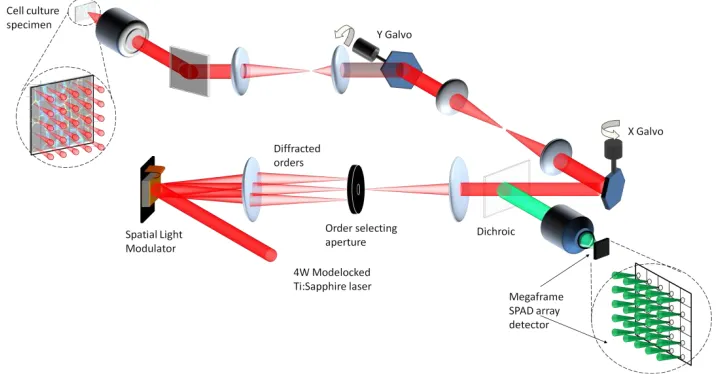
[image:3.612.134.494.362.549.2]The MM-FLIM microscopy system is shown schematically in Figure 1. For multifocal beam generation, a phase-domain spatial light modulator based, arbitrary pattern holographic projection system was implemented, using techniques originally developed for optical tweezing[13, 21] and single molecule imaging with fluorescent correlation spectroscopy[26].
Fig. 1: Operational schematic of the multifocal multiphoton system.
order diffraction pattern. The patterned NIR light was then optically relayed through a set of x-y galvanometer scanners and transmitted through a long-pass dichroic filter onto the back aperture of a x40 1.3N.A. Plan Fluor oil immersion microscope objective [Nikon Instruments Ltd] such that the back focal plane was conjugate to the SLM. Due to issues associated with projecting a square pattern onto a circular aperture, the beam size was set so that it slightly under-filled the pupil plane of the objective. Therefore the multifocal microscope system functioned with an effective excitation N.A. of 1.2. Since the focal plane was conjugate with the image plane of the SLM, the 2D beamlet array was re-created at the focal plane and was raster scanned across the sample in beam scanning mode (using the galvanometer scanners). Two photon excited fluorescence was then collected from the focal plane by the objective, de-scanned by the galvanometer scanners and re-imaged via a dichroic mirror onto the back aperture of a x10 0.3N.A. Plan Fluor objective [Nikon] and focused onto the Megaframe SPAD array.
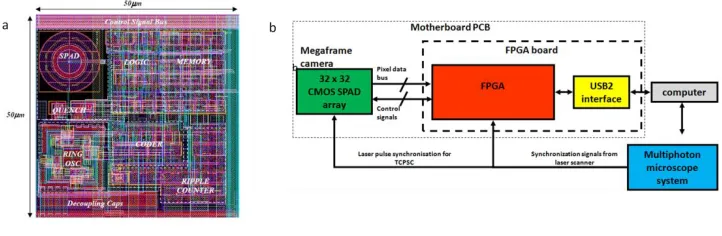
The beam generation technique offers significant flexibility in terms of near-field resolution control as well as having complete programmable control of the number and positioning of each beamlet. The excitation beamlet array generated fluorescence in the microscope focal plane via a two photon absorption process and was back-projected through the system to the detection plane. For parallelized TCSPC detection, each fluorescence image of the beamlet array was focused onto a single SPAD of a detector array (Figure 2a & b). To ensure optimal efficiency of detection, the fluorescent beamlet projected onto the detector aperture was significantly smaller (1.8 µm FWHM) than the active area of the SPAD (6 µm dia.). The field of view of the microscope was determined by the magnification between object and detection planes, with beamlets separated in the detection plane by the detector spacing, 50 µm. With a 40x objective (Nikon Plan Fluor Oil Immersion 1.3 NA) the field of view was 100 μm for an 8 x 8 beamlet array. Precise alignment and matching of the beamlet spacing and angular orientation onto the detector array was performed to ensure a fill factor of 100%. The DWGS algorithm [30] was implemented (incorporating direct feedback from the detector array) to compensate for Poor intensity fidelity between beamlets[31] leading to significant improvement in uniformity of the beamlet intensity variation.
Figure 2 (a) Single pixel architecture with SPAD detector and associated logic, memory and timing circuitry. The active area of the SPAD is 1% of the total footprint of the pixel. (b) A flow chart detailing the Megaframe camera internal architecture, consisting of the motherboard PCB holding the Megaframe camera and programmable logic (FPGA). The FPGA controls the Megaframe camera readout and forwards the data to PC via USB2.0 link.
Time-Resolved Detection & Megaframe Architecture
[image:4.612.128.489.421.539.2]In the current architecture, up to 0.5M time-stamp/s are delivered to the field programmable gate array (FPGA) for each pixel. Each timestamp is 10 bits long resulting in 56 ns dynamic range covering the needs for most fluorophores and light sources commonly used in microscopy. The FPGA circuit board (Opal Kelly XEM3050) contains the Spartan 3 FPGA from Xilinx (XC3S4000) and provides a USB2 interface to the host PC. The test software included with the FPGA circuit (pipetest.exe, FrontPanel 4.2.5, Opal Kelly) board can perform ~32MB/s streaming to the host PC. The firmware was written in Verilog using Xilinx’s ISE Design Tools, System Edition, version 13.2. FPGA board and Megaframe camera are interfaced via a custom motherboard printed circuit board (PCB). The motherboard PCB provides the inputs to laser pulse and laser scanner synchronization. Laser pulse synchronization signal is fed directly into Megaframe camera for reverse start-stop TCSPC timing. Laser scanner synchronization signals are interfaced to the FPGA.
The Megaframe was operated in either time correlated (lifetime) or time-uncorrelated modes (intensity). On-pixel TDCs generated raw time-correlated data, which was post-processed to generate an image. Due to the small size of the SPAD active area (6 µm diameter, ~28 µm2), the focused beamlet array required careful alignment for which a protocol was
developed [could add spie ref]
Image Acquisition and reconstruction
All aspects of the microscope system were controlled via custom developed software written in the LabVIEW graphical programming environment. The appropriate region of interest for each sample was first selected whilst operating the microscope in wide-field fluorescent mode. Depending on the sample, the most suitable acquisition time and beamlet pattern laser power were chosen. The MM-FLIM system functioned in either single acquire, time-lapse or z-stack imaging modes. For each individual image acquisition, the system was processed 32 × 32 data points for 8 × 8 detectors producing 256 × 256 pixel images. The user set the scan period and software generated and software generates the appropriate x-y galvanometer signals and pixel trigger clock. Once initialized, the buffered data reads were saved sequentially with the data containing an embedded x- address signal to enable sorting. Processing on the Megaframe camera was controlled through firmware loaded onto an on-chip FPGA.
Data lines from columns of the Megaframe camera were de-serialized and prepared for transfer over USB2. At each pixel_clk cycle one bit of a row was transferred from the top half (32 data lines) and bottom half (32 data lines). As each time-to-digital converter (TDC) was 10 bits, 10 pixel_clk cycles were needed to transfer one top-half row and one bottom half row. The deserializer provided 640 lines (containing all data for two rows) to the module which checked if the two rows currently transferred contained pixels of interest. The data rate between the Megaframe camera and the FPGA is 5 Gbits/s (64 data lines at 80 MHz). This translates to a frame rate of 500 kHz, where each frame is 1024 pixels (32 × 32). As 5 Gbits/s data rate cannot be sustained to the PC, our approach was to select 64 pixels and transfer these at fastest possible rate over USB2 bus. The TDC timestamps for selected pixels were placed in the first-in-first-out (FIFO) buffer. Each timestamp is 16 bits long to allow for 10 bits of time data, 5 bits of addressing of 64 pixels and one spare bit. Our USB2 link allowed for up to 32 MBytes/s transfer rate. In practice, this was lower due to overheads in firmware and also lower photon budget. The interface between the microscope and detector system (Megaframe, FPGA circuit board and the interface board) was via standard laser scan triggers whereby the scanner triggered the detector on each pixel thus ensuring that histograms were calculated for the correct pixels of interest.
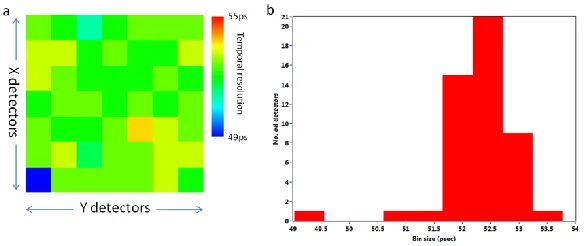
(i) Differential Non-Linearity (DNL) – cyclic intensity variations in time due to phases generated by the four delay-element oscillator (see Figure 3). This was corrected individually for each pixel. The four delay-element oscillator in the pixel has 8 phases (essentially four positive transitions round the ring followed by four negative transitions). This results in a histogram with a repeating pattern of 8. By reducing the bin size to 8 for a measurement taken with a temporally uniform illumination source, one can determine appropriate correction factor to scale/multiply to each bin number. (ii) Integral Non-Linearity (INL) - Variations in the temporal bin size between detectors as a result of the CMOS fabrication process (see Figure 4). This was compensated using a rational resampling technique. This technique incorporated first interpolation and decimation to change the sampling rate by a rational factor, thereby rescaling the temporal data taken from each detector into the same time bin size.
[image:6.612.204.428.239.408.2]Figure 3: Comparing raw data with a DNL corrected histogram for a 7x7 detector array. Correction of the DNL gives a marked reduction of the intensity variation of the transient.
Figure 4: Presents data on the 7×7 detector array used for imaging (a) the temporal bin size of each detector in the 7×7 array. Average temporal resolution of the 7×7 array is 52.5 +/- 0.7ps. Variation in the temporal bin sizes are due to minor discrepancies between individual SPADs caused in the fabrication process of the chip. (b) Presents a histogram of the distribution of bin sizes of the 7×7 detector array.
[image:6.612.170.463.462.585.2]Sample preparation of plasmids, cell lines, and cell culture conditions.
The plasmids encoding human EGFR (with the (A206K) dimerization-deficient mutant) and human ErbB2 tagged at the c-terminus were constructed by inserting the cDNA for the respective receptor into a modified version of the pEGFP-N3 vector (Clontech) in which the Ala206 to Lys mutation had been incorporated into the EGFP sequence. The plasmid encoding human ErbB3 tagged at the c-terminus with mRFP was constructed by inserting the ErbB3 cDNA sequence upstream of mRFP within a modified pcDNA3.1 vector. The plasmid encoding Grb2-mCherry was a gift from Dr Perani and Prof Peter Parker (King’s College London, UK).
MCF7 breast carcinoma cells were grown in DMEM medium supplemented with 10% fetal bovine serum (FBS), penicillin G (100 U/ml)/streptomycin (100 mg/ml) and 1% L-glutamine, and cultured in an atmosphere containing 5% CO2/95% air (v/v). For imaging, cells were plated into 3.5 cm glass-bottom culture dishes (PAA Laboratories) 24 hours prior to transfection. For EGFR-EGFP/Grb2-mCherry and HER2-EGFP/HER3-mCherry co-expression studies cells were co-transfected using Fugene 6 (Promega, Madison,WI, USA) with 1.5 µg and 3 µg of donor and acceptor plasmids respectively. Following transfection, cells were maintained at 37°C in a humidified 5% CO2 atmosphere for 24h to allow expression of exogenous proteins.
For live cell imaging, cell culture media was replaced with phenol red-free OptiMEM (Gibco), supplemented with 10% FBS and 25 mM HEPES. The microscope body was equipped with an environment chamber (Solent Scientific Ltd, UK) enabling cell cultures to be stably maintained at 37°C for the duration of imaging experiments. Human recombinant EGF and Neuregulin were purchased from PeproTech, New Jersey, USA.
3. Experimental Results
Resolution measurements
To demonstrate the diffraction limited imaging performance of the microscope across all beamlets, sub-resolution (100 nm dia.) fluorescent beads were imaged. Diffraction limited performance in lateral and axial resolutions of 0.44± 0.01 µm and 1.03±0.01 µm respectively [N = 55 PSF’s distributed over 25 SPADs] was demonstrated with an effective 1.2 N.A. (due to under-illumination of the back pupil of the 1.3 N.A. objective).
Comparing lifetime analysis techniques for image acquisition of live cells at high speed
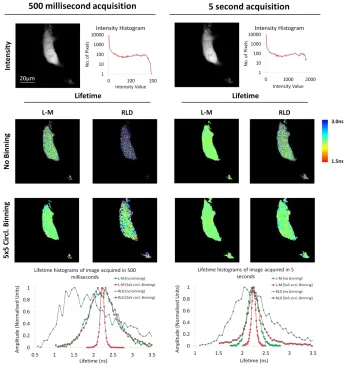
Figure 5: Comparing lifetime analysis techniques for image acquisition of live cells at high speed. MCF-7 human breast carcinoma cells were transiently transfected with EGFP only and datasets were acquired for a 7x7 array for 500 milliseconds and 5 seconds. In a 256x256 dataset, a maximum of 200 photons and 2000 photons were collected per pixel at 500 milliseconds and 5 second acquisitions respectively. In order to simulate the analysis of time gated camera to compare with Levenburg-Marquardt (L-M) fitting using Tri2 we used the 2 gated Rapid Lifetime Determination (RLD) approach for single exponential decays with 2 ns gate size. Lifetime images are displayed for both techniques with no binning and 5x5 circular binning for both 500 milliseconds and 5second acquisitions and their histograms compared. L-M clearly outperforms the RLD in all data analysis performed giving a much more accurate determination of the lifetime.
Imaging protein-protein interactions in live cells
EGFR-EGFP and Grb2-mCherry
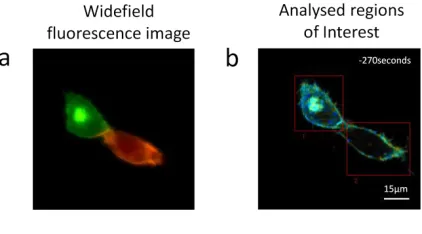
Epidermal Growth Factor (EGF)-dependent activation of EGFR represents the archetypal mitogenic signalling pathway for receptor tyrosine kinases, coupling extracellular growth factors to Ras/MAPK activation[39]. In addition to its role in cell proliferation, EGFR activation can promote cell survival and differentiation and also drive the profound remodelling of the cell cytoskeleton, inducing migratory and invasive phenotypes in many cell types. The adaptor protein Grb2 is likely to represent a key node coupling EGFR activation to this diverse range of biological outputs as it provides a molecular bridge between active receptor and an array of downstream signalling protein classes including exchange factors, phosphatases, ubiquitin ligases and cytoskeletal remodelling factors[40-43]. Grb2 is recruited to activated receptor via its Src Homology 2 (SH2) domain which targets specific peptide consensuses flanking a critical central phosphotyrosine residue within the receptor’s intracellular domain. Grb2 serves to establish receptor-associated signalling scaffolds through which a downstream array of enzymatic pathways are rapidly activated: indeed Ras activation, which occurs following the Grb2-dependent recruitment of the exchange factor SOS to ligand-activated EGFR, is maximal within two minutes of addition of EGF to cultured cells[44]. Visualisation of EGF-induced EGFR/Grb2 association (which cannot be performed in a conventional signal beam scanning FLIM) represents an interesting challenge for testing the capabilities of the MM-FLIM system. For live cell experiments, MCF-7 human breast carcinoma cells transiently transfected with an EGFP fusion of EGFR (EGFR-EGFP) and a mCherry fusion of Grb2 (Grb2-mCherry) were subjected to fluorescence lifetime time-lapse imaging to assess the effects of EGF stimulation on EGFR-EGFP/Grb2- mCherry interaction. A 7 × 7 beamlet pattern was applied which gave sufficient field of view (87.5 × 87.5 µm) to illuminate small clusters of cells over the course of time-lapse experiments (Figure 6a & b). Cell imaging data was acquired continuously for 30 minutes (10 s/frame) (Video 1).
Figure 6: (a) Fluorescence widefield image highlighting the relative abundance of donor (green) and acceptor (red) in each cell. (b) A composite of Intensity and lifetime images are presented highlighting the ROIs chosen for the two cells which were examined before and after EGF ligand was added.
[image:9.612.210.421.392.509.2]Figure 7: 3D-image stack of a 40 z-sections acquired in 400 s (1 section/10s) of an MCF-7 cell, taken pre and post EGF addition.
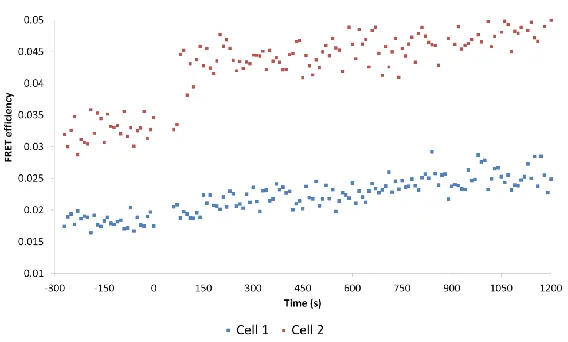
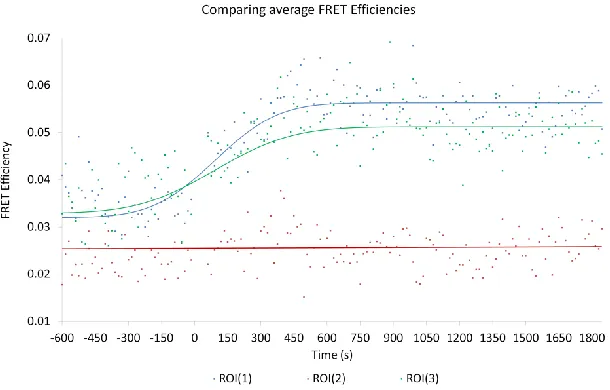
Analysis of the time-lapse imaging revealed a rapid increase in FRET between EGFR-EGFP and Grb2-mCherry following stimulation as measured by a reduction in the lifetime of the EGFR-tagged EGFP donor fluorophore (Figure 8).
Figure 8: Average FRET efficiency values of the region of interest (ROI) are presented in the accompanying graph with 0 seconds indicating the moment that EGF addition occurs.
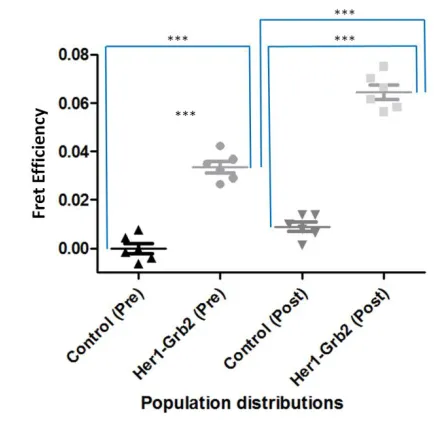
[image:10.612.179.463.355.526.2]EGF ligand, a significant increase in this FRET interaction occurred, with FRET efficiency rising to 6.1 0.9 %.
Figure 9: Statistical analysis comparing control MCF-7 cells expressing EGFR-EGFP with MCF-7 cells coexpressing EGFR-EGFP & Grb2-mCherry, both pre and post addition of EGF ligand. In order to compare two different populations (control vs. test) for significance the unpaired Student test was used. For the same populations (Pre vs. post treatment) the paired t-test was used. *** between populations denotes a highly significant difference in lifetime values (p<0.0001).
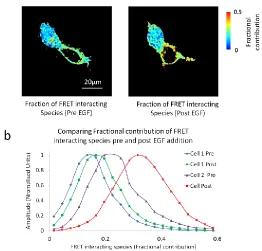
[image:11.612.203.426.107.323.2]Figure 10: Data from figures 7 & 8 reanalysed by biexponential global analysis to determine the fraction of Her1-eGFP interacting by FRET with Grb2-mCherry. (a) Presents the total fraction of FRET interacting species, pre and post EGF addition. (b) Histograms comparing fractional contributions of FRET interaction species for pre and post EGF ligand addition.
HER2-EGFP and HER3-mRFP
Further to imaging EGFR/Grb2 signalling dynamics in living cells MM-FLIM was appied to the analysis of ligand-dependent receptor heterodimerisation. We examined the interaction between the EGFR family members HER2 and HER3, given the clinical significance of this heterodimer pair. HER3, which lacks intrinsic tyrosine kinase activity, can form competent signalling complexes through heterodimerisation with other EGFR family members following activation by its ligand neuregulin. As a potent driver of the PI3K/AKT-dependent cell survival pathway this novel kinase-deficient EGFR family member is gaining greater attention as a potential therapeutic target in cancer[45]. In particular, the role that the HER2/HER3 heterodimer plays in tumourigenesis and treatment resistance in breast cancer has become the focus of intense study. In HER2-amplified breast cancers, it is the HER2/HER3 heterodimer which is largely responsible for driving tumour growth. Poor response to HER2-targeted therapies (for instance trastuzumab) in these patients is believed, in part, to be associated with increased expression of HER3[46].
These localisations accumulated at the cell periphery and within a perinuclear compartment, the latter of which was far more pronounced in the case of HER3-mRFP (Figure 11).
Figure 11 (a) Fluorescence widefield image highlighting the relative abundance of donor (green) and acceptor (red) regions in each cell. (b) A composite of Intensity and lifetime images are presented highlighting the ROIs chosen for the cells which were examined before and after neuregulin ligand was added.
[image:13.612.142.489.311.675.2]Figure 12: Intensity, lifetime and composite images for a four frames in the time lapse.
Following the addition of neuregulin, time-lapse imaging revealed a gradual fall in the lifetime of the HER2-EGFP donor specifically within the perinuclear compartment (from 2.21 +/- 0.02ns to 2.15 +/- 0.02ns) due to accumulation of vesicles with short lifetimes whilst donor lifetime at the cell periphery remained relatively constant (Figure 13). These data constituted a FRET efficiency increase from 3.1 1.3% to 5.7 0.9% after neuregulin addition. The fall in donor lifetime, indicating an accumulation of HER2/HER3 heterodimer within a perinuclear compartment, was detectable within the first 100s of ligand addition and stabilised after approximately 7 minutes, remaining low for the remainder of the observation period. Interestingly, the lack of any detectable change in donor lifetime at the cell periphery suggests that newly formed HER2/HER3 heterdimers are rapidly internalised and targeted to subcellular compartments following neuregulin stimulation and therefore active receptor complexes are predominantly intracellular.
Figure 13: Average FRET efficiencies values of the ROIs are presented in the accompanying graph with 0 seconds indicating the moment that neuregulin addition occurs.
[image:14.612.145.450.308.503.2]Figure 14: Statistical analysis comparing FRET efficiencies of control MCF-7 cells expressing HER2-EGFP with MCF-7 cells coexpressing HER2-EGFP & HER3-mRFP, both pre and post addition of neuregulin ligand. In order to compare two different populations (control vs. test) for significance the unpaired Student t-test was used. For the same populations (Pre vs. post treatment) the paired t-test was used. *** between populations denotes a highly significant difference in lifetime values (p<0.0001).
Discussion & Conclusions
This paper presents development of a multifocal multiphoton imaging system for high-frame rate FLIM imaging. We have demonstrated that multifocal multiphoton imaging with a 2D SPAD array is practical and offers significant speed advantages compared to single beam laser scanning or a widefield FLIM microscopes. With this implementation of MM-FLIM, the minimum acquisition time for a homogeneous image scales as 𝑁2∆𝑡 𝑛⁄ where N2 is the number
of pixels in the image, Δt is the pixel dwell time to acquire the required 1000 photons for a satisfactory single exponential fit[47] and n is the number of beams. At the maximum count rate per pixel for the current system (500 kHz) and 64 beams, the minimum frame time is 2.05 s for a homogeneous sample, which is a drastic improvement when compared with 131 s required for a single beam scanning system. Often in FLIM imaging spatial resolution is sacrificed for temporal resolution and applying a 3 x 3 spatial binning reduces this acquisition further to 228 ms in the MM-FLIM. One can also fit with a lower number of photons to obtain faster acquisition rates (500 ms acquisitions) although this will affect the accuracy of the lifetime determination (Figure 5). We have demonstrated long-term observation of living biological specimens with diffraction limited imaging performance with no significant degradation in signal to noise. This is due to the lower photon flux of excitation in each beamlet compared to a single beam scanning system[19].
unprecedented spatial and temporal resolutions for time-domain FLIM. We show that the Grb2 adaptor protein is recruited to EGFR receptor within 75 s of cell stimulation with EGF, an observation that would be challenging with conventional TCSPC systems. In addition, we are able to visualise the rapid heterodimerisation of HER2 and HER3 receptor tyrosine kinases in response to cell stimulation with the ligand neuregulin. We observe the gradual accumulation of these HER2/HER3 receptor complexes within a discrete perinuclear compartment highlighting the spatial resolution of the MM-FLIM system. We believe this technology has the potential to transform functional FLIM/FRET imaging to enable dynamic spatio-temporal protein interactions to be studied quantitatively for the first time in situ.
Acknowledgements
The authors would like to thank: The Biotechnology and Biological Sciences Research Council UK (BB/I022074/1 and BB/I022937/1); STMicroelectronics (Imaging Division, Edinburgh, UK); Cancer Research UK, Engineering and Physical Sciences Research Council (UK), Medical Research Council (UK) and Department of Health (UK), KCL/UCL Comprehensive Cancer Imaging Centre; Dimbleby Cancer Care endowment fund to King’s College London and The Royal Society. The Megaframe project has been supported by the European Community within the Sixth Framework Programme IST FET Open,
http://www.megaframe.eu.
1. J. R. Morris, C. Boutell, M. Keppler, R. Densham, D. Weekes, A. Alamshah, L. Butler, Y. Galanty, L. Pangon, T. Kiuchi, T. Ng, and E. Solomon, "The SUMO modification pathway is involved in the BRCA1 response to genotoxic stress," Nature 462, 886-U877 (2009). 2. M. Peter, S. M. Ameer-Beg, M. K. Hughes, M. D. Keppler, S. Prag, M. Marsh, B. Vojnovic, and T. Ng, "Multiphoton-FLIM quantification of the EGFP-mRFP1 FRET pair for localization of membrane receptor-kinase interactions," Biophys J 88, 1224-1237 (2005). 3. P. I. Bastiaens, and R. Pepperkok, "Observing proteins in their natural habitat: the living cell," Trends Biochem Sci 25, 631-637 (2000).
4. F. S. Wouters, P. J. Verveer, and P. I. Bastiaens, "Imaging biochemistry inside cells," Trends Cell Biol 11, 203-211 (2001).
5. W. R. Zipfel, R. M. Williams, and W. W. Webb, "Nonlinear magic: multiphoton microscopy in the biosciences," Nat Biotechnol 21, 1368-1376 (2003).
6. E. B. Brown, R. B. Campbell, Y. Tsuzuki, L. Xu, P. Carmeliet, D. Fukumura, and R. K. Jain, "In vivo measurement of gene expression, angiogenesis and physiological function in tumors using multiphoton laser scanning microscopy (vol 7, pg 864, 2001)," Nat Med 7, 1069-1069 (2001).
7. W. Denk, J. H. Strickler, and W. W. Webb, "2-Photon Laser Scanning Fluorescence Microscopy," Science 248, 73-76 (1990).
8. F. Helmchen, and W. Denk, "Deep tissue two-photon microscopy," Nat Methods 2, 932-940 (2005).
9. J. Bewersdorf, R. Pick, and S. W. Hell, "Multifocal multiphoton microscopy," Opt Lett 23, 655-657 (1998).
10. T. Nielsen, M. Frick, D. Hellweg, and P. Andresen, "High efficiency beam splitter for multifocal multiphoton microscopy," J Microsc-Oxford 201, 368-376 (2001).
12. L. Sacconi, E. Froner, R. Antolini, M. R. Taghizadeh, A. Choudhury, and F. S. Pavone, "Multiphoton multifocal microscopy exploiting a diffractive optical element," Opt Lett 28, 1918-1920 (2003).
13. J. Leach, K. Wulff, G. Sinclair, P. Jordan, J. Courtial, L. Thomson, G. Gibson, K. Karunwi, J. Cooper, Z. J. Laczik, and M. Padgett, "Interactive approach to optical tweezers control," Appl Optics 45, 897-903 (2006).
14. V. Nikolenko, B. O. Watson, R. Araya, A. Woodruff, D. S. Peterka, and R. Yuste, "SLM microscopy: scanless two-photon imaging and photostimulation with spatial light modulators," Frontiers in neural circuits 2 (2008).
15. E. Gratton, S. Breusegem, J. Sutin, Q. Ruan, and N. Barry, "Fluorescence lifetime imaging for the two-photon microscope: time-domain and frequency-domain methods," J Biomed Opt 8, 381-390 (2003).
16. K. Suhling, D. McLoskey, and D. Birch, "Multiplexed single‐photon counting. II. The statistical theory of time‐correlated measurements," Rev Sci Instrum 67, 2238-2246 (1996). 17. A. Miyawaki, O. Griesbeck, R. Heim, and R. Y. Tsien, "Dynamic and quantitative Ca2+ measurements using improved cameleons," Proceedings of the National Academy of Sciences 96, 2135-2140 (1999).
18. S. Kumar, C. Dunsby, P. A. A. De Beule, D. M. Owen, U. Anand, P. M. P. Lanigan, R. K. P. Benninger, D. M. Davis, M. A. A. Neil, P. Anand, C. Benham, A. Naylor, and P. M. W. French, "Multifocal multiphoton excitation and time correlated single photon counting detection for 3-D fluorescence lifetime imaging," Optics Express 15, 12548-12561 (2007). 19. J. L. Rinnenthal, C. Börnchen, H. Radbruch, V. Andresen, A. Mossakowski, V. Siffrin, T. Seelemann, H. Spiecker, I. Moll, and J. Herz, "Parallelized TCSPC for dynamic intravital fluorescence lifetime imaging: Quantifying neuronal dysfunction in neuroinflammation," PloS one 8, e60100 (2013).
20. D. M. Grant, J. McGinty, E. McGhee, T. Bunney, D. Owen, C. Talbot, W. Zhang, S. Kumar, I. Munro, and P. Lanigan, "High speed optically sectioned fluorescence lifetime imaging permits study of live cell signaling events," Optics express 15, 15656-15673 (2007). 21. S. Padilla-Parra, N. Auduge, M. Coppey-Moisan, and M. Tramier, "Quantitative FRET analysis by fast acquisition time domain FLIM at high spatial resolution in living cells," Biophysical Journal 95, 2976-2988 (2008).
22. Y. Enari, K. Hayasaka, T. Hokuue, K. Inami, T. Ohshima, N. Sato, M. Akatsu, S. Kawakami, Y. Miyabayashi, and H. Tokuda, "Cross-talk of a multi-anode PMT and attainment of a TOF counter," Nuclear Instruments and Methods in Physics Research Section A: Accelerators, Spectrometers, Detectors and Associated Equipment 547, 490-503 (2005). 23. Q. S. Hanley, V. Subramaniam, D. J. Arndt‐Jovin, and T. M. Jovin, "Fluorescence lifetime imaging: multi‐point calibration, minimum resolvable differences, and artifact suppression," Cytometry 43, 248-260 (2001).
24. X. Michalet, R. Colyer, G. Scalia, A. Ingargiola, R. Lin, J. Millaud, S. Weiss, O. H. Siegmund, A. S. Tremsin, and J. V. Vallerga, "Development of new photon-counting detectors for single-molecule fluorescence microscopy," Philosophical Transactions of the Royal Society B: Biological Sciences 368, 20120035 (2013).
25. E. Charbon, "Single-photon imaging in complementary metal oxide semiconductor processes," Philosophical Transactions of the Royal Society A: Mathematical, Physical and Engineering Sciences 372, 20130100 (2014).
26. R. A. Colyer, G. Scalia, I. Rech, A. Gulinatti, M. Ghioni, S. Cova, S. Weiss, and X. Michalet, "High-throughput FCS using an LCOS spatial light modulator and an 8× 1 SPAD array," Biomedical optics express 1, 1408-1431 (2010).
28. J. Richardson, R. Walker, L. Grant, D. Stoppa, F. Borghetti, E. Charbon, M. Gersbach, and R. K. Henderson, "A 32× 32 50ps resolution 10 bit time to digital converter array in 130nm CMOS for time correlated imaging," in Custom Integrated Circuits Conference, 2009. CICC'09. IEEE(IEEE, 2009), pp. 77-80.
29. D. D.-U. Li, J. Arlt, D. Tyndall, R. Walker, J. Richardson, D. Stoppa, E. Charbon, and R. K. Henderson, "Video-rate fluorescence lifetime imaging camera with CMOS single-photon avalanche diode arrays and high-speed imaging algorithm," Journal of biomedical optics 16, 096012-096012-096012 (2011).
30. S. P. Poland, N. Krstajić, R. D. Knight, R. K. Henderson, and S. M. Ameer-Beg, "Development of a doubly weighted Gerchberg–Saxton algorithm for use in multibeam imaging applications," Opt Lett 39, 2431-2434 (2014).
31. G. C. Spalding, J. Courtial, and R. Di Leonardo, "Holographic optical tweezers," Structured Light and Its Applications, DL Andrews, ed.(Academic Press, 2008) pp, 139-168 (2008).
32. J. Kalisz, "Review of methods for time interval measurements with picosecond resolution," Metrologia 41, 17 (2004).
33. P. Barber, S. Ameer-Beg, J. Gilbey, L. Carlin, M. Keppler, T. Ng, and B. Vojnovic, "Multiphoton time-domain fluorescence lifetime imaging microscopy: practical application to protein–protein interactions using global analysis," J R Soc Interface 6, S93-S105 (2009). 34. K. K. Sharman, A. Periasamy, H. Ashworth, and J. Demas, "Error analysis of the rapid lifetime determination method for double-exponential decays and new windowing schemes," Anal Chem 71, 947-952 (1999).
35. E. Van Munster, and T. W. Gadella, "φFLIM: a new method to avoid aliasing in frequency‐domain fluorescence lifetime imaging microscopy," J Microsc-Oxford 213, 29-38 (2004).
36. E. B. van Munster, and T. W. Gadella, "Suppression of photobleaching‐induced artifacts in frequency‐domain FLIM by permutation of the recording order," Cytom Part A 58, 185-194 (2004).
37. Q. S. Hanley, K. A. Lidke, R. Heintzmann, D. J. Arndt‐Jovin, and T. M. Jovin, "Fluorescence lifetime imaging in an optically sectioning programmable array microscope (PAM)," Cytom Part A 67, 112-118 (2005).
38. M. vandeVen, M. Ameloot, B. Valeur, and N. Boens, "Pitfalls and their remedies in time-resolved fluorescence spectroscopy and microscopy," J Fluoresc 15, 377-413 (2005). 39. S. E. Egan, B. W. Giddings, M. W. Brooks, L. Buday, A. M. Sizeland, and R. A. Weinberg, "Association of Sos Ras exchange protein with Grb2 is implicated in tyrosine kinase signal transduction and transformation," Nature 363, 45-51 (1993).
40. J. P. Olivier, T. Raabe, M. Henkemeyer, B. Dickson, G. Mbamalu, B. Margolis, J. Schlessinger, E. Hafen, and T. Pawson, "A Drosophila SH2-SH3 adaptor protein implicated in coupling the sevenless tyrosine kinase to an activator of Ras guanine nucleotide exchange, Sos," Cell 73, 179-191 (1993).
41. L. Wong, and G. R. Johnson, "Epidermal growth factor induces coupling of protein-tyrosine phosphatase 1D to GRB2 via the COOH-terminal SH3 domain of GRB2," Journal of Biological Chemistry 271, 20981-20984 (1996).
42. N. Li, M. Lorinczi, K. Ireton, and L. A. Elferink, "Specific Grb2-mediated interactions regulate clathrin-dependent endocytosis of the cMet-tyrosine kinase," Journal of Biological Chemistry 282, 16764-16775 (2007).
44. S. Yamasaki, K. Nishida, Y. Yoshida, M. Itoh, M. Hibi, and T. Hirano, "Gab1 is required for EGF receptor signaling and the transformation by activated ErbB2," Oncogene 22, 1546-1556 (2003).
45. K. Gala, and S. Chandarlapaty, "Molecular Pathways: HER3 Targeted Therapy," Clinical Cancer Research 20, 1410-1416 (2014).
46. Y. Park, H. Jung, M. Choi, W. Chang, Y. Choi, I. Do, J. Ahn, and Y. Im, "Role of HER3 expression and PTEN loss in patients with HER2-overexpressing metastatic breast cancer (MBC) who received taxane plus trastuzumab treatment," Brit J Cancer (2013). 47. M. Köllner, and J. Wolfrum, "How many photons are necessary for fluorescence-lifetime measurements?," Chem Phys Lett 200, 199-204 (1992).