Psychology
http://journals.cambridge.org/ORP
Additional services for
The Australian and New Zealand Journal of
Organisational Psychology:
Email alerts: Click here Subscriptions: Click here Commercial reprints: Click here Terms of use : Click here
Errors, Feedback, Learning and Performance
Dianne Gardner and Robert Wood
The Australian and New Zealand Journal of Organisational Psychology / Volume 2 / August 2009, pp 30 - 43 DOI: 10.1375/ajop.2.1.30, Published online: 23 February 2012
Link to this article: http://journals.cambridge.org/abstract_S1835760100000084
How to cite this article:
Dianne Gardner and Robert Wood (2009). Errors, Feedback, Learning and Performance. The Australian and New Zealand Journal of Organisational Psychology, 2, pp 30-43 doi:10.1375/ajop.2.1.30
ADDRESS FOR CORRESPONDENCE:Dr Dianne Gardner, School of Psychology, Massey University, Private Bag 102 904, NSMC Auckland, New Zealand. E-mail: [email protected] The decisions made by people experienced in a task
may often be based on recognition of a situation and identification of learned rules that apply (Glockner & Betsch, 2008). Learning is an important issue in the study of decision-making, but while there are numerous studies into how people learn to use complex informa-tion (Karelaia & Hogarth, 2008), much less atteninforma-tion has been paid to learning from errors (Heimbeck, Frese, Sonnentag, & Keith, 2003). Errors are an integral part of learning, but what is learned is influenced by both the informational and motivational effects of error feed-back. If errors are interpreted as evidence of failure then negative evaluation can undermine attention, self-efficacy and performance (Chillarege, Nordstrom, & Williams, 2003; Debowski, Wood, & Bandura, 2001;
Frese & Altmann, 1989; Heimbeck, et al., 2003; Wood, Kakebeeke, Debowski, & Frese, 2000). Errors also create frustration and anxiety (Brodbeck, Zapf, Pruemper, & Frese, 1993). There are, however, good reasons to include errors in the learning process. As errors can rarely be eliminated entirely from learning or performance it is important to learn how to cope with them effectively (Frese, 1995; Frese & Altmann, 1989; Pruemper, Zapf, Brodbeck, & Frese, 1992). Errors can also facilitate learning by signalling what is not known,
Errors, Feedback, Learning and Performance
Dianne Gardner
Massey University, New Zealand
Robert Wood
Melbourne Business School, University of Melbourne, Australia
The value of feedback about errors when learning a novel computer-based task was explored in two studies. The first study examined the optimal level of information to be provided in feedback about errors. The second study examined whether framing errors positively as opportunities to learn (which encourages error tolerance) or negatively as hindrances to learning (which encourages error avoidance) facilitated learning and performance. Both studies used a computer-based simulation of a management decision-making task. In the first study there were three feedback conditions: outcome feedback alone, outcome feedback plus error signal feedback, and outcome feedback plus corrective feedback. Corrective feedback produced better performance than error signal and outcome feedback but learning did not differ across the three conditions. Corrective feedback also facilitated the use of systematic exploration which was positively associated with performance and learning. Learners’ self-efficacy moderated the effects of error feedback: learners with high self-efficacy showed high levels of performance in all conditions but for those with low self-efficacy, detailed corrective feedback was essential for learning. The second study explored the effects of positive vs. negative error framing and corrective vs. signal error feedback in a 2 ×2 design. Positive error framing produced more unsystematic exploration and worse performance than negative error framing. Positive error framing helped those with low self-efficacy but for those with higher self-efficacy it was of more value to frame errors negatively. The implications of the interactions between error framing, error feedback and learner characteristics are discussed along with implications for the study of error manage-ment, a positive error framing technique.
(Ivancic & Hesketh, 1995, 2000) and by providing opportunities to practice problem solving (Needham & Begg, 1991). Adaptive decision-making and learning require effective use of information including the effec-tive processing of information about errors (Karelaia & Hogarth, 2008). The aims of the present study are to examine which forms of error feedback are associated with effective learning and performance, and to explore the effects of framing errors positively as opportunities to learn or negatively as hindrances to learning on moti-vation and performance.
Errors occur when planned activities fail to achieve their intended outcome and this failure is not due to chance (Reason, 1990). Error feedback is always nega-tive feedback because the outcome is not what was intended. However, while the sign of error feedback is fixed, the information content can vary. Knowledge that an error has occurred may be communicated by feedback about outcomes but outcome feedback alone often conveys no information about the type, nature or location of errors. Outcome feedback can be improved by adding information which signals the location of errors (error signal feedback), such as the highlighting of misspelled words by some word processing programs. Additional information can be provided about the type of error and how to correct it (corrective feedback). Spell-check programs that suggest correct spelling are an example of corrective feedback.
Outcome feedback is relatively nonspecific and requires effort by the recipient in order to identify the cause of the error and the correct response. Outcome feedback alone is relatively helpful in straightforward tasks, but not in complex ones, and may impair learn-ing by decreaslearn-ing consistent use of knowledge and strategies (Karelaia & Hogarth, 2008). Corrective feed-back is the most specific of the three types and requires relatively little exploration or information processing to identify correct responses. Feedback about correct outcomes and task information has been shown to improve performance and knowledge (Karelaia & Hogarth, 2008). Much less is known about error signal feedback, which falls between the other two in the amount of information that it provides. By showing the location of errors it focuses recipients’ exploration and information processing, but recipients still must iden-tify the correct response.
The relative effectiveness of corrective and error signal feedback has not been clearly established. Corrective feedback should assist recipients to learn from errors, to build and refine their mental models, to develop effective strategies for problem solution and to facilitate short-term performance by providing infor-mation about correct responses (Debowski, et al., 2001). However, providing the ‘correct’ answer may reduce motivation to explore the problem and as
explo-ration and active problem-solving are associated with more effective learning, corrective feedback may be less effective than feedback that encourages an active approach to learning (Frese, 1995; Frese, et al., 1988; Frese & Altmann, 1989). In contrast, error signal feed-back may result in lower short-term performance than corrective feedback, but better learning of tasks because it requires more active information processing to iden-tify correct responses. This will be the case if error signal feedback provides an incentive to explore and to experiment with the task in a way that promotes learn-ing (Dormann & Frese, 1994; Frese, et al., 1988; Frese & Altmann, 1989).
Hypothesis 1a: In initial practice trials, corrective feed-back will result in superior performance to error signal and outcome feedback.
Hypothesis 1b: Error signal feedback will result in superior learning compared to corrective and outcome feedback.
When an error occurs, exploration to discover the cause and possible solutions for the error may lead the learner to discover new ways of doing things (Dormann & Frese, 1994; Frese, 1995; Frese, et al., 1988; Frese & Altmann, 1989). Through exploration, trainees should develop a better knowledge of the task and a better ability to respond outside the training context, where errors are inevitable. However, the nature of the explo-ration needs to be considered. An exploexplo-ration strategy that is effective for learning complex tasks is for learners to construct hypotheses or tentative rules as to how various actions affect outcomes and then to test those hypotheses systematically by testing each action in turn and observing the effects (Debowski, et al., 2001; Wood & Bandura, 1989; Wood, Bandura, & Bailey, 1990; Wood, et al., 2000). Systematic exploration will typically lead to better learning than unsystematic exploration where several actions are changed at once and it is impossible to identify the contributions of each (Tschirgi, 1980).
Specific corrective feedback has been shown to lead to more systematic exploration than outcome feedback (Goodman & Wood, 2004; Goodman, Wood, & Hendrickx, 2004), but the effects of error signal feed-back on exploration are not yet established.
Hypothesis 2: Corrective feedback will result in more systematic exploration and less unsystematic explo-ration than error signal or outcome feedback.
one is capable of performing a task (Bandura, 1997). Self-efficacy beliefs are associated with higher self-set goals, more positive affective reactions, more effort and persistence in the face of difficulties, a tendency to interpret poor performance in constructive rather than debilitating ways, and importantly for the current study, more systematic exploration (Bandura, 1997; Debowski, et al., 2001; Gist & Mitchell, 1992; Tabernero & Wood, 1999; Wood, et al., 1990; Wood, et al., 2000). Corrective feedback, which provides guid-ance on how to correctly respond should result in higher perceived mastery of the task and higher self-efficacy than error signal or outcome feedback. Self-efficacy is also likely to be a key moderator of the impacts of error feedback. A lack of detailed feedback about the task should impact more upon learning for those with low efficacy than those with high self-efficacy, as people with low task self-efficacy are more likely to respond to impoverished levels of feedback about the task with less effective exploration strategies (Wood, George-Falvy, & Debowski, 2001).
Hypothesis 3: Corrective feedback will result in higher self-efficacy than error signal or outcome feedback.
Hypothesis 4: Systematic and unsystematic exploration will positively and negatively, respectively, mediate the relationship between corrective feedback and perform-ance and learning outcomes.
Hypothesis 5: Self-efficacy will mediate the relationship between corrective feedback and performance and learning outcomes.
Hypothesis 6: Participants with high self-efficacy will show similar performance and learning whether pro-vided with a corrective, error signal or outcome feedback while participants with low self-efficacy will show poorer performance and learning when receiving error signal and outcome feedback than when receiving corrective feedback.
Study 1 Method
PARTICIPANTSThe 48 participants included 19 men and 29 women recruited from undergraduate classes at an Australian university. The average age was 19.7 years (SD= 1.69). Although cognitive ability is an important predictor of learning and decision quality (Cokely & Kelley, 2009; Gully, Payne, Koles, & Whiteman, 2002), as all partici-pants were university students the sample was relatively homogenous in this regard and general mental ability was not included as a covariate.
THE TASK
Initial levels of expertise affect learning and perform-ance (Karelaia & Hogarth, 2008), so it was important
that the task was unfamiliar to all participants. For this reason a computer-based simulation was used. No par-ticipants had had previous experience with this task. The task was a 12-trial decision-making simulation of a group management situation that has been widely used in research into learning, performance, cognitive and self-regulatory processes, and has proved valuable in studies of this type (Tabernero & Wood, 1999; Wood & Bandura, 1989; Wood et al., 1990). The study was presented as a study in management decision-making in which participants would manage a simulated work group by allocating workers to different jobs and then making a series of decisions about goals, feedback and rewards in order to motivate the workers. Participants managed the work group for a total of 12 simulated weekly orders, with each order representing a perform-ance trial in the simulation. The experiment was completed in a single session taking approximately one hour. There was no time pressure to complete the simu-lation as time pressure has been shown to prompt restricted consideration of alternatives (Karelaia & Hogarth, 2008).
ERROR FEEDBACK MANIPULATIONS
Participants were randomly allocated to one of the three error feedback groups.
Control Condition: Outcome Feedback
The control group received outcome feedback on the performance of individual workers and the work group on each trial. After each trial the computer provided feedback as follows: ‘Your department produced the special order in (for example) 144% of standard time’. The outcome feedback did not include any informa-tion on the locainforma-tion of errors or any other informainforma-tion that might have guided participants’ search for correc-tive actions.
Error Signal Feedback
Participants in the error signal condition received the outcome feedback described above along with feedback that signalled the location of errors and their impor-tance. After each trial the computer provided feedback as follows: ‘If you had made different choices for Production Targets and Job Assignments your team’s performance would have been about 30% better. Job assignments would have made more difference than production targets on this order’. The error signal group received guidance in their search for corrective actions but still had to identify the corrective actions necessary to improve performance.
Corrective Feedback
as: ‘Joe should have been assigned to the scheduling jobs. Mary should have been given a challenging goal’. Feedback in the corrective feedback condition identi-fied errors and correct responses.
MEASURES Learning
At the end of the task participants completed a 24-item quiz that tested their declarative knowledge of the deci-sion rules that governed performance on the simulation. Each item was answered true or false. Scores on this quiz were the number of correct answers out of 24.
Performance
Performance was based on the total number of hours taken by the group of employees to complete each weekly order. The simulation model automatically cal-culated the number of production hours for each trial on the basis of participants’ job allocations and other decisions. The fewer the production hours of the group, the better the participant’s managerial decision-making. Performance of participants was reported as percentages of the standard, reverse scored so that a higher score indicated better performance.
Exploration
In a decision task participants can explore the impacts of different actions by altering what they do and observing the impacts on performance. The systematic exploration scores were the sum of decisions across each block of six trials in which participants changed only a single factor (i.e., job allocation, goal level, instructive feedback, or social reward) for each employee. Changing more than one factor concurrently for a given employee did not allow participants to identify the contribution of factors to outcomes. Five systematic tests, one for each employee, could be made in each trial and so a participant’s systematic exploration score across a block of six trials could range from 0 to 30.
Unsystematic exploration was operationalised as the number of confounded changes. A confounded change was where more then one change per employee was made per trial. When a participant changed the job and the goal levels for an employee on a single trial, for example, this was counted as 2. On a single trial a par-ticipant could make a total of 20 confounded changes (4 for each of the 5 employees). For the block of 6 trials, the number of confounded changes could range from 0 to 120.
Perceived Self-Efficacy1
Perceived self-efficacy was measured for processes and outcomes. Process self-efficacy was measured with 4 items that targeted the different decisions that had to be made in the management of the simulation includ-ing efficacy for placinclud-ing employees in the correct job,
setting appropriate goals, giving relevant feedback and giving appropriate rewards. Each item was rated on a 10 point scale, where 1 = ‘very low confidence’ and 10 = ‘very high confidence’. Self-efficacy was the sum of the confidence ratings for the four items. Internal relia-bility coefficients for the self-efficacy scale were low for measures taken after the 6th trial (α1 = 0.60) but
acceptable after the 12th trial (α2 = 0.83). Outcome self-efficacy items asked respondents how confident they were that they could achieve each of nine levels of production (from 30% better than standard to 40% worse than standard production time). Outcome self-efficacy was the sum of the nine confidence scores (α1=
0.84; α2= 0.87).
ANALYSIS
Hypotheses 1–3 were tested using repeated measures ANOVA with planned comparisons with feedback type as the between participants factor and trial block as the within participants factor, followed by planned compar-isons for differences between feedback conditions. The mediation hypotheses (4 and 5) were tested on block 2 performance, with feedback type as the antecedent vari-able. To ensure the proper causal ordering, self-efficacy measured at the first assessment phase and exploration in block 1 were used as the mediators. For the purposes of the mediation analysis feedback type was dummy coded so that outcome and error signal feedback = 0 and corrective feedback = 1. The mediated regression procedure recommended by Baron and Kenny was used (Baron & Kenny, 1986) supplemented by the Sobel test. Hypothesis 6 was tested using moderated regres-sion analysis. As prior analysis had indicated no significant differences in the effects for outcome feed-back and error signal feedfeed-back the test of interaction effects was for the corrective feedback versus the other two conditions combined. Dummy coding was used, in which outcome feedback and error signal feedback = 0 and the corrective feedback = 1. The predictors in the regression analysis were the dummy coded feedback type, the self-efficacy measure from the first assessment phase and the product of self-efficacy and the dummy coded feedback term. Process self-efficacy was centred to remove scale effects in the interpretation of the b. Performance in block 2 was the criterion variable.
Results
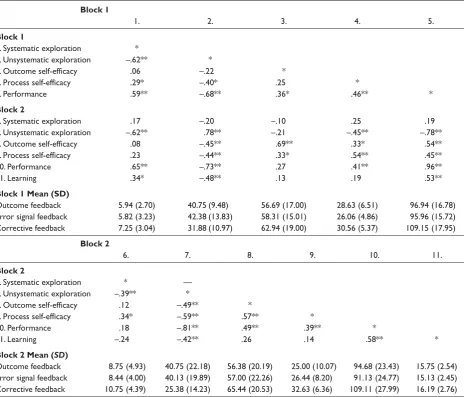
correlated with learning. Unsystematic exploration in block 1 was negatively correlated with block 2 per-formance and learning. Unsystematic exploration was negatively correlated with systematic exploration and with self-efficacy, while use of systematic exploration was positively correlated with self-efficacy.
EFFECTS OF ERROR FEEDBACK ON PERFORMANCE AND LEARNING
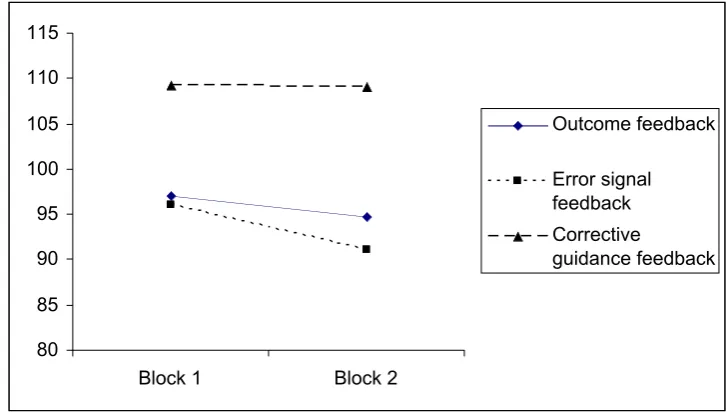
Hypothesis 1a was supported (see Figure 1). Participants in the corrective feedback condition averaged 109% of standard performance in block 1 compared to 91% of standard for participants in the error signal feedback group and 95% in the outcome feedback group, F(2,45) = 3.04, p = .05, η2 = 0.12. The corrective feedback
group outperformed the error signal feedback and outcome groups on the first, ψ= 12.70, se 5.10, t(46) = 2.49, p< .05, η2= 0.12, 95% CI 2.43 < ψ< 22.97, as
well as the second block of trials, ψ = 16.21, se 7.73,
t(46) = 2.10, p< .05, η2= 0.12, 95% CI 0.66 < ψ<
31.76. Hypothesis 1b was not supported. Participants in the different feedback conditions did not differ in their conscious recall of the decision rules that guided performance.
EFFECTS OF ERROR FEEDBACK ON EXPLORATION
Hypothesis 2 was supported. Effective systematic explo-ration increased from the first to the second block of trials, F(1,45) = 16.67, p< .05, η2= 0.27. The
correc-tive feedback group used more systematic exploration than the other two groups ψ = 3.53, se 1.72, t(46) = 2.06, p< .05, η2= 0.27, 95% CI 0.07 < ψ< 6.99.
Feedback type affected unsystematic exploration in block 1, F(2,45) = 3.82, p < .05, η2= 0.15, and block
[image:6.595.67.532.87.484.2]2, F(2,45) = 3.34, p = .05, η2= 0.13. The corrective
TABLE 1
Intercorrelations, Means and Standard Deviations of Study 1 Variables
Block 1
1. 2. 3. 4. 5.
Block 1
1. Systematic exploration *
2. Unsystematic exploration –.62** *
3. Outcome self-efficacy .06 –.22 *
4. Process self-efficacy .29* –.40* .25 *
5. Performance .59** –.68** .36* .46** *
Block 2
6. Systematic exploration .17 –.20 –.10 .25 .19
7. Unsystematic exploration –.62** .78** –.21 –.45** –.78**
8. Outcome self-efficacy .08 –.45** .69** .33* .54**
9. Process self-efficacy .23 –.44** .33* .54** .45**
10. Performance .65** –.73** .27 .41** .96**
11. Learning .34* –.48** .13 .19 .53**
Block 1 Mean (SD)
Outcome feedback 5.94 (2.70) 40.75 (9.48) 56.69 (17.00) 28.63 (6.51) 96.94 (16.78)
Error signal feedback 5.82 (3.23) 42.38 (13.83) 58.31 (15.01) 26.06 (4.86) 95.96 (15.72)
Corrective feedback 7.25 (3.04) 31.88 (10.97) 62.94 (19.00) 30.56 (5.37) 109.15 (17.95)
Block 2
6. 7. 8. 9. 10. 11.
Block 2
6. Systematic exploration * —
7. Unsystematic exploration –.39** *
8. Outcome self-efficacy .12 –.49** *
9. Process self-efficacy .34* –.59** .57** *
10. Performance .18 –.81** .49** .39** *
11. Learning –.24 –.42** .26 .14 .58** *
Block 2 Mean (SD)
Outcome feedback 8.75 (4.93) 40.75 (22.18) 56.38 (20.19) 25.00 (10.07) 94.68 (23.43) 15.75 (2.54)
Error signal feedback 8.44 (4.00) 40.13 (19.89) 57.00 (22.26) 26.44 (8.20) 91.13 (24.77) 15.13 (2.45)
feedback participants used less unsystematic exploration than participants in the other groups, ψ = 24.75, se 8.72, t(46) = 2.84, p< .01, η2= 0.15, 95% CI 7.20 < ψ
< 42.29. Unsystematic exploration was negatively asso-ciated with performance and learning (see Table 1).
EFFECTS OF FEEDBACK ON SELF-EFFICACY
Hypothesis 3 was supported for process but not outcome self-efficacy. There were significant differences in participants’ process self-efficacy across the three feedback groups, F(2,45) = 3.68, p < .05, η2 = 0.14.
The corrective feedback group showed stronger process self-efficacy than those receiving the other two types of feedback, ψ= 10.13, se 3.71, t(46) = 2.73, p< .01, η2=
0.14, 95% CI 2.65< ψ< 17.60.
MEDIATION ANALYSES
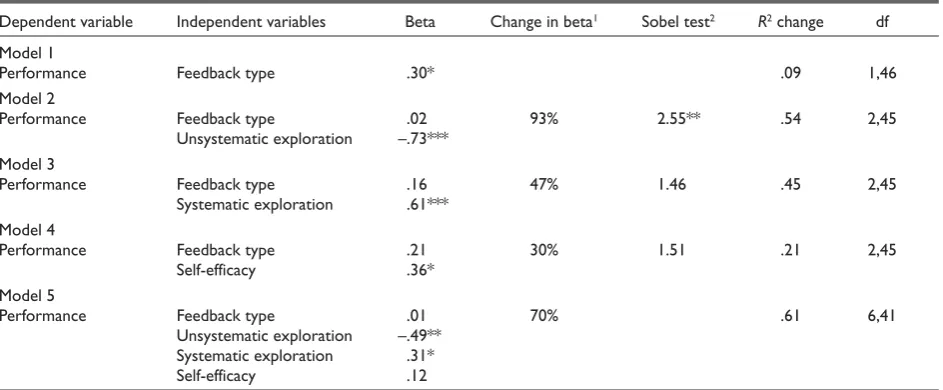
Hypotheses 4 and 5 stated that exploration and self-efficacy would mediate the effects of feedback on performance and learning. The mediation hypotheses were partially supported for performance on block 2. The hypotheses were not tested for learning as feedback type was unrelated to learning. As shown in model 1 (see Table 2), the dummy coded feedback variable had a significant impact on performance. The three hypothe-sised mediators each had significant relations with Block 2 performance (see Table 1). Table 2 reports the separate mediation tests for unsystematic exploration (model 2), systematic exploration (model 3) and self-efficacy (model 4), plus the analyses including all three mediators (model 5). In models 2 to 4, the introduc-tion of each single mediator reduced the impact of corrective feedback on performance from significance to non-significance. However, only the Sobel tests for
unsystematic exploration reached significance. With all mediation variables included in the regression (model 5), the impact of the corrective feedback on perform-ance was fully mediated. In the full model, the significant mediation pathways after controlling for the effects of all other mediators were unsystematic explo-ration and systematic exploexplo-ration. The R2 change
following the introduction of the mediators indicates that, in addition to the mediation effects, the mediator variables had direct effects on performance.
Moderation Effects
Hypothesis 6 was not supported. The self-efficacy × feedback interaction term failed to reach significance at the .05 level but was significant at the 0.10 level (b = –2.33, beta = –.285, p= .09) and the effects were in the predicted directions. Participants with high self-effi-cacy demonstrated high levels of performance under all feedback conditions. Participants with low self-efficacy performed poorly under impoverished feedback condi-tions (outcome feedback and error signal feedback) but matched their high self-efficacy counterparts when they received corrective feedback.
Discussion
There was support for the hypothesised benefits of corrective feedback but not for error signal feedback. Participants who received corrective feedback outper-formed those who received either error signal or outcome feedback and the latter two groups did not differ from one another. Corrective feedback also pro-duced more systematic exploration, less unsystematic exploration and stronger self-efficacy than the other two forms of feedback. It was apparent that good
per-FIGURE 1
Performance in each block of trials, Study 1. 80
85 90 95 100 105 110 115
Block 1 Block 2
Outcome feedback
Error signal feedback
Corrective
[image:7.595.114.478.64.271.2]formance required systematic rather than unsystematic exploration and only the corrective feedback min-imised the tendency of participants to explore the problem in an unsystematic fashion. The moderating effects of self-efficacy were in the predicted direction but not significant.
The findings indicate that corrective feedback pro-duces more systematic responses to the task than error signal or outcome feedback. However, these did not translate into better learning. Error signal feedback was ineffective in that it prompted high levels of unsystem-atic rather than systemunsystem-atic exploration and did not help participants develop self-efficacy for the task. However error signal feedback is common in learning tasks and so it is important to identify ways in which its effective-ness can be enhanced. Study 2 was undertaken to investigate the extent to which positive error framing could improve the effectiveness of error signal feedback.
Study 2
From the results of Study 1 it appears that the benefits of error feedback depend on how feedback is used (Frese, 1995). One explanation for this is that error signal feedback does not lead to the type of exploration that will aid performance and learning. Another expla-nation is that error signal feedback leads to negative self-evaluative reactions that undermine performance. Both explanations are consistent with the results in study 1 where error signal feedback led to more unsys-tematic exploration and lower self–efficacy than corrective feedback.
Trainees who expect errors and learn to frame them positively as learning opportunities typically have
higher motivation, less frustration and better perform-ance than those who frame errors negatively (Chillarege et al., 2003; Dormann & Frese, 1994; Frese, 1995; Frese et al., 1991; Heimbeck et al., 2003; Keith & Frese, 2005, 2008). The same has been found to apply to organisations where a positive error culture in which errors are identified, corrected and analysed rather than punished and concealed, is associated positively with organisational performance (van Dyck, Frese, Baer, & Sonnentag, 2005). There have, however, been some inconsistent findings (Debowski et al., 2001; Gully et al., 2002), and interactions between error feedback and error framing have not been explored.
The aim of Study 2 was to establish whether the positive framing of errors can mitigate negative self-evaluative reactions arising from error signal feedback and enhance its effectiveness. Corrective feedback was used as the comparison condition for this study as the corrective feedback in Study 1 produced more system-atic exploration, better performance and equivalent levels of learning to error signal feedback. The aims of Study 2 were to examine whether positive error framing could make error signal feedback more effective and to investigate the impacts of positive error framing on the effects of corrective feedback.
[image:8.595.63.535.86.281.2]Effective learning from errors requires that learners’ frustrations and anxiety about errors are addressed. One approach, known as error management, uses heuristics to prompt a reframing of errors as challenges and opportunities rather than as problems (Chillarege, et al., 2003; Dormann & Frese, 1994; Frese, 1991, 1995; Frese & Altmann, 1989; Ivancic & Hesketh, 1995, 2000; Keith & Frese, 2005). Examples of heuristics
TABLE 2
Mediation of the Relationship Between Error Feedback and Performance, Study 1
Dependent variable Independent variables Beta Change in beta1 Sobel test2 R2change df
Model 1
Performance Feedback type .30* .09 1,46
Model 2
Performance Feedback type .02 93% 2.55** .54 2,45
Unsystematic exploration –.73*** Model 3
Performance Feedback type .16 47% 1.46 .45 2,45
Systematic exploration .61***
Model 4
Performance Feedback type .21 30% 1.51 .21 2,45
Self-efficacy .36*
Model 5
Performance Feedback type .01 70% .61 6,41
Unsystematic exploration –.49**
Systematic exploration .31*
Self-efficacy .12
Note: 1. Percentage attenuation of the feedback type beta following the introduction of the mediator variables.
include: ‘I have made an error. Great!’ and ‘There is a way to leave the error situation’ (Frese, et al., 1991). The heuristics are presented before and during training in order to reframe errors from being seen as obstacles to learning and performance to being seen as a natural and useful part of the training process. Error framing can encourage trainees to explore, create a perception that errors are natural and teach strategies for getting out of situations resulting from errors. It was antici-pated that the positive framing of errors would have most impact for error signal feedback where setbacks and lack of information about correct responses may lead to frustration and a perceived lack of progress.
Hypothesis 7: Error signal feedback will result in higher levels of performance and learning with positive error framing than with negative error framing. Performance and learning with corrective feedback will not be affected by error framing.
Arguments for the benefits of positive error framing often state that it can prompt trainees to use more sys-tematic exploration (Frese, 1995). These differences should be more pronounced for error signal feedback than for corrective feedback which guides the recipient to correct responses.
Hypothesis 8: Error signal feedback will result in more systematic exploration and less unsystematic explo-ration with positive error framing than with negative error framing. Exploration for corrective feedback will not be affected by error framing.
Compared to negative error framing, positive error framing makes individuals less likely to interpret nega-tive feedback as evidence of a lack of competence (Frese, 1995) and should lead to higher self-efficacy especially when feedback signals errors but does not supply corrective information.
Hypothesis 9: Error signal feedback will result in stronger self-efficacy with positive error framing than with negative error framing. Self-efficacy for corrective feedback will not be affected by error framing.
Hypothesis 10: Exploration will mediate the relation-ships between error feedback and error framing and performance and learning.
Hypothesis 11: Self-efficacy will mediate the relation-ship between error feedback and error framing and performance and learning.
Hypothesis 12: Participants with high self-efficacy will show similar performance and learning regardless of feedback type and error framing, while participants with low self-efficacy will show better performance and learning with corrective feedback or positive error framing than with error signal feedback or negative error framing.
Method
Participants completed the same simulation as in Study 1. Participants received either positive or negative error framing instructions combined with either signal error or corrective feedback. The participants were randomly allocated to one four groups in a 2 ×2 design: positive framing/error signal feedback (n = 19), positive framing/corrective feedback (n = 19), negative framing/error signal feedback (n = 19) and negative framing/corrective feedback (n= 18).
Participants
The 75 participants included 39 men and 36 women undergraduate students. Their average age was 19.7 years (SD = 3.78).
THE TASK AND ERROR FEEDBACK CONDITIONS
Participants completed 12 trials on the decision making simulation described for Study 1. The two feedback manipulations were the same as those described for error signal and corrective feedback for Study 1.
Error Framing
Prior to commencing the simulation and again follow-ing the 3rd, 6th and 9th trials, participants were provided with on-screen statements of the error framing messages for their assigned condition. The positive error framing messages were based upon those validated in previous research on error management (Dormann & Frese, 1994; Frese, 1995; Frese & Altmann, 1989). Two examples of positive error framing messages are: ‘Remember, errors are a natural part of learning. They point out what you can still learn’ and ‘When you make an error in this simulation, look at it as help to improve your performance’. The messages used to induce a nega-tive error frame were developed as counterparts to the positive frame messages. Two examples are: ‘Remember, errors interrupt learning. Avoiding mistakes is the best way to learn this task’ and ‘When you make an error in this simulation, it has a bad effect on your performance’.
MEASURES
All measures were as described for Study 1. The reliabil-ity coefficients for the self-efficacy measures taken after the first and second block of trials respectively were: outcome self-efficacy (α1 = 0.78; α2 = 0.86), process self-efficacy (α1= 0.79; α2= 0.80).
ANALYSIS
pre-dicted in Hypothesis 12 error feedback was coded so that 0 = error signal feedback and 1 = corrective feed-back. Error framing was dummy coded so that 0 = negative error framing and 1 = positive error framing. The self-efficacy and exploration variables were centred around their means to remove scale effects in the inter-pretation of the beta as in moderator analyses.
Results
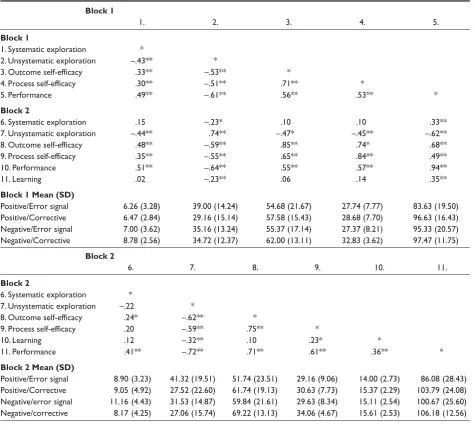
Table 3 shows the intercorrelations, means and stan-dard deviations for all study variables. As for Study 1 the principal correlations for testing the hypothesised relationships were the systematic and unsystematic exploration and self-regulatory responses from block 1 with performance on block 2 and learning. These are shown in Table 3. The overall pattern of correlations
was similar to that in Study 1. Systematic exploration and self-efficacy were positively correlated with one another and were positively related to performance. As in Study 1 unsystematic exploration in block 1 was neg-atively related to performance in block 2 and learning. Unsystematic exploration was negatively related to sys-tematic exploration and self-efficacy. Performance on block 1 and block 2 correlated with learning.
EFFECTS OF ERROR FEEDBACK AND ERROR FRAMING ON PERFORMANCE AND LEARNING
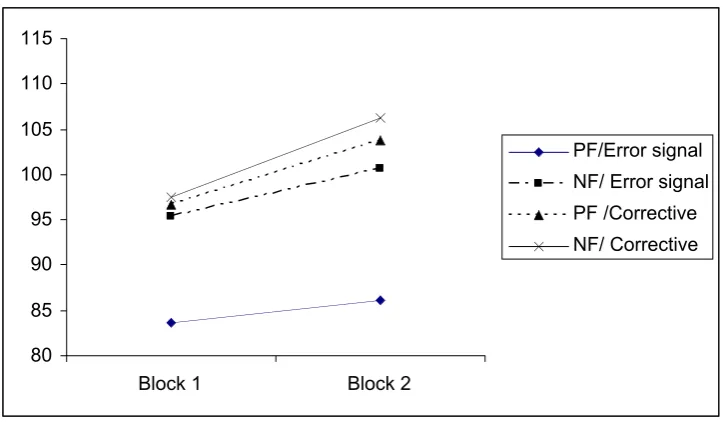
Hypothesis 7 was not supported. There was a signifi-cant effect for feedback type on performance, F(3,71) = 4.23, p<. 05, η2= 0.06, as for Study 1 and there were
improvements in performance across the two blocks by all participants, F(1,71) = 28.54, p< .001, η2= 0.29,
[image:10.595.62.538.86.516.2]but the positive framing/error signal group performed
TABLE 3
Intercorrelations, Means and Standard Deviations of Study Variables, Study 2
Block 1
1. 2. 3. 4. 5.
Block 1
1. Systematic exploration *
2. Unsystematic exploration –.43** *
3. Outcome self-efficacy .33** –.53** *
4. Process self-efficacy .30** –.51** .71** *
5. Performance .49** –.61** .56** .53** *
Block 2
6. Systematic exploration .15 –.23* .10 .10 .33**
7. Unsystematic exploration –.44** .74** –.47* –.45** –.62**
8. Outcome self-efficacy .48** –.59** .85** .74* .68**
9. Process self-efficacy .35** –.55** .65** .84** .49**
10. Performance .51** –.64** .55** .57** .94**
11. Learning .02 –.23** .06 .14 .35**
Block 1 Mean (SD)
Positive/Error signal 6.26 (3.28) 39.00 (14.24) 54.68 (21.67) 27.74 (7.77) 83.63 (19.50)
Positive/Corrective 6.47 (2.84) 29.16 (15.14) 57.58 (15.43) 28.68 (7.70) 96.63 (16.43)
Negative/Error signal 7.00 (3.62) 35.16 (13.24) 55.37 (17.14) 27.37 (8.21) 95.33 (20.57)
Negative/Corrective 8.78 (2.56) 34.72 (12.37) 62.00 (13.11) 32.83 (3.62) 97.47 (11.75)
Block 2
6. 7. 8. 9. 10. 11.
Block 2
6. Systematic exploration *
7. Unsystematic exploration –.22 *
8. Outcome self-efficacy .24* –.62** *
9. Process self-efficacy .20 –.59** .75** *
10. Learning .12 –.32** .10 .23* *
11. Performance .41** –.72** .71** .61** .36** *
Block 2 Mean (SD)
Positive/Error signal 8.90 (3.23) 41.32 (19.51) 51.74 (23.51) 29.16 (9.06) 14.00 (2.73) 86.08 (28.43)
Positive/Corrective 9.05 (4.92) 27.52 (22.60) 61.74 (19.13) 30.63 (7.73) 15.37 (2.29) 103.79 (24.08)
Negative/error signal 11.16 (4.43) 31.53 (14.87) 59.84 (21.61) 29.63 (8.34) 15.11 (2.54) 100.67 (25.60)
worse than the other three groups (see Figure 2). Post-hoc comparisons revealed this result to be significant in both block 1, ψ= 12.83, se 4.58, t(73) = 2.81, p< .01,
η2= 0.10, 95% CI 3.70 < ψ< 21.95, and block 2, ψ=
17.42, se 6.20, t(73) = 2.81, p < .01, η2= 0.10, 95%
CI 5.07 < ψ < 29.76. Scores on learning were also lowest in the positive framing/error signal group. A post hoc test revealed that learning in that condition was lower than in the other three conditions, ψ = 1.36, se 0.66, t(71) = 2.05, p< .05, η2= 0.05, 95% CI 0.04 < ψ
< 2.68.
EFFECTS OF ERROR FEEDBACK AND ERROR FRAMING ON EXPLORATION
Hypothesis 8 was partially supported. There was a sig-nificant three-way interaction between block, feedback type and error framing for systematic exploration,
F(1,71) = 4.63, p < .05, η2 = .06. The two positive
framing groups increased their use of systematic explo-ration over time (positive framing/error signal feedback:
ψ= 2.63, se .77, t(18) = 3.42, p< .01, 95% CI 1.02< ψ < 4.25; positive framing/corrective feedback: ψ= 2.58, se 1.14, t(18) = 2.26, p < .01, 95% CI 0.18 < ψ < 4.98), as did the negative framing/error signal group, ψ = 4.16, se 1.24, t(18) = 3.36, p< .01, 95% CI 1.56 < ψ < 6.76. Only the negative framing/corrective feedback group showed no change in their use of systematic exploration over time.
Analyses of unsystematic exploration revealed a sig-nificant interaction between trial block and error framing, F(1,71) = 4.32, p < .05, η2= 0.06. The
posi-tive framing/error signal feedback group increased unsystematic exploration over time and used more unsystematic exploration than the other three groups in
block 2, ψ= 12.58, se 4.86, t(73) = 2.59, p< .05, η2=
0.10, 95% CI 2.90 < ψ< 22.26.
EFFECTS OF ERROR FEEDBACK AND ERROR FRAMING ON SELF-EFFICACY
Hypothesis 9 was partially supported. The differences in efficacy in study 2 were evident in outcome self-efficacy items but not the process self-self-efficacy items (in study 1 the differences were evident in process but not outcome self-efficacy items). There were significant interactions for outcome self-efficacy between assess-ment phase and error feedback, F(1,71) = 4.44, p <.05,
η2 = .06, and between assessment phase and error
framing, F(1,71) = 5.03, p <.05, η2= 0.07. Both
cor-rective feedback groups had stronger self-efficacy in the second assessment phase than in the first assessment phase: Positive framing/corrective feedback: ψ = 4.16, se 1.95, t(18) = 2.13, p <.05, 95% CI .05 < ψ< 8.26; negative framing/corrective feedback: ψ= 7.22, se 2.62,
t(17) = 2.76, p< .05, 95% CI 1.70 < ψ< 12.74. The group receiving negative framing/error signal feedback showed no significant change in self-efficacy over time but the self-efficacy of the positive framing/signal feed-back group declined, resulting in lower self-efficacy scores in block 2 for this group than for the other groups, ψ = –11.76, se 5.27, t(73) = –2.23, p < .05, 95% CI –22.26 < ψ< –1.26.
MEDIATION ANALYSES
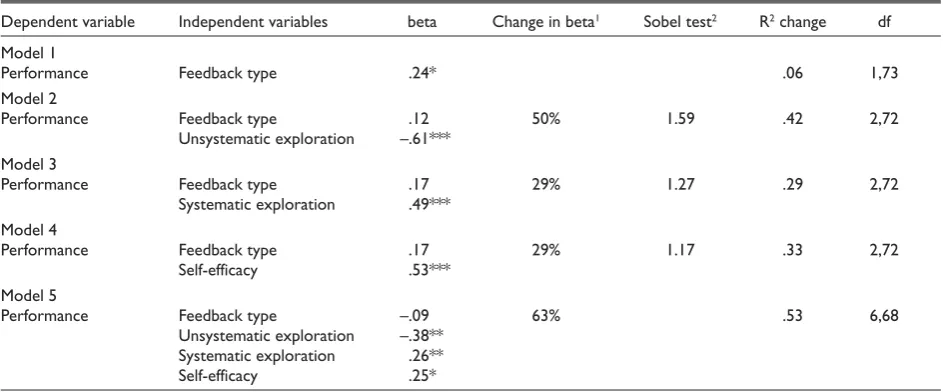
[image:11.595.117.480.60.271.2]There was no significant effect of error framing on per-formance, and no effect of error framing or error feedback on learning. The mediation hypotheses (10 and 11) were therefore tested for the relationship between error feedback and performance, as in study 1. The results of the mediation analyses are shown in
FIGURE 2
Performance in each block of trials, Study 2.
80 85 90 95 100 105 110 115
Block 1 Block 2
Table 4. The introduction of each mediator reduced the impact of feedback type on performance to non-signifi-cance. With all three mediators included in the regression (model 5), the impacts of feedback type on performance were fully mediated.
MODERATOR ANALYSES
There was a significant interaction effect between self-efficacy and error framing on learning (b = –.238, beta = –.51, p< .01). Participants with low self-efficacy dis-played relatively low levels of learning under both positive and negative error framing conditions. For par-ticipants with high self-efficacy, negative error framing resulted in higher levels of learning than positive error framing. The role of self-efficacy in the error framing process clearly requires further investigation.
Discussion
As in Study 1, participants who received corrective feedback performed better than those who received error signal feedback. The effects of feedback on per-formance were mediated through exploration and self-efficacy. Study 2 confirmed that the nature of error feedback affected exploration, which in turn influenced performance. However as with Study 1 this did not translate into better learning of the decision rules.
The effects of error framing were unexpected. Rather than boosting the effectiveness of error signal feedback, positive error framing encouraged unsystematic explo-ration that undermined performance. The combination of positive error framing and error signal feedback resulted in worse performance than any other
combina-tion of feedback and framing. Negative error framing resulted in more learning for participants with high self-efficacy. For those who lacked confidence with the task there was little effect of the way in which errors were framed but for confident participants it was of value to emphasise correct performance instead of learning from errors. Overall, the results of Study 2 support the advantages of corrective feedback over error signal feed-back and point to limiting conditions for the benefits of positive error framing. The implications of the results are discussed next.
General Discussion
[image:12.595.62.534.86.282.2]In both studies, participants receiving corrective feed-back outperformed those who received error signal feedback or outcome feedback but feedback type did not affect participants’ reported understanding of the task rules. The hypothesised benefits of corrective feed-back were based on the argument that corrective feedback would help learners identify and systematically test decision rules. There was support for this but not for the notion that signal feedback would prompt sys-tematic exploration to identify correct responses. Signal feedback led to high levels of unsystematic exploration and participants were unable to use the information uncovered during exploration to identify more effective strategies or learn the decision rules. It has often been argued that exploration can help learners uncover aspects of the problem they would not otherwise have encountered but exploration is only helpful when learn-ers can interpret the results. Systematic exploration was positively related to performance in both studies but
TABLE 4
Mediation of Exploration and Self-Regulatory Processes on the Relationship Between Error Feedback and Performance, Study 2
Dependent variable Independent variables beta Change in beta1 Sobel test2 R2change df
Model 1
Performance Feedback type .24* .06 1,73
Model 2
Performance Feedback type .12 50% 1.59 .42 2,72
Unsystematic exploration –.61*** Model 3
Performance Feedback type .17 29% 1.27 .29 2,72
Systematic exploration .49***
Model 4
Performance Feedback type .17 29% 1.17 .33 2,72
Self-efficacy .53***
Model 5
Performance Feedback type –.09 63% .53 6,68
Unsystematic exploration –.38**
Systematic exploration .26**
Self-efficacy .25*
Note: 1. Percentage attenuation of the feedback type b following the introduction of the mediator variables.
unsystematic exploration, where individuals made mul-tiple confounded changes, was negatively related to performance and learning. The effectiveness of error feedback appears to be related to the nature of the exploration prompted by the feedback and whether that exploration provides information that the learner can interpret and use.
The hypothesised benefits of positive error framing were based on the arguments that, by reducing the neg-ative self-evaluation associated with errors and alerting learners to the information to be extracted from errors, positive error framing would encourage trainees to learn from their errors. Unexpectedly, in the present research performance was improved when participants were advised to avoid errors rather than to regard them as positive opportunities to learn. Again the findings were related to exploration: positive error framing can prompt unsystematic exploration and learners maybe unable to use the information they uncover to improve their performance. In the present research the combina-tion of positive error framing and error signal feedback led to particularly high levels of unsystematic explo-ration and poor performance. In the absence of good error feedback it appears to be important to frame errors in such a way as to encourage systematic rather than trial-and-error exploration of the problem.
Without error framing, corrective feedback in Study 1 gave learners confidence in their ability to manage the task and make correct decisions but did not increase confidence in their ability to achieve good outcomes. The error framing in Study 2 shifted participants’ focus from task processes to task outcomes. This is not sur-prising given that the error framing heuristics explicitly linked errors to performance and learning outcomes. The heuristics therefore made outcomes, as well as errors, salient. This effect requires further investigation. It is unclear whether the effects of positive error heuris-tics may arise from shifting learners’ attention away from task processes towards task outcomes as well as by increasing the salience of errors themselves.
While positive error framing may be intuitively appealing it has potential costs. If it encourages ineffec-tive unsystematic exploration, the resulting frustration can have negative motivational effects such as lower self-efficacy. Feedback has to help learners identify and correct their errors and get out of error situations. When a task is complex and feedback is unclear it is better not to encourage learners to make errors unless corrective feedback is available.
RESEARCH IMPLICATIONS
The generalisability of results reported in Study 1 and Study 2 is yet to be established. Sample sizes were rela-tively small and did not permit modelling of the data Structural equation modelling with robust sample sizes would enable alternative models to be established and
tested with regard to mediating variables. Although the present task was unrelated to participants’ studies or work the results are consistent with other research into enactive exploration (combining error framing and exploratory learning) that used an ecologically valid electronic search task (Debowski et al., 2001). Positive error framing has been shown to be effective with tasks such as word-processing and statistical analysis in which menu based structures provide relatively useful feedback but less effective in tasks such as CD-ROM searching in which only outcome feedback is generally available (Wood, et al., 2001). The interactions between error framing and error feedback need further investigation particularly in terms of how feedback supports either unsystematic exploration or systematic exploration. The present measure of exploration did not allow for identi-fying systematic but ineffective strategies, such as persisting in changing multiple factors in the simula-tion. Further studies directly investigating cognitive strategies, for instance involving protocol analysis, may be valuable in distinguishing between systematic and efficient strategies. Investigation is also needed into the extent to which exploration is a useful strategy for learning the task and how this affects the value of error feedback and error framing. It is important to clarify how learners’ requirements change as they gain experi-ence with the task. Novices may require feedback that supports the use of systematic exploration whereas more advanced learners may benefit from feedback with less guidance.
Little is yet known about interactions between the type of error feedback and the type of error. The effec-tiveness of different forms of error feedback may be affected by the nature of the error. Error signal feedback may be best for skill-based errors where knowledge of rules and principles is not required for error correction. Corrective feedback may be most useful for errors that are due to inadequate knowledge or poor application of rules. Further research should consider the different types of errors and investigate which forms of feedback best help trainees to learn.
IMPLICATIONS FOR PRACTICE
Errors in training can help learners to understand how errors arise, how to deal with errors and how to prevent them but for errors to be valuable appropriate feedback must be provided. Good error feedback helps learners to understand what the error was, how it arose, what must be done to prevent its recurrence and how to escape the situation which the error has created. Error diagnosis is a problem for novices who often lack the necessary knowledge to interpret error feedback. Corrective feed-back not only helps learners to diagnose their errors but also helps them to use effective strategies for under-standing a complex task. Many existing software packages for example do not provide corrective feedback on errors only error signal feedback (at best) and many people must learn to use software independently and without task-related training. It may be helpful to train novice computer users in systematic exploration as well as in the interpretation of task-specific feedback. Effective strategies have been identified for different tasks; for example, the use of ‘help’ facilities for menu-based software and the use of thesauri and dictionaries for electronic searching. More task-specific strategies need to be identified and tested and methods developed for training users to employ them effectively.
Positive error framing should be used with caution as it tends to prompt ineffective unsystematic exploration rather than systematic hypothesis testing. If the task does not provide good corrective feedback then struc-tured learning approaches which minimise errors may be preferable to trial-and-error learning. Once learners have developed core competencies and self-efficacy for the task it may be helpful to emphasise correct performance and systematic learning strategies than to stress learning from errors. Exceptions may occur when a task is highly structured and provides immediate corrective feedback, or when learners lack confidence for the task. Under these conditions positive error framing can help learners to focus on the information that an error provides and to learn strategies for dealing with errors. However, when tasks are unstructured, feedback is ambiguous and learners are relatively confident, learners will benefit more from instructions which emphasis correct per-formance than from an emphasis on making errors.
Endnote
1 Measures of satisfaction with performance and self-set goals were also collected. Both constructs were positively correlated with self-efficacy at all assessment phases. Measures of intrinsic motivation were also taken. Intrinsic motivation did not differ significantly between groups and was relatively high with group means ranging from 25.6–31.1 on a scale from 1–42.
References
Bandura, A. (1997). Self-efficacy: The exercise of control.NY: W.H. Freeman and Co.
Baron, R.M., & Kenny, D.A. (1986). The moderator-mediator variable distinction in social psychology research: Conceptual, strategic and statistical considerations. Journal of Personality and Social Psychology, 51(6), 1173–1182.
Brodbeck, F.C., Zapf, D., Pruemper, J., & Frese, M. (1993). Error handling in office work with computers: A field study. Journal of Occupational and Organisational Psychology, 66, 303–317.
Chillarege, K.A., Nordstrom, C.R., & Williams, K.B. (2003). Learning from our mistakes: Error management training for mature learners. Journal of Business and Psychology, 17(3), 369–385.
Cokely, E.T., & Kelley, C.M. (2009). Cognitive abilities and superior decision making under risk: A protocol analysis and process model evaluation. Judgment and Decision Making, 4(1), 20–33.
Debowski, S., Wood, R.E., & Bandura, A. (2001). Impact of guided exploration on self-regulatory mechanisms and infor-mation acquisition through electronic search. Journal of Applied Psychology, 86(6), 1129–1141.
Dormann, T., & Frese, M. (1994). Error training: Replication and the function of exploratory behaviour. International Journal of Human-Computer Interaction, 6(4), 365–372. Frese, M. (1991). Error management or error prevention: Two
strategies to deal with errors in software design. In H.-J. Bullinger (Ed.), Human aspects in computing: Design and use of interactive systems and work with terminals(pp. 776–782). Amsterdam: Elsevier Science Publishers.
Frese, M. (1995). Error management in training: Conceptual and empirical results. In C. Zucchermaglio, S. Bagnara & S.U. Stucky (Eds.), Organisational learning and technological change(NATO ASI Series, pp. 112–124). New York: Springer Verlag.
Frese, M., Albrecht, K., Altmann, A., Lang, J., Papstein, P.V., Peyerl, R., et al. (1988). The effects of an active development of the mental model in the training process: Experimental results in a word processing system. Behaviour and Information Technology, 7(3), 295–304.
Frese, M., & Altmann, A. (1989). The treatment of errors in learning and training. In L. Bainbridge & S.A. Ruiz Quintanilla (Eds.), Developing skills with information technol-ogy(pp. 65–86). New York: John Wiley and Sons.
Frese, M., Brodbeck, F., Heinbokel, T., Mooser, C., Schleiffenbaum, E., & Thiemann, P. (1991). Errors in train-ing computer skills: On the positive function of errors. Human-Computer Interaction, 6, 77–93.
Gist, M.E., & Mitchell, T.R. (1992). Self-efficacy: A theoretical analysis of its determinants and malleability. Academy of Management Review, 17(2), 183–211.
Glockner, A., & Betsch, T. (2008). Modeling option and strategy choices with connectionist networks: Towards an integrative model of automatic and deliberate decision making. Judgment and Decision Making, 3(3), 215–228.
Goodman, J., & Wood, R.E. (2004). Feedback specificity, learn-ing opportunities, and learnlearn-ing. Journal of Applied Psychology, 89(3), 809–821.
in computerized office work. Behaviour and Information Technology, 11(6), 319–328.
Reason, J. (1990). Human Error. Cambridge: Cambridge University Press.
Tabernero, C., & Wood, R.E. (1999). Implicit theories versus the social construal of ability in self-regulation and perform-ance on a complex task. Organizational Behavior and Human Decision Processes, 78(2), 104–127.
Tschirgi, J.E. (1980). Sensible reasoning: A hypothesis about hypotheses. Child Development, 51, 1–10.
van Dyck, C., Frese, M., Baer, M., & Sonnentag, S. (2005). Organizational error management culture and its impact on performance: A two-study replication. Journal of Applied Psychology, 90(6), 1228–1240.
Wood, R., & Bandura, A. (1989). Impact of conceptions of ability on self-regulatory mechanisms and complex decision-making. Journal of Personality and Social Psychology, 56(3), 407–415.
Wood, R., Bandura, A., & Bailey, T. (1990). Mechanisms govern-ing organizational performance in complex decision-makgovern-ing environments. Organizational Behaviour and Human Decision Processes, 46, 181–201.
Wood, R., George-Falvy, J., & Debowski, S. (2001). Motivation and information search on complex tasks. In M. Erez & U. Kleinbeck (Eds.), Work Motivation in the Context of a Globalizing Economy(pp. 27–48). Mahwah, NJ: Lawrence Erlbaum Associates.
Wood, R., Kakebeeke, B.M., Debowski, S., & Frese, M. (2000). The impact of enactive exploration on intrinsic motivation, strategy and performance in electronic search. Applied Psychology: An International Review, 49(2), 263–283. Gully, S.M., Payne, S.C., Koles, K.L.K., & Whiteman, J.A.K.
(2002). The impact of error management training and individ-ual differences on training outcomes: An attribute-treatment interaction perspective. Journal of Applied Psychology, 87(1), 143–155.
Heimbeck, D., Frese, M., Sonnentag, S., & Keith, N. (2003). Integrating errors into the training process: The function of error management instructions and the role of goal orienta-tion. Personnel Psychology, 56(3), 333–361.
Ivancic, K., & Hesketh, B. (1995). Making the best of errors during training. Training Research Journal, 1, 103–125. Ivancic, K., & Hesketh, B. (2000). Learning from error in a
driving simulation: Effects on driving skill and self-confi-dence. Ergonomics, 43(4), 1966–1984.
Karelaia, N., & Hogarth, R.M. (2008). Determinants of linear judgment: A meta-analysis of lens model studies. Psychological Bulletin, 134(3), 404–426.
Keith, N., & Frese, M. (2005). Self-regulation in error manage-ment training: Emotion control and metacognition as mediators of performance effects. Journal of Applied Psychology, 90(4), 677–691.
Keith, N., & Frese, M. (2008). Effectiveness of error manage-ment training: A meta-analysis. Journal of Applied Psychology, 93(1), 59–69.
Needham, D.R., & Begg, I.M. (1991). Problem-oriented training promotes spontaneuous analogical transfer: Memory-oriented training promotes memory for training. Memory and Cognition, 19(6), 543–557.
MASSEY RESEARCH ONLINE http://mro.massey.ac.nz/
Massey Documents by Type Journal Articles
Errors, feedback, learning and performance
Gardner, DH
2009