An Ensemble-based Feature Selection
Methodology for Case-Based Learning
Maqbool Ali
MS(IT, First Class)
National University of Science and Technology (NUST), Pakistan
A dissertation submitted to the Faculty of Engineering and ICT, University of
Tasmania in fulfillment of the requirements for the degree of
Doctor of Philosophy
Declaration of Originality
This thesis contains no material which has been accepted for a degree or diploma by the University or any other institution, except by way of background information and duly acknowledged in the thesis, and to the best of my knowledge and belief no material previously published or written by another person except where due acknowledgement is made in the text of the thesis, nor does the thesis contain any material that infringes copyright.
Authority of Access
This thesis may be made available for loan and limited copying and communication in accordance with the Copyright Act 1968.
Statement regarding published work contained in thesis
The publishers of the papers comprising Chapters 1 and 2 (partly), Chapter 3, Chapter 4 (partly), and Chapter 5 hold the copyright for that content, and access to the material should be sought from the respective journals. The remaining non published content of the thesis may be made available for loan and limited copying and communication in accordance with the Copyright Act 1968.
xi
Located in chapters 1, 2, and 3
Candidate was the prima,y author and contributed 80% to the proposal and implementation of the idea, conceived, designed, and pe1fonned the experiments, and wrote the paper Author 8 contributed in formal analysis and partly drafied related work and algorithm
explanation
Author 1 and author 2 provided advisory comments and modified representations
Paper 5, <UDeKAM: A Methodology for Acquiring Declarative Structured Knowl edge from Unstructured Knowledge Resources>:
Located in chapters 1 and 4
Candidate was the primary author and contributed 90% to the proposal of the idea, con ceived, designed, and pe1formed the experiments, and wrote the paper
Author 1 and author 2 provided advisory comments
We the undersigned agree with the above stated "proportion of work undertaken" for each of the above published (or submitted) peer-reviewed manuscripts contributing to this thesis:
Signed: _ _ _
Date:
Professor Byeong Ho Kang Professor Kirsten Orr
Supervisor Head of School
Discipline of JCT I School of Technology, School of Technology, Environments
Environments and Design, and Design,
University of Tasmania University of ll1smania
I dedicated my thesis to my beloved parents and family, who play a pivotal role by encouraging and supporting in all hard times to keep me in the position to complete my PhD
Acknowledgements
Alhumdolillah, By grace of ALLAH Almighty, who is the most beneficent and merciful. Who gave me the strength, courage, patience during my doctoral study and showering HIS blessings upon me and my family.
I am highly grateful to my advisors Prof. Byeong Ho Kang from University of Tasmania (UTAS), Australia, and Prof. Sungyoung Lee from Kyung Hee University (KHU), South Korea for their boundless moral and technical supervision, guidance, and courage in coping with the difficult challenges throughout the education period of my doctoral studies. They trained me in multi-directions to face the challenges of practical life in a professional manner. Their lively natures, clear assistance, and direction enabled me able to complete my thesis. They have refined the key ingredients for high quality research, namely my skills of creativity, thinking, and technical understanding. Moreover, I would like to acknowledge their valuable guidance and support to refine the problem statement as well as that to streamline my research direction.
I appreciate my UTAS and KHU dissertation evaluation committee for their valuable observations and insight recommendations during the dissertation defense. These comments enhanced the presentation and contents of the dissertation.
Hafiz Syed Muhammad Bilal, Muhammad Asif Razzaq, Syed Imran Ali, Usman Akhtar, Musarrat Hussain, Ubaid Ur Rehman, Fahad Ahmed Satti, Muhammad Sadiq, and Anees Ul Hassan. They supported me in successfully performing various personal and academic tasks that presented hurdles me during my stay at South Korea. I would like to thank Mrs. Kim for being available and helping me in many regards.
I also appreciated to all of my current and former UCLab fellows for their kind support to my personal and academic life at Korea. I am highly gratified to the following excellent researchers - Dr. Rehman Ali, Dr. Maqbool Hussain, Dr. Muhammad Afzal, Tae Ho Hur, Dohyeong Kim, Jaehun Bang, Hua-Cam Hao, Asim Abbas, Muhammad Zaki Ansaar, Dr. Kifayat Ullah, Dr. Waqas Nawaz, Dr. Ahsan Raza Kazmi, Saeed Ullah, Waseem ul Hassan, Dildar Hussain, Abdul Sattar, Zain Abbas, Ahmad Jan, and Aftab Alam. This journey would have been quite difficult without their support. They helped my personal and academic life to boost myself. I also appreciate all my Korean and international friends who worked collaboratively with me and inculcated team work skills in me.
I would like to thank Dr. Soyeon Caren Han, Matthew Jee Yun Kang, Mrs. Kerrin McKeown, David Herbert, and Leandro Disiuta for their kind support during my stay at UTAS. I would like to thank Mrs. Kerrin McKeown also for reviewing and editing the English in this thesis.
I am thankful to my MS advisor Dr. Ali Mustafa Qamar in SEECS, NUST, Islamabad for his guidance and continuous support during my study in Korea. Last but not the least, I would like to express my sincere gratitude to my close friends especially Dr. Kashif Sattar, Dr. Aftab Ahmad, and Muhammad Junaid.
Abstract
Case-based learning (CBL) approach has been receiving a lot of attention in medical educa-tion, as an alternative to the traditional learning environment. This student-centric teaching methodology, exposes the medical students to practice the real-world scenarios. In order to support the learning outcomes of students, existing systems do not provide computer-based as well as experiential knowledge-based support for CBL practice. Medical literature contains textual knowledge, which can be used as a very beneficial source for the computer-based CBL practice. Therefore, designing and developing of an automated CBL approach is a chal-lenging problem. In order, to solve this problem, the text mining domain provides the basic framework for constructing domain knowledge, where the feature selection is considered to be one of the most critical requirement to select the appropriate features.
Table of contents
List of figures xxiii
List of tables xxvii
1 Introduction 1
1.1 Motivation . . . 2
1.2 Problem Statement . . . 6
1.3 Key Contributions . . . 8
1.3.1 Novel feature ranking algorithm . . . 8
1.3.2 Novel threshold value selection algorithm . . . 9
1.3.3 Improved feature selection . . . 9
1.3.4 Reliable domain knowledge construction . . . 9
1.3.5 Semi-automatic real-world clinical case creation technique . . . 9
1.3.6 An interactive and effective automated CBL system development . 10 1.4 Thesis Organization . . . 10
2 Related Work 15 2.1 Overview of feature selection . . . 15
2.2 Overview of domain knowledge construction . . . 25
2.3 Overview of case-based learning . . . 33
2.3.2 Evolutionary technologies for case-based learning . . . 37
2.3.3 Review of existing web-based learning systems . . . 39
2.4 Summary of literature . . . 40
2.4.1 Feature selection literature . . . 40
2.4.2 Domain knowledge construction literature . . . 42
2.4.3 Case-based learning literature . . . 44
3 Univariate Ensemble-based Feature Selection 47 3.1 Introduction . . . 47
3.2 Materials and methods . . . 50
3.2.1 Univariate ensemble-based features selection methodology . . . 50
3.2.2 Unified features scoring . . . 51
3.2.3 Threshold Value Selection . . . 57
3.2.4 State-of-the-art feature selection methods for comparing the perfor-mance of the proposed univariate ensemble-based feature selection methodology . . . 61
3.2.5 Statistical measures for evaluating the performance of the proposed univariate ensemble-based feature selection methodology . . . 64
3.3 Experimental results of the threshold value selection algorithm . . . 65
3.4 Evaluation of the univariate ensemble-based feature selection methodology 77 3.4.1 Experimental setup . . . 78
3.4.2 Experimental execution . . . 82
3.5 Conclusions . . . 94
4 Domain Knowledge Construction 97 4.1 Introduction . . . 97
Table of contents xxi
4.2.1 Proposed knowledge construction methodology . . . 100
4.2.2 Functional mapping of the proposed knowledge construction method-ology with phases of the CRISP-DM . . . 102
4.3 Realization of the domain knowledge construction methodology . . . 104
4.4 Conclusions . . . 109
5 Case-Based Learning 111 5.1 Introduction . . . 112
5.2 Materials and Methods . . . 118
5.2.1 Proposed system architecture . . . 118
5.2.2 Clinical case creation methodology . . . 122
5.2.3 Case formulation methodology . . . 126
5.3 Simulation of iCBLS . . . 128
5.3.1 Case study: Glycemia case . . . 129
5.3.2 Clinical case creations . . . 131
5.3.3 Case formulation . . . 135
5.4 System Evaluation . . . 137
5.4.1 Users interaction evaluation . . . 140
5.4.2 Learning effectiveness evaluation . . . 144
5.5 IoT-based Flip Learning Platform (IoTFLiP) . . . 146
5.5.1 Proposed platform architecture . . . 147
5.5.2 Working scenario . . . 151
5.6 Discussion about Significance, Challenges and Limitations of the Work . . 154
5.7 Conclusions . . . 155
6.2 Future Direction . . . 160 6.3 Potential Applications . . . 161
Bibliography 163
Appendix A List of Acronyms 181
Appendix B UFS Algorithm - Source Code 183
Appendix C Survey Forms for Evaluating the iCBLS 195
C.1 Users Interaction Evaluation . . . 195 C.2 Learning Effectiveness Evaluation . . . 197
Appendix D List of Publications 199
List of figures
1.1 Idea diagram of the proposed research studies with chapters mapping. . . . 11
2.1 Basic steps of feature selection [1]. . . 17 2.2 Research Taxonomy - Dimensionality reduction and different feature
selec-tion approaches [2, 3]. . . 18 2.3 Keyword extraction methodologies [4–7] . . . 27 2.4 Controlled natural languages categories [8] . . . 31
3.1 uEFS methodology. . . 51 3.2 UFS algorithm. . . 56 3.3 Diabetes dataset example for explaining the UFS. . . 57 3.4 TVS algorithm. . . 60 3.5 An average predictive accuracy graph using the 10-fold cross validation
technique for threshold value identification. . . 66 3.6 An average predictive accuracy graph using training datasets for threshold
value identification. . . 72 3.7 ROC curves using each classifier for the Arrhythmia dataset. . . 77 3.8 Predictive accuracies of classifiers against benchmark datasets with varying
3.10 Comparisons of predictive accuracy with existing feature selection mea-sures [2, 9–11]. . . 83 3.11 Comparisons of F-measure with existing feature selection measures. . . 85
4.1 A workflow for domain knowledge construction methodology . . . 100 4.2 Domain model generation through ACE controlled natural language . . . . 108 4.3 A partial view of the domain model . . . 109
5.1 Functional architecture of the iCBLS . . . 119 5.2 iCBLS flow chart . . . 119 5.3 Flow diagram of system administration module . . . 121 5.4 Real-world clinical case creation steps . . . 123 5.5 Flow diagram of case formulation module . . . 128 5.6 iCBLS role descriptor . . . 130 5.7 Health record management interface . . . 132 5.8 Managing vital signs information view . . . 132 5.9 Weekly trends of patient’s vital signs information . . . 133 5.10 Weekly average chart of measured patient’s vital signs . . . 134 5.11 Real-world clinical case creation steps . . . 135 5.12 Student view for case formulation . . . 136 5.13 Tutor view for providing feedback . . . 137 5.14 iCBLS interaction evaluation - response comparison chart . . . 142 5.15 System effectiveness summary chart . . . 144 5.16 IoT-based flip learning platform (IoTFLiP) architecture . . . 148 5.17 Working scenario for case-based flip learning . . . 151
List of figures xxv
List of tables
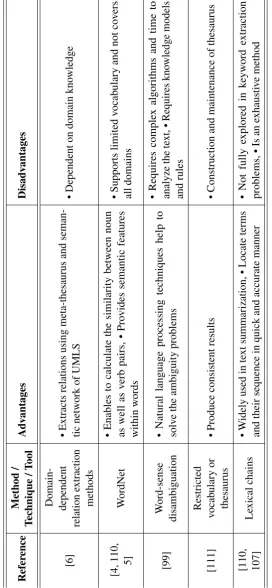
2.1 Feature selection approaches [12, 1, 13–16]. . . 19 2.2 Advantages and disadvantages of technologies used for domain knowledge
construction. . . 28 2.3 Advantages and disadvantages of technologies used for domain knowledge
construction (cont.) . . . 29
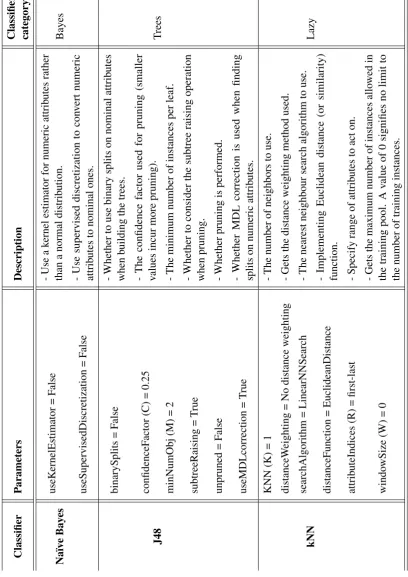
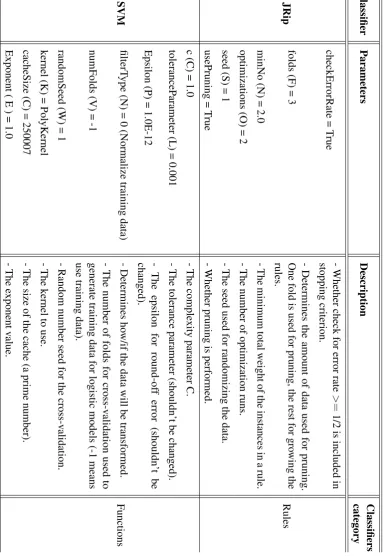
3.1 Selected classifiers characteristics. . . 67 3.2 Selected classifiers characteristics. (cont.) . . . 68 3.3 Predictive accuracy (in %age) of classifiers using the 10-fold cross validation
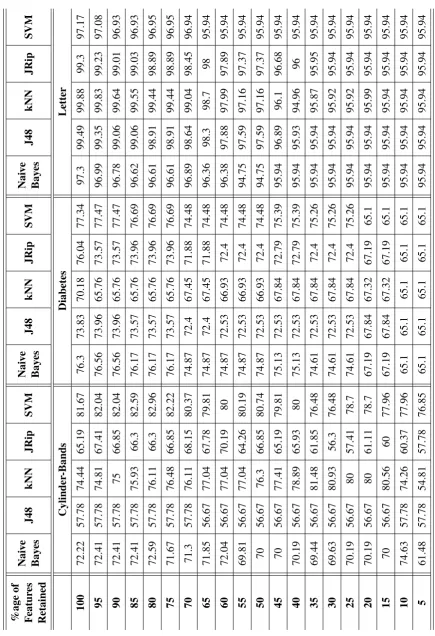
technique. . . 69 3.4 Predictive accuracy (in %age) of classifiers using the 10-fold cross validation
technique. . . 70 3.5 Predictive accuracy (in %age) of classifiers using the 10-fold cross validation
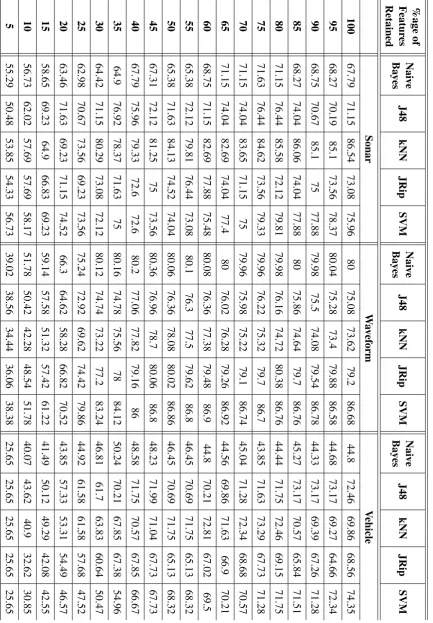
technique. . . 71 3.6 Predictive accuracy (in %age) of classifiers using training datasets. . . 73 3.7 Predictive accuracy (in %age) of classifiers using training datasets. . . 74 3.8 Predictive accuracy (in %age) of classifiers using training datasets. . . 75 3.9 ROC area values of well-known classifiers using Arrhythmia dataset. . . 76 3.10 Weighted average values of ROC area of well-known classifiers using
3.11 Selected text datasets’ characteristics. . . 79 3.12 Selected nontext datasets’ characteristics. . . 80 3.13 Selected classifier parameters. . . 82 3.14 Comparisons of average classifier precision with existing feature selection
methods [2, 9–11]. . . 84 3.15 Comparisons of average classifier recall with existing feature selection
meth-ods [2, 9–11]. . . 84 3.16 Comparisons of average classifier precision with existing feature selection
measures. . . 86 3.17 Comparisons of average classifier recall with existing feature selection
mea-sures. . . 87 3.18 Comparisons of predictive accuracy (in %age) of the uEFS with existing
feature selection measures using the 10-fold cross validation technique. . . 88 3.19 Comparisons of predictive accuracy (in %age) of the uEFS with existing
feature selection measures using the out-of-sample bootstrapping technique. 89 3.20 Comparisons of time measure (in seconds) with existing feature selection
measures. . . 91 3.21 Comparisons of predictive accuracy (in %age) with existing feature selection
methods. . . 91 3.22 Position-based ranking for computing features weightage. . . 92 3.23 Weightages of features using information gain filter measures. . . 93 3.24 Comparisons of predictive accuracy and F-measure with weightage mechanism. 94
List of tables xxix
4.5 Selected words for domain model construction. . . 107 4.6 Identified relations of diabetes domain. . . 108
Chapter 1
Introduction
1.1
Motivation
Medical education is an active area of research and has seen tremendous revolutionary measures in the past few decades. The main purpose of these educational programs is to: (1) develop educational leaders, (2) change the learners’ knowledge, skills, or attitudes, and (3) improve the educational structures [18]. Various teaching methodologies have been introduced in professional health education [19], with active learning gaining a lot of attention around the world [20]. In active learning, instructions are given to students to actively engage them [21]. Case-Based Learning (CBL) is one of the active learning approaches, which provides favorable circumstances to students in order to explore, question, discuss and share their experiential knowledge for improving their practical intelligence [20]. CBL is not a new term, from its introduction in the medical domain since 1912 [22]. It has proceeded in many forms, from simple hands-on, in-class exercises to semester long projects and/or case studies [23], CBL, has maintained its focus around clinical, communal, and scientific problems.
1.1 Motivation 3
In CBL practice, the clinical case is a key component in learning activities, which includes basic, social, and clinical studies of the patient [34]. In the medical domain, this component provides the foundation to understand the particulars of a disease. Recent trends have emphasized the use of real-life clinical case(s) for providing this much needed practice for the medical students [35–37]. These cases enable the students to use their experiential knowledge to interpret them easily [20]. In medical area, CBL facilitates students in learning the diagnosis and management of clinical cases [22], and prepares the participants to practice primary care and critical situations [38]. The CBL approach promotes learning outcomes and builds confidence in students, enabling them to practice real-life decisions [39, 28]. According to Thistlethwaite [34], “CBL promotes learning through the application of knowledge to clinical cases by students, enhancing the relevance of their learning and promoting their understanding of concepts". CBL is also known to be an effective learning approach for small groups of medical students at undergraduate, graduate, postgraduate education levels as well as for professional development [34, 40, 35, 41, 22].
situations, each student has his/her own judgment, opinion, and feedback and will consider this integral as well as appropriate for that situation. In such situations, an experiential knowl-edge (EK) is thought-out as a resource [46] which can facilitate and provide lived knowlknowl-edge to students. According to Willoughby [47], “Experiential knowledge is a knowledge of particular things gained by perception and experience". Experiential knowledge enables individuals to capture practical experience for problem solving. It is considered as a valuable resource to enhance an individual’s participation and user empowerment [46].
For problem-based learning, humans and computers can play a key role in the medical domain. However, both have their own strengths and weaknesses [48, 49]. For example, In terms of their strengths, (1) Human judgment is considered as credible, (2) Humans have common sense and can determine new rules, off the shelf, (3) Humans can easily identify trends or abnormality in visualization data. However, Humans also suffer from severe weaknesses whereby they (1) cannot often accomplish complex computational decisions, (2) cannot perform fast reasoning computations, and (3) get easily tired and bored. These human weaknesses can be mitigated by using a computer, which can perform complex computation decisions relatively faster and will not suffer from tiredness or boredom.
1.1 Motivation 5
complaint, medical history, habits, family history, medicines, allergies, diagnosis, treatment, and recommendations) from a given clinical case and then writing personal observations for each component.
There exists plenty of textual data in the medical domain, which can be useful for medical education, especially for CBL purposes. This data is available in a variety of formats and with different semantics. This overwhelming data provides various opportunities to gain useful knowledge that reflects the depth of information that plays an important role in decision-making. Declarative knowledge (also called factual knowledge) is a type of knowledge expressed in the form of unstructured text, which can play an important role in health’s education, decision support, and wellness applications after structured transformation. According to the Simply Philosophy study [63], “Factual knowledge is a justified affirmation of something". It combines the concepts to make an affirmation of something. For example, “Blood_disease" and “is a symptom" make an affirmation “Blood_disease is a symptom". The produced affirmation is either true or false; however, in declarative knowledge it is always true. Handling unstructured contents is the foundation to construct the domain knowledge (structured declarative knowledge) required for interactive learning, to prepare medical students for their clinical practice before and outside the class.
Feature selection performs a key role in the (so-called) process of ‘Knowledge Discov-ery’ [67]. Traditionally, this task is performed manually by a human expert; thereby making it more expensive and time-consuming, as opposed to an automatic FS which has become necessary for the fast-paced digital world of today [13]. Feature selection techniques are generally split into three categories: filters, wrappers, and hybrid, where each technique has capabilities and limitations [12–14]. Popular evaluation methods used for these tech-niques areinformation-theoretic measures,co-relational measures,consistency measures,
distance-based measuresandclassification/predictive accuracy. A good feature selection
algorithm can effectively filter out unimportant features [68]. In this regard, a significant amount of research has focused on proposing improved feature selection algorithms [69–73]; consequently, most of these algorithms use one or more of the aforementioned methods for performing feature selection. However, there is a lack of a comprehensive framework, which can select features from a given feature set.
1.2
Problem Statement
For an automated CBL, a structured knowledge construction from textual data is a challenging task [74]. In the text mining domain, normally text preprocessing, text transformation, feature selection, term extraction, relation extraction, and model construction tasks are involved, where the feature selection task is considered to be one of the most critical problems for selecting appropriate features from a larger set of features [65–67]. To design an effective CBL approach for better clinical competency, three major research questions must be answered:
1.2 Problem Statement 7
approaches (wrapper, hybrid). Filter-based methods evaluate a feature’s relevance without using any learning algorithm [65, 12]. Filter-based feature ranking methods are further split into two subcategories: univariate and multivariate. Univariate filter methods are simple and have high performance characteristics as compared to other approaches [75]. Even though the univariate filter-based methods are considered to be much faster and less computationally expensive than wrapper methods [15, 12]; each method has its capabilities as well as its limitations. For example, Information Gain (IG) is a widely acceptable measure for ranking the features [76]; however, IG is biased towards choosing features with a large number of values [77]. Similarly, Chi Square (CS) determines the association between a feature and its target concept/class; however, CS is sensitive to sample size [77]. In addition, Gain Ratio and Symmetrical Uncertainty enhances the information gain; however, both are biased towards features with fewer values [78]. Therefore, designing an efficient feature ranking approach and overcoming the aforementioned limitations is our first target.
2. How to find a minimum threshold value for retaining important features irrespective of the characteristics of the dataset? In this case, for defining cut off points for remov-ing irrelevant features, a separated validation set and artificially generated features approaches are used [70]; however, it is not clear how to find the threshold for the features’ ranking [79, 80]. Finding an optimal cut-off value to select important features from different datasets is problematic [79]. Therefore, designing an empirical method to specify a minimum threshold value for retaining important features and overcoming the aforementioned limitations is our second target.
perform fast reasoning computations to work for extended periods and will get tired and feel bored. A computer has the advantage over a human of being able to perform fast reasoning computation without feeling bored. Being a human, students feel that classroom CBL activities require a significant amount of time; they get tired [42], and tend to choose computer-based cases [34, 50]. Similarly, students opt for web-based cases as compared to lectures for their learning [51, 52]. Additionally, more attention is given to online/web-based learning environments [34]. In order to support the learning outcomes of students, a plethora of web-based learning systems have been developed [53–62]. A review of the literature shows that these systems either do not support computer-based interactive case authoring as well as its formulation, or without the support of acquiring real-world CBL cases, or do not provide feedback to students. Currently, much less attention is given to fill the gaps between human-based and computer-based learning. Therefore, designing and developing an interactive and effective case-based learning approach to utilize the strength of both human (experiential knowledge) and computer (domain knowledge) and overcoming the aforementioned limitations is our third target.
1.3
Key Contributions
We summarize the main contributions of this thesis as below:
1.3.1
Novel feature ranking algorithm
1.3 Key Contributions 9
1.3.2
Novel threshold value selection algorithm
For defining the cut-off point for removing irrelevant features, athreshold value selection
(TVS) algorithm is introduced, which selects a subset of features that are deemed important for the domain knowledge construction. TVS finds a minimum threshold value for retaining important features irrespective of the characteristics of the dataset.
1.3.3
Improved feature selection
Proof-of-concept for the UFS and TVS techniques, after performing extensive experimenta-tion which achieved (1) on average, a 7% increase in f-measure as compared to the baseline approach, and (2) on average, a 5% increase in predictive accuracy as compared to state-of-the-art methods.
1.3.4
Reliable domain knowledge construction
For interactive and effective learning purposes, this research includes a methodology to construct the domain knowledge (i.e. structured declarative knowledge) from unstructured text, to facilitate and provide computer-based domain knowledge to medical students for solving real-world clinical cases during CBL practice. With the evolution of knowledge stored in a database, the proposed system can hold better clinical competence and can provide intensive learning in the future. For effective transformation, controlled natural language is used, which constructs syntactically correct and unambiguous computer-processable texts.
1.3.5
Semi-automatic real-world clinical case creation technique
semi-automatic technique for real-world clinical case creation is introduced. The proposed technique facilitates health care professionals (medical teachers) who are interconnected in common practice, to produce experiential knowledge for the purpose of developing clinical knowledge. This knowledge includes scientific knowledge and realistic experiences to provide responses in risky and uncertain situations.
1.3.6
An interactive and effective automated CBL system development
For an interactive as well as an effective case-based learning (CBL) approach, aninteractive
case-based learning system(iCBLS) is designed and developed, which utilizes the strength
of both human (experiential knowledge) and computer (domain knowledge). The iCBLS enables medical teachers to create real-world CBL cases for their students with the support of their experiential knowledge and computer-generated trends, review students’ solutions, and give feedback and opinions to their students. It also facilitates medical students to do CBL rehearsal with a machine-generated domain knowledge support before attending an actual CBL class.
1.4
Thesis Organization
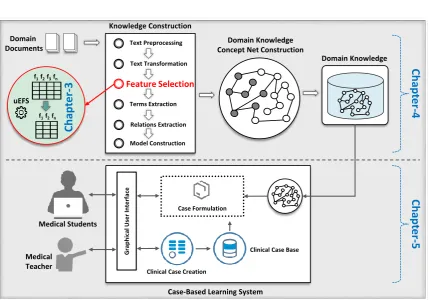
The dissertation aims to investigate an efficient feature selection methodology to construct reliable domain knowledge for case-based learning. Figure 1.1 shows the dissertation overview, and summarizes the structure and flow of the dissertation.
This dissertation is organized into chapters as following.
• Chapter 1: Introduction. Chapter 1 provides the introduction of the research work
1.4 Thesis Organization 11
Domain Documents
Knowledge Construction
Text Preprocessing
Text Transformation
Feature Selection
Terms Extraction
Domain Knowledge Concept Net Construction
Domain Knowledge
Case-Based Learning System Medical Students
Case Formulation
Clinical Case Base
Gr
ap
h
ic
al
Us
e
r
In
te
rface
Clinical Case Creation Relations Extraction
Model Construction f1 f2 f3 fn
f1 f2 fn
Medical Teacher uEFS
Chap
te
r-3
Chap
te
r-5
Chap
te
[image:41.595.92.523.90.390.2]r-4
Fig. 1.1 Idea diagram of the proposed research studies with chapters mapping.
problems, the objectives achieved in this research work, and finally the dissertation overview.
• Chapter 2: Related work. Chapter 2 reviews previous research for feature selection
are discussed in each subsection. Finally, we summarize the related works that utilize feature selection, knowledge construction, and case-based learning methodologies.
• Chapter 3: Univariate ensemble-based feature selection. In this chapter, we present
univariate ensemble-based feature selection(uEFS) methodology to select informative
features from a given dataset. For the uEFS methodology, we first propose aunified
features scoring (UFS) algorithm to generate a final ranked list of features after a
comprehensive evaluation of a feature set. For defining a cut-off point to remove irrelevant features, we then propose athreshold value selection(TVS) algorithm to select a subset of features, which are deemed important for the domain knowledge construction. To evaluate the proposed uEFS methodology, we have performed two studies. Finally, for each study, we present the experiment setup, and then provide the corresponding experimental results for each study under different settings.
• Chapter 4: Domain knowledge construction. This chapter describes a methodology
to construct the machine-generated domain knowledge (i.e. structured declarative knowledge) from an unstructured text. The proposed methodology constructs an ontology from unstructured textual resources in a systematic and automatic way using artificial intelligence techniques with minimum intervention of a knowledge engineer.
• Chapter 5: Case-based learning. This chapter presents an interactive and effective
1.4 Thesis Organization 13
study, we present the evaluation setup and then provide the corresponding evaluation results for each study under different settings.
• Chapter 6: Conclusion and future directions. This chapter concludes the thesis
Chapter 2
Related Work
This chapter describes various existing studies related to each aspect of this research work. This research focuses on presenting a comprehensive and flexible feature selection methodol-ogy based on an ensemble of univariate filter measures for constructing a reliable domain knowledge, to innovate the case-based learning approach. Therefore, this section is split into three subsections to present an overview of different methodological studies of feature selection, domain knowledge construction, and case-based learning approaches. Various research directions related to (1) feature selections such as features ranking and ensemble approaches, (2) technologies used for domain knowledge construction, and (3) case-based learning methodologies and related web-based learning systems, are discussed in each sub-section. Finally, we summarize the related works that utilize feature selection, knowledge construction, and case-based learning methodologies.
2.1
Overview of feature selection
gain, gain ratio etc. The following are some relevant feature selection (FS) studies from a methodological point of view, which contain:
• basic concepts and procedures of feature selection
• state-of-the-art feature selection approaches, and
• research surveys, comparative studies, and frameworks in the domain of FS
FS is an approach that chooses a subset of features from a given list of original features and filters the irrelevant features to speed up the processing of a machine learning algorithm for improving mining performance (predictive accuracy, result comprehensibility). Feature selection is an active area of research and has undergone significant revolution in the past few decades. Various research disciplines such as pattern recognition, machine learning, data mining, and text mining have applied FS techniques to many fields such as text categorization, image retrieval, customer relationship management, and intrusion detection [1]. The FS task is considered to be one of the most critical problems for selecting appropriate features from a larger set of features [65]. This approach becomes expensive and intractable (NP-hard), when the number of features N increases. It performs a key role in the so-called process of ’Knowledge Discovery’ [67]. The FS task can also be performed manually by a human expert; however, in this case it is considered as an expensive and time-consuming task. In such cases, an automatic FS is necessary [13].
2.1 Overview of feature selection 17
Fig. 2.1 Basic steps of feature selection [1].
• Subset generation is a searching process, which is based on a specific approach to
evaluate a candidate subset. For this process, two basic criterion are defined. The first one is to decide the starting point of the search and the second one is about the search strategy. For the first criteria, the search can be started either from an empty set, or from a full set, or from both ends, or at random. Similarly, for the second criteria, the search strategy can be sequential, complete, or a random search.
• Subset evaluation is the second step for the feature selection procedure. In this
step, each candidate subset, which is generated from the previous step, is compared against the previous best subset based on a certain evaluation criterion. In the case of better results, the new subset replaces the previous one, as it is considered the best subset. The goodness of a subset is evaluated either by an independent criterion (without involvement of mining algorithm such as filter method) or by a dependent criterion (reliant on mining algorithm such as wrapper and hybrid methods). For independent criteria, information-theoretic measures, co-relational or dependency-based measures, consistency-dependency-based measures, and distance-dependency-based measures are widely used in literature [1]. Most of the feature selection algorithms use one or more of the aforementioned measures for performing feature selection.
• Stopping criterion is the third step, in which the procedure of feature selection is
criteria, which are: (1) when the search is complete, (2) when a specific number(limit) is reached, (3) when addition or deletion of features are not improving the result, and lastly, (4) when the error rate is reduced for the given task [1].
• Result validation is the final step, where the selected subset is validated either by
beforehand knowledge or by observing the change of mining performance using synthetic or real-world data sets [1].
A research taxonomy of feature selection approaches is shown in Figure 2.2; the compo-nents represented with bold text and highlighted background are covered in this study. This figure shows an abstract view of taxonomy for feature ranking methods.
Chosen
Fig. 2.2 Research Taxonomy - Dimensionality reduction and different feature selection approaches [2, 3].
Feature selection approaches are generally split into three categories: filter, wrapper, and hybrid as shown in Figure 2.2, where each approach has capabilities and limitations as shown in Table 2.1.
2.1 Overview of feature selection 19
Table 2.1 Feature selection approaches [12, 1, 13–16].
Filter approach Wrapper approach Hybrid approach
Capabilities
+ Performs simple and fast computation
+ Conducts a subset search with an optimal algorithm
+ Requires less com-putation than wrapper method
+ Not dependent on the classification algorithm
+ Better classification ac-curacy
+ Generally have less com-putational costs than wrap-per and hybrid methods + Better suited to high di-mensional datasets
Limitations
– Decreases classification performance
– Higher risk of over fit-ting
– Specific to a learning machine
– High computational cost
Examples Information Gain,
Chi-Squared, ReliefF etc.
Sequential Forward or Backward Selection, Genetic Algorithm etc.
Information Gain + Ge-netic Algorithm etc.
for an intrusion detection system. Experiments were performed for different FS methods i.e. filter, wrapper, and hybrid. Since this study was not focused on comprehensible classifiers it did not study the effects of FS algorithms on the comprehensibility of a classifier. In addition to this, no unifying methodology was proposed which could categorize existing FS methods based on their common characteristics or their effects on classifiers.
method. Prati [70] also proposed a general framework for the use of ensemble feature ranking to improve the quality of feature rankings, and was able to obtain better results than others. Belanche and Gonzalez [69] performed a thorough study of feature selection algorithms in synthetic problems to evaluate their performance. In this study, a scoring measure was devised to score the output of the feature selection methods, a solution that was considered to be optimal. In addition to this, a comprehensive survey of FS methods was also performed. In the current study, we have used ensemble-based filter approach. A generalized filter approach is described in Algorithm-1.
Algorithm 1:A generalized filter algorithm [1]
Input :D−(f1,f2, ...,fn) // a training data set with N features
S0 // a subset from which to start the search
δ // a stopping criteria
Output :Sbest // an optimal subset
initialization;
Sbest ←S0
γbest←evaluate(S0,D,M);
while(δ is not reached)do
S←generate(D);
γ←evaluate(S,D,M);
if(γis better thanγbest)then γbest←γ;
Sbest←S;
end end
return Sbest
This algorithm takes a list ofN features (f1,f2, ...,fn) from a given data setDas input and then sequentially passes through mandatory steps to produce best subsetSbest. S0 is a subset from which it starts the searching process. It can be either an empty set or a full set, or any random set. δ is a stopping criteria to stop the feature selection process as mentioned earlier. Initially,S0is assumed as the best subset and represented bySbest. Similarly, evaluate
2.1 Overview of feature selection 21
subsetSagainst measureMand store the result inγ. After comparingγ withγbest, ifγ has a better result, considerγ andSasγbest andSbest. In each iteration, values are compared with the previous best one. This process is repeated until predefinedδ stopping criteria is reached. Finally, the algorithm provides best subsetSbest as an output.
A good feature selection algorithm can effectively filter out unimportant features [68]. A feature selection algorithm assesses the usefulness of the features present in the dataset, based on some evaluation metrics. For this study, information-theoretic measures (information gain, gain ratio, and symmetric uncertainty) and co-relational or dependency-based or statistical measures (chi-squared and significance) are utilized. Statistical measures provide good performance in various domains [78] and information-theoretic measures such as entropy are good measures to quantify the uncertainty of features and provide good performance in various domains [2, 78], each of these measures is defined as follows:
IG is an information theoretic as well as a symmetric measure, which is computed by following equation [76]:
IG(A) =In f o(D)−In f oA(D) (2.1)
whereIG(A)is the IG of an independent feature or attributeA,Info(D)is the entropy of the entire dataset, andIn f oA(D)is the conditional entropy of attributeAoverD.
Gain ratiois considered to be one of the disparity measures that provides normalized
score to enhance the IG result. This measure utilizes the split information value that is given as follows [76]:
SplitIn f oA(D) =−
v
∑
j=1|Dj| |D| ∗log2
|Dj|
|D| (2.2)
where SplitInfo represents the structure of v partitions. Finally, gain ratio is defined as follows [76]:
GainRatio(A) =IG(A)/SplitIn f o(A) (2.3)
Chi-squaredis a statistic measure that computes the association between the attribute
Aand its class or categoryCi. It helps to measure the independence of an attribute from its class. It is defined as follows [76]:
CHI(A,Ci) = N∗(F1F4−F2F3)
2
(F1+F3)∗(F2+F4)∗(F1+F2)∗(F3+F4)
2.1 Overview of feature selection 23
CHImax(A) =maxi(CHI(A,Ci)) (2.5)
whereF1,F1,F3, andF4represent the frequencies of occurrence of bothAandCi,Awithout
Ci,CiwithoutA, and neitherCinorA, respectively, whileN represents the total number of attributes. A zero value of CHI indicates that bothCiandAare independent.
Symmetric uncertaintyis an information theoretic measure to assess the rating of
con-structed solutions. It is a symmetric measure and is expressed by the following equation [88]:
SU(A,B) = 2∗IG(A|B)
H(A) +H(B) (2.6)
whereIG(A|B) represents the IG computed by an independent attribute A and the class-attributeB. WhileH(A)andH(B)represent the entropies of the attributesAandB.
Significanceis a real-valued, two-way function used to assess the worth of an attribute
with respect to a class attribute [89]. The significance of an attributeAiis denoted byσ(Ai), which is computed by the following equation:
σ(Ai) =
AE(Ai) +CE(Ai)
2 (2.7)
whereAE(Ai)represents the cumulative effect of all possible attribute-to-class associations of an attributeAi, which are computed as follows:
AE(Ai) = 1/k
∑
r=1,2,...,k ϑir
!
−1.0 (2.8)
wherekrepresents the different values of the attributeAi.
decisions, which is computed as follows:
CE+ (Ai) = (1/m)∗
∑
j=1,2,...,m
Aij
!
−1.0 (2.9)
wheremrepresents the number of classes and+(Ai)depicts the class-to-attribute association of the attributeAi.
2.2 Overview of domain knowledge construction 25
2.2
Overview of domain knowledge construction
This section describes the important aspects of the data science (DS) process. It deals with: (1) DS background and theCross Industry Standard Process for Data Mining(CRISP-DM) methodology, (2) methodological studies of knowledge construction approaches, and (3) controlled natural languages background and methodological studies for domain model construction.
The term DS was used in the early 1960s to cover six processes [90]–problem identifica-tion, data collecidentifica-tion, data preprocessing, data analysis, data modeling, and product evaluaidentifica-tion, in order to extract knowledge for decision-making. Text mining (TM) is a multidisciplinary research area, which derives high-quality information from textual data. TM includes in-formation retrieval, natural language processing, data mining (DM), machine learning, and others [64]. Data mining is generally considered a sub-step of the DS process [90]. CRISP-DM, published in the year 2000, is a widely-used systematic methodology for developing DM/DS projects. It is considered to be the de facto standard [17] for executing a DM project systematically. Gupta [91] discussed software development and CRISP-DM, two different approaches to the data mining process. In the software development approach, the data mining process includes six steps: ‘requirement analysis,’ ‘data selection and collection,’ ‘cleaning and preparing data,’ ‘data mining exploration and validation,’ ‘implementation,
evaluation, and monitoring,’ and ‘results visualization.’
form. Similarly, Friedman et al. [95] developed an approach, which maps the textual data into UMLS codes for translating them into a structured form (XML format); however, their approach does not support lexical ambiguity and requires a knowledge engineer as well as domain knowledge for structured translation. Leao et al. [96] proposed an ontology learning methodology using OntoUML. They converted unstructured text into structured form by utilizing WordNet lexicon to study word-sense disambiguation. Reuss et al. [97] proposed and implemented a semi-automatic methodology to extract knowledge from unstructured as well as semi-structured data. The proposed methodology does not support lexical ambiguity.
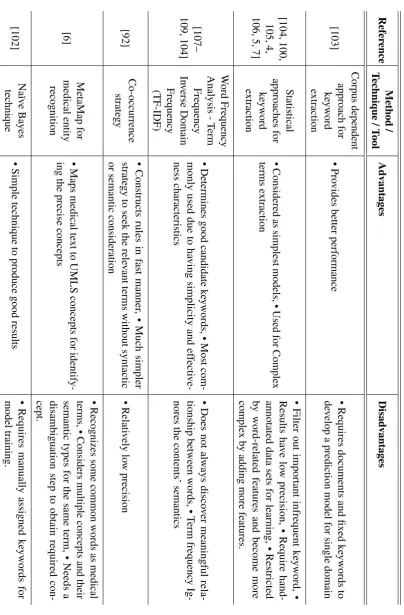
For knowledge construction, keyword extraction is a vital technique for textual data as well as information retrieval, automatic indexing, text summarization, text mining, text clustering, text categorization, topic detection, and question-answering [4, 98, 5]. Loh et al. [99] noted that concept extraction is a low cost process that helps to build a vocabulary for constructing/discovering domain knowledge. Haggag [4] described that both qualitative and quantitative techniques can be used for keywords extraction task. Qualitative techniques are considered reliable, while quantitative techniques are preferable due to handling multiple text processing tasks. According to Chen and Lin [100], machine learning approaches can be used for keyword extraction; however, as this approach is used in specific domains and for moving to other domains, re-learning is required to build that domain model. Zhu et al. [101] utilized supervised methods for extracting the term relations; however, they required human help to tag the data for learning an extractor. Wenchao et al. [102] presented a keyword extraction approach using a thesaurus; however, the man-made thesaurus are unable to follow the abrupt changes in textual information. In the literature various methodologies are used, which are represented in Figure 2.3.
Kuhn [8] described how controlled natural language (CNL) is similar to natural language and humans can easily understand it. CNL is a restricted language, which can be processed and interpreted by computers. This language preserves its essential properties, while restrict-ing its syntax, semantic, and lexicon [112]. CNL was proposed to build knowledge bases (ontologies). Multiple CNLs have been developed to build semantic web ontologies such as
Attempto Controlled English(ACE),Sydney OWL Syntax(SOS),Controlled Language for
Ontology Editing(CLOnE), and Rabbit. In the literature, various categories of controlled
natural languages are used, which are represented in Figure 2.4.
CNLs have been successfully used in various commercial applications such as machine translation, information management, mobile communication, and so on [113]. Shiffman et al. [114] translated a complete set of guideline recommendations into computer-interpretable statements using controlled natural language. Similarly, in GuideLines Into Decision Support (GLIDES) project, BRIDGE-Wiz used controlled natural language to formalize a process for writing implementable recommendations to improve guideline quality [115].
For computer processability, the CNL is written in formal logic. The basic purpose of defining CNL is to design computer-processable text for improving machine translation. Similarly, Safwat and Davis [116] noted that controlled natural languages (CNLs) facilitate non-expert users to develop ontologies of varying sizes in an easy-to-use manner. Williams et al. [117] described how CNLs are knowledge representation languages, which help non-expert users to translate their knowledge into a computer interpretable form without involvement of a knowledge engineer. Schwitter [118] worked on communication among humans with different native languages and used CNL to represent the formal notations. He concluded that CNL can improve human communication. In addition, Miyabe and Uozaki [113] described various features of CNL, namely that they:
• Enhance readability
• Are easy to understand
• Reduce misunderstanding
• Minimize the role of knowledge engineer
• Reduce the human translation cost, and
• Improve re-usability of knowledge
Kuhn [8] designed a CNL, calledAttempto Controlled English(ACE), which is considered one of the most mature CNLs. ACE was developed in early 1995 and has been under development for more than 20 years. This language is most widely used in the academic domain. Its vocabulary is not fixed and varies based on the particular problem domain. ACE also covers all four design principles, as compared to other CNLs, which do not satisfy all principles. In addition, it is acknowledged to be an unambiguous language. Similarly, Denaux [119] also described some features of the ACE language; he noted that ACE can be used for ontology construction without knowing the knowledge of web ontology language (OWL). It supports all kinds of ontology expressiveness. In addition, it is easy to use for all domain experts.
2.3 Overview of case-based learning 33
predictive editor and described how the predictive editor is showing the most promise to resolve the writability problem. Schwitter [122] also mentioned that a predictive interface of an editor can help to write correct CNL sentences for building a knowledge base [122].
For evaluating the CNLs, ontographs are considered a simple and powerful approach [123, 124]. Kuhn described how ontographs are intuitive, represent the logic forms in simple manner, and help to understand the core logic [123, 124].
2.3
Overview of case-based learning
This section demonstrates pedagogical concepts, methodologies applied incase-based learn-ing (CBL), and related web-based learning systems in medical education. It is further classified into: (1) a background subsection, which describes the basics of CBL with respect to background, features, its comparisons withproblem-based learning(PBL), and role of experiential knowledge in CBL; (2) an evolutionary technologies subsection, which explains that how IoT technology was used in the medical domain, and how CBL with flip envi-ronment was applied in medical education; and (3) a review subsection, which overviews the existing web-based learning systems, and compares these with well-established CBL systems.
2.3.1
Background for case-based learning
query or question that the learner then attempts to solve. The learner attempts to solve a specific problem while acquiring knowledge on how to solve similar problems.
CBL was introduced by pedagogy experts to improve knowledge exploration, empha-size critical thinking, achieve better collaboration, and increase opportunities for receiving feedback [126]. Research literature provides multiple features of CBL, such as: (i) it assists students to examine fact-based data, employ analytical tools, articulate their concerns, and draw conclusions for relating to new situations [127, 25], (ii) it offers an opportunity to realize theory in practice [25], and (iii) it develops students’ clinical skills in independent and group learning, as well as in communication and critical thinking, to acquire meaningful knowledge for improving students’ attitudes towards medical education [24–31]. Because of these features, there are several researchers who have applied CBL in medical education. Fish et al. [32] states Samford University received a grant to apply CBL in undergraduate education. CBL was integrated into the some of the nursing courses. This was successful and as a result CBL was implemented across the entire curriculum. CBL was effectively used in adult health, mental health, pediatric and obstetrical nursing courses. CBL was also used effectively in non-clinical courses such as pathophysiology, statistics and research. Moreover, students studying medicine at the University of Missouri who graduated from 1993 through to 1996 went through a traditional curriculum, whereas students graduating from 1996 through to 2006 went through a CBL curriculum [33]. As part of both curriculums students must pass a ’step 1’ test in their third year of study before progressing on to their fourth year. They must complete a ’step 2’ test in order to graduate. Since the introduction of the CBL curriculum, these scores have risen significantly and have remained significantly higher.
2.3 Overview of case-based learning 35
less time and are more efficient in providing large amounts of material compared to PBL. Moreover, Umbrin [130] differentiated PBL from CBL and defined the steps for learning in both PBL as well as CBL. In PBL, the steps are: Problem→Explore problem→ Self-learning →Group discussion, while in CBL, the steps are: Prior reading→ Problem→
Seeking out extra information → Interview with a knowledge expert. Furthermore, the researcher of [130] mentioned that in PBL, students improved their problem solving skills; while in CBL, students learned clinical skills. In addition, in PBL, the role of a facilitator is passive as opposed to CBL, where a facilitator’s role is active. Finally, the researcher of [130] concluded that CBL is a preferred methodology over PBL.
In specialized literature, medical education programs are considered to be complex due to their diverse interactions amongst participants and environments [18]. Discussion-based learning in a group, like CBL, is considered to be a complex system [44]. In small-groups, multiple medical students are interacting and exchanging information with each other, where each student is also a complex system [45]. In health care professional education, students have to tackle uncertain situations resulting from the accumulation of multiple problems [46]. In such situations, everyone has his/her own judgment, opinion, and feedback and will consider these integral as well as appropriate to the situation. Baillergeau and Duyvendak [46] relate this situation with bricolage, and investigated the ways to correlate the non-expert knowledge with other types of knowledge (expert knowledge). In such situations, experiential knowledge (EK) is considered a valuable resource [46, 131], which can facilitate and provide lived knowledge to students for enhancing individual’s participation and user empowerment [46].
EK either recalled from experiences, or learned, or acquired [132] is mostly utilized for problem solving. Teachers, general practitioners, and social workers are the leading experts that provide experiential knowledge. These experts provide competent interventions utilizing their practical knowledge that is built up using experiential or lay knowledge. Experiential knowledge can be domain-specific as well as holistic and is mostly described in the form of statements [132]. The idea of experiential expertise was introduced in early 1980s [133]. Willoughby [47] observed that the brain has remarkable capacity for accumulating infor-mation and facts. She mentioned that an older brain has accumulated and stored vastly more information than a younger brain. So an older person has a well of information and experience to draw on. Therefore, age and experience are advantages in fields like coaching, journalism, law, and management. According to Storkerson [132], “The termexperience
2.3 Overview of case-based learning 37
2.3.2
Evolutionary technologies for case-based learning
In this study, we have proposedIoT-based Flip Learning Platform(IoTFLiP) for medical education, especially, case-based learning; where IoT infrastructure is exploited to support flipped case-based learning in the cloud environment with state of the art security and privacy measures for potential personalized medical data. In order to propose the IoTFLiP, we conducted a literature review in IoT and flip learning research domains. This section covers (1) how IoT technology was used in the medical domain, and (2) how CBL with flip environment was applied in medical education.
IoT is no longer new to human and it has gained much attention in recent years [135]. According to the Gartner study1, 26 billion devices could be communicating with one another by 2020 with an estimated global economic value-add of $ 1.9 trillion. It has changed the concept of the virtual world for communication, information exchange, availability, and ease of use. The concepts of device-to-device connectivity is described by IoTivity. In healthcare, IoTivity has been exploited from wellness applications [136] for treatment and patient care, such as using sensors for monitoring and real-time status detection [137]. Apart from the wellness applications of IoT, it has been used for medical treatment, identification of diseases, complications, and prevention. IoTivity has been exploited to overcome the challenges of existing healthcare, hospital information and management systems [138, 139]. IoT offers great promise in healthcare fields especially in reducing the cost of care [140]. Due to its low cost and with reduced sensing device sizes, IoT can play an important role in boosting the learning capability of medical students by providing real-world CBL cases. In current practices, multiple IoT platforms exist with particular features. As health is the primary
1Gartner says the Internet of things installed base will grow to 26 billion units by 2020,
concern for society and has strong impact on all stakeholders, IoT in healthcare domains not only improves healthcare in society but is also beneficial for macroeconomic conditions2.
Aazam et al. [141] presented a resource management and pricing model for IoT through fog computing. The authors emphasized the usefulness and importance of customers’ history while determining the amount of resources required for each type of service. However, they did not discuss how their resource management can be mapped to flipped learning. This is also the case with another study the same authors presented in [142], where smart gateway architecture is discussed. The authors proposed that several type of services require smart and real-time decision making, which can be performed by a middleware gateway. Our proposed work integrates the features of [141, 142] and builds on those works, providing an architecture of how IoT resources and infrastructure can be used for medical education. In addition to that, various other platforms and systems have been applied to acquire real-time data through IoT devices such asMasimo Radical-7®,Freescale Home Health Hub reference
platform,Remote Patient Monitoring[140],IoT-enabled mobile e-learning platform[143],
Remote Monitoring and Management Platform of Healthcare Information(RMMP-HI) [144].
They have been proposed or implemented in specific domains for particular applications without flip learning, as well as CBL, for the purpose of medical education.
With the flipped learning environment, the effectiveness of CBL is surprisingly improved. The flipped classroom is a pedagogical framework in which the traditional lecture and assignment elements of a course are flipped or reversed [145]. Students can learn necessary knowledge before the class session, while in-class time is devoted to exercises and discussion by applying the knowledge. In comparing flip learning in CBL with traditional learning practices, Gilboy et al. [146] showed that students preferred flip learning over traditional pedagogical approaches. Similarly, according to Street et al. [147], “The flipped classroom could be a useful and successful educational approach in medical curricula". With the
2Transforming economic growth with the industrial Internet Of things,
2.3 Overview of case-based learning 39
technologies available today, students learn more through active interactions as compared to passively watching the teacher do everything. Lack of such features is one of the main motivations of our proposed flip-based learning for medical education.
2.3.3
Review of existing web-based learning systems
In order to support the learning outcomes of students, a plethora of web-based learning systems have been developed [53–62]. A review of the literature shows that learning systems,
Design A Case(DAC) [54] andExtension for Community Healthcare Outcomes(ECHO) [55]
are well established CBL projects. The ECHO platform was developed for case-based learning in which primary and specialty care providers work together to provide care for patients using video conferencing and sharing electronic records. Similarly, the DAC provided an online educational tool, which is designed to supplement traditional teaching and allows for the development of health related virtual cases for medical students. Both ECHO and DAC projects support postgraduate medical students; however, they do not provide domain knowledge support for CBL practice, while ECHO does not support interactive case authoring and formulation.
Ali et al. [53] developed an online CBL tool, calledinteractive case-based flip learning tool(ICBFLT), which formulates the CBL case summaries (e.g., further history, examination, and investigations) of virtual patient through intervention of student as well as medical experts’ knowledge. This tool also provides learning services to medical students before attending an actual class. Boubouka [61] designed a case-based learning environment, called
CASes for Teaching and LEarning(CASTLE) for supporting teaching as well as learning
predefined case-based tutorials to provide clinical exposure to medical students without the support of acquiring real-world patient cases and without providing feedback to students.
Cheng et al. [57] adopted a web-based prototype system calledHealth Information
Net-work Teaching-case System(HINTS) in practical training of medical students for clinical
medicine. They also explained the development mechanism of teaching cases but with no support of providing feedback to students. Shyu et al. [56] established a platform, called
Vir-tual Medical School(VMS) for problem-based learning. They utilized their online authoring
tools to capture the patient cases from theHospital Information Systemdatabase. Suebnukarn and Haddawy [59] developed a problem-based learning system, calledCollaborative Medical
Tutor(COMET) for medical students to provide intelligent tutoring during problem solving
tasks. The COMET generates tutorial hints to guide medical students in problem solving. Both VMS and COMET have been used for problem-based learning; however, they lacked tutor feedback and domain knowledge support. Sharples et al. [60] described a case-based training system calledMR Tutor for learning purposes. This system provided computer-assisted training in radiology; it also provided feedback to users without considering tutors’ feedback for solved clinical cases. Chen et al. [62] developed a web-based learning system that followed the development of real clinical situations; however their system also lacked the support of feedback and domain knowledge.
2.4
Summary of literature
2.4.1
Feature selection literature
2.4 Summary of literature 41
opposed to an automatic FS, which has become necessary for the fast paced digital world of today [13].
Feature selection approaches are generally split into three categories: filters, wrappers, and hybrid, where each approach has capabilities and limitations [12–14]. The filter ap-proach [15, 12]: (i) is generally much faster and have less computational cost than the wrapper approach, (ii) is better suited to high dimensional datasets, and (iii) provides better generalization. Both evaluate feature relevance without using any learning algorithm [65, 12]. The feature selection task requires two basic steps, ranking and filtering. Here the former step requires ranking of all features, while the later involves filtering out of irrelevant features based on some threshold value.
The ranking approach is considered an attractive approach due to its simplicity, scalability, and good empirical success [3, 87]; however, each feature ranking method has its own statistical biases and reveals different relative scales. For example,information gain(IG) is biased towards choosing features with a large number of values [77]. Similarly,chi square
cut-off value to select important features from different datasets is problematic [79]. With respect to identifying an appropriate cut-off value for the threshold, some studies have been performed [2, 80, 77, 70, 79], which are either wrapper-based to determine the threshold value or domain expert needed to make an educated guess regarding the final subset; or a starting value is required to initiate the process or a fixed threshold value is defined; or a separated validation set and artificially generated features approaches are required, or it is not clear how to find the threshold value.
Taking into consideration the aforementioned discussion, a significant amount of re-search [72, 83, 71, 73, 69, 70, 2, 77, 80, 75] has focused on proposing improved feature selection methodologies; however, not so much consideration is given to how to select fea-tures from a given feature set in a comprehensive manner. The availability of a comprehensive feature ranking and filtering approach, which alleviates existing limitations and provides an efficient mechanism for achieving optimal results, is a major problem. State-of-the-art feature selection methodologies have either used relatively more expensive techniques to select the features or required an educated guess to specify a minimum threshold value for retaining important features.
2.4.2
Domain knowledge construction literature
2.4 Summary of literature 43
combines the concepts to make an affirmation of something. For example, “Blood_disease" and “is a symptom" make an affirmation “Blood_disease is a symptom". The produced affirmation is either true or false; however, in declarative knowledge it is always true. Han-dling unstructured content is the foundation to construct the domain knowledge (structured declarative knowledge) required for interactive learning to prepare medical students for their clinical practice before and outside the class. One way to represent declarative knowledge is ontology, which has been considered as a common way to represent a real-world machine interpretable knowledge and is not constructed systematically [151].
According to Abacha and Zweigenbaum [6], “the medical knowledge is growing sig-nificantly every year. According to some studies, the volume of this knowledge doubles every five years, or even every two years". Since most of the information available in digital format is unstructured [92] the information extraction problem has attracted wide interest in several research communities [93]. Text mining (TM) is a multidisciplinary research area, which derives high-quality information from textual data. TM involves the application of techniques from areas such as information retrieval, natural language processing, information extraction, and data mining [64]. In text mining domain, normally text preprocessing, text transformation, feature selection, term extraction, relation extraction, and model construction tasks are involved to construct domain knowledge from textual data. For reliable knowledge construction, keywords as well as their relations are the key elements for knowledge repre-sentation, which are mostly extracted from given data using machine learning approaches and a thesaurus [100–102].
ambigu-ity [94, 97]. We have responded to these deficiencies by including a methodology to construct the domain knowledge (i.e. structured declarative knowledge) from unstructured text. For effective transformation, controlled natural language is used, which constructs syntactically correct and unambiguous computer-processable texts [8].
![Table 2.1 Feature selection approaches [12, 1, 13–16].](https://thumb-us.123doks.com/thumbv2/123dok_us/8400243.325490/49.595.88.523.129.403/table-feature-selection-approaches.webp)
![Fig. 2.3 Keyword extraction methodologies [4–7]](https://thumb-us.123doks.com/thumbv2/123dok_us/8400243.325490/57.595.213.378.116.745/fig-keyword-extraction-methodologies.webp)
![Fig. 2.4 Controlled natural languages categories [8]](https://thumb-us.123doks.com/thumbv2/123dok_us/8400243.325490/61.595.206.372.116.726/fig-controlled-natural-languages-categories.webp)